

- Industry Size (2026)
- USD 617.8 Mn
- Forecast (2036)
- USD 2392.8 Mn
- CAGR (2026 to 2036)
- 14.5%
Digital Microsurgery Market Forecast and Outlook 2026 to 2036
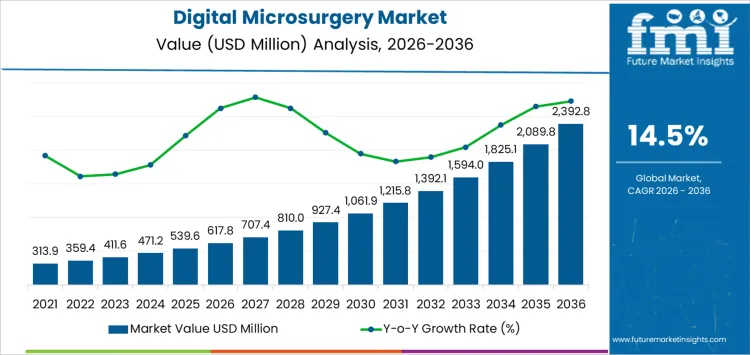
The digital microsurgery market is expected to grow from USD 617.8 million in 2026 to USD 2,392.8 million by 2036, reflecting a compound annual growth rate (CAGR) of 14.5%. Digital microsurgery involves the use of advanced technologies such as robotics, augmented reality (AR), and artificial intelligence (AI) to enhance the precision and efficiency of microsurgical procedures. The market is driven by the growing adoption of minimally invasive surgeries, technological advancements in surgical equipment, and the increasing demand for improved outcomes and faster recovery times. Surgeons use digital tools for better visualization, enhanced precision, and real-time monitoring during complex procedures, which is transforming the field of microsurgery.
The market's growth is further supported by the rising prevalence of conditions that require microsurgery, such as cancer, neurological disorders, and traumatic injuries. Additionally, the increasing availability of training and simulation tools for digital microsurgery is expanding its application in both clinical settings and education, further driving the adoption of these technologies across the globe.
Quick Stats of the Digital Microsurgery Market
- Digital Microsurgery Market Value (2026): USD 617.8 million
- Digital Microsurgery Market Forecast Value (2036): USD 2,392.8 million
- Digital Microsurgery Market Global Forecast CAGR (2026-2036): 14.5%
- Digital Microsurgery Market Leading Segment: End User (Hospitals) 62%
- Key Growth Regions in Digital Microsurgery Market: China
- Top Players in Digital Microsurgery Market: Carl Zeiss Meditec, Leica Microsystems, Olympus, Topcon, Nikon, Stryker, KARL STORZ, Sony (medical imaging), Medtronic, Haag-Streit
What is the Growth Forecast for the Digital Microsurgery Market through 2036?
The compound annual growth rate (CAGR) for the digital microsurgery market shows robust growth over the forecast period, with a noticeable acceleration as the technology becomes more widely adopted. Starting at USD 617.8 million in 2026, the market grows to USD 706.7 million in 2027 and USD 808.2 million in 2028. These early years reflect steady adoption as healthcare providers begin to recognize the advantages of digital tools in enhancing surgical precision and outcomes.
From 2028 to 2030, the market experiences increased adoption, reaching USD 923.1 million in 2029 and USD 1,052.4 million in 2030. This period reflects a phase of significant acceleration driven by continued technological advancements and the growing recognition of the benefits digital microsurgery offers. The market’s momentum continues from 2030 to 2035, reaching USD 1,196.2 million in 2031, USD 1,357 million in 2032, and USD 1,535 million in 2033. By 2035, the market is projected to reach USD 1,732.9 million, with the final projected value of USD 2,392.8 million expected in 2036. This growth trajectory indicates the increasing reliance on digital technologies in surgery and the market's continued expansion driven by better clinical outcomes, increased surgical precision, and enhanced recovery times.
Digital Microsurgery Market Key Takeaways
| Metric | Value |
|---|---|
| Industry Sales Value (2026) | USD 617.8 million |
| Industry Forecast Value (2036) | USD 2,392.8 million |
| Industry Forecast CAGR (2026-2036) | 14.5% |
What Is Driving the Demand for the Digital Microsurgery Market Globally?
The global demand for digital microsurgery systems is driven by the increasing adoption of advanced surgical technologies that enhance precision, visualization, and decision support in complex procedures. Digital microsurgery integrates high-definition imaging, 3D visualization, digital overlays, and sometimes robotic assistance to support low-impact interventions in neurosurgery, ophthalmology, ENT, plastic surgery, and orthopaedics.
Growing incidence of chronic and age-related conditions requiring fine surgical work, such as retinal disorders, cerebral aneurysms, and intricate reconstructive surgeries, is expanding the use of these systems. Traditional optical microscopes provide limited depth perception and reliance on physical eyepiece alignment, while digital platforms offer superior resolution, ergonomic viewing, and augmented imaging that aids surgeon focus and reduces fatigue. Investment in minimally invasive procedures that shorten recovery times and improve outcomes has encouraged hospitals and surgical centres to adopt digital microscopes, especially in advanced healthcare markets.
Demand is also shaped by integration with intraoperative navigation, surgical planning tools, and real-time analytics, enabling multidisciplinary teams to coordinate decisions more effectively. Furthermore, increasing training and familiarity with digital technologies among surgeons is reducing barriers to adoption. As healthcare facilities modernise operating rooms and prioritise technologies that improve safety and efficiency, digital microsurgery systems are becoming more central to surgical practice worldwide.
Future demand for the digital microsurgery market is expected to grow as technological innovation and clinical evidence expand the scope of applications. Advances in real-time imaging, augmented reality overlays, and AI-assisted guidance will further enhance tissue differentiation, margin assessment, and intraoperative decision-making, making digital platforms more valuable for complex interventions. As remote collaboration and training tools become more sophisticated, surgeons in geographically dispersed regions may adopt digital microsurgery systems to support tele-mentoring and knowledge exchange.
Expansion of healthcare infrastructure in emerging markets will increase access to advanced surgical technologies, particularly where investments in modern operating suites are underway. Regulatory clarity around software-driven surgical tools and reimbursement models that recognise the value of improved outcomes will also influence adoption pace.
Additionally, integration with hospital information systems and surgical robotics ecosystems will broaden usability, enabling workflow coordination from planning through postoperative care. As evidence continues to demonstrate reductions in operative time, improved accuracy, and lower complication rates, healthcare providers are likely to prioritise digital microsurgery systems in capital planning. Overall, an emphasis on precision, safety, and surgical innovation supports steady global growth in the digital microsurgery market.
What is the Segment Analysis for the Digital Microsurgery Market?
The digital microsurgery market is driven by two major factors: platform types and specialties, each contributing significantly to its overall growth. Among the platform types, digital surgical microscopes hold the largest share at 46%, followed by exoscope systems and microscope-to-digital upgrade kits. These platforms are crucial in enhancing precision during microsurgical procedures. The market is also divided into various specialties, including neurosurgery, ENT & head/neck, plastics/reconstructive & hand, and ophthalmic & other areas.
Neurosurgery is the leading specialty, accounting for 34% of the market. Other specialties, like ENT & head/neck and plastics/reconstructive & hand, also play an important role in driving the adoption of digital microsurgery technologies. Regional demand, particularly in North America and Europe, further influences the growth of these segments. The demand for advanced surgical systems in these regions, alongside innovations in digital surgical technologies, contributes to the market’s expanding applications across a variety of medical fields.
What is Driving Growth in the Digital Surgical Microscopes Segment of the Digital Microsurgery Market?
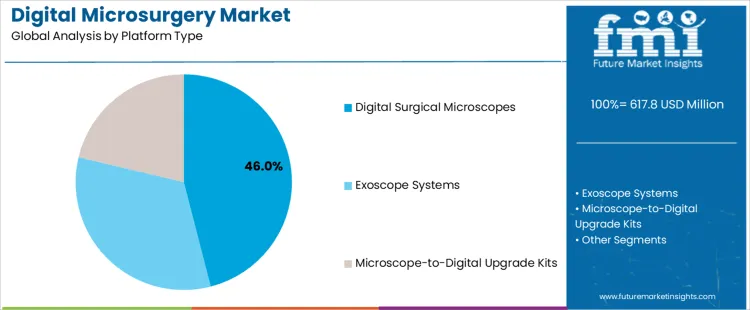
Digital surgical microscopes represent the largest platform type in the digital microsurgery market, holding 46% of the market share. These advanced microscopes provide high-definition imaging, enhanced visualization, and real-time image processing, allowing surgeons to perform intricate procedures with greater accuracy. The demand for digital surgical microscopes is growing as surgical techniques become increasingly complex and require precise imaging capabilities. These systems are particularly valuable in disciplines like neurosurgery, ophthalmic surgery, and reconstructive surgery, where fine detail is critical.
The integration of digital technologies in microscopes has greatly improved the quality of surgical outcomes by offering surgeons superior clarity and enhanced depth perception during operations. The ongoing development of digital surgical microscopes with more user-friendly features and superior functionality is driving their adoption in both established and emerging medical practices. As healthcare facilities continue to invest in state-of-the-art equipment to improve patient outcomes and operational efficiency, the digital surgical microscope segment is expected to maintain its leading role in the market, further propelled by innovations in imaging technologies and software.
What is Contributing to the Growth of the Neurosurgery Segment in the Digital Microsurgery Market?
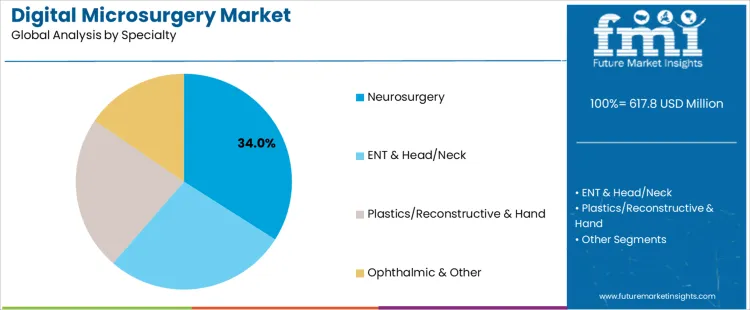
The neurosurgery segment is the largest specialty in the digital microsurgery market, accounting for 34% of the market share. The growing prevalence of neurological disorders, along with advancements in surgical techniques, has significantly boosted the demand for digital microsurgery tools in neurosurgical procedures. Neurosurgeons rely on high-precision equipment to perform delicate surgeries on the brain, spine, and nervous system, where even minor errors can lead to serious complications. The integration of digital surgical microscopes and exoscope systems into neurosurgery has revolutionized the field by enhancing visualization and enabling more accurate, less invasive procedures.
These systems provide surgeons with real-time, high-definition imaging, improving their ability to identify critical structures during surgery. The demand for digital microsurgery in neurosurgery is further driven by the increasing focus on minimally invasive techniques, which aim to reduce recovery times and improve patient outcomes. As the need for advanced microsurgical equipment in neurosurgery grows, the adoption of digital technologies is expected to rise, ensuring the continued dominance of this specialty in the digital microsurgery market.
What are the Key Dynamics of the Global Digital Microsurgery Market?
The global digital microsurgery market is growing as surgeons and healthcare facilities adopt advanced visualization, imaging, and navigation technologies to improve precision in minimally invasive procedures. Digital systems support high-resolution displays, real-time feedback, ergonomic assistance and enhanced depth perception that help clinicians perform delicate operations across specialties such as neurosurgery, ophthalmology, ENT and reconstructive surgery. Growth reflects rising demand for better surgical outcomes, investment in next-generation operating room technology, and broader access to digital tools in hospital and outpatient settings across the United States and other regions.
What are the Key Drivers for the Global Digital Microsurgery Market?
A key driver is the increasing preference for minimally invasive surgical procedures that rely on enhanced visualization and accuracy. Digital microsurgery tools support surgeons with high-definition imaging, 3D visualization and augmented assistance, which help reduce procedure time and improve patient outcomes. Advances in digital display systems, robotic integration and surgical navigation enhance clinical confidence and case complexity handling. Hospital systems and specialty clinics are investing in digital operating room upgrades that include microscopes, displays, and imaging platforms. Rising surgical volumes, demand for precision medicine and surgeon preference for technology-enabled tools further support market expansion.
What are the Restraints for the Global Digital Microsurgery Market?
One restraint is the high cost of acquiring and integrating digital microsurgery equipment, which may limit adoption among smaller hospitals or clinics with budget constraints. Training surgical teams to use advanced systems takes time and requires resources that some providers find challenging to allocate. Compatibility with existing operating room infrastructure may require additional investment, slowing implementation. Reimbursement policies and varying levels of coverage for technologically advanced surgical procedures can influence purchasing decisions. Some clinicians may remain cautious about transitioning from traditional microscopes until clear clinical benefit is demonstrated in specific procedures.
What is the Key Trends in the Global Digital Microsurgery Market?
A key trend is integration of artificial intelligence and machine learning into digital microsurgical platforms to assist with image enhancement, automated tracking and procedural guidance. Developers are focusing on tools that improve depth perception, reduce visual fatigue and support surgeon decision-making with real-time analytics. Cloud-enabled surgical data systems and collaborative platforms are gaining traction, allowing distributed surgical teams to share insights and outcomes. There is growing adoption of augmented reality overlays that help visualize anatomy and planned resections during live procedures. Partnerships between technology vendors and clinical institutions are increasing to validate performance and expand training programs that accelerate surgeon confidence and system utilization.
What are the Key Insights from the Digital Microsurgery Market Analysis?
The digital microsurgery market is poised for significant growth across various regions, with differing compound annual growth rates (CAGRs) reflecting the specific demand and adoption rates in each country. The projected growth is driven by increasing advancements in surgical technology, rising demand for precision surgeries, and the broadening applications of digital microsurgery in medical procedures. The market is being shaped by factors such as the rise in chronic diseases, a growing aging population, and advancements in healthcare infrastructure. By analyzing the regional growth trends, businesses can strategically plan their market entry and expansion to capitalize on high-growth areas.
| Country | CAGR (2026-2036) |
|---|---|
| China | 16% |
| United States | 14% |
| United Kingdom | 14% |
| Germany | 13.9% |
| Japan | 12.5% |
What is the Growth Outlook for the Digital Microsurgery Market in China?
The digital microsurgery market in China is expected to grow at the highest rate, with a CAGR of 16%. This rapid growth can be attributed to the country’s strong investment in healthcare and medical technologies, as well as its rising healthcare needs. China’s expanding medical infrastructure and increasing demand for precision surgeries make it an ideal market for digital microsurgery innovations. The country’s large population, coupled with rising healthcare awareness, is driving the adoption of advanced surgical techniques. Furthermore, government policies promoting healthcare modernization and technological advancement are expected to contribute significantly to the market’s growth. As a result, China is set to remain one of the fastest-growing markets for digital microsurgery.
What is the Market Outlook for the Digital Microsurgery Market in the United States?
The digital microsurgery market in the United States is projected to grow at a steady pace, with a CAGR of 14%. The USA market benefits from the country’s advanced healthcare infrastructure, high demand for precision and minimally invasive surgical techniques, and continuous innovations in surgical technologies. The strong presence of leading medical device companies and research institutions fosters the development and adoption of digital microsurgery technologies. Furthermore, the USA healthcare system is highly receptive to new medical technologies, providing a favorable environment for market growth. With increasing focus on improving patient outcomes and reducing surgical risks, the USA is expected to remain a key market for digital microsurgery.
How is the Digital Microsurgery Market Performing in the United Kingdom?
The digital microsurgery market in the United Kingdom is also forecasted to grow at a CAGR of 14%. The UK’s highly advanced healthcare system and strong emphasis on adopting innovative medical technologies provide a conducive environment for digital microsurgery adoption. Increasing prevalence of complex medical conditions, such as cardiovascular diseases and neurological disorders, drives the demand for digital microsurgery procedures. The country’s government and healthcare organizations are focused on improving surgical precision and outcomes, further supporting the market’s expansion. Additionally, research and development initiatives in medical technologies in the UK contribute to the growth of digital microsurgery, positioning it as a growing market in the European region.
What is the Market Outlook for the Digital Microsurgery Market in Germany?
The digital microsurgery market in Germany is expected to grow steadily, with a CAGR of 13.9%. Germany’s reputation for medical innovation and its strong healthcare infrastructure make it a key player in the global digital microsurgery market. The country’s increasing demand for minimally invasive surgeries, coupled with advancements in digital technologies, is driving market growth. Germany’s healthcare system, which is among the most sophisticated in the world, ensures the widespread adoption of cutting-edge surgical technologies. As a leading European market, Germany is expected to see consistent growth in the digital microsurgery market, supported by high-quality medical research and innovation.
What are the Growth Prospects for the Digital Microsurgery Market in Japan?
The digital microsurgery market in Japan is forecasted to grow at a CAGR of 12.5%. Japan’s aging population and high incidence of chronic diseases contribute to the growing demand for precision surgery technologies. The country’s strong healthcare system and focus on technological advancements support the adoption of digital microsurgery. Japan’s medical community is increasingly embracing minimally invasive techniques that promise improved patient outcomes and reduced recovery times. As Japan continues to invest in healthcare innovation and digital technologies, the market for digital microsurgery is expected to see moderate yet steady growth. The country’s healthcare infrastructure, along with its aging demographic, positions it as a key market for the adoption of these advanced surgical techniques.
What is the Competitive Landscape for the Digital Microsurgery Market?
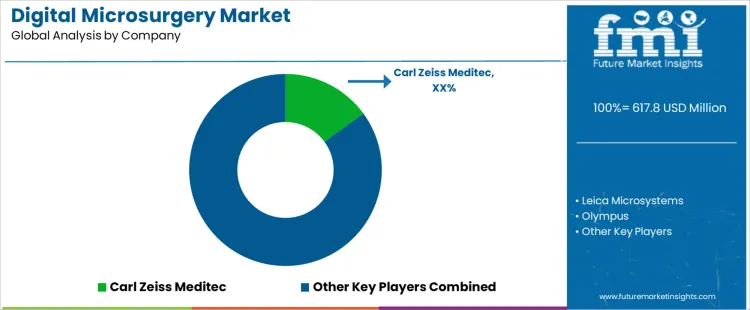
The digital microsurgery market is growing as medical imaging technology continues to advance, enabling more precise surgical procedures. Carl Zeiss Meditec leads the market with its cutting-edge digital microscopes, offering high-resolution imaging systems designed for microsurgery. Their focus on providing detailed, real-time imaging to enhance surgical precision positions them as the leader in this field. Leica Microsystems, Olympus, and Topcon are also key competitors, each offering digital microscopes with integrated imaging technologies. Leica Microsystems is known for its high-performance optical solutions, while Olympus and Topcon provide advanced visualization systems that assist surgeons in performing complex microsurgical procedures.
Nikon, Stryker, KARL STORZ, Sony (medical imaging), Medtronic, and Haag-Streit add further competition with their innovative digital microsurgery tools. Nikon integrates high-quality imaging systems for a range of surgical specialties, while Stryker focuses on advanced digital visualization systems for surgical environments. KARL STORZ offers state-of-the-art medical imaging systems, enhancing the precision of microsurgical procedures. Sony and Medtronic bring advanced imaging and digital technologies to microsurgery, with Sony specializing in high-definition cameras and Medtronic in integrated surgical solutions. Haag-Streit provides digital solutions aimed at improving surgical outcomes through enhanced visualization. These companies compete on technological innovation, product quality, and the ability to improve surgical precision, driving advancements in the digital microsurgery market.
Key Players of the Digital Microsurgery Market
- Carl Zeiss Meditec
- Leica Microsystems
- Olympus
- Topcon
- Nikon
- Stryker
- KARL STORZ
- Sony (medical imaging)
- Medtronic
- Haag-Streit
Scope of the Report
| Items | Values |
|---|---|
| Quantitative Units (2026) | USD Million |
| Platform Type | Digital Surgical Microscopes, Exoscope Systems, Microscope-to-Digital Upgrade Kits |
| Specialty | Neurosurgery, ENT & Head/Neck, Plastics/Reconstructive & Hand, Ophthalmic & Other |
| Visualization | 4K/3D Systems, HD/2D Digital Systems, AI-Assisted Visualization Add-ons |
| End User | Hospitals, Ambulatory Surgery Centers, Academic/Training Centers, Other Users |
| Companies | Carl Zeiss Meditec, Leica Microsystems, Olympus, Topcon, Nikon, Stryker, KARL STORZ, Sony (medical imaging), Medtronic, Haag-Streit |
| Regions Covered | North America, Latin America, Western Europe, Eastern Europe, South Asia and Pacific, East Asia, Middle East & Africa |
| Countries Covered | United States, Canada, Mexico, Brazil, Argentina, Germany, France, United Kingdom, Italy, Spain, Netherlands, China, India, Japan, South Korea, ANZ, GCC Countries, South Africa |
| Additional Attributes | Dollar by sales by platform type, specialty, visualization, end-user, and region. Includes market trends in digital microsurgery, focusing on digital surgical microscopes, exoscope systems, and the use of 4K/3D systems, HD/2D digital systems, and AI-assisted visualization. Highlights key applications in neurosurgery, ENT & head/neck surgery, plastics/reconstructive & hand surgery, and ophthalmic procedures. Focus on cost-effectiveness, regulatory compliance, market share, and competitive positioning of key companies. |
Digital Microsurgery Market Segmentation
Platform Type
- Digital Surgical Microscopes
- Exoscope Systems
- Microscope-to-Digital Upgrade Kits
Specialty
- Neurosurgery
- ENT & Head/Neck
- Plastics/Reconstructive & Hand
- Ophthalmic & Other
Visualization
- 4K/3D Systems
- HD/2D Digital Systems
- AI-Assisted Visualization Add-ons
End User
- Hospitals
- Ambulatory Surgery Centers
- Academic/Training Centers
- Other Users
Region
- Asia Pacific
- China
- Japan
- South Korea
- India
- Australia & New Zealand
- ASEAN
- Rest of Asia Pacific
- Europe
- Germany
- United Kingdom
- France
- Italy
- Spain
- Nordic
- BENELUX
- Rest of Europe
- North America
- United States
- Canada
- Mexico
- Latin America
- Brazil
- Chile
- Rest of Latin America
- Middle East & Africa
- Kingdom of Saudi Arabia
- Other GCC Countries
- Turkey
- South Africa
- Other African Union
- Rest of Middle East & Africa
Frequently Asked Questions
How big is the digital microsurgery market in 2026?
The global digital microsurgery market is estimated to be valued at USD 617.8 million in 2026.
What will be the size of digital microsurgery market in 2036?
The market size for the digital microsurgery market is projected to reach USD 2,392.8 million by 2036.
How much will be the digital microsurgery market growth between 2026 and 2036?
The digital microsurgery market is expected to grow at a 14.5% CAGR between 2026 and 2036.
What are the key product types in the digital microsurgery market?
The key product types in digital microsurgery market are digital surgical microscopes, exoscope systems and microscope-to-digital upgrade kits.
Which specialty segment to contribute significant share in the digital microsurgery market in 2026?
In terms of specialty, neurosurgery segment to command 34.0% share in the digital microsurgery market in 2026.
Preview the report firsthand - request a free sample
Get SampleGet the brochure for pricing and purchase details.
Get PDFTable of Content
- Executive Summary
- Global Market Outlook
- Demand-side Trends
- Supply-side Trends
- Technology Roadmap Analysis
- Analysis and Recommendations
- Market Overview
- Market Coverage / Taxonomy
- Market Definition / Scope / Limitations
- Market Background
- Market Dynamics
- Drivers
- Restraints
- Opportunity
- Trends
- Scenario Forecast
- Demand in Optimistic Scenario
- Demand in Likely Scenario
- Demand in Conservative Scenario
- Opportunity Map Analysis
- Product Life Cycle Analysis
- Supply Chain Analysis
- Investment Feasibility Matrix
- Value Chain Analysis
- PESTLE and Porter’s Analysis
- Regulatory Landscape
- Regional Parent Market Outlook
- Production and Consumption Statistics
- Import and Export Statistics
- Market Dynamics
- Global Market Analysis 2021 to 2025 and Forecast, 2026 to 2036
- Historical Market Size Value (USD Million) Analysis, 2021 to 2025
- Current and Future Market Size Value (USD Million) Projections, 2026 to 2036
- Y-o-Y Growth Trend Analysis
- Absolute $ Opportunity Analysis
- Global Market Pricing Analysis 2021 to 2025 and Forecast 2026 to 2036
- Global Market Analysis 2021 to 2025 and Forecast 2026 to 2036, By Platform Type
- Introduction / Key Findings
- Historical Market Size Value (USD Million) Analysis By Platform Type , 2021 to 2025
- Current and Future Market Size Value (USD Million) Analysis and Forecast By Platform Type , 2026 to 2036
- Digital Surgical Microscopes
- Exoscope Systems
- Microscope-to-Digital Upgrade Kits
- Y-o-Y Growth Trend Analysis By Platform Type , 2021 to 2025
- Absolute $ Opportunity Analysis By Platform Type , 2026 to 2036
- Global Market Analysis 2021 to 2025 and Forecast 2026 to 2036, By Specialty
- Introduction / Key Findings
- Historical Market Size Value (USD Million) Analysis By Specialty, 2021 to 2025
- Current and Future Market Size Value (USD Million) Analysis and Forecast By Specialty, 2026 to 2036
- Neurosurgery
- ENT & Head/Neck
- Plastics/Reconstructive & Hand
- Ophthalmic & Other
- Y-o-Y Growth Trend Analysis By Specialty, 2021 to 2025
- Absolute $ Opportunity Analysis By Specialty, 2026 to 2036
- Global Market Analysis 2021 to 2025 and Forecast 2026 to 2036, By Visualization
- Introduction / Key Findings
- Historical Market Size Value (USD Million) Analysis By Visualization, 2021 to 2025
- Current and Future Market Size Value (USD Million) Analysis and Forecast By Visualization, 2026 to 2036
- 4K/3D Systems
- HD/2D Digital Systems
- AI-Assisted Visualization Add-ons
- Y-o-Y Growth Trend Analysis By Visualization, 2021 to 2025
- Absolute $ Opportunity Analysis By Visualization, 2026 to 2036
- Global Market Analysis 2021 to 2025 and Forecast 2026 to 2036, By End User
- Introduction / Key Findings
- Historical Market Size Value (USD Million) Analysis By End User, 2021 to 2025
- Current and Future Market Size Value (USD Million) Analysis and Forecast By End User, 2026 to 2036
- Hospitals
- Ambulatory Surgery Centers
- Academic/Training Centers
- Other Users
- Y-o-Y Growth Trend Analysis By End User, 2021 to 2025
- Absolute $ Opportunity Analysis By End User, 2026 to 2036
- Global Market Analysis 2021 to 2025 and Forecast 2026 to 2036, By Region
- Introduction
- Historical Market Size Value (USD Million) Analysis By Region, 2021 to 2025
- Current Market Size Value (USD Million) Analysis and Forecast By Region, 2026 to 2036
- North America
- Latin America
- Western Europe
- Eastern Europe
- East Asia
- South Asia and Pacific
- Middle East & Africa
- Market Attractiveness Analysis By Region
- North America Market Analysis 2021 to 2025 and Forecast 2026 to 2036, By Country
- Historical Market Size Value (USD Million) Trend Analysis By Market Taxonomy, 2021 to 2025
- Market Size Value (USD Million) Forecast By Market Taxonomy, 2026 to 2036
- By Country
- USA
- Canada
- Mexico
- By Platform Type
- By Specialty
- By Visualization
- By End User
- By Country
- Market Attractiveness Analysis
- By Country
- By Platform Type
- By Specialty
- By Visualization
- By End User
- Key Takeaways
- Latin America Market Analysis 2021 to 2025 and Forecast 2026 to 2036, By Country
- Historical Market Size Value (USD Million) Trend Analysis By Market Taxonomy, 2021 to 2025
- Market Size Value (USD Million) Forecast By Market Taxonomy, 2026 to 2036
- By Country
- Brazil
- Chile
- Rest of Latin America
- By Platform Type
- By Specialty
- By Visualization
- By End User
- By Country
- Market Attractiveness Analysis
- By Country
- By Platform Type
- By Specialty
- By Visualization
- By End User
- Key Takeaways
- Western Europe Market Analysis 2021 to 2025 and Forecast 2026 to 2036, By Country
- Historical Market Size Value (USD Million) Trend Analysis By Market Taxonomy, 2021 to 2025
- Market Size Value (USD Million) Forecast By Market Taxonomy, 2026 to 2036
- By Country
- Germany
- UK
- Italy
- Spain
- France
- Nordic
- BENELUX
- Rest of Western Europe
- By Platform Type
- By Specialty
- By Visualization
- By End User
- By Country
- Market Attractiveness Analysis
- By Country
- By Platform Type
- By Specialty
- By Visualization
- By End User
- Key Takeaways
- Eastern Europe Market Analysis 2021 to 2025 and Forecast 2026 to 2036, By Country
- Historical Market Size Value (USD Million) Trend Analysis By Market Taxonomy, 2021 to 2025
- Market Size Value (USD Million) Forecast By Market Taxonomy, 2026 to 2036
- By Country
- Russia
- Poland
- Hungary
- Balkan & Baltic
- Rest of Eastern Europe
- By Platform Type
- By Specialty
- By Visualization
- By End User
- By Country
- Market Attractiveness Analysis
- By Country
- By Platform Type
- By Specialty
- By Visualization
- By End User
- Key Takeaways
- East Asia Market Analysis 2021 to 2025 and Forecast 2026 to 2036, By Country
- Historical Market Size Value (USD Million) Trend Analysis By Market Taxonomy, 2021 to 2025
- Market Size Value (USD Million) Forecast By Market Taxonomy, 2026 to 2036
- By Country
- China
- Japan
- South Korea
- By Platform Type
- By Specialty
- By Visualization
- By End User
- By Country
- Market Attractiveness Analysis
- By Country
- By Platform Type
- By Specialty
- By Visualization
- By End User
- Key Takeaways
- South Asia and Pacific Market Analysis 2021 to 2025 and Forecast 2026 to 2036, By Country
- Historical Market Size Value (USD Million) Trend Analysis By Market Taxonomy, 2021 to 2025
- Market Size Value (USD Million) Forecast By Market Taxonomy, 2026 to 2036
- By Country
- India
- ASEAN
- Australia & New Zealand
- Rest of South Asia and Pacific
- By Platform Type
- By Specialty
- By Visualization
- By End User
- By Country
- Market Attractiveness Analysis
- By Country
- By Platform Type
- By Specialty
- By Visualization
- By End User
- Key Takeaways
- Middle East & Africa Market Analysis 2021 to 2025 and Forecast 2026 to 2036, By Country
- Historical Market Size Value (USD Million) Trend Analysis By Market Taxonomy, 2021 to 2025
- Market Size Value (USD Million) Forecast By Market Taxonomy, 2026 to 2036
- By Country
- Kingdom of Saudi Arabia
- Other GCC Countries
- Turkiye
- South Africa
- Other African Union
- Rest of Middle East & Africa
- By Platform Type
- By Specialty
- By Visualization
- By End User
- By Country
- Market Attractiveness Analysis
- By Country
- By Platform Type
- By Specialty
- By Visualization
- By End User
- Key Takeaways
- Key Countries Market Analysis
- USA
- Pricing Analysis
- Market Share Analysis, 2025
- By Platform Type
- By Specialty
- By Visualization
- By End User
- Canada
- Pricing Analysis
- Market Share Analysis, 2025
- By Platform Type
- By Specialty
- By Visualization
- By End User
- Mexico
- Pricing Analysis
- Market Share Analysis, 2025
- By Platform Type
- By Specialty
- By Visualization
- By End User
- Brazil
- Pricing Analysis
- Market Share Analysis, 2025
- By Platform Type
- By Specialty
- By Visualization
- By End User
- Chile
- Pricing Analysis
- Market Share Analysis, 2025
- By Platform Type
- By Specialty
- By Visualization
- By End User
- Germany
- Pricing Analysis
- Market Share Analysis, 2025
- By Platform Type
- By Specialty
- By Visualization
- By End User
- UK
- Pricing Analysis
- Market Share Analysis, 2025
- By Platform Type
- By Specialty
- By Visualization
- By End User
- Italy
- Pricing Analysis
- Market Share Analysis, 2025
- By Platform Type
- By Specialty
- By Visualization
- By End User
- Spain
- Pricing Analysis
- Market Share Analysis, 2025
- By Platform Type
- By Specialty
- By Visualization
- By End User
- France
- Pricing Analysis
- Market Share Analysis, 2025
- By Platform Type
- By Specialty
- By Visualization
- By End User
- India
- Pricing Analysis
- Market Share Analysis, 2025
- By Platform Type
- By Specialty
- By Visualization
- By End User
- ASEAN
- Pricing Analysis
- Market Share Analysis, 2025
- By Platform Type
- By Specialty
- By Visualization
- By End User
- Australia & New Zealand
- Pricing Analysis
- Market Share Analysis, 2025
- By Platform Type
- By Specialty
- By Visualization
- By End User
- China
- Pricing Analysis
- Market Share Analysis, 2025
- By Platform Type
- By Specialty
- By Visualization
- By End User
- Japan
- Pricing Analysis
- Market Share Analysis, 2025
- By Platform Type
- By Specialty
- By Visualization
- By End User
- South Korea
- Pricing Analysis
- Market Share Analysis, 2025
- By Platform Type
- By Specialty
- By Visualization
- By End User
- Russia
- Pricing Analysis
- Market Share Analysis, 2025
- By Platform Type
- By Specialty
- By Visualization
- By End User
- Poland
- Pricing Analysis
- Market Share Analysis, 2025
- By Platform Type
- By Specialty
- By Visualization
- By End User
- Hungary
- Pricing Analysis
- Market Share Analysis, 2025
- By Platform Type
- By Specialty
- By Visualization
- By End User
- Kingdom of Saudi Arabia
- Pricing Analysis
- Market Share Analysis, 2025
- By Platform Type
- By Specialty
- By Visualization
- By End User
- Turkiye
- Pricing Analysis
- Market Share Analysis, 2025
- By Platform Type
- By Specialty
- By Visualization
- By End User
- South Africa
- Pricing Analysis
- Market Share Analysis, 2025
- By Platform Type
- By Specialty
- By Visualization
- By End User
- USA
- Market Structure Analysis
- Competition Dashboard
- Competition Benchmarking
- Market Share Analysis of Top Players
- By Regional
- By Platform Type
- By Specialty
- By Visualization
- By End User
- Competition Analysis
- Competition Deep Dive
- Carl Zeiss Meditec
- Overview
- Product Portfolio
- Profitability by Market Segments (Product/Age /Sales Channel/Region)
- Sales Footprint
- Strategy Overview
- Marketing Strategy
- Product Strategy
- Channel Strategy
- Leica Microsystems
- Olympus
- Topcon
- Nikon
- Stryker
- KARL STORZ
- Sony (medical imaging)
- Medtronic
- Haag-Streit
- Carl Zeiss Meditec
- Competition Deep Dive
- Assumptions & Acronyms Used
- Research Methodology


