

- Industry Size (2026)
- USD 1.9 Bn
- Forecast (2036)
- USD 19.2 Bn
- CAGR (2026 to 2036)
- 26.00%
Swarm Robotics Market Forecast and Outlook 2026 to 2036
Swarm robotics market size stands at USD 1.9 billion in 2026, is projected to reach USD 19.2 billion by 2036, at CAGR of 26%. Growth momentum is anchored in coordinated multi robot systems transitioning from controlled trials into selective commercial and defense deployments. Swarm architectures offer scalability and redundancy, yet execution quality defines outcomes more than conceptual promise. Operational risk emerges when communication latency, sensing noise, or localization drift propagate across fleets, reducing reliability in uncontrolled environments. Adoption friction remains visible in non defense sectors where certification frameworks, safety accountability, and interoperability standards remain fragmented. Economic sensitivity also shapes deployment decisions, as swarm systems require upfront capital, integration effort, and sustained software validation rather than incremental automation spend. Budget timing, procurement cycles, and uncertainty around long term maintenance costs influence buyer commitment. While technical progress continues, commercial scaling depends on disciplined execution, cost control, and predictable performance under real operating constraints.
Quick Stats for Swarm Robotics Market
- Swarm Robotics Market Value (2026): USD 1.9 Billion
- Swarm Robotics Market Forecast Value (2036): USD 19.2 Billion
- Swarm Robotics Market Forecast CAGR 2026 to 2036: 26.00%
- Leading Platform in Swarm Robotics Market: Unmanned Aerial Vehicles (40% share)
- Leading End-User in Swarm Robotics Market: Defense & Security (30% share)
- Key Growth Regions in Swarm Robotics Market: Asia Pacific, North America, Europe, Middle East & Africa, Latin America
- Top Key Players in Swarm Robotics Market: Boston Dynamics, Clearpath Robotics, Swarm Technology, Sentien Robotics, Hydromea, Locus Robotics, Red Cat Holdings, EDGE Group, Swarm Systems Limited, Icarus Drone

Swarm Robotics Market Key Takeaways
| Metric | Value |
|---|---|
| Swarm Robotics Market Value (2026) | USD 1.9 Billion |
| Swarm Robotics Market Forecast Value (2036) | USD 19.2 Billion |
| Swarm Robotics Market Forecast CAGR 2026 to 2036 | 26.00% |
Why Is the Swarm Robotics Market Experiencing Rapid Growth?
The swarm robotics market is expanding due to rising adoption of coordinated robotic systems across industrial, defense, and research applications. Swarm robotics leverages multiple robots operating collaboratively to perform tasks that are complex, hazardous, or large-scale. Industries are increasingly utilizing swarm systems for inspection, monitoring, material handling, and precision agriculture, driving market demand.
Technological advancements are accelerating growth in the swarm robotics market. Integration of artificial intelligence, machine learning, and advanced communication protocols enables autonomous coordination and efficient task allocation among multiple robots. Improvements in sensors, battery life, and modular design allow robots to operate in diverse environments, including warehouses, agricultural fields, and disaster zones, enhancing operational efficiency and scalability.
Government initiatives, defense projects, and industrial automation investments are further supporting expansion in the swarm robotics market. Research institutions and commercial organizations are experimenting with swarm systems for exploration, surveillance, and manufacturing. Increasing demand for automation, cost efficiency, and high-throughput solutions reinforces adoption. Combined, technological progress, practical applications, and institutional support are driving the high CAGR and strong growth of the market over the forecast period.
What Does The Segment Overview Indicate About The Swarm Robotics Market?
The swarm robotics market is segmented by platform and end user, reflecting varying operational environments and use-case priorities. Unmanned aerial vehicles (UAVs) lead the platform segment with an estimated 40% share, driven by their scalability and deployment flexibility in large-scale surveillance, mapping, and search-and-rescue operations. Unmanned ground vehicles (UGVs), underwater robots, and other swarm systems support domain-specific functions such as terrain navigation, aquatic inspection, and collaborative transport. On the demand side, defense and security applications account for approximately 30% share, as government agencies and military forces adopt swarm tactics for situational awareness and autonomous missions. Agriculture, logistics, and healthcare form growing sectors with niche use cases and pilot deployments.
Why Do UAVs Hold The Leading Platform Share In The Swarm Robotics Market?

Unmanned aerial vehicles (UAVs) hold the leading 40% share in the swarm robotics market due to their superior mobility, coverage area, and minimal ground-based constraints. Swarm-enabled UAVs are deployed in defense for aerial surveillance, target identification, and threat response with autonomous coordination across multiple units. In civilian use, UAV swarms are applied in crop monitoring, environmental analysis, and large-scale industrial inspections. Their ability to self-organize, maintain formation, and adapt flight paths in real time makes them ideal for dynamic environments. Demand variation arises based on swarm size, altitude capability, and communication protocols. Advances in lightweight sensors, flight control systems, and swarm AI models continue to reinforce UAVs as the primary platform for swarm robotics adoption.
How Does Defense And Security Drive End-User Demand In The Swarm Robotics Market?

Defense and security represent the largest end-user segment in the swarm robotics market, accounting for approximately 30% share, due to their reliance on autonomous multi-agent systems for operational resilience and mission scalability. Military organizations employ swarms for reconnaissance, perimeter monitoring, combat support, and communication relays in GPS-denied or high-risk zones. These systems offer redundancy, distributed intelligence, and robustness against single-point failure. Deployment scenarios include UAVs in contested airspace, ground robots for surveillance, and underwater systems for port security. Regional growth is strong in North America, China, and Israel, with government-funded research accelerating field trials and procurement. Continued focus on autonomous mission execution, battlefield awareness, and cost-effective force multiplication supports defense and security as the key early-adoption domain.
What Is Driving Interest in the Swarm Robotics Market Across Industries?
The swarm robotics market is gaining traction due to rising demand for decentralized, scalable, and resilient systems in logistics, agriculture, defense, and inspection services. Swarm robotics systems use simple, low-cost autonomous units coordinated through local interactions and distributed algorithms. This allows task execution without centralized control, improving fault tolerance and flexibility. In warehouse operations, swarm robots are being tested for dynamic inventory movement and space optimization. Precision farming is another key application, where small ground robots collectively monitor crops, manage irrigation, or conduct pesticide delivery. Growth is also supported by increasing research funding and testbed deployments in academic and industrial labs across North America, Europe, and East Asia.
Why Are Defense, Agriculture, and Warehouse Sectors Adopting Swarm Robotics?
Adoption in the swarm robotics market is rising across industries requiring coverage of large, dynamic, or hazardous environments. Defense agencies are deploying aerial and ground swarms for surveillance, target tracking, and autonomous perimeter control, with minimal operator involvement. In agriculture, swarms support crop health monitoring, weeding, and harvesting across expansive fields with fewer human inputs. Warehousing operations use swarm-based fleets for real-time order picking, aisle management, and traffic deconfliction. These systems reduce single-point failures and adapt to changing layouts or missions. The collective behavior of swarms also supports low-cost redundancy, enabling robust performance even when some units malfunction or disconnect.
What Barriers Are Slowing Commercial Expansion of Swarm Robotics?
Despite high interest, the swarm robotics market faces adoption constraints due to coordination complexity, regulatory ambiguity, and limited hardware standardization. Swarm algorithms must perform reliably in dynamic environments with signal interference, localization errors, and unpredictable obstacles. Inter-robot communication protocols and real-time decision rules require extensive validation before field deployment. Regulatory oversight for autonomous swarm behaviors particularly in public airspace or near critical infrastructure remains undefined in many jurisdictions.
What is the Country-Wise Growth Outlook for the Swarm Robotics Market?
The swarm robotics market is expanding rapidly in countries prioritizing autonomous multi-robot coordination for defense, logistics, agriculture, and industrial monitoring. China leads with a CAGR of 27.8%, driven by national programs in unmanned ground and aerial systems. Japan follows with 27.1% CAGR, backed by research-intensive robotics development in autonomous mobility and automation. India is growing at 26.0% CAGR as defense labs and agri-tech startups invest in coordinated swarm platforms. The USA posts a CAGR of 24.1%, led by DARPA-backed initiatives and commercial swarm drone systems. Germany records a CAGR of 23.7%, with emphasis on industrial automation and decentralized robotic control frameworks.
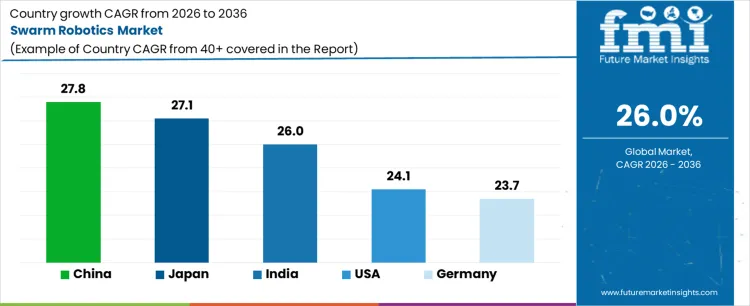
| Country | CAGR |
|---|---|
| China | 27.8% |
| Japan | 27.1% |
| India | 26.0% |
| USA | 24.1% |
| Germany | 23.7% |
Why Is China Leading in the Swarm Robotics Market?
Demand for the swarm robotics in China is growing at a CAGR of 27.8%, driven by large-scale integration of multi-robot coordination into defense, industrial, and agricultural sectors. Chinese government programs focus on autonomous drone swarms for perimeter security, forest fire monitoring, and battlefield surveillance. State-owned research institutes are developing algorithms for cooperative decision-making, fault tolerance, and real-time environment mapping. Deployment of coordinated robotic platforms is expanding across logistics parks and ports to enhance throughput and reduce labor dependency. Swarm navigation technologies are being tested in orchard spraying, rice field monitoring, and post-harvest handling. China’s industrial policy encourages localization of both hardware and control software stacks. Tech conglomerates and AI robotics startups are scaling production of ground robots and aerial drones with edge computing features. Local governments provide grants for demonstration trials in smart manufacturing zones.
What Is Supporting Growth in Japan’s Swarm Robotics Market?
Sales for the swarm robotics in Japan are expanding at a CAGR of 27.1%, supported by advanced research in multi-agent robotics and scalable automation platforms. Japanese universities and national labs are developing swarm coordination algorithms for disaster recovery, nuclear decommissioning, and exploration in hazardous environments. Automotive and aerospace companies are investing in robotic fleets for inspection and maintenance within assembly lines. Japan’s agricultural sector is adopting coordinated drone systems for crop monitoring and pollination in high-value horticulture zones. Swarm-based warehouse robots are being deployed in compact logistics centers to optimize order picking and reduce transit time. National funding schemes prioritize modularity, redundancy, and autonomous cooperation among robotic agents. Private companies are focusing on developing miniaturized swarm-capable bots integrated with distributed sensing and communication protocols. Use cases in elderly care, hospital logistics, and indoor delivery are also being piloted using swarming logic.
Why Is India Seeing Fast Growth in the Swarm Robotics Market?
Demand for the swarm robotics in India is increasing at a CAGR of 26.0%, driven by growing interest in decentralized automation for defense, agriculture, and disaster response. Research labs affiliated with DRDO and academic institutions are developing coordinated robotic platforms for border surveillance, minefield mapping, and crowd control. Agricultural universities and agri-tech startups are piloting drone swarms for sowing, pesticide dispersion, and yield assessment in fragmented farmlands. Logistics companies are testing collaborative robots for intra-warehouse transport and sorting. Cost-effective local manufacturing of swarm-ready platforms is accelerating adoption in government and enterprise deployments. India’s Ministry of Electronics and IT supports R&D in distributed AI, control systems, and cooperative task execution. Educational robotics competitions have helped nurture a pipeline of technical talent working on swarm behaviors. Increasing demand for scalable, resilient, and flexible robotics platforms across tier-1 and tier-2 cities is strengthening market potential.
What Is Driving Adoption in the USA’s Swarm Robotics Market?
Sales for the swarm robotics market in the USA are growing at a CAGR of 24.1%, led by military, space, and industrial automation applications. DARPA and the Department of Defense are actively funding swarm-capable unmanned aerial and ground systems for reconnaissance, mapping, and combat support missions. Commercial drone companies are developing multi-agent coordination protocols for surveillance and delivery fleets. Robotics OEMs are deploying swarm-enabled ground units in construction monitoring, warehouse optimization, and facility security. The USA agriculture sector is adopting autonomous swarm solutions for spraying, field scouting, and weed detection. Research institutions like MIT, Stanford, and Carnegie Mellon contribute foundational work on swarm intelligence and agent cooperation. Interoperability standards, simulation environments, and modular software frameworks are accelerating commercial deployments. Aerospace firms are testing swarm behavior for satellite servicing and lunar exploration. USA investments focus on resilience, scalability, and adversarial robustness.
Why Is Germany Expanding Its Swarm Robotics Capabilities?
Demand for the swarm robotics in Germany is rising at a CAGR of 23.7%, with applications in industrial automation, manufacturing logistics, and precision agriculture. German robotics companies are integrating swarm-based software modules into autonomous forklifts, floor cleaners, and warehouse shuttles. Swarm-controlled drones are being piloted for infrastructure inspection, crop spraying, and terrain mapping under precision farming initiatives. Research programs funded by the Federal Ministry of Education and Research focus on decentralized control, fault tolerance, and real-time adaptation in multi-agent systems. Collaborations between industry and academia are yielding testbeds for swarm behavior under real-world constraints. Automotive assembly lines are trialing self-coordinated robots to handle component delivery and tool repositioning. Germany’s emphasis on Industrie 4.0 is driving interest in robotics systems that can scale autonomously and adapt to production changes without centralized command.
How Are Leading Companies Competing And Differentiating In The Swarm Robotics Market?

Competition in the swarm robotics market is being shaped by coordination efficiency, autonomous operation, and scalability. Boston Dynamics is being positioned around agile mobile robots capable of synchronized tasks, with product brochures emphasizing terrain adaptability, precise motion, and real-time swarm communication. Clearpath Robotics is being differentiated through modular platforms that support multi-robot collaboration for logistics and industrial environments, highlighting fleet management software and rapid deployment. Swarm Technology focuses on algorithm-driven coordination, promoting collision avoidance, adaptive task allocation, and energy-efficient path planning for multi-unit robotic systems.
Operational versatility and specialized applications are being leveraged by Sentien Robotics, Hydromea, and Locus Robotics. Sentien Robotics markets micro-swarm platforms for inspection and monitoring, emphasizing autonomous navigation, high-precision sensing, and minimal human intervention. Hydromea is being positioned around aquatic swarm systems, with brochures highlighting waterproofing, submersible actuation, and synchronized underwater operations. Locus Robotics promotes warehouse and fulfillment swarm solutions, emphasizing productivity gains, adaptive task scheduling, and seamless integration with warehouse management systems.
A different competitive angle is being applied by Red Cat Holdings, EDGE Group, Swarm Systems Limited, and Icarus Drone. Red Cat Holdings focuses on defense-oriented swarm robotics, highlighting resilient communications, coordinated offensive and defensive maneuvers, and field adaptability. EDGE Group promotes modular swarm platforms for security and tactical applications. Swarm Systems Limited emphasizes research and prototype development for academic and industrial innovation, while Icarus Drone markets aerial swarms for surveying, mapping, and surveillance, stressing precision coordination and autonomous flight. Across the market, differentiation is being driven by swarm intelligence, operational reliability, and multi-robot adaptability, with product materials translating technical capability into tangible efficiency and scalability advantages.
Key Players in Swarm Robotics Market
- Boston Dynamics
- Clearpath Robotics
- Swarm Technology
- Sentien Robotics
- Hydromea
- Locus Robotics
- Red Cat Holdings
- EDGE Group
- Swarm Systems Limited
- Icarus Drone
Scope of Report
| Attributes | Description |
|---|---|
| Quantitative Unit | USD Billion |
| Platform | Unmanned Aerial Vehicles (UAVs), Unmanned Ground Vehicles (UGVs), Underwater Robots, Other Swarm Systems |
| End Users | Defense & Security, Agriculture, Healthcare, Logistics & Warehousing, Research & Academia, Others |
| Regions Covered | Asia Pacific, Europe, North America, Latin America, Middle East & Africa |
| Countries Covered | China, Japan, South Korea, India, Australia & New Zealand, ASEAN, Rest of Asia Pacific, Germany, United Kingdom, France, Italy, Spain, Nordic, BENELUX, Rest of Europe, United States, Canada, Mexico, Brazil, Chile, Rest of Latin America, Kingdom of Saudi Arabia, Other GCC Countries, Turkey, South Africa, Other African Union, Rest of Middle East & Africa |
| Key Companies Profiled | Boston Dynamics, Clearpath Robotics, Swarm Technology, Sentien Robotics, Hydromea, Locus Robotics, Red Cat Holdings, EDGE Group, Swarm Systems Limited, Icarus Drone |
| Additional Attributes | Market revenue by platform type and end-user industry; adoption trends across defense, agriculture, healthcare, and logistics; regional growth analysis; projected market size and CAGR for 2026-2036; technological advancements in UAVs, UGVs, and underwater swarm systems; competitive landscape with strategy and portfolio analysis of leading players; emerging applications in research and academia; supply chain and distribution overview. |
Swarm Robotics Market by Key Segments
Platform:
- Unmanned Aerial Vehicles (UAVs)
- Unmanned Ground Vehicles (UGVs)
- Underwater Robots
- Other Swarm Systems
End User:
- Defense & Security
- Agriculture
- Healthcare
- Logistics & Warehousing
- Research & Academia
- Others
Region:
- Asia Pacific
- China
- Japan
- South Korea
- India
- Australia & New Zealand
- ASEAN
- Rest of Asia Pacific
- Europe
- Germany
- United Kingdom
- France
- Italy
- Spain
- Nordic
- BENELUX
- Rest of Europe
- North America
- United States
- Canada
- Mexico
- Latin America
- Brazil
- Chile
- Rest of Latin America
- Middle East & Africa
- Kingdom of Saudi Arabia
- Other GCC Countries
- Turkey
- South Africa
- Other African Union
- Rest of Middle East & Africa
Bibliography
- USA Department of Defense, Deputy Secretary of Defense Kathleen Hicks remarks on the Replicator initiative (Sep 6, 2023).
- arXiv, "Decentralized Motion Planning for Multiple Agents with Limited Communication" (2023)
- NASA, Starling extended mission update on distributed autonomy in a satellite swarm (Sep 23, 2025).
- Stanford University School of Engineering, in-orbit test of swarm satellite autonomous navigation (Aug 8, 2024).
Frequently Asked Questions
How big is the swarm robotics market in 2026?
The global swarm robotics market is estimated to be valued at USD 1.9 billion in 2026.
What will be the size of swarm robotics market in 2036?
The market size for the swarm robotics market is projected to reach USD 19.2 billion by 2036.
How much will be the swarm robotics market growth between 2026 and 2036?
The swarm robotics market is expected to grow at a 26.0% CAGR between 2026 and 2036.
What are the key product types in the swarm robotics market?
The key product types in swarm robotics market are unmanned aerial vehicles (uavs), unmanned ground vehicles (ugvs), underwater robots and other swarm systems.
Which end user segment to contribute significant share in the swarm robotics market in 2026?
In terms of end user, defense & security segment to command 30.0% share in the swarm robotics market in 2026.
Preview the report firsthand - request a free sample
Get SampleGet the brochure for pricing and purchase details.
Get PDFTable of Content
- Executive Summary
- Global Market Outlook
- Demand-side Trends
- Supply-side Trends
- Technology Roadmap Analysis
- Analysis and Recommendations
- Market Overview
- Market Coverage / Taxonomy
- Market Definition / Scope / Limitations
- Market Background
- Market Dynamics
- Drivers
- Restraints
- Opportunity
- Trends
- Scenario Forecast
- Demand in Optimistic Scenario
- Demand in Likely Scenario
- Demand in Conservative Scenario
- Opportunity Map Analysis
- Product Life Cycle Analysis
- Supply Chain Analysis
- Investment Feasibility Matrix
- Value Chain Analysis
- PESTLE and Porter’s Analysis
- Regulatory Landscape
- Regional Parent Market Outlook
- Production and Consumption Statistics
- Import and Export Statistics
- Market Dynamics
- Global Market Analysis 2021 to 2025 and Forecast, 2026 to 2036
- Historical Market Size Value (USD Million) Analysis, 2021 to 2025
- Current and Future Market Size Value (USD Million) Projections, 2026 to 2036
- Y-o-Y Growth Trend Analysis
- Absolute $ Opportunity Analysis
- Global Market Pricing Analysis 2021 to 2025 and Forecast 2026 to 2036
- Global Market Analysis 2021 to 2025 and Forecast 2026 to 2036, By Platform
- Introduction / Key Findings
- Historical Market Size Value (USD Million) Analysis By Platform, 2021 to 2025
- Current and Future Market Size Value (USD Million) Analysis and Forecast By Platform, 2026 to 2036
- Unmanned Aerial Vehicles (UAVs)
- Unmanned Ground Vehicles (UGVs)
- Underwater Robots
- Other Swarm Systems
- Unmanned Aerial Vehicles (UAVs)
- Y-o-Y Growth Trend Analysis By Platform, 2021 to 2025
- Absolute $ Opportunity Analysis By Platform, 2026 to 2036
- Global Market Analysis 2021 to 2025 and Forecast 2026 to 2036, By End User
- Introduction / Key Findings
- Historical Market Size Value (USD Million) Analysis By End User, 2021 to 2025
- Current and Future Market Size Value (USD Million) Analysis and Forecast By End User, 2026 to 2036
- Defense & Security
- Agriculture
- Healthcare
- Logistics & Warehousing
- Research & Academia
- Others
- Defense & Security
- Y-o-Y Growth Trend Analysis By End User, 2021 to 2025
- Absolute $ Opportunity Analysis By End User, 2026 to 2036
- Global Market Analysis 2021 to 2025 and Forecast 2026 to 2036, By Region
- Introduction
- Historical Market Size Value (USD Million) Analysis By Region, 2021 to 2025
- Current Market Size Value (USD Million) Analysis and Forecast By Region, 2026 to 2036
- North America
- Latin America
- Western Europe
- Eastern Europe
- East Asia
- South Asia and Pacific
- Middle East & Africa
- Market Attractiveness Analysis By Region
- North America Market Analysis 2021 to 2025 and Forecast 2026 to 2036, By Country
- Historical Market Size Value (USD Million) Trend Analysis By Market Taxonomy, 2021 to 2025
- Market Size Value (USD Million) Forecast By Market Taxonomy, 2026 to 2036
- By Country
- USA
- Canada
- Mexico
- By Platform
- By End User
- By Country
- Market Attractiveness Analysis
- By Country
- By Platform
- By End User
- Key Takeaways
- Latin America Market Analysis 2021 to 2025 and Forecast 2026 to 2036, By Country
- Historical Market Size Value (USD Million) Trend Analysis By Market Taxonomy, 2021 to 2025
- Market Size Value (USD Million) Forecast By Market Taxonomy, 2026 to 2036
- By Country
- Brazil
- Chile
- Rest of Latin America
- By Platform
- By End User
- By Country
- Market Attractiveness Analysis
- By Country
- By Platform
- By End User
- Key Takeaways
- Western Europe Market Analysis 2021 to 2025 and Forecast 2026 to 2036, By Country
- Historical Market Size Value (USD Million) Trend Analysis By Market Taxonomy, 2021 to 2025
- Market Size Value (USD Million) Forecast By Market Taxonomy, 2026 to 2036
- By Country
- Germany
- UK
- Italy
- Spain
- France
- Nordic
- BENELUX
- Rest of Western Europe
- By Platform
- By End User
- By Country
- Market Attractiveness Analysis
- By Country
- By Platform
- By End User
- Key Takeaways
- Eastern Europe Market Analysis 2021 to 2025 and Forecast 2026 to 2036, By Country
- Historical Market Size Value (USD Million) Trend Analysis By Market Taxonomy, 2021 to 2025
- Market Size Value (USD Million) Forecast By Market Taxonomy, 2026 to 2036
- By Country
- Russia
- Poland
- Hungary
- Balkan & Baltic
- Rest of Eastern Europe
- By Platform
- By End User
- By Country
- Market Attractiveness Analysis
- By Country
- By Platform
- By End User
- Key Takeaways
- East Asia Market Analysis 2021 to 2025 and Forecast 2026 to 2036, By Country
- Historical Market Size Value (USD Million) Trend Analysis By Market Taxonomy, 2021 to 2025
- Market Size Value (USD Million) Forecast By Market Taxonomy, 2026 to 2036
- By Country
- China
- Japan
- South Korea
- By Platform
- By End User
- By Country
- Market Attractiveness Analysis
- By Country
- By Platform
- By End User
- Key Takeaways
- South Asia and Pacific Market Analysis 2021 to 2025 and Forecast 2026 to 2036, By Country
- Historical Market Size Value (USD Million) Trend Analysis By Market Taxonomy, 2021 to 2025
- Market Size Value (USD Million) Forecast By Market Taxonomy, 2026 to 2036
- By Country
- India
- ASEAN
- Australia & New Zealand
- Rest of South Asia and Pacific
- By Platform
- By End User
- By Country
- Market Attractiveness Analysis
- By Country
- By Platform
- By End User
- Key Takeaways
- Middle East & Africa Market Analysis 2021 to 2025 and Forecast 2026 to 2036, By Country
- Historical Market Size Value (USD Million) Trend Analysis By Market Taxonomy, 2021 to 2025
- Market Size Value (USD Million) Forecast By Market Taxonomy, 2026 to 2036
- By Country
- Kingdom of Saudi Arabia
- Other GCC Countries
- Turkiye
- South Africa
- Other African Union
- Rest of Middle East & Africa
- By Platform
- By End User
- By Country
- Market Attractiveness Analysis
- By Country
- By Platform
- By End User
- Key Takeaways
- Key Countries Market Analysis
- USA
- Pricing Analysis
- Market Share Analysis, 2025
- By Platform
- By End User
- Canada
- Pricing Analysis
- Market Share Analysis, 2025
- By Platform
- By End User
- Mexico
- Pricing Analysis
- Market Share Analysis, 2025
- By Platform
- By End User
- Brazil
- Pricing Analysis
- Market Share Analysis, 2025
- By Platform
- By End User
- Chile
- Pricing Analysis
- Market Share Analysis, 2025
- By Platform
- By End User
- Germany
- Pricing Analysis
- Market Share Analysis, 2025
- By Platform
- By End User
- UK
- Pricing Analysis
- Market Share Analysis, 2025
- By Platform
- By End User
- Italy
- Pricing Analysis
- Market Share Analysis, 2025
- By Platform
- By End User
- Spain
- Pricing Analysis
- Market Share Analysis, 2025
- By Platform
- By End User
- France
- Pricing Analysis
- Market Share Analysis, 2025
- By Platform
- By End User
- India
- Pricing Analysis
- Market Share Analysis, 2025
- By Platform
- By End User
- ASEAN
- Pricing Analysis
- Market Share Analysis, 2025
- By Platform
- By End User
- Australia & New Zealand
- Pricing Analysis
- Market Share Analysis, 2025
- By Platform
- By End User
- China
- Pricing Analysis
- Market Share Analysis, 2025
- By Platform
- By End User
- Japan
- Pricing Analysis
- Market Share Analysis, 2025
- By Platform
- By End User
- South Korea
- Pricing Analysis
- Market Share Analysis, 2025
- By Platform
- By End User
- Russia
- Pricing Analysis
- Market Share Analysis, 2025
- By Platform
- By End User
- Poland
- Pricing Analysis
- Market Share Analysis, 2025
- By Platform
- By End User
- Hungary
- Pricing Analysis
- Market Share Analysis, 2025
- By Platform
- By End User
- Kingdom of Saudi Arabia
- Pricing Analysis
- Market Share Analysis, 2025
- By Platform
- By End User
- Turkiye
- Pricing Analysis
- Market Share Analysis, 2025
- By Platform
- By End User
- South Africa
- Pricing Analysis
- Market Share Analysis, 2025
- By Platform
- By End User
- USA
- Market Structure Analysis
- Competition Dashboard
- Competition Benchmarking
- Market Share Analysis of Top Players
- By Regional
- By Platform
- By End User
- Competition Analysis
- Competition Deep Dive
- Boston Dynamics
- Overview
- Product Portfolio
- Profitability by Market Segments (Product/Age /Sales Channel/Region)
- Sales Footprint
- Strategy Overview
- Marketing Strategy
- Product Strategy
- Channel Strategy
- Clearpath Robotics
- Swarm Technology
- Sentien Robotics
- Hydromea
- Locus Robotics
- Red Cat Holdings
- EDGE Group
- Swarm Systems Limited
- Icarus Drone
- Boston Dynamics
- Competition Deep Dive
- Assumptions & Acronyms Used
- Research Methodology


