

- Industry Size (2026)
- USD 6.8 Bn
- Forecast (2036)
- USD 15.2 Bn
- CAGR (2026 to 2036)
- 8.40%
Thermal Imaging Components Market Forecast and Outlook 2026 to 2036
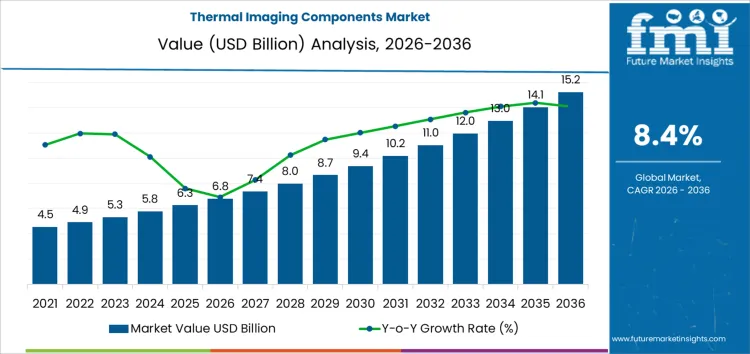
The thermal imaging components market is forecast to grow from USD 6.8 billion in 2026 to USD 15.2 billion by 2036, expanding at a CAGR of 8.40%. Regulatory oversight increasingly acts as a structural filter rather than a peripheral constraint in this market. Defense export controls, dual-use technology classifications, and country-specific certification regimes directly shape which suppliers can access high-value programs. Compliance costs linked to ITAR, EAR, automotive functional safety standards, and industrial quality certifications raise entry barriers and favor established manufacturers with compliance infrastructure already in place.
Certification timelines extend sales cycles, particularly in defense, aerospace, and automotive applications, influencing cash-flow planning and capacity utilization. For suppliers, positioning is strengthened through demonstrated traceability, documentation depth, and long-term component availability commitments. Smaller vendors face pressure to partner or specialize due to audit and qualification burdens. Adoption decisions by OEMs increasingly weigh compliance risk alongside performance metrics.
Quick Stats for Thermal Imaging Components Market
- Thermal Imaging Components Market Value (2026): USD 6.8 Billion
- Thermal Imaging Components Market Forecast Value (2036): USD 15.2 Billion
- Thermal Imaging Components Market Forecast CAGR 2026 to 2036: 8.40%
- Leading Product Type in Thermal Imaging Components Market: Thermal Cameras & Modules (55% share)
- Key Growth Regions in Thermal Imaging Components Market: Asia Pacific, Europe, North America, Latin America, Middle East & Africa
- Top Key Players in Thermal Imaging Components Market: Teledyne FLIR LLC, L3Harris Technologies Inc., RTX Corporation, Honeywell International Inc., BAE Systems PLC, Leonardo S.p.A., Axis Communications AB, Fluke Corporation, Testo SE & Co. KGaA, Lynred
Thermal Imaging Components Market Key Takeaways
| Metric | Value |
|---|---|
| Thermal Imaging Components Market Value (2026) | USD 6.8 Billion |
| Thermal Imaging Components Market Forecast Value (2036) | USD 15.2 Billion |
| Thermal Imaging Components Market Forecast CAGR 2026 to 2036 | 8.40% |
How Are Commercial and Technology Shifts Reshaping the Thermal Imaging Components Market?
The thermal imaging components market is being reshaped by a shift from niche, defense-centric demand toward diversified, volume-driven commercial applications. Manufacturers are seeing increasing orders from industrial automation, automotive safety, and infrastructure monitoring segments, where thermal sensors and optics are being embedded directly into larger systems. This transition is expanding addressable volumes while placing greater emphasis on component standardization, scalability, and cost efficiency. Suppliers capable of supporting high-volume production with consistent performance specifications are gaining competitive advantage.
Product development priorities are also evolving in response to system-level integration requirements. OEMs are demanding compact, lightweight, and power-efficient thermal components that can be seamlessly integrated into cameras, drones, vehicles, and fixed monitoring platforms. This is encouraging component manufacturers to focus on uncooled detector innovation, wafer-level optics, and modular architectures. Suppliers offering co-design capabilities, long-term availability assurances, and customization support are increasingly preferred over standalone component vendors.
Supply chain resilience and geographic diversification are becoming strategic differentiators. Defense, security, and industrial customers are prioritizing suppliers with localized manufacturing, dual sourcing options, and compliance with export control and certification requirements. At the same time, growth in automotive and smart infrastructure applications is pushing suppliers to meet automotive-grade quality and reliability standards. Together, volume expansion beyond defense, integration-driven product design, and procurement scrutiny are redefining competitive positioning and long-term growth opportunities in the thermal imaging components market.
What Is The Segment Overview Of The Thermal Imaging Components Market?
The thermal imaging components market is structured around product type and application, reflecting how hardware capabilities align with end-user performance requirements. By product type, thermal cameras and modules account for around 55% share, as they integrate sensing, processing, and imaging functions into deployable systems. Other product categories such as thermal sensors and detectors, infrared optics and components, and accessories and software support system customization and performance enhancement. By application, defense and security represent the primary demand center with approximately 35% share, driven by surveillance, targeting, and situational awareness needs. Additional applications including industrial inspection, automotive and ADAS, healthcare, commercial electronics, and other uses broaden adoption across civilian and industrial domains.
Why Do Thermal Cameras And Modules Dominate The Thermal Imaging Components Market By Product Type?
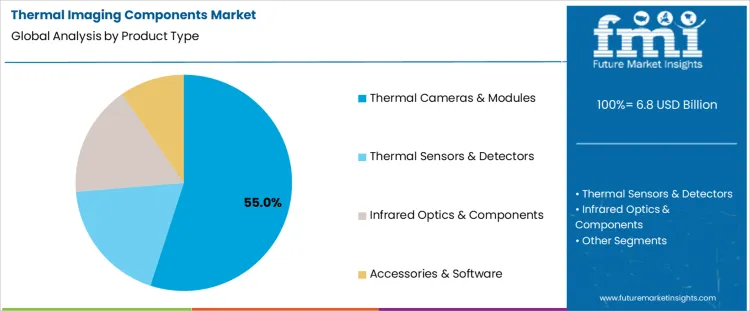
Thermal cameras and modules account for 55% share of the thermal imaging components market because they serve as complete, ready-to-integrate imaging solutions for OEMs and system integrators. Manufacturers prefer modules that combine sensors, optics compatibility, image processing, and output interfaces within compact form factors. These components reduce development time for defense equipment, industrial inspection tools, automotive night-vision systems, and handheld thermal devices. Advances in uncooled microbolometer technology have lowered power consumption and cost, enabling wider commercial adoption. Suppliers offering scalable camera modules benefit from repeat orders across multiple industries. This ability to deliver standardized yet adaptable imaging platforms explains why thermal cameras and modules remain the most commercially valuable product segment.
Why Does Defense And Security Lead The Thermal Imaging Components Market By Application?
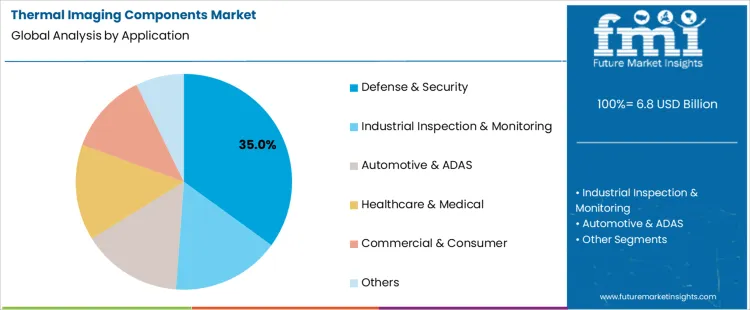
Defense and security hold 35% share of the thermal imaging components market due to sustained demand for all-weather, low-visibility imaging capabilities. Armed forces and security agencies deploy thermal systems for border surveillance, perimeter monitoring, target acquisition, and threat detection. Thermal imaging components function independently of ambient light, providing operational reliability during night operations, smoke, fog, and adverse weather conditions. Modern defense platforms integrate thermal cameras into unmanned systems, soldier-worn devices, and vehicle-mounted surveillance units. Long procurement cycles and stringent performance standards favor established component suppliers. These operational and procurement dynamics explain why defense and security continue to anchor demand within the thermal imaging components market.
What Are The Key Dynamics Of The Thermal Imaging Components Market?
The thermal imaging components market is evolving as manufacturers and suppliers respond to rising demand across defense, industrial monitoring, automotive safety, and building diagnostics. Core components such as infrared detectors, lenses, shutters, and signal processing electronics are seeing increased innovation to improve sensitivity, resolution, and reliability. Miniaturization and cost optimization are enabling broader commercial adoption beyond traditional defense use. Supply chain resilience for critical materials, production scalability, and performance differentiation remain decisive competitive factors. For component manufacturers, long-term OEM partnerships and compliance with application-specific standards are shaping procurement decisions in the thermal imaging components market.
How Are Technology And Manufacturing Trends Shaping The Thermal Imaging Components Market?
Technology and manufacturing trends are reshaping the thermal imaging components market through advances in uncooled microbolometers, wafer-level optics, and integrated signal processing. Manufacturers are focusing on higher pixel density sensors, improved thermal sensitivity, and reduced power consumption to meet OEM requirements. Automated fabrication and higher wafer yields are supporting cost reduction strategies. Increasing integration of components into compact modules is enabling easier system-level adoption. For suppliers, offering standardized yet customizable components is becoming a key strategy to address diverse applications such as drones, automotive driver assistance, and industrial inspection systems.
Why Do Cost, Supply Chain, And Qualification Requirements Restrain The Thermal Imaging Components Market?
Cost and supply chain challenges continue to restrain the thermal imaging components market. High precision manufacturing requirements for infrared sensors and optics increase production costs and limit supplier entry. Dependence on specialized materials and fabrication equipment exposes manufacturers to supply disruptions. Lengthy qualification cycles, especially in defense, aerospace, and automotive sectors, delay revenue realization. Export controls and regulatory approvals in certain regions add compliance complexity. These factors require suppliers to balance investment in advanced manufacturing with long-term demand visibility and diversified customer portfolios.
How Is the Global Demand Landscape Shaping Country-Level Opportunities in the Thermal Imaging Components Market?
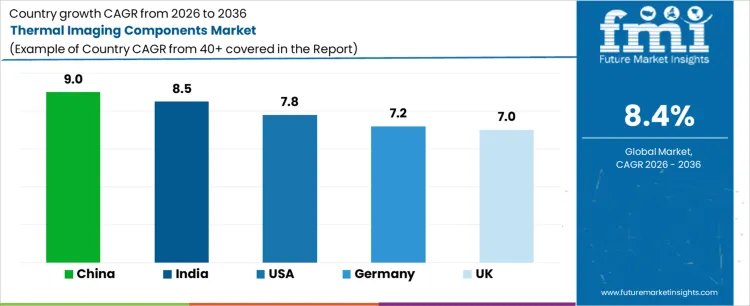
Demand for thermal imaging components varies significantly across countries based on defense spending patterns, industrial automation intensity, surveillance infrastructure, and domestic manufacturing capabilities. Asia Pacific leads volume growth due to expanding security, electronics manufacturing, and automotive sensing applications. China and India are emerging as high-growth production and consumption hubs, while the United States and Europe remain technology-driven markets focused on performance and reliability. Growth is increasingly influenced by component localization strategies, supply chain resilience, and integration of thermal modules into multi-sensor platforms. Manufacturers are responding by aligning product portfolios with country-specific regulatory, cost, and performance expectations.
| Country | CAGR (%) |
|---|---|
| China | 9.0% |
| India | 8.5% |
| USA | 7.8% |
| Germany | 7.2% |
| UK | 7.0% |
Why Is China Becoming the Primary Volume Anchor for Thermal Imaging Component Suppliers?
Demand for thermal imaging components in China, expanding at a CAGR of 9.0% during 2026 to 2036, is anchored in scale-driven electronics manufacturing, domestic system integration, and aggressive localization strategies. The thermal imaging components market in China is shaped by high-volume procurement across surveillance infrastructure, industrial automation, perimeter security, and commercial monitoring systems. Component buyers prioritize cost efficiency, yield stability, and local supply continuity over ultra-premium performance specifications.
Domestic OEMs increasingly source detectors, infrared lenses, and integrated modules from local suppliers to reduce import exposure and improve lead times. Government-backed investments in sensing technologies support upstream component capacity expansion. Export-oriented manufacturers integrate thermal components into drones, automotive night-vision platforms, and smart infrastructure products, widening application breadth. Competitive intensity remains high, pushing suppliers toward vertical integration, automation, and pricing discipline. Suppliers that align manufacturing scale, localization partnerships, and multi-application compatibility gain sustained traction.
How Is India Creating Growth Pathways for Thermal Imaging Component Vendors?
Sales of thermal imaging components in India, growing at a CAGR of 8.5% from 2026 to 2036, are driven by expanding defense procurement, infrastructure surveillance, and industrial safety adoption. The thermal imaging components market in India is transitioning from limited deployment toward broader system penetration. Defense and border security programs generate recurring demand for detectors, optics, and core modules, while transportation, energy, and smart city projects open non-defense avenues. Buyers emphasize affordability, modular design, and long-term serviceability. Component suppliers supporting local assembly and phased localization gain preference. Import substitution policies influence sourcing decisions, encouraging joint ventures and technology partnerships. System integrators value components adaptable across multiple platforms, reducing inventory complexity. Procurement cycles are longer than mature markets, yet contract durations extend over multiple years. Domestic electronics manufacturing initiatives improve visibility for suppliers willing to invest locally. India presents a growth-oriented market where customization flexibility, cost-performance balance, and aftersales support shape supplier success.
What Sustains High-Value Demand for Thermal Imaging Components in the United States?
Demand for thermal imaging components in United States, expanding at a CAGR of 7.8% during 2026 to 2036, is sustained by performance-critical applications across defense, aerospace, industrial inspection, and research environments. The thermal imaging components market in the United States is specification-driven, with buyers prioritizing sensitivity, resolution, durability, and reliability over unit pricing. Defense programs and aerospace testing platforms generate long qualification cycles and multi-year procurement visibility for component suppliers. Industrial automation and predictive maintenance applications support steady replacement demand as legacy systems are upgraded. Buyers emphasize traceability, documentation, and lifecycle support, influencing supplier selection. Integration of thermal detectors with AI-enabled analytics and multisensor platforms increases component complexity and value per unit. Procurement decisions favor suppliers with strong R&D depth, certification readiness, and domestic manufacturing or secure sourcing capabilities. Volumes are moderate compared with Asia, yet margins remain attractive due to technical rigor.
How Does Germany Shape Precision-Oriented Opportunities for Component Manufacturers?
Demand for thermal imaging components in Germany, growing at a CAGR of 7.2% over the forecast period, is shaped by precision-led industrial applications and structured procurement environments. The thermal imaging components market in Germany is driven by automotive testing, quality inspection, advanced manufacturing, and research laboratories. Buyers emphasize measurement accuracy, thermal stability, and long operational life rather than rapid deployment. Demand is largely replacement-driven, with upgrades focused on integrating thermal imaging into automated inspection and control systems. Procurement processes are qualification-intensive, favoring suppliers with proven reliability, documentation depth, and engineering support capabilities. Environmental compliance and energy efficiency considerations increasingly influence component design preferences. Volumes remain moderate, yet unit values are high due to specification rigor. Suppliers benefit from long-term customer relationships and predictable replacement cycles. Germany rewards manufacturers offering customization, application engineering, and precision-calibrated components rather than cost-led solutions.
Why Is the UK a Selective but Strategically Relevant Market for Suppliers?
Sales of thermal imaging components in United Kingdom, expanding at a CAGR of 7.0% during 2026 to 2036, reflect selective but consistent demand across defense, aerospace research, and specialized industrial applications. The thermal imaging components market in the UK is characterized by lower volumes but high expectations for reliability and performance consistency. Procurement is driven by surveillance upgrades, aerospace testing environments, and research institutions rather than mass commercial deployment. Buyers prefer proven component designs with established operational records. Long-term supplier relationships and aftersales support influence purchasing decisions. Replacement demand dominates as systems are upgraded to meet evolving performance standards. R&D-driven applications sustain baseline demand, particularly within academic and defense-linked programs. The UK favors suppliers offering niche expertise, engineering collaboration, and responsive technical support. While volume expansion is limited, the market provides stable opportunities for manufacturers positioned around specialized components, program-based supply, and long-term customer engagement strategies.
How Are Component Specialists and System Integrators Shaping Competition in the Thermal Imaging Components Market?
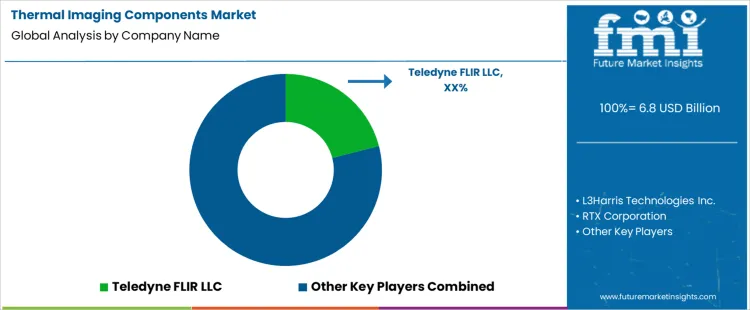
Competition in the thermal imaging components market is increasingly structured around control of critical subsystems rather than finished cameras alone. Teledyne FLIR LLC anchors its position through vertically integrated detector cores, ROICs, and calibrated modules supplied across defense, industrial, and OEM channels. Product documentation highlights long-term supply continuity and standardized cores designed for rapid system integration. L3Harris Technologies Inc. and RTX Corporation compete through mission-grade infrared components engineered for high reliability, radiation tolerance, and extended lifecycle programs, with brochures stressing qualification depth over commercial volume.
European defense suppliers emphasize performance envelopes and compliance. BAE Systems PLC and Leonardo S.p.A. position cooled and uncooled infrared components for surveillance and targeting platforms, supported by product literature focused on sensitivity stability and harsh-environment operation. Honeywell International Inc. differentiates through infrared sensing components integrated into avionics and industrial safety systems, where certification and traceability are emphasized.
Industrial and security-focused suppliers compete on scalability and interoperability. Axis Communications AB focuses on thermal modules optimized for networked security architectures, with brochures highlighting open interfaces and edge analytics readiness. Fluke Corporation and Testo SE & Co. KGaA position thermal components around measurement accuracy and calibration integrity rather than raw pixel counts.
Component-level competition is most visible among detector specialists. InfraTec GmbH and Lynred emphasize detector sensitivity, pixel uniformity, and wafer-level control in official datasheets. InfiRay expands aggressively through high-volume uncooled detector supply for OEMs. Thermoteknix Systems Ltd and Workswell s.r.o. address niche integration needs with modular components. Across the market, value is increasingly created through detector access, calibration know-how, and integration readiness rather than finished device branding alone.
Key Players in Thermal Imaging Components Market
- Teledyne FLIR LLC
- L3Harris Technologies Inc.
- RTX Corporation
- Honeywell International Inc.
- BAE Systems PLC
- Leonardo S.p.A.
- Axis Communications AB
- Fluke Corporation
- Hikvision Digital Technology Co., Ltd.
- Testo SE & Co. KGaA
- InfraTec GmbH
- Lynred
- InfiRay (IRay)
- Thermoteknix Systems Ltd
- Workswell s.r.o.
Scope of Report
| Attribute | Description |
|---|---|
| Quantitative Unit | USD Billion |
| Product Type | Thermal Cameras & Modules, Thermal Sensors & Detectors, Infrared Optics & Components, Accessories & Software |
| Application | Defense & Security, Industrial Inspection & Monitoring, Automotive & ADAS, Healthcare & Medical, Commercial & Consumer, Others |
| Countries Covered | China, Japan, South Korea, India, Australia & New Zealand, ASEAN, Rest of Asia Pacific, Germany, United Kingdom, France, Italy, Spain, Nordic, BENELUX, Rest of Europe, United States, Canada, Mexico, Brazil, Chile, Rest of Latin America, Kingdom of Saudi Arabia, Other GCC Countries, Turkey, South Africa, Other African Union, Rest of Middle East & Africa |
| Regions Covered | Asia Pacific, Europe, North America, Latin America, Middle East & Africa |
| Key Companies Profiled | Teledyne FLIR LLC, L3Harris Technologies Inc., RTX Corporation, Honeywell International Inc., BAE Systems PLC, Leonardo S.p.A., Axis Communications AB, Fluke Corporation, Hikvision Digital Technology Co., Ltd., Testo SE & Co. KGaA, InfraTec GmbH, Lynred, InfiRay (IRay), Thermoteknix Systems Ltd, Workswell s.r.o. |
| Additional Attributes | Dollar sales by product type and application are evaluated across defense, industrial, automotive, and commercial imaging deployments. The report includes country-level demand assessment, growth projections for 2026 to 2036, analysis of sensor resolution and optics performance trends, evaluation of uncooled and cooled detector adoption, competitive benchmarking of suppliers, and assessment of integration trends across imaging platforms. |
Thermal Imaging Components Market by Key Segments
Product Type
- Thermal Cameras & Modules
- Thermal Sensors & Detectors
- Infrared Optics & Components
- Accessories & Software
Application
- Defense & Security
- Industrial Inspection & Monitoring
- Automotive & ADAS
- Healthcare & Medical
- Commercial & Consumer
- Others
Region:
- Asia Pacific
- China
- Japan
- South Korea
- India
- Australia & New Zealand
- ASEAN
- Rest of Asia Pacific
- Europe
- Germany
- United Kingdom
- France
- Italy
- Spain
- Nordic
- BENELUX
- Rest of Europe
- North America
- United States
- Canada
- Mexico
- Latin America
- Brazil
- Chile
- Rest of Latin America
- Middle East & Africa
- Kingdom of Saudi Arabia
- Other GCC Countries
- Turkey
- South Africa
- Other African Union
- Rest of Middle East & Africa
Bibliography
- National Aeronautics and Space Administration. (2024). Thermal infrared remote sensing and imaging. NASA Earthdata.
- U.S. Department of Commerce, Bureau of Industry and Security. (2024). Export controls for advanced imaging and sensing technologies. BIS.
- National Oceanic and Atmospheric Administration. (2024). Thermal infrared imaging for environmental monitoring. NOAA.
- U.S. Department of Defense. (2024). Defense Federal Acquisition Regulation Supplement (DFARS): Sensor and imaging compliance. U.S. Department of Defense.
Frequently Asked Questions
How big is the thermal imaging components market in 2026?
The global thermal imaging components market is estimated to be valued at USD 6.8 billion in 2026.
What will be the size of thermal imaging components market in 2036?
The market size for the thermal imaging components market is projected to reach USD 15.2 billion by 2036.
How much will be the thermal imaging components market growth between 2026 and 2036?
The thermal imaging components market is expected to grow at a 8.4% CAGR between 2026 and 2036.
What are the key product types in the thermal imaging components market?
The key product types in thermal imaging components market are thermal cameras & modules, thermal sensors & detectors, infrared optics & components and accessories & software.
Which application segment to contribute significant share in the thermal imaging components market in 2026?
In terms of application, defense & security segment to command 35.0% share in the thermal imaging components market in 2026.
Preview the report firsthand - request a free sample
Get SampleGet the brochure for pricing and purchase details.
Get PDFTable of Content
- Executive Summary
- Global Market Outlook
- Demand-side Trends
- Supply-side Trends
- Technology Roadmap Analysis
- Analysis and Recommendations
- Market Overview
- Market Coverage / Taxonomy
- Market Definition / Scope / Limitations
- Market Background
- Market Dynamics
- Drivers
- Restraints
- Opportunity
- Trends
- Scenario Forecast
- Demand in Optimistic Scenario
- Demand in Likely Scenario
- Demand in Conservative Scenario
- Opportunity Map Analysis
- Product Life Cycle Analysis
- Supply Chain Analysis
- Investment Feasibility Matrix
- Value Chain Analysis
- PESTLE and Porter’s Analysis
- Regulatory Landscape
- Regional Parent Market Outlook
- Production and Consumption Statistics
- Import and Export Statistics
- Market Dynamics
- Global Market Analysis 2021 to 2025 and Forecast, 2026 to 2036
- Historical Market Size Value (USD Million) Analysis, 2021 to 2025
- Current and Future Market Size Value (USD Million) Projections, 2026 to 2036
- Y-o-Y Growth Trend Analysis
- Absolute $ Opportunity Analysis
- Global Market Pricing Analysis 2021 to 2025 and Forecast 2026 to 2036
- Global Market Analysis 2021 to 2025 and Forecast 2026 to 2036, By Product Type
- Introduction / Key Findings
- Historical Market Size Value (USD Million) Analysis By Product Type , 2021 to 2025
- Current and Future Market Size Value (USD Million) Analysis and Forecast By Product Type , 2026 to 2036
- Thermal Cameras & Modules
- Thermal Sensors & Detectors
- Infrared Optics & Components
- Accessories & Software
- Thermal Cameras & Modules
- Y-o-Y Growth Trend Analysis By Product Type , 2021 to 2025
- Absolute $ Opportunity Analysis By Product Type , 2026 to 2036
- Global Market Analysis 2021 to 2025 and Forecast 2026 to 2036, By Application
- Introduction / Key Findings
- Historical Market Size Value (USD Million) Analysis By Application, 2021 to 2025
- Current and Future Market Size Value (USD Million) Analysis and Forecast By Application, 2026 to 2036
- Defense & Security
- Industrial Inspection & Monitoring
- Automotive & ADAS
- Healthcare & Medical
- Commercial & Consumer
- Others
- Defense & Security
- Y-o-Y Growth Trend Analysis By Application, 2021 to 2025
- Absolute $ Opportunity Analysis By Application, 2026 to 2036
- Global Market Analysis 2021 to 2025 and Forecast 2026 to 2036, By Region
- Introduction
- Historical Market Size Value (USD Million) Analysis By Region, 2021 to 2025
- Current Market Size Value (USD Million) Analysis and Forecast By Region, 2026 to 2036
- North America
- Latin America
- Western Europe
- Eastern Europe
- East Asia
- South Asia and Pacific
- Middle East & Africa
- Market Attractiveness Analysis By Region
- North America Market Analysis 2021 to 2025 and Forecast 2026 to 2036, By Country
- Historical Market Size Value (USD Million) Trend Analysis By Market Taxonomy, 2021 to 2025
- Market Size Value (USD Million) Forecast By Market Taxonomy, 2026 to 2036
- By Country
- USA
- Canada
- Mexico
- By Product Type
- By Application
- By Country
- Market Attractiveness Analysis
- By Country
- By Product Type
- By Application
- Key Takeaways
- Latin America Market Analysis 2021 to 2025 and Forecast 2026 to 2036, By Country
- Historical Market Size Value (USD Million) Trend Analysis By Market Taxonomy, 2021 to 2025
- Market Size Value (USD Million) Forecast By Market Taxonomy, 2026 to 2036
- By Country
- Brazil
- Chile
- Rest of Latin America
- By Product Type
- By Application
- By Country
- Market Attractiveness Analysis
- By Country
- By Product Type
- By Application
- Key Takeaways
- Western Europe Market Analysis 2021 to 2025 and Forecast 2026 to 2036, By Country
- Historical Market Size Value (USD Million) Trend Analysis By Market Taxonomy, 2021 to 2025
- Market Size Value (USD Million) Forecast By Market Taxonomy, 2026 to 2036
- By Country
- Germany
- UK
- Italy
- Spain
- France
- Nordic
- BENELUX
- Rest of Western Europe
- By Product Type
- By Application
- By Country
- Market Attractiveness Analysis
- By Country
- By Product Type
- By Application
- Key Takeaways
- Eastern Europe Market Analysis 2021 to 2025 and Forecast 2026 to 2036, By Country
- Historical Market Size Value (USD Million) Trend Analysis By Market Taxonomy, 2021 to 2025
- Market Size Value (USD Million) Forecast By Market Taxonomy, 2026 to 2036
- By Country
- Russia
- Poland
- Hungary
- Balkan & Baltic
- Rest of Eastern Europe
- By Product Type
- By Application
- By Country
- Market Attractiveness Analysis
- By Country
- By Product Type
- By Application
- Key Takeaways
- East Asia Market Analysis 2021 to 2025 and Forecast 2026 to 2036, By Country
- Historical Market Size Value (USD Million) Trend Analysis By Market Taxonomy, 2021 to 2025
- Market Size Value (USD Million) Forecast By Market Taxonomy, 2026 to 2036
- By Country
- China
- Japan
- South Korea
- By Product Type
- By Application
- By Country
- Market Attractiveness Analysis
- By Country
- By Product Type
- By Application
- Key Takeaways
- South Asia and Pacific Market Analysis 2021 to 2025 and Forecast 2026 to 2036, By Country
- Historical Market Size Value (USD Million) Trend Analysis By Market Taxonomy, 2021 to 2025
- Market Size Value (USD Million) Forecast By Market Taxonomy, 2026 to 2036
- By Country
- India
- ASEAN
- Australia & New Zealand
- Rest of South Asia and Pacific
- By Product Type
- By Application
- By Country
- Market Attractiveness Analysis
- By Country
- By Product Type
- By Application
- Key Takeaways
- Middle East & Africa Market Analysis 2021 to 2025 and Forecast 2026 to 2036, By Country
- Historical Market Size Value (USD Million) Trend Analysis By Market Taxonomy, 2021 to 2025
- Market Size Value (USD Million) Forecast By Market Taxonomy, 2026 to 2036
- By Country
- Kingdom of Saudi Arabia
- Other GCC Countries
- Turkiye
- South Africa
- Other African Union
- Rest of Middle East & Africa
- By Product Type
- By Application
- By Country
- Market Attractiveness Analysis
- By Country
- By Product Type
- By Application
- Key Takeaways
- Key Countries Market Analysis
- USA
- Pricing Analysis
- Market Share Analysis, 2025
- By Product Type
- By Application
- Canada
- Pricing Analysis
- Market Share Analysis, 2025
- By Product Type
- By Application
- Mexico
- Pricing Analysis
- Market Share Analysis, 2025
- By Product Type
- By Application
- Brazil
- Pricing Analysis
- Market Share Analysis, 2025
- By Product Type
- By Application
- Chile
- Pricing Analysis
- Market Share Analysis, 2025
- By Product Type
- By Application
- Germany
- Pricing Analysis
- Market Share Analysis, 2025
- By Product Type
- By Application
- UK
- Pricing Analysis
- Market Share Analysis, 2025
- By Product Type
- By Application
- Italy
- Pricing Analysis
- Market Share Analysis, 2025
- By Product Type
- By Application
- Spain
- Pricing Analysis
- Market Share Analysis, 2025
- By Product Type
- By Application
- France
- Pricing Analysis
- Market Share Analysis, 2025
- By Product Type
- By Application
- India
- Pricing Analysis
- Market Share Analysis, 2025
- By Product Type
- By Application
- ASEAN
- Pricing Analysis
- Market Share Analysis, 2025
- By Product Type
- By Application
- Australia & New Zealand
- Pricing Analysis
- Market Share Analysis, 2025
- By Product Type
- By Application
- China
- Pricing Analysis
- Market Share Analysis, 2025
- By Product Type
- By Application
- Japan
- Pricing Analysis
- Market Share Analysis, 2025
- By Product Type
- By Application
- South Korea
- Pricing Analysis
- Market Share Analysis, 2025
- By Product Type
- By Application
- Russia
- Pricing Analysis
- Market Share Analysis, 2025
- By Product Type
- By Application
- Poland
- Pricing Analysis
- Market Share Analysis, 2025
- By Product Type
- By Application
- Hungary
- Pricing Analysis
- Market Share Analysis, 2025
- By Product Type
- By Application
- Kingdom of Saudi Arabia
- Pricing Analysis
- Market Share Analysis, 2025
- By Product Type
- By Application
- Turkiye
- Pricing Analysis
- Market Share Analysis, 2025
- By Product Type
- By Application
- South Africa
- Pricing Analysis
- Market Share Analysis, 2025
- By Product Type
- By Application
- USA
- Market Structure Analysis
- Competition Dashboard
- Competition Benchmarking
- Market Share Analysis of Top Players
- By Regional
- By Product Type
- By Application
- Competition Analysis
- Competition Deep Dive
- Teledyne FLIR LLC
- Overview
- Product Portfolio
- Profitability by Market Segments (Product/Age /Sales Channel/Region)
- Sales Footprint
- Strategy Overview
- Marketing Strategy
- Product Strategy
- Channel Strategy
- L3Harris Technologies Inc.
- RTX Corporation
- Honeywell International Inc.
- BAE Systems PLC
- Leonardo S.p.A.
- Axis Communications AB
- Fluke Corporation
- Hikvision Digital Technology Co., Ltd.
- Testo SE & Co. KGaA
- InfraTec GmbH
- Lynred
- InfiRay (IRay)
- Thermoteknix Systems Ltd
- Workswell s.r.o.
- Teledyne FLIR LLC
- Competition Deep Dive
- Assumptions & Acronyms Used
- Research Methodology


