

- Industry Size (2026)
- USD 640.0 Mn
- Forecast (2036):
- USD 1433.7 Mn
- CAGR (2026 to 2036)
- 8.4%
Thermal Underfloor Heating Actuator Market Forecast and Outlook 2026 to 2036
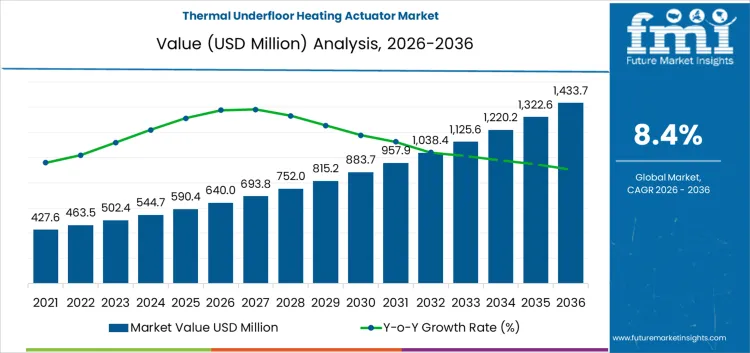
The thermal underfloor heating actuator market is likely to be valued at USD 640.0 million in 2026 and is forecasted to reach USD 1,433.7 million by 2036 at a CAGR of 8.4%. Value behavior is shaped by the actuator’s role as a precision flow control component within zoned hydronic heating systems rather than a standalone HVAC accessory. Demand formation reflects increasing deployment of underfloor heating in residential and mixed-use buildings where temperature uniformity and energy efficiency are design priorities.
Capital allocation favors actuators that deliver stable modulation across multiple heating loops while integrating with thermostats and building control systems. Purchasing decisions align with zoning density, compatibility with manifold standards, and sensitivity of system performance to flow accuracy. Demand persistence concentrates in retrofit and renovation activity where upgrading control components improves efficiency without full system replacement.
Installation economics and long-term operating reliability influence achievable market scale across regions. Cost sensitivity emerges where retrofit projects require electrical adaptation or manifold reconfiguration to accommodate actuator integration. Thermal wax and electrothermal mechanisms experience gradual performance drift under repeated heating cycles, affecting response accuracy over time. Water quality issues accelerate seal wear and internal corrosion, increasing failure rates in poorly conditioned systems. Limited diagnostic feedback complicates preventive maintenance planning. Price competition constrains adoption of higher-grade materials that could extend service life. Variation in regional heating codes and manifold geometries restricts product standardization, increasing inventory complexity for manufacturers and distributors.
Quick Stats for Thermal Underfloor Heating Actuator Market
- Thermal Underfloor Heating Actuator Market Value (2026): USD 640.0 million
- Thermal Underfloor Heating Actuator Market Forecast Value (2036): USD 1,433.7 million
- Thermal Underfloor Heating Actuator Market Forecast CAGR 2026 to 2036: 8.4%
- Leading Actuator Type by Demand Share: Thermal Wax Actuators
- Fastest-Growing Countries: Germany, UK, France, Italy, USA
- Top Players in Global Demand: Danfoss, Siemens, Honeywell, Schneider Electric, Belimo
Thermal Underfloor Heating Actuator Market Key Takeaways
| Metric | Value |
|---|---|
| Market Value (2026) | USD 640.0 million |
| Market Forecast Value (2036) | USD 1,433.7 million |
| Forecast CAGR 2026 to 2036 | 8.4% |
Why is the Demand for Thermal Underfloor Heating Actuator Market Growing?
Demand for thermal underfloor heating actuators is rising as construction projects focus on efficient temperature regulation in residential and commercial buildings. Actuators control fluid flow through underfloor circuits, enabling precise zone level management that supports energy use optimization. HVAC system designers integrate these devices to balance comfort requirements with stringent building performance standards that emphasize thermal efficiency. Urban development in high density areas incorporates radiant floor heating to reduce reliance on forced air systems that struggle with uneven heat distribution. Retrofit initiatives in existing buildings seek modulatable control elements that can be paired with smart thermostats to improve user interaction and system responsiveness without extensive infrastructure changes.
Interest from building automation and energy management sectors contributes to market expansion because facility managers prioritize hardware that supports remote monitoring and scheduling. Manufacturers supply actuators compatible with a range of control protocols and actuator sizes to meet diverse installation needs across floor plans and construction types. Regulatory frameworks addressing energy conservation in new builds influence procurement decisions favoring components that enhance system performance metrics. Training programs for HVAC technicians include actuator selection and commissioning to ensure quality installations. Growing awareness of occupant wellbeing linked to consistent indoor temperatures supports uptake across climates with variable seasonal demands.
How Are the Segments Classified in the Thermal Underfloor Heating Actuator Market?
Demand for thermal underfloor heating actuators grows due to energy efficiency regulations, zoning requirements, and adoption of hydronic heating systems. Building operators prioritize precise flow control to optimize thermal comfort and reduce energy losses. Integration with automated control systems strengthens reliance on reliable actuator performance. Expansion of low temperature heating solutions and refurbishment of existing buildings further supports consistent deployment across residential and commercial heating infrastructures.
Which actuator type represents the largest share of demand?
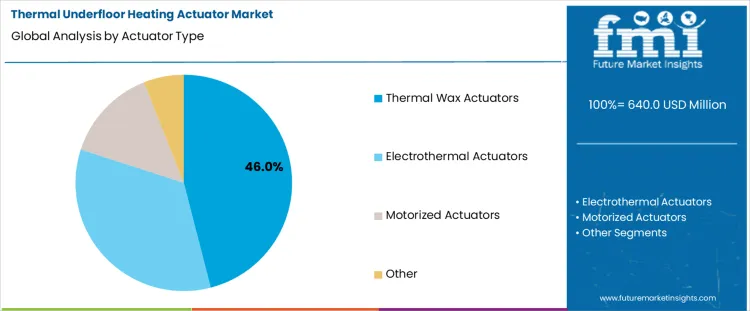
Thermal wax actuators account for a 46.0% share, reflecting suitability for simple, reliable flow control applications. These actuators operate without complex electronics, supporting stable performance over long service periods. Slow and controlled actuation aligns well with underfloor heating response characteristics. Minimal maintenance requirements reduce lifecycle costs for installers and building operators. Compatibility with standard manifold designs further supports widespread adoption across heating system configurations.
Key Points
- Operates reliably without electronic complexity
- Matches slow response needs of underfloor heating
- Reduces maintenance and lifecycle management effort
Which control type accounts for the highest share of demand?
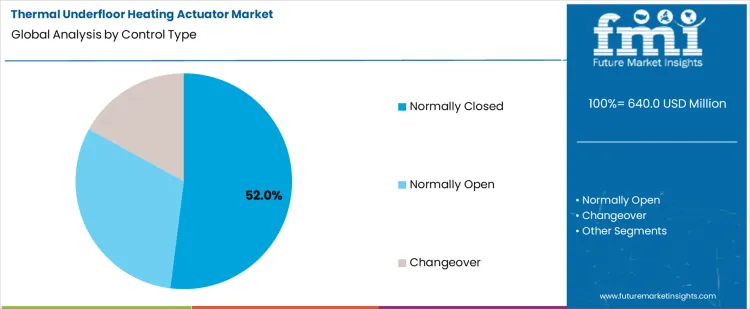
Normally closed configurations represent a 52.0% share, driven by safety and energy efficiency considerations. This design prevents unintended flow during power loss, reducing overheating risks. Default closed positioning supports zoning accuracy and prevents unnecessary circulation. Integration with thermostatic controls enables precise heat delivery based on room demand. Installers favor this configuration for compliance with modern heating control standards across building projects.
Key Points
- Prevents unintended heating during power interruptions
- Enhances zoning accuracy and energy control
- Aligns with modern heating safety practices
Which application accounts for the highest share of demand?
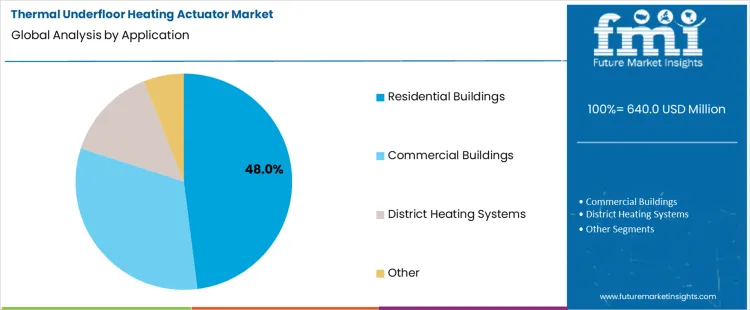
Residential buildings hold a 48.0% share, reflecting strong adoption of underfloor heating in housing developments. Homeowners value consistent thermal comfort and space efficiency enabled by hidden heating systems. Actuators support room level temperature regulation within multi zone layouts. Retrofit activity and new housing construction both contribute to sustained installation volumes. Residential usage emphasizes reliability and quiet operation over extended daily heating cycles.
Key Points
- Supports room level temperature zoning
- Aligns with comfort focused residential heating needs
- Sustains demand through new builds and retrofits
What are the Key Dynamics in the thermal underfloor heating actuator market?
Demand dynamics in the thermal underfloor heating actuator market reflect control accuracy requirements within hydronic floor heating systems. Global activity centers on residential and commercial building efficiency upgrades and zoning optimization. Value formation depends on response precision, valve compatibility, and long-term reliability. Purchasing decisions align with system integration needs, regulatory energy efficiency standards, and lifecycle maintenance considerations.
How do building energy control requirements shape adoption?
Adoption increases as building operators prioritize zone-level temperature control to reduce energy waste. Demand strengthens where underfloor heating systems require precise modulation of water flow across multiple loops. Thermal actuators support automated balancing, improving occupant comfort and reducing boiler cycling losses. Growth in smart building management systems elevates demand for actuators compatible with programmable thermostats and centralized controllers. Regulatory focus on building energy performance certificates reinforces deployment in new construction and retrofits. Installation simplicity and standardized thread interfaces reduce labor time, supporting contractor preference. Reliability under continuous seasonal operation influences specification decisions for large residential complexes and commercial properties seeking predictable thermal performance.
How does installation cost and operational durability constraints influence market scalability?
Market scalability faces constraints from installation cost sensitivity and actuator durability under repetitive thermal cycling. Demand encounters resistance where retrofit applications require manifold replacement or electrical rewiring. Wax motor and thermal expansion mechanisms exhibit wear over extended operating periods, increasing replacement frequency. Moisture exposure and poor water quality accelerate seal degradation, affecting actuation reliability. Limited fault diagnostics complicate maintenance planning. Price competition restricts material upgrades that could improve lifespan. Regional differences in heating standards and manifold designs limit product standardization, increasing inventory complexity for suppliers and installers.
How Is Demand for the Thermal Underfloor Heating Actuator Market Evolving Globally?
Global demand for thermal underfloor heating actuators is increasing due to energy efficiency mandates and electrification of residential heating systems. Retrofit activity and new residential construction drive actuator adoption within hydronic underfloor heating installations. Demand growth reflects regulatory pressure to reduce space heating emissions and improve zoning control accuracy. Germany records 9.2% CAGR, UK records 8.9% CAGR, France records 8.3% CAGR, Italy records 7.8% CAGR, and USA records 7.1% CAGR. Adoption remains linked to smart building integration, renovation incentives, and shift toward low temperature heating architectures globally.
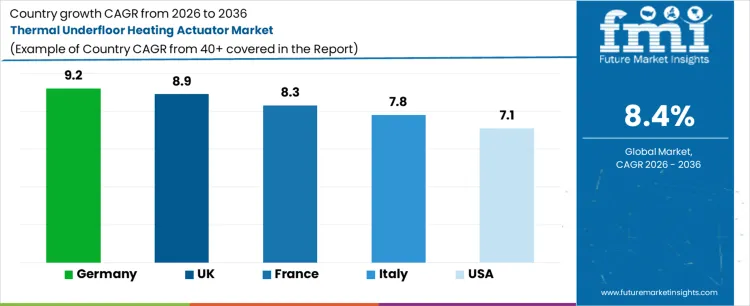
| Country | CAGR (%) |
|---|---|
| Germany | 9.2% |
| UK | 8.9% |
| France | 8.3% |
| Italy | 7.8% |
| USA | 7.1% |
What is driving growth of thermal underfloor heating actuator demand in Germany?
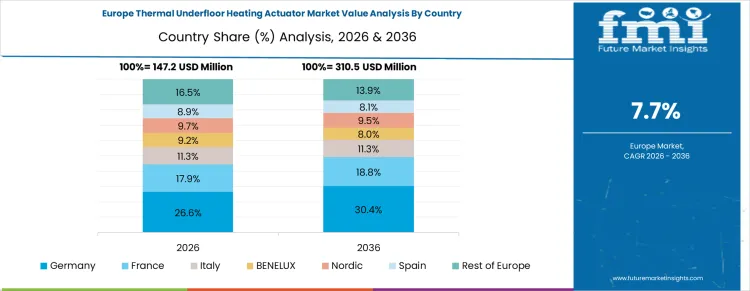
Demand for thermal underfloor heating actuators in Germany is expanding as residential retrofits prioritize energy efficiency and zoning precision. Growth at 9.2% CAGR reflects widespread adoption of hydronic underfloor systems paired with heat pumps. Building regulations encourage low temperature distribution, increasing actuator installation density. Replacement demand rises as legacy valves lack smart control compatibility. Manufacturers benefit from standardized installation practices across multi-family housing. Integration with building automation systems supports precise room level temperature regulation. Adoption remains strongest in renovation driven projects rather than new construction, reflecting aging housing stock modernization requirements nationwide.
- Heat pump compatible heating systems
- Strong renovation driven demand
- Emphasis on zoning control precision
- Building automation integration
Why is the UK seeing expansion in thermal underfloor heating actuator adoption?
Thermal underfloor heating actuator demand in the UK is rising as residential renovation and low carbon heating policies gain momentum. Expansion at 8.9% CAGR reflects replacement of radiator based systems in new build and retrofit homes. Actuators enable zone based control supporting energy savings under dynamic pricing conditions. Housing developers adopt underfloor systems to meet tightening building performance standards. Consumer demand favors comfort and floor space optimization. Smart thermostat compatibility strengthens actuator value proposition. Adoption concentrates within detached housing and premium apartment developments responding to decarbonization targets.
- Low carbon heating policy support
- Growth of residential retrofits
- Smart thermostat compatibility
- Preference for comfort driven systems
How is France supporting growth of thermal underfloor heating actuator demand?
Thermal underfloor heating actuator sales in France are increasing as building energy regulations encourage efficient heating distribution. Growth of 8.3% CAGR aligns with expansion of heat pump installations and renovation incentives. Actuator adoption supports room level temperature balancing in hydronic systems. Public housing upgrades contribute steady baseline demand. Manufacturers focus on compatibility with centralized control platforms. Adoption favors new residential developments emphasizing thermal comfort and efficiency. Replacement cycles emerge as older mechanical valves transition toward electronically controlled actuators across multifamily buildings nationwide.
- Building energy regulation enforcement
- Expansion of heat pump adoption
- Public housing renovation programs
- Shift toward electronic control
What factors are shaping thermal underfloor heating actuator sales in Italy?
Thermal underfloor heating actuator demand in Italy is shaped by residential renovation incentives and energy efficiency upgrades. Expansion at 7.8% CAGR reflects strong retrofit activity within urban housing stock. Underfloor heating adoption increases in mixed use residential buildings seeking improved comfort. Actuators support zoning across varied room sizes common in older buildings. Climate variability increases demand for precise thermal regulation. Manufacturers emphasize reliability and ease of installation. Adoption remains concentrated in northern regions with higher heating requirements and renovation spending intensity.
- Residential renovation incentives
- Urban housing retrofit activity
- Need for precise zoning control
- Regional climate driven demand
How is the USA supporting growth of thermal underfloor heating actuator demand?
Thermal underfloor heating actuator market demand in the USA is advancing as premium residential construction and renovations adopt hydronic heating systems. Growth at 7.1% CAGR reflects interest in energy efficiency and comfort driven heating solutions. Adoption remains niche relative to forced air systems. Actuators enable zoning control reducing energy waste. Cold climate regions drive most installations. Integration with smart home platforms increases adoption appeal. Replacement demand emerges as early systems upgrade control components. Market growth remains gradual due to established HVAC preferences.
- Premium residential construction adoption
- Cold climate installation concentration
- Smart home system integration
- Gradual replacement driven demand
What is the competitive landscape of demand for the thermal underfloor heating actuator market globally?
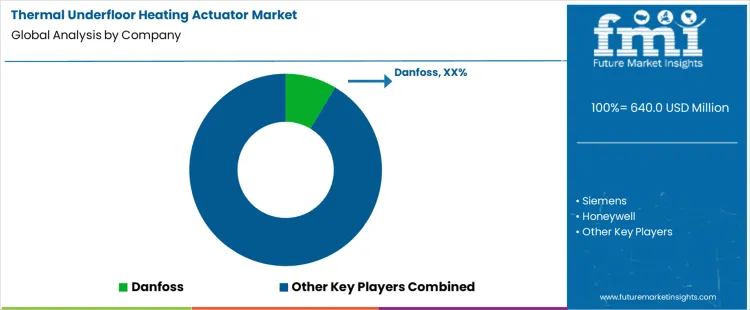
Demand for thermal underfloor heating actuators is driven by building electrification, energy efficiency regulation, and hydronic heating adoption. Buyers evaluate actuation reliability, response time, power consumption, noise levels, installation compatibility, and control integration accuracy. Procurement behavior prioritizes standardized specifications, long service life, supplier certifications, and availability across regional distribution networks. Purchasing decisions emphasize total installed cost, interoperability with thermostats, maintenance simplicity, and compliance with building automation standards. Trend in the thermal underfloor heating actuator market reflects smart control integration, retrofit driven demand, and preference for low energy normally closed actuator designs.
Danfoss leads competitive positioning through hydronic expertise, broad actuator portfolios, and strong presence across residential and commercial heating systems. Siemens supports demand via building automation integration, actuator reliability, and alignment with digital control platforms. Honeywell competes using established HVAC component credibility, wide installer familiarity, and compatibility with zoning solutions. Schneider Electric maintains relevance through system level energy management integration and global electrical distribution strength. Belimo participates by supplying precision actuators valued for durability, control accuracy, and long operational lifetimes. Competitive differentiation depends on reliability under thermal cycling, control compatibility, installation flexibility, and global service support depth.
Key Players in the Thermal Underfloor Heating Actuator Market
- Danfoss
- Siemens
- Honeywell
- Schneider Electric
- Belimo
Scope of the Report
| Items | Values |
|---|---|
| Quantitative Units | USD million |
| Actuator Type | Thermal Wax Actuators; Electrothermal Actuators; Motorized Actuators; Other |
| Control Type | Normally Closed; Normally Open; Changeover |
| Application | Residential Buildings; Commercial Buildings; District Heating Systems; Other |
| Regions Covered | Asia Pacific, Europe, North America, Latin America, Middle East & Africa |
| Countries Covered | Germany, UK, France, Italy, USA, and 40+ countries |
| Key Companies Profiled | Danfoss; Siemens; Honeywell; Schneider Electric; Belimo |
| Additional Attributes | Dollar sales by actuator type, control type, application, and sales channel; response time consistency and thermal expansion performance affecting zone control accuracy; power consumption and standby efficiency in residential and commercial installations; reliability under continuous cycling in district heating networks; compatibility with manifold systems and building automation protocols; procurement patterns spanning HVAC OEM supply, distributor-led retrofits, and contractor-driven replacement demand. |
Thermal Underfloor Heating Actuator Market by Segment
Actuator Type:
- Thermal Wax Actuators
- Electrothermal Actuators
- Motorized Actuators
- Other
Control Type:
- Normally Closed
- Normally Open
- Changeover
Application:
- Residential Buildings
- Commercial Buildings
- District Heating Systems
- Other
Region:
- Asia Pacific
- China
- Japan
- South Korea
- India
- Australia & New Zealand
- ASEAN
- Rest of Asia Pacific
- Europe
- Germany
- United Kingdom
- France
- Italy
- Spain
- Nordic
- BENELUX
- Rest of Europe
- North America
- United States
- Canada
- Mexico
- Latin America
- Brazil
- Chile
- Rest of Latin America
- Middle East & Africa
- Kingdom of Saudi Arabia
- Other GCC Countries
- Turkey
- South Africa
- Other African Union
- Rest of Middle East & Africa
Bibliography
- International Energy Agency. (2024). Energy efficiency 2024. International Energy Agency.
- European Commission, Directorate-General for Energy. (2023). Perceptions, markets and regulatory frameworks for decarbonisation: Final report (Overview of heating and cooling). European Commission.
- International Organization for Standardization. (2021). Energy performance of buildings—Contribution of building automation, controls and building management—Part 1: General framework and procedures (ISO Standard No. 52120-1:2021). International Organization for Standardization.
Frequently Asked Questions
How big is the thermal underfloor heating actuator market in 2026?
The global thermal underfloor heating actuator market is estimated to be valued at USD 640.0 million in 2026.
What will be the size of thermal underfloor heating actuator market in 2036?
The market size for the thermal underfloor heating actuator market is projected to reach USD 1,433.7 million by 2036.
How much will be the thermal underfloor heating actuator market growth between 2026 and 2036?
The thermal underfloor heating actuator market is expected to grow at a 8.4% CAGR between 2026 and 2036.
What are the key product types in the thermal underfloor heating actuator market?
The key product types in thermal underfloor heating actuator market are thermal wax actuators, electrothermal actuators, motorized actuators and other.
Which control type segment to contribute significant share in the thermal underfloor heating actuator market in 2026?
In terms of control type, normally closed segment to command 52.0% share in the thermal underfloor heating actuator market in 2026.
Preview the report firsthand - request a free sample
Get SampleGet the brochure for pricing and purchase details.
Get PDFTable of Content
- Executive Summary
- Global Market Outlook
- Demand-side Trends
- Supply-side Trends
- Technology Roadmap Analysis
- Analysis and Recommendations
- Market Overview
- Market Coverage / Taxonomy
- Market Definition / Scope / Limitations
- Market Background
- Market Dynamics
- Drivers
- Restraints
- Opportunity
- Trends
- Scenario Forecast
- Demand in Optimistic Scenario
- Demand in Likely Scenario
- Demand in Conservative Scenario
- Opportunity Map Analysis
- Product Life Cycle Analysis
- Supply Chain Analysis
- Investment Feasibility Matrix
- Value Chain Analysis
- PESTLE and Porter’s Analysis
- Regulatory Landscape
- Regional Parent Market Outlook
- Production and Consumption Statistics
- Import and Export Statistics
- Market Dynamics
- Global Market Analysis 2021 to 2025 and Forecast, 2026 to 2036
- Historical Market Size Value (USD Million) Analysis, 2021 to 2025
- Current and Future Market Size Value (USD Million) Projections, 2026 to 2036
- Y-o-Y Growth Trend Analysis
- Absolute $ Opportunity Analysis
- Global Market Pricing Analysis 2021 to 2025 and Forecast 2026 to 2036
- Global Market Analysis 2021 to 2025 and Forecast 2026 to 2036, By Actuator Type
- Introduction / Key Findings
- Historical Market Size Value (USD Million) Analysis By Actuator Type, 2021 to 2025
- Current and Future Market Size Value (USD Million) Analysis and Forecast By Actuator Type, 2026 to 2036
- Thermal Wax Actuators
- Electrothermal Actuators
- Motorized Actuators
- Other
- Thermal Wax Actuators
- Y-o-Y Growth Trend Analysis By Actuator Type, 2021 to 2025
- Absolute $ Opportunity Analysis By Actuator Type, 2026 to 2036
- Global Market Analysis 2021 to 2025 and Forecast 2026 to 2036, By Control Type
- Introduction / Key Findings
- Historical Market Size Value (USD Million) Analysis By Control Type, 2021 to 2025
- Current and Future Market Size Value (USD Million) Analysis and Forecast By Control Type, 2026 to 2036
- Normally Closed
- Normally Open
- Changeover
- Normally Closed
- Y-o-Y Growth Trend Analysis By Control Type, 2021 to 2025
- Absolute $ Opportunity Analysis By Control Type, 2026 to 2036
- Global Market Analysis 2021 to 2025 and Forecast 2026 to 2036, By Application
- Introduction / Key Findings
- Historical Market Size Value (USD Million) Analysis By Application, 2021 to 2025
- Current and Future Market Size Value (USD Million) Analysis and Forecast By Application, 2026 to 2036
- Residential Buildings
- Commercial Buildings
- District Heating Systems
- Other
- Residential Buildings
- Y-o-Y Growth Trend Analysis By Application, 2021 to 2025
- Absolute $ Opportunity Analysis By Application, 2026 to 2036
- Global Market Analysis 2021 to 2025 and Forecast 2026 to 2036, By Region
- Introduction
- Historical Market Size Value (USD Million) Analysis By Region, 2021 to 2025
- Current Market Size Value (USD Million) Analysis and Forecast By Region, 2026 to 2036
- North America
- Latin America
- Western Europe
- Eastern Europe
- East Asia
- South Asia and Pacific
- Middle East & Africa
- Market Attractiveness Analysis By Region
- North America Market Analysis 2021 to 2025 and Forecast 2026 to 2036, By Country
- Historical Market Size Value (USD Million) Trend Analysis By Market Taxonomy, 2021 to 2025
- Market Size Value (USD Million) Forecast By Market Taxonomy, 2026 to 2036
- By Country
- USA
- Canada
- Mexico
- By Actuator Type
- By Control Type
- By Application
- By Country
- Market Attractiveness Analysis
- By Country
- By Actuator Type
- By Control Type
- By Application
- Key Takeaways
- Latin America Market Analysis 2021 to 2025 and Forecast 2026 to 2036, By Country
- Historical Market Size Value (USD Million) Trend Analysis By Market Taxonomy, 2021 to 2025
- Market Size Value (USD Million) Forecast By Market Taxonomy, 2026 to 2036
- By Country
- Brazil
- Chile
- Rest of Latin America
- By Actuator Type
- By Control Type
- By Application
- By Country
- Market Attractiveness Analysis
- By Country
- By Actuator Type
- By Control Type
- By Application
- Key Takeaways
- Western Europe Market Analysis 2021 to 2025 and Forecast 2026 to 2036, By Country
- Historical Market Size Value (USD Million) Trend Analysis By Market Taxonomy, 2021 to 2025
- Market Size Value (USD Million) Forecast By Market Taxonomy, 2026 to 2036
- By Country
- Germany
- UK
- Italy
- Spain
- France
- Nordic
- BENELUX
- Rest of Western Europe
- By Actuator Type
- By Control Type
- By Application
- By Country
- Market Attractiveness Analysis
- By Country
- By Actuator Type
- By Control Type
- By Application
- Key Takeaways
- Eastern Europe Market Analysis 2021 to 2025 and Forecast 2026 to 2036, By Country
- Historical Market Size Value (USD Million) Trend Analysis By Market Taxonomy, 2021 to 2025
- Market Size Value (USD Million) Forecast By Market Taxonomy, 2026 to 2036
- By Country
- Russia
- Poland
- Hungary
- Balkan & Baltic
- Rest of Eastern Europe
- By Actuator Type
- By Control Type
- By Application
- By Country
- Market Attractiveness Analysis
- By Country
- By Actuator Type
- By Control Type
- By Application
- Key Takeaways
- East Asia Market Analysis 2021 to 2025 and Forecast 2026 to 2036, By Country
- Historical Market Size Value (USD Million) Trend Analysis By Market Taxonomy, 2021 to 2025
- Market Size Value (USD Million) Forecast By Market Taxonomy, 2026 to 2036
- By Country
- China
- Japan
- South Korea
- By Actuator Type
- By Control Type
- By Application
- By Country
- Market Attractiveness Analysis
- By Country
- By Actuator Type
- By Control Type
- By Application
- Key Takeaways
- South Asia and Pacific Market Analysis 2021 to 2025 and Forecast 2026 to 2036, By Country
- Historical Market Size Value (USD Million) Trend Analysis By Market Taxonomy, 2021 to 2025
- Market Size Value (USD Million) Forecast By Market Taxonomy, 2026 to 2036
- By Country
- India
- ASEAN
- Australia & New Zealand
- Rest of South Asia and Pacific
- By Actuator Type
- By Control Type
- By Application
- By Country
- Market Attractiveness Analysis
- By Country
- By Actuator Type
- By Control Type
- By Application
- Key Takeaways
- Middle East & Africa Market Analysis 2021 to 2025 and Forecast 2026 to 2036, By Country
- Historical Market Size Value (USD Million) Trend Analysis By Market Taxonomy, 2021 to 2025
- Market Size Value (USD Million) Forecast By Market Taxonomy, 2026 to 2036
- By Country
- Kingdom of Saudi Arabia
- Other GCC Countries
- Turkiye
- South Africa
- Other African Union
- Rest of Middle East & Africa
- By Actuator Type
- By Control Type
- By Application
- By Country
- Market Attractiveness Analysis
- By Country
- By Actuator Type
- By Control Type
- By Application
- Key Takeaways
- Key Countries Market Analysis
- USA
- Pricing Analysis
- Market Share Analysis, 2025
- By Actuator Type
- By Control Type
- By Application
- Canada
- Pricing Analysis
- Market Share Analysis, 2025
- By Actuator Type
- By Control Type
- By Application
- Mexico
- Pricing Analysis
- Market Share Analysis, 2025
- By Actuator Type
- By Control Type
- By Application
- Brazil
- Pricing Analysis
- Market Share Analysis, 2025
- By Actuator Type
- By Control Type
- By Application
- Chile
- Pricing Analysis
- Market Share Analysis, 2025
- By Actuator Type
- By Control Type
- By Application
- Germany
- Pricing Analysis
- Market Share Analysis, 2025
- By Actuator Type
- By Control Type
- By Application
- UK
- Pricing Analysis
- Market Share Analysis, 2025
- By Actuator Type
- By Control Type
- By Application
- Italy
- Pricing Analysis
- Market Share Analysis, 2025
- By Actuator Type
- By Control Type
- By Application
- Spain
- Pricing Analysis
- Market Share Analysis, 2025
- By Actuator Type
- By Control Type
- By Application
- France
- Pricing Analysis
- Market Share Analysis, 2025
- By Actuator Type
- By Control Type
- By Application
- India
- Pricing Analysis
- Market Share Analysis, 2025
- By Actuator Type
- By Control Type
- By Application
- ASEAN
- Pricing Analysis
- Market Share Analysis, 2025
- By Actuator Type
- By Control Type
- By Application
- Australia & New Zealand
- Pricing Analysis
- Market Share Analysis, 2025
- By Actuator Type
- By Control Type
- By Application
- China
- Pricing Analysis
- Market Share Analysis, 2025
- By Actuator Type
- By Control Type
- By Application
- Japan
- Pricing Analysis
- Market Share Analysis, 2025
- By Actuator Type
- By Control Type
- By Application
- South Korea
- Pricing Analysis
- Market Share Analysis, 2025
- By Actuator Type
- By Control Type
- By Application
- Russia
- Pricing Analysis
- Market Share Analysis, 2025
- By Actuator Type
- By Control Type
- By Application
- Poland
- Pricing Analysis
- Market Share Analysis, 2025
- By Actuator Type
- By Control Type
- By Application
- Hungary
- Pricing Analysis
- Market Share Analysis, 2025
- By Actuator Type
- By Control Type
- By Application
- Kingdom of Saudi Arabia
- Pricing Analysis
- Market Share Analysis, 2025
- By Actuator Type
- By Control Type
- By Application
- Turkiye
- Pricing Analysis
- Market Share Analysis, 2025
- By Actuator Type
- By Control Type
- By Application
- South Africa
- Pricing Analysis
- Market Share Analysis, 2025
- By Actuator Type
- By Control Type
- By Application
- USA
- Market Structure Analysis
- Competition Dashboard
- Competition Benchmarking
- Market Share Analysis of Top Players
- By Regional
- By Actuator Type
- By Control Type
- By Application
- Competition Analysis
- Competition Deep Dive
- Danfoss
- Overview
- Product Portfolio
- Profitability by Market Segments (Product/Age /Sales Channel/Region)
- Sales Footprint
- Strategy Overview
- Marketing Strategy
- Product Strategy
- Channel Strategy
- Siemens
- Honeywell
- Schneider Electric
- Belimo
- Danfoss
- Competition Deep Dive
- Assumptions & Acronyms Used
- Research Methodology


