

- Industry Size (2026)
- USD 551.0 Mn
- Forecast (2036)
- USD 1010 Mn
- CAGR (2026 to 2036)
- 6.1%
Thermal Mass Concrete Additives Market Forecast and Outlook 2026 to 2036
The thermal mass concrete additives market is estimated at USD 551.0 million in 2026 and projected to reach USD 996.1 million by 2036, registering a CAGR of 6.1%. Phase-change material (PCM) microcapsules lead the additive type segment, primarily deployed in commercial buildings through ready-mix admixtures for moderate thermal storage. High-density aggregates and conductive graphite/carbon additives are widely integrated into industrial, residential, and retrofit applications. End users include construction contractors, industrial facility operators, and residential developers, driven by rising interest in energy-efficient building solutions and enhanced indoor thermal performance.
Growth is supported by increased adoption in data centers, high-performance commercial complexes, and urban residential developments targeting energy savings. Precast elements, panels, and overlays are becoming common integration methods, enabling rapid construction cycles and reduced thermal loss. Market expansion is also influenced by regulatory standards promoting energy efficiency and sustainability in buildings. Companies providing multi-functional additive packages and hybrid thermal solutions are expected to capture significant market share over the forecast period.
Quick Stats of the Thermal Mass Concrete Additives Market:
- Thermal Mass Concrete Additives Market Value (2026): USD 551.0 million
- Thermal Mass Concrete Additives Market Forecast Value (2036): USD 996 million
- Thermal Mass Concrete Additives Market Forecast CAGR (2026 to 2036): 6.1%
- Leading Additive Type in the Market: PCM Microcapsules (32%)
- Key Growth Regions in the Market: China, Brazil, USA, Germany, UK
- Top Players in the Market: BASF, Sika, Saint-Gobain, Holcim (Solutions & Products), Heidelberg Materials, Dow, Evonik, 3M, CEMEX, Wacker Chemie
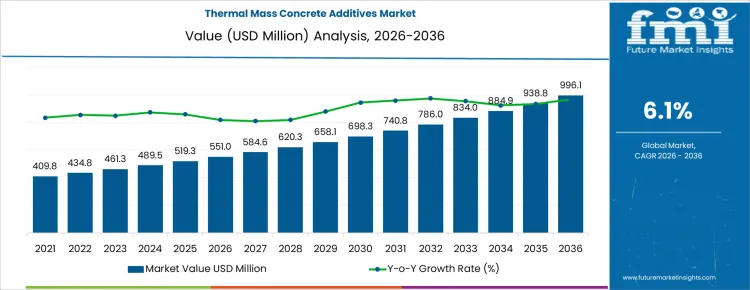
What is the Growth Forecast for the Thermal Mass Concrete Additives Market through 2036?
The market grows from USD 551 million to USD 732 million, representing the first five-year growth block. Growth is driven by adoption in residential and commercial construction targeting energy-efficient thermal mass designs, particularly in temperate and hot climates. Annual additions average USD 36 million per year, with uptake concentrated in high-value infrastructure projects, sustainable housing, and institutional buildings. North America and Europe account for around 60% of early adoption, while Asia Pacific begins scaling pilot applications in high-density urban developments. Demand is shaped by formulation optimization for thermal retention, workability, and compatibility with local cement blends.
Thermal Mass Concrete Additives Market Key Takeaways
| Metric | Value |
|---|---|
| Market Value (2026) | USD 551.0 million |
| Forecast Value (2036) | USD 1,010 million |
| Forecast CAGR (2026 to 2036) | 6.1% |
What Is Driving the Demand for the Thermal Mass Concrete Additives Market?
Demand for thermal mass concrete additives arose from persistent limitations in conventional concrete materials when used in environments with significant temperature fluctuations. Standard concrete mixes provide basic thermal inertia due to inherent density, but they do not optimise heat storage and release to moderate building interior temperatures. Early research and pilot projects in energy-efficient buildings explored additives such as phase change materials, lightweight aggregates, and microencapsulated thermal enhancers to improve heat absorption and release properties.
Uptake was initially concentrated in experimental architecture, institutional facilities, and specialised retrofit projects where energy performance metrics were explicitly tracked. Future demand for thermal mass concrete additives is expected to reflect regulatory drivers and building performance standards that extend beyond basic structural requirements to include energy reduction outcomes. As jurisdictions adopt stricter building energy codes and net zero carbon targets, designers and contractors will specify concrete systems that contribute measurable gains in thermal regulation.
Advances in additive technologies, including engineered phase change materials and advanced mineral modifiers, will improve compatibility with standard concrete production and maintain mechanical properties while enhancing thermal storage. Demand will align with energy performance certification programmes and lifecycle cost analyses that value reduced heating and cooling loads.
What Factors Are Affecting the Demand for Thermal Mass Concrete Additives Market in Terms of Additive Type and Building Application?
Demand for thermal mass concrete additives develops from how buildings manage heat absorption and release over daily operating cycles. PCM microcapsules represent about 32% of demand because they enable latent heat storage within defined temperature ranges. High density aggregates, conductive carbon based additives, and other thermal performance modifiers address different thermal response profiles without relying on phase change behavior. Building application segmentation reflects how heat loads vary by use. Commercial buildings account for about 34% of demand due to predictable occupancy and HVAC cycling. Industrial facilities, data centers, residential buildings, and infrastructure projects apply thermal mass additives selectively based on internal heat generation and operating schedules rather than structural design considerations.
What Drives Demand by Additive Type in the Thermal Mass Concrete Additives Market?
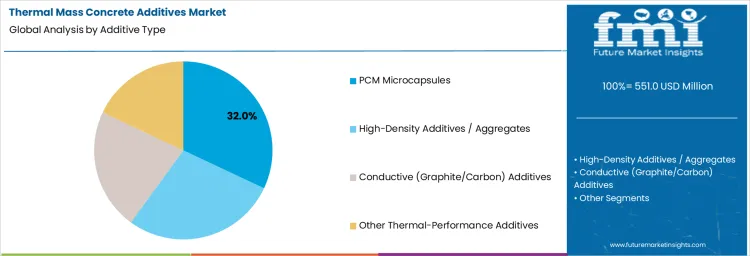
PCM microcapsules lead demand with a 32% share because they directly dampen indoor temperature fluctuation without increasing structural mass. Their value lies in controlled heat absorption and release during peak load periods. High density additives and aggregates are selected where physical mass increase is acceptable and space is constrained. Conductive graphite and carbon additives are applied to improve heat distribution within concrete elements rather than storage capacity. Other thermal performance additives address niche design objectives. Additive type selection is driven by thermal modeling outcomes and target temperature profiles. Demand therefore reflects functional thermal behavior during building operation rather than contribution to mechanical strength or durability.
Additive demand remains stable once thermal strategies are fixed during design. PCM systems are incorporated where passive temperature control is prioritized. High density aggregates are favored in industrial environments with constant heat loads. Conductive additives remain limited to designs requiring faster heat transfer. Designers avoid changing additive strategies after simulation and approval stages. This constrains rapid shifts between additive categories. Additive type demand therefore aligns with early stage energy modeling decisions rather than construction phase variability.
How Does Building Application Shape Demand for Thermal Mass Concrete Additives Market?
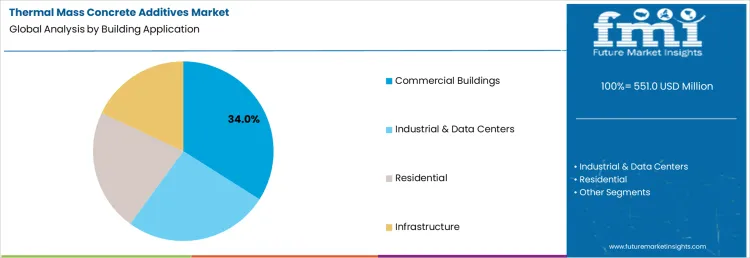
Commercial buildings account for about 34% of total demand, reflecting regular occupancy patterns and sensitivity to peak energy loads. Thermal mass additives are used to moderate internal temperatures during working hours. Industrial buildings and data centers apply thermal mass to stabilize environments with continuous heat generation. Residential use remains selective due to varied occupancy and climate conditions. Infrastructure projects adopt thermal mass additives where temperature buffering supports service life or operational stability. Application driven demand depends on internal heat profiles and energy management priorities rather than total floor area.
Commercial applications maintain leadership because energy savings can be modeled and recovered over time. Industrial and data center projects apply additives where thermal stability protects equipment. Residential adoption varies by region and building design. Infrastructure usage remains project specific. Once specified, additive use is rarely altered during construction. This stabilizes demand by application. Building application segmentation therefore reflects operational heat behavior rather than construction volume.
How Are Thermal Mass Concrete Additives Being Applied Across Building and Infrastructure Projects?
Use appears in concrete mixes where heat storage and temperature regulation are critical for energy efficiency. Residential and commercial building floors, walls, and ceilings incorporate thermal mass additives to absorb, store, and gradually release heat, reducing heating and cooling loads. Industrial facilities apply them in slab-on-grade floors to moderate temperature fluctuations and maintain process stability. Precast and mass concrete applications use additives to improve thermal inertia while minimizing cracking from differential temperatures. These applications reflect operational and energy efficiency priorities rather than aesthetic considerations, with adoption driven by performance, sustainability, and occupant comfort.
What Operational and Material Conditions Support Adoption of Thermal Mass Concrete Additives?
Selection aligns with mixes requiring controlled density, workability, and curing behavior while enhancing specific heat capacity. Concrete technologists optimize additive type and dosage to balance thermal storage with compressive strength and durability. Contractors value additives compatible with conventional mixing and placement techniques. Architects and engineers specify thermal mass performance to support building energy codes and sustainability targets. Construction teams monitor hydration heat and temperature profiles to avoid thermal cracking. These conditions emerge from operational efficiency, structural integrity, and energy performance priorities within structured concrete workflows.
Which Practical Considerations Limit Wider Use of Thermal Mass Concrete Additives?
Cost per cubic meter can be higher than standard mixes, influencing adoption in budget-sensitive projects. Compatibility with cement type, admixtures, and aggregate composition requires validation. Variations in thermal conductivity and specific heat may limit performance in certain climates or structural elements. Placement and curing protocols may require adjustment to prevent differential shrinkage or cracking. Long-term performance validation may be needed to satisfy energy code requirements. These factors lead to selective deployment where energy efficiency, structural integrity, and sustainability benefits justify incremental cost and operational planning.
What is the Demand for Thermal Mass Concrete Additives by Country?
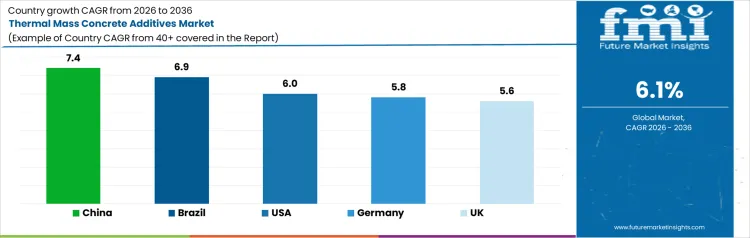
| Country | CAGR (%) |
|---|---|
| USA | 6.0% |
| Germany | 5.8% |
| China | 7.4% |
| UK | 5.6% |
| Brazil | 6.9% |
The demand for thermal mass concrete additives varies across countries, driven by energy efficient building practices, construction growth, and adoption of enhanced concrete formulations. China leads with a 7.4% CAGR, supported by rapid urbanization, large scale residential and commercial projects, and focus on energy efficient construction. Brazil follows at 6.9%, driven by infrastructure development and growing adoption of thermal mass solutions for sustainable buildings. The USA grows at 6.0%, reflecting steady use in commercial and residential construction for improved energy performance. Germany records 5.8%, shaped by strict building codes and sustainable construction standards. The UK posts 5.6%, supported by adoption in energy efficient building projects and retrofitting applications.
How Is Thermal Mass Optimization Driving Growth in the United States?
In the United States, revenue from the Thermal Mass Concrete Additives Market is expanding at a CAGR of 6.0% through 2035, driven by adoption of additives that improve heat storage, energy efficiency, and durability in concrete structures. Manufacturers are integrating thermal mass additives in commercial, residential, and infrastructure projects to enhance temperature regulation and reduce energy consumption. Demand is concentrated in high-rise buildings, industrial facilities, and large-scale construction projects. Domestic suppliers provide high-performance additives compatible with cementitious systems and standard mixing processes. Energy efficiency requirements, sustainability initiatives, and recurring construction cycles are sustaining predictable procurement nationwide.
- Commercial, residential, and infrastructure projects adopt thermal mass concrete additives
- Additives enhance heat storage, energy efficiency, and durability
- Domestic suppliers provide high-performance, cement-compatible additives
- Recurring construction cycles sustain predictable procurement
How Are Energy Efficiency Standards Supporting Growth in Germany?
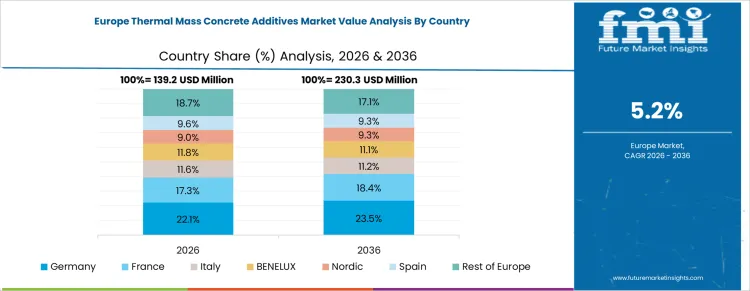
Germany continues to record steady growth in the Thermal Mass Concrete Additives Market at a CAGR of 5.8% through 2035, supported by energy efficiency regulations and sustainable construction practices. Manufacturers are integrating additives to improve thermal storage, reduce heating and cooling loads, and enhance concrete durability. Demand is concentrated in commercial buildings, industrial projects, and infrastructure applications. Domestic suppliers provide additives engineered for consistent performance, cement compatibility, and long-term thermal stability. Regulatory compliance, energy efficiency targets, and recurring construction activity are sustaining measured adoption nationwide.
- Commercial, industrial, and infrastructure applications drive additive adoption
- Additives improve heat storage, reduce energy loads, and enhance durability
- Domestic suppliers provide cement-compatible, high-performance additives
- Recurring construction activity sustains predictable procurement
How Is Infrastructure and Residential Expansion Accelerating Adoption in China?
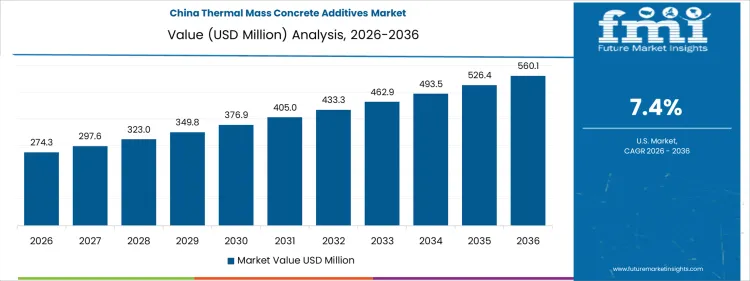
In China, revenue from the Thermal Mass Concrete Additives Market is growing at a CAGR of 7.4% through 2035, driven by rapid urbanization and construction of residential, commercial, and infrastructure projects. Manufacturers are adopting thermal mass additives to improve concrete heat retention, reduce building energy consumption, and enhance structural performance. Demand is strong across high-rise buildings, industrial facilities, and large-scale public projects. Domestic suppliers are scaling production of additives compatible with cementitious systems and modern mixing processes. High construction volumes and structured procurement programs are sustaining rapid adoption nationwide.
- High-rise, industrial, and infrastructure projects drive thermal mass additive adoption
- Additives enhance heat retention, reduce energy consumption, and improve structural performance
- Domestic suppliers scale production of cement-compatible additives
- High construction volumes sustain consistent adoption
How Is Sustainable Building Supporting Growth in the United Kingdom?
In the United Kingdom, revenue from the Thermal Mass Concrete Additives Market is expanding at a CAGR of 5.6% through 2035, supported by adoption of energy-efficient and sustainable construction practices. Manufacturers are integrating additives in commercial, residential, and infrastructure projects to improve thermal regulation, reduce HVAC loads, and enhance concrete durability. Demand is concentrated in building construction, civil engineering, and industrial facilities. Domestic suppliers provide high-quality additives compatible with cement-based concrete and standard mixing processes. Energy efficiency standards, durability requirements, and recurring construction cycles are sustaining predictable procurement nationwide.
- Commercial, residential, and infrastructure projects anchor thermal mass additive demand
- Additives improve thermal regulation, reduce HVAC loads, and enhance durability
- Domestic suppliers provide cement-compatible, high-quality additives
- Recurring construction cycles sustain predictable procurement
How Is Civil and Industrial Construction Supporting Adoption in Brazil?
Brazil is seeing strong growth in the Thermal Mass Concrete Additives Market at a CAGR of 6.9% through 2035, supported by rising residential, commercial, and industrial construction. Manufacturers are adopting thermal mass additives to enhance concrete heat storage, reduce building energy consumption, and improve durability. Demand is concentrated in high-rise buildings, infrastructure, and industrial facilities. Domestic suppliers are expanding production of high-performance additives compatible with cementitious systems. Growth in construction projects, energy efficiency initiatives, and recurring construction cycles are sustaining robust procurement nationwide.
- High-rise, infrastructure, and industrial projects drive thermal mass additive adoption
- Additives enhance heat storage, reduce energy consumption, and improve durability
- Domestic suppliers expand high-performance cement-compatible additives
- Recurring construction cycles sustain robust procurement
Which Companies Are Shaping Competition in The Thermal Mass Concrete Additives Market Through Design Practice and Project Specification?
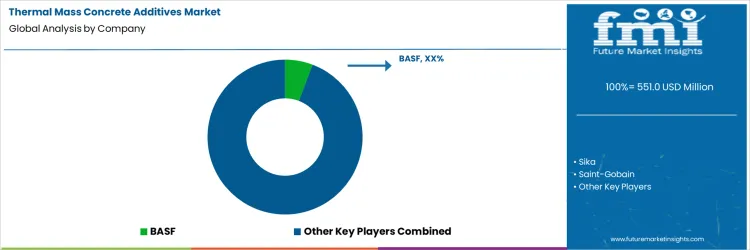
Competition in the Thermal Mass Concrete Additives Market is influenced less by standalone additive categories and more by how thermal behavior is addressed during building design. In many projects, thermal mass performance is achieved through mix optimization rather than dedicated products, which places upstream chemical suppliers such as BASF, Dow, Evonik, and Wacker Chemie in a supporting role. Their additives are selected to fine tune moisture movement, density, and heat transfer characteristics within standard concrete formulations. These materials are rarely specified independently and are instead embedded within broader mix designs developed in collaboration with engineers and concrete producers. Adoption depends on predictability across climates and construction schedules, reinforcing conservative material choices.
System level control defines competitive positioning among construction material groups. Sika and Saint Gobain influence outcomes by linking thermal performance to durability, curing behavior, and building envelope interaction within their construction solutions. Holcim Solutions and Products, Heidelberg Materials, and CEMEX shape demand directly through ready mix and cement offerings where thermal mass is addressed during batching and placement. 3M participates selectively through specialty materials used in niche heat management roles rather than core concrete systems. Local ready mix producers play a decisive role by translating design intent into workable mixes suited to regional conditions. Competitive advantage rests on technical coordination, specification trust, and execution consistency rather than additive novelty.
Key Players in the Thermal Mass Concrete Additives Market
- BASF
- Sika
- Saint-Gobain
- Holcim (Solutions & Products)
- Heidelberg Materials
- Dow
- Evonik
- 3M
- CEMEX
- Wacker Chemie
Scope of the Report
| Items | Values |
|---|---|
| Quantitative Units (2026) | USD million |
| Additive Type | PCM Microcapsules; High-Density Additives / Aggregates; Conductive (Graphite/Carbon) Additives; Other Thermal-Performance Additives |
| Building Application | Commercial Buildings; Industrial & Data Centers; Residential; Infrastructure |
| Integration Method | Ready-Mix Admixture; Precast Elements; Retrofit Toppings / Overlays; Panels / Blocks |
| Performance Specification | Moderate Thermal Storage; High Thermal Storage; Enhanced Conductivity; Multi-Functional Packages |
| Region | Asia Pacific; Europe; North America; Latin America; Middle East & Africa |
| Countries Covered | China; Japan; South Korea; India; Australia & New Zealand; ASEAN; Germany; United Kingdom; France; Italy; Spain; Nordic; BENELUX; United States; Canada; Mexico; Brazil; Chile; Kingdom of Saudi Arabia; Other GCC Countries; Turkey; South Africa; Other African Union; Rest of Asia Pacific; Rest of Europe; Rest of Latin America; Rest of Middle East & Africa |
| Key Companies Profiled | BASF; Sika; Saint-Gobain; Holcim (Solutions & Products); Heidelberg Materials; Dow; Evonik; 3M; CEMEX; Wacker Chemie |
| Additional Attributes | Dollar by sales across additive type, building application, and integration method; PCM microcapsules dominate due to latent heat storage; High-density aggregates and conductive additives applied in industrial and retrofit applications; Early adoption concentrated in commercial buildings and high-rise residential projects; Adoption influenced by energy-efficiency regulations and building codes; Multi-functional and hybrid thermal solutions support portfolio expansion; Repeat procurement and standardized integration methods reinforce structural market growth; Suppliers provide technical support for mix optimization, heat retention performance, and compatibility with cement systems; Regional growth driven by urbanization, infrastructure expansion, and sustainability targets; Demand formation shaped by operational thermal requirements rather than structural load or construction volume. |
Thermal Mass Concrete Additives Market Segmentation
Additive Type:
- PCM Microcapsules
- High-Density Additives / Aggregates
- Conductive (Graphite/Carbon) Additives
- Other Thermal-Performance Additives
Building Application:
- Commercial Buildings
- Industrial & Data Centers
- Residential
- Infrastructure
Integration Method:
- Ready-Mix Admixture
- Precast Elements
- Retrofit Toppings / Overlays
- Panels / Blocks
Performance Spec:
- Moderate Thermal Storage
- High Thermal Storage
- Enhanced Conductivity
- Multi-Functional Packages
Region
- Asia Pacific
- China
- Japan
- South Korea
- India
- Australia & New Zealand
- ASEAN
- Rest of Asia Pacific
- Europe
- Germany
- United Kingdom
- France
- Italy
- Spain
- Nordic
- BENELUX
- Rest of Europe
- North America
- United States
- Canada
- Mexico
- Latin America
- Brazil
- Chile
- Rest of Latin America
- Middle East & Africa
- Kingdom of Saudi Arabia
- Other GCC Countries
- Turkey
- South Africa
- Other African Union
- Rest of Middle East & Africa
Frequently Asked Questions
How big is the thermal mass concrete additives market in 2026?
The global thermal mass concrete additives market is estimated to be valued at USD 551.0 million in 2026.
What will be the size of thermal mass concrete additives market in 2036?
The market size for the thermal mass concrete additives market is projected to reach USD 996.1 million by 2036.
How much will be the thermal mass concrete additives market growth between 2026 and 2036?
The thermal mass concrete additives market is expected to grow at a 6.1% CAGR between 2026 and 2036.
What are the key product types in the thermal mass concrete additives market?
The key product types in thermal mass concrete additives market are pcm microcapsules, high-density additives / aggregates, conductive (graphite/carbon) additives and other thermal-performance additives.
Which building application segment to contribute significant share in the thermal mass concrete additives market in 2026?
In terms of building application, commercial buildings segment to command 34.0% share in the thermal mass concrete additives market in 2026.
Preview the report firsthand - request a free sample
Get SampleGet the brochure for pricing and purchase details.
Get PDFTable of Content
- Executive Summary
- Global Market Outlook
- Demand-side Trends
- Supply-side Trends
- Technology Roadmap Analysis
- Analysis and Recommendations
- Market Overview
- Market Coverage / Taxonomy
- Market Definition / Scope / Limitations
- Market Background
- Market Dynamics
- Drivers
- Restraints
- Opportunity
- Trends
- Scenario Forecast
- Demand in Optimistic Scenario
- Demand in Likely Scenario
- Demand in Conservative Scenario
- Opportunity Map Analysis
- Product Life Cycle Analysis
- Supply Chain Analysis
- Investment Feasibility Matrix
- Value Chain Analysis
- PESTLE and Porter’s Analysis
- Regulatory Landscape
- Regional Parent Market Outlook
- Production and Consumption Statistics
- Import and Export Statistics
- Market Dynamics
- Global Market Analysis 2021 to 2025 and Forecast, 2026 to 2036
- Historical Market Size Value (USD Million) Analysis, 2021 to 2025
- Current and Future Market Size Value (USD Million) Projections, 2026 to 2036
- Y-o-Y Growth Trend Analysis
- Absolute $ Opportunity Analysis
- Global Market Pricing Analysis 2021 to 2025 and Forecast 2026 to 2036
- Global Market Analysis 2021 to 2025 and Forecast 2026 to 2036, By Additive Type
- Introduction / Key Findings
- Historical Market Size Value (USD Million) Analysis By Additive Type , 2021 to 2025
- Current and Future Market Size Value (USD Million) Analysis and Forecast By Additive Type , 2026 to 2036
- PCM Microcapsules
- High-Density Additives / Aggregates
- Conductive (Graphite/Carbon) Additives
- Other Thermal-Performance Additives
- Y-o-Y Growth Trend Analysis By Additive Type , 2021 to 2025
- Absolute $ Opportunity Analysis By Additive Type , 2026 to 2036
- Global Market Analysis 2021 to 2025 and Forecast 2026 to 2036, By Building Application
- Introduction / Key Findings
- Historical Market Size Value (USD Million) Analysis By Building Application, 2021 to 2025
- Current and Future Market Size Value (USD Million) Analysis and Forecast By Building Application, 2026 to 2036
- Commercial Buildings
- Industrial & Data Centers
- Residential
- Infrastructure
- Y-o-Y Growth Trend Analysis By Building Application, 2021 to 2025
- Absolute $ Opportunity Analysis By Building Application, 2026 to 2036
- Global Market Analysis 2021 to 2025 and Forecast 2026 to 2036, By Integration Method
- Introduction / Key Findings
- Historical Market Size Value (USD Million) Analysis By Integration Method, 2021 to 2025
- Current and Future Market Size Value (USD Million) Analysis and Forecast By Integration Method, 2026 to 2036
- Ready-Mix Admixture
- Precast Elements
- Retrofit Toppings / Overlays
- Panels / Blocks
- Y-o-Y Growth Trend Analysis By Integration Method, 2021 to 2025
- Absolute $ Opportunity Analysis By Integration Method, 2026 to 2036
- Global Market Analysis 2021 to 2025 and Forecast 2026 to 2036, By Performance Spec
- Introduction / Key Findings
- Historical Market Size Value (USD Million) Analysis By Performance Spec, 2021 to 2025
- Current and Future Market Size Value (USD Million) Analysis and Forecast By Performance Spec, 2026 to 2036
- Moderate Thermal Storage
- High Thermal Storage
- Enhanced Conductivity
- Multi-Functional Packages
- Y-o-Y Growth Trend Analysis By Performance Spec, 2021 to 2025
- Absolute $ Opportunity Analysis By Performance Spec, 2026 to 2036
- Global Market Analysis 2021 to 2025 and Forecast 2026 to 2036, By Region
- Introduction
- Historical Market Size Value (USD Million) Analysis By Region, 2021 to 2025
- Current Market Size Value (USD Million) Analysis and Forecast By Region, 2026 to 2036
- North America
- Latin America
- Western Europe
- Eastern Europe
- East Asia
- South Asia and Pacific
- Middle East & Africa
- Market Attractiveness Analysis By Region
- North America Market Analysis 2021 to 2025 and Forecast 2026 to 2036, By Country
- Historical Market Size Value (USD Million) Trend Analysis By Market Taxonomy, 2021 to 2025
- Market Size Value (USD Million) Forecast By Market Taxonomy, 2026 to 2036
- By Country
- USA
- Canada
- Mexico
- By Additive Type
- By Building Application
- By Integration Method
- By Performance Spec
- By Country
- Market Attractiveness Analysis
- By Country
- By Additive Type
- By Building Application
- By Integration Method
- By Performance Spec
- Key Takeaways
- Latin America Market Analysis 2021 to 2025 and Forecast 2026 to 2036, By Country
- Historical Market Size Value (USD Million) Trend Analysis By Market Taxonomy, 2021 to 2025
- Market Size Value (USD Million) Forecast By Market Taxonomy, 2026 to 2036
- By Country
- Brazil
- Chile
- Rest of Latin America
- By Additive Type
- By Building Application
- By Integration Method
- By Performance Spec
- By Country
- Market Attractiveness Analysis
- By Country
- By Additive Type
- By Building Application
- By Integration Method
- By Performance Spec
- Key Takeaways
- Western Europe Market Analysis 2021 to 2025 and Forecast 2026 to 2036, By Country
- Historical Market Size Value (USD Million) Trend Analysis By Market Taxonomy, 2021 to 2025
- Market Size Value (USD Million) Forecast By Market Taxonomy, 2026 to 2036
- By Country
- Germany
- UK
- Italy
- Spain
- France
- Nordic
- BENELUX
- Rest of Western Europe
- By Additive Type
- By Building Application
- By Integration Method
- By Performance Spec
- By Country
- Market Attractiveness Analysis
- By Country
- By Additive Type
- By Building Application
- By Integration Method
- By Performance Spec
- Key Takeaways
- Eastern Europe Market Analysis 2021 to 2025 and Forecast 2026 to 2036, By Country
- Historical Market Size Value (USD Million) Trend Analysis By Market Taxonomy, 2021 to 2025
- Market Size Value (USD Million) Forecast By Market Taxonomy, 2026 to 2036
- By Country
- Russia
- Poland
- Hungary
- Balkan & Baltic
- Rest of Eastern Europe
- By Additive Type
- By Building Application
- By Integration Method
- By Performance Spec
- By Country
- Market Attractiveness Analysis
- By Country
- By Additive Type
- By Building Application
- By Integration Method
- By Performance Spec
- Key Takeaways
- East Asia Market Analysis 2021 to 2025 and Forecast 2026 to 2036, By Country
- Historical Market Size Value (USD Million) Trend Analysis By Market Taxonomy, 2021 to 2025
- Market Size Value (USD Million) Forecast By Market Taxonomy, 2026 to 2036
- By Country
- China
- Japan
- South Korea
- By Additive Type
- By Building Application
- By Integration Method
- By Performance Spec
- By Country
- Market Attractiveness Analysis
- By Country
- By Additive Type
- By Building Application
- By Integration Method
- By Performance Spec
- Key Takeaways
- South Asia and Pacific Market Analysis 2021 to 2025 and Forecast 2026 to 2036, By Country
- Historical Market Size Value (USD Million) Trend Analysis By Market Taxonomy, 2021 to 2025
- Market Size Value (USD Million) Forecast By Market Taxonomy, 2026 to 2036
- By Country
- India
- ASEAN
- Australia & New Zealand
- Rest of South Asia and Pacific
- By Additive Type
- By Building Application
- By Integration Method
- By Performance Spec
- By Country
- Market Attractiveness Analysis
- By Country
- By Additive Type
- By Building Application
- By Integration Method
- By Performance Spec
- Key Takeaways
- Middle East & Africa Market Analysis 2021 to 2025 and Forecast 2026 to 2036, By Country
- Historical Market Size Value (USD Million) Trend Analysis By Market Taxonomy, 2021 to 2025
- Market Size Value (USD Million) Forecast By Market Taxonomy, 2026 to 2036
- By Country
- Kingdom of Saudi Arabia
- Other GCC Countries
- Turkiye
- South Africa
- Other African Union
- Rest of Middle East & Africa
- By Additive Type
- By Building Application
- By Integration Method
- By Performance Spec
- By Country
- Market Attractiveness Analysis
- By Country
- By Additive Type
- By Building Application
- By Integration Method
- By Performance Spec
- Key Takeaways
- Key Countries Market Analysis
- USA
- Pricing Analysis
- Market Share Analysis, 2025
- By Additive Type
- By Building Application
- By Integration Method
- By Performance Spec
- Canada
- Pricing Analysis
- Market Share Analysis, 2025
- By Additive Type
- By Building Application
- By Integration Method
- By Performance Spec
- Mexico
- Pricing Analysis
- Market Share Analysis, 2025
- By Additive Type
- By Building Application
- By Integration Method
- By Performance Spec
- Brazil
- Pricing Analysis
- Market Share Analysis, 2025
- By Additive Type
- By Building Application
- By Integration Method
- By Performance Spec
- Chile
- Pricing Analysis
- Market Share Analysis, 2025
- By Additive Type
- By Building Application
- By Integration Method
- By Performance Spec
- Germany
- Pricing Analysis
- Market Share Analysis, 2025
- By Additive Type
- By Building Application
- By Integration Method
- By Performance Spec
- UK
- Pricing Analysis
- Market Share Analysis, 2025
- By Additive Type
- By Building Application
- By Integration Method
- By Performance Spec
- Italy
- Pricing Analysis
- Market Share Analysis, 2025
- By Additive Type
- By Building Application
- By Integration Method
- By Performance Spec
- Spain
- Pricing Analysis
- Market Share Analysis, 2025
- By Additive Type
- By Building Application
- By Integration Method
- By Performance Spec
- France
- Pricing Analysis
- Market Share Analysis, 2025
- By Additive Type
- By Building Application
- By Integration Method
- By Performance Spec
- India
- Pricing Analysis
- Market Share Analysis, 2025
- By Additive Type
- By Building Application
- By Integration Method
- By Performance Spec
- ASEAN
- Pricing Analysis
- Market Share Analysis, 2025
- By Additive Type
- By Building Application
- By Integration Method
- By Performance Spec
- Australia & New Zealand
- Pricing Analysis
- Market Share Analysis, 2025
- By Additive Type
- By Building Application
- By Integration Method
- By Performance Spec
- China
- Pricing Analysis
- Market Share Analysis, 2025
- By Additive Type
- By Building Application
- By Integration Method
- By Performance Spec
- Japan
- Pricing Analysis
- Market Share Analysis, 2025
- By Additive Type
- By Building Application
- By Integration Method
- By Performance Spec
- South Korea
- Pricing Analysis
- Market Share Analysis, 2025
- By Additive Type
- By Building Application
- By Integration Method
- By Performance Spec
- Russia
- Pricing Analysis
- Market Share Analysis, 2025
- By Additive Type
- By Building Application
- By Integration Method
- By Performance Spec
- Poland
- Pricing Analysis
- Market Share Analysis, 2025
- By Additive Type
- By Building Application
- By Integration Method
- By Performance Spec
- Hungary
- Pricing Analysis
- Market Share Analysis, 2025
- By Additive Type
- By Building Application
- By Integration Method
- By Performance Spec
- Kingdom of Saudi Arabia
- Pricing Analysis
- Market Share Analysis, 2025
- By Additive Type
- By Building Application
- By Integration Method
- By Performance Spec
- Turkiye
- Pricing Analysis
- Market Share Analysis, 2025
- By Additive Type
- By Building Application
- By Integration Method
- By Performance Spec
- South Africa
- Pricing Analysis
- Market Share Analysis, 2025
- By Additive Type
- By Building Application
- By Integration Method
- By Performance Spec
- USA
- Market Structure Analysis
- Competition Dashboard
- Competition Benchmarking
- Market Share Analysis of Top Players
- By Regional
- By Additive Type
- By Building Application
- By Integration Method
- By Performance Spec
- Competition Analysis
- Competition Deep Dive
- BASF
- Overview
- Product Portfolio
- Profitability by Market Segments (Product/Age /Sales Channel/Region)
- Sales Footprint
- Strategy Overview
- Marketing Strategy
- Product Strategy
- Channel Strategy
- Sika
- Saint-Gobain
- Holcim (Solutions & Products)
- Heidelberg Materials
- Dow
- Evonik
- 3M
- CEMEX
- Wacker Chemie
- BASF
- Competition Deep Dive
- Assumptions & Acronyms Used
- Research Methodology


