

- Industry Size (2026)
- USD 795 Mn
- Forecast (2036)
- USD 1623.3 Mn
- CAGR (2026 to 2036)
- 7.4%
Low-Carbon Concrete Shrinkage-Reduction Additives Market Size, Market Forecast and Outlook By FMI
Summary of the Low-Carbon Concrete Shrinkage-Reduction Additives Market
- Demand and Growth Drivers
- Low-clinker concrete mixes use slag and fly ash to cut carbon intensity, which affects early shrinkage behavior in slabs and bridge decks.
- Ready-mix producers add shrinkage control to reduce cracking risk during drying and to protect concrete service life.
- Public low-carbon material rules move project approval toward mixes with verified carbon and field performance records.
- Product and Segment View
- Shrinkage-reducing admixtures are anticipated to represent 46.0% in 2026 as producers trust direct capillary stress reduction.
- Ready-mix concrete is projected to hold 44.0% in 2026 due to high placement volume and site curing variation.
- Direct supply to ready-mix producers is expected to secure 41.0% of sales route in 2026, reflected by batch plants depending on mix trial support.
- Geography and Competitive Outlook
- China is projected to record 8.8% CAGR by 2036, influenced by large cement output and state focus on lower-emission construction materials.
- Brazil is expected to expand at 8.4% CAGR by 2036 as infrastructure repair and cement output gains support low-carbon admixture trials.
- Key players such as Sika and Master Builders Solutions are focusing on admixture depth as Saint-Gobain expands construction chemicals through Fosroc.
- Analyst Opinion
- Nikhil Kaitwade, Principal Analyst for Chemicals and Materials at FMI, states, “Shrinkage control is moving from a repair-cost issue into a mix approval input for low-carbon concrete. Buyers compare drying shrinkage results and compressive strength before approving lower-clinker mixes. Suppliers able to support plant trials with simple dosage proof should gain access in ready-mix and precast accounts. Demand is expected to follow infrastructure decks and slabs with longer service-life targets by 2036.”
- Low-Carbon Concrete Shrinkage-Reduction Additives Market Value Analysis
- Low-carbon concrete shrinkage-reduction additives are moving from specialty admixture use into a clearer concrete performance input.
- Concrete producers are expected to use such additives to control cracking risk in mixes with lower clinker content.
- Ready-mix suppliers are anticipated to benefit from additive systems that protect durability without forcing major mix-design changes.
- Project owners will prefer formulations that help low-carbon concrete meet strength targets and reduce repair risk over time.
Key Takeaways
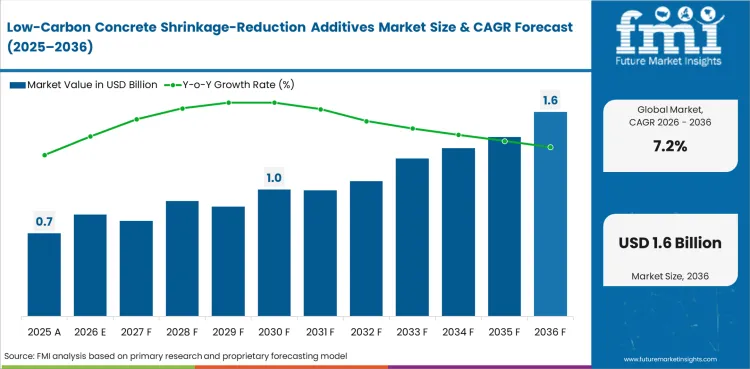
- The low-carbon concrete shrinkage-reduction additives market value stood at USD 0.7 billion in 2025.
- Industry value is projected to reach USD 1.6 billion by 2036 as low-clinker concrete mixes need tighter crack control.
- The market is expected to growt at 7.2% CAGR from 2026 to 2036 across infrastructure and building concrete mixes.
- The sector is projected to create an incremental opportunity of USD 0.8 billion between 2026 and 2036.
- New construction is expected to account for 64.0% share in 2026 as fresh project specifications can add shrinkage control before mix approval.
- China at 8.8% CAGR and Brazil at 8.4% CAGR are expected to record the fastest pace through 2036.
Low-Carbon Concrete Shrinkage-Reduction Additives Market Definition
The sector covers admixtures and additive packages used to reduce plastic, autogenous, and drying shrinkage in low-carbon concrete systems. Included products cover shrinkage-reducing admixtures, internal curing agents, expansive agents, fiber-based shrinkage control, and hybrid systems. The scope includes products used with blended cement, slag cement, fly ash mixes, calcined clay cement, and recycled aggregate concrete. Finished concrete, cement production equipment, and general water reducers without shrinkage-control claims remain outside this study.
Low-Carbon Concrete Shrinkage-Reduction Additives Market Inclusions
Market scope covers all commercially traded shrinkage-reduction additive products categorized by chemistry type, including glycol ether-based additives and polyol-based additives; concrete type, including ready-mix concrete and precast concrete; application, including slabs, pavements, bridge decks, and low-clinker structural mixes; and end users, including ready-mix producers, precast manufacturers, infrastructure contractors, and building developers. Revenue scope covers 2026 to 2036. Participants include admixture manufacturers, raw material suppliers, cement producers, concrete producers, precast companies, construction contractors, infrastructure agencies, engineering consultants, testing labs, distributors, and regulatory bodies.
Low-Carbon Concrete Shrinkage-Reduction Additives Market Exclusions
The study excludes finished cement, fly ash, slag powder, fiber reinforcement sold without shrinkage claims, concrete repair mortars, curing membranes, waterproofing membranes, and carbon capture equipment.
Low-Carbon Concrete Shrinkage-Reduction Additives Market Research Methodology
- Primary Research: FMI analysts reviewed ready-mix producers, precast plants, and admixture suppliers using shrinkage-control additives in lower-clinker concrete. Interviews focused on dosage ranges and drying shrinkage testing.
- Desk Research: The desk review used USGS cement data, IEA cement decarbonization guidance, FHWA low-carbon material programs, and official company actions after January 2024.
- Market Sizing and Forecasting: Forecast work combined concrete admixture use with low-carbon concrete mix penetration and shrinkage-control dose bands.
- Data Validation: Segment shares were checked against concrete type use and additive qualification needs before regional construction material review.
Why is the Low-Carbon Concrete Shrinkage-Reduction Additives Market Growing?
-
Low-carbon concrete mixes using supplementary cementitious materials depend on tighter shrinkage control because SCM type and dosage affect water demand and early slab stability.
- GSA listed low embodied carbon concrete limits by strength class in April 2025 and influences federal acceptance of verified low-carbon concrete mixes.
- FHWA opened USD 800 million in August 2024 for low-carbon transportation materials after making USD 1.2 billion available to state DOTs in March 2024.
- Fosroc started the HORSUPAL project in April 2025 to develop admixtures for low-CO₂ concrete made with recycled aggregates.
Low-carbon concrete adoption is turning shrinkage control into a practical approval step. Cement reduction can lower embodied carbon. Floor slabs and bridge decks require crack control. Shrinkage-reduction additives lower moisture stress inside concrete and help protect surface performance. Suppliers with laboratory shrinkage data and batch plant guidance should gain earlier project acceptance.
Material producers are using formulation control to protect strength as carbon targets tighten. Low-CO₂ concrete links binder substitution with carbon reporting and project acceptance. GSA requires product-specific Type III EPDs for low embodied carbon concrete under IRA requirements. Product-specific documentation is anticipated to increase demand for admixture packages with clear dosage records and repeatable performance.
Market Segmentation Analysis
- Shrinkage-reducing admixtures are anticipated to lead additive type demand with 46.0% share in 2026 because low-carbon mixes require direct drying-shrinkage control after cement reduction changes early-age volume stability.
- Ready-mix concrete is projected to lead concrete type demand with 44.0% share in 2026 because centralized batching allows tighter dosage control for shrinkage-reduction additives across commercial and infrastructure pours.
- Slabs and industrial floors are expected to lead application demand with 35.0% share in 2026 due to wide exposed surfaces face higher cracking risk during curing and service.
- SCM blended mixes are estimated to lead binder system demand with 39.0% share in 2026 as slag and fly ash blends often require shrinkage control to protect low-carbon performance targets.
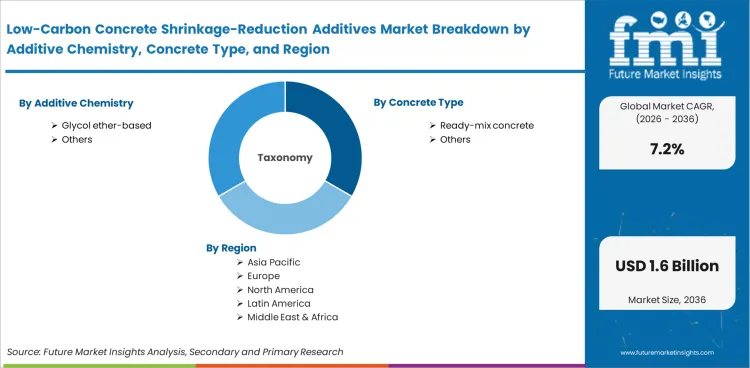
The low-carbon concrete shrinkage-reduction additives industry is segmented by additive chemistry into glycol ether-based additives, polyol-based additives, surfactant blends, polymer-modified additives, and hybrid admixture systems. By concrete type, industry demand is divided into ready-mix concrete, precast concrete, high-performance concrete, self-consolidating concrete, and mass concrete. Based on application, demand is segmented into slabs and floors, pavements, bridge decks, parking structures, industrial foundations, and repair mortars. By project type, demand is segmented into commercial buildings, transport infrastructure, industrial facilities, residential buildings, and public works. Based on end user, demand is categorized into ready-mix producers, precast manufacturers, infrastructure contractors, building developers, and repair contractors. By supply channel, demand is segmented into direct technical sales, admixture distributors, cement partnerships, contractor supply networks, and online B2B channels.
Low-Carbon Concrete Shrinkage-Reduction Additives Market Analysis by Additive Chemistry
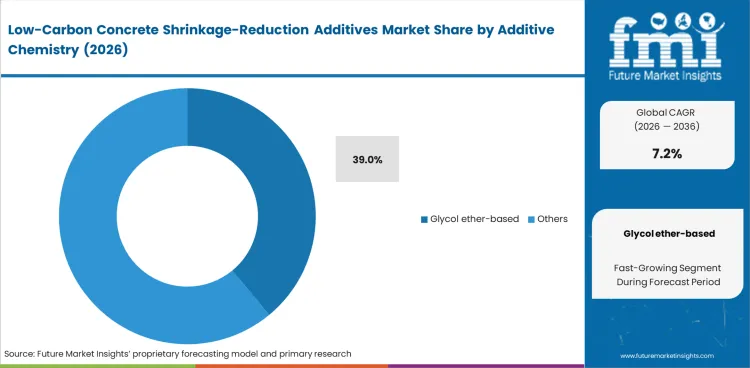
- Glycol ether-based additives are expected to account for 39.0% share in 2026 because reliable shrinkage control in low-clinker concrete mixes used for slabs and pavements.
- Admixture makers prefer glycol ether-based systems for low-carbon concrete since stable dosage response helps reduce drying shrinkage without major mix redesign.
Low-Carbon Concrete Shrinkage-Reduction Additives Market Analysis by Concrete Type
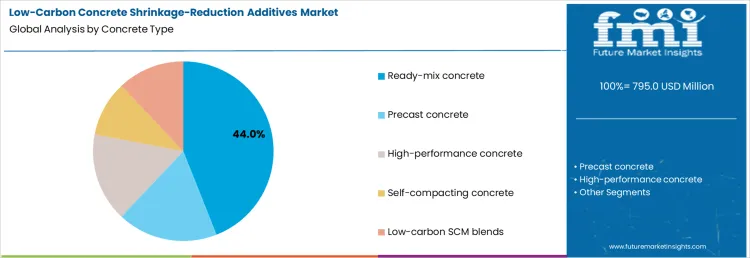
- Ready-mix concrete is projected to represent 47.0% share in 2026 because of large daily placement volumes across building and infrastructure projects.
- Concrete suppliers prioritize ready-mix applications because low-carbon mixes depend on field-ready shrinkage control during transport and placement.
Low-Carbon Concrete Shrinkage-Reduction Additives Market Analysis by Application
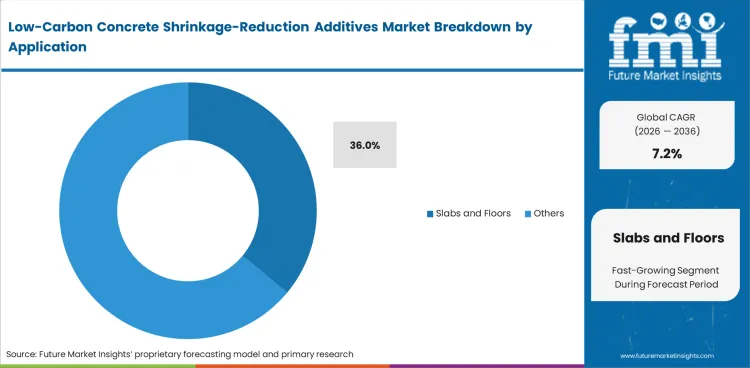
- Slabs and floors are anticipated to account for 36.0% share in 2026, driven by crack-control needs in low-carbon concrete placed across large surface areas.
- Flooring contractors value shrinkage-reduction additives as fewer drying cracks can lower repair work after warehouse and commercial slab placement.
Low-Carbon Concrete Shrinkage-Reduction Additives Market Analysis by Project Type
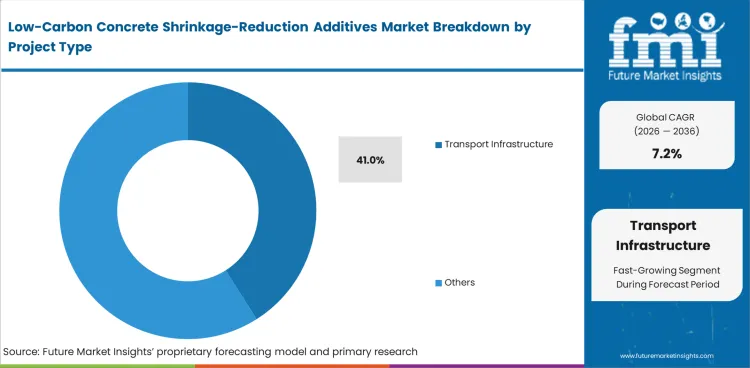
- Transport infrastructure is expected to secure 41.0% share in 2026 as public low-carbon material programs covering roads and bridge works.
- Public agencies prefer tested shrinkage-control admixtures since transport structures need low embodied carbon performance with fewer service-life repairs.
Low-Carbon Concrete Shrinkage-Reduction Additives Market Analysis by End User
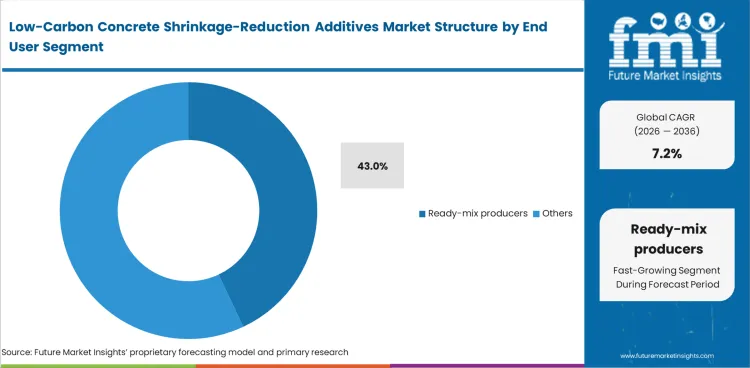
- Ready-mix producers are projected to account for 43.0% share in 2026 as batch plants manage daily low-carbon concrete supply for contractors.
- Producer demand reflects the need to keep mix performance steady across different cement blends and supplementary cementitious material levels.
Low-Carbon Concrete Shrinkage-Reduction Additives Market Analysis by Supply Channel
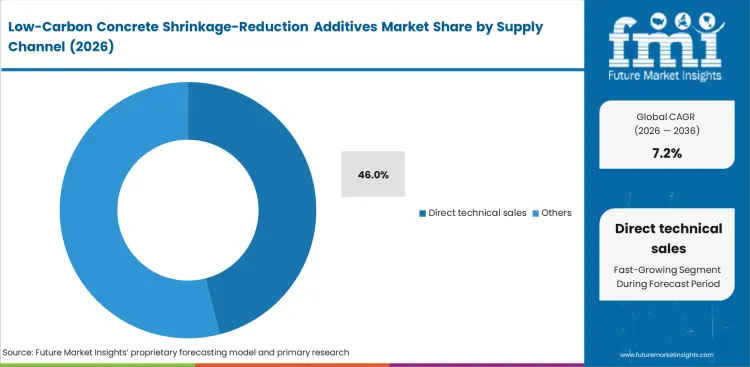
- Direct technical sales are expected to represent 46.0% share in 2026 because project teams need dosage support and shrinkage test data before approval.
- Direct supply lets admixture firms combine low-carbon concrete trials through lab testing and field placement guidance.
Low-Carbon Concrete Shrinkage-Reduction Additives Market Drivers, Restraints, and Opportunities
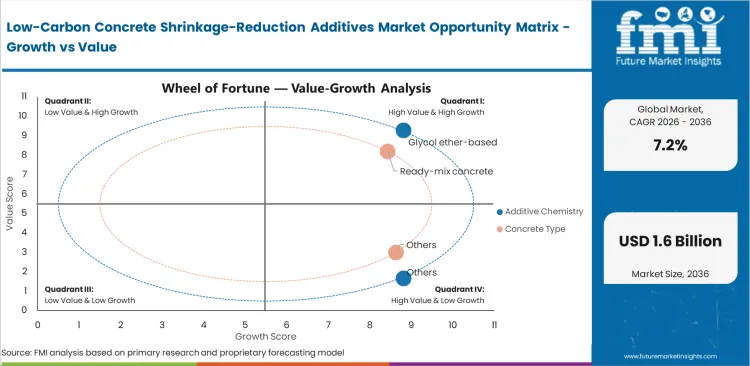
- SCM-rich concrete is expected to lift additive use as producers need crack control without raising cement content in low-carbon mix designs.
- Mix validation delays are expected to slow supplier switching since every additive dose needs shrinkage and strength checks before approval.
- Recycled aggregate concrete is expected to create more prospects as higher water absorption variation increases the need for shrinkage control.
Low-clinker formulation work is expected to integrate shrinkage reducers into standard concrete trial plans by 2036. Holcim reported ECOPact at 31% of ready-mix concrete net sales in 2025 and ECOPlanet at 36% of cement net sales. Low-carbon concrete and lower-clinker cement sales show a shift in mix design. Additive suppliers able to protect early strength and drying performance are likely to gain higher technical access.
Qualification work is predicted to limit faster adoption in low-cost concrete accounts. Shrinkage tests need curing time after casting and cannot be judged from slump alone. SCM use in concrete remains tied to state DOT practices and material approval checks. Suppliers can lower risk when they pair shrinkage records with plant mixing guidance and clear field limits.
Application-wise Equipment Installation Analysis
Low-carbon concrete shrinkage-reduction additives are expected to gain higher use in ready-mix plants and precast yards. USGS reported blended cement at 63% of U.S. cement shipments during the first nine months of 2025 with 95% of blended shipments estimated as Portland-limestone cement. Cement blend movement raises the need for accurate admixture dosing and slump control during batching. Plants using automated liquid dosing should add shrinkage reducers with fewer handling changes.
Technology Adoption and Automation Penetration Analysis
Technology adoption for shrinkage-reduction additives is expected to focus on mix software and plant dosing control. Low-carbon concrete recipes need batch records linking cement content with strength and shrinkage results. Digital mix tools can connect EPD files with test data before steady project supply begins. Producers using verified recipes should shorten approval time for low-carbon concrete grades.
Regional Analysis
.webp "Top Country Growth Comparison Low Carbon Concrete Shrinkage Reduction Additives Market Cagr (2026 2036)")
| Country | CAGR 2026 to 2036 |
|---|---|
| China | 8.8% |
| Brazil | 8.4% |
| India | 8.0% |
| United States | 7.2% |
| Germany | 6.8% |
| United Kingdom | 6.7% |
| Japan | 6.2% |
Source: Future Market Insights analysis based on public source checks and concrete admixture adoption review in 2026.
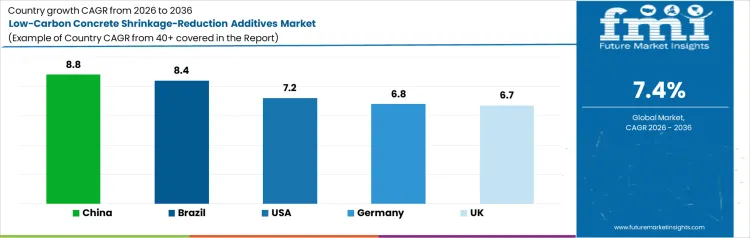
Analysis of Low-Carbon Concrete Shrinkage-Reduction Additives Market by Key Countries
- China is expected to record 8.8% CAGR by 2036, driven by large‑scale infrastructure programs and faster approval of lower‑clinker concrete mixes across urban construction
- Brazil is projected to grow at 8.4% CAGR by 2036, supported by infrastructure rehabilitation activity that encourages shrinkage‑control solutions.
- India is expected to advance at 8.0% CAGR by 2036, propelled by high‑volume infrastructure and urban development projects.
- United States demand is projected at 7.2% CAGR by 2036 as federal low-carbon material funding improves acceptance of verified concrete mixes.
- Germany at 6.8% CAGR, United Kingdom at 6.7% CAGR, and Japan at 6.2% CAGR expand through carbon labeling and mature mix approval practices.
Country pace varies by cement output scale and low-carbon buying rules. China leads through unmatched cement volume and a faster trial base for lower-clinker concrete. Brazil follows as infrastructure work and cement output expansion improve trial room for shrinkage-control additives. Germany and United Kingdom grow at measured rates due to stricter documentation needs. Japan remains steadier as plant density and careful specification review guide admixture approval.
Demand Outlook for Low-Carbon Concrete Shrinkage-Reduction Additives in China
Demand for low-carbon concrete shrinkage-reduction additives in China is projected to rise at 8.8% CAGR by 2036 as national cement production reached 1,700 million tons in 2025. Large output lets producers test SCM blends across bridges and high-rise concrete programs. Local suppliers can gain faster access by pairing shrinkage data with plant-scale trial support.
- Large ready-mix networks need shrinkage reducers capable of handling slag and fly ash variability across urban projects.
- Low-carbon concrete trials favor additives with simple dosing and clear drying shrinkage results for structural slabs.
- Domestic admixture producers can scale by serving plants near infrastructure clusters using lower-clinker mixes.
Industry Outlook for Low-Carbon Concrete Shrinkage-Reduction Additives in Brazil
Industry sales in Brazil are expected to expand at 8.4% CAGR by 2036 as cement production reached 67 million tons in 2025 and infrastructure repair needs influence concrete durability. Lower-carbon mixes depend on shrinkage control for decks and industrial floors exposed to high drying stress. Regional suppliers can benefit from additives suited to local aggregates.
- Infrastructure programs create demand for additives that reduce cracking across bridges and pavement concrete.
- Ready-mix producers need products tolerant of tropical curing conditions and varied sand moisture.
- Local trial support will remain valuable as public works specify concrete performance and carbon limits together.
Sales Analysis of Low-Carbon Concrete Shrinkage-Reduction Additives in India
India is projected to record 8.0% CAGR by 2036, led by cement output reaching 470 million tons in 2025 and infrastructure concrete volume remaining high. SCM-rich mixes using fly ash and slag create shrinkage-control needs in metro and road projects. Suppliers offering lower-dose systems can win plant trials in cost-sensitive accounts.
- Urban rail and highway projects need concrete with lower cracking risk across hot placement conditions.
- Precast yards can use shrinkage control to protect segment shape and reduce rejection rates before site delivery.
- Regional admixture makers should pair product samples with simple curing guidance for batch plant teams.
Adoption Outlook of Low-Carbon Concrete Shrinkage-Reduction Additives in United States
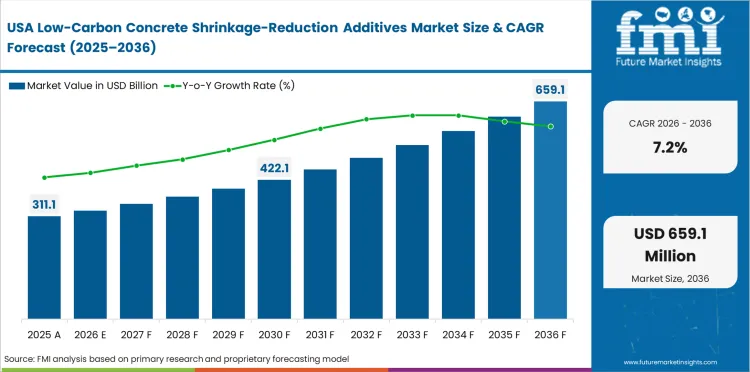
Sales of low-carbon concrete shrinkage-reduction additives in United States are projected to increase at 7.2% CAGR by 2036 as federal low-carbon material funding covers concrete and cement. USGS estimated 100 million tons of 2025 cement shipments to final customers. Funding and channel scale create a clear route for qualified low-carbon ready-mix systems.
- DOT projects are expected to favor mixes with EPD support and field shrinkage records for transportation concrete.
- Ready-mix plants need liquid admixtures compatible with portland-limestone cement and local aggregates.
- Flooring and bridge contractors prefer additives that reduce curling risk without slowing early strength too much.
Demand Outlook for Low-Carbon Concrete Shrinkage-Reduction Additives in Germany
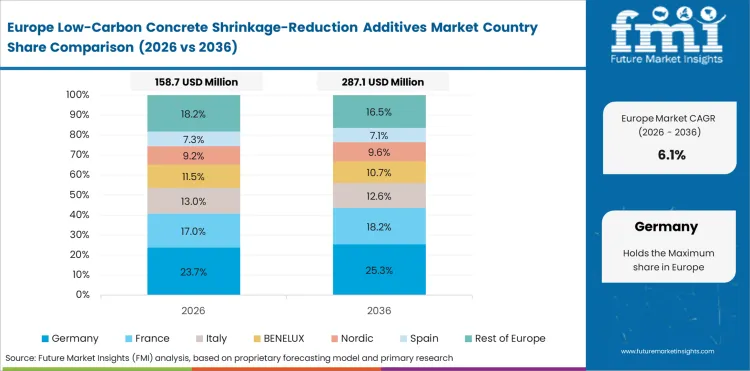
The sector in Germany is expected to record 6.8% CAGR by 2036 since VDZ introduced the cement carbon class label in February 2025. Carbon-labeled cement creates a clearer path for admixtures matched to lower-emission binders. German uptake remains measured as engineers review shrinkage and strength proof before changing approved mixes.
- Industrial floors and transport structures need additives with verified shrinkage data under strict specification review.
- Specialty chemical suppliers can support producers testing calcined clay and slag blends in local plants.
- Carbon labels should improve visibility for low-carbon cement and raise the need for compatible shrinkage reducers.
Demand Outlook for Low-Carbon Concrete Shrinkage-Reduction Additives in United Kingdom
United Kingdom demand for the sector is forecast to expand at 6.7% CAGR by 2036 as GB ready-mixed concrete sales dropped 12.0% in Quarter 3 2025 from the prior year. Lower volumes influence producers toward higher-value concrete with carbon and durability proof. Shrinkage reducers help protect margins in technical mixes for infrastructure and commercial work.
- Ready-mix plants need additives able to improve durability claims in a weaker volume cycle.
- Public projects raise interest in verified mixes with lower embodied carbon and stable cracking performance.
- Distributors remain useful for smaller contractors needing standard shrinkage-control grades and advice.
Demand Outlook for Low-Carbon Concrete Shrinkage-Reduction Additives in Japan
Industry demand in Japan is expected to reach 6.2% CAGR by 2036 as July 2025 industry structure covered 26 plants and 15 companies with 47 million tons of clinker capacity. Smaller national volume keeps adoption steady instead of fast. Precision-focused users depend on shrinkage control for precast and high-performance concrete.
- Precast producers need shrinkage reducers to protect dimensional accuracy in panels and structural units.
- Kanto demand centers support technical concrete grades for commercial and infrastructure applications.
- Suppliers with clean documentation and local testing support should gain easier access to mature accounts.
Competitive Positioning and Strategic Supplier Strength
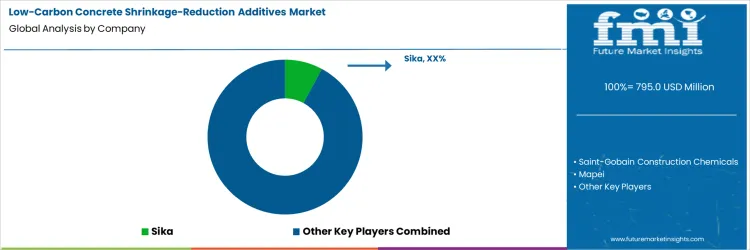
- Sika can gain trials by pairing low-carbon concrete project proof with shrinkage records and early-age test support.
- Master Builders Solutions defends concrete producer accounts through sustainable admixture recognition and easier placement in low-carbon mixes.
- Saint-Gobain Construction Chemicals expands regional project access after Fosroc added admixture depth across India and Middle East construction chemicals.
Competition in low-carbon concrete shrinkage-reduction additives is likely to center on mix approval data and field support. Sika shows project proof through a Paris low-carbon concrete program using around 300,000 liters of admixtures from 2022 to 2024 and reporting nearly 40% lower CO₂ emissions. Master Builders Solutions adds product credibility after MasterEase 5000 won a 2025 World of Concrete award in sustainable concrete materials. Fosroc brings recycled-aggregate relevance through HORSUPAL, an April 2025 project focused on admixtures for low-CO₂ concrete made with recycled aggregates.
Integrated building-material firms are influencing buyer expectations around carbon proof and mix performance. Holcim states ECOPact offers at least 30% lower CO₂ compared with standard CEM I concrete without offsets. Holcim also reported ECOPact reached 31% of ready-mix concrete net sales in 2025. The share signals larger use of verified low-carbon concrete formats.
Key Companies in Low-Carbon Concrete Shrinkage-Reduction Additives Market
Competition spans construction chemical suppliers, cement-linked admixture platforms, and regional specialists serving ready-mix and precast accounts.
- Global construction chemical suppliers: Sika, Saint-Gobain Construction Chemicals, Master Builders Solutions, Mapei, and GCP Applied Technologies compete through admixture portfolios and concrete testing support.
- Cement-linked platforms: Holcim and CEMEX Admixtures connect low-carbon cement systems with concrete admixture guidance for plant-level adoption.
- Regional specialists: Fosroc, CICO Technologies, and RPM International compete through local construction channels and project-specific service.
Competitive Benchmarking: Low-Carbon Concrete Shrinkage-Reduction Additives Market
| Company | Shrinkage Control Depth | Low-Carbon Mix Support | Ready-Mix Trial Access | Footprint |
|---|---|---|---|---|
| Sika | High | High | High | Global |
| Saint-Gobain Construction Chemicals | High | High | Large | Global |
| Master Builders Solutions | High | High | High | Global |
| Mapei | Large | High | Large | Global |
| Fosroc | Large | Moderate | Large | Regional |
| Holcim | Moderate | High | High | Global |
| CEMEX Admixtures | Moderate | High | Large | Global |
| CICO Technologies | Moderate | Moderate | Moderate | Regional |
Source: Future Market Insights competitive analysis based on public product portfolios and company activity in 2026.
Key Developments in the Low-Carbon Concrete Shrinkage-Reduction Additives Market
- In June 2024, Saint-Gobain agreed to acquire Fosroc and stated construction chemicals reached EUR 6.2 billion in combined pro forma sales.
- In April 2025, Fosroc Euco started the HORSUPAL project to develop admixtures for low-CO₂ concrete made with recycled aggregates.
- In October 2025, Mapei stated Mapecube 60W can allow CO₂ reductions of up to 35% in a specific low-carbon concrete formulation.
Key Players in the Low-Carbon Concrete Shrinkage-Reduction Additives Market
Construction chemical suppliers
- Sika
- Saint-Gobain Construction Chemicals
- Master Builders Solutions
- Mapei
- Fosroc
- GCP Applied Technologies
- RPM International
- CICO Technologies
Cement-linked admixture platforms
- Holcim
- CEMEX Admixtures
- BASF construction chemical legacy portfolio
Report Scope and Coverage
| Item | Value |
|---|---|
| Market value in 2025 | USD 0.7 billion |
| Market value in 2026 | USD 0.8 billion |
| Market value in 2036 | USD 1.6 billion |
| CAGR from 2026 to 2036 | 7.2% |
| Quantitative units | USD billion |
| Market definition | Additives used to reduce plastic and drying shrinkage in low-carbon concrete mixes |
| By additive type | Shrinkage-reducing admixtures, internal curing agents, expansive agents, fiber-based shrinkage control, hybrid systems |
| By concrete type | Ready-mix concrete, precast concrete, high-performance concrete, self-compacting concrete, low-carbon SCM blends |
| By application | Slabs and industrial floors, bridges and infrastructure, commercial buildings, residential construction, other applications |
| By binder system | SCM blended mixes, slag cement mixes, fly ash mixes, calcined clay mixes, recycled aggregate mixes, ternary blends |
| By construction stage | New construction, repair construction, infrastructure renewal, precast production |
| By sales channel | Direct ready-mix supply, admixture distributors, direct precast supply, contractor-led buying, online B2B channels |
| Regions covered | North America, Latin America, Europe, East Asia, South Asia and Pacific, Middle East and Africa |
| Countries covered | China, Brazil, India, United States, Germany, United Kingdom, Japan |
| Key companies profiled | Sika, Saint-Gobain Construction Chemicals, Master Builders Solutions, Mapei, Fosroc, Holcim, CEMEX Admixtures, CICO Technologies |
| Forecast period | 2026 to 2036 |
| Approach | FMI analysis based on concrete admixture use, low-carbon concrete adoption, public source checks, and company activity |
Source: Future Market Insights analysis, 2026.
Low-Carbon Concrete Shrinkage-Reduction Additives Market Breakdown by Additive Type, Concrete Type, Application, Binder System, Construction Stage, Sales Channel, and Region
Low-Carbon Concrete Shrinkage-Reduction Additives Market Segmented by Additive Type
- Shrinkage-Reducing Admixtures
- Internal Curing Agents
- Expansive Agents
- Fiber Systems
- Hybrid Systems
Low-Carbon Concrete Shrinkage-Reduction Additives Market Segmented by Concrete Type
- Ready-Mix Concrete
- Precast Concrete
- High-Performance Concrete
- Self-Compacting Concrete
- SCM Blends
Low-Carbon Concrete Shrinkage-Reduction Additives Market Segmented by Application
- Industrial Floors
- Infrastructure
- Commercial Buildings
- Residential Construction
- Other Applications
Low-Carbon Concrete Shrinkage-Reduction Additives Market Segmented by Binder System
- SCM Blends
- Slag Cement
- Fly Ash
- Calcined Clay
- Recycled Aggregate
- Ternary Blends
Low-Carbon Concrete Shrinkage-Reduction Additives Market Segmented by Construction Stage
- New Construction
- Repair Construction
- Infrastructure Renewal
- Precast Production
Low-Carbon Concrete Shrinkage-Reduction Additives Market Segmented by Sales Channel
- Direct Supply
- Distributors
- Precast Supply
- Contractor Buying
- Online B2B
Low-Carbon Concrete Shrinkage-Reduction Additives Market by Region
- North America
- United States
- Canada
- Mexico
- Latin America
- Brazil
- Chile
- Western Europe
- Germany
- United Kingdom
- France
- East Asia
- China
- Japan
- South Asia and Pacific
- India
- ASEAN
- Middle East and Africa
- Kingdom of Saudi Arabia
- South Africa
Research Sources and Bibliography
- National Academies of Sciences, Engineering, and Medicine. (2025). Use of supplementary cementitious materials for concrete. The National Academies Press.
- USA Geological Survey. (2026, February). Cement: Mineral Commodity Summaries 2026.
- International Energy Agency. (2025, October 29). Cement and concrete. In The Breakthrough Agenda Report 2025.
- Federal Highway Administration. (2024, August 27). FHWA opens applications for $800 million in funding to reduce climate pollution from transportation, encourage cleaner construction materials.
- USA General Services Administration. (2025, April 10). Inflation Reduction Act low-embodied carbon material requirements.
- Department for Business and Trade. (2025, December 3). Construction building materials: Commentary November 2025. GOV.UK.
- VDZ. (2025, February 4). VDZ introduces CO₂ label for cement.
- Japan Cement Association. (2025, July). Cement plants in Japan.
- Fosroc. (2025, April 1). HORSUPAL’s mission to develop low-CO₂ concrete admixtures.
- Master Builders Solutions. (2025, March 11). MasterEase® 5000 admixture receives 2025 Innovative Product Award.
- Saint-Gobain. (2024, June 27). Saint-Gobain further strengthens its worldwide presence in construction chemicals by signing a definitive agreement to acquire Fosroc, a leading player in Asia and emerging markets.
- Sika. (2025). Mastering low-carbon concrete construction.
- Mapei. (2025, October 14). How the admixtures industry can assist in low carbon concrete production.
- Holcim. (2026). Innovation accelerating decarbonization.
The bibliography is provided for reader reference and direct source checking.
This Report Answers
- How large is the low-carbon concrete shrinkage-reduction additives sector in 2026 and how far it can rise by 2036?
- Which additive type and construction stage hold the largest projected share positions in 2026?
- Why do shrinkage-reducing admixtures and new construction hold the clearest lead in current additive structure?
- Why do China and Brazil lead the country growth set through 2036?
- How does direct ready-mix supply shape access for large concrete producers and precast plants?
- Which supplier capabilities help companies defend their position in low-carbon concrete additive qualification?
- Which public low-carbon material rules and company actions support the forecast method used in this study?
Frequently Asked Questions
How large is the low-carbon concrete shrinkage-reduction additives market in 2026?
The low-carbon concrete shrinkage-reduction additives market is projected to reach USD 0.8 billion in 2026.
What will the low-carbon concrete shrinkage-reduction additives market be worth by 2036?
The low-carbon concrete shrinkage-reduction additives market is forecast to reach USD 1.6 billion by 2036.
What is the expected low-carbon concrete shrinkage-reduction additives market CAGR?
The low-carbon concrete shrinkage-reduction additives market is expected to expand at 7.2% CAGR from 2026 to 2036.
Which additive type leads the low-carbon concrete shrinkage-reduction additives market?
Shrinkage-reducing admixtures are projected to account for 46.0% share in 2026 as producers need direct drying shrinkage control.
Which countries grow fastest in the low-carbon concrete shrinkage-reduction additives market?
China at 8.8% CAGR and Brazil at 8.4% CAGR are expected to grow fastest by 2036.
Which companies shape the low-carbon concrete shrinkage-reduction additives market?
Sika and Master Builders Solutions hold stronger technical depth. Saint-Gobain Construction Chemicals expands reach through Fosroc and GCP Applied Technologies.
Preview the report firsthand - request a free sample
Get SampleGet the brochure for pricing and purchase details.
Get PDFTable of Content
- Executive Summary
- Global Market Outlook
- Demand-side Trends
- Supply-side Trends
- Technology Roadmap Analysis
- Analysis and Recommendations
- Market Overview
- Market Coverage / Taxonomy
- Market Definition / Scope / Limitations
- Research Methodology
- Chapter Orientation
- Analytical Lens and Working Hypotheses
- Market Structure, Signals, and Trend Drivers
- Benchmarking and Cross-market Comparability
- Market Sizing, Forecasting, and Opportunity Mapping
- Research Design and Evidence Framework
- Desk Research Programme (Secondary Evidence)
- Company Annual and Sustainability Reports
- Peer-reviewed Journals and Academic Literature
- Corporate Websites, Product Literature, and Technical Notes
- Earnings Decks and Investor Briefings
- Statutory Filings and Regulatory Disclosures
- Technical White Papers and Standards Notes
- Trade Journals, Industry Magazines, and Analyst Briefs
- Conference Proceedings, Webinars, and Seminar Materials
- Government Statistics Portals and Public Data Releases
- Press Releases and Reputable Media Coverage
- Specialist Newsletters and Curated Briefings
- Sector Databases and Reference Repositories
- FMI Internal Proprietary Databases and Historical Market Datasets
- Subscription Datasets and Paid Sources
- Social Channels, Communities, and Digital Listening Inputs
- Additional Desk Sources
- Expert Input and Fieldwork (Primary Evidence)
- Primary Modes
- Qualitative Interviews and Expert Elicitation
- Quantitative Surveys and Structured Data Capture
- Blended Approach
- Why Primary Evidence is Used
- Field Techniques
- Interviews
- Surveys
- Focus Groups
- Observational and In-context Research
- Social and Community Interactions
- Stakeholder Universe Engaged
- C-suite Leaders
- Board Members
- Presidents and Vice Presidents
- R&D and Innovation Heads
- Technical Specialists
- Domain Subject-matter Experts
- Scientists
- Physicians and Other Healthcare Professionals
- Governance, Ethics, and Data Stewardship
- Research Ethics
- Data Integrity and Handling
- Primary Modes
- Tooling, Models, and Reference Databases
- Desk Research Programme (Secondary Evidence)
- Data Engineering and Model Build
- Data Acquisition and Ingestion
- Cleaning, Normalisation, and Verification
- Synthesis, Triangulation, and Analysis
- Quality Assurance and Audit Trail
- Market Background
- Market Dynamics
- Drivers
- Restraints
- Opportunity
- Trends
- Scenario Forecast
- Demand in Optimistic Scenario
- Demand in Likely Scenario
- Demand in Conservative Scenario
- Opportunity Map Analysis
- Product Life Cycle Analysis
- Supply Chain Analysis
- Investment Feasibility Matrix
- Value Chain Analysis
- PESTLE and Porter’s Analysis
- Regulatory Landscape
- Regional Parent Market Outlook
- Production and Consumption Statistics
- Import and Export Statistics
- Market Dynamics
- Global Market Analysis 2021 to 2025 and Forecast, 2026 to 2036
- Historical Market Size Value (USD Million) Analysis, 2021 to 2025
- Current and Future Market Size Value (USD Million) Projections, 2026 to 2036
- Y-o-Y Growth Trend Analysis
- Absolute $ Opportunity Analysis
- Global Market Pricing Analysis 2021 to 2025 and Forecast 2026 to 2036
- Global Market Analysis 2021 to 2025 and Forecast 2026 to 2036, By Additive Chemistry
- Introduction / Key Findings
- Historical Market Size Value (USD Million) Analysis By Additive Chemistry , 2021 to 2025
- Current and Future Market Size Value (USD Million) Analysis and Forecast By Additive Chemistry , 2026 to 2036
- Glycol ether-based
- Others
- Glycol ether-based
- Y-o-Y Growth Trend Analysis By Additive Chemistry , 2021 to 2025
- Absolute $ Opportunity Analysis By Additive Chemistry , 2026 to 2036
- Global Market Analysis 2021 to 2025 and Forecast 2026 to 2036, By Concrete Type
- Introduction / Key Findings
- Historical Market Size Value (USD Million) Analysis By Concrete Type, 2021 to 2025
- Current and Future Market Size Value (USD Million) Analysis and Forecast By Concrete Type, 2026 to 2036
- Ready-mix concrete
- Others
- Ready-mix concrete
- Y-o-Y Growth Trend Analysis By Concrete Type, 2021 to 2025
- Absolute $ Opportunity Analysis By Concrete Type, 2026 to 2036
- Global Market Analysis 2021 to 2025 and Forecast 2026 to 2036, By Application
- Introduction / Key Findings
- Historical Market Size Value (USD Million) Analysis By Application, 2021 to 2025
- Current and Future Market Size Value (USD Million) Analysis and Forecast By Application, 2026 to 2036
- Slabs and Floors
- Others
- Slabs and Floors
- Y-o-Y Growth Trend Analysis By Application, 2021 to 2025
- Absolute $ Opportunity Analysis By Application, 2026 to 2036
- Global Market Analysis 2021 to 2025 and Forecast 2026 to 2036, By Project Type
- Introduction / Key Findings
- Historical Market Size Value (USD Million) Analysis By Project Type, 2021 to 2025
- Current and Future Market Size Value (USD Million) Analysis and Forecast By Project Type, 2026 to 2036
- Transport Infrastructure
- Others
- Transport Infrastructure
- Y-o-Y Growth Trend Analysis By Project Type, 2021 to 2025
- Absolute $ Opportunity Analysis By Project Type, 2026 to 2036
- Global Market Analysis 2021 to 2025 and Forecast 2026 to 2036, By End User
- Introduction / Key Findings
- Historical Market Size Value (USD Million) Analysis By End User, 2021 to 2025
- Current and Future Market Size Value (USD Million) Analysis and Forecast By End User, 2026 to 2036
- Ready-mix producers
- Others
- Ready-mix producers
- Y-o-Y Growth Trend Analysis By End User, 2021 to 2025
- Absolute $ Opportunity Analysis By End User, 2026 to 2036
- Global Market Analysis 2021 to 2025 and Forecast 2026 to 2036, By Supply Channel
- Introduction / Key Findings
- Historical Market Size Value (USD Million) Analysis By Supply Channel, 2021 to 2025
- Current and Future Market Size Value (USD Million) Analysis and Forecast By Supply Channel, 2026 to 2036
- Direct technical sales
- Others
- Direct technical sales
- Y-o-Y Growth Trend Analysis By Supply Channel, 2021 to 2025
- Absolute $ Opportunity Analysis By Supply Channel, 2026 to 2036
- Global Market Analysis 2021 to 2025 and Forecast 2026 to 2036, By Region
- Introduction
- Historical Market Size Value (USD Million) Analysis By Region, 2021 to 2025
- Current Market Size Value (USD Million) Analysis and Forecast By Region, 2026 to 2036
- North America
- Latin America
- Western Europe
- Eastern Europe
- East Asia
- South Asia and Pacific
- Middle East & Africa
- Market Attractiveness Analysis By Region
- North America Market Analysis 2021 to 2025 and Forecast 2026 to 2036, By Country
- Historical Market Size Value (USD Million) Trend Analysis By Market Taxonomy, 2021 to 2025
- Market Size Value (USD Million) Forecast By Market Taxonomy, 2026 to 2036
- By Country
- USA
- Canada
- Mexico
- By Additive Chemistry
- By Concrete Type
- By Application
- By Project Type
- By End User
- By Supply Channel
- By Country
- Market Attractiveness Analysis
- By Country
- By Additive Chemistry
- By Concrete Type
- By Application
- By Project Type
- By End User
- By Supply Channel
- Key Takeaways
- Latin America Market Analysis 2021 to 2025 and Forecast 2026 to 2036, By Country
- Historical Market Size Value (USD Million) Trend Analysis By Market Taxonomy, 2021 to 2025
- Market Size Value (USD Million) Forecast By Market Taxonomy, 2026 to 2036
- By Country
- Brazil
- Chile
- Rest of Latin America
- By Additive Chemistry
- By Concrete Type
- By Application
- By Project Type
- By End User
- By Supply Channel
- By Country
- Market Attractiveness Analysis
- By Country
- By Additive Chemistry
- By Concrete Type
- By Application
- By Project Type
- By End User
- By Supply Channel
- Key Takeaways
- Western Europe Market Analysis 2021 to 2025 and Forecast 2026 to 2036, By Country
- Historical Market Size Value (USD Million) Trend Analysis By Market Taxonomy, 2021 to 2025
- Market Size Value (USD Million) Forecast By Market Taxonomy, 2026 to 2036
- By Country
- Germany
- UK
- Italy
- Spain
- France
- Nordic
- BENELUX
- Rest of Western Europe
- By Additive Chemistry
- By Concrete Type
- By Application
- By Project Type
- By End User
- By Supply Channel
- By Country
- Market Attractiveness Analysis
- By Country
- By Additive Chemistry
- By Concrete Type
- By Application
- By Project Type
- By End User
- By Supply Channel
- Key Takeaways
- Eastern Europe Market Analysis 2021 to 2025 and Forecast 2026 to 2036, By Country
- Historical Market Size Value (USD Million) Trend Analysis By Market Taxonomy, 2021 to 2025
- Market Size Value (USD Million) Forecast By Market Taxonomy, 2026 to 2036
- By Country
- Russia
- Poland
- Hungary
- Balkan & Baltic
- Rest of Eastern Europe
- By Additive Chemistry
- By Concrete Type
- By Application
- By Project Type
- By End User
- By Supply Channel
- By Country
- Market Attractiveness Analysis
- By Country
- By Additive Chemistry
- By Concrete Type
- By Application
- By Project Type
- By End User
- By Supply Channel
- Key Takeaways
- East Asia Market Analysis 2021 to 2025 and Forecast 2026 to 2036, By Country
- Historical Market Size Value (USD Million) Trend Analysis By Market Taxonomy, 2021 to 2025
- Market Size Value (USD Million) Forecast By Market Taxonomy, 2026 to 2036
- By Country
- China
- Japan
- South Korea
- By Additive Chemistry
- By Concrete Type
- By Application
- By Project Type
- By End User
- By Supply Channel
- By Country
- Market Attractiveness Analysis
- By Country
- By Additive Chemistry
- By Concrete Type
- By Application
- By Project Type
- By End User
- By Supply Channel
- Key Takeaways
- South Asia and Pacific Market Analysis 2021 to 2025 and Forecast 2026 to 2036, By Country
- Historical Market Size Value (USD Million) Trend Analysis By Market Taxonomy, 2021 to 2025
- Market Size Value (USD Million) Forecast By Market Taxonomy, 2026 to 2036
- By Country
- India
- ASEAN
- Australia & New Zealand
- Rest of South Asia and Pacific
- By Additive Chemistry
- By Concrete Type
- By Application
- By Project Type
- By End User
- By Supply Channel
- By Country
- Market Attractiveness Analysis
- By Country
- By Additive Chemistry
- By Concrete Type
- By Application
- By Project Type
- By End User
- By Supply Channel
- Key Takeaways
- Middle East & Africa Market Analysis 2021 to 2025 and Forecast 2026 to 2036, By Country
- Historical Market Size Value (USD Million) Trend Analysis By Market Taxonomy, 2021 to 2025
- Market Size Value (USD Million) Forecast By Market Taxonomy, 2026 to 2036
- By Country
- Kingdom of Saudi Arabia
- Other GCC Countries
- Turkiye
- South Africa
- Other African Union
- Rest of Middle East & Africa
- By Additive Chemistry
- By Concrete Type
- By Application
- By Project Type
- By End User
- By Supply Channel
- By Country
- Market Attractiveness Analysis
- By Country
- By Additive Chemistry
- By Concrete Type
- By Application
- By Project Type
- By End User
- By Supply Channel
- Key Takeaways
- Key Countries Market Analysis
- USA
- Pricing Analysis
- Market Share Analysis, 2025
- By Additive Chemistry
- By Concrete Type
- By Application
- By Project Type
- By End User
- By Supply Channel
- Canada
- Pricing Analysis
- Market Share Analysis, 2025
- By Additive Chemistry
- By Concrete Type
- By Application
- By Project Type
- By End User
- By Supply Channel
- Mexico
- Pricing Analysis
- Market Share Analysis, 2025
- By Additive Chemistry
- By Concrete Type
- By Application
- By Project Type
- By End User
- By Supply Channel
- Brazil
- Pricing Analysis
- Market Share Analysis, 2025
- By Additive Chemistry
- By Concrete Type
- By Application
- By Project Type
- By End User
- By Supply Channel
- Chile
- Pricing Analysis
- Market Share Analysis, 2025
- By Additive Chemistry
- By Concrete Type
- By Application
- By Project Type
- By End User
- By Supply Channel
- Germany
- Pricing Analysis
- Market Share Analysis, 2025
- By Additive Chemistry
- By Concrete Type
- By Application
- By Project Type
- By End User
- By Supply Channel
- UK
- Pricing Analysis
- Market Share Analysis, 2025
- By Additive Chemistry
- By Concrete Type
- By Application
- By Project Type
- By End User
- By Supply Channel
- Italy
- Pricing Analysis
- Market Share Analysis, 2025
- By Additive Chemistry
- By Concrete Type
- By Application
- By Project Type
- By End User
- By Supply Channel
- Spain
- Pricing Analysis
- Market Share Analysis, 2025
- By Additive Chemistry
- By Concrete Type
- By Application
- By Project Type
- By End User
- By Supply Channel
- France
- Pricing Analysis
- Market Share Analysis, 2025
- By Additive Chemistry
- By Concrete Type
- By Application
- By Project Type
- By End User
- By Supply Channel
- India
- Pricing Analysis
- Market Share Analysis, 2025
- By Additive Chemistry
- By Concrete Type
- By Application
- By Project Type
- By End User
- By Supply Channel
- ASEAN
- Pricing Analysis
- Market Share Analysis, 2025
- By Additive Chemistry
- By Concrete Type
- By Application
- By Project Type
- By End User
- By Supply Channel
- Australia & New Zealand
- Pricing Analysis
- Market Share Analysis, 2025
- By Additive Chemistry
- By Concrete Type
- By Application
- By Project Type
- By End User
- By Supply Channel
- China
- Pricing Analysis
- Market Share Analysis, 2025
- By Additive Chemistry
- By Concrete Type
- By Application
- By Project Type
- By End User
- By Supply Channel
- Japan
- Pricing Analysis
- Market Share Analysis, 2025
- By Additive Chemistry
- By Concrete Type
- By Application
- By Project Type
- By End User
- By Supply Channel
- South Korea
- Pricing Analysis
- Market Share Analysis, 2025
- By Additive Chemistry
- By Concrete Type
- By Application
- By Project Type
- By End User
- By Supply Channel
- Russia
- Pricing Analysis
- Market Share Analysis, 2025
- By Additive Chemistry
- By Concrete Type
- By Application
- By Project Type
- By End User
- By Supply Channel
- Poland
- Pricing Analysis
- Market Share Analysis, 2025
- By Additive Chemistry
- By Concrete Type
- By Application
- By Project Type
- By End User
- By Supply Channel
- Hungary
- Pricing Analysis
- Market Share Analysis, 2025
- By Additive Chemistry
- By Concrete Type
- By Application
- By Project Type
- By End User
- By Supply Channel
- Kingdom of Saudi Arabia
- Pricing Analysis
- Market Share Analysis, 2025
- By Additive Chemistry
- By Concrete Type
- By Application
- By Project Type
- By End User
- By Supply Channel
- Turkiye
- Pricing Analysis
- Market Share Analysis, 2025
- By Additive Chemistry
- By Concrete Type
- By Application
- By Project Type
- By End User
- By Supply Channel
- South Africa
- Pricing Analysis
- Market Share Analysis, 2025
- By Additive Chemistry
- By Concrete Type
- By Application
- By Project Type
- By End User
- By Supply Channel
- USA
- Market Structure Analysis
- Competition Dashboard
- Competition Benchmarking
- Market Share Analysis of Top Players
- By Regional
- By Additive Chemistry
- By Concrete Type
- By Application
- By Project Type
- By End User
- By Supply Channel
- Competition Analysis
- Competition Deep Dive
- Sika
- Overview
- Product Portfolio
- Profitability by Market Segments (Product/Age /Sales Channel/Region)
- Sales Footprint
- Strategy Overview
- Marketing Strategy
- Product Strategy
- Channel Strategy
- Saint-Gobain Construction Chemicals
- Master Builders Solutions
- Mapei
- Fosroc
- GCP Applied Technologies
- RPM International
- Sika
- Competition Deep Dive
- Assumptions & Acronyms Used


