

- Industry Size (2026)
- USD 1.1 Bn
- Forecast (2036)
- USD 2.9 Bn
- CAGR (2026 to 2036)
- 10.2%
Reinforced Concrete Additives Using PCR Fibers Market Forecast and Outlook 2026 to 2036
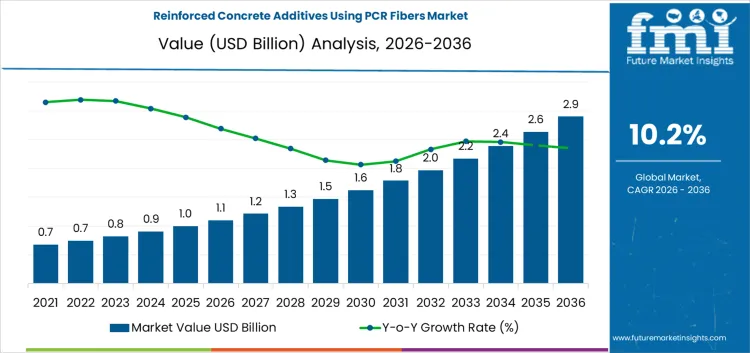
The reinforced concrete additives using PCR fibers market is set to reach USD 1.1 billion in 2026 and is projected to grow to USD 2.9 billion by 2036, with a CAGR of 10.2%. Growth is being shaped by material selection decisions in concrete formulation, where durability, crack control, and cost efficiency are primary technical and commercial criteria. Post-consumer recycled fibers are increasingly being incorporated into admixtures and fiber-reinforced concrete systems as producers seek to diversify raw material inputs while maintaining performance consistency and compliance with structural application requirements.
In reinforced concrete applications, PCR fibers are specified based on tensile performance, dispersion behavior, compatibility with cementitious systems, and impact on placing and finishing operations. Adoption is supported by improvements in fiber processing, grading, and quality control, which have reduced variability and improved predictability in finished concrete performance. Acceptance is also being reinforced through project specifications and contractor familiarity in non-structural and selected structural applications. Over the forecast period, demand is expected to increase through broader qualification in infrastructure, commercial building, and precast concrete segments, supported by standardization of product grades and testing protocols.
Quick Stats for Reinforced Concrete Additives Using PCR Fibers Market
- Reinforced Concrete Additives Using PCR Fibers Market Value (2026): USD 1.1 billion
- Reinforced Concrete Additives Using PCR Fibers Market Forecast Value (2036): USD 2.9 billion
- Reinforced Concrete Additives Using PCR Fibers Market Forecast CAGR 2026 to 2036: 10.2%
- Leading Type in Reinforced Concrete Additives Using PCR Fibers Market: Macro & micro fibers
- Key Growth Regions in Reinforced Concrete Additives Using PCR Fibers Market: Asia Pacific, North America, Europe
- Top Players in Reinforced Concrete Additives Using PCR Fibers Market: Sika, BASF, Owens Corning, Hengli, Reliance Industries, Viapol, Toray
What is the Growth Forecast for Reinforced Concrete Additives Using PCR Fibers Market through 2036?
The reinforced concrete additives using PCR fibers market is expected to reach USD 1.1 billion in 2026 and grow to USD 2.9 billion by 2036, reflecting a compound annual growth rate (CAGR) of 10.2%. From 2020 to 2026, the market increases from USD 0.6 billion to USD 1.1 billion. This growth is driven by rising demand for stronger, more durable concrete solutions in construction, as well as the growing focus on reducing environmental impact by incorporating PCR fibers. North America and other developed regions lead the adoption due to regulatory pressures and established infrastructure, while Asia Pacific is seeing rapid growth due to a surge in construction and infrastructure projects.
Between 2026 and 2036, the reinforced concrete additives using PCR fibers market will continue to expand, reaching USD 2.9 billion by 2036. The market is forecast to grow from USD 1.2 billion in 2027 to USD 2.7 billion by 2034. Increased focus on enhancing the strength and longevity of concrete structures will drive demand for PCR fiber additives. As regulatory frameworks around construction and sustainability tighten, vendors that provide certified, high-performance solutions will gain a competitive advantage. Emerging markets will likely experience faster adoption, particularly as infrastructure projects increase and demand for cost-effective, durable materials rises.
Reinforced Concrete Additives Using PCR Fibers Market Key Takeaways
| Metric | Value |
|---|---|
| Market Value (2026) | USD 1.1 billion |
| Forecast Value (2036) | USD 2.9 billion |
| Forecast CAGR 2026 to 2036 | 10.2% |
What Factors Are Influencing Growth in the Reinforced Concrete Additives Using PCR Fibers Market?
Growth in the Reinforced Concrete Additives Using PCR Fibers Market is linked to rising demand for improved concrete performance across infrastructure, commercial, and residential construction projects. Reinforced concrete applications such as slabs, bridge decks, pavements, and shotcrete structures increasingly incorporate post‑consumer recycled (PCR) fibers to enhance tensile strength, crack resistance, and impact tolerance. Engineers and project leads are specifying PCR fiber additives based on documented enhancements in flexural performance, reduced shrinkage cracking, and improved post‑crack behavior under load. Building codes and material standards in North America and Asia Pacific are recognizing fiber‑reinforced concrete mixes that meet defined mechanical performance criteria. As a result, concrete producers and ready‑mix suppliers are offering formulations with PCR fiber reinforcement that align with design specifications for durability and long‑term in‑service performance. Procurement teams on infrastructure contracts are reviewing laboratory test data for compressive strength, modulus of elasticity, and distribution uniformity before authorizing use on site. These concrete fiber additives are positioned as alternatives to conventional fiber solutions where performance criteria are paramount.
Cost dynamics and supply chain considerations are shaping adoption patterns for PCR fiber additives in reinforced concrete. Contractors assess PCR fiber products on the basis of availability, ease of integration into batching processes, and predictable performance outcomes in mixed concrete. Specific use cases include industrial floor slabs, heavy duty pavements, and tunnel linings where enhanced fracture control reduces long‑term maintenance needs. Consistency in PCR fiber physical properties, such as length distribution and surface treatment, influences selection by concrete producers that seek reliable performance across batches. Pricing relative to conventional synthetic fibers and steel reinforcement affects specification choices, particularly on large‑scale projects where material costs are a significant portion of overall expenditures. Validation protocols in project specifications often require independent certificates of analysis for tensile strength, fiber content, and dispersion characteristics prior to material acceptance.
What Are the Key Segments in the Reinforced Concrete Additives Using PCR Fibers Market?
The Reinforced Concrete Additives Using PCR Fibers Market is divided into Fiber Type and Material. Macro & micro fibers lead the fiber type segment, holding 50% of the market share, while PCR-PET fibers dominate the material segment, comprising 55%. These segments are influenced by the increasing demand for sustainable, high-performance reinforcement solutions in concrete applications. The use of PCR fibers, particularly in structural reinforcement, crack control, and synthetic reinforcement, addresses both the need for durability and environmental concerns. As construction projects focus on increasing material efficiency while reducing environmental impact, the adoption of PCR-based fibers in concrete additives is expected to grow steadily.
How Do Macro & Micro Fibers Impact Concrete Performance and Adoption?
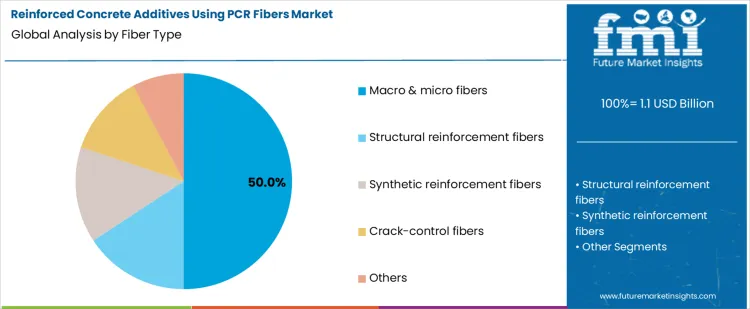
The Macro & Micro fibers segment accounts for 50% of the Fiber Type category in the Reinforced Concrete Additives Using PCR Fibers Market. These fibers are used in concrete to enhance properties like tensile strength, crack resistance, and overall durability. Macro fibers, typically larger in diameter, improve concrete’s post-crack behavior and help prevent the propagation of cracks, while micro fibers, with their fine structure, enhance the homogeneity and cohesiveness of the mix. The integration of PCR-PET fibers in these applications helps maintain structural integrity while incorporating post-consumer recycled material into critical concrete applications.
The demand for macro and micro fibers is primarily driven by the growing need for durable concrete solutions that can withstand environmental stressors such as temperature fluctuations, vibrations, and chemical exposure. Adoption is further influenced by the construction industry's focus on achieving both cost-effective solutions and reduced environmental impact. Supply-side challenges, such as ensuring consistent fiber quality and maintaining strength while using recycled PET feedstock, are being addressed through advanced processing and sorting technologies. As the construction industry increasingly turns to recycled materials, the use of PCR-PET macro and micro fibers is expected to rise, providing an eco-friendly yet high-performance solution for concrete additives.
How Do PCR-PET Fibers Contribute to the Reinforced Concrete Additives Market?
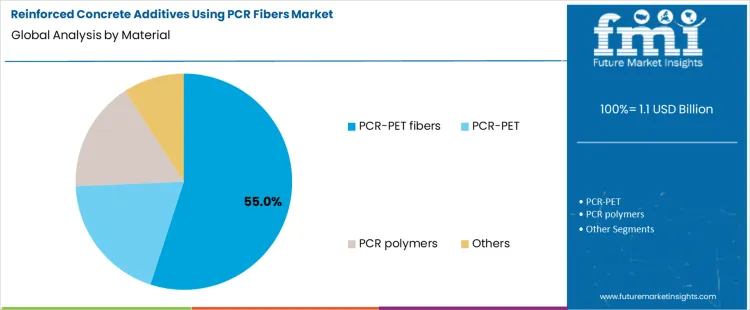
PCR-PET fibers hold 55% of the Material segment in the Reinforced Concrete Additives Using PCR Fibers Market. These fibers are specifically valued for their ability to provide both structural reinforcement and crack control in concrete, significantly improving the material's longevity and performance. The mechanical properties of PCR-PET fibers, such as tensile strength, impact resistance, and flexibility, make them ideal for use in demanding applications such as foundation construction, roadways, and high-load-bearing structures. Their inclusion in concrete mixes helps distribute the load more evenly across the structure, preventing early failure and improving overall durability.
The adoption of PCR-PET fibers is closely tied to the increasing emphasis on reducing construction’s environmental footprint while ensuring high-quality structural performance. These fibers contribute to sustainability efforts by utilizing post-consumer recycled materials, reducing the need for virgin raw materials. However, challenges include ensuring consistency in fiber length and dispersion within concrete mixes, as well as overcoming potential performance variations between recycled and virgin PET fibers. Despite these issues, ongoing improvements in recycling processes and material processing are expected to drive further adoption of PCR-PET fibers in the construction sector, offering a cost-effective and environmentally conscious solution in the Reinforced Concrete Additives Using PCR Fibers Market.
What Specification and Performance Needs Are Driving Demand for Reinforced Concrete Additives Using PCR Fibers?
Procurement teams for infrastructure and building projects are specifying reinforced concrete additives made with post consumer recycled (PCR) fibers to improve tensile strength, shrinkage control, and crack resistance. Engineers reference measured improvements in flexural toughness and post crack load capacity from validated test reports when evaluating PCR fiber performance against traditional steel or synthetic fibers. Project bids often require certified data on fiber dispersion, pull out strength, and concrete durability under cyclic loading. Buyers also assess compatibility with admixtures and aggregate types. This focus on quantifiable performance criteria is shaping material selection in applications such as slabs, walls, and industrial flooring.
What Material Quality and Processing Barriers Are Restricting Growth of Reinforced Concrete Additives Using PCR Fibers?
Inconsistent properties of PCR fiber feedstock remain a barrier for concrete additives that must meet strict structural standards. Variability in polymer types, fiber length distribution, and residual contaminants can affect workability, slump retention, and mechanical performance of fiber reinforced concrete. Concrete mix designers conduct multiple trial batches to validate fiber dispersion and bond behavior, which extends development timelines. Compliance testing for compressive strength, modulus of rupture, and toughness indices is required for acceptance in critical infrastructure projects. Differences in regional construction codes add complexity for suppliers seeking multi area approvals. These material quality and processing constraints slow broader specification of PCR fiber additives in reinforced concrete.
How Are Application Patterns Influencing Use of Reinforced Concrete Additives Using PCR Fibers?
Structural designers are aligning PCR fiber additives with specific reinforced concrete applications where enhanced crack control and impact resistance are required, such as bridge decks, parking structures, and precast panels. Mix design specialists refer to mechanical property charts and field performance histories to assign appropriate fiber dosages that support targeted strength and ductility outcomes. Construction engineers use trial mixes to optimize workability while maintaining pumpability for cast in place pours. Suppliers provide guidance on fiber integration methods, advising adjustments to water cement ratios and vibration practices. This practice of matching fiber characteristics with end use requirements is guiding adoption of PCR fiber additives in selected concrete applications.
What Supply Chain and Cost Constraints Are Limiting Expansion of Reinforced Concrete Additives Using PCR Fibers?
The reinforced concrete additives using PCR fibers market faces supply chain constraints due to uneven availability of high quality recycled fiber feedstock. Collection and preprocessing of post consumer plastics suitable for fiber production vary across regions, resulting in irregular input streams. Sorting, cleaning, and conversion to consistent fiber lengths add handling costs and extend lead times for manufacturers. Limited capacity at specialized compounding and fiber extrusion facilities contributes to higher unit costs compared with conventional synthetic fiber additives. Price unpredictability of recycled inputs complicates long term procurement planning for large civil construction programs. These supply and cost dynamics restrict the ability of suppliers to offer stable pricing and guaranteed volumes of PCR fiber additives for reinforced concrete.
What Are the Growth Trends for Reinforced Concrete Additives Using PCR Fibers by Country?
| Country | CAGR (%) |
|---|---|
| Germany | 8.8% |
| USA | 8.2% |
| China | 12.2% |
| India | 12.0% |
| Brazil | 8.3% |
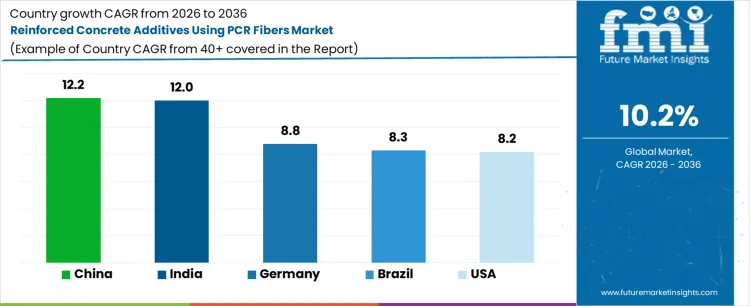
The reinforced concrete additives using PCR fibers market is growing steadily across various regions. India leads with a 12.0% CAGR, driven by rapid infrastructure development, a growing demand for sustainable construction practices, and increased adoption of PCR fibers in concrete reinforcement. China follows with a 12.2% growth rate, fueled by large-scale infrastructure projects and a focus on using eco-friendly materials in construction. Germany records an 8.8% CAGR, reflecting strong industry standards and the integration of PCR fibers in reinforced concrete as part of sustainable building efforts. The USA, with an 8.2% CAGR, shows steady growth driven by regulations encouraging the use of sustainable building materials in construction. Brazil, at 8.3%, is experiencing gradual growth in PCR fiber adoption, spurred by increasing infrastructure needs and cost-effective, environmentally conscious building solutions.
How is Germany experiencing growth in the reinforced concrete additives using PCR fibers market?
Germany is experiencing growth at a CAGR of 8.8%, driven by increasing adoption of recycled materials in construction and government initiatives promoting circular economy practices. Reinforced concrete additives using PCR fibers are optimized for enhancing structural strength, crack resistance, and durability while reducing environmental impact. Demand is concentrated in industrialized urban regions such as Berlin, Hamburg, and Munich, where large-scale infrastructure projects and commercial construction are underway. Investments focus on material performance, compliance with EU construction standards, and integration into high-performance concrete applications. Growth reflects emphasis on sustainable construction practices, regulatory compliance, and the modernization of building infrastructure.
- Circular economy and sustainable construction drive adoption.
- Urban infrastructure projects concentrate demand.
- Material performance and EU compliance guide investment.
How is the United States witnessing growth in the reinforced concrete additives using PCR fibers market?
United States is witnessing growth at a CAGR of 8.2%, supported by rising infrastructure development, adoption of green building practices, and increasing use of post-consumer recycled (PCR) materials. Reinforced concrete additives are optimized for high tensile strength, crack resistance, and longevity in commercial and civil construction projects. Demand is concentrated in metropolitan construction hubs such as New York, Los Angeles, and Chicago, where large-scale infrastructure and high-rise projects are ongoing. Investments focus on durability, performance consistency, and adherence to ASTM and federal construction standards. Growth reflects sustainable construction adoption and modernization of infrastructure with eco-friendly materials.
- Infrastructure expansion drives adoption.
- Major urban construction hubs concentrate demand.
- Performance and regulatory compliance guide investment.
How is China experiencing growth in the reinforced concrete additives using PCR fibers market?
China is experiencing growth at a CAGR of 12.2%, fueled by rapid urbanization, high-rise construction, and government policies supporting sustainable construction practices. Reinforced concrete additives using PCR fibers are optimized for structural reinforcement, long-term durability, and integration into high-performance concrete for commercial and residential projects. Demand is concentrated in industrial and urban regions such as Shanghai, Beijing, and Guangzhou, where large-scale infrastructure development is prevalent. Investments focus on quality control, material innovation, and compliance with national building codes. Growth reflects government incentives, urban construction expansion, and increasing adoption of recycled materials in concrete.
- Urbanization and sustainable construction drive adoption.
- Industrial and urban regions concentrate demand.
- Material quality and regulatory compliance guide investment.
How is India witnessing growth in the reinforced concrete additives using PCR fibers market?
India is witnessing growth at a CAGR of 12%, supported by rapid urban infrastructure development, metro rail projects, and residential high-rise construction in cities such as Mumbai, Bengaluru, and Delhi. Reinforced concrete additives using PCR fibers are optimized for crack resistance, structural reinforcement, and enhanced concrete durability under diverse climatic conditions. Demand is concentrated in urban construction hubs, industrial complexes, and infrastructure projects. Investments focus on material performance, integration into concrete production processes, and compliance with Indian building standards. Growth reflects modernization of construction practices, focus on eco-friendly materials, and increasing use of post-consumer recycled fibers.
- Additives optimize crack resistance and durability.
- Metro cities and industrial hubs concentrate demand.
- Material performance and standards compliance guide investment.
How is Brazil experiencing growth in the reinforced concrete additives using PCR fibers market?
Brazil is experiencing growth at a CAGR of 8.3%, driven by expansion in commercial and residential construction and increasing adoption of sustainable building materials. Reinforced concrete additives using PCR fibers are optimized for structural strength, crack prevention, and long-term durability, suitable for tropical and high-humidity environments. Demand is concentrated in São Paulo, Rio de Janeiro, and Paraná, where urban development and industrial construction projects are significant. Investments focus on material reliability, environmental impact reduction, and compliance with national building regulations. Growth reflects rising use of recycled materials, modernization of construction practices, and sustainable infrastructure development.
- Additives enhance structural strength and crack resistance.
- Urban and industrial hubs concentrate demand.
- Material reliability and regulatory compliance guide investment.
How Are Companies Competing in Reinforced Concrete Additives Using PCR Fibers Market?
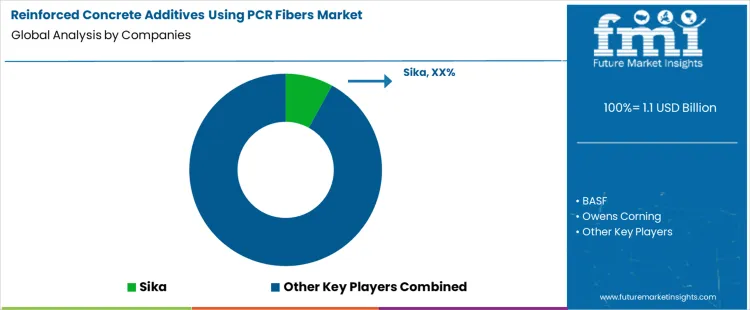
Sika and BASF lead competition with PCR fiber additives engineered to enhance concrete performance in structural reinforcement and crack control. Sika’s product literature highlights PCR-based fiber blends integrated into its SikaFiber range, with data showing improved tensile strength, reduced shrinkage cracking, and controlled post-crack behavior in slabs and precast elements. Sika emphasizes consistent fiber dispersion and compatibility with high-flow concrete mixes to support standard placement methods. BASF competes with PCR-modified polymer fibers and admixture systems designed to improve impact resistance and ductility in reinforced concrete. Technical brochures detail controlled elongation and bond strength with cementitious matrices, enabling precise specification for infrastructure and building projects.
Owens Corning advances PCR basalt and polymer fiber additives that target enhanced flexural performance and fatigue resistance. Its materials are presented with validated performance in standardized toughness and residual strength tests. Hengli’s strategy focuses on PCR polypropylene fiber grades engineered for uniform length and consistent dispersion, with product sheets showing effective control of plastic shrinkage and improved post-crack load transfer. Reliance Industries supplies base PCR polymer fibers that converters compound with performance additives to meet specific mix design targets. Viapol markets PCR fiber reinforced admixtures tailored to local concrete practices, emphasizing ease of use and predictable performance in reinforcing applications. Toray contributes PCR high-strength fiber additives that prioritize tensile modulus and controlled strain at break, supported by documented test results for reinforced concrete panels and overlays.
Key Players in the Reinforced Concrete Additives Using PCR Fibers Market
- Sika
- BASF
- Owens Corning
- Hengli
- Reliance Industries
- Viapol
- Toray
Scope of the Report
| Items | Values |
|---|---|
| Quantitative Units (2026) | USD billion |
| End-use | Structural Concrete & Slabs, Infrastructure & Pavements, Infrastructure Projects, Affordable Housing, Commercial Construction |
| Fiber Type | Macro & Micro Fibers, Structural Reinforcement Fibers, Synthetic Reinforcement Fibers, Crack-Control Fibers, Others |
| Material | PCR-PET Fibers, PCR Polymers, PCR-PET, Others |
| Technology | Fiber Dispersion & Crack-Control Design, ASTM-Compliant Fiber Dosing, High-Volume Fiber Production, Cost-Efficient Fiber Compounding, Others |
| Regions Covered | Asia Pacific, Europe, North America, Latin America, Middle East & Africa |
| Countries Covered | China, Japan, South Korea, India, Australia & New Zealand, ASEAN, Germany, United Kingdom, France, Italy, Spain, Nordic, BENELUX, United States, Canada, Mexico, Brazil, Chile, Saudi Arabia, Turkey, South Africa, and other regional markets |
| Key Companies Profiled | Sika, BASF, Owens Corning, Hengli, Reliance Industries, Viapol, Toray |
| Additional Attributes | Dollar sales by end-use, fiber type, material, and technology; macro and micro fibers as the leading fiber type; PCR-PET fibers as the main material; demand driven by crack control and durability needs; procurement shaped by tensile strength, dispersion, and toughness testing; performance influenced by feedstock quality, fiber processing, and compliance with construction standards. |
Reinforced Concrete Additives Using PCR Fibers Market Segmentation
End-use:
- Structural concrete & slabs
- Infrastructure & pavements
- Infrastructure projects
- Affordable housing
- Commercial construction
Fiber Type:
- Macro & micro fibers
- Structural reinforcement fibers
- Synthetic reinforcement fibers
- Crack-control fibers
- Others
Material:
- PCR-PET fibers
- PCR polymers
- PCR-PET
- Others
Technology:
- Fiber dispersion & crack-control design
- ASTM-compliant fiber dosing
- High-volume fiber production
- Cost-efficient fiber compounding
- Others
Region
Asia Pacific
- China
- Japan
- South Korea
- India
- Australia & New Zealand
- ASEAN
- Rest of Asia Pacific
Europe
- Germany
- United Kingdom
- France
- Italy
- Spain
- Nordic
- BENELUX
- Rest of Europe
North America
- United States
- Canada
- Mexico
Latin America
- Brazil
- Chile
- Rest of Latin America
Middle East & Africa
- Kingdom of Saudi Arabia
- Other GCC Countries
- Turkey
- South Africa
- Other African Union
- Rest of Middle East & Africa
Bibliography
- Suraweera, S. M. D. V., & De Silva, S. (2023). Effect of recycled polyethylene terephthalate (PET) fibres on fresh and hardened properties of concrete: A review. International Journal of Sustainable Engineering, 16(1), 269–284.
- Brown, A., & Börkey, P. (2024). Plastics recycled content requirements (OECD Environment Working Papers No. 236). Organisation for Economic Co-operation and Development.
- Ministry of Environment, Forest and Climate Change (India). (2025). Annual report 2024–25. Government of India.
Frequently Asked Questions
How big is the reinforced concrete additives using PCR fibers market in 2026?
The global reinforced concrete additives using PCR fibers market is estimated to be valued at USD 1.1 billion in 2026.
What will be the size of reinforced concrete additives using PCR fibers market in 2036?
The market size for the reinforced concrete additives using PCR fibers market is projected to reach USD 2.9 billion by 2036.
How much will be the reinforced concrete additives using PCR fibers market growth between 2026 and 2036?
The reinforced concrete additives using PCR fibers market is expected to grow at a 10.2% CAGR between 2026 and 2036.
What are the key end use segments in the reinforced concrete additives using PCR fibers market?
The key end use segments in reinforced concrete additives using PCR fibers market are structural concrete & slabs, infrastructure & pavements, infrastructure projects, affordable housing, commercial construction and high-durability concrete.
Which fiber type segment to contribute significant share in the reinforced concrete additives using PCR fibers market in 2026?
In terms of fiber type, macro & micro fibers segment to command 50.0% share in the reinforced concrete additives using PCR fibers market in 2026.
Preview the report firsthand - request a free sample
Get SampleGet the brochure for pricing and purchase details.
Get PDFTable of Content
- Executive Summary
- Global Market Outlook
- Demand-side Trends
- Supply-side Trends
- Technology Roadmap Analysis
- Analysis and Recommendations
- Market Overview
- Market Coverage / Taxonomy
- Market Definition / Scope / Limitations
- Market Background
- Market Dynamics
- Drivers
- Restraints
- Opportunity
- Trends
- Scenario Forecast
- Demand in Optimistic Scenario
- Demand in Likely Scenario
- Demand in Conservative Scenario
- Opportunity Map Analysis
- Product Life Cycle Analysis
- Supply Chain Analysis
- Investment Feasibility Matrix
- Value Chain Analysis
- PESTLE and Porter’s Analysis
- Regulatory Landscape
- Regional Parent Market Outlook
- Production and Consumption Statistics
- Import and Export Statistics
- Market Dynamics
- Global Market Analysis 2021 to 2025 and Forecast, 2026 to 2036
- Historical Market Size Value (USD Million) Analysis, 2021 to 2025
- Current and Future Market Size Value (USD Million) Projections, 2026 to 2036
- Y-o-Y Growth Trend Analysis
- Absolute $ Opportunity Analysis
- Global Market Pricing Analysis 2021 to 2025 and Forecast 2026 to 2036
- Global Market Analysis 2021 to 2025 and Forecast 2026 to 2036, By End-use
- Introduction / Key Findings
- Historical Market Size Value (USD Million) Analysis By End-use , 2021 to 2025
- Current and Future Market Size Value (USD Million) Analysis and Forecast By End-use , 2026 to 2036
- Structural concrete & slabs
- Infrastructure & pavements
- Infrastructure projects
- Affordable housing
- Commercial construction
- High-durability concrete
- Structural concrete & slabs
- Y-o-Y Growth Trend Analysis By End-use , 2021 to 2025
- Absolute $ Opportunity Analysis By End-use , 2026 to 2036
- Global Market Analysis 2021 to 2025 and Forecast 2026 to 2036, By Fiber Type
- Introduction / Key Findings
- Historical Market Size Value (USD Million) Analysis By Fiber Type, 2021 to 2025
- Current and Future Market Size Value (USD Million) Analysis and Forecast By Fiber Type, 2026 to 2036
- Macro & micro fibers
- Structural reinforcement fibers
- Synthetic reinforcement fibers
- Crack-control fibers
- Others
- Macro & micro fibers
- Y-o-Y Growth Trend Analysis By Fiber Type, 2021 to 2025
- Absolute $ Opportunity Analysis By Fiber Type, 2026 to 2036
- Global Market Analysis 2021 to 2025 and Forecast 2026 to 2036, By Material
- Introduction / Key Findings
- Historical Market Size Value (USD Million) Analysis By Material, 2021 to 2025
- Current and Future Market Size Value (USD Million) Analysis and Forecast By Material, 2026 to 2036
- PCR-PET fibers
- PCR-PET
- PCR polymers
- Others
- PCR-PET fibers
- Y-o-Y Growth Trend Analysis By Material, 2021 to 2025
- Absolute $ Opportunity Analysis By Material, 2026 to 2036
- Global Market Analysis 2021 to 2025 and Forecast 2026 to 2036, By Technology
- Introduction / Key Findings
- Historical Market Size Value (USD Million) Analysis By Technology, 2021 to 2025
- Current and Future Market Size Value (USD Million) Analysis and Forecast By Technology, 2026 to 2036
- Fiber dispersion & crack-control design
- ASTM-compliant fiber dosing
- High-volume fiber production
- Cost-efficient fiber compounding
- Others
- Fiber dispersion & crack-control design
- Y-o-Y Growth Trend Analysis By Technology, 2021 to 2025
- Absolute $ Opportunity Analysis By Technology, 2026 to 2036
- Global Market Analysis 2021 to 2025 and Forecast 2026 to 2036, By 0.36
- Introduction / Key Findings
- Historical Market Size Value (USD Million) Analysis By 0.36, 2021 to 2025
- Current and Future Market Size Value (USD Million) Analysis and Forecast By 0.36, 2026 to 2036
- 0.28
- 0.22
- 0.1
- 0.02
- 0.02
- 0.28
- Y-o-Y Growth Trend Analysis By 0.36, 2021 to 2025
- Absolute $ Opportunity Analysis By 0.36, 2026 to 2036
- Global Market Analysis 2021 to 2025 and Forecast 2026 to 2036, By Region
- Introduction
- Historical Market Size Value (USD Million) Analysis By Region, 2021 to 2025
- Current Market Size Value (USD Million) Analysis and Forecast By Region, 2026 to 2036
- North America
- Latin America
- Western Europe
- Eastern Europe
- East Asia
- South Asia and Pacific
- Middle East & Africa
- Market Attractiveness Analysis By Region
- North America Market Analysis 2021 to 2025 and Forecast 2026 to 2036, By Country
- Historical Market Size Value (USD Million) Trend Analysis By Market Taxonomy, 2021 to 2025
- Market Size Value (USD Million) Forecast By Market Taxonomy, 2026 to 2036
- By Country
- USA
- Canada
- Mexico
- By End-use
- By Fiber Type
- By Material
- By Technology
- By 0.36
- By Country
- Market Attractiveness Analysis
- By Country
- By End-use
- By Fiber Type
- By Material
- By Technology
- By 0.36
- Key Takeaways
- Latin America Market Analysis 2021 to 2025 and Forecast 2026 to 2036, By Country
- Historical Market Size Value (USD Million) Trend Analysis By Market Taxonomy, 2021 to 2025
- Market Size Value (USD Million) Forecast By Market Taxonomy, 2026 to 2036
- By Country
- Brazil
- Chile
- Rest of Latin America
- By End-use
- By Fiber Type
- By Material
- By Technology
- By 0.36
- By Country
- Market Attractiveness Analysis
- By Country
- By End-use
- By Fiber Type
- By Material
- By Technology
- By 0.36
- Key Takeaways
- Western Europe Market Analysis 2021 to 2025 and Forecast 2026 to 2036, By Country
- Historical Market Size Value (USD Million) Trend Analysis By Market Taxonomy, 2021 to 2025
- Market Size Value (USD Million) Forecast By Market Taxonomy, 2026 to 2036
- By Country
- Germany
- UK
- Italy
- Spain
- France
- Nordic
- BENELUX
- Rest of Western Europe
- By End-use
- By Fiber Type
- By Material
- By Technology
- By 0.36
- By Country
- Market Attractiveness Analysis
- By Country
- By End-use
- By Fiber Type
- By Material
- By Technology
- By 0.36
- Key Takeaways
- Eastern Europe Market Analysis 2021 to 2025 and Forecast 2026 to 2036, By Country
- Historical Market Size Value (USD Million) Trend Analysis By Market Taxonomy, 2021 to 2025
- Market Size Value (USD Million) Forecast By Market Taxonomy, 2026 to 2036
- By Country
- Russia
- Poland
- Hungary
- Balkan & Baltic
- Rest of Eastern Europe
- By End-use
- By Fiber Type
- By Material
- By Technology
- By 0.36
- By Country
- Market Attractiveness Analysis
- By Country
- By End-use
- By Fiber Type
- By Material
- By Technology
- By 0.36
- Key Takeaways
- East Asia Market Analysis 2021 to 2025 and Forecast 2026 to 2036, By Country
- Historical Market Size Value (USD Million) Trend Analysis By Market Taxonomy, 2021 to 2025
- Market Size Value (USD Million) Forecast By Market Taxonomy, 2026 to 2036
- By Country
- China
- Japan
- South Korea
- By End-use
- By Fiber Type
- By Material
- By Technology
- By 0.36
- By Country
- Market Attractiveness Analysis
- By Country
- By End-use
- By Fiber Type
- By Material
- By Technology
- By 0.36
- Key Takeaways
- South Asia and Pacific Market Analysis 2021 to 2025 and Forecast 2026 to 2036, By Country
- Historical Market Size Value (USD Million) Trend Analysis By Market Taxonomy, 2021 to 2025
- Market Size Value (USD Million) Forecast By Market Taxonomy, 2026 to 2036
- By Country
- India
- ASEAN
- Australia & New Zealand
- Rest of South Asia and Pacific
- By End-use
- By Fiber Type
- By Material
- By Technology
- By 0.36
- By Country
- Market Attractiveness Analysis
- By Country
- By End-use
- By Fiber Type
- By Material
- By Technology
- By 0.36
- Key Takeaways
- Middle East & Africa Market Analysis 2021 to 2025 and Forecast 2026 to 2036, By Country
- Historical Market Size Value (USD Million) Trend Analysis By Market Taxonomy, 2021 to 2025
- Market Size Value (USD Million) Forecast By Market Taxonomy, 2026 to 2036
- By Country
- Kingdom of Saudi Arabia
- Other GCC Countries
- Turkiye
- South Africa
- Other African Union
- Rest of Middle East & Africa
- By End-use
- By Fiber Type
- By Material
- By Technology
- By 0.36
- By Country
- Market Attractiveness Analysis
- By Country
- By End-use
- By Fiber Type
- By Material
- By Technology
- By 0.36
- Key Takeaways
- Key Countries Market Analysis
- USA
- Pricing Analysis
- Market Share Analysis, 2025
- By End-use
- By Fiber Type
- By Material
- By Technology
- By 0.36
- Canada
- Pricing Analysis
- Market Share Analysis, 2025
- By End-use
- By Fiber Type
- By Material
- By Technology
- By 0.36
- Mexico
- Pricing Analysis
- Market Share Analysis, 2025
- By End-use
- By Fiber Type
- By Material
- By Technology
- By 0.36
- Brazil
- Pricing Analysis
- Market Share Analysis, 2025
- By End-use
- By Fiber Type
- By Material
- By Technology
- By 0.36
- Chile
- Pricing Analysis
- Market Share Analysis, 2025
- By End-use
- By Fiber Type
- By Material
- By Technology
- By 0.36
- Germany
- Pricing Analysis
- Market Share Analysis, 2025
- By End-use
- By Fiber Type
- By Material
- By Technology
- By 0.36
- UK
- Pricing Analysis
- Market Share Analysis, 2025
- By End-use
- By Fiber Type
- By Material
- By Technology
- By 0.36
- Italy
- Pricing Analysis
- Market Share Analysis, 2025
- By End-use
- By Fiber Type
- By Material
- By Technology
- By 0.36
- Spain
- Pricing Analysis
- Market Share Analysis, 2025
- By End-use
- By Fiber Type
- By Material
- By Technology
- By 0.36
- France
- Pricing Analysis
- Market Share Analysis, 2025
- By End-use
- By Fiber Type
- By Material
- By Technology
- By 0.36
- India
- Pricing Analysis
- Market Share Analysis, 2025
- By End-use
- By Fiber Type
- By Material
- By Technology
- By 0.36
- ASEAN
- Pricing Analysis
- Market Share Analysis, 2025
- By End-use
- By Fiber Type
- By Material
- By Technology
- By 0.36
- Australia & New Zealand
- Pricing Analysis
- Market Share Analysis, 2025
- By End-use
- By Fiber Type
- By Material
- By Technology
- By 0.36
- China
- Pricing Analysis
- Market Share Analysis, 2025
- By End-use
- By Fiber Type
- By Material
- By Technology
- By 0.36
- Japan
- Pricing Analysis
- Market Share Analysis, 2025
- By End-use
- By Fiber Type
- By Material
- By Technology
- By 0.36
- South Korea
- Pricing Analysis
- Market Share Analysis, 2025
- By End-use
- By Fiber Type
- By Material
- By Technology
- By 0.36
- Russia
- Pricing Analysis
- Market Share Analysis, 2025
- By End-use
- By Fiber Type
- By Material
- By Technology
- By 0.36
- Poland
- Pricing Analysis
- Market Share Analysis, 2025
- By End-use
- By Fiber Type
- By Material
- By Technology
- By 0.36
- Hungary
- Pricing Analysis
- Market Share Analysis, 2025
- By End-use
- By Fiber Type
- By Material
- By Technology
- By 0.36
- Kingdom of Saudi Arabia
- Pricing Analysis
- Market Share Analysis, 2025
- By End-use
- By Fiber Type
- By Material
- By Technology
- By 0.36
- Turkiye
- Pricing Analysis
- Market Share Analysis, 2025
- By End-use
- By Fiber Type
- By Material
- By Technology
- By 0.36
- South Africa
- Pricing Analysis
- Market Share Analysis, 2025
- By End-use
- By Fiber Type
- By Material
- By Technology
- By 0.36
- USA
- Market Structure Analysis
- Competition Dashboard
- Competition Benchmarking
- Market Share Analysis of Top Players
- By Regional
- By End-use
- By Fiber Type
- By Material
- By Technology
- By 0.36
- Competition Analysis
- Competition Deep Dive
- Sika
- Overview
- Product Portfolio
- Profitability by Market Segments (Product/Age /Sales Channel/Region)
- Sales Footprint
- Strategy Overview
- Marketing Strategy
- Product Strategy
- Channel Strategy
- BASF
- Owens Corning
- Hengli
- Reliance Industries
- Viapol
- Toray
- Sika
- Competition Deep Dive
- Assumptions & Acronyms Used
- Research Methodology


