

- Industry Size (2026)
- USD 11.20 Bn
- Forecast (2036)
- USD 25.09 Bn
- CAGR (2026 to 2036)
- 8.40%
PCR Thermoforms Market Size, Market Forecast and Outlook By FMI
The PCR thermoforms market was valued at USD 10.33 billion in 2025. Industry valuation is expected to hit USD 11.20 billion in 2026 at a CAGR of 8.40% during this forecast period. Sustained investment propels cumulative revenue to USD 25.09 billion through 2036 as food-contact regulatory approvals for post-consumer recycled resins intersect with corporate virgin-plastic reduction targets, forcing packaging conversions.
Summary of PCR Thermoforms Market
- PCR Thermoforms Market Definition
- Rigid plastic packaging containers are manufactured using post-consumer recycled resins through thermoforming processes. Items like food trays and clamshells containing verified recycled content from formal recovery streams form this core.
- Demand Drivers in the Market
- Plastic packaging taxes compel category managers to substitute virgin formats with recycled alternatives.
- Corporate sustainability targets force procurement teams to demand certified post-consumer content across core product lines.
- Retailer mandates require brand owners to eliminate non-circular formats to maintain shelf presence.
- Key Segments Analyzed in the FMI Report
- Material: rPE is anticipated to hold 63.0% share in 2026, as established bottle-to-tray recycling streams provide reliable feedstock.
- Product: Trays are projected to capture 34.0% share in 2026, driven by intense substitution pressure in fresh protein packaging applications.
- End Use: Food is expected to record 56.0% share in 2026, due to massive volume requirements in fast-moving consumer goods sectors.
- Process: Inline thermoforming is set to command 58.0% share in 2026, as integrated extrusion and forming minimize heat cycles.
- PCR Content: 30–50% PCR is estimated to secure 37.0% share in 2026, representing an optimal balance between compliance and mechanical performance.
- India: Country is scaling rapidly, supported by compound growth of 10.2% as extended producer responsibility rules bring structure to collection systems.
- Analyst Opinion at FMI
- Ismail Sutaria, Principal Analyst, Packaging, at FMI, notes that "Procurement directors assume securing post-consumer resin commitments guarantees compliance. In reality, purchasing recycled material is simply a commercial transaction. Running it efficiently is a complex operational hurdle. Variations in intrinsic viscosity between different post-consumer recycled plastic packaging batches wreak havoc on inline extrusion stability. Converters often run machines slower to compensate for brittle recycled flakes. They might also increase sheet thickness, silently eroding promised sustainability metrics. What standard reporting models miss entirely is this hidden operational tax. Sourcing recycled material happens readily. Forming it at virgin-equivalent speeds without massive scrap generation separates tier-one suppliers from vulnerable competitors."
- Strategic Implications / Executive Takeaways
- Packaging engineers must validate seal integrity across varying post-consumer batch qualities to prevent catastrophic shelf-life failures.
- Sourcing directors face critical decisions regarding long-term feedstock contracts to avoid stranded supply.
- Operations managers must upgrade extrusion filtration systems to handle increased contamination levels inherent in recycled flake inputs.
- Methodology
- Primary Research: Direct interviews with packaging engineers and procurement heads at major converting facilities.
- Desk Research: Exhaustive review of food-contact regulatory approvals and recycling design guidelines.
- Market-Sizing and Forecasting: Baseline established through certified post-consumer resin capacity volumes and converter agreements.
- Data Validation and Update Cycle: Cross-validation utilizing independent bale yield reports and recovery facility metrics.
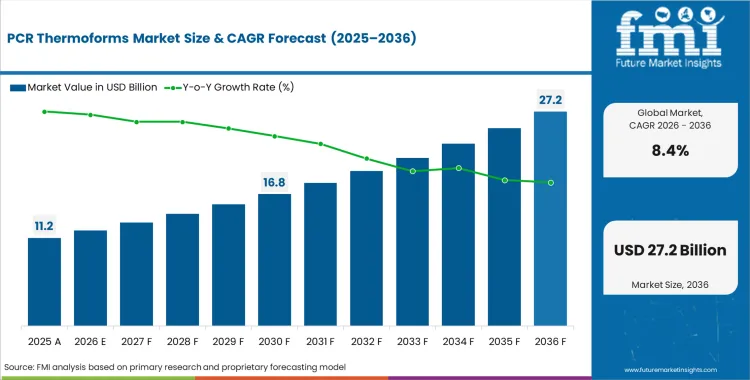
PCR Thermoforms Market Key Takeaways
| Metric | Details |
|---|---|
| Industry Size (2026) | USD 11.20 billion |
| Industry Value (2036) | USD 25.09 billion |
| CAGR (2026–2036) | 8.40% |
Source: Future Market Insights (FMI) analysis, based on proprietary forecasting model and primary research
Procurement directors at major food processors face immediate legislative mandates requiring minimum recycled content. Delaying transition exposes fast-moving consumer goods companies to escalating extended producer responsibility fees across key operating regions. Securing reliable volumes of recyclable thermoforms dictates supplier relationships today. Buyers prioritize converters possessing secured feedstock contracts over those offering lower unit costs from spot-market resin purchases. What escapes surface-level sustainability reports involves actual supply realities. Shortages of high-clarity flake often force brands into accepting slight color variations or haze. This directly challenges established retail visual standards for post-consumer recycled thermoforms.
Once regional mechanical recycling infrastructure achieves food-grade certification at scale, virgin resin parity ceases to justify delaying adoption. Converters securing consistent, clean bale inputs dominate capacity expansions. Competitors reliant on imported resins remain vulnerable to severe supply shocks.
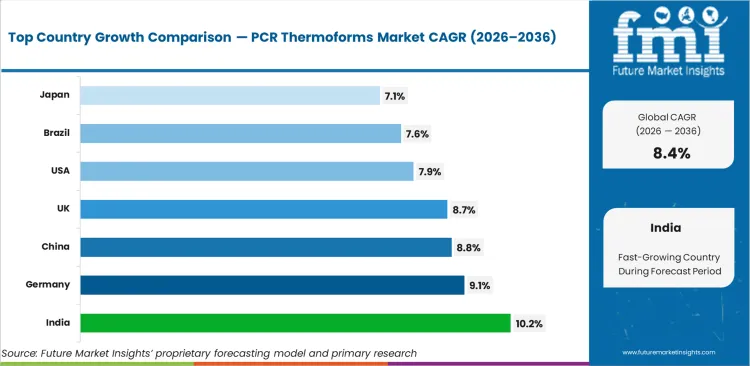
India leads at 10.2% compound growth as sweeping policy enforcement forces informal collection networks into formal feedstock streams. Germany tracks at 9.1% on strict circular-packaging obligations. China advances at 8.8% owing to immense domestic manufacturing scaling. United Kingdom records 8.7% growth as tax structures directly reward recycled formats. Brazil follows at 7.6% alongside United States at 7.9%. Both nations are actively building crucial recovery infrastructure. Japan registers 7.1% as rigid quality constraints slowly resolve. Diverging regulatory enforcement timelines dictate this geographic spread, creating uneven global adoption speeds.
PCR Thermoforms Market Definition
Recycled thermoforms encompass rigid plastic packaging containers manufactured using post-consumer reclaimed resins through thermoforming processes. This category strictly bounds products containing verified recycled content sourced from municipal or commercial recovery streams. Converters extrude reclaimed polymer flakes into sheets before applying heat and pressure to form specific geometries. These formats satisfy critical structural and clarity requirements for retail distribution.
PCR Thermoforms Market Inclusions
Scope involves rigid containers incorporating post-consumer resin across all basic chemistries including polyethylene terephthalate and polypropylene. Standard thermoform packaging formats like food trays and protective clamshells fall within boundaries. Medical blisters qualify provided they contain verifiable recycled content. Analysis includes both multi-layer structures containing recycled core layers and single-layer solutions.
PCR Thermoforms Market Exclusions
Flexible packaging formats completely fall outside these parameters. Virgin-only plastic containers receive strict exclusion because they lack required post-consumer recycled content. Bio-based plastics lacking mechanical recycling provenance also sit beyond analytical scope. Industrial thick-gauge thermoforming for automotive components is excluded. Focus remains entirely on thin-gauge packaging applications.
PCR Thermoforms Market Research Methodology
- Primary Research: Procurement directors at fast-moving consumer goods brands and packaging engineers at tier-one converting facilities.
- Desk Research: European Food Safety Authority authorizations, FDA no-objection letters, and Association of Plastic Recyclers design documentation.
- Market-Sizing and Forecasting: Certified post-consumer resin capacity volumes and documented converter offtake agreements.
- Data Validation and Update Cycle: Independent bale yield reports and municipal recovery facility sorting data.
Segmental Analysis
PCR Thermoforms Market Analysis by Material
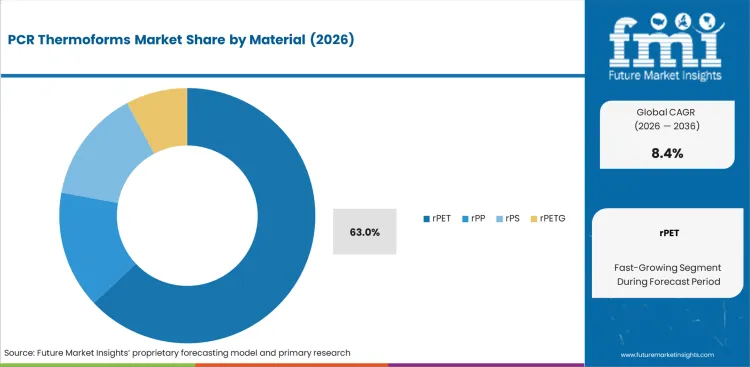
Established bottle-to-tray recycling systems continue to shape how the market is structured today. This trend supports formats that rely on easily available raw materials. FMI’s analysis shows that rPET holds a 63.0% share, largely because of strong polyethylene terephthalate bottle recovery networks that supply clean flakes for thermoforming processes. Procurement teams at major food companies increasingly prefer PCR PET thermoforms to meet sustainability targets. Using this material allows converters to run recycled PET on existing equipment with minimal changes. Pricing trends are not always straightforward. High demand for clear bottle bales often drives recycled resin prices above virgin materials. Buyers who wait for price parity risk facing supply shortages, while leading FMCG companies secure long-term contracts for high-quality bales in advance.
-
- Sourcing reality: Converters depend on bottle bales to maintain consistent material quality. Poor flake quality can create serious issues during extrusion.
- Contamination limits: Even small amounts of polyvinyl chloride can damage PET batches. Quality teams use advanced sorting systems to avoid major production losses.
- Future trajectory: Tray-to-tray recycled PET systems are gradually developing. Over time, supply chains are expected to rely less on bottle-based sources as these systems expand.
PCR Thermoforms Market Analysis by Product
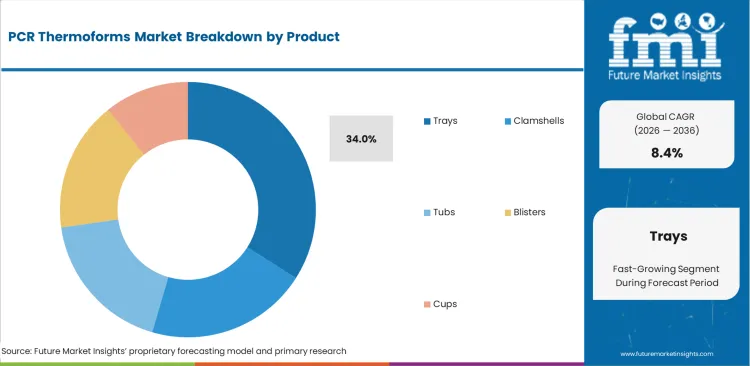
Fresh protein and produce packaging needs play a key role in shaping adoption trends for different formats. Trays account for a 34.0% share, with PCR tray packaging widely used for meat, poultry, and ready-to-eat meals. Packaging engineers prefer these formats because they work smoothly with automated lidding lines. Using thermoformed containers that fit into existing high-speed filling systems helps food processors avoid expensive factory redesigns. These share figures often overlook a key recycling challenge. Adding peelable sealing layers can reduce actual recyclability in municipal systems. Many trays marketed as sustainable do not get properly sorted or recycled. Brands that ignore these end-of-life challenges risk facing negative public perception.
-
- Geometry constraints: Deep-draw designs require even material distribution across the sheet. Tooling engineers carefully adjust forming processes to avoid thinning at the corners, especially when using recycled materials.
- Sealing interface: Lidding film compatibility directly affects flange design. Plant teams must maintain flat, uniform flanges to prevent leaks in modified atmosphere packaging.
- Stacking performance: Supply chains require strong trays that can handle stacking pressure. Weak recycled tray walls can lead to product damage during transport.
PCR Thermoforms Market Analysis by End Use
Strict regulations around materials used for direct human consumption play a major role in determining which sectors adopt these solutions fastest. The food sector holds a 56.0% share, driven by high product turnover in grocery retail. Supermarket category managers are increasingly pushing for sustainable packaging in private-label produce, putting strong pressure on food tray suppliers using PCR PET. Moving into recycled pharma trays is more complex due to stricter approval processes, while food applications benefit from relatively clearer compliance pathways supported by functional barrier layers. One important detail often overlooked is the requirement for safe direct food contact. To meet these standards, manufacturers commonly use A-B-A co-extrusion structures, where recycled material is layered between thin virgin plastic layers. Companies trying to use 100% recycled content without these barriers risk regulatory penalties. FMI analysts highlight that these requirements significantly influence investment decisions in extrusion technologies.
- Regulatory clearance: Guidelines from authorities such as the European Food Safety Authority set strict limits on recycled content. Compliance teams must ensure full traceability of each resin batch.
- Retailer mandates: Supermarket chains remove non-compliant packaging from shelves. Delays in transition can result in lost shelf space and reduced sales opportunities.
- Consumer perception: Clear packaging remains important for fresh food appeal. Marketing teams often balance sustainability goals with maintaining product visibility and appearance.
PCR Thermoforms Market Analysis by Process
Energy efficiency and scrap management play a key role in determining profitability across different manufacturing methods. Inline thermoforming holds a 58.0% share as this technique combines vacuum thermoformed packaging principles directly with sheet extrusion in one continuous operation. Plant managers prefer this setup because forming the sheet immediately after extrusion removes the need for additional heating, leading to significant energy savings. It also allows recycled scrap to be fed back directly into the system, improving material utilization. One limitation is that this efficiency drops if the moisture level in post-consumer flakes is not properly controlled. Poor drying can lead to sheet defects that cannot be fixed later in the process. Facilities that do not invest in advanced drying systems often face high rejection rates.
- Thermal history: Reducing repeated heating helps maintain material quality. Operators closely monitor temperature levels to avoid polymer degradation.
- Scrap handling: Recycling leftover material directly impacts overall yield. Production teams carefully manage the balance between virgin and recycled content to ensure consistent performance.
- Tooling optimization: Multi-cavity molds need accurate cooling systems. Maintenance teams regularly adjust cooling settings to prevent defects during high-speed production.
PCR Thermoforms Market Analysis by PCR Content
Material performance limits how much recycled content can realistically be used in production. The 30–50% PCR range holds a 37.0% share, as it offers a balance between meeting regulatory requirements and maintaining product strength. Product developers choose thermoforms with 30% PCR to meet baseline tax exemptions while keeping standard production speeds on existing polyethylene pe thermoform packaging lines. Increasing recycled content beyond 50% often requires thicker sheets to maintain strength, especially for load-bearing applications. Brands that push for thermoforms with 50% PCR without adjusting packaging design or logistics may face higher failure rates during transportation.
- Drop impact resistance: Higher recycled content can reduce strength and durability. Teams must carry out thorough drop testing to ensure packaging performs well in cold-chain conditions.
- Optical sorting limits: Dark or mixed-color flakes can affect material consistency. Quality teams often reject batches if color variation exceeds acceptable limits.
- Compliance verification: Independent certification is used to confirm recycled content levels. Sustainability teams maintain detailed tracking systems to support compliance and avoid misleading claims.
PCR Thermoforms Market Drivers, Restraints, and Opportunities
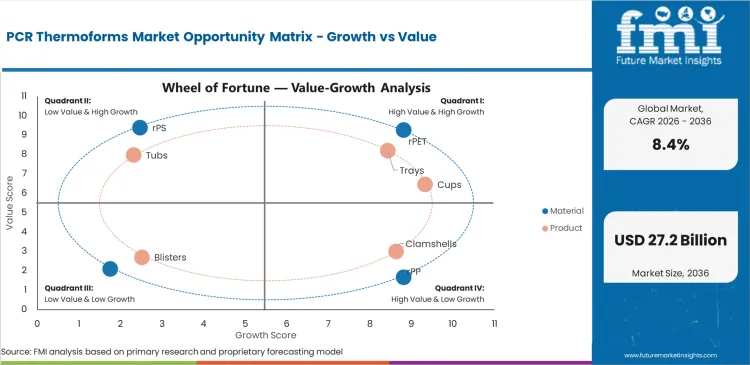
Plastic packaging taxes compel category managers to substitute virgin formats with recycled alternatives immediately. Delaying this transition transforms packaging from a standard cost of goods into an escalating tax liability. Major retailers actively enforce strict sustainability portfolios. They threaten to delist fast-moving consumer goods that fail to incorporate minimum recycled content. Brands scrambling to secure compliant thermoformed skin packaging formats are realizing that securing reliable feedstock contracts dictates operational survival.
Securing consistent, high-quality, food-grade PCR thermoforms supply outpaces actual thermoforming capacity constraints. Intrinsic viscosity variations across different post-consumer batches wreak havoc on high-speed inline extrusion stability. Operators must constantly adjust processing parameters. Converters cannot simply purchase spot-market recycled flake and expect virgin-like performance. They must build entirely new quality control and filtration infrastructures. Current mechanical recycling realities mean processors constantly battle contamination and polymer degradation.
Opportunities in the PCR Thermoforms Market
- Tray-to-tray closed loops: Developing dedicated sorting infrastructure for non-bottle rigid packaging. Facility operators secure independent feedstock streams to bypass highly competitive bottle bales.
- Advanced sorting technologies: Installing artificial intelligence-driven optical sorters inside recovery facilities. Plant managers dramatically increase food-grade yield from mixed plastic waste streams.
- Mono-material redesigns: Engineering evoh free modified atmosphere meat trays. Packaging developers eliminate incompatible barrier layers to ensure true circularity and premium pricing power.
Regional Analysis
.webp "Top Country Growth Comparison Pcr Thermoforms Market Cagr (2026 2036)")
Based on regional analysis, PCR Thermoforms is segmented into North America, Europe, Asia Pacific, and Latin America across 40 plus countries.
| Country | CAGR (2026 to 2036) |
|---|---|
| India | 10.2% |
| Germany | 9.1% |
| China | 8.8% |
| United Kingdom | 8.7% |
| United States | 7.9% |
| Brazil | 7.6% |
| Japan | 7.1% |
Source: Future Market Insights (FMI) analysis, based on proprietary forecasting model and primary research
North America PCR Thermoforms Market Analysis
State-level regulations that require minimum recycled content are driving major supply chain changes across North America. Procurement teams at large food companies are rushing to secure domestic recycled materials as deadlines approach. Converters are expanding extrusion capacity to handle more contaminated post-consumer waste. Based on FMI’s assessment, heavy reliance on municipal recycling systems is creating bottlenecks, as current sorting infrastructure often struggles to separate PET containers from similar-looking thermoformed trays. While it may appear as a unified regulatory push, the reality is a fragmented system of state-specific laws. National brands must design packaging to meet the strictest local requirements rather than a single national standard.
- United States: Adoption of compliant packaging formats is accelerating as extended producer responsibility laws take effect across multiple states in the United States. Financial penalties associated with non‑compliance are reinforcing an expected 7.9% CAGR in recyclable packaging solutions, prompting brands to reassess material choices and supplier alignment. To manage variation across state‑level requirements, packaging teams are centralizing procurement strategies to improve consistency and reduce regulatory complexity.
FMI’s report includes Canada and Mexico. Cross‑border packaging supply chains complicate compliance for converters operating across this trade corridor, as tracking the precise origin of post‑consumer flake becomes a mandatory audit requirement rather than an internal quality metric. Colombia is also gaining relevance within the regional outlook, supported by growing recycled material availability and improving traceability standards.
Europe PCR Thermoforms Market Analysis
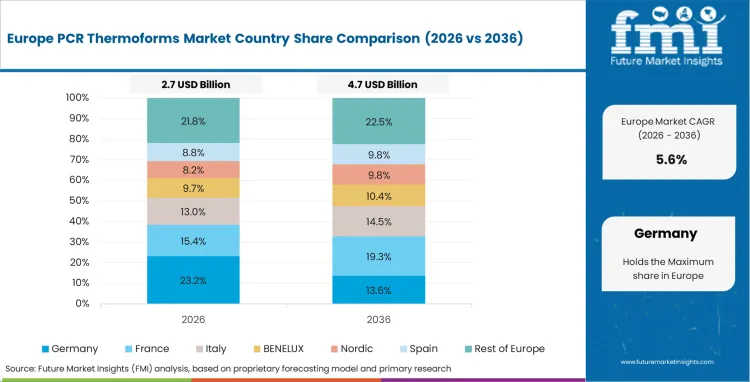
Strict plastic taxes and regulations from authorities like the European Food Safety Authority play a major role in shaping packaging decisions across Europe. Sustainability teams at leading supermarket chains are pushing for fully circular packaging formats. To meet food safety standards, extrusion teams must work with complex A-B-A co-extrusion structures. Integrating PET-material packaging into closed-loop systems requires strong traceability across the supply chain. Despite high recycling rates, there is still a shortage of high-quality recycled material, as multiple industries compete for the same bottle-based feedstock.
- Germany: Strong circular economy policies continue to shape packaging material choices across Germany, where recycled content is becoming a default requirement rather than a differentiator. Converters are investing heavily in advanced washing, sorting, and reprocessing technologies to improve output quality and yield. These investments are supporting an estimated 9.1% CAGR in recycled packaging materials, while also strengthening Germany’s role as a supplier of high‑grade recycled packaging solutions to neighboring European markets.
- United Kingdom: In the United Kingdom, cost pressure rather than policy ambition alone is accelerating the shift toward recycled content. The Plastic Packaging Tax has turned material selection into a financial decision, prompting rapid changes in resin and fiber sourcing. This dynamic is supporting a projected 8.7% CAGR in recycled‑content packaging, as companies that adapt quickly gain an advantage by offering tax‑compliant solutions that help brand owners manage compliance risk and operating costs.
FMI’s report includes France, Italy, and Spain. Southern European processors are increasingly evaluating localized chemical recycling partnerships to handle highly contaminated mixed‑plastic bales that mechanical washing lines cannot process economically. Germany is also emerging as an important reference point, with early commercial deployment of chemical recycling facilities influencing technology selection across Europe.
Asia Pacific PCR Thermoforms Market Analysis
The rapid development of formal waste management systems is reshaping packaging dynamics across Asia. Operations teams are moving away from imported recycled materials and focusing on building strong domestic supply chains. Extrusion facilities are upgrading their equipment with advanced filtration systems to manage the variability in locally sourced materials. Using recycled polyolefin compounds for food packaging also requires meeting newly introduced food safety regulations. This shift reflects a move from informal waste collection to structured and traceable recycling systems.
- India: Tighter enforcement of extended producer responsibility rules is reshaping waste collection into more organized and traceable supply chains. In India, supply chain teams are responding by forming direct relationships with formal recycling partners rather than relying on fragmented intermediaries. These changes are supporting an estimated 10.2% CAGR in post‑consumer recycled (PCR) thermoform packaging, as local processing capacity expands and investment activity accelerates.
- China: Manufacturing scale continues to shape outcomes in China, where large, integrated production sites deliver efficiency advantages that smaller converters struggle to match. Many facilities combine sorting, washing, and thermoforming within a single operation, reducing handling costs and improving yield consistency. This operating model is supporting a projected 8.8% CAGR in recycled plastic packaging production, driven by higher throughput and tighter process control across vertically integrated plants.
- Japan: In Japan, market expansion follows a more gradual path, defined by strict quality expectations for recycled materials. Packaging producers must meet high standards for cleanliness and visual clarity, even as recycled content levels increase. These constraints are contributing to a steady 7.1% CAGR in recycled packaging applications, with growth closely tied to incremental infrastructure upgrades and continued improvements in material purification and inspection processes.
FMI’s report includes South Korea, Australia, and key Southeast Asian manufacturing hubs. Export‑oriented electronics and appliance manufacturers in these jurisdictions must secure certified post‑consumer packaging formats to maintain access to tightly regulated Western retail channels. Taiwan is also emerging as a relevant influence, as electronics producers there increase adoption of compliant packaging to meet export requirements tied to North American and European buyers.
Latin America PCR Thermoforms Market Analysis
The development of municipal recycling systems plays a key role in shaping sustainable packaging adoption across Latin America. Facility managers often deal with limited infrastructure by building their own collection networks to work around gaps in public systems. Converters use flexible thermoforming films to manage the inconsistency in recycled resin quality. Multinational consumer goods companies are leading early adoption, pushing local suppliers to upgrade their capabilities to stay competitive. The main challenge lies in balancing ambitious sustainability goals with the limited availability of reliable recycled materials.
- Brazil: Gradual improvements in recycling infrastructure are beginning to unlock usable post‑consumer material across Brazil, reducing long‑standing supply constraints. Procurement teams are responding by securing early‑stage agreements with emerging recycling groups, a shift that is supporting an estimated 7.6% CAGR in recycled‑content packaging materials. Converters that establish access to these local feedstocks gain a clear cost and supply advantage compared with peers that remain dependent on higher‑priced imported inputs.
FMI’s report includes Argentina and Chile. Multinational beverage and food conglomerates operating in these markets frequently fund dedicated recovery pilot programs directly to secure future access to packaging feedstock. Peru is also emerging as a relevant market, supported by rising packaged food consumption and early investment in formal collection and sorting initiatives.
Competitive Aligners for Market Players
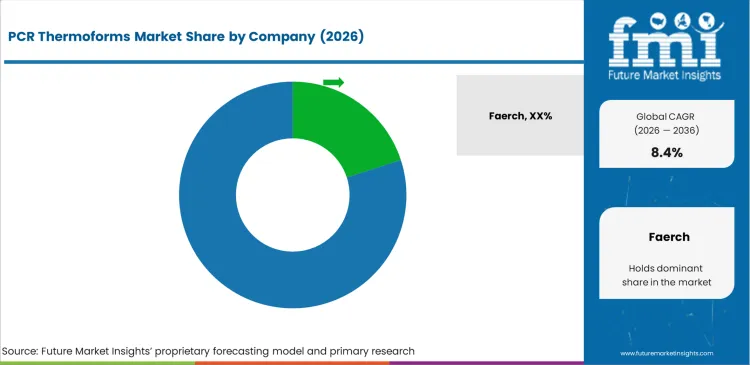
Material science expertise and vertical integration play a key role in determining profitability within this moderately concentrated market. PCR thermoform manufacturers such as Faerch and Placon lead by securing stable and reliable sources of recycled material, helping them avoid fluctuations in spot-market pricing. Their engineering teams develop specialized tooling designs that can handle more brittle recycled materials at high production speeds without defects. Buyers today look beyond just recycled content claims; they closely assess decontamination processes and food-contact certifications before making decisions.
New entrants trying to compete in this space need to invest in advanced filtration systems to produce high clarity PCR sheets. Established companies have strong partnerships with municipal recycling facilities and specialized bale suppliers, giving them priority access to high-quality feedstock. This high capital requirement makes it difficult for smaller thermoformers to shift toward sustainable packaging. Without the right equipment, the output often turns out hazy, brittle, or contaminated, leading to failures in strict brand quality checks.
Large fast-moving consumer goods companies try to avoid depending on a single PCR thermoform supplier by working with multiple converters across different regions. Procurement teams divide contracts carefully, which keeps top suppliers under constant pressure to compete on both price and performance. Converters that develop tray-to-tray recycling systems can reduce their reliance on highly competitive bottle-bale markets, potentially changing the overall economics of feedstock sourcing.
Key Players in PCR Thermoforms Market
- Faerch
- Placon
- Pactiv Evergreen
- Genpak
- TOPPAN Packaging
- Sabert
- Amcor
Scope of the Report
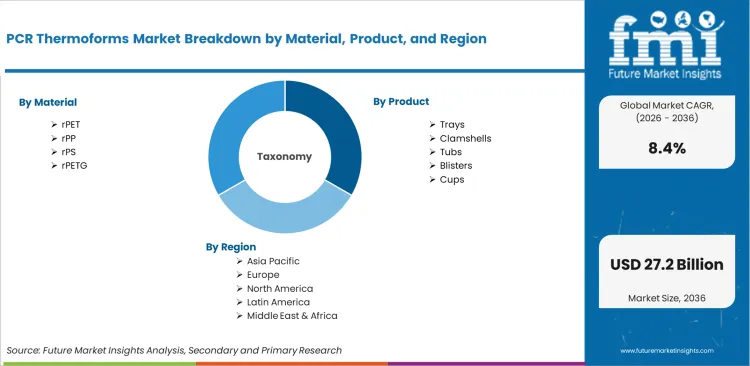
| Metric | Value |
|---|---|
| Quantitative Units | USD 11.20 billion to USD 25.09 billion, at a CAGR of 8.40% |
| Market Definition | Rigid plastic packaging containers manufactured using post-consumer recycled resins through thermoforming processes. Items like food trays and clamshells containing verified recycled content from formal recovery streams form this core. |
| Segmentation | By Material, Product, End Use, Process, PCR Content, and Region |
| Regions Covered | North America, Europe, Asia Pacific, Latin America, Middle East and Africa |
| Countries Covered | United States, Germany, United Kingdom, China, India, Japan, Brazil, and others |
| Key Companies Profiled | Faerch, Placon, Pactiv Evergreen, Genpak, TOPPAN Packaging, Sabert, Amcor |
| Forecast Period | 2026 to 2036 |
| Approach | Baseline established through certified post-consumer resin capacity volumes and documented converter offtake agreements. |
Source: Future Market Insights (FMI) analysis, based on proprietary forecasting model and primary research
PCR Thermoforms Market Analysis by Segments
Material
- rPET
- rPP
- rPS
- rPETG
Product
- Trays
- Clamshells
- Tubs
- Blisters
- Cups
End Use
- Food
- Foodservice
- Retail
- Healthcare
- Electronics
Process
- Inline thermoforming
- Sheet thermoforming
- Vacuum forming
- Pressure forming
PCR Content
- 30–50% PCR
- Below 30%
- 50–75%
- Above 75%
Region
- North America
- United States
- Canada
- Europe
- Germany
- United Kingdom
- France
- Italy
- Spain
- Asia Pacific
- China
- India
- Japan
- South Korea
- Australia
- Latin America
- Brazil
- Mexico
- Argentina
- Middle East and Africa
- GCC Countries
- South Africa
Bibliography
- Association of Plastic Recyclers. (2024, November 18). PET Thermoform Packaging Design Resource Document.
- RecyClass. (2025). RecyClass updates packaging recyclability recommendations following extensive testing in 2025.
- North American PET Resin Association. (2025, December 10). NAPCOR releases 2024 PET Recycling Report highlighting system efficiency gains and continued strength of PET circularity.
- USA Environmental Protection Agency. (2025, August 6). USA Recycling Infrastructure Assessment and State Data Collection Reports
- Systemiq. (2024, November 22). Transforming PET Packaging and Textiles in the United States: System change scenarios and recommendations to cut waste, create jobs, and mitigate climate change
- Nguyen, P. M., Feigenbaum, A., Dagnon, S., Bellenfant, G., Rivaton, A., Schmitz-Afonso, I., Bach, C., & Veyrand, B. (2024). Assessment of chemical risks and circular economy perspective associated with the use of recycled PET in food packaging trays. Current Research in Food Science, 9, 100840.
- Bezeraj, E., Di Maio, F., & Zaccariello, L. (2025). State-of-the-art of industrial PET mechanical recycling: Technologies, impact of contamination and guidelines for decision-making. Sustainable Horizons, 5, 100064.
This bibliography is provided for reader reference. The full FMI report contains the complete reference list with primary source documentation.
This Report Addresses
- Post-consumer recycled resin availability and impact on tray manufacturing capacity.
- Extrusion machinery upgrades required for handling highly contaminated flake streams.
- European Food Safety Authority compliance pathways for direct food contact formats.
- Cost decoupling between clear bottle bales and virgin polyethylene terephthalate.
- Tooling modifications necessary to prevent corner thinning with brittle recycled sheet.
- Tax liability implications for fast-moving consumer goods companies delaying adoption.
- Mono-material structural redesigns eliminating non-recyclable sealing layers.
- Dedicated tray-to-tray recovery infrastructure development and feedstock scaling.
Frequently Asked Questions
What are PCR thermoforms?
They are rigid plastic packaging containers manufactured using post-consumer reclaimed resins through thermoforming processes, satisfying critical structural and barrier requirements for retail distribution.
Are PCR thermoforms recyclable?
Compatibility depends entirely on specific sealing layers and polymer blends utilized during manufacturing, as adding peelable lidding films often ruins recyclability at municipal facilities.
Are PCR thermoforms food safe?
Yes, provided converters utilize authorized decontamination processes or functional A-B-A co-extrusion barrier layers to navigate complex regulatory approvals.
Explain the PCR thermoforms outlook to 2036?
Revenue expands at an 8.40% CAGR, reaching USD 25.09 billion as corporate sustainability mandates force packaging conversions globally.
How do EPR rules affect PCR thermoforms?
Extended producer responsibility legislation imposes severe financial penalties on virgin plastics, accelerating sustainable substitutions to protect product margins.
How do PCR thermoforms vs virgin thermoforms compare economically?
High demand for clean recycled flakes frequently pushes sustainable resin prices above virgin alternatives, reversing historical cost models entirely.
What defines PET thermoform recycling limits?
Intrinsic viscosity degradation during mechanical recycling restricts how many times polymer chains can endure heat cycles without catastrophic failure.
How do PET tray recycling guidelines shape design?
Association of Plastic Recyclers documentation strongly advises against specific peelable lidding films that ruin municipal sorting capabilities.
How do inline thermoforming processes maintain efficiency?
Integrating extrusion directly with forming eliminates secondary heating cycles. Plant managers favor this architecture to save massive energy costs and prevent polymer degradation common in separate sheet reheating.
Why is India expanding at a 10.2% compound rate?
Sweeping extended producer responsibility enforcement forces informal waste picking into formal, documented feedstock streams. This rapid formalization provides converters with reliable, industrial-scale material necessary for capacity expansion.
What prevents immediate 100% adoption across all formats?
Securing consistent, high-quality, food-grade PCR supply contracts remains difficult. Intrinsic viscosity variations across different batches wreak havoc on high-speed extrusion stability, demanding advanced filtration upgrades.
Why do high clarity requirements cause pricing issues?
Intense competition for clear bottle bales frequently pushes recycled resin prices above virgin alternatives. Brands wait for parity, completely missing that localized scarcity permanently decouples these cost models.
How does peelable lidding impact recyclability?
Adding incompatible sealing layers often ruins recyclability at municipal facilities. Millions of trays sold as sustainable never successfully navigate secondary sorting, creating a massive discrepancy between claimed and actual circularity.
What defines success for tier-one converters?
Mastering A-B-A co-extrusion techniques determines survival. Converters sandwich recycled material between functional virgin barriers to meet unforgiving food contact safety standards while maximizing total recycled content.
Why are dedicated tray-to-tray loops critical?
Relying exclusively on bottle bales creates severe supply bottlenecks. Developing independent tray sorting infrastructure allows facility operators to secure isolated feedstock streams, protecting margins from beverage industry competition.
What operational hurdle do extrusion managers face?
Inadequate flake drying causes severe sheet defects. Processors failing to invest in advanced desiccant systems suffer unacceptable reject rates, obliterating economic advantages gained through integrated manufacturing.
How do brands manage visual clarity expectations?
Marketing directors struggle balancing sustainability claims against slightly hazy packaging. Accepting minor color variations becomes necessary as pristine clear flakes become increasingly expensive and scarce.
Why do challengers struggle entering this sector?
Constructing advanced melt-filtration and solid-state polycondensation infrastructure requires immense capital. Smaller conventional thermoformers cannot easily pivot, as inadequate equipment inevitably produces contaminated, brittle parts.
Preview the report firsthand - request a free sample
Get SampleGet the brochure for pricing and purchase details.
Get PDFTable of Content
- Executive Summary
- Global Market Outlook
- Demand-side Trends
- Supply-side Trends
- Technology Roadmap Analysis
- Analysis and Recommendations
- Market Overview
- Market Coverage / Taxonomy
- Market Definition / Scope / Limitations
- Research Methodology
- Chapter Orientation
- Analytical Lens and Working Hypotheses
- Market Structure, Signals, and Trend Drivers
- Benchmarking and Cross-market Comparability
- Market Sizing, Forecasting, and Opportunity Mapping
- Research Design and Evidence Framework
- Desk Research Programme (Secondary Evidence)
- Company Annual and Sustainability Reports
- Peer-reviewed Journals and Academic Literature
- Corporate Websites, Product Literature, and Technical Notes
- Earnings Decks and Investor Briefings
- Statutory Filings and Regulatory Disclosures
- Technical White Papers and Standards Notes
- Trade Journals, Industry Magazines, and Analyst Briefs
- Conference Proceedings, Webinars, and Seminar Materials
- Government Statistics Portals and Public Data Releases
- Press Releases and Reputable Media Coverage
- Specialist Newsletters and Curated Briefings
- Sector Databases and Reference Repositories
- FMI Internal Proprietary Databases and Historical Market Datasets
- Subscription Datasets and Paid Sources
- Social Channels, Communities, and Digital Listening Inputs
- Additional Desk Sources
- Presidents and Vice Presidents
- R&D and Innovation Heads
- Technical Specialists
- Domain Subject-matter Experts
- Scientists
- Physicians and Other Healthcare Professionals
- Desk Research Programme (Secondary Evidence)
- Governance, Ethics, and Data Stewardship
- Research Ethics
- Data Integrity and Handling
- Tooling, Models, and Reference Databases
- Data Engineering and Model Build
- Data Acquisition and Ingestion
- Cleaning, Normalisation, and Verification
- Synthesis, Triangulation, and Analysis
- Quality Assurance and Audit Trail
- Market Background
- Market Dynamics
- Drivers
- Restraints
- Opportunity
- Trends
- Scenario Forecast
- Demand in Optimistic Scenario
- Demand in Likely Scenario
- Demand in Conservative Scenario
- Opportunity Map Analysis
- Product Life Cycle Analysis
- Supply Chain Analysis
- Investment Feasibility Matrix
- Value Chain Analysis
- PESTLE and Porter’s Analysis
- Regulatory Landscape
- Regional Parent Market Outlook
- Production and Consumption Statistics
- Import and Export Statistics
- Market Dynamics
- Global Market Analysis 2021 to 2025 and Forecast, 2026 to 2036
- Historical Market Size Value (USD Million) Analysis, 2021 to 2025
- Current and Future Market Size Value (USD Million) Projections, 2026 to 2036
- Y-o-Y Growth Trend Analysis
- Absolute $ Opportunity Analysis
- Global Market Pricing Analysis 2021 to 2025 and Forecast 2026 to 2036
- Global Market Analysis 2021 to 2025 and Forecast 2026 to 2036, By Material
- Introduction / Key Findings
- Historical Market Size Value (USD Million) Analysis By Material , 2021 to 2025
- Current and Future Market Size Value (USD Million) Analysis and Forecast By Material , 2026 to 2036
- rPET
- rPP
- rPS
- rPETG
- rPET
- Y-o-Y Growth Trend Analysis By Material , 2021 to 2025
- Absolute $ Opportunity Analysis By Material , 2026 to 2036
- Global Market Analysis 2021 to 2025 and Forecast 2026 to 2036, By Product
- Introduction / Key Findings
- Historical Market Size Value (USD Million) Analysis By Product, 2021 to 2025
- Current and Future Market Size Value (USD Million) Analysis and Forecast By Product, 2026 to 2036
- Trays
- Clamshells
- Tubs
- Blisters
- Cups
- Trays
- Y-o-Y Growth Trend Analysis By Product, 2021 to 2025
- Absolute $ Opportunity Analysis By Product, 2026 to 2036
- Global Market Analysis 2021 to 2025 and Forecast 2026 to 2036, By Region
- Introduction
- Historical Market Size Value (USD Million) Analysis By Region, 2021 to 2025
- Current Market Size Value (USD Million) Analysis and Forecast By Region, 2026 to 2036
- North America
- Latin America
- Western Europe
- Eastern Europe
- East Asia
- South Asia and Pacific
- Middle East & Africa
- Market Attractiveness Analysis By Region
- North America Market Analysis 2021 to 2025 and Forecast 2026 to 2036, By Country
- Historical Market Size Value (USD Million) Trend Analysis By Market Taxonomy, 2021 to 2025
- Market Size Value (USD Million) Forecast By Market Taxonomy, 2026 to 2036
- By Country
- USA
- Canada
- Mexico
- By Material
- By Product
- By Country
- Market Attractiveness Analysis
- By Country
- By Material
- By Product
- Key Takeaways
- Latin America Market Analysis 2021 to 2025 and Forecast 2026 to 2036, By Country
- Historical Market Size Value (USD Million) Trend Analysis By Market Taxonomy, 2021 to 2025
- Market Size Value (USD Million) Forecast By Market Taxonomy, 2026 to 2036
- By Country
- Brazil
- Chile
- Rest of Latin America
- By Material
- By Product
- By Country
- Market Attractiveness Analysis
- By Country
- By Material
- By Product
- Key Takeaways
- Western Europe Market Analysis 2021 to 2025 and Forecast 2026 to 2036, By Country
- Historical Market Size Value (USD Million) Trend Analysis By Market Taxonomy, 2021 to 2025
- Market Size Value (USD Million) Forecast By Market Taxonomy, 2026 to 2036
- By Country
- Germany
- UK
- Italy
- Spain
- France
- Nordic
- BENELUX
- Rest of Western Europe
- By Material
- By Product
- By Country
- Market Attractiveness Analysis
- By Country
- By Material
- By Product
- Key Takeaways
- Eastern Europe Market Analysis 2021 to 2025 and Forecast 2026 to 2036, By Country
- Historical Market Size Value (USD Million) Trend Analysis By Market Taxonomy, 2021 to 2025
- Market Size Value (USD Million) Forecast By Market Taxonomy, 2026 to 2036
- By Country
- Russia
- Poland
- Hungary
- Balkan & Baltic
- Rest of Eastern Europe
- By Material
- By Product
- By Country
- Market Attractiveness Analysis
- By Country
- By Material
- By Product
- Key Takeaways
- East Asia Market Analysis 2021 to 2025 and Forecast 2026 to 2036, By Country
- Historical Market Size Value (USD Million) Trend Analysis By Market Taxonomy, 2021 to 2025
- Market Size Value (USD Million) Forecast By Market Taxonomy, 2026 to 2036
- By Country
- China
- Japan
- South Korea
- By Material
- By Product
- By Country
- Market Attractiveness Analysis
- By Country
- By Material
- By Product
- Key Takeaways
- South Asia and Pacific Market Analysis 2021 to 2025 and Forecast 2026 to 2036, By Country
- Historical Market Size Value (USD Million) Trend Analysis By Market Taxonomy, 2021 to 2025
- Market Size Value (USD Million) Forecast By Market Taxonomy, 2026 to 2036
- By Country
- India
- ASEAN
- Australia & New Zealand
- Rest of South Asia and Pacific
- By Material
- By Product
- By Country
- Market Attractiveness Analysis
- By Country
- By Material
- By Product
- Key Takeaways
- Middle East & Africa Market Analysis 2021 to 2025 and Forecast 2026 to 2036, By Country
- Historical Market Size Value (USD Million) Trend Analysis By Market Taxonomy, 2021 to 2025
- Market Size Value (USD Million) Forecast By Market Taxonomy, 2026 to 2036
- By Country
- Kingdom of Saudi Arabia
- Other GCC Countries
- Turkiye
- South Africa
- Other African Union
- Rest of Middle East & Africa
- By Material
- By Product
- By Country
- Market Attractiveness Analysis
- By Country
- By Material
- By Product
- Key Takeaways
- Key Countries Market Analysis
- USA
- Pricing Analysis
- Market Share Analysis, 2025
- By Material
- By Product
- Canada
- Pricing Analysis
- Market Share Analysis, 2025
- By Material
- By Product
- Mexico
- Pricing Analysis
- Market Share Analysis, 2025
- By Material
- By Product
- Brazil
- Pricing Analysis
- Market Share Analysis, 2025
- By Material
- By Product
- Chile
- Pricing Analysis
- Market Share Analysis, 2025
- By Material
- By Product
- Germany
- Pricing Analysis
- Market Share Analysis, 2025
- By Material
- By Product
- UK
- Pricing Analysis
- Market Share Analysis, 2025
- By Material
- By Product
- Italy
- Pricing Analysis
- Market Share Analysis, 2025
- By Material
- By Product
- Spain
- Pricing Analysis
- Market Share Analysis, 2025
- By Material
- By Product
- France
- Pricing Analysis
- Market Share Analysis, 2025
- By Material
- By Product
- India
- Pricing Analysis
- Market Share Analysis, 2025
- By Material
- By Product
- ASEAN
- Pricing Analysis
- Market Share Analysis, 2025
- By Material
- By Product
- Australia & New Zealand
- Pricing Analysis
- Market Share Analysis, 2025
- By Material
- By Product
- China
- Pricing Analysis
- Market Share Analysis, 2025
- By Material
- By Product
- Japan
- Pricing Analysis
- Market Share Analysis, 2025
- By Material
- By Product
- South Korea
- Pricing Analysis
- Market Share Analysis, 2025
- By Material
- By Product
- Russia
- Pricing Analysis
- Market Share Analysis, 2025
- By Material
- By Product
- Poland
- Pricing Analysis
- Market Share Analysis, 2025
- By Material
- By Product
- Hungary
- Pricing Analysis
- Market Share Analysis, 2025
- By Material
- By Product
- Kingdom of Saudi Arabia
- Pricing Analysis
- Market Share Analysis, 2025
- By Material
- By Product
- Turkiye
- Pricing Analysis
- Market Share Analysis, 2025
- By Material
- By Product
- South Africa
- Pricing Analysis
- Market Share Analysis, 2025
- By Material
- By Product
- USA
- Market Structure Analysis
- Competition Dashboard
- Competition Benchmarking
- Market Share Analysis of Top Players
- By Regional
- By Material
- By Product
- Competition Analysis
- Competition Deep Dive
- Faerch
- Overview
- Product Portfolio
- Profitability by Market Segments (Product/Age /Sales Channel/Region)
- Sales Footprint
- Strategy Overview
- Marketing Strategy
- Product Strategy
- Channel Strategy
- Placon
- Pactiv Evergreen
- Genpak
- TOPPAN Packaging
- Sabert
- Amcor
- Faerch
- Competition Deep Dive
- Assumptions & Acronyms Used


