

- Industry Size (2026)
- USD 2420.0 Mn
- Forecast (2036)
- USD 7651.5 Mn
- CAGR (2026 to 2036)
- 12.2%
Recycled Polyolefin Compounds for Food Packaging Market Forecast and Outlook 2026 to 2036
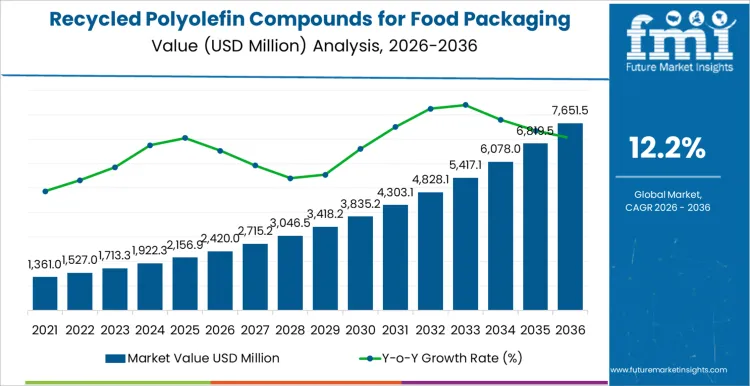
The recycled polyolefin compounds for food packaging market is set to reach USD 2,420.0 million in 2026 and is projected to expand to USD 7,651.5 million by 2036, at a CAGR of 12.2% during the forecast period. Growth reflects accelerating adoption of recycled polyethylene and polypropylene compounds within food packaging systems that require both regulatory compliance and functional reliability.
Food packaging converters increasingly integrate recycled polyolefin compounds into rigid containers, trays, closures, and flexible packaging where mechanical strength, thermal resistance, and dimensional stability remain critical. Advances in super-clean compounding, filtration, and decontamination technologies have enabled recycled polyolefins to meet food contact standards while limiting odor transfer, extractables, and migration risks. These developments support usage in applications exposed to hot fill, refrigeration, and automated high-speed packaging lines.
Regulatory mandates on recycled content, combined with retailer sustainability requirements, are influencing procurement strategies across mass and premium food categories. Brands prioritize certified, traceable recycled compounds that maintain shelf-life protection and product presentation. Market expansion is therefore driven by verified food safety performance, supply chain consistency, and growing alignment between circular economy targets and mainstream food packaging operations.
Quick Stats for Recycled Polyolefin Compounds for Food Packaging Market
- Recycled Polyolefin Compounds for Food Packaging Market Value (2026): USD 2,420.0 million
- Recycled Polyolefin Compounds for Food Packaging Market Forecast Value (2036): USD 7,651.5 million
- Recycled Polyolefin Compounds for Food Packaging Market Forecast CAGR 2026 to 2036: 12.2%
- Leading Compound Type by Demand Share: Food-grade PCR compounds
- Fastest-Growing Countries: India, China, USA, Germany, Japan
- Top Players in Global Demand: Borealis, BASF, Avient, Dow Packaging & Specialty Plastics, Kingfa
Recycled Polyolefin Compounds for Food Packaging Market Key Takeaways
| Metric | Value |
|---|---|
| Market Value (2026) | USD 2,420.0 million |
| Market Forecast Value (2036) | USD 7,651.5 million |
| Forecast CAGR 2026 to 2036 | 12.2% |
Why is the Demand for Recycled Polyolefin Compounds for Food Packaging Growing?
Food packaging converters are adopting recycled polyolefin compounds to satisfy both sustainability commitments and performance requirements in rigid and flexible formats. Recycled high-density polyethylene (rHDPE) and recycled polypropylene (rPP) blended with engineered additives are increasingly used in closures, trays, and pouches where strength, stress crack resistance, and thermal stability matter. Food processors require materials that withstand hot fill, cold chain storage, and sterilization without compromising barrier integrity or dimensional accuracy on automated lines. High-clarity applications such as deli containers and produce trays benefit from optimized polyolefin compounds that manage haze and maintain attractive presentation. Grocery brands and retailers implementing reusable and refillable systems in select regions lean on recycled polyolefins that can be reprocessed multiple times while delivering consistent mechanical properties under repeated use.
Procurement of recycled polyolefin compounds for food packaging is shaped by regulatory frameworks and retailer category specifications that mandate minimum recycled content levels. Several markets now require independent certification of recycled polymer streams to demonstrate traceability and food safety compliance, encouraging brand owners to invest in validated compound solutions. Polymer scientists and compounders refine decontamination and sorting processes to reduce residual contaminants that could affect organoleptic properties or regulatory acceptance. Packaging engineers perform rigorous migration testing and compatibility assessments with food types, ensuring recycled polyolefins meet functional and safety criteria throughout shelf life. Growth in on-shelf sustainable options with verified recycled content expands adoption across mainstream and private label food categories.
How Is the Recycled Polyolefin Compounds for Food Packaging Industry Segmented by Compound Type, Compounding Technology, and End Use?
Demand for recycled polyolefin compounds in food packaging is driven by food-contact compliance, recycled content mandates, and brand commitments to circular materials. Manufacturers prioritize compounds delivering low odor, controlled contamination, and stable processing behavior. Regulatory acceptance, traceability, and consistency across batches influence purchasing decisions. Segmentation by compound type, compounding technology, and end use explains how safety assurance, processing rigor, and packaging performance requirements shape adoption across food-contact packaging formats.
Which Compound Type Holds the Largest Share in Food-Grade Recycled Polyolefin Compounds?
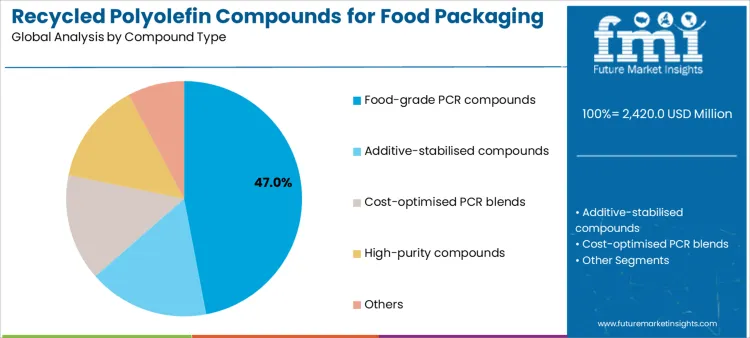
Food-grade PCR Food-grade PCR compounds hold 47.0%, reflecting priority placed on regulatory compliance and suitability for direct food-contact applications. These compounds undergo enhanced sorting, decontamination, and verification to meet stringent safety thresholds. Adoption concentrates where packaging visibility, consumer trust, and brand risk management remain critical. Additive-stabilised compounds, cost-optimised PCR blends, high-purity compounds, and other categories support differentiated performance or cost objectives without disclosed share values. Compound-type segmentation indicates strong preference for compliant solutions capable of replacing virgin materials in sensitive food packaging environments while maintaining mechanical reliability and process stability.
Key Points:
- Food-grade PCR compounds dominate due to compliance requirements.
- Safety validation drives compound selection decisions.
- Alternative blends support cost or performance tailoring.
How Does Compounding Technology Influence Food-Packaging-Grade PCR Adoption?
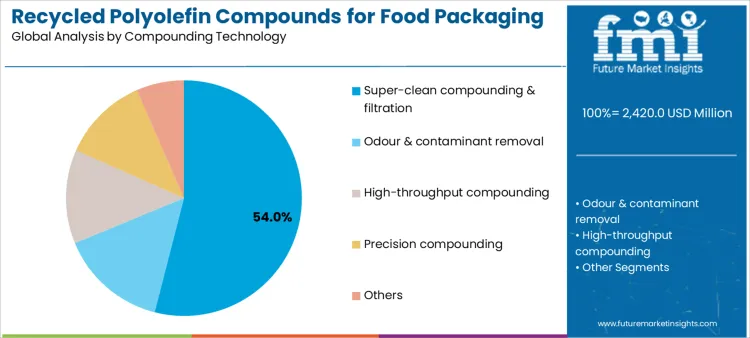
Super-clean compounding and filtration account for 54.0%, underscoring emphasis on contaminant removal, odor reduction, and consistent rheological properties. These technologies integrate advanced melt filtration, degassing, and process controls aligned with food-contact standards. Adoption aligns with packaging formats requiring clarity, seal integrity, and low sensory impact. Odor and contaminant removal, high-throughput compounding, precision compounding, and other approaches address operational priorities without disclosed share values. Compounding-technology segmentation highlights importance of process rigor in enabling recycled polyolefins for regulated food packaging use.
Key Points:
- Super-clean compounding supports food-contact suitability.
- Filtration and degassing improve sensory performance.
- Process control underpins consistency and compliance.
Which End Uses Drive Demand for Recycled Polyolefin Compounds in Food Packaging?
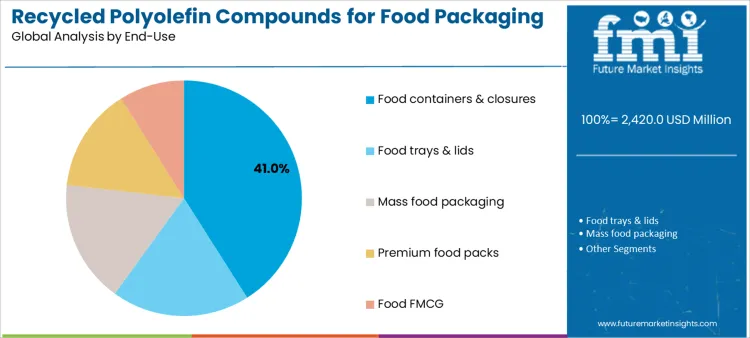
Food containers and closures represent 41.0%, driven by high-volume demand, regulatory oversight, and need for dimensional consistency. These formats require compounds that maintain seal performance and mechanical strength across production cycles. Food trays and lids, mass food packaging, premium food packs, and food FMCG applications contribute to demand without quantified shares. End-use segmentation shows concentration in rigid packaging where compliance, repeatability, and scalability determine material selection and long-term supplier relationships.
Key Points:
- Containers and closures anchor primary demand.
- Rigid formats require consistent compound performance.
- Compliance expectations shape end-use prioritization.
What are the key dynamics in the recycled polyolefin compounds for food packaging market?
Demand in the recycled polyolefin compounds for food packaging market is shaped by stringent food safety requirements and growing brand commitments to reduce reliance on virgin plastics. Food packagers seek recycled polyethylene (PE) and polypropylene (PP) compounds that deliver acceptable barrier performance, thermal stability, and mechanical strength while meeting migration limits and regulatory compliance for direct food contact. Activity is concentrated in applications such as rigid containers, trays, closures, and thermoformed packaging where performance equivalence to virgin resins is critical for product protection and shelf life.
How do food safety standards and performance expectations influence material adoption?
Food packagers require recycled polyolefin compounds that consistently meet regulatory thresholds for extractables and migrants under defined conditions of temperature and time. Compounds used in packaging dairy, produce, and ready meals must sustain performance through processing operations such as heat sealing, sterilization, and chilling without compromising seal integrity or dimensional stability. Suppliers formulate recycled PE and PP grades with targeted melt flow and controlled additive profiles that help converters achieve uniform wall thickness and predictable molding behavior. Barrier performance against moisture and oxygen is evaluated for specific food categories; for example, low-density PE compounds used in chilled produce retain moisture control, while PP compounds for rigid tubs must resist stress cracking under repeated handling. Brands conducting shelf life testing look for compounds that support consistent sensory protection without introducing taste or odor.
How do supply chain quality controls and regulatory documentation affect market scalability?
Market scalability is influenced by the need for robust feedstock quality controls and comprehensive regulatory documentation for food contact use. Sorting and decontamination systems must deliver recycled polyolefin streams with low levels of contaminants, residual additives, or non-polyolefin matter, which can otherwise affect performance or safety compliance. Qualification processes for recycled compounds involve extensive testing to demonstrate conformity with food contact regulations in key jurisdictions, which can extend time to commercialization for new grades. Variability in PCR feedstock quality raises challenges for converters seeking reliable compound performance across production runs, prompting some to blend recycled content with virgin resins to manage risk. Cost sensitivity arises where premium pricing for certified food-grade recycled compounds must compete with lower-cost virgin materials, especially in value-oriented packaging segments. Differences in regional regulatory frameworks influence where specific recycled polyolefin compounds can be deployed without additional testing, shaping procurement strategies for multinational brands seeking harmonized material specifications across markets.
How Is Demand for the Recycled Polyolefin Compounds for Food Packaging Market Evolving Globally?
Global demand for recycled polyolefin compounds for food packaging is increasing as the food industry seeks sustainable alternatives to virgin plastics. Growth reflects rising consumer demand for eco-friendly packaging solutions, coupled with regulatory pressure to reduce plastic waste and increase recycling rates. Recycled polyolefin compounds offer a high-performance alternative in food packaging, ensuring safety, durability, and preservation while contributing to the circular economy. India records 15.8% CAGR, China records 14.4% CAGR, USA records 11.6% CAGR, Germany records 11.2% CAGR, and Japan records 10.0% CAGR. Adoption is driven by sustainability initiatives, regulatory frameworks, and the food industry's shift towards greener practices.
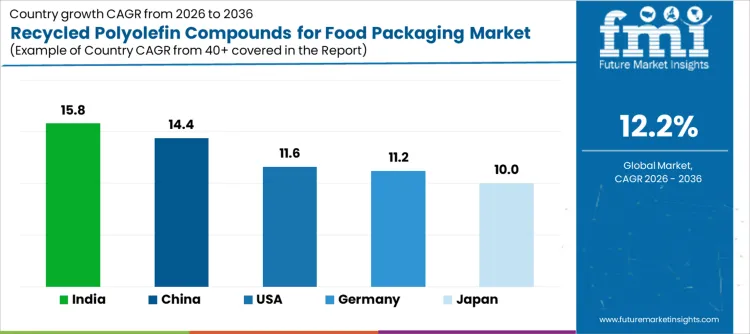
| Country | CAGR (%) |
|---|---|
| India | 15.8% |
| China | 14.4% |
| USA | 11.6% |
| Germany | 11.2% |
| Japan | 10.0% |
What is driving growth of recycled polyolefin compounds for food packaging demand in India?
Demand for recycled polyolefin compounds for food packaging in India is expanding rapidly as sustainability efforts intensify across the food and beverage industry. Growth at 15.8% CAGR reflects increasing pressure from regulatory bodies and consumers to adopt recycled content in food packaging. As India focuses on reducing plastic waste and increasing recycling rates, the demand for high-quality recycled polyolefins in packaging materials is rising. Recycled polyolefin compounds offer a cost-effective and environmentally friendly solution, especially for packaging widely used in processed food and snacks. The rise of organized retail and private-label brands also encourages the adoption of recycled materials.
- Government-driven recycling and waste reduction policies
- Growing consumer demand for sustainable food packaging
- Focus on increasing recycled content in food packaging
- Cost-effective and environmentally friendly packaging solutions
Why is China seeing expansion in recycled polyolefin compounds for food packaging adoption?
Recycled polyolefin compounds for food packaging are gaining traction in China as the country strengthens its recycling infrastructure and aligns with global sustainability goals. Growth at 14.4% CAGR reflects the need for packaging solutions that reduce plastic waste while ensuring performance standards are met for food safety and preservation. Government regulations mandating the use of recycled materials in packaging are driving the shift, particularly in the food and beverage sector. The Chinese packaging industry is increasingly adopting recycled polyolefins to meet these regulatory standards and consumer preferences for eco-friendly packaging solutions.
- Government regulations encouraging the use of recycled materials
- Increased focus on reducing plastic waste in packaging
- Consumer preference for sustainable packaging alternatives
- Expansion of local recycling infrastructure and capacity
What factors are shaping recycled polyolefin compounds for food packaging sales in the USA?
Sales of recycled polyolefin compounds for food packaging in the USA are increasing as manufacturers seek to meet sustainability targets and comply with growing regulatory requirements for recycled content. Growth at 11.6% CAGR reflects the food packaging sector’s shift towards using more recycled materials to reduce its carbon footprint and meet extended producer responsibility (EPR) laws. Recycled polyolefin compounds offer a reliable solution for producing durable, safe, and sustainable packaging without compromising the quality of the food. The USA’s emphasis on reducing single-use plastics is also a major driver of growth in this market.
- Regulatory push for increased recycled content in packaging
- Consumer demand for eco-friendly and sustainable products
- Focus on reducing plastic waste and carbon footprint
- Adoption of circular economy practices in the food industry
How is Germany supporting growth of recycled polyolefin compounds for food packaging demand?
Demand for recycled polyolefin compounds for food packaging in Germany is rising as the country leads in circular economy practices and sustainability initiatives. Growth at 11.2% CAGR reflects Germany’s stringent waste management regulations and the increasing demand for eco-friendly packaging solutions in the food sector. The German food packaging industry is increasingly adopting recycled polyolefins to meet both regulatory and consumer expectations. The shift towards sustainable packaging is being driven by consumer awareness and government policies that encourage the use of recycled content in packaging materials to reduce plastic waste.
- Strong regulatory focus on circular economy and sustainability
- Consumer preference for sustainable packaging solutions
- Government policies supporting increased recycling and reduced waste
- Increased adoption of recycled polyolefins in food packaging
What is driving expansion of recycled polyolefin compounds for food packaging demand in Japan?
Recycled polyolefin compounds for food packaging are seeing growth in Japan as the country focuses on sustainability and plastic waste reduction. Growth at 10.0% CAGR reflects Japan’s growing adoption of recycled content in food packaging, driven by government regulations and consumer demand for eco-friendly products. With Japan's focus on recycling, manufacturers are investing in advanced technologies to produce high-quality recycled polyolefins suitable for food packaging applications. The food industry is increasingly adopting recycled materials to meet environmental targets and enhance the sustainability of their packaging systems.
- Strong recycling infrastructure and government policies
- Consumer demand for sustainable and recyclable food packaging
- Focus on reducing plastic waste through recycling initiatives
- Adoption of recycled polyolefins to meet sustainability targets
What is the competitive landscape of demand for the recycled polyolefin compounds for food packaging market globally?
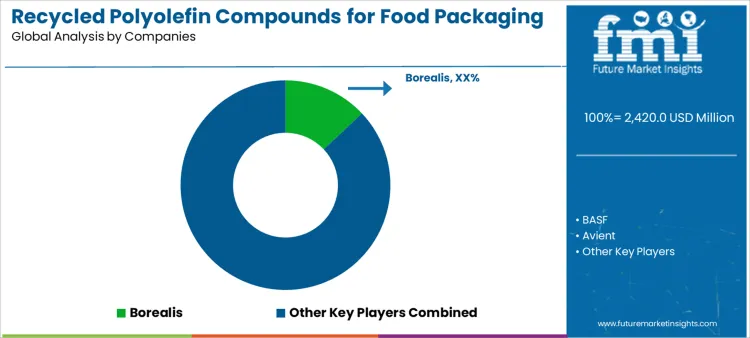
Demand for recycled polyolefin compounds in food packaging is increasingly driven by sustainability goals, regulatory compliance, and consumer preference for environmentally friendly products. Manufacturers focus on ensuring that recycled polyolefin compounds meet stringent food safety standards while maintaining the required performance characteristics, such as barrier properties, strength, and flexibility. Companies are innovating to enhance the quality of recycled content without compromising on food safety regulations. Buyer assessment includes cost-effectiveness, consistency of material properties, and the ability to meet circular economy targets. The market trend reflects growing adoption as the food packaging industry seeks to reduce virgin plastic use and increase the incorporation of recycled materials.
Borealis leads competitive positioning with a strong portfolio of recycled polyolefin compounds that meet both food safety regulations and high-performance requirements for food packaging. BASF competes by offering sustainable solutions in recycled polyolefins with an emphasis on maintaining quality and compliance across food applications. Avient supports demand with innovative solutions for recycled content integration in packaging, focusing on performance and regulatory adherence. Dow Packaging & Specialty Plastics maintains relevance by integrating high-quality recycled polyolefin compounds into their packaging solutions, addressing both sustainability and material performance needs. Kingfa participates by providing cost-effective recycled polyolefin compounds for the food packaging sector, ensuring product consistency and scalability. Wanhua and Mitsui Chemicals are also key players, supporting the market with materials that meet the specific needs of food packaging, particularly in flexible formats. Competitive differentiation centers on material quality, regulatory compliance, supply chain reliability, and the ability to provide cost-effective, sustainable solutions.
Key Players in the Recycled Polyolefin Compounds for Food Packaging Market
- Borealis
- BASF
- Avient
- Dow Packaging & Specialty Plastics
- Kingfa
- Wanhua
- Mitsui Chemicals
- Prime Polymer
- Others
Scope of the Report
| Items | Values |
|---|---|
| Quantitative Units | USD million |
| Compound Type | Food-grade PCR compounds; Additive-stabilised compounds; Cost-optimised PCR blends; High-purity compounds; Others |
| Compounding Technology | Super-clean compounding & filtration; Odour & contaminant removal; High-throughput compounding; Precision compounding; Others |
| End-Use | Food containers & closures; Food trays & lids; Mass food packaging; Premium food packs; Food FMCG |
| Regions Covered | Asia Pacific, Europe, North America, Latin America, Middle East & Africa |
| Countries Covered | India, China, USA, Germany, Japan, and 40+ countries |
| Key Companies Profiled | Borealis; BASF; Avient; Dow Packaging & Specialty Plastics; Kingfa; Wanhua; Mitsui Chemicals; Prime Polymer; Others |
| Additional Attributes | Dollar sales by compound type, compounding technology, and end-use; effectiveness of high-purity and additive-stabilised compounds in food packaging; performance of super-clean compounding and high-throughput compounding technologies in improving product safety and shelf-life; impact of precision compounding on packaging integrity and regulatory compliance; procurement dynamics driven by demand for sustainable food packaging solutions and long-term supplier partnerships. |
Recycled Polyolefin Compounds for Food Packaging Market by Segment
Compound Type:
- Food-grade PCR compounds
- Additive-stabilised compounds
- Cost-optimised PCR blends
- High-purity compounds
- Others
Compounding Technology:
- Super-clean compounding & filtration
- Odour & contaminant removal
- High-throughput compounding
- Precision compounding
- Others
End-Use:
- Food containers & closures
- Food trays & lids
- Mass food packaging
- Premium food packs
- Food FMCG
Region:
- Asia Pacific
- China
- Japan
- South Korea
- India
- Australia & New Zealand
- ASEAN
- Rest of Asia Pacific
- Europe
- Germany
- United Kingdom
- France
- Italy
- Spain
- Nordic
- BENELUX
- Rest of Europe
- North America
- United States
- Canada
- Mexico
- Latin America
- Brazil
- Chile
- Rest of Latin America
- Middle East & Africa
- Kingdom of Saudi Arabia
- Other GCC Countries
- Turkey
- South Africa
- Other African Union
- Rest of Middle East & Africa
Bibliography
- European Food Safety Authority. (2024). Evaluation of recycling processes to produce recycled plastic materials intended for food contact applications. EFSA Journal, 22(3), e08745.
- European Commission, Joint Research Centre. (2023). Food-grade recycled polyolefins: Decontamination efficiency, migration behavior, and material performance. Publications Office of the European Union.
- International Organization for Standardization. (2023). ISO 22000-2: Plastics-Assessment of recycled polyolefin materials for food-contact use. ISO.
- USA. Food and Drug Administration. (2024). Guidance for industry: Use of recycled plastics in food packaging-Safety, compliance, and migration testing. Center for Food Safety and Applied Nutrition.
- Schyns, Z. O. G., & Shaver, M. P. (2024). Mechanical performance and food-contact safety of recycled polyethylene and polypropylene packaging materials. Resources, Conservation & Recycling, 199, 107205.
Frequently Asked Questions
How big is the recycled polyolefin compounds for food packaging market in 2026?
The global recycled polyolefin compounds for food packaging market is estimated to be valued at USD 2,420.0 million in 2026.
What will be the size of recycled polyolefin compounds for food packaging market in 2036?
The market size for the recycled polyolefin compounds for food packaging market is projected to reach USD 7,651.5 million by 2036.
How much will be the recycled polyolefin compounds for food packaging market growth between 2026 and 2036?
The recycled polyolefin compounds for food packaging market is expected to grow at a 12.2% CAGR between 2026 and 2036.
What are the key product types in the recycled polyolefin compounds for food packaging market?
The key product types in recycled polyolefin compounds for food packaging market are food-grade pcr compounds, additive-stabilised compounds, cost-optimised pcr blends, high-purity compounds and others.
Which compounding technology segment to contribute significant share in the recycled polyolefin compounds for food packaging market in 2026?
In terms of compounding technology, super-clean compounding & filtration segment to command 54.0% share in the recycled polyolefin compounds for food packaging market in 2026.
Preview the report firsthand - request a free sample
Get SampleGet the brochure for pricing and purchase details.
Get PDFTable of Content
- Executive Summary
- Global Market Outlook
- Demand-side Trends
- Supply-side Trends
- Technology Roadmap Analysis
- Analysis and Recommendations
- Market Overview
- Market Coverage / Taxonomy
- Market Definition / Scope / Limitations
- Market Background
- Market Dynamics
- Drivers
- Restraints
- Opportunity
- Trends
- Scenario Forecast
- Demand in Optimistic Scenario
- Demand in Likely Scenario
- Demand in Conservative Scenario
- Opportunity Map Analysis
- Product Life Cycle Analysis
- Supply Chain Analysis
- Investment Feasibility Matrix
- Value Chain Analysis
- PESTLE and Porter’s Analysis
- Regulatory Landscape
- Regional Parent Market Outlook
- Production and Consumption Statistics
- Import and Export Statistics
- Market Dynamics
- Global Market Analysis 2021 to 2025 and Forecast, 2026 to 2036
- Historical Market Size Value (USD Million) Analysis, 2021 to 2025
- Current and Future Market Size Value (USD Million) Projections, 2026 to 2036
- Y-o-Y Growth Trend Analysis
- Absolute $ Opportunity Analysis
- Global Market Pricing Analysis 2021 to 2025 and Forecast 2026 to 2036
- Global Market Analysis 2021 to 2025 and Forecast 2026 to 2036, By Compound Type
- Introduction / Key Findings
- Historical Market Size Value (USD Million) Analysis By Compound Type , 2021 to 2025
- Current and Future Market Size Value (USD Million) Analysis and Forecast By Compound Type , 2026 to 2036
- Food-grade PCR compounds
- Additive-stabilised compounds
- Cost-optimised PCR blends
- High-purity compounds
- Others
- Food-grade PCR compounds
- Y-o-Y Growth Trend Analysis By Compound Type , 2021 to 2025
- Absolute $ Opportunity Analysis By Compound Type , 2026 to 2036
- Global Market Analysis 2021 to 2025 and Forecast 2026 to 2036, By Compounding Technology
- Introduction / Key Findings
- Historical Market Size Value (USD Million) Analysis By Compounding Technology, 2021 to 2025
- Current and Future Market Size Value (USD Million) Analysis and Forecast By Compounding Technology, 2026 to 2036
- Super-clean compounding & filtration
- Odour & contaminant removal
- High-throughput compounding
- Precision compounding
- Others
- Super-clean compounding & filtration
- Y-o-Y Growth Trend Analysis By Compounding Technology, 2021 to 2025
- Absolute $ Opportunity Analysis By Compounding Technology, 2026 to 2036
- Global Market Analysis 2021 to 2025 and Forecast 2026 to 2036, By End-Use
- Introduction / Key Findings
- Historical Market Size Value (USD Million) Analysis By End-Use, 2021 to 2025
- Current and Future Market Size Value (USD Million) Analysis and Forecast By End-Use, 2026 to 2036
- Food containers & closures
- Food trays & lids
- Mass food packaging
- Premium food packs
- Food FMCG
- Food containers & closures
- Y-o-Y Growth Trend Analysis By End-Use, 2021 to 2025
- Absolute $ Opportunity Analysis By End-Use, 2026 to 2036
- Global Market Analysis 2021 to 2025 and Forecast 2026 to 2036, By Region
- Introduction
- Historical Market Size Value (USD Million) Analysis By Region, 2021 to 2025
- Current Market Size Value (USD Million) Analysis and Forecast By Region, 2026 to 2036
- North America
- Latin America
- Western Europe
- Eastern Europe
- East Asia
- South Asia and Pacific
- Middle East & Africa
- Market Attractiveness Analysis By Region
- North America Market Analysis 2021 to 2025 and Forecast 2026 to 2036, By Country
- Historical Market Size Value (USD Million) Trend Analysis By Market Taxonomy, 2021 to 2025
- Market Size Value (USD Million) Forecast By Market Taxonomy, 2026 to 2036
- By Country
- USA
- Canada
- Mexico
- By Compound Type
- By Compounding Technology
- By End-Use
- By Country
- Market Attractiveness Analysis
- By Country
- By Compound Type
- By Compounding Technology
- By End-Use
- Key Takeaways
- Latin America Market Analysis 2021 to 2025 and Forecast 2026 to 2036, By Country
- Historical Market Size Value (USD Million) Trend Analysis By Market Taxonomy, 2021 to 2025
- Market Size Value (USD Million) Forecast By Market Taxonomy, 2026 to 2036
- By Country
- Brazil
- Chile
- Rest of Latin America
- By Compound Type
- By Compounding Technology
- By End-Use
- By Country
- Market Attractiveness Analysis
- By Country
- By Compound Type
- By Compounding Technology
- By End-Use
- Key Takeaways
- Western Europe Market Analysis 2021 to 2025 and Forecast 2026 to 2036, By Country
- Historical Market Size Value (USD Million) Trend Analysis By Market Taxonomy, 2021 to 2025
- Market Size Value (USD Million) Forecast By Market Taxonomy, 2026 to 2036
- By Country
- Germany
- UK
- Italy
- Spain
- France
- Nordic
- BENELUX
- Rest of Western Europe
- By Compound Type
- By Compounding Technology
- By End-Use
- By Country
- Market Attractiveness Analysis
- By Country
- By Compound Type
- By Compounding Technology
- By End-Use
- Key Takeaways
- Eastern Europe Market Analysis 2021 to 2025 and Forecast 2026 to 2036, By Country
- Historical Market Size Value (USD Million) Trend Analysis By Market Taxonomy, 2021 to 2025
- Market Size Value (USD Million) Forecast By Market Taxonomy, 2026 to 2036
- By Country
- Russia
- Poland
- Hungary
- Balkan & Baltic
- Rest of Eastern Europe
- By Compound Type
- By Compounding Technology
- By End-Use
- By Country
- Market Attractiveness Analysis
- By Country
- By Compound Type
- By Compounding Technology
- By End-Use
- Key Takeaways
- East Asia Market Analysis 2021 to 2025 and Forecast 2026 to 2036, By Country
- Historical Market Size Value (USD Million) Trend Analysis By Market Taxonomy, 2021 to 2025
- Market Size Value (USD Million) Forecast By Market Taxonomy, 2026 to 2036
- By Country
- China
- Japan
- South Korea
- By Compound Type
- By Compounding Technology
- By End-Use
- By Country
- Market Attractiveness Analysis
- By Country
- By Compound Type
- By Compounding Technology
- By End-Use
- Key Takeaways
- South Asia and Pacific Market Analysis 2021 to 2025 and Forecast 2026 to 2036, By Country
- Historical Market Size Value (USD Million) Trend Analysis By Market Taxonomy, 2021 to 2025
- Market Size Value (USD Million) Forecast By Market Taxonomy, 2026 to 2036
- By Country
- India
- ASEAN
- Australia & New Zealand
- Rest of South Asia and Pacific
- By Compound Type
- By Compounding Technology
- By End-Use
- By Country
- Market Attractiveness Analysis
- By Country
- By Compound Type
- By Compounding Technology
- By End-Use
- Key Takeaways
- Middle East & Africa Market Analysis 2021 to 2025 and Forecast 2026 to 2036, By Country
- Historical Market Size Value (USD Million) Trend Analysis By Market Taxonomy, 2021 to 2025
- Market Size Value (USD Million) Forecast By Market Taxonomy, 2026 to 2036
- By Country
- Kingdom of Saudi Arabia
- Other GCC Countries
- Turkiye
- South Africa
- Other African Union
- Rest of Middle East & Africa
- By Compound Type
- By Compounding Technology
- By End-Use
- By Country
- Market Attractiveness Analysis
- By Country
- By Compound Type
- By Compounding Technology
- By End-Use
- Key Takeaways
- Key Countries Market Analysis
- USA
- Pricing Analysis
- Market Share Analysis, 2025
- By Compound Type
- By Compounding Technology
- By End-Use
- Canada
- Pricing Analysis
- Market Share Analysis, 2025
- By Compound Type
- By Compounding Technology
- By End-Use
- Mexico
- Pricing Analysis
- Market Share Analysis, 2025
- By Compound Type
- By Compounding Technology
- By End-Use
- Brazil
- Pricing Analysis
- Market Share Analysis, 2025
- By Compound Type
- By Compounding Technology
- By End-Use
- Chile
- Pricing Analysis
- Market Share Analysis, 2025
- By Compound Type
- By Compounding Technology
- By End-Use
- Germany
- Pricing Analysis
- Market Share Analysis, 2025
- By Compound Type
- By Compounding Technology
- By End-Use
- UK
- Pricing Analysis
- Market Share Analysis, 2025
- By Compound Type
- By Compounding Technology
- By End-Use
- Italy
- Pricing Analysis
- Market Share Analysis, 2025
- By Compound Type
- By Compounding Technology
- By End-Use
- Spain
- Pricing Analysis
- Market Share Analysis, 2025
- By Compound Type
- By Compounding Technology
- By End-Use
- France
- Pricing Analysis
- Market Share Analysis, 2025
- By Compound Type
- By Compounding Technology
- By End-Use
- India
- Pricing Analysis
- Market Share Analysis, 2025
- By Compound Type
- By Compounding Technology
- By End-Use
- ASEAN
- Pricing Analysis
- Market Share Analysis, 2025
- By Compound Type
- By Compounding Technology
- By End-Use
- Australia & New Zealand
- Pricing Analysis
- Market Share Analysis, 2025
- By Compound Type
- By Compounding Technology
- By End-Use
- China
- Pricing Analysis
- Market Share Analysis, 2025
- By Compound Type
- By Compounding Technology
- By End-Use
- Japan
- Pricing Analysis
- Market Share Analysis, 2025
- By Compound Type
- By Compounding Technology
- By End-Use
- South Korea
- Pricing Analysis
- Market Share Analysis, 2025
- By Compound Type
- By Compounding Technology
- By End-Use
- Russia
- Pricing Analysis
- Market Share Analysis, 2025
- By Compound Type
- By Compounding Technology
- By End-Use
- Poland
- Pricing Analysis
- Market Share Analysis, 2025
- By Compound Type
- By Compounding Technology
- By End-Use
- Hungary
- Pricing Analysis
- Market Share Analysis, 2025
- By Compound Type
- By Compounding Technology
- By End-Use
- Kingdom of Saudi Arabia
- Pricing Analysis
- Market Share Analysis, 2025
- By Compound Type
- By Compounding Technology
- By End-Use
- Turkiye
- Pricing Analysis
- Market Share Analysis, 2025
- By Compound Type
- By Compounding Technology
- By End-Use
- South Africa
- Pricing Analysis
- Market Share Analysis, 2025
- By Compound Type
- By Compounding Technology
- By End-Use
- USA
- Market Structure Analysis
- Competition Dashboard
- Competition Benchmarking
- Market Share Analysis of Top Players
- By Regional
- By Compound Type
- By Compounding Technology
- By End-Use
- Competition Analysis
- Competition Deep Dive
- Borealis
- Overview
- Product Portfolio
- Profitability by Market Segments (Product/Age /Sales Channel/Region)
- Sales Footprint
- Strategy Overview
- Marketing Strategy
- Product Strategy
- Channel Strategy
- BASF
- Avient
- Dow Packaging & Specialty Plastics
- Kingfa
- Wanhua
- Mitsui Chemicals
- Prime Polymer
- Others
- Borealis
- Competition Deep Dive
- Assumptions & Acronyms Used
- Research Methodology


