

- Industry Size (2026)
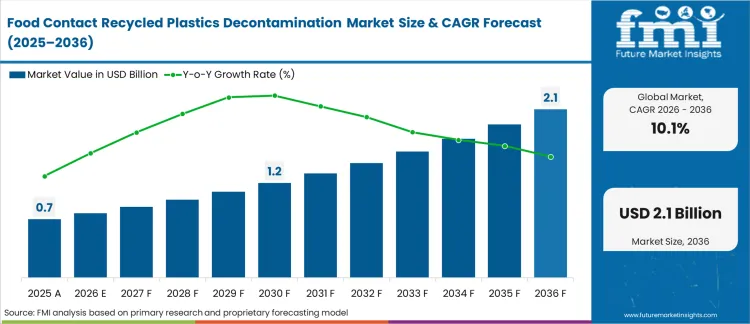
- USD 0.8 Bn
- Forecast (2036)
- USD 2.1 Bn
- CAGR (2026 to 2036)
- 10.1%
Food Contact Recycled Plastics Decontamination Market Size, Market Forecast and Outlook By FMI
The food contact recycled plastics decontamination market was valued at USD 0.7 billion in 2025. The sector is set to reach USD 0.8 billion in 2026 at a CAGR of 10.1% during the forecast period. Demand outlook lifts the total opportunity to USD 2.1 billion through 2036 as stringent contact safety mandates reach regional packaging converters that previously deferred technology upgrades.
The transition from mechanical downcycling to high-purity processing targets packaging converters facing immediate brand compliance deadlines. Brands utilizing substandard decontamination technologies risk severe volatile organic compound deep-layer migration, leading to complete batch rejections and loss of vendor status. A critical reality often missed by general analysts is that volatile organic compound stripping speed dictates facility throughput far more than simple bulk melting capacity. Facilities ignoring this structural dynamic fail European Food Safety Authority challenge tests entirely. Upgrading to certified reactor architectures enables converters to secure high-margin supply agreements for next-generation food contact paper and hybrid plastic alternatives.
Summary of Food Contact Recycled Plastics Decontamination Market
- Food Contact Recycled Plastics Decontamination Market Definition
- Food contact recycled plastics decontamination provides specialized reactor infrastructure designed to strip molecular contaminants from post-consumer polymers, ensuring the material meets stringent safety standards for direct human food contact packaging applications.
- Demand Drivers in the Market
- EU Regulation 2022/1616 forces regional recycling operators to install certified super-clean technologies to maintain legal market access.
- Beverage brand sustainability targets compel packaging procurement leads to secure high volumes of verified food-grade resin.
- Escalating virgin polymer taxes drive fast-moving consumer goods conglomerates to underwrite capital equipment upgrades at their primary material suppliers.
- Key Segments Analyzed in the FMI Report
- PET: 65.0% share in 2026, driven by established global collection infrastructure and proven solid state polycondensation technology scaling.
- Vacuum/Thermal Treatment: 45.0% share in 2026, leading due to its proven efficacy in extracting deeply embedded volatile organic compounds from sorted flakes.
- Bottles & Jars: 52.0% share in 2026, representing the largest consolidated demand pool mandated by strict beverage industry compliance standards.
- India: 14.0% compound growth, anchored by immediate national mandates forcing domestic converters to integrate post-consumer resin.
- Analyst Opinion at FMI
- Ismail Sutaria, Principal Consultant for Packaging, opines, "Volatile organic compound extraction speed, not bulk melting capacity, is the real constraint in these systems. Facilities that prioritize throughput over adequate molecular residence time risk failing challenge tests, resulting in batch rejections and loss of access to key fast‑moving consumer goods supply chains."
- Strategic Implications / Executive Takeaways
- Facility engineering directors must validate reactor residence times against official challenge protocols before committing capital to full-scale expansion.
- Packaging procurement leads should mandate continuous quality monitoring data integration from their recycled resin suppliers to prevent cross-contamination events.
- Equipment manufacturers must secure third-party efficacy certifications or face immediate exclusion from major regional tender shortlists.
- Methodology
- Primary Research: FMI conducted detailed technical interviews with polymer processing engineers, regional compliance officers, and packaging specification directors across 35 countries to validate technology adoption timelines.
- Desk Research: Analysts aggregated public regulatory frameworks from regional food safety authorities, corporate equipment launch sheets, and national circular economy grant programs.
- Market-Sizing and Forecasting: The model applies a bottom-up methodology starting with the global installed base of food-grade extrusion lines and projecting the conversion rate to advanced super-clean standards.
- Data Validation and Update Cycle: Segment forecasts undergo cross-validation against quarterly shipment volumes reported by leading industrial polymer processing equipment manufacturers.
European Food Safety Authority dossier approval timelines force recyclers to commit to certified reactor designs immediately. Facility owners must submit detailed challenge test data proving complete deep-layer contaminant eradication before entering commercial production. Once this regulatory threshold is crossed, the facility gains an unassailable compliance moat against non-certified regional competitors.
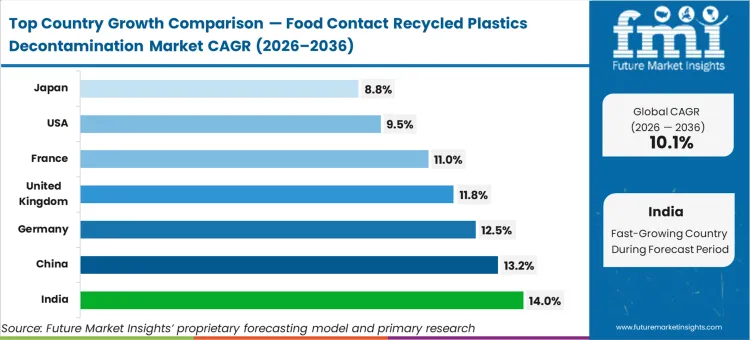
India advances at 14.0% as national plastic waste management rules mandate post-consumer content in fast-moving consumer goods applications. China records a 13.2% CAGR as domestic packaging conglomerates upgrade their chemical wash capabilities to meet global export standards. Germany tracks at 12.5% driven by stringent extended producer responsibility taxes penalizing virgin polymer use. The United Kingdom follows at 11.8% as independent recyclers deploy super-clean thermal technologies. France reaches 11.0% supported by circular economy laws targeting single-use plastics. The United States grows at 9.5% anchored by FDA non-objection letter requirements for rigid containers. Japan posts an 8.8% expansion rate as meticulous sorting infrastructure enables highly efficient solid state polycondensation. This global dispersion reflects distinct national enforcement timelines for mandatory recycled content minimums rather than generic sustainability preferences.
Food Contact Recycled Plastics Decontamination Market Definition
The Food Contact Recycled Plastics Decontamination Market encompasses the specialized industrial technologies and reactor systems engineered to extract deeply embedded molecular contaminants from post-consumer polymers. The functional boundary of this sector requires the output material to pass rigorous food safety challenge tests for direct human consumption contact. It explicitly excludes standard mechanical shredding and basic hot washing processes that only address surface-level organic residue.
Food Contact Recycled Plastics Decontamination Market Inclusions
The scope includes vacuum thermal reactors, solid state polycondensation towers, supercritical fluid extraction units, and specialized extruder degassing modules designed specifically for food-grade output. Proprietary chemical wash systems targeting legacy ink and adhesive removal are fully incorporated. Integration software managing critical temperature and residence time parameters for plastic recycling machines falls strictly within the defined boundaries.
Food Contact Recycled Plastics Decontamination Market Exclusions
Standard municipal sorting lines, basic friction washers, and conventional pelletizing extruders lacking high-vacuum degassing capabilities are explicitly excluded. General wastewater treatment systems attached to recycling facilities fall outside the parameters. Chemical recycling technologies that completely break polymers down into basic monomers, such as pyrolysis or advanced depolymerization plants, are omitted from this specific mechanical decontamination valuation.
Food Contact Recycled Plastics Decontamination Market Research Methodology
- Primary Research: Analysts engaged with facility engineering directors, polymer science compliance leads, and extrusion equipment procurement heads to map the technical bottlenecks triggering reactor upgrades.
- Desk Research: The data collection phase aggregated challenge test protocols from the European Food Safety Authority, FDA non-objection letter registries, and ISO food safety management frameworks.
- Market-Sizing and Forecasting: The baseline value derives from a bottom-up aggregation of specialized thermal reactor and SSP tower shipments, applying regional regulatory enforcement curves to project future installation velocity.
- Data Validation and Update Cycle: Projections are rigorously tested against publicly reported capital expenditure guidance from the world's leading polymer processing and packaging conglomerates.
Food Contact Recycled Plastics Decontamination Market Key Takeaways
| Metric | Details |
|---|---|
| Industry Size (2026) | USD 0.8 billion |
| Industry Value (2036) | USD 2.1 billion |
| CAGR (2026-2036) | 10.1% |
Source: Future Market Insights (FMI) analysis, based on proprietary forecasting model and primary research
Segmental Analysis
Food Contact Recycled Plastics Decontamination Market Analysis by Material Type
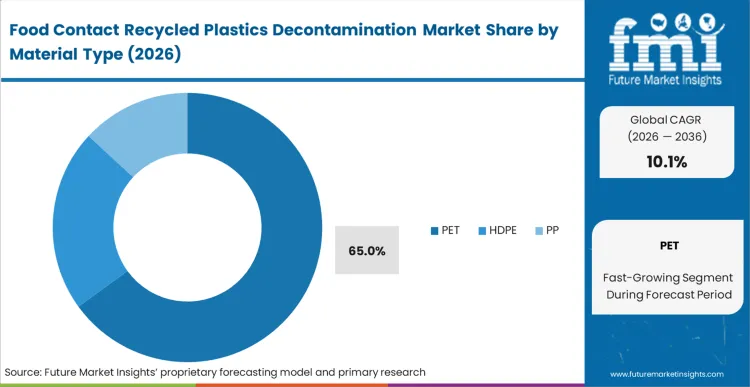
The displacement of virgin polymers by mandated recycled content exposes severe technical limitations in legacy polyolefin washing lines. PET holds a dominant 65.0% share in 2026 because its molecular structure naturally withstands the intense heat and vacuum required for extreme deep-layer stripping without losing intrinsic viscosity. Facility operators specifying continuous solid state polycondensation towers exclusively for PET establish the highest margin output streams in the industry. Based on FMI's assessment, the predictable melt behavior of PET allows engineering teams to optimize residence times precisely against European Food Safety Authority challenge protocols. Procurement directors failing to secure adequate high-purity recycled PET supplies face immediate production halts due to non-compliance with brand mandates. Facility owners must deploy advanced optical sorters prior to the thermal decontamination phase to prevent destructive PVC contamination.
- Viscosity retention: Precise thermal management inside the vacuum reactor restores broken polymer chains while simultaneously extracting volatile contaminants. Quality assurance leads secure premium pricing for high-viscosity food-grade output.
- Sorting prerequisites: Deep-layer decontamination efficiency requires near-perfect input purity. Facility engineers install artificial intelligence optical sorting modules to eliminate false positives before the critical heating phase.
- Compliance standardization: The long history of PET recycling provides a clear regulatory pathway for challenge testing. Compliance officers streamline their dossier submissions using established proxy contaminant data.
Food Contact Recycled Plastics Decontamination Market Analysis by Decontamination Technology
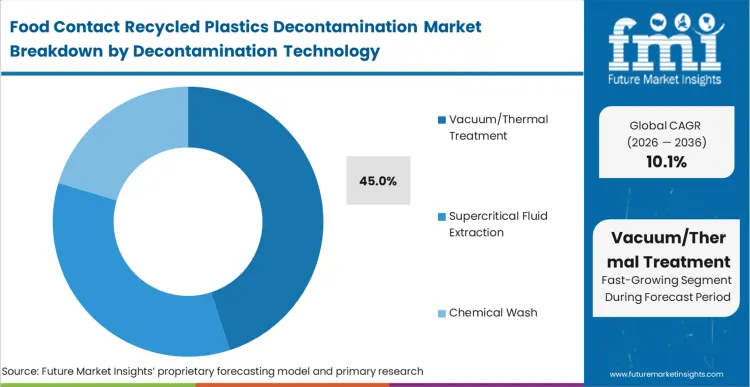
The operational gap between surface washing and molecular purification requires specialized thermodynamic engineering to solve safely. Vacuum/Thermal Treatment commands a 45.0% share in 2026 as it reliably vaporizes deeply embedded organic compounds without degrading the base polymer structure. Recycling plant directors select this technology because it scales efficiently across massive continuous processing lines. According to FMI's estimates, integrating the vacuum degassing phase directly into the extrusion melt zone drastically reduces total energy consumption per ton. Manufacturers operating older atmospheric venting systems cannot achieve the parts-per-billion purity thresholds required for flexible films designed for high-fat food contact. Equipment procurement leads must validate the precise vacuum depth capabilities of new reactor designs before signing purchase agreements.
- Vapor extraction: High-intensity vacuum pumps strip microscopic gaseous impurities directly from the molten polymer matrix. Plant operators prevent flavor scalping in the final packaging application by maximizing residence time under extreme negative pressure.
- Energy optimization: Combining the heating and purification phases into a single continuous reactor reduces overall thermal degradation. Engineering directors minimize operating costs by recovering excess heat from the polycondensation cooling sequence.
- Resin versatility: Advanced thermal systems adjust temperature profiles dynamically to handle varying input flake qualities. Production managers maintain consistent output purity despite seasonal fluctuations in collection stream contamination.
Food Contact Recycled Plastics Decontamination Market Analysis by End Use
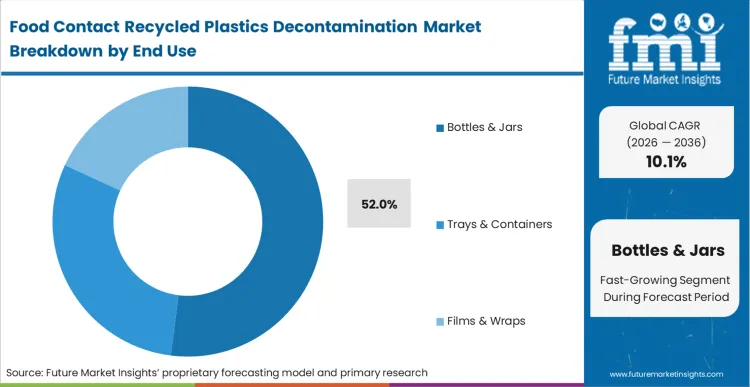
Strict beverage industry compliance standards establish the primary threshold that forces massive capital investment in super-clean technologies. Bottles & Jars represents the leading application with a 52.0% share in 2026, driven directly by global brand commitments to incorporate 50% or more recycled content by 2030. Quality control directors operating high-speed bottling facilities reject resin batches exhibiting the slightest odor or color variation introduced by inadequate decontamination. As per FMI's projection, the sheer volume of material required for daily beverage packaging production necessitates continuous, unbroken decontamination reactor operations. Converters supplying the beverage sector who fail to upgrade their raw material purification specifications lose their tier-one supplier status instantly. Sourcing directors must audit their resin suppliers' specific challenge test documentation prior to authorizing any commercial food-contact trials.
- Organoleptic preservation: Complete extraction of prior-use chemicals ensures the recycled container imparts zero taste or odor to sensitive liquid contents. Brand managers protect critical consumer equity by enforcing zero-tolerance contamination limits.
- Structural integrity: Decontaminated resin must match the exact drop-impact strength and barrier properties of virgin material. Packaging engineers validate the intrinsic viscosity of the purified polymer to prevent catastrophic failure on high-speed filling lines.
- Traceability mandates: Continuous digital monitoring of the decontamination reactor provides immutable proof of processing parameters for every resin batch. Compliance teams utilize these secure data logs to satisfy stringent food safety regulatory audits.
Food Contact Recycled Plastics Decontamination Market Drivers, Restraints, and Opportunities
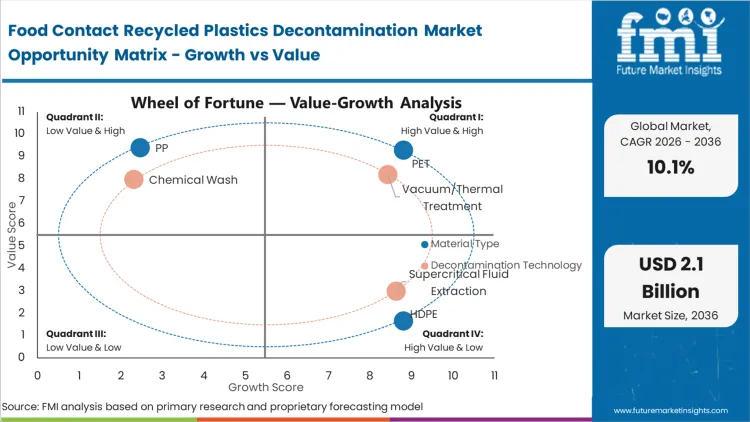
EU Regulation 2022/1616 forces regional recycling operators to install certified super-clean technologies to maintain legal market access. This strict regulatory framework renders older mechanical recycling methods completely obsolete for direct food contact applications. Asset owners upgrading their facilities face a strict binary choice: deploy certified decontamination reactor architectures or be legally barred from selling high-margin food-grade resin. Transitioning to highly monitored thermal extraction processes allows recyclers to secure long-term off-take agreements with major consumer brands. Operators who fail to modernize their core purification layers face permanent confinement to low-margin agricultural or construction material markets.
The intricate thermodynamic parameters required to optimize continuous vacuum extraction create steep energy cost barriers for independent recyclers. Designing a system that maintains extreme negative pressure while continuously feeding abrasive polymer flakes demands specialized metallurgical engineering that drives up initial capital expenditure. To mitigate this margin pressure, facility directors increasingly rely on highly automated reactor control software that precisely adjusts heating profiles in real-time to prevent energy waste during operational fluctuations.
Opportunities in the Food Contact Recycled Plastics Decontamination Market
- Polyolefin Reactor Scaling: Next-generation super-clean technologies enable engineering teams to process high-density polyethylene for direct food contact safely. This advancement allows dairy and juice brands to source fully decontaminated rigid plastic solutions derived from post-consumer milk jugs.
- Odor Elimination Modules: Upgraded chemical wash systems permit facility operators to completely neutralize legacy fragrances from household chemical containers before the thermal phase. This capability vastly expands the usable volume of the collected plastic waste stream.
- Inline Quality Diagnostics: Advanced sensor integration provides quality assurance leads with real-time molecular contamination readings directly inside the extruder melt zone. This continuous validation prevents operators from producing massive volumes of out-of-spec material during unseen process deviations.
Regional Analysis
Based on the regional analysis, the food contact recycled plastics decontamination market is segmented into North America, Latin America, Europe, East Asia, South Asia, Oceania, and Middle East & Africa across 40 plus countries.
.webp "Top Country Growth Comparison Food Contact Recycled Plastics Decontamination Market Cagr (2026 2036)")
| Country | CAGR (2026 to 2036) |
|---|---|
| India | 14.0% |
| China | 13.2% |
| Germany | 12.5% |
| United Kingdom | 11.8% |
| France | 11.0% |
| United States | 9.5% |
| Japan | 8.8% |
Source: Future Market Insights (FMI) analysis, based on proprietary forecasting model and primary research
Asia Pacific Food Contact Recycled Plastics Decontamination Market Analysis
Aggressive national investment programs across the Asia Pacific region accelerate the deployment of massive centralized decontamination infrastructure. Capital project directors constructing new polymer processing hubs specify integrated super-clean reactor technologies in their initial site blueprints to meet escalating global brand requirements. FMI analysts opine that this coordinated expansion enables the region to bypass the fragmented, small-scale recycling models that plague older Western markets. By embedding advanced sustainable packaging purification capabilities directly into major petrochemical complexes, regional asset owners establish highly flexible production environments capable of satisfying both domestic mandates and export compliance standards. This clean-slate industrial strategy directly fuels the demand for ultra-high-capacity solid state polycondensation towers.
- India: India's Plastic Waste Management Rules mandate escalating post-consumer recycled content minimums across all rigid and flexible packaging formats. Facility operators must deploy certified decontamination reactors to legally supply the massive domestic fast-moving consumer goods sector. The national push toward localized circularity triggers a wave of facility upgrades prioritizing verifiable food-safe output. Expanding at 14.0% between 2026 and 2036, the country forces global equipment vendors to localize their supply chains. Suppliers failing to provide hardware with built-in digital traceability mechanisms face disqualification from major corporate tenders.
- China: Fast-moving consumer goods conglomerates in China must navigate tightening domestic food safety standards while simultaneously meeting stringent European export criteria for packaged goods. Sourcing directors deploy massive chemical wash and thermal extraction lines to guarantee cross-border compliance. The absolute necessity for uncompromised material safety anchors China's 13.2% compound growth over the forecast period. Industrial asset operators failing to pass continuous automated challenge tests risk losing access to lucrative international trade corridors entirely.
- Japan: Municipal sorting infrastructure in Japan enables facility engineers to optimize solid state polycondensation run times with exceptionally pure input streams. Technology vendors operate under strict societal expectations for absolute food safety and zero-defect manufacturing. This operational advantage sustains an 8.8% CAGR to 2036 as domestic operators continuously refine their deep-vacuum degassing efficiencies. Procurement specification leads lacking verified challenge test data forfeit integration into the highly controlled domestic beverage supply chain.
FMI's report includes extensive coverage of the broader Asia Pacific recycling landscape, including South Korea, Australia, and the ASEAN nations. The rapid localization of brand packaging operations forces contract manufacturers in these nations to specify unified decontamination architectures to satisfy stringent global brand safety requirements.
Europe Food Contact Recycled Plastics Decontamination Market Analysis
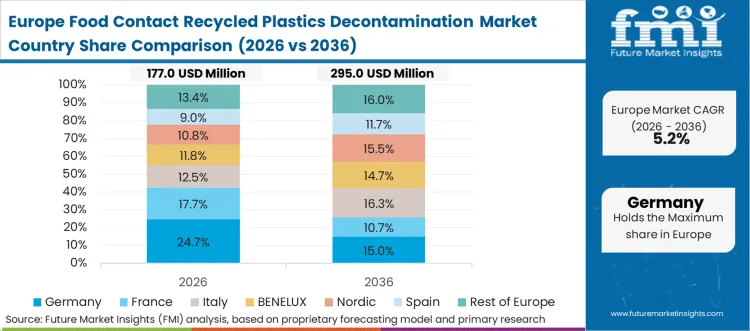
Stringent EU regulations acts as the absolute legal forcing mechanism reshaping the entire European polymer recovery landscape. Compliance officers redesigning legacy recycling lines must integrate certified super-clean reactor technologies to maintain their authorization to sell direct food contact materials. This non-negotiable regulatory barrier forces the rapid adoption of highly monitored continuous processing architectures capable of providing immutable batch data. The transition requires a complete overhaul of existing mechanical facilities, shifting from basic hot washing to extreme vacuum thermodynamic extraction. According to FMI's estimates, upgrading the core purification infrastructure provides the necessary chemical safety guarantees to support the continent's aggressive circular economy targets. Facility directors recognize that operating uncertified hardware legally eliminates them from the premium packaging supply chain.
- Germany: Germany's updated Packaging Act imposes punitive extended producer responsibility taxes on consumer brands failing to utilize high percentages of verified recycled material. System integrators must demonstrate flawless execution of European Food Safety Authority challenge protocols before receiving authorization to commission new reactor installations. This systemic regulatory pressure drives a 12.5% annual expansion rate through the decade as compliance dictates continuous hardware replacement. Equipment providers targeting domestic facility modernization projects must guarantee parts-per-billion contaminant removal prior to the finalization of procurement contracts.
- United Kingdom: Independent recyclers in the United Kingdom face immense pressure from retail consortiums demanding fully traceable, high-viscosity recycled resins for internal private-label packaging. Facility owners mandate communication architectures capable of sub-millisecond data delivery linking the vacuum reactor sensors directly to cloud-based compliance dashboards. This critical infrastructure transition anchors the UK's 11.8% compound trajectory to 2036 as operators systematically upgrade their operational backbones. Sourcing directors unable to demonstrate absolute deep-layer volatile organic compound extraction forfeit qualification for national supermarket supply agreements.
- France: Circular economy mandates in France require absolute elimination of legacy plasticizers from recovered packaging streams destined for new food applications. Capital project directors face strict directives to unify disparate sorting and washing domains under a single certified super-clean architecture. Advancing at 11.0% compound between 2026 and 2036, the market relies on heavy investments in advanced chemical wash modules. Hardware vendors lacking documented compliance with rigorous national health agency standards face immediate exclusion from modernization subsidies.
FMI's report includes thorough investigation of the European compliance framework encompassing Italy, Spain, the Nordics, and the Benelux region. A prevailing structural condition across these nations is the mandatory integration of real-time sensory data logs, forcing asset owners to specify equipment that can securely report thermal profiles directly to regulatory authorities.
North America Food Contact Recycled Plastics Decontamination Market Analysis
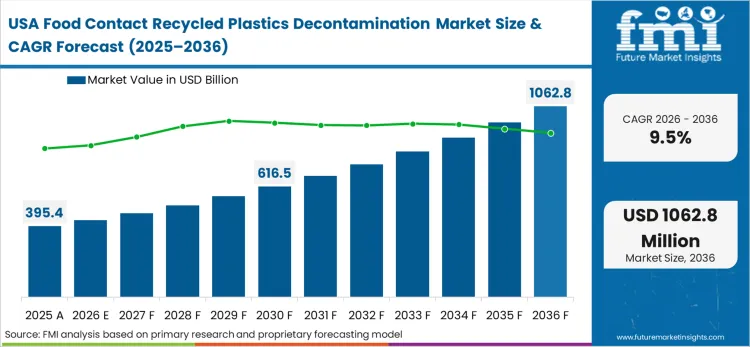
Strict FDA non-objection letter requirements govern the exact technical specifications required to produce legally compliant recycled resins across North America. Polymer scientists leading critical facility overhauls face strict directives to deploy reactor configurations specifically approved for defined condition-of-use categories. In FMI's view, the extreme liability associated with food safety recalls actively drives major petrochemical conglomerates to acquire and aggressively modernize independent recycling operations. Implementing a standardized, highly automated decontamination backbone enables these consolidated facilities to scale production safely without compromising molecular purity. This strategic shift requires significant capital allocation toward robust solid state polycondensation hardware capable of processing massive, highly variable post-consumer bales.
- United States: The United States beverage sector enforces strict purity mandates across its massive centralized bottling ecosystem to prevent catastrophic brand damage from flavor scalping. Network specification leads replacing aging atmospheric extruders must deploy converged architectures capable of supporting both real-time thermal management and secure telemetry extraction for FDA audits. Federal and state infrastructure grants actively fund the replacement of vulnerable basic washing lines with standardized super-clean reactor backbones. Projected at 9.5% compound growth over the forecast period, the market expands as major brand owners integrate vertically into the recycling supply chain. Engineering contractors failing to secure specific non-objection letter pathways for their hardware designs face immediate exclusion from lucrative facility expansion contracts.
FMI's report features specific analysis of the Canadian and Mexican industrial recycling markets. A defining dynamic involves the integration of cross-border packaging supply chains, which requires standardized decontamination protocols to coordinate resin delivery sequences and maintain synchronized production schedules across multinational brand facilities.
Competitive Aligners for Market Players
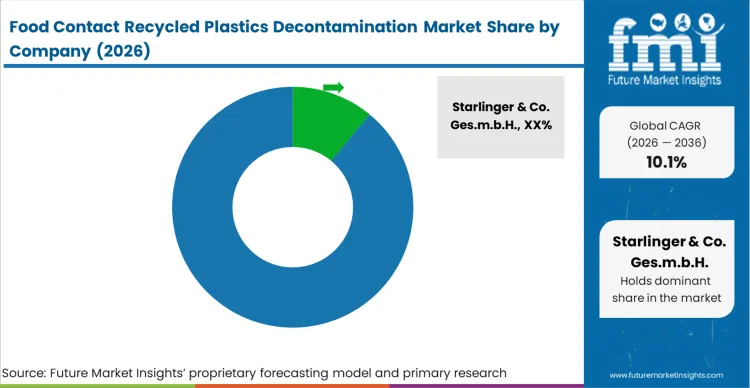
The introduction of unified European Food Safety Authority challenge test protocols is structurally concentrating the decontamination equipment sector. Instead of accepting generic extrusion hardware, procurement teams now demand highly specialized, pre-certified reactor architectures in all new facility tenders. This shift has raised the engineering barrier to entry significantly, meaning vendors that rely on basic mechanical washing systems risk permanent exclusion from major food-grade modernization programs. Leading companies compete intensely on their ability to guarantee maximum volatile organic compound extraction while consuming the lowest possible kilowatt-hours per ton.
Vendors embedding continuous diagnostic sensors directly into the extreme vacuum zones of their reactors gain a significant architectural advantage. Companies such as Starlinger & Co. Ges.m.b.H. and Erema Group natively integrate these monitoring capabilities, allowing facility engineers to adjust residence times dynamically without halting production. FMI observes that this hardware-software integration accelerates complex dossier approvals, allowing project leads to prioritize food packaging equipment platforms that avoid the unpredictable quality variances associated with disconnected legacy lines. Challengers attempting to enter this space must develop proprietary thermodynamic models capable of proving deep-layer extraction before any major recycler will test their hardware.
Massive packaging conglomerates prevent vendor lock-in by maintaining internal polymer science teams capable of independently validating challenge test results across multiple equipment suppliers. This intense technical scrutiny limits the pricing power of dominant reactor manufacturers, forcing them to continuously innovate their energy recovery systems to justify premium capital costs. The competitive trajectory points toward an increasingly consolidated tier of global equipment providers, as the extreme capital required to maintain ongoing regulatory certifications outpaces the financial capacity of smaller regional machinery builders.
Key Players in Food Contact Recycled Plastics Decontamination Market
- Starlinger & Co. Ges.m.b.H.
- Erema Group
- Sorema (Previero N. S.r.l.)
- Bühler Group
- Tomra Systems ASA
- Pellenc ST
- Gneuss Kunststofftechnik GmbH
Scope of the Report
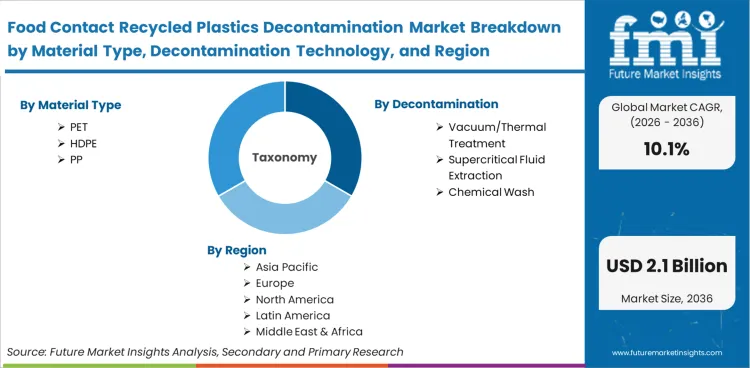
| Metric | Value |
|---|---|
| Quantitative Units | USD 0.8 billion to USD 2.1 billion, at a CAGR of 10.1% |
| Market Definition | Food Contact Recycled Plastics Decontamination encompasses the specialized industrial technologies and reactor systems engineered to extract deeply embedded molecular contaminants from post-consumer polymers, ensuring regulatory compliance for safe human food packaging. |
| Material Type Segmentation | PET, HDPE, PP, Others |
| Decontamination Technology Segmentation | Vacuum/Thermal Treatment, Supercritical Fluid Extraction, Chemical Wash, Solid State Polycondensation |
| End Use Segmentation | Bottles & Jars, Trays & Containers, Films & Wraps |
| Regions Covered | North America, Latin America, Europe, East Asia, South Asia, Oceania, Middle East & Africa |
| Countries Covered | India, China, Germany, United Kingdom, France, United States, Japan, and 40 plus countries |
| Key Companies Profiled | Starlinger & Co. Ges.m.b.H., Erema Group, Sorema (Previero N. S.r.l.), Bühler Group, Tomra Systems ASA, Pellenc ST, Gneuss Kunststofftechnik GmbH |
| Forecast Period | 2026 to 2036 |
| Approach | The baseline value derives from a bottom-up aggregation of specialized thermal reactor shipments, applying regional regulatory enforcement curves to project future installation velocity and cross-validating against capital expenditure guidance from leading polymer processing conglomerates. |
Source: Future Market Insights (FMI) analysis, based on proprietary forecasting model and primary research
Food Contact Recycled Plastics Decontamination Market Analysis by Segments
Material Type:
- PET
- HDPE
- PP
- Others
Decontamination Technology:
- Vacuum/Thermal Treatment
- Supercritical Fluid Extraction
- Chemical Wash
- Solid State Polycondensation
End Use:
- Bottles & Jars
- Trays & Containers
- Films & Wraps
Region:
-
- North America
- United States
- Canada
- Latin America
- Brazil
- Mexico
- Rest of Latin America
- Europe
- Germany
- United Kingdom
- France
- Italy
- Spain
- Rest of Europe
- East Asia
- China
- Japan
- South Korea
- South Asia
- India
- ASEAN
- Rest of South Asia
- Oceania
- Australia
- New Zealand
- Middle East & Africa
- GCC Countries
- South Africa
- Rest of Middle East & Africa
- North America
Bibliography
- USA Food and Drug Administration. (2024, November 15). Guidance for Industry: Use of Recycled Plastics in Food Packaging (Chemistry Considerations). FDA.
- European Food Safety Authority. (2025, January 20). Scientific opinion on the safety assessment of the process for recycling post-consumer PET into food contact materials. EFSA Journal.
- DIN. (2024, July 18). DIN EN 15343:2007 Plastics recycling traceability and assessment of conformity and recycled content. DIN.
- Association of Plastic Recyclers. (2025, February 10). APR Design Guide for Plastics Recyclability: Food Contact Requirements. APR.
- PlasticsEurope. (2024, September 30). Circular Economy for Plastics: A European Overview. PlasticsEurope Publications.
- Packaging and Films Association. (2024, October 25). UK guidelines for food contact recycled polymers. PAFA.
This bibliography is provided for reader reference. The full FMI report contains the complete reference list with primary source documentation.
This Report Addresses
- Market intelligence to support strategic decision making across high-vacuum thermal reactors, continuous SSP towers, and proprietary chemical wash modules unique to this market
- Market size estimation and 10-year revenue forecasts from 2026 to 2036, supported by certified reactor installation metrics and regional regulatory enforcement curves
- Growth opportunity mapping across specific material types and processing architectures with emphasis on the absolute necessity of European Food Safety Authority dossier approval timelines
- Segment and regional revenue forecasts covering critical End Use applications like Bottles & Jars and Trays & Containers across tightening legislative landscapes in the EU and India
- Competition strategy assessment including proprietary thermodynamic modeling capabilities, inline diagnostic sensor integration, and challenge-test success rates
- Equipment capability development tracking including EFSA challenge protocols, FDA non-objection letters, and advanced automated residence time optimization software
- Market access analysis covering stringent extended producer responsibility taxes, national circular economy grants, and rigid food safety auditing pathways
- Market report delivery in PDF, Excel, PPT, and interactive dashboard formats for executive strategy, global packaging procurement planning, and operational benchmarking use
Frequently Asked Questions
How large is the food contact recycled plastics decontamination market in 2026?
Demand for the food contact recycled plastics decontamination market is estimated to be valued at USD 0.8 billion in 2026, driven by continuous hardware replacement programs as legacy operators are forced to comply with strict new super-clean mandates.
What will it be valued at by 2036?
Market size for food contact recycled plastics decontamination is projected to reach USD 2.1 billion by 2036 as stringent contact safety mandates reach regional packaging converters that previously deferred technology upgrades.
What CAGR is projected?
Demand for food contact recycled plastics decontamination is expected to grow at a CAGR of 10.1% between 2026 and 2036, solidly defended by the legal impossibility of using non-decontaminated post-consumer materials in premium fast-moving consumer goods applications.
Which material type segment leads?
PET holds a 65.0% share in 2026 because its resilient molecular structure naturally withstands the extreme heat and vacuum needed for deep-layer stripping without severe viscosity loss.
Which decontamination technology segment leads?
Vacuum/thermal treatment leads the technology segment because integrating deep-vacuum degassing directly into the continuous melt zone securely vaporizes deeply embedded volatile organic compounds.
Which end use segment leads?
Bottles & jars represents the dominant End Use because massive global beverage brands face absolute zero-tolerance consumer safety standards and mandate verified processing for all incoming resin.
What drives rapid growth?
EU Regulation 2022/1616 forces regional recycling operators to install certified super-clean technologies, compelling facility engineering directors to abandon legacy mechanical washing lines immediately.
What is the primary restraint?
The intricate thermodynamic parameters required to optimize continuous vacuum extraction create steep energy cost barriers for independent recyclers.
Which country grows fastest?
India expands at 14.0% as national plastic waste management rules mandate immediate post-consumer content integration across all domestic fast-moving consumer goods formats.
How does European regulation impact technology selection?
European Food Safety Authority dossier approval timelines force recyclers to commit exclusively to certified reactor designs that can pass extensive deep-layer contaminant challenge tests.
What specific bottleneck dictates facility throughput?
Volatile organic compound stripping speed dictates facility processing rates far more than standard bulk melting capacity, completely redefining how engineers calculate true operational output.
What defines the competitive landscape for equipment vendors?
Vendors compete heavily on embedding continuous diagnostic sensors directly into their extreme vacuum zones to guarantee maximum extraction with the lowest possible energy expenditure per ton.
Why is Germany showing strong growth in this sector?
Germany's updated Packaging Act imposes punitive extended producer responsibility taxes on consumer brands, accelerating domestic facility modernization projects.
How does the United States market structure differ?
Strict FDA non-objection letter requirements force major petrochemical conglomerates to acquire independent recycling operations and standardize their super-clean reactor backbones.
What role does Japan play in decontamination infrastructure?
Meticulous municipal sorting infrastructure in Japan allows facility engineers to optimize their solid state polycondensation run times using exceptionally pure input streams.
What technologies are excluded from this market valuation?
Standard municipal sorting lines, basic friction washers, and advanced chemical depolymerization or pyrolysis plants are explicitly excluded from this mechanical decontamination scope.
How do flexible films impact future equipment design?
The demand for high-fat food contact films forces equipment providers to push vacuum depths even further to achieve parts-per-billion purity thresholds in polyolefin streams.
What is the strategic advantage of inline quality diagnostics?
Continuous validation directly inside the extruder melt zone prevents operators from producing massive volumes of out-of-spec material during unseen process deviations.
Why is China upgrading its domestic recycling capabilities rapidly?
Chinese fast-moving consumer goods conglomerates must deploy massive chemical wash and thermal extraction lines to guarantee their packaged exports comply with stringent European entry criteria.
What dictates the failure of legacy mechanical recyclers?
Operators who prioritize raw throughput over molecular residence time fail strict challenge tests and face immediate, permanent lot rejections from critical corporate buyers.
What is the primary methodology used for this FMI report?
The baseline derives from a bottom-up aggregation of specialized thermal reactor shipments, cross-validated against capital expenditure guidance from major global polymer processing conglomerates.
What does zero reliance on generic data mean for this study?
Analysts exclusively used documented challenge test protocols, FDA non-objection registries, and primary engineering interviews to define true adoption velocities.
Preview the report firsthand - request a free sample
Get SampleGet the brochure for pricing and purchase details.
Get PDFTable of Content
- Executive Summary
- Global Market Outlook
- Demand-side Trends
- Supply-side Trends
- Technology Roadmap Analysis
- Analysis and Recommendations
- Market Overview
- Market Coverage / Taxonomy
- Market Definition / Scope / Limitations
- Research Methodology
- Chapter Orientation
- Analytical Lens and Working Hypotheses
- Market Structure, Signals, and Trend Drivers
- Benchmarking and Cross-market Comparability
- Market Sizing, Forecasting, and Opportunity Mapping
- Research Design and Evidence Framework
- Desk Research Programme (Secondary Evidence)
- Company Annual and Sustainability Reports
- Peer-reviewed Journals and Academic Literature
- Corporate Websites, Product Literature, and Technical Notes
- Earnings Decks and Investor Briefings
- Statutory Filings and Regulatory Disclosures
- Technical White Papers and Standards Notes
- Trade Journals, Industry Magazines, and Analyst Briefs
- Conference Proceedings, Webinars, and Seminar Materials
- Government Statistics Portals and Public Data Releases
- Press Releases and Reputable Media Coverage
- Specialist Newsletters and Curated Briefings
- Sector Databases and Reference Repositories
- FMI Internal Proprietary Databases and Historical Market Datasets
- Subscription Datasets and Paid Sources
- Social Channels, Communities, and Digital Listening Inputs
- Additional Desk Sources
- Expert Input and Fieldwork (Primary Evidence)
- Primary Modes
- Qualitative Interviews and Expert Elicitation
- Quantitative Surveys and Structured Data Capture
- Blended Approach
- Why Primary Evidence is Used
- Field Techniques
- Interviews
- Surveys
- Focus Groups
- Observational and In-context Research
- Social and Community Interactions
- Stakeholder Universe Engaged
- C-suite Leaders
- Board Members
- Presidents and Vice Presidents
- R&D and Innovation Heads
- Technical Specialists
- Domain Subject-matter Experts
- Scientists
- Physicians and Other Healthcare Professionals
- Governance, Ethics, and Data Stewardship
- Research Ethics
- Data Integrity and Handling
- Primary Modes
- Tooling, Models, and Reference Databases
- Desk Research Programme (Secondary Evidence)
- Data Engineering and Model Build
- Data Acquisition and Ingestion
- Cleaning, Normalisation, and Verification
- Synthesis, Triangulation, and Analysis
- Quality Assurance and Audit Trail
- Market Background
- Market Dynamics
- Drivers
- Restraints
- Opportunity
- Trends
- Scenario Forecast
- Demand in Optimistic Scenario
- Demand in Likely Scenario
- Demand in Conservative Scenario
- Opportunity Map Analysis
- Product Life Cycle Analysis
- Supply Chain Analysis
- Investment Feasibility Matrix
- Value Chain Analysis
- PESTLE and Porter’s Analysis
- Regulatory Landscape
- Regional Parent Market Outlook
- Production and Consumption Statistics
- Import and Export Statistics
- Market Dynamics
- Global Market Analysis 2021 to 2025 and Forecast, 2026 to 2036
- Historical Market Size Value (USD Million) Analysis, 2021 to 2025
- Current and Future Market Size Value (USD Million) Projections, 2026 to 2036
- Y-o-Y Growth Trend Analysis
- Absolute $ Opportunity Analysis
- Global Market Pricing Analysis 2021 to 2025 and Forecast 2026 to 2036
- Global Market Analysis 2021 to 2025 and Forecast 2026 to 2036, By Material Type
- Introduction / Key Findings
- Historical Market Size Value (USD Million) Analysis By Material Type , 2021 to 2025
- Current and Future Market Size Value (USD Million) Analysis and Forecast By Material Type , 2026 to 2036
- PET
- HDPE
- PP
- PET
- Y-o-Y Growth Trend Analysis By Material Type , 2021 to 2025
- Absolute $ Opportunity Analysis By Material Type , 2026 to 2036
- Global Market Analysis 2021 to 2025 and Forecast 2026 to 2036, By Decontamination Technology
- Introduction / Key Findings
- Historical Market Size Value (USD Million) Analysis By Decontamination Technology, 2021 to 2025
- Current and Future Market Size Value (USD Million) Analysis and Forecast By Decontamination Technology, 2026 to 2036
- Vacuum/Thermal Treatment
- Supercritical Fluid Extraction
- Chemical Wash
- Vacuum/Thermal Treatment
- Y-o-Y Growth Trend Analysis By Decontamination Technology, 2021 to 2025
- Absolute $ Opportunity Analysis By Decontamination Technology, 2026 to 2036
- Global Market Analysis 2021 to 2025 and Forecast 2026 to 2036, By End Use
- Introduction / Key Findings
- Historical Market Size Value (USD Million) Analysis By End Use, 2021 to 2025
- Current and Future Market Size Value (USD Million) Analysis and Forecast By End Use, 2026 to 2036
- Bottles & Jars
- Trays & Containers
- Films & Wraps
- Bottles & Jars
- Y-o-Y Growth Trend Analysis By End Use, 2021 to 2025
- Absolute $ Opportunity Analysis By End Use, 2026 to 2036
- Global Market Analysis 2021 to 2025 and Forecast 2026 to 2036, By Region
- Introduction
- Historical Market Size Value (USD Million) Analysis By Region, 2021 to 2025
- Current Market Size Value (USD Million) Analysis and Forecast By Region, 2026 to 2036
- North America
- Latin America
- Western Europe
- Eastern Europe
- East Asia
- South Asia and Pacific
- Middle East & Africa
- Market Attractiveness Analysis By Region
- North America Market Analysis 2021 to 2025 and Forecast 2026 to 2036, By Country
- Historical Market Size Value (USD Million) Trend Analysis By Market Taxonomy, 2021 to 2025
- Market Size Value (USD Million) Forecast By Market Taxonomy, 2026 to 2036
- By Country
- USA
- Canada
- Mexico
- By Material Type
- By Decontamination Technology
- By End Use
- By Country
- Market Attractiveness Analysis
- By Country
- By Material Type
- By Decontamination Technology
- By End Use
- Key Takeaways
- Latin America Market Analysis 2021 to 2025 and Forecast 2026 to 2036, By Country
- Historical Market Size Value (USD Million) Trend Analysis By Market Taxonomy, 2021 to 2025
- Market Size Value (USD Million) Forecast By Market Taxonomy, 2026 to 2036
- By Country
- Brazil
- Chile
- Rest of Latin America
- By Material Type
- By Decontamination Technology
- By End Use
- By Country
- Market Attractiveness Analysis
- By Country
- By Material Type
- By Decontamination Technology
- By End Use
- Key Takeaways
- Western Europe Market Analysis 2021 to 2025 and Forecast 2026 to 2036, By Country
- Historical Market Size Value (USD Million) Trend Analysis By Market Taxonomy, 2021 to 2025
- Market Size Value (USD Million) Forecast By Market Taxonomy, 2026 to 2036
- By Country
- Germany
- UK
- Italy
- Spain
- France
- Nordic
- BENELUX
- Rest of Western Europe
- By Material Type
- By Decontamination Technology
- By End Use
- By Country
- Market Attractiveness Analysis
- By Country
- By Material Type
- By Decontamination Technology
- By End Use
- Key Takeaways
- Eastern Europe Market Analysis 2021 to 2025 and Forecast 2026 to 2036, By Country
- Historical Market Size Value (USD Million) Trend Analysis By Market Taxonomy, 2021 to 2025
- Market Size Value (USD Million) Forecast By Market Taxonomy, 2026 to 2036
- By Country
- Russia
- Poland
- Hungary
- Balkan & Baltic
- Rest of Eastern Europe
- By Material Type
- By Decontamination Technology
- By End Use
- By Country
- Market Attractiveness Analysis
- By Country
- By Material Type
- By Decontamination Technology
- By End Use
- Key Takeaways
- East Asia Market Analysis 2021 to 2025 and Forecast 2026 to 2036, By Country
- Historical Market Size Value (USD Million) Trend Analysis By Market Taxonomy, 2021 to 2025
- Market Size Value (USD Million) Forecast By Market Taxonomy, 2026 to 2036
- By Country
- China
- Japan
- South Korea
- By Material Type
- By Decontamination Technology
- By End Use
- By Country
- Market Attractiveness Analysis
- By Country
- By Material Type
- By Decontamination Technology
- By End Use
- Key Takeaways
- South Asia and Pacific Market Analysis 2021 to 2025 and Forecast 2026 to 2036, By Country
- Historical Market Size Value (USD Million) Trend Analysis By Market Taxonomy, 2021 to 2025
- Market Size Value (USD Million) Forecast By Market Taxonomy, 2026 to 2036
- By Country
- India
- ASEAN
- Australia & New Zealand
- Rest of South Asia and Pacific
- By Material Type
- By Decontamination Technology
- By End Use
- By Country
- Market Attractiveness Analysis
- By Country
- By Material Type
- By Decontamination Technology
- By End Use
- Key Takeaways
- Middle East & Africa Market Analysis 2021 to 2025 and Forecast 2026 to 2036, By Country
- Historical Market Size Value (USD Million) Trend Analysis By Market Taxonomy, 2021 to 2025
- Market Size Value (USD Million) Forecast By Market Taxonomy, 2026 to 2036
- By Country
- Kingdom of Saudi Arabia
- Other GCC Countries
- Turkiye
- South Africa
- Other African Union
- Rest of Middle East & Africa
- By Material Type
- By Decontamination Technology
- By End Use
- By Country
- Market Attractiveness Analysis
- By Country
- By Material Type
- By Decontamination Technology
- By End Use
- Key Takeaways
- Key Countries Market Analysis
- USA
- Pricing Analysis
- Market Share Analysis, 2025
- By Material Type
- By Decontamination Technology
- By End Use
- Canada
- Pricing Analysis
- Market Share Analysis, 2025
- By Material Type
- By Decontamination Technology
- By End Use
- Mexico
- Pricing Analysis
- Market Share Analysis, 2025
- By Material Type
- By Decontamination Technology
- By End Use
- Brazil
- Pricing Analysis
- Market Share Analysis, 2025
- By Material Type
- By Decontamination Technology
- By End Use
- Chile
- Pricing Analysis
- Market Share Analysis, 2025
- By Material Type
- By Decontamination Technology
- By End Use
- Germany
- Pricing Analysis
- Market Share Analysis, 2025
- By Material Type
- By Decontamination Technology
- By End Use
- UK
- Pricing Analysis
- Market Share Analysis, 2025
- By Material Type
- By Decontamination Technology
- By End Use
- Italy
- Pricing Analysis
- Market Share Analysis, 2025
- By Material Type
- By Decontamination Technology
- By End Use
- Spain
- Pricing Analysis
- Market Share Analysis, 2025
- By Material Type
- By Decontamination Technology
- By End Use
- France
- Pricing Analysis
- Market Share Analysis, 2025
- By Material Type
- By Decontamination Technology
- By End Use
- India
- Pricing Analysis
- Market Share Analysis, 2025
- By Material Type
- By Decontamination Technology
- By End Use
- ASEAN
- Pricing Analysis
- Market Share Analysis, 2025
- By Material Type
- By Decontamination Technology
- By End Use
- Australia & New Zealand
- Pricing Analysis
- Market Share Analysis, 2025
- By Material Type
- By Decontamination Technology
- By End Use
- China
- Pricing Analysis
- Market Share Analysis, 2025
- By Material Type
- By Decontamination Technology
- By End Use
- Japan
- Pricing Analysis
- Market Share Analysis, 2025
- By Material Type
- By Decontamination Technology
- By End Use
- South Korea
- Pricing Analysis
- Market Share Analysis, 2025
- By Material Type
- By Decontamination Technology
- By End Use
- Russia
- Pricing Analysis
- Market Share Analysis, 2025
- By Material Type
- By Decontamination Technology
- By End Use
- Poland
- Pricing Analysis
- Market Share Analysis, 2025
- By Material Type
- By Decontamination Technology
- By End Use
- Hungary
- Pricing Analysis
- Market Share Analysis, 2025
- By Material Type
- By Decontamination Technology
- By End Use
- Kingdom of Saudi Arabia
- Pricing Analysis
- Market Share Analysis, 2025
- By Material Type
- By Decontamination Technology
- By End Use
- Turkiye
- Pricing Analysis
- Market Share Analysis, 2025
- By Material Type
- By Decontamination Technology
- By End Use
- South Africa
- Pricing Analysis
- Market Share Analysis, 2025
- By Material Type
- By Decontamination Technology
- By End Use
- USA
- Market Structure Analysis
- Competition Dashboard
- Competition Benchmarking
- Market Share Analysis of Top Players
- By Regional
- By Material Type
- By Decontamination Technology
- By End Use
- Competition Analysis
- Competition Deep Dive
- Starlinger & Co. Ges.m.b.H.
- Overview
- Product Portfolio
- Profitability by Market Segments (Product/Age /Sales Channel/Region)
- Sales Footprint
- Strategy Overview
- Marketing Strategy
- Product Strategy
- Channel Strategy
- Erema Group
- Sorema (Previero N. S.r.l.)
- Bühler Group
- Tomra Systems ASA
- Pellenc ST
- Gneuss Kunststofftechnik GmbH
- Starlinger & Co. Ges.m.b.H.
- Competition Deep Dive
- Assumptions & Acronyms Used


