

- Industry Size (2026)
- USD 2640 Mn
- Forecast (2036)
- USD 7911.3 Mn
- CAGR (2026 to 2036)
- 11.6%
PCR in Dairy Bottle and Lid Applications Market Forecast and Outlook 2026 to 2036
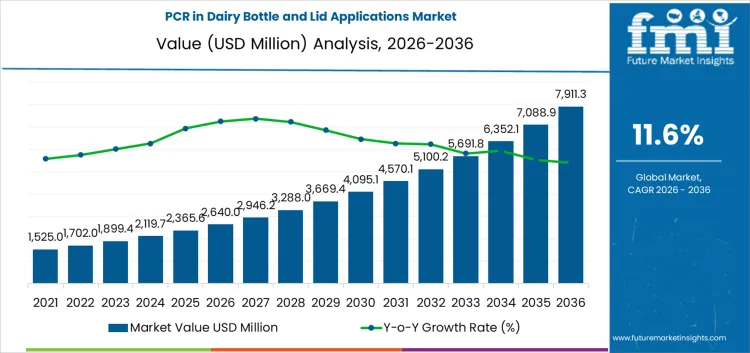
The PCR in dairy bottle and lid applications market is anticipated to expand from USD 2,640 million in 2026 to USD 7,911.3 million by 2036, growing at a CAGR of 11.6%. This market sits at the intersection of food-grade packaging performance and circular economy compliance, making growth highly dependent on material reliability rather than simple volume substitution. Adoption of PCR in dairy packaging is shaped by strict food-contact regulations, high-speed filling requirements, and brand-level sustainability commitments.
Value creation increasingly concentrates around suppliers that can deliver consistent resin quality, odor control, and processing stability at scale. Bottles and closures remain the primary entry points for PCR integration due to material intensity and manageable performance risk. Between 2026 and 2036, margin capture favors recyclers, compounders, and converters with certified food-grade capabilities and long-term supply agreements rather than opportunistic resin sellers. As dairy brands prioritize risk mitigation and audit readiness, competitive advantage shifts toward partners offering traceability, technical validation, and supply continuity, positioning PCR-enabled dairy packaging as a structurally premium segment within recycled plastics.
Quick Stats for PCR in Dairy Bottle and Lid Applications Market
- PCR in Dairy Bottle and Lid Applications Market Value (2026): USD 2,640 Million
- PCR in Dairy Bottle and Lid Applications Market Forecast Value (2036): USD 7,911.3 Million
- PCR in Dairy Bottle and Lid Applications Market Forecast CAGR 2026 to 2036: 11.6%
- Leading Packaging Component in PCR in Dairy Bottle and Lid Applications Market: Bottles & Closures (37.0% share)
- Key Growth Regions in PCR in Dairy Bottle and Lid Applications Market: Asia Pacific, Europe, North America, Latin America, Middle East & Africa
- Top Key Players in PCR in Dairy Bottle and Lid Applications Market: Silgan Holdings Inc., Greiner Packaging International GmbH, Plastipak Holdings, Inc., ALPLA Werke Alwin Lehner GmbH & Co. KG, Inner Mongolia Yili Industrial Group Co., Ltd., Shanghai Zijiang Enterprise Group Co., Ltd., Yoshino Kogyosho Co., Ltd.
PCR in Dairy Bottle and Lid Applications Market Key Takeaways
| Metric | Value |
|---|---|
| PCR in Dairy Bottle and Lid Applications Market Value (2026) | USD 2,640 Million |
| PCR in Dairy Bottle and Lid Applications Market Forecast Value (2036) | USD 7,911.3 Million |
| PCR in Dairy Bottle and Lid Applications Market Forecast CAGR 2026 to 2036 | 11.6% |
How Are Regulatory Compliance and Packaging Performance Requirements Accelerating PCR Adoption in Dairy Bottles and Lids?
Adoption of PCR materials in dairy bottle and lid applications is accelerating as brands align packaging portfolios with recycled-content mandates and sustainability commitments. Dairy packaging operates under strict food-contact, safety, and shelf-life requirements, making PCR integration a materials-engineering challenge rather than a simple substitution. For resin suppliers and converters, demand is increasingly concentrated on food-grade PCR with consistent melt flow, color control, and low odor-attributes essential for maintaining product integrity across high-speed filling lines.
Procurement decisions are being shaped by performance parity and risk management. Dairy processors prioritize PCR solutions that deliver predictable processing behavior in blow molding and injection molding, with minimal line adjustments. Closure manufacturers, in particular, are evaluating PCR blends that preserve torque performance, seal integrity, and dimensional stability. Suppliers that can offer validated formulations, technical data packages, and co-development support are gaining preferred status with large dairy brands and contract packers.
Supply assurance and traceability are becoming decisive factors as volumes scale. Brands are seeking long-term PCR supply agreements with certified recyclers and compounders to mitigate volatility and ensure audit readiness. Regional investments in advanced sorting, decontamination, and food-grade recycling infrastructure are improving availability, but qualification timelines remain critical. For companies across the value chain, competitive advantage in the PCR dairy packaging market increasingly depends on material consistency, regulatory confidence, and the ability to integrate PCR at scale without compromising packaging performance or operational efficiency.
How Is the PCR in Dairy Bottle and Lid Applications Market Structured Across Key Segments?
The PCR in dairy bottle and lid applications market is segmented by end use and packaging component, reflecting how dairy formats and packaging performance requirements shape recycled content adoption. By end use, milk, yogurt, and drinkable dairy represent the leading segment, driven by high-volume consumption and brand commitments to circular packaging. Other end uses include fluid milk and creamers, ambient and chilled dairy, premium dairy products, pouched and bottled milk, and UHT dairy lines that apply PCR at varying inclusion rates. By packaging component, bottles and closures form the primary focus, supported by compatibility of PCR resins with blow molding and injection molding processes.
Why Do Milk, Yogurt, And Drinkable Dairy Lead PCR Adoption By End Use?
Milk, yogurt, and drinkable dairy account for 45.0% share of the PCR in dairy bottle and lid applications market because these categories represent the highest-volume and most frequently purchased dairy products. Daily consumption patterns create large, predictable demand for rigid plastic bottles and lids, making them priority targets for recycled content integration. High production throughput enables brand owners to achieve sustainability targets faster by introducing PCR at scale. Packaging formats for drinkable dairy are relatively standardized, simplifying qualification of PCR resins across multiple SKUs. Continuous improvements in resin washing, deodorization, and decontamination improve suitability for liquid contact applications. For resin suppliers and converters, this segment offers stable volumes, repeat procurement cycles, and long-term contracts, reinforcing its leadership.
Why Do Bottles And Closures Dominate The Packaging Component Segment?
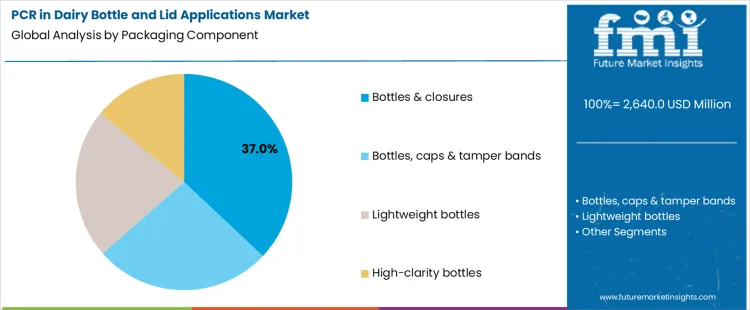
Bottles and closures hold 37.0% share of the PCR in dairy bottle and lid applications market because they account for the largest share of plastic material used in dairy packaging by both weight and unit count. Introducing PCR into bottles and closures delivers immediate reductions in virgin plastic consumption without altering filling lines or packaging formats. Advances in sorting technology and food-grade recycling improve clarity, mechanical strength, and odor performance, supporting wider adoption in dairy containers. Closures and caps tolerate higher PCR inclusion rates due to lower visual sensitivity compared to bottles. Packaging manufacturers prioritize these components to demonstrate measurable sustainability impact while maintaining functional reliability. This alignment of material volume, process compatibility, and compliance requirements sustains their dominance.
What Are The Key Dynamics Of The PCR In Dairy Bottle And Lid Applications Market?
The PCR in dairy bottle and lid applications market is driven by increasing use of recycled resins in rigid dairy packaging to meet packaging material targets and cost optimization goals. Post-consumer recycled (PCR) HDPE and PP are being incorporated into dairy bottles and caps to balance material availability, performance consistency, and branding requirements. For dairy processors and packaging converters, resin purity, odor control, color stability, and melt flow behavior are critical to maintain filling line efficiency and seal integrity. Supply continuity, price competitiveness versus virgin resin, and food-contact compliance strongly influence purchasing and long-term sourcing decisions.
How Are Regulatory And Industry Practices Shaping This Market?
Regulatory frameworks and evolving industry practices are shaping the PCR in dairy bottle and lid applications market by defining acceptable recycled content levels and food-contact compliance requirements. Dairy brands and converters must comply with regional packaging regulations and certification protocols for recycled plastics used in food applications. Retail packaging standards and private-label requirements are also influencing PCR adoption levels. Advances in sorting, washing, and resin upgrading technologies are improving material consistency, enabling wider use in dairy packaging formats. Packaging design adjustments, such as standardized bottle shapes and simplified resin structures, further support efficient processing and resin utilization.
Why Do Supply And Performance Constraints Limit Wider Adoption?
Supply and performance constraints continue to limit broader adoption of PCR in dairy bottle and lid applications. Availability of high-quality, food-grade PCR resin remains uneven due to dependence on collection and processing capacity. Variability in resin color, odor, and mechanical properties can affect bottle appearance, shelf presentation, and closure performance. Strict food-contact testing and documentation requirements add cost and extend qualification timelines. Dairy fillers face operational risks if recycled resin causes processing instability or packaging defects, leading many producers to adopt PCR gradually rather than at high inclusion rates across all product lines.
What Is the Country-Wise Outlook for the PCR in Dairy Bottle and Lid Applications Market?
The PCR in dairy bottle and lid applications market is shaped by regulatory pressure on food-grade plastics, brand-owner sustainability commitments, and advances in recycled polymer purification. Country-level growth varies based on food-contact compliance frameworks, recycling infrastructure maturity, and adoption of circular packaging targets by dairy processors. Emerging markets show faster expansion as new PCR-compatible packaging lines are introduced, while developed economies focus on improving recycled content quality, consistency, and supply security. Growth is influenced by lightweighting trends, HDPE and PP recycling efficiency, and availability of certified food-grade PCR resins. Suppliers that combine material quality assurance, regulatory compliance support, and stable PCR supply chains are best positioned across country markets.
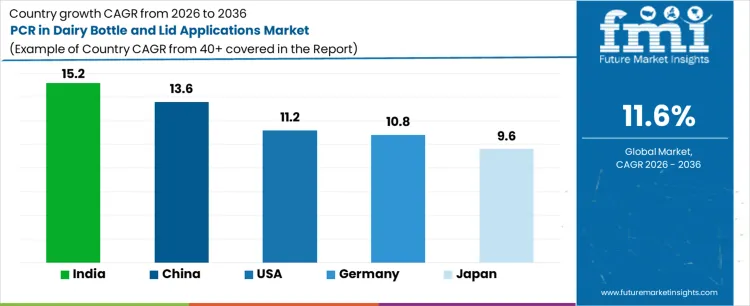
| Country | CAGR (%) |
|---|---|
| India | 15.2% |
| China | 13.6% |
| United States | 11.2% |
| Germany | 10.8% |
| Japan | 9.6% |
How is Germany Advancing Food-Grade PCR Adoption in Dairy Bottles and Lids?
The PCR in dairy bottle and lid applications market in Germany, growing at a CAGR of 10.8% during 2026-2036, is shaped by stringent packaging waste regulations and strong retailer-led circular economy commitments. German dairy brands and converters prioritize food-contact safety, traceability, and material consistency when introducing PCR into bottles and closures. Adoption is largely upgrade-driven, with extrusion blow molding and injection molding lines optimized to handle higher PCR ratios without affecting shelf life or mechanical strength. Buyers emphasize certified food-grade PCR HDPE and PP, odor control, color uniformity, and melt flow stability. Procurement decisions are specification-intensive, favoring suppliers operating closed-loop recycling systems with documented compliance to EFSA standards. Volumes are moderate, but value per contract remains high due to quality expectations and long-term supply agreements.
What is Driving Rapid Uptake of PCR in US Dairy Bottles and Lids?
Demand for PCR in dairy bottle and lid applications in the United States, expanding at a CAGR of 11.2% during 2026-2036, is driven by aggressive brand sustainability targets and improving availability of food-grade recycled resins. Dairy producers increasingly incorporate PCR to meet recycled content pledges while maintaining high-speed bottling efficiency. Buyers prioritize resin consistency, FDA food-contact compliance, and compatibility with automated filling and capping lines. Demand is supported by investments in advanced sorting, washing, and mechanical recycling infrastructure. Procurement decisions emphasize supply security, nationwide logistics reach, and technical collaboration to minimize line disruptions. Adoption often begins with caps and closures before expanding into full bottle applications. Volumes are growing steadily, supported by long-term brand commitments rather than regulatory mandates alone.
Why is China Emerging as a High-Growth Market for PCR in Dairy Packaging?
Sale of PCR in dairy bottle and lid applications market in China, growing at a CAGR of 13.6% during 2026-2036, reflects rapid expansion of packaged dairy consumption and evolving plastic waste management policies. Dairy brands increasingly pilot PCR use in closures, labels, and non-contact bottle layers to balance sustainability goals with cost considerations. Buyers focus on affordability, volume availability, and processability across large-scale production lines. Domestic recyclers are scaling food-grade PCR capacity, supported by government initiatives and multinational brand pressure. Procurement decisions favor suppliers capable of delivering consistent resin quality at competitive prices. Adoption is primarily volume-led, with gradual movement toward higher PCR content as purification technologies mature. China represents a scale-driven market where success depends on production capacity, pricing discipline, and partnerships with dairy brands navigating early-stage food-grade PCR implementation.
How Does Japan Maintain a Quality-Centric Approach to PCR in Dairy Bottles and Lids?
The PCR in dairy bottle and lid applications market in Japan, expanding at a CAGR of 9.6% during the forecast period, is shaped by stringent food safety expectations and conservative adoption practices. Dairy brands introduce PCR incrementally, prioritizing material purity, odor neutrality, and dimensional stability. Buyers emphasize pilot testing, long validation cycles, and close collaboration with resin suppliers. Demand is focused on high-quality PCR HDPE and PP suitable for premium dairy packaging. Procurement decisions favor suppliers with advanced purification technology, strong documentation, and long-standing industry credibility. Volumes remain moderate, but quality thresholds are among the highest globally. Japan represents a precision-oriented market where supplier differentiation depends on technical excellence, consistency, and long-term reliability rather than rapid volume expansion.
Why is India the Fastest-Growing Market for PCR in Dairy Bottle and Lid Applications?
Demand for PCR in dairy bottle and lid applications in India, growing at a CAGR of 15.2% during 2026-2036, is driven by rising packaged dairy consumption and regulatory push for recycled plastics. Dairy brands increasingly adopt PCR in caps and non-contact packaging layers to meet sustainability targets. Buyers emphasize affordability, local availability, and compliance with emerging food-contact guidelines. Demand is largely greenfield, supported by new dairy packaging lines and expanding cold-chain infrastructure. Procurement decisions are cost-sensitive but increasingly influenced by quality consistency and supply reliability. India represents a high-growth, early-stage market where supplier education, scalable PCR production, and technical support play a critical role in accelerating adoption across mass-market dairy brands.
How Are Companies Competing in the PCR in Dairy Bottle and Lid Applications Market?
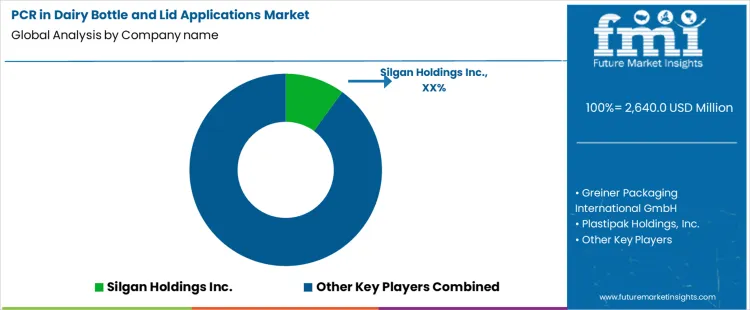
Competition in the PCR (Post-Consumer Recycled) in dairy bottle and lid applications market is driven by documented material performance, regulatory compliance, and sustainable sourcing claims presented in official product brochures and technical datasheets. ALPLA Werke Alwin Lehner GmbH & Co. KG positions its PCR bottles and lids around robust mechanical performance and barrier integrity. Product literature highlights certified PCR content, controlled odor profiles, and compatibility with high-speed filling lines. Brochures emphasize alignment with food contact standards (e.g., FDA, EFSA) and closed-loop recycling partnerships that secure consistent PCR feedstocks.
Major global converters differentiate through end-to-end quality assurance. Greiner Packaging International GmbH and Plastipak Holdings, Inc. compete by offering PCR-enhanced dairy bottles and caps with product documentation that details multi-layer constructions engineered for light and oxygen protection. Their brochures emphasize traceable PCR sourcing and mechanical property retention through processing, appealing to large dairy OEMs prioritizing shelf life and sustainability reporting.
Brand-focused suppliers leverage scale and customization. Silgan Holdings Inc. highlights portfolio breadth with PCR bottle and lid formats designed for diverse dairy SKUs. Official materials focus on consistent torque performance for closures and injection/stretch blow molding precision. Inner Mongolia Yili Industrial Group Co., Ltd. and Shanghai Zijiang Enterprise Group Co., Ltd. integrate PCR solutions within localized dairy packaging platforms, with product guides that stress regulatory compliance and cost-efficient PCR incorporation.
Specialized regional players like Yoshino Kogyosho Co., Ltd. differentiate through technical support for PCR resin selection and processing optimization. Across all suppliers, competitive advantage is built on documented PCR content verification, performance metrics in food contact applications, and transparent supply chains rather than price alone.
Key Players in PCR in Dairy Bottle and Lid Applications Market
- Silgan Holdings Inc.
- Greiner Packaging International GmbH
- Plastipak Holdings, Inc.
- ALPLA Werke Alwin Lehner GmbH & Co. KG
- Inner Mongolia Yili Industrial Group Co., Ltd.
- Shanghai Zijiang Enterprise Group Co., Ltd.
- Yoshino Kogyosho Co., Ltd.
Scope of Report
| Attribute | Description |
|---|---|
| Quantitative Unit | USD Million |
| End-use | Milk, Yogurt & Drinkable Dairy; Fluid Milk & Creamers; Ambient & Chilled Dairy; Premium Dairy; Pouched & Bottled Milk; UHT & Chilled Dairy |
| Packaging Component | Bottles & Closures, Bottles, Caps & Tamper Bands, Lightweight Bottles, High-Clarity Bottles |
| Countries Covered | China, Japan, South Korea, India, Australia & New Zealand, ASEAN, Rest of Asia Pacific, Germany, United Kingdom, France, Italy, Spain, Nordic, BENELUX, Rest of Europe, United States, Canada, Mexico, Brazil, Chile, Rest of Latin America, Kingdom of Saudi Arabia, Other GCC Countries, Turkey, South Africa, Other African Union, Rest of Middle East & Africa |
| Regions Covered | Asia Pacific, Europe, North America, Latin America, Middle East & Africa |
| Key Companies Profiled | Silgan Holdings Inc., Greiner Packaging International GmbH, Plastipak Holdings, Inc., ALPLA Werke Alwin Lehner GmbH & Co. KG, Inner Mongolia Yili Industrial Group Co., Ltd., Shanghai Zijiang Enterprise Group Co., Ltd., Yoshino Kogyosho Co., Ltd. |
| Additional Attributes | Dollar sales by end-use and packaging component are evaluated across recycled-content dairy packaging formats. The report includes country-level demand assessment, growth projections for 2026-2036, analysis of food-contact compliance and PCR resin quality, evaluation of lightweighting and clarity performance, competitive benchmarking of packaging suppliers, and assessment of sustainability-driven adoption across dairy brands and processors. |
PCR in Dairy Bottle and Lid Applications Market by Key Segments
End-use
- Milk, yogurt & drinkable dairy
- Fluid milk & creamers
- Ambient & chilled dairy
- Premium dairy
- Pouched & bottled milk
- UHT & chilled dairy
Packaging Component
- Bottles & closures
- Bottles, caps & tamper bands
- Lightweight bottles
- High-clarity bottles
Region
- Asia Pacific
- China
- Japan
- South Korea
- India
- Australia & New Zealand
- ASEAN
- Rest of Asia Pacific
- Europe
- Germany
- United Kingdom
- France
- Italy
- Spain
- Nordic
- BENELUX
- Rest of Europe
- North America
- United States
- Canada
- Mexico
- Latin America
- Brazil
- Chile
- Rest of Latin America
- Middle East & Africa
- Kingdom of Saudi Arabia
- Other GCC Countries
- Turkey
- South Africa
- Other African Union
- Rest of Middle East & Africa
Bibliography
- European Union. (2025). Regulation (EU) 2025/40 of the European Parliament and of the Council of 19 December 2024 on packaging and packaging waste. Publications Office of the European Union.
- European Food Safety Authority. (2025). Recycling of plastic materials for food contact use: Updated guidance for applicants (EFSA Journal No. 2025; 23(11)). European Food Safety Authority.
- Organisation for Economic Co-operation and Development. (2024). Circular economy policy approaches for flexible plastic packaging recycling. OECD Publishing.
Frequently Asked Questions
How big is the PCR in dairy bottle and lid applications market in 2026?
The global PCR in dairy bottle and lid applications market is estimated to be valued at USD 2,640.0 million in 2026.
What will be the size of PCR in dairy bottle and lid applications market in 2036?
The market size for the PCR in dairy bottle and lid applications market is projected to reach USD 7,911.3 million by 2036.
How much will be the PCR in dairy bottle and lid applications market growth between 2026 and 2036?
The PCR in dairy bottle and lid applications market is expected to grow at a 11.6% CAGR between 2026 and 2036.
What are the key product types in the PCR in dairy bottle and lid applications market?
The key product types in PCR in dairy bottle and lid applications market are milk, yogurt & drinkable dairy, fluid milk & creamers, ambient & chilled dairy, premium dairy, pouched & bottled milk and uht & chilled dairy.
Which packaging component segment to contribute significant share in the PCR in dairy bottle and lid applications market in 2026?
In terms of packaging component, bottles & closures segment to command 37.0% share in the PCR in dairy bottle and lid applications market in 2026.
Preview the report firsthand - request a free sample
Get SampleGet the brochure for pricing and purchase details.
Get PDFTable of Content
- Executive Summary
- Global Market Outlook
- Demand-side Trends
- Supply-side Trends
- Technology Roadmap Analysis
- Analysis and Recommendations
- Market Overview
- Market Coverage / Taxonomy
- Market Definition / Scope / Limitations
- Market Background
- Market Dynamics
- Drivers
- Restraints
- Opportunity
- Trends
- Scenario Forecast
- Demand in Optimistic Scenario
- Demand in Likely Scenario
- Demand in Conservative Scenario
- Opportunity Map Analysis
- Product Life Cycle Analysis
- Supply Chain Analysis
- Investment Feasibility Matrix
- Value Chain Analysis
- PESTLE and Porter’s Analysis
- Regulatory Landscape
- Regional Parent Market Outlook
- Production and Consumption Statistics
- Import and Export Statistics
- Market Dynamics
- Global Market Analysis 2021 to 2025 and Forecast, 2026 to 2036
- Historical Market Size Value (USD Million) Analysis, 2021 to 2025
- Current and Future Market Size Value (USD Million) Projections, 2026 to 2036
- Y-o-Y Growth Trend Analysis
- Absolute $ Opportunity Analysis
- Global Market Pricing Analysis 2021 to 2025 and Forecast 2026 to 2036
- Global Market Analysis 2021 to 2025 and Forecast 2026 to 2036, By End-use
- Introduction / Key Findings
- Historical Market Size Value (USD Million) Analysis By End-use , 2021 to 2025
- Current and Future Market Size Value (USD Million) Analysis and Forecast By End-use , 2026 to 2036
- Milk, yogurt & drinkable dairy
- Fluid milk & creamers
- Ambient & chilled dairy
- Premium dairy
- Pouched & bottled milk
- UHT & chilled dairy
- Milk, yogurt & drinkable dairy
- Y-o-Y Growth Trend Analysis By End-use , 2021 to 2025
- Absolute $ Opportunity Analysis By End-use , 2026 to 2036
- Global Market Analysis 2021 to 2025 and Forecast 2026 to 2036, By Packaging Component
- Introduction / Key Findings
- Historical Market Size Value (USD Million) Analysis By Packaging Component, 2021 to 2025
- Current and Future Market Size Value (USD Million) Analysis and Forecast By Packaging Component, 2026 to 2036
- Bottles & closures
- Bottles, caps & tamper bands
- Lightweight bottles
- High-clarity bottles
- Bottles & closures
- Y-o-Y Growth Trend Analysis By Packaging Component, 2021 to 2025
- Absolute $ Opportunity Analysis By Packaging Component, 2026 to 2036
- Global Market Analysis 2021 to 2025 and Forecast 2026 to 2036, By Region
- Introduction
- Historical Market Size Value (USD Million) Analysis By Region, 2021 to 2025
- Current Market Size Value (USD Million) Analysis and Forecast By Region, 2026 to 2036
- North America
- Latin America
- Western Europe
- Eastern Europe
- East Asia
- South Asia and Pacific
- Middle East & Africa
- Market Attractiveness Analysis By Region
- North America Market Analysis 2021 to 2025 and Forecast 2026 to 2036, By Country
- Historical Market Size Value (USD Million) Trend Analysis By Market Taxonomy, 2021 to 2025
- Market Size Value (USD Million) Forecast By Market Taxonomy, 2026 to 2036
- By Country
- USA
- Canada
- Mexico
- By End-use
- By Packaging Component
- By Country
- Market Attractiveness Analysis
- By Country
- By End-use
- By Packaging Component
- Key Takeaways
- Latin America Market Analysis 2021 to 2025 and Forecast 2026 to 2036, By Country
- Historical Market Size Value (USD Million) Trend Analysis By Market Taxonomy, 2021 to 2025
- Market Size Value (USD Million) Forecast By Market Taxonomy, 2026 to 2036
- By Country
- Brazil
- Chile
- Rest of Latin America
- By End-use
- By Packaging Component
- By Country
- Market Attractiveness Analysis
- By Country
- By End-use
- By Packaging Component
- Key Takeaways
- Western Europe Market Analysis 2021 to 2025 and Forecast 2026 to 2036, By Country
- Historical Market Size Value (USD Million) Trend Analysis By Market Taxonomy, 2021 to 2025
- Market Size Value (USD Million) Forecast By Market Taxonomy, 2026 to 2036
- By Country
- Germany
- UK
- Italy
- Spain
- France
- Nordic
- BENELUX
- Rest of Western Europe
- By End-use
- By Packaging Component
- By Country
- Market Attractiveness Analysis
- By Country
- By End-use
- By Packaging Component
- Key Takeaways
- Eastern Europe Market Analysis 2021 to 2025 and Forecast 2026 to 2036, By Country
- Historical Market Size Value (USD Million) Trend Analysis By Market Taxonomy, 2021 to 2025
- Market Size Value (USD Million) Forecast By Market Taxonomy, 2026 to 2036
- By Country
- Russia
- Poland
- Hungary
- Balkan & Baltic
- Rest of Eastern Europe
- By End-use
- By Packaging Component
- By Country
- Market Attractiveness Analysis
- By Country
- By End-use
- By Packaging Component
- Key Takeaways
- East Asia Market Analysis 2021 to 2025 and Forecast 2026 to 2036, By Country
- Historical Market Size Value (USD Million) Trend Analysis By Market Taxonomy, 2021 to 2025
- Market Size Value (USD Million) Forecast By Market Taxonomy, 2026 to 2036
- By Country
- China
- Japan
- South Korea
- By End-use
- By Packaging Component
- By Country
- Market Attractiveness Analysis
- By Country
- By End-use
- By Packaging Component
- Key Takeaways
- South Asia and Pacific Market Analysis 2021 to 2025 and Forecast 2026 to 2036, By Country
- Historical Market Size Value (USD Million) Trend Analysis By Market Taxonomy, 2021 to 2025
- Market Size Value (USD Million) Forecast By Market Taxonomy, 2026 to 2036
- By Country
- India
- ASEAN
- Australia & New Zealand
- Rest of South Asia and Pacific
- By End-use
- By Packaging Component
- By Country
- Market Attractiveness Analysis
- By Country
- By End-use
- By Packaging Component
- Key Takeaways
- Middle East & Africa Market Analysis 2021 to 2025 and Forecast 2026 to 2036, By Country
- Historical Market Size Value (USD Million) Trend Analysis By Market Taxonomy, 2021 to 2025
- Market Size Value (USD Million) Forecast By Market Taxonomy, 2026 to 2036
- By Country
- Kingdom of Saudi Arabia
- Other GCC Countries
- Turkiye
- South Africa
- Other African Union
- Rest of Middle East & Africa
- By End-use
- By Packaging Component
- By Country
- Market Attractiveness Analysis
- By Country
- By End-use
- By Packaging Component
- Key Takeaways
- Key Countries Market Analysis
- USA
- Pricing Analysis
- Market Share Analysis, 2025
- By End-use
- By Packaging Component
- Canada
- Pricing Analysis
- Market Share Analysis, 2025
- By End-use
- By Packaging Component
- Mexico
- Pricing Analysis
- Market Share Analysis, 2025
- By End-use
- By Packaging Component
- Brazil
- Pricing Analysis
- Market Share Analysis, 2025
- By End-use
- By Packaging Component
- Chile
- Pricing Analysis
- Market Share Analysis, 2025
- By End-use
- By Packaging Component
- Germany
- Pricing Analysis
- Market Share Analysis, 2025
- By End-use
- By Packaging Component
- UK
- Pricing Analysis
- Market Share Analysis, 2025
- By End-use
- By Packaging Component
- Italy
- Pricing Analysis
- Market Share Analysis, 2025
- By End-use
- By Packaging Component
- Spain
- Pricing Analysis
- Market Share Analysis, 2025
- By End-use
- By Packaging Component
- France
- Pricing Analysis
- Market Share Analysis, 2025
- By End-use
- By Packaging Component
- India
- Pricing Analysis
- Market Share Analysis, 2025
- By End-use
- By Packaging Component
- ASEAN
- Pricing Analysis
- Market Share Analysis, 2025
- By End-use
- By Packaging Component
- Australia & New Zealand
- Pricing Analysis
- Market Share Analysis, 2025
- By End-use
- By Packaging Component
- China
- Pricing Analysis
- Market Share Analysis, 2025
- By End-use
- By Packaging Component
- Japan
- Pricing Analysis
- Market Share Analysis, 2025
- By End-use
- By Packaging Component
- South Korea
- Pricing Analysis
- Market Share Analysis, 2025
- By End-use
- By Packaging Component
- Russia
- Pricing Analysis
- Market Share Analysis, 2025
- By End-use
- By Packaging Component
- Poland
- Pricing Analysis
- Market Share Analysis, 2025
- By End-use
- By Packaging Component
- Hungary
- Pricing Analysis
- Market Share Analysis, 2025
- By End-use
- By Packaging Component
- Kingdom of Saudi Arabia
- Pricing Analysis
- Market Share Analysis, 2025
- By End-use
- By Packaging Component
- Turkiye
- Pricing Analysis
- Market Share Analysis, 2025
- By End-use
- By Packaging Component
- South Africa
- Pricing Analysis
- Market Share Analysis, 2025
- By End-use
- By Packaging Component
- USA
- Market Structure Analysis
- Competition Dashboard
- Competition Benchmarking
- Market Share Analysis of Top Players
- By Regional
- By End-use
- By Packaging Component
- Competition Analysis
- Competition Deep Dive
- Silgan Holdings Inc.
- Overview
- Product Portfolio
- Profitability by Market Segments (Product/Age /Sales Channel/Region)
- Sales Footprint
- Strategy Overview
- Marketing Strategy
- Product Strategy
- Channel Strategy
- Greiner Packaging International GmbH
- Plastipak Holdings, Inc.
- ALPLA Werke Alwin Lehner GmbH & Co. KG
- Inner Mongolia Yili Industrial Group Co., Ltd.
- Shanghai Zijiang Enterprise Group Co., Ltd.
- Yoshino Kogyosho Co., Ltd.
- Silgan Holdings Inc.
- Competition Deep Dive
- Assumptions & Acronyms Used
- Research Methodology


