

- Market Size (2026)
- USD 40.8 Mn
- Forecast (2036)
- USD 130.0 Mn
- CAGR (2026 to 2036)
- 12.3%
Dairy-free Evaporated Milk Market Size, Market Forecast and Outlook By FMI
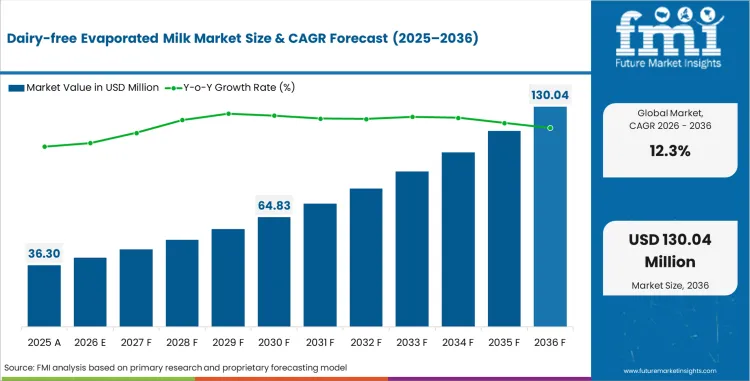
The dairy-free evaporated milk market was valued at USD 36.3 million in 2025. The market is set to reach USD 40.8 million by 2026-end and grow at a CAGR of 12.3% between 2026-2036 to reach USD 130.0 million by 2036. Coconut Based Evaporated Milk will dominate with a 45.0% share, while Food And Beverage will lead with a 70.0% share.
Summary of the Dairy-free Evaporated Milk Market
- Demand and Growth Drivers
- Food and beverage accounts for 70.0% of application demand, reflecting the growing adoption of dairy-free evaporated milk as a cooking and baking ingredient by consumers seeking plant-based alternatives to traditional evaporated milk.
- Coconut-based evaporated milk accounts for 45.0% of product demand, reflecting consumer preference for the rich, creamy texture and neutral cooking properties that closely replicate traditional dairy evaporated milk in recipes.
- Household consumers account for 60.0% of end-use demand, with food and beverage manufacturers and foodservice operators completing the balance.
- Product and Segment View
- Coconut-based evaporated milk is projected to represent 45.0% of demand for the product, which has the closest sensory profile to dairy evaporated milk in cooking applications.
- Unsweetened formulations account for 55.0% of formulation demand, indicative of consumer demand for multi-purpose cooking ingredients without additional sugar.
- Cans make up 60.0% of packaging demand and maintain the traditional form of evaporated milk that consumers associate with the product category.
- Geography and Competitive Outlook
- Germany (13.5%) is the leading growth market globally, underpinned by strong adoption of plant-based food and an established vegan consumer base.
- Established plant-based food retail distribution and increasing usage of dairy-free cooking ingredients, boost demand in North America.
- Danone (20.0%) is in the lead with its plant-based portfolio and existing dairy-alternative distribution infrastructure.
- Analyst Opinion
- Nandini Roy Choudhury, Principal Consultant at FMI says “Brands able to match the cooking performance of traditional evaporated milk, while maintaining clean-label plant-based credentials, are likely to drive faster mainstream adoption beyond the current base of vegan and lactose-intolerant consumers
- The dairy-free evaporated milk market is young, moving from niche vegan product to mainstream cooking ingredient for dairy-alternatives.
- The biggest hurdle for the mainstream consumer is cooking performance, especially heat stability, emulsification and browning behavior.
- Foodservice is an underdeveloped channel with high-volume potential for restaurants, bakeries and cafes.
Key Takeaways, Market Size, and Forecast
- The dairy-free evaporated milk market was valued at USD 36.3 million in 2025.
- By 2036, the Dairy-free Evaporated Milk Market is expected to be worth USD 130.0 million.
- From 2026 to 2036, the market is projected to expand at a CAGR of 12.3%.
- The market is projected to create an incremental opportunity of USD 89.28 million between 2026 and 2036.
- In 2026, food and beverage is expected to account for 70% of the application segment, driven by growing consumer demand for plant-based cooking alternatives driven by lactose intolerance, veganism, and dietary preference shifts.
- Germany (13.5%) and Brazil (12.92%) are two of the fastest growing markets in the world.
Dairy-free Evaporated Milk Market Definition
The dairy-free evaporated milk market includes plant-based concentrated milk alternatives produced from coconut, oat, soy, almond, and other plant sources, used as cooking and baking ingredients, beverage additions, and foodservice applications as substitutes for traditional dairy evaporated milk.
Dairy-free Evaporated Milk Market Inclusions
Market scope encompasses all commercially traded dairy-free evaporated milk categorized by product (coconut-based, oat-based, soy-based, almond-based), application (food and beverage, household consumption, foodservice), end use (household consumers, food and beverage manufacturers, foodservice operators), distribution channel (offline retail, online retail), packaging (cans, cartons, pouches), and formulation (unsweetened, sweetened). Revenue estimates cover the period from 2026 to 2036.
Dairy-free Evaporated Milk Market Exclusions
The scope does not include regular dairy evaporated milk, plant-based drinking milks not in evaporated form, coconut cream, or condensed milk products.
Dairy-free Evaporated Milk Market Research Methodology
- Primary Research: FMI utilized secondary data derived from industry sources, trade associations, government agencies, and industry publications.
- Desk Research: Collate data from plant-based food industry associations, retail scanner data for dairy alternatives, consumer dietary trend surveys.
- Market sizing and forecasting: Aggregated bottom-up from dairy-free evaporated milk retail and e-commerce sales data with adjustments for regional plant-based food adoption curve.
- Data validation: Cross-checked quarterly against plant-based food market tracking, retail sell-through data and manufacturer disclosures.
Why is the Dairy-free Evaporated Milk Market Growing?
- The addressable consumer base is growing beyond vegans and lactose-intolerant consumers to flexitarian and health-conscious consumers who seek to cut their intake of dairy.
- Better cooking heat stability and improved emulsification performance are allowing dairy-free evaporated milk to mimic the functionality of dairy in recipes.
The market for dairy-free evaporated milk is projected to grow at a rate of 12.3% to reach USD 130.04 million by 2036 from USD 40.76 million in 2026. Adoption of plant-based food, prevalence of lactose intolerance, and trends in the substitution of cooking ingredients affect the demand. Coconut based products demand accounts for 45.0%.
The market is in an early growth phase with limited but increasing brand and product offerings. Danone leads at 20.0% through its plant-based portfolio, while specialty brands including Nature's Charm and Grain Changer serve niche but growing segments.
Germany is leading the pack with 13.5% CAGR, driven by the highest adoption of plant-based food in Europe. Brazil at 12.92% CAGR, benefits from large consumer market scale & proximity to coconut supply chain.
Market Segmentation Analysis
- The product market is dominated by evaporated milk made from coconut (45.0%). It is the closest in taste and texture to dairy evaporated milk and also is versatile in cooking.
- Food and beverage application demand accounts for 70.0% of total consumption with cooking and baking ingredients as the primary consumption pathway.
- Offline retail is the largest channel at 65.0% with the key consumer purchase channels including health food stores and the plant-based sections of mainstream supermarkets.
The dairy-free evaporated milk market is segmented on the basis of product, application, end use, distribution channel, packaging and formulation. Demand patterns show plant-based food adoption, dietary preferences, and retail channel development for dairy alternatives.
Insights into the Coconut-Based Product Segment
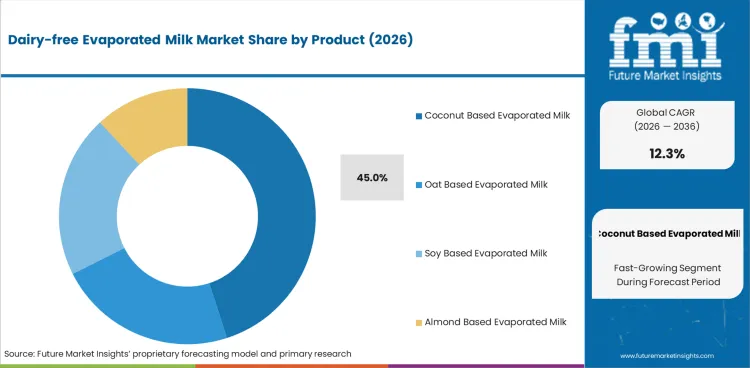
Coconut based evaporated milk is expected to hold 45.0% of the demand of the product in 2026. Of the plant bases, coconut provides the richest, creamiest texture and is the choice for cooking applications requiring emulsification and heat stability.
The sub-segment of evaporated milk based on oat is growing at the fastest pace, as it benefits from the general trend for oat milk and has a neutral flavor profile that works in both sweet and savory cooking applications.
Insights into the Unsweetened Formulations Segment
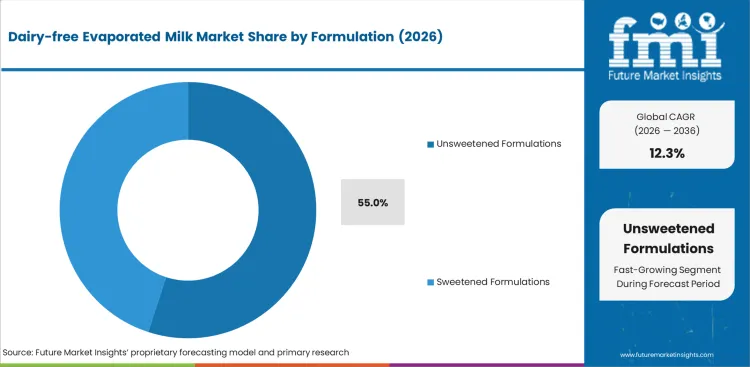
Unsweetened formulations account for 55.0% of demand, reflecting consumer preference for versatile cooking ingredients that can be used in both savory and sweet applications. The use of added sugar does not impact recipe outcomes.
Sweetened formulations contribute 45.0% towards dessert, baking and beverage applications where additional sweetness is required.
Dairy-free Evaporated Milk Market Drivers, Restraints, and Opportunities
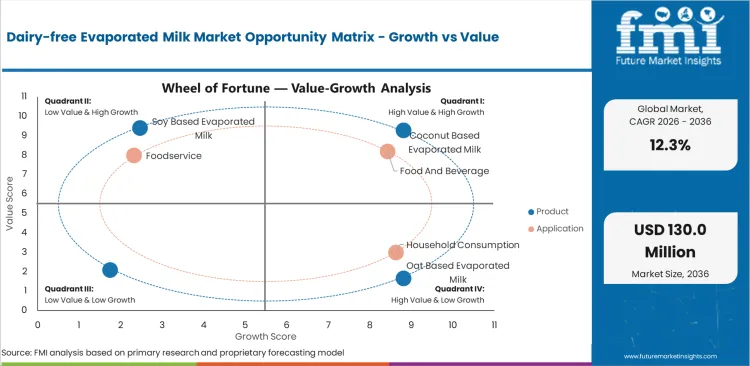
- The mainstreaming of plant-based food is broadening the consumer base for dairy-free cooking ingredients beyond just vegans to flexitarian and health-conscious consumers.
- Cooking performance limitations in heat stability and browning limit consumer adoption when results are directly compared to traditional dairy evaporated milk.
- Foodservice adoption is a nascent channel with substantial volume potential as restaurants and bakeries add dairy-free menu items.
The market is propelled by the adoption of plant-based foods, limited by performance gaps in cooking, and revolutionized by formulation innovation and development of foodservice channels.
Plant-Based Mainstream Adoption
The addressable market for dairy-free cooking ingredients including evaporated milk alternatives is expanding with the expansion of plant-based food consumption beyond the vegan consumer to include flexitarian, lactose intolerant, and health-conscious consumers.
Cooking Performance Innovation
Advances in formulation have been reducing the performance gap with traditional dairy evaporated milk in heat stability, emulsification, browning behavior and mouthfeel. The products that reach cooking parity have the most potential to convert the mainstream market.
Foodservice Channel Development
One channel that needs development is the expansion of dairy-free menu options in restaurants, bakeries and cafes. To adopt at scale in foodservice you need bulk packaging formats and consistent cooking performance.
Retail Distribution Expansion
Dairy-free evaporated milk is moving out of health food and specialty stores into the plant-based sections of mainstream grocery stores. Better shelf placement next to traditional evaporated milk helps to drive trial and repeat purchase.
Analysis of Dairy-free Evaporated Milk Market By Key Countries
.webp "Top Country Growth Comparison Dairy Free Evaporated Milk Market Cagr (2026 2036)")
| Country | CAGR |
|---|---|
| Germany | 13.5% |
| Brazil | 12.92% |
| Japan | 12.9% |
| USA | 11.2% |
| UK | 10.46% |
| India | 9.3% |
| China | 8.7% |
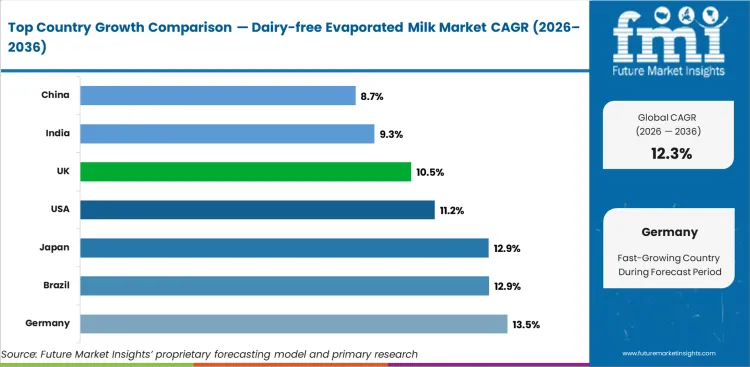
- Germany is leading the pack with a 13.5% CAGR, driven by the widespread adoption of plant-based foods, a tradition of natural cosmetics, and a strong foundation of vegan consumers.
- Demanding Market Brazil: 12.92% Large scale of consumer market, growing awareness on plant-based products, supply advantages of coconut-based products.
Regional demand reflects the maturity of plant-based food adoption, the prevalence of lactose intolerance, and the development of retail channels for dairy alternatives. Europe drives growth, while North America maintains mature demand.
Demand Outlook for Dairy-free Evaporated Milk Market in Germany
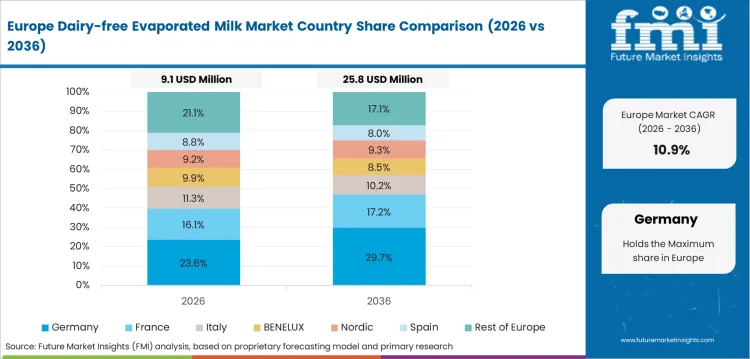
Germany leads at 13.5% CAGR through 2036. Favorable conditions: Strongest plant-based food adoption in Europe, established vegan consumer base and natural food retail infrastructure.
- Europe has the highest adoption rates for plant-based food, and a receptive consumer base for dairy-free cooking ingredients.
- Natural food retail and organic supermarket channels have been established as distribution channels for plant-based products.
- DMK Group local producers adding more dairy-free products to keep up with demand.
Future Outlook for Dairy-free Evaporated Milk Market in Brazil
Brazil is expected to grow at a CAGR of 12.92% until 2036. Demand is underpinned by large consumer market scale, increasing plant-based awareness and coconut supply chain advantages.
- As awareness for plant-based products grows, the large consumer market has a significant volume potential.
- Domestic coconut production provides supply chain advantages for coconut-based evaporated milk manufacturing.
- Increasing health consciousness and awareness of lactose intolerance are expanding the addressable consumer base.
Opportunity Analysis of Dairy-free Evaporated Milk Market in Japan
Japan is expected to grow at a CAGR of 12.9% through 2036. Natural consumer base due to high prevalence of lactose intolerance and growing interest in plant-based foods.
- Lactose intolerance is so widespread that it creates a natural market for dairy-free cooking alternatives.
- By positioning the product as premium, average selling prices in Japanese retail are higher.
- Growing interest in plant-based foods from health-conscious consumers is expanding the addressable market.
In-depth Analysis of Dairy-free Evaporated Milk Market in the United States
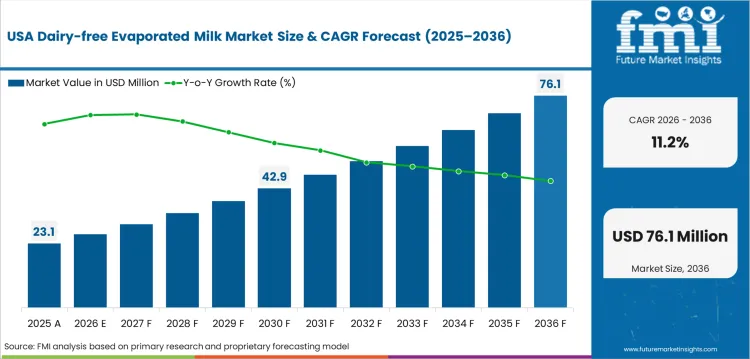
The USA is projected to grow at 11.2% CAGR through 2036. Demand is bolstered by existing plant-based retail distribution and growing use of dairy-free cooking.
- Established plant-based food retail distribution provides the consumer access through mainstream supermarket channels.
- Increasing adoption of dairy-free food among flexitarian consumers is broadening consumption beyond vegan groups.
- Foodservice expansion of dairy-free menu options creates commercial channel growth potential.
Sales Analysis of Dairy-free Evaporated Milk Market in the United Kingdom
The UK is projected to grow at 10.46% CAGR through 2036. Strong uptake of plant-based food and retailer commitment to dairy-free product ranges are driving demand.
- The retailers’ commitment to expand the plant-based product range improves the shelf availability for dairy-free evaporated milk.
- Veganuary & plant-based awareness campaigns drive consumer trial & adoption.
- Health food retail and online channels provide additional distribution pathways.
Growth Analysis of Dairy-free Evaporated Milk Market in India
India is expected to grow at a CAGR of 9.3% till 2036. Increasing health consciousness and prevalence of lactose intolerance create conditions for adoption.
- The high prevalence of lactose intolerance creates a natural consumer base for dairy-free alternatives.
- Growing health consciousness among urban consumers is supporting the adoption of plant-based cooking ingredients.
- The knowledge of coconut-based products from traditional cuisine supports the acceptance by consumers.
Market Landscape for Dairy-free Evaporated Milk Market in China
China should grow at 8.7% CAGR through 2036. Demand development is driven by high prevalence of lactose-intolerance and increasing interest in plant-based food.
- Lactose intolerance is very common , so there is a huge potential customer base for dairy alternatives .
- The growing interest in plant-based food among urban consumers is expanding the addressable market.
- E-commerce distribution allows consumers to access imported and domestic dairy-free products.
Competitive Landscape and Strategic Positioning
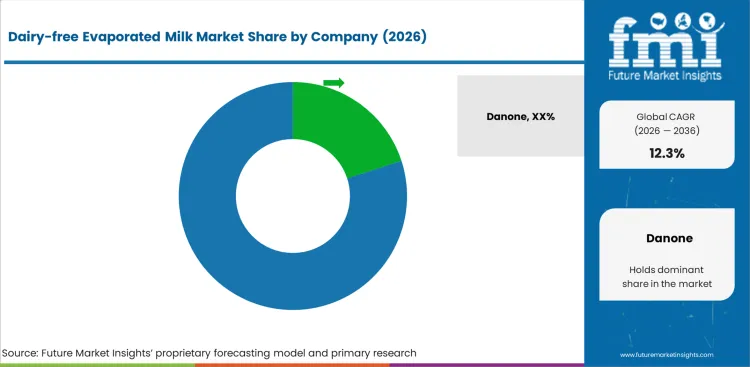
- Danone (20.0%), on the other hand, benefits from the breadth of its plant-based portfolio and established dairy-alternative distribution infrastructure around the world.
- Eagle Family Foods and DANA Dairy battle it out with traditional evaporated milk expertise in non-dairy formulations.
- Specialty brands such as Nature's Charm, Grain Changer and Califia Farms serve premium and niche segments with differentiated formulations.
Key Companies in the Dairy-free Evaporated Milk Market
Key global companies leading the dairy-free evaporated milk market include:
- Danone, Eagle Family Foods, DANA Dairy hold leadership positions based on their well established manufacturing infrastructure, distribution networks and breadth of products.
- Califia Farms, Nestle have strong regional or segment specific positions with specialized capabilities.
- Emerging players such as Grain Changer, Nature’s Charm and Minor Figures are growing via innovation of technology and niche markets.
Competitive Benchmarking: Dairy-free Evaporated Milk Market
| Company | Plant-Based Portfolio | Formulation Technology | Retail Distribution | Geographic Coverage |
|---|---|---|---|---|
| Danone | Very High | Strong | Very Strong | Global |
| Eagle Family Foods | Medium | Strong | Strong | N. America |
| DANA Dairy | Medium | Moderate | Moderate | Europe, Global |
| Grain Changer | Low | Strong | Low | N. America |
| DMK GROUP | Medium | Moderate | Strong | Europe |
| Califia Farms | Medium | Strong | Strong | N. America |
| Nestle | Very High | Strong | Very Strong | Global |
| Nature's Charm | Low | Strong | Moderate | Global |
Source: Future Market Insights competitive analysis, 2026.
Key Developments in Dairy-free Evaporated Milk Marke
- Nature's Charm (2025): Continued to expand distribution of its coconut-based evaporated milk (and related oat-based variants) into broader North American retail channels, including mainstream and natural food stores. The brand has strengthened its presence in the US and Canada through wider supermarket availability.
- Danone (2025): No major launch of a dedicated oat-based evaporated milk was reported. However, Danone (through its Silk and Alpro brands) continued expanding its broad plant-based portfolio, including oat-based beverages and cooking products targeted at European and North American markets for mainstream cooking and baking applications.
Key Players in the Dairy-free Evaporated Milk Market
Major Global Players
- Danone
- Eagle Family Foods
- DANA Dairy
- DMK GROUP
- Califia Farms
- Nestle
Emerging Players/Startups
- Grain Changer
- Nature's Charm
- Minor Figures
- Oatly
- Sproud
Report Scope and Coverage
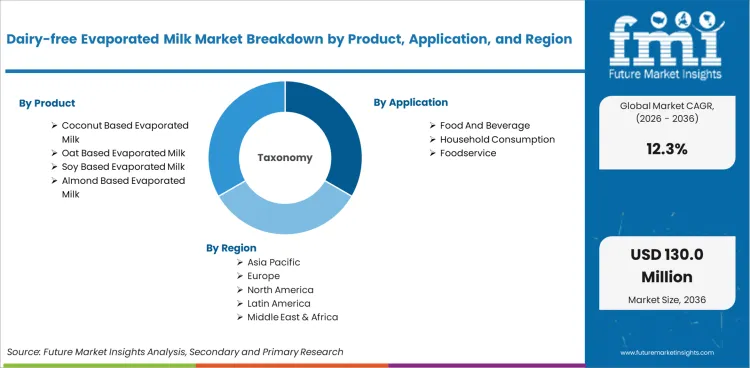
| Parameter | Details |
|---|---|
| Quantitative Units | USD 40.8 million to USD 130.0 million, at a CAGR of 12.3% |
| Market Definition | The dairy-free evaporated milk market includes plant-based concentrated milk alternatives produced from coconut, oat, soy, almond, and other plant sources, used as cooking and baking ingredients, beverage additions, and foodservice applications as substitutes for traditional dairy evaporated milk. |
| Regions Covered | North America, Latin America, Europe, East Asia, South Asia and Pacific, Middle East and Africa |
| Countries Covered | Germany, Brazil, Japan, USA, UK, India, China, 30 plus countries |
| Key Companies Profiled | Danone, Eagle Family Foods, DANA Dairy, Grain Changer, DMK GROUP, Califia Farms, Nestlé, Nature’s Charm, Earth’s Own, GLORIA |
| Forecast Period | 2026 to 2036 |
| Approach | Hybrid bottom-up and top-down methodology starting with verified transaction data, projecting adoption velocity across segments and regions. |
Market Segmentation Analysis
Dairy-free Evaporated Milk Market Segmented by Product:
- Coconut Based Evaporated Milk
- Organic Coconut Milk
- Certified Organic Products
- Clean Label Products
- Conventional Coconut Milk
- Mass Market Products
- Foodservice Products
- Organic Coconut Milk
- Oat Based Evaporated Milk
- Barista Formulations
- Coffee Applications
- Cafe Use Products
- Consumer Formulations
- Retail Products
- Cooking Applications
- Barista Formulations
- Soy Based Evaporated Milk
- Protein Enriched Products
- Functional Nutrition Products
- Fortified Products
- Protein Enriched Products
- Almond Based Evaporated Milk
- Low Calorie Products
- Weight Management Products
- Premium Retail Products
- Low Calorie Products
Dairy-free Evaporated Milk Market Segmented by Application:
- Food And Beverage
- Bakery And Confectionery
- Desserts
- Baked Products
- Beverages
- Coffee And Tea
- Ready To Drink Beverages
- Cooking Applications
- Soups And Sauces
- Savory Dishes
- Bakery And Confectionery
- Household Consumption
- Daily Consumption
- Home Cooking
- Health Conscious Consumption
- Daily Consumption
- Foodservice
- Cafes And Restaurants
- Specialty Cafes
- Plant Based Restaurants
- Hotels
- Hospitality Applications
- Buffet Services
- Cafes And Restaurants
Dairy-free Evaporated Milk Market Segmented by End Use:
- Household Consumers
- Health Conscious Consumers
- Plant Based Lifestyle Consumers
- Lactose Intolerant Consumers
- Vegan Consumers
- Ethical Consumption
- Environmental Conscious Buyers
- Health Conscious Consumers
- Food And Beverage Manufacturers
- Bakery Manufacturers
- Dessert Producers
- Packaged Bakery Producers
- Beverage Manufacturers
- Coffee Beverage Producers
- Plant Based Beverage Brands
- Bakery Manufacturers
- Foodservice Operators
- Cafe Chains
- Specialty Coffee Shops
- Quick Service Cafes
- Restaurant Chains
- Casual Dining Restaurants
- Premium Dining Restaurants
- Cafe Chains
Dairy-free Evaporated Milk Market Segmented by Distribution Channel:
- Offline Retail
- Supermarkets And Hypermarkets
- Large Retail Chains
- Modern Trade Stores
- Convenience Stores
- Urban Convenience Stores
- Neighborhood Retailers
- Specialty Stores
- Organic Food Stores
- Health Food Stores
- Supermarkets And Hypermarkets
- Online Retail
- E Commerce Platforms
- Marketplace Platforms
- Brand Owned Platforms
- Direct To Consumer
- Subscription Services
- Online Exclusive Products
- E Commerce Platforms
Dairy-free Evaporated Milk Market Segmented by Packaging:
- Cans
- Metal Cans
- Shelf Stable Packaging
- Bulk Retail Packaging
- Easy Open Cans
- Convenience Packaging
- Consumer Friendly Packaging
- Metal Cans
- Cartons
- Aseptic Cartons
- Extended Shelf Life Packaging
- Premium Packaging
- Aseptic Cartons
- Pouches
- Flexible Pouches
- Travel Friendly Packaging
- Single Serve Packaging
- Flexible Pouches
Dairy-free Evaporated Milk Market Segmented by Formulation:
- Unsweetened Formulations
- Original Flavor
- Plain Products
- Cooking Applications
- Fortified Products
- Vitamin Enriched Products
- Mineral Enriched Products
- Original Flavor
- Sweetened Formulations
- Flavored Products
- Vanilla Flavor
- Chocolate Flavor
- Dessert Applications
- Condensed Style Products
- Bakery Use Products
- Flavored Products
Dairy-free Evaporated Milk Market by Region:
- North America
- USA
- Canada
- Mexico
- Latin America
- Brazil
- Chile
- Rest of Latin America
- Western Europe
- Germany
- UK
- Italy
- Spain
- France
- Nordic
- BENELUX
- Rest of Western Europe
- Eastern Europe
- Russia
- Poland
- Hungary
- Balkan & Baltic
- Rest of Eastern Europe
- East Asia
- China
- Japan
- South Korea
- South Asia and Pacific
- India
- ASEAN
- Australia & New Zealand
- Rest of South Asia and Pacific
- Middle East & Africa
- Kingdom of Saudi Arabia
- Other GCC Countries
- Turkiye
- South Africa
- Other African Union
- Rest of Middle East & Africa
Research Sources and Bibliography
- 1. European Commission. (2024). EU Regulation on Food Labeling: Plant-Based Dairy Alternative Requirements. EC.
- 2. USA Food and Drug Administration. (2025). FDA Guidance on Labeling of Plant-Based Milk Alternatives. FDA.
- 3. Good Food Institute. (2025). GFI Plant-Based Food Market Data: Dairy Alternatives Segment. GFI.
- 4. International Dairy Federation. (2024). IDF Bulletin: Global Dairy Market and Alternative Product Trends. IDF.
- 5. European Vegetarian Union. (2025). EVU European Plant-Based Food Market Statistics. EVU.
This bibliography is provided for reader reference. The full Future Market Insights report contains the complete reference list with publication dates, URLs, and supporting data for all cited works.
This Report Answers
- Estimating the size of the market and revenue projections from 2026 to 2036.
- Segmentation by product, application, end use, distribution channel, packaging, and formulation.
- Insights about more than 30 country markets.
- Analysis of plant-based adoption trends and cooking performance innovation.
- Assessment of the competitive landscape and brand positioning dynamics.
- Finding investment opportunities in foodservice, mainstream retail, and emerging markets.
- Tracking plant-based food regulatory developments and consumer adoption patterns.
- Delivery of data in PDF and Excel formats.
Frequently Asked Questions
How big is the dairy-free evaporated milk market in 2026?
The global dairy-free evaporated milk market is estimated to be valued at USD 40.8 million in 2026.
What will be the size of dairy-free evaporated milk market in 2036?
The market size for the dairy-free evaporated milk market is projected to reach USD 130.0 million by 2036.
How much will be the dairy-free evaporated milk market growth between 2026 and 2036?
The dairy-free evaporated milk market is expected to grow at a 12.3% CAGR between 2026 and 2036.
What are the key product types in the dairy-free evaporated milk market?
The key product types in dairy-free evaporated milk market are coconut based evaporated milk, oat based evaporated milk, soy based evaporated milk and almond based evaporated milk.
Which application segment is expected to contribute significant share in the dairy-free evaporated milk market in 2026?
In terms of application, food and beverage segment is expected to command 70.0% share in the dairy-free evaporated milk market in 2026.
Preview the report firsthand - request a free sample
Get SampleGet the brochure for pricing and purchase details.
Get PDFTable of Content
- Executive Summary
- Global Market Outlook
- Demand-side Trends
- Supply-side Trends
- Technology Roadmap Analysis
- Analysis and Recommendations
- Market Overview
- Market Coverage / Taxonomy
- Market Definition / Scope / Limitations
- Research Methodology
- Chapter Orientation
- Analytical Lens and Working Hypotheses
- Market Structure, Signals, and Trend Drivers
- Benchmarking and Cross-market Comparability
- Market Sizing, Forecasting, and Opportunity Mapping
- Research Design and Evidence Framework
- Desk Research Programme (Secondary Evidence)
- Company Annual and Sustainability Reports
- Peer-reviewed Journals and Academic Literature
- Corporate Websites, Product Literature, and Technical Notes
- Earnings Decks and Investor Briefings
- Statutory Filings and Regulatory Disclosures
- Technical White Papers and Standards Notes
- Trade Journals, Industry Magazines, and Analyst Briefs
- Conference Proceedings, Webinars, and Seminar Materials
- Government Statistics Portals and Public Data Releases
- Press Releases and Reputable Media Coverage
- Specialist Newsletters and Curated Briefings
- Sector Databases and Reference Repositories
- FMI Internal Proprietary Databases and Historical Market Datasets
- Subscription Datasets and Paid Sources
- Social Channels, Communities, and Digital Listening Inputs
- Additional Desk Sources
- Expert Input and Fieldwork (Primary Evidence)
- Primary Modes
- Qualitative Interviews and Expert Elicitation
- Quantitative Surveys and Structured Data Capture
- Blended Approach
- Why Primary Evidence is Used
- Field Techniques
- Interviews
- Surveys
- Focus Groups
- Observational and In-context Research
- Social and Community Interactions
- Stakeholder Universe Engaged
- C-suite Leaders
- Board Members
- Presidents and Vice Presidents
- R&D and Innovation Heads
- Technical Specialists
- Domain Subject-matter Experts
- Scientists
- Physicians and Other Healthcare Professionals
- Governance, Ethics, and Data Stewardship
- Research Ethics
- Data Integrity and Handling
- Primary Modes
- Tooling, Models, and Reference Databases
- Desk Research Programme (Secondary Evidence)
- Data Engineering and Model Build
- Data Acquisition and Ingestion
- Cleaning, Normalisation, and Verification
- Synthesis, Triangulation, and Analysis
- Quality Assurance and Audit Trail
- Market Background
- Market Dynamics
- Drivers
- Restraints
- Opportunity
- Trends
- Scenario Forecast
- Demand in Optimistic Scenario
- Demand in Likely Scenario
- Demand in Conservative Scenario
- Opportunity Map Analysis
- Product Life Cycle Analysis
- Supply Chain Analysis
- Investment Feasibility Matrix
- Value Chain Analysis
- PESTLE and Porter’s Analysis
- Regulatory Landscape
- Regional Parent Market Outlook
- Production and Consumption Statistics
- Import and Export Statistics
- Market Dynamics
- Global Market Analysis 2021 to 2025 and Forecast, 2026 to 2036
- Historical Market Size Value (USD Million) Analysis, 2021 to 2025
- Current and Future Market Size Value (USD Million) Projections, 2026 to 2036
- Y-o-Y Growth Trend Analysis
- Absolute $ Opportunity Analysis
- Global Market Pricing Analysis 2021 to 2025 and Forecast 2026 to 2036
- Global Market Analysis 2021 to 2025 and Forecast 2026 to 2036, By Product
- Introduction / Key Findings
- Historical Market Size Value (USD Million) Analysis By Product , 2021 to 2025
- Current and Future Market Size Value (USD Million) Analysis and Forecast By Product , 2026 to 2036
- Coconut Based Evaporated Milk
- Organic Coconut Milk
- Certified Organic Products
- Clean Label Products
- Conventional Coconut Milk
- Mass Market Products
- Foodservice Products
- Oat Based Evaporated Milk
- Barista Formulations
- Coffee Applications
- Cafe Use Products
- Consumer Formulations
- Retail Products
- Soy Based Evaporated Milk
- Protein Enriched Products
- Functional Nutrition Products
- Fortified Products
- Almond Based Evaporated Milk
- Low Calorie Products
- Weight Management Products
- Premium Retail Products
- Coconut Based Evaporated Milk
- Y-o-Y Growth Trend Analysis By Product , 2021 to 2025
- Absolute $ Opportunity Analysis By Product , 2026 to 2036
- Global Market Analysis 2021 to 2025 and Forecast 2026 to 2036, By Application
- Introduction / Key Findings
- Historical Market Size Value (USD Million) Analysis By Application, 2021 to 2025
- Current and Future Market Size Value (USD Million) Analysis and Forecast By Application, 2026 to 2036
- Food And Beverage
- Bakery And Confectionery
- Desserts
- Baked Products
- Beverages
- Coffee And Tea
- Ready To Drink Beverages
- Cooking Applications
- Soups And Sauces
- Savory Dishes
- Household Consumption
- Daily Consumption
- Home Cooking
- Health Conscious Consumption
- Foodservice
- Cafes And Restaurants
- Specialty Cafes
- Plant Based Restaurants
- Hotels
- Hospitality Applications
- Food And Beverage
- Y-o-Y Growth Trend Analysis By Application, 2021 to 2025
- Absolute $ Opportunity Analysis By Application, 2026 to 2036
- Global Market Analysis 2021 to 2025 and Forecast 2026 to 2036, By End Use
- Introduction / Key Findings
- Historical Market Size Value (USD Million) Analysis By End Use, 2021 to 2025
- Current and Future Market Size Value (USD Million) Analysis and Forecast By End Use, 2026 to 2036
- Household Consumers
- Health Conscious Consumers
- Plant Based Lifestyle Consumers
- Lactose Intolerant Consumers
- Vegan Consumers
- Ethical Consumption
- Environmental Conscious Buyers
- Food And Beverage Manufacturers
- Bakery Manufacturers
- Dessert Producers
- Packaged Bakery Producers
- Beverage Manufacturers
- Coffee Beverage Producers
- Foodservice Operators
- Cafe Chains
- Specialty Coffee Shops
- Quick Service Cafes
- Restaurant Chains
- Casual Dining Restaurants
- Household Consumers
- Y-o-Y Growth Trend Analysis By End Use, 2021 to 2025
- Absolute $ Opportunity Analysis By End Use, 2026 to 2036
- Global Market Analysis 2021 to 2025 and Forecast 2026 to 2036, By Distribution Channel
- Introduction / Key Findings
- Historical Market Size Value (USD Million) Analysis By Distribution Channel, 2021 to 2025
- Current and Future Market Size Value (USD Million) Analysis and Forecast By Distribution Channel, 2026 to 2036
- Offline Retail
- Supermarkets And Hypermarkets
- Large Retail Chains
- Modern Trade Stores
- Convenience Stores
- Urban Convenience Stores
- Neighborhood Retailers
- Specialty Stores
- Organic Food Stores
- Health Food Stores
- Online Retail
- E Commerce Platforms
- Marketplace Platforms
- Brand Owned Platforms
- Direct To Consumer
- Subscription Services
- Offline Retail
- Y-o-Y Growth Trend Analysis By Distribution Channel, 2021 to 2025
- Absolute $ Opportunity Analysis By Distribution Channel, 2026 to 2036
- Global Market Analysis 2021 to 2025 and Forecast 2026 to 2036, By Packaging
- Introduction / Key Findings
- Historical Market Size Value (USD Million) Analysis By Packaging, 2021 to 2025
- Current and Future Market Size Value (USD Million) Analysis and Forecast By Packaging, 2026 to 2036
- Cans
- Metal Cans
- Shelf Stable Packaging
- Bulk Retail Packaging
- Easy Open Cans
- Convenience Packaging
- Consumer Friendly Packaging
- Cartons
- Aseptic Cartons
- Extended Shelf Life Packaging
- Premium Packaging
- Pouches
- Flexible Pouches
- Travel Friendly Packaging
- Single Serve Packaging
- Cans
- Y-o-Y Growth Trend Analysis By Packaging, 2021 to 2025
- Absolute $ Opportunity Analysis By Packaging, 2026 to 2036
- Global Market Analysis 2021 to 2025 and Forecast 2026 to 2036, By Formulation
- Introduction / Key Findings
- Historical Market Size Value (USD Million) Analysis By Formulation, 2021 to 2025
- Current and Future Market Size Value (USD Million) Analysis and Forecast By Formulation, 2026 to 2036
- Unsweetened Formulations
- Original Flavor
- Plain Products
- Cooking Applications
- Fortified Products
- Vitamin Enriched Products
- Mineral Enriched Products
- Sweetened Formulations
- Flavored Products
- Vanilla Flavor
- Chocolate Flavor
- Dessert Applications
- Condensed Style Products
- Unsweetened Formulations
- Y-o-Y Growth Trend Analysis By Formulation, 2021 to 2025
- Absolute $ Opportunity Analysis By Formulation, 2026 to 2036
- Global Market Analysis 2021 to 2025 and Forecast 2026 to 2036, By Region
- Introduction
- Historical Market Size Value (USD Million) Analysis By Region, 2021 to 2025
- Current Market Size Value (USD Million) Analysis and Forecast By Region, 2026 to 2036
- North America
- Latin America
- Western Europe
- Eastern Europe
- East Asia
- South Asia and Pacific
- Middle East & Africa
- Market Attractiveness Analysis By Region
- North America Market Analysis 2021 to 2025 and Forecast 2026 to 2036, By Country
- Historical Market Size Value (USD Million) Trend Analysis By Market Taxonomy, 2021 to 2025
- Market Size Value (USD Million) Forecast By Market Taxonomy, 2026 to 2036
- By Country
- USA
- Canada
- Mexico
- By Product
- By Application
- By End Use
- By Distribution Channel
- By Packaging
- By Formulation
- By Country
- Market Attractiveness Analysis
- By Country
- By Product
- By Application
- By End Use
- By Distribution Channel
- By Packaging
- By Formulation
- Key Takeaways
- Latin America Market Analysis 2021 to 2025 and Forecast 2026 to 2036, By Country
- Historical Market Size Value (USD Million) Trend Analysis By Market Taxonomy, 2021 to 2025
- Market Size Value (USD Million) Forecast By Market Taxonomy, 2026 to 2036
- By Country
- Brazil
- Chile
- Rest of Latin America
- By Product
- By Application
- By End Use
- By Distribution Channel
- By Packaging
- By Formulation
- By Country
- Market Attractiveness Analysis
- By Country
- By Product
- By Application
- By End Use
- By Distribution Channel
- By Packaging
- By Formulation
- Key Takeaways
- Western Europe Market Analysis 2021 to 2025 and Forecast 2026 to 2036, By Country
- Historical Market Size Value (USD Million) Trend Analysis By Market Taxonomy, 2021 to 2025
- Market Size Value (USD Million) Forecast By Market Taxonomy, 2026 to 2036
- By Country
- Germany
- UK
- Italy
- Spain
- France
- Nordic
- BENELUX
- Rest of Western Europe
- By Product
- By Application
- By End Use
- By Distribution Channel
- By Packaging
- By Formulation
- By Country
- Market Attractiveness Analysis
- By Country
- By Product
- By Application
- By End Use
- By Distribution Channel
- By Packaging
- By Formulation
- Key Takeaways
- Eastern Europe Market Analysis 2021 to 2025 and Forecast 2026 to 2036, By Country
- Historical Market Size Value (USD Million) Trend Analysis By Market Taxonomy, 2021 to 2025
- Market Size Value (USD Million) Forecast By Market Taxonomy, 2026 to 2036
- By Country
- Russia
- Poland
- Hungary
- Balkan & Baltic
- Rest of Eastern Europe
- By Product
- By Application
- By End Use
- By Distribution Channel
- By Packaging
- By Formulation
- By Country
- Market Attractiveness Analysis
- By Country
- By Product
- By Application
- By End Use
- By Distribution Channel
- By Packaging
- By Formulation
- Key Takeaways
- East Asia Market Analysis 2021 to 2025 and Forecast 2026 to 2036, By Country
- Historical Market Size Value (USD Million) Trend Analysis By Market Taxonomy, 2021 to 2025
- Market Size Value (USD Million) Forecast By Market Taxonomy, 2026 to 2036
- By Country
- China
- Japan
- South Korea
- By Product
- By Application
- By End Use
- By Distribution Channel
- By Packaging
- By Formulation
- By Country
- Market Attractiveness Analysis
- By Country
- By Product
- By Application
- By End Use
- By Distribution Channel
- By Packaging
- By Formulation
- Key Takeaways
- South Asia and Pacific Market Analysis 2021 to 2025 and Forecast 2026 to 2036, By Country
- Historical Market Size Value (USD Million) Trend Analysis By Market Taxonomy, 2021 to 2025
- Market Size Value (USD Million) Forecast By Market Taxonomy, 2026 to 2036
- By Country
- India
- ASEAN
- Australia & New Zealand
- Rest of South Asia and Pacific
- By Product
- By Application
- By End Use
- By Distribution Channel
- By Packaging
- By Formulation
- By Country
- Market Attractiveness Analysis
- By Country
- By Product
- By Application
- By End Use
- By Distribution Channel
- By Packaging
- By Formulation
- Key Takeaways
- Middle East & Africa Market Analysis 2021 to 2025 and Forecast 2026 to 2036, By Country
- Historical Market Size Value (USD Million) Trend Analysis By Market Taxonomy, 2021 to 2025
- Market Size Value (USD Million) Forecast By Market Taxonomy, 2026 to 2036
- By Country
- Kingdom of Saudi Arabia
- Other GCC Countries
- Turkiye
- South Africa
- Other African Union
- Rest of Middle East & Africa
- By Product
- By Application
- By End Use
- By Distribution Channel
- By Packaging
- By Formulation
- By Country
- Market Attractiveness Analysis
- By Country
- By Product
- By Application
- By End Use
- By Distribution Channel
- By Packaging
- By Formulation
- Key Takeaways
- Key Countries Market Analysis
- USA
- Pricing Analysis
- Market Share Analysis, 2025
- By Product
- By Application
- By End Use
- By Distribution Channel
- By Packaging
- By Formulation
- Canada
- Pricing Analysis
- Market Share Analysis, 2025
- By Product
- By Application
- By End Use
- By Distribution Channel
- By Packaging
- By Formulation
- Mexico
- Pricing Analysis
- Market Share Analysis, 2025
- By Product
- By Application
- By End Use
- By Distribution Channel
- By Packaging
- By Formulation
- Brazil
- Pricing Analysis
- Market Share Analysis, 2025
- By Product
- By Application
- By End Use
- By Distribution Channel
- By Packaging
- By Formulation
- Chile
- Pricing Analysis
- Market Share Analysis, 2025
- By Product
- By Application
- By End Use
- By Distribution Channel
- By Packaging
- By Formulation
- Germany
- Pricing Analysis
- Market Share Analysis, 2025
- By Product
- By Application
- By End Use
- By Distribution Channel
- By Packaging
- By Formulation
- UK
- Pricing Analysis
- Market Share Analysis, 2025
- By Product
- By Application
- By End Use
- By Distribution Channel
- By Packaging
- By Formulation
- Italy
- Pricing Analysis
- Market Share Analysis, 2025
- By Product
- By Application
- By End Use
- By Distribution Channel
- By Packaging
- By Formulation
- Spain
- Pricing Analysis
- Market Share Analysis, 2025
- By Product
- By Application
- By End Use
- By Distribution Channel
- By Packaging
- By Formulation
- France
- Pricing Analysis
- Market Share Analysis, 2025
- By Product
- By Application
- By End Use
- By Distribution Channel
- By Packaging
- By Formulation
- India
- Pricing Analysis
- Market Share Analysis, 2025
- By Product
- By Application
- By End Use
- By Distribution Channel
- By Packaging
- By Formulation
- ASEAN
- Pricing Analysis
- Market Share Analysis, 2025
- By Product
- By Application
- By End Use
- By Distribution Channel
- By Packaging
- By Formulation
- Australia & New Zealand
- Pricing Analysis
- Market Share Analysis, 2025
- By Product
- By Application
- By End Use
- By Distribution Channel
- By Packaging
- By Formulation
- China
- Pricing Analysis
- Market Share Analysis, 2025
- By Product
- By Application
- By End Use
- By Distribution Channel
- By Packaging
- By Formulation
- Japan
- Pricing Analysis
- Market Share Analysis, 2025
- By Product
- By Application
- By End Use
- By Distribution Channel
- By Packaging
- By Formulation
- South Korea
- Pricing Analysis
- Market Share Analysis, 2025
- By Product
- By Application
- By End Use
- By Distribution Channel
- By Packaging
- By Formulation
- Russia
- Pricing Analysis
- Market Share Analysis, 2025
- By Product
- By Application
- By End Use
- By Distribution Channel
- By Packaging
- By Formulation
- Poland
- Pricing Analysis
- Market Share Analysis, 2025
- By Product
- By Application
- By End Use
- By Distribution Channel
- By Packaging
- By Formulation
- Hungary
- Pricing Analysis
- Market Share Analysis, 2025
- By Product
- By Application
- By End Use
- By Distribution Channel
- By Packaging
- By Formulation
- Kingdom of Saudi Arabia
- Pricing Analysis
- Market Share Analysis, 2025
- By Product
- By Application
- By End Use
- By Distribution Channel
- By Packaging
- By Formulation
- Turkiye
- Pricing Analysis
- Market Share Analysis, 2025
- By Product
- By Application
- By End Use
- By Distribution Channel
- By Packaging
- By Formulation
- South Africa
- Pricing Analysis
- Market Share Analysis, 2025
- By Product
- By Application
- By End Use
- By Distribution Channel
- By Packaging
- By Formulation
- USA
- Market Structure Analysis
- Competition Dashboard
- Competition Benchmarking
- Market Share Analysis of Top Players
- By Regional
- By Product
- By Application
- By End Use
- By Distribution Channel
- By Packaging
- By Formulation
- Competition Analysis
- Competition Deep Dive
- Danone
- Overview
- Product Portfolio
- Profitability by Market Segments (Product/Age /Sales Channel/Region)
- Sales Footprint
- Strategy Overview
- Marketing Strategy
- Product Strategy
- Channel Strategy
- Eagle Family Foods
- DANA Dairy
- Grain Changer
- DMK GROUP
- Califia Farms
- Nestlé
- Nature’s Charm
- Earth’s Own
- GLORIA
- Other Emerging Players
- Danone
- Competition Deep Dive
- Assumptions & Acronyms Used


