

- Market Size (2026)
- USD 35.7 Bn
- Forecast (2036)
- USD 97.7 Bn
- CAGR (2026 to 2036)
- 10.6%
Milk Alternatives Market Size, Market Forecast and Outlook By FMI
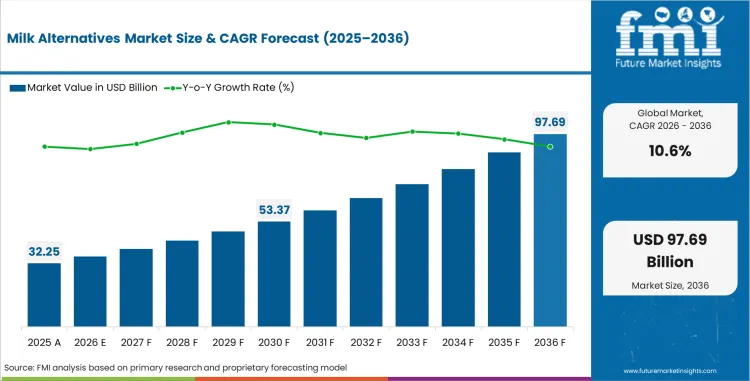
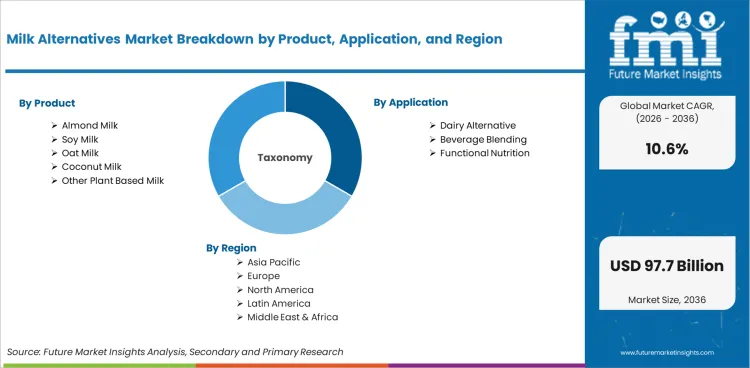
The milk alternatives market was valued at USD 32.3 billion in 2025. The market is set to reach USD 35.7 billion by 2026-end and grow at a CAGR of 10.6% between 2026-2036 to reach USD 97.7 billion by 2036. Almond Milk will dominate with a 40.0% share, while Dairy Alternative will lead with a 60.0% share.
Summary of the Milk Alternatives Market
- Demand and Growth Drivers
- Lactose intolerance prevalence affecting approximately 68% of the global adult population provides a structural demand base for dairy-free milk alternatives, particularly in East Asia, South Asia, and Africa where intolerance rates exceed 80%.
- Coffee shop and foodservice channel adoption of oat and almond milk as standard non-dairy options is normalizing plant-based milk consumption among mainstream consumers beyond dedicated vegan or lactose-intolerant demographics.
- Environmental sustainability positioning of plant-based milk as a lower carbon footprint alternative to dairy is resonating with climate-conscious consumers and influencing retailer category expansion decisions.
- Product and Segment View
- Almond Milk is likely to remain the leading product segment at 40% share, supported by established demand and procurement patterns.
- Dairy Alternative is likely to account for 60% of the application segment, reflecting buyer preference and usage patterns.
- Retail Consumers is likely to lead the end use segment at 70% share during the forecast period.
- Geography and Competitive Outlook
- China is likely to remain a key market at 14.31% CAGR, supported by strong demand fundamentals and expanding adoption.
- India is likely to sustain growth at 13.25% CAGR owing to rising spending and expanding infrastructure.
- Companies with broad product portfolios and multi-channel distribution are likely to gain traction during the forecast period.
- Analyst Opinion
- The milk alternatives market is becoming a more defined commercial category with clear segment leaders and established distribution patterns.
- Adoption is being driven by increasing awareness, increasing distribution and increasing influence of premiumization on purchasing behaviour.
- Diversification of product formats, with manufacturers broadening their offerings to tap new consumption occasions and buyer segments, also underpins demand.
- Companies with the ability to ensure consistent supply and deliver quality across key segments are likely to improve their position over the forecast period.
Key Takeaways, Market Size, and Forecast
- The milk alternatives market was valued at USD 32.3 billion in 2025.
- By 2036, the Milk Alternatives Market is expected to be worth USD 97.7 billion.
- From 2026 to 2036, the market is projected to expand at a CAGR of 10.6%.
- The market is projected to create an incremental opportunity of USD 62.02 billion between 2026 and 2036.
- In 2026, almond milk is expected to account for 40% of the product segment, driven by demand for almond-based dairy replacement beverages driven by lactose intolerance prevalence, vegan dietary adoption, and consumer preference for plant-based protein sources.
- China (14.31%) and India (13.25%) are two of the fastest growing markets in the world.
Milk Alternatives Market Definition
The milk alternatives market encompasses commercially traded plant-based beverages designed to replace conventional dairy milk. Product categories include almond milk, oat milk, soy milk, coconut milk, and rice milk in fortified and unfortified formulations sold through retail and foodservice channels.
Milk Alternatives Market Inclusions
Market scope covers all commercially traded milk alternative products categorized by product (almond milk, oat milk, soy milk, coconut milk, rice milk, others), application (dairy alternative, cooking and baking, coffee and tea, cereal and breakfast), end use (retail consumers, foodservice operators), distribution channel (offline retail, online retail), formulation (fortified beverages, unfortified beverages), packaging (carton packaging, bottle packaging, pouch packaging), and pricing tier (mid range, economy, premium). The revenue range spans from 2026 to 2036.
Milk Alternatives Market Exclusions
The scope does not include conventional dairy milk, dairy-based flavored milks, or plant-based yogurt, cheese, or ice cream products sold as separate categories.
Milk Alternatives Market Research Methodology
- Primary Research: FMI’s analysts interviewed plant-based beverage manufacturers, dairy alternative ingredients suppliers, retail category managers and heads of coffee chains procurement across key markets.
- Desk Research: Data synthesis from dairy and plant-based food associations, retail scanner databases and consumer dietary trend surveys.
- Market sizing and forecasting: Bottom-up aggregation by product type and distribution channels, with regional adoption curves adjusted for lactose intolerance prevalence, vegan population growth and dairy price dynamics.
- Data validation: Quarterly validation against retail scanner data, manufacturer shipment reports and trade flow statistics.
Why is the Milk Alternatives Market Growing?
- With approximately 68% of the world’s adult population being lactose intolerant, there is a structural demand for dairy-free milk substitutes, especially in East Asia.
- Driving the normalization of plant-based milk consumption among mainstream consumers beyond dedicated vegan or lactose-intolerant segments, with coffee shop and foodservice channel adoption of oat and almond milk as standard non-dairy options.
- Plant-based milk’s environmental sustainability positioning as a lower carbon footprint alternative to dairy is resonating with climate-conscious consumers and driving retailer category expansion decisions.
The milk alternatives market is experiencing a compound annual growth rate of 10.6% as the uptake of plant-based diets speeds up and dairy displacement gains traction across retail and foodservice channels. Almond milk commands a significant share of 40.0% in the product segment due to its mild flavor, versatility and existing consumer awareness. The formulation segment is dominated by fortified beverages (55.0%) where calcium, vitamin D and protein fortification solves nutritional parity issues with traditional dairy.
70.0% of end-user demand comes from retail consumers who purchase products through supermarkets, health food stores and online grocery platforms. 65.0% offline retail, with visibility from dedicated plant-based sections in major grocery chains. Lead in carton packaging 70.0% Shelf stable aseptic cartons allowing ambient temperature distribution and longer shelf life enabling mass retail logistics.
Market Segmentation Analysis
- 40% of the product segment is Almond Milk which is indicative of established demand patterns.
- Retail Consumers constitute 70% of the end use segment.
The milk alternatives market is segmented by product, application, end use, distribution channel, formulation, packaging, pricing tier.
Insights into the Almond Milk Product Segment
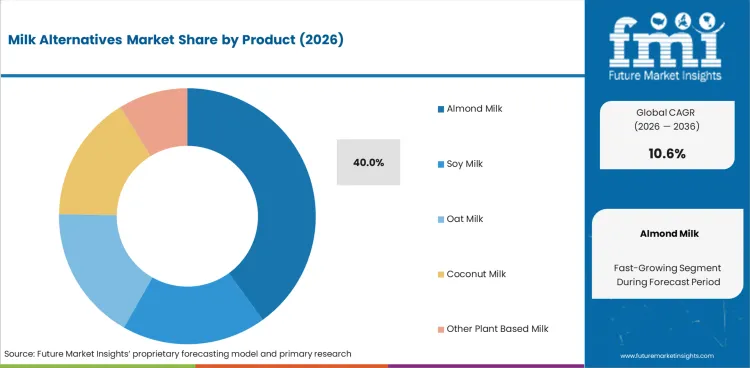
In 2026, almond milk is expected to account for 40.0% of the product segment. Unsweetened and original varieties serve as direct dairy replacements, while flavored variants target taste-driven consumers. Almond milk benefits from established brand recognition through Califia Farms, Silk, and Alpro. Oat milk is the fastest-growing alternative, gaining share through barista-grade formulations that froth and steam comparably to dairy.
Insights into the Offline Retail Distribution Channel
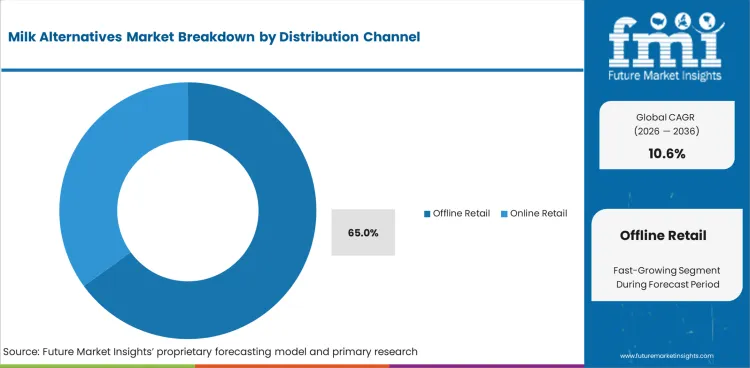
65.0% distribution through offline retail. Supermarkets are setting up plant-based dairy sections next to traditional dairy aisles, increasing consumer visibility and making comparison shopping easier. Health food stores are the premium/organic segment. Indirect distribution channels are growing as coffee chains and foodservice operators use barista-grade milk alternatives to create consumer trial, with the hope of transitioning to retail purchasing.
Milk Alternatives Market Drivers, Restraints, and Opportunities
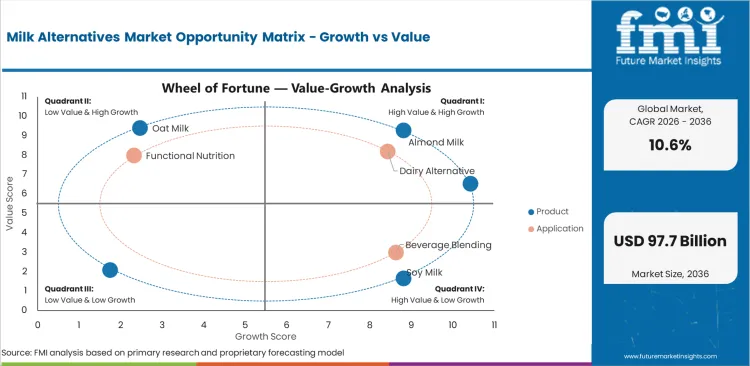
- Lactose Intolerance and Dairy-Free is creating structured demand across key segments.
- Taste Parity and Nutritional is limiting adoption at stable pricing in some segments.
The milk alternatives market is shaped by demand-side catalysts and supply-side constraints that vary by region and price tier.
Lactose Intolerance and Dairy-Free Dietary Needs
Demand is driven by lactose intolerance, which affects around two-thirds of the adult population worldwide. The regions with the highest rates of intolerance are East Asia, South Asia and Africa, which also represent the largest structural demand base for dairy-free milk alternatives.
Coffee Channel Adoption and Mainstream Normalization
The growth is an indication that oat and almond milk are becoming a standard non-dairy option in coffee chains across the world. Starbucks, Costa and independent specialty coffee shops making plant-based milk the default option are normalising consumption among mainstream consumers.
Taste Parity and Nutritional Perception Gaps
Gaps in perception (taste and nutrition) between plant-based and dairy milk inhibit adoption. The conversion rates from dairy to plant-based alternatives are lowered due to some consumers’ reduced protein content and altered taste profiles.
Environmental Sustainability and Carbon Footprint Positioning
Environmental messaging around plant-based milk as a lower greenhouse gas, water and land-use alternative to dairy is helping growth. More climate-aware consumers and institutional purchasing policies are increasingly selecting plant-based options based on sustainability metrics.
Analysis of Milk Alternatives Market By Key Countries
.webp "Top Country Growth Comparison Milk Alternatives Market Cagr (2026 2036)")
| Country | CAGR |
|---|---|
| China | 14.31% |
| India | 13.25% |
| Germany | 12.19% |
| Brazil | 11.13% |
| USA | 10.07% |
| UK | 9.01% |
| Japan | 7.95% |
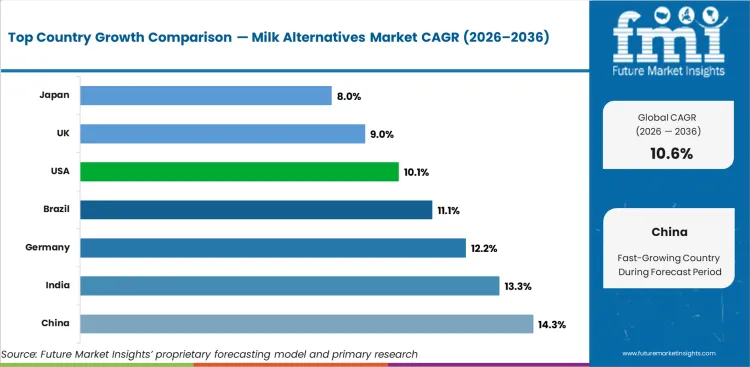
- China is leading the way at 14.31% CAGR, supported by the largest demand base and increasing adoption.
- India at 13.25% reflects strong demand on the back of rising spend and distribution expansion.
- Germany (12.19%) and Brazil (11.13%) continue to grow through expanding market development.
The global milk alternatives market is projected to expand at 10.6% per year from 2026 to 2036. The study covers more than 30 countries.
Sales Analysis of Milk Alternatives Market in China
China is ahead 14.31% through 2036. Very high rates of lactose intolerance (>90%) in adult population create structural demand base. Soy milk has a long cultural heritage while almond and oat milk are gaining momentum among urban consumers through coffee chain and e-commerce channels.
- The largest structural demand base in the world is found in populations with adult lactose intolerance rates over 90%
- Soy milk heritage provides cultural familiarity that facilitates wider acceptance of plant-based milks.
- Urban centers drive almond and oat milk adoption with coffee chain expansion and e-commerce distribution.
Demand Outlook for Milk Alternatives Market in India
India is expanding at 13.25% through 2036. High lactose intolerance prevalence, growing vegan and plant-based dietary interest, and urban health consciousness are creating rapid market development. Domestic brands and multinational entrants compete through online and modern retail channels.
- High lactose intolerance prevalence creates a large untapped consumer base for dairy alternatives.
- Growing vegan and plant-based dietary interest among urban millennials expands the addressable market.
- Online retail and modern grocery channels serve as primary distribution for branded plant-based milk.
Future Outlook for Milk Alternatives Market in the United States
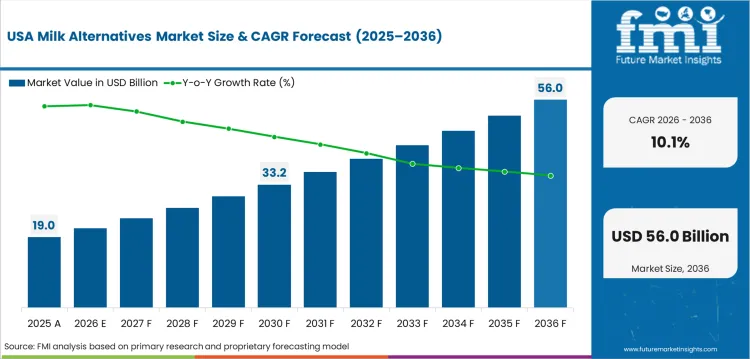
The USA is growing at 8.5% through 2036. The most developed milk alternatives market globally, with almond and oat milk firmly established in mainstream grocery. Califia Farms, Oatly, and Silk dominate retail shelf space while coffee chain adoption sustains trial conversion.
- Most developed milk alternatives market with almond and oat milk established in mainstream grocery.
- Califia Farms, Oatly, and Silk maintain leading positions through brand recognition and retail distribution.
- Coffee chain barista-grade adoption sustains consumer trial and converts to retail purchasing.
In-depth Analysis of Milk Alternatives Market in Germany
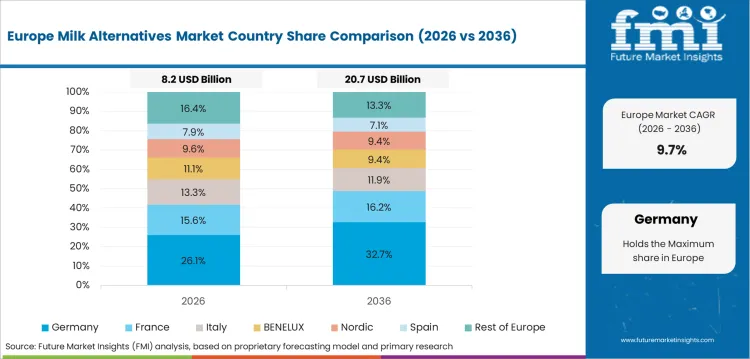
Germany is expanding at 7.8% through 2036. Strong sustainability consciousness and growing vegan population support demand. EU labeling regulations for plant-based dairy alternatives shape product positioning and marketing claims.
- Strong sustainability consciousness drives consumer preference for plant-based alternatives.
- Growing vegan population in urban areas creates expanding core demand beyond lactose-intolerant consumers.
- EU labeling regulations shape product naming and nutritional claim positioning.
Opportunity Analysis of Milk Alternatives Market in the United Kingdom
UK is set to grow 7.5% to 2036. The growth of oat milk in the coffee culture and the involvement in the Veganuary campaign have hastened its acceptance in the mainstream. Multiple UK retailers dedicate shelf space to plant-based dairy alternatives
- Plant-based milk has become mainstream, driven by the rise of oat milk in coffee culture.
- Veganuary and other plant-based campaigns drive consumer trial and awareness of the category.
- Plant-based dairy sections get premium shelf space from major retailers.
In-depth Analysis of Milk Alternatives Market in Japan
Japan at 7.2% through 2036. High levels of lactose intolerance and a well-established drinking culture of soy milk favor the adoption of plant-based milk. Almond and oat milk are capturing market share as newer alternatives to traditional soy products.
- High lactose intolerance = structural demand for dairy free alternatives.
- Current soy milk culture is a foundation for acceptance of broader plant-based milks.
- Almond and oat milk formats are gaining retail shelf space as new alternative categories.
Demand Outlook for Milk Alternatives Market in Brazil
Brazil is up 6.8% through 2036. The adoption of plant-based milk is driven by urban health awareness and modern retail distribution. Local availability of ingredients favors coconut and soy-based options.
- Increasing urban health consciousness boosts the demand for plant-based dairy alternatives.
- Local availability of ingredients for coconut and soy supports manufacturing of domestic products
- Modern retail expansion enhances accessibility and visibility of plant-based milk products.
Competitive Landscape and Strategic Positioning
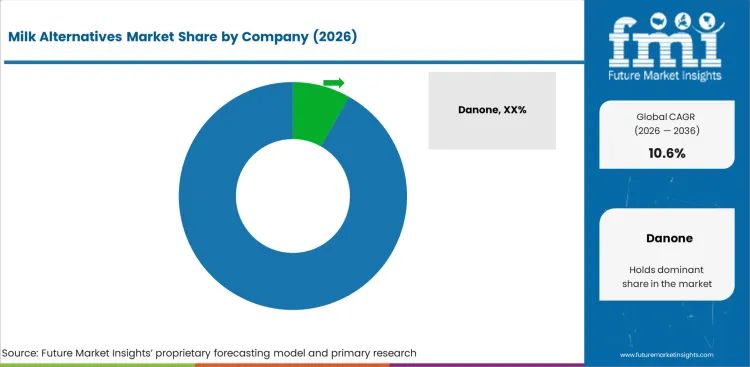
- Danone leads through its Alpro and Silk brands, with global manufacturing and retail distribution infrastructure serving both European and North American plant-based dairy markets.
- Califia Farms competes through premium almond and oat milk positioning, direct-to-consumer brand building, and coffee channel partnerships that create consumer trial and brand loyalty.
- Oatly and Pacific Foods represent category specialists with focused positioning in oat milk and multi-grain alternatives respectively, gaining share through barista-grade product innovation and sustainability messaging.
The competitive landscape is shaped by global leaders with integrated supply chains and regional specialists with niche capabilities.
Key Companies in the Milk Alternatives Market
Key global companies leading the milk alternatives market include:
- Danone (France), Califia Farms (USA), and Freedom Foods (Australia) lead through established plant-based milk brands, global manufacturing, and multi-channel retail distribution spanning grocery, health food, and coffee chain channels.
- MALK Organics (USA), New Barn Inc. (USA), and Pacific Foods (USA) serve the premium and organic segment through clean-label positioning, minimal ingredient formulations, and direct-to-consumer distribution.
- So Delicious (USA), Tofutti Brands Inc. (USA), and Valsoia SpA (Italy) compete through diverse plant-based product portfolios, regional market expertise, and established retail relationships.
Competitive Benchmarking: Milk Alternatives Market
| Company | Product Range | Barista Grade | Distribution Scale | Brand Strength |
|---|---|---|---|---|
| Danone | Very High | High | Global | Very Strong |
| Califia Farms | High | Very High | N. America | Strong |
| Freedom Foods | Medium | Medium | Australia, Asia | Moderate |
| MALK Organics | Low | Medium | N. America | Moderate |
| New Barn Inc. | Low | Medium | N. America | Moderate |
| Pacific Foods | Medium | Medium | N. America | Strong |
| So Delicious | High | Medium | N. America | Strong |
| Tofutti Brands | Medium | Low | N. America | Moderate |
| Valsoia SpA | Medium | Medium | Europe | Moderate |
Source: Future Market Insights competitive analysis, 2026.
Key Developments in Milk Alternatives Market
- In 2025, Califia Farms launched a protein-fortified almond milk product targeting consumers seeking higher protein content from plant-based milk alternatives.
- Califia Farms expanded its plant-based beverage portfolio with Califia Farms Complete, a protein-rich plant milk containing 8g of protein and nine essential nutrients, targeting consumers seeking nutritionally comparable alternatives to dairy milk.
Key Players in the Milk Alternatives Market
Major Global Players
- Danone
- Califia Farms
- Freedom Foods
- MALK Organics
- New Barn, Inc.
Emerging Players/Startups
- Pacific Foods
- So Delicious
- Tofutti Brands Inc.
- Valsoia SpA
- Oatly
- Minor Figures
Report Scope and Coverage
| Parameter | Details |
|---|---|
| Quantitative Units | USD 35.7 billion to USD 97.7 billion, at a CAGR of 10.6% |
| Market Definition | The milk alternatives market encompasses commercially traded plant-based beverages designed to replace conventional dairy milk. Product categories include almond milk, oat milk, soy milk, coconut milk, and rice milk in fortified and unfortified formulations sold through retail and foodservice channels. |
| Regions Covered | North America, Latin America, Europe, East Asia, South Asia and Pacific, Middle East and Africa |
| Countries Covered | China, India, Germany, Brazil, USA, UK, Japan, 30 plus countries |
| Key Companies Profiled | Danone, Califia Farms, Freedom Foods, MALK Organics, New Barn, Inc., Pacific Foods, So Delicious, Tofutti Brands Inc. |
| Forecast Period | 2026 to 2036 |
| Approach | Hybrid bottom-up and top-down methodology starting with verified transaction data, projecting adoption velocity across segments and regions. |
Market Segmentation Analysis
Milk Alternatives Market Segmented by Product:
- Almond Milk
- Unsweetened Almond Milk
- Plain Variants
- Clean Label Products
- Flavored Almond Milk
- Vanilla Flavored
- Chocolate Flavored
- Unsweetened Almond Milk
- Soy Milk
- Organic Soy Milk
- Non Genetically Modified Variants
- Clean Label Soy Milk
- Flavored Soy Milk
- Sweetened Variants
- Fortified Variants
- Organic Soy Milk
- Oat Milk
- Barista Oat Milk
- Coffee Applications
- Foaming Variants
- Standard Oat Milk
- Daily Consumption
- Fortified Variants
- Barista Oat Milk
- Coconut Milk
- Canned Coconut Milk
- Cooking Grade
- Thick Variants
- Beverage Coconut Milk
- Ready To Drink
- Light Variants
- Canned Coconut Milk
- Other Plant Based Milk
- Rice Milk
- Hypoallergenic Variants
- Low Fat Milk
- Cashew Milk
- Creamy Variants
- Premium Products
- Rice Milk
Milk Alternatives Market Segmented by Application:
- Dairy Alternative
- Household Consumption
- Daily Nutrition
- Lactose Free Diets
- Foodservice Use
- Cafe Applications
- Restaurant Use
- Household Consumption
- Beverage Blending
- Coffee And Tea
- Barista Applications
- Specialty Drinks
- Smoothies And Shakes
- Meal Replacement
- Fitness Drinks
- Coffee And Tea
- Functional Nutrition
- Digestive Health
- Gut Health Products
- Fiber Enriched Beverages
- Heart Health
- Cholesterol Management
- Low Fat Diets
- Digestive Health
Milk Alternatives Market Segmented by End Use:
- Retail Consumers
- Health Conscious Consumers
- Vegan Consumers
- Lactose Intolerant Consumers
- General Consumers
- Urban Households
- Convenience Focused Buyers
- Health Conscious Consumers
- Foodservice Industry
- Cafes And Coffee Chains
- Specialty Coffee Shops
- Quick Service Cafes
- Restaurants And Hotels
- Casual Dining
- Premium Dining
- Cafes And Coffee Chains
Milk Alternatives Market Segmented by Distribution Channel:
- Offline Retail
- Supermarkets And Hypermarkets
- Large Format Stores
- Discount Stores
- Convenience Stores
- Urban Stores
- Transit Locations
- Health And Organic Stores
- Specialty Stores
- Natural Product Stores
- Supermarkets And Hypermarkets
- Online Retail
- E Commerce Platforms
- Third Party Marketplaces
- Brand Owned Websites
- Subscription Services
- Recurring Delivery Models
- Bundle Offerings
- E Commerce Platforms
Milk Alternatives Market Segmented by Formulation:
- Fortified Beverages
- Vitamin Enriched
- Vitamin D Fortified
- Vitamin B Enriched
- Mineral Enriched
- Calcium Fortified
- Iron Enriched
- Vitamin Enriched
- Standard Beverages
- Unsweetened
- No Added Sugar
- Clean Label Variants
- Sweetened
- Flavored Sweetened
- Natural Sweeteners
- Unsweetened
Milk Alternatives Market Segmented by Packaging:
- Carton Packaging
- Aseptic Cartons
- Long Shelf Life Packs
- Tetra Pack Formats
- Refrigerated Cartons
- Fresh Packs
- Short Shelf Life Variants
- Aseptic Cartons
- Bottles
- Plastic Bottles
- Single Serve Bottles
- Multi Serve Bottles
- Glass Bottles
- Premium Packaging
- Sustainable Packaging
- Plastic Bottles
Milk Alternatives Market Segmented by Pricing Tier:
- Mid Range
- Branded Products
- Standard Quality Offerings
- Branded Products
- Economy
- Private Label Products
- Mass Market Variants
- Private Label Products
- Premium
- Organic And Clean Label
- Certified Organic
- Non Genetically Modified Products
- Organic And Clean Label
Milk Alternatives Market by Region:
- North America
- USA
- Canada
- Mexico
- Latin America
- Brazil
- Chile
- Rest of Latin America
- Western Europe
- Germany
- UK
- Italy
- Spain
- France
- Nordic
- BENELUX
- Rest of Western Europe
- Eastern Europe
- Russia
- Poland
- Hungary
- Balkan & Baltic
- Rest of Eastern Europe
- East Asia
- China
- Japan
- South Korea
- South Asia and Pacific
- India
- ASEAN
- Australia & New Zealand
- Rest of South Asia and Pacific
- Middle East & Africa
- Kingdom of Saudi Arabia
- Other GCC Countries
- Turkiye
- South Africa
- Other African Union
- Rest of Middle East & Africa
Research Sources and Bibliography
- 1. Food and Agriculture Organization. (2025). FAO Global Dairy and Plant-Based Alternatives Report. FAO.
- 2. European Commission. (2024). EU Regulation on Plant-Based Food Labeling. EC.
- 3. USA Department of Agriculture. (2025). USDA Dietary Guidelines: Plant-Based Beverage Nutritional Profiles. USDA.
- 4. International Dairy Federation. (2025). IDF World Dairy Situation: Alternative Beverage Trends. IDF.
- 5. World Health Organization. (2024). WHO Nutritional Guidelines: Lactose Intolerance Prevalence. WHO.
This bibliography is provided for reader reference.
This Report Answers
- Estimating the market size and revenue generation from 2026 to 2036.
- Segmenting by product, application, end use, distribution channel, formulation, packaging, and pricing tier.
- Providing regional insights across more than 30 markets.
- Analyzing coffee channel adoption and mainstream normalization dynamics.
- Assessing the competitive landscape across almond, oat, soy, and coconut categories.
- Identifying investment opportunities in barista-grade and protein-fortified formulations.
- Tracking sustainability positioning and labeling regulation trends.
- Delivering data in PDF and Excel formats.
Frequently Asked Questions
How big is the milk alternatives market in 2026?
The global milk alternatives market is estimated to be valued at USD 35.7 billion in 2026.
What will be the size of milk alternatives market in 2036?
The market size for the milk alternatives market is projected to reach USD 97.7 billion by 2036.
How much will be the milk alternatives market growth between 2026 and 2036?
The milk alternatives market is expected to grow at a 10.6% CAGR between 2026 and 2036.
What are the key product types in the milk alternatives market?
The key product types in milk alternatives market are almond milk, soy milk, oat milk, coconut milk and other plant based milk.
Which application segment is expected to contribute significant share in the milk alternatives market in 2026?
In terms of application, dairy alternative segment is expected to command 60.0% share in the milk alternatives market in 2026.
Preview the report firsthand - request a free sample
Get SampleGet the brochure for pricing and purchase details.
Get PDFTable of Content
- Executive Summary
- Global Market Outlook
- Demand-side Trends
- Supply-side Trends
- Technology Roadmap Analysis
- Analysis and Recommendations
- Market Overview
- Market Coverage / Taxonomy
- Market Definition / Scope / Limitations
- Research Methodology
- Chapter Orientation
- Analytical Lens and Working Hypotheses
- Market Structure, Signals, and Trend Drivers
- Benchmarking and Cross-market Comparability
- Market Sizing, Forecasting, and Opportunity Mapping
- Research Design and Evidence Framework
- Desk Research Programme (Secondary Evidence)
- Company Annual and Sustainability Reports
- Peer-reviewed Journals and Academic Literature
- Corporate Websites, Product Literature, and Technical Notes
- Earnings Decks and Investor Briefings
- Statutory Filings and Regulatory Disclosures
- Technical White Papers and Standards Notes
- Trade Journals, Industry Magazines, and Analyst Briefs
- Conference Proceedings, Webinars, and Seminar Materials
- Government Statistics Portals and Public Data Releases
- Press Releases and Reputable Media Coverage
- Specialist Newsletters and Curated Briefings
- Sector Databases and Reference Repositories
- FMI Internal Proprietary Databases and Historical Market Datasets
- Subscription Datasets and Paid Sources
- Social Channels, Communities, and Digital Listening Inputs
- Additional Desk Sources
- Expert Input and Fieldwork (Primary Evidence)
- Primary Modes
- Qualitative Interviews and Expert Elicitation
- Quantitative Surveys and Structured Data Capture
- Blended Approach
- Why Primary Evidence is Used
- Field Techniques
- Interviews
- Surveys
- Focus Groups
- Observational and In-context Research
- Social and Community Interactions
- Stakeholder Universe Engaged
- C-suite Leaders
- Board Members
- Presidents and Vice Presidents
- R&D and Innovation Heads
- Technical Specialists
- Domain Subject-matter Experts
- Scientists
- Physicians and Other Healthcare Professionals
- Governance, Ethics, and Data Stewardship
- Research Ethics
- Data Integrity and Handling
- Primary Modes
- Tooling, Models, and Reference Databases
- Desk Research Programme (Secondary Evidence)
- Data Engineering and Model Build
- Data Acquisition and Ingestion
- Cleaning, Normalisation, and Verification
- Synthesis, Triangulation, and Analysis
- Quality Assurance and Audit Trail
- Market Background
- Market Dynamics
- Drivers
- Restraints
- Opportunity
- Trends
- Scenario Forecast
- Demand in Optimistic Scenario
- Demand in Likely Scenario
- Demand in Conservative Scenario
- Opportunity Map Analysis
- Product Life Cycle Analysis
- Supply Chain Analysis
- Investment Feasibility Matrix
- Value Chain Analysis
- PESTLE and Porter’s Analysis
- Regulatory Landscape
- Regional Parent Market Outlook
- Production and Consumption Statistics
- Import and Export Statistics
- Market Dynamics
- Global Market Analysis 2021 to 2025 and Forecast, 2026 to 2036
- Historical Market Size Value (USD Million) Analysis, 2021 to 2025
- Current and Future Market Size Value (USD Million) Projections, 2026 to 2036
- Y-o-Y Growth Trend Analysis
- Absolute $ Opportunity Analysis
- Global Market Pricing Analysis 2021 to 2025 and Forecast 2026 to 2036
- Global Market Analysis 2021 to 2025 and Forecast 2026 to 2036, By Product
- Introduction / Key Findings
- Historical Market Size Value (USD Million) Analysis By Product , 2021 to 2025
- Current and Future Market Size Value (USD Million) Analysis and Forecast By Product , 2026 to 2036
- Almond Milk
- Unsweetened Almond Milk
- Plain Variants
- Clean Label Products
- Flavored Almond Milk
- Vanilla Flavored
- Chocolate Flavored
- Soy Milk
- Organic Soy Milk
- Non Genetically Modified Variants
- Clean Label Soy Milk
- Flavored Soy Milk
- Sweetened Variants
- Oat Milk
- Barista Oat Milk
- Coffee Applications
- Foaming Variants
- Standard Oat Milk
- Daily Consumption
- Coconut Milk
- Canned Coconut Milk
- Cooking Grade
- Thick Variants
- Beverage Coconut Milk
- Ready To Drink
- Other Plant Based Milk
- Rice Milk
- Hypoallergenic Variants
- Low Fat Milk
- Cashew Milk
- Creamy Variants
- Almond Milk
- Y-o-Y Growth Trend Analysis By Product , 2021 to 2025
- Absolute $ Opportunity Analysis By Product , 2026 to 2036
- Global Market Analysis 2021 to 2025 and Forecast 2026 to 2036, By Application
- Introduction / Key Findings
- Historical Market Size Value (USD Million) Analysis By Application, 2021 to 2025
- Current and Future Market Size Value (USD Million) Analysis and Forecast By Application, 2026 to 2036
- Dairy Alternative
- Household Consumption
- Daily Nutrition
- Lactose Free Diets
- Foodservice Use
- Cafe Applications
- Restaurant Use
- Beverage Blending
- Coffee And Tea
- Barista Applications
- Specialty Drinks
- Smoothies And Shakes
- Meal Replacement
- Functional Nutrition
- Digestive Health
- Gut Health Products
- Fiber Enriched Beverages
- Heart Health
- Cholesterol Management
- Dairy Alternative
- Y-o-Y Growth Trend Analysis By Application, 2021 to 2025
- Absolute $ Opportunity Analysis By Application, 2026 to 2036
- Global Market Analysis 2021 to 2025 and Forecast 2026 to 2036, By End Use
- Introduction / Key Findings
- Historical Market Size Value (USD Million) Analysis By End Use, 2021 to 2025
- Current and Future Market Size Value (USD Million) Analysis and Forecast By End Use, 2026 to 2036
- Retail Consumers
- Health Conscious Consumers
- Vegan Consumers
- Lactose Intolerant Consumers
- General Consumers
- Urban Households
- Convenience Focused Buyers
- Foodservice Industry
- Cafes And Coffee Chains
- Specialty Coffee Shops
- Quick Service Cafes
- Restaurants And Hotels
- Casual Dining
- Retail Consumers
- Y-o-Y Growth Trend Analysis By End Use, 2021 to 2025
- Absolute $ Opportunity Analysis By End Use, 2026 to 2036
- Global Market Analysis 2021 to 2025 and Forecast 2026 to 2036, By Distribution Channel
- Introduction / Key Findings
- Historical Market Size Value (USD Million) Analysis By Distribution Channel, 2021 to 2025
- Current and Future Market Size Value (USD Million) Analysis and Forecast By Distribution Channel, 2026 to 2036
- Offline Retail
- Supermarkets And Hypermarkets
- Large Format Stores
- Discount Stores
- Convenience Stores
- Urban Stores
- Transit Locations
- Health And Organic Stores
- Specialty Stores
- Natural Product Stores
- Online Retail
- E Commerce Platforms
- Third Party Marketplaces
- Brand Owned Websites
- Subscription Services
- Recurring Delivery Models
- Offline Retail
- Y-o-Y Growth Trend Analysis By Distribution Channel, 2021 to 2025
- Absolute $ Opportunity Analysis By Distribution Channel, 2026 to 2036
- Global Market Analysis 2021 to 2025 and Forecast 2026 to 2036, By Formulation
- Introduction / Key Findings
- Historical Market Size Value (USD Million) Analysis By Formulation, 2021 to 2025
- Current and Future Market Size Value (USD Million) Analysis and Forecast By Formulation, 2026 to 2036
- Fortified Beverages
- Vitamin Enriched
- Vitamin D Fortified
- Vitamin B Enriched
- Mineral Enriched
- Calcium Fortified
- Iron Enriched
- Standard Beverages
- Unsweetened
- No Added Sugar
- Clean Label Variants
- Sweetened
- Flavored Sweetened
- Fortified Beverages
- Y-o-Y Growth Trend Analysis By Formulation, 2021 to 2025
- Absolute $ Opportunity Analysis By Formulation, 2026 to 2036
- Global Market Analysis 2021 to 2025 and Forecast 2026 to 2036, By Packaging
- Introduction / Key Findings
- Historical Market Size Value (USD Million) Analysis By Packaging, 2021 to 2025
- Current and Future Market Size Value (USD Million) Analysis and Forecast By Packaging, 2026 to 2036
- Carton Packaging
- Aseptic Cartons
- Long Shelf Life Packs
- Tetra Pack Formats
- Refrigerated Cartons
- Fresh Packs
- Short Shelf Life Variants
- Bottles
- Plastic Bottles
- Single Serve Bottles
- Multi Serve Bottles
- Glass Bottles
- Premium Packaging
- Carton Packaging
- Y-o-Y Growth Trend Analysis By Packaging, 2021 to 2025
- Absolute $ Opportunity Analysis By Packaging, 2026 to 2036
- Global Market Analysis 2021 to 2025 and Forecast 2026 to 2036, By Pricing Tier
- Introduction / Key Findings
- Historical Market Size Value (USD Million) Analysis By Pricing Tier, 2021 to 2025
- Current and Future Market Size Value (USD Million) Analysis and Forecast By Pricing Tier, 2026 to 2036
- Mid Range
- Branded Products
- Standard Quality Offerings
- Economy
- Private Label Products
- Mass Market Variants
- Premium
- Organic And Clean Label
- Certified Organic
- Non Genetically Modified Products
- Mid Range
- Y-o-Y Growth Trend Analysis By Pricing Tier, 2021 to 2025
- Absolute $ Opportunity Analysis By Pricing Tier, 2026 to 2036
- Global Market Analysis 2021 to 2025 and Forecast 2026 to 2036, By Region
- Introduction
- Historical Market Size Value (USD Million) Analysis By Region, 2021 to 2025
- Current Market Size Value (USD Million) Analysis and Forecast By Region, 2026 to 2036
- North America
- Latin America
- Western Europe
- Eastern Europe
- East Asia
- South Asia and Pacific
- Middle East & Africa
- Market Attractiveness Analysis By Region
- North America Market Analysis 2021 to 2025 and Forecast 2026 to 2036, By Country
- Historical Market Size Value (USD Million) Trend Analysis By Market Taxonomy, 2021 to 2025
- Market Size Value (USD Million) Forecast By Market Taxonomy, 2026 to 2036
- By Country
- USA
- Canada
- Mexico
- By Product
- By Application
- By End Use
- By Distribution Channel
- By Formulation
- By Packaging
- By Pricing Tier
- By Country
- Market Attractiveness Analysis
- By Country
- By Product
- By Application
- By End Use
- By Distribution Channel
- By Formulation
- By Packaging
- By Pricing Tier
- Key Takeaways
- Latin America Market Analysis 2021 to 2025 and Forecast 2026 to 2036, By Country
- Historical Market Size Value (USD Million) Trend Analysis By Market Taxonomy, 2021 to 2025
- Market Size Value (USD Million) Forecast By Market Taxonomy, 2026 to 2036
- By Country
- Brazil
- Chile
- Rest of Latin America
- By Product
- By Application
- By End Use
- By Distribution Channel
- By Formulation
- By Packaging
- By Pricing Tier
- By Country
- Market Attractiveness Analysis
- By Country
- By Product
- By Application
- By End Use
- By Distribution Channel
- By Formulation
- By Packaging
- By Pricing Tier
- Key Takeaways
- Western Europe Market Analysis 2021 to 2025 and Forecast 2026 to 2036, By Country
- Historical Market Size Value (USD Million) Trend Analysis By Market Taxonomy, 2021 to 2025
- Market Size Value (USD Million) Forecast By Market Taxonomy, 2026 to 2036
- By Country
- Germany
- UK
- Italy
- Spain
- France
- Nordic
- BENELUX
- Rest of Western Europe
- By Product
- By Application
- By End Use
- By Distribution Channel
- By Formulation
- By Packaging
- By Pricing Tier
- By Country
- Market Attractiveness Analysis
- By Country
- By Product
- By Application
- By End Use
- By Distribution Channel
- By Formulation
- By Packaging
- By Pricing Tier
- Key Takeaways
- Eastern Europe Market Analysis 2021 to 2025 and Forecast 2026 to 2036, By Country
- Historical Market Size Value (USD Million) Trend Analysis By Market Taxonomy, 2021 to 2025
- Market Size Value (USD Million) Forecast By Market Taxonomy, 2026 to 2036
- By Country
- Russia
- Poland
- Hungary
- Balkan & Baltic
- Rest of Eastern Europe
- By Product
- By Application
- By End Use
- By Distribution Channel
- By Formulation
- By Packaging
- By Pricing Tier
- By Country
- Market Attractiveness Analysis
- By Country
- By Product
- By Application
- By End Use
- By Distribution Channel
- By Formulation
- By Packaging
- By Pricing Tier
- Key Takeaways
- East Asia Market Analysis 2021 to 2025 and Forecast 2026 to 2036, By Country
- Historical Market Size Value (USD Million) Trend Analysis By Market Taxonomy, 2021 to 2025
- Market Size Value (USD Million) Forecast By Market Taxonomy, 2026 to 2036
- By Country
- China
- Japan
- South Korea
- By Product
- By Application
- By End Use
- By Distribution Channel
- By Formulation
- By Packaging
- By Pricing Tier
- By Country
- Market Attractiveness Analysis
- By Country
- By Product
- By Application
- By End Use
- By Distribution Channel
- By Formulation
- By Packaging
- By Pricing Tier
- Key Takeaways
- South Asia and Pacific Market Analysis 2021 to 2025 and Forecast 2026 to 2036, By Country
- Historical Market Size Value (USD Million) Trend Analysis By Market Taxonomy, 2021 to 2025
- Market Size Value (USD Million) Forecast By Market Taxonomy, 2026 to 2036
- By Country
- India
- ASEAN
- Australia & New Zealand
- Rest of South Asia and Pacific
- By Product
- By Application
- By End Use
- By Distribution Channel
- By Formulation
- By Packaging
- By Pricing Tier
- By Country
- Market Attractiveness Analysis
- By Country
- By Product
- By Application
- By End Use
- By Distribution Channel
- By Formulation
- By Packaging
- By Pricing Tier
- Key Takeaways
- Middle East & Africa Market Analysis 2021 to 2025 and Forecast 2026 to 2036, By Country
- Historical Market Size Value (USD Million) Trend Analysis By Market Taxonomy, 2021 to 2025
- Market Size Value (USD Million) Forecast By Market Taxonomy, 2026 to 2036
- By Country
- Kingdom of Saudi Arabia
- Other GCC Countries
- Turkiye
- South Africa
- Other African Union
- Rest of Middle East & Africa
- By Product
- By Application
- By End Use
- By Distribution Channel
- By Formulation
- By Packaging
- By Pricing Tier
- By Country
- Market Attractiveness Analysis
- By Country
- By Product
- By Application
- By End Use
- By Distribution Channel
- By Formulation
- By Packaging
- By Pricing Tier
- Key Takeaways
- Key Countries Market Analysis
- USA
- Pricing Analysis
- Market Share Analysis, 2025
- By Product
- By Application
- By End Use
- By Distribution Channel
- By Formulation
- By Packaging
- By Pricing Tier
- Canada
- Pricing Analysis
- Market Share Analysis, 2025
- By Product
- By Application
- By End Use
- By Distribution Channel
- By Formulation
- By Packaging
- By Pricing Tier
- Mexico
- Pricing Analysis
- Market Share Analysis, 2025
- By Product
- By Application
- By End Use
- By Distribution Channel
- By Formulation
- By Packaging
- By Pricing Tier
- Brazil
- Pricing Analysis
- Market Share Analysis, 2025
- By Product
- By Application
- By End Use
- By Distribution Channel
- By Formulation
- By Packaging
- By Pricing Tier
- Chile
- Pricing Analysis
- Market Share Analysis, 2025
- By Product
- By Application
- By End Use
- By Distribution Channel
- By Formulation
- By Packaging
- By Pricing Tier
- Germany
- Pricing Analysis
- Market Share Analysis, 2025
- By Product
- By Application
- By End Use
- By Distribution Channel
- By Formulation
- By Packaging
- By Pricing Tier
- UK
- Pricing Analysis
- Market Share Analysis, 2025
- By Product
- By Application
- By End Use
- By Distribution Channel
- By Formulation
- By Packaging
- By Pricing Tier
- Italy
- Pricing Analysis
- Market Share Analysis, 2025
- By Product
- By Application
- By End Use
- By Distribution Channel
- By Formulation
- By Packaging
- By Pricing Tier
- Spain
- Pricing Analysis
- Market Share Analysis, 2025
- By Product
- By Application
- By End Use
- By Distribution Channel
- By Formulation
- By Packaging
- By Pricing Tier
- France
- Pricing Analysis
- Market Share Analysis, 2025
- By Product
- By Application
- By End Use
- By Distribution Channel
- By Formulation
- By Packaging
- By Pricing Tier
- India
- Pricing Analysis
- Market Share Analysis, 2025
- By Product
- By Application
- By End Use
- By Distribution Channel
- By Formulation
- By Packaging
- By Pricing Tier
- ASEAN
- Pricing Analysis
- Market Share Analysis, 2025
- By Product
- By Application
- By End Use
- By Distribution Channel
- By Formulation
- By Packaging
- By Pricing Tier
- Australia & New Zealand
- Pricing Analysis
- Market Share Analysis, 2025
- By Product
- By Application
- By End Use
- By Distribution Channel
- By Formulation
- By Packaging
- By Pricing Tier
- China
- Pricing Analysis
- Market Share Analysis, 2025
- By Product
- By Application
- By End Use
- By Distribution Channel
- By Formulation
- By Packaging
- By Pricing Tier
- Japan
- Pricing Analysis
- Market Share Analysis, 2025
- By Product
- By Application
- By End Use
- By Distribution Channel
- By Formulation
- By Packaging
- By Pricing Tier
- South Korea
- Pricing Analysis
- Market Share Analysis, 2025
- By Product
- By Application
- By End Use
- By Distribution Channel
- By Formulation
- By Packaging
- By Pricing Tier
- Russia
- Pricing Analysis
- Market Share Analysis, 2025
- By Product
- By Application
- By End Use
- By Distribution Channel
- By Formulation
- By Packaging
- By Pricing Tier
- Poland
- Pricing Analysis
- Market Share Analysis, 2025
- By Product
- By Application
- By End Use
- By Distribution Channel
- By Formulation
- By Packaging
- By Pricing Tier
- Hungary
- Pricing Analysis
- Market Share Analysis, 2025
- By Product
- By Application
- By End Use
- By Distribution Channel
- By Formulation
- By Packaging
- By Pricing Tier
- Kingdom of Saudi Arabia
- Pricing Analysis
- Market Share Analysis, 2025
- By Product
- By Application
- By End Use
- By Distribution Channel
- By Formulation
- By Packaging
- By Pricing Tier
- Turkiye
- Pricing Analysis
- Market Share Analysis, 2025
- By Product
- By Application
- By End Use
- By Distribution Channel
- By Formulation
- By Packaging
- By Pricing Tier
- South Africa
- Pricing Analysis
- Market Share Analysis, 2025
- By Product
- By Application
- By End Use
- By Distribution Channel
- By Formulation
- By Packaging
- By Pricing Tier
- USA
- Market Structure Analysis
- Competition Dashboard
- Competition Benchmarking
- Market Share Analysis of Top Players
- By Regional
- By Product
- By Application
- By End Use
- By Distribution Channel
- By Formulation
- By Packaging
- By Pricing Tier
- Competition Analysis
- Competition Deep Dive
- Danone
- Overview
- Product Portfolio
- Profitability by Market Segments (Product/Age /Sales Channel/Region)
- Sales Footprint
- Strategy Overview
- Marketing Strategy
- Product Strategy
- Channel Strategy
- Califia Farms
- Freedom Foods
- MALK Organics
- New Barn, Inc.
- Pacific Foods
- So Delicious
- Tofutti Brands Inc.
- Valsoia SpA
- Danone
- Competition Deep Dive
- Assumptions & Acronyms Used


