

- Industry Size (2026)
- USD 1.3 Bn
- Forecast (2036)
- USD 2.4 Bn
- CAGR (2026 to 2036)
- 6.3%
Dairy Mineral Premixes Market Size, Market Forecast and Outlook By FMI
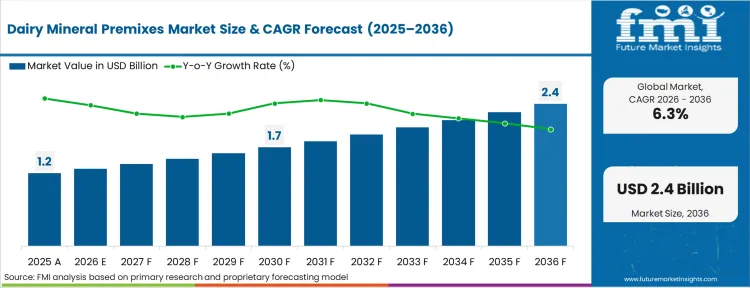
The dairy mineral premixes market was valued at USD 1.2 billion in 2025. Sales is estimated to reach USD 1.3 billion in 2026 at a CAGR of 6.3% during the forecast period. Sustained investment propels the valuation to USD 2.4 billion through 2036 as dairy processors transition from batch-level individual mineral dosing to standardized premixes to eliminate blending inconsistencies and reduce quality assurance failure rates.
Buyers in this sector are shifting away from price-per-kilogram purchasing frameworks, moving toward qualifying their nutritional blends based on dissolution kinetics and specific bioavailability metrics. This operational shift forces dairy formulators to evaluate ingredient interactions, such as calcium and iron precipitating in liquid suspensions, before approving a supplier. Processors who continue to source raw minerals independently face mounting internal costs for homogenization testing, effectively erasing any raw material cost advantage. The real value generated by premix suppliers lies in the liability transfer, where the vendor assumes the regulatory risk of over- or under-fortification prior to the processor receiving the bulk delivery.
Summary of Dairy Mineral Premixes Market
- Dairy Mineral Premixes Market Definition:
- This category comprises chemically stabilized, multi-component mineral formulations engineered to withstand dairy processing conditions without degrading the protein matrix. It structurally isolates the complex blending and bioavailability optimization functions from the dairy processor, moving them upstream to specialized ingredient vendors.
- Demand Drivers in the Market:
- Tightening infant formula regulations globally require nutritional formulators to achieve extremely narrow analytical tolerances for trace minerals.
- Retail margin compression in fluid milk forces brand category managers to introduce value-added functional variants to justify premium shelf pricing.
- Variability in regional raw milk quality obligates quality assurance directors to implement standardized fortification baselines across distributed production networks.
- Key Segments Analyzed in the FMI Report:
- Dry/Powder: Dry/Powder is estimated to account for 65.4% share in 2026, as this format bypasses the inherent solubility limits and shelf-life degradation common to liquid mineral suspensions, allowing processors longer inventory cycles.
- Milk: Milk is projected to hold 42.1% share in 2026, driven by continuous institutional procurement requirements and national nutritional mandates targeting early childhood development.
- B2B: B2B is poised to garner 78.5% share in 2026, because functional mineral stabilization requires highly controlled industrial homogenization before the final product can reach retail channels.
- India: 8.2% compound growth, as the formalization of cooperative dairy networks necessitates standardized nutrient profiles across highly variable raw material inputs.
- Analyst Opinion at FMI:
- Nandini Roy Choudhury, Principal Analyst for Food and Beverage, opines, "The widespread assumption is that dairy processors evaluate mineral premixes based on the raw cost per kilogram of the active ingredients. However, procurement directors actually buy these blends to purchase regulatory certainty. A processor will gladly pay a 30% premium on the raw material cost to a vendor who guarantees the iron won't oxidize the milk fats and the calcium won't precipitate out during UHT pasteurization, because a single batch failure or product recall obliterates years of margin savings."
- Strategic Implications / Executive Takeaways
- Formulation engineers must integrate custom solubility testing protocols early in the vendor qualification phase to prevent downstream thermal processing bottlenecks.
- Procurement directors at mid-tier dairies should consolidate their individual mineral sourcing contracts into unified premix agreements to reduce internal blending liability.
- Toll blending operators face severe capital constraints that require them to invest in dedicated, allergen-free blending lines to secure infant nutrition contracts.
- Methodology:
- Primary Research: Procurement directors at tier-1 dairy processing firms, nutritional formulators, and supply chain managers overseeing functional ingredient sourcing.
- Desk Research: Technical specification archives, nutritional compliance registries, formulation patent filings, and quality assurance qualification protocols utilized by global dairy brands.
- Market-Sizing and Forecasting: The baseline anchors to annual capital expenditure allocated to functional dairy product development and the volume throughput of fortified fluid milk and infant nutrition lines.
- Data Validation and Update Cycle: Forecasts are cross-validated against global dairy consumption volumes and the capacity expansion announcements of specialized toll blenders.
Growth becomes self-reinforcing once a processor transitions from generic fortification claims to targeted functional claims, such as specific bone health or immunity matrices. This transition, triggered primarily by brand-level product development teams, requires multi-mineral matrices that are physically impossible to stabilize using rudimentary internal blending equipment. Once a production facility validates a specialized customized ingredient matrix, the operational friction of reverse-engineering that exact solubility profile creates immediate vendor lock-in.
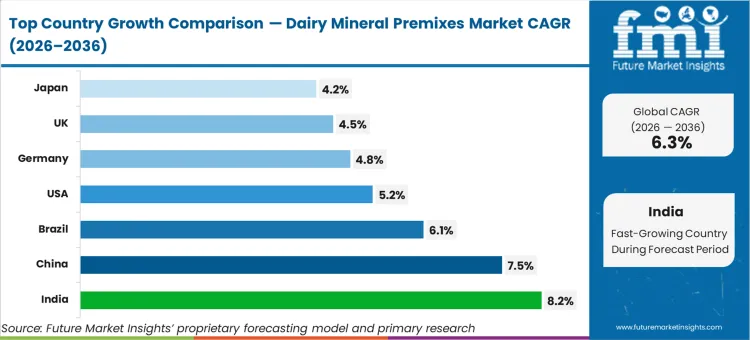
India is expected to track at a CAGR of 8.2%, followed by China expanding at 7.5%, and Brazil registering a 6.1% rate. The United States is estimated to record 5.2%, while Germany and the United Kingdom are likely to garner 4.8% and 4.5%, respectively. Japan is poised to advance at 4.2%. This divergence across the growth range reflects the underlying composition of raw milk supply chains; regions relying heavily on highly variable cooperative inputs require intensive fortification standardization, whereas markets with vertically integrated, tightly controlled raw dairy inputs utilize premixes selectively for premium functional product tiers.
Dairy Mineral Premixes Market Key Takeaways
| Metric | Details |
|---|---|
| Industry Size (2026) | USD 1.3 billion |
| Industry Value (2036) | USD 2.4 billion |
| CAGR (2026-2036) | 6.3% |
Source: Future Market Insights (FMI) analysis, based on proprietary forecasting model and primary research
Dairy Mineral Premixes Market Definition
The dairy mineral premixes encompasses specifically engineered blends of essential macro and micro-minerals formulated explicitly for integration into dairy matrices. Functionally, this category is distinct from general dietary supplements or single-mineral additives, as these blends are chemically stabilized to prevent protein denaturation, flavor degradation, or precipitation when introduced to complex fat and whey protein environments during thermal processing or fermentation.
Dairy Mineral Premixes Market Inclusions
The scope captures custom and standard dry powders and liquid mineral suspensions designed for dairy fortification, incorporating calcium, iron, zinc, magnesium, and trace elements. It includes formulations utilizing microencapsulation, chelation, and micronization technologies to enhance solubility. The analysis also incorporates the functional fortifiers utilized as carrier matrices within the premix, provided they are engineered specifically for end-use in milks, yogurts, cheeses, and dairy-based infant nutrition.
Dairy Mineral Premixes Market Exclusions
Standalone vitamin blends without mineral components, raw unblended bulk minerals, and premixes engineered exclusively for plant-based dairy alternatives are explicitly excluded. Single-ingredient bulk commodity minerals are excluded because they do not participate in the specialized blending and stabilization value chain that defines the premix industry. Formulations for non-dairy functional beverages are also removed, as their solubility and thermal stability requirements fundamentally differ from those dictated by dairy protein chemistry.
Dairy Mineral Premixes Market Research Methodology
- Primary Research: Procurement directors at tier-1 dairy processing firms, nutritional formulators, and supply chain managers overseeing functional ingredient sourcing.
- Desk Research: Technical specification archives, nutritional compliance registries, formulation patent filings, and quality assurance qualification protocols utilized by global dairy brands.
- Market-Sizing and Forecasting: The baseline anchors to annual capital expenditure allocated to functional dairy product development and the volume throughput of fortified fluid milk and infant nutrition lines.
- Data Validation and Update Cycle: Forecasts are cross-validated against global dairy consumption volumes and the capacity expansion announcements of specialized toll blenders.
Segmental Analysis
Dairy Mineral Premixes Market Analysis by Form
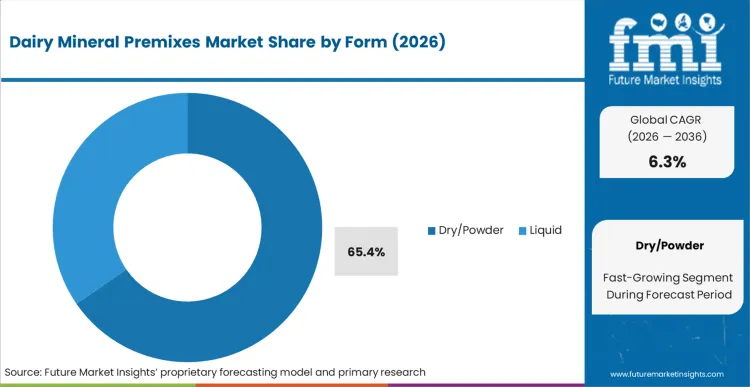
What liquid suspensions fail to deliver in terms of long-term shelf stability and freight density is precisely what forces modern dairy facilities toward powdered alternatives. Dry/powder formats hold a commanding 65.4% share, reflecting an operational reality: moisture is the enemy of complex mineral matrices prior to final homogenization. According to FMI's estimates, facility managers explicitly specify dry blends to avoid the continuous agitation required to keep liquid premixes from settling in holding tanks. By utilizing powdered formats, procurement teams can order larger bulk volumes, extending their inventory cycles and insulating the plant against short-term supply chain shocks. The powder format allows formulation engineers to utilize microencapsulated dairy ingredients that only release under specific thermal conditions inside the pasteurizer. Facilities that attempt to integrate complex liquid suspensions often encounter rapid oxidation of trace minerals, resulting in metallic off-flavors that ruin entire production runs.
- Procurement trigger: Granular stability extends the viable inventory shelf life for the facility, removing the need for just-in-time delivery schedules. Supply chain managers lock in quarterly pricing structures rather than fluctuating monthly spot rates.
- Qualification gate: Dissolution kinetics during the hydration phase dictate whether a powder passes the initial trial. Formulators reject any blend that requires altering the existing shear rate of their homogenization equipment.
- Retention driver: Consistent batch-to-batch micro-homogeneity ensures the final product passes continuous nutritional audits. Quality assurance directors rarely displace a vendor once the specific blend behaves predictably within the facility's existing thermal processing parameters.
Dairy Mineral Premixes Market Analysis by Application
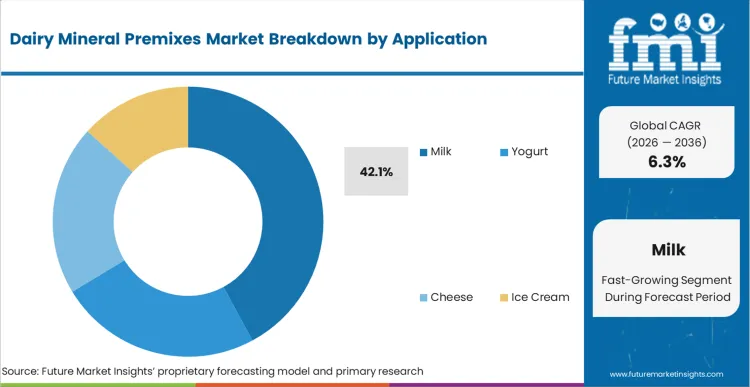
The 42.1% share held by the fluid milk application is structurally anchored by massive institutional and governmental procurement contracts that mandate specific nutritional baselines. Fluid milk presents the most unforgiving matrix for mineral fortification, as any precipitation or flavor alteration is immediately detectable by the consumer. As per FMI's projection, formulation engineers focus intensely on selecting the precise calcium and iron salts that will not interact with casein micelles during Ultra High Temperature (UHT) pasteurization. The inclusion of these highly refined food minerals represents a significant variable cost, but it is necessary to secure placement in national school lunch programs and maternal health initiatives. The lifecycle economics of fluid milk fortification hinge on achieving perfect suspension; a slight miscalculation in the premix formulation results in sediment at the bottom of the carton, leading to immediate retailer rejection and brand erosion.
- Margin origination: The initial cost savings emerge from consolidating multiple trace mineral purchase orders into a single SKU. Procurement consolidates vendor management overhead and reduces inbound freight testing requirements.
- Operational reality: Hidden costs emerge during the required cleaning-in-place (CIP) cycles, where poorly designed mineral blends create stubborn scaling inside heat exchangers. Maintenance heads must optimize cleaning protocols to prevent unscheduled downtime.
- Lifecycle outcome: The total cost comparison heavily favors premium, highly soluble premixes that protect the brand's organoleptic profile over cheaper, generic blends. Formulators who sacrifice solubility for unit-cost savings inevitably face catastrophic product recall expenses.
Dairy Mineral Premixes Market Analysis by Distribution Channel
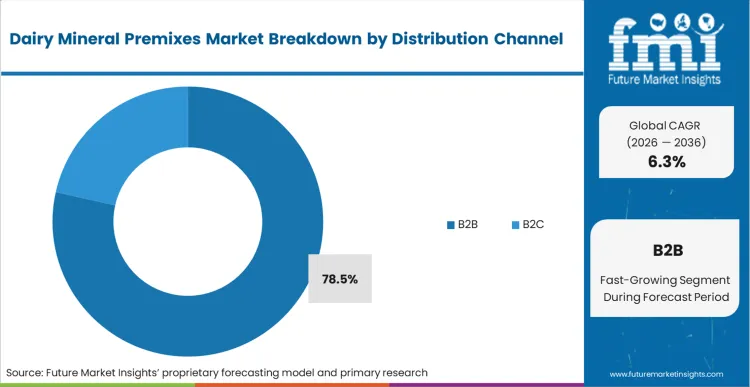
The precise engineering required for functional dairy fortification cannot be fulfilled through fragmented retail or wholesale distributors, due to which the direct business-to-business (B2B) procurement channels account for 78.5% of the market. Based on FMI's assessment, tier-1 dairy processors require deep technical integration with their suppliers, often demanding access to the vendor's internal quality control data before a shipment leaves the blending facility. Suppliers maintaining direct B2B relationships build their margins by offering formulation consulting alongside the physical product, integrating their food fortifying agents seamlessly into the buyer's existing product development pipeline. This channel dominance is insulated by the stringent documentation required for regulatory compliance, which third-party distributors generally lack the technical depth to provide. Facilities attempting to source functional premixes through secondary channels face significant delays in obtaining the necessary allergen and purity certifications, effectively stalling their product launch timelines.
- Primary production: Dedicated toll blenders produce these matrices using specialized ribbon and paddle mixers designed to prevent cross-contamination. Facility managers must constantly validate their sanitation protocols to maintain active B2B contracts.
- Capacity constraints: The limited availability of certified, allergen-free blending capacity creates a severe bottleneck during peak seasonal dairy production. Procurement teams must forecast their requirements up to six months in advance to secure production slots.
- 2036 Outlook: The supply landscape is shifting toward extreme vendor consolidation, where large dairy processors will likely acquire specialized blending facilities to internalize critical food blending capabilities.
Dairy Mineral Premixes Market Drivers, Restraints, and Opportunities
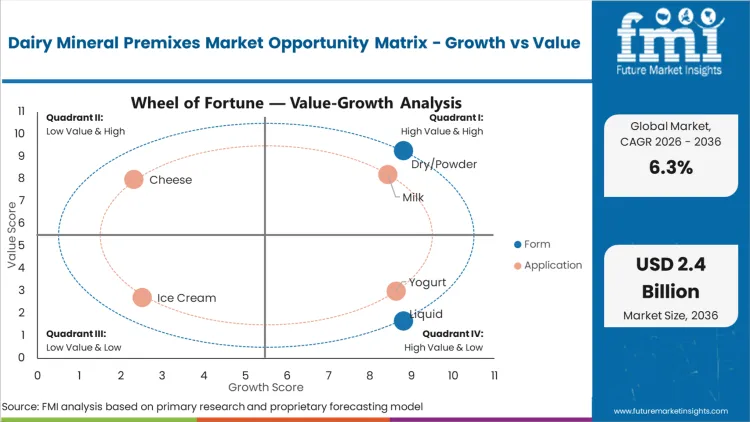
The transition toward precision nutrition in early childhood development forces formulation directors to integrate highly complex, bioavailable mineral matrices into their premium product lines. This is not driven by general consumer awareness, but by stringent updates to international infant formula standards that severely penalize both under-fortification and over-fortification. A formulation director at a tier-1 dairy brand must now secure ingredient matrices that guarantee absolute uniformity down to the microgram, pushing them to abandon internal batch mixing in favor of outsourced, technologically advanced premixes. Delaying this transition exposes the processor to severe compliance risks and product seizures, compelling immediate action to upgrade their sourcing frameworks.
The single biggest operational friction slowing rapid premix integration is the unpredictable interaction between complex mineral salts and varied raw milk protein profiles under extreme thermal stress. This matrix instability forces product development teams into protracted, multi-month qualification cycles just to validate a single new SKUs. While advanced microencapsulation technologies are emerging to mask these minerals from the protein environment, they introduce a distinct cost premium that mid-tier dairies struggle to absorb. Until the cost of encapsulation reaches parity with unprotected mineral salts, regional processors will continue to experience formulation bottlenecks that stall broader portfolio expansion.
Opportunities in the Dairy Mineral Premixes Market
- Targeted maternal nutrition: The rising focus on specific trimester-based nutritional needs enables the development of highly specialized calcium-iron-folate matrices. Research and development teams at functional dairy brands can capture premium retail margins by launching clinically validated maternal milk powders.
- Plant-dairy hybrid matrices: The structural challenge of fortifying blended animal and plant protein bases creates a demand for highly versatile stabilizing chelates. Ingredient formulators who develop premixes that remain soluble across mixed protein environments secure early-mover advantage in this rapidly expanding category.
- Real-time formulation integration: The shift toward digitized supply chains allows vendor systems to interface directly with a dairy processor's raw material intake data. Quality control managers can leverage this connectivity to automatically adjust incoming premix profiles, compensating for seasonal variations in raw milk mineral content.
Regional Analysis
Based on the regional analysis, the Dairy Mineral Premixes market is segmented into North America, Latin America, Europe, East Asia, South Asia, Oceania, and Middle East and Africa across 40 plus countries.
.webp "Top Country Growth Comparison Dairy Mineral Premixes Market Cagr (2026 2036)")
| Country | CAGR (2026 to 2036) |
|---|---|
| India | 8.2% |
| China | 7.5% |
| Brazil | 6.1% |
| United States | 5.2% |
| Germany | 4.8% |
| United Kingdom | 4.5% |
| Japan | 4.2% |
Source: Future Market Insights (FMI) analysis, based on proprietary forecasting model and primary research
North America Dairy Mineral Premixes Market Analysis
The intense concentration of specialized dairy protein manufacturing and sports nutrition brands in North America fundamentally dictates the buyer behavior regarding functional ingredient sourcing. Instead of standardizing basic fluid milk, formulation engineers in this region utilize dietary supplements concepts to create highly fortified whey isolates and specialized recovery beverages. In FMI's view, the procurement dynamic is defined by rapid innovation cycles; vendors are evaluated not just on purity, but on their ability to rapidly prototype and scale complex trace mineral blends that do not impart astringency to high-protein formats. This requires suppliers to maintain extensive domestic application laboratories to co-develop products alongside their tier-1 customers.
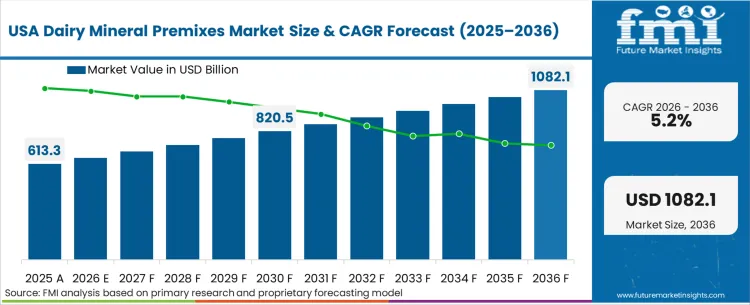
- United States: The dominance of specialized sports and active nutrition dairy formats forces ingredient buyers to demand extremely high bioavailability from their trace mineral blends. Formulators are transitioning away from standard carbonates toward expensive amino acid chelates to ensure maximum absorption without gastrointestinal distress. The United States market is forecast to register a CAGR of 5.2%. This trajectory positions American dairy brands to aggressively capture the high-margin adult clinical nutrition segment before European competitors can adapt their traditional portfolios.
FMI's report includes an assessment of Canada and Mexico. The integration of cross-border dairy supply chains requires formulation managers in these adjacent markets to increasingly adopt United States nutritional standards to maintain export viability for their specialized whey derivatives.
Europe Dairy Mineral Premixes Market Analysis
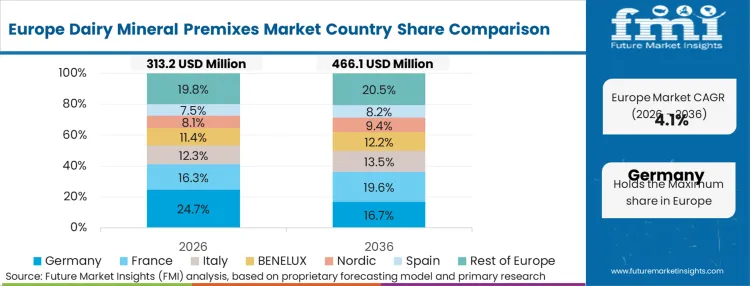
The regulatory environment surrounding clean label claims and the strict European Food Safety Authority (EFSA) guidelines on allowable mineral forms shape every procurement decision in the Europe market. Dairy processors operate under severe constraints regarding what chemical stabilizers can accompany a mineral blend, forcing food additives suppliers to develop highly natural, label-friendly carrier mechanisms. FMI analysts opine that this environment actively penalizes cheap, generic formulations imported from outside the region, creating a protective barrier for domestic European blenders who understand the nuance of EFSA compliance documentation.
- Germany: Dairy industry in the country is expected to demonstrate a CAGR of 4.8%. The robust organic dairy sector in Germany requires procurement managers to source specialized, non-synthetic mineral isolates that comply with stringent organic certification bodies. This restricts the vendor pool significantly, pushing buyers to form deep, multi-year strategic alliances with specialized ingredient processors. This dynamic fundamentally changes the operational reality inside the plant, where quality teams spend more time verifying upstream organic provenance than conducting physical chemistry tests on the blends.
- United Kingdom: Post-Brexit regulatory divergence obligates nutritional compliance officers to navigate dual qualification pathways for any new fortified dairy product intended for both domestic and EU distribution. This dual-track approval process inherently slows down new product development cycles for fluid milks and yogurts. Over the forecast period, demand in the United Kingdom is set for a CAGR of 4.5%. British dairy processors who centralize their compliance frameworks capture significant commercial opportunity by positioning themselves as agile co-manufacturers for international brands seeking UK market entry.
FMI's report includes coverage of France, Italy, and Spain. The mature cheese manufacturing sectors in these nations are beginning to explore subtle mineral fortification to offset the nutritional losses associated with extensive whey separation during curd formation.
Asia Pacific Dairy Mineral Premixes Market Analysis
The highly fragmented nature of the raw milk supply chain across Asia Pacific makes standardized fortification a logistical necessity rather than a premium product strategy. Dairy processing cooperatives intake milk from millions of smallholder farmers, resulting in massive batch-to-batch variations in baseline nutritional quality. Based on FMI's assessment, facility managers utilize robust micronutrient premixes not just to add value, but to establish a consistent nutritional floor that meets government minimums. This infrastructure-led environment requires blends that are highly resilient to fluctuations in storage temperature and mixing shear.
- India: The rapid formalization of the domestic cooperative dairy network forces processing facility managers to integrate highly soluble, heat-stable mineral powders to standardize massive volumes of highly variable raw milk. India is expected to see its sector grow at a compound annual rate of 8.2%. These facilities cannot rely on consistent baseline nutrition from the farm level, placing the entire burden of nutritional uniformity on the final blending stage. The transition heading into the next decade will see cooperative giants moving from basic iron-calcium blends to highly complex pediatric formulations as rural distribution cold chains stabilize.
FMI's report includes analysis of Bangladesh and Sri Lanka. The increasing reliance on reconstituted milk powders in these markets requires specialized premixes that hydrate instantly without forming clumps, presenting a unique technical hurdle for ingredient formulators targeting the region.
Competitive Aligners for Market Players
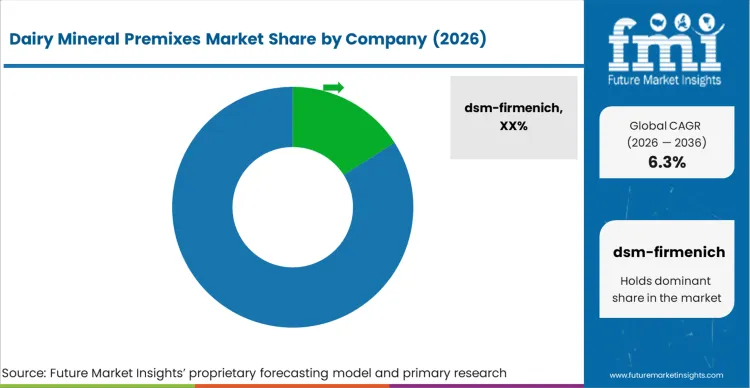
The concentrated nature of the functional premix landscape is structurally dictated by the massive capital investment required to achieve micro-homogeneity without the risk of cross-contamination. Tier-1 dairy processors explicitly filter out smaller regional blenders by requiring rigorous, multi-site quality audits and complete traceability down to the raw mineral extraction point. Companies like DSM, Glanbia plc, and SternVitamin dominate because their physical infrastructure ensures that a trace element like selenium is distributed perfectly evenly across a 1,000-kilogram batch. Buyers use documented batch-to-batch consistency as their primary variable to distinguish qualified, global suppliers from unqualified entrants.
To maintain their competitive moats, incumbents like Corbion and Prinova Group leverage proprietary microencapsulation technologies that mask the astringent taste of essential minerals in liquid dairy environments. This specific capability persists because the intellectual property surrounding thermal-release coatings in pasteurization systems is incredibly difficult to circumvent. A challenger attempting to replicate this advantage must build a sophisticated food encapsulation application laboratory capable of simulating UHT dairy processing conditions, requiring years of capital outlay before presenting a viable product to a major dairy brand.
Large dairy procurement networks actively resist this technological lock-in by constantly demanding secondary supplier validation for their most critical product lines. The structural tension emerges between the buyer's desire for commoditized, interchangeable premix formulas and the vendor's incentive to create highly customized, irreplaceable functional matrices. Through 2036, the sector will likely see increased consolidation as the capital requirements for regulatory compliance and advanced bioavailability testing outpace the financial capabilities of independent toll blenders.
Key Players in Dairy Mineral Premixes Market
- dsm-firmenich
- Archer Daniels Midland Company (ADM)
- Glanbia Nutritionals
- BASF SE
- Corbion N.V.
- Prinova Group LLC
- SternVitamin GmbH & Co. KG
- Vitablend Nederland B.V.
- Wright Enrichment Inc.
- Hexagon Nutrition Ltd.
Scope of the Report
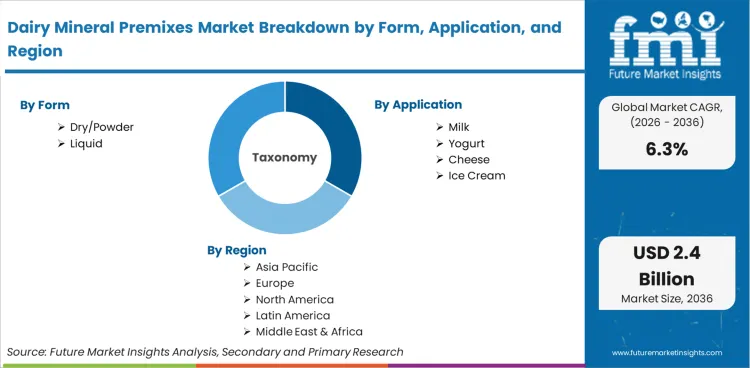
| Metric | Value |
|---|---|
| Quantitative Units | USD 1.3 billion to USD 2.4 billion, at a CAGR of 6.3% |
| Market Definition | This category encompasses specialized, chemically stabilized macro and micro-mineral blends engineered explicitly to fortify dairy matrices without causing protein denaturation or flavor degradation. |
| Form Segmentation | Dry/Powder, Liquid |
| Application Segmentation | Milk, Yogurt, Cheese, Ice Cream |
| Distribution Channel Segmentation | B2B, B2C |
| Regions Covered | North America, Latin America, Europe, East Asia, South Asia, Oceania, Middle East and Africa |
| Countries Covered | India, China, Brazil, United States, Germany, United Kingdom, Japan, and 40 plus countries |
| Key Companies Profiled | DSM, Glanbia plc, Corbion, SternVitamin, Wright Enrichment Inc., Barentz, Prinova Group, Vitablend Nederland B.V., Hexagon Nutrition, Farbest Brands |
| Forecast Period | 2026 to 2036 |
| Approach | Primary interviews were conducted with tier-1 dairy formulation engineers and quality assurance directors to establish current blending practices. The data baseline was anchored to observable capital expenditures in functional dairy product development globally. These projections were cross-validated against regional milk consumption volumes and supplier capacity expansions. |
Source: Future Market Insights (FMI) analysis, based on proprietary forecasting model and primary research
Dairy Mineral Premixes Market Analysis by Segments
Form:
- Dry/Powder
- Liquid
Application:
- Milk
- Yogurt
- Cheese
- Ice Cream
Distribution Channel:
- B2B
- B2C
Region:
- North America
- United States
- Canada
- Europe
- Germany
- United Kingdom
- France
- Asia Pacific
- India
- Bangladesh
- China
- Japan
- Latin America
- Brazil
- Mexico
Bibliography
- Food and Agriculture Organization of the United Nations. (2024, June). Food Outlook: Global market analysis – Milk and dairy products. FAO.
- Canadian Food Inspection Agency. (2025, January 15). Fortification of food. Government of Canada.
- Health Canada. (2024, May 2). Divisions 24 and 25 of the Food and Drug Regulations: Foods for a special dietary use and infant foods. Government of Canada.
- Food Standards Australia New Zealand. (2024, June 13). Approval report – Proposal P1028: Infant formula.
- European Food Safety Authority. (2024). Guidance on scientific principles and data requirements for the safety evaluation of sources of nutrients and bioavailability of nutrient from the sources (Revision 1). EFSA Journal, 22(10), e8946.
- Canadian Food Inspection Agency. (2025, January 15). Nutrient content claims: Reference information. Government of Canada.
This Report Addresses
- Market intelligence to support strategic decision making across dry and liquid mineral suspension formulations for functional dairy product pipelines
- Market size estimation and 10-year revenue forecasts from 2026 to 2036, supported by specific volume throughput analysis of fortified fluid milk and infant nutrition lines
- Growth opportunity mapping across Form and Application dimensions with emphasis on the transition from generic fortification to targeted, multi-mineral functional matrices
- Segment and regional revenue forecasts covering critical sub-segments like customized infant nutrition blends across strict European regulatory environments
- Competition strategy assessment including evaluation of proprietary microencapsulation technologies, batch-to-batch micro-homogeneity capabilities, and toll blending capacity constraints
- Technology development tracking including specific integration of amino acid chelates and thermal-release coatings utilized in UHT pasteurization systems
- Market access analysis covering stringent EFSA mineral guidelines, FDA infant formula tolerances, and domestic cooperative procurement pathways
- Market report delivery in PDF, Excel, PPT, and interactive dashboard formats for executive strategy, functional ingredient supply chain planning, and operational benchmarking use
Frequently Asked Questions
How large is the dairy mineral premixes market in 2026?
The industry is expected to be valued at USD 1.3 billion in 2026. This figure reflects the baseline expenditure required by dairy processors to outsource the complex, high-liability blending of essential trace elements to specialized third-party formulators.
What will it be valued at by 2036?
It is projected to reach USD 2.4 billion by 2036. This expansion signals a permanent structural shift where even mid-tier regional dairies are abandoning internal batch mixing in favor of perfectly homogenized, externally sourced functional matrices.
What CAGR is projected?
A CAGR of 6.3% is expected during the forecast period. This rate is heavily constrained by the physical capacity limits of certified, allergen-free blending facilities globally, rather than a lack of downstream consumer demand for fortified dairy products.
Which Form segment leads?
The dry/powder segment is estimated to lead with a 65.4% share. Processors explicitly mandate powdered formats to entirely bypass the rapid oxidation and physical settling issues that plague liquid mineral suspensions inside holding tanks.
Which application segment leads?
Milk holds the leading position with a 42.1% share. Massive institutional procurement contracts and stringent national school lunch mandates dictate absolute precision in fluid milk fortification, driving reliance on highly engineered premixes.
Which distribution channel segment leads?
The B2B channel leads with a commanding 78.5% share. The extreme technical integration required to align a vendor's formulation with a processor's specific UHT pasteurization parameters makes secondary retail or wholesale distribution functionally obsolete.
What drives rapid growth?
The implementation of strict regulatory tolerances for infant nutrition trace minerals leaves dairy processors no margin for error. They are compelled to source precisely engineered blends from specialized vendors rather than risking massive product recalls due to internal blending variations.
What is the primary restraint?
The complex, often unpredictable interaction between raw milk protein matrices and complex mineral salts creates massive qualification friction. Formulators face protracted testing cycles to ensure the added minerals do not cause precipitation or off-flavors during thermal processing.
Which country grows fastest?
India is projected to grow the fastest at 8.2%, compared to China at 7.5%. The Indian cooperative network relies on highly variable raw milk inputs from millions of smallholders, making intensive, standardized fortification an operational necessity, whereas China's more consolidated dairy farming allows for tighter upstream nutritional control.
How do EFSA regulations impact European adoption?
Stringent EFSA guidelines strictly limit the types of chemical stabilizers that can accompany mineral blends in clean-label products. This constraint protects domestic European blenders who specialize in highly natural carrier mechanisms from cheaper, non-compliant imported alternatives.
Why are microencapsulated minerals becoming critical?
Microencapsulation physically shields reactive trace minerals like iron from the surrounding dairy protein matrix during high-heat processing. This technology allows formulation engineers to drastically improve bioavailability without imparting metallic tastes or causing the fluid milk to coagulate.
How do incumbent blenders maintain their market position?
Leading suppliers leverage massive capital investments in dedicated, allergen-free ribbon and paddle mixers to guarantee perfect micro-homogeneity. Buyers prioritize this documented batch-to-batch consistency over slight unit-cost savings offered by unproven entrants.
Why do processors prefer B2B direct sourcing over distributors?
Direct sourcing allows the dairy processor to access the vendor's application laboratories and real-time quality control data. Quality assurance directors require this absolute transparency to secure regulatory approvals before releasing the final fortified product.
What role does organic certification play in Germany?
The dominance of the organic sector forces German buyers to source non-synthetic, highly specialized mineral isolates. This severely limits the vendor pool and creates deep, sticky relationships between processors and specialized ingredient suppliers.
Why are liquid suspensions losing share to powders?
Liquid formats carry heavy inbound freight penalties and require constant agitation to prevent the minerals from settling out of suspension. Facilities utilize powders to extend their bulk inventory cycles and eliminate the need for specialized liquid holding infrastructure.
How does UHT pasteurization affect premix selection?
The extreme thermal shock of UHT processing can instantly denature proteins if the mineral balance is incorrect. Formulators explicitly select premium calcium and iron salts engineered specifically to remain stable under these exact shear and temperature conditions.
What is the penalty for failing infant formula standards?
A single batch showing trace mineral levels outside the microscopic regulatory tolerances triggers immediate product seizure and facility audits. Processors gladly pay a 30% premium for specialized premixes to transfer this catastrophic regulatory liability to the supplier.
How is the United States sports nutrition sector different?
American procurement focuses on fortifying complex whey isolates rather than standard fluid milk. This requires vendors to rapidly prototype specialized amino acid chelates that deliver maximum mineral absorption without disrupting the organoleptic profile of high-protein beverages.
Why is B2C distribution negligible in this market?
Functional dairy minerals are industrial-grade chemical components requiring sophisticated homogenization equipment to incorporate safely. They cannot be sold directly to consumers or small retail outlets due to the massive toxicity risks of improper, localized over-fortification.
What changes when processors shift to functional claims?
Moving from a generic "fortified" label to a specific "bone health" claim requires the integration of complex, multi-element matrices. This operational pivot forces the processor to abandon internal batch mixing entirely and rely exclusively on advanced toll blenders.
How will supply chain digitization affect the market by 2036?
Future ingredient networks will interface directly with a dairy plant's incoming raw milk nutritional assays. Vendor systems will automatically adjust the micro-composition of the delivered premix batch to instantly compensate for seasonal nutritional variations at the farm level.
What structural advantage do major toll blenders hold?
Massive incumbent blenders possess the capital to maintain entirely separate production lines for different allergen profiles. Mid-tier challengers cannot replicate this infrastructure, permanently locking them out of lucrative, high-volume infant formula contracts.
Preview the report firsthand - request a free sample
Get SampleGet the brochure for pricing and purchase details.
Get PDFTable of Content
- Executive Summary
- Global Market Outlook
- Demand-side Trends
- Supply-side Trends
- Technology Roadmap Analysis
- Analysis and Recommendations
- Market Overview
- Market Coverage / Taxonomy
- Market Definition / Scope / Limitations
- Research Methodology
- Chapter Orientation
- Analytical Lens and Working Hypotheses
- Market Structure, Signals, and Trend Drivers
- Benchmarking and Cross-market Comparability
- Market Sizing, Forecasting, and Opportunity Mapping
- Research Design and Evidence Framework
- Desk Research Programme (Secondary Evidence)
- Company Annual and Sustainability Reports
- Peer-reviewed Journals and Academic Literature
- Corporate Websites, Product Literature, and Technical Notes
- Earnings Decks and Investor Briefings
- Statutory Filings and Regulatory Disclosures
- Technical White Papers and Standards Notes
- Trade Journals, Industry Magazines, and Analyst Briefs
- Conference Proceedings, Webinars, and Seminar Materials
- Government Statistics Portals and Public Data Releases
- Press Releases and Reputable Media Coverage
- Specialist Newsletters and Curated Briefings
- Primary Modes
- Qualitative Interviews and Expert Elicitation
- Quantitative Surveys and Structured Data Capture
- Blended Approach
- Why Primary Evidence is Used
- Field Techniques
- Interviews
- Surveys
- Focus Groups
- Observational and In-context Research
- Social and Community Interactions
- Stakeholder Universe Engaged
- C-suite Leaders
- Board Members
- Presidents and Vice Presidents
- R&D and Innovation Heads
- Technical Specialists
- Domain Subject-matter Experts
- Scientists
- Physicians and Other Healthcare Professionals
- Governance, Ethics, and Data Stewardship
- Research Ethics
- Data Integrity and Handling
- Tooling, Models, and Reference Databases
- Desk Research Programme (Secondary Evidence)
- Data Engineering and Model Build
- Data Acquisition and Ingestion
- Cleaning, Normalisation, and Verification
- Synthesis, Triangulation, and Analysis
- Quality Assurance and Audit Trail
- Market Background
- Market Dynamics
- Drivers
- Restraints
- Opportunity
- Trends
- Scenario Forecast
- Demand in Optimistic Scenario
- Demand in Likely Scenario
- Demand in Conservative Scenario
- Opportunity Map Analysis
- Product Life Cycle Analysis
- Supply Chain Analysis
- Investment Feasibility Matrix
- Value Chain Analysis
- PESTLE and Porter’s Analysis
- Regulatory Landscape
- Regional Parent Market Outlook
- Production and Consumption Statistics
- Import and Export Statistics
- Market Dynamics
- Global Market Analysis 2021 to 2025 and Forecast, 2026 to 2036
- Historical Market Size Value (USD Million) Analysis, 2021 to 2025
- Current and Future Market Size Value (USD Million) Projections, 2026 to 2036
- Y-o-Y Growth Trend Analysis
- Absolute $ Opportunity Analysis
- Global Market Pricing Analysis 2021 to 2025 and Forecast 2026 to 2036
- Global Market Analysis 2021 to 2025 and Forecast 2026 to 2036, By Form
- Introduction / Key Findings
- Historical Market Size Value (USD Million) Analysis By Form , 2021 to 2025
- Current and Future Market Size Value (USD Million) Analysis and Forecast By Form , 2026 to 2036
- Dry/Powder
- Liquid
- Dry/Powder
- Y-o-Y Growth Trend Analysis By Form , 2021 to 2025
- Absolute $ Opportunity Analysis By Form , 2026 to 2036
- Global Market Analysis 2021 to 2025 and Forecast 2026 to 2036, By Application
- Introduction / Key Findings
- Historical Market Size Value (USD Million) Analysis By Application, 2021 to 2025
- Current and Future Market Size Value (USD Million) Analysis and Forecast By Application, 2026 to 2036
- Milk
- Yogurt
- Cheese
- Ice Cream
- Milk
- Y-o-Y Growth Trend Analysis By Application, 2021 to 2025
- Absolute $ Opportunity Analysis By Application, 2026 to 2036
- Global Market Analysis 2021 to 2025 and Forecast 2026 to 2036, By Distribution Channel
- Introduction / Key Findings
- Historical Market Size Value (USD Million) Analysis By Distribution Channel, 2021 to 2025
- Current and Future Market Size Value (USD Million) Analysis and Forecast By Distribution Channel, 2026 to 2036
- B2B
- B2C
- B2B
- Y-o-Y Growth Trend Analysis By Distribution Channel, 2021 to 2025
- Absolute $ Opportunity Analysis By Distribution Channel, 2026 to 2036
- Global Market Analysis 2021 to 2025 and Forecast 2026 to 2036, By Region
- Introduction
- Historical Market Size Value (USD Million) Analysis By Region, 2021 to 2025
- Current Market Size Value (USD Million) Analysis and Forecast By Region, 2026 to 2036
- North America
- Latin America
- Western Europe
- Eastern Europe
- East Asia
- South Asia and Pacific
- Middle East & Africa
- Market Attractiveness Analysis By Region
- North America Market Analysis 2021 to 2025 and Forecast 2026 to 2036, By Country
- Historical Market Size Value (USD Million) Trend Analysis By Market Taxonomy, 2021 to 2025
- Market Size Value (USD Million) Forecast By Market Taxonomy, 2026 to 2036
- By Country
- USA
- Canada
- Mexico
- By Form
- By Application
- By Distribution Channel
- By Country
- Market Attractiveness Analysis
- By Country
- By Form
- By Application
- By Distribution Channel
- Key Takeaways
- Latin America Market Analysis 2021 to 2025 and Forecast 2026 to 2036, By Country
- Historical Market Size Value (USD Million) Trend Analysis By Market Taxonomy, 2021 to 2025
- Market Size Value (USD Million) Forecast By Market Taxonomy, 2026 to 2036
- By Country
- Brazil
- Chile
- Rest of Latin America
- By Form
- By Application
- By Distribution Channel
- By Country
- Market Attractiveness Analysis
- By Country
- By Form
- By Application
- By Distribution Channel
- Key Takeaways
- Western Europe Market Analysis 2021 to 2025 and Forecast 2026 to 2036, By Country
- Historical Market Size Value (USD Million) Trend Analysis By Market Taxonomy, 2021 to 2025
- Market Size Value (USD Million) Forecast By Market Taxonomy, 2026 to 2036
- By Country
- Germany
- UK
- Italy
- Spain
- France
- Nordic
- BENELUX
- Rest of Western Europe
- By Form
- By Application
- By Distribution Channel
- By Country
- Market Attractiveness Analysis
- By Country
- By Form
- By Application
- By Distribution Channel
- Key Takeaways
- Eastern Europe Market Analysis 2021 to 2025 and Forecast 2026 to 2036, By Country
- Historical Market Size Value (USD Million) Trend Analysis By Market Taxonomy, 2021 to 2025
- Market Size Value (USD Million) Forecast By Market Taxonomy, 2026 to 2036
- By Country
- Russia
- Poland
- Hungary
- Balkan & Baltic
- Rest of Eastern Europe
- By Form
- By Application
- By Distribution Channel
- By Country
- Market Attractiveness Analysis
- By Country
- By Form
- By Application
- By Distribution Channel
- Key Takeaways
- East Asia Market Analysis 2021 to 2025 and Forecast 2026 to 2036, By Country
- Historical Market Size Value (USD Million) Trend Analysis By Market Taxonomy, 2021 to 2025
- Market Size Value (USD Million) Forecast By Market Taxonomy, 2026 to 2036
- By Country
- China
- Japan
- South Korea
- By Form
- By Application
- By Distribution Channel
- By Country
- Market Attractiveness Analysis
- By Country
- By Form
- By Application
- By Distribution Channel
- Key Takeaways
- South Asia and Pacific Market Analysis 2021 to 2025 and Forecast 2026 to 2036, By Country
- Historical Market Size Value (USD Million) Trend Analysis By Market Taxonomy, 2021 to 2025
- Market Size Value (USD Million) Forecast By Market Taxonomy, 2026 to 2036
- By Country
- India
- ASEAN
- Australia & New Zealand
- Rest of South Asia and Pacific
- By Form
- By Application
- By Distribution Channel
- By Country
- Market Attractiveness Analysis
- By Country
- By Form
- By Application
- By Distribution Channel
- Key Takeaways
- Middle East & Africa Market Analysis 2021 to 2025 and Forecast 2026 to 2036, By Country
- Historical Market Size Value (USD Million) Trend Analysis By Market Taxonomy, 2021 to 2025
- Market Size Value (USD Million) Forecast By Market Taxonomy, 2026 to 2036
- By Country
- Kingdom of Saudi Arabia
- Other GCC Countries
- Turkiye
- South Africa
- Other African Union
- Rest of Middle East & Africa
- By Form
- By Application
- By Distribution Channel
- By Country
- Market Attractiveness Analysis
- By Country
- By Form
- By Application
- By Distribution Channel
- Key Takeaways
- Key Countries Market Analysis
- USA
- Pricing Analysis
- Market Share Analysis, 2025
- By Form
- By Application
- By Distribution Channel
- Canada
- Pricing Analysis
- Market Share Analysis, 2025
- By Form
- By Application
- By Distribution Channel
- Mexico
- Pricing Analysis
- Market Share Analysis, 2025
- By Form
- By Application
- By Distribution Channel
- Brazil
- Pricing Analysis
- Market Share Analysis, 2025
- By Form
- By Application
- By Distribution Channel
- Chile
- Pricing Analysis
- Market Share Analysis, 2025
- By Form
- By Application
- By Distribution Channel
- Germany
- Pricing Analysis
- Market Share Analysis, 2025
- By Form
- By Application
- By Distribution Channel
- UK
- Pricing Analysis
- Market Share Analysis, 2025
- By Form
- By Application
- By Distribution Channel
- Italy
- Pricing Analysis
- Market Share Analysis, 2025
- By Form
- By Application
- By Distribution Channel
- Spain
- Pricing Analysis
- Market Share Analysis, 2025
- By Form
- By Application
- By Distribution Channel
- France
- Pricing Analysis
- Market Share Analysis, 2025
- By Form
- By Application
- By Distribution Channel
- India
- Pricing Analysis
- Market Share Analysis, 2025
- By Form
- By Application
- By Distribution Channel
- ASEAN
- Pricing Analysis
- Market Share Analysis, 2025
- By Form
- By Application
- By Distribution Channel
- Australia & New Zealand
- Pricing Analysis
- Market Share Analysis, 2025
- By Form
- By Application
- By Distribution Channel
- China
- Pricing Analysis
- Market Share Analysis, 2025
- By Form
- By Application
- By Distribution Channel
- Japan
- Pricing Analysis
- Market Share Analysis, 2025
- By Form
- By Application
- By Distribution Channel
- South Korea
- Pricing Analysis
- Market Share Analysis, 2025
- By Form
- By Application
- By Distribution Channel
- Russia
- Pricing Analysis
- Market Share Analysis, 2025
- By Form
- By Application
- By Distribution Channel
- Poland
- Pricing Analysis
- Market Share Analysis, 2025
- By Form
- By Application
- By Distribution Channel
- Hungary
- Pricing Analysis
- Market Share Analysis, 2025
- By Form
- By Application
- By Distribution Channel
- Kingdom of Saudi Arabia
- Pricing Analysis
- Market Share Analysis, 2025
- By Form
- By Application
- By Distribution Channel
- Turkiye
- Pricing Analysis
- Market Share Analysis, 2025
- By Form
- By Application
- By Distribution Channel
- South Africa
- Pricing Analysis
- Market Share Analysis, 2025
- By Form
- By Application
- By Distribution Channel
- USA
- Market Structure Analysis
- Competition Dashboard
- Competition Benchmarking
- Market Share Analysis of Top Players
- By Regional
- By Form
- By Application
- By Distribution Channel
- Competition Analysis
- Competition Deep Dive
- dsm-firmenich
- Overview
- Product Portfolio
- Profitability by Market Segments (Product/Age /Sales Channel/Region)
- Sales Footprint
- Strategy Overview
- Marketing Strategy
- Product Strategy
- Channel Strategy
- Archer Daniels Midland Company (ADM)
- Glanbia Nutritionals
- BASF SE
- Corbion N.V.
- Prinova Group LLC
- SternVitamin GmbH & Co. KG
- Vitablend Nederland B.V.
- Wright Enrichment Inc.
- Hexagon Nutrition Ltd.
- dsm-firmenich
- Competition Deep Dive
- Assumptions & Acronyms Used


