

- Industry Size (2026)
- USD 3.2 Bn
- Forecast (2036)
- USD 7.0 Bn
- CAGR (2026 to 2036)
- 8.1%
Dairy Animal Biosecurity Market Forecast and Outlook 2026 to 2036
The dairy animal biosecurity market is likely to be valued at USD 3.2 billion in 2026, reach USD 7.0 billion by 2036, and expand at a CAGR of 8.1%. Growth is grounded in the structural need to protect milk-producing herds from infectious disease exposure that directly affects yield stability, animal longevity, and compliance with food safety standards. Biosecurity is increasingly treated as an operational input rather than a reactive safeguard, particularly in systems where herd size, animal turnover, and external traffic elevate transmission risk. Producers and veterinarians prioritize preventive controls that reduce baseline disease pressure, limit production variability, and support predictable milk output under tightening regulatory and buyer oversight.
Quick Stats for Dairy Animal Biosecurity Market
- Dairy Animal Biosecurity Market Value (2026): USD 3.2 billion
- Dairy Animal Biosecurity Market Forecast Value (2036): USD 7.0 billion
- Dairy Animal Biosecurity Market Forecast CAGR 2026 to 2036: 8.1%
- Leading Product Category by Utilization: Disinfectants & sanitizers
- Fastest-Growing Countries: India, China, Brazil, USA, UK
- Top Players in Global Demand: Zoetis, Boehringer Ingelheim, Elanco, Neogen, Ceva
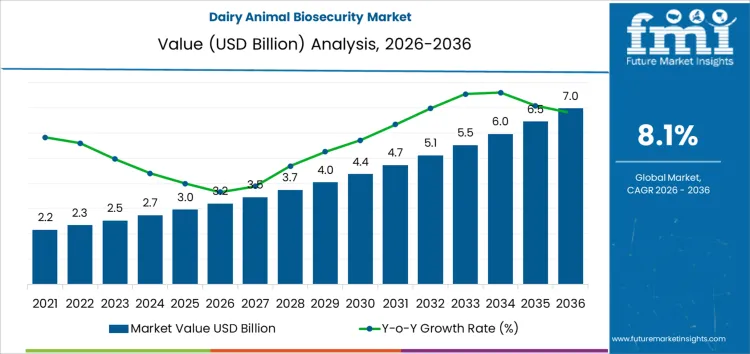
Adoption patterns show that demand is shaped more by management discipline and integration into daily routines than by episodic outbreak events. Large and integrated dairy operations embed sanitation protocols, access control, vaccination coordination, and monitoring into standard operating procedures to reduce reliance on therapeutic intervention. Investment decisions focus on measures that can be executed consistently by farm labor, audited by veterinary advisors, and documented for processors or assurance schemes. Smaller operations selectively adopt scalable elements aligned with risk exposure and cost tolerance. Expansion is therefore driven by the normalization of biosecurity as part of routine herd management, where prevention economics, supply continuity, and reputational risk mitigation outweigh short-term cost considerations.
Dairy Animal Biosecurity Market Key Takeaways
| Metric | Value |
|---|---|
| Market Value (2026) | USD 3.2 billion |
| Market Forecast Value (2036) | USD 7.0 billion |
| Forecast CAGR 2026 to 2036 | 8.1% |
Why is the Demand for Dairy Animal Biosecurity Growing?
Demand for dairy animal biosecurity solutions is rising as producers confront persistent threats from infectious diseases that compromise herd health, productivity, and farm sustainability. Pathogens such as bovine viral diarrhea virus, Johne’s disease, and mastitis-causing bacteria impose direct costs through reduced milk yield, treatment expenditure, and increased culling. Dairy veterinarians and herd health advisors specify biosecurity measures that include controlled animal movement, enhanced sanitation, and diagnostic screening to break transmission cycles and reduce disease incidence. Procurement specialists evaluate products and protocols that deliver measurable reduction in pathogen load, align with milking parlor workflows, and integrate with recordkeeping systems to support traceability and regulatory expectations. These practices are essential in large herds and intensively managed operations because even subclinical infections can erode feed efficiency and reproductive performance.
Growth in consumer demand for milk quality and regulatory oversight of food safety reinforces adoption of comprehensive biosecurity frameworks at dairy farms of all sizes. Supply chain partners such as processors and cooperatives encourage on-farm protocols that improve herd health metrics and limit antimicrobial use by preventing infections rather than relying on reactive treatment. Implementation of controlled visitor access, dedicated equipment zones, and routine herd health screening fosters consistency in daily operations and reduces variability in disease outcomes. Extension services and industry groups provide education and benchmarking tools that help producers evaluate the effectiveness of adopted measures. These operational and health management priorities are contributing to sustained demand growth in the dairy animal biosecurity market.
How Is the Dairy Animal Biosecurity Market Segmented by Product Type, Application, and End User?
Demand for dairy animal biosecurity solutions is shaped by herd density, disease transmission risk, and economic impact of production disruptions. Management priorities emphasize prevention over treatment, focusing on entry control, sanitation discipline, and early threat detection. Adoption reflects regulatory expectations, export compliance, and integration with herd health protocols. Selection decisions consider scalability, operational fit, and effectiveness under continuous farm exposure. Segmentation explains how biosecurity tools, use objectives, and operational ownership structures influence deployment intensity and purchasing concentration across dairy operations.
Which Product Type Drives Biosecurity Implementation Across Dairy Operations?
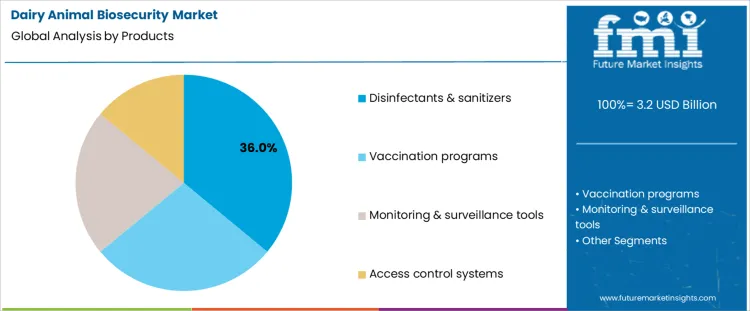
Disinfectants and sanitizers lead utilization at 36.0%, reflecting their role as foundational controls against pathogen introduction and spread. These products are applied across housing, equipment, vehicles, and personnel contact points. High-frequency use aligns with routine hygiene protocols and measurable compliance outcomes. Vaccination programs at 28.0% support immunological protection against region-specific disease risks and endemic threats. Monitoring and surveillance tools at 22.0% enable early detection through testing, tracking, and data-driven alerts. Access control systems at 14.0% manage movement of people and assets. Product segmentation reflects emphasis on daily, repeatable controls complemented by preventive and detection-focused tools.
Key Points
- Sanitization forms the baseline of daily biosecurity practice.
- Vaccination reduces susceptibility to known disease threats.
- Surveillance and access control strengthen prevention layers.
How Do Application Priorities Shape Biosecurity Deployment Patterns?
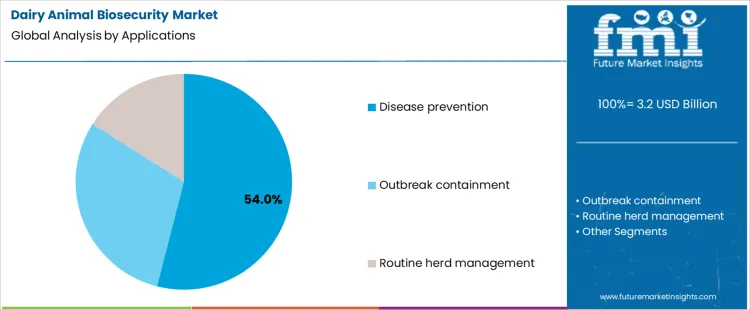
Biosecurity deployment centers on disease prevention at 54.0%, driven by the high cost of herd-wide infection events. Preventive measures reduce mortality, productivity loss, and trade restrictions. Outbreak containment at 30.0% focuses on rapid isolation, disinfection escalation, and movement restriction during confirmed incidents. Routine herd management at 16.0% integrates biosecurity into daily workflows such as milking, feeding, and animal movement. Application segmentation highlights stronger investment where risk avoidance and continuity of production outweigh reactive response requirements.
Key Points
- Prevention minimizes financial and operational disruption.
- Containment measures activate during confirmed incidents.
- Routine management embeds biosecurity into daily operations.
Which End User Segment Concentrates Biosecurity Adoption Most Heavily?
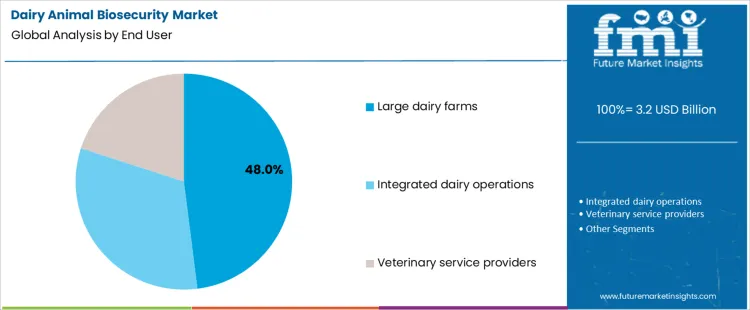
Large dairy farms account for 48.0% of biosecurity adoption due to higher animal density and exposure risk. Scale necessitates standardized protocols and continuous enforcement across facilities. Integrated dairy operations at 32.0% apply biosecurity across breeding, production, and processing units to protect vertical value chains. Veterinary service providers at 20.0% support program design, auditing, and outbreak response. End-user segmentation reflects concentration where operational scale, system integration, and risk exposure drive structured and sustained biosecurity investment.
Key Points
- Large farms require standardized, high-frequency controls.
- Integrated operations protect multi-stage production systems.
- Veterinary providers support oversight and response planning.
What are the Key Dynamics in the Dairy Animal Biosecurity Market?
Demand for dairy animal biosecurity measures reflects need to prevent infectious disease introduction and spread within milk-producing herds. Adoption concentrates in commercial dairy farms, cooperative-managed operations, and integrated milk production systems. Global scope aligns with herd density, trade exposure, and regulatory disease control frameworks. Usage centers on hygiene protocols, controlled access systems, vaccination programs, diagnostic screening, and disinfection solutions applied across farm infrastructure and animal movement points.
How do herd disease risk exposure and productivity protection shape adoption?
Dairy herds face continuous exposure to pathogens through animal movement, personnel traffic, feed delivery, and shared equipment. Demand increases where infectious outbreaks disrupt milk yield, reproduction, and culling rates. Biosecurity programs prioritize control of entry points, including quarantine of new animals and sanitation of vehicles and footwear. Routine vaccination and diagnostic testing support early detection and containment of endemic and emerging diseases. Large-scale operations adopt structured biosecurity plans to protect genetic investment and stabilize supply contracts. Integration of protocols into daily farm routines improves compliance. Adoption reflects operational need to safeguard herd health as a prerequisite for consistent milk production and regulatory compliance.
How do implementation discipline, cost tolerance, and behavioral factors influence market scalability?
Biosecurity effectiveness depends on consistent execution rather than one-time investment. Demand sensitivity rises where labor turnover and training gaps weaken protocol adherence. Cost exposure affects uptake of advanced monitoring and controlled access infrastructure, particularly in small and mid-sized farms. Perceived inconvenience reduces compliance with movement restrictions and hygiene steps. Diagnostic and vaccination costs add recurring expense without immediate visible return. Regional variation in disease pressure influences prioritization. Enforcement relies on voluntary participation beyond minimum regulation. Scalability remains constrained by behavioral compliance challenges, uneven economic capacity, and dependence on sustained management commitment rather than product substitution alone.
How Is Demand for Dairy Animal Biosecurity Measures Evolving Globally?
Demand for dairy animal biosecurity measures is increasing globally as disease prevention becomes central to productivity protection and supply continuity. Farm-level controls covering access management, sanitation, vaccination coordination, and monitoring reduce outbreak-related losses. Integrated herd health programs and traceability requirements reinforce adoption. Government advisories and private procurement influence implementation depth. Growth rates in India at 9.4%, China at 9.2%, Brazil at 8.9%, USA at 7.8%, and the UK at 7.6% indicate steady expansion driven by intensification of dairy operations, trade risk management, and preventive economics rather than reactive disease response.
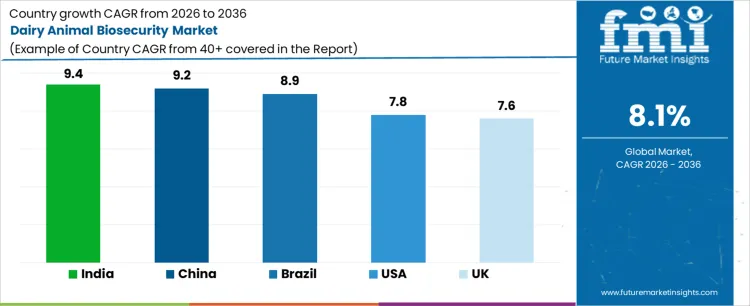
| Country | CAGR (%) |
|---|---|
| India | 9.4% |
| China | 9.2% |
| Brazil | 8.9% |
| USA | 7.8% |
| UK | 7.6% |
What Is Driving Uptake of Dairy Biosecurity Practices in India?
Demand for dairy animal biosecurity in India is growing at a CAGR of 9.4%, reflecting cooperative-led disease prevention and herd consolidation. Organized dairies implement access controls, vaccination scheduling, and sanitation protocols to stabilize milk procurement. Veterinary extension services promote farm hygiene and quarantine practices. High-density peri-urban dairies elevate transmission risk, increasing preventive investment. Government programs align biosecurity with productivity incentives. Growth reflects operational risk reduction and supply reliability priorities rather than episodic outbreak containment.
- Cooperative-led hygiene and vaccination protocols
- Veterinary extension promoting quarantine practices
- High-density dairies increasing prevention needs
- Policy-linked incentives for productivity protection
Why Is China Sustaining Growth in Dairy Biosecurity Adoption?
Dairy biosecurity demand in China is expanding at a CAGR of 9.2%, supported by farm consolidation and standardized operating procedures. Large-scale dairies deploy controlled access, disinfection systems, and monitoring to protect herd health. Integrated veterinary services enable protocol compliance. Traceability and quality assurance requirements reinforce preventive investment. Domestic suppliers provide equipment and consumables at scale. Growth reflects system-level modernization and risk governance rather than expansion driven by disease incidence spikes.
- Consolidated farms enabling standardized controls
- Integrated veterinary oversight and monitoring
- Traceability and quality assurance requirements
- Scaled domestic supply of biosecurity inputs
How Is Brazil Supporting Expansion of Dairy Biosecurity Measures?
Demand for dairy animal biosecurity in Brazil is growing at a CAGR of 8.9%, influenced by climate exposure and regional trade considerations. Warm conditions increase pathogen pressure, prompting sanitation and vector control measures. Producers adopt perimeter controls and vaccination coordination to protect yields. Veterinary outreach supports implementation across mixed-scale farms. Export orientation elevates compliance with health standards. Growth reflects preventive economics and market access protection rather than reliance on emergency interventions.
- Climate-driven pathogen and vector management
- Perimeter control and sanitation investments
- Veterinary outreach across diverse farm scales
- Export compliance reinforcing biosecurity adoption
What Factors Are Driving Dairy Biosecurity Growth in United States?
Dairy biosecurity demand in the United States is expanding at a CAGR of 7.8%, driven by risk management and continuity planning. Large operations implement controlled traffic flow, testing, and vaccination coordination. Data-driven monitoring supports early detection. Processor requirements and insurance considerations reinforce compliance. Strong veterinary infrastructure supports standardized protocols. Growth reflects operational resilience and cost avoidance rather than increased baseline disease pressure.
- Controlled traffic and access management
- Data-driven monitoring and early detection
- Processor and insurer compliance requirements
- Robust veterinary protocol support
Why Is the UK Showing Steady Expansion in Dairy Biosecurity?
Demand for dairy animal biosecurity in United Kingdom is growing at a CAGR of 7.6%, shaped by welfare standards and assurance schemes. Farm assurance programs specify hygiene, isolation, and monitoring practices. Veterinary guidance emphasizes targeted prevention aligned with grazing systems. Regulatory oversight and movement controls reinforce discipline. Cost sensitivity favors proportionate measures. Growth remains steady, reflecting governance-led adoption and productivity protection rather than aggressive system overhaul.
- Assurance scheme-driven hygiene requirements
- Veterinary guidance aligned with grazing systems
- Movement controls and regulatory oversight
- Proportionate investment under cost constraints
What is the competitive landscape of demand for the dairy animal biosecurity market globally?
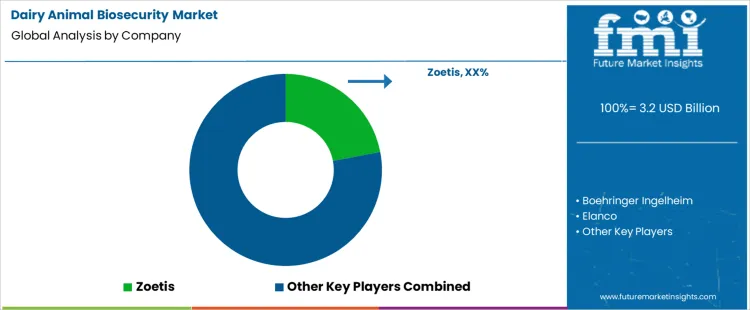
Demand for dairy animal biosecurity is shaped by herd disease prevention priorities, milk quality assurance, and regulatory scrutiny on animal health. Farm operators and veterinarians evaluate disinfection efficacy, pathogen spectrum coverage, residue safety, application practicality, and compatibility with milking routines. Buyer assessment includes scalability across herd sizes, worker safety, and alignment with mastitis and enteric disease control programs. Procurement behavior favors integrated biosecurity protocols, dependable supply, and products supported by field validation. Purchasing decisions emphasize cost predictability, ease of standard operating procedure adoption, and measurable reduction in disease incidence. Trend in the dairy animal biosecurity market shows wider adoption of preventive frameworks embedded into daily farm management.
Zoetis leads competitive positioning through comprehensive biosecurity solutions integrated with diagnostics, vaccines, and herd health programs. Boehringer Ingelheim competes via preventive health platforms supporting sanitation, disease monitoring, and veterinary-led implementation. Elanco supports demand with biosecurity products aligned to productivity protection and antimicrobial stewardship goals. Neogen maintains relevance through diagnostics-driven biosecurity tools and on-farm testing integration. Ceva participates by offering practical hygiene and prevention solutions suited to routine dairy operations. Competitive differentiation centers on preventive breadth, veterinary trust, ease of protocol execution, and demonstrated impact on herd performance metrics.
Key Players in the Dairy Animal Biosecurity Market
- Zoetis
- Boehringer Ingelheim
- Elanco
- Neogen
- Ceva
- Others
Scope of the Report
| Items | Values |
|---|---|
| Quantitative Units | USD billion |
| Products | Disinfectants & sanitizers; Vaccination programs; Monitoring & surveillance tools; Access control systems |
| Applications | Disease prevention; Outbreak containment; Routine herd management |
| End User | Large dairy farms; Integrated dairy operations; Veterinary service providers |
| Regions Covered | Asia Pacific, Europe, North America, Latin America, Middle East & Africa |
| Countries Covered | India, China, Brazil, USA, UK, and 40+ countries |
| Key Companies Profiled | Zoetis; Boehringer Ingelheim; Elanco; Neogen; Ceva; Others |
| Additional Attributes | Dollar sales by product type, application, end user, and sales channel; effectiveness of disinfectants and vaccination protocols in reducing pathogen load and transmission risk; adoption of monitoring and surveillance tools for early disease detection; biosecurity compliance requirements within integrated dairy operations; procurement dynamics influenced by veterinary service contracts, farm-scale biosecurity programs, and regulatory disease control initiatives. |
Dairy Animal Biosecurity Market by Segment
Products:
- Disinfectants & sanitizers
- Vaccination programs
- Monitoring & surveillance tools
- Access control systems
Applications:
- Disease prevention
- Outbreak containment
- Routine herd management
End User:
- Large dairy farms
- Integrated dairy operations
- Veterinary service providers
Region:
- Asia Pacific
- China
- Japan
- South Korea
- India
- Australia & New Zealand
- ASEAN
- Rest of Asia Pacific
- Europe
- Germany
- United Kingdom
- France
- Italy
- Spain
- Nordic
- BENELUX
- Rest of Europe
- North America
- United States
- Canada
- Mexico
- Latin America
- Brazil
- Chile
- Rest of Latin America
- Middle East & Africa
- Kingdom of Saudi Arabia
- Other GCC Countries
- Turkey
- South Africa
- Other African Union
- Rest of Middle East & Africa
Bibliography
- Food and Agriculture Organization of the United Nations. (2025). FAO–WOAH joint guidance on biosecurity and antimicrobial stewardship in dairy production systems. FAO Animal Health Division.
- World Organisation for Animal Health. (2025). Terrestrial Animal Health Code: Chapter 6.5 – Biosecurity procedures in dairy cattle production (2025 revision). WOAH.
- United States Department of Agriculture, Animal and Plant Health Inspection Service. (2025). Dairy herd biosecurity, herd health, and antimicrobial stewardship survey 2025. USDA-APHIS.
Frequently Asked Questions
How big is the dairy animal biosecurity market in 2026?
The global dairy animal biosecurity market is estimated to be valued at USD 3.2 billion in 2026.
What will be the size of dairy animal biosecurity market in 2036?
The market size for the dairy animal biosecurity market is projected to reach USD 7.0 billion by 2036.
How much will be the dairy animal biosecurity market growth between 2026 and 2036?
The dairy animal biosecurity market is expected to grow at a 8.1% CAGR between 2026 and 2036.
What are the key product types in the dairy animal biosecurity market?
The key product types in dairy animal biosecurity market are disinfectants & sanitizers, vaccination programs, monitoring & surveillance tools and access control systems.
Which applications segment to contribute significant share in the dairy animal biosecurity market in 2026?
In terms of applications, disease prevention segment to command 54.0% share in the dairy animal biosecurity market in 2026.
Preview the report firsthand - request a free sample
Get SampleGet the brochure for pricing and purchase details.
Get PDFTable of Content
- Executive Summary
- Global Market Outlook
- Demand-side Trends
- Supply-side Trends
- Technology Roadmap Analysis
- Analysis and Recommendations
- Market Overview
- Market Coverage / Taxonomy
- Market Definition / Scope / Limitations
- Market Background
- Market Dynamics
- Drivers
- Restraints
- Opportunity
- Trends
- Scenario Forecast
- Demand in Optimistic Scenario
- Demand in Likely Scenario
- Demand in Conservative Scenario
- Opportunity Map Analysis
- Product Life Cycle Analysis
- Supply Chain Analysis
- Investment Feasibility Matrix
- Value Chain Analysis
- PESTLE and Porter’s Analysis
- Regulatory Landscape
- Regional Parent Market Outlook
- Production and Consumption Statistics
- Import and Export Statistics
- Market Dynamics
- Global Market Analysis 2021 to 2025 and Forecast, 2026 to 2036
- Historical Market Size Value (USD Million) Analysis, 2021 to 2025
- Current and Future Market Size Value (USD Million) Projections, 2026 to 2036
- Y-o-Y Growth Trend Analysis
- Absolute $ Opportunity Analysis
- Global Market Pricing Analysis 2021 to 2025 and Forecast 2026 to 2036
- Global Market Analysis 2021 to 2025 and Forecast 2026 to 2036, By Products
- Introduction / Key Findings
- Historical Market Size Value (USD Million) Analysis By Products , 2021 to 2025
- Current and Future Market Size Value (USD Million) Analysis and Forecast By Products , 2026 to 2036
- Disinfectants & sanitizers
- Vaccination programs
- Monitoring & surveillance tools
- Access control systems
- Disinfectants & sanitizers
- Y-o-Y Growth Trend Analysis By Products , 2021 to 2025
- Absolute $ Opportunity Analysis By Products , 2026 to 2036
- Global Market Analysis 2021 to 2025 and Forecast 2026 to 2036, By Applications
- Introduction / Key Findings
- Historical Market Size Value (USD Million) Analysis By Applications, 2021 to 2025
- Current and Future Market Size Value (USD Million) Analysis and Forecast By Applications, 2026 to 2036
- Disease prevention
- Outbreak containment
- Routine herd management
- Disease prevention
- Y-o-Y Growth Trend Analysis By Applications, 2021 to 2025
- Absolute $ Opportunity Analysis By Applications, 2026 to 2036
- Global Market Analysis 2021 to 2025 and Forecast 2026 to 2036, By End User
- Introduction / Key Findings
- Historical Market Size Value (USD Million) Analysis By End User, 2021 to 2025
- Current and Future Market Size Value (USD Million) Analysis and Forecast By End User, 2026 to 2036
- Large dairy farms
- Integrated dairy operations
- Veterinary service providers
- Large dairy farms
- Y-o-Y Growth Trend Analysis By End User, 2021 to 2025
- Absolute $ Opportunity Analysis By End User, 2026 to 2036
- Global Market Analysis 2021 to 2025 and Forecast 2026 to 2036, By Region
- Introduction
- Historical Market Size Value (USD Million) Analysis By Region, 2021 to 2025
- Current Market Size Value (USD Million) Analysis and Forecast By Region, 2026 to 2036
- North America
- Latin America
- Western Europe
- Eastern Europe
- East Asia
- South Asia and Pacific
- Middle East & Africa
- Market Attractiveness Analysis By Region
- North America Market Analysis 2021 to 2025 and Forecast 2026 to 2036, By Country
- Historical Market Size Value (USD Million) Trend Analysis By Market Taxonomy, 2021 to 2025
- Market Size Value (USD Million) Forecast By Market Taxonomy, 2026 to 2036
- By Country
- USA
- Canada
- Mexico
- By Products
- By Applications
- By End User
- By Country
- Market Attractiveness Analysis
- By Country
- By Products
- By Applications
- By End User
- Key Takeaways
- Latin America Market Analysis 2021 to 2025 and Forecast 2026 to 2036, By Country
- Historical Market Size Value (USD Million) Trend Analysis By Market Taxonomy, 2021 to 2025
- Market Size Value (USD Million) Forecast By Market Taxonomy, 2026 to 2036
- By Country
- Brazil
- Chile
- Rest of Latin America
- By Products
- By Applications
- By End User
- By Country
- Market Attractiveness Analysis
- By Country
- By Products
- By Applications
- By End User
- Key Takeaways
- Western Europe Market Analysis 2021 to 2025 and Forecast 2026 to 2036, By Country
- Historical Market Size Value (USD Million) Trend Analysis By Market Taxonomy, 2021 to 2025
- Market Size Value (USD Million) Forecast By Market Taxonomy, 2026 to 2036
- By Country
- Germany
- UK
- Italy
- Spain
- France
- Nordic
- BENELUX
- Rest of Western Europe
- By Products
- By Applications
- By End User
- By Country
- Market Attractiveness Analysis
- By Country
- By Products
- By Applications
- By End User
- Key Takeaways
- Eastern Europe Market Analysis 2021 to 2025 and Forecast 2026 to 2036, By Country
- Historical Market Size Value (USD Million) Trend Analysis By Market Taxonomy, 2021 to 2025
- Market Size Value (USD Million) Forecast By Market Taxonomy, 2026 to 2036
- By Country
- Russia
- Poland
- Hungary
- Balkan & Baltic
- Rest of Eastern Europe
- By Products
- By Applications
- By End User
- By Country
- Market Attractiveness Analysis
- By Country
- By Products
- By Applications
- By End User
- Key Takeaways
- East Asia Market Analysis 2021 to 2025 and Forecast 2026 to 2036, By Country
- Historical Market Size Value (USD Million) Trend Analysis By Market Taxonomy, 2021 to 2025
- Market Size Value (USD Million) Forecast By Market Taxonomy, 2026 to 2036
- By Country
- China
- Japan
- South Korea
- By Products
- By Applications
- By End User
- By Country
- Market Attractiveness Analysis
- By Country
- By Products
- By Applications
- By End User
- Key Takeaways
- South Asia and Pacific Market Analysis 2021 to 2025 and Forecast 2026 to 2036, By Country
- Historical Market Size Value (USD Million) Trend Analysis By Market Taxonomy, 2021 to 2025
- Market Size Value (USD Million) Forecast By Market Taxonomy, 2026 to 2036
- By Country
- India
- ASEAN
- Australia & New Zealand
- Rest of South Asia and Pacific
- By Products
- By Applications
- By End User
- By Country
- Market Attractiveness Analysis
- By Country
- By Products
- By Applications
- By End User
- Key Takeaways
- Middle East & Africa Market Analysis 2021 to 2025 and Forecast 2026 to 2036, By Country
- Historical Market Size Value (USD Million) Trend Analysis By Market Taxonomy, 2021 to 2025
- Market Size Value (USD Million) Forecast By Market Taxonomy, 2026 to 2036
- By Country
- Kingdom of Saudi Arabia
- Other GCC Countries
- Turkiye
- South Africa
- Other African Union
- Rest of Middle East & Africa
- By Products
- By Applications
- By End User
- By Country
- Market Attractiveness Analysis
- By Country
- By Products
- By Applications
- By End User
- Key Takeaways
- Key Countries Market Analysis
- USA
- Pricing Analysis
- Market Share Analysis, 2025
- By Products
- By Applications
- By End User
- Canada
- Pricing Analysis
- Market Share Analysis, 2025
- By Products
- By Applications
- By End User
- Mexico
- Pricing Analysis
- Market Share Analysis, 2025
- By Products
- By Applications
- By End User
- Brazil
- Pricing Analysis
- Market Share Analysis, 2025
- By Products
- By Applications
- By End User
- Chile
- Pricing Analysis
- Market Share Analysis, 2025
- By Products
- By Applications
- By End User
- Germany
- Pricing Analysis
- Market Share Analysis, 2025
- By Products
- By Applications
- By End User
- UK
- Pricing Analysis
- Market Share Analysis, 2025
- By Products
- By Applications
- By End User
- Italy
- Pricing Analysis
- Market Share Analysis, 2025
- By Products
- By Applications
- By End User
- Spain
- Pricing Analysis
- Market Share Analysis, 2025
- By Products
- By Applications
- By End User
- France
- Pricing Analysis
- Market Share Analysis, 2025
- By Products
- By Applications
- By End User
- India
- Pricing Analysis
- Market Share Analysis, 2025
- By Products
- By Applications
- By End User
- ASEAN
- Pricing Analysis
- Market Share Analysis, 2025
- By Products
- By Applications
- By End User
- Australia & New Zealand
- Pricing Analysis
- Market Share Analysis, 2025
- By Products
- By Applications
- By End User
- China
- Pricing Analysis
- Market Share Analysis, 2025
- By Products
- By Applications
- By End User
- Japan
- Pricing Analysis
- Market Share Analysis, 2025
- By Products
- By Applications
- By End User
- South Korea
- Pricing Analysis
- Market Share Analysis, 2025
- By Products
- By Applications
- By End User
- Russia
- Pricing Analysis
- Market Share Analysis, 2025
- By Products
- By Applications
- By End User
- Poland
- Pricing Analysis
- Market Share Analysis, 2025
- By Products
- By Applications
- By End User
- Hungary
- Pricing Analysis
- Market Share Analysis, 2025
- By Products
- By Applications
- By End User
- Kingdom of Saudi Arabia
- Pricing Analysis
- Market Share Analysis, 2025
- By Products
- By Applications
- By End User
- Turkiye
- Pricing Analysis
- Market Share Analysis, 2025
- By Products
- By Applications
- By End User
- South Africa
- Pricing Analysis
- Market Share Analysis, 2025
- By Products
- By Applications
- By End User
- USA
- Market Structure Analysis
- Competition Dashboard
- Competition Benchmarking
- Market Share Analysis of Top Players
- By Regional
- By Products
- By Applications
- By End User
- Competition Analysis
- Competition Deep Dive
- Zoetis
- Overview
- Product Portfolio
- Profitability by Market Segments (Product/Age /Sales Channel/Region)
- Sales Footprint
- Strategy Overview
- Marketing Strategy
- Product Strategy
- Channel Strategy
- Boehringer Ingelheim
- Elanco
- Neogen
- Ceva
- Others
- Zoetis
- Competition Deep Dive
- Assumptions & Acronyms Used
- Research Methodology


