

- Industry Size (2026)
- USD 880 Mn
- Forecast (2036)
- USD 2420 Mn
- CAGR (2026 to 2036)
- 10.6%
Anti-Static PCR Polymer Market for Electrical Applications Forecast and Outlook 2026 to 2036
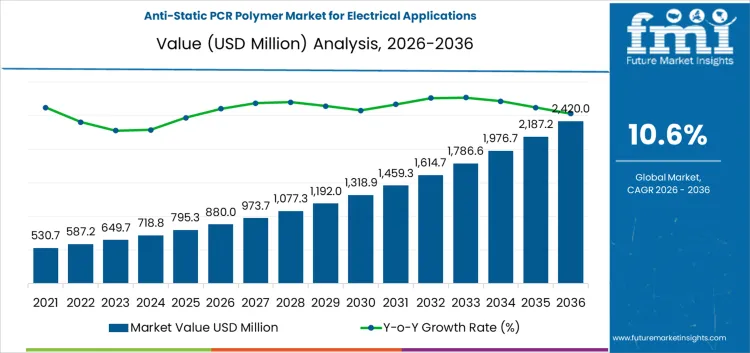
The anti-static PCR polymer market for electrical applications is projected to reach USD 880 million in 2026 and is set to grow to USD 2,420 million by 2036, with a CAGR of 10.6%. This growth is driven by the increasing use of post-consumer recycled (PCR) polymers in electrical and electronic applications, where materials that offer anti-static properties are essential. These PCR polymers are gaining traction due to their ability to meet stringent performance requirements while providing environmental benefits and reducing the reliance on virgin materials.
Anti-static PCR polymers offer critical advantages in electrical applications, such as preventing static charge buildup that can damage sensitive electronic components. As the demand for eco-efficient materials in the electronics industry grows, PCR polymers are becoming a preferred choice due to their enhanced electrical performance and reduced environmental footprint. The growing need for durable, cost-effective, and high-performance materials in the manufacturing of electrical components, cables, and enclosures is expected to drive market growth. Advances in polymer technology are further enhancing the properties of anti-static PCR polymers, expanding their applications and increasing their adoption across the electronics and electrical industries.
Quick Stats for Anti-Static PCR Polymer Market for Electrical Applications
- Anti-Static PCR Polymer Market for Electrical Applications Value (2026): USD 880 million
- Anti-Static PCR Polymer Market for Electrical Applications Forecast Value (2036): USD 2,420 million
- Anti-Static PCR Polymer Market for Electrical Applications Forecast CAGR 2026 to 2036: 10.6%
- Leading Type in Anti-Static PCR Polymer Market for Electrical Applications: Anti-static ABS & PS
- Key Growth Regions in Anti-Static PCR Polymer Market for Electrical Applications: Asia Pacific, North America, Europe
- Top Players in Anti-Static PCR Polymer Market for Electrical Applications: SABIC, Covestro, BASF, Avient, Celanese, Toray, Asahi Kasei, Reliance Industries, SK Chemicals
What is the Growth Forecast for Anti-Static PCR Polymer Market for Electrical Applications through 2036?
The anti-static PCR polymer market for electrical applications is projected to reach USD 880 million in 2026 and grow to USD 2,420 million by 2036, reflecting a compound annual growth rate (CAGR) of 10.6%. From 2020 to 2026, the market grows from USD 480 million in 2020 to USD 880 million in 2026. This growth is driven by the increasing adoption of PCR polymers that meet safety and performance standards for electrical applications, particularly as demand for electrical components continues to rise. North America is expected to maintain strong adoption due to its advanced infrastructure and regulatory requirements, while Asia Pacific shows rapid expansion driven by lower production costs and high-demand manufacturing sectors.
Between 2026 and 2036, the market is forecast to expand from USD 880 million in 2026 to USD 2,420 million by 2036. The growth will be supported by increasing regulatory standards, demand for energy-efficient electrical products, and heightened consumer and industrial concerns about static discharge. In particular, demand for anti-static materials in consumer electronics, automotive, and industrial electrical systems will drive further growth. The market will grow from USD 975 million in 2027 to USD 2.02 billion by 2034, with key drivers including regulatory pressure, evolving consumer preferences, and advances in manufacturing techniques.
Anti-Static PCR Polymer Market for Electrical Applications Key Takeaways
| Metric | Value |
|---|---|
| Market Value (2026) | USD 880 million |
| Forecast Value (2036) | USD 2,420 million |
| Forecast CAGR 2026 to 2036 | 10.6% |
How Is the Anti-Static PCR Polymer Market Supporting Electrical and Electronic Applications?
Anti-static post-consumer recycled (PCR) polymers are increasingly adopted to prevent static charge accumulation and ensure safety in electrical and electronic components. Historically, conventional polymers accumulated static charges, causing dust attraction, electrostatic discharge (ESD), and potential damage to sensitive electronic parts. Modern anti-static PCR polymers integrate conductive additives, surface treatments, or blended compounds to provide consistent electrostatic dissipation while maintaining mechanical strength, dimensional stability, and recyclability. Electrical component manufacturers, consumer electronics producers, and industrial equipment suppliers prioritize surface resistivity, material consistency, and compliance with ESD standards. Early adoption focused on sensitive electronics and precision equipment, while current demand spans consumer devices, automotive electronics, and industrial controls, driven by safety requirements, component protection, and regulatory compliance. Conductivity level, mechanical performance, and thermal stability influence supplier selection.
Increasing use of sensitive electronics, safety standards for ESD, and regulatory compliance are shaping market growth. Compared with conventional plastics, anti-static PCR polymers emphasize static dissipation, mechanical reliability, and compatibility with electrical assemblies. Cost structures depend on polymer sourcing, additive integration, and quality control, concentrating margins among suppliers capable of delivering high-performance, certified materials. Manufacturers adopt these polymers to protect components, maintain product reliability, and comply with industry standards. By 2036, anti-static PCR polymers are expected to become standard in electrical and electronic applications, supporting safety, component integrity, and long-term operational performance.
What Factors Are Shaping the Demand for Anti-Static PCR Polymers for Electrical Applications by Resin System and PCR Feedstock Choice in 2026?
The anti-static PCR polymer market for electrical applications in 2026 is segmented by polymer type and by material feedstock. By resin system, demand is divided into anti-static ABS and PS, ESD PC ABS, anti-static PP and ABS, ESD engineering plastics, and other formulations that differ in mechanical performance and surface resistivity control. By material feedstock, demand is organized around PCR ABS and PCR HIPS, PCR PC blends, general PCR polymers, and other sources that vary in consistency and processing behavior. These segments reflect how compounders and OEMs manage electrostatic discharge risk while meeting molding, appearance, and durability requirements in electrical housings and components.
Why Do Anti-Static ABS and PS Compounds Represent the Largest Polymer Segment?
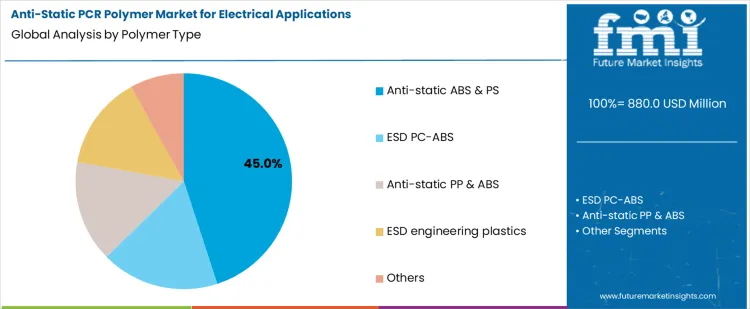
Anti-static ABS and PS account for about 45% of demand in 2026, reflecting their long standing use in electronic enclosures, trays, and handling components. These resins offer a stable balance between stiffness, impact resistance, and surface finish, which makes them easy to qualify for visible parts. Anti-static additives can be dispersed predictably, allowing manufacturers to hit target surface resistivity ranges without complex processing steps. Tooling and molding parameters are well understood, which reduces scrap risk when switching to PCR based formulations. Their broad acceptance across consumer electronics and industrial electrical equipment sustains high volumes and frequent reorders. This combination of processing familiarity and application breadth keeps these compounds as the primary choice.
ESD PC ABS, anti-static PP blends, and other engineering plastics address more demanding mechanical or thermal environments. PC ABS is used where higher heat resistance or toughness is needed, yet it involves tighter process control and higher material cost. PP based systems offer chemical resistance and lower density, though achieving consistent surface conductivity is more challenging. Higher end engineering plastics serve specialized housings and components with stricter performance envelopes. These materials are selected case by case rather than as default options. Their narrower application scope and more complex qualification paths limit their aggregate volume compared with the widely accepted ABS and PS based anti-static compounds.
Why Do PCR ABS and PCR HIPS Dominate Material Feedstock Selection?
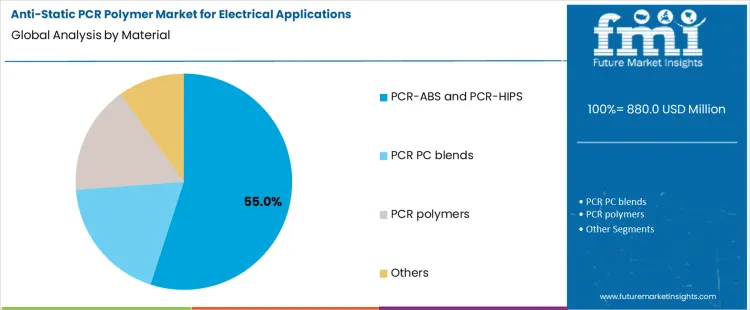
PCR ABS and PCR HIPS represent about 55% of feedstock use in 2026 because they provide the most reliable balance between supply availability and processing consistency. These streams are widely collected from consumer electronics and appliance waste, which supports stable sourcing at scale. Their melt flow and mechanical behavior can be adjusted through compounding to meet enclosure and tray requirements without excessive reformulation. Using these feedstocks also allows manufacturers to keep part geometry and tooling unchanged. In high volume electrical components, this continuity reduces qualification time and production risk. This combination of supply scale, predictable behavior, and tooling compatibility keeps PCR ABS and HIPS as the preferred recycled base materials.
PCR PC blends and mixed PCR polymer streams serve more limited roles. PC streams are less abundant and show greater variability in properties, which increases the need for sorting and blending. Mixed PCR polymers offer cost advantages, yet they require tighter incoming material control to avoid appearance and performance variation. These options are used where performance margins allow or where parts are hidden from view. They remain important for expanding recycled content usage, but their adoption is more selective. This keeps PCR ABS and HIPS as the dominant feedstock choice for anti-static electrical applications.
Why Are ESD Control Requirements and Platform Lock in Driving the Anti-Static PCR Polymer Market for Electrical Applications through 2036?
Demand is anchored in risk management rather than in material experimentation. In electrical enclosures, device housings, and connector systems, electrostatic discharge can destroy components or create latent faults that surface later in the field. As electronics become more compact and sensitive, tolerance for uncontrolled static events keeps shrinking. OEMs therefore specify dissipative or anti-static materials as part of system level protection strategies. Once a polymer grade is qualified for ESD behavior, flammability, and mechanical performance, it remains locked into the platform for years. Using PCR content allows policy compliance without changing the underlying reliability logic. Volume follows equipment production, not substitution enthusiasm.
What Qualification Burden and Performance Consistency Risk Are Slowing Wider Adoption?
The main restraint is engineering exposure. Anti-static behavior depends on formulation stability, humidity, and aging, which makes any material change a reliability risk. Every new PCR based grade requires full electrical, mechanical, and safety requalification, which consumes time and testing budgets. PCR feedstock variability increases uncertainty around batch to batch behavior, something electronics manufacturers are especially sensitive to. In many programs, virgin engineered polymers already meet requirements at predictable cost and performance. Procurement teams are therefore reluctant to accept change unless forced by customer or internal policy. This keeps adoption selective and slow, even where material availability exists.
How Are Material Governance Systems and Portfolio Standardization Changing This Category?
The key trend is institutionalization. Large OEMs are moving toward controlled material libraries where approved polymer families are used across multiple products. Anti-static PCR grades are increasingly qualified as drop in options within these libraries rather than as one off substitutions. This shifts competition toward documentation quality, traceability, and supply stability rather than just resin pricing. Some platforms are designed to accept both virgin and PCR variants under one specification to allow gradual transitions. Over time, demand becomes programmatic and repeatable, tied to platform refresh cycles and corporate material policies instead of isolated sustainability initiatives or ad hoc engineering experiments.
What is the Demand for Anti-Static PCR Polymer for Electrical Applications by Country?
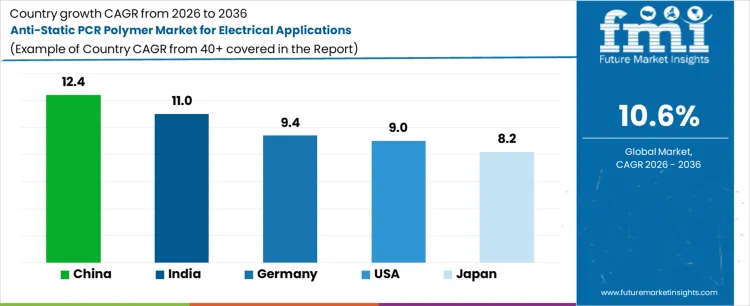
| Country | CAGR (%) |
|---|---|
| China | 12.4% |
| Germany | 9.4% |
| USA | 9.0% |
| Japan | 8.2% |
| India | 11.0% |
Demand for anti-static PCR polymer for electrical applications is rising as manufacturers adopt recycled polymers to improve electrical safety, reduce product defects, and meet regulatory requirements. China leads with a 12.4% CAGR, driven by expanding electronics production and demand for anti-static components. India follows at 11.0%, supported by growth in domestic electrical equipment manufacturing and adoption of PCR polymers. Germany records 9.4% growth, shaped by industrial use of anti-static polymers in electronic assemblies. The USA grows at 9.0%, influenced by replacement demand and integration in electrical devices. Japan shows 8.2% CAGR, reflecting steady adoption in electrical applications and component manufacturing.
How is China experiencing growth in the anti-static PCR polymer market for electrical applications?
China is experiencing growth at a CAGR of 12.4%, driven by rapid expansion of electronics manufacturing hubs in Shenzhen, Shanghai, and Suzhou, where circuit boards, connectors, and consumer electronics are produced at scale. Anti-static PCR polymers are optimized for electrostatic discharge protection, thermal stability, and integration into high-volume production processes. Demand is concentrated in industrial clusters specializing in semiconductors, electronic assemblies, and telecommunications equipment. Investments focus on material consistency, resistance to high temperatures, and compliance with national electrical safety standards. Growth reflects increasing domestic electronics production, rising demand for reliable polymer components, and industrial emphasis on quality control.
- Electronics manufacturing drives adoption.
- Polymers optimize electrostatic discharge protection and thermal stability.
- Industrial clusters concentrate demand.
- Material consistency and safety compliance guide investment.
How is Germany witnessing growth in the anti-static PCR polymer market for electrical applications?
Germany is witnessing growth at a CAGR of 9.4%, supported by the automotive, industrial machinery, and electronics sectors in regions such as Bavaria, Baden-Württemberg, and North Rhine-Westphalia. Anti-static PCR polymers are optimized for use in connectors, housings, and industrial electrical components requiring long-term reliability and ESD protection. Demand is concentrated in automotive electronics suppliers, industrial automation manufacturers, and high-tech facilities. Investments focus on material durability, process precision, and adherence to EU electrical and industrial standards. Growth reflects industrial modernization, precision manufacturing needs, and rising adoption of polymers in high-reliability electrical applications.
- Automotive and industrial sectors drive adoption.
- Polymers enhance reliability and ESD protection.
- High-tech and industrial hubs concentrate demand.
- Material durability and EU compliance guide investment.
How is the United States experiencing growth in the anti-static PCR polymer market for electrical applications?
United States is experiencing growth at a CAGR of 9%, fueled by demand from aerospace, defense electronics, and consumer electronics manufacturers in California, Texas, and Arizona. Anti-static PCR polymers are optimized for electrical insulation, durability, and compatibility with high-performance electronic assemblies. Demand is concentrated in specialized electronics clusters and defense supply chains. Investments prioritize thermal stability, manufacturing precision, and compliance with UL and federal electrical standards. Growth reflects increasing use of polymers in sensitive electronics, expansion of domestic manufacturing, and rising emphasis on reliable, safe electrical components.
- Aerospace and defense electronics drive adoption.
- Polymers optimize insulation and thermal stability.
- Specialized electronics clusters concentrate demand.
- Precision and regulatory compliance guide investment.
How is Japan witnessing growth in the anti-static PCR polymer market for electrical applications?
Japan is witnessing growth at a CAGR of 8.2%, supported by consumer electronics, robotics, and semiconductor industries in Tokyo, Osaka, and Nagoya. Anti-static PCR polymers are optimized for ESD protection, dimensional stability, and high-precision integration into compact electronics. Demand is concentrated in electronics manufacturing facilities, automation equipment producers, and semiconductor assembly centers. Investments focus on product consistency, thermal resistance, and adherence to Japanese industrial and electrical safety standards. Growth reflects high-quality manufacturing requirements, miniaturization of devices, and widespread use of polymers in precision electronics.
- Consumer electronics and robotics drive adoption.
- Polymers enhance ESD protection and dimensional stability.
- Electronics and automation hubs concentrate demand.
- Product consistency and compliance guide investment.
How is India experiencing growth in the anti-static PCR polymer market for electrical applications?
India is experiencing growth at a CAGR of 11%, driven by expansion of electronics manufacturing, automotive component production, and electrical assembly clusters in Bengaluru, Pune, and Gurugram. Anti-static PCR polymers are optimized for thermal performance, ESD resistance, and integration into industrial and consumer electronic devices. Demand is concentrated in electronics parks, industrial clusters, and automotive suppliers. Investments focus on material quality, process efficiency, and compliance with national electrical standards. Growth reflects increasing domestic electronics production, rising adoption of polymers for safe electrical applications, and expansion of industrial clusters.
- Electronics and automotive clusters drive adoption.
- Polymers optimize thermal performance and ESD resistance.
- Industrial and electronics parks concentrate demand.
- Material quality and regulatory compliance guide investment.
What Defines Competition in the Anti-Static PCR Polymer Market for Electrical Applications?
Competition in the anti-static post-consumer recycled (PCR) polymer market for electrical applications is shaped by material performance, electrical safety compliance, and consistency of recycled content. SABIC develops PCR polymer formulations with surface resistivity tailored to dissipate static charge in housings and components, while meeting flame retardancy and dielectric requirements. Covestro and BASF supply engineered PCR resins designed to balance anti-static performance with mechanical strength and thermal stability needed in connectors, enclosures, and cable jackets. Avient and Celanese offer PCR polymer blends with controlled electrostatic properties and compatibility with high-throughput molding processes. Toray and Asahi Kasei provide specialty polymers where anti-static performance is integrated into advanced polymer matrices for electronics and electrical assemblies.
Reliance Industries supplies PCR polymer compounds engineered for static control in electrical parts with focus on sustainable material integration and cost-effective processing. SK Chemicals offers PCR resin solutions with tailored electrical properties suitable for consumer and industrial electrical components. Other regional and specialty suppliers contribute recycled polymer grades optimized for specific resistivity ranges, impact resistance, or heat deflection requirements. Competitive differentiation arises from the ability to deliver stable anti-static performance across varied operating environments, documented compliance with electrical and safety standards (such as UL and IEC), and integration with existing manufacturing processes for electronic and electrical parts. Suppliers with consistent supply chains, robust quality control for PCR feedstock, and technical support for design integration maintain stronger positioning in applications where static discharge prevention, material sustainability, and electrical safety converge.
Key Players in the Anti-Static PCR Polymer Market for Electrical Applications
- SABIC
- Covestro
- BASF
- Avient
- Celanese
- Toray
- Asahi Kasei
- Reliance Industries
- SK Chemicals
Scope of the Report
| Items | Values |
|---|---|
| Quantitative Units (2026) | USD million |
| End-use | ESD-Safe Housings & Connectors, Industrial Electronics, Electrical Enclosures, Precision Electronics, Switchgear & Panels, IT Components |
| Polymer Type | Anti-Static ABS & PS, ESD PC-ABS, Anti-Static PP & ABS, ESD Engineering Plastics, Others |
| Material | PCR-ABS & PCR-HIPS, PCR PC Blends, PCR Polymers, Others |
| Technology | Permanent & Migratory Anti-Static Additives, Conductive Filler Dispersion, Carbon-Based ESD Systems, Tight Resistivity Control, Others |
| Regions Covered | Asia Pacific, Europe, North America, Latin America, Middle East & Africa |
| Countries Covered | China, Japan, South Korea, India, Australia & New Zealand, ASEAN, Germany, United Kingdom, France, Italy, Spain, Nordic, BENELUX, United States, Canada, Mexico, Brazil, Chile, Saudi Arabia, Turkey, South Africa, and other regional markets |
| Key Companies Profiled | SABIC, Covestro, BASF, Avient, Celanese, Toray, Asahi Kasei, Reliance Industries, SK Chemicals |
| Additional Attributes | Dollar sales by end-use, polymer type, material, and technology; anti-static ABS and PS as the leading polymer type; demand driven by ESD protection and electrical safety standards; procurement shaped by UL and IEC compliance; performance influenced by additive dispersion, resistivity control, and PCR feedstock consistency. |
Anti-Static PCR Polymer Market for Electrical Applications Segmentation
End-use:
- ESD-safe housings & connectors
- Industrial electronics
- Electrical enclosures
- Precision electronics
- Switchgear & panels
- IT components
Polymer Type:
- Anti-static ABS & PS
- ESD PC-ABS
- Anti-static PP & ABS
- ESD engineering plastics
- Others
Material:
- PCR-ABS and PCR-HIPS
- PCR PC blends
- PCR polymers
- Others
Technology:
- Permanent & migratory anti-static additives
- Conductive filler dispersion
- Carbon-based ESD systems
- Tight resistivity control
- Others
Region
- Asia Pacific
- China
- Japan
- South Korea
- India
- Australia & New Zealand
- ASEAN
- Rest of Asia Pacific
- Europe
- Germany
- United Kingdom
- France
- Italy
- Spain
- Nordic
- BENELUX
- Rest of Europe
- North America
- United States
- Canada
- Mexico
- Latin America
- Brazil
- Chile
- Rest of Latin America
- Middle East & Africa
- Kingdom of Saudi Arabia
- Other GCC Countries
- Turkey
- South Africa
- Other African Union
- Rest of Middle East & Africa
Bibliography
- International Electrotechnical Commission. (2024). IEC 61340-5-1: Electrostatics - Part 5-1: Protection of electronic devices from electrostatic phenomena - General requirements. IEC.
- International Electrotechnical Commission. (2023). IEC 61340-5-2: Electrostatics - User guide for protection of electronic devices from electrostatic phenomena. IEC.
- Underwriters Laboratories. (2023). UL 94: Tests for flammability of plastic materials for parts in devices and appliances. UL Standards.
- European Commission. (2024). Regulation (EU) 2024/… on ecodesign requirements for sustainable products (ESPR). Publications Office of the European Union.
- European Commission. (2023). Critical raw materials and circular plastics in electrical and electronic equipment. Joint Research Centre (JRC), Publications Office of the European Union.
Frequently Asked Questions
How big is the anti-static pcr polymer market for electrical applications in 2026?
The global anti-static pcr polymer market for electrical applications is estimated to be valued at USD 880.0 million in 2026.
What will be the size of anti-static pcr polymer market for electrical applications in 2036?
The market size for the anti-static pcr polymer market for electrical applications is projected to reach USD 2,420.0 million by 2036.
How much will be the anti-static pcr polymer market for electrical applications growth between 2026 and 2036?
The anti-static pcr polymer market for electrical applications is expected to grow at a 10.6% CAGR between 2026 and 2036.
What are the key product types in the anti-static pcr polymer market for electrical applications?
The key product types in anti-static pcr polymer market for electrical applications are esd-safe housings & connectors, industrial electronics, electrical enclosures, precision electronics, switchgear & panels and it components.
Which polymer type segment to contribute significant share in the anti-static pcr polymer market for electrical applications in 2026?
In terms of polymer type, anti-static abs & ps segment to command 45.0% share in the anti-static pcr polymer market for electrical applications in 2026.
Preview the report firsthand - request a free sample
Get SampleGet the brochure for pricing and purchase details.
Get PDFTable of Content
- Executive Summary
- Global Market Outlook
- Demand-side Trends
- Supply-side Trends
- Technology Roadmap Analysis
- Analysis and Recommendations
- Market Overview
- Market Coverage / Taxonomy
- Market Definition / Scope / Limitations
- Market Background
- Market Dynamics
- Drivers
- Restraints
- Opportunity
- Trends
- Scenario Forecast
- Demand in Optimistic Scenario
- Demand in Likely Scenario
- Demand in Conservative Scenario
- Opportunity Map Analysis
- Product Life Cycle Analysis
- Supply Chain Analysis
- Investment Feasibility Matrix
- Value Chain Analysis
- PESTLE and Porter’s Analysis
- Regulatory Landscape
- Regional Parent Market Outlook
- Production and Consumption Statistics
- Import and Export Statistics
- Market Dynamics
- Global Market Analysis 2021 to 2025 and Forecast, 2026 to 2036
- Historical Market Size Value (USD Million) Analysis, 2021 to 2025
- Current and Future Market Size Value (USD Million) Projections, 2026 to 2036
- Y-o-Y Growth Trend Analysis
- Absolute $ Opportunity Analysis
- Global Market Pricing Analysis 2021 to 2025 and Forecast 2026 to 2036
- Global Market Analysis 2021 to 2025 and Forecast 2026 to 2036, By End-use
- Introduction / Key Findings
- Historical Market Size Value (USD Million) Analysis By End-use , 2021 to 2025
- Current and Future Market Size Value (USD Million) Analysis and Forecast By End-use , 2026 to 2036
- ESD-safe housings & connectors
- Industrial electronics
- Electrical enclosures
- Precision electronics
- Switchgear & panels
- IT components
- ESD-safe housings & connectors
- Y-o-Y Growth Trend Analysis By End-use , 2021 to 2025
- Absolute $ Opportunity Analysis By End-use , 2026 to 2036
- Global Market Analysis 2021 to 2025 and Forecast 2026 to 2036, By Polymer Type
- Introduction / Key Findings
- Historical Market Size Value (USD Million) Analysis By Polymer Type, 2021 to 2025
- Current and Future Market Size Value (USD Million) Analysis and Forecast By Polymer Type, 2026 to 2036
- Anti-static ABS & PS
- ESD PC-ABS
- Anti-static PP & ABS
- ESD engineering plastics
- Others
- Anti-static ABS & PS
- Y-o-Y Growth Trend Analysis By Polymer Type, 2021 to 2025
- Absolute $ Opportunity Analysis By Polymer Type, 2026 to 2036
- Global Market Analysis 2021 to 2025 and Forecast 2026 to 2036, By Material
- Introduction / Key Findings
- Historical Market Size Value (USD Million) Analysis By Material, 2021 to 2025
- Current and Future Market Size Value (USD Million) Analysis and Forecast By Material, 2026 to 2036
- PCR-ABS and PCR-HIPS
- PCR PC blends
- PCR polymers
- Others
- PCR-ABS and PCR-HIPS
- Y-o-Y Growth Trend Analysis By Material, 2021 to 2025
- Absolute $ Opportunity Analysis By Material, 2026 to 2036
- Global Market Analysis 2021 to 2025 and Forecast 2026 to 2036, By Technology
- Introduction / Key Findings
- Historical Market Size Value (USD Million) Analysis By Technology, 2021 to 2025
- Current and Future Market Size Value (USD Million) Analysis and Forecast By Technology, 2026 to 2036
- Permanent & migratory anti-static additives
- Conductive filler dispersion
- Carbon-based ESD systems
- Tight resistivity control
- Others
- Permanent & migratory anti-static additives
- Y-o-Y Growth Trend Analysis By Technology, 2021 to 2025
- Absolute $ Opportunity Analysis By Technology, 2026 to 2036
- Global Market Analysis 2021 to 2025 and Forecast 2026 to 2036, By 0.34
- Introduction / Key Findings
- Historical Market Size Value (USD Million) Analysis By 0.34, 2021 to 2025
- Current and Future Market Size Value (USD Million) Analysis and Forecast By 0.34, 2026 to 2036
- 0.28
- 0.22
- 0.08
- 0.04
- 0.02
- 0.28
- Y-o-Y Growth Trend Analysis By 0.34, 2021 to 2025
- Absolute $ Opportunity Analysis By 0.34, 2026 to 2036
- Global Market Analysis 2021 to 2025 and Forecast 2026 to 2036, By Region
- Introduction
- Historical Market Size Value (USD Million) Analysis By Region, 2021 to 2025
- Current Market Size Value (USD Million) Analysis and Forecast By Region, 2026 to 2036
- North America
- Latin America
- Western Europe
- Eastern Europe
- East Asia
- South Asia and Pacific
- Middle East & Africa
- Market Attractiveness Analysis By Region
- North America Market Analysis 2021 to 2025 and Forecast 2026 to 2036, By Country
- Historical Market Size Value (USD Million) Trend Analysis By Market Taxonomy, 2021 to 2025
- Market Size Value (USD Million) Forecast By Market Taxonomy, 2026 to 2036
- By Country
- USA
- Canada
- Mexico
- By End-use
- By Polymer Type
- By Material
- By Technology
- By 0.34
- By Country
- Market Attractiveness Analysis
- By Country
- By End-use
- By Polymer Type
- By Material
- By Technology
- By 0.34
- Key Takeaways
- Latin America Market Analysis 2021 to 2025 and Forecast 2026 to 2036, By Country
- Historical Market Size Value (USD Million) Trend Analysis By Market Taxonomy, 2021 to 2025
- Market Size Value (USD Million) Forecast By Market Taxonomy, 2026 to 2036
- By Country
- Brazil
- Chile
- Rest of Latin America
- By End-use
- By Polymer Type
- By Material
- By Technology
- By 0.34
- By Country
- Market Attractiveness Analysis
- By Country
- By End-use
- By Polymer Type
- By Material
- By Technology
- By 0.34
- Key Takeaways
- Western Europe Market Analysis 2021 to 2025 and Forecast 2026 to 2036, By Country
- Historical Market Size Value (USD Million) Trend Analysis By Market Taxonomy, 2021 to 2025
- Market Size Value (USD Million) Forecast By Market Taxonomy, 2026 to 2036
- By Country
- Germany
- UK
- Italy
- Spain
- France
- Nordic
- BENELUX
- Rest of Western Europe
- By End-use
- By Polymer Type
- By Material
- By Technology
- By 0.34
- By Country
- Market Attractiveness Analysis
- By Country
- By End-use
- By Polymer Type
- By Material
- By Technology
- By 0.34
- Key Takeaways
- Eastern Europe Market Analysis 2021 to 2025 and Forecast 2026 to 2036, By Country
- Historical Market Size Value (USD Million) Trend Analysis By Market Taxonomy, 2021 to 2025
- Market Size Value (USD Million) Forecast By Market Taxonomy, 2026 to 2036
- By Country
- Russia
- Poland
- Hungary
- Balkan & Baltic
- Rest of Eastern Europe
- By End-use
- By Polymer Type
- By Material
- By Technology
- By 0.34
- By Country
- Market Attractiveness Analysis
- By Country
- By End-use
- By Polymer Type
- By Material
- By Technology
- By 0.34
- Key Takeaways
- East Asia Market Analysis 2021 to 2025 and Forecast 2026 to 2036, By Country
- Historical Market Size Value (USD Million) Trend Analysis By Market Taxonomy, 2021 to 2025
- Market Size Value (USD Million) Forecast By Market Taxonomy, 2026 to 2036
- By Country
- China
- Japan
- South Korea
- By End-use
- By Polymer Type
- By Material
- By Technology
- By 0.34
- By Country
- Market Attractiveness Analysis
- By Country
- By End-use
- By Polymer Type
- By Material
- By Technology
- By 0.34
- Key Takeaways
- South Asia and Pacific Market Analysis 2021 to 2025 and Forecast 2026 to 2036, By Country
- Historical Market Size Value (USD Million) Trend Analysis By Market Taxonomy, 2021 to 2025
- Market Size Value (USD Million) Forecast By Market Taxonomy, 2026 to 2036
- By Country
- India
- ASEAN
- Australia & New Zealand
- Rest of South Asia and Pacific
- By End-use
- By Polymer Type
- By Material
- By Technology
- By 0.34
- By Country
- Market Attractiveness Analysis
- By Country
- By End-use
- By Polymer Type
- By Material
- By Technology
- By 0.34
- Key Takeaways
- Middle East & Africa Market Analysis 2021 to 2025 and Forecast 2026 to 2036, By Country
- Historical Market Size Value (USD Million) Trend Analysis By Market Taxonomy, 2021 to 2025
- Market Size Value (USD Million) Forecast By Market Taxonomy, 2026 to 2036
- By Country
- Kingdom of Saudi Arabia
- Other GCC Countries
- Turkiye
- South Africa
- Other African Union
- Rest of Middle East & Africa
- By End-use
- By Polymer Type
- By Material
- By Technology
- By 0.34
- By Country
- Market Attractiveness Analysis
- By Country
- By End-use
- By Polymer Type
- By Material
- By Technology
- By 0.34
- Key Takeaways
- Key Countries Market Analysis
- USA
- Pricing Analysis
- Market Share Analysis, 2025
- By End-use
- By Polymer Type
- By Material
- By Technology
- By 0.34
- Canada
- Pricing Analysis
- Market Share Analysis, 2025
- By End-use
- By Polymer Type
- By Material
- By Technology
- By 0.34
- Mexico
- Pricing Analysis
- Market Share Analysis, 2025
- By End-use
- By Polymer Type
- By Material
- By Technology
- By 0.34
- Brazil
- Pricing Analysis
- Market Share Analysis, 2025
- By End-use
- By Polymer Type
- By Material
- By Technology
- By 0.34
- Chile
- Pricing Analysis
- Market Share Analysis, 2025
- By End-use
- By Polymer Type
- By Material
- By Technology
- By 0.34
- Germany
- Pricing Analysis
- Market Share Analysis, 2025
- By End-use
- By Polymer Type
- By Material
- By Technology
- By 0.34
- UK
- Pricing Analysis
- Market Share Analysis, 2025
- By End-use
- By Polymer Type
- By Material
- By Technology
- By 0.34
- Italy
- Pricing Analysis
- Market Share Analysis, 2025
- By End-use
- By Polymer Type
- By Material
- By Technology
- By 0.34
- Spain
- Pricing Analysis
- Market Share Analysis, 2025
- By End-use
- By Polymer Type
- By Material
- By Technology
- By 0.34
- France
- Pricing Analysis
- Market Share Analysis, 2025
- By End-use
- By Polymer Type
- By Material
- By Technology
- By 0.34
- India
- Pricing Analysis
- Market Share Analysis, 2025
- By End-use
- By Polymer Type
- By Material
- By Technology
- By 0.34
- ASEAN
- Pricing Analysis
- Market Share Analysis, 2025
- By End-use
- By Polymer Type
- By Material
- By Technology
- By 0.34
- Australia & New Zealand
- Pricing Analysis
- Market Share Analysis, 2025
- By End-use
- By Polymer Type
- By Material
- By Technology
- By 0.34
- China
- Pricing Analysis
- Market Share Analysis, 2025
- By End-use
- By Polymer Type
- By Material
- By Technology
- By 0.34
- Japan
- Pricing Analysis
- Market Share Analysis, 2025
- By End-use
- By Polymer Type
- By Material
- By Technology
- By 0.34
- South Korea
- Pricing Analysis
- Market Share Analysis, 2025
- By End-use
- By Polymer Type
- By Material
- By Technology
- By 0.34
- Russia
- Pricing Analysis
- Market Share Analysis, 2025
- By End-use
- By Polymer Type
- By Material
- By Technology
- By 0.34
- Poland
- Pricing Analysis
- Market Share Analysis, 2025
- By End-use
- By Polymer Type
- By Material
- By Technology
- By 0.34
- Hungary
- Pricing Analysis
- Market Share Analysis, 2025
- By End-use
- By Polymer Type
- By Material
- By Technology
- By 0.34
- Kingdom of Saudi Arabia
- Pricing Analysis
- Market Share Analysis, 2025
- By End-use
- By Polymer Type
- By Material
- By Technology
- By 0.34
- Turkiye
- Pricing Analysis
- Market Share Analysis, 2025
- By End-use
- By Polymer Type
- By Material
- By Technology
- By 0.34
- South Africa
- Pricing Analysis
- Market Share Analysis, 2025
- By End-use
- By Polymer Type
- By Material
- By Technology
- By 0.34
- USA
- Market Structure Analysis
- Competition Dashboard
- Competition Benchmarking
- Market Share Analysis of Top Players
- By Regional
- By End-use
- By Polymer Type
- By Material
- By Technology
- By 0.34
- Competition Analysis
- Competition Deep Dive
- SABIC
- Overview
- Product Portfolio
- Profitability by Market Segments (Product/Age /Sales Channel/Region)
- Sales Footprint
- Strategy Overview
- Marketing Strategy
- Product Strategy
- Channel Strategy
- Covestro
- BASF
- Avient
- Celanese
- Toray
- Asahi Kasei
- Reliance Industries
- SK Chemicals
- SABIC
- Competition Deep Dive
- Assumptions & Acronyms Used
- Research Methodology


