

- Market Size (2026)
- USD 4.4 Bn
- Forecast (2036)
- USD 9.3 Bn
- CAGR (2026 to 2036)
- 7.7%
Dairy Processing Sludge and Whey Stream Resource Recovery in EU Industry Size, Market Forecast and Outlook by FMI
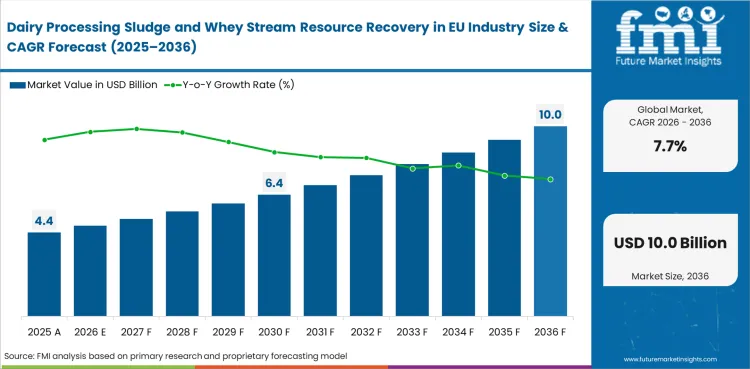
Market value of dairy processing sludge and whey stream resource recovery in EU industry is estimated at USD 4.1 billion in 2025. By 2026, the market is projected to rise to a valuation of USD 4.4 billion and to USD 9.3 billion by 2036, which implies a 7.7% CAGR.
Summary of Dairy Processing Sludge and Whey Stream Resource Recovery in EU Industry
- Market value is projected at USD 4.4 billion in 2026 and reaches USD 9.3 billion by 2036 across EU dairy recovery operations.
- Forecast expansion stands at 7.7% CAGR from 2026 to 2036 with USD 4.9 billion incremental opportunity over ten years.
- Baseline value for 2025 is estimated at USD 4.1 billion using EU dairy output and recovery-intensity modeling.
- Sweet whey is expected to account for 43.0% share in 2026 within stream source segmentation.
- Membranes are projected to contribute 36.0% share in 2026 within recovery technology segmentation.
- Protein ingredients are anticipated to represent 31.0% share in 2026 within recovered output segmentation.
- Food ingredients are likely to secure 47.0% share in 2026 within end-use segmentation.
- Direct systems are set to make up 52.0% share in 2026 within project format segmentation.
- Ireland, Poland, and the Netherlands are expected to are the fastest-rising national demand centers across the study period.
Key Takeaways, Market Size, and Forecast
- Dairy Processing Sludge and Whey Stream Resource Recovery in EU Industry is projected to grow from USD 4.4 billion in 2026 to USD 9.3 billion by 2036, at a CAGR of 7.7%.
- The dairy processing sludge and whey stream resource recovery in EU industry was valued at USD 4.1 billion in 2025.
- By 2036, the Dairy Processing Sludge and Whey Stream Resource Recovery in EU Industry is expected to be worth USD 9.3 billion.
- From 2026 to 2036, the industry is anticipated to expand at a CAGR of 7.7%.
- The industry is predicted to create an incremental opportunity of USD 4.9 billion between 2026 and 2036.
- In 2026, Sweet Whey is expected to account for 43.0% of the stream source segment.
- Ireland (8.4%) and Poland (8.1%) are projected to be two of the fastest growing markets.
Dairy Processing Sludge and Whey Stream Resource Recovery in EU Industry Key Takeaways
| Parameter | Details |
|---|---|
| Market value (2026) | USD 4.4 billion |
| Forecast value (2036) | USD 9.3 billion |
| CAGR (2026 to 2036) | 7.7% |
| Estimated market value (2025) | USD 4.1 billion |
| Incremental opportunity | USD 4.9 billion |
| Leading stream source | Sweet whey - 43.0% share |
| Leading recovery technology | Membranes - 36.0% share |
| Leading recovered output | Protein ingredients - 31.0% share |
| Leading end use | Food ingredients - 47.0% share |
| Leading project format | Direct systems - 52.0% share |
| Key players | GEA Group, Tetra Pak, Alfa Laval, ANDRITZ, Veolia Water Technologies, SPX FLOW, FrieslandCampina Ingredients |
Source: Future Market Insights, 2026
creates USD 4.9 billion of incremental opportunity across the forecast period. EU cheese output and whey availability is the main volume anchors for this outlook, while higher product values in whey protein, lactose, and dairy filtration systems keep recovery spending commercially visible across larger dairy plants and selective retrofit programs.
Value creation in this market comes from better conversion of side streams into products with stronger resale economics. Plants able to pair concentration, drying, and reuse programs around condensed whey and demineralized whey powder ingredient usually capture more value than sites focused only on disposal reduction. Recovery quality is now a stronger decision factor than simple throughput. Product purity plays a central role in determining project returns. Line uptime is equally important for maintaining consistent output. Wash cycle efficiency further influences performance across whey solids recovery, water reuse, and sludge handling. This keeps integrated engineering support central for larger processors planning multi-stage upgrades.
Country demand exhibitss a mixed pattern across the EU. Ireland is estimated to expand at 8.4% CAGR through 2036, while Poland is projected at 8.1% CAGR and the Netherlands at 7.9% CAGR. Spain is expected to post 7.4% CAGR and Italy 7.2% CAGR as both markets gain from rising throughput and tighter water economics. France at 6.8% CAGR and Germany, at 6.6% CAGR is large installed bases with a stronger emphasis on upgrades across dairy processing systems rather than first-time deployment.
Dairy Processing Sludge and Whey Stream Resource Recovery in EU Industry Definition
Dairy processing sludge and whey stream resource recovery in EU industry covers equipment, process systems, software-linked controls, and recovery services used to convert whey streams and dairy sludge into saleable products or reusable plant resources across the European Union. Scope includes product recovery, energy recovery, nutrient recovery, and water reuse linked directly to dairy processing operations.
Dairy Processing Sludge and Whey Stream Resource Recovery in EU Industry Inclusions
Included within scope are sweet whey and acid whey concentration, whey protein recovery, lactose extraction, evaporation, spray drying, sludge digestion, nutrient capture, biomethane-linked upgrades, reclaimed water systems, and retrofit work linked directly to recovery performance. Service contracts and plant integration support tied to recovery outcomes are also included.
Dairy Processing Sludge and Whey Stream Resource Recovery in EU Industry Exclusions
Excluded from scope are generic dairy assets with no recovery function, including standard pasteurizers, filling lines, secondary packaging systems, and plant automation unrelated to side-stream value capture. Municipal sludge treatment outside dairy facilities and consumer sales of finished dairy products also stay outside the market boundary.
Dairy Processing Sludge and Whey Stream Resource Recovery in EU Industry Research Methodology
- Primary Research involved supplier activity checks, official company releases, plant implementation cases, and verification of current participation in whey valorization, sludge recovery, and water reuse across EU dairy operations.
- Desk Research used non-commercial anchors from USDA, the European Biogas Association, national statistical bodies, and sector organizations covering milk intake, cheese output, whey availability, and biomethane infrastructure.
- Market Sizing and Forecasting applied a hybrid bottom-up and top-down model linking dairy output volumes with recovery adoption and cross-checking results against adjacent processing and treatment segments.
- Data Validation and Update Cycle pressure-tested forecast assumptions against country conditions, official releases after January 2024, and recent installation or upgrade activity across the supplier base.
Why Is the Dairy Processing Sludge and Whey Stream Resource Recovery in EU Industry Expanding?
- Cheese-led whey generation across the EU keeps recoverable liquid streams visible for plants with steady throughput and ingredient ambitions.
- Utility pressure is pushing dairies toward water reuse and sludge energy recovery inside the same capital review cycle.
- Higher values for upgraded whey solids support investment in premium outputs with stronger resale economics.
Cheese output across the European Union continues to anchor recoverable whey volumes for this market. Large dairy plants hold the strongest position as steady stream flow supports better utilization for whey protein ingredients and whey basic proteinp isolates. Premium solids usually secure the first investment case while water reuse or sludge handling enter later after processors seek wider plant payback.
Utilities pressure adds a second investment layer across older dairy facilities and newer processing sites. GEA reinforced this direction in November 2024 through its Ammerland deployment which lowered water use and energy demand during membrane cleaning. Plants increasingly review biogas and biomethane options alongside whey recovery as wet organic streams support broader resource recovery programs. This wider project view helps processors connect yield improvement with utility savings across the same operating plan.
Segmental Analysis
- Sweet whey is anticipated to lead stream source demand with 43.0% share in 2026 across EU dairy recovery systems.
- Food ingredients and protein ingredients are expected to be the largest end-use and output pools during 2026.
- Direct systems are projected to stay ahead in project format as large plants prefer integrated supplier-led execution.
Segment patterns in this market reflect plant economics more directly than downstream food demand across the European Union. Stream source sets solids load and sets the initial ceiling for product recovery inside each facility. Recovery technology shapes how processors separate proteins and minerals while managing water or sludge flows. Recovered output and end use reflect how earnings are distributed after concentration or reuse work. Project format then explains how processors procure systems and organize installation across new sites or retrofit programs.
Insights into the Stream Source Segment
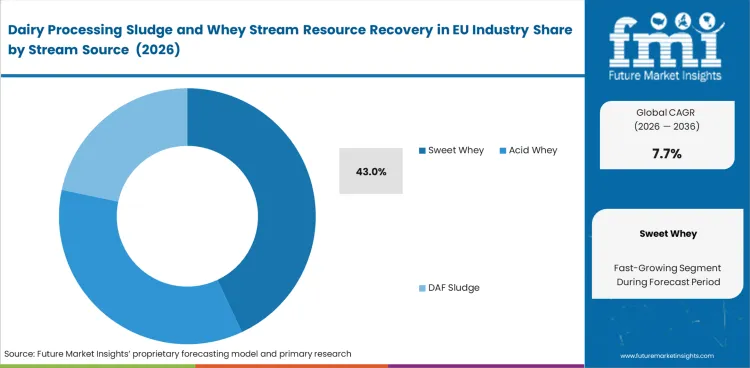
Sweet whey leads stream source demand across the region as cheese-heavy plants generate more usable recovery volumes. In 2026 sweet whey is expected to account for 43.0% share in stream source demand. Its composition is easier to process and supports better alignment with protein extraction or powder production. Acid whey keeps an important place in cultured dairy output though recovery returns are usually less direct. Arla Foods Ingredients addressed this issue in May 2025 through a yield concept targeting earlier acid whey control in plant design.
Insights into the Recovery Technology Segment
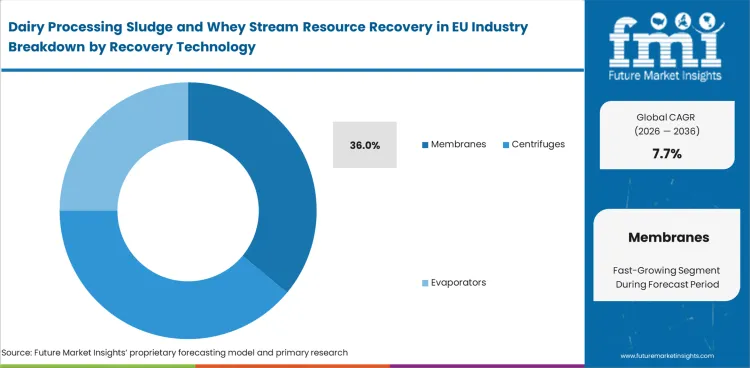
Membranes hold the leading technology position across dairy recovery since separation begins with controlled concentration and solids handling. Processors rely on membrane microfiltration for premium product streams and better purity across delicate applications. Market estimates place membranes at 36.0% share in 2026 within recovery technology across this market. Dutch dairy conditions reinforce this lead as cheese output keeps sweet whey flow dense across large sites. Such operating conditions support concentration and reuse projects with better asset use across ingredient-oriented facilities.
Insights into the Recovered Output Segment
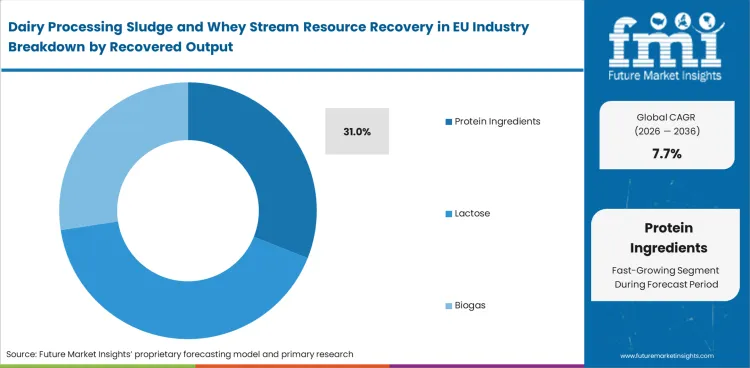
Protein ingredients stay ahead in recovered output as captured solids earn more than untreated liquid handling. Nutrition programs across sports and infant formulas keep premium whey fractions commercially attractive for processors. Ingredient-focused suppliers continue to position recovered whey solids as premium nutritional inputs across specialized formulations. Protein ingredients are anticipated to represent 31.0% share of recovered output in 2026 across the European Union. Recovery work aligned with demand for lactose in EU can widen earnings once the extraction performance improves.
Insights into the End Use Segment
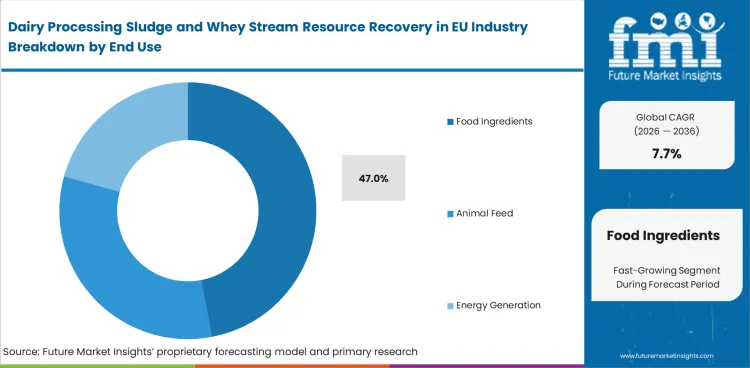
Food ingredients is the largest destination pool for recovered dairy solids across the European Union. Higher returns from nutritional solids and specialty powders keep this end use at the front of investment review across many dairy plants. Food ingredients are likely to secure 47.0% share in 2026 across this market. Processors usually assess product recovery before lower-value energy conversion or nutrient recovery options. This pattern reflects stronger earnings potential from ingredients with wider use across nutrition and food manufacturing applications.
Insights into the Project Format Segment
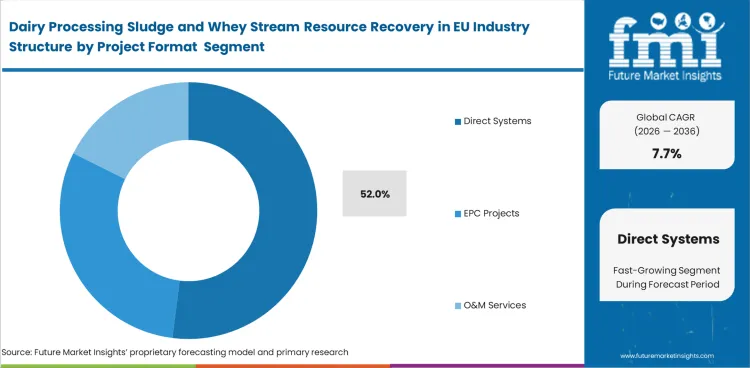
Direct systems are expected to make up 52.0% share in 2026 as large dairies prefer one lead supplier across connected work. Recovery projects often combine utilities integration and controls support with service coverage inside the same installation. Coordination grows harder as concentration equipment and reuse equipment interact inside one active operating facility. Sites planning new spray dryer capacity often pair this spending with whey upgrading or wastewater improvement. Retrofit services and toll processing hold a useful role for smaller dairies though direct systems define core spending. Taken together these segment patterns reveal why plant conditions and output value guide spending across EU recovery programs.
What Are the Drivers, Restraints, and Key Trends in the Dairy Processing Sludge and Whey Stream Resource Recovery in EU Industry?
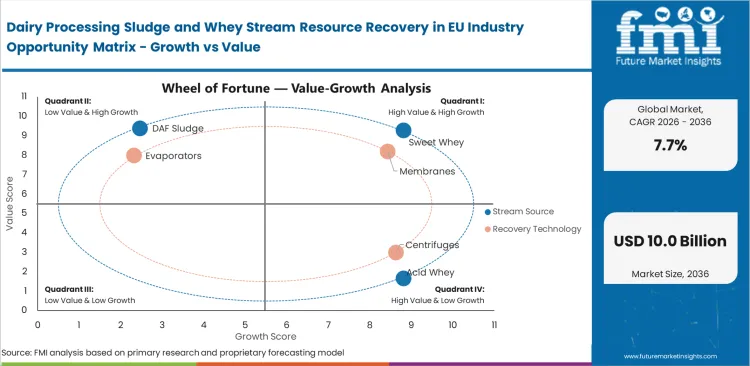
- High whey volumes and stronger pricing for premium solids keep recovery spending visible across large dairy operations.
- Older plants face heavier retrofit cost and greater contamination exposure across mixed or variable streams.
- Water reuse, sludge digestion, and digital cleaning tools are increasingly reviewed inside one plant-efficiency program.
Plant economics and operating discipline shape this market more than simple disposal concerns. Whey recovery can support strong returns in suitable assets, while project economics improve further once wastewater load and utility savings are reviewed together. Stream quality varies across cheese and cultured dairy production, which changes output value and project performance across similar facilities. Older lines also face harder integration work around hygienic design and downtime control. Suppliers with stronger yield support and plant compatibility usually hold the better position across complex recovery programs.
Compliance Pressure and Water Handling
Discharge pressure does not drive every project, yet it often advances investment timing across water-intensive dairy plants. Sites facing tighter treatment burdens usually review ingredient recovery and reclaimed water inside one capital plan. Veolia’s Centre of Excellence in Ireland reinforced this direction during 2024 through direct emphasis on recycling and reuse-led recovery. Plants comparing upgrades often assess water treatment alongside product recovery instead of separating both discussions. Suppliers with broader engineering coverage usually gain more traction across sites carrying high organic load and frequent wash cycles.
Premium Output Development
Project value is moving away from disposal avoidance and toward better end products from the same incoming stream. SPX FLOW introduced its APV Combi MP pilot in October 2025 and lowered barriers for processors testing functional whey proteins before full-scale commitment. FrieslandCampina Ingredients also pointed toward richer output pools through its Wisconsin Whey Protein acquisition plan. Such activity improves confidence around premium product programs and supports review through lactose market share analysis. Plants with pilot access and application support usually enter higher-margin product forms faster than operators limited to commodity output.
Wider Access for Mid-Sized Plants
Large processors keep an advantage, although recovery investment no longer belongs only to the biggest ingredient sites. Mid-sized plants can now examine digestion and selective concentration work with stronger support from the wider EU installed base. Poland’s dairy exports reached nearly EUR 2.1 billion in the first half of 2025 and rose 14% year on year. Wider adoption of anaerobic digestion equipment across Europe expands the number of workable project formats. More processors can now justify at least one recovery stage without full ingredient-scale capacity. This shift supports a broader buyer base and leaves the market with a more practical path for phased adoption.
Analysis of Dairy Processing Sludge and Whey Stream Resource Recovery in EU Industry by Key Countries
- Ireland is expected to register 8.4% CAGR through 2036 as milk intake and export-oriented processing keep stream volumes rising.
- Poland is projected to post 8.1% CAGR with stronger export performance and newer installed capacity supporting value-oriented upgrades.
- The Netherlands is forecast at 7.9% CAGR as its cheese-heavy mix keeps sweet whey concentration commercially attractive.
- France and Germany are large demand bases, though both expand below 7.0% as upgrade work outweighs first-time deployment.
.webp "Top Country Growth Comparison Dairy Processing Sludge And Whey Stream Resource Recovery In Eu Industry Cagr (2026 2036)")
| Country | CAGR |
|---|---|
| Ireland | 8.4% |
| Poland | 8.1% |
| Netherlands | 7.9% |
| Spain | 7.4% |
| Italy | 7.2% |
| France | 6.8% |
| Germany | 6.6% |
Source: FMI analysis based on primary research and proprietary forecasting model
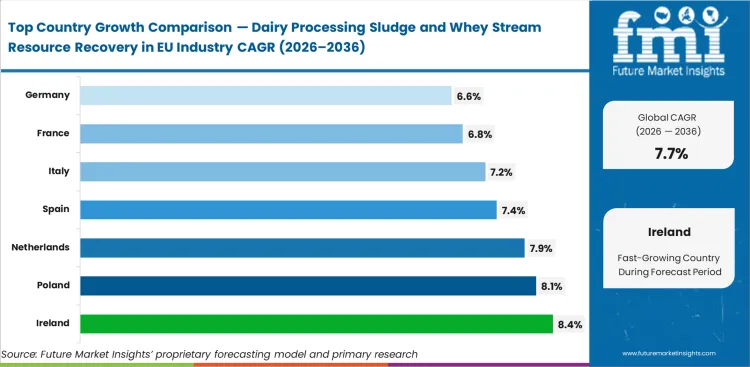
Country performance follows dairy mix more closely than population or GDP. Cheese-heavy systems create more predictable sweet whey flow, while rising intake or export activity improves confidence around new project spending. Mature territories such as Germany and France generate large absolute demand, though installed-base maturity reduces forecast pace for first-time builds. Ireland and Poland retain stronger upside as processors continue adding recovery intensity across throughput expansion, product quality, and utility management.
Demand Outlook for Dairy Processing Sludge and Whey Stream Resource Recovery in EU Industry in Ireland
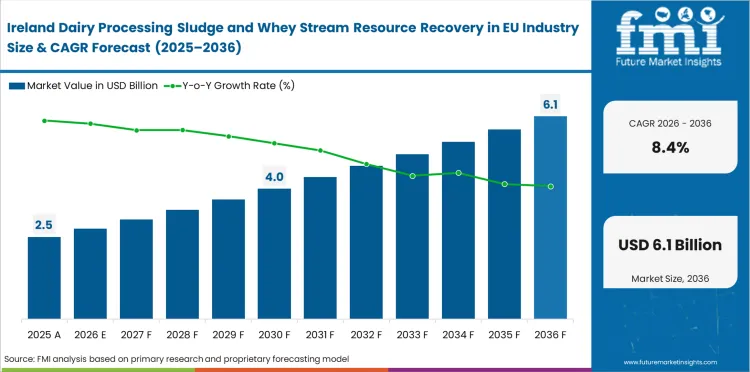
Ireland iss one of the strongest national opportunities in this study across dairy recovery investment. Domestic milk intake reached 8.84 billion liters in 2025 and lifted available whey volumes across major processing sites. Higher intake also raised effluent pressure and pushed processors toward stronger recovery planning inside large plants. Demand in Ireland is expected to rise at a CAGR of 8.4% through 2036 across this segment. Export-oriented dairy groups place more value on premium solids and lower wastewater burden across nutrition and ingredient programs. Projects using anaerobic digester digestate upgrading additive can widen value capture across plants already running digestion programs.
- Munster continues to attract larger recovery projects through concentrated milk processing and export-oriented dairy investment.
- Rising intake increases both available whey volumes and treatment burden across high-throughput dairy sites locally.
- Export-focused processors often favor premium solids recovery earlier than smaller regional operators handling mixed production lines.
Sales Analysis of Dairy Processing Sludge and Whey Stream Resource Recovery in EU Industry in Poland
Poland combines a stronger dairy trade with room for more recovery intensity across newer processing assets. Poland is projected to record 8.1% CAGR during the forecast period in dairy sludge and whey recovery demand. Export exposure supports investment in product quality and tighter side-stream control across expanding dairy plants. Plants with better wash performance and selective concentration work can capture more value from rising shipments. Stronger process support from membrane chemicals can also improve uptime and product consistency across expanding dairy sites.
- Mazowieckie and Podlaskie are key dairy regions for plant upgrades and new recovery-related investment programs.
- Export expansion improves the case for higher-value recovery instead of lower-return disposal-focused handling methods.
- Newer assets allow phased filtration and reuse work with less disruption across active processing sites.
In-Depth Analysis of Dairy Processing Sludge and Whey Stream Resource Recovery in EU Industry in the Netherlands
Dutch dairy processing offers one of the best operating mixes for whey recovery across the European Union. Cheese concentration keeps the whey flow regular and helps processors justify separation and drying systems more easily. The Netherlands is set to expand at 7.9% CAGR through 2036 across this industry. Large ingredient and cheese sites also maintain high technical discipline across purity-focused production programs.
- Cheese-heavy production keeps sweet whey volumes regular across major Dutch dairy processing facilities.
- Large processors are well placed for membrane upgrades and linked drying or reuse projects.
- Export-oriented dairy groups support reliable demand for premium recovered solids across nutrition-focused operations.
Dairy Processing Sludge and Whey Stream Resource Recovery in EU Industry Analysis in Spain
Spain is advancing through a measured expansion pattern instead of abrupt build cycles across dairy recovery assets. Stable stream volumes support continued review of reuse systems and digestion-linked investment across active dairy plants. Utility pressure also strengthens project interest across larger plants handling rising liquid loads each year. Spain is likely to increase at a CAGR of 7.4% in this sector over the forecast years. Processors with better separation and wash control can improve yield while easing treatment pressure across sites.
- Galicia anchors a large share of Spanish milk collection and supports visible recovery investment activity.
- Water efficiency has greater value across plants facing heavier utility bills and stricter handling pressure.
- Measured capacity additions support staged upgrades instead of immediate large-scale plant rebuilding programs.
Industry Analysis of Dairy Processing Sludge and Whey Stream Resource Recovery in EU Industry in Italy
Italy brings a strong raw-material-cost focus into project decisions across dairy recovery investment. Higher milk values sharpen attention on solids loss and avoidable treatment cost across ingredient and cheese plants. Recovery projects often begin with product yield protection and later expand into water reuse or energy conversion. Northern cheese-producing districts are the main base for larger projects linked with higher-value side-stream use. Italy is forecast to post 7.2% CAGR from 2026 to 2036 in the whey and sludge recovery demand.
- Northern cheese belts are the strongest base for dairy recovery demand across Italian processing operations.
- Higher milk values strengthen the financial case for solids capture and tighter wash-cycle management.
- Many processors first assess recovery as yield protection before adding broader utility-focused improvement work.
Demand Outlook for Dairy Processing Sludge and Whey Stream Resource Recovery in EU Industry in France
France combines large industrial depth with a more mature processing base across dairy recovery activity. Large scale across food and dairy manufacturing keeps filtration and reuse demand commercially visible. Many processors already operate concentration or treatment assets across long-established dairy networks. Current investment therefore leans more toward modernization and selective extension work inside existing sites. France is expected to register 6.8% CAGR through 2036 across this industry.
- Normandy and western France form the main processing belt for recovery-related dairy investment.
- Installed asset maturity reduces forecast pace yet keeps modernization demand substantial across large plants.
- Diverse dairy portfolios support ongoing filtration and reuse projects across major French processing groups.
Dairy Processing Sludge and Whey Stream Resource Recovery in EU Industry Analysis in Germany
Germany stays central through processing scale and a very large milk base across the European Union. Many large plants already operate whey systems and wastewater assets across established dairy operations. Current spending therefore leans toward upgrades in digital cleaning and selective solids capture programs. Engineering-heavy projects usually focus on better performance inside installed assets instead of first-entry deployment. Bavaria and Lower Saxony continue to anchor much of the country’s dairy processing investment profile. Adoption across Germany is anticipated to rise at 6.6% CAGR during the study period.
- Bavaria and Lower Saxony are important centers for dairy processing and related recovery investment.
- Mature installed assets shift buyer focus toward upgrades instead of broad first-time system adoption.
- Efficiency tools gain wider interest as processors seek better returns from existing dairy plant infrastructure.
Competitive Landscape of Dairy Processing Sludge and Whey Stream Resource Recovery in EU Industry
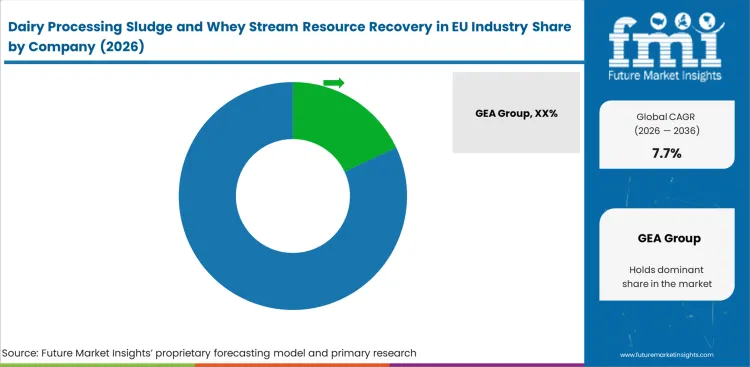
- Market structure iss moderately fragmented across equipment suppliers, water specialists, and ingredient-focused dairy groups.
- Large incumbents compete on integration depth, hygienic process design, service coverage, and plant compatibility across more than one recovery stage.
- Specialist firms are competitive in pilot work, application support, and project-specific product recovery tasks.
Competitive Aligners
Competition follows each supplier’s place in dairy recovery work and the value captured from upgraded outputs. GEA and Alfa Laval compete through separation and concentration across large dairy installations. ANDRITZ and SPX FLOW add strength in drying work and process execution across demanding plant programs. Tetra Pak and Veolia Water Technologies hold stronger positions in projects linking recovery systems with utilities and wastewater control.
Large suppliers usually perform best in projects carrying downtime exposure and heavy coordination pressure. Processors seeking better whey recovery and lower wash consumption often choose one supplier for several connected stages. GEA’s Ammerland case showed value through cleaning efficiency, while equipment performance remained an important part of the wider return. Tetra Pak’s 2024 Factory Sustainable Solutions launch also supported wider plant integration across dairy sites.
Specialists are important in projects focused on product quality instead of simple stream capture. SPX FLOW lowered the entry barrier in 2025 through the APV Combi MP pilot for richer whey protein trials. Arla Foods Ingredients widened technical options through earlier acid whey avoidance inside line design decisions. Interest in whey basic proteinp isolates and demand for lactose in EU also keeps attention on higher-value output positioning.
Entry barriers are meaningful, though new firms can enter through one process step or a focused software layer. Larger tenders usually require strong dairy references and hygienic design credibility with proof of stable product quality. Work linked with water and wastewater treatment chemicals and integrated plant optimization also strengthens larger suppliers. New entrants therefore need practical proof on uptime and yield before larger processors place broader project orders.
Competitive Benchmarking: Dairy Processing Sludge and Whey Stream Resource Recovery in EU Industry
| Company | Recovery Breadth | Process Integration | Ingredient Reach | Geographic Footprint |
|---|---|---|---|---|
| GEA Group | High | High | Strong | Global |
| Tetra Pak | Medium | High | Moderate | Global |
| Alfa Laval | High | Medium | Moderate | Global |
| ANDRITZ | High | Medium | Moderate | Global |
| Veolia Water Technologies | Medium | High | Low | Global |
| SPX FLOW | Medium | Medium | Moderate | Global |
| FrieslandCampina Ingredients | Low | Low | Strong | Europe / North America |
| Arla Foods Ingredients | Low | Low | Strong | Europe / Global sales |
| Lactalis Ingredients | Low | Low | Strong | Europe / Global sales |
| Valio | Low | Low | Moderate | Europe / Global sales |
Source: Future Market Insights, 2026.
Key Developments in Dairy Processing Sludge and Whey Stream Resource Recovery in EU Industry
- In May 2024, Tetra Pak launched Factory Sustainable Solutions for energy and water reduction across integrated plant upgrades, which supports dairy recovery programs needing utilities relief alongside product yield improvement.
- In October 2024, FrieslandCampina Ingredients secured EU approval for Hyvital Whey HA 300, which strengthens the premium path for whey-derived ingredients inside regulated nutrition applications.
- In April 2025, Carbery reported EUR 668 million revenue and EUR 52 million EBITDA for 2024, which signals ongoing financial support for value-added dairy ingredient activity.
Key Players in the Dairy Processing Sludge and Whey Stream Resource Recovery in EU Industry
Major Global Players
- GEA Group
- Tetra Pak
- Alfa Laval
- ANDRITZ
- Veolia Water Technologies
- SPX FLOW
Key Emerging Players/Startups
- FrieslandCampina Ingredients
- Arla Foods Ingredients
- Lactalis Ingredients
- Valio
- Carbery
Scope of the Report
| Metric | Value |
|---|---|
| Quantitative Units | USD Billion |
| Market Definition | Commercial recovery of proteins, lactose, powder solids, biogas, nutrients, and reusable water from whey streams and dairy sludge in EU processing plants. |
| Segmentation |
|
| Regions Covered | European Union |
| Countries Covered | Ireland, Poland, Netherlands, Spain, Italy, France, Germany |
| Key Companies Profiled | GEA Group, Tetra Pak, Alfa Laval, ANDRITZ, Veolia Water Technologies, SPX FLOW, FrieslandCampina Ingredients |
| Forecast Period | 2026 to 2036 |
| Approach | Hybrid sizing model using EU dairy output, whey generation intensity, recovery adoption, adjacent equipment demand, and recent supplier activity. |
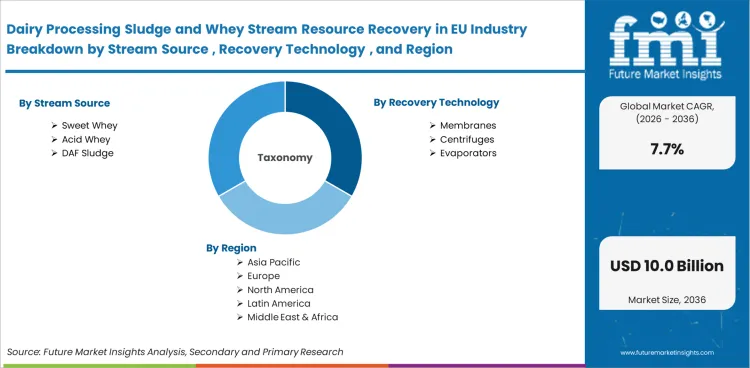
Dairy Processing Sludge and Whey Stream Resource Recovery in EU Industry by Segments
Dairy Processing Sludge and Whey Stream Resource Recovery in EU Industry Segmented as Stream Source
- Sweet whey
- Acid whey
- DAF sludge
- Anaerobic sludge
- CIP water
Dairy Processing Sludge and Whey Stream Resource Recovery in EU Industry Classified by Recovery Technology
- Membranes
- Centrifuges
- Evaporators
- Anaerobic digestion
- Nutrient recovery
Dairy Processing Sludge and Whey Stream Resource Recovery in EU Industry Analyzed by Recovered Output
- Protein ingredients
- Lactose
- Whey powder
- Biogas
- Reclaimed water
Dairy Processing Sludge and Whey Stream Resource Recovery in EU Industry Classified by End Use
- Food ingredients
- Animal feed
- Energy generation
- Fertilizer use
- Water reuse
Dairy Processing Sludge and Whey Stream Resource Recovery in EU Industry Classified by Project Format
- Direct systems
- EPC projects
- Retrofit services
- Toll processing
- O&M services
Dairy Processing Sludge and Whey Stream Resource Recovery in EU Industry by Region and Country
- Western Europe
- Germany
- UK
- Italy
- Spain
- France
- Nordic
- BENELUX
- Rest of Western Europe
- Eastern Europe
- Russia
- Poland
- Hungary
- Balkan & Baltic
- Rest of Eastern Europe
Bibliography
- Agreste. (2024). Key figures 2024.
- Alfa Laval. (2026, February). 2025 impact summary.
- Arla Foods Ingredients. (2025, May 14). Arla Foods Ingredients targets acid whey elimination with high-yield solution.
- Carbery. (2025, April 28). Carbery Group records strong financial performance, boosts profits through global growth while supporting farmers and reducing emissions.
- Central Statistics Office. (2026, February 6). Milk statistics December 2025.
- European Biogas Association. (2025, December 10). EBA statistical report 2025.
- European Biogas Association. (2024, April 16). Biogases towards 2040 and beyond.
- FrieslandCampina Ingredients. (2024, October 14). FrieslandCampina Ingredients secures EU approval for protein hydrolysate in infant and follow-on formulas.
- FrieslandCampina Ingredients. (2025, February 12). FrieslandCampina strengthens its global protein position with acquisition of Wisconsin Whey Protein.
- GEA Group. (2024, November 11). GEA software cuts water and energy consumption by up to 77% at Ammerland dairy.
- SPX FLOW. (2025, October 27). APV introduces ‘Combi MP’ pilot to advance functional whey protein innovation.
- Thünen Institute. (2025, November 10). Livestock farming and meat production in Germany.
- Veolia Water Technologies. (2024). Driving water treatment innovation, growth and training in Ireland.
- ZuivelNL. (2024). Dutch Dairy in Figures 2024.
This bibliography is provided for reader reference and reflects the sources used in the compiled market draft.
This Report Addresses
- Market sizing and revenue forecasting for dairy recovery systems and services from 2026 to 2036.
- Segmentation analysis across stream source, recovery technology, recovered output, end use, and project format.
- Country-level demand analysis covering Ireland, Poland, Netherlands, Spain, Italy, France, and Germany.
- Competitive assessment across integrated process suppliers, water specialists, and ingredient-led dairy groups.
- Review of regulatory and plant-efficiency drivers affecting recovery spending inside EU dairy facilities.
- Investment analysis across solids recovery, water reuse, sludge energy conversion, and selective retrofit programs.
- Supply-chain scope from incoming dairy streams to saleable solids, reusable water, and energy outputs.
- Report delivery suited to strategy review, plant investment planning, and competitive benchmarking.
Frequently Asked Questions
What is the 2026 market value for dairy processing sludge and whey stream resource recovery in the EU?
Market value for 2026 is estimated at USD 4.4 billion across recovery of proteins, lactose, powder solids, reusable water, and sludge-linked energy outputs.
What is the 2036 forecast value for this EU market?
The market is projected to reach USD 9.3 billion by 2036 under the current base-case forecast and current recovery-adoption assumptions.
What CAGR is used for the 2026 to 2036 forecast period?
Forecast expansion for the study period is set at 7.7% CAGR, based on EU dairy output, recovery intensity, and adjacent treatment adoption.
Which stream source leads the market in 2026?
Sweet whey leads stream source demand with 43.0% share in 2026 as cheese-linked processing keeps recoverable volumes commercially visible across the EU.
Which recovery technology remains ahead across EU dairy plants?
Membranes lead recovery technology with 36.0% share in 2026, supported by concentration, separation, reuse, and product-purity requirements.
Which end use holds the leading position across recovered outputs?
Food ingredients remain the main end use and are projected to secure 47.0% share in 2026 across proteins, lactose, and related dairy solids.
Which country records the fastest forecast pace across the covered group?
Ireland leads the country set with 8.4% CAGR through 2036, supported by rising milk intake and strong export-oriented dairy processing.
What does this market include inside its commercial boundary?
Scope includes whey recovery, lactose extraction, sludge digestion, nutrient capture, reclaimed water systems, and related plant integration across EU dairy processing.
Preview the report firsthand - request a free sample
Get SampleGet the brochure for pricing and purchase details.
Get PDFTable of Content
- Executive Summary
- Global Market Outlook
- Demand-side Trends
- Supply-side Trends
- Technology Roadmap Analysis
- Analysis and Recommendations
- Market Overview
- Market Coverage / Taxonomy
- Market Definition / Scope / Limitations
- Research Methodology
- Chapter Orientation
- Analytical Lens and Working Hypotheses
- Market Structure, Signals, and Trend Drivers
- Benchmarking and Cross-market Comparability
- Market Sizing, Forecasting, and Opportunity Mapping
- Research Design and Evidence Framework
- Desk Research Programme (Secondary Evidence)
- Company Annual and Sustainability Reports
- Peer-reviewed Journals and Academic Literature
- Corporate Websites, Product Literature, and Technical Notes
- Earnings Decks and Investor Briefings
- Statutory Filings and Regulatory Disclosures
- Technical White Papers and Standards Notes
- Trade Journals, Industry Magazines, and Analyst Briefs
- Conference Proceedings, Webinars, and Seminar Materials
- Government Statistics Portals and Public Data Releases
- Press Releases and Reputable Media Coverage
- Specialist Newsletters and Curated Briefings
- Sector Databases and Reference Repositories
- FMI Internal Proprietary Databases and Historical Market Datasets
- Subscription Datasets and Paid Sources
- Social Channels, Communities, and Digital Listening Inputs
- Additional Desk Sources
- Expert Input and Fieldwork (Primary Evidence)
- Primary Modes
- Qualitative Interviews and Expert Elicitation
- Quantitative Surveys and Structured Data Capture
- Blended Approach
- Why Primary Evidence is Used
- Field Techniques
- Interviews
- Surveys
- Focus Groups
- Observational and In-context Research
- Social and Community Interactions
- Stakeholder Universe Engaged
- C-suite Leaders
- Board Members
- Presidents and Vice Presidents
- R&D and Innovation Heads
- Technical Specialists
- Domain Subject-matter Experts
- Scientists
- Physicians and Other Healthcare Professionals
- Governance, Ethics, and Data Stewardship
- Research Ethics
- Data Integrity and Handling
- Primary Modes
- Tooling, Models, and Reference Databases
- Desk Research Programme (Secondary Evidence)
- Data Engineering and Model Build
- Data Acquisition and Ingestion
- Cleaning, Normalisation, and Verification
- Synthesis, Triangulation, and Analysis
- Quality Assurance and Audit Trail
- Market Background
- Market Dynamics
- Drivers
- Restraints
- Opportunity
- Trends
- Scenario Forecast
- Demand in Optimistic Scenario
- Demand in Likely Scenario
- Demand in Conservative Scenario
- Opportunity Map Analysis
- Product Life Cycle Analysis
- Supply Chain Analysis
- Investment Feasibility Matrix
- Value Chain Analysis
- PESTLE and Porter’s Analysis
- Regulatory Landscape
- Regional Parent Market Outlook
- Production and Consumption Statistics
- Import and Export Statistics
- Market Dynamics
- Global Market Analysis 2021 to 2025 and Forecast, 2026 to 2036
- Historical Market Size Value (USD Million) Analysis, 2021 to 2025
- Current and Future Market Size Value (USD Million) Projections, 2026 to 2036
- Y-o-Y Growth Trend Analysis
- Absolute $ Opportunity Analysis
- Global Market Pricing Analysis 2021 to 2025 and Forecast 2026 to 2036
- Global Market Analysis 2021 to 2025 and Forecast 2026 to 2036, By Stream Source
- Introduction / Key Findings
- Historical Market Size Value (USD Million) Analysis By Stream Source , 2021 to 2025
- Current and Future Market Size Value (USD Million) Analysis and Forecast By Stream Source , 2026 to 2036
- Sweet Whey
- Acid Whey
- DAF Sludge
- Sweet Whey
- Y-o-Y Growth Trend Analysis By Stream Source , 2021 to 2025
- Absolute $ Opportunity Analysis By Stream Source , 2026 to 2036
- Global Market Analysis 2021 to 2025 and Forecast 2026 to 2036, By Recovery Technology
- Introduction / Key Findings
- Historical Market Size Value (USD Million) Analysis By Recovery Technology, 2021 to 2025
- Current and Future Market Size Value (USD Million) Analysis and Forecast By Recovery Technology, 2026 to 2036
- Membranes
- Centrifuges
- Evaporators
- Membranes
- Y-o-Y Growth Trend Analysis By Recovery Technology, 2021 to 2025
- Absolute $ Opportunity Analysis By Recovery Technology, 2026 to 2036
- Global Market Analysis 2021 to 2025 and Forecast 2026 to 2036, By Recovered Output
- Introduction / Key Findings
- Historical Market Size Value (USD Million) Analysis By Recovered Output, 2021 to 2025
- Current and Future Market Size Value (USD Million) Analysis and Forecast By Recovered Output, 2026 to 2036
- Protein Ingredients
- Lactose
- Biogas
- Protein Ingredients
- Y-o-Y Growth Trend Analysis By Recovered Output, 2021 to 2025
- Absolute $ Opportunity Analysis By Recovered Output, 2026 to 2036
- Global Market Analysis 2021 to 2025 and Forecast 2026 to 2036, By End Use
- Introduction / Key Findings
- Historical Market Size Value (USD Million) Analysis By End Use, 2021 to 2025
- Current and Future Market Size Value (USD Million) Analysis and Forecast By End Use, 2026 to 2036
- Food Ingredients
- Animal Feed
- Energy Generation
- Food Ingredients
- Y-o-Y Growth Trend Analysis By End Use, 2021 to 2025
- Absolute $ Opportunity Analysis By End Use, 2026 to 2036
- Global Market Analysis 2021 to 2025 and Forecast 2026 to 2036, By Project Format
- Introduction / Key Findings
- Historical Market Size Value (USD Million) Analysis By Project Format, 2021 to 2025
- Current and Future Market Size Value (USD Million) Analysis and Forecast By Project Format, 2026 to 2036
- Direct Systems
- EPC Projects
- O&M Services
- Direct Systems
- Y-o-Y Growth Trend Analysis By Project Format, 2021 to 2025
- Absolute $ Opportunity Analysis By Project Format, 2026 to 2036
- Global Market Analysis 2021 to 2025 and Forecast 2026 to 2036, By Region
- Introduction
- Historical Market Size Value (USD Million) Analysis By Region, 2021 to 2025
- Current Market Size Value (USD Million) Analysis and Forecast By Region, 2026 to 2036
- North America
- Latin America
- Western Europe
- Eastern Europe
- East Asia
- South Asia and Pacific
- Middle East & Africa
- Market Attractiveness Analysis By Region
- North America Market Analysis 2021 to 2025 and Forecast 2026 to 2036, By Country
- Historical Market Size Value (USD Million) Trend Analysis By Market Taxonomy, 2021 to 2025
- Market Size Value (USD Million) Forecast By Market Taxonomy, 2026 to 2036
- By Country
- USA
- Canada
- Mexico
- By Stream Source
- By Recovery Technology
- By Recovered Output
- By End Use
- By Project Format
- By Country
- Market Attractiveness Analysis
- By Country
- By Stream Source
- By Recovery Technology
- By Recovered Output
- By End Use
- By Project Format
- Key Takeaways
- Latin America Market Analysis 2021 to 2025 and Forecast 2026 to 2036, By Country
- Historical Market Size Value (USD Million) Trend Analysis By Market Taxonomy, 2021 to 2025
- Market Size Value (USD Million) Forecast By Market Taxonomy, 2026 to 2036
- By Country
- Brazil
- Chile
- Rest of Latin America
- By Stream Source
- By Recovery Technology
- By Recovered Output
- By End Use
- By Project Format
- By Country
- Market Attractiveness Analysis
- By Country
- By Stream Source
- By Recovery Technology
- By Recovered Output
- By End Use
- By Project Format
- Key Takeaways
- Western Europe Market Analysis 2021 to 2025 and Forecast 2026 to 2036, By Country
- Historical Market Size Value (USD Million) Trend Analysis By Market Taxonomy, 2021 to 2025
- Market Size Value (USD Million) Forecast By Market Taxonomy, 2026 to 2036
- By Country
- Germany
- UK
- Italy
- Spain
- France
- Nordic
- BENELUX
- Rest of Western Europe
- By Stream Source
- By Recovery Technology
- By Recovered Output
- By End Use
- By Project Format
- By Country
- Market Attractiveness Analysis
- By Country
- By Stream Source
- By Recovery Technology
- By Recovered Output
- By End Use
- By Project Format
- Key Takeaways
- Eastern Europe Market Analysis 2021 to 2025 and Forecast 2026 to 2036, By Country
- Historical Market Size Value (USD Million) Trend Analysis By Market Taxonomy, 2021 to 2025
- Market Size Value (USD Million) Forecast By Market Taxonomy, 2026 to 2036
- By Country
- Russia
- Poland
- Hungary
- Balkan & Baltic
- Rest of Eastern Europe
- By Stream Source
- By Recovery Technology
- By Recovered Output
- By End Use
- By Project Format
- By Country
- Market Attractiveness Analysis
- By Country
- By Stream Source
- By Recovery Technology
- By Recovered Output
- By End Use
- By Project Format
- Key Takeaways
- East Asia Market Analysis 2021 to 2025 and Forecast 2026 to 2036, By Country
- Historical Market Size Value (USD Million) Trend Analysis By Market Taxonomy, 2021 to 2025
- Market Size Value (USD Million) Forecast By Market Taxonomy, 2026 to 2036
- By Country
- China
- Japan
- South Korea
- By Stream Source
- By Recovery Technology
- By Recovered Output
- By End Use
- By Project Format
- By Country
- Market Attractiveness Analysis
- By Country
- By Stream Source
- By Recovery Technology
- By Recovered Output
- By End Use
- By Project Format
- Key Takeaways
- South Asia and Pacific Market Analysis 2021 to 2025 and Forecast 2026 to 2036, By Country
- Historical Market Size Value (USD Million) Trend Analysis By Market Taxonomy, 2021 to 2025
- Market Size Value (USD Million) Forecast By Market Taxonomy, 2026 to 2036
- By Country
- India
- ASEAN
- Australia & New Zealand
- Rest of South Asia and Pacific
- By Stream Source
- By Recovery Technology
- By Recovered Output
- By End Use
- By Project Format
- By Country
- Market Attractiveness Analysis
- By Country
- By Stream Source
- By Recovery Technology
- By Recovered Output
- By End Use
- By Project Format
- Key Takeaways
- Middle East & Africa Market Analysis 2021 to 2025 and Forecast 2026 to 2036, By Country
- Historical Market Size Value (USD Million) Trend Analysis By Market Taxonomy, 2021 to 2025
- Market Size Value (USD Million) Forecast By Market Taxonomy, 2026 to 2036
- By Country
- Kingdom of Saudi Arabia
- Other GCC Countries
- Turkiye
- South Africa
- Other African Union
- Rest of Middle East & Africa
- By Stream Source
- By Recovery Technology
- By Recovered Output
- By End Use
- By Project Format
- By Country
- Market Attractiveness Analysis
- By Country
- By Stream Source
- By Recovery Technology
- By Recovered Output
- By End Use
- By Project Format
- Key Takeaways
- Key Countries Market Analysis
- USA
- Pricing Analysis
- Market Share Analysis, 2025
- By Stream Source
- By Recovery Technology
- By Recovered Output
- By End Use
- By Project Format
- Canada
- Pricing Analysis
- Market Share Analysis, 2025
- By Stream Source
- By Recovery Technology
- By Recovered Output
- By End Use
- By Project Format
- Mexico
- Pricing Analysis
- Market Share Analysis, 2025
- By Stream Source
- By Recovery Technology
- By Recovered Output
- By End Use
- By Project Format
- Brazil
- Pricing Analysis
- Market Share Analysis, 2025
- By Stream Source
- By Recovery Technology
- By Recovered Output
- By End Use
- By Project Format
- Chile
- Pricing Analysis
- Market Share Analysis, 2025
- By Stream Source
- By Recovery Technology
- By Recovered Output
- By End Use
- By Project Format
- Germany
- Pricing Analysis
- Market Share Analysis, 2025
- By Stream Source
- By Recovery Technology
- By Recovered Output
- By End Use
- By Project Format
- UK
- Pricing Analysis
- Market Share Analysis, 2025
- By Stream Source
- By Recovery Technology
- By Recovered Output
- By End Use
- By Project Format
- Italy
- Pricing Analysis
- Market Share Analysis, 2025
- By Stream Source
- By Recovery Technology
- By Recovered Output
- By End Use
- By Project Format
- Spain
- Pricing Analysis
- Market Share Analysis, 2025
- By Stream Source
- By Recovery Technology
- By Recovered Output
- By End Use
- By Project Format
- France
- Pricing Analysis
- Market Share Analysis, 2025
- By Stream Source
- By Recovery Technology
- By Recovered Output
- By End Use
- By Project Format
- India
- Pricing Analysis
- Market Share Analysis, 2025
- By Stream Source
- By Recovery Technology
- By Recovered Output
- By End Use
- By Project Format
- ASEAN
- Pricing Analysis
- Market Share Analysis, 2025
- By Stream Source
- By Recovery Technology
- By Recovered Output
- By End Use
- By Project Format
- Australia & New Zealand
- Pricing Analysis
- Market Share Analysis, 2025
- By Stream Source
- By Recovery Technology
- By Recovered Output
- By End Use
- By Project Format
- China
- Pricing Analysis
- Market Share Analysis, 2025
- By Stream Source
- By Recovery Technology
- By Recovered Output
- By End Use
- By Project Format
- Japan
- Pricing Analysis
- Market Share Analysis, 2025
- By Stream Source
- By Recovery Technology
- By Recovered Output
- By End Use
- By Project Format
- South Korea
- Pricing Analysis
- Market Share Analysis, 2025
- By Stream Source
- By Recovery Technology
- By Recovered Output
- By End Use
- By Project Format
- Russia
- Pricing Analysis
- Market Share Analysis, 2025
- By Stream Source
- By Recovery Technology
- By Recovered Output
- By End Use
- By Project Format
- Poland
- Pricing Analysis
- Market Share Analysis, 2025
- By Stream Source
- By Recovery Technology
- By Recovered Output
- By End Use
- By Project Format
- Hungary
- Pricing Analysis
- Market Share Analysis, 2025
- By Stream Source
- By Recovery Technology
- By Recovered Output
- By End Use
- By Project Format
- Kingdom of Saudi Arabia
- Pricing Analysis
- Market Share Analysis, 2025
- By Stream Source
- By Recovery Technology
- By Recovered Output
- By End Use
- By Project Format
- Turkiye
- Pricing Analysis
- Market Share Analysis, 2025
- By Stream Source
- By Recovery Technology
- By Recovered Output
- By End Use
- By Project Format
- South Africa
- Pricing Analysis
- Market Share Analysis, 2025
- By Stream Source
- By Recovery Technology
- By Recovered Output
- By End Use
- By Project Format
- USA
- Market Structure Analysis
- Competition Dashboard
- Competition Benchmarking
- Market Share Analysis of Top Players
- By Regional
- By Stream Source
- By Recovery Technology
- By Recovered Output
- By End Use
- By Project Format
- Competition Analysis
- Competition Deep Dive
- GEA Group
- Overview
- Product Portfolio
- Profitability by Market Segments (Product/Age /Sales Channel/Region)
- Sales Footprint
- Strategy Overview
- Marketing Strategy
- Product Strategy
- Channel Strategy
- Tetra Pak
- Alfa Laval
- ANDRITZ
- Veolia Water Technologies
- SPX FLOW
- GEA Group
- Competition Deep Dive
- Assumptions & Acronyms Used


