

- Industry Size (2026)
- USD 1.1 Bn
- Forecast (2036)
- USD 1.9 Bn
- CAGR (2026 to 2036)
- 5.6%
Household Large Appliance Steel and Polymer Recycling Streams in Europe Industry Size, Market Forecast and Outlook By FMI
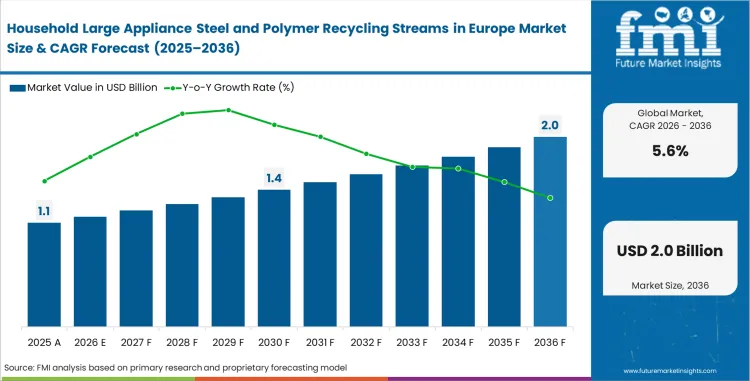
Recovery economics for discarded white goods are becoming more important as European recyclers move beyond bulk scrap treatment and focus on cleaner secondary material output. FMI estimates that the household large appliance recycling industry in Europe crossed a valuation of USD 1.0 billion in 2025. Market value is projected to reach USD 1.1 billion in 2026 and is expected to rise to USD 1.9 billion by 2036, reflecting a CAGR of 5.6% over the forecast period. Growth is being supported by continued investment in sensor-based sorting systems that can separate large household appliances into cleaner steel and polymer fractions at a commercial scale.
Summary of Household Large Appliance Steel and Polymer Recycling Streams in Europe Industry
- Market Snapshot
- The household large appliance steel and polymer recycling streams in Europe Industry is valued at USD 1.03 billion in 2025 and is projected to reach USD 1.9 billion by 2036.
- The industry is expected to grow at a 5.6% CAGR from 2026 to 2036, creating an incremental opportunity of USD 0.84 billion over the period.
- This is a compliance-led secondary materials market where collection quality, dismantling yield, and downstream separation economics matter more than consumer branding.
- Demand and Growth Drivers
- Demand is rising because large and bulky equipment categories are easier to collect than small devices, and WEEE Forum data points to low hoarding for large equipment and temperature-exchange equipment.
- Growth is supported by the fact that Europe’s official WEEE collection rate was still only 40.6% in 2022, which leaves formal recovery headroom under the WEEE Directive framework.
- Polymer recovery is becoming more valuable because appliance-plastic streams are increasingly characterized, monitored, and separated rather than treated as a minor by-product.
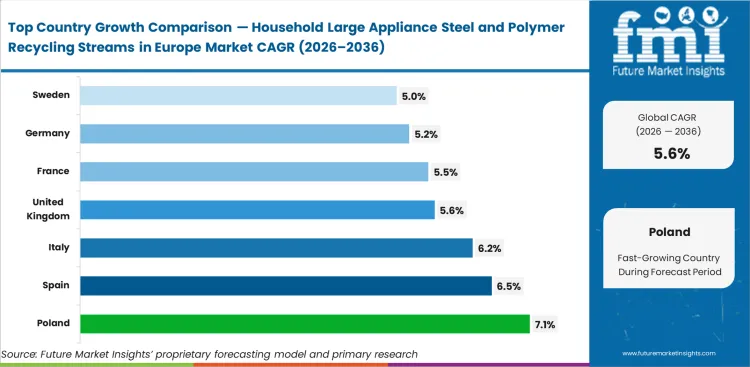
- Among key countries, Poland leads at 7.1% CAGR, followed by Spain at 6.5%, Italy at 6.2%, United Kingdom at 5.6%, France at 5.5%, Germany at 5.2%, and Sweden at 5.0%.
- Growth is moderated by hazardous-additive controls and the need for better polymer sorting quality, especially where brominated or legacy additives can disrupt closed-loop reuse.
- Product and Segment View
- The market covers recovered steel and recovered polymers from large household appliances such as refrigerators, freezers, washing machines, dishwashers, dryers, and related bulky domestic equipment.
- Steel leads the material stream segment with 78.0% share because large appliances remain predominantly steel-based by construction.
- Refrigeration leads the appliance-type segment with 31.0% share, helped by the heavy installed base of fridges and freezers and their strong formal-collection visibility.
- Separation leads the process-stage segment with 34.0% share because value realization depends on isolating ferrous, stainless, and polymer fractions after collection and de-pollution.
- Ferrous scrap leads the output-grade segment with 64.0% share, reflecting both the weight profile of white goods and the deeper liquidity of steel recycling markets.
- EPR schemes lead the collection-channel segment with 46.0% share because European WEEE handling is still structured around producer-responsibility systems and authorized treatment routes.
- The scope includes collection, dismantling, shredding, ferrous recovery, and polymer sorting linked to large household appliances, but excludes small appliances, precious-metals-rich IT scrap, and battery-only recycling.
- Geography and Competitive Outlook
- Poland, Spain, and Italy are the fastest-growing national markets, while Germany remains the most stable high-volume base for formal large-appliance recycling activity.
- Competition is shaped by plant networks, EPR contracts, downstream polymer purification, and the ability to return steel and plastics to appliance-grade or industrial-grade loops.
- The market remains fragmented and the key participants include Stena Recycling, TSR Recycling, REMONDIS Electrorecycling, Kuusakoski, Veolia, and EMR.
Key Takeaways, Market Size, and Forecast
- Household Large Appliance Steel and Polymer Recycling Streams in Europe Industry is projected to grow from USD 1.1 billion in 2026 to USD 1.9 billion by 2036, at a CAGR of 5.6%.
- The household large appliance steel and polymer recycling streams in Europe industry was valued at USD 1.0 billion in 2025.
- By 2036, the Household Large Appliance Steel and Polymer Recycling Streams in Europe Industry is expected to be worth USD 1.9 billion.
- From 2026 to 2036, the industry is projected to expand at a CAGR of 5.6%.
- The industry is projected to create an incremental opportunity of USD 0.84 billion between 2026 and 2036.
- In 2026, Steel is expected to account for 78.0% of the material stream segment.
- Poland (7.1%) and Spain (6.5%) are two of the fastest growing markets.
Processing facilities are under growing pressure to recover more value from large appliance waste instead of relying mainly on bulk metal output. Mixed shredder residue is becoming more expensive to dispose of as WEEE treatment rules tighten across Europe. Delayed upgrades can leave operators carrying higher landfill costs while recovery yields remain limited. FMI observes that global e-waste management is placing greater weight on higher-value polymer recovery from appliance waste, especially where recyclers can improve purity through density separation and electrostatic sorting. That shift is making material quality and fraction control more important to plant economics.
Recycled polymers become more commercially viable once producer responsibility systems and recycled content targets begin to influence material purchasing. Cleaner ABS and HIPS output can attract stronger demand from manufacturers when consistency and contamination control improve. Structured collection systems also matter because stable feedstock supply supports better plant utilization and more predictable output quality. Access to electronics take back material through organized appliance return networks is therefore becoming more important for recyclers aiming to build stronger positions in high-purity appliance polymer recovery.
Poland is expected to remain one of the faster-growing markets, with a CAGR of 7.1% through 2036, as formal recovery channels continue to capture bulky appliances that previously moved through less structured routes. Spain is projected to expand at a CAGR of 6.5%, supported by sorting upgrades that improve downstream material quality. Italy is likely to post 6.2% CAGR during the forecast period, helped by steady replacement demand in household appliances. The United Kingdom is estimated to grow at 5.6%, backed by established WEEE treatment capability and strong metal recovery systems. France is projected to register 5.5%, while Germany is expected to record 5.2% CAGR through 2036. Sweden is likely to witness 5.0% CAGR, reflecting a more mature collection environment. Market progress across Europe is expected to depend increasingly on fraction purity, plant efficiency, and the ability to convert collected volumes into higher-value steel and polymer outputs.
Segmental Analysis
Household Large Appliance Steel and Polymer Recycling Streams in Europe Industry Analysis by Material Stream
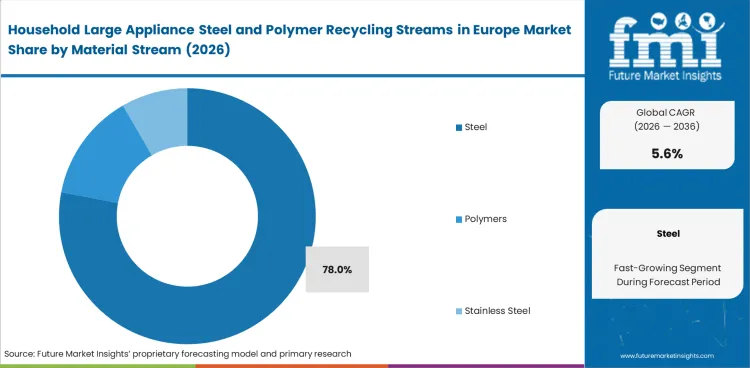
Shredder economics in large appliance recycling still begin with magnetic recovery because steel remains the heaviest and most accessible fraction in the input mix. FMI’s assessment indicates steel is estimated to account for 78.0% share in 2026. Ferrous output gives operators a dependable base stream that helps support daily line economics before more complex downstream sorting begins. Steel can be recovered with far less manual effort than mixed polymer fractions, which is why many facilities still prioritize it first. Weak attention to white goods plastic recovery and PCR limits overall value capture, especially when plastic residue management remains inefficient and disposal costs rise. Copper entanglement inside shredded steel also reduces bale quality and can lead to pricing deductions. Heavy dependence on ferrous volumes therefore supports plant continuity, but it does not remove the need for stronger polymer recovery discipline.
- Baseline revenue anchor: Magnetic overbands remove ferrous material quickly and support the basic economics of downstream processing.
- Purity grade constraints: Copper from motor windings can remain mixed with steel and lower bale quality at sale.
- Volume dependency: Plant performance still depends on high daily throughput because fixed costs remain hard to absorb at lower intake levels.
Household Large Appliance Steel and Polymer Recycling Streams in Europe Industry Analysis by Appliance Type
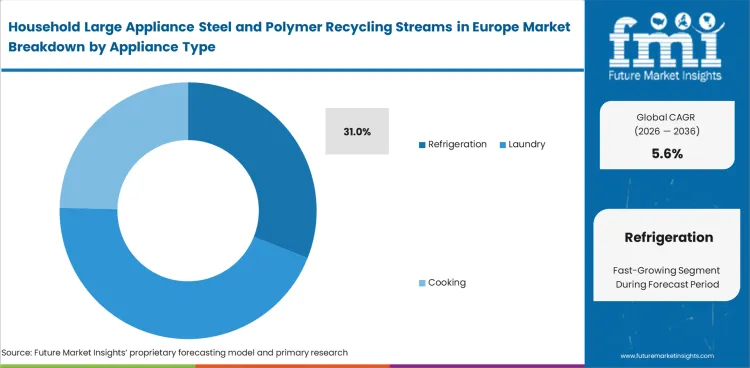
Cooling equipment remains a priority stream because it combines hazardous handling requirements with stronger recovery value once treated correctly. Degassing must be completed before these units can move safely into mechanical processing. Refrigeration equipment is expected to represent 31.0% share in 2026. Infrastructure requirements are also more demanding than for standard large appliances because refrigerants and insulation foams require controlled removal. FMI’s assessment indicates closed loop recycled polymers recovered from refrigerator liners attract stronger market interest due to their high HIPS content and cleaner output profile. Facilities that do not invest in enclosed degassing systems risk losing access to this important input stream. Process quality in this category depends as much on compliance control as on material separation.
- Hazardous gas capture: Certified suction systems remove refrigerants before shredding and reduce environmental compliance risk.
- Insulation foam treatment: Foam sections need controlled processing because trapped blowing agents can create fire and safety concerns.
- Premium polymer extraction: Refrigerator interiors yield cleaner HIPS fractions that are better suited for downstream compounding.
Household Large Appliance Steel and Polymer Recycling Streams in Europe Industry Analysis by Process Stage
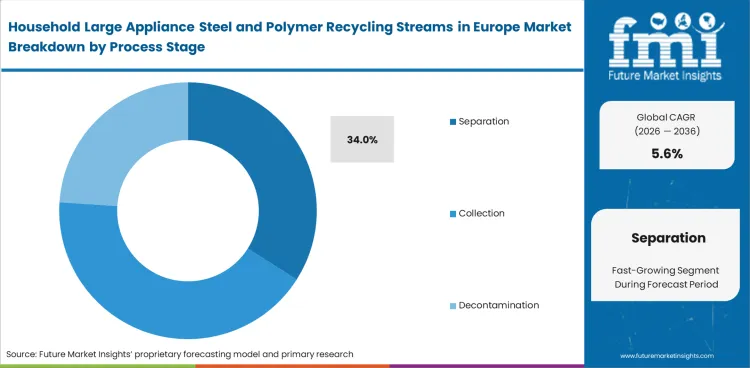
Plant survival depends on how effectively mixed shred is converted into distinct and saleable material grades. Density baths and optical systems play a central role because separation quality determines whether output becomes usable product or residual waste. FMI indicates separation processes are likely to account for 34.0% share in 2026. This stage becomes more important as modern appliances generate more complex mixed-material flows that are harder to sort with basic manual methods alone. Near-infrared systems are especially important where metal recycling equipment streams also carry dark plastics and rubber that need accurate distinction. Dust buildup and poor calibration can reduce identification accuracy quickly and lower the purity expected by plastic compounders. Stable process control therefore remains essential for both throughput and output quality.
- Density-based isolation: Sink-float systems separate heavier metal fragments from lighter plastics before optical sorting begins.
- Sensor array deployment: Near-infrared units identify polymer signatures at speed and improve the purity of recovered resin streams.
- Calibration drift risk: Dust on sensor surfaces can lower sorting accuracy and increase losses of high-value plastics into reject fractions.
Household Large Appliance Steel and Polymer Recycling Streams in Europe Industry Analysis by Output Grade
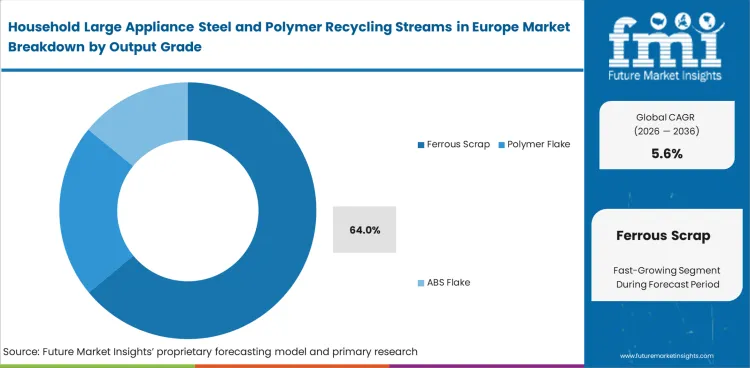
Smelter demand continues to set the base outlet for large volumes of recovered appliance material. Ferrous scrap moves consistently because secondary steel mills require steady supply and can absorb substantial tonnage. This output is also important for global waste recycling services that depend on stable commodity movement across regional processing networks. According to FMI’s estimates, ferrous scrap is anticipated to account for 64.0% share in 2026. Strong steel recovery still does not tell the full value story, since separated polymers are becoming more commercially important where purity targets can be met. Facilities that stop at bulk ferrous recovery often miss better-margin contracts tied to appliance-grade recycled plastics. Output strategy is therefore shifting from volume-only recovery toward more balanced material monetization.
- Furnace ready preparation: Hammermills reduce steel casings into dense fragments that can move directly into secondary melting systems.
- Tramp element control: Residual copper and tin can weaken steel quality and raise the risk of smelter rejection.
- Margin floor establishment: Bulk ferrous movement supports baseline plant costs and helps fund more advanced polymer recovery upgrades.
Household Large Appliance Steel and Polymer Recycling Streams in Europe Industry Analysis by Collection Channel
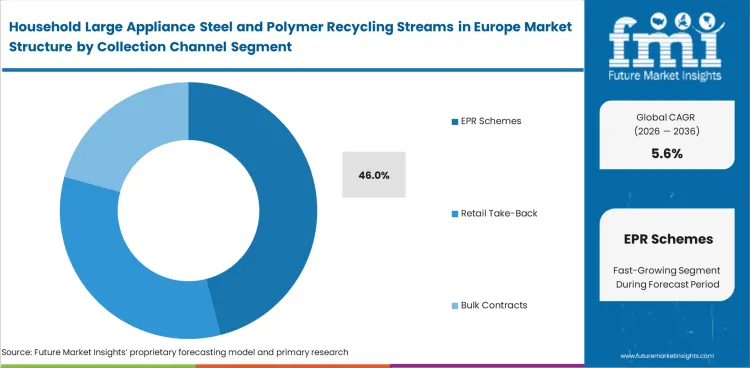
Collection stability in this market is shaped largely by producer-funded systems that direct appliance volumes into certified recovery channels. Formal allocation structures give recyclers better visibility over incoming tonnage and support capacity planning. EPR schemes are forecast to command 46.0% share in 2026. National compliance bodies also monitor downstream destinations closely, which makes traceability a central part of channel control. In FMI’s view, recycled metal output remains heavily dependent on these organized networks because informal collection channels rarely provide the same consistency or documentation quality. Independent scrap yards often struggle to secure a steady flow of higher-quality white goods outside these systems. Formal collection structure therefore remains a key support for both feedstock quality and compliance performance.
- Quota allocation stability: Producer compliance systems assign collection territories that help recyclers plan annual feedstock intake more reliably.
- Traceability enforcement: Material flows are tracked from collection through final delivery, which strengthens audit readiness and compliance control.
- Informal leakage prevention: Secure municipal collection systems are used to reduce diversion into unauthorized scrap channels.
Household Large Appliance Steel and Polymer Recycling Streams in Europe Industry Drivers, Restraints, and Opportunities
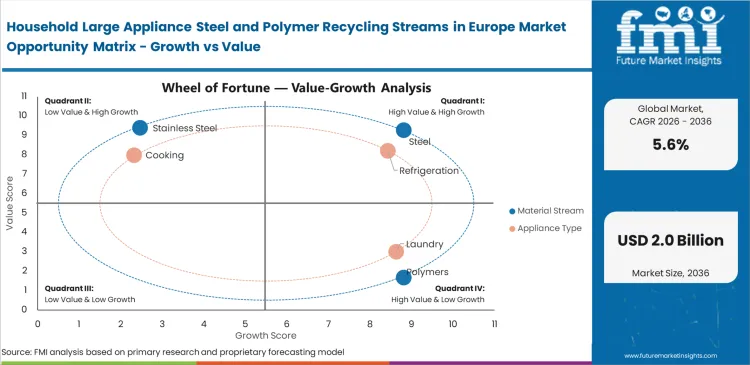
Landfill gate fees penalize facilities heavily for generating unrecyclable shredder residue. Manufacturers face commercial pressure to extract every usable gram of plastic from mixed white goods. Leaving recoverable ABS and HIPS in reject streams reduces value capture and can materially weaken plant margins where disposal costs are rising. Securing high-purity polymer yields is becoming more important to plant viability as residue disposal costs rise and buyers place tighter quality requirements on recycled outputs. Investment in density separation and electrostatic sorting is becoming commercially important for operators seeking to improve polymer recovery and reduce residue-related costs.
Legacy appliance plastics can contain halogenated flame retardants that complicate separation, limit reuse pathways, and raise compliance requirements for downstream buyers. Companies struggle to separate clean polymers from legacy plastics containing these restricted chemical compounds. Density sorting fails to isolate certain brominated plastics effectively. Optical sorters utilizing x-ray fluorescence detect bromine presence, but this technology requires significant capital investment. Facilities without advanced detection capability may have to divert a larger share of mixed plastics to lower-value or non-closed-loop pathways, which can constrain overall material recovery performance.
Opportunities in the Household Large Appliance Steel and Polymer Recycling Streams in Europe Industry
- Direct manufacturer partnerships: Appliance brands signing long-term off-take agreements guarantee fixed prices for specific recycled polymer grades. Firms secure supply chain stability.
- Advanced electrostatic sorting: Implementing triboelectric separation systems isolates mixed black plastics efficiently. Companies capture value from dark components invisible to standard optical cameras.
- Installer network integration: Contracting directly with professional appliance delivery fleets captures premium metal recycling units before informal scrappers intervene. Logistics coordinators increase high-quality intake volumes significantly.
Regional Analysis
Based on regional analysis, household large appliance steel and polymer recycling streams in Europe Industry is segmented into Western Europe, Southern Europe, and Northern and Eastern Europe across multiple countries.
.webp "Top Country Growth Comparison Household Large Appliance Steel And Polymer Recycling Streams In Europe Market Cagr (2026 2036)")
| Country | CAGR (2026 to 2036) |
|---|---|
| Poland | 7.1% |
| Spain | 6.5% |
| Italy | 6.2% |
| United Kingdom | 5.6% |
| France | 5.5% |
| Germany | 5.2% |
| Sweden | 5.0% |
Source: Future Market Insights (FMI) analysis, based on proprietary forecasting model and primary research
Western Europe Household Large Appliance Steel and Polymer Recycling Streams in Europe Industry Analysis
Mature collection networks shift investment strategies strictly toward yield optimization. Recycling facilities across these territories already process peak volumes of discarded white goods, limiting raw volume expansion. Extracting residual plastics mixed within shredder dust generates incremental value from stagnant intake tonnages. Stringent purity mandates compel operators to deploy advanced sorting technology, isolating distinct polymer grades for manufacturers.
- United Kingdom: Demand for household large appliance recycling in the United Kingdom is anticipated to rise at a CAGR of 5.6% during the forecast period. Combined metal recovery infrastructure and established WEEE compliance frameworks ensure steady material flow into processing hubs. Justifying new density separation systems relies heavily on this consistent feedstock. Upgrading legacy sorting lines ultimately reduces landfill disposal costs for recycling facilities.
- France: French repairability policies are extending appliance replacement cycles, which can slow near-term recycling intake even as they shift future processing toward older and more compositionally complex units. Demand for large appliance recycling in France is expected to grow at a CAGR of 5.5% from 2026 to 2036. For processors, this makes capacity planning, decontamination readiness, and sorting flexibility more important as the incoming mix becomes older and harder to process efficiently
- Germany: High baseline recovery rates push domestic processing plants to innovate entirely new compounding methods. Germany is likely to post a CAGR of 5.2% in appliance recycling demand by 2036. Valorizing dark polymer fractions remains the exclusive focus for capacity upgrades in this mature landscape. Seeking value in previously discarded shredder residue offsets flat metal recovery margins for incumbent recyclers.
Southern Europe Household Large Appliance Steel and Polymer Recycling Streams in Europe Industry Analysis
Active appliance replacement cycles currently generate massive influxes of complex cooling and laundry units. Routing heavy appliances efficiently from remote municipal depots to central shredding hubs creates persistent logistical bottlenecks. Unformalized collection channels still intercept significant volumes of high-value metal before official networks secure them, restricting the feedstock available to certified downstream processing centers.
- Spain: Downstream sorting investments rapidly formalize previously fragmented scrap networks across the country. Expanding regional collection footprints allows certified processors to secure feedstock directly from municipal sources. Large appliance recycling demand in Spain is poised to grow at a CAGR of 6.5% during the assessment period. Capturing these units before informal scrappers intervene establishes a massive competitive advantage for formalized operations.
- Italy: Regional waste authorities enforcing stricter tracking on municipal collection yards pushes material into certified channels. Italy is anticipated to see large appliance recycling demand grow at a CAGR of 6.2% over the forecast period. Formalized tonnage reaching advanced processing centers improves overall regional metal recovery statistics. Battling unauthorized metal scavengers daily dictates local consolidation strategies for major recycling networks.
Northern and Eastern Europe Household Large Appliance Steel and Polymer Recycling Streams in Europe Industry Analysis
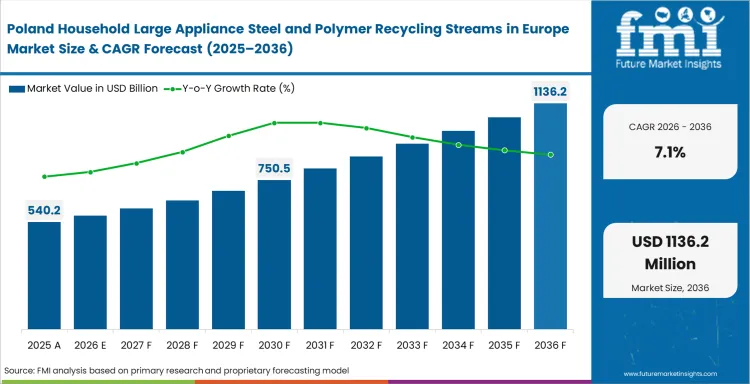
Divergent maturity levels define operational strategies across this combined geography. Advanced northern facilities optimize existing high-tech lines to isolate polymers, while eastern operations rapidly build out primary shredding capacity for bulk metal. Formalizing bulky-waste networks in developing regions provides significant raw growth opportunity, shifting market momentum toward territories with untapped appliance stockpiles.
- Poland: Bulky-appliance recovery networks aggressively formalize previously uncaptured material streams, supplying vital new shredding capacity. Polish large appliance recycling demand is poised to expand at a CAGR of 7.1% during the forecast period. Establishing new regional consolidation centers anchors this rapid material volume expansion. Early movers securing exclusive municipal supply contracts dominate regional secondary output, successfully preventing competing plants from achieving profitable scale.
- Sweden: Highly mature collection environments strictly limit pure volume expansion, forcing facilities to improve secondary material purity. Sweden is forecast to record steady growth in appliance recycling demand at a CAGR of 5.0% from 2026 to 2036. Extracting high-purity polymers from existing shredder output runs localized investment. Technological trajectory points toward fully closed-loop plastic compounding, satisfying domestic manufacturer requirements without exporting shredder fluff.
Detailed assessments of secondary raw material trading dynamics across all specified European territories reveal deep supply chain dependencies. Cross-border movement of partially processed shredder fluff continues to shape waste management pricing structures heavily across the region.
Competitive Aligners for Market Players
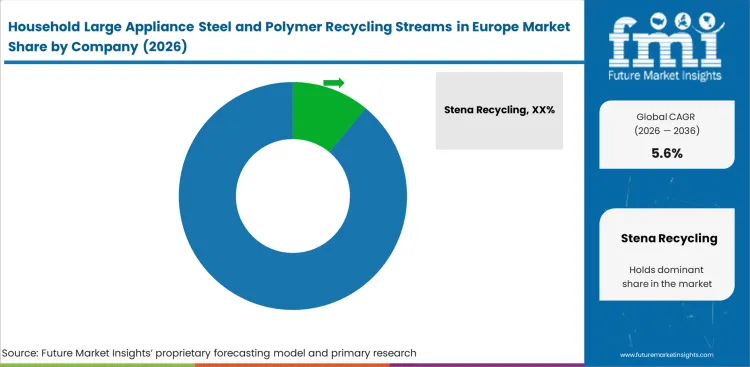
Securing long-term municipal collection contracts dictates a competitive baseline. Dominant players increase volumes by maintaining extensive logistics networks that capture appliances before unauthorized scrappers intervene. Processing capacity has limited value without stable daily tonnage, since throughput consistency is needed to absorb fixed operating costs. Regional shredder operators prioritize EPR scheme allocations because stable feedstock is critical to maintaining utilization across high-capex processing infrastructure.
Incumbents possess massive industrial environmental permits granting exclusive rights to process hazardous refrigeration gases. New entrants cannot easily replicate these compliance approvals. Operators with certified degassing lines can hold a structural advantage in cooling-unit processing where compliance approvals and hazardous-handling capabilities are difficult to replicate. FMI observes that integrating PCR in consumer electronics supply chains requires verified material passports, an administrative capability large appliance recycling companies in Europe already master.
Appliance manufacturers utilize massive purchasing power to demand exact polymer specifications. Manufacturers and compounders increasingly look for recycled ABS and HIPS with tight consistency, contamination control, and performance characteristics suitable for higher-specification applications. Secondary material buyers reject entire shipments if optical sorters fail to remove trace brominated flame retardants. Some competitors constantly recalibrate near-infrared camera arrays to satisfy strict buyer qualification standards.
Key Players in Household Large Appliance Steel and Polymer Recycling Streams in Europe Industry
- Stena Recycling
- TSR Recycling
- REMONDIS Electrorecycling
- Kuusakoski
- Veolia
- EMR
Scope of the Report
| Metric | Value |
|---|---|
| Quantitative Units | USD 1.1 billion to USD 1.9 billion, at a CAGR of 5.6% |
| Market Definition | Industrial recovery systems process discarded white goods into secondary steel and purified polymer fractions. Advanced sorting infrastructure separates complex multi-material assemblies to supply manufacturers with specification-grade recycled inputs. |
| Segmentation | By material stream, appliance type, process stage, output grade, collection channel, and region |
| Regions Covered | North America, Latin America, Europe, Asia Pacific, Middle East and Africa |
| Countries Covered | Poland, Spain, Italy, United Kingdom, France, Germany, Sweden |
| Key Companies Profiled | Stena Recycling, TSR Recycling, REMONDIS Electrorecycling, Kuusakoski, Veolia, EMR |
| Forecast Period | 2026 to 2036 |
| Approach | Tracked tonnages of processed large household appliances converted to regional output commodity pricing |
Source: Future Market Insights (FMI) analysis, based on proprietary forecasting model and primary research
Household Large Appliance Steel and Polymer Recycling Streams in Europe Industry Analysis by Segments
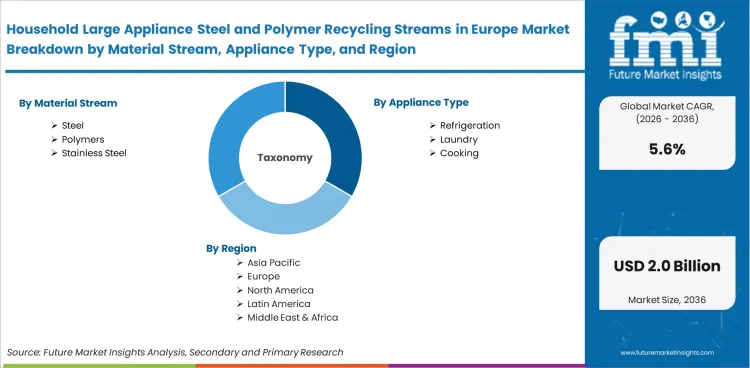
Material stream
- Steel
- Polymers
- Stainless steel
- Mixed residue
Appliance type
- Refrigeration
- Laundry
- Dishwashing
- Cooking
- Air treatment
Process stage
- Collection
- Separation
- Shredding
- Decontamination
- Recompounding
Output grade
- Ferrous scrap
- Polymer flake
- ABS flake
- HIPS flake
- Regrind resin
Collection channel
- EPR schemes
- Municipal depots
- Retail take-back
- Installer returns
- Bulk contracts
Region
- Poland
- Spain
- Italy
- United Kingdom
- France
- Germany
- Sweden
Bibliography
- Baldé, C. P., Kuehr, R., Yamamoto, T., McDonald, R., D’Angelo, E., Althaf, S., Bel, G., Deubzer, O., Fernandez-Cubillo, E., Forti, V., Gray, V., Herat, S., Honda, S., Iattoni, G., Khetriwal, D. S., Luda di Cortemiglia, V., Lobuntsova, Y., Nnorom, I., Pralat, N., & Wagner, M. (2024). The Global E-waste Monitor 2024. United Nations Institute for Training and Research.
- European Chemicals Agency. (2024). Investigation report on aromatic brominated flame retardants.
- Jeschonowski-Papstein, J., Gast, L., Binding, M., & Faulstich, M. (2024). Improving the recycling of plastic parts in household appliances-a review. Resources, Conservation & Recycling Advances, 24, 200235.
- Nève, N., Mackré-Delannoy, X., Fayolle, B., Gervais, M., Pompidou, S., Charbuillet, C., Sollogoub, C., & Perry, N. (2025). A review of methods and data on the recycling of plastics from the European waste stream of electric and electronic equipment. Recycling, 10(4), 148.
- Organization for Economic Co-operation and Development. (2024). Plastics recycled content requirements.
This bibliography is provided for reader reference. The full FMI report contains the complete reference list with primary source documentation.
This Report Addresses
- Landfill tax pressures forcing facility operations managers to adopt density separation tanks
- Premium contract structures created by appliance brands seeking decontaminated ABS flake
- Compliance mandates requiring enclosed degassing lines for refrigeration units
- Smelter quality control protocols penalizing excessive copper contamination in ferrous scrap
- Regional collection quotas assigned to logistics providers by national EPR scheme directors
- Cross-border material tracking implemented to satisfy strict European WEEE directives
- Artificial intelligence sorting robots deployed to capture mixed black plastics effectively
- Investment trajectories formalizing bulky-waste collection networks across Eastern Europe
Frequently Asked Questions
What is the size of the household large appliance recycling industry in Europe?
Revenue is anticipated to reach USD 1.1 billion in 2026. This figure reflects widespread investments in sensor-based sorting lines across major processing hubs aiming to maximize value from complex white goods.
How fast will Europe’s large appliance steel and polymer recycling streams grow through 2036?
Total valuation is poised to cross USD 1.9 billion by 2036. Sustained demand for closed-loop secondary materials from major appliance manufacturers creates this long-term capacity expansion.
What is the expected compound annual growth rate?
Calculations show a 5.6% CAGR between 2026 and 2036. Tightening landfill regulations and rising disposal fees compel operators to upgrade mechanical shredding capabilities continuously.
How much of large appliance recycling value comes from steel versus polymers?
Steel accounts for 78.0% share in 2026. Magnetic overbands pull ferrous materials automatically, providing facility operators with immediate cash flow to fund complex downstream polymer sorting.
Why do refrigerators and laundry appliances matter most in this market?
Cooling units hold 31.0% share due to rapid replacement cycles and heavy unit weights. Specialized degassing protocols require dedicated infrastructure, keeping this processing highly centralized among certified operators.
What are the main process stages in large appliance recycling?
Separation captures 34.0% share as density baths and optical sorters isolate valuable materials. Engineers configure these lines to distinguish mixed plastics, preventing high-value resins from escaping into reject streams.
Which output grade secures baseline plant revenue?
Ferrous scrap holds 64.0% share, providing critical volume metrics for secondary steel mills. Heavy reliance on bulk ferrous sales covers baseline operational electricity and labor costs for shredder operators.
How do EPR rules shape appliance recycling economics in Europe?
Producer-funded networks represent 46.0% share. National compliance organizations allocate regional quotas to certified providers, guaranteeing annual feedstock volumes for multi-million-dollar processing facilities.
Which countries lead growth in Europe’s white goods recycling industry?
Regional bulky-appliance recovery networks formalize previously uncaptured material streams aggressively. Firms target 7.1% CAGR by establishing new regional consolidation centers to secure municipal contracts early.
How does Spain's trajectory differ from Italy's?
Downstream sorting investments in Spain formalize fragmented scrap networks, yielding 6.5% CAGR. Italian authorities focus instead on stricter tracking at municipal yards, achieving 6.2% CAGR as formalized tonnage reaches advanced centers.
What gate initiates self-reinforcing adoption?
Implementing minimum recycled content quotas in new appliance manufacturing makes closed-loop circulation financially viable. Brands secure specific polymer streams actively before competitors lock them up.
How do compliance rules affect refrigeration processing?
Treating insulation foam requires anaerobic shredding environments to manage trapped blowing agents. Processors utilize nitrogen-purged chambers to prevent facility fires, limiting market participation to heavily permitted incumbents.
What limits higher-value closed-loop polymer recovery from white goods?
Halogenated flame retardants contaminate older appliance plastics severely. Identifying brominated compounds requires expensive x-ray fluorescence sorters, artificially capping recycling rates at facilities lacking this detection equipment.
How do commodity traders evaluate ferrous bales?
Inspectors monitor shredder output constantly to detect residual copper and tin. Excessive tramp elements degrade integrity in new steel batches, leading smelters to reject contaminated shipments outright.
Why do manual sorting operations fail strict specifications?
Human operators cannot distinguish specific polymer signatures reliably on high-speed belts. Processing modern complex appliances demands near-infrared optical arrays to achieve ABS purities exceeding 95 percent consistently.
How do informal scrappers impact companies?
Unlicensed collectors intercept heavy appliances for quick metal cash value before official networks arrive. Companies implement secure municipal cages to stop this unauthorized scavenging from eroding legal quotas.
What limits pure volume expansion in Sweden?
Highly mature collection environments process maximum available units already. Plant engineers manage 5.0% CAGR by optimizing existing lines to extract high-purity polymers from current shredder output.
How do appliance manufacturers influence processing standards?
Purchasing power allows major brands to demand flakes matching virgin resin performance exactly. Secondary material buyers reject entire shipments if sorting lines fail to meet these strict qualification standards.
Which polymers are commonly recovered from household appliances?
Standard optical cameras struggle to identify dark components accurately. Electrostatic separation isolates mixed black plastics, ABS, and HIPS efficiently, allowing sorting managers to capture hidden value from previously discarded residue.
How do repairability mandates affect French processors?
Extending appliance lifespans artificially forces vendors to adjust intake projections. Preparing for older, complex units entering processing streams allows agile processors to capture premium secondary materials alongside a 5.5% CAGR.
Who are the leading recyclers of large household appliances in Europe?
Maintaining extensive logistics networks captures appliances consistently before unauthorized scrappers intervene. Securing these massive intake volumes ensures regional shredders never run empty, establishing baseline commercial dominance.
Why are material passports critical for polymer buyers?
Integrating recycled content into consumer electronics requires verified origin documentation. Large incumbents leverage their administrative capacity to provide this traceability, satisfying strict European environmental reporting mandates seamlessly.
How do independent scrap yards perform against formalized networks?
Operators outside EPR frameworks struggle to secure high-quality white goods consistently. Lacking guaranteed annual tonnages leaves independent facilities vulnerable during regional collection volume dips.
What dictates profitability beyond basic ferrous recovery?
Producing pure ABS flake from complex assemblies determines whether a plant makes margin. Recovering bulk iron covers overhead, but purified polymer separation prevents severe margin compression from escalating disposal fees.
Preview the report firsthand - request a free sample
Get SampleGet the brochure for pricing and purchase details.
Get PDFTable of Content
- Executive Summary
- Global Market Outlook
- Demand-side Trends
- Supply-side Trends
- Technology Roadmap Analysis
- Analysis and Recommendations
- Market Overview
- Market Coverage / Taxonomy
- Market Definition / Scope / Limitations
- Research Methodology
- Chapter Orientation
- Analytical Lens and Working Hypotheses
- Market Structure, Signals, and Trend Drivers
- Benchmarking and Cross-market Comparability
- Market Sizing, Forecasting, and Opportunity Mapping
- Research Design and Evidence Framework
- Desk Research Programme (Secondary Evidence)
- Company Annual and Sustainability Reports
- Peer-reviewed Journals and Academic Literature
- Corporate Websites, Product Literature, and Technical Notes
- Earnings Decks and Investor Briefings
- Statutory Filings and Regulatory Disclosures
- Technical White Papers and Standards Notes
- Trade Journals, Industry Magazines, and Analyst Briefs
- Conference Proceedings, Webinars, and Seminar Materials
- Government Statistics Portals and Public Data Releases
- Press Releases and Reputable Media Coverage
- Specialist Newsletters and Curated Briefings
- Sector Databases and Reference Repositories
- FMI Internal Proprietary Databases and Historical Market Datasets
- Subscription Datasets and Paid Sources
- Social Channels, Communities, and Digital Listening Inputs
- Additional Desk Sources
- Expert Input and Fieldwork (Primary Evidence)
- Primary Modes
- Qualitative Interviews and Expert Elicitation
- Quantitative Surveys and Structured Data Capture
- Blended Approach
- Why Primary Evidence is Used
- Field Techniques
- Interviews
- Surveys
- Focus Groups
- Observational and In-context Research
- Social and Community Interactions
- Stakeholder Universe Engaged
- C-suite Leaders
- Board Members
- Presidents and Vice Presidents
- R&D and Innovation Heads
- Technical Specialists
- Domain Subject-matter Experts
- Scientists
- Physicians and Other Healthcare Professionals
- Governance, Ethics, and Data Stewardship
- Research Ethics
- Data Integrity and Handling
- Primary Modes
- Opportunity
- Trends
- Desk Research Programme (Secondary Evidence)
- Scenario Forecast
- Demand in Optimistic Scenario
- Demand in Likely Scenario
- Demand in Conservative Scenario
- Opportunity Map Analysis
- Product Life Cycle Analysis
- Supply Chain Analysis
- Investment Feasibility Matrix
- Value Chain Analysis
- PESTLE and Porter’s Analysis
- Regulatory Landscape
- Regional Parent Market Outlook
- Production and Consumption Statistics
- Import and Export Statistics
- Global Market Analysis 2021 to 2025 and Forecast, 2026 to 2036
- Historical Market Size Value (USD Million) Analysis, 2021 to 2025
- Current and Future Market Size Value (USD Million) Projections, 2026 to 2036
- Y-o-Y Growth Trend Analysis
- Absolute $ Opportunity Analysis
- Global Market Pricing Analysis 2021 to 2025 and Forecast 2026 to 2036
- Global Market Analysis 2021 to 2025 and Forecast 2026 to 2036, By Material Stream
- Introduction / Key Findings
- Historical Market Size Value (USD Million) Analysis By Material Stream , 2021 to 2025
- Current and Future Market Size Value (USD Million) Analysis and Forecast By Material Stream , 2026 to 2036
- Steel
- Polymers
- Stainless Steel
- Steel
- Y-o-Y Growth Trend Analysis By Material Stream , 2021 to 2025
- Absolute $ Opportunity Analysis By Material Stream , 2026 to 2036
- Global Market Analysis 2021 to 2025 and Forecast 2026 to 2036, By Appliance Type
- Introduction / Key Findings
- Historical Market Size Value (USD Million) Analysis By Appliance Type, 2021 to 2025
- Current and Future Market Size Value (USD Million) Analysis and Forecast By Appliance Type, 2026 to 2036
- Refrigeration
- Laundry
- Cooking
- Refrigeration
- Y-o-Y Growth Trend Analysis By Appliance Type, 2021 to 2025
- Absolute $ Opportunity Analysis By Appliance Type, 2026 to 2036
- Global Market Analysis 2021 to 2025 and Forecast 2026 to 2036, By Process Stage
- Introduction / Key Findings
- Historical Market Size Value (USD Million) Analysis By Process Stage, 2021 to 2025
- Current and Future Market Size Value (USD Million) Analysis and Forecast By Process Stage, 2026 to 2036
- Separation
- Collection
- Decontamination
- Separation
- Y-o-Y Growth Trend Analysis By Process Stage, 2021 to 2025
- Absolute $ Opportunity Analysis By Process Stage, 2026 to 2036
- Global Market Analysis 2021 to 2025 and Forecast 2026 to 2036, By Output Grade
- Introduction / Key Findings
- Historical Market Size Value (USD Million) Analysis By Output Grade, 2021 to 2025
- Current and Future Market Size Value (USD Million) Analysis and Forecast By Output Grade, 2026 to 2036
- Ferrous Scrap
- Polymer Flake
- ABS Flake
- Ferrous Scrap
- Y-o-Y Growth Trend Analysis By Output Grade, 2021 to 2025
- Absolute $ Opportunity Analysis By Output Grade, 2026 to 2036
- Global Market Analysis 2021 to 2025 and Forecast 2026 to 2036, By Collection Channel
- Introduction / Key Findings
- Historical Market Size Value (USD Million) Analysis By Collection Channel, 2021 to 2025
- Current and Future Market Size Value (USD Million) Analysis and Forecast By Collection Channel, 2026 to 2036
- EPR Schemes
- Retail Take-Back
- Bulk Contracts
- EPR Schemes
- Y-o-Y Growth Trend Analysis By Collection Channel, 2021 to 2025
- Absolute $ Opportunity Analysis By Collection Channel, 2026 to 2036
- Global Market Analysis 2021 to 2025 and Forecast 2026 to 2036, By Region
- Introduction
- Historical Market Size Value (USD Million) Analysis By Region, 2021 to 2025
- Current Market Size Value (USD Million) Analysis and Forecast By Region, 2026 to 2036
- North America
- Latin America
- Western Europe
- Eastern Europe
- East Asia
- South Asia and Pacific
- Middle East & Africa
- Market Attractiveness Analysis By Region
- North America Market Analysis 2021 to 2025 and Forecast 2026 to 2036, By Country
- Historical Market Size Value (USD Million) Trend Analysis By Market Taxonomy, 2021 to 2025
- Market Size Value (USD Million) Forecast By Market Taxonomy, 2026 to 2036
- By Country
- USA
- Canada
- Mexico
- By Material Stream
- By Appliance Type
- By Process Stage
- By Output Grade
- By Collection Channel
- By Country
- Market Attractiveness Analysis
- By Country
- By Material Stream
- By Appliance Type
- By Process Stage
- By Output Grade
- By Collection Channel
- Key Takeaways
- Latin America Market Analysis 2021 to 2025 and Forecast 2026 to 2036, By Country
- Historical Market Size Value (USD Million) Trend Analysis By Market Taxonomy, 2021 to 2025
- Market Size Value (USD Million) Forecast By Market Taxonomy, 2026 to 2036
- By Country
- Brazil
- Chile
- Rest of Latin America
- By Material Stream
- By Appliance Type
- By Process Stage
- By Output Grade
- By Collection Channel
- By Country
- Market Attractiveness Analysis
- By Country
- By Material Stream
- By Appliance Type
- By Process Stage
- By Output Grade
- By Collection Channel
- Key Takeaways
- Western Europe Market Analysis 2021 to 2025 and Forecast 2026 to 2036, By Country
- Historical Market Size Value (USD Million) Trend Analysis By Market Taxonomy, 2021 to 2025
- Market Size Value (USD Million) Forecast By Market Taxonomy, 2026 to 2036
- By Country
- Germany
- UK
- Italy
- Spain
- France
- Nordic
- BENELUX
- Rest of Western Europe
- By Material Stream
- By Appliance Type
- By Process Stage
- By Output Grade
- By Collection Channel
- By Country
- Market Attractiveness Analysis
- By Country
- By Material Stream
- By Appliance Type
- By Process Stage
- By Output Grade
- By Collection Channel
- Key Takeaways
- Eastern Europe Market Analysis 2021 to 2025 and Forecast 2026 to 2036, By Country
- Historical Market Size Value (USD Million) Trend Analysis By Market Taxonomy, 2021 to 2025
- Market Size Value (USD Million) Forecast By Market Taxonomy, 2026 to 2036
- By Country
- Russia
- Poland
- Hungary
- Balkan & Baltic
- Rest of Eastern Europe
- By Material Stream
- By Appliance Type
- By Process Stage
- By Output Grade
- By Collection Channel
- By Country
- Market Attractiveness Analysis
- By Country
- By Material Stream
- By Appliance Type
- By Process Stage
- By Output Grade
- By Collection Channel
- Key Takeaways
- East Asia Market Analysis 2021 to 2025 and Forecast 2026 to 2036, By Country
- Historical Market Size Value (USD Million) Trend Analysis By Market Taxonomy, 2021 to 2025
- Market Size Value (USD Million) Forecast By Market Taxonomy, 2026 to 2036
- By Country
- China
- Japan
- South Korea
- By Material Stream
- By Appliance Type
- By Process Stage
- By Output Grade
- By Collection Channel
- By Country
- Market Attractiveness Analysis
- By Country
- By Material Stream
- By Appliance Type
- By Process Stage
- By Output Grade
- By Collection Channel
- Key Takeaways
- South Asia and Pacific Market Analysis 2021 to 2025 and Forecast 2026 to 2036, By Country
- Historical Market Size Value (USD Million) Trend Analysis By Market Taxonomy, 2021 to 2025
- Market Size Value (USD Million) Forecast By Market Taxonomy, 2026 to 2036
- By Country
- India
- ASEAN
- Australia & New Zealand
- Rest of South Asia and Pacific
- By Material Stream
- By Appliance Type
- By Process Stage
- By Output Grade
- By Collection Channel
- By Country
- Market Attractiveness Analysis
- By Country
- By Material Stream
- By Appliance Type
- By Process Stage
- By Output Grade
- By Collection Channel
- Key Takeaways
- Middle East & Africa Market Analysis 2021 to 2025 and Forecast 2026 to 2036, By Country
- Historical Market Size Value (USD Million) Trend Analysis By Market Taxonomy, 2021 to 2025
- Market Size Value (USD Million) Forecast By Market Taxonomy, 2026 to 2036
- By Country
- Kingdom of Saudi Arabia
- Other GCC Countries
- Turkiye
- South Africa
- Other African Union
- Rest of Middle East & Africa
- By Material Stream
- By Appliance Type
- By Process Stage
- By Output Grade
- By Collection Channel
- By Country
- Market Attractiveness Analysis
- By Country
- By Material Stream
- By Appliance Type
- By Process Stage
- By Output Grade
- By Collection Channel
- Key Takeaways
- Key Countries Market Analysis
- USA
- Pricing Analysis
- Market Share Analysis, 2025
- By Material Stream
- By Appliance Type
- By Process Stage
- By Output Grade
- By Collection Channel
- Canada
- Pricing Analysis
- Market Share Analysis, 2025
- By Material Stream
- By Appliance Type
- By Process Stage
- By Output Grade
- By Collection Channel
- Mexico
- Pricing Analysis
- Market Share Analysis, 2025
- By Material Stream
- By Appliance Type
- By Process Stage
- By Output Grade
- By Collection Channel
- Brazil
- Pricing Analysis
- Market Share Analysis, 2025
- By Material Stream
- By Appliance Type
- By Process Stage
- By Output Grade
- By Collection Channel
- Chile
- Pricing Analysis
- Market Share Analysis, 2025
- By Material Stream
- By Appliance Type
- By Process Stage
- By Output Grade
- By Collection Channel
- Germany
- Pricing Analysis
- Market Share Analysis, 2025
- By Material Stream
- By Appliance Type
- By Process Stage
- By Output Grade
- By Collection Channel
- UK
- Pricing Analysis
- Market Share Analysis, 2025
- By Material Stream
- By Appliance Type
- By Process Stage
- By Output Grade
- By Collection Channel
- Italy
- Pricing Analysis
- Market Share Analysis, 2025
- By Material Stream
- By Appliance Type
- By Process Stage
- By Output Grade
- By Collection Channel
- Spain
- Pricing Analysis
- Market Share Analysis, 2025
- By Material Stream
- By Appliance Type
- By Process Stage
- By Output Grade
- By Collection Channel
- France
- Pricing Analysis
- Market Share Analysis, 2025
- By Material Stream
- By Appliance Type
- By Process Stage
- By Output Grade
- By Collection Channel
- India
- Pricing Analysis
- Market Share Analysis, 2025
- By Material Stream
- By Appliance Type
- By Process Stage
- By Output Grade
- By Collection Channel
- ASEAN
- Pricing Analysis
- Market Share Analysis, 2025
- By Material Stream
- By Appliance Type
- By Process Stage
- By Output Grade
- By Collection Channel
- Australia & New Zealand
- Pricing Analysis
- Market Share Analysis, 2025
- By Material Stream
- By Appliance Type
- By Process Stage
- By Output Grade
- By Collection Channel
- China
- Pricing Analysis
- Market Share Analysis, 2025
- By Material Stream
- By Appliance Type
- By Process Stage
- By Output Grade
- By Collection Channel
- Japan
- Pricing Analysis
- Market Share Analysis, 2025
- By Material Stream
- By Appliance Type
- By Process Stage
- By Output Grade
- By Collection Channel
- South Korea
- Pricing Analysis
- Market Share Analysis, 2025
- By Material Stream
- By Appliance Type
- By Process Stage
- By Output Grade
- By Collection Channel
- Russia
- Pricing Analysis
- Market Share Analysis, 2025
- By Material Stream
- By Appliance Type
- By Process Stage
- By Output Grade
- By Collection Channel
- Poland
- Pricing Analysis
- Market Share Analysis, 2025
- By Material Stream
- By Appliance Type
- By Process Stage
- By Output Grade
- By Collection Channel
- Hungary
- Pricing Analysis
- Market Share Analysis, 2025
- By Material Stream
- By Appliance Type
- By Process Stage
- By Output Grade
- By Collection Channel
- Kingdom of Saudi Arabia
- Pricing Analysis
- Market Share Analysis, 2025
- By Material Stream
- By Appliance Type
- By Process Stage
- By Output Grade
- By Collection Channel
- Turkiye
- Pricing Analysis
- Market Share Analysis, 2025
- By Material Stream
- By Appliance Type
- By Process Stage
- By Output Grade
- By Collection Channel
- South Africa
- Pricing Analysis
- Market Share Analysis, 2025
- By Material Stream
- By Appliance Type
- By Process Stage
- By Output Grade
- By Collection Channel
- USA
- Market Structure Analysis
- Competition Dashboard
- Competition Benchmarking
- Market Share Analysis of Top Players
- By Regional
- By Material Stream
- By Appliance Type
- By Process Stage
- By Output Grade
- By Collection Channel
- Competition Analysis
- Competition Deep Dive
- Stena Recycling
- Overview
- Product Portfolio
- Profitability by Market Segments (Product/Age /Sales Channel/Region)
- Sales Footprint
- Strategy Overview
- Marketing Strategy
- Product Strategy
- Channel Strategy
- TSR Recycling
- REMONDIS Electrorecycling
- Kuusakoski
- Veolia
- Stena Recycling
- Competition Deep Dive
- Assumptions & Acronyms Used


