

- Industry Size (2026)
- USD 240 Mn
- Forecast (2036)
- USD 1200 Mn
- CAGR (2026 to 2036)
- 17.5%
Post-Consumer Polyester Apparel Fibre-to-Fibre Chemical Recycling Industry in Europe Size, Market Forecast and Outlook By FMI
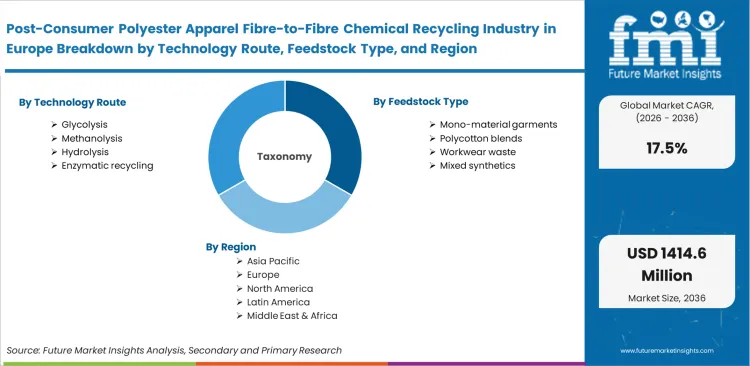
The Europe post-consumer polyester apparel fibre-to-fibre chemical recycling industry in Europe hit USD 200 million in 2025. Demand climbs to USD 240 million in 2026, establishing a CAGR of 17.5%. Consistent capital deployment shapes Europe’s polyester recycling forecast 2036 expectations, pushing cumulative opportunity to USD 1,200 million as regional legislation mandates separate garment collection.
Summary of Post-Consumer Polyester Apparel Fibre-to-Fibre Chemical Recycling in Europe Market
- Post-Consumer Polyester Apparel Fibre-to-Fibre Chemical Recycling in Europe Market Definition
- Industrial depolymerization converts end-of-life polyester clothing into purified monomers. Regenerated outputs repolymerize into virgin-equivalent fibers, enabling true garment-to-garment circularity.
- Demand Drivers in the Market
- Stringent EPR for textiles Europe structures force apparel brands to finance regional recovery infrastructure directly.
- Impending Europe textile waste collection rules 2025 compel municipal waste managers to divert massive clothing volumes from incineration.
- Corporate sustainability officers authorize premium pricing for molecularly regenerated yarns to satisfy internal circularity pledges.
- Key Segments Analyzed in the FMI Report
- Glycolysis captures 38.0% share in 2026, outperforming alternatives via lower energy requirements and compatibility with legacy recycled pet bottle glycols architecture.
- Mono-material garments lead with 41.0% share through 2036, offering predictable molecular yields without complex upstream separation steps.
- Recycled PET chips command 36.0% share in 2026, matching spinning-facility input requirements flawlessly.
- Sportswear holds 34.0% share in 2026, driven by intense performance testing that mechanical alternatives routinely fail.
- Pilot plants maintain 44.0% share in 2026, reflecting current technological maturity before massive commercial circular specialty plastics for textiles and packaging facilities activate.
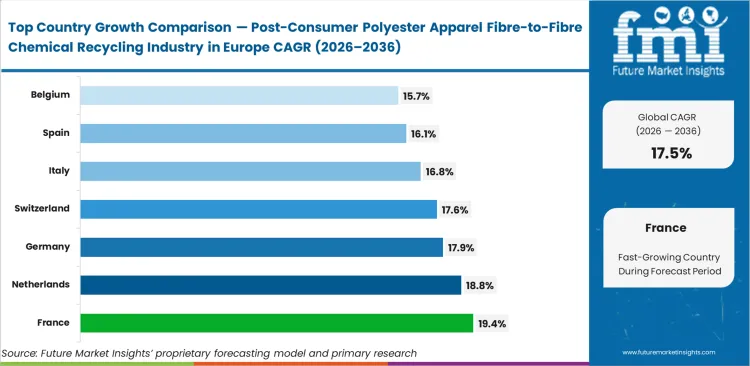
- France is projected to observe 19.4% compound growth over the forecast period, anchored by immense industrial regeneration hub investments.
- Analyst Opinion at FMI
- Nikhil Kaitwade, Principal Analyst, Chemicals, at FMI, notes that " Broad-based models usually report nameplate capacity accurately, yet these figures miss actual textile recycling sorting efficiency entirely. My team observes commercial plants running at fractional capacity because automated near-infrared sorting networks remain severely underfunded. Investors valuing novel chemistry over reverse-logistics contracts consistently misjudge breakeven timelines."
- Strategic Implications / Executive Takeaways
- Facility operators must vertically integrate with municipal sorting hubs to guarantee continuous reactor feedstocks.
- Brand procurement teams risk structural supply deficits unless they co-invest in early-stage demonstration facilities immediately.
- Chemical engineers face urgent mandates to optimize catalyst recovery loops for improved overall unit economics.
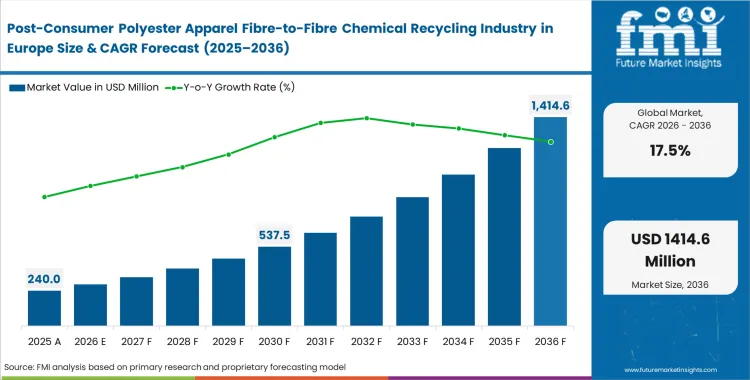
Procurement directors across fashion conglomerates face severe capacity deficits for fibre-to-fibre polyester recycling outputs. Sourcing managers urgently seek recycled polyester apparel fiber to satisfy impending corporate sustainability targets. When evaluating mechanical vs chemical recycling for polyester apparel, the data shows: thermal degradation
Securing high-purity recycled polyester from textile waste in Europe enables immediate operational viability. Hubs mastering chemical recycling feedstock aggregation flip unit economics from deficit to profitability, turning municipal collection mandates into reliable chemical inputs.
Geographic expansion relies primarily on Europe textile recycling capacity polyester buildup. France expands at 19.4% backed by dedicated European recycling infrastructure, while Netherlands tracks at 18.8% using existing chemical parks. Germany registers 17.9%, Switzerland hits 17.6%, and Italy achieves 16.8%. Spain and Belgium follow at 16.1% and 15.7% respectively. Variations stem directly from distinct national approaches to extended producer responsibility frameworks.
Definition
Evaluating chemical recycling of polyester garments in Europe involves tracking industrial processes that break ester bonds to isolate base monomers. Operations convert discarded clothing fibers into virgin-grade resins specifically formulated for apparel spinning. This sector establishes closed-loop garment circularity entirely separate from traditional plastic downcycling pathways.
Inclusions
Scope covers polyester textile depolymerization in Europe utilizing glycolysis, methanolysis, hydrolysis, and enzymatic routes. Plants generating molecular recycling feedstock and polyester renewal resins from polycotton blends fall within measured boundaries. Pre-treatment steps directly integrated into main depolymerization lines are included.
Exclusions
Analysts comparing bottle-to-fiber vs textile-to-textile polyester recycling omit facilities processing packaging waste for garment spinning. Standard recycled pet mechanical shredding operations remain excluded. Open-loop downcycling into industrial insulation or carpets falls outside this specific fiber-to-fiber boundary.
Post-Consumer Polyester Apparel Fibre-to-Fibre Chemical Recycling in Europe Market Research Methodology
- Primary Research: Sourcing directors at multinational sports brands, facility managers at European depolymerization plants, municipal sorting hub operators.
- Desk Research: European Environment Agency waste directives, Systemiq capacity models, patent filings for novel catalyst recovery systems.
- Market-Sizing and Forecasting: Off-take agreement volumes anchoring baseline capacity against projected separate-collection yields across EU member states.
- Data Validation and Update Cycle: Independent cross-validation against Textile Exchange materials production data and regional EPR fee disclosures.
Segmental Analysis
Post-Consumer Polyester Apparel Fibre-to-Fibre Chemical Recycling in Europe Market Analysis by Technology Route
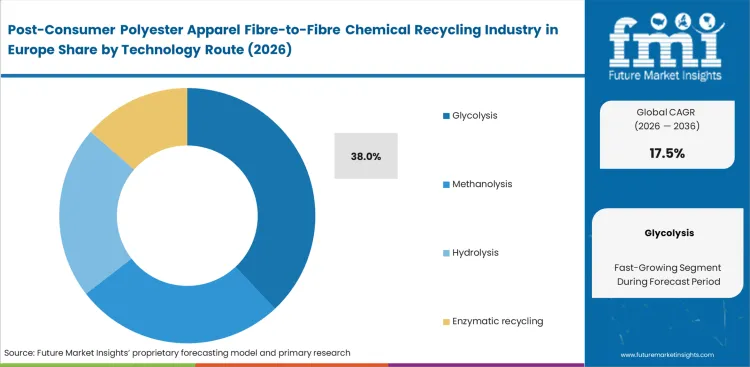
Legacy mechanical shredding fails to deliver virgin-equivalent tensile strength for premium apparel. Glycolysis holds 38.0% share in 2026 as plant managers replace thermal degradation cycles with precise ester-bond cleavage. FMI's analysis indicates chemical engineers favour this textile-to-textile polyester recycling Europe route because depolymerization catalysts for pet and polyesters operate at lower temperatures than methanolysis, reducing energy overhead per metric ton. Sourcing directors mandate this output because staple fibers spun from glycolysis-derived BHET behave exactly like fossil-derived inputs. However, volume metrics don't show that glycolysis units struggle severely with elastane contamination, forcing rigid upstream sorting requirements. Brands delaying transition face total exclusion from premium performance-wear categories.
- Sorting mandate: Near-infrared scanners must reject garments containing high elastane percentages. Hub operators face severe yield penalties when stretch fabrics enter continuous glycolysis reactors.
- Catalyst recovery: Chemical engineers implement closed-loop filtration to reclaim expensive zinc-based catalysts. Plant managers capture significant operational savings by preventing active-metal losses during purification.
- Spinning integration: Extrusion technicians load purified monomers directly into polymerization lines. Sourcing directors eliminate secondary remelting steps, improving factory carbon footprints substantially.
Post-Consumer Polyester Apparel Fibre-to-Fibre Chemical Recycling in Europe Market Analysis by Feedstock Type
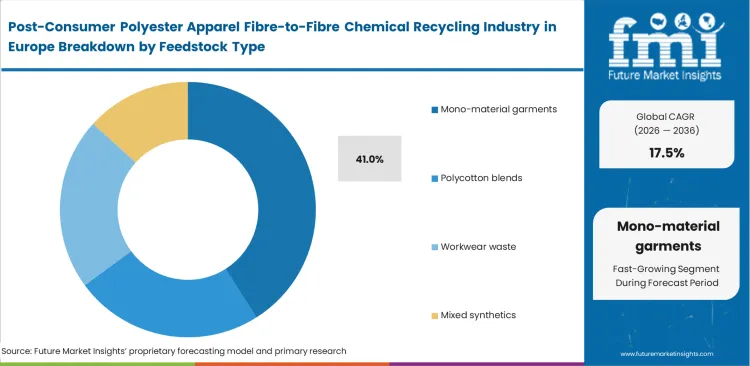
Molecular purity determines processing economics across every active demonstration plant. Mono-material garments capture 41.0% share in 2026 because facility operators demand predictable inputs to maintain continuous reactor equilibrium. Based on FMI's assessment, polyester textile recycling suppliers Europe route pure synthetic streams to premium chemical recyclers while downgrading blends to thermal recovery. This clean input stream allows engineers to utilize standard textile waste recycling machine infrastructure without complex filtration cycles. True 100% polyester garments comprise less than a third of post-consumer waste, making mono-material sourcing highly competitive. Aggregators failing to secure municipal sorting contracts now will find themselves locked out of high-margin molecular feedstock markets entirely.
- Yield maximization: Pure inputs eliminate complex separation requirements during depolymerization. Plant managers achieve maximum monomer recovery rates while minimizing hazardous sludge disposal costs.
- Dye removal: Decoloration loops operate more efficiently on uniform synthetic substrates. Chemical engineers spend fewer resources stripping pigment from mono-materials compared to handling reactive dyes on cotton blends.
- Contract leverage: Aggregators holding verified mono-material bales dictate pricing terms directly to regional chemical plants. Procurement directors must accept premium spot-market rates without long-term supply agreements.
Post-Consumer Polyester Apparel Fibre-to-Fibre Chemical Recycling in Europe Market Analysis by Output Form
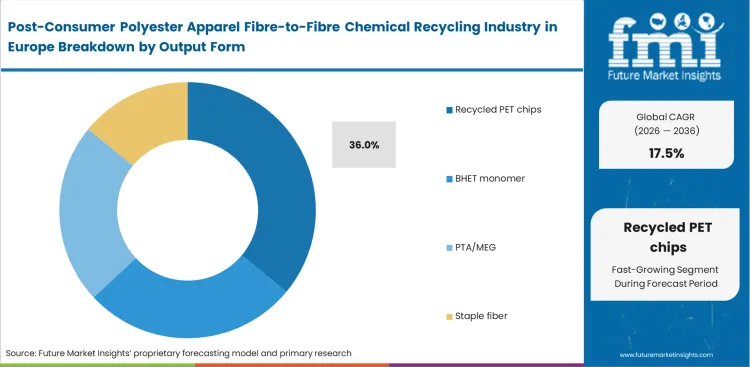
Spinning facility technicians require specific molecular weights to prevent yarn breakage during high-speed extrusion. Recycled PET chips account for 36.0% share in 2026 because this format drops directly into existing polyester fiber production lines. FMI observes that procurement directors evaluating BHET from textile waste for polyester production often prefer standardized chips to avoid handling volatile liquid monomers. Purchasing standardized formats shifts polymerization risk back to chemical recyclers, ensuring any chemical recycled polyester yarn supplier Europe delivers certified, spinnable resins. A critical nuance is that chip viscosity often dictates final fabric applications, meaning generic packaging chips cannot serve technical apparel requirements. Mills attempting to utilize low-grade inputs for apparel spinning suffer catastrophic line-breakage rates.
- Viscosity failure: Low intrinsic viscosity causes fibre snapping during fine-denier extrusion. Spinning technicians must halt entire production lines, costing textile mills thousands in lost throughput.
- Moisture contamination: Hygroscopic chips require intensive pre-drying before entering melt extruders. Plant operators deploy specialized desiccant systems to prevent hydrolytic degradation during thermal processing.
- Drop-in transition: Standardized chips integrate flawlessly into legacy melt-spinning architecture. Procurement directors achieve corporate recycled-content targets without authorizing capital expenditures for new equipment.
Post-Consumer Polyester Apparel Fibre-to-Fibre Chemical Recycling in Europe Market Analysis by Application
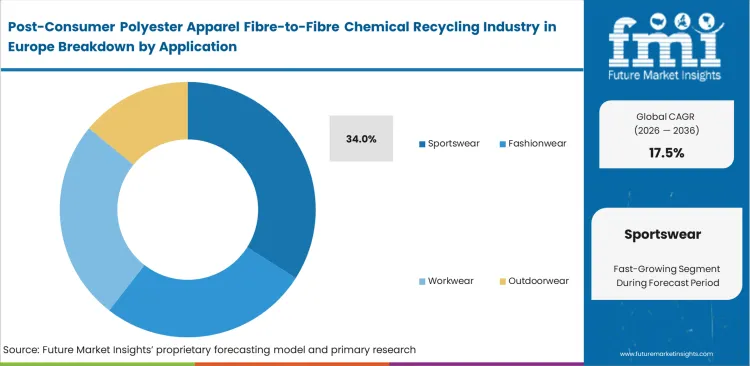
Sustainability mandates conflict with extreme performance requirements in athletic wear. Sportswear commands 34.0% share in 2026 as material scientists demand moisture-wicking properties that mechanically recycled fibers simply cannot sustain. In FMI's view, R&D directors authorize premium pricing for chemically regenerated polyester microfiber fabric because it remains durable after repeated industrial washing. Athletic brands face intense public scrutiny, forcing aggressive transition timelines from virgin plastics. Sportswear's heavy reliance on elastane blends presents a challenge: apparel demanding the highest chemical-recycling quality proves hardest to chemically recycle. Brands designing new collections without disassembly in mind severely limit future circularity loops.
- Tensile testing: Chemically regenerated yarns must pass strict burst-strength evaluations. Material scientists reject batches failing multi-directional stretch criteria, forcing suppliers to refine repolymerization parameters.
- Wicking validation: Capillary action requires precise cross-sections achievable only with virgin-equivalent polymer structures. R&D directors qualify chemical recycling outputs solely on moisture-management performance metrics.
- End-of-life sorting: Complex activewear construction complicates automated recycling systems. Designers must implement dissolvable threading to enable future circular design certified textile fiber systems recovery.
Post-Consumer Polyester Apparel Fibre-to-Fibre Chemical Recycling in Europe Market Analysis by Scale Stage
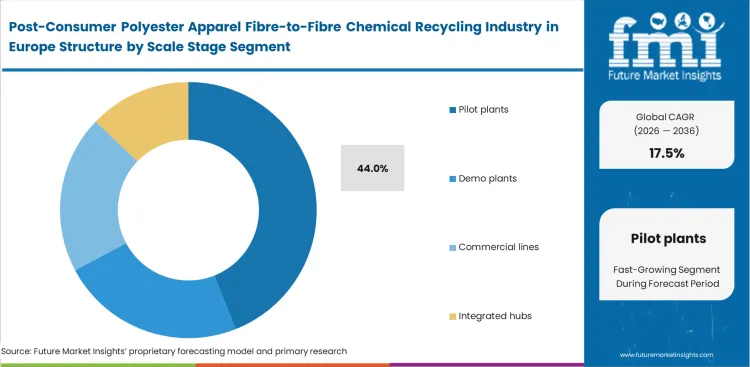
Chemical engineering concepts currently face massive hurdles transitioning from laboratory beakers to continuous industrial flows. Pilot plants dominate with 44.0% share as venture capital targets proof-of-concept validation before funding full-scale recycled polyethylene terephthalate packaging or textile hubs. Chief technology officers utilize pilot data to identify heat-transfer bottlenecks and solvent recovery inefficiencies that theoretical models miss. Early-stage facilities prove chemical viability but operate at severe financial losses. Most pilot plants quietly supplement textile feedstocks with pure PET bottle flake to maintain operational stability during investor demonstrations. Consortia delaying transition to demo-scale operations risk losing off-take commitments entirely.
- Validation runs: Engineers test novel catalysts on continuous small-scale loops before authorizing massive capital expenditures. Chief technology officers identify fatal scaling flaws early, saving millions in industrial redesigns.
- Sample production: Pilot lines generate sufficient staple fiber volumes for brand testing. Sourcing directors knit sample garments to verify hand-feel and dyeability before signing multi-year volume agreements.
- Scale-up friction: Heat dynamics change unpredictably when moving from 500-liter to 50,000-liter reactors. Plant managers face unexpected exothermic reactions requiring sophisticated thermal regulation systems.
Post-Consumer Polyester Apparel Fibre-to-Fibre Chemical Recycling in Europe Market Drivers, Restraints, and Opportunities
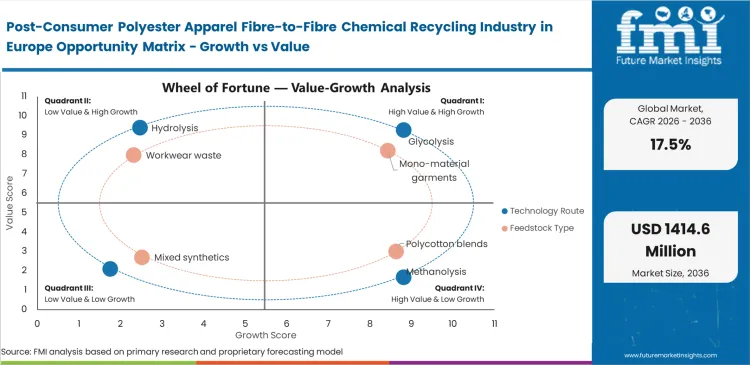
Procurement teams locking down circular polyester offtake agreements in Europe gain gain significant competitive advantages. Securing textile-to-textile recycled polyester procurement in Europe shields brands from punitive virgin plastic taxes while satisfying impending regulatory mandates. Sustainability directors cannot rely on mechanical shredding for performance fabrics which triggers urgent contracts with early-stage chemical recyclers. Delaying these agreements leaves brands exposed to severe supply bottlenecks as EU legislation forces municipal waste managers to stockpile massive volumes of discarded garments.
Sorting bottlenecks choke continuous reactor flows even when depolymerization chemistry works perfectly. Reverse logistics managers struggle to source homogenous polyester bales because clothing recycling facilities lack automated near-infrared optical scanners. This friction forces chemical plants to operate below nameplate capacity, wrecking damaging unit economics. Emerging automated systems offer partial solutions, but high capital costs slow widespread deployment across fragmented European sorting ecosystems.
Opportunities in the Post-Consumer Polyester Apparel Fibre-to-Fibre Chemical Recycling in Europe Market
- Enzymatic optimization: Chemical engineers isolating mutated depolymerase enzymes achieve ambient-temperature breakdown of mixed plastics. Plant managers capture massive energy savings compared to thermal glycolysis.
- Dope-dying integration: Extrusion specialists injecting liquid pigments into chemically dope dyed recycled polyester melts eliminate water-intensive downstream coloring. Textile mills slash effluent treatment costs entirely.
- Elastane separation: R&D directors deploying novel solvent systems successfully dissolve spandex prior to polyester depolymerization. Sorting hubs monetize previously rejected stretch-fabric bales.
Regional Analysis
.webp "Top Country Growth Comparison Post Consumer Polyester Apparel Fibre To Fibre Chemical Recycling Industry In Europe Cagr (2026 2036)")
Based on regional analysis, post-consumer polyester apparel fibre-to-fibre chemical recycling in Europe is segmented into Western Europe and Southern Europe across 40 plus countries.
| Country | CAGR (2026 to 2036) |
|---|---|
| France | 19.4% |
| Netherlands | 18.8% |
| Germany | 17.9% |
| Switzerland | 17.6% |
| Italy | 16.8% |
| Spain | 16.1% |
| Belgium | 15.7% |
Source: Future Market Insights (FMI) analysis, based on proprietary forecasting model and primary research
Western Europe Post-Consumer Polyester Apparel Fibre-to-Fibre Chemical Recycling in Europe Market Analysis
Industrial regeneration mandates push facility operators to integrate novel depolymerization technologies directly into existing chemical parks. Procurement teams bypass massive initial capital expenditures for standalone power and water treatment by connecting to established industrial infrastructure. FMI analysts note local governments heavily subsidize these transitions to protect domestic manufacturing bases from cheap virgin Asian imports. Centralized strategies solve energy constraints but exacerbate logistics hurdles, requiring massive textile shipments across borders.
- France: Growth in post‑consumer polyester apparel fibre‑to‑fibre chemical recycling is underpinned by sustained public investment in biorecycling infrastructure. This funding enables operators to secure long‑term domestic feedstock contracts, which in turn positions French facilities as preferred suppliers for luxury fashion houses concentrated around Paris. Over the 2026 to 2036 forecast period, the market for fibre‑to‑fibre chemical recycling capacity in France is projected to expand at a CAGR of 19.4%, reflecting the rapid redirection of sorted textile flows away from downcycling and toward closed‑loop applications. Municipal supply agreements play a central role, as they allow domestic mills to plan premium circular yarn output with a high degree of certainty.
- Netherlands: In the Netherlands, chemical recycling expansion is closely tied to integration within the Chemelot industrial cluster, where shared utilities materially reduce operating costs. Access to existing hydrogen, solvent recovery, and waste‑water systems shortens scale‑up timelines and limits upfront capital exposure during early commercialisation. As a result, the Netherlands’ fibre‑to‑fibre polyester chemical recycling sector is expected to rise at a CAGR of 18.8% between 2026 and 2036, driven by capacity additions rather than greenfield construction. By reallocating capital away from standalone infrastructure and toward yield optimisation, Dutch operators improve unit economics and achieve stable, continuous repolymerisation at cost levels that isolated facilities struggle to match.
- Germany: Germany’s trajectory reflects structural energy constraints rather than aggressive capacity build‑outs. High baseload electricity prices push operators toward low‑temperature glycolysis routes, making thermodynamic efficiency a core competitive variable. The post‑consumer polyester apparel chemical recycling sector in country is forecast to expand at a CAGR of 17.9% from 2026 to 2036, supported by incremental process improvements rather than rapid scale expansion. Facility managers prioritise advanced heat‑exchange and energy‑recovery systems during monomer purification, as long‑term commercial viability depends on reducing exposure to volatile gas and power prices. Plants that fail to resolve these energy dynamics face significant barriers to progressing beyond pilot and demonstration stages.
- Switzerland: The country functions less as a volume‑driven recycling hub and more as a technology development centre for fibre‑to‑fibre chemical recycling. Companies such as DePoly and Worn Again leverage the country’s precision engineering base to refine catalyst systems and continuous‑flow reactor designs, while maintaining tight control over intellectual property. The industry, measured in technology development and licensing activity, is projected to register a CAGR of 17.6% through 2036. Rather than pursuing large‑scale waste handling, Swiss players focus on process optimisation and patent generation, monetising innovation
- Belgium: Belgium’s role in the fibre‑to‑fibre recycling landscape is shaped by logistics rather than processing scale. Its port infrastructure enables efficient movement of sorted garment bales and finished circular yarns across borders, compensating for comparatively limited domestic depolymerisation capacity. Over the 2026–2036 period, fibre‑to‑fibre polyester recycling logistics and toll‑processing activities sector is expected to rise at a CAGR of 15.7%. Demand is concentrated in transshipment, customs clearance, and intermediate storage, with coastal aggregation hubs evolving into critical gateways feeding inland chemical recycling plants across Western Europe.FMI's report includes Austria and the regional Nordic markets. Specialised automation firms in these adjacent territories supply crucial near-infrared sorting machinery to primary Western European chemical hubs.
Southern Europe Post-Consumer Polyester Apparel Fibre-to-Fibre Chemical Recycling in Europe Market Analysis
Legacy textile manufacturing districts confront massive transitions as cheap virgin synthetics lose viability under incoming EU regulations. Mill owners historically reliant on mechanical shredding lack technical expertise to operate complex chemical reactors. FMI's analysis indicates regional consortiums form rapidly, pooling capital to build shared depolymerization infrastructure near historic fashion hubs. Localized strategies minimize transport emissions but require intensive retraining for workers accustomed to traditional spinning operations.
- Italy: Italy's deep, multi-generational expertise in luxury apparel sorting translates directly into unparalleled feedstock quality. Hub operators here bypass standard processing delays by feeding pristine textile scraps straight into chemical loops, achieving exceptional monomer yields that highly automated competitors simply cannot replicate. For the broader Post-Consumer Polyester Apparel Fibre-to-Fibre Chemical Recycling in Europe market to function reliably, this level of precise, manual grading is mandatory to prevent catastrophic reactor contamination. Tracking a projected 16.8% CAGR from 2026 to 2036, procurement directors in Italy are actively utilize this sorting accuracy. By guaranteeing zero elastane contamination in their deliveries, specialized aggregation facilities command premium spot-market rates, effectively transferring profit margins from the technology operators back to the waste handlers.
- Spain: In contrast, Spain leverages its massive fast-fashion reverse logistics networks to aggregate enormous daily volumes of low-grade, discarded garments. Supply chain directors are intentionally channelling these highly contaminated streams into heavy-duty methanolysis lines, which are engineered specifically to survive massive dye and elastane loads. To successfully scale the wider Post-Consumer Polyester Apparel Fibre-to-Fibre Chemical Recycling in Europe market, the industry absolutely requires this capability to process bottom-tier textiles without breaking continuous reactor flows. Anticipated to grow at a 16.1% CAGR through the 2036 forecast period, Spain’s domestic market relies heavily on facility managers deploying aggressive pre-washing and mechanical filtration steps prior to chemical insertion. Stabilizing these low-purity input streams secures baseload plant operation, transforming what was previously an unrecyclable fast-fashion liability into a highly consistent supply of repolymerized industrial monomers.
FMI's report includes Portugal and Greece. These nations leverage remaining garment assembly infrastructure to test initial closed-loop recycled yarn deployments before wider European rollouts.
Competitive Aligners for Market Players
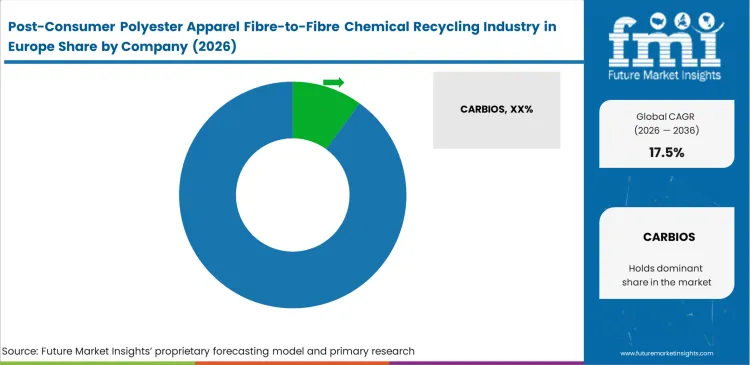
Technological viability determines early survival, but execution of feedstock aggregation contracts dictates long-term market dominance. When sourcing executives compare Carbios Reju Worn Again CuRe and DePoly, operational viability outweighs theoretical chemistry. Supply chain directors at frontrunner firms lock down exclusive access to high-grade textile waste streams, starving newer entrants of necessary operational inputs. Competition centers less on reactor design and more on securing reliable, automated regional sorting capacity.
Incumbents possessing deep ties to existing petrochemical supply chains deploy distinct operational leverage. Companies like Syre utilize established relationships with major buyers of biodegradable polyester cellulosi blend fiber to guarantee minimum volume purchases. Financial officers at these firms easily secure scale-up capital because order books show guaranteed revenue before groundbreaking occurs. Startups lacking historical industry connections struggle to convince conservative textile mills to trial novel regenerated monomers.
Brand coalitions exert massive pressure on technology developers by forming unified buying blocks. Sourcing directors from competing fashion houses collaborate to fund shared pilot facilities, demanding open-access intellectual property licensing in return. Consolidated approaches prevent any single chemical recycler from establishing monopolistic control. Facilities refusing transparency requirements or demanding exorbitant premiums find themselves excluded from lucrative multi-brand off-take agreements entirely.
Key Players in Post-Consumer Polyester Apparel Fibre-to-Fibre Chemical Recycling in Europe Market
- CARBIOS
- Reju
- Worn Again Technologies
- CuRe Technology
- DePoly
- GR3N
- Syre
Scope of the Report
| Metric | Value |
|---|---|
| Quantitative Units | USD 240 million to USD 1,200 million, at a CAGR of 17.5% |
| Market Definition | Industrial depolymerization converts end-of-life polyester clothing into purified monomers. Regenerated outputs repolymerize into virgin-equivalent fibers, enabling true garment-to-garment circularity. |
| Segmentation | Technology route, Feedstock type, Output form, Application, Scale stage, Region |
| Regions Covered | North America, Latin America, Europe, Asia Pacific, Middle East and Africa |
| Countries Covered | France, Netherlands, Germany, Switzerland, Italy, Spain, Belgium |
| Key Companies Profiled | CARBIOS, Reju, Worn Again Technologies, CuRe Technology, DePoly, GR3N, Syre |
| Forecast Period | 2026 to 2036 |
| Approach | Off-take agreement volumes anchoring baseline capacity against projected separate-collection yields across EU member states. |
Source: Future Market Insights (FMI) analysis, based on proprietary forecasting model and primary research
Post-Consumer Polyester Apparel Fibre-to-Fibre Chemical Recycling in Europe Market Analysis by Segments
Technology route
- Glycolysis
- Methanolysis
- Hydrolysis
- Enzymatic recycling
Feedstock type
- Mono-material garments
- Polycotton blends
- Workwear waste
- Mixed synthetics
Output form
- Recycled PET chips
- BHET monomer
- PTA/MEG
- Staple fiber
Application
- Sportswear
- Fashionwear
- Workwear
- Outdoorwear
Scale stage
- Pilot plants
- Demo plants
- Commercial lines
- Integrated hubs
Region
- Western Europe
- France
- Netherlands
- Germany
- Switzerland
- Belgium
- Austria
- Southern Europe
- Italy
- Spain
- Portugal
- Greece
Bibliography
- European Environment Agency. (2024, May 21). Management of used and waste textiles in Europe’s circular economy.
- European Topic Centre on Circular Economy and Resource Use. (2024, May). Textile waste management in Europe’s circular economy (ETC CE Report 2024/5).
- Enking, J., Stern, T., Poschmann, H., Woidasky, J., & Moosbauer, J. (2025, June). Recycling processes of polyester-containing textile waste: A review of technologies, markets, and sustainability. Resources, Conservation and Recycling, 220, 108536.
- Lanz, I. E., Hagedorn, L., & Sieling, K. (2024, August). A mapping of textile waste recycling technologies in Europe. Recycling, 9(3), 22.
- Mohtaram, F., Boström, M., & Ljungkvist Nordin, H. (2025, June). From waste to value: Advances in recycling textile-based materials. Textiles, 5(3), 24.
- Solis, M., Hallberg, P., Palm, D., Elander, M., & Watson, D. (2024, December). Contribution of waste management to a sustainable textile and clothing sector in Europe. Waste Management, 182, 1-14.
- Systemiq. (2025, May). The Textile Recycling Breakthrough: Why policy must lead the scale-up of polyester recycling in Europe.
- PETCORE Europe. (2024). PET market in Europe: State of play 2022 data.
This bibliography is provided for reader reference. The full FMI report contains the complete reference list with primary source documentation.
This Report Addresses
- Feedstock aggregation challenges disrupting commercial scale-up for major European depolymerization facilities.
- Operational friction preventing mono-material garment sorting at municipal waste hubs.
- Tensile strength validation metrics required by sportswear brands evaluating chemically recycled yarns.
- Catalyst recovery efficiencies impacting unit economics within early-stage glycolysis pilot plants.
- Regulatory mandates driving luxury fashion houses toward closed-loop circular-chemicals ecosystems.
- Viscosity failure rates associated with utilizing low-grade packaging chips in fine-denier extrusion lines.
- Elastane separation strategies deployed by R&D directors to monetize complex stretch-fabric bales.
- Capital expenditure requirements for integrating near-infrared scanners into legacy mechanical shredding operations.
Frequently Asked Questions
What is the market size of polyester textile chemical recycling in Europe?
Market valuation reached USD 200 million in 2025. Revenue scales to USD 1,200 million by 2036, driven by an urgent need for closed-loop recycled ocean plastic performance textile fiber alternatives and impending waste directives.
Which companies are leading polyester fibre-to-fibre recycling in Europe?
Frontrunners include CARBIOS, Reju, Worn Again Technologies, CuRe Technology, DePoly, GR3N, and Syre. These entities secure early dominance through aggressive capacity expansion and strategic municipal sorting partnerships.
How will EU textile collection rules affect polyester recycling demand?
Directives mandate separate clothing collection, creating immense stockpiles. Waste managers must divert these volumes from landfills, instantly providing continuous feedstock necessary for chemical plants to achieve operational breakeven.
What limits continuous reactor equilibrium in early-stage pilot plants?
Inconsistent feedstock purity disrupts thermal dynamics. Plant managers constantly adjust catalyst dosing to compensate for unexpected elastane or cotton contamination entering glycolysis chambers.
Why do procurement directors prioritize chip formats over liquid monomers?
Chips drop flawlessly into legacy melt-spinning architecture. Supply chain managers avoid hazardous materials transport regulations while textile mills bypass expensive equipment modifications required for liquid inputs.
How does elastane contamination affect chemical yield?
Spandex degrades into sticky residues during depolymerization. Chemical engineers must halt continuous lines to clear filtration systems, severely reducing overall daily monomer output.
What consequence faces apparel brands delaying off-take agreements?
Companies lose access to premium molecular feedstock. Procurement teams missing initial production windows face complete exclusion from compliant supply chains as impending virgin-plastic taxes take effect.
How does enzymatic recycling reduce operational overhead?
Mutated depolymerase enzymes break ester bonds at ambient temperatures. Plant managers bypass massive thermal heating requirements, drastically lowering energy consumption per metric ton of processed waste.
Why do pilot facilities supplement textile feedstocks with bottle flake?
Consistent purity stabilizes continuous reactor demonstrations. Chief technology officers mask reverse-logistics failures during investor tours by blending easily accessible, highly homogenous packaging waste.
What dictates competitive survival among chemical recycling startups?
Securing municipal sorting contracts outweighs novel catalyst designs. Companies capturing reliable incoming garment streams starve competitors of necessary inputs, dominating regional material flows entirely.
Why do R&D directors favor dope-dying integration?
Injecting liquid pigments directly into recycled melts eliminates downstream aqueous coloring. Textile mills completely bypass water-intensive treatment steps, cutting effluent discharge costs to zero.
What role does Chemelot play in Netherlands' recycling dominance?
Shared utility infrastructure slashes capital expenditures. Startups tap directly into existing hydrogen and solvent recovery networks, accelerating commercial scale-up timelines significantly.
How do high energy costs shape Germany's technological focus?
Thermodynamic efficiency becomes critical for survival. CTOs prioritize low-temperature glycolysis innovations to insulate business models against unpredictable natural gas price spikes.
Why does Italy command premium monomer yields?
Historic luxury apparel sorting expertise ensures exceptional feedstock purity. Hub operators feed pristine scraps into chemical loops, minimizing filtration cycles and maximizing continuous throughput.
What risk do brands face when designing complex activewear?
Inseparable hardware and complex blends thwart automated recycling systems. Designers failing to implement dissolvable threading permanently block future circularity loops for high-performance collections.
How does zinc catalyst recovery impact facility profitability?
Closed-loop filtration prevents active-metal losses. Plant managers capture significant operational savings, preventing expensive catalyst replacement cycles from wrecking overall unit economics.
Why do venture capitalists target proof-of-concept validation first?
Scaling heat dynamics alters theoretical models unpredictably. Investors demand hard data on thermal regulation efficiency before funding massive commercial-scale reactors.
Preview the report firsthand - request a free sample
Get SampleGet the brochure for pricing and purchase details.
Get PDFTable of Content
- Executive Summary
- Global Market Outlook
- Demand-side Trends
- Supply-side Trends
- Technology Roadmap Analysis
- Analysis and Recommendations
- Market Overview
- Market Coverage / Taxonomy
- Market Definition / Scope / Limitations
- Research Methodology
- Chapter Orientation
- Analytical Lens and Working Hypotheses
- Market Structure, Signals, and Trend Drivers
- Benchmarking and Cross-market Comparability
- Market Sizing, Forecasting, and Opportunity Mapping
- Research Design and Evidence Framework
- Desk Research Programme (Secondary Evidence)
- Company Annual and Sustainability Reports
- Peer-reviewed Journals and Academic Literature
- Corporate Websites, Product Literature, and Technical Notes
- Earnings Decks and Investor Briefings
- Statutory Filings and Regulatory Disclosures
- Technical White Papers and Standards Notes
- Trade Journals, Industry Magazines, and Analyst Briefs
- Conference Proceedings, Webinars, and Seminar Materials
- Government Statistics Portals and Public Data Releases
- Press Releases and Reputable Media Coverage
- Specialist Newsletters and Curated Briefings
- Sector Databases and Reference Repositories
- FMI Internal Proprietary Databases and Historical Market Datasets
- Subscription Datasets and Paid Sources
- Social Channels, Communities, and Digital Listening Inputs
- Additional Desk Sources
- Expert Input and Fieldwork (Primary Evidence)
- Primary Modes
- Qualitative Interviews and Expert Elicitation
- Quantitative Surveys and Structured Data Capture
- Blended Approach
- Why Primary Evidence is Used
- Field Techniques
- Interviews
- Surveys
- Focus Groups
- Observational and In-context Research
- Social and Community Interactions
- Stakeholder Universe Engaged
- C-suite Leaders
- Board Members
- Presidents and Vice Presidents
- R&D and Innovation Heads
- Technical Specialists
- Domain Subject-matter Experts
- Scientists
- Physicians and Other Healthcare Professionals
- Governance, Ethics, and Data Stewardship
- Research Ethics
- Data Integrity and Handling
- Primary Modes
- Tooling, Models, and Reference Databases
- Desk Research Programme (Secondary Evidence)
- Data Engineering and Model Build
- Data Acquisition and Ingestion
- Cleaning, Normalisation, and Verification
- Synthesis, Triangulation, and Analysis
- Quality Assurance and Audit Trail
- Market Background
- Market Dynamics
- Drivers
- Restraints
- Opportunity
- Trends
- Scenario Forecast
- Demand in Optimistic Scenario
- Demand in Likely Scenario
- Demand in Conservative Scenario
- Opportunity Map Analysis
- Product Life Cycle Analysis
- Supply Chain Analysis
- Investment Feasibility Matrix
- Value Chain Analysis
- PESTLE and Porter’s Analysis
- Regulatory Landscape
- Regional Parent Market Outlook
- Production and Consumption Statistics
- Import and Export Statistics
- Market Dynamics
- Global Market Analysis 2021 to 2025 and Forecast, 2026 to 2036
- Historical Market Size Value (USD Million) Analysis, 2021 to 2025
- Current and Future Market Size Value (USD Million) Projections, 2026 to 2036
- Y-o-Y Growth Trend Analysis
- Absolute $ Opportunity Analysis
- Global Market Pricing Analysis 2021 to 2025 and Forecast 2026 to 2036
- Global Market Analysis 2021 to 2025 and Forecast 2026 to 2036, By Technology Route
- Introduction / Key Findings
- Historical Market Size Value (USD Million) Analysis By Technology Route , 2021 to 2025
- Current and Future Market Size Value (USD Million) Analysis and Forecast By Technology Route , 2026 to 2036
- Glycolysis
- Methanolysis
- Hydrolysis
- Enzymatic recycling
- Glycolysis
- Y-o-Y Growth Trend Analysis By Technology Route , 2021 to 2025
- Absolute $ Opportunity Analysis By Technology Route , 2026 to 2036
- Global Market Analysis 2021 to 2025 and Forecast 2026 to 2036, By Feedstock Type
- Introduction / Key Findings
- Historical Market Size Value (USD Million) Analysis By Feedstock Type, 2021 to 2025
- Current and Future Market Size Value (USD Million) Analysis and Forecast By Feedstock Type, 2026 to 2036
- Mono-material garments
- Polycotton blends
- Workwear waste
- Mixed synthetics
- Mono-material garments
- Y-o-Y Growth Trend Analysis By Feedstock Type, 2021 to 2025
- Absolute $ Opportunity Analysis By Feedstock Type, 2026 to 2036
- Global Market Analysis 2021 to 2025 and Forecast 2026 to 2036, By Output Form
- Introduction / Key Findings
- Historical Market Size Value (USD Million) Analysis By Output Form, 2021 to 2025
- Current and Future Market Size Value (USD Million) Analysis and Forecast By Output Form, 2026 to 2036
- Recycled PET chips
- BHET monomer
- PTA/MEG
- Staple fiber
- Recycled PET chips
- Y-o-Y Growth Trend Analysis By Output Form, 2021 to 2025
- Absolute $ Opportunity Analysis By Output Form, 2026 to 2036
- Global Market Analysis 2021 to 2025 and Forecast 2026 to 2036, By Application
- Introduction / Key Findings
- Historical Market Size Value (USD Million) Analysis By Application, 2021 to 2025
- Current and Future Market Size Value (USD Million) Analysis and Forecast By Application, 2026 to 2036
- Sportswear
- Fashionwear
- Workwear
- Outdoorwear
- Sportswear
- Y-o-Y Growth Trend Analysis By Application, 2021 to 2025
- Absolute $ Opportunity Analysis By Application, 2026 to 2036
- Global Market Analysis 2021 to 2025 and Forecast 2026 to 2036, By Scale Stage
- Introduction / Key Findings
- Historical Market Size Value (USD Million) Analysis By Scale Stage, 2021 to 2025
- Current and Future Market Size Value (USD Million) Analysis and Forecast By Scale Stage, 2026 to 2036
- Pilot plants
- Demo plants
- Commercial lines
- Integrated hubs
- Pilot plants
- Y-o-Y Growth Trend Analysis By Scale Stage, 2021 to 2025
- Absolute $ Opportunity Analysis By Scale Stage, 2026 to 2036
- Global Market Analysis 2021 to 2025 and Forecast 2026 to 2036, By Region
- Introduction
- Historical Market Size Value (USD Million) Analysis By Region, 2021 to 2025
- Current Market Size Value (USD Million) Analysis and Forecast By Region, 2026 to 2036
- North America
- Latin America
- Western Europe
- Eastern Europe
- East Asia
- South Asia and Pacific
- Middle East & Africa
- Market Attractiveness Analysis By Region
- North America Market Analysis 2021 to 2025 and Forecast 2026 to 2036, By Country
- Historical Market Size Value (USD Million) Trend Analysis By Market Taxonomy, 2021 to 2025
- Market Size Value (USD Million) Forecast By Market Taxonomy, 2026 to 2036
- By Country
- USA
- Canada
- Mexico
- By Technology Route
- By Feedstock Type
- By Output Form
- By Application
- By Scale Stage
- By Country
- Market Attractiveness Analysis
- By Country
- By Technology Route
- By Feedstock Type
- By Output Form
- By Application
- By Scale Stage
- Key Takeaways
- Latin America Market Analysis 2021 to 2025 and Forecast 2026 to 2036, By Country
- Historical Market Size Value (USD Million) Trend Analysis By Market Taxonomy, 2021 to 2025
- Market Size Value (USD Million) Forecast By Market Taxonomy, 2026 to 2036
- By Country
- Brazil
- Chile
- Rest of Latin America
- By Technology Route
- By Feedstock Type
- By Output Form
- By Application
- By Scale Stage
- By Country
- Market Attractiveness Analysis
- By Country
- By Technology Route
- By Feedstock Type
- By Output Form
- By Application
- By Scale Stage
- Key Takeaways
- Western Europe Market Analysis 2021 to 2025 and Forecast 2026 to 2036, By Country
- Historical Market Size Value (USD Million) Trend Analysis By Market Taxonomy, 2021 to 2025
- Market Size Value (USD Million) Forecast By Market Taxonomy, 2026 to 2036
- By Country
- Germany
- UK
- Italy
- Spain
- France
- Nordic
- BENELUX
- Rest of Western Europe
- By Technology Route
- By Feedstock Type
- By Output Form
- By Application
- By Scale Stage
- By Country
- Market Attractiveness Analysis
- By Country
- By Technology Route
- By Feedstock Type
- By Output Form
- By Application
- By Scale Stage
- Key Takeaways
- Eastern Europe Market Analysis 2021 to 2025 and Forecast 2026 to 2036, By Country
- Historical Market Size Value (USD Million) Trend Analysis By Market Taxonomy, 2021 to 2025
- Market Size Value (USD Million) Forecast By Market Taxonomy, 2026 to 2036
- By Country
- Russia
- Poland
- Hungary
- Balkan & Baltic
- Rest of Eastern Europe
- By Technology Route
- By Feedstock Type
- By Output Form
- By Application
- By Scale Stage
- By Country
- Market Attractiveness Analysis
- By Country
- By Technology Route
- By Feedstock Type
- By Output Form
- By Application
- By Scale Stage
- Key Takeaways
- East Asia Market Analysis 2021 to 2025 and Forecast 2026 to 2036, By Country
- Historical Market Size Value (USD Million) Trend Analysis By Market Taxonomy, 2021 to 2025
- Market Size Value (USD Million) Forecast By Market Taxonomy, 2026 to 2036
- By Country
- China
- Japan
- South Korea
- By Technology Route
- By Feedstock Type
- By Output Form
- By Application
- By Scale Stage
- By Country
- Market Attractiveness Analysis
- By Country
- By Technology Route
- By Feedstock Type
- By Output Form
- By Application
- By Scale Stage
- Key Takeaways
- South Asia and Pacific Market Analysis 2021 to 2025 and Forecast 2026 to 2036, By Country
- Historical Market Size Value (USD Million) Trend Analysis By Market Taxonomy, 2021 to 2025
- Market Size Value (USD Million) Forecast By Market Taxonomy, 2026 to 2036
- By Country
- India
- ASEAN
- Australia & New Zealand
- Rest of South Asia and Pacific
- By Technology Route
- By Feedstock Type
- By Output Form
- By Application
- By Scale Stage
- By Country
- Market Attractiveness Analysis
- By Country
- By Technology Route
- By Feedstock Type
- By Output Form
- By Application
- By Scale Stage
- Key Takeaways
- Middle East & Africa Market Analysis 2021 to 2025 and Forecast 2026 to 2036, By Country
- Historical Market Size Value (USD Million) Trend Analysis By Market Taxonomy, 2021 to 2025
- Market Size Value (USD Million) Forecast By Market Taxonomy, 2026 to 2036
- By Country
- Kingdom of Saudi Arabia
- Other GCC Countries
- Turkiye
- South Africa
- Other African Union
- Rest of Middle East & Africa
- By Technology Route
- By Feedstock Type
- By Output Form
- By Application
- By Scale Stage
- By Country
- Market Attractiveness Analysis
- By Country
- By Technology Route
- By Feedstock Type
- By Output Form
- By Application
- By Scale Stage
- Key Takeaways
- Key Countries Market Analysis
- USA
- Pricing Analysis
- Market Share Analysis, 2025
- By Technology Route
- By Feedstock Type
- By Output Form
- By Application
- By Scale Stage
- Canada
- Pricing Analysis
- Market Share Analysis, 2025
- By Technology Route
- By Feedstock Type
- By Output Form
- By Application
- By Scale Stage
- Mexico
- Pricing Analysis
- Market Share Analysis, 2025
- By Technology Route
- By Feedstock Type
- By Output Form
- By Application
- By Scale Stage
- Brazil
- Pricing Analysis
- Market Share Analysis, 2025
- By Technology Route
- By Feedstock Type
- By Output Form
- By Application
- By Scale Stage
- Chile
- Pricing Analysis
- Market Share Analysis, 2025
- By Technology Route
- By Feedstock Type
- By Output Form
- By Application
- By Scale Stage
- Germany
- Pricing Analysis
- Market Share Analysis, 2025
- By Technology Route
- By Feedstock Type
- By Output Form
- By Application
- By Scale Stage
- UK
- Pricing Analysis
- Market Share Analysis, 2025
- By Technology Route
- By Feedstock Type
- By Output Form
- By Application
- By Scale Stage
- Italy
- Pricing Analysis
- Market Share Analysis, 2025
- By Technology Route
- By Feedstock Type
- By Output Form
- By Application
- By Scale Stage
- Spain
- Pricing Analysis
- Market Share Analysis, 2025
- By Technology Route
- By Feedstock Type
- By Output Form
- By Application
- By Scale Stage
- France
- Pricing Analysis
- Market Share Analysis, 2025
- By Technology Route
- By Feedstock Type
- By Output Form
- By Application
- By Scale Stage
- India
- Pricing Analysis
- Market Share Analysis, 2025
- By Technology Route
- By Feedstock Type
- By Output Form
- By Application
- By Scale Stage
- ASEAN
- Pricing Analysis
- Market Share Analysis, 2025
- By Technology Route
- By Feedstock Type
- By Output Form
- By Application
- By Scale Stage
- Australia & New Zealand
- Pricing Analysis
- Market Share Analysis, 2025
- By Technology Route
- By Feedstock Type
- By Output Form
- By Application
- By Scale Stage
- China
- Pricing Analysis
- Market Share Analysis, 2025
- By Technology Route
- By Feedstock Type
- By Output Form
- By Application
- By Scale Stage
- Japan
- Pricing Analysis
- Market Share Analysis, 2025
- By Technology Route
- By Feedstock Type
- By Output Form
- By Application
- By Scale Stage
- South Korea
- Pricing Analysis
- Market Share Analysis, 2025
- By Technology Route
- By Feedstock Type
- By Output Form
- By Application
- By Scale Stage
- Russia
- Pricing Analysis
- Market Share Analysis, 2025
- By Technology Route
- By Feedstock Type
- By Output Form
- By Application
- By Scale Stage
- Poland
- Pricing Analysis
- Market Share Analysis, 2025
- By Technology Route
- By Feedstock Type
- By Output Form
- By Application
- By Scale Stage
- Hungary
- Pricing Analysis
- Market Share Analysis, 2025
- By Technology Route
- By Feedstock Type
- By Output Form
- By Application
- By Scale Stage
- Kingdom of Saudi Arabia
- Pricing Analysis
- Market Share Analysis, 2025
- By Technology Route
- By Feedstock Type
- By Output Form
- By Application
- By Scale Stage
- Turkiye
- Pricing Analysis
- Market Share Analysis, 2025
- By Technology Route
- By Feedstock Type
- By Output Form
- By Application
- By Scale Stage
- South Africa
- Pricing Analysis
- Market Share Analysis, 2025
- By Technology Route
- By Feedstock Type
- By Output Form
- By Application
- By Scale Stage
- USA
- Market Structure Analysis
- Competition Dashboard
- Competition Benchmarking
- Market Share Analysis of Top Players
- By Regional
- By Technology Route
- By Feedstock Type
- By Output Form
- By Application
- By Scale Stage
- Competition Analysis
- Competition Deep Dive
- CARBIOS
- Overview
- Product Portfolio
- Profitability by Market Segments (Product/Age /Sales Channel/Region)
- Sales Footprint
- Strategy Overview
- Marketing Strategy
- Product Strategy
- Channel Strategy
- Reju
- Worn Again Technologies
- CuRe Technology
- DePoly
- GR3N
- Syre
- CARBIOS
- Competition Deep Dive
- Assumptions & Acronyms Used


