

- Market Size (2026)
- USD 2592.0 Mn
- Forecast (2036)
- USD 5595.9 Mn
- CAGR (2026 to 2036)
- 8.0%
Dope-Dyed Recycled Polyester Market Forecast and Outlook 2026 to 2036
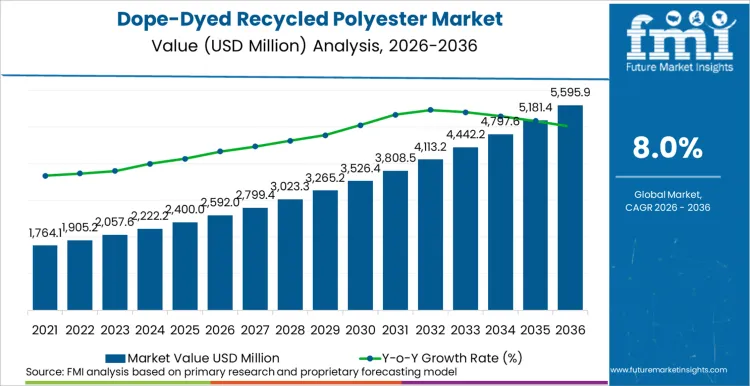
The dope-dyed recycled polyester market is expected to be valued at USD 2,592.0 million in 2026 and is forecasted to reach USD 5,595.9 million by 2036, at a CAGR of 8.0% over the forecast period. Growth is anchored in structural shifts within textile manufacturing toward water-efficient coloration methods and recycled polymer integration. Dope dyeing embeds pigments during melt processing, removing downstream dyeing stages and materially reducing water use, chemical discharge, and energy intensity across fiber and yarn production. When combined with recycled polyester feedstocks, this process aligns environmental performance with industrial-scale color consistency and durability requirements.
Demand concentration reflects end-use segments where colorfastness, UV stability, and abrasion resistance directly influence product life and brand acceptance. Apparel, automotive interiors, and technical textiles account for sustained uptake because shade reproducibility and long-term performance remain critical qualification criteria. Adoption pace is shaped by access to consistent recycled feedstock, capital investment in dope-dye spinning infrastructure, and the ability to maintain batch-to-batch color control across large volumes. Value growth follows material substitution in established textile categories rather than volume expansion alone, reinforcing a steady transition toward integrated, low-impact polyester production systems.
Quick Stats for Dope-Dyed Recycled Polyester Market
- Dope-Dyed Recycled Polyester Market Value (2026): USD 2,592.0 million
- Dope-Dyed Recycled Polyester Market Forecast Value (2036): USD 5,595.9 million
- Dope-Dyed Recycled Polyester Market Forecast CAGR 2026 to 2036: 8.0%
- Leading Product Form by Demand Share: Filament yarn
- Fastest-Growing Regions: China, Brazil, USA, Germany, South Korea
- Key Industry Participants: Indorama Ventures, Reliance Industries, Far Eastern New Century, Toray Industries, Teijin
Dope-Dyed Recycled Polyester Market Key Takeaways
| Metric | Value |
|---|---|
| Market Value (2026) | USD 2,592.0 million |
| Market Forecast Value (2036) | USD 5,595.9 million |
| Forecast CAGR 2026 to 2036 | 8.0% |
Why is the Demand for Dope-Dyed Recycled Polyester Growing?
Manufacturers in apparel and technical textiles are increasingly specifying dope‑dyed recycled polyester because it aligns sustainability goals with performance requirements in colorfastness and environmental impact. Dope dyeing embeds pigment into the polymer at the melt stage, reducing water use and eliminating post‑dyeing effluent that typically burdens wet processing in conventional dyehouses. When combined with recycled polyester sourced from post‑consumer PET bottles and textile waste, dope dyeing creates fibers and yarns that deliver uniform color intensity, excellent UV stability, and resistance to fading under repeated laundering and sunlight exposure. Activewear, outdoor gear, and fashion brands that emphasize performance and durability depend on these attributes when selecting materials for garments, backpacks, and technical fabrics.
Retailers with sustainability commitments prioritize dope-dyed recycled polyester to reduce water footprint metrics and support transparent environmental reporting. Procurement of dope-dyed recycled polyester is also driven by shifting consumer preferences for sustainable products that do not compromise aesthetic quality. As awareness of water scarcity and chemical use in textile dyeing grows, buyers increasingly seek products that visibly reflect circular economy principles. Material scientists refine pellet and filament production techniques to preserve tensile strength, elongation, and abrasion resistance in recycled polyester infused with dope pigments. Supply chain partners coordinate color standards and batch consistency to ensure repeatability across seasons and product lines. Growth in athleisure and lifestyle apparel with environmental positioning reinforces adoption of dope-dyed recycled polyester in mainstream and premium offerings.
How Is the Dope-Dyed Recycled Polyester Industry Segmented by Product Form, Application, and Color Range?
Adoption of dope-dyed recycled polyester is shaped by color consistency requirements, process efficiency, and sustainability targets. Producers and textile manufacturers evaluate product form, downstream application fit, and achievable color depth before material selection. Segmenting the industry by product form, application, and color range explains how performance needs, aesthetics, and manufacturing economics influence demand patterns.
Which Product Form Holds the Largest Share in the Dope-Dyed Recycled Polyester Industry?
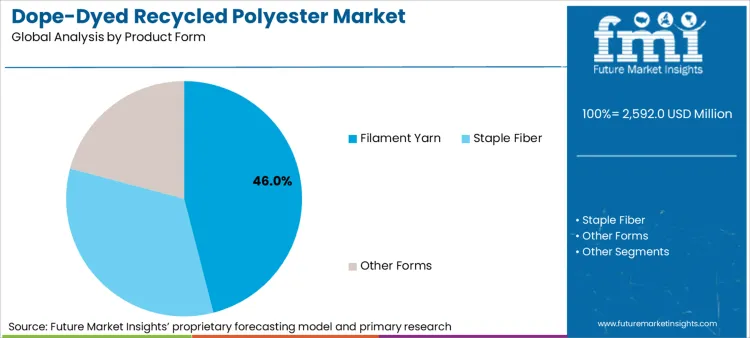
Filament yarn accounts for 46.0%, supported by its use in performance apparel, technical textiles, and uniform fabric production. Filament yarn enables consistent coloration, high tensile strength, and smooth surface finish. Staple fiber is preferred in spun yarns for casualwear and blended fabrics. Other forms include nonwoven feedstocks and specialty yarn constructions used in industrial and interior textiles. Product form segmentation highlights how spinning technology and end-use performance expectations drive material preference.
Key Points
- Filament yarn dominates due to strength and color uniformity.
- Staple fiber supports spun and blended textile formats.
- Specialty forms address nonwoven and technical textile needs.
How Do Applications Influence Demand for Dope-Dyed Recycled Polyester?
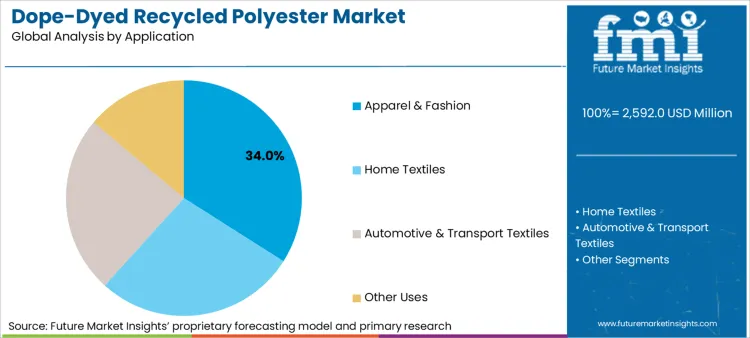
Apparel and fashion applications represent 34.0%, driven by demand for colorfast fabrics with reduced water and energy consumption. Home textiles apply dope-dyed fibers for curtains, upholstery, and bedding where shade consistency matters across production lots. Automotive and transport textiles use these materials for interiors, trims, and seat fabrics requiring UV stability and abrasion resistance. Other uses include outdoor textiles and industrial fabrics. Application-based segmentation reflects differing durability, aesthetic, and sustainability requirements across end-use sectors.
Key Points
- Apparel leads due to sustainability and colorfastness benefits.
- Home textiles value batch-to-batch shade consistency.
- Automotive textiles prioritize durability and UV stability.
Which Color Range Accounts for the Highest Adoption Share?
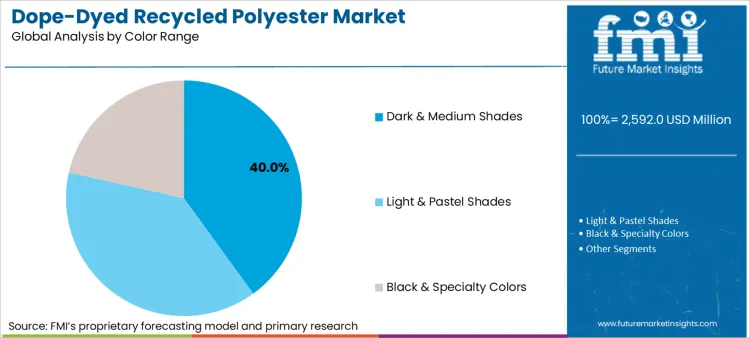
Dark and medium shades hold 40.0%, as they are easier to achieve with recycled feedstock variability and offer strong color saturation. Light and pastel shades face higher purity and consistency requirements, limiting broader adoption. Black and specialty colors are used in automotive interiors, uniforms, and performance textiles where deep coloration and concealment of material variation are critical. Color range segmentation illustrates how recyclate quality and dye-in-polymer processes influence achievable aesthetics.
Key Points
- Dark and medium shades dominate due to process reliability.
- Light shades require higher feedstock purity.
- Black and specialty colors support technical applications.
What are the Key Dynamics in the Dope-Dyed Recycled Polyester Market?
Demand in the dope-dyed recycled polyester market is driven by apparel brands and textile converters seeking reduced environmental impact without sacrificing colorfastness and performance. Fabric producers and fashion labels prioritize recycled polyester that is color matched during fiber production, eliminating conventional dyeing steps and reducing water and energy use. Growth reflects consumer preference for sustainably produced garments and increased regulatory scrutiny of textile waste and dye effluent. Purchasing decisions focus on color precision, mechanical performance, and compliance with restricted substance lists relevant to apparel and soft goods.
How do sustainability expectations and color performance requirements shape adoption?
Adoption increases where brands face pressure to demonstrate measurable reductions in water use and carbon emissions in textile supply chains. Dope-dyed processes integrate pigment during polymer melting, which locks color into the fiber and improves dye fastness relative to post-spinning dyeing methods. Fashion and sportswear producers value recycled polyester with stable color under wash, UV exposure, and abrasion as this supports product durability and reduces returns due to fading or bleeding. Market segments such as outdoor apparel and athleisure demand materials that maintain color integrity under high strain and repeated laundering. Consumer communication around sustainability claims and lifecycle impacts influences formulation and sourcing choices, especially where transparency in recycled content and processing methods is expected.
How do cost structures and supply consistency influence market growth?
Market growth is influenced by the relative cost of dope-dyed recycled polyester compared with conventional and stock-dyed alternatives and by the availability of consistent recycled feedstock. Producing dope-dyed fiber requires investment in specialized compounding and spinning equipment, which increases unit cost relative to standard recycled polyester. Textile manufacturers and brand owners must balance these higher costs against savings from fewer dyehouse steps and lower effluent management expenses. Consistency in recycled polymer quality affects color precision and mechanical properties, making feedstock variability a key concern for converters. Price sensitivity in value fashion segments can limit adoption where the premium for dope-dyed recycled fiber must be justified by sustainability positioning or performance advantages. Supply chain infrastructure, including access to high-quality PCR polyester feedstock, shapes where dope-dyed solutions can be sourced reliably at scale for diverse apparel lines.
How Is Demand for the Dope-Dyed Recycled Polyester Market Evolving Globally?
Global demand for dope-dyed recycled polyester is rising as industries in fashion, automotive, and textiles prioritize sustainability and eco-friendly production methods. Growth reflects increasing use of recycled polyester in fabrics and materials, particularly in response to regulatory pressures and consumer demand for greener alternatives. Dope-dyeing, which integrates color into the polyester during the spinning process, reduces water usage and waste compared to traditional dyeing methods. China records 9.2% CAGR, Brazil records 8.8% CAGR, USA records 7.7% CAGR, Germany records 7.6% CAGR, and South Korea records 7.2% CAGR. Adoption is driven by performance benefits, water savings, and eco-conscious production requirements.
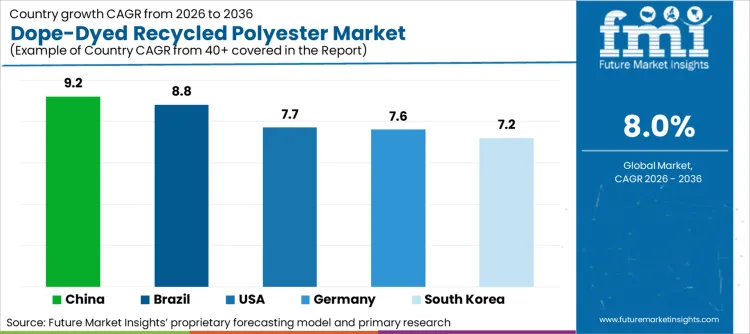
| Country | CAGR (%) |
|---|---|
| China | 9.2% |
| Brazil | 8.8% |
| USA | 7.7% |
| Germany | 7.6% |
| South Korea | 7.2% |
What is driving growth of dope-dyed recycled polyester demand in China?
Demand for dope-dyed recycled polyester in China is expanding as the textile and fashion industries increase their focus on sustainable practices. Growth at 9.2% CAGR reflects the adoption of recycled materials in apparel, automotive fabrics, and home textiles. China’s large manufacturing base and significant textile production capacity support high-volume use of dope-dyed recycled polyester, reducing water and energy consumption. Regulatory requirements for reducing textile waste and increasing recycled content are accelerating adoption. The cost-effectiveness and eco-friendly nature of dope-dyeing also make it an attractive option for large-scale textile producers, driving demand for high-quality recycled polyester fibers.
- Growth of the textile and fashion manufacturing base
- Regulatory push for increased use of recycled content
- Water and energy savings with dope-dyeing methods
- Cost-effective, eco-friendly production processes
Why is Brazil seeing expansion in dope-dyed recycled polyester adoption?
Dope-dyed recycled polyester demand in Brazil is increasing as textile manufacturers respond to sustainability goals and eco-conscious consumer preferences. Growth at 8.8% CAGR reflects the rising demand for eco-friendly fabrics and materials in fashion and home goods. Brazil's textile industry is increasingly focused on reducing its environmental footprint, with dope-dyed recycled polyester offering significant reductions in water usage and chemical waste compared to traditional dyeing methods. Local manufacturers are leveraging these benefits to meet both international and domestic market requirements for sustainable production, further boosting adoption.
- Consumer demand for eco-friendly fabrics
- Regulatory push for more sustainable production methods
- Focus on reducing environmental impact in textile manufacturing
- Increasing use of recycled materials in fashion and home goods
What factors are shaping dope-dyed recycled polyester sales in the USA?
Sales of dope-dyed recycled polyester in the USA are rising as industries embrace circular economy models and respond to sustainability pressure. Growth at 7.7% CAGR reflects increasing adoption in the apparel, automotive, and home textile sectors. The USA’s stringent environmental regulations on waste management and textile production are accelerating the shift towards more sustainable, water-efficient practices. Dope-dyeing provides a solution to reduce chemical usage and water consumption, making it a popular choice for textile manufacturers seeking compliance with eco-conscious standards and certifications. Brands are also adopting dope-dyed recycled polyester to meet consumer expectations for sustainable products.
- Regulatory pressure on water usage and chemical waste
- Consumer preference for sustainable textile production
- Eco-conscious branding in the fashion industry
- Adoption of sustainable, cost-effective production methods
How is Germany supporting growth of dope-dyed recycled polyester demand?
Dope-dyed recycled polyester demand in Germany is advancing as the country leads in sustainable textile manufacturing and waste reduction initiatives. Growth at 7.6% CAGR reflects Germany’s strong push towards circular economy practices and eco-friendly production methods. As Germany’s textile industry integrates more recycled content into manufacturing, dope-dyed recycled polyester becomes a key material to meet environmental regulations and consumer demand for green products. The focus on water-saving dyeing techniques and reducing the carbon footprint of textile production continues to drive the demand for dope-dyed solutions, further promoting its adoption in high-quality textile production.
- Strong commitment to circular economy and sustainability
- Regulatory focus on water and chemical waste reduction
- Adoption of water-efficient and energy-saving dyeing processes
- Rising demand for sustainable textiles in the fashion industry
What is driving expansion of dope-dyed recycled polyester demand in South Korea?
Demand for dope-dyed recycled polyester in South Korea is rising as the textile and apparel sectors embrace sustainability in response to both consumer demand and regulatory requirements. Growth at 7.2% CAGR reflects the increasing use of recycled polyester in fashion and textile products that require durability, color fastness, and water efficiency. South Korean manufacturers are investing in sustainable dyeing technologies, with dope-dyeing systems being a popular choice for reducing environmental impact. The country’s textile industry, known for its innovation and efficiency, is integrating dope-dyed recycled polyester to meet eco-friendly production standards and cater to the global demand for sustainable fabrics.
- Investment in sustainable dyeing technologies
- Government regulations promoting eco-friendly production
- Consumer demand for eco-conscious textiles
- Focus on innovation and efficiency in textile manufacturing
What Defines the Competitive Landscape for the Dope-Dyed Recycled Polyester Market Globally?
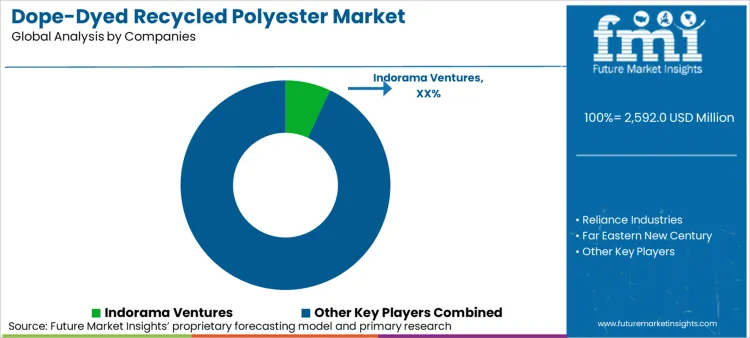
Global demand for dope-dyed recycled polyester is shaped by apparel brands targeting water reduction, color consistency, and lower environmental footprints. Buyers evaluate colorfastness, shade reproducibility, yarn tenacity, and process efficiency compared with piece-dyed alternatives. Assessment also includes compatibility with performance textiles, scalability across fashion and home textiles, and availability of certified recycled feedstock. Procurement behavior favors vertically integrated producers capable of controlling recycling, polymerization, and spinning stages while offering long-term color libraries. Industry direction reflects increasing adoption in sportswear, uniforms, and automotive textiles where durability, color stability, and sustainability claims are tightly linked.
Indorama Ventures holds leading global positioning through integrated rPET fiber production and large-scale dope-dyed capacity serving international apparel brands. Reliance Industries competes with vertically integrated recycled polyester operations aligned with mass-market textile demand. Far Eastern New Century maintains relevance through advanced recycling technologies supplying high-quality dope-dyed yarns to premium apparel segments. Toray Industries and Teijin support demand with performance-focused recycled polyester targeting technical and automotive textiles. Unifi participates strongly in branded recycled yarn programs, while Hyosung and Sanfangxiang serve sportswear and regional manufacturing hubs. Competitive differentiation centers on integration depth, color consistency, recycled feedstock security, and brand qualification breadth.
Key Players in the Dope-Dyed Recycled Polyester Market
- Indorama Ventures
- Reliance Industries
- Far Eastern New Century
- Toray Industries
- Teijin
- Unifi
- Hyosung
- Sanfangxiang
- Alpek Polyester
- Mitsubishi Chemical Group
Scope of the Report
| Items | Values |
|---|---|
| Quantitative Units | USD million |
| Product Form | Filament Yarn; Staple Fiber; Other Forms |
| Application | Apparel & Fashion; Home Textiles; Automotive & Transport Textiles; Other Uses |
| Color Range | Dark & Medium Shades; Light & Pastel Shades; Black & Specialty Colors |
| Regions Covered | Asia Pacific, Europe, North America, Latin America, Middle East & Africa |
| Countries Covered | China, Brazil, USA, Germany, South Korea, and 40+ countries |
| Key Companies Profiled | Indorama Ventures; Reliance Industries; Far Eastern New Century; Toray Industries; Teijin; Unifi; Hyosung; Sanfangxiang; Alpek Polyester; Mitsubishi Chemical Group |
| Additional Attributes | Dollar sales by product form, application, and color range; material quality and sustainability standards; advancements in dope-dyeing technologies; environmental benefits and cost-effectiveness in recycled polyester production; market shift towards circular economy models in the textile industry. |
Dope-Dyed Recycled Polyester Market by Segment
Product Form:
- Filament Yarn
- Staple Fiber
- Other Forms
Application:
- Apparel & Fashion
- Home Textiles
- Automotive & Transport Textiles
- Other Uses
Color Range:
- Dark & Medium Shades
- Light & Pastel Shades
- Black & Specialty Colors
Region:
- Asia Pacific
- China
- Japan
- South Korea
- India
- Australia & New Zealand
- ASEAN
- Rest of Asia Pacific
- Europe
- Germany
- United Kingdom
- France
- Italy
- Spain
- Nordic
- BENELUX
- Rest of Europe
- North America
- United States
- Canada
- Mexico
- Latin America
- Brazil
- Chile
- Rest of Latin America
- Middle East & Africa
- Kingdom of Saudi Arabia
- Other GCC Countries
- Turkey
- South Africa
- Other African Union
- Rest of Middle East & Africa
Bibliography
- International Organization for Standardization. (2023). ISO 14067: Greenhouse gases-Carbon footprint of products-Requirements and guidelines for quantification. ISO.
- European Commission. (2023). Commission recommendation (EU) 2023/1796 on environmental footprint methods for textiles. Official Journal of the European Union.
- United Nations Environment Programme. (2023). Sustainability and circularity in the textile value chain. UNEP.
- European Chemicals Agency. (2023). Restriction and compliance framework for chemicals used in textile coloration. ECHA.
-
FAQs
- What is the market size for dope-dyed recycled polyester in 2026? The market value for dope-dyed recycled polyester is projected to be USD 2,592.0 million in 2026.
- What will the market size for dope-dyed recycled polyester be in 2036? The market forecast value for dope-dyed recycled polyester is expected to reach USD 5,595.9 million by 2036.
- What is the forecast CAGR for dope-dyed recycled polyester from 2026 to 2036? The forecast CAGR for dope-dyed recycled polyester is 8.0% between 2026 and 2036.
- Which product form dominates the dope-dyed recycled polyester market? Filament yarn dominates the market with a 46.0% share in 2026.
- Which application has the largest share in the dope-dyed recycled polyester market? Apparel & fashion applications hold the largest share, accounting for 34.0% of the market in 2026.
Frequently Asked Questions
How big is the dope-dyed recycled polyester market in 2026?
The global dope-dyed recycled polyester market is estimated to be valued at USD 2,592.0 million in 2026.
What will be the size of dope-dyed recycled polyester market in 2036?
The market size for the dope-dyed recycled polyester market is projected to reach USD 5,595.9 million by 2036.
How much will be the dope-dyed recycled polyester market growth between 2026 and 2036?
The dope-dyed recycled polyester market is expected to grow at a 8.0% CAGR between 2026 and 2036.
What are the key product types in the dope-dyed recycled polyester market?
The key product types in dope-dyed recycled polyester market are filament yarn, staple fiber and other forms.
Which application segment to contribute significant share in the dope-dyed recycled polyester market in 2026?
In terms of application, apparel & fashion segment to command 34.0% share in the dope-dyed recycled polyester market in 2026.
Preview the report firsthand - request a free sample
Get SampleGet the brochure for pricing and purchase details.
Get PDFTable of Content
- Executive Summary
- Global Market Outlook
- Demand-side Trends
- Supply-side Trends
- Technology Roadmap Analysis
- Analysis and Recommendations
- Market Overview
- Market Coverage / Taxonomy
- Market Definition / Scope / Limitations
- Market Background
- Market Dynamics
- Drivers
- Restraints
- Opportunity
- Trends
- Scenario Forecast
- Demand in Optimistic Scenario
- Demand in Likely Scenario
- Demand in Conservative Scenario
- Opportunity Map Analysis
- Product Life Cycle Analysis
- Supply Chain Analysis
- Investment Feasibility Matrix
- Value Chain Analysis
- PESTLE and Porter’s Analysis
- Regulatory Landscape
- Regional Parent Market Outlook
- Production and Consumption Statistics
- Import and Export Statistics
- Market Dynamics
- Global Market Analysis 2021 to 2025 and Forecast, 2026 to 2036
- Historical Market Size Value (USD Million) Analysis, 2021 to 2025
- Current and Future Market Size Value (USD Million) Projections, 2026 to 2036
- Y-o-Y Growth Trend Analysis
- Absolute $ Opportunity Analysis
- Global Market Pricing Analysis 2021 to 2025 and Forecast 2026 to 2036
- Global Market Analysis 2021 to 2025 and Forecast 2026 to 2036, By Product Form
- Introduction / Key Findings
- Historical Market Size Value (USD Million) Analysis By Product Form , 2021 to 2025
- Current and Future Market Size Value (USD Million) Analysis and Forecast By Product Form , 2026 to 2036
- Filament Yarn
- Staple Fiber
- Other Forms
- Filament Yarn
- Y-o-Y Growth Trend Analysis By Product Form , 2021 to 2025
- Absolute $ Opportunity Analysis By Product Form , 2026 to 2036
- Global Market Analysis 2021 to 2025 and Forecast 2026 to 2036, By Application
- Introduction / Key Findings
- Historical Market Size Value (USD Million) Analysis By Application, 2021 to 2025
- Current and Future Market Size Value (USD Million) Analysis and Forecast By Application, 2026 to 2036
- Apparel & Fashion
- Home Textiles
- Automotive & Transport Textiles
- Other Uses
- Apparel & Fashion
- Y-o-Y Growth Trend Analysis By Application, 2021 to 2025
- Absolute $ Opportunity Analysis By Application, 2026 to 2036
- Global Market Analysis 2021 to 2025 and Forecast 2026 to 2036, By Color Range
- Introduction / Key Findings
- Historical Market Size Value (USD Million) Analysis By Color Range, 2021 to 2025
- Current and Future Market Size Value (USD Million) Analysis and Forecast By Color Range, 2026 to 2036
- Dark & Medium Shades
- Light & Pastel Shades
- Black & Specialty Colors
- Dark & Medium Shades
- Y-o-Y Growth Trend Analysis By Color Range, 2021 to 2025
- Absolute $ Opportunity Analysis By Color Range, 2026 to 2036
- Global Market Analysis 2021 to 2025 and Forecast 2026 to 2036, By Region
- Introduction
- Historical Market Size Value (USD Million) Analysis By Region, 2021 to 2025
- Current Market Size Value (USD Million) Analysis and Forecast By Region, 2026 to 2036
- North America
- Latin America
- Western Europe
- Eastern Europe
- East Asia
- South Asia and Pacific
- Middle East & Africa
- Market Attractiveness Analysis By Region
- North America Market Analysis 2021 to 2025 and Forecast 2026 to 2036, By Country
- Historical Market Size Value (USD Million) Trend Analysis By Market Taxonomy, 2021 to 2025
- Market Size Value (USD Million) Forecast By Market Taxonomy, 2026 to 2036
- By Country
- USA
- Canada
- Mexico
- By Product Form
- By Application
- By Color Range
- By Country
- Market Attractiveness Analysis
- By Country
- By Product Form
- By Application
- By Color Range
- Key Takeaways
- Latin America Market Analysis 2021 to 2025 and Forecast 2026 to 2036, By Country
- Historical Market Size Value (USD Million) Trend Analysis By Market Taxonomy, 2021 to 2025
- Market Size Value (USD Million) Forecast By Market Taxonomy, 2026 to 2036
- By Country
- Brazil
- Chile
- Rest of Latin America
- By Product Form
- By Application
- By Color Range
- By Country
- Market Attractiveness Analysis
- By Country
- By Product Form
- By Application
- By Color Range
- Key Takeaways
- Western Europe Market Analysis 2021 to 2025 and Forecast 2026 to 2036, By Country
- Historical Market Size Value (USD Million) Trend Analysis By Market Taxonomy, 2021 to 2025
- Market Size Value (USD Million) Forecast By Market Taxonomy, 2026 to 2036
- By Country
- Germany
- UK
- Italy
- Spain
- France
- Nordic
- BENELUX
- Rest of Western Europe
- By Product Form
- By Application
- By Color Range
- By Country
- Market Attractiveness Analysis
- By Country
- By Product Form
- By Application
- By Color Range
- Key Takeaways
- Eastern Europe Market Analysis 2021 to 2025 and Forecast 2026 to 2036, By Country
- Historical Market Size Value (USD Million) Trend Analysis By Market Taxonomy, 2021 to 2025
- Market Size Value (USD Million) Forecast By Market Taxonomy, 2026 to 2036
- By Country
- Russia
- Poland
- Hungary
- Balkan & Baltic
- Rest of Eastern Europe
- By Product Form
- By Application
- By Color Range
- By Country
- Market Attractiveness Analysis
- By Country
- By Product Form
- By Application
- By Color Range
- Key Takeaways
- East Asia Market Analysis 2021 to 2025 and Forecast 2026 to 2036, By Country
- Historical Market Size Value (USD Million) Trend Analysis By Market Taxonomy, 2021 to 2025
- Market Size Value (USD Million) Forecast By Market Taxonomy, 2026 to 2036
- By Country
- China
- Japan
- South Korea
- By Product Form
- By Application
- By Color Range
- By Country
- Market Attractiveness Analysis
- By Country
- By Product Form
- By Application
- By Color Range
- Key Takeaways
- South Asia and Pacific Market Analysis 2021 to 2025 and Forecast 2026 to 2036, By Country
- Historical Market Size Value (USD Million) Trend Analysis By Market Taxonomy, 2021 to 2025
- Market Size Value (USD Million) Forecast By Market Taxonomy, 2026 to 2036
- By Country
- India
- ASEAN
- Australia & New Zealand
- Rest of South Asia and Pacific
- By Product Form
- By Application
- By Color Range
- By Country
- Market Attractiveness Analysis
- By Country
- By Product Form
- By Application
- By Color Range
- Key Takeaways
- Middle East & Africa Market Analysis 2021 to 2025 and Forecast 2026 to 2036, By Country
- Historical Market Size Value (USD Million) Trend Analysis By Market Taxonomy, 2021 to 2025
- Market Size Value (USD Million) Forecast By Market Taxonomy, 2026 to 2036
- By Country
- Kingdom of Saudi Arabia
- Other GCC Countries
- Turkiye
- South Africa
- Other African Union
- Rest of Middle East & Africa
- By Product Form
- By Application
- By Color Range
- By Country
- Market Attractiveness Analysis
- By Country
- By Product Form
- By Application
- By Color Range
- Key Takeaways
- Key Countries Market Analysis
- USA
- Pricing Analysis
- Market Share Analysis, 2025
- By Product Form
- By Application
- By Color Range
- Canada
- Pricing Analysis
- Market Share Analysis, 2025
- By Product Form
- By Application
- By Color Range
- Mexico
- Pricing Analysis
- Market Share Analysis, 2025
- By Product Form
- By Application
- By Color Range
- Brazil
- Pricing Analysis
- Market Share Analysis, 2025
- By Product Form
- By Application
- By Color Range
- Chile
- Pricing Analysis
- Market Share Analysis, 2025
- By Product Form
- By Application
- By Color Range
- Germany
- Pricing Analysis
- Market Share Analysis, 2025
- By Product Form
- By Application
- By Color Range
- UK
- Pricing Analysis
- Market Share Analysis, 2025
- By Product Form
- By Application
- By Color Range
- Italy
- Pricing Analysis
- Market Share Analysis, 2025
- By Product Form
- By Application
- By Color Range
- Spain
- Pricing Analysis
- Market Share Analysis, 2025
- By Product Form
- By Application
- By Color Range
- France
- Pricing Analysis
- Market Share Analysis, 2025
- By Product Form
- By Application
- By Color Range
- India
- Pricing Analysis
- Market Share Analysis, 2025
- By Product Form
- By Application
- By Color Range
- ASEAN
- Pricing Analysis
- Market Share Analysis, 2025
- By Product Form
- By Application
- By Color Range
- Australia & New Zealand
- Pricing Analysis
- Market Share Analysis, 2025
- By Product Form
- By Application
- By Color Range
- China
- Pricing Analysis
- Market Share Analysis, 2025
- By Product Form
- By Application
- By Color Range
- Japan
- Pricing Analysis
- Market Share Analysis, 2025
- By Product Form
- By Application
- By Color Range
- South Korea
- Pricing Analysis
- Market Share Analysis, 2025
- By Product Form
- By Application
- By Color Range
- Russia
- Pricing Analysis
- Market Share Analysis, 2025
- By Product Form
- By Application
- By Color Range
- Poland
- Pricing Analysis
- Market Share Analysis, 2025
- By Product Form
- By Application
- By Color Range
- Hungary
- Pricing Analysis
- Market Share Analysis, 2025
- By Product Form
- By Application
- By Color Range
- Kingdom of Saudi Arabia
- Pricing Analysis
- Market Share Analysis, 2025
- By Product Form
- By Application
- By Color Range
- Turkiye
- Pricing Analysis
- Market Share Analysis, 2025
- By Product Form
- By Application
- By Color Range
- South Africa
- Pricing Analysis
- Market Share Analysis, 2025
- By Product Form
- By Application
- By Color Range
- USA
- Market Structure Analysis
- Competition Dashboard
- Competition Benchmarking
- Market Share Analysis of Top Players
- By Regional
- By Product Form
- By Application
- By Color Range
- Competition Analysis
- Competition Deep Dive
- Indorama Ventures
- Overview
- Product Portfolio
- Profitability by Market Segments (Product/Age /Sales Channel/Region)
- Sales Footprint
- Strategy Overview
- Marketing Strategy
- Product Strategy
- Channel Strategy
- Reliance Industries
- Far Eastern New Century
- Toray Industries
- Teijin
- Unifi
- Hyosung
- Sanfangxiang
- Alpek Polyester
- Mitsubishi Chemical Group
- Indorama Ventures
- Competition Deep Dive
- Assumptions & Acronyms Used
- Research Methodology


