

- Industry Size (2026)
- USD 1.3 Bn
- Forecast (2036)
- USD 4.1 Bn
- CAGR (2026 to 2036)
- 12.2%
Chemical Recycling Solutions for End of Life Vehicle Plastics Market Forecast and Outlook 2026 to 2036
The chemical recycling solutions for end of life vehicle plastics market is projected to reach USD 1.3 billion in 2026 and is forecasted to expand to USD 4.1 billion by 2036, growing at a CAGR of 12.2%. This growth reflects the increasing demand for sustainable recycling technologies in the automotive sector, especially for plastics in end-of-life vehicles. The market’s expansion is driven by stricter regulations around plastic waste management and the automotive industry's shift toward more environmentally friendly solutions.
The adoption of chemical recycling technologies is gaining momentum as manufacturers seek to recover valuable materials from vehicle plastics. Traditional recycling methods have limited efficiency with complex plastics, but chemical recycling enables the breakdown of these materials into usable feedstocks. As the focus on sustainability strengthens, both automakers and recyclers are investing in advanced technologies. The continuous development of chemical recycling methods will drive market growth, facilitating the transition to a circular economy. Additionally, government policies promoting resource conservation will further enhance the market’s outlook over the next decade.
Quick Stats of the Chemical Recycling Solutions for End of Life Vehicle Plastics Market
- Chemical Recycling Solutions for End of Life Vehicle Plastics Market Value (2026): USD 1.3 billion
- Chemical Recycling Solutions for End of Life Vehicle Plastics Market Forecast Value (2036): USD 4.1 billion
- Chemical Recycling Solutions for End of Life Vehicle Plastics Market Forecast CAGR 2026 to 2036: 12.2%
- Chemical Recycling Solutions for End of Life Vehicle Plastics Market Leading Recycling Route: Pyrolysis & depolymerisation (48% share)
- Chemical Recycling Solutions for End of Life Vehicle Plastics Market Key Growth Regions: India, China, Germany, USA, Brazil
- Chemical Recycling Solutions for End of Life Vehicle Plastics Market Top Players: BASF, Eastman, Dow, Sinopec, Wanhua, Reliance Industries, Braskem, Teijin
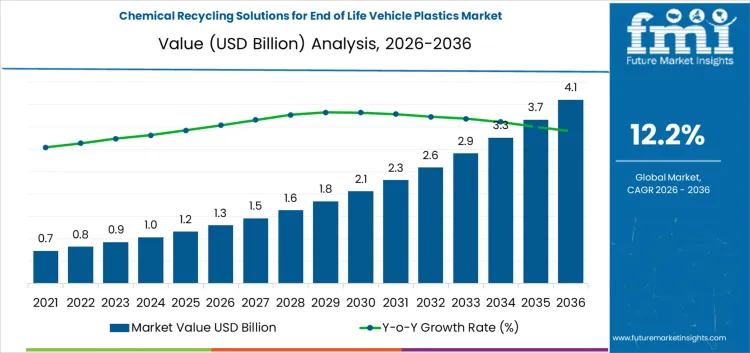
What is the Growth Forecast for Chemical Recycling Solutions for End of Life Vehicle Plastics Market through 2036?
The chemical recycling solutions for end-of-life vehicle plastics industry is expanding steadily as the automotive sector increases its focus on sustainability and circular material management. Advanced recycling technologies are gaining adoption because they enable the recovery of complex plastic components that are difficult to process through conventional mechanical methods, improving overall recycling efficiency and waste reduction.
Growth is being supported by stricter environmental regulations, ongoing technological innovation, and rising pressure on automakers to reduce plastic waste. Investments in recycling infrastructure and collaboration between vehicle manufacturers and technology providers are strengthening adoption. As circular economy principles become central to automotive strategies, chemical recycling is emerging as a key solution for managing end-of-life vehicle plastics responsibly.
Chemical Recycling Solutions for End-of-Life Vehicle Plastics Market Key Takeaways
| Metric | Value |
|---|---|
| Market Value (2026) | USD 1.3 billion |
| Forecast Value (2036) | USD 4.1 billion |
| Forecast CAGR 2026 to 2036 | 12.2% |
What is Driving Growth in the Chemical Recycling Solutions for End of Life Vehicle Plastics Market?
The chemical recycling solutions market for end of life vehicle plastics is poised for significant growth as the automotive and recycling industries work towards more sustainable solutions. Increasing global awareness of plastic waste and its environmental impact, coupled with stringent regulatory standards, is driving demand for advanced recycling technologies. Chemical recycling allows for the breakdown of plastics into their original monomers, enabling the production of new plastic materials that can be used in various applications, including automotive parts. This process is particularly beneficial for dealing with complex materials that are difficult to recycle through traditional mechanical methods. As the world focuses on reducing its carbon footprint, chemical recycling presents a compelling solution for managing plastics from end-of-life vehicles, aligning with global sustainability goals.
Technological advancements in chemical recycling are playing a crucial role in boosting market growth. Innovations in pyrolysis and depolymerization processes have significantly improved the efficiency and cost-effectiveness of recycling end-of-life vehicle plastics. Furthermore, collaboration between automotive manufacturers, recycling companies, and technology providers is fostering the development of scalable solutions that can be integrated into existing automotive production systems. As a result, a growing number of countries are introducing incentives and regulations that encourage the adoption of chemical recycling technologies. These developments are expected to drive the market forward, positioning chemical recycling as a key player in reducing plastic waste and promoting a circular economy.
What Are the Key Segments in the Chemical Recycling Solutions for End of Life Vehicle Plastics Market?
The Chemical Recycling Solutions for End of Life Vehicle Plastics market is primarily driven by two key segments: End-use and Recycling Route. The End-use segment is dominated by ELV interior & under-hood plastics, holding a 45% market share. These plastics are challenging to recycle due to their complex polymer composition. On the Recycling Route side, Pyrolysis & depolymerisation leads with 48% market share, as these technologies offer effective solutions for breaking down mixed and contaminated plastics, turning them into valuable byproducts like synthetic oils and gases. The combination of both segments highlights the growing focus on sustainable recycling solutions within the automotive industry and the need for advanced technologies to manage vehicle plastic waste.
What Is the Role of the End-use Segment in the Chemical Recycling Solutions Market?
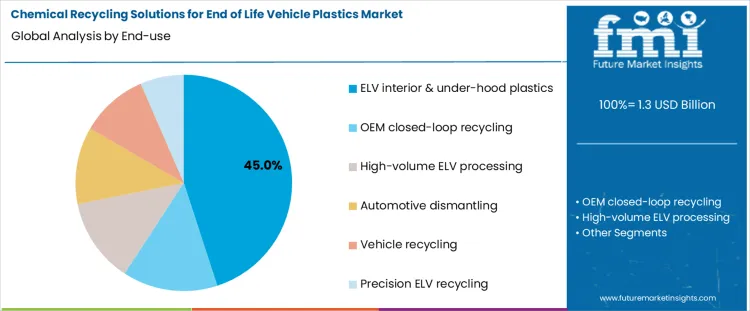
The End-use Segment in the Chemical Recycling Solutions for End of Life Vehicle Plastics market is led by ELV interior & under-hood plastics, which account for 45% of the market share. These plastics are widely used in vehicle interiors and engine compartments. They include polymers that are difficult to recycle through traditional methods, making chemical recycling a vital solution. Technologies like pyrolysis allow for more efficient processing of these materials, enabling the recovery of valuable chemicals and resources. The increasing demand for ELV recycling stems from stringent environmental regulations and the automotive industry’s push toward sustainability.
The demand for recycling ELV interior and under-hood plastics is mainly driven by regulatory pressures and growing environmental concerns. As global regulations surrounding plastic waste management tighten, automakers and recyclers are increasingly adopting chemical recycling technologies. This adoption behavior is influenced by the need for processes that can handle the diverse and complex materials found in vehicle components. Despite the advantages, challenges such as high operational costs and the need for specialized infrastructure may limit wider adoption in the short term. However, as technology advances and becomes more cost-effective, these barriers are expected to lessen, allowing further market expansion.
What Are the Key Dynamics of the Recycling Route Segment?
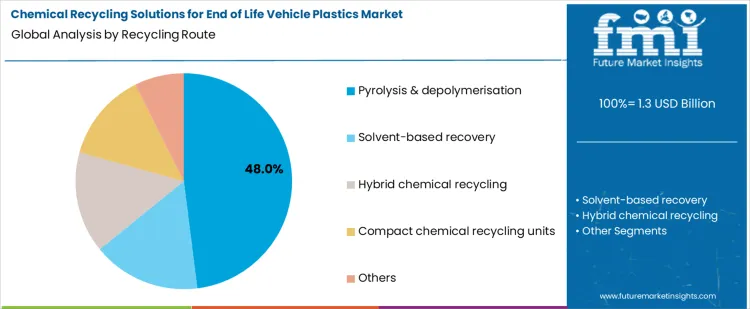
The Recycling Route Segment is dominated by Pyrolysis & depolymerisation, which holds a significant 48% share of the market. These chemical recycling processes are essential for converting complex and mixed plastics from end-of-life vehicles (ELVs) into valuable byproducts such as synthetic oils and gases. Pyrolysis, in particular, has emerged as a preferred method for treating non-recyclable plastics, turning them into useful resources. The ability of these technologies to process contaminated and mixed materials makes them highly suitable for ELVs, where plastics are often difficult to sort and process through traditional methods.
The demand for pyrolysis and depolymerisation technologies is growing due to the increasing need for sustainable solutions to manage plastic waste. These recycling processes offer a high yield of usable byproducts, making them economically attractive. The adoption of these technologies is driven by industries seeking to reduce their environmental footprint and comply with strict waste management regulations. Despite challenges such as high initial costs and energy consumption, the adoption of pyrolysis is expanding as industries face growing pressure to incorporate circular economy practices. This trend is positioning pyrolysis and depolymerisation as key players in the future of chemical recycling for automotive plastics.
What Cost and Procurement Dynamics Are Influencing Adoption of Chemical Recycling Solutions for End Of Life Vehicle Plastics?
Original equipment manufacturers face pressures to reduce costs associated with virgin polymer sourcing. Fluctuating crude oil pricing directly affects raw materials, raising interest in recycled feedstock that can stabilize procurement budgets. Chemical recyclers that offer predictable pricing and quality attract OEM contracts focused on total cost of ownership. Long-term supply agreements are emerging between recyclers and tier suppliers to secure resin volumes for interior and exterior components. Investment in on-site pretreatment and scalable reactor systems lowers per-unit processing costs. This alignment of procurement strategies with cost containment is shaping purchasing decisions across automotive supply chains.
What Production and Regulatory Barriers Are Limiting Growth of Chemical Recycling for Vehicle Plastics?
Scaling chemical recycling facilities requires significant capital spending on advanced reactors, separation units, and effluent treatment systems. Limited access to financing slows capacity expansion, particularly for mid-tier players. Regulatory frameworks governing hazardous byproducts and emissions vary by region, complicating site selection and permitting for new plants. Certification processes for recycled polymers intended for automotive use involve rigorous testing, extending time to market and increasing expenses. Supply chains for end-of-life plastics remain fragmented, raising logistical costs for feedstock collection and sorting. These factors restrict throughput and deter some investors, dampening deployment of chemical recycling infrastructure at the scale needed for widespread automotive integration.
How Are Platform Strategies and Material Innovation Shaping Trends in Recycling End of Life Vehicle Plastics?
Automotive manufacturers are exploring modular recycling platforms that integrate pyrolysis, solvolysis, and depolymerization pathways to handle diverse polymer mixes. Partnerships between resin producers and recyclers are yielding tailored catalysts that improve recovery rates for mixed plastics found in bumpers and dashboards. Material design practices at the component level increasingly consider downstream chemical recycling compatibility, enabling easier breakdown into monomers. Digital tracking of part materials using markers and RFID tags enhances sorting precision, feeding optimized reactor loads. Circularity agreements between OEMs and recyclers are evolving into structured networks that share technology and data, enhancing overall processing efficiency of end-of-life plastics.
What Are the Growth Trends for Chemical Recycling Solutions for End of Life Vehicle Plastics by Country?
| Country | CAGR (%) |
|---|---|
| Germany | 11.2% |
| USA | 10.4% |
| China | 13.8% |
| India | 14.6% |
| Brazil | 9.2% |
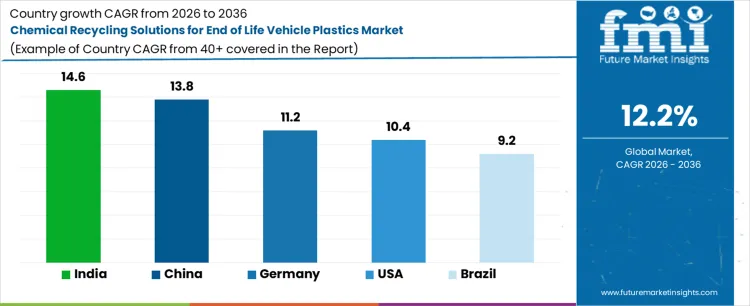
The demand for chemical recycling solutions for end-of-life vehicle plastics is experiencing significant growth across various global markets. India leads with a 14.6% CAGR, driven by increasing environmental awareness and regulatory pressure on waste management practices, coupled with rapid automotive industry growth. China follows closely at 13.8%, supported by large-scale automotive manufacturing and government-backed initiatives to promote recycling technologies. Germany records 11.2%, driven by stringent environmental regulations and the country's strong commitment to sustainability. The USA shows steady growth at 10.4%, with a growing focus on circular economy initiatives within the automotive sector. Brazil, with a 9.2% CAGR, is witnessing increased adoption of chemical recycling technologies as part of its broader sustainability goals.
What Drives the Chemical Recycling Solutions Market in Germany?
Germany has become a leading force in the chemical recycling solutions market, with the sector growing at a CAGR of 11.2%. The country's well-established automotive industry and its strong push for sustainability are key drivers of demand for recycling technologies. A focus on circular economy principles and efficient waste management is shaping Germany’s approach to tackling end-of-life vehicle plastics. With stringent regulatory frameworks and a commitment to innovation, the market is poised for consistent growth as both public and private sectors embrace greener alternatives.
- Regulatory standards foster the adoption of recycling technologies.
- Strong automotive industry pushes demand for end-of-life vehicle solutions.
- Innovations in recycling drive long-term market expansion.
How Is the USA Contributing to the Growth of Chemical Recycling Solutions?
In the USA, the market for chemical recycling solutions is experiencing steady growth, projected at a CAGR of 10.4%. The automotive sector’s prominence, combined with consumer demand for eco-friendly practices, plays a central role in increasing the need for advanced recycling technologies. National policies targeting plastic waste reduction support the transition toward more sustainable waste management. Additionally, the growing availability of cutting-edge recycling solutions is expected to continue fueling market expansion over the forecast period.
- A thriving automotive industry strengthens recycling solution demand.
- USA environmental policies encourage investment in recycling technologies.
- Consumer trends toward sustainability drive market growth.
What Is Powering China’s Chemical Recycling Solutions Market?
In China, the chemical recycling solutions market is growing rapidly, with a projected CAGR of 13.8%. The country’s status as the world's largest automotive manufacturer is integral to the rising demand for sustainable recycling technologies. China’s government is prioritizing circular economy practices and has introduced policies to reduce plastic waste, contributing to the acceleration of chemical recycling adoption. As technological advancements continue to emerge, China is expected to lead the global market in addressing the environmental impact of plastic waste.
- The automotive sector’s expansion increases demand for recycling.
- Government policies support the development of chemical recycling solutions.
- Advancements in recycling technology enhance waste management efficiency.
How Is India Adapting to the Chemical Recycling Solutions Market?
India is seeing a rapid increase in demand for chemical recycling solutions for end-of-life vehicle plastics, with the market projected to grow at 14.6% CAGR. As the automotive industry grows, the need for efficient plastic waste management solutions becomes more critical. India’s evolving environmental policies, which increasingly favor sustainable recycling methods, are contributing to the adoption of chemical recycling technologies. With rising awareness of the need for sustainable practices, both the public and private sectors are focusing on innovative solutions to reduce plastic waste.
- Rapid automotive growth drives demand for advanced recycling solutions.
- Government incentives support the adoption of recycling technologies.
- Growing environmental consciousness accelerates market expansion.
What Factors Are Influencing Chemical Recycling Solutions Market in Brazil?
Brazil is witnessing an upward trend in the demand for chemical recycling solutions, with a projected CAGR of 9.2%. As the country’s automotive production increases, there is a corresponding need for more sustainable ways to manage end-of-life vehicle plastics. Brazil’s environmental policies are becoming more focused on circular economy principles, which support the adoption of recycling technologies. Additionally, heightened awareness about the environmental effects of plastic waste is encouraging the shift toward more efficient waste management practices across the nation.
- Growing automotive production increases the need for recycling solutions.
- Evolving environmental policies promote chemical recycling technologies.
- Public awareness of plastic waste drives demand for sustainable practices.
How Are Companies Competing in Chemical Recycling Solutions for End of Life Vehicle Plastics?
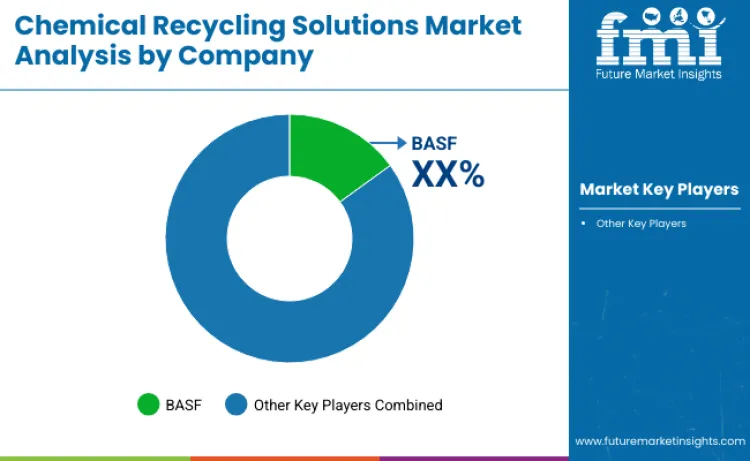
BASF focuses on advancing chemical recycling technologies such as ChemCycling® and depolymerization to process difficult-to-recycle plastics from end-of-life vehicles. These technologies allow BASF to transform mixed plastics into valuable feedstock, enabling automotive manufacturers to reuse these materials without sacrificing performance. BASF's approach integrates circular solutions by using pyrolysis oil as a feedstock for new polyamide and thermoplastic products. This focus on high-quality, closed-loop recycling aligns with the increasing demand for sustainable materials in the automotive industry, positioning BASF as a leader in advanced recycling technologies. Similarly, Eastman uses molecular recycling to break down plastics into their molecular building blocks, creating high-performance materials from previously unrecyclable waste. By offering solutions that restore plastics to their original properties, Eastman highlights its ability to meet the rigorous standards required for automotive parts, thus providing an efficient solution to the recycling challenges in the automotive sector.
Dow, Sinopec, and Wanhua have all invested heavily in expanding their chemical recycling capabilities, using technologies such as pyrolysis and catalytic cracking to process plastic waste into useful feedstock for new polymer production. Dow has leveraged its global petrochemical infrastructure to scale recycling solutions, making it a significant player in the industry. Sinopec’s focus on solvent pyrolysis and Wanhua’s work on catalytic cracking emphasize their respective efforts to develop processes that deliver higher yields and feedstock quality, which can be used in automotive applications. Reliance Industries and Braskem also compete in this space, with Reliance using catalytic pyrolysis to convert mixed plastic waste into valuable monomers, while Braskem emphasizes circular feedstock integration into automotive and packaging sectors. Teijin’s solvent-based recycling method for polycarbonate waste further sets it apart by focusing on reclaiming high-quality materials used in automotive lighting and transparent parts. These varied approaches reflect the ongoing technological race to enhance the efficiency and scalability of chemical recycling for automotive plastics.
Key Players in the Chemical Recycling Solutions for End of Life Vehicle Plastics Market
- BASF
- Eastman
- Dow
- Sinopec
- Wanhua
- Reliance Industries
- Braskem
- Teijin
Scope of the Report
| Items | Values |
|---|---|
| Quantitative Units (2026) | USD billion |
| End-use | ELV Interior & Under-Hood Plastics, OEM Closed-Loop Recycling, High-Volume ELV Processing, Automotive Dismantling, Vehicle Recycling, Precision ELV Recycling |
| Recycling Route | Pyrolysis & Depolymerisation, Solvent-Based Recovery, Hybrid Chemical Recycling, Compact Chemical Recycling Units, Others |
| Plastic Stream | PP, ABS, PA, Mixed Auto Plastics, Mixed Polymer Streams, PP-Dominant Waste, Others |
| Technology | Automotive-Grade Chemical Recycling, Contaminant-Tolerant Processing, Large-Scale Reactor Systems, Cost-Efficient Depolymerisation, Others |
| Regions Covered | Asia Pacific, Europe, North America, Latin America, Middle East & Africa |
| Countries Covered | China, Japan, South Korea, India, Australia & New Zealand, ASEAN, Germany, United Kingdom, France, Italy, Spain, Nordic, BENELUX, United States, Canada, Mexico, Brazil, Chile, Saudi Arabia, Turkey, South Africa, and other regional markets |
| Key Companies Profiled | BASF, Eastman, Dow, Sinopec, Wanhua, Reliance Industries, Braskem, Teijin |
| Additional Attributes | Dollar sales by end-use, recycling route, plastic stream, and technology, ELV interior and under-hood plastics representing the largest end-use segment due to complex polymer composition and regulatory pressure, pyrolysis and depolymerisation representing the leading recycling route because of ability to process mixed and contaminated plastics, market growth driven by stricter plastic waste regulations and automotive sustainability targets, economics shaped by reactor scale, feedstock logistics, and long-term supply agreements with OEMs, increasing use of circularity agreements and closed-loop recycling models, rising investment in large-scale and contaminant-tolerant processing systems, and competitive positioning based on technology efficiency, feedstock flexibility, product quality, and ability to meet automotive-grade material certification requirements. |
Chemical Recycling Solutions for End of Life Vehicle Plastics Market Segmentation
End-use:
- ELV interior & under-hood plastics
- OEM closed-loop recycling
- High-volume ELV processing
- Automotive dismantling
- Vehicle recycling
- Precision ELV recycling
Recycling Route:
- Pyrolysis & depolymerisation
- Solvent-based recovery
- Hybrid chemical recycling
- Compact chemical recycling units
- Others
Plastic Stream:
- PP, ABS, PA
- Mixed auto plastics
- Mixed polymer streams
- PP-dominant waste
- Others
Technology:
- Automotive-grade chemical recycling
- Contaminant-tolerant processing
- Large-scale reactor systems
- Cost-efficient depolymerisation
- Others
Region
- Asia Pacific
- China
- Japan
- South Korea
- India
- Australia & New Zealand
- ASEAN
- Rest of Asia Pacific
- Europe
- Germany
- United Kingdom
- France
- Italy
- Spain
- Nordic
- BENELUX
- Rest of Europe
- North America
- United States
- Canada
- Mexico
- Latin America
- Brazil
- Chile
- Rest of Latin America
- Middle East & Africa
- Kingdom of Saudi Arabia
- Other GCC Countries
- Turkey
- South Africa
- Other African Union
- Rest of Middle East & Africa
Bibliography
- International Organization for Standardization. (2023). Acoustics—Determination of acoustic properties in impedance tubes—Part 2: Two-microphone technique for normal sound absorption coefficient and normal surface impedance (ISO 10534-2:2023). ISO.
- Organisation for Economic Co-operation and Development. (2024). Policy scenarios for eliminating plastic pollution by 2040. OECD Publishing.
- European Commission. (2023). Proposal for a regulation of the European Parliament and of the Council on circularity requirements for vehicle design and on management of end-of-life vehicles, amending Regulations (EU) 2018/858 and 2019/1020 and repealing Directives 2000/53/EC and 2005/64/EC (COM/2023/451 final). European Union.
Frequently Asked Questions
How big is the chemical recycling solutions for end of life vehicle plastics market in 2026?
The global chemical recycling solutions for end of life vehicle plastics market is estimated to be valued at USD 1.3 billion in 2026.
What will be the size of chemical recycling solutions for end of life vehicle plastics market in 2036?
The market size for the chemical recycling solutions for end of life vehicle plastics market is projected to reach USD 4.1 billion by 2036.
How much will be the chemical recycling solutions for end of life vehicle plastics market growth between 2026 and 2036?
The chemical recycling solutions for end of life vehicle plastics market is expected to grow at a 12.2% CAGR between 2026 and 2036.
What are the key product types in the chemical recycling solutions for end of life vehicle plastics market?
The key product types in chemical recycling solutions for end of life vehicle plastics market are elv interior & under-hood plastics, oem closed-loop recycling, high-volume elv processing, automotive dismantling, vehicle recycling and precision elv recycling.
Which recycling route segment to contribute significant share in the chemical recycling solutions for end of life vehicle plastics market in 2026?
In terms of recycling route, pyrolysis & depolymerisation segment to command 48.0% share in the chemical recycling solutions for end of life vehicle plastics market in 2026.
Preview the report firsthand - request a free sample
Get SampleGet the brochure for pricing and purchase details.
Get PDFTable of Content
- Executive Summary
- Global Market Outlook
- Demand-side Trends
- Supply-side Trends
- Technology Roadmap Analysis
- Analysis and Recommendations
- Market Overview
- Market Coverage / Taxonomy
- Market Definition / Scope / Limitations
- Market Background
- Market Dynamics
- Drivers
- Restraints
- Opportunity
- Trends
- Scenario Forecast
- Demand in Optimistic Scenario
- Demand in Likely Scenario
- Demand in Conservative Scenario
- Opportunity Map Analysis
- Product Life Cycle Analysis
- Supply Chain Analysis
- Investment Feasibility Matrix
- Value Chain Analysis
- PESTLE and Porter’s Analysis
- Regulatory Landscape
- Regional Parent Market Outlook
- Production and Consumption Statistics
- Import and Export Statistics
- Market Dynamics
- Global Market Analysis 2021 to 2025 and Forecast, 2026 to 2036
- Historical Market Size Value (USD Million) Analysis, 2021 to 2025
- Current and Future Market Size Value (USD Million) Projections, 2026 to 2036
- Y-o-Y Growth Trend Analysis
- Absolute $ Opportunity Analysis
- Global Market Pricing Analysis 2021 to 2025 and Forecast 2026 to 2036
- Global Market Analysis 2021 to 2025 and Forecast 2026 to 2036, By End-use
- Introduction / Key Findings
- Historical Market Size Value (USD Million) Analysis By End-use , 2021 to 2025
- Current and Future Market Size Value (USD Million) Analysis and Forecast By End-use , 2026 to 2036
- ELV interior & under-hood plastics
- OEM closed-loop recycling
- High-volume ELV processing
- Automotive dismantling
- Vehicle recycling
- Precision ELV recycling
- ELV interior & under-hood plastics
- Y-o-Y Growth Trend Analysis By End-use , 2021 to 2025
- Absolute $ Opportunity Analysis By End-use , 2026 to 2036
- Global Market Analysis 2021 to 2025 and Forecast 2026 to 2036, By Recycling Route
- Introduction / Key Findings
- Historical Market Size Value (USD Million) Analysis By Recycling Route, 2021 to 2025
- Current and Future Market Size Value (USD Million) Analysis and Forecast By Recycling Route, 2026 to 2036
- Pyrolysis & depolymerisation
- Solvent-based recovery
- Hybrid chemical recycling
- Compact chemical recycling units
- Others
- Pyrolysis & depolymerisation
- Y-o-Y Growth Trend Analysis By Recycling Route, 2021 to 2025
- Absolute $ Opportunity Analysis By Recycling Route, 2026 to 2036
- Global Market Analysis 2021 to 2025 and Forecast 2026 to 2036, By Plastic Stream
- Introduction / Key Findings
- Historical Market Size Value (USD Million) Analysis By Plastic Stream, 2021 to 2025
- Current and Future Market Size Value (USD Million) Analysis and Forecast By Plastic Stream, 2026 to 2036
- PP, ABS, PA
- Mixed auto plastics
- Mixed polymer streams
- PP-dominant waste
- Others
- PP, ABS, PA
- Y-o-Y Growth Trend Analysis By Plastic Stream, 2021 to 2025
- Absolute $ Opportunity Analysis By Plastic Stream, 2026 to 2036
- Global Market Analysis 2021 to 2025 and Forecast 2026 to 2036, By Technology
- Introduction / Key Findings
- Historical Market Size Value (USD Million) Analysis By Technology, 2021 to 2025
- Current and Future Market Size Value (USD Million) Analysis and Forecast By Technology, 2026 to 2036
- Automotive-grade chemical recycling
- Contaminant-tolerant processing
- Large-scale reactor systems
- Cost-efficient depolymerisation
- Others
- Automotive-grade chemical recycling
- Y-o-Y Growth Trend Analysis By Technology, 2021 to 2025
- Absolute $ Opportunity Analysis By Technology, 2026 to 2036
- Global Market Analysis 2021 to 2025 and Forecast 2026 to 2036, By 0.36
- Introduction / Key Findings
- Historical Market Size Value (USD Million) Analysis By 0.36, 2021 to 2025
- Current and Future Market Size Value (USD Million) Analysis and Forecast By 0.36, 2026 to 2036
- 0.28
- 0.22
- 0.1
- 0.02
- 0.02
- 0.28
- Y-o-Y Growth Trend Analysis By 0.36, 2021 to 2025
- Absolute $ Opportunity Analysis By 0.36, 2026 to 2036
- Global Market Analysis 2021 to 2025 and Forecast 2026 to 2036, By Region
- Introduction
- Historical Market Size Value (USD Million) Analysis By Region, 2021 to 2025
- Current Market Size Value (USD Million) Analysis and Forecast By Region, 2026 to 2036
- North America
- Latin America
- Western Europe
- Eastern Europe
- East Asia
- South Asia and Pacific
- Middle East & Africa
- Market Attractiveness Analysis By Region
- North America Market Analysis 2021 to 2025 and Forecast 2026 to 2036, By Country
- Historical Market Size Value (USD Million) Trend Analysis By Market Taxonomy, 2021 to 2025
- Market Size Value (USD Million) Forecast By Market Taxonomy, 2026 to 2036
- By Country
- USA
- Canada
- Mexico
- By End-use
- By Recycling Route
- By Plastic Stream
- By Technology
- By 0.36
- By Country
- Market Attractiveness Analysis
- By Country
- By End-use
- By Recycling Route
- By Plastic Stream
- By Technology
- By 0.36
- Key Takeaways
- Latin America Market Analysis 2021 to 2025 and Forecast 2026 to 2036, By Country
- Historical Market Size Value (USD Million) Trend Analysis By Market Taxonomy, 2021 to 2025
- Market Size Value (USD Million) Forecast By Market Taxonomy, 2026 to 2036
- By Country
- Brazil
- Chile
- Rest of Latin America
- By End-use
- By Recycling Route
- By Plastic Stream
- By Technology
- By 0.36
- By Country
- Market Attractiveness Analysis
- By Country
- By End-use
- By Recycling Route
- By Plastic Stream
- By Technology
- By 0.36
- Key Takeaways
- Western Europe Market Analysis 2021 to 2025 and Forecast 2026 to 2036, By Country
- Historical Market Size Value (USD Million) Trend Analysis By Market Taxonomy, 2021 to 2025
- Market Size Value (USD Million) Forecast By Market Taxonomy, 2026 to 2036
- By Country
- Germany
- UK
- Italy
- Spain
- France
- Nordic
- BENELUX
- Rest of Western Europe
- By End-use
- By Recycling Route
- By Plastic Stream
- By Technology
- By 0.36
- By Country
- Market Attractiveness Analysis
- By Country
- By End-use
- By Recycling Route
- By Plastic Stream
- By Technology
- By 0.36
- Key Takeaways
- Eastern Europe Market Analysis 2021 to 2025 and Forecast 2026 to 2036, By Country
- Historical Market Size Value (USD Million) Trend Analysis By Market Taxonomy, 2021 to 2025
- Market Size Value (USD Million) Forecast By Market Taxonomy, 2026 to 2036
- By Country
- Russia
- Poland
- Hungary
- Balkan & Baltic
- Rest of Eastern Europe
- By End-use
- By Recycling Route
- By Plastic Stream
- By Technology
- By 0.36
- By Country
- Market Attractiveness Analysis
- By Country
- By End-use
- By Recycling Route
- By Plastic Stream
- By Technology
- By 0.36
- Key Takeaways
- East Asia Market Analysis 2021 to 2025 and Forecast 2026 to 2036, By Country
- Historical Market Size Value (USD Million) Trend Analysis By Market Taxonomy, 2021 to 2025
- Market Size Value (USD Million) Forecast By Market Taxonomy, 2026 to 2036
- By Country
- China
- Japan
- South Korea
- By End-use
- By Recycling Route
- By Plastic Stream
- By Technology
- By 0.36
- By Country
- Market Attractiveness Analysis
- By Country
- By End-use
- By Recycling Route
- By Plastic Stream
- By Technology
- By 0.36
- Key Takeaways
- South Asia and Pacific Market Analysis 2021 to 2025 and Forecast 2026 to 2036, By Country
- Historical Market Size Value (USD Million) Trend Analysis By Market Taxonomy, 2021 to 2025
- Market Size Value (USD Million) Forecast By Market Taxonomy, 2026 to 2036
- By Country
- India
- ASEAN
- Australia & New Zealand
- Rest of South Asia and Pacific
- By End-use
- By Recycling Route
- By Plastic Stream
- By Technology
- By 0.36
- By Country
- Market Attractiveness Analysis
- By Country
- By End-use
- By Recycling Route
- By Plastic Stream
- By Technology
- By 0.36
- Key Takeaways
- Middle East & Africa Market Analysis 2021 to 2025 and Forecast 2026 to 2036, By Country
- Historical Market Size Value (USD Million) Trend Analysis By Market Taxonomy, 2021 to 2025
- Market Size Value (USD Million) Forecast By Market Taxonomy, 2026 to 2036
- By Country
- Kingdom of Saudi Arabia
- Other GCC Countries
- Turkiye
- South Africa
- Other African Union
- Rest of Middle East & Africa
- By End-use
- By Recycling Route
- By Plastic Stream
- By Technology
- By 0.36
- By Country
- Market Attractiveness Analysis
- By Country
- By End-use
- By Recycling Route
- By Plastic Stream
- By Technology
- By 0.36
- Key Takeaways
- Key Countries Market Analysis
- USA
- Pricing Analysis
- Market Share Analysis, 2025
- By End-use
- By Recycling Route
- By Plastic Stream
- By Technology
- By 0.36
- Canada
- Pricing Analysis
- Market Share Analysis, 2025
- By End-use
- By Recycling Route
- By Plastic Stream
- By Technology
- By 0.36
- Mexico
- Pricing Analysis
- Market Share Analysis, 2025
- By End-use
- By Recycling Route
- By Plastic Stream
- By Technology
- By 0.36
- Brazil
- Pricing Analysis
- Market Share Analysis, 2025
- By End-use
- By Recycling Route
- By Plastic Stream
- By Technology
- By 0.36
- Chile
- Pricing Analysis
- Market Share Analysis, 2025
- By End-use
- By Recycling Route
- By Plastic Stream
- By Technology
- By 0.36
- Germany
- Pricing Analysis
- Market Share Analysis, 2025
- By End-use
- By Recycling Route
- By Plastic Stream
- By Technology
- By 0.36
- UK
- Pricing Analysis
- Market Share Analysis, 2025
- By End-use
- By Recycling Route
- By Plastic Stream
- By Technology
- By 0.36
- Italy
- Pricing Analysis
- Market Share Analysis, 2025
- By End-use
- By Recycling Route
- By Plastic Stream
- By Technology
- By 0.36
- Spain
- Pricing Analysis
- Market Share Analysis, 2025
- By End-use
- By Recycling Route
- By Plastic Stream
- By Technology
- By 0.36
- France
- Pricing Analysis
- Market Share Analysis, 2025
- By End-use
- By Recycling Route
- By Plastic Stream
- By Technology
- By 0.36
- India
- Pricing Analysis
- Market Share Analysis, 2025
- By End-use
- By Recycling Route
- By Plastic Stream
- By Technology
- By 0.36
- ASEAN
- Pricing Analysis
- Market Share Analysis, 2025
- By End-use
- By Recycling Route
- By Plastic Stream
- By Technology
- By 0.36
- Australia & New Zealand
- Pricing Analysis
- Market Share Analysis, 2025
- By End-use
- By Recycling Route
- By Plastic Stream
- By Technology
- By 0.36
- China
- Pricing Analysis
- Market Share Analysis, 2025
- By End-use
- By Recycling Route
- By Plastic Stream
- By Technology
- By 0.36
- Japan
- Pricing Analysis
- Market Share Analysis, 2025
- By End-use
- By Recycling Route
- By Plastic Stream
- By Technology
- By 0.36
- South Korea
- Pricing Analysis
- Market Share Analysis, 2025
- By End-use
- By Recycling Route
- By Plastic Stream
- By Technology
- By 0.36
- Russia
- Pricing Analysis
- Market Share Analysis, 2025
- By End-use
- By Recycling Route
- By Plastic Stream
- By Technology
- By 0.36
- Poland
- Pricing Analysis
- Market Share Analysis, 2025
- By End-use
- By Recycling Route
- By Plastic Stream
- By Technology
- By 0.36
- Hungary
- Pricing Analysis
- Market Share Analysis, 2025
- By End-use
- By Recycling Route
- By Plastic Stream
- By Technology
- By 0.36
- Kingdom of Saudi Arabia
- Pricing Analysis
- Market Share Analysis, 2025
- By End-use
- By Recycling Route
- By Plastic Stream
- By Technology
- By 0.36
- Turkiye
- Pricing Analysis
- Market Share Analysis, 2025
- By End-use
- By Recycling Route
- By Plastic Stream
- By Technology
- By 0.36
- South Africa
- Pricing Analysis
- Market Share Analysis, 2025
- By End-use
- By Recycling Route
- By Plastic Stream
- By Technology
- By 0.36
- USA
- Market Structure Analysis
- Competition Dashboard
- Competition Benchmarking
- Market Share Analysis of Top Players
- By Regional
- By End-use
- By Recycling Route
- By Plastic Stream
- By Technology
- By 0.36
- Competition Analysis
- Competition Deep Dive
- BASF
- Overview
- Product Portfolio
- Profitability by Market Segments (Product/Age /Sales Channel/Region)
- Sales Footprint
- Strategy Overview
- Marketing Strategy
- Product Strategy
- Channel Strategy
- Eastman
- Dow
- Sinopec
- Wanhua
- Reliance Industries
- BASF
- Competition Deep Dive
- Assumptions & Acronyms Used
- Research Methodology


