

- Industry Size (2026)
- USD 4.1 Bn
- Forecast (2036)
- USD 18.7 Bn
- CAGR (2026 to 2036)
- 16.5%
Chemical Recycling of Multilayer Polyolefin Films for PPWR-Ready Recyclate Market Forecast and Outlook 2026 to 2036
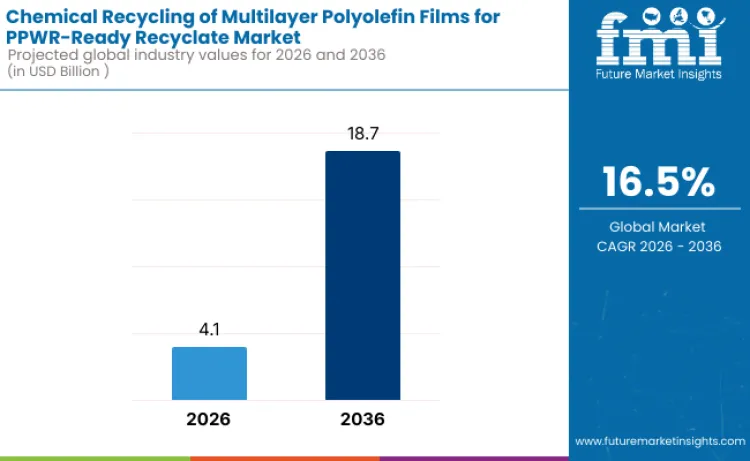
The chemical recycling of multilayer polyolefin films for PPWR-ready recyclate market is valued at USD 4.1 billion in 2026 and is projected to reach USD 18.7 billion by 2036, reflecting a CAGR of 16.5%. Demand increases as packaging producers transition away from non-recyclable multilayer structures and prepare for PPWR-driven recyclability and recycled-content mandates. Chemical recycling becomes essential for recovering value from complex films that cannot be processed through mechanical systems.
Advanced chemical depolymerization of multilayer polyolefin films leads technology adoption because it breaks down PE/PP structures into hydrocarbon intermediates suitable for re-polymerization into virgin-equivalent materials. High thermal conversion efficiency, robust contaminant tolerance, and compatibility with mixed-film feedstocks strengthen industrial deployment. Output streams integrate into cracker and polymerization units to produce PPWR-compliant recyclate capable of food-contact applications when regulatory criteria are met.
China, India, USA, and Japan act as key growth regions driven by expanding flexible packaging volumes and large-scale investment in circular petrochemical infrastructure. Plastic Energy, Eastman, Honeywell UOP, Quantafuel, and Alterra Energy guide sector development through advanced pyrolysis and solvent-based depolymerization platforms, long-term offtake agreements with resin producers, and integrated recycling hubs designed to generate high-quality, PPWR-ready polyolefin recyclate.
Quick Stats for Chemical Recycling of Multilayer Polyolefin Films for PPWR-Ready Recyclate Sector
- Market Value (2026): USD 4.1 billion
- Market Forecast Value (2036): USD 18.7 billion
- Forecast CAGR (2026 to 2036): 16.5%
- Leading Recycling Technology in Global Demand: Advanced chemical depolymerization of multilayer polyolefin films
- Key Growth Regions in Global Demand: China, India, USA, Japan
- Top Players in Global Demand: Plastic Energy, Eastman, Honeywell UOP, Quantafuel, Alterra Energy
Chemical Recycling of Multilayer Polyolefin Films for PPWR-Ready Recyclate Market Key Takeaways
| Metric | Value |
|---|---|
| Market Value (2026) | USD 4.1 billion |
| Market Forecast Value (2036) | USD 18.7 billion |
| Forecast CAGR (2026 to 2036) | 16.5% |
How Are the Segments Classified in the Chemical Recycling of Multilayer Polyolefin Films for PPWR-Ready Recyclate Market?
Demand for chemical recycling of multilayer polyolefin films is shaped by PPWR-driven recyclability requirements, increased scrutiny of mixed-film waste streams, and the need to produce high-purity polyolefin recyclate suitable for food-contact applications. Buyers evaluate depolymerization efficiency, delamination performance, contaminant tolerance, and suitability of recovered outputs for film reprocessing. Adoption patterns reflect accelerated transition away from non-recyclable multilayer structures and the expansion of chemical recycling infrastructure to achieve PPWR compliance.
Which Recycling Technology Accounts for the Largest Share of Global Demand?
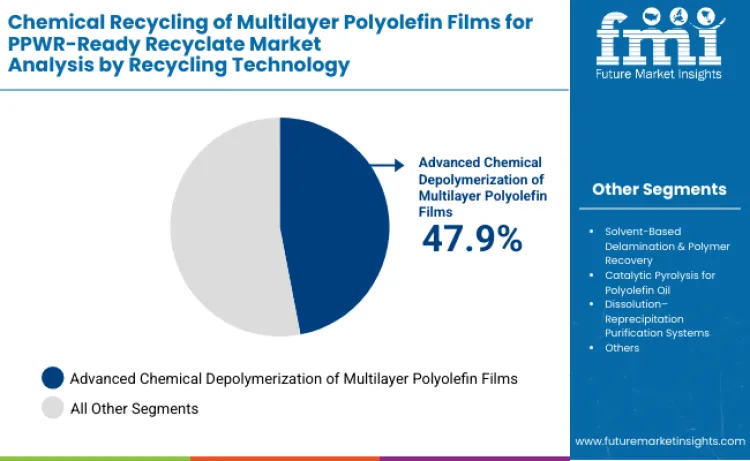
Advanced chemical depolymerization of multilayer polyolefin films holds 47.9%, making it the leading recycling-technology segment globally. Depolymerization breaks polymer chains into controlled fragments or monomers suitable for repolymerization into high-purity recyclate. Solvent-based delamination and polymer recovery separates film layers, enabling targeted purification of PE and PP fractions. Catalytic pyrolysis converts mixed polyolefin waste into oils usable as chemical feedstock. Dissolution–reprecipitation purification systems remove inks, additives, and contaminants while preserving polymer integrity. Technology-type distribution reflects sustained preference for depolymerization routes capable of producing PPWR-ready outputs.
Key Points:
- Depolymerization enables high-purity repolymerized recyclate.
- Solvent delamination separates layers for targeted recovery.
- Catalytic pyrolysis produces feedstock oils from mixed films.
- Dissolution–reprecipitation improves polymer purity.
Which Film Structure Represents the Largest Share of Global Demand?
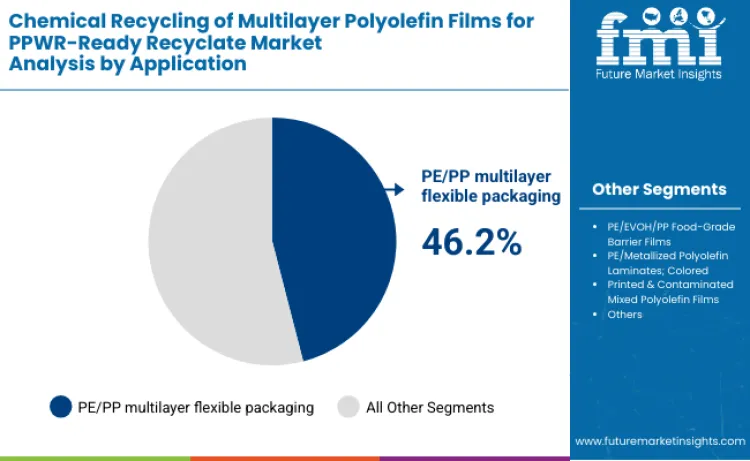
PE/PP multilayer flexible packaging holds 46.2%, making it the largest film-structure segment globally. These films dominate consumer packaging and generate substantial mixed-polyolefin waste streams that require advanced recycling. PE/EVOH/PP food-grade barrier films require delamination or chemical treatment to remove EVOH for PPWR compliance. PE/metallized polyolefin laminates require dissolution or pyrolysis pathways to overcome metallization contamination. Colored, printed, and contaminated mixed polyolefin films depend on chemical purification for acceptable output properties. Film-structure distribution reflects high prevalence of PE/PP multilayers across packaging segments.
Key Points:
- PE/PP multilayers dominate flexible-packaging waste volumes.
- EVOH-barrier films require selective removal for compliance.
- Metallized laminates need chemical routes to bypass contamination.
- Printed mixed films depend on high-purity chemical purification.
Which Output Recyclate Type Accounts for the Largest Share of Global Demand?
Food-grade polyolefin recyclate holds 45.8%, making it the leading output type globally. PPWR compliance requires high purity, low odour, and stringent migration-limit performance, achievable through depolymerization and advanced purification. Non-food-grade high-purity recyclate supports durable goods and non-contact films. Chemical feedstock oils and waxes serve as upstream inputs for virgin-equivalent polymer production. Recovered polymer blends support mechanical reprocessing into non-food applications. Output distribution reflects strong regulatory pressure to produce food-grade, PPWR-aligned polyolefin recyclate.
Key Points:
- Food-grade recyclate meets PPWR purity and safety thresholds.
- Non-food-grade outputs serve secondary durable applications.
- Feedstock oils support virgin-equivalent polymer production.
- Recovered blends supply film reprocessing for non-food uses.
What are the Key Dynamics in the Chemical Recycling of Multilayer Polyolefin Films for PPWR-Ready Recyclate Market?
Global demand rises as converters, brand owners, and waste-management operators adopt chemical recycling pathways to process multilayer polyolefin films that cannot be mechanically recycled. These films contain PE, PP, tie-layers, and barrier components that require depolymerisation or dissolution technologies to produce PPWR-ready recyclate. Interest grows as EU circularity rules push brands toward high-quality recycled inputs while maintaining packaging functionality for food and non-food applications.
How are PPWR compliance needs and multilayer packaging redesign shaping adoption of chemical recycling?
PPWR targets strengthen interest in technologies capable of converting complex PE–PP multilayers into high-purity recyclate. Chemical depolymerisation and solvent-based dissolution enable recovery of polyolefins from structures containing adhesives, inks, EVOH, and metallisation that hinder mechanical routes. Brand owners evaluate chemical recycling to secure feedstock for mandated recycled-content thresholds. Converters redesign multilayers to improve processability by reducing incompatible additives. Pilot plants test polymer recovery yield, contaminant removal, and recyclate suitability for flexible packaging. Partnerships emerge between producers, recyclers, and CPGs to demonstrate closed-loop potential for PPWR-aligned packaging systems requiring consistent material quality.
How do feedstock variability, technological complexity, and regulatory validation influence scalability?
Post-consumer multilayer film streams vary by barrier composition, ink system, and lamination type, challenging stable input quality. Chemical recycling technologies require high capital investment, controlled operating conditions, and robust solvent or catalyst management. Contaminants such as food residues, adhesives, and pigments affect depolymerisation efficiency and purity of recovered polymers. Regulatory approval for PPWR-ready recyclate demands documentation of process safety, migration compliance, and traceability. Infrastructure gaps limit collection of flexible films across several regions. Brands depend on predictable output properties to reintegrate recyclate into packaging. Long-term scale-up relies on harmonized feedstock specifications, supply agreements, and demonstration of cost-effective, compliant recyclate production.
How is Demand for Chemical Recycling of Multilayer Polyolefin Films for PPWR-Ready Recyclate Market Evolving Across Key Countries?
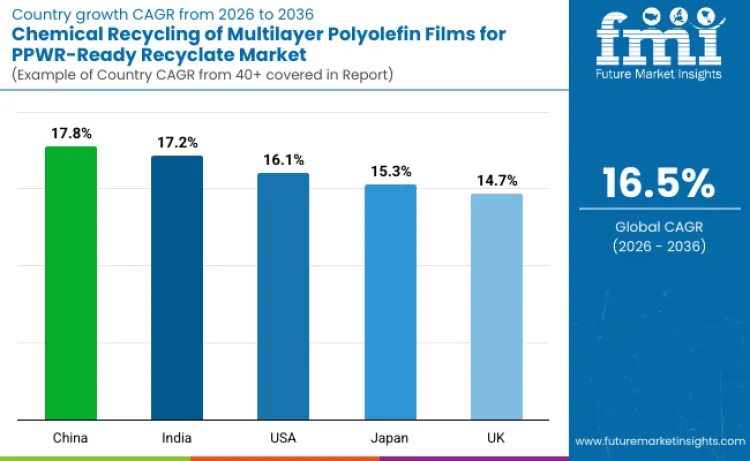
Demand for chemical recycling of multilayer polyolefin films for PPWR-ready recyclate is rising due to tighter recyclability regulations, increased use of complex film structures, and the need for high-purity outputs suitable for packaging-compliance frameworks. China records a CAGR of 17.8% supported by large-scale polyolefin film consumption. India shows a 17.2% CAGR driven by rapid flexible-packaging growth. USA posts a 16.1% CAGR supported by chemical-recycling infrastructure expansion. Japan holds a 15.3% CAGR linked with precision depolymerization technologies. UK records a 14.7% CAGR supported by PPWR-aligned packaging redesign requirements.
| Country | CAGR (%) |
|---|---|
| China | 17.8% |
| India | 17.2% |
| USA | 16.1% |
| Japan | 15.3% |
| UK | 14.7% |
How is China driving demand for Chemical Recycling of Multilayer Polyolefin Films for PPWR-Ready Recyclate?
China drives demand due to high multilayer film usage, strong interest in advanced recycling, and continued expansion of chemical-depolymerization capacity. The country’s CAGR of 17.8% reflects adoption of pyrolysis, hydrocracking, and catalytic depolymerization systems converting multilayer PE/PP into PPWR-ready recyclate. Recyclers expand pretreatment systems such as delamination, solvent-washing, and density separation improving feed quality. Packaging firms explore redesign pathways aligned with PPWR-style compliance. Petrochemical companies integrate circular-feedstock output into polymer production. National targets promoting high-value recycling accelerate technology uptake.
- Scale-up of pyrolysis and catalytic depolymerization units
- Increased use of pretreatment for multilayer film separation
- Packaging-sector alignment with recyclability frameworks
- Petrochemical integration of circular polymer feedstocks
How is India driving demand for Chemical Recycling of Multilayer Polyolefin Films for PPWR-Ready Recyclate?
India supports rising demand due to rapid growth in flexible packaging, EPR enforcement, and increased interest in recovering value from multilayer film waste. The country’s CAGR of 17.2% reflects adoption of chemical-recycling technologies enabling processing of PE/PP laminate structures that cannot be mechanically recycled. Facilities deploy pyrolysis, solvent-based dissolution, and catalytic cracking to generate PPWR-compatible recyclate streams. FMCG companies explore recyclable and circular-compatible film designs. Infrastructure expansion strengthens feedstock collection for chemical recycling. National sustainability mandates encourage industry transition toward circular polyolefin systems.
- EPR-driven demand for advanced film-recycling solutions
- Adoption of pyrolysis and solvent-based dissolution technologies
- Increased redesign of flexible packaging for PPWR-style compatibility
- Expansion of feedstock collection for chemical recycling
How is the USA driving demand for Chemical Recycling of Multilayer Polyolefin Films for PPWR-Ready Recyclate?
USA drives demand through rapid growth in chemical-recycling capacity, strong commitments from brand owners, and rising volume of multilayer films entering waste streams. The country’s CAGR of 16.1% reflects deployment of pyrolysis, gasification, and catalytic depolymerization systems converting multilayer PE/PP into high-quality circular feedstocks. Packaging companies redesign laminates to improve technical compatibility with chemical-recycling pathways. Material recovery facilities expand sorting and preprocessing for film aggregation. Regulatory initiatives supporting advanced recycling classification influence project investment.
- Expansion of pyrolysis and catalytic depolymerization projects
- Packaging redesign improving chemical-recycling compatibility
- Growth in film aggregation and preprocessing infrastructure
- Policy frameworks supporting advanced recycling deployment
How is Japan driving demand for Chemical Recycling of Multilayer Polyolefin Films for PPWR-Ready Recyclate?
Japan drives demand due to strict material-quality expectations, advanced chemical-engineering capabilities, and interest in high-purity circular polymers. The country’s CAGR of 15.3% reflects development of precision depolymerization systems targeting multilayer polyolefin structures. Research institutes refine solvent-based delamination, catalytic liquefaction, and controlled pyrolysis improving monomer recovery. Packaging firms test PPWR-aligned film constructions compatible with chemical recycling. National emphasis on high-purity outputs enhances uptake across converters and brand owners.
- Precision depolymerization and solvent-delamination research
- Adoption of PPWR-focused film redesign
- Investment in catalytic liquefaction technologies
- Strong emphasis on high-quality circular polymer outputs
How is the UK driving demand for Chemical Recycling of Multilayer Polyolefin Films for PPWR-Ready Recyclate?
UK supports demand through strong circular-packaging regulations, rapid growth in flexible packaging, and investment in advanced recycling. The country’s CAGR of 14.7% reflects adoption of chemical-recycling solutions capable of processing complex PE/PP laminates. Recyclers develop delamination, dissolution, and pyrolytic systems delivering PPWR-aligned recyclate. Brands redesign multilayer structures toward chemical-recycling compatibility. National EPR and PPWR-driven mandates accelerate transitions to circular-aligned polyolefin systems.
- Growth in delamination and dissolution technologies
- Redesign of multilayer films for PPWR compatibility
- Investment in pyrolysis for circular feedstock production
- EPR and PPWR requirements accelerating adoption
What is the competitive landscape of demand for chemical recycling of multilayer polyolefin films for PPWR-ready recyclate globally?
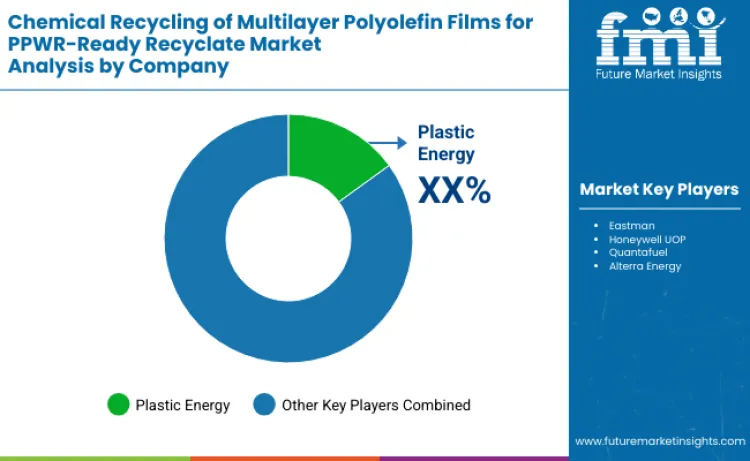
Demand for chemical recycling of multilayer polyolefin films grows as producers and recyclers address PPWR requirements targeting difficult-to-recycle flexible packaging. Requirements center on depolymerization efficiency, contaminant tolerance, feedstock flexibility, and output consistency suitable for downstream cracker or polymerization units. Buyers evaluate reactor design, catalyst performance, energy intensity, and yield stability when processing PE/PP laminates containing barrier layers, inks, and adhesives. Procurement teams prioritize traceable feedstock supply, product-stewardship documentation, and compatibility with existing polyolefin value chains. Trend in the global market reflects expanded investment in advanced recycling plants, broader acceptance of chemically recycled feedstock by converters, and alignment with PPWR-driven circularity targets.
Plastic Energy holds an estimated 25.0% share. Position strengthens through commercial thermal depolymerization plants capable of processing complex multilayer polyolefin waste into feedstock oil used by petrochemical partners. Eastman participates with molecular-recycling technology designed for mixed flexible packaging streams requiring stable monomer or intermediate production. Honeywell UOP maintains visibility through licensed pyrolysis and upgrading technologies tailored for multilayer PE/PP film conversion. Quantafuel contributes advanced recycling capacity integrated with sorting partners supplying mixed flexible feedstock. Alterra Energy supports demand with continuous pyrolysis systems engineered for high-contaminant polyolefin waste and integrated upgrading units. Competitive positioning globally reflects depolymerization efficiency, feedstock versatility, product-quality stability, and integration with polymer producers seeking PPWR-ready recycled content.
Key Players in the Chemical Recycling of Multilayer Polyolefin Films for PPWR-Ready Recyclate Market
- Plastic Energy
- Eastman
- Honeywell UOP
- Quantafuel
- Alterra Energy
Scope of the Report
| Items | Values |
|---|---|
| Quantitative Units | USD billion |
| Recycling Technology | Advanced Chemical Depolymerization of Multilayer Polyolefin Films; Solvent-Based Delamination & Polymer Recovery; Catalytic Pyrolysis for Polyolefin Oil; Dissolution-Reprecipitation Purification Systems |
| Film Structure | PE/PP Multilayer Flexible Packaging; PE/EVOH/PP Food-Grade Barrier Films; PE/Metallized Polyolefin Laminates; Colored, Printed & Contaminated Mixed Polyolefin Films |
| Output Recyclate Type | Food-Grade Polyolefin Recyclate (PPWR-Ready); Non-Food-Grade High-Purity Recyclate; Chemical Feedstock Oils & Waxes; Recovered Polymer Blends for Film Reprocessing |
| End-User | FMCG & Food Packaging Brands; Flexible Packaging Converters; Chemical Recycling Operators; Waste Management & EPR Compliance Schemes |
| Regions Covered | Asia Pacific, Europe, North America, Latin America, Middle East & Africa |
| Countries Covered | USA, Germany, France, Italy, UK, China, India, South Korea, Japan, plus 40+ countries |
| Key Companies Profiled | Plastic Energy; Eastman; Honeywell UOP; Quantafuel; Alterra Energy |
| Additional Attributes | Dollar sales by recycling technology; adoption benchmarking for chemical depolymerization of multilayer polyolefin films; performance indicators for solvent-based delamination processes; catalytic pyrolysis output yields and downstream integration; PPWR compliance-driven demand for food-grade polyolefin recyclate; regional regulatory drivers for multilayer film recovery; contamination-handling efficiency and recyclate purity analysis; competitive positioning of chemical recyclers participating in PPWR-aligned polyolefin circularity. |
Chemical Recycling of Multilayer Polyolefin Films for PPWR-Ready Recyclate Market by Segment
By Recycling Technology:
- Advanced Chemical Depolymerization of Multilayer Polyolefin Films
- Solvent-Based Delamination & Polymer Recovery
- Catalytic Pyrolysis for Polyolefin Oil
- Dissolution–Reprecipitation Purification Systems
By Film Structure:
- PE/PP Multilayer Flexible Packaging
- PE/EVOH/PP Food-Grade Barrier Films
- PE/Metallized Polyolefin Laminates
- Colored, Printed & Contaminated Mixed Polyolefin Films
By Output Recyclate Type:
- Food-Grade Polyolefin Recyclate (PPWR-Ready)
- Non-Food-Grade High-Purity Recyclate
- Chemical Feedstock Oils & Waxes
- Recovered Polymer Blends for Film Reprocessing
By End-User:
- FMCG & Food Packaging Brands
- Flexible Packaging Converters
- Chemical Recycling Operators
- Waste Management & EPR Compliance Schemes
By Region:
- Asia Pacific
- China
- Japan
- South Korea
- India
- Australia & New Zealand
- ASEAN
- Rest of Asia Pacific
- Europe
- Germany
- United Kingdom
- France
- Italy
- Spain
- Nordic
- BENELUX
- Rest of Europe
- North America
- United States
- Canada
- Mexico
- Latin America
- Brazil
- Chile
- Rest of Latin America
- Middle East & Africa
- Kingdom of Saudi Arabia
- Other GCC Countries
- Turkey
- South Africa
- Other African Union
- Rest of Middle East & Africa
Frequently Asked Questions
What is the size of the chemical recycling of multilayer polyolefin films for PPWR-ready recyclate market in 2026?
The market is valued at USD 4.1 billion in 2026 due to rising need to process difficult-to-recycle multilayer flexible packaging.
What will be the industry size by 2036?
Industry value will reach USD 18.7 billion by 2036 as producers scale chemical depolymerization systems to generate PPWR-compliant recyclate.
What is the CAGR for 2026 to 2036?
The chemical recycling of multilayer polyolefin films for PPWR-ready recyclate market expands at a 16.5% CAGR during the forecast period.
Which recycling-technology segment leads in 2026?
Advanced chemical depolymerization of multilayer polyolefin films holds 47.9% share due to its ability to break down complex film structures into high-quality monomers and oils.
Which film-structure segment holds the highest share?
PE/PP multilayer flexible packaging leads with 46.2% share, reflecting its widespread use and the need for PPWR-compatible recycling solutions.
Preview the report firsthand - request a free sample
Get SampleGet the brochure for pricing and purchase details.
Get PDFTable of Content
- Executive Summary
- Market Overview
- Global Market Value, 2020 to 2026
- Global Market Forecast, 2026 to 2036
- Market Dynamics
- Drivers
- Restraints
- Opportunities
- Regulatory & Standards Landscape
- Technology & Materials Innovation Outlook
- Market Segmentation Analysis
- By Recycling Technology
- Advanced Chemical Depolymerization of Multilayer Polyolefin Films
- Solvent-Based Delamination & Polymer Recovery
- Catalytic Pyrolysis for Polyolefin Oil
- Dissolution-Reprecipitation Purification Systems
- By Film Structure
- PE/PP Multilayer Flexible Packaging
- PE/EVOH/PP Food-Grade Barrier Films
- PE/Metallized Polyolefin Laminates
- Colored, Printed & Contaminated Mixed Polyolefin Films
- By Output Recyclate Type
- Food-Grade Polyolefin Recyclate (PPWR-Ready)
- Non-Food-Grade High-Purity Recyclate
- Chemical Feedstock Oils & Waxes
- Recovered Polymer Blends for Film Reprocessing
- By End-User
- FMCG & Food Packaging Brands
- Flexible Packaging Converters
- Chemical Recycling Operators
- Waste Management & EPR Compliance Schemes
- By Sales Channel
- Direct Industrial Offtake
- Resin Producer Integration
- Recycling Partnerships & Long-Term Contracts
- By Recycling Technology
- 4. Regional Outlook
- Asia Pacific
- Europe
- North America
- Latin America
- Middle East & Africa
- Country-Level Outlook
- United States
- Germany
- France
- Italy
- United Kingdom
- China
- India
- Japan
- South Korea
- Australia & New Zealand
- GCC Countries
- South Africa
- Competitive Landscape
- Market Structure Overview
- Company Positioning
- Strategic Initiatives
- Key Player Profiles
- Scope of the Report
- Research Methodology
- Assumptions & Acronyms


