

- Industry Size (2026)
- USD 23016.8 Mn
- Forecast (2036)
- USD 36001.5 Mn
- CAGR (2026 to 2036)
- 4.6%
Polyolefin in Pharmaceutical Packaging Market Forecast and Outlook By FMI
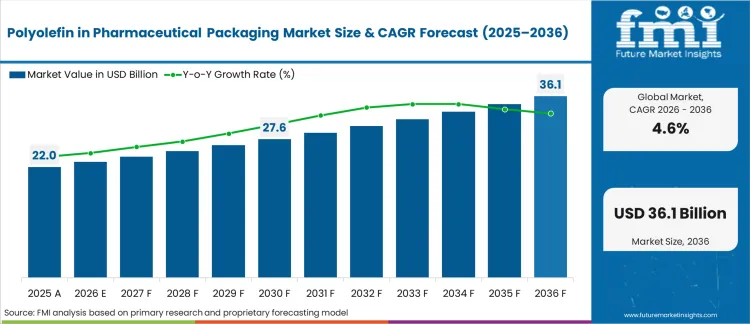
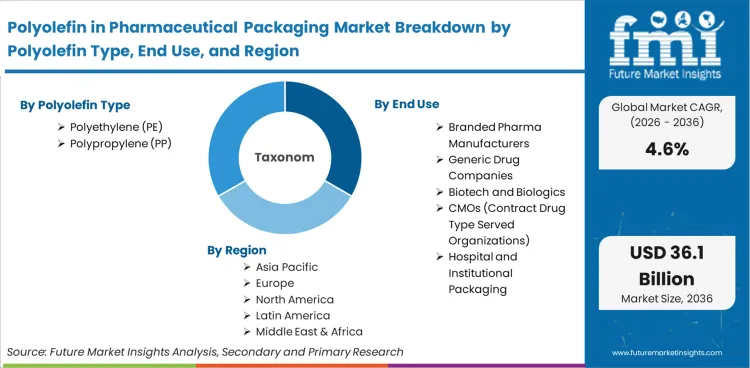
In 2025, the polyolefin in pharmaceutical packaging market was valued at USD 21,839.3 million. Based on Future Market Insights' analysis, demand for polyolefin materials in pharmaceutical packaging is estimated to grow to USD 23,016.8 million in 2026 and USD 36,001.5 million by 2036. FMI projects a CAGR of 4.6% during the forecast period.
The market is expected to generate an absolute dollar growth of USD 12,984.7 million between 2026 and 2036. This reflects steady, regulation-led expansion supported by rising pharmaceutical production, biologics growth, and increasing demand for high-barrier primary packaging. Polyethylene and polypropylene remain central to bottles, closures, blister laminates, and flexible overwraps due to chemical resistance and sterilization compatibility. Growth is reinforced by injectable and liquid dosage expansion, while resin price volatility and tightening extractables and leachable regulations continue to moderate material substitution flexibility.
“By providing high-quality and differentiated polyolefin solutions, we are enabling our partners to enhance product durability, improve recyclability, and reduce environmental impact. Borouge materials are engineered to meet the evolving needs of advanced packaging, ensuring efficiency, safety, and long-term performance. Through these partnerships, Borouge is not only strengthening supply chains but also shaping the future of sustainable manufacturing by delivering cutting-edge solutions that create real value for our customers and the industries they serve.” Said by Hazeem Sultan Al Suwaidi, CEO – Borouge.
Summary of Polyolefin in Pharmaceutical Packaging Market
- Polyolefin in Pharmaceutical Packaging Market Definition
- The polyolefin in pharmaceutical packaging market includes polyethylene, polypropylene, and specialty olefin-based materials used in rigid and flexible packaging formats for drug containment, protection, and regulatory compliance.
- Demand Drivers in the Market
- Rising global production of solid oral and liquid drug formulations is increasing demand for HDPE bottles, closures, and blister packaging components.
- Growth in biologics and injectable therapies is driving adoption of high-purity, extractables-controlled polyolefin grades such as COC/COP and metallocene-based materials.
- Stringent pharmaceutical safety regulations are accelerating the shift toward advanced primary packaging systems with improved moisture and barrier performance.
- Key Segments Analysed in the FMI Report
- By Packaging Format: Rigid packaging dominates, particularly bottles, closures, and containers used for tablets, capsules, and syrups.
- By Polyolefin Type: Polyethylene leads adoption due to versatility across LDPE, LLDPE, and HDPE grades suited for bottles, liners, and flexible laminates.
- By Geography: North America represents a leading region supported by strong pharmaceutical manufacturing and regulatory-driven packaging standards.
- Analyst Opinion at FMI
- Ismail Sutaria, Principal Consultant for Packaging Industry at Future Market Insights, opines, ‘CXOs will find in this report strategic insight into how regulatory compliance, biologics expansion, and material innovation are reshaping competitive dynamics in pharmaceutical polyolefin packaging.’
- Strategic Implications / Executive Takeaways
- Invest in high-purity and low-extractable polyolefin grades to meet stringent pharmaceutical validation requirements.
- Expand capabilities in advanced rigid and blister packaging formats serving injectables and specialty drugs.
- Strengthen partnerships with CMOs and biotech firms to secure long-term material supply agreements.
- Methodology
- Market estimates were validated through interviews with polymer producers and pharmaceutical packaging manufacturers.
- Secondary research included drug production data and regulatory documentation analysis.
- Forecasts were developed using dosage-form demand modeling and material consumption trends
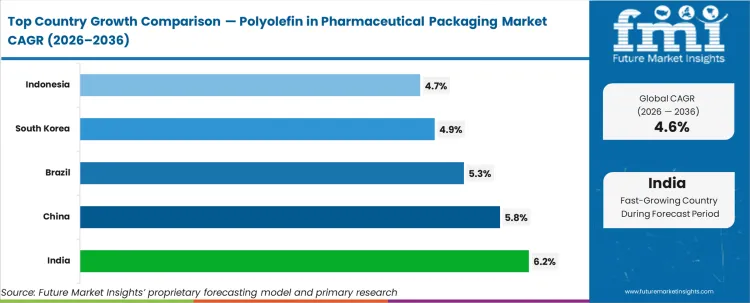
India (6.2%) is projected to register the fastest growth, driven by strong generic drug manufacturing and export capacity. China (5.8%) follows with expanding API and finished dosage production. Brazil (5.3%) benefits from rising domestic pharmaceutical consumption. South Korea (4.9%) and Indonesia (4.7%) show steady expansion supported by regional healthcare investment, while mature Western markets remain compliance-driven and replacement-oriented rather than volume-accelerated.
Polyolefin in Pharmaceutical Packaging Market Definition
The polyolefin in pharmaceutical packaging market refers to the use of polyethylene, polypropylene, and related olefin-based polymers in the production of pharmaceutical packaging components. These materials are used in rigid formats such as bottles, caps, vials, syringe parts, and droppers, as well as in flexible formats such as blister packs, strip packs, pouches, and laminates. Polyolefins are selected for their chemical resistance, moisture barrier properties, lightweight structure, and compatibility with sterilization and regulatory requirements. Their primary function is to protect drug formulations from contamination, degradation, and environmental exposure. Key end users include branded pharmaceutical manufacturers, generic drug producers, biotech companies, and contract manufacturing organizations.
Polyolefin in Pharmaceutical Packaging Market Inclusions
The report provides global and regional market size estimates for 2025 and 2026, with forecasts through 2036 and CAGR analysis. It includes segmentation by packaging format, polyolefin type, packaging function, drug type served, end user, and region. The study covers value-based sizing, regulatory impact assessment, material substitution trends, sterilization compatibility analysis, and demand patterns across pharmaceutical production categories.
Polyolefin in Pharmaceutical Packaging Market Exclusions
The scope excludes non-polyolefin materials such as PVC, PET, glass, aluminum, and engineering plastics unless incorporated within polyolefin-based structures. It does not include finished pharmaceutical drugs or active pharmaceutical ingredients. Machinery used in pharmaceutical packaging operations is also excluded, as the analysis focuses strictly on polyolefin materials and components used in packaging systems.
Polyolefin in Pharmaceutical Packaging Market Research Methodology
- Primary Research: Interviews were conducted with polyolefin resin producers, pharmaceutical packaging converters, drug manufacturers, regulatory consultants, and contract manufacturing organizations. Resin suppliers clarified pricing dynamics for medical-grade PE and PP, while converters validated material demand across solid oral, liquid, and injectable packaging formats.
- Desk Research: FDA and EU regulatory publications, trade statistics, polymer industry association data, and company annual reports were reviewed to benchmark production volumes and regional demand patterns.
- Market-Sizing and Forecasting: A hybrid top-down and bottom-up approach was applied. Demand was estimated from pharmaceutical production volumes and validated against resin supply capacity and packaging converter output.
- Data Validation and Update Cycle: Data was cross verified through trade datasets, regulatory filings, and stakeholder interviews, followed by structured expert review before final publication.
Polyolefin in Pharmaceutical Packaging Market Analysis by Polyolefin Type
Based on FMI's Polyolefin in Pharmaceutical Packaging market report, consumption of Polyethylene (PE) is estimated to hold 50.4% share in 2026. PE dominates due to its strong chemical resistance, moisture barrier properties, and compatibility with blow molding and film extrusion processes used in pharmaceutical bottles, caps, and flexible packaging. It addresses manufacturer priorities including product stability, low extractables, lightweighting, and compliance with pharmacopeial standards. PE is widely used for solid oral dose bottles, ophthalmic containers, and liquid medication packaging.
- Regulatory Compliance: Pharmaceutical-grade PE meets USP, EP, and FDA material requirements, supporting safe primary packaging for drug products.
- Moisture Protection: High-density polyethylene provides reliable moisture resistance, critical for protecting hygroscopic tablets and capsules.
- Processing Scalability: PE supports high-speed blow molding and film conversion, enabling cost-efficient production across global pharmaceutical packaging lines.
Polyolefin in Pharmaceutical Packaging Market Analysis by End User
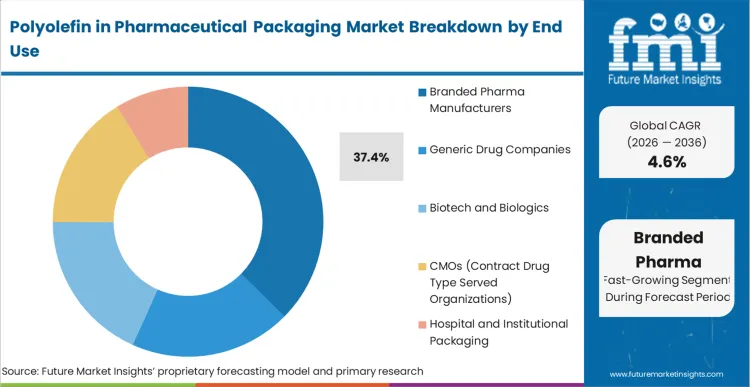
Based on FMI's Polyolefin in Pharmaceutical Packaging market report, consumption by Branded pharma manufacturers is estimated to hold 37.4% share in 2026. Branded pharmaceutical companies lead due to stringent packaging performance requirements, global regulatory obligations, and premium product positioning. Polyolefins address their need for consistent quality, barrier integrity, tamper evidence, and compatibility with serialization and track-and-trace systems.
- Quality Assurance Standards: Branded manufacturers prioritize pharmaceutical-grade polyolefins with validated supply chains and documented regulatory compliance.
- Global Distribution Needs: Lightweight PE and PP packaging supports efficient transportation and long shelf life across international markets.
- Innovation Investment: Leading pharma companies increasingly adopt advanced polyolefin structures to support child-resistant closures and patient-friendly dispensing systems.
Polyolefin in Pharmaceutical Packaging Market: Drivers, Restraints, and Opportunities
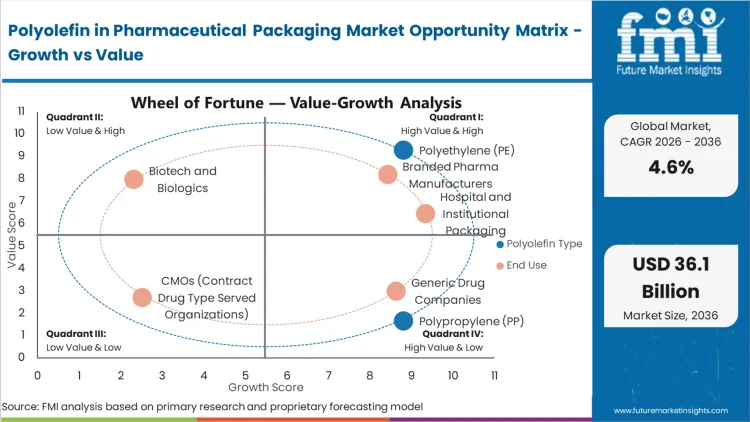
Future Market Insights analysis indicates that the polyolefin in pharmaceutical packaging market is structurally driven by the global expansion of drug manufacturing and the increasing preference for lightweight, chemically inert packaging materials. Polyolefins such as polyethylene (PE) and polypropylene (PP) are widely used in bottles, closures, blister components, IV containers, and flexible films due to their moisture resistance, processability, and compatibility with sterilization methods. The market exists at its current scale because pharmaceutical supply chains require high-volume, cost-efficient packaging that meets strict safety and stability standards while supporting global distribution.
FMI analysts observe a transition from standard commodity-grade resins toward pharmaceutical-grade, high-purity polyolefins with enhanced barrier and extractables performance. While conventional HDPE bottles continue to dominate solid oral dose packaging, growth is increasingly concentrated in clarified polypropylene, co-extruded films, and advanced polyolefin-based blister systems designed to improve moisture protection and reduce leachables. These specialized materials command higher pricing due to documentation, validation, and regulatory compliance requirements. However, improved drug stability, extended shelf life, and reduced risk of contamination justify the premium, resulting in value-driven growth despite moderate volume expansion in mature pharmaceutical markets.
- Regulatory Compliance Requirements:Packaging must comply with standards such as USA FDA 21 CFR for food and drug contact materials and pharmacopeial guidelines related to extractables and leachables. This drives demand for certified pharmaceutical-grade polyolefins.
- Biologics & Specialty Drug Growth:Expansion of temperature-sensitive and high-value biologics increases the need for advanced polyolefin films and containers with improved barrier and sterilization compatibility.
- Emerging Market Manufacturing Expansion:Growth of pharmaceutical production capacity in Asia-Pacific is boosting demand for cost-efficient yet compliant polyolefin packaging formats for both domestic and export markets.
Regional Analysis
.webp "Top Country Growth Comparison Polyolefin In Pharmaceutical Packaging Market Cagr (2026 2036)")
The global polyolefin in pharmaceutical packaging market is segmented across Asia Pacific and Latin America, with strong growth pockets in South and Southeast Asia. Regional dynamics are shaped by pharmaceutical manufacturing expansion, regulatory compliance standards, sterile packaging requirements, and export-driven drug production. The full report provides comprehensive regional market attractiveness analysis.
| Country | CAGR (%) |
|---|---|
| India | 6.2% |
| China | 5.8% |
| Brazil | 5.3% |
| South Korea | 4.9% |
| Indonesia | 4.7% |
Source: Future Market Insights (FMI) analysis, based on proprietary forecasting model and primary research
Asia Pacific – The Pharmaceutical Manufacturing Expansion Hub
Asia Pacific serves as the pharmaceutical manufacturing expansion hub, supported by generic drug production growth and export-oriented formulation capacity. Companies such as Uflex Limited, Huhtamaki PPL Limited, and Gerresheimer AG maintain strong presence in pharmaceutical-grade polyolefin packaging components. Competitive positioning is shaped by regulatory compliance upgrades, sterile packaging requirements, and expanding domestic drug production.
India
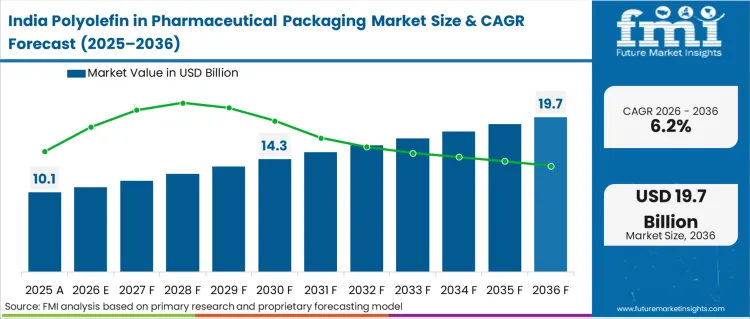
Demand for polyolefin in pharmaceutical packaging in India is projected to rise at 6.2% CAGR through 2036. Growth is closely tied to India’s expanding generic drug manufacturing base. In 2024, the Central Drugs Standard Control Organization continued strengthening Good Manufacturing Practice compliance for pharmaceutical packaging materials, reinforcing requirements for pharmaceutical-grade polypropylene and polyethylene. The Production Linked Incentive scheme for pharmaceuticals remains active, supporting expansion of bulk drug parks and formulation facilities.
In 2024, multiple state governments advanced development of pharmaceutical clusters, increasing demand for blister packaging films, bottles, and caps made from medical-grade polyolefins. Rising exports to regulated markets such as the US and EU further require high-purity and compliant packaging materials. While pricing pressure remains in generics, sustained manufacturing expansion supports steady polyolefin demand.
China
Demand for polyolefin in pharmaceutical packaging in China is projected to rise at 5.8% CAGR through 2036. The market benefits from rapid pharmaceutical production growth and regulatory strengthening. In 2024, the National Medical Products Administration continued enforcement of revised drug administration regulations, reinforcing packaging traceability and material compliance standards. China’s push for higher-quality domestic drug production under industrial modernization initiatives is increasing adoption of certified pharmaceutical-grade polymers. Expansion in injectable drug manufacturing and medical consumables supports demand for polyethylene bottles and polypropylene closures. Rising exports of finished formulations further strengthen the need for validated and traceable packaging materials.
FMI's analysis of polyolefin in pharmaceutical packaging market in Asia Pacific consists of country-wise assessment that includes India and China. Readers can find insights on GMP compliance impact, export-driven manufacturing, and sterile packaging demand.
Latin America – Expanding Domestic Drug Production Base
Latin America represents a growing pharmaceutical packaging market driven by public healthcare procurement and domestic manufacturing expansion. Companies such as Essel Propack Limited and Constantia Flexibles Group GmbH maintain supply linkages serving regional pharmaceutical converters.
Brazil
Demand for polyolefin in pharmaceutical packaging in Brazil is projected to rise at 5.3% CAGR through 2036. Growth is influenced by regulatory oversight from ANVISA, which continues to enforce Good Manufacturing Practice standards for pharmaceutical packaging materials. In 2024, public healthcare procurement under Brazil’s Unified Health System supported domestic production of essential medicines, increasing demand for compliant polymer packaging. Investments in local pharmaceutical manufacturing facilities have expanded demand for polyethylene bottles and polypropylene caps. While economic fluctuations may influence capital expenditure, public sector healthcare procurement sustains steady packaging consumption.
FMI's analysis of polyolefin in pharmaceutical packaging market in Latin America consists of country-wise assessment that includes Brazil. Readers can find insights on regulatory enforcement, public procurement impact, and domestic drug production growth.
East Asia – Technology-Driven Pharmaceutical Packaging Market
East Asia remains a technology-driven pharmaceutical packaging market supported by advanced formulation manufacturing and export competitiveness.
South Korea
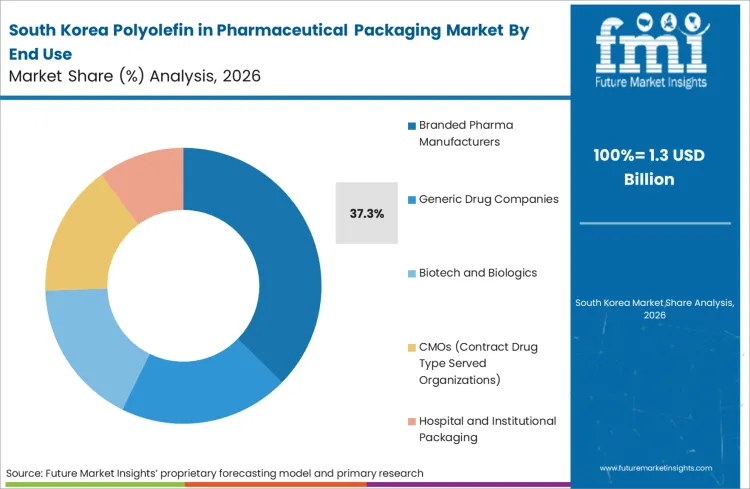
Demand for polyolefin in pharmaceutical packaging in South Korea is projected to rise at 4.9% CAGR through 2036. The country’s strong biopharmaceutical and generic drug export sector drives packaging material demand. In 2024, the Ministry of Food and Drug Safety continued enforcement of strict pharmaceutical manufacturing compliance standards, reinforcing traceability and packaging material validation. Government support for biohealth industry development has encouraged expansion of injectable and specialty drug production, increasing reliance on high-purity polymer packaging components. Sustainability considerations are also encouraging adoption of recyclable secondary packaging formats.
FMI's analysis of polyolefin in pharmaceutical packaging market in East Asia consists of country-wise assessment that includes South Korea. Readers can find insights on biohealth industry growth and compliance-driven packaging demand.
Southeast Asia – Emerging Pharmaceutical Manufacturing Market
Southeast Asia functions as an emerging pharmaceutical production and packaging market.
Indonesia
Demand for polyolefin in pharmaceutical packaging in Indonesia is projected to rise at 4.7% CAGR through 2036. Growth is supported by government efforts to expand domestic pharmaceutical production capacity. In 2024, Indonesia continued strengthening implementation of pharmaceutical manufacturing standards under its national drug regulatory framework, reinforcing compliance for packaging materials. Public health insurance expansion and increased local drug production further stimulate demand for polyethylene bottles and polypropylene closures. Investment in local pharmaceutical manufacturing facilities is gradually reducing reliance on imports and supporting steady packaging material growth.
FMI's analysis of polyolefin in pharmaceutical packaging market in Southeast Asia consists of country-wise assessment that includes Indonesia. Readers can find insights on domestic production expansion, regulatory modernization, and healthcare demand trends.
Competitive Aligners for Market Players
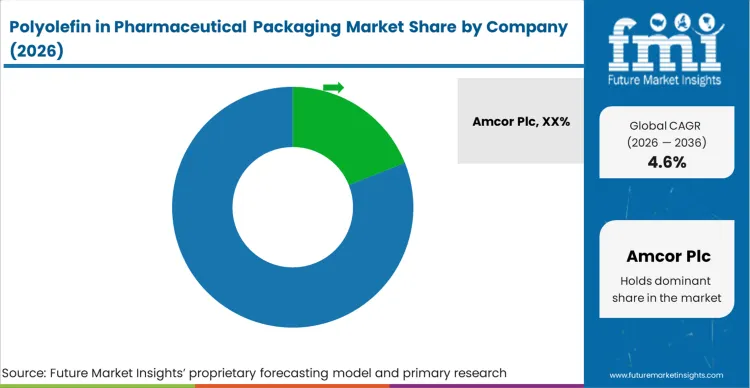
The polyolefin in pharmaceutical packaging market is moderately concentrated, led by global packaging and healthcare material specialists with established regulatory compliance frameworks. Companies such as Amcor Plc, Gerresheimer AG, AptarGroup, West Pharmaceutical Services, Schott AG, SGD Pharma, Winpak Ltd., Constantia Flexibles, and SÜDPACK hold significant positions due to their validated pharma-grade production capabilities and long-standing relationships with pharmaceutical manufacturers. Regional and niche firms including Kaufman Container, Origin Pharma Packaging, Sonic Packaging Industries, Nosco, Essel Propack, Uflex, Bilcare, Huhtamaki PPL, and CCL Healthcare compete through customization, shorter lead times, and cost efficiency. The primary competitive variables in this market are regulatory compliance (USP, EP, FDA standards), material purity, sterilization compatibility, and long-term supply reliability rather than price alone.
Structural advantages are strongest among companies with vertically integrated film extrusion, blow molding, injection molding, and cleanroom manufacturing capabilities. Firms such as Amcor, Gerresheimer, West Pharmaceutical Services, and AptarGroup benefit from dedicated healthcare divisions with controlled medical-grade polyolefin product lines and strict change management protocols. These companies maintain validated resin formulations, global GMP-certified facilities, and comprehensive documentation systems that create high entry barriers. Integration across closures, primary containers, and flexible pharma films further enhances competitive positioning, particularly for injectable, oral solid dose, and sterile packaging applications.
Buyer leverage in this market is moderated by regulatory qualification requirements. Pharmaceutical manufacturers must validate packaging materials as part of drug master files (DMFs) and regulatory submissions, making supplier switching complex and costly. While large pharmaceutical companies may dual-source to reduce risk, requalification timelines limit flexibility. As a result, approved suppliers retain relatively stable pricing power, especially during periods of feedstock volatility. However, procurement teams still negotiate long-term contracts and sustainability commitments, particularly for recyclable and mono-material polyolefin packaging solutions.
Recent Developments
- In Augut 2025, at FACHPACK, Constantia Flexibles announced €100 Mn in investments and expanded its product portfolio. The launch included mono‑polyethylene EcoLamHighPlus and mono‑PP EcoVerHighPlus packaging, reinforcing its commitment to sustainable, high-performance polyolefin solutions for the pharmaceutical industry.
- In August 2025, Schott began construction of an electric melting tank in Germany for FIOLAX Pro OCF glass tubing production. The project aims to reduce carbon emissions by 50%, supporting sustainable manufacturing and strengthening the company’s eco-friendly pharmaceutical packaging initiatives.
Key Players
- Amcor Plc
- Kaufman Container
- Gerresheimer AG
- AptarGroup, Inc.
- West Pharmaceutical Services, Inc.
- Origin Pharma Packaging
- Sonic Packaging Industries, Inc.
- Nosco, Inc.
- Essel Propack Limited
- Uflex Limited
- Huhtamaki PPL Limited
- Constantia Flexibles Group GmbH
Scope Of Report
| Metric | Value |
|---|---|
| Quantitative Units | USD 21,839.3 million (2025); USD 23,016.8 million (2026) to USD 36,001.5 million (2036), at a CAGR of 4.6% |
| Market Definition | The polyolefin in pharmaceutical packaging market comprises the global production and utilization of polyethylene-, polypropylene-, and specialty olefin-based materials engineered for pharmaceutical packaging applications, ensuring chemical resistance, moisture barrier protection, regulatory compliance, and compatibility with sterile and non-sterile drug formulations. |
| Form Segmentation | Rigid Packaging; Flexible Packaging |
| End Use Segmentation | Branded Pharmaceutical Manufacturers; Generic Drug Companies; Biotech & Biologics Firms; CMOs (Contract Manufacturing Organizations); Hospital & Institutional Packaging Providers |
| Application Coverage | Solid Oral Dosage Forms; Liquid Oral Dosage Forms; Injectable Formulations; Topical Formulations; Powders & Granules; Nutraceuticals |
| Regions Covered | North America; Latin America; East Asia; South Asia & Pacific; Western Europe; Eastern Europe; Middle East & Africa |
| Countries Covered | United States; Germany; France; United Kingdom; China; India; Japan; Brazil; South Korea; Italy; and 40+ countries |
| Key Companies Profiled | Amcor Plc; Gerresheimer AG; AptarGroup, Inc.; West Pharmaceutical Services, Inc.; Constantia Flexibles Group GmbH; Others |
| Forecast Period | 2026 to 2036 |
| Approach | Hybrid top-down and bottom-up market modeling validated through primary interviews with pharmaceutical packaging manufacturers, polymer producers, CMOs, and drug manufacturers, supported by regulatory benchmarking (FDA, EMA, USP), plant-level capacity verification, material performance assessment, and trade flow analysis across global pharmaceutical supply chains. |
Polyolefin in Pharmaceutical Packaging Market by Segment
By Packaging Format
- Rigid Packaging
- Bottles
- Closures and Caps
- Containers and Vials
- Syringe Components
- Droppers
- Flexible Packaging
- Blister Packs
- Strip Packs
- Sachets and Pouches
- Liners and Overwraps
- Laminates
By Polyolefin Type
- Polyethylene (PE)
- Low-Density Polyethylene (LDPE)
- Linear Low-Density Polyethylene (LLDPE)
- High-Density Polyethylene (HDPE)
- Metallocene Polyethylene (mPE)
- Polypropylene (PP)
- Homopolymer Polypropylene (Homo-PP)
- Random Copolymer Polypropylene
- Impact Copolymer Polypropylene
- Metallocene Polypropylene (mPP)
- EVA
- PB-1
- OBCs
- COC/COP
- EPDM/EPR
By Packaging Function
- Primary Packaging
- Secondary Packaging
- Tertiary Packaging
By Drug Type Served
- Solid Oral Dosage Forms
- Liquid Oral Dosage Forms
- Injectable Formulations
- Topical Formulations
- Powders and Granules
- Nutraceuticals
By End User
- Branded Pharma Manufacturers
- Generic Drug Companies
- Biotech and Biologics
- CMOs (Contract Drug Type Served Organizations)
- Hospital and Institutional Packaging
By Region
- North America
- Latin America
- East Asia
- South Asia & Pacific
- Western Europe
- Eastern Europe
- Middle East & Africa (MEA)
Bibliography
- USA Food and Drug Administration (FDA), Container Closure Systems for Packaging Human Drugs and Biologics - Guidance for Industry, Updated February 2024.
- USA Food and Drug Administration (FDA), Indirect Food Additives: Polymers (21 CFR Part 177), January 2024.
- United States Pharmacopeial Convention (USP), USP–NF General Chapter <661.2> Plastic Packaging Systems for Pharmaceutical Use, Official Edition 2023.
- European Directorate for the Quality of Medicines & HealthCare (EDQM), European Pharmacopoeia 11th Edition - Plastic Containers and Closures for Pharmaceutical Use, 2023 Edition.
- International Organization for Standardization (ISO), ISO 15378:2017 Primary Packaging Materials for Medicinal Products - Particular Requirements for the Application of ISO 9001 (Confirmed 2023 Review), September 2023.
- ASTM International, ASTM D4976-23 - Standard Specification for Polyethylene Plastics Molding and Extrusion Materials, April 2023.
- ASTM International, ASTM D4101-23 - Standard Specification for Polypropylene Injection and Extrusion Materials, April 2023.
- European Parliament and Council, Regulation (EU) 2024/1781 on Packaging and Packaging Waste (PPWR), April 2024.
This Report Addresses
- Market intelligence enabling structured strategic decision making across global pharmaceutical packaging and regulated polyolefin supply ecosystems.
- Market size estimation and 10 year revenue forecasts from 2026 to 2036, validated through pharma output and resin benchmarking.
- Growth opportunity mapping across PE, PP, mPE, mPP, and COC/COP grades serving sterile and moisture-sensitive drugs.
- Segment and regional revenue forecasts across rigid and flexible formats, packaging functions, drug types, and end users.
- Competition strategy assessment covering pharma-grade certification, extractables control capability, cleanroom conversion integration, and long-term supply positioning.
- Material compliance tracking aligned with USP <661.2>, FDA 21 CFR, ISO 15378, and European Pharmacopoeia standards.
- Regulatory and sterility impact analysis addressing biologics growth, leachables scrutiny, serialization mandates, and moisture barrier upgrades.
- Market report delivery in PDF, Excel, PPT, and interactive dashboard formats for executive, regulatory, and procurement planning use.
Frequently Asked Questions
How large is the Polyolefin in Pharmaceutical Packaging Market in 2026?
The Polyolefin in Pharmaceutical Packaging Market is valued at 23,016.8 Mn in 2026
What was the market size of the Polyolefin in Pharmaceutical Packaging Market in 2025?
The market was valued at 21,839.3 Million in 2025.
What will the market size be for the Polyolefin in Pharmaceutical Packaging Market by 2036?
The market is projected to reach 36,001.5 Mn by 2036.
What is the expected CAGR of the Polyolefin in Pharmaceutical Packaging Market during the forecast period?
The Polyolefin in Pharmaceutical Packaging Market is expected to grow at a CAGR of 4.6%.
Which packaging format is poised to lead the market?
Rigid packaging leads the market with 67.0% share, while flexible packaging accounts for 33.0%.
Which polyolefin type dominates the market?
Polyethylene (PE) dominates with 50.4% share, followed by polypropylene (PP) at 34.9%.
Branded pharma manufacturers account for 37.4% of the market, followed by generic drug companies at 27.3%.
Branded pharma manufacturers account for 37.4% of the market, followed by generic drug companies at 27.3%.
Which country is projected to grow the fastest in this market?
India is projected to grow at the highest CAGR of 6.2%, followed by China at 5.8% and Brazil at 5.3%.
What is the growth outlook for South Korea and Indonesia?
South Korea is projected to grow at a CAGR of 4.9%, while Indonesia is expected to expand at 4.7% during the forecast period.
Which drug types are served by polyolefin pharmaceutical packaging solutions?
The market serves solid oral dosage forms, liquid oral dosage forms, injectable formulations, topical formulations, powders and granules, and nutraceuticals.
Preview the report firsthand - request a free sample
Get SampleGet the brochure for pricing and purchase details.
Get PDFTable of Content
- Executive Summary
- Global Market Outlook
- Demand-side Trends
- Supply-side Trends
- Technology Roadmap Analysis
- Analysis and Recommendations
- Market Overview
- Market Coverage / Taxonomy
- Market Definition / Scope / Limitations
- Research Methodology
- Chapter Orientation
- Analytical Lens and Working Hypotheses
- Market Structure, Signals, and Trend Drivers
- Benchmarking and Cross-market Comparability
- Market Sizing, Forecasting, and Opportunity Mapping
- Research Design and Evidence Framework
- Desk Research Programme (Secondary Evidence)
- Company Annual and Sustainability Reports
- Peer-reviewed Journals and Academic Literature
- Corporate Websites, Product Literature, and Technical Notes
- Earnings Decks and Investor Briefings
- Statutory Filings and Regulatory Disclosures
- Technical White Papers and Standards Notes
- Trade Journals, Industry Magazines, and Analyst Briefs
- Conference Proceedings, Webinars, and Seminar Materials
- Government Statistics Portals and Public Data Releases
- Press Releases and Reputable Media Coverage
- Specialist Newsletters and Curated Briefings
- Sector Databases and Reference Repositories
- FMI Internal Proprietary Databases and Historical Market Datasets
- Subscription Datasets and Paid Sources
- Social Channels, Communities, and Digital Listening Inputs
- Additional Desk Sources
- Expert Input and Fieldwork (Primary Evidence)
- Primary Modes
- Qualitative Interviews and Expert Elicitation
- Quantitative Surveys and Structured Data Capture
- Blended Approach
- Why Primary Evidence is Used
- Field Techniques
- Interviews
- Surveys
- Focus Groups
- Observational and In-context Research
- Social and Community Interactions
- Stakeholder Universe Engaged
- C-suite Leaders
- Board Members
- Presidents and Vice Presidents
- R&D and Innovation Heads
- Technical Specialists
- Domain Subject-matter Experts
- Scientists
- Physicians and Other Healthcare Professionals
- Governance, Ethics, and Data Stewardship
- Research Ethics
- Data Integrity and Handling
- Primary Modes
- Tooling, Models, and Reference Databases
- Desk Research Programme (Secondary Evidence)
- Data Engineering and Model Build
- Data Acquisition and Ingestion
- Cleaning, Normalisation, and Verification
- Synthesis, Triangulation, and Analysis
- Quality Assurance and Audit Trail
- Market Background
- Market Dynamics
- Drivers
- Restraints
- Opportunity
- Trends
- Scenario Forecast
- Demand in Optimistic Scenario
- Demand in Likely Scenario
- Demand in Conservative Scenario
- Opportunity Map Analysis
- Product Life Cycle Analysis
- Supply Chain Analysis
- Investment Feasibility Matrix
- Value Chain Analysis
- PESTLE and Porter’s Analysis
- Regulatory Landscape
- Regional Parent Market Outlook
- Production and Consumption Statistics
- Import and Export Statistics
- Market Dynamics
- Global Market Analysis 2021 to 2025 and Forecast, 2026 to 2036
- Historical Market Size Value (USD Million) Analysis, 2021 to 2025
- Current and Future Market Size Value (USD Million) Projections, 2026 to 2036
- Y-o-Y Growth Trend Analysis
- Absolute $ Opportunity Analysis
- Global Market Pricing Analysis 2021 to 2025 and Forecast 2026 to 2036
- Global Market Analysis 2021 to 2025 and Forecast 2026 to 2036, By Polyolefin Type
- Introduction / Key Findings
- Historical Market Size Value (USD Million) Analysis By Polyolefin Type , 2021 to 2025
- Current and Future Market Size Value (USD Million) Analysis and Forecast By Polyolefin Type , 2026 to 2036
- Polyethylene (PE)
- Polypropylene (PP)
- Polyethylene (PE)
- Y-o-Y Growth Trend Analysis By Polyolefin Type , 2021 to 2025
- Absolute $ Opportunity Analysis By Polyolefin Type , 2026 to 2036
- Global Market Analysis 2021 to 2025 and Forecast 2026 to 2036, By End Use
- Introduction / Key Findings
- Historical Market Size Value (USD Million) Analysis By End Use, 2021 to 2025
- Current and Future Market Size Value (USD Million) Analysis and Forecast By End Use, 2026 to 2036
- Branded Pharma Manufacturers
- Generic Drug Companies
- Biotech and Biologics
- CMOs (Contract Drug Type Served Organizations)
- Hospital and Institutional Packaging
- Branded Pharma Manufacturers
- Y-o-Y Growth Trend Analysis By End Use, 2021 to 2025
- Absolute $ Opportunity Analysis By End Use, 2026 to 2036
- Global Market Analysis 2021 to 2025 and Forecast 2026 to 2036, By Region
- Introduction
- Historical Market Size Value (USD Million) Analysis By Region, 2021 to 2025
- Current Market Size Value (USD Million) Analysis and Forecast By Region, 2026 to 2036
- North America
- Latin America
- Western Europe
- Eastern Europe
- East Asia
- South Asia and Pacific
- Middle East & Africa
- Market Attractiveness Analysis By Region
- North America Market Analysis 2021 to 2025 and Forecast 2026 to 2036, By Country
- Historical Market Size Value (USD Million) Trend Analysis By Market Taxonomy, 2021 to 2025
- Market Size Value (USD Million) Forecast By Market Taxonomy, 2026 to 2036
- By Country
- USA
- Canada
- Mexico
- By Polyolefin Type
- By End Use
- By Country
- Market Attractiveness Analysis
- By Country
- By Polyolefin Type
- By End Use
- Key Takeaways
- Latin America Market Analysis 2021 to 2025 and Forecast 2026 to 2036, By Country
- Historical Market Size Value (USD Million) Trend Analysis By Market Taxonomy, 2021 to 2025
- Market Size Value (USD Million) Forecast By Market Taxonomy, 2026 to 2036
- By Country
- Brazil
- Chile
- Rest of Latin America
- By Polyolefin Type
- By End Use
- By Country
- Market Attractiveness Analysis
- By Country
- By Polyolefin Type
- By End Use
- Key Takeaways
- Western Europe Market Analysis 2021 to 2025 and Forecast 2026 to 2036, By Country
- Historical Market Size Value (USD Million) Trend Analysis By Market Taxonomy, 2021 to 2025
- Market Size Value (USD Million) Forecast By Market Taxonomy, 2026 to 2036
- By Country
- Germany
- UK
- Italy
- Spain
- France
- Nordic
- BENELUX
- Rest of Western Europe
- By Polyolefin Type
- By End Use
- By Country
- Market Attractiveness Analysis
- By Country
- By Polyolefin Type
- By End Use
- Key Takeaways
- Eastern Europe Market Analysis 2021 to 2025 and Forecast 2026 to 2036, By Country
- Historical Market Size Value (USD Million) Trend Analysis By Market Taxonomy, 2021 to 2025
- Market Size Value (USD Million) Forecast By Market Taxonomy, 2026 to 2036
- By Country
- Russia
- Poland
- Hungary
- Balkan & Baltic
- Rest of Eastern Europe
- By Polyolefin Type
- By End Use
- By Country
- Market Attractiveness Analysis
- By Country
- By Polyolefin Type
- By End Use
- Key Takeaways
- East Asia Market Analysis 2021 to 2025 and Forecast 2026 to 2036, By Country
- Historical Market Size Value (USD Million) Trend Analysis By Market Taxonomy, 2021 to 2025
- Market Size Value (USD Million) Forecast By Market Taxonomy, 2026 to 2036
- By Country
- China
- Japan
- South Korea
- By Polyolefin Type
- By End Use
- By Country
- Market Attractiveness Analysis
- By Country
- By Polyolefin Type
- By End Use
- Key Takeaways
- South Asia and Pacific Market Analysis 2021 to 2025 and Forecast 2026 to 2036, By Country
- Historical Market Size Value (USD Million) Trend Analysis By Market Taxonomy, 2021 to 2025
- Market Size Value (USD Million) Forecast By Market Taxonomy, 2026 to 2036
- By Country
- India
- ASEAN
- Australia & New Zealand
- Rest of South Asia and Pacific
- By Polyolefin Type
- By End Use
- By Country
- Market Attractiveness Analysis
- By Country
- By Polyolefin Type
- By End Use
- Key Takeaways
- Middle East & Africa Market Analysis 2021 to 2025 and Forecast 2026 to 2036, By Country
- Historical Market Size Value (USD Million) Trend Analysis By Market Taxonomy, 2021 to 2025
- Market Size Value (USD Million) Forecast By Market Taxonomy, 2026 to 2036
- By Country
- Kingdom of Saudi Arabia
- Other GCC Countries
- Turkiye
- South Africa
- Other African Union
- Rest of Middle East & Africa
- By Polyolefin Type
- By End Use
- By Country
- Market Attractiveness Analysis
- By Country
- By Polyolefin Type
- By End Use
- Key Takeaways
- Key Countries Market Analysis
- USA
- Pricing Analysis
- Market Share Analysis, 2025
- By Polyolefin Type
- By End Use
- Canada
- Pricing Analysis
- Market Share Analysis, 2025
- By Polyolefin Type
- By End Use
- Mexico
- Pricing Analysis
- Market Share Analysis, 2025
- By Polyolefin Type
- By End Use
- Brazil
- Pricing Analysis
- Market Share Analysis, 2025
- By Polyolefin Type
- By End Use
- Chile
- Pricing Analysis
- Market Share Analysis, 2025
- By Polyolefin Type
- By End Use
- Germany
- Pricing Analysis
- Market Share Analysis, 2025
- By Polyolefin Type
- By End Use
- UK
- Pricing Analysis
- Market Share Analysis, 2025
- By Polyolefin Type
- By End Use
- Italy
- Pricing Analysis
- Market Share Analysis, 2025
- By Polyolefin Type
- By End Use
- Spain
- Pricing Analysis
- Market Share Analysis, 2025
- By Polyolefin Type
- By End Use
- France
- Pricing Analysis
- Market Share Analysis, 2025
- By Polyolefin Type
- By End Use
- India
- Pricing Analysis
- Market Share Analysis, 2025
- By Polyolefin Type
- By End Use
- ASEAN
- Pricing Analysis
- Market Share Analysis, 2025
- By Polyolefin Type
- By End Use
- Australia & New Zealand
- Pricing Analysis
- Market Share Analysis, 2025
- By Polyolefin Type
- By End Use
- China
- Pricing Analysis
- Market Share Analysis, 2025
- By Polyolefin Type
- By End Use
- Japan
- Pricing Analysis
- Market Share Analysis, 2025
- By Polyolefin Type
- By End Use
- South Korea
- Pricing Analysis
- Market Share Analysis, 2025
- By Polyolefin Type
- By End Use
- Russia
- Pricing Analysis
- Market Share Analysis, 2025
- By Polyolefin Type
- By End Use
- Poland
- Pricing Analysis
- Market Share Analysis, 2025
- By Polyolefin Type
- By End Use
- Hungary
- Pricing Analysis
- Market Share Analysis, 2025
- By Polyolefin Type
- By End Use
- Kingdom of Saudi Arabia
- Pricing Analysis
- Market Share Analysis, 2025
- By Polyolefin Type
- By End Use
- Turkiye
- Pricing Analysis
- Market Share Analysis, 2025
- By Polyolefin Type
- By End Use
- South Africa
- Pricing Analysis
- Market Share Analysis, 2025
- By Polyolefin Type
- By End Use
- USA
- Market Structure Analysis
- Competition Dashboard
- Competition Benchmarking
- Market Share Analysis of Top Players
- By Regional
- By Polyolefin Type
- By End Use
- Competition Analysis
- Competition Deep Dive
- Amcor Plc
- Overview
- Product Portfolio
- Profitability by Market Segments (Product/Age /Sales Channel/Region)
- Sales Footprint
- Strategy Overview
- Marketing Strategy
- Product Strategy
- Channel Strategy
- Kaufman Container
- Gerresheimer AG
- AptarGroup, Inc.
- West Pharmaceutical Services, Inc.
- Origin Pharma Packaging
- Sonic Packaging Industries, Inc.
- Nosco, Inc.
- Essel Propack Limited
- Uflex Limited
- Huhtamaki PPL Limited
- Constantia Flexibles Group GmbH
- Amcor Plc
- Competition Deep Dive
- Assumptions & Acronyms Used


