

- Industry Size (2026)
- USD 504.6 Mn
- Forecast (2036)
- USD 1326.8 Mn
- CAGR (2026 to 2036)
- 10.1%
Multilayer Stretch Hood Recycling Compatibilizers Market Size, Market Forecast and Outlook By FMI
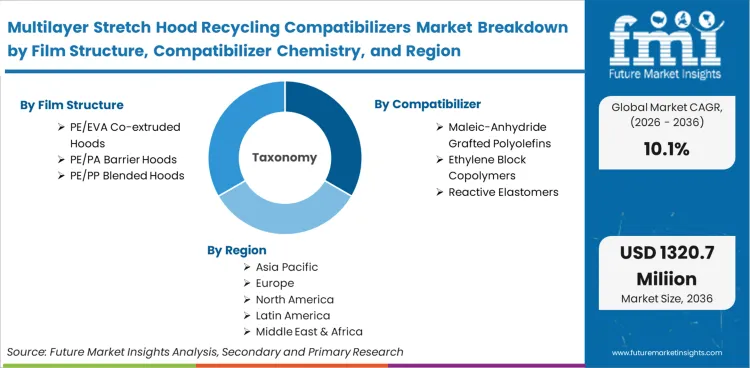
The multilayer stretch hood recycling compatibilizers market was valued at USD 456.3 million in 2025. Industry demand is estimated to cross USD 504.6 million in 2026 at a CAGR of 10.1% during the forecast. The demand outlook carries the valuation to USD 1,326.8 million through 2036 as chemical bonding technologies finally enable closed-loop recovery for complex multi-polymer structures that previously evaded mechanical recycling. FMI analysts opine that facility managers relying on simple melt filtration face rapid disqualification from premium resin supply chains as physical blending proves inadequate for multi-layer architectures. This failure mechanism forces compounding plants to adopt reactive extrusion protocols that permanently bridge incompatible polymer domains.
Competitors who hesitate to implement advanced interfacial adhesion technologies surrender highly lucrative packaging accounts to early adopters. The true inflection point for circular tertiary packaging hinges on the phase separation behavior of dissimilar resins as they cool within the die head. Compounders must successfully introduce customized ethylene block copolymers into the tight melt-viscosity window before the 2028 corporate compliance deadlines activate. Neutralizing these immiscible boundary layers ultimately converts what is currently deemed low-value industrial scrap into premium stretchable equivalents that match virgin performance.
Summary of Multilayer Stretch Hood Recycling Compatibilizers Market
- Multilayer Stretch Hood Recycling Compatibilizers Market Definition
- This market involves functional chemical additives that bridge incompatible polymer boundaries within recycled pallet wrapping films. They restore essential mechanical properties like tear resistance and elasticity to post-consumer resins.
- Demand Drivers in the Market
- Extended producer responsibility legislation forces packaging manufacturers to integrate minimum post-consumer recycled content into heavy-duty transit films.
- Corporate sustainability pledges compel fast-moving consumer goods brands to demand closed-loop recovery systems for their secondary distribution packaging.
- Unpredictable virgin resin pricing pushes large-scale film extruders to secure domestic, high-quality recycled feedstock streams utilizing advanced chemical coupling agents.
- Key Segments Analyzed in the FMI Report
- Maleic-Anhydride Grafted Polyolefins: 48.0% share in 2026, establishing the foundational chemistry required to bond polar barrier resins with non-polar polyethylene matrices.
- PE/EVA Co-extruded Hoods: 55.0% share in 2026, reflecting the massive installed base of stretch packaging utilized across the global beverage and appliance sectors.
- China: 12.1% CAGR, driven by state-sponsored recycling modernization programs seeking to maximize the domestic utilization of industrial film waste.
- Analyst Opinion at FMI
- Ismail Sutaria, Principal Consultant for Packaging, opines, "In my analysis, I have observed that the primary obstacle to circular pallet logistics is the severe optical and mechanical degradation caused by non-compatibilized EVA layers. Facilities attempting to re-extrude these multi-layer scraps without precision grafting agents face immediate web-breaks during blown film production. Extrusion plant operators who fail to transition to reactive compatibilizers before the 2028 regulatory compliance window will find their recycled output permanently relegated to the low-margin garbage bag sector."
- Strategic Implications / Executive Takeaways
- Resin compounders must acquire advanced reactive extrusion capabilities to process highly variable post-consumer stretch hood bales profitably.
- Procurement officers at major packaging converters should establish long-term supply agreements with specialized compatibilizer additives manufacturers to ensure formulation stability.
- Chemical additive suppliers need to develop custom-tailored block copolymers that activate efficiently at the low melt temperatures preferred by sustainable film extruders.
- Market Research Methodology
- Primary Research: Analysts engaged with polymer compounding directors, film extrusion plant managers, and resin procurement leads.
- Desk Research: The data collection phase aggregated compliance roadmaps from the Ellen MacArthur Foundation and European Plastics Pact mandates.
- Market-Sizing and Forecasting: The baseline value derives from a bottom-up aggregation of functional additive shipments into recycling facilities.
- Data Validation and Update Cycle: Projections are rigorously tested against publicly reported specialty chemical capacity expansions.
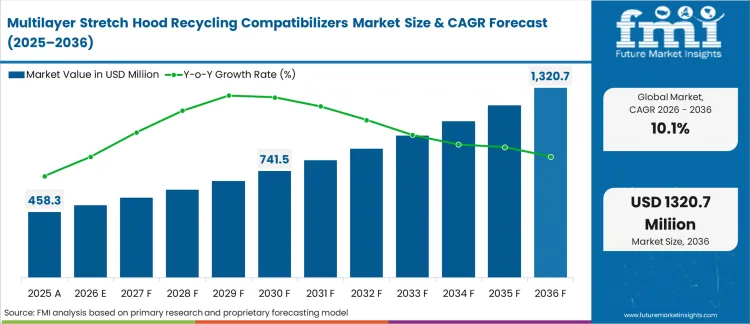
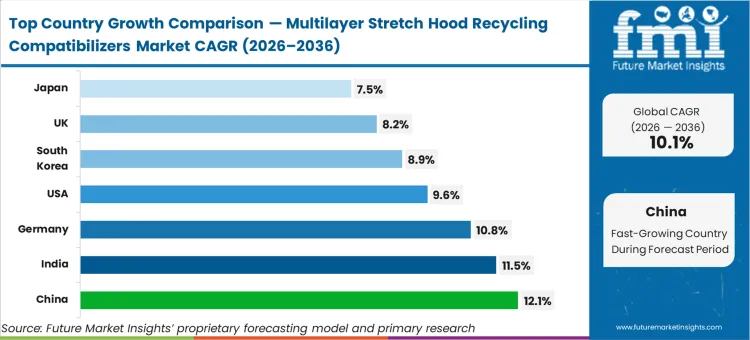
China advances at a 12.1% CAGR as vast industrial parks establish localized film recovery ecosystems. India records an 11.5% expansion driven by domestic mandates to formalize fragmented post-industrial collection networks. Germany expands at 10.8% while the USA tracks at 9.6%, both pushed by aggressive corporate packaging commitments. The geographic polarization of demand reflects a permanent structural pivot where nations enforcing stringent producer responsibility legislation dictate global additive consumption patterns.
Multilayer Stretch Hood Recycling Compatibilizers Market Definition
Multilayer stretch hood recycling compatibilizers are specialized polymeric additives designed to chemically bond immiscible plastic layers found in heavy-duty pallet wrapping films. They prevent phase separation and mechanical failure during the melt-reprocessing of co-extruded structures containing polyethylene, ethylene-vinyl acetate, and polyamides.
Multilayer Stretch Hood Recycling Compatibilizers Market Inclusions
The market encompasses maleic-anhydride grafted polyolefins, customized block copolymers, and reactive elastomers engineered specifically for the recovery of complex flexible packaging. Products supporting the broader multi-layer film recycling ecosystem, such as dual-functional interfacial modifiers used during the melt extrusion of post-industrial and post-consumer stretch hoods, are fully integrated into the assessment scope.
Multilayer Stretch Hood Recycling Compatibilizers Market Exclusions
General-purpose plasticizers, basic color masterbatches, and standard UV stabilizers lacking reactive polymer-bridging capabilities are excluded. Additives designed exclusively for rigid plastic recycling, pure PVC recovery, or biological degradation accelerators fall entirely outside the operational boundaries of this specific market valuation.
Multilayer Stretch Hood Recycling Compatibilizers Market Research Methodology
- Primary Research: Analysts engaged with polymer compounding directors, film extrusion plant managers, and resin procurement leads to map the specific performance failures triggering additive integration.
- Desk Research: The data collection phase aggregated compliance roadmaps from the Ellen MacArthur Foundation, European Plastics Pact mandates, and historical stretch film packs production volumes.
- Market-Sizing and Forecasting: The baseline value derives from a bottom-up aggregation of functional additive shipments into recycling facilities, applying region-specific regulatory timelines to project future adoption velocity.
- Data Validation and Update Cycle: Projections are rigorously tested against publicly reported specialty chemical capacity expansions from leading global polymers and plastics suppliers.
Segmental Analysis
Multilayer Stretch Hood Recycling Compatibilizers Market Analysis by Compatibilizer Chemistry
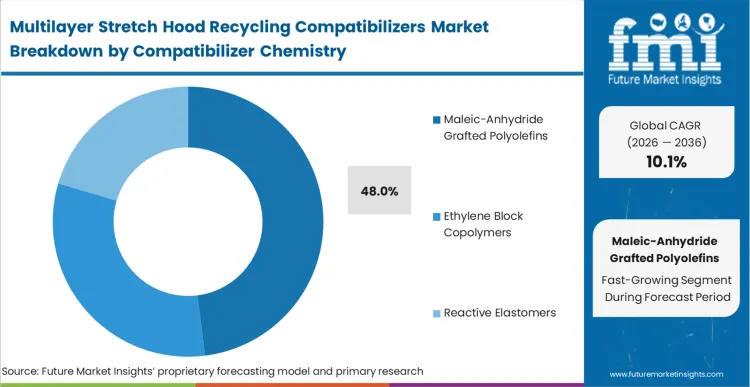
Recycling plant operators failing to standardize their compatibilizer recipes around maleic-anhydride technology suffer catastrophic field failures when their recycled film fractures under load tension. Maleic-anhydride grafted polyolefins account for a dominant 48.0% share in 2026 because they provide the critical covalent bonding necessary to bridge polar and non-polar polymer interfaces. Resin formulation engineers integrating mixed plastic waste into new flexible structures absolutely depend on these highly reactive chains to neutralize phase separation. As per FMI's projection, this specific chemical architecture prevents the disastrous delamination that plagues rudimentary mechanical recycling efforts. Compounding facilities heavily dose these agents when reprocessing challenging bales of shrink and stretch films retrieved from distribution centers. Without these robust molecular anchors, the recycled melt cannot withstand the extreme elongation forces exerted during modern pallet wrapping operations.
- Polarity Management: The engineered backbone of the additive chemically fuses with incompatible barrier layers while the polyolefin tail anchors securely into the primary polyethylene matrix.
- Elongation Retention: Maintaining microscopic structural integrity allows the final recycled film to achieve stretching capabilities that closely rival virgin material specifications.
- Thermal Stabilization: Precise reactive extrusion controls prevent the premature degradation of the grafted sites during the aggressive shear forces of the palletization process.
Multilayer Stretch Hood Recycling Compatibilizers Market Analysis by Film Structure
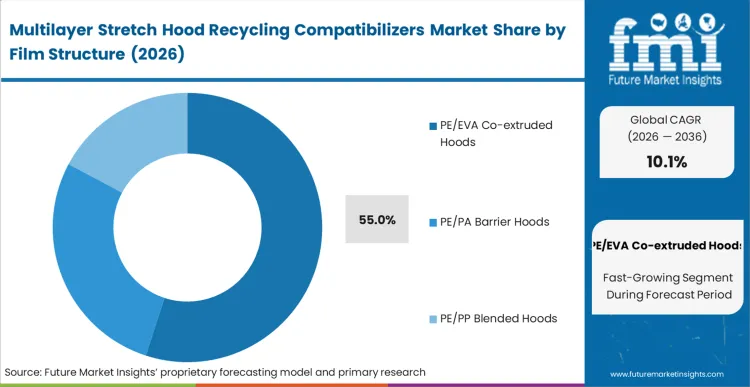
Extrusion line managers must precisely calibrate their chemical dosing systems to distribute the compatibilizer evenly across the rapidly cooling polymer web. This targeted chemical intervention disperses the EVA domains into microscopic, uniform particles that do not compromise the film's structural integrity. Production supervisors enforcing strict compatibilization protocols successfully deliver defect-free, high-clarity PCR resins to demanding tertiary packaging converters. The absolute necessity of maintaining tear resistance in logistics packaging propels PE/EVA co-extruded hoods to capture a 55.0% share in 2026. Prior efforts to mechanically recycle these high-performance wraps failed entirely because the ethylene-vinyl acetate core layers agglomerated into rigid optical defects during standard extrusion. Based on FMI's assessment, introducing customized mixed-plastic reactive agents directly into the melt pool resolves this persistent industrial bottleneck.
- Defect Elimination: Breaking down macroscopic EVA gels prevents the formation of localized weak points that inevitably trigger catastrophic web tearing.
- Optical Clarity: Uniform microscopic dispersion of the incompatible phases significantly reduces the severe haze typically associated with recycled multilayer packaging.
- Melt Flow Consistency: Stabilizing the complex rheology of the mixed polymer melt ensures uniform thickness control across massive commercial blown film dies.
Multilayer Stretch Hood Recycling Compatibilizers Market Analysis by End Use
Logistics contractors facing mounting corporate pressure to decarbonize their supply chains drive the pallet packaging recycling segment to early market dominance. In FMI's view, the immense volume of transit wraps discarded at retail distribution centers represents a highly concentrated, yet chemically complex, secondary resource. Sorting facility directors must deploy dedicated flexible plastic sorting systems before feeding the recovered films into reactive compounding lines. This integration of physical separation and chemical enhancement allows the production of premium recycled stretch hoods perfectly suited for circular deployment. The resulting high-strength resins bypass the traditional downcycling pathways that historically absorbed contaminated industrial films. Supply chain vice presidents securing long-term offtake agreements for these engineered PCR films significantly insulate their operations from volatile virgin petrochemical pricing cycles.
- Yield Optimization: Aggressive chemical compatibilization allows recyclers to process bales with higher cross-contamination rates without sacrificing the final mechanical specifications.
- Circular Integration: Formulating resins that can be continuously re-extruded into identical pallet wrapping applications fulfills the strict criteria of closed-loop packaging pledges.
- Load Stability: Ensuring the recycled hoods maintain their elastic memory prevents high-value palletized merchandise from shifting dangerously during extended transit routes.
Multilayer Stretch Hood Recycling Compatibilizers Market Drivers, Restraints, and Opportunities
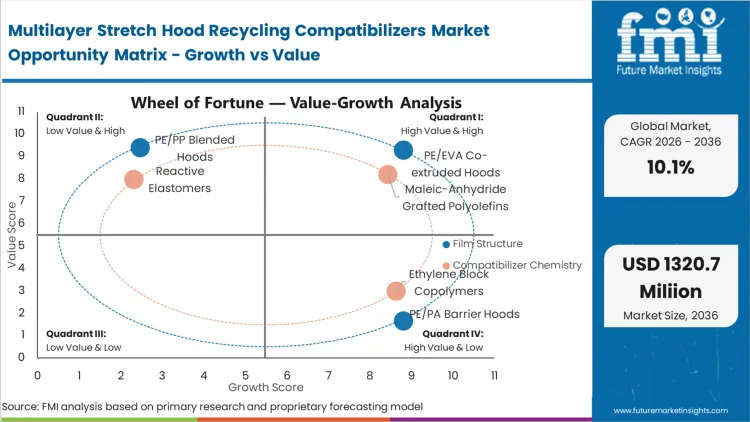
Stringent extended producer responsibility mandates targeting tertiary packaging force major fast-moving consumer goods companies to aggressively overhaul their supply chain plastics. Packaging procurement officers facing these regulatory deadlines must secure immense volumes of high-performance recycled film, directly triggering the widespread adoption of reactive extrusion chemistry. According to FMI's estimates, this legislative pressure transforms recycled thermoplastics from a niche sustainable alternative into an absolute commercial necessity for maintaining market access in regulated jurisdictions. Extrusion companies that ignore this permanent shift and refuse to invest in compatibilization technology inevitably forfeit their tier-one supplier status as brands aggressively audit their supply chains for verified recycled content.
The severe sensitivity of reactive grafting agents to moisture and residual contamination creates significant operational friction for traditional mechanical recyclers. Plant managers face immense difficulties maintaining the precise melt temperatures and shear rates required to activate the chemical bonds without degrading the base polymer. While advanced vacuum degassing and sophisticated twin-screw extruders offer technical workarounds, the massive capital expenditure required severely limits adoption among smaller regional operators.
Opportunities in the Multilayer Stretch Hood Recycling Compatibilizers Market
- Closed-Loop Chemical Leasing: Advanced additive manufacturers partner directly with large-scale recyclers to supply customized reactive chemistries on a performance-guaranteed basis.
- Barrier Film Recovery: Breakthroughs in targeted block copolymers allow the profitable recovery of highly complex EVOH-based stretch hoods previously deemed entirely unrecyclable.
- High-Clarity PCR Production: Utilizing precision reactive diluents and novel catalysts enables compounders to produce ultra-clear recycled resins suitable for premium consumer-facing applications.
Regional Analysis
Based on the regional analysis, the Multilayer Stretch Hood Recycling Compatibilizers Market is segmented into North America, Latin America, Europe, East Asia, South Asia, Oceania, and Middle East & Africa across 40 plus countries.
.webp "Top Country Growth Comparison Multilayer Stretch Hood Recycling Compatibilizers Market Cagr (2026 2036)")
| Country | CAGR (2026 to 2036) |
|---|---|
| China | 12.1% |
| India | 11.5% |
| Germany | 10.8% |
| USA | 9.6% |
| South Korea | 8.9% |
| UK | 8.2% |
| Japan | 7.5% |
Source: Future Market Insights (FMI) analysis, based on proprietary forecasting model and primary research
Asia-Pacific Multilayer Stretch Hood Recycling Compatibilizers Market Analysis
Regional sustainability directors pivot aggressively from rudimentary waste incineration toward sophisticated chemical compatibilization to satisfy the demanding environmental criteria of their Western export partners. This unparalleled economies of scale significantly lowers the per-ton cost of integrating highly engineered PCR resin compatibilizers. FMI's analysis indicates that massive industrial consolidation enables regional compounders to process unprecedented volumes of secondary transit packaging. The concentration of global manufacturing and immense export logistics networks dictates the rapid expansion of advanced film recovery infrastructure across East Asia. Conversely, South Asia's rapid formalization of sprawling, informal waste collection networks unlocks massive new streams of previously stranded post-industrial film. These highly distinct structural realities force chemical suppliers to formulate highly adaptable impact-modified PCR plastics capable of handling wildly fluctuating feedstock qualities.
- China: China's market demand is rising at a CAGR of 12.1% as government-mandated circular economy targets strictly prohibit the landfilling of industrial flexible waste. The integration of advanced ocean plastic packaging recovery models highlights this modernization. This sheer scale dictates the economics of the compatibilizer market, fundamentally lowering additive costs. Chemical formulation leads utilizing localized production of maleic-anhydride grafted polyolefins outcompete smaller rivals who rely on expensive imported additives. China's sprawling industrial packaging sector deploys massive twin-screw reactive compounding lines to rapidly process the millions of tons of transit films discarded annually.
- India: The integration of highly robust reactive compatibilizers anchors India's 11.5% CAGR through to 2036. Recycling plant operators implementing advanced melt filtration and reactive extrusion techniques secure immense long-term contracts from multinational brands operating within the subcontinent. Recognizing this resource, major domestic petrochemical players are investing heavily in formalizing the collection and compounding of these industrial films. India's rapidly expanding e-commerce and organized retail sectors generate unprecedented volumes of secondary distribution waste.
- South Korea: By aggressively scaling these operations, the nation establishes a highly self-sufficient circular packaging ecosystem, augmenting capabilities beyond conventional flame-retardant PCR plastics. They possess the complex reactor technology required to synthesize highly specialized ethylene block copolymers domestically. South Korea's 8.9% CAGR reflects robust state support for advanced materials engineering. Export compliance managers securing verified PCR certification through these advanced domestic resins successfully bypass international plastic border taxes. Petrochemical conglomerates in South Korea rapidly pivot their massive virgin resin capacities toward the lucrative production of engineered recycled compounds.
- Japan: Corporate procurement officers mandating zero-defect recycled packaging solutions completely dominate the domestic procurement landscape. Consequently, Japanese compounders achieve extraordinary material purity using significantly lower compatibilizer dosing ratios. This meticulous separation of post-industrial stretch hoods drastically reduces the variable contamination that plagues Western recycling efforts. Stringent municipal sorting regulations define Japan's highly organized approach to commercial plastic waste recovery. Advanced interface stabilization anchors Japan's 7.5% CAGR trajectory to 2036.
FMI reports, the Asia-Pacific region stands as the primary volume engine for the multilayer stretch hood recycling compatibilizers market, fueled by an unprecedented intersection of state-mandated circularity and massive export compliance pressures. As global manufacturing hubs across China, India, Japan, and South Korea pivot from fragmented waste disposal toward highly formalized, chemically stabilized film recovery, the broader region provides the definitive industrial scale necessary to commercialize next-generation interfacial additives profitably.
Europe Multilayer Stretch Hood Recycling Compatibilizers Market Analysis
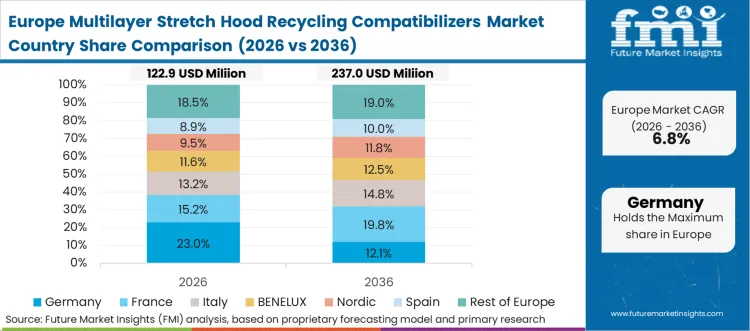
Europe's aggressive implementation of plastic packaging taxes and stringent landfill diversion targets creates an uncompromising legislative environment for logistics materials. The European Union’s rigid enforcement of the Packaging and Packaging Waste Directive mandates minimum post-consumer recycled content in all commercial transit films, backed by severe financial penalties for virgin polymer consumption. Logistics providers and massive retail distributors now face crippling operational costs if they fail to transition their palletization networks to circular models. Because rudimentary mechanical recycling fails to preserve the critical elongation and tear-resistance properties of multi-polymer stretch hoods, this aggressive regulatory framework directly forces the industry toward advanced chemical stabilization. Reactive compatibilizers have effectively transitioned from optional quality enhancers to absolute compliance necessities. By enabling extruders to consistently bridge incompatible polymer boundaries within highly contaminated waste streams, these precision additives allow packaging converters to produce high-strength recycled transit films that seamlessly bypass the continent's punitive fossil-plastic levies.
- Germany: Compliance auditors actively disqualifying packaging structures that fail to meet these rigid circularity mandates permanently alter the regional procurement landscape. This legislative certainty provides the financial security required for major chemical companies to heavily fund next-generation compatibilizer research and development. The deployment of precision-engineered block copolymers drives a 10.8% CAGR as facilities upgrade their compounding architectures. Germany's uncompromising packaging waste directives enforce strict quotas for recycled content within all commercial and industrial transit wraps.
- UK: Logistics directors failing to successfully integrate these chemically stabilized PCR plastic packaging solutions suffer crippling tax liabilities that destroy their operational margins. This immediate financial pressure forces retail logistics managers to rapidly transition to high-performance PCR stretch hoods. The implementation of aggressive plastic packaging taxes strictly penalizes companies utilizing virgin polymers in their distribution networks. The absolute necessity of maintaining pallet stability during transit sustains an 8.2% CAGR for advanced interfacial additives in the UK.
FMI estimates, Europe functions as the definitive legislative pioneer for the multilayer stretch hood recycling compatibilizers market, dictating the pace of advanced polymer recovery through uncompromising financial penalties and zero-tolerance landfill directives. By fundamentally rewriting the economic realities of transit packaging via stringent plastic taxes and mandated recycled content quotas, the continent forces supply chain stakeholders into an immediate, irreversible transition toward premium reactive extrusion technologies.
North America Multilayer Stretch Hood Recycling Compatibilizers Market Analysis
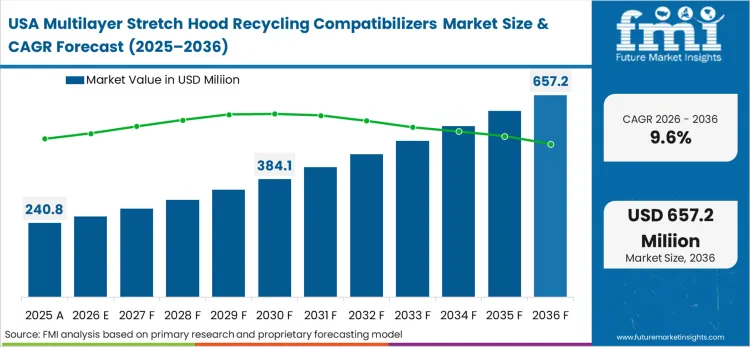
This direct corporate intervention bypasses municipal gridlock, rapidly accelerating the deployment of sophisticated mechanical recycling systems. Major retail conglomerates and massive warehouse operators actively partner directly with advanced compounding facilities to close their internal packaging loops. The fragmented municipal recycling infrastructure across North America forces private enterprise to independently construct dedicated post-industrial film recovery networks.
- USA: This coordinated corporate strategy advances at a 9.6% CAGR as reactive extrusion becomes the standard operating procedure. Extrusion facility managers leveraging proprietary compatibilizer formulations to produce ultra-high strength industrial stretch films totally dominate the lucrative domestic secondary packaging market. Recognizing the brand vulnerability associated with plastic waste, major retailers directly finance the construction of advanced regional compounding centers. The United States logistics sector aggressively pursues closed-loop recovery models to manage the staggering volume of stretch films generated by its massive distribution hubs.
FMI's report includes comprehensive evaluation of the Latin American and Middle Eastern film recycling sectors. A defining dynamic across these emerging regions involves the rapid technology transfer from global petrochemical leaders, allowing local compounders to leapfrog outdated mechanical recycling methods entirely.
Competitive Aligners for Market Players
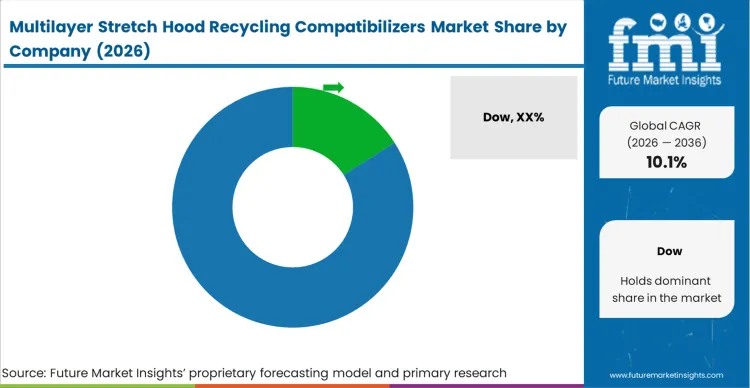
The multilayer stretch hood recycling compatibilizers market operates as a high-stakes technological arms race, heavily concentrated among a select group of global petrochemical giants and specialized additive engineers. This oligopolistic structure persists because developing, patenting, and scaling precision reactive chemistry requires immense capital expenditure and deep integration into global polymer supply chains. Industry heavyweights such as Dow, ExxonMobil Chemical, and LyondellBasell dictate the baseline market reality by leveraging their monumental existing virgin resin production infrastructure. By aggressively commercializing robust new compatibilizer portfolios, these scale-leaders offer packaging converters what they demand most: guaranteed batch-to-batch chemical consistency that prevents a single degraded melt from destroying miles of commercial blown film.
Simultaneously, specialized innovators like Arkema and SK Functional Polymer command distinct structural advantages by maintaining vast intellectual property fortresses covering highly specific block copolymer architectures. Replicating this deep technical expertise and navigating their complex web of existing patents presents an almost insurmountable barrier to entry for smaller, generic chemical manufacturers. Challengers attempting to penetrate this lucrative space must focus entirely on developing niche, highly tailored solutions for specific, heavily contaminated recovery streams where standard off-the-shelf additives frequently fail to activate.
The competitive matrix is further energized by the aggressive circularity initiatives of regional powerhouses pushing global boundaries. SABIC utilizes its immense petrochemical scale and global reach to deliver highly adaptable reactive agents capable of managing wildly fluctuating post-industrial feedstocks across emerging markets. In contrast, Borealis leverages its deep integration into European sustainability frameworks to pioneer premium compatibilizers that are perfectly tuned to satisfy the continent's rigid plastic packaging taxes and closed-loop mandates. Meanwhile, Mitsui Chemicals captures high-margin territory across East Asia by developing the ultra-precise interfacial adhesion technologies demanded by Japan's meticulous, zero-defect material recovery culture.
To survive this consolidated power dynamic, large-scale recycling conglomerates actively prevent total vendor lock-in by rigorously qualifying multiple compatibilizer formulations across their global compounding facilities. This aggressive multi-sourcing strategy structurally limits the pricing leverage held by the dominant chemical giants, forcing them to compete heavily on technical support, custom formulation tweaking, and localized supply chain resilience. The inherent tension between the chemical suppliers' desire for proprietary, closed product ecosystems and the recyclers' absolute demand for open, interoperable chemistries defines the current battleground. As environmental legislation tightens globally, competitive differentiation is pivoting permanently from the mere supply of raw chemicals toward comprehensive, consultative compounding partnerships.
Key Players in Multilayer Stretch Hood Recycling Compatibilizers Market
- Dow
- ExxonMobil Chemical
- LyondellBasell
- Mitsui Chemicals
- Arkema
- SK Functional Polymer
- SABIC
- Borealis
Scope of the Report
| Metric | Value |
|---|---|
| Quantitative Units | USD 504.6 million to USD 1,326.8 million, at a CAGR of 10.1% |
| Market Definition | Multilayer stretch hood recycling compatibilizers are specialized polymeric additives designed to chemically bond immiscible plastic layers found in heavy-duty pallet wrapping films. |
| Compatibilizer Chemistry Segmentation | Maleic-Anhydride Grafted Polyolefins, Ethylene Block Copolymers, Reactive Elastomers, Others |
| Film Structure Segmentation | PE/EVA Co-extruded Hoods, PE/PA Barrier Hoods, PE/PP Blended Hoods |
| End Use Segmentation | Pallet Packaging Recycling, Construction Material Wraps, Chemical Packaging, Others |
| Regions Covered | North America, Latin America, Europe, East Asia, South Asia, Oceania, Middle East & Africa |
| Countries Covered | China, India, Germany, USA, South Korea, UK, Japan, and 40 plus countries |
| Key Companies Profiled | Dow, ExxonMobil Chemical, LyondellBasell, Mitsui Chemicals, Arkema, SK Functional Polymer, SABIC, Borealis |
| Forecast Period | 2026 to 2036 |
| Approach | The baseline value derives from a bottom-up aggregation of functional additive shipments into recycling facilities, applying region-specific regulatory timelines to project future adoption velocity. |
Source: Future Market Insights (FMI) analysis, based on proprietary forecasting model and primary research
Segments
Compatibilizer Chemistry:
- Maleic-Anhydride Grafted Polyolefins
- Ethylene Block Copolymers
- Reactive Elastomers
- Others
Film Structure:
- PE/EVA Co-extruded Hoods
- PE/PA Barrier Hoods
- PE/PP Blended Hoods
End Use:
- Pallet Packaging Recycling
- Construction Material Wraps
- Chemical Packaging
- Others
Regions:
- North America
- USA
- Canada
- Latin America
- Brazil
- Mexico
- Europe
- Germany
- UK
- France
- East Asia
- China
- Japan
- South Korea
- South Asia
- India
- ASEAN
- Oceania
- Australia
- New Zealand
- Middle East & Africa
- GCC
- South Africa
Bibliography
- Association of Plastic Recyclers. (2025, January 18). Design guide for multilayer flexible film recovery. APR Technical Publications.
- Plastics Recyclers Europe. (2025, March 12). Guidelines for the mechanical recycling of PE-based agricultural and industrial films. PRE Guidelines.
- USA Environmental Protection Agency. (2025, November 02). National recycling strategy for industrial plastics. EPA Policy Directives.
- Society of Plastics Engineers. (2026, January 10). Specialty additives in circular economy applications. SPE Polymer Analytics.
This bibliography is provided for reader reference. The full FMI report contains the complete reference list with primary source documentation.
This Report Addresses
- Market intelligence to support strategic decision making across organized and emerging multilayer stretch hood recycling compatibilizer value chains, with emphasis on reactive additive deployment and closed‑loop flexible packaging recovery.
- Market size estimation and 10‑year revenue forecasts from 2026 to 2036, supported by validated capacity expansion tracking, regulatory‑driven adoption modeling, and structured primary interviews with extrusion plant managers and polymer compounding directors.
- Growth opportunity mapping across compatibilizer chemistries, film structures, and recycling end‑use segments, including maleic‑anhydride grafted polyolefins, ethylene block copolymers, and EVA‑rich co‑extruded hoods requiring advanced interfacial stabilization.
- Segment and regional performance forecasts covering PE/EVA co‑extruded hoods, PE/PA barrier hoods, and PE/PP blended structures, benchmarked across North America, Europe, East Asia, South Asia, and additional global recycling ecosystems.
- Competition strategy assessment including reactive extrusion capabilities, interfacial adhesion technology differentiation, procurement‑led formulation stability programs, and multi‑sourcing strategies adopted by global recyclers.
- Technology and product development tracking including covalent‑bonding graft systems, block‑copolymer architecture innovations, EVA domain dispersion methodologies, and melt‑flow stabilization frameworks for highly contaminated film streams.
- Market access analysis covering recycling infrastructure modernization, compounding‑facility investment patterns, regulatory‑driven feedstock formalization, and cross‑segment integration with pallet packaging, chemical drums, and construction material wraps.
- Market report delivery in PDF, Excel, PPT, and interactive dashboard formats for executive planning, operational benchmarking, and strategic category alignment.
Frequently Asked Questions
How large is the Multilayer Stretch Hood Recycling Compatibilizers Market in 2026?
The market is valued at USD 504.6 million in 2026. This base is driven heavily by the implementation of extended producer responsibility mandates in Europe and North America.
What will the Multilayer Stretch Hood Recycling Compatibilizers Market be valued at by 2036?
The market is projected to reach USD 1,326.8 million by 2036. The scale-up of advanced recycling infrastructure across Asia fuels this massive long-term valuation.
What CAGR is projected for Multilayer Stretch Hood Recycling Compatibilizers Market from 2026 to 2036?
The market is forecast to grow at a CAGR of 10.1% from 2026 to 2036. This robust expansion is sustained by the absolute chemical necessity of using these additives to achieve viable film-grade performance from mixed plastic waste.
Which segment leads by Compatibilizer Chemistry?
Maleic-Anhydride Grafted Polyolefins capture a 48.0% share in 2026. Their chemical structure provides the vital covalent bonding required to bridge polar and non-polar polymer interfaces efficiently.
Which segment leads by Film Structure?
PE/EVA Co-extruded Hoods dominate with a 55.0% share in 2026. These complex films require heavy compatibilization to prevent the ethylene-vinyl acetate core layers from forming rigid optical defects during recycling.
Which segment leads by End Use?
Pallet Packaging Recycling holds a 45.0% share in 2026. The immense volume of transit wraps discarded at distribution centers provides the concentrated feedstock necessary to scale these advanced compounding operations.
What distinguishes the fastest-growing country from the second-fastest?
China's 12.1% growth relies heavily on establishing massive, localized industrial recycling parks specifically for film recovery. India's 11.5% growth is driven predominantly by initiatives attempting to formalize its sprawling, historically fragmented post-industrial collection networks.
What makes the CAGR defensible over a full decade?
The long-term growth is secured by a permanent legislative shift from simple downcycling to closed-loop recovery. As sustainability mandates tighten globally, the volume of heavily contaminated post-consumer films requiring high compatibilizer dosing ratios will expand exponentially.
What specific transformation defines this market?
The industry is pivoting directly from utilizing simple melt filtration to deploying advanced reactive extrusion protocols. This shift is required to permanently bridge incompatible polymer domains that otherwise destroy the mechanical integrity of recycled films.
What do buyers evaluate now that they ignored previously?
Procurement officers now strictly evaluate the guaranteed batch-to-batch chemical consistency of reactive additives. A decade ago, buyers prioritized basic cost-per-ton metrics over the complex interfacial stabilization properties now required.
What drives early adoption in Germany?
Germany expands at a 10.8% rate due to strict national quotas for recycled content within all commercial transit wraps. Compliance auditors actively disqualify packaging structures lacking verifiable circularity.
How does the USA approach this market differently?
The USA grows at 9.6% driven primarily by massive retail conglomerates directly financing advanced compounding centers. This corporate intervention effectively bypasses the nation's highly fragmented municipal recycling infrastructure.
What constraint limits adoption among smaller regional operators?
The extreme sensitivity of reactive grafting agents to moisture creates massive operational friction. Smaller facilities simply lack the capital to install the sophisticated twin-screw extruders required to manage this precise chemistry.
Why do block copolymers represent a major market opportunity?
Advanced block copolymers enable the profitable recovery of highly complex EVOH-based stretch hoods. These specific multi-layer structures were previously deemed entirely unrecyclable by standard mechanical processors.
What structural advantage do leading chemical giants hold?
Companies like Dow and LyondellBasell leverage massive existing virgin resin production infrastructure to commercialize compatibilizers rapidly. This unmatched scale allows them to dominate the global supply of baseline reactive chemistries.
How do recyclers prevent complete vendor lock-in?
Large compounding facilities systematically qualify multiple compatibilizer formulations across their global operations. This multi-sourcing approach structurally limits the pricing leverage held by dominant additive manufacturers.
Why is South Korea a critical market to watch?
South Korea establishes a highly self-sufficient circular ecosystem, tracking at an 8.9% rate. Domestic petrochemical giants leverage their complex reactor technology to synthesize highly specialized block copolymers internally.
What unique condition accelerates growth in Japan?
Japan's meticulous municipal separation standards provide incredibly pure post-industrial stretch hood streams. This allows Japanese compounders, growing at 7.5%, to achieve superior material properties using significantly lower additive dosing ratios.
How do plastic packaging taxes impact demand in the UK?
The UK grows at 8.2% because aggressive financial penalties force logistics managers to rapidly transition away from virgin polymers. Utilizing chemically stabilized recycled stretch hoods allows companies to avoid these crippling tax liabilities.
What defines the Multilayer Stretch Hood Recycling Compatibilizers Market?
The market encompasses specialized polymeric additives designed to chemically bond immiscible plastic layers found in heavy-duty pallet wrapping films.
What is explicitly excluded from the market scope?
General-purpose plasticizers and basic color masterbatches lacking reactive bridging capabilities are entirely omitted.
How did FMI validate the market sizing model?
The projections were rigorously cross-tested against publicly reported specialty chemical capacity expansions from the world's leading polymer and additive suppliers.
What is the most critical strategic takeaway for resin compounders?
Compounders must immediately acquire advanced reactive extrusion capabilities to process highly variable post-consumer bales. Failing to adapt ensures their recycled output remains relegated to low-margin, non-structural applications.
Preview the report firsthand - request a free sample
Get SampleGet the brochure for pricing and purchase details.
Get PDFTable of Content
- Key Takeaways
- Market Size and CAGR
- Top Growth Driver
- Fastest Growing Segment
- Leading Region
- Key Companies
- Emerging Opportunities
- Executive Summary
- Global Market Outlook
- Demand-side Trends
- Supply-side Trends
- Technology Roadmap Analysis
- Analysis and Recommendations
- Analyst Perspective (What is happening? Why now? What should investors know?)
- Key Questions Answered
- How large is the market?
- What is the CAGR?
- What are key trends?
- Which region dominates?
- Who are the leaders?
- Market Overview
- Market Coverage / Taxonomy
- Market Definition / Scope / Limitations
- Research Methodology
- Chapter Orientation
- Analytical Lens and Working Hypotheses
- Market Structure, Signals, and Trend Drivers
- Benchmarking and Cross-market Comparability
- Market Sizing, Forecasting, and Opportunity Mapping
- Research Design and Evidence Framework
- Desk Research Programme (Secondary Evidence)
- Expert Input and Fieldwork (Primary Evidence)
- Tooling, Models, and Reference Databases
- Data Engineering and Model Build
- Quality Assurance and Audit Trail
- Market Background
- Market Dynamics (Drivers, Restraints, Opportunity, Trends)
- Scenario Forecast (Optimistic, Likely, Conservative)
- Impact Analysis
- AI Impact
- Sustainability Impact
- Regulatory Impact
- Technology Impact
- Consumer / Buyer Analysis
- Purchase Drivers
- Adoption Barriers
- Buyer Journey
- Opportunity Map Analysis
- Product Life Cycle Analysis
- Supply Chain Analysis
- Investment Feasibility Matrix
- Value Chain Analysis
- PESTLE and Porter's Analysis
- Regulatory Landscape
- Regional Parent Market Outlook
- Production and Consumption Statistics
- Import and Export Statistics
- Global Market Analysis and Forecast, 2021 to 2036
- Historical Market Size Value (USD Million) & Volume (Unit) Analysis, 2021 to 2025
- Current and Future Market Size Value (USD Million) & Volume (Unit) Projections, 2026 to 2036
- Y-o-Y Growth Trend Analysis
- Absolute $ Opportunity Analysis
- Global Market Pricing Analysis, 2021 to 2036
- Global Market Analysis and Forecast, By Compatibilizer Chemistry, 2021 to 2036
- Introduction / Key Findings
- Historical Market Size Value (USD Million) & Volume (Unit) Analysis By Compatibilizer Chemistry, 2021 to 2025
- Current and Future Market Size Value (USD Million) & Volume (Unit) Analysis and Forecast By Compatibilizer Chemistry, 2026 to 2036
- Maleic-Anhydride Grafted Polyolefins
- Ethylene Block Copolymers
- Reactive Elastomers
- Others
- Maleic-Anhydride Grafted Polyolefins
- Y-o-Y Growth Trend Analysis By Compatibilizer Chemistry, 2021 to 2025
- Absolute $ Opportunity Analysis By Compatibilizer Chemistry, 2026 to 2036
- Global Market Analysis and Forecast, By Film Structure, 2021 to 2036
- Introduction / Key Findings
- Historical Market Size Value (USD Million) & Volume (Unit) Analysis By Film Structure, 2021 to 2025
- Current and Future Market Size Value (USD Million) & Volume (Unit) Analysis and Forecast By Film Structure, 2026 to 2036
- PE/EVA Co-extruded Hoods
- PE/PA Barrier Hoods
- PE/PP Blended Hoods
- PE/EVA Co-extruded Hoods
- Y-o-Y Growth Trend Analysis By Film Structure, 2021 to 2025
- Absolute $ Opportunity Analysis By Film Structure, 2026 to 2036
- Global Market Analysis and Forecast, By End Use, 2021 to 2036
- Introduction / Key Findings
- Historical Market Size Value (USD Million) & Volume (Unit) Analysis By End Use, 2021 to 2025
- Current and Future Market Size Value (USD Million) & Volume (Unit) Analysis and Forecast By End Use, 2026 to 2036
- Pallet Packaging Recycling
- Construction Material Wraps
- Chemical Packaging
- Others
- Pallet Packaging Recycling
- Y-o-Y Growth Trend Analysis By End Use, 2021 to 2025
- Absolute $ Opportunity Analysis By End Use, 2026 to 2036
- Global Market Analysis and Forecast, By Region, 2021 to 2036
- Introduction
- Historical Market Size Value (USD Million) & Volume (Unit) Analysis By Region, 2021 to 2025
- Current Market Size Value (USD Million) & Volume (Unit) Analysis and Forecast By Region, 2026 to 2036
- North America
- Latin America
- Western Europe
- Eastern Europe
- East Asia
- South Asia and Pacific
- Middle East & Africa
- Market Attractiveness Analysis By Region
- North America Market Analysis and Forecast, By Country, 2021 to 2036
- Historical Market Size Value (USD Million) & Volume (Unit) Trend Analysis By Market Taxonomy, 2021 to 2025
- Market Size Value (USD Million) & Volume (Unit) Forecast By Market Taxonomy, 2026 to 2036
- By Country
- USA
- Canada
- Mexico
- By Compatibilizer Chemistry
- By Film Structure
- By End Use
- By Country
- Market Attractiveness Analysis
- By Country
- By Compatibilizer Chemistry
- By Film Structure
- By End Use
- Key Takeaways
- Latin America Market Analysis and Forecast, By Country
- Historical Market Size Value (USD Million) & Volume (Unit) Trend Analysis By Market Taxonomy, 2021 to 2025
- Market Size Value (USD Million) & Volume (Unit) Forecast By Market Taxonomy, 2026 to 2036
- By Country
- Brazil
- Chile
- Rest of Latin America
- By Compatibilizer Chemistry
- By Film Structure
- By End Use
- By Country
- Market Attractiveness Analysis
- By Country
- By Compatibilizer Chemistry
- By Film Structure
- By End Use
- Key Takeaways
- Western Europe Market Analysis and Forecast, By Country
- Historical Market Size Value (USD Million) & Volume (Unit) Trend Analysis By Market Taxonomy, 2021 to 2025
- Market Size Value (USD Million) & Volume (Unit) Forecast By Market Taxonomy, 2026 to 2036
- By Country
- Germany
- UK
- Italy
- Spain
- France
- Nordic
- BENELUX
- Rest of Western Europe
- By Compatibilizer Chemistry
- By Film Structure
- By End Use
- By Country
- Market Attractiveness Analysis
- By Country
- By Compatibilizer Chemistry
- By Film Structure
- By End Use
- Key Takeaways
- Eastern Europe Market Analysis and Forecast, By Country
- Historical Market Size Value (USD Million) & Volume (Unit) Trend Analysis By Market Taxonomy, 2021 to 2025
- Market Size Value (USD Million) & Volume (Unit) Forecast By Market Taxonomy, 2026 to 2036
- By Country
- Russia
- Poland
- Hungary
- Balkan & Baltic
- Rest of Eastern Europe
- By Compatibilizer Chemistry
- By Film Structure
- By End Use
- By Country
- Market Attractiveness Analysis
- By Country
- By Compatibilizer Chemistry
- By Film Structure
- By End Use
- Key Takeaways
- East Asia Market Analysis and Forecast, By Country
- Historical Market Size Value (USD Million) & Volume (Unit) Trend Analysis By Market Taxonomy, 2021 to 2025
- Market Size Value (USD Million) & Volume (Unit) Forecast By Market Taxonomy, 2026 to 2036
- By Country
- China
- Japan
- South Korea
- By Compatibilizer Chemistry
- By Film Structure
- By End Use
- By Country
- Market Attractiveness Analysis
- By Country
- By Compatibilizer Chemistry
- By Film Structure
- By End Use
- Key Takeaways
- South Asia and Pacific Market Analysis and Forecast, By Country
- Historical Market Size Value (USD Million) & Volume (Unit) Trend Analysis By Market Taxonomy, 2021 to 2025
- Market Size Value (USD Million) & Volume (Unit) Forecast By Market Taxonomy, 2026 to 2036
- By Country
- India
- ASEAN
- Australia & New Zealand
- Rest of South Asia and Pacific
- By Compatibilizer Chemistry
- By Film Structure
- By End Use
- By Country
- Market Attractiveness Analysis
- By Country
- By Compatibilizer Chemistry
- By Film Structure
- By End Use
- Key Takeaways
- Middle East & Africa Market Analysis and Forecast, By Country
- Historical Market Size Value (USD Million) & Volume (Unit) Trend Analysis By Market Taxonomy, 2021 to 2025
- Market Size Value (USD Million) & Volume (Unit) Forecast By Market Taxonomy, 2026 to 2036
- By Country
- Kingdom of Saudi Arabia
- Other GCC Countries
- Türkiye
- South Africa
- Other African Union
- Rest of Middle East & Africa
- By Compatibilizer Chemistry
- By Film Structure
- By End Use
- By Country
- Market Attractiveness Analysis
- By Country
- By Compatibilizer Chemistry
- By Film Structure
- By End Use
- Key Takeaways
- Key Countries Market Analysis
- USA
- Pricing Analysis
- Market Share Analysis, 2025
- By Compatibilizer Chemistry
- By Film Structure
- By End Use
- Canada
- Pricing Analysis
- Market Share Analysis, 2025
- By Compatibilizer Chemistry
- By Film Structure
- By End Use
- Mexico
- Pricing Analysis
- Market Share Analysis, 2025
- By Compatibilizer Chemistry
- By Film Structure
- By End Use
- Brazil
- Pricing Analysis
- Market Share Analysis, 2025
- By Compatibilizer Chemistry
- By Film Structure
- By End Use
- Chile
- Pricing Analysis
- Market Share Analysis, 2025
- By Compatibilizer Chemistry
- By Film Structure
- By End Use
- Germany
- Pricing Analysis
- Market Share Analysis, 2025
- By Compatibilizer Chemistry
- By Film Structure
- By End Use
- UK
- Pricing Analysis
- Market Share Analysis, 2025
- By Compatibilizer Chemistry
- By Film Structure
- By End Use
- Italy
- Pricing Analysis
- Market Share Analysis, 2025
- By Compatibilizer Chemistry
- By Film Structure
- By End Use
- Spain
- Pricing Analysis
- Market Share Analysis, 2025
- By Compatibilizer Chemistry
- By Film Structure
- By End Use
- France
- Pricing Analysis
- Market Share Analysis, 2025
- By Compatibilizer Chemistry
- By Film Structure
- By End Use
- India
- Pricing Analysis
- Market Share Analysis, 2025
- By Compatibilizer Chemistry
- By Film Structure
- By End Use
- ASEAN
- Pricing Analysis
- Market Share Analysis, 2025
- By Compatibilizer Chemistry
- By Film Structure
- By End Use
- Australia & New Zealand
- Pricing Analysis
- Market Share Analysis, 2025
- By Compatibilizer Chemistry
- By Film Structure
- By End Use
- China
- Pricing Analysis
- Market Share Analysis, 2025
- By Compatibilizer Chemistry
- By Film Structure
- By End Use
- Japan
- Pricing Analysis
- Market Share Analysis, 2025
- By Compatibilizer Chemistry
- By Film Structure
- By End Use
- South Korea
- Pricing Analysis
- Market Share Analysis, 2025
- By Compatibilizer Chemistry
- By Film Structure
- By End Use
- Russia
- Pricing Analysis
- Market Share Analysis, 2025
- By Compatibilizer Chemistry
- By Film Structure
- By End Use
- Poland
- Pricing Analysis
- Market Share Analysis, 2025
- By Compatibilizer Chemistry
- By Film Structure
- By End Use
- Hungary
- Pricing Analysis
- Market Share Analysis, 2025
- By Compatibilizer Chemistry
- By Film Structure
- By End Use
- Kingdom of Saudi Arabia
- Pricing Analysis
- Market Share Analysis, 2025
- By Compatibilizer Chemistry
- By Film Structure
- By End Use
- Türkiye
- Pricing Analysis
- Market Share Analysis, 2025
- By Compatibilizer Chemistry
- By Film Structure
- By End Use
- South Africa
- Pricing Analysis
- Market Share Analysis, 2025
- By Compatibilizer Chemistry
- By Film Structure
- By End Use
- USA
- Market Structure Analysis
- Competition Dashboard
- Competition Benchmarking
- Market Share Analysis of Top Players
- By Regional
- By Compatibilizer Chemistry
- By Film Structure
- By End Use
- Emerging Startups
- Innovation Benchmarking
- Competition Analysis
- Competition Deep Dive
- Dow
- Overview
- Product Portfolio
- Profitability by Market Segments (Product/Region/Sales Channel)
- Sales Footprint
- Strategy Overview
- Marketing Strategy
- Product Strategy
- Channel Strategy
- ExxonMobil Chemical
- LyondellBasell
- Mitsui Chemicals
- Arkema
- SK Functional Polymer
- SABIC
- Borealis
- Dow
- Case Studies
- Success Stories
- Recent Developments
- Competition Deep Dive
- Assumptions & Acronyms Used


