

- Market Size (2026)
- USD 2.3 Bn
- Forecast (2036)
- USD 4.5 Bn
- CAGR (2026 to 2036)
- 7.0%
Compatibilizer Additives Market Forecast and Outlook 2026 to 2036
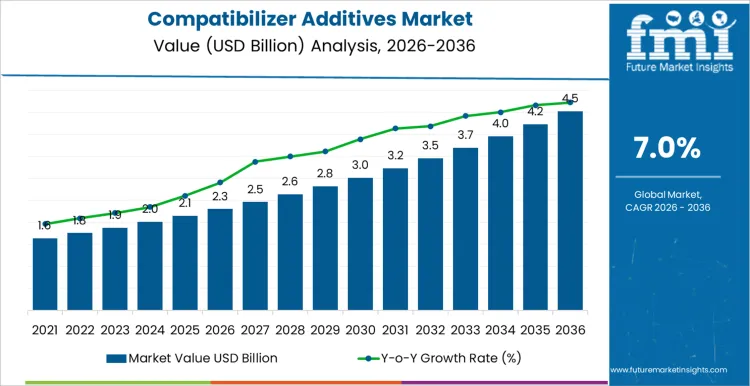
The compatibilizer additives market totals USD 2.3 billion in 2026 and is expected to reach USD 4.5 billion by 2036, with a 7.00% CAGR. Competitive power in this market is concentrated among a small group of global polymer and additive producers with deep chemistry portfolios and close integration into resin supply chains. These players defend pricing power through proprietary grafting technologies, application-specific formulations, and long-standing qualification with compounders and OEMs. Entry barriers remain high due to the technical complexity of reactive compatibilizer design, the need for extensive validation across multiple polymer systems, and the cost of scaling production with consistent molecular control. At the same time, fragmentation persists in regional and niche segments where localized compounding needs, recycled resin variability, and cost sensitivity create room for specialized suppliers. As recycled-content mandates and multi-polymer formulations standardize, buyer preference increasingly shifts toward proven suppliers, reinforcing incumbent influence over high-volume applications.
Quick Stats for Compatibilizer Additives Market
- Compatibilizer Additives Market Value (2026): USD 2.3 Billion
- Compatibilizer Additives Market Forecast Value (2036): USD 4.5 Billion
- Compatibilizer Additives Market Forecast CAGR 2026 to 2036: 7.00%
- Leading Chemistry in Compatibilizer Additives Market: Maleic-Anhydride Grafted Polyolefins (46% share)
- Key Growth Regions in Compatibilizer Additives Market: Asia Pacific, Europe, North America, Latin America, Middle East & Africa
- Top Key Players in Compatibilizer Additives Market: Dow, ExxonMobil Chemical, LyondellBasell, Mitsui Chemicals, SABIC, Arkema, BASF, Borealis, SK Functional Polymer, INEOS Olefins & Polymers
Compatibilizer Additives Market Key Takeaways
| Metric | Value |
|---|---|
| Compatibilizer Additives Market Value (2026) | USD 2.3 Billion |
| Compatibilizer Additives Market Forecast Value (2036) | USD 4.5 Billion |
| Compatibilizer Additives Market Forecast CAGR 2026 to 2036 | 7.00% |
How are Multi-Polymer Formulations and Recycling Requirements Driving the Compatibilizer Additives Market?
The compatibilizer additives market is expanding as polymer processors increasingly work with complex material blends to achieve targeted performance and cost efficiency. In multi-polymer systems, immiscibility between different resins can lead to weak interfacial adhesion, poor mechanical properties, and inconsistent processing behavior. Compatibilizer additives enhance interfacial bonding between dissimilar polymers, enabling stable blends and alloys used in automotive components, packaging, consumer goods, and industrial applications.
Performance consistency and formulation flexibility are central to adoption decisions. End users evaluate compatibilizers based on their ability to improve impact strength, tensile properties, and dispersion uniformity without adversely affecting melt flow or thermal stability. Functionalized polymers such as maleic anhydride-grafted polyolefins and reactive copolymers are widely used to tailor interfacial interactions in blends involving polyethylene, polypropylene, polyamides, and engineering plastics. The ability to fine-tune compatibilizer chemistry for specific resin combinations is allowing manufacturers to optimize material performance across diverse processing conditions.
Growth in recycled plastics utilization and lightweight material design is further reinforcing market demand. Incorporating recycled content often introduces variability in polymer composition, making compatibilizers essential for maintaining product quality and processing reliability. At the same time, industries are adopting polymer blends to reduce material costs and improve sustainability without compromising performance. For additive suppliers, competitive advantage increasingly depends on application-specific formulation expertise, technical support for recyclate integration, and collaboration with processors positioning compatibilizer additives as a critical enabler of advanced polymer blending and circular materials strategies.
How Is the Compatibilizer Additives Market Structured by Chemistry and Application?
The compatibilizer additives market is structured by chemistry and application, reflecting how interfacial adhesion requirements and polymer immiscibility challenges shape additive demand. By chemistry, maleic-anhydride grafted polyolefins represent the leading segment, driven by their effectiveness in improving compatibility between dissimilar polymer phases. Other chemistries include glycidyl and other reactive compatibilizers, along with styrenic and polar compatibilizers used in engineering and specialty polymer systems. By application, polyolefin blends and alloys account for the largest share, followed by recycled plastics and mixed polymer streams, engineering plastics and blends, and other uses where mechanical integrity and phase stability are required.
Why Do Maleic-Anhydride Grafted Polyolefins Lead Chemistry Adoption in the Compatibilizer Additives Market?
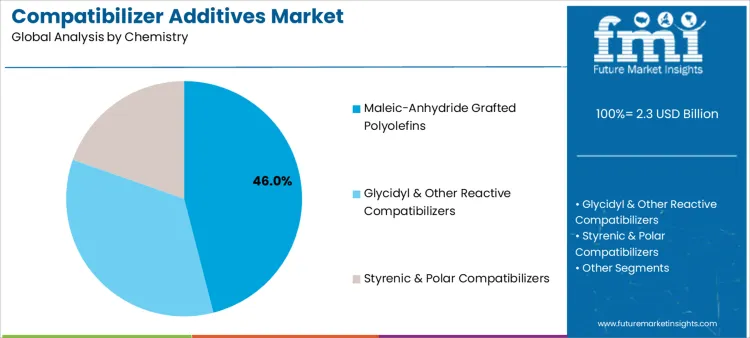
Maleic-anhydride grafted polyolefins account for 46% share of the compatibilizer additives market because they provide strong chemical interaction with polar polymers while maintaining compatibility with non-polar polyolefin matrices. These compatibilizers are widely used in blends containing polyethylene, polypropylene, polyamides, and recycled polymers to enhance interfacial adhesion and stress transfer. Compounders prefer maleic-anhydride grafted systems due to processing stability, predictable reaction behavior, and broad applicability across blend formulations. Their ability to improve mechanical strength, impact resistance, and dispersion efficiency supports widespread adoption, reinforcing their dominant position in the market.
Why Do Polyolefin Blends and Alloys Dominate Application Demand in the Compatibilizer Additives Market?
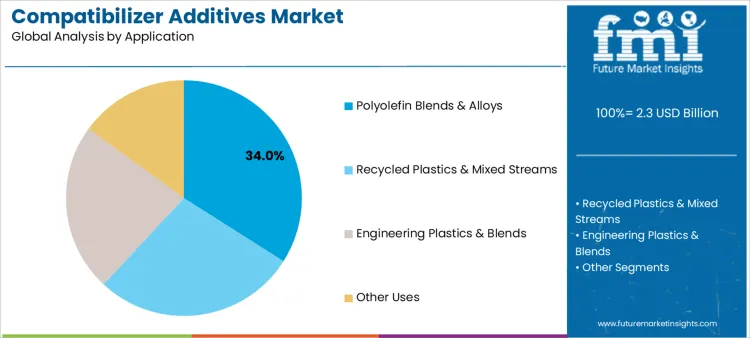
Polyolefin blends and alloys hold 34% share of the compatibilizer additives market because blending is a cost-effective strategy to tailor material properties without developing entirely new polymers. However, immiscibility between polyolefins and other resin systems can lead to poor mechanical performance without effective compatibilization. Compatibilizer additives improve phase dispersion, enhance toughness, and stabilize morphology during processing and end use. High production volumes of polyolefin blends in automotive components, consumer goods, and industrial applications drive consistent demand. These performance and scale factors explain why polyolefin blends and alloys remain the leading application segment.
What Are the Key Dynamics of the Compatibilizer Additives Market?
The compatibilizer additives market is driven by increasing use of multi-component polymer systems and recycled plastics where dissimilar polymers must be effectively blended. Compatibilizers enhance interfacial adhesion between immiscible polymers, improving mechanical properties, impact resistance, and overall performance in blends such as PP/PA, PE/PET, and other engineering resin combinations. Growth in automotive lightweighting, sustainable packaging, and circular economy initiatives that emphasize high-quality recycled content amplifies demand for effective compatibilization solutions. Material suppliers and compounders prioritize molecular design, reactive functionality, and ease of incorporation, as these factors directly influence blend homogeneity, property retention, and processing stability.
How Do Application Trends and Industry Requirements Shape This Market?
Application trends and industry requirements are shaping the compatibilizer additives market as manufacturers seek tailored chemistries that balance performance with processing and regulatory demands. In automotive and transportation, compatibilizers support multi-material assemblies, enhancing strength and durability while enabling lightweight structures. In packaging, high levels of recycled content demand robust compatibilization to maintain clarity, toughness, and barrier performance in films and rigid containers. Consumer electronics and appliance housings leverage compatibilizers to unify disparate polymers in complex component designs. Industry requirements for reduced cycle times, predictable rheology, and compliance with food contact and environmental regulations further influence product selection and formulation strategies.
Why Do Cost, Processing, and Performance Challenges Restrain Market Growth?
Cost, processing, and performance challenges restrain market growth in the compatibilizer additives market, especially in cost-sensitive or low-margin applications. High-performance compatibilizers with tailored reactive groups often carry a price premium that can discourage use where standard additives or simple blends suffice. Achieving optimal compatibilization requires precise control of formulation and processing conditions; suboptimal dispersion or reaction can lead to compromised mechanical properties or processing instability. The need to qualify compatibilizers across diverse polymer systems and end-use specifications extends development timelines. In some cases, legacy materials or simpler polymer pairings persist due to lower cost and established processing familiarity, slowing broader adoption of advanced compatibilizer solutions.
How Is the Compatibilizer Additives Market Growing Across Key Countries?
The compatibilizer additives market is expanding steadily as polymer processors and compounders seek to improve compatibility between immiscible polymers, recycled resin streams, and filled plastic systems. Compatibilizers play a critical role in enhancing interfacial adhesion, mechanical strength, and dispersion in blends used across packaging, automotive, consumer goods, and industrial plastics. Country-wise growth varies based on recycled plastics adoption, polymer compounding activity, and demand for multi-material formulations. High-growth markets benefit from large plastics processing bases and rapid uptake of recycled content, while mature regions emphasize formulation precision, performance consistency, and process reliability.
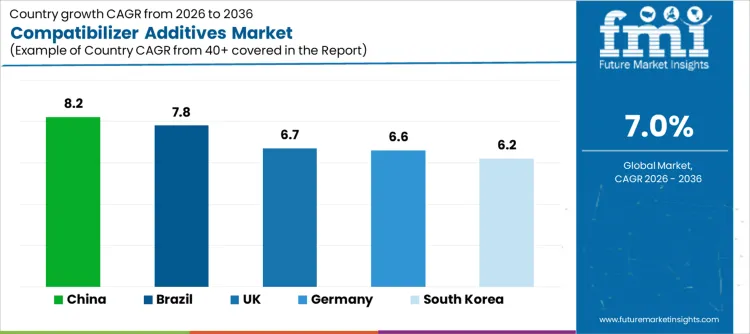
| Country | CAGR (%) |
|---|---|
| China | 8.2 |
| Brazil | 7.8 |
| United Kingdom | 6.7 |
| Germany | 6.6 |
| South Korea | 6.2 |
Why Is China Leading the Compatibilizer Additives Market?
China’s compatibilizer additives market is expanding at a CAGR of 8.2% during 2026-2036, driven by large-scale polymer compounding, extensive use of recycled plastics, and growing production of multi-material packaging and consumer products. Compatibilizers are widely used to improve performance of polyolefin blends, recycled polymer streams, and filled plastic systems used in packaging films, rigid containers, and industrial components. Chinese compounders prioritize compatibilizers that deliver strong interfacial bonding, stable melt flow behavior, and compatibility with high-speed extrusion and injection molding. Domestic additive suppliers benefit from close alignment with plastics processors and the ability to offer cost-effective solutions at scale. Adoption is strongest in recycled polyolefins, automotive parts, and flexible packaging compounds. Procurement decisions emphasize cost efficiency, dispersion consistency, and adaptability across multiple resin systems. Market growth is reinforced by increasing recycled content usage, expansion of plastics processing capacity, and continued development of blended polymer formulations.
Why Is Brazil Emerging as a High-Growth Market for Compatibilizer Additives?
Brazil’s compatibilizer additives market is growing at a CAGR of 7.8% during 2026-2036, supported by rising use of recycled polymers, expansion of plastics compounding, and demand from packaging and automotive sectors. Compatibilizers are increasingly applied to improve mechanical performance and processability of recycled and mixed-polymer materials. Brazilian processors value compatibilizers that enhance impact strength and dispersion while maintaining cost competitiveness. Adoption is strong in packaging, consumer goods, and automotive interior components. Climatic conditions also drive demand for stable formulations with consistent long-term performance. Procurement decisions often favor suppliers offering technical compounding support, local availability, and compatibility with commonly processed resins. Market growth is supported by increasing recycled plastic utilization and gradual upgrading of polymer formulation standards.
What Is Driving Demand for Compatibilizer Additives in the United Kingdom?
The United Kingdom compatibilizer additives market is expanding at a CAGR of 6.7% during 2026-2036, driven by demand from recycled plastics processing, packaging, and specialty polymer applications. Compatibilizers are used to improve consistency and performance of recycled polymer blends in rigid and flexible packaging formats. UK compounders emphasize predictable performance, controlled rheology, and compatibility with food-contact and regulated packaging applications. Demand is strongest in high-quality recycled content formulations rather than commodity plastics. Procurement decisions prioritize supplier reliability, formulation documentation, and repeatable performance. Market growth is reinforced by continued use of recycled polymers and demand for higher-quality plastic products.
How Is Germany Supporting Growth in the Compatibilizer Additives Market?
Germany’s compatibilizer additives market is growing at a CAGR of 6.6% during 2026-2036, supported by strong demand from automotive plastics, engineering compounds, and advanced polymer blends. German manufacturers focus on precision material performance, where compatibilizers are essential for achieving consistent mechanical and thermal properties. Buyers prioritize compatibilizers with controlled molecular architecture, reproducible performance, and compatibility with high-end processing technologies. Adoption is driven by performance optimization rather than volume expansion. Procurement decisions favor suppliers with strong quality systems, application expertise, and ability to support customized polymer formulations. Market growth is reinforced by Germany’s leadership in automotive plastics and advanced materials engineering.
How Is South Korea Expanding Use of Compatibilizer Additives?
South Korea’s compatibilizer additives market is expanding at a CAGR of 6.2% during 2026-2036, driven by demand from electronics housings, automotive components, and consumer goods plastics. Compatibilizers are increasingly used to improve blend performance and surface quality in precision-molded products. Manufacturers emphasize additive purity, dispersion stability, and compatibility with automated, high-speed processing lines. Adoption is strongest in export-oriented plastic components and high-value consumer products. Procurement decisions are influenced by supplier technical capability, product consistency, and alignment with global manufacturing standards. Market growth is supported by steady industrial output and increasing use of multi-material plastic systems.
How Are Suppliers Competing in the Compatibilizer Additives Market?
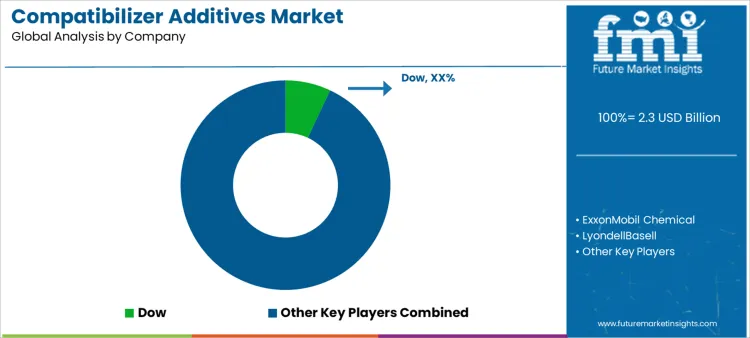
Competition in the compatibilizer additives market is driven by chemistry depth, performance reliability across mixed polymer systems, and the ability to improve interfacial adhesion without compromising processing efficiency or end-use properties. Compatibilizer additives are essential in polyolefin blends, engineering plastics, recycled polymer streams, and specialty compounds, where they enhance dispersion, mechanical strength, and long-term stability. Suppliers compete by offering application-specific grafted and reactive chemistries, consistent molecular architecture, and technical support that helps processors manage increasingly complex material formulations.
Dow and ExxonMobil Chemical leverage strong polymer science capabilities and backward integration to supply compatibilizers optimized for polyolefin blends and recycled plastics. Their portfolios emphasize predictable performance, scalable supply, and compatibility with high-throughput compounding operations. LyondellBasell and SABIC compete through broad resin and additive platforms, positioning compatibilizers as part of integrated material solutions for automotive, packaging, and infrastructure applications.
Japanese and European chemical producers differentiate through precision chemistry and performance tuning. Mitsui Chemicals and BASF focus on reactive and specialty compatibilizers that improve adhesion between dissimilar polymers and fillers, supporting advanced engineering plastics and high-value applications. Arkema and Borealis strengthen their positions through specialty polyolefin-based compatibilizers tailored for recyclability, lightweighting, and durability requirements.
Regional and specialty suppliers add competitive pressure through focused portfolios. SK Functional Polymer targets performance-driven compatibilizers for industrial and recycled materials, while INEOS Olefins & Polymers supports compatibilizer demand through its extensive polyolefin ecosystem. Across the market, competitive advantage is defined by proven interfacial performance, formulation flexibility, and alignment with recycling and sustainability goals rather than price-led differentiation alone.
Key Players in Compatibilizer Additives Market
- Dow
- ExxonMobil Chemical
- LyondellBasell
- Mitsui Chemicals
- SABIC
- Arkema
- BASF
- Borealis
- SK Functional Polymer
- INEOS Olefins & Polymers
Scope of Report
| Attribute | Details |
|---|---|
| Market Size Unit | USD Billion |
| Chemistry Covered | Maleic-Anhydride Grafted Polyolefins, Glycidyl & Other Reactive Compatibilizers, Styrenic & Polar Compatibilizers |
| Application Covered | Polyolefin Blends & Alloys, Recycled Plastics & Mixed Streams, Engineering Plastics & Blends, Other Uses |
| Countries Covered | China, Japan, South Korea, India, Australia & New Zealand, ASEAN, Rest of Asia Pacific, Germany, United Kingdom, France, Italy, Spain, Nordic, BENELUX, Rest of Europe, United States, Canada, Mexico, Brazil, Chile, Rest of Latin America, Kingdom of Saudi Arabia, Other GCC Countries, Turkey, South Africa, Other African Union, Rest of Middle East & Africa |
| Regions Covered | Asia Pacific, Europe, North America, Latin America, Middle East & Africa |
| Key Companies Profiled | Dow, ExxonMobil Chemical, LyondellBasell, Mitsui Chemicals, SABIC, Arkema, BASF, Borealis, SK Functional Polymer, INEOS Olefins & Polymers |
| Additional Attributes | Dollar sales of compatibilizer additives are analyzed by chemistry type and end-use application across virgin and recycled polymer systems. The scope evaluates interfacial adhesion improvement, dispersion efficiency, mechanical property enhancement, and processing compatibility in multi-polymer blends. Country-level analysis reflects rising use of recycled plastics, demand for lightweight and high-performance polymer alloys, regulatory pressure to improve recyclability, and increasing adoption of compatibilizers in circular plastics and advanced materials applications. |
Compatibilizer Additives Market by Key Segments
Chemistry:
- Maleic-Anhydride Grafted Polyolefins
- Glycidyl & Other Reactive Compatibilizers
- Styrenic & Polar Compatibilizers
Application:
- Polyolefin Blends & Alloys
- Recycled Plastics & Mixed Streams
- Engineering Plastics & Blends
- Other Uses
Region:
- Asia Pacific
- China
- Japan
- South Korea
- India
- Australia & New Zealand
- ASEAN
- Rest of Asia Pacific
- Europe
- Germany
- United Kingdom
- France
- Italy
- Spain
- Nordic
- BENELUX
- Rest of Europe
- North America
- United States
- Canada
- Mexico
- Latin America
- Brazil
- Chile
- Rest of Latin America
- Middle East & Africa
- Kingdom of Saudi Arabia
- Other GCC Countries
- Turkey
- South Africa
- Other African Union
- Rest of Middle East & Africa
Bibliography
- Gahleitner, M., Tranninger, C., & Grein, C. (2024). Polyolefin blends and alloys: Structure-property relationships and compatibilization concepts.
- Hopewell, J., Dvorak, R., & Kosior, E. (2024). Plastics recycling: Challenges and opportunities for compatibilizers in circular materials systems.
- European Commission, Joint Research Centre. (2024). Plastics recycling and compatibilization technologies for circular economy applications. Publications Office of the European Union.
- OECD. (2024). Global plastics outlook: Economic drivers, environmental impacts and policy options. OECD Publishing.
- USA. Department of Energy. (2024). Advanced polymer materials for sustainable manufacturing and recycling. Office of Energy Efficiency & Renewable Energy.
Frequently Asked Questions
How big is the compatibilizer additives market in 2026?
The global compatibilizer additives market is estimated to be valued at USD 2.3 billion in 2026.
What will be the size of compatibilizer additives market in 2036?
The market size for the compatibilizer additives market is projected to reach USD 4.5 billion by 2036.
How much will be the compatibilizer additives market growth between 2026 and 2036?
The compatibilizer additives market is expected to grow at a 7.0% CAGR between 2026 and 2036.
What are the key product types in the compatibilizer additives market?
The key product types in compatibilizer additives market are maleic-anhydride grafted polyolefins, glycidyl & other reactive compatibilizers and styrenic & polar compatibilizers.
Which application segment to contribute significant share in the compatibilizer additives market in 2026?
In terms of application, polyolefin blends & alloys segment to command 34.0% share in the compatibilizer additives market in 2026.
Preview the report firsthand - request a free sample
Get SampleGet the brochure for pricing and purchase details.
Get PDFTable of Content
- Executive Summary
- Global Market Outlook
- Demand-side Trends
- Supply-side Trends
- Technology Roadmap Analysis
- Analysis and Recommendations
- Market Overview
- Market Coverage / Taxonomy
- Market Definition / Scope / Limitations
- Market Background
- Market Dynamics
- Drivers
- Restraints
- Opportunity
- Trends
- Scenario Forecast
- Demand in Optimistic Scenario
- Demand in Likely Scenario
- Demand in Conservative Scenario
- Opportunity Map Analysis
- Product Life Cycle Analysis
- Supply Chain Analysis
- Investment Feasibility Matrix
- Value Chain Analysis
- PESTLE and Porter’s Analysis
- Regulatory Landscape
- Regional Parent Market Outlook
- Production and Consumption Statistics
- Import and Export Statistics
- Market Dynamics
- Global Market Analysis 2021 to 2025 and Forecast, 2026 to 2036
- Historical Market Size Value (USD Million) Analysis, 2021 to 2025
- Current and Future Market Size Value (USD Million) Projections, 2026 to 2036
- Y-o-Y Growth Trend Analysis
- Absolute $ Opportunity Analysis
- Global Market Pricing Analysis 2021 to 2025 and Forecast 2026 to 2036
- Global Market Analysis 2021 to 2025 and Forecast 2026 to 2036, By Chemistry
- Introduction / Key Findings
- Historical Market Size Value (USD Million) Analysis By Chemistry , 2021 to 2025
- Current and Future Market Size Value (USD Million) Analysis and Forecast By Chemistry , 2026 to 2036
- Maleic-Anhydride Grafted Polyolefins
- Glycidyl & Other Reactive Compatibilizers
- Styrenic & Polar Compatibilizers
- Maleic-Anhydride Grafted Polyolefins
- Y-o-Y Growth Trend Analysis By Chemistry , 2021 to 2025
- Absolute $ Opportunity Analysis By Chemistry , 2026 to 2036
- Global Market Analysis 2021 to 2025 and Forecast 2026 to 2036, By Application
- Introduction / Key Findings
- Historical Market Size Value (USD Million) Analysis By Application, 2021 to 2025
- Current and Future Market Size Value (USD Million) Analysis and Forecast By Application, 2026 to 2036
- Polyolefin Blends & Alloys
- Recycled Plastics & Mixed Streams
- Engineering Plastics & Blends
- Other Uses
- Polyolefin Blends & Alloys
- Y-o-Y Growth Trend Analysis By Application, 2021 to 2025
- Absolute $ Opportunity Analysis By Application, 2026 to 2036
- Global Market Analysis 2021 to 2025 and Forecast 2026 to 2036, By Region
- Introduction
- Historical Market Size Value (USD Million) Analysis By Region, 2021 to 2025
- Current Market Size Value (USD Million) Analysis and Forecast By Region, 2026 to 2036
- North America
- Latin America
- Western Europe
- Eastern Europe
- East Asia
- South Asia and Pacific
- Middle East & Africa
- Market Attractiveness Analysis By Region
- North America Market Analysis 2021 to 2025 and Forecast 2026 to 2036, By Country
- Historical Market Size Value (USD Million) Trend Analysis By Market Taxonomy, 2021 to 2025
- Market Size Value (USD Million) Forecast By Market Taxonomy, 2026 to 2036
- By Country
- USA
- Canada
- Mexico
- By Chemistry
- By Application
- By Country
- Market Attractiveness Analysis
- By Country
- By Chemistry
- By Application
- Key Takeaways
- Latin America Market Analysis 2021 to 2025 and Forecast 2026 to 2036, By Country
- Historical Market Size Value (USD Million) Trend Analysis By Market Taxonomy, 2021 to 2025
- Market Size Value (USD Million) Forecast By Market Taxonomy, 2026 to 2036
- By Country
- Brazil
- Chile
- Rest of Latin America
- By Chemistry
- By Application
- By Country
- Market Attractiveness Analysis
- By Country
- By Chemistry
- By Application
- Key Takeaways
- Western Europe Market Analysis 2021 to 2025 and Forecast 2026 to 2036, By Country
- Historical Market Size Value (USD Million) Trend Analysis By Market Taxonomy, 2021 to 2025
- Market Size Value (USD Million) Forecast By Market Taxonomy, 2026 to 2036
- By Country
- Germany
- UK
- Italy
- Spain
- France
- Nordic
- BENELUX
- Rest of Western Europe
- By Chemistry
- By Application
- By Country
- Market Attractiveness Analysis
- By Country
- By Chemistry
- By Application
- Key Takeaways
- Eastern Europe Market Analysis 2021 to 2025 and Forecast 2026 to 2036, By Country
- Historical Market Size Value (USD Million) Trend Analysis By Market Taxonomy, 2021 to 2025
- Market Size Value (USD Million) Forecast By Market Taxonomy, 2026 to 2036
- By Country
- Russia
- Poland
- Hungary
- Balkan & Baltic
- Rest of Eastern Europe
- By Chemistry
- By Application
- By Country
- Market Attractiveness Analysis
- By Country
- By Chemistry
- By Application
- Key Takeaways
- East Asia Market Analysis 2021 to 2025 and Forecast 2026 to 2036, By Country
- Historical Market Size Value (USD Million) Trend Analysis By Market Taxonomy, 2021 to 2025
- Market Size Value (USD Million) Forecast By Market Taxonomy, 2026 to 2036
- By Country
- China
- Japan
- South Korea
- By Chemistry
- By Application
- By Country
- Market Attractiveness Analysis
- By Country
- By Chemistry
- By Application
- Key Takeaways
- South Asia and Pacific Market Analysis 2021 to 2025 and Forecast 2026 to 2036, By Country
- Historical Market Size Value (USD Million) Trend Analysis By Market Taxonomy, 2021 to 2025
- Market Size Value (USD Million) Forecast By Market Taxonomy, 2026 to 2036
- By Country
- India
- ASEAN
- Australia & New Zealand
- Rest of South Asia and Pacific
- By Chemistry
- By Application
- By Country
- Market Attractiveness Analysis
- By Country
- By Chemistry
- By Application
- Key Takeaways
- Middle East & Africa Market Analysis 2021 to 2025 and Forecast 2026 to 2036, By Country
- Historical Market Size Value (USD Million) Trend Analysis By Market Taxonomy, 2021 to 2025
- Market Size Value (USD Million) Forecast By Market Taxonomy, 2026 to 2036
- By Country
- Kingdom of Saudi Arabia
- Other GCC Countries
- Turkiye
- South Africa
- Other African Union
- Rest of Middle East & Africa
- By Chemistry
- By Application
- By Country
- Market Attractiveness Analysis
- By Country
- By Chemistry
- By Application
- Key Takeaways
- Key Countries Market Analysis
- USA
- Pricing Analysis
- Market Share Analysis, 2025
- By Chemistry
- By Application
- Canada
- Pricing Analysis
- Market Share Analysis, 2025
- By Chemistry
- By Application
- Mexico
- Pricing Analysis
- Market Share Analysis, 2025
- By Chemistry
- By Application
- Brazil
- Pricing Analysis
- Market Share Analysis, 2025
- By Chemistry
- By Application
- Chile
- Pricing Analysis
- Market Share Analysis, 2025
- By Chemistry
- By Application
- Germany
- Pricing Analysis
- Market Share Analysis, 2025
- By Chemistry
- By Application
- UK
- Pricing Analysis
- Market Share Analysis, 2025
- By Chemistry
- By Application
- Italy
- Pricing Analysis
- Market Share Analysis, 2025
- By Chemistry
- By Application
- Spain
- Pricing Analysis
- Market Share Analysis, 2025
- By Chemistry
- By Application
- France
- Pricing Analysis
- Market Share Analysis, 2025
- By Chemistry
- By Application
- India
- Pricing Analysis
- Market Share Analysis, 2025
- By Chemistry
- By Application
- ASEAN
- Pricing Analysis
- Market Share Analysis, 2025
- By Chemistry
- By Application
- Australia & New Zealand
- Pricing Analysis
- Market Share Analysis, 2025
- By Chemistry
- By Application
- China
- Pricing Analysis
- Market Share Analysis, 2025
- By Chemistry
- By Application
- Japan
- Pricing Analysis
- Market Share Analysis, 2025
- By Chemistry
- By Application
- South Korea
- Pricing Analysis
- Market Share Analysis, 2025
- By Chemistry
- By Application
- Russia
- Pricing Analysis
- Market Share Analysis, 2025
- By Chemistry
- By Application
- Poland
- Pricing Analysis
- Market Share Analysis, 2025
- By Chemistry
- By Application
- Hungary
- Pricing Analysis
- Market Share Analysis, 2025
- By Chemistry
- By Application
- Kingdom of Saudi Arabia
- Pricing Analysis
- Market Share Analysis, 2025
- By Chemistry
- By Application
- Turkiye
- Pricing Analysis
- Market Share Analysis, 2025
- By Chemistry
- By Application
- South Africa
- Pricing Analysis
- Market Share Analysis, 2025
- By Chemistry
- By Application
- USA
- Market Structure Analysis
- Competition Dashboard
- Competition Benchmarking
- Market Share Analysis of Top Players
- By Regional
- By Chemistry
- By Application
- Competition Analysis
- Competition Deep Dive
- Dow
- Overview
- Product Portfolio
- Profitability by Market Segments (Product/Age /Sales Channel/Region)
- Sales Footprint
- Strategy Overview
- Marketing Strategy
- Product Strategy
- Channel Strategy
- ExxonMobil Chemical
- LyondellBasell
- Mitsui Chemicals
- SABIC
- Arkema
- BASF
- Borealis
- SK Functional Polymer
- INEOS Olefins & Polymers
- Dow
- Competition Deep Dive
- Assumptions & Acronyms Used
- Research Methodology


