

- Industry Size (2026)
- USD 748 Mn
- Forecast (2036)
- USD 2048.6 Mn
- CAGR (2026 to 2036)
- 10.6%
Mixed-Plastic Waste Stream Reactive Compatibilizers Market Forecast and Outlook 2026 to 2036
The mixed-plastic waste stream reactive compatibilizers market is valued at USD 748 million in 2026 and is projected to reach USD 2,048.6 million by 2036, reflecting a CAGR of 10.6%. Early growth from 2026 to 2031, rising from approximately USD 748 million to USD 1,189 million, is driven by increasing demand for compatibilizers in mixed PE/PP and PP/PET packaging waste streams. MAH-grafted polyolefins and epoxy-functional compatibilizers lead adoption due to their efficiency in improving polymer miscibility, enabling high-quality reprocessing into films, sheets, injection-molded parts, and profiles.
Between 2031 and 2036, expansion from roughly USD 1,189 million to USD 2,048.6 million is supported by growth in automotive, building, and WEEE applications, alongside rising mechanical and chemical recycling initiatives. Supply forms such as pellets, masterbatches, and powders dominate due to ease of integration in compounding lines. Regulatory emphasis on circular economy adoption and growing demand for recycled-content products further accelerate uptake. Technological improvements in block copolymer and reactive elastomer chemistries ensure continued structural value accumulation and sustained growth across multiple polymer reuse segments.
Quick Stats of the Mixed Plastic Waste Stream Reactive Compatibilizers Market:
- Mixed Plastic Waste Stream Reactive Compatibilizers Market Value (2026): USD 748 million
- Mixed Plastic Waste Stream Reactive Compatibilizers Market Forecast Value (2036): USD 2,048.6 million
- Mixed Plastic Waste Stream Reactive Compatibilizers Market Forecast CAGR (2026 to 2036): 10.6%
- Leading Waste Stream in the Market: Mixed PE/PP packaging (40%)
- Key Growth Regions in the Market: China, Brazil, USA, Germany, UK
- Top Players in the Market: Dow, BASF, Arkema, LyondellBasell, SABIC, ExxonMobil Chemical, Borealis, DuPont, Clariant, Avient
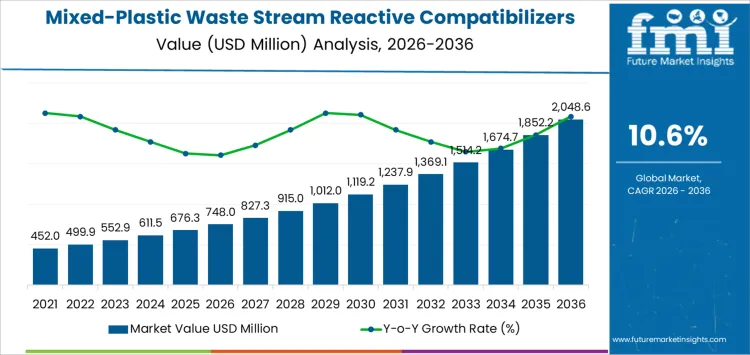
What is the Growth Forecast for the Mixed-Plastic Waste Stream Reactive Compatibilizers Market through 2036?
From 2026 to 2031, the mixed-plastic waste stream reactive compatibilizers market grows from USD 748 million to approximately USD 1,189 million, reflecting a phase of rapid early adoption driven by increasing industrial-scale recycling and multi-polymer blending initiatives. Growth in this period is heavily influenced by the rising volume of post-consumer and post-industrial mixed plastic waste streams being mechanically recycled. Adoption is concentrated in high-value applications, including packaging, automotive components, and construction materials, where compatibilizers restore mechanical integrity, thermal stability, and processability. Year-on-year absolute value additions increase sharply, from USD 55 million in 2026 to over USD 103 million in 2031, reflecting both higher unit penetration and the expansion of multi-site processing facilities globally.
Between 2031 and 2036, the market expands from roughly USD 1,189 million to USD 2,048.6 million, showing a substantial acceleration in both absolute and relative terms. Annual increments rise consistently, reaching USD 211 million in the final forecast year, driven by scale deployment, regulatory pressures for recycled content, and expanded multi-polymer recycling infrastructure. Growth is further reinforced by cross-sector adoption in rigid and flexible packaging, automotive thermoplastics, and industrial molded components.
Mixed Plastic Waste Stream Reactive Compatibilizers Market Key Takeaways
| Metric | Value |
|---|---|
| Market Value (2026) | USD 748 million |
| Forecast Value (2036) | USD 2,048.6 million |
| Forecast CAGR (2026–2036) | 10.6% |
Why Are Reactive Compatibilizers Becoming Central to Mixed Plastic Recycling Outcomes?
Early use of reactive compatibilizers in mixed plastic waste streams followed practical limits faced by recyclers processing unsorted or lightly sorted plastics. Facilities handling municipal and commercial waste encountered blends with unstable melt behaviour, brittle outputs, and inconsistent mechanical properties. Without separation, recycled material struggled to meet even low grade application requirements. Compatibilizers entered processing lines as corrective additives, introduced during extrusion to stabilise interfaces between dissimilar polymers. Historical demand remained tactical and volume limited. Use depended on specific waste profiles, local economics, and recycler experimentation rather than standard practice.
Future demand for reactive compatibilizers reflects a shift from damage control toward material strategy. Recycling systems are now required to recover value from complex streams that cannot be economically separated. Brand owners and compounders increasingly seek recycled blends with defined properties rather than generic recyclate. Compatibilizers enable controlled formulation by allowing recyclers to work with predictable mixed inputs. This supports broader use in packaging components, consumer goods, and durable products. Demand growth will track feedstock scarcity, rising virgin polymer costs, and pressure to utilise available waste streams. Unlike earlier deployment driven by necessity inside recycling plants, future adoption reflects upstream specification, contract supply requirements, and performance accountability across the plastics value chain.
What Factors Are Affecting the Demand for Mixed Plastic Waste Stream Reactive Compatibilizers Market in Terms of Compatibilizer Type and Waste Stream?
Demand for reactive compatibilizers used in mixed plastic waste streams is segmented by compatibilizer type and target waste stream across mechanical recycling operations. MAH grafted polyolefins account for about 34% of total demand, making them the leading compatibilizer type. Epoxy functional compatibilizers, reactive elastomers, and block copolymer systems represent additional types without disclosed share splits. These materials differ in reactivity, interfacial adhesion performance, and tolerance to contamination. Waste stream segmentation reflects the composition challenges faced by recyclers. Mixed PE and PP packaging accounts for about 40% of demand, followed by PP and PET blends, PE and PA blends, multilayer flexible packaging, and WEEE derived streams. Together, these segments explain demand formation shaped by polymer incompatibility, sorting limits, and performance recovery requirements rather than recycling volume growth alone.
What Drives Demand by Compatibilizer Type in the Mixed Plastic Waste Stream Reactive Compatibilizers Market?
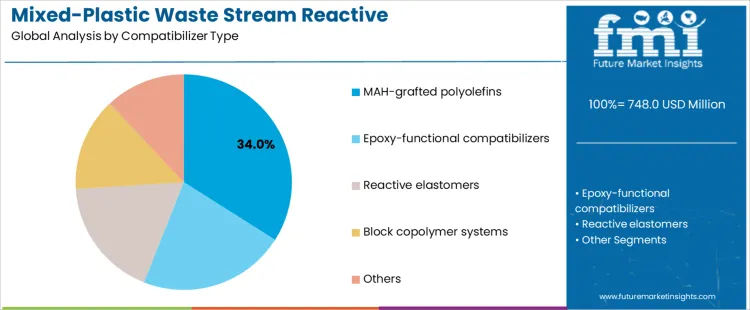
MAH grafted polyolefins lead demand with a 34% share due to effectiveness in improving adhesion between non polar and polar polymers. These compatibilizers are widely used in mixed polyolefin streams where contamination levels vary. Epoxy functional compatibilizers are applied where chain extension and interfacial bonding are required in blends containing PET. Reactive elastomers are used to improve impact resistance in incompatible blends. Block copolymer systems address multilayer structures with complex interfaces. Adoption intensity aligns with feedstock variability and extrusion conditions. Compatibilizer type demand therefore reflects processing robustness and versatility rather than specialization or material cost alone.
Compatibilizer selection remains stable because recyclers qualify formulations across repeated production runs. MAH grafted systems are favored for predictable performance across diverse waste streams. Epoxy systems are applied where viscosity rebuilding is required. Elastomers are used selectively to balance toughness and stiffness. Block copolymers remain limited to targeted applications. These patterns constrain rapid substitution. Compatibilizer type segmentation highlights reliance on proven interfacial chemistry. Demand therefore aligns with recycling process stability and tolerance to mixed inputs rather than experimentation with novel compatibilizer chemistries.
How Does Waste Stream Application Shape Demand for Mixed Plastic Waste Stream Reactive Compatibilizers Market?
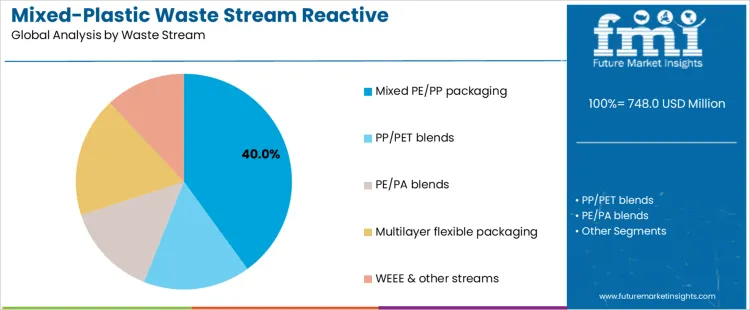
Mixed PE and PP packaging accounts for about 40% of total demand, making it the leading waste stream application. This dominance reflects high collection volumes and limited separation efficiency. PP and PET blends require compatibilizers to manage polarity differences and phase dispersion. PE and PA blends adopt compatibilizers to improve mechanical integrity. Multilayer flexible packaging presents complex interfaces requiring tailored solutions. WEEE and other streams introduce additional variability due to additives and fillers. Waste stream driven demand depends on contamination level, polymer diversity, and end use performance targets. Demand follows waste stream composition challenges rather than downstream product category preferences.
Mixed polyolefin streams maintain leadership due to prevalence in post-consumer waste. PP and PET blends grow selectively where recycling targets increase. PE and PA blends remain niche due to collection constraints. Multilayer packaging adoption remains limited by processing complexity. WEEE streams require specialized handling. Recyclers avoid aggressive formulation changes that risk process instability. This stabilizes demand distribution. Waste stream segmentation therefore reinforces focus on dominant mixed packaging streams while enabling gradual expansion into more complex material blends as processing capability improves.
How Are Reactive Compatibilizers Being Applied in Mixed Plastic Waste Stream Processing?
Use emerges in recycling facilities where heterogeneous plastic streams-such as PET, PE, and PP blends-require chemical modification to improve blend homogeneity and mechanical performance. Processors incorporate reactive compatibilizers during extrusion to reduce phase separation and increase interfacial adhesion, producing more uniform recycled pellets suitable for packaging, automotive, and construction applications. Manufacturers of multilayer films adopt compatibilized recyclate to maintain film strength and flexibility. These applications reflect operational and material performance priorities rather than aesthetic goals, with adoption driven by improved recyclate quality and expanded application potential.
What Operational and Material Conditions Support Adoption of Mixed-Plastic Waste Stream Compatibilizers?
Selection aligns with extrusion and compounding processes that face challenges from polymer immiscibility. Reactive compatibilizers are tailored to interact with specific polymer functional groups, enabling uniform melt viscosity and reduced defects in final pellets. Recycling lines require controlled dosing, residence time, and shear to optimize reaction efficiency. Product developers use compatibilized recyclate for end applications where mechanical performance and barrier properties are critical. These conditions emerge from the need for reproducible properties, operational consistency, and versatility across diverse polymer blends.
Which Practical Considerations Limit Broader Use of Reactive Compatibilizers in Mixed Plastic Streams?
Effectiveness depends on composition of incoming waste streams, including contaminants and unknown polymer ratios. Cost of compatibilizers and associated process control can be high relative to untreated recyclate. Process optimization may require retrofitting extrusion equipment and operator training. Variability in feedstock quality may lead to inconsistent results. Regulatory acceptance for food-contact or sensitive applications may restrict certain chemistries. These factors lead to selective deployment where performance gains, recyclate value, and process control justify additional complexity and expense.
What is the Demand for Mixed Plastic Waste Stream Reactive Compatibilizers by Country?
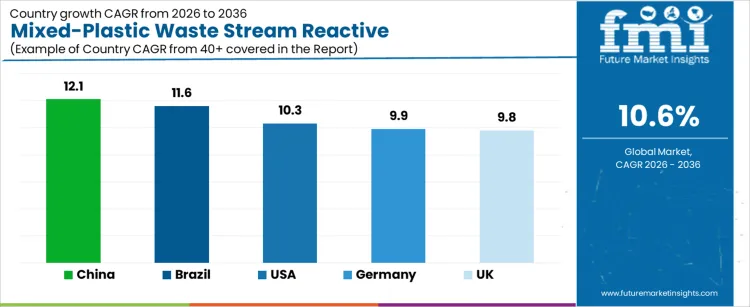
| Country | CAGR (%) |
|---|---|
| USA | 10.3% |
| Germany | 9.9% |
| China | 12.1% |
| UK | 9.8% |
| Brazil | 11.6% |
The demand for mixed plastic waste stream reactive compatibilizers varies across countries, driven by recycling initiatives, plastic waste management, and adoption of high performance recycling technologies. China leads with a 12.1% CAGR, supported by large scale plastic recycling operations and growing use of compatibilizers to improve mixed plastic quality. Brazil follows at 11.6%, driven by expanding recycling infrastructure and adoption in packaging and industrial applications. The USA grows at 10.3%, reflecting efforts to enhance recycled plastic performance and circular economy initiatives. Germany records 9.9%, shaped by regulatory compliance and established recycling systems, while the UK posts 9.8%, supported by adoption in recycled plastics for packaging and consumer goods.
How Is Mixed-Plastic Waste Management Driving Growth in the United States?
In the United States, revenue from the Mixed-Plastic Waste Stream Reactive Compatibilizers Market is expanding at a CAGR of 10.3% through 2036, driven by adoption of chemical compatibilizers to improve the processability and mechanical performance of recycled mixed-plastic streams. Manufacturers are integrating reactive additives to enhance interfacial adhesion, stabilize polymer blends, and produce high-quality recycled materials for packaging, automotive, and industrial applications. Demand is concentrated in recycling plants, industrial converters, and polymer compounding facilities. Domestic suppliers provide high-efficiency compatibilizers compatible with extrusion, injection molding, and pelletizing operations. Increasing recycling mandates, sustainability targets, and recurring polymer processing are sustaining predictable procurement nationwide.
- Packaging, automotive, and industrial applications drive adoption of reactive compatibilizers
- Compatibilizers enhance interfacial adhesion and mechanical performance of recycled plastics
- Domestic suppliers provide high-efficiency agents compatible with extrusion and molding processes
- Recycling mandates and recurring polymer processing sustain predictable procurement
How Are Recycling Standards Supporting Growth in Germany?
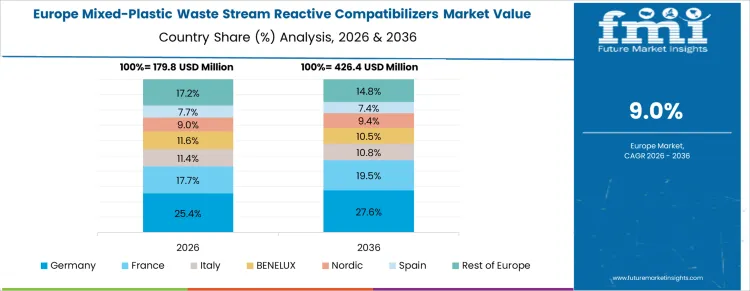
Germany continues to record steady growth in the Mixed-Plastic Waste Stream Reactive Compatibilizers Market at a CAGR of 9.9% through 2036, supported by stringent recycling regulations and circular economy initiatives. Manufacturers are applying compatibilizers to mixed-plastic streams for packaging, automotive, and industrial applications to improve material performance and processability. Demand is concentrated in recycling facilities, polymer converters, and industrial compounding operations. Domestic suppliers provide high-quality reactive compatibilizers engineered for consistent performance with varied polymer blends. Regulatory compliance, stable recycling volumes, and recurring processing cycles are sustaining measured adoption nationwide.
- Recycling and circular economy initiatives drive adoption of reactive compatibilizers
- Packaging, automotive, and industrial polymers anchor demand
- Domestic suppliers provide high-quality compatibilizers for mixed-plastic streams
- Regulatory compliance and recurring processing sustain steady adoption
How Is Industrial Recycling Expansion Accelerating Adoption in China?
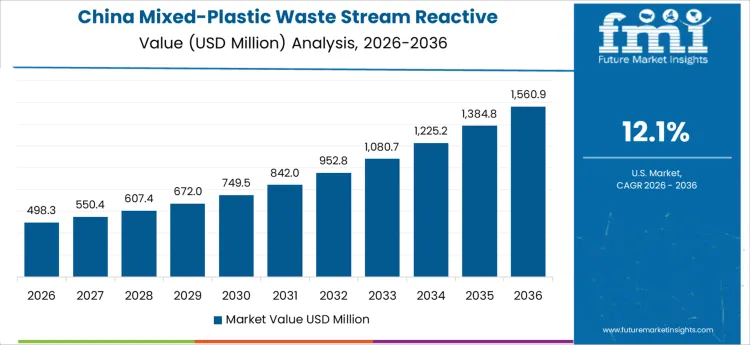
In China, revenue from the Mixed-Plastic Waste Stream Reactive Compatibilizers Market is growing at a CAGR of 12.1% through 2036, driven by rapid expansion of mixed-plastic recycling and polymer compounding operations. Manufacturers are integrating reactive compatibilizers to improve interfacial adhesion, mechanical strength, and processability of recycled plastics for packaging, automotive, and industrial applications. Demand is strong across recycling plants, industrial converters, and polymer compounding facilities. Domestic suppliers are scaling production of high-performance compatibilizers compatible with extrusion, injection molding, and pelletizing processes. High recycling volumes and structured procurement practices are sustaining rapid adoption nationwide.
- Mixed-plastic recycling and polymer compounding drive compatibilizer adoption
- Packaging, automotive, and industrial applications anchor demand
- Domestic suppliers scale production of high-performance compatibilizers
- High recycling volumes sustain consistent adoption
How Is Circular Economy and Industrial Manufacturing Supporting Growth in the United Kingdom?
In the United Kingdom, revenue from the Mixed-Plastic Waste Stream Reactive Compatibilizers Market is expanding at a CAGR of 9.8% through 2036, driven by adoption of chemical agents to improve the quality and processability of recycled mixed-plastic streams. Manufacturers are integrating compatibilizers in polymer blends for packaging, automotive components, and industrial applications. Demand is concentrated in recycling facilities, polymer converters, and industrial compounding operations. Domestic suppliers provide high-efficiency compatibilizers compatible with extrusion, injection molding, and pelletizing processes. Circular economy targets, regulatory standards, and recurring recycling operations are sustaining predictable procurement nationwide.
- Recycling facilities and industrial manufacturing drive compatibilizer adoption
- Packaging, automotive, and industrial polymers anchor demand
- Domestic suppliers provide high-efficiency compatibilizers compatible with extrusion and molding
- Circular economy initiatives sustain predictable procurement
How Is Post-Consumer Waste Recycling Supporting Adoption in Brazil?
Brazil is seeing strong growth in the Mixed-Plastic Waste Stream Reactive Compatibilizers Market at a CAGR of 11.6% through 2036, supported by increasing adoption of mixed-plastic recycling in packaging, automotive, and industrial applications. Manufacturers are using reactive compatibilizers to enhance interfacial adhesion, processability, and mechanical performance of recycled plastic streams. Demand is concentrated in recycling plants, polymer converters, and industrial compounding facilities. Domestic suppliers are expanding production of high-performance compatibilizers compatible with extrusion, molding, and pelletizing operations. Growth in recycling infrastructure, industrial processing, and recurring polymer use is sustaining robust procurement nationwide.
- Packaging, automotive, and industrial polymers drive adoption of reactive compatibilizers
- Compatibilizers improve interfacial adhesion and mechanical performance
- Domestic suppliers expand production of high-performance agents
- Recycling infrastructure and recurring polymer processing sustain procurement
Which Companies Are Shaping Competition in The Mixed Plastic Waste Stream Reactive Compatibilizers Market Across Recycling and Compounding Operations?
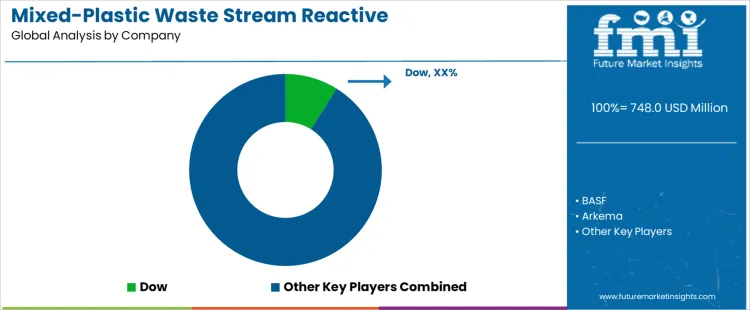
Competition in the Mixed Plastic Waste Stream Reactive Compatibilizers Market is driven by polymer and specialty chemical suppliers addressing incompatibility in post-consumer and postindustrial plastic blends. Dow, BASF, and Arkema influence this space through reactive compatibilizer chemistries designed to improve interfacial bonding between dissimilar polymers. LyondellBasell, SABIC, ExxonMobil Chemical, and Borealis participate through polyolefin based modifiers and functionalized polymers integrated into recycling and compounding processes. DuPont contributes compatibilization technologies derived from engineering polymer applications adapted for mixed waste streams. Competitive positioning reflects reaction efficiency during melt processing, tolerance to feedstock variability, and stability across repeated thermal cycles rather than proprietary branding or formulation complexity.
Additive specialists and masterbatch suppliers add practical depth to competitive dynamics. Clariant and Avient support recyclers and compounders through formulated compatibilizer systems combined with stabilizers and processing aids. These suppliers work closely with recycling operators to tailor solutions to specific waste stream compositions and target end uses. Collaboration across the value chain remains central, as compatibilizer selection depends on contamination levels, polymer ratios, and final application requirements. Local compounders and recycling focused technology providers influence adoption by validating performance at industrial scale. Market entry is shaped by polymer chemistry expertise, processing know-how, and customer qualification timelines rather than capital intensity or portfolio breadth.
Key Players in the Mixed Plastic Waste Stream Reactive Compatibilizers Market
- Dow
- BASF
- Arkema
- LyondellBasell
- SABIC
- ExxonMobil Chemical
- Borealis
- DuPont
- Clariant
- Avient
Scope of the Report
| Items | Values |
|---|---|
| Quantitative Units (2026) | USD million |
| Compatibilizer Type | MAH-grafted polyolefins; Epoxy-functional compatibilizers; Reactive elastomers; Block copolymer systems; Others |
| Waste Stream | Mixed PE/PP packaging; PP/PET blends; PE/PA blends; Multilayer flexible packaging; WEEE & other streams |
| End Use Product | Injection molded parts; Film/sheet products; Profiles & building products; Automotive parts; Others |
| Supply Form | Pellets; Masterbatch; Powder; Liquid |
| Region | Asia Pacific; Europe; North America; Latin America; Middle East & Africa |
| Countries Covered | China; Japan; South Korea; India; Australia & New Zealand; ASEAN; Germany; United Kingdom; France; Italy; Spain; Nordic; BENELUX; United States; Canada; Mexico; Brazil; Chile; Kingdom of Saudi Arabia; Other GCC Countries; Turkey; South Africa; Other African Union; Rest of Asia Pacific; Rest of Europe; Rest of Latin America; Rest of Middle East & Africa |
| Key Companies Profiled | Dow; BASF; Arkema; LyondellBasell; SABIC; ExxonMobil Chemical; Borealis; DuPont; Clariant; Avient |
| Additional Attributes | Dollar by sales across compatibilizer types, waste streams, end-use products, and supply forms; MAH-grafted polyolefins lead due to broad polyolefin compatibility; Mixed PE/PP packaging represents highest demand due to prevalence in post-consumer streams; Supply forms dominated by pellets and masterbatches for ease of dosing and extrusion; Automotive, packaging, and building applications anchor end-use demand; Regulatory emphasis on recycled content and circular economy adoption drives structural uptake. |
Mixed Plastic Waste Stream Reactive Compatibilizers Market Segmentation
Compatibilizer Type:
- MAH-grafted polyolefins
- Epoxy-functional compatibilizers
- Reactive elastomers
- Block copolymer systems
- Others
Waste Stream:
- Mixed PE/PP packaging
- PP/PET blends
- PE/PA blends
- Multilayer flexible packaging
- WEEE & other streams
End Use Product:
- Injection molded parts
- Film/sheet products
- Profiles & building products
- Automotive parts
- Others
Supply Form:
- Pellets
- Masterbatch
- Powder
- Liquid
Region
- Asia Pacific
- China
- Japan
- South Korea
- India
- Australia & New Zealand
- ASEAN
- Rest of Asia Pacific
- Europe
- Germany
- United Kingdom
- France
- Italy
- Spain
- Nordic
- BENELUX
- Rest of Europe
- North America
- United States
- Canada
- Mexico
- Latin America
- Brazil
- Chile
- Rest of Latin America
- Middle East & Africa
- Kingdom of Saudi Arabia
- Other GCC Countries
- Turkey
- South Africa
- Other African Union
- Rest of Middle East & Africa
Frequently Asked Questions
How big is the mixed-plastic waste stream reactive compatibilizers market in 2026?
The global mixed-plastic waste stream reactive compatibilizers market is estimated to be valued at USD 748.0 million in 2026.
What will be the size of mixed-plastic waste stream reactive compatibilizers market in 2036?
The market size for the mixed-plastic waste stream reactive compatibilizers market is projected to reach USD 2,048.6 million by 2036.
How much will be the mixed-plastic waste stream reactive compatibilizers market growth between 2026 and 2036?
The mixed-plastic waste stream reactive compatibilizers market is expected to grow at a 10.6% CAGR between 2026 and 2036.
What are the key product types in the mixed-plastic waste stream reactive compatibilizers market?
The key product types in mixed-plastic waste stream reactive compatibilizers market are mah-grafted polyolefins, epoxy-functional compatibilizers, reactive elastomers, block copolymer systems and others.
Which waste stream segment to contribute significant share in the mixed-plastic waste stream reactive compatibilizers market in 2026?
In terms of waste stream, mixed pe/pp packaging segment to command 40.0% share in the mixed-plastic waste stream reactive compatibilizers market in 2026.
Preview the report firsthand - request a free sample
Get SampleGet the brochure for pricing and purchase details.
Get PDFTable of Content
- Executive Summary
- Global Market Outlook
- Demand-side Trends
- Supply-side Trends
- Technology Roadmap Analysis
- Analysis and Recommendations
- Market Overview
- Market Coverage / Taxonomy
- Market Definition / Scope / Limitations
- Market Background
- Market Dynamics
- Drivers
- Restraints
- Opportunity
- Trends
- Scenario Forecast
- Demand in Optimistic Scenario
- Demand in Likely Scenario
- Demand in Conservative Scenario
- Opportunity Map Analysis
- Product Life Cycle Analysis
- Supply Chain Analysis
- Investment Feasibility Matrix
- Value Chain Analysis
- PESTLE and Porter’s Analysis
- Regulatory Landscape
- Regional Parent Market Outlook
- Production and Consumption Statistics
- Import and Export Statistics
- Market Dynamics
- Global Market Analysis 2021 to 2025 and Forecast, 2026 to 2036
- Historical Market Size Value (USD Million) Analysis, 2021 to 2025
- Current and Future Market Size Value (USD Million) Projections, 2026 to 2036
- Y-o-Y Growth Trend Analysis
- Absolute $ Opportunity Analysis
- Global Market Pricing Analysis 2021 to 2025 and Forecast 2026 to 2036
- Global Market Analysis 2021 to 2025 and Forecast 2026 to 2036, By Compatibilizer Type
- Introduction / Key Findings
- Historical Market Size Value (USD Million) Analysis By Compatibilizer Type , 2021 to 2025
- Current and Future Market Size Value (USD Million) Analysis and Forecast By Compatibilizer Type , 2026 to 2036
- MAH-grafted polyolefins
- Epoxy-functional compatibilizers
- Reactive elastomers
- Block copolymer systems
- Others
- Y-o-Y Growth Trend Analysis By Compatibilizer Type , 2021 to 2025
- Absolute $ Opportunity Analysis By Compatibilizer Type , 2026 to 2036
- Global Market Analysis 2021 to 2025 and Forecast 2026 to 2036, By Waste Stream
- Introduction / Key Findings
- Historical Market Size Value (USD Million) Analysis By Waste Stream, 2021 to 2025
- Current and Future Market Size Value (USD Million) Analysis and Forecast By Waste Stream, 2026 to 2036
- Mixed PE/PP packaging
- PP/PET blends
- PE/PA blends
- Multilayer flexible packaging
- WEEE & other streams
- Y-o-Y Growth Trend Analysis By Waste Stream, 2021 to 2025
- Absolute $ Opportunity Analysis By Waste Stream, 2026 to 2036
- Global Market Analysis 2021 to 2025 and Forecast 2026 to 2036, By End Use Product
- Introduction / Key Findings
- Historical Market Size Value (USD Million) Analysis By End Use Product, 2021 to 2025
- Current and Future Market Size Value (USD Million) Analysis and Forecast By End Use Product, 2026 to 2036
- Injection molded parts
- Film/sheet products
- Profiles & building products
- Automotive parts
- Others
- Y-o-Y Growth Trend Analysis By End Use Product, 2021 to 2025
- Absolute $ Opportunity Analysis By End Use Product, 2026 to 2036
- Global Market Analysis 2021 to 2025 and Forecast 2026 to 2036, By Supply Form
- Introduction / Key Findings
- Historical Market Size Value (USD Million) Analysis By Supply Form, 2021 to 2025
- Current and Future Market Size Value (USD Million) Analysis and Forecast By Supply Form, 2026 to 2036
- Pellets
- Masterbatch
- Powder
- Liquid
- Y-o-Y Growth Trend Analysis By Supply Form, 2021 to 2025
- Absolute $ Opportunity Analysis By Supply Form, 2026 to 2036
- Global Market Analysis 2021 to 2025 and Forecast 2026 to 2036, By Region
- Introduction
- Historical Market Size Value (USD Million) Analysis By Region, 2021 to 2025
- Current Market Size Value (USD Million) Analysis and Forecast By Region, 2026 to 2036
- North America
- Latin America
- Western Europe
- Eastern Europe
- East Asia
- South Asia and Pacific
- Middle East & Africa
- Market Attractiveness Analysis By Region
- North America Market Analysis 2021 to 2025 and Forecast 2026 to 2036, By Country
- Historical Market Size Value (USD Million) Trend Analysis By Market Taxonomy, 2021 to 2025
- Market Size Value (USD Million) Forecast By Market Taxonomy, 2026 to 2036
- By Country
- USA
- Canada
- Mexico
- By Compatibilizer Type
- By Waste Stream
- By End Use Product
- By Supply Form
- By Country
- Market Attractiveness Analysis
- By Country
- By Compatibilizer Type
- By Waste Stream
- By End Use Product
- By Supply Form
- Key Takeaways
- Latin America Market Analysis 2021 to 2025 and Forecast 2026 to 2036, By Country
- Historical Market Size Value (USD Million) Trend Analysis By Market Taxonomy, 2021 to 2025
- Market Size Value (USD Million) Forecast By Market Taxonomy, 2026 to 2036
- By Country
- Brazil
- Chile
- Rest of Latin America
- By Compatibilizer Type
- By Waste Stream
- By End Use Product
- By Supply Form
- By Country
- Market Attractiveness Analysis
- By Country
- By Compatibilizer Type
- By Waste Stream
- By End Use Product
- By Supply Form
- Key Takeaways
- Western Europe Market Analysis 2021 to 2025 and Forecast 2026 to 2036, By Country
- Historical Market Size Value (USD Million) Trend Analysis By Market Taxonomy, 2021 to 2025
- Market Size Value (USD Million) Forecast By Market Taxonomy, 2026 to 2036
- By Country
- Germany
- UK
- Italy
- Spain
- France
- Nordic
- BENELUX
- Rest of Western Europe
- By Compatibilizer Type
- By Waste Stream
- By End Use Product
- By Supply Form
- By Country
- Market Attractiveness Analysis
- By Country
- By Compatibilizer Type
- By Waste Stream
- By End Use Product
- By Supply Form
- Key Takeaways
- Eastern Europe Market Analysis 2021 to 2025 and Forecast 2026 to 2036, By Country
- Historical Market Size Value (USD Million) Trend Analysis By Market Taxonomy, 2021 to 2025
- Market Size Value (USD Million) Forecast By Market Taxonomy, 2026 to 2036
- By Country
- Russia
- Poland
- Hungary
- Balkan & Baltic
- Rest of Eastern Europe
- By Compatibilizer Type
- By Waste Stream
- By End Use Product
- By Supply Form
- By Country
- Market Attractiveness Analysis
- By Country
- By Compatibilizer Type
- By Waste Stream
- By End Use Product
- By Supply Form
- Key Takeaways
- East Asia Market Analysis 2021 to 2025 and Forecast 2026 to 2036, By Country
- Historical Market Size Value (USD Million) Trend Analysis By Market Taxonomy, 2021 to 2025
- Market Size Value (USD Million) Forecast By Market Taxonomy, 2026 to 2036
- By Country
- China
- Japan
- South Korea
- By Compatibilizer Type
- By Waste Stream
- By End Use Product
- By Supply Form
- By Country
- Market Attractiveness Analysis
- By Country
- By Compatibilizer Type
- By Waste Stream
- By End Use Product
- By Supply Form
- Key Takeaways
- South Asia and Pacific Market Analysis 2021 to 2025 and Forecast 2026 to 2036, By Country
- Historical Market Size Value (USD Million) Trend Analysis By Market Taxonomy, 2021 to 2025
- Market Size Value (USD Million) Forecast By Market Taxonomy, 2026 to 2036
- By Country
- India
- ASEAN
- Australia & New Zealand
- Rest of South Asia and Pacific
- By Compatibilizer Type
- By Waste Stream
- By End Use Product
- By Supply Form
- By Country
- Market Attractiveness Analysis
- By Country
- By Compatibilizer Type
- By Waste Stream
- By End Use Product
- By Supply Form
- Key Takeaways
- Middle East & Africa Market Analysis 2021 to 2025 and Forecast 2026 to 2036, By Country
- Historical Market Size Value (USD Million) Trend Analysis By Market Taxonomy, 2021 to 2025
- Market Size Value (USD Million) Forecast By Market Taxonomy, 2026 to 2036
- By Country
- Kingdom of Saudi Arabia
- Other GCC Countries
- Turkiye
- South Africa
- Other African Union
- Rest of Middle East & Africa
- By Compatibilizer Type
- By Waste Stream
- By End Use Product
- By Supply Form
- By Country
- Market Attractiveness Analysis
- By Country
- By Compatibilizer Type
- By Waste Stream
- By End Use Product
- By Supply Form
- Key Takeaways
- Key Countries Market Analysis
- USA
- Pricing Analysis
- Market Share Analysis, 2025
- By Compatibilizer Type
- By Waste Stream
- By End Use Product
- By Supply Form
- Canada
- Pricing Analysis
- Market Share Analysis, 2025
- By Compatibilizer Type
- By Waste Stream
- By End Use Product
- By Supply Form
- Mexico
- Pricing Analysis
- Market Share Analysis, 2025
- By Compatibilizer Type
- By Waste Stream
- By End Use Product
- By Supply Form
- Brazil
- Pricing Analysis
- Market Share Analysis, 2025
- By Compatibilizer Type
- By Waste Stream
- By End Use Product
- By Supply Form
- Chile
- Pricing Analysis
- Market Share Analysis, 2025
- By Compatibilizer Type
- By Waste Stream
- By End Use Product
- By Supply Form
- Germany
- Pricing Analysis
- Market Share Analysis, 2025
- By Compatibilizer Type
- By Waste Stream
- By End Use Product
- By Supply Form
- UK
- Pricing Analysis
- Market Share Analysis, 2025
- By Compatibilizer Type
- By Waste Stream
- By End Use Product
- By Supply Form
- Italy
- Pricing Analysis
- Market Share Analysis, 2025
- By Compatibilizer Type
- By Waste Stream
- By End Use Product
- By Supply Form
- Spain
- Pricing Analysis
- Market Share Analysis, 2025
- By Compatibilizer Type
- By Waste Stream
- By End Use Product
- By Supply Form
- France
- Pricing Analysis
- Market Share Analysis, 2025
- By Compatibilizer Type
- By Waste Stream
- By End Use Product
- By Supply Form
- India
- Pricing Analysis
- Market Share Analysis, 2025
- By Compatibilizer Type
- By Waste Stream
- By End Use Product
- By Supply Form
- ASEAN
- Pricing Analysis
- Market Share Analysis, 2025
- By Compatibilizer Type
- By Waste Stream
- By End Use Product
- By Supply Form
- Australia & New Zealand
- Pricing Analysis
- Market Share Analysis, 2025
- By Compatibilizer Type
- By Waste Stream
- By End Use Product
- By Supply Form
- China
- Pricing Analysis
- Market Share Analysis, 2025
- By Compatibilizer Type
- By Waste Stream
- By End Use Product
- By Supply Form
- Japan
- Pricing Analysis
- Market Share Analysis, 2025
- By Compatibilizer Type
- By Waste Stream
- By End Use Product
- By Supply Form
- South Korea
- Pricing Analysis
- Market Share Analysis, 2025
- By Compatibilizer Type
- By Waste Stream
- By End Use Product
- By Supply Form
- Russia
- Pricing Analysis
- Market Share Analysis, 2025
- By Compatibilizer Type
- By Waste Stream
- By End Use Product
- By Supply Form
- Poland
- Pricing Analysis
- Market Share Analysis, 2025
- By Compatibilizer Type
- By Waste Stream
- By End Use Product
- By Supply Form
- Hungary
- Pricing Analysis
- Market Share Analysis, 2025
- By Compatibilizer Type
- By Waste Stream
- By End Use Product
- By Supply Form
- Kingdom of Saudi Arabia
- Pricing Analysis
- Market Share Analysis, 2025
- By Compatibilizer Type
- By Waste Stream
- By End Use Product
- By Supply Form
- Turkiye
- Pricing Analysis
- Market Share Analysis, 2025
- By Compatibilizer Type
- By Waste Stream
- By End Use Product
- By Supply Form
- South Africa
- Pricing Analysis
- Market Share Analysis, 2025
- By Compatibilizer Type
- By Waste Stream
- By End Use Product
- By Supply Form
- USA
- Market Structure Analysis
- Competition Dashboard
- Competition Benchmarking
- Market Share Analysis of Top Players
- By Regional
- By Compatibilizer Type
- By Waste Stream
- By End Use Product
- By Supply Form
- Competition Analysis
- Competition Deep Dive
- Dow
- Overview
- Product Portfolio
- Profitability by Market Segments (Product/Age /Sales Channel/Region)
- Sales Footprint
- Strategy Overview
- Marketing Strategy
- Product Strategy
- Channel Strategy
- BASF
- Arkema
- LyondellBasell
- SABIC
- ExxonMobil Chemical
- Borealis
- DuPont
- Clariant
- Avient
- Dow
- Competition Deep Dive
- Assumptions & Acronyms Used
- Research Methodology


