

- Market Size (2026)
- USD 61.9 Mn
- Forecast (2036)
- USD 182.2 Mn
- CAGR (2026 to 2036)
- 11.4%
PET Microfiber Fleece Garment Recycling Streams in Europe Market Size, Market Forecast and Outlook by FMI
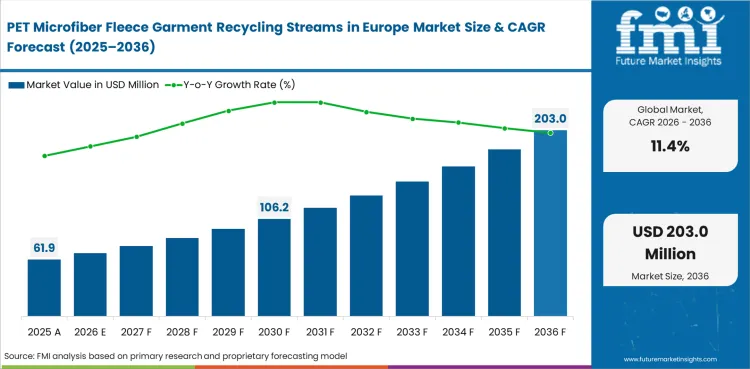
The PET microfiber fleece garment recycling streams in Europe market was valued at USD 55.6 million in 2025 and is expected to reach USD 61.9 million in 2026. Industry valuation is projected to climb to USD 182.2 million by 2036. This reflects a CAGR of 11.4% from 2026 to 2036. Based on FMI analysis, the market is anticipated to create an incremental opportunity of USD 120.3 million over the forecast period.
Summary of PET Microfiber Fleece Garment Recycling Streams in Europe Market
- The market is forecast to reach USD 182.2 million by 2036.
- The market is expected to grow at a CAGR of 11.4% from 2026 to 2036.
- The market was estimated at USD 55.6 million in 2025.
- The forecast period represents an incremental opportunity of USD 120.3 million.
- Mechanical recycling is expected to account for 48% of the recycling route segment in 2026.
- Post-consumer feedstock is estimated to account for 72% share in 2026.
- Bring points are projected to hold 43% of the collection channel segment in 2026.
- Mono-material feedstock is expected to account for 46% share in 2026.
- Staple fiber is anticipated to capture 44% of the output form segment in 2026.
Key Takeaways, Market Size, and Forecast
- PET Microfiber Fleece Garment Recycling Streams in Europe Market is projected to grow from USD 61.9 million in 2026 to USD 182.2 million by 2036, at a CAGR of 11.4%.
- The PET microfiber fleece garment recycling streams in Europe market was valued at USD 55.6 million in 2025.
- By 2036, the PET Microfiber Fleece Garment Recycling Streams in Europe Market is expected to be worth USD 182.2 million.
- From 2026 to 2036, the market is expected to expand at a CAGR of 11.4%.
- The market is projected to create an incremental opportunity of USD 120.3 million between 2026 and 2036.
- In 2026, Mechanical recycling is expected to account for 48.0% of the recycling route segment.
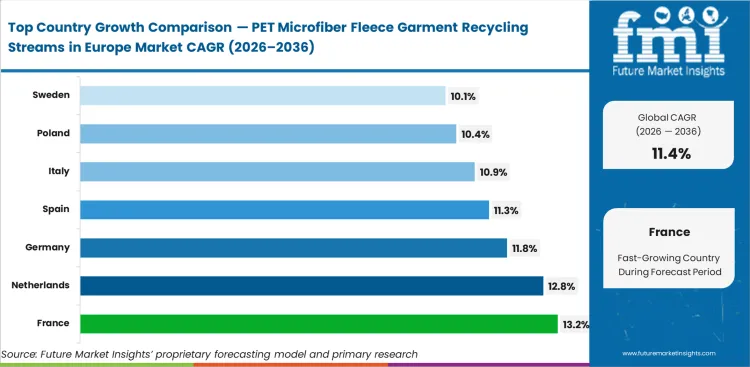
- France (13.2%) and the Netherlands (12.8%) are two of the fastest growing markets.
PET Microfiber Fleece Garment Recycling Streams in Europe Market Key Takeaways
| Parameter | Details |
|---|---|
| Market value (2026) | USD 61.9 million |
| Forecast value (2036) | USD 182.2 million |
| CAGR (2026 to 2036) | 11.4% |
| Estimated market value (2025) | USD 55.6 million |
| Incremental opportunity | USD 120.3 million |
| Leading recycling route | Mechanical (48% of recycling route segment) |
| Leading feedstock source | Post-consumer (72% of feedstock source segment) |
| Leading collection channel | Bring points (43% of collection channel segment) |
| Leading feedstock purity | Mono-material (46% of feedstock purity segment) |
| Leading output form | Staple fiber (44% of output form segment) |
| Key players | SOEX, TOMRA Textiles, Reju, CARBIOS, Eastman, Circ, Nouvelles Fibres Textiles |
Source: Future Market Insights competitive analysis, 2026.
Separate textile collection is pushing larger synthetic garment volumes into formal sorting and recycling channels. Mixed textile bales are becoming harder to place at profitably . Export options for lower-grade synthetic fractions are narrowing. Domestic recovery capacity is becoming more important as compliance pressure rises across municipalities and brands. Mechanical recycling remains the most accessible route today. Chemical and molecular processing is still building scale.
Country performance continues to vary by collection model and processing depth. France is projected to expand at a CAGR of 13.2% from 2026 to 2036. The Netherlands follows at 12.8%. Germany records 11.8%. Spain and Italy are expected to grow at 11.3% and 10.9%. Poland and Sweden are likely to record 10.4% and 10.1% by the forecast period.
PET Microfiber Fleece Garment Recycling Streams in Europe Market Definition
The PET microfiber fleece garment recycling streams in Europe market includes formal supply chains that recover, sort, pre-process, and recycle end-of-use polyester fleece garments into usable secondary raw materials within Europe. It includes the collection and processing of fleece jackets, pullovers, hoodies, and similar PET-rich microfiber garments that move into mechanical, thermo-mechanical, chemical, or solvolysis-based recycling routes.
PET Microfiber Fleece Garment Recycling Streams in Europe Market Inclusions
Market scope includes post-consumer and post-industrial fleece garments made largely from PET-rich microfiber constructions. It covers recycling routes, feedstock sources, collection channels, feedstock purity profiles, output forms, and regional analysis across Europe. Resulting outputs include staple fiber, pellets, monomers, and insulation fill intended for secondary material use rather than resale.
PET Microfiber Fleece Garment Recycling Streams in Europe Market Exclusions
The scope excludes secondhand resale-only flows, virgin fiber production, and broader textile waste streams outside the fleece category. It also excludes non-recycled garment circulation models where no material recovery or polymer processing takes place.
PET Microfiber Fleece Garment Recycling Streams in Europe Market Research Methodology
- Primary Research: FMI discussions covered sorting operators, recyclers, collection-system participants, and downstream users involved in textile recovery and polyester recycling across Europe.
- Desk Research: Review included public circular-textile policy material, recycling studies, waste-textile publications, and technical sources related to polyester garment recovery and route economics.
- Market Sizing and Forecasting: Forecasting used installed regional sorting and processing capacity as an anchor. It then assessed route adoption, feedstock availability, and output conversion across key countries.
- Data Validation and Update Cycle: Market estimates were validated against collection trends, textile waste generation patterns, route maturity, and participation across sorting and downstream recycling channels.
Why is the PET Microfiber Fleece Garment Recycling Streams in Europe Market Growing?
- Separate textile collection requirements are pushing larger garment volumes into formal sorting and recycling systems from 2025 onward.
- Mechanical recycling remains the largest route at 48% share in 2026 because current infrastructure still favors tearing and lower-capex recovery lines.
- Post-consumer feedstock leads with 72% share in 2026 because household textile disposal remains the largest available source of recoverable fleece garments.
Europe is moving from voluntary textile circularity efforts toward more structured recovery, which aligns closely with the broader textile recycling market. PET fleece garments are becoming a larger waste stream as polyester-rich textile volumes rise and municipalities face stronger diversion pressure. This is raising the commercial value of collection access, sorting accuracy, and route allocation.
Recovery economics are becoming more sensitive to route quality. Operators that isolate cleaner fleece fractions and reduce contamination earlier in the chain are better placed to protect yield and margin. Market growth depends on the ability to convert incoming volume into stable secondary output under tighter quality requirements. This follows the same operating logic seen in the recycled polyester apparel fiber market.
Chemical recycling capacity is expanding the longer-term opportunity. France, Germany, and the Netherlands are becoming important locations for polyester regeneration. A large share of output still moves through lower-value channels. Growth in this market depends on stronger feedstock quality as well as higher garment collection.
Segmental Analysis
- Mechanical recycling is projected to account for 48% of the recycling route segment in 2026.
- Post-consumer feedstock is expected to hold 72% of the feedstock source segment in 2026.
- Bring points are estimated to account for 43% of the collection channel segment in 2026.
- Mono-material feedstock is projected to secure 46% of the feedstock purity segment in 2026.
- Staple fiber is expected to capture 44% of the output form segment in 2026.
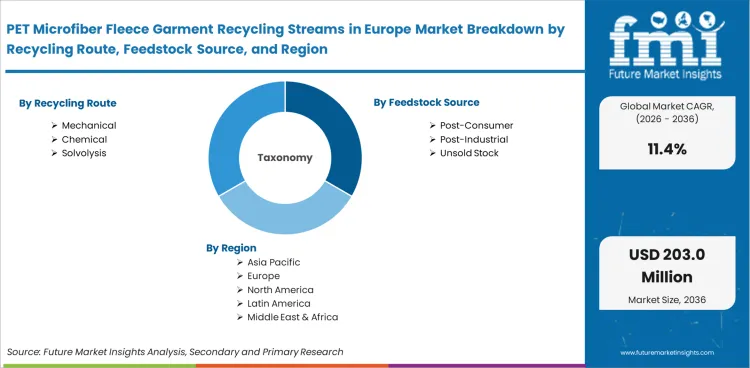
The market is segmented by recycling route, feedstock source, collection channel, feedstock purity, output form, and region. By recycling route, the market is divided into mechanical, chemical, thermo-mechanical, and solvolysis. By feedstock source, it is classified into post-consumer, post-industrial, and unsold stock. By collection channel, it includes bring points, retail take-back, municipal curbside, and civic sites. By feedstock purity, the market covers mono-material, blend-rich, dark colors, and contaminated streams. By output form, it includes staple fiber, pellets, monomers, and insulation fill.
Insights into the Mechanical Recycling Route Segment
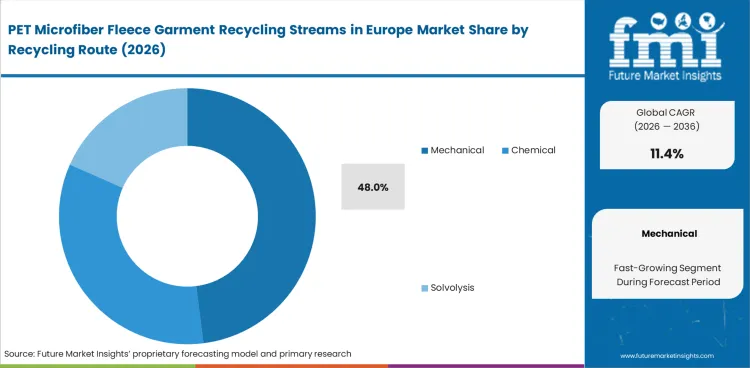
Mechanical recycling is expected to lead because it remains the most commercially accessible route for fleece recovery under current European conditions. Conventional tearing lines require lower upfront investment than chemical depolymerization systems. Mechanical recycling is projected to account for 48% share in 2026. That cost advantage keeps the route relevant where feedstock quality is uneven and scale is still developing.
Insights into the Post-consumer Feedstock Source Segment
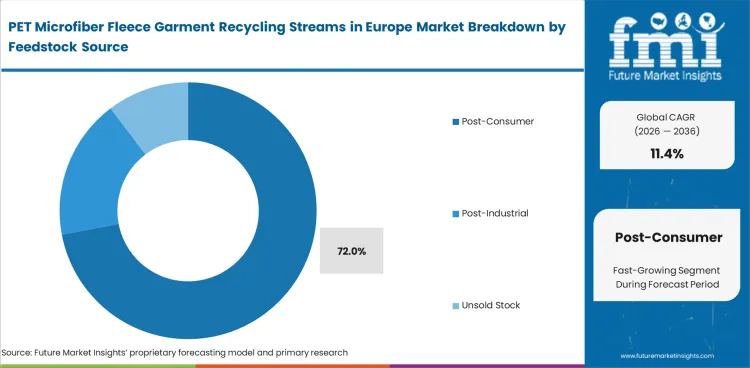
Post-consumer feedstock is estimated to account for 72% share in 2026 because municipal and household collection systems generate the largest volume of discarded fleece garments. The segment benefits from scale, though that scale comes with operating friction. Moisture and mixed waste raise sorting costs. Biological contamination also increases rejection rates before usable fleece can be isolated.
Insights into the Bring Points Collection Channel Segment
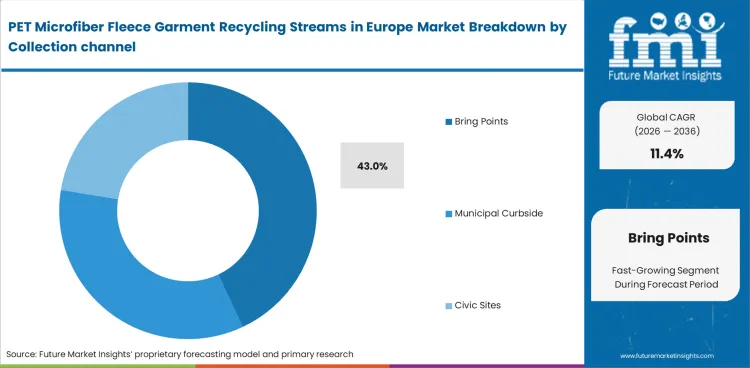
Bring points are expected to account for 43% of the collection channel segment in 2026 because they allow municipalities to collect textile volumes without building dense staffed networks. Their continued use reflects practical coverage and legacy infrastructure. Their operating weakness is feedstock exposure. Rain and humidity can damage fleece garments before they reach sorting sites. Deliberate contamination adds further loss.
Insights into the Mono-material Feedstock Purity Segment
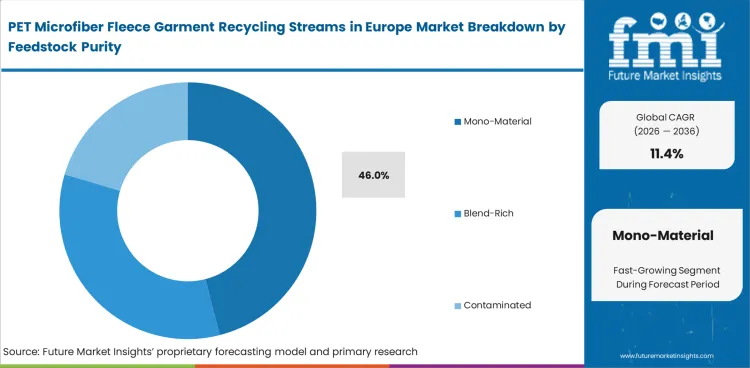
Mono-material feedstock is projected to hold 46% share in 2026 because cleaner PET input supports stronger yield and more stable processing. This segment matters most where facilities are targeting higher-value chemical and molecular recycling channels. Advanced routes depend on cleaner polymer input to protect process performance and maintain monomer quality.
Insights into the Staple Fiber Output Form Segment
Staple fiber fits current market conditions more easily than pellet and monomer routes, so it is anticipated to capture 44% share in 2026. It can move into existing carding and spinning operations without specialized melting and extrusion equipment. This makes it the most practical outlet for a large share of mechanically recovered material.
What are the Drivers, Restraints, and Key Trends of the PET Microfiber Fleece Garment Recycling Streams in Europe Market?
- Separate textile collection rules and tighter landfill pressure are directing more synthetic garments into formal recovery systems across Europe.
- Elastane contamination remains a major technical restraint because even low blend ratios can reduce chemical processing reliability and shrink the usable feedstock pool.
- Digital tracers, closed-loop solvent systems, and automated trim removal are emerging as practical areas of improvement for route allocation and value retention.
The PET microfiber fleece garment recycling streams in Europe market is expanding because disposal economics are changing. Municipalities and regional waste systems face stronger pressure to divert low-grade synthetic garments away from landfill and incineration, much like the operating shift seen in the textile recycling market. This is pushing operators toward longer-duration feedstock agreements with recyclers and advanced processing facilities that can offer more dependable recovery channels. Route security is becoming more valuable because delayed access to capacity increases exposure to disposal costs and weakens control over diversion targets.
Collection-led volume formalization
Separate textile collection is bringing larger synthetic garment volumes into formal recovery channels across Europe. This is expanding the workable feedstock base for sorters and recyclers while exposing the gap between collection growth and processing readiness across the post-consumer recycled polyester market. Operators that absorb higher inflows while maintaining sorting accuracy, contamination control, and output quality are better placed to secure municipal and commercial contracts. Volume is entering the system more consistently, though commercial value depends on how much material can be converted into usable secondary output at viable cost.
Capacity access and route security
Municipalities and waste handlers need dependable outlets for low-grade synthetic garments as landfill and incineration become less attractive. Long-term agreements with regional recyclers are becoming more valuable, especially where disposal costs are rising and fallback options are weakening, a pattern that is also shaping the recycled plastics market. Feedstock access is no longer solves the problem. Municipal operators and waste handlers also need route certainty, stable offtake, and enough downstream capacity to avoid material build-up during periods of heavy inflow. Operators with secured processing relationships are better placed to protect margin and maintain continuity when volumes rise unevenly.
Analysis of PET Microfiber Fleece Garment Recycling Streams in Europe Market By Key Countries
- Europe is moving ahead through better collection systems and stronger recycling capacity. France, the Netherlands, and Germany are progressing faster because feedstock control and downstream route development are improving there.
- France leads tracked countries at 13.2% CAGR. Eco-modulation pressure, domestic sorting expansion, and stronger demand for traceable recycled PET are supporting growth.
- The Netherlands follows at 12.8% CAGR. Efficient municipal textile separation is bringing more garment volume into formal recovery channels and raising the need for deeper domestic processing.
- Germany records 11.8% CAGR. Retail take-back systems and cleaner garment returns are improving sorting quality and supporting more reliable downstream recycling.
- Spain is expected to post 11.3% CAGR. Domestic upgrading and lower reliance on bale transfers to other markets are strengthening local recycling economics.
- Italy is projected to grow at 10.9% CAGR. Textile district linkages are helping operators manage sorting, fiber preparation, and output consistency more effectively.
- Poland records 10.4% CAGR. Its role remains important in sorting and bale preparation for material moving through the wider European recycling chain.
- Sweden posts 10.1% CAGR. Design alignment, local recovery interest, and cleaner route planning are supporting steady market progress.
.webp "Top Country Growth Comparison Pet Microfiber Fleece Garment Recycling Streams In Europe Market Cagr (2026 2036)")
| Country | CAGR (2026-2036) |
|---|---|
| France | 13.2% |
| Netherlands | 12.8% |
| Germany | 11.8% |
| Spain | 11.3% |
| Italy | 10.9% |
| Poland | 10.4% |
| Sweden | 10.1% |
Source: Future Market Insights competitive analysis, 2026.
Demand Outlook for PET Microfiber Fleece Garment Recycling Streams in Europe Market in France
Eco-modulation fees and recycled-content pressure are strengthening the commercial case for localized recycled PET supply in France. Domestic sorting hubs that handle cleaner fleece volumes are gaining leverage because local material remains limited against apparel-sector demand. France is projected to expand at a CAGR of 13.2% through 2036, supported by stronger buyer preference for traceable secondary inputs and firmer pricing for verified recycled output.
- Eco-modulation fees are improving the case for local recycled PET supply.
- Cleaner domestic sorting streams are supporting stronger pricing power.
- Traceable secondary inputs are gaining importance in apparel procurement.
Future Outlook for PET Microfiber Fleece Garment Recycling Streams in Europe Market in the Netherlands
The Netherlands is expected to grow at a CAGR of 12.8% from 2026 to 2036. Efficient municipal textile separation is bringing larger garment volumes into dedicated recovery channels. Processing capacity is not rising at the same pace, which is increasing pressure on sorting floors and making localized conversion more important for margin protection. Market progress is moving beyond collection efficiency toward stronger domestic processing depth and better value retention.
- Municipal textile separation is increasing formal recovery volumes.
- Processing constraints are raising pressure on sorting base.
- Local conversion capacity is becoming more important for value retention.
Opportunity Analysis of PET Microfiber Fleece Garment Recycling Streams in Europe Market in Germany
Retail take-back systems are improving feedstock quality in Germany by reducing exposure to contamination that is more common in mixed municipal collection channels. Cleaner returns support better sorting accuracy and improve input consistency for downstream chemical processing. Germany is forecast to grow at a CAGR of 11.8% by 2036, which reflects the commercial benefit of improving route efficiency and stronger output value.
- Retail take-back systems are improving feedstock cleanliness.
- Better sorting accuracy is supporting downstream processing quality.
- Higher route efficiency is strengthening output value.
In-depth Analysis of PET Microfiber Fleece Garment Recycling Streams in Europe Market in Spain
Spain is moving toward a more localized recycling model as operators reduce reliance on sending baled synthetic waste to Northern Europe. Keeping more processing inside the country improves control over secondary polymer supply and reduces the margin loss tied to long-distance transfers. Spain is projected to record a CAGR of 11.3% through 2036 as domestic upgrading and conversion become more important.
- Local recycling capacity is reducing dependence on bale exports.
- Domestic upgrading is improving control over secondary polymer supply.
- Lower transport exposure is helping protect recycling margins.
Sales Analysis of PET Microfiber Fleece Garment Recycling Streams in Europe Market in Italy
Italy is expected to rise at a CAGR of 10.9% from 2026 to 2036. Long-established textile districts support closer links between sorting and fiber preparation than in less specialized markets. This setup improves feedstock control and supports more consistent recovered staple fiber output from synthetic fleece garments. Italy remains commercially relevant because operational proximity improves execution across the chain.
- Textile districts are improving coordination between sorting and fiber preparation.
- Better feedstock control is supporting more consistent output.
- Operational proximity is strengthening execution across the recycling chain.
In-depth Analysis of PET Microfiber Fleece Garment Recycling Streams in Europe Market in Poland
Poland is projected to expand at a CAGR of 10.4% through 2036. The country remains an important sorting location because large post-consumer textile volumes from Western Europe continue to move eastward for lower-cost handling and bale preparation. Its role depends on bale quality and sorting precision. More detailed cleaning and removal of non-PET elements are helping Poland maintain its position in preparing feedstock for advanced recycling routes.
- Western European textile flows continue to support Poland’s sorting role.
- Bale quality and sorting precision remain central to market position.
- Better removal of non-PET elements is improving feedstock preparation.
Future Outlook for PET Microfiber Fleece Garment Recycling Streams in Europe Market in Sweden
Sweden is improving its position through closer alignment between garment recyclability and end-of-life processing. The country is anticipated to grow at a CAGR of 10.1% from 2026 to 2036. Domestic relevance in outdoor apparel also supports interest in local recovery routes for synthetic fleece garments. Sweden’s role is being shaped by cleaner route planning and stronger design alignment.
- Design alignment is improving garment recyclability outcomes.
- Outdoor apparel relevance is supporting interest in local recovery.
- Cleaner route planning is strengthening Sweden’s market position.
Competitive Landscape of PET Microfiber Fleece Garment Recycling Streams in Europe Market
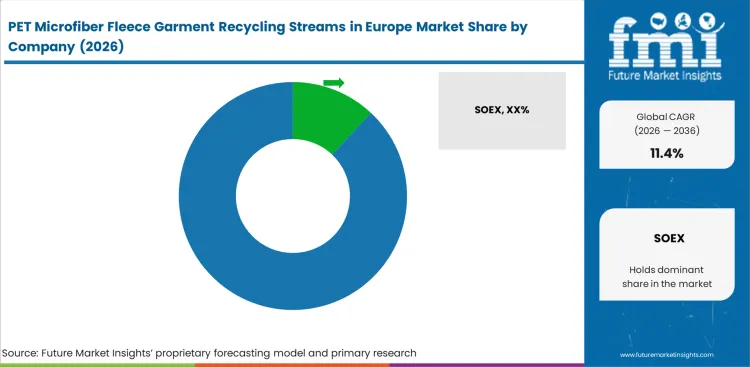
- Competition is shaped by control over collection access, sorting capability, and downstream route qualification rather than chemistry alone.
- Legacy sorting operators remain strongly positioned because municipal integration and collection arrangement take years to build.
- Partnership models between advanced recyclers and established aggregators are becoming more important as chemical scale-up depends on stable feedstock throughput.
The market remains fragmented as no single operator controls the full chain from garment collection to regenerated PET output at meaningful scale. Competitive strength still starts with feedstock access. Collection reach and sorting groundwork give established operators an advantage before advanced processing begins.
Chemical depolymerization specialists are competing for the same feedstock streams as mechanical shredding and sorting operators. Route chemistry alone does not determine commercial position. Continuous advanced recycling systems require reliable throughput. Access to sorted volume is as important as reactor capability. This is pushing the market toward partnership models in which advanced recyclers work alongside collection and sorting operators that already control inbound material.
Downstream buyers are also expanding qualification activity with caution. Many are avoiding overreliance on any single route while the market remains in scale-up mode. Participation is spreading across mechanical recycling and chemical depolymerization platforms to reduce interruption risk and preserve sourcing flexibility. Competitive consolidation is more likely where sorting capability, feedstock access, and conversion technology can be brought together in one operating model.
Major Industry Players
Key companies active in the PET microfiber fleece garment recycling streams in Europe market include:
- SOEX, TOMRA Textiles, and Nouvelles Fibres Textiles are among the more established operators in this market because their positioning is tied to textile collection access, sorting capability, and fiber preparation activity across European recovery chains.
- CARBIOS, Reju, Circ, and Eastman represent the group pushing the market toward higher-value polyester regeneration routes. Their position is shaped by chemical and molecular recycling capability, which is becoming more important as buyers seek stronger material recovery outcomes beyond conventional tear-down and lower-value fiber applications.
- Market leadership is still distributed rather than concentrated under one dominant operator, since Europe lacks a single company with full control from collection through regenerated PET output. Competitive strength therefore remains linked to route specialization, feedstock access, and the ability to convert recovered fleece garments into commercially usable secondary raw materials.
Competitive Benchmarking: PET Microfiber Fleece Garment Recycling Streams in Europe Market
| Company | Collection & Feedstock Access | Sorting / Feedstock Preparation | Polyester Regeneration Capability | Geographic Footprint |
|---|---|---|---|---|
| SOEX | High | High | Moderate | Multi-region |
| TOMRA Textiles | Low | High | Low | Global |
| Reju | Medium | Medium | High | Multi-region |
| CARBIOS | Low | Medium | High | Multi-region |
| Eastman | Low | Low | High | Global |
| Circ | Low | Low | High | Multi-region |
| Nouvelles Fibres Textiles | Medium | High | Low | Regional |
Source: Future Market Insights competitive analysis, 2026.
Key Developments in PET Microfiber Fleece Garment Recycling Streams in Europe Market
- In February 2026, Reju Announces Site Selection for French Regeneration Hub in Lacq Advancing Europe’s Circular Textile Infrastructure.
Key Players in the PET Microfiber Fleece Garment Recycling Streams in Europe Market
Major Global Players
- SOEX
- TOMRA Textiles
- Reju
- CARBIOS
- Eastman
Emerging Players / Growth-stage Participants
- Circ
- Nouvelles Fibres Textiles
Scope of the Report
| Metric | Value |
|---|---|
| Quantitative Units | USD 61.9 million to USD 182.2 million, at a CAGR of 11.4% |
| Market Definition | Formal supply chains dedicated to recovering, sorting, and processing end-of-use polyester fleece apparel back into usable secondary raw materials inside European borders. |
| Segmentation | Recycling route, Feedstock source, Collection channel, Feedstock purity, Output form, Region |
| Regions Covered | North America, Latin America, Western Europe, Eastern Europe, Asia Pacific |
| Countries Covered | France, Netherlands, Germany, Spain, Italy, Poland, Sweden |
| Key Companies Profiled | SOEX, TOMRA Textiles, Reju, CARBIOS, Eastman, Circ, Nouvelles Fibres Textiles |
| Forecast Period | 2026 to 2036 |
| Approach | Installed regional optical sorting capacity serves as baseline anchor metric |
Source: Future Market Insights (FMI) analysis, based on proprietary forecasting model and primary research
PET Microfiber Fleece Garment Recycling Streams in Europe Market Segments Analysis
Recycling route
- Mechanical
- Chemical
- Thermo-mechanical
- Solvolysis
Feedstock source
- Post-consumer
- Post-industrial
- Unsold stock
Collection channel
- Bring points
- Retail take-back
- Municipal curbside
- Civic sites
Feedstock purity
- Mono-material
- Blend-rich
- Dark colours
- Contaminated
Output form
- Staple fiber
- Pellets
- Monomers
- Insulation fill
Region
- Europe
- France
- Netherlands
- Germany
- Spain
- Italy
- Poland
- Sweden
Bibliography
- Reju. (2025). Reju and Nouvelles Fibres Textiles collaborate to create a circular ecosystem for textile waste in France.
- European Environment Agency. (2024, May 21). Management of used and waste textiles in Europe’s circular economy.
- European Environment Agency. (2025, March 19). Textile waste generation per person in the EU per year.
This bibliography is provided for reader reference. The full FMI report contains the complete reference list with primary research documentation.
This Report Addresses
- Market sizing and revenue forecasting for PET microfiber fleece garment recycling streams in Europe from 2026 to 2036
- Segmentation analysis across recycling route, feedstock source, collection channel, feedstock purity, and output form
- Country-level assessment of collection efficiency, route economics, and downstream processing depth across major European markets
- Competitive landscape analysis covering sorting operators, advanced recyclers, and route-positioning dynamics
- Feedstock quality analysis covering contamination, elastane presence, colour complexity, and route qualification barriers
- Processing outlook covering sorting, pre-processing, and downstream recycling capacity across the regional chain
Frequently Asked Questions
How large is the PET microfiber fleece garment recycling streams in Europe market in 2026?
The market is estimated to be valued at USD 61.9 million in 2026.
What will be the market size by 2036?
The market is projected to reach USD 182.2 million by 2036.What is the expected growth rate between 2026 and 2036?
What is the expected growth rate between 2026 and 2036?
Demand is expected to grow at a CAGR of 11.4% from 2026 to 2036.
Which recycling route is expected to lead in 2026?
Mechanical recycling is projected to account for 48% of the recycling route segment in 2026 because it remains the most commercially accessible recovery format under current foundational conditions.
Which feedstock source remains the largest in this market?
Post-consumer feedstock is expected to lead with 72% share in 2026 due to the large volume of household textile disposal entering recovery channels.
Why do bring points remain important in Europe?
Bring points continue to dominate textile collection coverage because they allow municipalities to gather large garment volumes without building more labour-intensive collection networks.
Preview the report firsthand - request a free sample
Get SampleGet the brochure for pricing and purchase details.
Get PDFTable of Content
- Executive Summary
- Global Market Outlook
- Demand-side Trends
- Supply-side Trends
- Technology Roadmap Analysis
- Analysis and Recommendations
- Market Overview
- Market Coverage / Taxonomy
- Market Definition / Scope / Limitations
- Research Methodology
- Chapter Orientation
- Analytical Lens and Working Hypotheses
- Market Structure, Signals, and Trend Drivers
- Benchmarking and Cross-market Comparability
- Market Sizing, Forecasting, and Opportunity Mapping
- Research Design and Evidence Framework
- Desk Research Programme (Secondary Evidence)
- Company Annual and Sustainability Reports
- Peer-reviewed Journals and Academic Literature
- Corporate Websites, Product Literature, and Technical Notes
- Earnings Decks and Investor Briefings
- Statutory Filings and Regulatory Disclosures
- Technical White Papers and Standards Notes
- Trade Journals, Industry Magazines, and Analyst Briefs
- Conference Proceedings, Webinars, and Seminar Materials
- Government Statistics Portals and Public Data Releases
- Press Releases and Reputable Media Coverage
- Specialist Newsletters and Curated Briefings
- Sector Databases and Reference Repositories
- FMI Internal Proprietary Databases and Historical Market Datasets
- Subscription Datasets and Paid Sources
- Social Channels, Communities, and Digital Listening Inputs
- Additional Desk Sources
- Expert Input and Fieldwork (Primary Evidence)
- Primary Modes
- Qualitative Interviews and Expert Elicitation
- Quantitative Surveys and Structured Data Capture
- Blended Approach
- Why Primary Evidence is Used
- Field Techniques
- Interviews
- Surveys
- Focus Groups
- Observational and In-context Research
- Social and Community Interactions
- Stakeholder Universe Engaged
- C-suite Leaders
- Board Members
- Presidents and Vice Presidents
- R&D and Innovation Heads
- Technical Specialists
- Domain Subject-matter Experts
- Scientists
- Physicians and Other Healthcare Professionals
- Governance, Ethics, and Data Stewardship
- Research Ethics
- Data Integrity and Handling
- Primary Modes
- Tooling, Models, and Reference Databases
- Desk Research Programme (Secondary Evidence)
- Data Engineering and Model Build
- Data Acquisition and Ingestion
- Cleaning, Normalisation, and Verification
- Synthesis, Triangulation, and Analysis
- Quality Assurance and Audit Trail
- Market Background
- Market Dynamics
- Drivers
- Restraints
- Opportunity
- Trends
- Scenario Forecast
- Demand in Optimistic Scenario
- Demand in Likely Scenario
- Demand in Conservative Scenario
- Opportunity Map Analysis
- Product Life Cycle Analysis
- Supply Chain Analysis
- Investment Feasibility Matrix
- Value Chain Analysis
- PESTLE and Porter’s Analysis
- Regulatory Landscape
- Regional Parent Market Outlook
- Production and Consumption Statistics
- Import and Export Statistics
- Market Dynamics
- Global Market Analysis 2021 to 2025 and Forecast, 2026 to 2036
- Historical Market Size Value (USD Million) Analysis, 2021 to 2025
- Current and Future Market Size Value (USD Million) Projections, 2026 to 2036
- Y-o-Y Growth Trend Analysis
- Absolute $ Opportunity Analysis
- Global Market Pricing Analysis 2021 to 2025 and Forecast 2026 to 2036
- Global Market Analysis 2021 to 2025 and Forecast 2026 to 2036, By Recycling Route
- Introduction / Key Findings
- Historical Market Size Value (USD Million) Analysis By Recycling Route , 2021 to 2025
- Current and Future Market Size Value (USD Million) Analysis and Forecast By Recycling Route , 2026 to 2036
- Mechanical
- Chemical
- Solvolysis
- Mechanical
- Y-o-Y Growth Trend Analysis By Recycling Route , 2021 to 2025
- Absolute $ Opportunity Analysis By Recycling Route , 2026 to 2036
- Global Market Analysis 2021 to 2025 and Forecast 2026 to 2036, By Feedstock Source
- Introduction / Key Findings
- Historical Market Size Value (USD Million) Analysis By Feedstock Source, 2021 to 2025
- Current and Future Market Size Value (USD Million) Analysis and Forecast By Feedstock Source, 2026 to 2036
- Post-Consumer
- Post-Industrial
- Unsold Stock
- Post-Consumer
- Y-o-Y Growth Trend Analysis By Feedstock Source, 2021 to 2025
- Absolute $ Opportunity Analysis By Feedstock Source, 2026 to 2036
- Global Market Analysis 2021 to 2025 and Forecast 2026 to 2036, By Collection channel
- Introduction / Key Findings
- Historical Market Size Value (USD Million) Analysis By Collection channel, 2021 to 2025
- Current and Future Market Size Value (USD Million) Analysis and Forecast By Collection channel, 2026 to 2036
- Bring Points
- Municipal Curbside
- Civic Sites
- Bring Points
- Y-o-Y Growth Trend Analysis By Collection channel, 2021 to 2025
- Absolute $ Opportunity Analysis By Collection channel, 2026 to 2036
- Global Market Analysis 2021 to 2025 and Forecast 2026 to 2036, By Feedstock Purity
- Introduction / Key Findings
- Historical Market Size Value (USD Million) Analysis By Feedstock Purity, 2021 to 2025
- Current and Future Market Size Value (USD Million) Analysis and Forecast By Feedstock Purity, 2026 to 2036
- Mono-Material
- Blend-Rich
- Contaminated
- Mono-Material
- Y-o-Y Growth Trend Analysis By Feedstock Purity, 2021 to 2025
- Absolute $ Opportunity Analysis By Feedstock Purity, 2026 to 2036
- Global Market Analysis 2021 to 2025 and Forecast 2026 to 2036, By Output Form
- Introduction / Key Findings
- Historical Market Size Value (USD Million) Analysis By Output Form, 2021 to 2025
- Current and Future Market Size Value (USD Million) Analysis and Forecast By Output Form, 2026 to 2036
- Staple Fiber
- Pellets
- Monomers
- Staple Fiber
- Y-o-Y Growth Trend Analysis By Output Form, 2021 to 2025
- Absolute $ Opportunity Analysis By Output Form, 2026 to 2036
- Global Market Analysis 2021 to 2025 and Forecast 2026 to 2036, By Region
- Introduction
- Historical Market Size Value (USD Million) Analysis By Region, 2021 to 2025
- Current Market Size Value (USD Million) Analysis and Forecast By Region, 2026 to 2036
- North America
- Latin America
- Western Europe
- Eastern Europe
- East Asia
- South Asia and Pacific
- Middle East & Africa
- Market Attractiveness Analysis By Region
- North America Market Analysis 2021 to 2025 and Forecast 2026 to 2036, By Country
- Historical Market Size Value (USD Million) Trend Analysis By Market Taxonomy, 2021 to 2025
- Market Size Value (USD Million) Forecast By Market Taxonomy, 2026 to 2036
- By Country
- USA
- Canada
- Mexico
- By Recycling Route
- By Feedstock Source
- By Collection channel
- By Feedstock Purity
- By Output Form
- By Country
- Market Attractiveness Analysis
- By Country
- By Recycling Route
- By Feedstock Source
- By Collection channel
- By Feedstock Purity
- By Output Form
- Key Takeaways
- Latin America Market Analysis 2021 to 2025 and Forecast 2026 to 2036, By Country
- Historical Market Size Value (USD Million) Trend Analysis By Market Taxonomy, 2021 to 2025
- Market Size Value (USD Million) Forecast By Market Taxonomy, 2026 to 2036
- By Country
- Brazil
- Chile
- Rest of Latin America
- By Recycling Route
- By Feedstock Source
- By Collection channel
- By Feedstock Purity
- By Output Form
- By Country
- Market Attractiveness Analysis
- By Country
- By Recycling Route
- By Feedstock Source
- By Collection channel
- By Feedstock Purity
- By Output Form
- Key Takeaways
- Western Europe Market Analysis 2021 to 2025 and Forecast 2026 to 2036, By Country
- Historical Market Size Value (USD Million) Trend Analysis By Market Taxonomy, 2021 to 2025
- Market Size Value (USD Million) Forecast By Market Taxonomy, 2026 to 2036
- By Country
- Germany
- UK
- Italy
- Spain
- France
- Nordic
- BENELUX
- Rest of Western Europe
- By Recycling Route
- By Feedstock Source
- By Collection channel
- By Feedstock Purity
- By Output Form
- By Country
- Market Attractiveness Analysis
- By Country
- By Recycling Route
- By Feedstock Source
- By Collection channel
- By Feedstock Purity
- By Output Form
- Key Takeaways
- Eastern Europe Market Analysis 2021 to 2025 and Forecast 2026 to 2036, By Country
- Historical Market Size Value (USD Million) Trend Analysis By Market Taxonomy, 2021 to 2025
- Market Size Value (USD Million) Forecast By Market Taxonomy, 2026 to 2036
- By Country
- Russia
- Poland
- Hungary
- Balkan & Baltic
- Rest of Eastern Europe
- By Recycling Route
- By Feedstock Source
- By Collection channel
- By Feedstock Purity
- By Output Form
- By Country
- Market Attractiveness Analysis
- By Country
- By Recycling Route
- By Feedstock Source
- By Collection channel
- By Feedstock Purity
- By Output Form
- Key Takeaways
- East Asia Market Analysis 2021 to 2025 and Forecast 2026 to 2036, By Country
- Historical Market Size Value (USD Million) Trend Analysis By Market Taxonomy, 2021 to 2025
- Market Size Value (USD Million) Forecast By Market Taxonomy, 2026 to 2036
- By Country
- China
- Japan
- South Korea
- By Recycling Route
- By Feedstock Source
- By Collection channel
- By Feedstock Purity
- By Output Form
- By Country
- Market Attractiveness Analysis
- By Country
- By Recycling Route
- By Feedstock Source
- By Collection channel
- By Feedstock Purity
- By Output Form
- Key Takeaways
- South Asia and Pacific Market Analysis 2021 to 2025 and Forecast 2026 to 2036, By Country
- Historical Market Size Value (USD Million) Trend Analysis By Market Taxonomy, 2021 to 2025
- Market Size Value (USD Million) Forecast By Market Taxonomy, 2026 to 2036
- By Country
- India
- ASEAN
- Australia & New Zealand
- Rest of South Asia and Pacific
- By Recycling Route
- By Feedstock Source
- By Collection channel
- By Feedstock Purity
- By Output Form
- By Country
- Market Attractiveness Analysis
- By Country
- By Recycling Route
- By Feedstock Source
- By Collection channel
- By Feedstock Purity
- By Output Form
- Key Takeaways
- Middle East & Africa Market Analysis 2021 to 2025 and Forecast 2026 to 2036, By Country
- Historical Market Size Value (USD Million) Trend Analysis By Market Taxonomy, 2021 to 2025
- Market Size Value (USD Million) Forecast By Market Taxonomy, 2026 to 2036
- By Country
- Kingdom of Saudi Arabia
- Other GCC Countries
- Turkiye
- South Africa
- Other African Union
- Rest of Middle East & Africa
- By Recycling Route
- By Feedstock Source
- By Collection channel
- By Feedstock Purity
- By Output Form
- By Country
- Market Attractiveness Analysis
- By Country
- By Recycling Route
- By Feedstock Source
- By Collection channel
- By Feedstock Purity
- By Output Form
- Key Takeaways
- Key Countries Market Analysis
- USA
- Pricing Analysis
- Market Share Analysis, 2025
- By Recycling Route
- By Feedstock Source
- By Collection channel
- By Feedstock Purity
- By Output Form
- Canada
- Pricing Analysis
- Market Share Analysis, 2025
- By Recycling Route
- By Feedstock Source
- By Collection channel
- By Feedstock Purity
- By Output Form
- Mexico
- Pricing Analysis
- Market Share Analysis, 2025
- By Recycling Route
- By Feedstock Source
- By Collection channel
- By Feedstock Purity
- By Output Form
- Brazil
- Pricing Analysis
- Market Share Analysis, 2025
- By Recycling Route
- By Feedstock Source
- By Collection channel
- By Feedstock Purity
- By Output Form
- Chile
- Pricing Analysis
- Market Share Analysis, 2025
- By Recycling Route
- By Feedstock Source
- By Collection channel
- By Feedstock Purity
- By Output Form
- Germany
- Pricing Analysis
- Market Share Analysis, 2025
- By Recycling Route
- By Feedstock Source
- By Collection channel
- By Feedstock Purity
- By Output Form
- UK
- Pricing Analysis
- Market Share Analysis, 2025
- By Recycling Route
- By Feedstock Source
- By Collection channel
- By Feedstock Purity
- By Output Form
- Italy
- Pricing Analysis
- Market Share Analysis, 2025
- By Recycling Route
- By Feedstock Source
- By Collection channel
- By Feedstock Purity
- By Output Form
- Spain
- Pricing Analysis
- Market Share Analysis, 2025
- By Recycling Route
- By Feedstock Source
- By Collection channel
- By Feedstock Purity
- By Output Form
- France
- Pricing Analysis
- Market Share Analysis, 2025
- By Recycling Route
- By Feedstock Source
- By Collection channel
- By Feedstock Purity
- By Output Form
- India
- Pricing Analysis
- Market Share Analysis, 2025
- By Recycling Route
- By Feedstock Source
- By Collection channel
- By Feedstock Purity
- By Output Form
- ASEAN
- Pricing Analysis
- Market Share Analysis, 2025
- By Recycling Route
- By Feedstock Source
- By Collection channel
- By Feedstock Purity
- By Output Form
- Australia & New Zealand
- Pricing Analysis
- Market Share Analysis, 2025
- By Recycling Route
- By Feedstock Source
- By Collection channel
- By Feedstock Purity
- By Output Form
- China
- Pricing Analysis
- Market Share Analysis, 2025
- By Recycling Route
- By Feedstock Source
- By Collection channel
- By Feedstock Purity
- By Output Form
- Japan
- Pricing Analysis
- Market Share Analysis, 2025
- By Recycling Route
- By Feedstock Source
- By Collection channel
- By Feedstock Purity
- By Output Form
- South Korea
- Pricing Analysis
- Market Share Analysis, 2025
- By Recycling Route
- By Feedstock Source
- By Collection channel
- By Feedstock Purity
- By Output Form
- Russia
- Pricing Analysis
- Market Share Analysis, 2025
- By Recycling Route
- By Feedstock Source
- By Collection channel
- By Feedstock Purity
- By Output Form
- Poland
- Pricing Analysis
- Market Share Analysis, 2025
- By Recycling Route
- By Feedstock Source
- By Collection channel
- By Feedstock Purity
- By Output Form
- Hungary
- Pricing Analysis
- Market Share Analysis, 2025
- By Recycling Route
- By Feedstock Source
- By Collection channel
- By Feedstock Purity
- By Output Form
- Kingdom of Saudi Arabia
- Pricing Analysis
- Market Share Analysis, 2025
- By Recycling Route
- By Feedstock Source
- By Collection channel
- By Feedstock Purity
- By Output Form
- Turkiye
- Pricing Analysis
- Market Share Analysis, 2025
- By Recycling Route
- By Feedstock Source
- By Collection channel
- By Feedstock Purity
- By Output Form
- South Africa
- Pricing Analysis
- Market Share Analysis, 2025
- By Recycling Route
- By Feedstock Source
- By Collection channel
- By Feedstock Purity
- By Output Form
- USA
- Market Structure Analysis
- Competition Dashboard
- Competition Benchmarking
- Market Share Analysis of Top Players
- By Regional
- By Recycling Route
- By Feedstock Source
- By Collection channel
- By Feedstock Purity
- By Output Form
- Competition Analysis
- Competition Deep Dive
- SOEX
- Overview
- Product Portfolio
- Profitability by Market Segments (Product/Age /Sales Channel/Region)
- Sales Footprint
- Strategy Overview
- Marketing Strategy
- Product Strategy
- Channel Strategy
- TOMRA Textiles
- Reju
- CARBIOS
- Eastman
- Circ
- Nouvelles Fibres Textiles
- SOEX
- Competition Deep Dive
- Assumptions & Acronyms Used


