

- Industry Size (2025)
- USD 4.9 Bn
- Forecast (2035)
- USD 19.6 Bn
- CAGR (2025 to 2035)
- 15.1%
PET Bottle-to-Bottle Recycling Plants Meeting EU 30% Recycled Content Mandate Market Forecast and Outlook 2026 to 2036
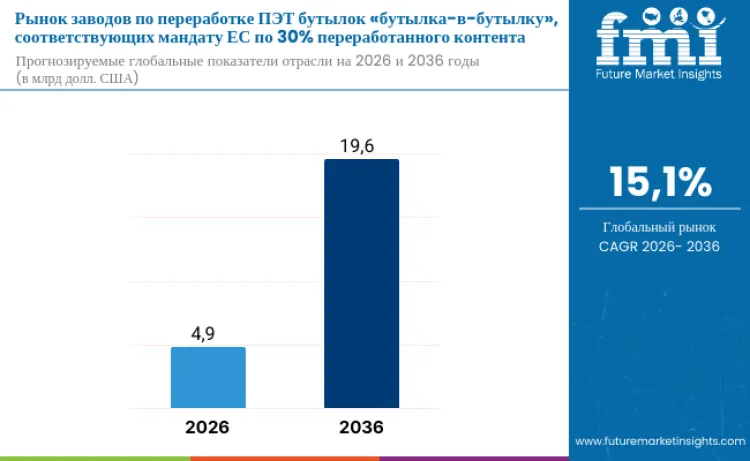
The PET bottle-to-bottle recycling plants market is valued at USD 4.9 billion in 2026 and is projected to reach USD 19.6 billion by 2036, reflecting a CAGR of 15.1%. Mechanical bottle-to-bottle recycling systems lead technology adoption because they offer proven scalability, strong decontamination performance, and high polymer recovery yields. Advanced wash lines, multi-stage extrusion, melt filtration, and solid-state polycondensation restore intrinsic viscosity and ensure suitability for direct food-contact applications. Optical sorting upgrades improve accuracy in removing PET variants, closures, and contaminants to raise recyclate purity. Demand intensifies as beverage brands adapt to EU directives requiring minimum recycled content in PET bottles and expand supply agreements for food-grade rPET. Investments accelerate in high-capacity plants capable of delivering consistent, compliance-ready output.
Quick Stats for PET Bottle-to-Bottle Recycling Plants Meeting EU 30% Recycled Content Mandate Market
- Market Value (2026): USD 4.9 billion
- Market Forecast Value (2036): USD 19.6 billion
- Forecast CAGR (2026 to 2036): 15.1%
- Leading Recycling Technology in Global Demand: Mechanical bottle-to-bottle recycling systems
- Key Growth Regions in Global Demand: China, India, USA, Japan
- Top Players in Global Demand: Erema Group, Starlinger Recycling Technology, Indorama Ventures, Plastipak, Veolia
China, India, USA, and Japan emerge as strategic growth regions due to global demand for recycling equipment, technology exports, and cross-border circular packaging initiatives. Erema Group, Starlinger Recycling Technology, Indorama Ventures, Plastipak, and Veolia guide competitive development through large-scale rPET plant deployments, licensing of advanced decontamination technologies, and partnerships with beverage producers seeking stable supply for EU-mandated recycled-content compliance.
PET Bottle-to-Bottle Recycling Plants Meeting EU 30% Recycled Content Mandate Market Key Takeaways
| Metric | Value |
|---|---|
| Market Value (2026) | USD 4.9 billion |
| Market Forecast Value (2036) | USD 19.6 billion |
| Forecast CAGR (2026-2036) | 15.1% |
How Are the Segments Classified in the PET Bottle-to-Bottle Recycling Plants Meeting EU 30% Recycled Content Mandate Market?
Demand for EU-compliant bottle-to-bottle PET recycling plants is shaped by mandatory recycled-content targets, large-scale beverage-sector requirements, and rising investment in high-purity rPET production capacity. Buyers evaluate decontamination efficiency, melt-quality consistency, and plant throughput aligned with food-grade safety regulations. Adoption patterns reflect expansion of mechanical recycling, integration of advanced sorting technologies, and complementary chemical depolymerization routes supporting closed-loop PET systems.
Which Recycling Technology Accounts for the Largest Share of Global Demand?
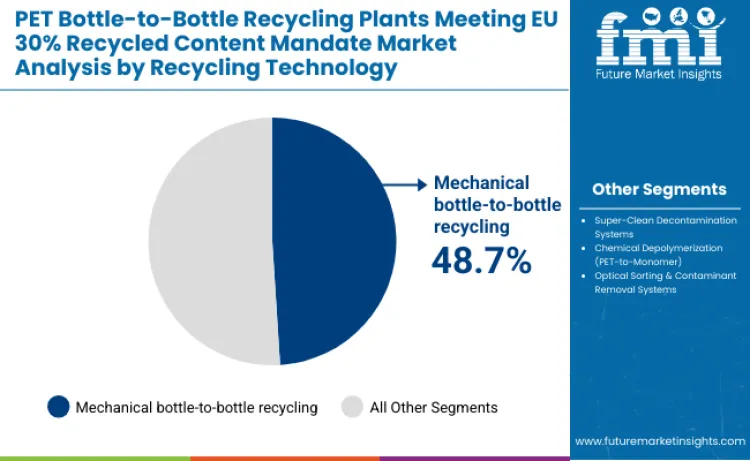
Mechanical bottle-to-bottle recycling systems hold 48.7%, making them the leading recycling-technology segment globally. These systems support high-throughput washing, flake purification, melt filtration, and re-pelletizing for food-grade rPET production. Super-clean decontamination systems elevate purity by removing volatile residues to meet EU food-contact limits. Chemical depolymerization converts contaminated PET into monomers suitable for high-purity repolymerization when mechanical performance is insufficient. Optical sorting and contaminant removal systems support feedstock cleaning by separating PVC, colored PET, and foreign materials. Technology distribution reflects strong reliance on scalable mechanical systems reinforced by advanced purification.
Key Points:
- Mechanical recycling supports large-scale food-grade rPET output.
- Super-clean systems ensure compliance with migration-limit criteria.
- Chemical depolymerization treats mixed or contaminated PET.
- Optical sorting improves input purity for consistent downstream quality.
Which Plant Capacity Segment Represents the Largest Share of Global Demand?
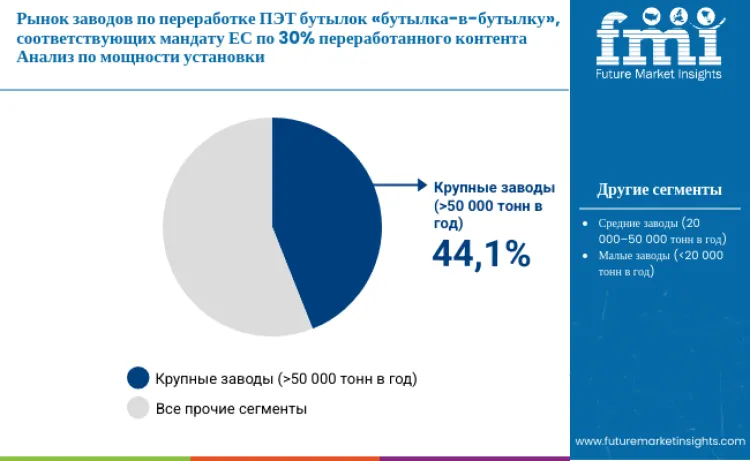
Large-scale plants above 50,000 TPA hold 44.1%, making them the leading capacity segment globally. These plants supply beverage companies needing consistent high-volume food-grade rPET to satisfy the EU 30% mandate. Mid-scale plants between 20,000 and 50,000 TPA support regional demand and diversified packaging sectors. Small-scale plants below 20,000 TPA serve localized collection zones or niche rPET applications with limited throughput. Capacity distribution reflects strong demand from major beverage producers requiring predictable recycled-content supply at industrial scale.
Key Points:
- Large plants provide high-volume output for beverage-sector compliance.
- Mid-scale plants support regional or multi-sector demand.
- Small plants address localized or specialty rPET requirements.
- Capacity choice aligns with feedstock availability and supply-chain scale.
Which Application Accounts for the Largest Share of Global Demand?
Beverage-grade rPET bottles hold 46.9%, making them the largest application segment globally. Compliance with EU beverage-sector mandates drives significant demand for high-purity rPET with strict color, clarity, and migration-limit criteria. Food-grade PET containers require odor-free rPET suitable for trays and rigid packaging. Personal care and household bottles rely on mechanical properties and consistent molding performance without stringent food-contact demands. Industrial packaging applications support non-food uses with wider tolerance for color variation. Application distribution reflects the dominance of beverage producers in rPET demand under mandatory recycled-content requirements.
Key Points:
- Beverage-grade bottles drive highest rPET demand under EU mandates.
- Food-grade containers require high-purity, odor-neutral resin.
- Personal-care bottles rely on consistent molding performance.
- Industrial packaging accepts broader property variation for rPET.a
What are the Key Dynamics in the PET Bottle-to-Bottle Recycling Plants Meeting EU 30% Recycled Content Mandate Market?
Global demand rises as beverage brands, recyclers, and packaging producers prepare for EU rules requiring 30 percent recycled content in PET bottles. Bottle-to-bottle plants expand capacity to supply food grade rPET compliant with strict migration and purity standards. Sorting, washing, and SSP technologies advance to deliver high quality outputs at scale. Long term offtake agreements form between producers and recyclers to stabilize supply needed for compliance across EU beverage sectors.
How are regulatory mandates and brand sustainability commitments shaping bottle-to-bottle recycling capacity?
EU content rules accelerate investment in mechanical recycling lines capable of producing food grade rPET. Brands seek secure supply to meet annual compliance thresholds, driving multiyear partnerships with recyclers. Sorting plants upgrade NIR and colour detection systems to maximize capture of clear PET bottles. Recyclers deploy advanced washing, decontamination, and solid state polycondensation units to meet food contact safety standards. Packaging producers redesign bottles for improved recyclability, reducing pigments and labels. Regional beverage markets emphasize transparent sourcing and traceability, encouraging adoption of certification systems that validate rPET quality and regulatory conformity.
How do feedstock scarcity, quality variability, and operational constraints influence plant scalability?
Collection systems across EU regions show inconsistent recovery rates, limiting clear PET feedstock availability for bottle-to-bottle recycling. Contamination from colour bottles, labels, and organics reduces yield and increases processing intensity. Recyclers face challenges stabilizing IV levels and mechanical performance of rPET to meet bottling requirements. Operational costs rise due to energy consumption in SSP processes. Competition for high quality feedstock increases procurement pressure across beverage producers. Plants require continuous quality monitoring to ensure compliance with food contact rules. Infrastructure gaps in certain regions delay scale-up of efficient bottle sorting and dedicated food grade recycling lines.
How is Demand for PET Bottle-to-Bottle Recycling Plants Meeting EU 30% Recycled Content Mandate Market Evolving Across Key Countries?
Demand for the PET bottle-to-bottle recycling plants meeting the EU 30% recycled content mandate market is rising due to global alignment with food-grade recycling standards, expansion of high-purity PET recovery capacity, and brand-owner requirements for certified rPET. China records a CAGR of 16.0% supported by rapid facility upgrades. India shows a 15.4% CAGR driven by strong PET packaging growth and regulatory modernization. USA posts a 14.3% CAGR supported by investment in bottle-grade rPET technologies. Japan holds a 13.4% CAGR linked with precision recycling systems. UK records a 12.9% CAGR supported by circular packaging policies and EPR-driven compliance.
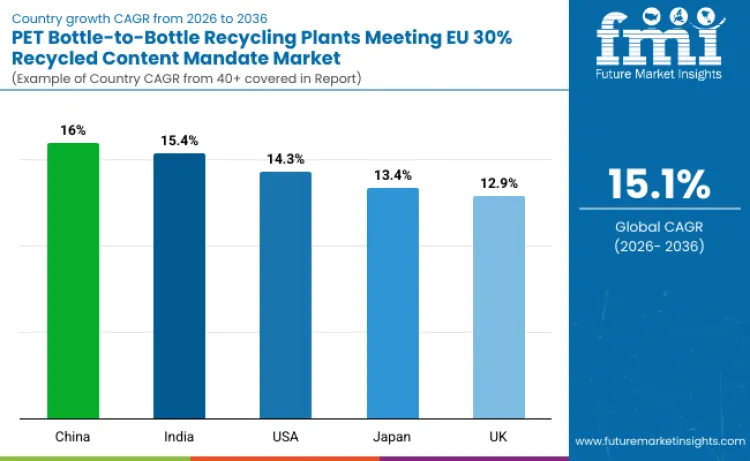
| Country | CAGR (%) |
|---|---|
| China | 16.0% |
| India | 15.4% |
| USA | 14.3% |
| Japan | 13.4% |
| UK | 12.9% |
How is China driving demand for PET Bottle-to-Bottle Recycling Plants Meeting the EU 30% Recycled Content Mandate?
China drives demand due to high PET bottle usage, expansion of food-grade recycling infrastructure, and increased alignment with international material-compliance standards. The country’s CAGR of 16.0% reflects deployment of advanced decontamination, melt-filtration, and SSP systems enabling bottle-grade rPET production. Regional recycling clusters invest in high-accuracy NIR sorting enhancing PET purity. Brand-owner sustainability commitments accelerate adoption of EU-aligned recycled content benchmarks. Collaboration between converters and recyclers strengthens feedstock uniformity. National circular-plastics programs support long-term investment in bottle-to-bottle technology.
- High PET bottle output requiring closed-loop recovery
- Installation of advanced decontamination and SSP systems
- Brand-owner alignment with EU recycled-content expectations
- Circular-plastics initiatives supporting bottle-grade rPET capacity
How is India driving demand for PET Bottle-to-Bottle Recycling Plants Meeting the EU 30% Recycled Content Mandate?
India supports rising demand due to strong beverage-sector growth, regulatory push toward higher recyclability, and increasing investment in food-grade PET reprocessing. The country’s CAGR of 15.4% reflects expansion of PET bottle collection and upgrading of pre-sorting, hot-wash, and SSP technologies. Recycling operators pursue EU-standard compliance for export-oriented packaging. Converters shift toward bottle-grade rPET integration supporting circular packaging commitments. Government-led EPR frameworks improve feedstock quality, enabling more consistent bottle-to-bottle recovery. Beverage producers increase procurement of high-purity rPET to meet sustainability targets.
- Expansion of PET bottle-collection systems
- Upgraded washing and SSP processes supporting food-grade output
- Converter interest in bottle-grade rPET integration
- EPR frameworks improving feedstock cleanliness and consistency
How is the USA driving demand for PET Bottle-to-Bottle Recycling Plants Meeting the EU 30% Recycled Content Mandate?
USA drives demand through infrastructure modernization, rising procurement of food-grade rPET, and broader adoption of design-for-recycling packaging. The country’s CAGR of 14.3% reflects increased installation of high-speed optical sorting, advanced decontamination modules, and SSP reactors. Brand-owner commitments strengthen demand for bottle-grade rPET meeting international standards. Regional MRF upgrades improve PET purity and throughput. Chemical-recycling pilots provide supplemental feedstock for high-quality rPET. Retail and beverage producers integrate rPET to align with sustainability frameworks.
- Optical-sorting upgrades improving PET purity
- Strong brand-owner demand for food-grade rPET
- SSP and decontamination enhancements increasing compliant output
- Chemical-recycling pilots supporting rPET supply resilience
How is Japan driving demand for PET Bottle-to-Bottle Recycling Plants Meeting the EU 30% Recycled Content Mandate?
Japan drives demand due to structured collection systems, precision recycling practices, and strong quality expectations for food-contact materials. The country’s CAGR of 13.4% reflects adoption of high-efficiency decontamination and SSP technologies generating consistent bottle-grade rPET. Municipal collection ensures stable, clean feedstock supporting closed-loop processing. Packaging producers collaborate with recyclers to maintain material specifications aligning with EU standards. Focus on resource efficiency strengthens investment in advanced reprocessing capabilities.
- Structured collection delivering uniform PET feedstock
- High-precision decontamination and SSP processes
- Manufacturer–recycler collaboration supporting compliance
- Quality-driven recycling standards promoting stable rPET output
How is the UK driving demand for PET Bottle-to-Bottle Recycling Plants Meeting the EU 30% Recycled Content Mandate?
UK supports demand through EPR-driven compliance, national recycled-content goals, and strong reliance on PET bottles in beverage sectors. The country’s CAGR of 12.9% reflects expansion of bottle-specific sorting lines and investment in food-grade PET reprocessing. Policy alignment with EU recycled-content mandates accelerates adoption of bottle-to-bottle systems. Packaging producers shift toward high-purity feedstock requirements supporting upgraded washing and SSP infrastructure. Retailers and beverage brands increase procurement of certified rPET to meet sustainability commitments.
- EPR and policy alignment driving recycled-content compliance
- Expansion of bottle-specific sorting and reprocessing lines
- Retail and beverage demand for certified food-grade rPET
- National recycling strategies supporting closed-loop PET systems
What is the competitive landscape of demand for PET bottle-to-bottle recycling plants meeting the EU 30% recycled content mandate?
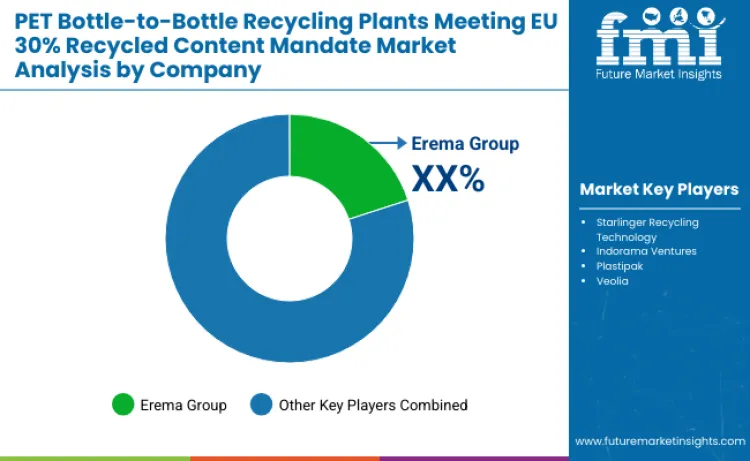
Demand for PET bottle-to-bottle recycling plants meeting the EU 30% recycled content mandate grows as beverage producers, packaging converters, and recyclers expand food-grade rPET capacity to comply with regulatory thresholds. Requirements center on decontamination efficiency, IV stability, color consistency, and throughput aligned with EFSA food-contact criteria. Buyers evaluate pre-sorting precision, label and adhesive removal, hot-wash performance, and melt filtration capability supporting high-purity flake and pellet output. Procurement teams prioritize energy efficiency, operational uptime, traceable feedstock management, and modular plant designs that accommodate regional collection variability. Trend in the EU market reflects accelerated investment in closed-loop PET infrastructure, enhanced NIR sorting, and expanded partnerships between recyclers and beverage producers.
Erema Group holds an estimated 33.0% share. Position strengthens through large-scale Vacurema and extrusion technologies delivering food-grade rPET widely adopted in EU bottle-to-bottle operations. Starlinger Recycling Technology participates with recoSTAR systems supporting high-purity pellet production for beverage-grade applications. Indorama Ventures maintains visibility through integrated recycling plants operating across Europe supplying food-grade rPET to major bottlers. Plastipak contributes with mechanical recycling platforms and vertically integrated rPET production supporting converter networks. Veolia supports demand through EU recycling facilities equipped with upgraded sorting, washing, and pelletizing lines designed for bottle-to-bottle output. Competitive positioning across the EU reflects decontamination performance, plant scalability, feedstock quality control, and certification readiness supporting the 30% mandate.
Key Players in the PET Bottle-to-Bottle Recycling Plants Meeting EU 30% Recycled Content Mandate Market
- Erema Group
- Starlinger Recycling Technology
- Indorama Ventures
- Plastipak
- Veolia
Scope of the Report
| Items | Values |
|---|---|
| Quantitative Units | USD billion |
| Recycling Technology | Mechanical Bottle-to-Bottle Recycling Systems, Super-Clean Decontamination Systems, Chemical Depolymerization (PET-to-Monomer), Optical Sorting & Contaminant Removal Systems |
| Plant Capacity | Large-Scale Plants (>50,000 TPA), Mid-Scale Plants (20,000–50,000 TPA), Small-Scale Plants (<20,000 TPA) |
| Application | Beverage-Grade rPET Bottles, Food-Grade PET Containers, Personal Care & Household Bottles, Industrial Packaging Applications |
| End-User | Beverage & Bottled Water Companies, Packaging Converters, FMCG Brands, Contract Recyclers & Waste Management Firms |
| Regions Covered | Asia Pacific, Europe, North America, Latin America, Middle East & Africa |
| Countries Covered | India, China, USA, Germany, South Korea, Japan, Italy, and 40+ countries |
| Key Companies Profiled | Erema Group, Starlinger Recycling Technology, Indorama Ventures, Plastipak, Veolia |
| Additional Attributes | Dollar sales by recycling technology, plant capacity tiers, and application segments; regional adoption trends aligned with EU 30% rPET mandate; scaling of super-clean decontamination systems for food-contact compliance; efficiency benchmarks for optical sorting and contaminant removal; integration of chemical depolymerization for high-quality monomer recovery; investment patterns in large-scale bottle-to-bottle plants across Europe; converter partnerships and contract recycling models. |
PET Bottle-to-Bottle Recycling Plants Meeting EU 30% Recycled Content Mandate Market by Segment
By Recycling Technology:
- Mechanical Bottle-to-Bottle Recycling Systems
- Super-Clean Decontamination Systems
- Chemical Depolymerization (PET-to-Monomer)
- Optical Sorting & Contaminant Removal Systems
By Plant Capacity:
- Large-Scale Plants (>50,000 TPA)
- Mid-Scale Plants (20,000–50,000 TPA)
- Small-Scale Plants (<20,000 TPA)
By Application:
- Beverage-Grade rPET Bottles
- Food-Grade PET Containers
- Personal Care & Household Bottles
- Industrial Packaging Applications
By End-User:
- Beverage & Bottled Water Companies
- Packaging Converters
- FMCG Brands
- Contract Recyclers & Waste Management Firms
Region:
- Asia Pacific
- China
- Japan
- South Korea
- India
- Australia & New Zealand
- ASEAN
- Rest of Asia Pacific
- Europe
- Germany
- United Kingdom
- France
- Italy
- Spain
- Nordic
- BENELUX
- Rest of Europe
- North America
- United States
- Canada
- Mexico
- Latin America
- Brazil
- Chile
- Rest of Latin America
- Middle East & Africa
- Kingdom of Saudi Arabia
- Other GCC Countries
- Turkey
- South Africa
- Other African Union
- Rest of Middle East & Africa
Frequently Asked Questions
What is the size of the PET bottle-to-bottle recycling plants meeting the EU 30% recycled content mandate market in 2026?
The market is valued at USD 4.9 billion in 2026 as producers expand B2B recycling capacity to meet mandatory recycled-content thresholds.
What will be the industry size by 2036?
Industry value will reach USD 19.6 billion by 2036 due to scaling of food-grade rPET production lines and investment in large-capacity processing units.
What is the CAGR for 2026 to 2036?
The PET bottle-to-bottle recycling plants meeting the EU 30% recycled content mandate market expands at a 15.1% CAGR during the forecast period.
Which processing-technology segment leads in 2026?
Mechanical B2B recycling holds 48.7% share, driven by its established efficiency in producing food-grade rPET.
Which plant-capacity segment holds the highest share?
Large-scale plants lead with 44.1% share due to their throughput advantage and alignment with rising EU rPET demand.
Preview the report firsthand - request a free sample
Get SampleGet the brochure for pricing and purchase details.
Get PDFTable of Content
- Executive Summary
- Market Overview
- Global Market Value, 2020-2026
- Global Market Forecast, 2026-2036
- Market Dynamics
- Drivers
- Restraints
- Opportunities
- Regulatory & Standards Landscape
- Technology & Material Innovation Outlook
- Market Segmentation Analysis
- By Recycling Technology
- Mechanical Bottle-to-Bottle Recycling Systems
- Super-Clean Decontamination Systems
- Chemical Depolymerization (PET-to-Monomer)
- Optical Sorting & Contaminant Removal Systems
- By Plant Capacity
- Large-Scale Plants (>50,000 TPA)
- Mid-Scale Plants (20,000-50,000 TPA)
- Small-Scale Plants (<20,000 TPA)
- By Application
- Beverage-Grade rPET Bottles
- Food-Grade PET Containers
- Personal Care & Household Bottles
- Industrial Packaging Applications
- By End-User
- Beverage & Bottled Water Companies
- Packaging Converters
- FMCG Brands
- Contract Recyclers & Waste Management Firms
- By Recycling Technology
- Regional Outlook
- Asia Pacific
- Europe
- North America
- Latin America
- Middle East & Africa
- Country-Level Outlook
- China
- India
- USA
- Japan
- United Kingdom
- Germany
- South Korea
- Italy
- Australia & New Zealand
- ASEAN
- Brazil
- Chile
- Turkey
- South Africa
- Other GCC Countries
- Rest of Europe
- Rest of Latin America
- Rest of Middle East & Africa
- Competitive Landscape
- Market Structure Overview
- Company Positioning
- Strategic Initiatives
- Key Player Profiles
- Scope of the Report
- Research Methodology
- Assumptions & Acronyms


