

- Industry Size (2025)
- USD 1.8 Bn
- Forecast (2035)
- USD 8.6 Bn
- CAGR (2025 to 2035)
- 17.1%
Cosmetics and Personal Care PP Jar and Closure Recycling Streams in Market Forecast and Outlook 2025 to 2035
The cosmetics and personal care PP Jar and closure recycling streams market is valued at USD 1.8 billion in 2026 and is projected to reach USD 8.6 billion by 2036, reflecting a CAGR of 17.1%. Demand grows as beauty and personal care brands commit to circular packaging targets and expand sourcing of post-consumer polypropylene suitable for jars, lids, and dispensing components. Regulatory pressure on single-use plastics and retailer-led sustainability benchmarks strengthens sector-wide investment in PP recovery systems.
Mechanical PP jar and closure recycling leads technology adoption as it provides scalable processing capacity and delivers consistent quality recyclate for non-food cosmetic packaging. Advanced sorting systems separate PP from mixed-stream packaging, while upgraded wash lines, melt filtration, and deodorization improve purity and color stability. Improved pelletization supports production of high-clarity and impact-resistant rPP grades tailored for premium cosmetic applications.
Quick Stats for Cosmetics and Personal Care PP Jar and Closure Recycling Streams Sector
- Market Value (2026): USD 1.8 billion
- Forecast Value (2036): USD 8.6 billion
- Forecast CAGR (2026 to 2036): 17.1%
- Leading Recycling Technology in Global Demand: Mechanical PP jar and closure recycling
- Key Growth Regions in Global Demand: China, India, USA, Japan
- Top Players in Global Demand: Borealis, Indorama Ventures, Alpla Group, Veolia, Plastika Skaza
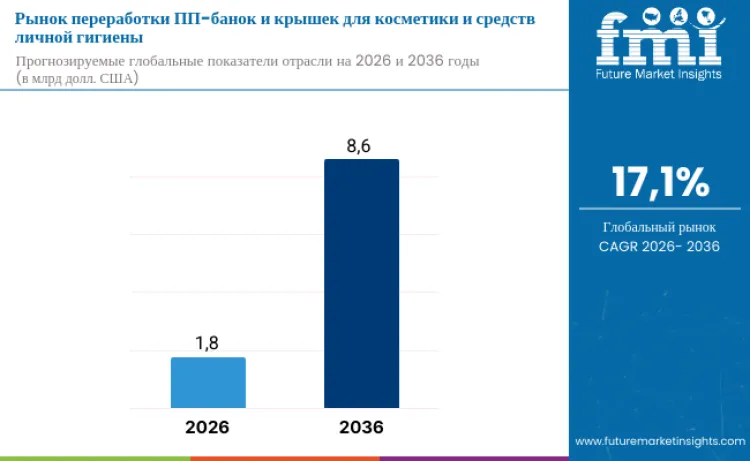
China, India, USA, and Japan function as key growth regions due to rising cosmetics consumption and expansion of brand-led circular packaging programs. Borealis, Indorama Ventures, Alpla Group, Veolia, and Plastika Skaza shape competitive activity through high-efficiency PP recycling plants, supply agreements with personal care manufacturers, and development of certified rPP suitable for molding jars, closures, and associated cosmetic packaging components.
Cosmetics and Personal Care PP Jar and Closure Recycling Streams in Market Key Takeaways
| Metric | Value |
|---|---|
| Market Value (2026) | USD 1.8 billion |
| Market Forecast Value (2036) | USD 8.6 billion |
| Forecast CAGR (2026 to 2036) | 17.1% |
How Are the Segments Classified in the Cosmetics and Personal Care PP Jar and Closure Recycling Streams in Market?
Demand for PP jar and closure recycling is shaped by rising circularity commitments, expansion of mono-material PP packaging, and increasing recovery of post-consumer cosmetic containers. Buyers evaluate decontamination capability, color-sorting precision, and suitability of recycled PP for premium skincare, haircare, and body-care packaging. Adoption patterns reflect the shift toward high-purity rPP streams supported by optical separation, mechanical purification, and chemical upcycling routes for complex cosmetic waste.
Which Recycling Technology Accounts for the Largest Share of Global Demand?
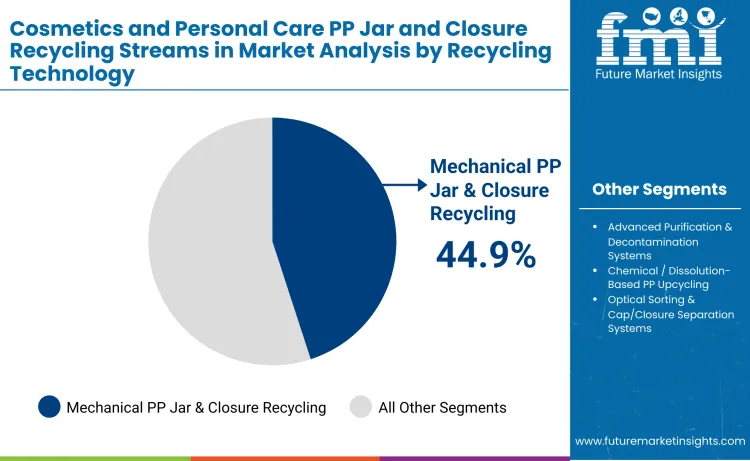
Mechanical PP jar and closure recycling holds 44.9%, making it the leading recycling-technology segment globally. Mechanical lines support high-throughput washing, melt filtration, and re-pelletizing for cosmetic-grade rPP requiring stable molding performance. Advanced purification and decontamination systems remove fragrances, oils, pigments, and formulation residues typical of skincare and beauty packaging. Chemical or dissolution-based upcycling treats highly contaminated, opaque, or color-saturated PP formats. Optical sorting and cap/closure separation systems improve PP purity by isolating lids, inserts, and multi-component accessories. Technology distribution reflects reliance on mechanical recovery combined with advanced purification for high-end cosmetic packaging.
Key Points:
- Mechanical recycling supports scalable cosmetic-grade rPP.
- Purification systems remove oils, pigments, and fragrance residues.
- Chemical upcycling treats difficult, heavily colored PP waste.
- Optical sorting improves PP separation across jar-closure streams.
Which Material Stream Represents the Largest Share of Global Demand?
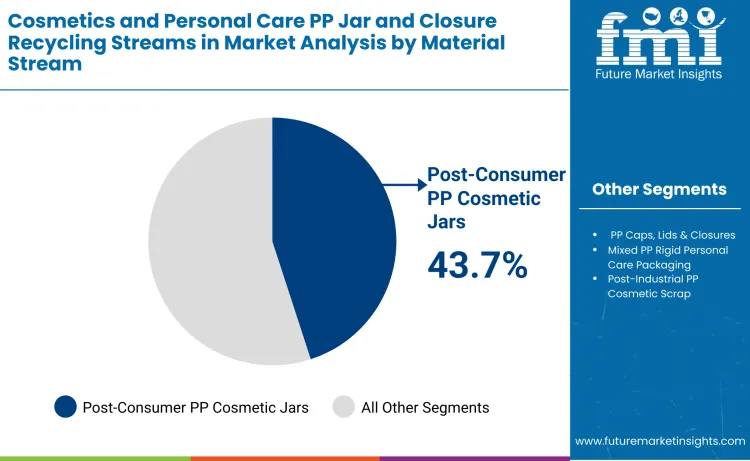
Post-consumer PP cosmetic jars hold 43.7%, making them the largest material-stream segment globally. These jars offer consistent wall thickness and color profiles suitable for high-purity mechanical recycling and premium packaging reuse. PP caps, lids, and closures rely on separation systems that isolate functional components for targeted recycling. Mixed PP rigid personal-care packaging requires advanced sorting to distinguish jars, closures, and accessory structures. Post-industrial PP cosmetic scrap supplies clean, predictable feedstock but in smaller volumes. Material-stream distribution reflects strong recovery focus on cosmetic jars due to volume, structural consistency, and high reuse potential.
Key Points:
- Cosmetic jars provide consistent, high-quality rPP feedstock.
- Caps and closures require precise mechanical separation.
- Mixed packaging depends on advanced optical sorting.
- Post-industrial scrap delivers clean but lower-volume inputs.
Which Application Accounts for the Largest Share of Global Demand?
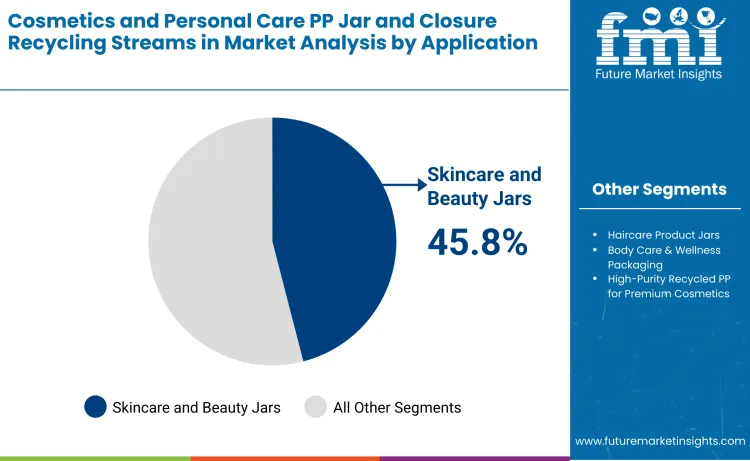
Skincare and beauty jars hold 45.8%, making them the leading application segment globally. These products demand high-clarity, odor-neutral, and color-stable rPP suitable for premium packaging formats. Haircare product jars rely on durable rPP with consistent molding and impact resistance. Body care and wellness packaging requires stable material performance for creams, balms, and scrubs. High-purity recycled PP for premium cosmetics targets luxury applications requiring controlled color, tight tolerances, and stringent decontamination to meet brand standards. Application distribution reflects the dominance of skincare jars in PP packaging volumes and the need for high-quality rPP in cosmetics.
Key Points:
- Skincare jars require high-purity, premium-grade rPP.
- Haircare jars rely on durable, impact-resistant recycled PP.
- Body-care formats demand uniform molding performance.
- Premium cosmetics require strictly purified, color-stable rPP.
What are the Key Dynamics in the Cosmetics and Personal Care PP Jar and Closure Recycling Streams in Market?
Global demand rises as beauty brands, recyclers, and converters expand recycling pathways for PP jars and closures used in skincare, haircare, and colour cosmetics. Brands evaluate PP formats to support circularity claims, while recyclers seek improved capture of small-format items. Sorting and reprocessing technologies evolve to deliver higher purity PP streams suitable for non-food applications. Interest increases as sustainability programs prioritize mono-material packaging aligned with established PP recovery systems.
How are brand sustainability goals and packaging standardization efforts shaping PP recycling streams?
Cosmetics and personal care producers redesign jars and closures to simplify recyclability by reducing pigments, metal components, liners, and mixed materials. Brands integrate mono-material PP systems to align with mechanical recycling capabilities. Sorting facilities upgrade optical sensors to improve capture of small PP items that traditionally fall through screens. Recyclers refine cleaning and melt filtration processes to handle residues from creams and oils. Partnerships form between brands and recyclers to establish stable offtake loops for high-quality non-food-grade rPP. Demand for transparency drives adoption of traceability frameworks that document recycled content and material origin for cosmetic packaging.
How do small-format recovery barriers, contamination risks, and regional infrastructure gaps influence scalability?
PP jars and closures often escape capture in household sorting due to size, shape, and colour, limiting feedstock availability. Residues from cosmetic formulas require intensive washing, raising processing costs and influencing yield. Dark pigments and multi-component assemblies reduce polymer purity during reprocessing. Regions lacking advanced optical sorting struggle to separate PP effectively from mixed plastic streams. Mechanical performance of rPP varies when feedstock contains blended cosmetic packaging types. Brands require predictable quality for non-food applications such as jars, caps, and secondary packaging, increasing pressure on recyclers to maintain consistency. Regulatory differences across markets shape long term investment decisions for PP recycling infrastructure.
How is Demand for Cosmetics and Personal Care PP Jar and Closure Recycling Streams in Market Evolving Across Key Countries?
Demand for the cosmetics and personal care PP jar and closure recycling streams market is rising due to increased recyclability requirements, growth in mono-material PP packaging, and stronger brand commitments to PCR integration across beauty and personal care categories. China records a CAGR of 18.4% supported by rapid PP-reprocessing expansion. India shows a 17.6% CAGR driven by rising beauty-product consumption. USA posts a 16.3% CAGR supported by design-for-recycling shifts. Japan holds a 15.2% CAGR linked with precision waste-management systems. UK records a 14.7% CAGR supported by EPR-driven improvements in PP recovery.
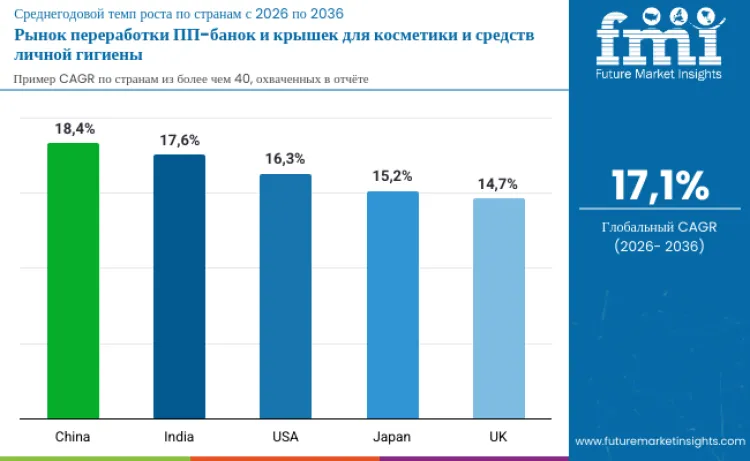
| Country | CAGR (%) |
|---|---|
| China | 18.4% |
| India | 17.6% |
| USA | 16.3% |
| Japan | 15.2% |
| UK | 14.7% |
How is China driving demand for Cosmetics and Personal Care PP Jar and Closure Recycling Streams?
China drives demand due to high output of cosmetics and personal care packaging, rapid PP recycling-system expansion, and increasing adoption of mono-material PP structures. The country’s CAGR of 18.4% reflects investments in advanced sorting, washing, and melt-filtration technologies improving PP purity levels. Converters transition jars and closures toward fully PP-based formats enhancing recyclability. AI-enabled polymer identification increases accuracy in separating PP from mixed rigid streams. Collaboration between brand owners and recyclers strengthens feedstock quality. National circular-packaging initiatives support closed-loop PP applications.
- Expansion of PP washing and filtration systems
- Increased adoption of mono-material PP packaging
- AI-driven sorting improving PP recovery accuracy
- Policy-driven support for circular PP systems
How is India driving demand for Cosmetics and Personal Care PP Jar and Closure Recycling Streams?
India supports rising demand due to strong growth in beauty and personal care consumption, increased use of PP jars and closures, and regulatory improvements in recyclability compliance. The country’s CAGR of 17.6% reflects installation of upgraded PP washing and extrusion lines producing higher-purity recycled PP. Packaging producers shift toward mono-material PP jars eliminating incompatible inserts. EPR-led reforms improve collection and sorting of rigid PP components. Brand-owner sustainability commitments encourage PP-PCR usage across premium beauty packaging.
- Growth in personal care and cosmetics packaging
- Upgraded PP reprocessing technology supporting purity gains
- Adoption of mono-material PP jar and closure formats
- EPR improvements strengthening PP segregation
How is the USA driving demand for Cosmetics and Personal Care PP Jar and Closure Recycling Streams?
USA drives demand through design-for-recycling initiatives, rising PCR procurement targets, and modernization of rigid PP recovery systems. The country’s CAGR of 16.3% reflects expansion of optical-sorting systems identifying PP jars and closures with greater precision. Beauty brands transition to mono-material PP packaging to meet recyclability guidelines. Upgraded washing, flake-cleaning, and melt-filtration systems improve PP-PCR quality. Industry stewardship programs improve feedstock consolidation and traceability for rigid PP streams.
- Optical sorting improving PP jar and closure identification
- Design shifts toward mono-material PP components
- Upgraded washing and melt-filtration enhancing PCR quality
- Stewardship programs supporting feedstock consolidation
How is Japan driving demand for Cosmetics and Personal Care PP Jar and Closure Recycling Streams?
Japan drives demand due to structured municipal collection, high standards for recycled-polymer quality, and increased use of PP in beauty-packaging formats. The country’s CAGR of 15.2% reflects adoption of controlled PP-sorting and washing systems producing uniform recycled resin. Packaging converters refine PP jar and closure designs improving recyclability. Reprocessing facilities apply precise decontamination and melt-filtration steps to meet quality benchmarks. Strong emphasis on material purity reinforces investment in advanced PP recovery systems.
- Structured municipal PP collection systems
- Controlled decontamination and high-purity washing
- Design refinements improving jar and closure recyclability
- High standards guiding investment in PP recovery systems
How is the UK driving demand for Cosmetics and Personal Care PP Jar and Closure Recycling Streams?
UK supports demand through EPR-driven packaging reforms, national circular-economy goals, and increased use of PP in premium and mass-market beauty products. The country’s CAGR of 14.7% reflects expansion of rigid PP sorting and washing capacity. Retailers encourage suppliers to adopt mono-material PP jars supporting recyclability targets. Recyclers install advanced polymer-identification systems improving PP stream purity. Policy alignment with recyclability guidelines supports broader acceptance of PP-PCR for cosmetic packaging applications.
- EPR-led improvement in PP recovery rates
- Retail and brand adoption of mono-material PP jars
- Upgraded polymer-identification systems
- Circular packaging policies supporting PP-PCR demand
What is the competitive landscape of demand for cosmetics and personal care PP jar and closure recycling streams globally?
Demand for cosmetics and personal care PP jar and closure recycling streams grows as brands shift toward mono-material packaging and higher post-consumer resin incorporation. Requirements center on color sorting accuracy, odor reduction, melt-flow stability, and purity levels suitable for non-food cosmetic applications. Buyers evaluate feedstock segregation systems, label and residue removal, polymer filtration capability, and pellet consistency supporting injection molding of jars, caps, and thick-walled components.
Procurement teams prioritize traceability, batch uniformity, and scalable supply agreements aligned with long-term sustainability commitments. Trend in the global market reflects greater investment in dedicated polyolefin recovery lines, improved NIR sorting for opaque PP, and enhanced washing technologies designed to manage cosmetic residues.
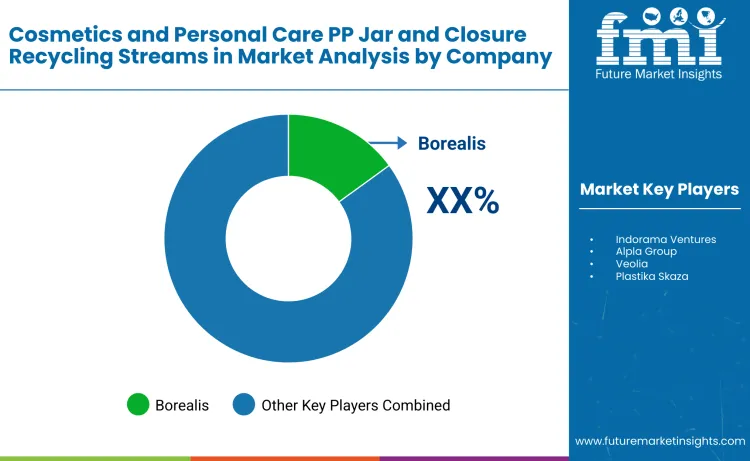
Borealis holds an estimated 27.0% share. Position strengthens through advanced mechanical recycling platforms producing high-quality rPP tailored for personal care packaging applications. Indorama Ventures participates with expanding polyolefin recycling capacity integrated into global infrastructure serving brand-owner supply chains. Alpla Group maintains visibility through closed-loop polyolefin programs supplying rPP for caps, closures, and rigid personal care components.
Veolia contributes with large-scale PP recovery operations producing rPP grades for non-food packaging converters. Plastika Skaza supports demand with recycled PP streams sourced from household rigid packaging, applied widely in personal care packaging lines requiring stable material performance. Competitive positioning globally reflects color-management capability, odor-control technology, pellet uniformity, and reliability of supply supporting cosmetic and personal care packaging converters.
Key Players in the Cosmetics and Personal Care PP Jar and Closure Recycling Streams in Market
- Borealis
- Indorama Ventures
- Alpla Group
- Veolia
- Plastika Skaza
Scope of the Report
| Items | Values |
|---|---|
| Quantitative Units | USD billion |
| Recycling Technology | Mechanical PP Jar & Closure Recycling, Advanced Purification & Decontamination Systems, Chemical / Dissolution-Based PP Upcycling, Optical Sorting & Cap/Closure Separation Systems |
| Material Stream | Post-Consumer PP Cosmetic Jars, PP Caps, Lids & Closures, Mixed PP Rigid Personal Care Packaging, Post-Industrial PP Cosmetic Scrap |
| Application | Skincare & Beauty Jars, Haircare Product Jars, Body Care & Wellness Packaging, High-Purity Recycled PP for Premium Cosmetics |
| End-User | Cosmetics & Personal Care Brands, Packaging Converters, Contract Manufacturers (CMOs), Recycling & EPR Scheme Operators |
| Regions Covered | Asia Pacific, Europe, North America, Latin America, Middle East & Africa |
| Countries Covered | India, China, USA, Germany, South Korea, Japan, Italy, and 40+ countries |
| Key Companies Profiled | Borealis, Indorama Ventures, Alpla Group, Veolia, Plastika Skaza |
| Additional Attributes | Dollar sales by recycling technology, material stream, application, and end-user categories; PP-grade purity requirements for cosmetic contact; recycling compatibility of caps/closures vs. jar bodies; optimization of NIR-based cap separation; decontamination standards for high-end skincare packaging; compliance with EU PP recyclability design guidelines and global EPR mandates; trends in premium-grade rPP adoption for beauty packaging. |
Cosmetics and Personal Care PP Jar and Closure Recycling Streams in Market by SegmentBy Recycling Technology: • Mechanical PP Jar & Closure Recycling • Advanced Purification & Decontamination Systems • Chemical / Dissolution-Based PP Upcycling • Optical Sorting & Cap/Closure Separation Systems By Material Stream: • Post-Consumer PP Cosmetic Jars • PP Caps, Lids & Closures • Mixed PP Rigid Personal Care Packaging • Post-Industrial PP Cosmetic Scrap By Application: • Skincare & Beauty Jars • Haircare Product Jars • Body Care & Wellness Packaging • High-Purity Recycled PP for Premium Cosmetics By End-User: • Cosmetics & Personal Care Brands • Packaging Converters • Contract Manufacturers (CMOs) • Recycling & EPR Scheme Operators Region: • Asia Pacific o China o Japan o South Korea o India o Australia & New Zealand o ASEAN o Rest of Asia Pacific • Europe o Germany o United Kingdom o France o Italy o Spain o Nordic o BENELUX o Rest of Europe • North America o United States o Canada o Mexico • Latin America o Brazil o Chile o Rest of Latin America • Middle East & Africa o Kingdom of Saudi Arabia o Other GCC Countries o Turkey o South Africa o Other African Union o Rest of Middle East & Africa
By Recycling Technology:
- Mechanical PP Jar & Closure Recycling
- Advanced Purification & Decontamination Systems
- Chemical / Dissolution-Based PP Upcycling
- Optical Sorting & Cap/Closure Separation Systems
By Material Stream:
- Post-Consumer PP Cosmetic Jars
- PP Caps, Lids & Closures
- Mixed PP Rigid Personal Care Packaging
- Post-Industrial PP Cosmetic Scrap
By Application:
- Skincare & Beauty Jars
- Haircare Product Jars
- Body Care & Wellness Packaging
- High-Purity Recycled PP for Premium Cosmetics
By End-User:
- Cosmetics & Personal Care Brands
- Packaging Converters
- Contract Manufacturers (CMOs)
- Recycling & EPR Scheme Operators
Region:
- Asia Pacific
- China
- Japan
- South Korea
- India
- Australia & New Zealand
- ASEAN
- Rest of Asia Pacific
- Europe
- Germany
- United Kingdom
- France
- Italy
- Spain
- Nordic
- BENELUX
- Rest of Europe
- North America
- United States
- Canada
- Mexico
- Latin America
- Brazil
- Chile
- Rest of Latin America
- Middle East & Africa
- Kingdom of Saudi Arabia
- Other GCC Countries
- Turkey
- South Africa
- Other African Union
- Rest of Middle East & Africa
Frequently Asked Questions
What is the size of the cosmetics and personal care PP jar and closure recycling streams market in 2026?
The market is valued at USD 1.8 billion in 2026 due to higher post-consumer PP recovery from beauty and personal care packaging.
What will be the industry size by 2036?
Industry value will reach USD 8.6 billion by 2036 as processors scale PP recycling lines and brands integrate rPP into jars, closures, and related packaging.
What is the CAGR for 2026-2036?
The cosmetics and personal care PP jar and closure recycling streams market expands at a 17.1% CAGR during the forecast period.
Which recycling-technology segment leads in 2026?
Mechanical PP jar and closure recycling holds 44.9% share due to established cost efficiency and suitability for cosmetic-grade PP recovery.
Which material-stream segment holds the highest share?
Post-consumer PP cosmetic jars lead with 43.7% share, supported by growing collection volumes and increased recyclability of mono-material PP components.
Preview the report firsthand - request a free sample
Get SampleGet the brochure for pricing and purchase details.
Get PDFTable of Content
- Executive Summary
- Market Overview
- Global Market Value, 2020-2026
- Global Market Forecast, 2026-2036
- Market Dynamics
- Drivers
- Restraints
- Opportunities
- Regulatory & Standards Landscape
- Technology & Material Innovation Outlook
- Market Segmentation Analysis
- By Recycling Technology
- Mechanical PP Jar & Closure Recycling
- Advanced Purification & Decontamination Systems
- Chemical / Dissolution-Based PP Upcycling
- Optical Sorting & Cap/Closure Separation Systems
- By Material Stream
- Post-Consumer PP Cosmetic Jars
- PP Caps, Lids & Closures
- Mixed PP Rigid Personal Care Packaging
- Post-Industrial PP Cosmetic Scrap
- By Application
- Skincare & Beauty Jars
- Haircare Product Jars
- Body Care & Wellness Packaging
- High-Purity Recycled PP for Premium Cosmetics
- By End-User
- Cosmetics & Personal Care Brands
- Packaging Converters
- Contract Manufacturers (CMOs)
- Recycling & EPR Scheme Operators
- By Recycling Technology
- Regional Outlook
- Asia Pacific
- Europe
- North America
- Latin America
- Middle East & Africa
- Country-Level Outlook
- China
- India
- USA
- Japan
- United Kingdom
- Germany
- South Korea
- Italy
- Australia & New Zealand
- ASEAN
- Brazil
- Chile
- Turkey
- South Africa
- Other GCC Countries
- Rest of Europe
- Rest of Latin America
- Rest of Middle East & Africa
- Competitive Landscape
- Market Structure Overview
- Company Positioning
- Strategic Initiatives
- Key Player Profiles
- Scope of the Report
- Research Methodology
- Assumptions & Acronyms


