

- Industry Size (2026)
- USD 190.0 Mn
- Forecast (2036)
- USD 560.0 Mn
- CAGR (2026 to 2036)
- 11.40%
Recycling Systems for Coffee Capsule Aluminium and Plastic Components in Europe Industry Size, Market Forecast and Outlook By FMI
The recycling systems for coffee capsule aluminium and plastic components in Europe industry were valued at USD 170.0 million in 2025. Sales are poised to surpass USD 190.0 million in 2026 at a CAGR of 11.40% during the forecast period. Ongoing investment propels cumulative revenue to USD 560.0 million through 2036 as coffee capsule EPR Europe mandates shift from voluntary targets to mandatory material recovery quotas across major municipal networks.
Waste management directors at municipal facilities are actively calculating how quickly they can integrate specialized eddy current separators before PPWR coffee capsules compliance deadlines trigger financial penalties. Upgrading infrastructure requires significant capital expenditure, leaving operators weighing immediate packaging waste recycling investments against long-term operational bottlenecks. What facility managers rarely state publicly is that current optical sorters routinely misidentify lightweight composite pods as standard municipal waste, ensuring thousands of tons bypass recovery loops entirely. Securing a dedicated turnkey coffee capsule recycling plant Europe determines which municipalities avoid landfill taxes and which absorb compounding annual deficits.
Summary of Recycling Systems for Coffee Capsule Aluminium and Plastic Components in Europe Industry
- Recycling Systems for Coffee Capsule Aluminium and Plastic Components in Europe Industry Definition
- Equipment and operational architectures engineered specifically to separate, clean, and reprocess single-serve coffee containers comprise this functional sector. Facilities deploy mechanical and chemical mechanisms to decouple organic coffee residue from aluminium and polymer casings.
- Demand Drivers in the Market
- Extended producer responsibility mandates compel municipal waste directors to deploy specialized aluminium capsule recycling lines.
- Landfill tax escalation forces facility operators to divert lightweight composites into secondary material streams.
- Brand sustainability commitments push procurement officers to source validated post-consumer recycled feedstocks.
- Key Segments Analyzed in the FMI Report
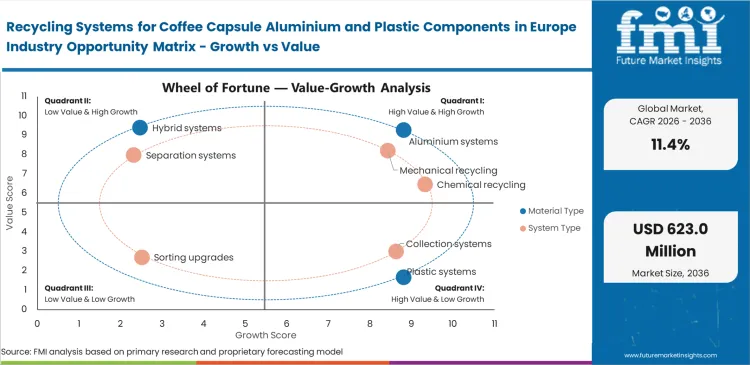
- Aluminium systems is anticipated to hold 58.0% share in 2026, compelled by high secondary material value and mature smelting infrastructure.
- Mechanical recycling is projected to capture 41.0% share in 2026, resting on established physical shredding and density separation technology.
- Public-bin systems is expected to account for 36.0% share in 2026, supported by deep municipal integration and baseline consumer convenience.
- Sorting lines is set to garner 33.0% share in 2026, reflecting critical capital deployment at initial material separation phases.
- Secondary aluminium is estimated to record 44.0% share in 2026, anchored by strict closed-loop supply chain manufacturing requirements.
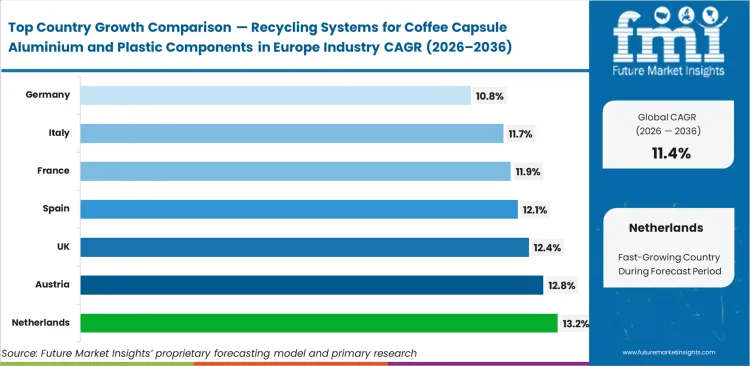
- Netherlands: 13.2% compound growth, propelled by active infrastructure-build phases targeting explicit collection target uplifts.
- Analyst Opinion at FMI
- Nikhil Kaitwade, Principal Analyst, Process Automation, at FMI, points out, "Municipal waste directors assume standard optical sorters can manage incoming single-serve pods. Lightweight aluminium and mixed polymers require entirely separate physical architectures to prevent catastrophic contamination of traditional recycling streams. Brands fund collection schemes, yet actual bottlenecks remain at municipal sorting decks where un-upgraded lines simply eject small formats as residual waste. Closing this specific measurement gap across coffee capsule recycling systems Europe determines whether a facility monetizes secondary aluminium or pays compounding landfill penalties."
- Strategic Implications / Executive Takeaways
- Facility managers must upgrade optical separation modules or face mounting residual waste disposal costs.
- Secondary material traders secure premium pricing by guaranteeing high-purity aluminium yields to packaging manufacturers.
- Brand sustainability directors avoid regulatory penalties by co-investing in localized sorting infrastructure.
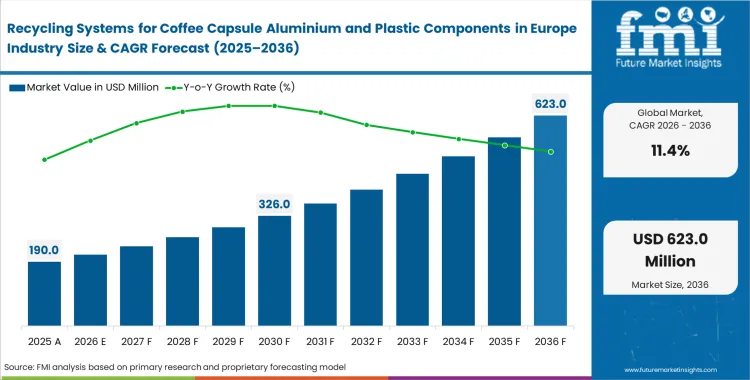
Once regional authorities enforce closed-loop accountability on single-serve brands, capital deployment for coffee capsule recycling for waste processors accelerates immediately. Regulatory pressure removes financial risk for independent recycling consortiums. Establishing a unified circular plastic packaging ecosystem transitions municipal recovery from a subsidized public service into a profitable secondary commodities channel managed by any specialized coffee pod recycling solution provider.
The Netherlands leads at 13.2% as national policies force active infrastructure-build phases from historically low recovery baselines, while Austria tracks closely at 12.8% on the back of explicit collection uplifts. The United Kingdom advances at 12.4% due to the network expansion of dedicated UK coffee pod recycling infrastructure. Spain expands at 12.1% through specialised sorting upgrades, with France following at 11.9% via alliance-led recovery programs. Italy progresses at 11.7% as local authorities standardise collection. Germany records 10.8% because yellow-bin integration is already mature and builds on a highly developed existing base.
Recycling Systems for Coffee Capsule Aluminium and Plastic Components in Europe Industry Definition
Equipment and operational architectures engineered specifically to separate, clean, and reprocess single-serve containers comprise this functional sector. Facilities deploy mechanical and chemical mechanisms, prioritizing coffee grounds separation from capsules, to decouple organic residue from casing materials. Processing lines transform contaminated pods into secondary raw materials suitable for manufacturing applications. Recovered yields feed directly into specialized metal packaging fabrication networks.
Recycling Systems for Coffee Capsule Aluminium and Plastic Components in Europe Industry Inclusions
Dedicated collection logistics networks and specialized coffee capsule collection and sorting systems fall within analytical boundaries. Municipal integration software and automated recycled plastic packaging separation modules qualify for inclusion. Mechanical shredders, eddy current separators configured for lightweight alloys, and thermal smelting units optimized for pod dimensions represent core hardware categories.
Recycling Systems for Coffee Capsule Aluminium and Plastic Components in Europe Industry Exclusions
General municipal solid waste trucks fall outside analytical boundaries because they lack capsule-specific sorting capabilities. Standard commercial coffee machines remain excluded since they handle brewing rather than end-of-life aluminium plastic coffee capsule recycling Europe operations. Raw material extraction operations are omitted as they involve virgin resource mining rather than secondary material generation.
Recycling Systems for Coffee Capsule Aluminium and Plastic Components in Europe Industry Research Methodology
- Primary Research: Facility operations managers and municipal waste directors.
- Desk Research: European extended producer responsibility registries and municipal recovery rate filings.
- Market-Sizing and Forecasting: Installed capacity of specialized sorting machinery across active municipal recycling centers.
- Data Validation and Update Cycle: Secondary commodity pricing indexes for recycled aluminium and food-grade polymers cross-validate recovery volume estimates.
Segmental Analysis
Recycling Systems for Coffee Capsule Aluminium and Plastic Components in Europe Industry Analysis by Material Type
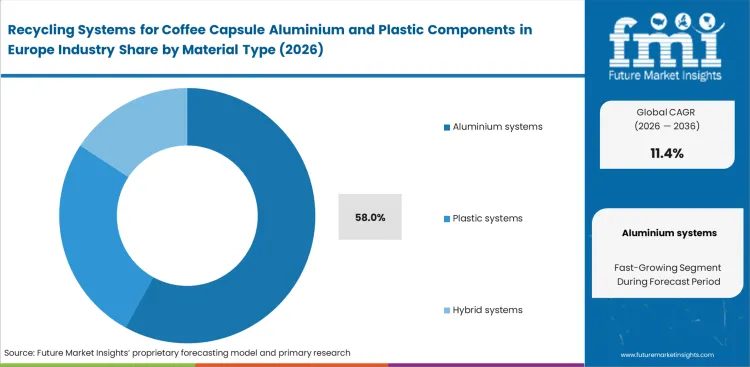
High inherent material value results in the 58.0% position Aluminium systems commands in this category. FMI analysts note that scrap metal brokers actively bid for these specific bales because lightweight alloy composition requires minimal energy to remelt compared to virgin ore processing. Secondary material procurement officers prioritize securing these streams to meet internal sustainability quotas for recycled aluminum packaging. What public diversion statistics rarely show is that actual recovery rates correlate directly with local eddy current separator calibration, not consumer participation levels. Municipalities delaying equipment upgrades forfeit lucrative secondary revenue and simultaneously incur heavy disposal fees for rejected loads.
- Eddy current separation: High-frequency magnetic fields eject lightweight metallic pods from mixed waste streams. Facility operations managers capture premium material fractions utilizing a dedicated waste sorter for small aluminium items alongside broader sorting equipment investments.
- Smelting integration: Direct feeding of recovered aluminium into regional foundries reduces logistics overhead. Secondary material traders bypass intermediate processors and secure higher profit margins.
- Alloy purity verification: Optical scanners confirm material composition before final baling. Procurement directors reject shipments lacking documented purity, forcing suppliers to maintain rigorous sorting standards.
Recycling Systems for Coffee Capsule Aluminium and Plastic Components in Europe Industry Analysis by System Type
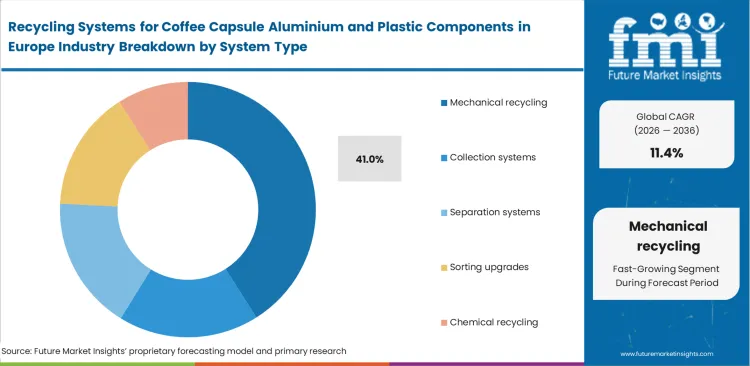
Facilities balancing throughput targets against capital constraints consistently select Mechanical recycling architectures. FMI's analysis indicates this sub-segment captures 41.0% share in 2026 as plant directors reject unproven chemical processes in favour of physical shredding and density separation. Process engineers deploy coffee capsule depackaging technology via sorting and grading machines to physically decouple organic coffee matrix from rigid casings. Most equipment manufacturers market these modules as drop-in upgrades, yet integration requires extensive redesign of existing conveyor geometries. Plant managers attempting to retrofit older facilities without addressing upstream conveyor flow face persistent jamming and unscheduled downtime.
- Shredding mechanics: High-torque rotors tear capsule casings to release compacted coffee grounds. Plant maintenance supervisors minimize blade wear by controlling feed rates to support design for recycling packaging standards.
- Density separation: Water baths float polymer components while metallic fragments sink. Operations managers achieve distinct material streams without complex optical systems.
- Washing friction: High-speed trommels remove residual organics from shredded casing fragments. Quality control technicians require clean outputs to prevent off-gassing during downstream extrusion processes.
Recycling Systems for Coffee Capsule Aluminium and Plastic Components in Europe Industry Analysis by Collection Model
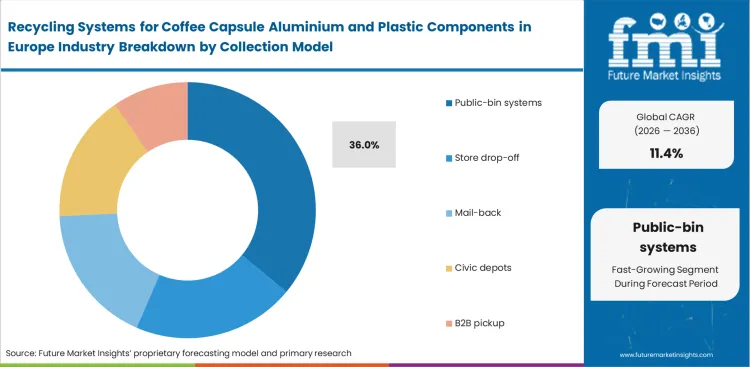
Municipal waste directors evaluating coffee capsule recycling for municipalities prioritize public bin vs drop off coffee capsule recycling models to capture volume at source locations. Based on FMI's assessment, Public-bin systems secure 36.0% share by leveraging existing residential collection routes rather than building parallel logistics networks. Logistics planners map integrated recycling hubs to consolidate materials from dispersed neighborhood collection points. Widely promoted consumer mail-back programs mask a deeper reality: localized bin integration captures ten times more volume at a fraction of measured carbon footprints. Municipalities relying entirely on voluntary store drop-off schemes consistently fail to meet mandated extended producer responsibility targets.
- Route optimization: Fleet managers program collection software to minimize transit distances between public bins. Logistics coordinators reduce fuel expenditure while maintaining consistent facility inbound volumes.
- Bin sensor monitoring: Telemetry units signal dispatchers when neighborhood collection points reach maximum capacity. Operations directors prevent overflow events and ensure steady processing facility utilization.
- Contamination penalty: Mixed public bins inevitably collect non-capsule municipal waste. Plant managers must deploy robust pre-sorting labor to prevent unexpected debris from damaging primary shredding rotors.
Recycling Systems for Coffee Capsule Aluminium and Plastic Components in Europe Industry Analysis by Process Stage
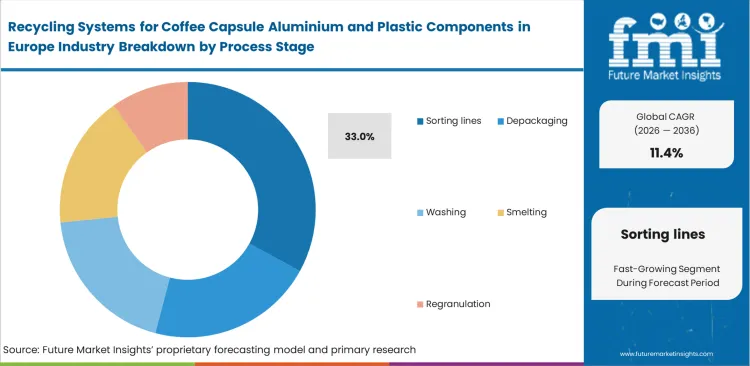
Manual intervention strategies are failing as Sorting lines assume primary responsibility for handling high throughput volumes. According to FMI's estimates, this initial stage represents 33.0% of material breakdown operations. Plant supervisors deploy ai waste sorting robots to identify and eject pods from fast-moving mixed recycling belts. Most generalist analyses focus on final melted products while ignoring that accurate initial separation dictates entire facility profitability. Facilities utilizing outdated optical scanners face severe contamination downstream, resulting in entire bales being downgraded and sold at steep discounts.
- Optical identification: Near-infrared sensors detect specific polymer signatures on high-speed conveyors. Quality assurance leads ensure targeted materials separate cleanly from main municipal waste flows.
- Pneumatic ejection: Targeted blasts of compressed air divert identified pods into specialized collection hoppers. Maintenance engineers calibrate valve timing to support advanced circular specialty plastics for textiles and packaging remanufacturing specifications.
- Throughput calibration: Conveyor speeds dictate accuracy within robotic identification systems. Facility directors balance processing volume against absolute purity requirements to maximize secondary market pricing.
Recycling Systems for Coffee Capsule Aluminium and Plastic Components in Europe Industry Analysis by End Output
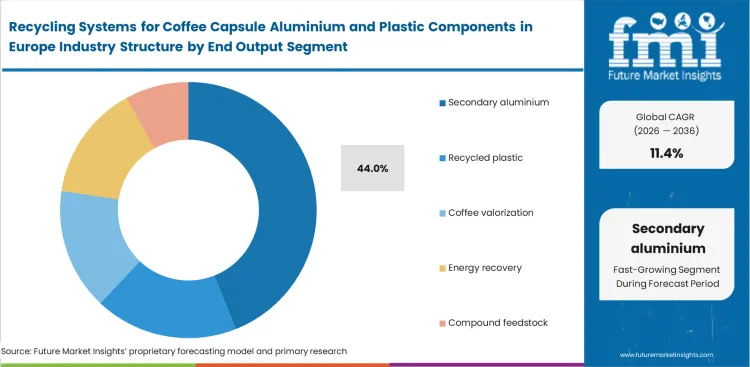
Securing reliable manufacturing inputs results in the 44.0% share held by Secondary aluminium. In FMI's view, packaging procurement directors mandate closed-loop sourcing to insulate supply chains from volatile virgin commodity pricing. Foundry managers rely on recycling traceability platforms to verify post-consumer origins for remelted ingots. While corporate sustainability reports highlight coffee valorization, economic engines sustaining these facilities remain strictly metallurgical recovery operations. Processors failing to achieve strict alloy specifications must sell output to lower-grade casting operations, eliminating premium margins required to justify initial collection costs.
- Ingot casting: Melted aluminium fragments form standardized blocks for industrial transport. Foundry supervisors ensure uniform cooling to establish a full closed loop recycling ecosystem for final material outputs.
- Purity certification: Metallurgists test batch samples to guarantee minimal organic or polymer contamination. Sales directors present these certificates to secure premium contracts with consumer goods manufacturers.
- Alloy blending: Technicians introduce specific additives into secondary melts to achieve exact client specifications. Production managers bridge gaps between variable inbound waste and precise outbound manufacturing requirements.
Recycling Systems for Coffee Capsule Aluminium and Plastic Components in Europe Industry Drivers, Restraints, and Opportunities
Landfill tax escalation forces facility operators to rapidly divert lightweight composites into secondary material streams. Waste management directors recognize incoming single-serve pod volumes compound annually, transforming previous niche nuisances into significant contributors to residual waste disposal penalties. Delaying installation of dedicated recovery modules exposes municipal processors to immediate margin compression as regulatory bodies increase per-ton landfill levies. Financial calculations shift entirely when regional authorities clarify what regulation is driving coffee capsule recycling in Europe and reclassify small-format items from unrecoverable waste to targeted recyclable packaging, mandating active extraction. Operations managers pivot from viewing capsules as contamination risks to treating them as necessary compliance metrics.
Severe spatial limitations within existing municipal sorting facilities present binding operational friction slowing adoption. Plant managers evaluating coffee capsule recycling plant cost face extreme difficulty retrofitting bulky eddy current separators and specialized trommels into linear conveyor architectures designed decades ago. Even when capital is secured for new equipment, facility directors cannot suspend daily municipal waste processing to execute complex mechanical installations. Physical infrastructure gaps mean many municipalities evaluating refillable low waste modular packaging alternatives continue incinerating recoverable aluminium simply because they cannot halt operations long enough to integrate required physical bypass lines.
Opportunities in the Recycling Systems for Coffee Capsule Aluminium and Plastic Components in Europe Industry
- AI visual recognition deployment: Software engineers train neural networks to identify specific pod dimensions on chaotic waste belts. Plant directors increase extraction rates without expanding physical sorting line footprints.
- Cross-municipality processing hubs: Logistics planners construct centralized facilities designed solely to process small-format rigid containers. Regional waste authorities pool capital to achieve economies of scale unachievable by individual autonomous sorting for flexible plastic waste initiatives, partnering directly with coffee capsule recycling equipment suppliers Europe.
- Direct-to-smelter logistics: Supply chain managers establish dedicated transit routes connecting recovery facilities straight to regional foundries. Secondary commodity brokers eliminate intermediate warehousing costs and improve material processing velocity.
Regional Analysis
Based on regional analysis, Recycling Systems for Coffee Capsule Aluminium and Plastic Components in Europe Industry is segmented into Netherlands, Austria, United Kingdom, Spain, France, Italy, and Germany across 40 plus countries.
.webp "Top Country Growth Comparison Recycling Systems For Coffee Capsule Aluminium And Plastic Components In Europe Industry Cagr (2026 2036)")
| Country | CAGR (2026 to 2036) |
|---|---|
| Netherlands | 13.2% |
| Austria | 12.8% |
| United Kingdom | 12.4% |
| Spain | 12.1% |
| France | 11.9% |
| Italy | 11.7% |
| Germany | 10.8% |
Source: Future Market Insights (FMI) analysis, based on proprietary forecasting model and primary research
Europe Recycling Systems for Coffee Capsule Aluminium and Plastic Components in Europe Industry Analysis
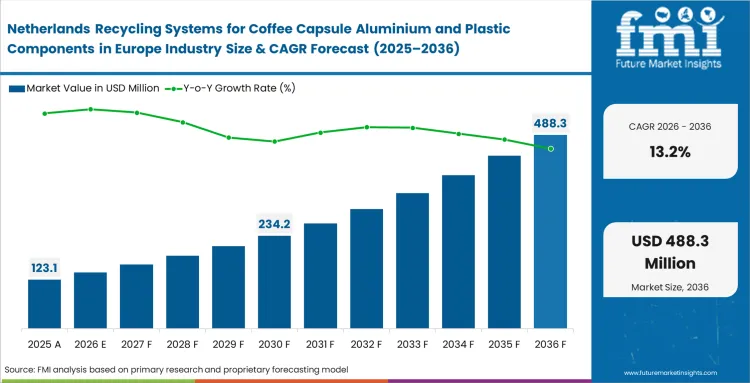
National policies across distinct regional jurisdictions force active infrastructure-build phases from historically low recovery baselines. Municipal waste directors face immediate pressure to hit explicit collection target uplifts mandated by central environmental authorities. FMI's analysis indicates this aggressive timeline forces rapid procurement of specialized mechanical separators rather than gradual pilot testing. Facility operators integrate new coffee capsules recovery modules directly into existing material recovery facility blueprints. Accelerated deployment shifts national capacity curves sharply upward over highly compressed timeframes across the continent.
- Netherlands: Procurement directors at Dutch waste management firms are actively tendering for optical sorting upgrades capable of identifying dark plastics to satisfy emerging extended producer responsibility mandates. Regional waste authorities design localized collection routes engineered specifically for lightweight metallic and polymer fractions, bypassing standard municipal trucks to prevent extreme compaction before materials reach sorting decks. Aggressive federal targets that eliminate local funding hesitation cause the demand within the Netherlands recycling systems for coffee capsule aluminium and plastic components in the European industry is projected to expand at a 13.2% CAGR from 2026 to 2036. Specialized secondary processors secure long-term municipal contracts guaranteeing consistent inbound volumes. By deploying these specific capabilities, operators ensure immediate compliance with stringent national circularity quotas, drastically reducing residual waste footprints and securing lucrative secondary commodity streams that offset initial capital expenditures within three fiscal cycles.
- Austria: Austria recycling systems for coffee capsule aluminium and plastic components industry in the Europea is anticipated to register a 12.8% CAGR over the 2026 to 2036 forecast period. Austrian plant engineers heavily focus on calibrating optical sorters to isolate dark-colored polymer pods from general rigid plastics. Quality assurance leads ensure these specific fractions divert into dedicated granulators rather than contaminating clear PET bales intended for returnable circular packaging. Simultaneously, operations directors prioritize high-efficiency eddy current systems to capture aluminium fractions that previously escaped manual quality control. Investment flows directly into upgrading physical separation mechanics at established regional processing centers. Upgrading these lines guarantees that local municipalities avoid compounding national waste penalties while maximizing secondary commodity revenues from extracted metallurgical yields. Local foundry supervisors absorb these verified ingots, eliminating cross-border logistics costs and insulating domestic manufacturing from volatile virgin ore pricing fluctuations.
- United Kingdom: Network expansion of dedicated pod recovery alliances fundamentally defines operational trajectories across the United Kingdom. Local authority directors are pivoting from ad-hoc collection trials to standardized nationwide reverse-logistics frameworks. Coordinated approaches remove fragmented collection policies that previously confused consumers and yielded highly contaminated inbound streams. Operations managers at specialized processing hubs configure mechanical shredders to handle uniquely designed compostable and hybrid casing variants, while maintenance supervisors adjust rotor speeds to prevent organic coffee residue from blinding downstream density separation screens. As facilities receive these unified streams and report significantly higher initial material purity, the United Kingdom recycling systems for coffee capsule aluminium and plastic components in the European segment is set to advance at a 12.4% CAGR during the 2026 to 2036 window. Plant managers leverage this unadulterated feed to negotiate premium pricing contracts with domestic packaging manufacturers, effectively transforming municipal recycling centers into highly profitable secondary commodity export nodes.
- Spain: Spain recycling systems for coffee capsule aluminium and plastic components in Europe segment is projected to progress at a 12.1% CAGR spanning 2026 to 2036. Facility directors across Spain are mandating the immediate integration of specialized trommels to manage rising influxes of mixed-material single-serve waste. Logistics coordinators establish alliance-led recovery networks that aggregate lightweight composites from dispersed municipal transfer stations into centralized sorting hubs. Plant supervisors deploy targeted pneumatic ejection systems to separate valuable polymer casings from organic municipal fines. Capital deployment toward automated screening ensures operators overcome historical manual sorting limitations. By formalizing these advanced separation protocols, operators drastically reduce residual incineration volumes. This participation allows Spanish secondary material brokers to lock in high-margin contracts with domestic extrusion facilities actively seeking verified post-consumer recycled feedstocks for new packaging applications, establishing robust operational benchmarks for Mediterranean waste processing frameworks.
- France: Supply chain managers in France are orchestrating nationwide take-back schemes funded directly by major single-serve coffee producers facing strict environmental taxation. Relying heavily on these alliance-backed capital injections, infrastructure developments aim to modernize aging municipal processing lines. Operations leads at regional sorting centers deploy advanced near-infrared identification modules to intercept both aluminium and plastic variants before they reach landfill diversion endpoints. Fueled by these modernization efforts, demand for the recycling systems for coffee capsule aluminium and plastic components in Europe industry in France is expected to track at an 11.9% CAGR between 2026 and 2036. Quality control technicians implement rigorous purity testing on recovered bales to satisfy French regulatory standards for secondary material contact. Local facility operators successfully transform historically unprofitable waste fractions into highly sought-after secondary commodities, insulating municipal budgets from escalating national landfill penalty structures while providing local cosmetic and food-grade packaging manufacturers with consistent, traceable streams of premium recycled alloy and polymer inputs.
- Italy: Metallurgists working alongside municipal waste directors in Italy formulate dedicated recovery channels exclusively for high-grade secondary aluminium extraction. Plant engineers recalibrate magnetic separation fields to specifically target the unique alloy signatures of premium single-serve pods. Regional consortia standardize localized public-bin networks to capture maximum volume directly at residential source points. As operators focus on refining mature collection frameworks to push extraction yields closer to absolute theoretical limits, the Italy recycling systems for coffee capsule aluminium and plastic components in Europe segment is forecast to record an 11.7% CAGR from 2026 through 2036. Procurement officers recognize that Italian facilities consistently produce exceptionally pure metallic bales. By systematically eliminating organic contamination prior to smelting, this operational precision grants Italian secondary material traders significant leverage when negotiating long-term supply agreements with specialized foundries supporting the broader European consumer goods manufacturing base.
- Germany: Germany recycling systems for coffee capsule aluminium and plastic components in Europe segment is estimated to register a 10.8% CAGR over the 2026 to 2036 period. Germany builds upon a highly developed existing base, meaning capital deployment targets marginal efficiency gains rather than foundational network construction. Waste management supervisors extract maximum value from the established yellow-bin collection infrastructure by integrating AI-guided robotic sorting arms directly over high-speed mixed recycling belts. Maintenance engineers optimize these neural networks to distinguish complex multi-layer pods from standard flexible packaging films, while facility directors fine-tune density separation water baths to capture residual polymer fractions that optical scanners occasionally miss. German processing plants maintain their status as high-volume secondary material exporters, subsequently forcing independent recovery facilities across neighboring jurisdictions to adopt these exacting purity standards and pricing models. This scale proves that mature municipal networks can still yield substantial commercial value when equipped with highly specialized separation hardware.
FMI's report includes extensive analysis covering multiple additional geographic locations. Specialized facilities leverage established alliance-led recovery programs across the region to push extraction yields closer to absolute theoretical limits on an international scale.
Competitive Aligners for Market Players
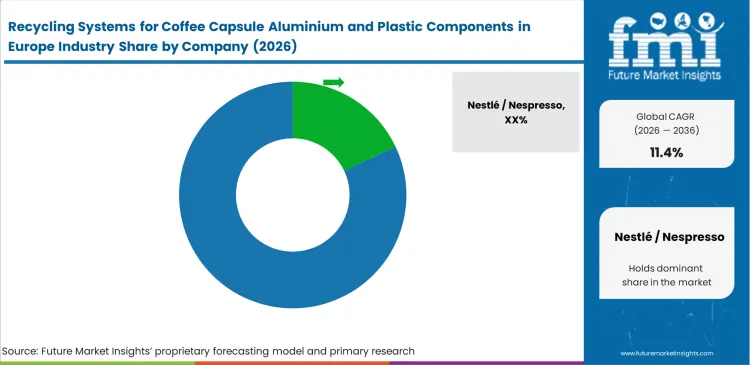
Specialized machinery manufacturers operate within highly technical competitive environments where success depends on demonstrating precise material extraction rates to municipal buyers. Companies like Altstoff Recycling Austria AG and Der Grüne Punkt anchor competitive positioning by proving systems prevent cross-contamination during high-speed municipal sorting of coffee capsule aluminum and plastic components. Procurement teams asking who are the key companies in coffee capsule recycling systems evaluate vendors not on theoretical processing speed, but on guaranteed purity percentages of final aluminium or polymer bales. Equipment providers failing to hit strict purity guarantees during pilot programs immediately lose access to massive regional municipal contracts.
Incumbents possess deep libraries of operational telemetry gathered from years of processing varied single-serve coffee containers across different municipal waste compositions. Historical data allows firms like TerraCycle and Podback to predict exact mechanical wear rates and optimize shredding architectures for specific regional waste profiles. Challengers attempting to enter hardware spaces often lack real-world failure data, resulting in equipment designs that jam or degrade rapidly under chaotic conditions inside live material recovery facilities. Mastering physical realities constitutes primary barriers against new entrants.
Large municipal consortiums exert high pressure on technology providers by demanding modular equipment that fits into existing spatial footprints. Procurement officers actively reject proprietary separation systems requiring specialized maintenance contracts, favoring architectures built with standardized industrial components. Recycap Technologies and Koffie Capsule Recycling Nederland navigate this dynamic by designing drop-in modules that integrate seamlessly with legacy conveyor systems. Toward 2036, decisive competitive advantages belong to firms capable of upgrading local facilities without triggering complete operational shutdowns during installation.
Key Players in Recycling Systems for Coffee Capsule Aluminium and Plastic Components in Europe Industry
- Nestlé / Nespresso
- Altstoff Recycling Austria AG
- TerraCycle
- Podback
- Koffie Capsule Recycling Nederland
- Recycap Technologies
- Der Grüne Punkt
Scope of the Report
| Metric | Value |
|---|---|
| Quantitative Units | USD 190.0 million to USD 560.0 million, at a CAGR of 11.40% |
| Market Definition | Equipment and operational architectures engineered specifically to separate, clean, and reprocess single-serve coffee containers comprise this functional sector. Facilities deploy mechanical and chemical mechanisms to decouple organic coffee residue from aluminium and polymer casings. |
| Segmentation | Material type, System type, Collection model, Process stage, End output, Region |
| Regions Covered | North America, Latin America, Europe, Asia Pacific, Middle East and Africa |
| Countries Covered | Netherlands, Austria, United Kingdom, Spain, France, Italy, Germany |
| Key Companies Profiled | Nestlé / Nespresso, Altstoff Recycling Austria AG, TerraCycle, Podback, Koffie Capsule Recycling Nederland, Recycap Technologies, Der Grüne Punkt |
| Forecast Period | 2026 to 2036 |
| Approach | Installed capacity of specialized sorting machinery across active municipal recycling centers. |
Source: Future Market Insights (FMI) analysis, based on proprietary forecasting model and primary research
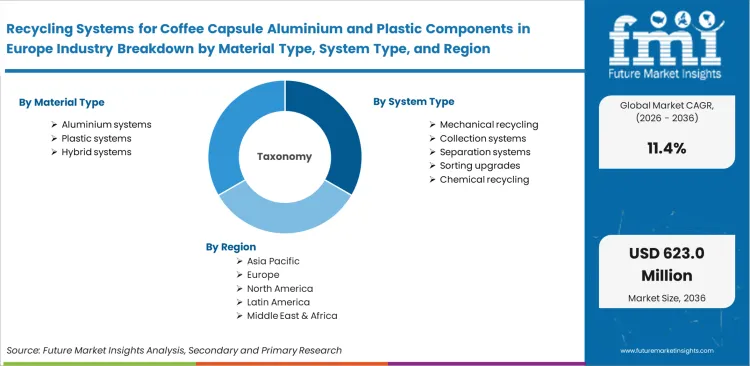
Recycling Systems for Coffee Capsule Aluminium and Plastic Components in Europe Industry Analysis by Segments
Material type
- Aluminium systems
- Plastic systems
- Hybrid systems
System type
- Mechanical recycling
- Collection systems
- Separation systems
- Sorting upgrades
- Chemical recycling
Collection model
- Public-bin systems
- Store drop-off
- Mail-back
- Civic depots
- B2B pickup
Process stage
- Sorting lines
- Depackaging
- Washing
- Smelting
- Regranulation
End output
- Secondary aluminium
- Recycled plastic
- Coffee valorization
- Energy recovery
- Compound feedstock
Region:
- Netherlands
- Austria
- United Kingdom
- Spain
- France
- Italy
Bibliography
- Nanni, A., Colonna, M., Liberati, G., & Bonoli, A. (2024, February). A novel process for the complete recycling of exhausted coffee capsules with a fully circular approach: Design of the industrial plant and techno-economic analysis of the process. Waste Management, 174, 114-125.
- Pinto, S. M., Gouveia, J. R., Sousa, M., Rodrigues, B., Oliveira, J., Pinto, C., & Baptista, A. J. (2024, July). Improving coffee capsules recyclability: A combined assessment of circularity and environmental performance of a novel design. Sustainable Production and Consumption, 46, 233-243.
- Lubongo, C., Bin Daej, M. A. A., & Alexandridis, P. (2024, July). Recent developments in technology for sorting plastic for recycling: The emergence of artificial intelligence and the rise of the robots. Recycling, 9(4), Article 59.
- Torkelis, A., Dvarionienė, J., & Denafas, G. (2024, October). The factors influencing the recycling of plastic and composite packaging waste. Sustainability, 16(21), Article 9515.
- Organisation for Economic Co-operation and Development. (2024, April). Extended producer responsibility: Basic facts and key considerations.
- IEA Bioenergy Task 36. (2024, July). Advanced sorting technologies in the waste sector: Case studies compilation.
- Department for Environment, Food & Rural Affairs. (2024, November). Simpler recycling: Workplace recycling in England. GOV.UK.
- Verpact. (2025). Verpact 2024 public report.
- Citeo. (2024, November 5). Petits emballages en métal : mieux les capter, mieux les recycler.
This bibliography is provided for reader reference. The full FMI report contains the complete reference list with primary source documentation.
This Report Addresses
- Municipal waste directors actively procuring eddy current separators for small-format pod extraction.
- Plant managers evaluating mechanical shredding equipment to decouple organic coffee from rigid polymer casings.
- Secondary material traders verifying alloy purity of smelted aluminium ingots sourced from municipal recovery lines.
- Logistics coordinators optimizing public-bin route networks to consolidate regional single-serve waste volumes.
- Facility supervisors deploying AI-guided robotic arms to eject lightweight composites from fast-moving mixed recycling conveyors.
- Packaging procurement officers securing closed-loop secondary feedstocks to satisfy extended producer responsibility mandates.
- Quality assurance leads calibrating optical sensors to distinguish dark polymers from standard clear municipal plastics.
- Equipment maintenance engineers reducing rotor blade wear during high-volume capsule depackaging and washing cycles.
Frequently Asked Questions
How big is the Recycling Systems for Coffee Capsule Aluminium and Plastic Components in Europe Industry?
Demand is expected to reach USD 190.0 million in 2026 and advance to USD 560.0 million by 2036. This coffee capsule recycling industry size Europe signals key changes as municipal operators transition from voluntary collection pilot programs to mandatory capital-intensive facility upgrades required by impending landfill diversion quotas.
Why are coffee capsules difficult to recycle at scale?
Standard optical units misidentify lightweight composite structures as residual waste. coffee capsule collection and sorting systems must be upgraded because un-modified conveyors ensure thousands of tons of valuable material successfully bypass recovery and enter incinerators instead.
What share of the market is aluminium vs plastic systems?
Aluminium systems holds 58.0% share because scrap metal brokers prioritize securing specific alloys. Secondary material traders actively bid on these bales, ensuring facility operators generate immediate return on investment for deployed eddy current separators.
Which European countries lead coffee capsule recycling infrastructure?
Analysts tracking which European countries lead coffee capsule recycling infrastructure observe Netherlands expanding at a 13.2% CAGR as national policies force immediate infrastructure upgrades. Municipal waste directors rapidly integrate specialized separation modules into existing recovery facilities to meet newly mandated collection target uplifts.
How is PPWR changing the economics of coffee capsule recycling?
Mandates surrounding PPWR coffee capsules force brand sustainability officers to co-fund municipal processing upgrades. Direct capital injections allow local waste authorities to purchase advanced shredding architectures without drawing from constrained municipal tax revenues.
What is the difference between public-bin and dedicated collection models?
Local authorities prefer integrated neighborhood bins, which account for 36.0% of collection methodologies. Logistics coordinators leverage existing transit routes to consolidate vast material volumes, bypassing severe limitations of localized consumer mail-back schemes.
Who are the main companies in Europe coffee capsule recycling systems?
Key players defining coffee capsule recycling trends in Europe include Nestlé / Nespresso, Altstoff Recycling Austria AG, TerraCycle, Podback, and Koffie Capsule Recycling Nederland. These incumbents possess years of operational telemetry to design highly resilient shredding architectures.
What happens to coffee grounds after capsule recycling?
Following coffee grounds separation from capsules, physical shredding and density separation isolate organic residue from rigid polymer casings. Operations managers utilize water baths and high-speed trommels to clean output for downstream extrusion or separate organic valorization.
Are aluminium coffee capsules easier to recycle than plastic ones?
Procurement directors who compare aluminium and plastic coffee capsule recycling economics find aluminium yields command higher market premiums. Foundry supervisors require exact metallurgical specifications to supply continuous consumer goods remanufacturing loops without relying on volatile virgin ore.
What technologies are used to separate mixed coffee capsule waste?
Physical shredding, density separation, and eddy current fields maintain operational footprints because plant directors reject unproven chemical alternatives. Facility operations managers capture premium material fractions by using dedicated waste sorters for small metallic and polymer fractions.
How do compostable capsules vs recyclable capsules Europe strategies differ?
Operations managers at specialized processing hubs configure mechanical shredders to handle uniquely designed compostable and hybrid casing variants. Maintenance supervisors adjust rotor speeds to prevent organic coffee residue from blinding downstream density separation screens based on material type.
What operational friction slows equipment installation?
Severe spatial limitations inside legacy recycling centers prevent rapid equipment integration. Facility directors struggle to fit new trommels and separators into existing conveyor geometries without triggering complete operational shutdowns.
Preview the report firsthand - request a free sample
Get SampleGet the brochure for pricing and purchase details.
Get PDFTable of Content
- Executive Summary
- Global Market Outlook
- Demand-side Trends
- Supply-side Trends
- Technology Roadmap Analysis
- Analysis and Recommendations
- Market Overview
- Market Coverage / Taxonomy
- Market Definition / Scope / Limitations
- Research Methodology
- Chapter Orientation
- Analytical Lens and Working Hypotheses
- Market Structure, Signals, and Trend Drivers
- Benchmarking and Cross-market Comparability
- Market Sizing, Forecasting, and Opportunity Mapping
- Research Design and Evidence Framework
- Desk Research Programme (Secondary Evidence)
- Company Annual and Sustainability Reports
- Peer-reviewed Journals and Academic Literature
- Corporate Websites, Product Literature, and Technical Notes
- Earnings Decks and Investor Briefings
- Statutory Filings and Regulatory Disclosures
- Technical White Papers and Standards Notes
- Trade Journals, Industry Magazines, and Analyst Briefs
- Conference Proceedings, Webinars, and Seminar Materials
- Government Statistics Portals and Public Data Releases
- Press Releases and Reputable Media Coverage
- Specialist Newsletters and Curated Briefings
- Sector Databases and Reference Repositories
- FMI Internal Proprietary Databases and Historical Market Datasets
- Subscription Datasets and Paid Sources
- Social Channels, Communities, and Digital Listening Inputs
- Additional Desk Sources
- Expert Input and Fieldwork (Primary Evidence)
- Primary Modes
- Qualitative Interviews and Expert Elicitation
- Quantitative Surveys and Structured Data Capture
- Blended Approach
- Why Primary Evidence is Used
- Field Techniques
- Interviews
- Surveys
- Focus Groups
- Observational and In-context Research
- Social and Community Interactions
- Stakeholder Universe Engaged
- C-suite Leaders
- Board Members
- Presidents and Vice Presidents
- R&D and Innovation Heads
- Technical Specialists
- Domain Subject-matter Experts
- Scientists
- Physicians and Other Healthcare Professionals
- Governance, Ethics, and Data Stewardship
- Research Ethics
- Data Integrity and Handling
- Primary Modes
- Tooling, Models, and Reference Databases
- Desk Research Programme (Secondary Evidence)
- Data Engineering and Model Build
- Data Acquisition and Ingestion
- Cleaning, Normalisation, and Verification
- Synthesis, Triangulation, and Analysis
- Quality Assurance and Audit Trail
- Market Background
- Market Dynamics
- Drivers
- Restraints
- Opportunity
- Trends
- Scenario Forecast
- Demand in Optimistic Scenario
- Demand in Likely Scenario
- Demand in Conservative Scenario
- Opportunity Map Analysis
- Product Life Cycle Analysis
- Supply Chain Analysis
- Investment Feasibility Matrix
- Value Chain Analysis
- PESTLE and Porter’s Analysis
- Regulatory Landscape
- Regional Parent Market Outlook
- Production and Consumption Statistics
- Import and Export Statistics
- Market Dynamics
- Global Market Analysis 2021 to 2025 and Forecast, 2026 to 2036
- Historical Market Size Value (USD Million) Analysis, 2021 to 2025
- Current and Future Market Size Value (USD Million) Projections, 2026 to 2036
- Y-o-Y Growth Trend Analysis
- Absolute $ Opportunity Analysis
- Global Market Pricing Analysis 2021 to 2025 and Forecast 2026 to 2036
- Global Market Analysis 2021 to 2025 and Forecast 2026 to 2036, By Material Type
- Introduction / Key Findings
- Historical Market Size Value (USD Million) Analysis By Material Type , 2021 to 2025
- Current and Future Market Size Value (USD Million) Analysis and Forecast By Material Type , 2026 to 2036
- Aluminium systems
- Plastic systems
- Hybrid systems
- Aluminium systems
- Y-o-Y Growth Trend Analysis By Material Type , 2021 to 2025
- Absolute $ Opportunity Analysis By Material Type , 2026 to 2036
- Global Market Analysis 2021 to 2025 and Forecast 2026 to 2036, By System Type
- Introduction / Key Findings
- Historical Market Size Value (USD Million) Analysis By System Type, 2021 to 2025
- Current and Future Market Size Value (USD Million) Analysis and Forecast By System Type, 2026 to 2036
- Mechanical recycling
- Collection systems
- Separation systems
- Sorting upgrades
- Chemical recycling
- Mechanical recycling
- Y-o-Y Growth Trend Analysis By System Type, 2021 to 2025
- Absolute $ Opportunity Analysis By System Type, 2026 to 2036
- Global Market Analysis 2021 to 2025 and Forecast 2026 to 2036, By Collection Model
- Introduction / Key Findings
- Historical Market Size Value (USD Million) Analysis By Collection Model, 2021 to 2025
- Current and Future Market Size Value (USD Million) Analysis and Forecast By Collection Model, 2026 to 2036
- Public-bin systems
- Store drop-off
- Mail-back
- Civic depots
- B2B pickup
- Public-bin systems
- Y-o-Y Growth Trend Analysis By Collection Model, 2021 to 2025
- Absolute $ Opportunity Analysis By Collection Model, 2026 to 2036
- Global Market Analysis 2021 to 2025 and Forecast 2026 to 2036, By Process Stage
- Introduction / Key Findings
- Historical Market Size Value (USD Million) Analysis By Process Stage, 2021 to 2025
- Current and Future Market Size Value (USD Million) Analysis and Forecast By Process Stage, 2026 to 2036
- Sorting lines
- Depackaging
- Washing
- Smelting
- Regranulation
- Sorting lines
- Y-o-Y Growth Trend Analysis By Process Stage, 2021 to 2025
- Absolute $ Opportunity Analysis By Process Stage, 2026 to 2036
- Global Market Analysis 2021 to 2025 and Forecast 2026 to 2036, By End Output
- Introduction / Key Findings
- Historical Market Size Value (USD Million) Analysis By End Output, 2021 to 2025
- Current and Future Market Size Value (USD Million) Analysis and Forecast By End Output, 2026 to 2036
- Secondary aluminium
- Recycled plastic
- Coffee valorization
- Energy recovery
- Compound feedstock
- Secondary aluminium
- Y-o-Y Growth Trend Analysis By End Output, 2021 to 2025
- Absolute $ Opportunity Analysis By End Output, 2026 to 2036
- Global Market Analysis 2021 to 2025 and Forecast 2026 to 2036, By Region
- Introduction
- Historical Market Size Value (USD Million) Analysis By Region, 2021 to 2025
- Current Market Size Value (USD Million) Analysis and Forecast By Region, 2026 to 2036
- North America
- Latin America
- Western Europe
- Eastern Europe
- East Asia
- South Asia and Pacific
- Middle East & Africa
- Market Attractiveness Analysis By Region
- North America Market Analysis 2021 to 2025 and Forecast 2026 to 2036, By Country
- Historical Market Size Value (USD Million) Trend Analysis By Market Taxonomy, 2021 to 2025
- Market Size Value (USD Million) Forecast By Market Taxonomy, 2026 to 2036
- By Country
- USA
- Canada
- Mexico
- By Material Type
- By System Type
- By Collection Model
- By Process Stage
- By End Output
- By Country
- Market Attractiveness Analysis
- By Country
- By Material Type
- By System Type
- By Collection Model
- By Process Stage
- By End Output
- Key Takeaways
- Latin America Market Analysis 2021 to 2025 and Forecast 2026 to 2036, By Country
- Historical Market Size Value (USD Million) Trend Analysis By Market Taxonomy, 2021 to 2025
- Market Size Value (USD Million) Forecast By Market Taxonomy, 2026 to 2036
- By Country
- Brazil
- Chile
- Rest of Latin America
- By Material Type
- By System Type
- By Collection Model
- By Process Stage
- By End Output
- By Country
- Market Attractiveness Analysis
- By Country
- By Material Type
- By System Type
- By Collection Model
- By Process Stage
- By End Output
- Key Takeaways
- Western Europe Market Analysis 2021 to 2025 and Forecast 2026 to 2036, By Country
- Historical Market Size Value (USD Million) Trend Analysis By Market Taxonomy, 2021 to 2025
- Market Size Value (USD Million) Forecast By Market Taxonomy, 2026 to 2036
- By Country
- Germany
- UK
- Italy
- Spain
- France
- Nordic
- BENELUX
- Rest of Western Europe
- By Material Type
- By System Type
- By Collection Model
- By Process Stage
- By End Output
- By Country
- Market Attractiveness Analysis
- By Country
- By Material Type
- By System Type
- By Collection Model
- By Process Stage
- By End Output
- Key Takeaways
- Eastern Europe Market Analysis 2021 to 2025 and Forecast 2026 to 2036, By Country
- Historical Market Size Value (USD Million) Trend Analysis By Market Taxonomy, 2021 to 2025
- Market Size Value (USD Million) Forecast By Market Taxonomy, 2026 to 2036
- By Country
- Russia
- Poland
- Hungary
- Balkan & Baltic
- Rest of Eastern Europe
- By Material Type
- By System Type
- By Collection Model
- By Process Stage
- By End Output
- By Country
- Market Attractiveness Analysis
- By Country
- By Material Type
- By System Type
- By Collection Model
- By Process Stage
- By End Output
- Key Takeaways
- East Asia Market Analysis 2021 to 2025 and Forecast 2026 to 2036, By Country
- Historical Market Size Value (USD Million) Trend Analysis By Market Taxonomy, 2021 to 2025
- Market Size Value (USD Million) Forecast By Market Taxonomy, 2026 to 2036
- By Country
- China
- Japan
- South Korea
- By Material Type
- By System Type
- By Collection Model
- By Process Stage
- By End Output
- By Country
- Market Attractiveness Analysis
- By Country
- By Material Type
- By System Type
- By Collection Model
- By Process Stage
- By End Output
- Key Takeaways
- South Asia and Pacific Market Analysis 2021 to 2025 and Forecast 2026 to 2036, By Country
- Historical Market Size Value (USD Million) Trend Analysis By Market Taxonomy, 2021 to 2025
- Market Size Value (USD Million) Forecast By Market Taxonomy, 2026 to 2036
- By Country
- India
- ASEAN
- Australia & New Zealand
- Rest of South Asia and Pacific
- By Material Type
- By System Type
- By Collection Model
- By Process Stage
- By End Output
- By Country
- Market Attractiveness Analysis
- By Country
- By Material Type
- By System Type
- By Collection Model
- By Process Stage
- By End Output
- Key Takeaways
- Middle East & Africa Market Analysis 2021 to 2025 and Forecast 2026 to 2036, By Country
- Historical Market Size Value (USD Million) Trend Analysis By Market Taxonomy, 2021 to 2025
- Market Size Value (USD Million) Forecast By Market Taxonomy, 2026 to 2036
- By Country
- Kingdom of Saudi Arabia
- Other GCC Countries
- Turkiye
- South Africa
- Other African Union
- Rest of Middle East & Africa
- By Material Type
- By System Type
- By Collection Model
- By Process Stage
- By End Output
- By Country
- Market Attractiveness Analysis
- By Country
- By Material Type
- By System Type
- By Collection Model
- By Process Stage
- By End Output
- Key Takeaways
- Key Countries Market Analysis
- USA
- Pricing Analysis
- Market Share Analysis, 2025
- By Material Type
- By System Type
- By Collection Model
- By Process Stage
- By End Output
- Canada
- Pricing Analysis
- Market Share Analysis, 2025
- By Material Type
- By System Type
- By Collection Model
- By Process Stage
- By End Output
- Mexico
- Pricing Analysis
- Market Share Analysis, 2025
- By Material Type
- By System Type
- By Collection Model
- By Process Stage
- By End Output
- Brazil
- Pricing Analysis
- Market Share Analysis, 2025
- By Material Type
- By System Type
- By Collection Model
- By Process Stage
- By End Output
- Chile
- Pricing Analysis
- Market Share Analysis, 2025
- By Material Type
- By System Type
- By Collection Model
- By Process Stage
- By End Output
- Germany
- Pricing Analysis
- Market Share Analysis, 2025
- By Material Type
- By System Type
- By Collection Model
- By Process Stage
- By End Output
- UK
- Pricing Analysis
- Market Share Analysis, 2025
- By Material Type
- By System Type
- By Collection Model
- By Process Stage
- By End Output
- Italy
- Pricing Analysis
- Market Share Analysis, 2025
- By Material Type
- By System Type
- By Collection Model
- By Process Stage
- By End Output
- Spain
- Pricing Analysis
- Market Share Analysis, 2025
- By Material Type
- By System Type
- By Collection Model
- By Process Stage
- By End Output
- France
- Pricing Analysis
- Market Share Analysis, 2025
- By Material Type
- By System Type
- By Collection Model
- By Process Stage
- By End Output
- India
- Pricing Analysis
- Market Share Analysis, 2025
- By Material Type
- By System Type
- By Collection Model
- By Process Stage
- By End Output
- ASEAN
- Pricing Analysis
- Market Share Analysis, 2025
- By Material Type
- By System Type
- By Collection Model
- By Process Stage
- By End Output
- Australia & New Zealand
- Pricing Analysis
- Market Share Analysis, 2025
- By Material Type
- By System Type
- By Collection Model
- By Process Stage
- By End Output
- China
- Pricing Analysis
- Market Share Analysis, 2025
- By Material Type
- By System Type
- By Collection Model
- By Process Stage
- By End Output
- Japan
- Pricing Analysis
- Market Share Analysis, 2025
- By Material Type
- By System Type
- By Collection Model
- By Process Stage
- By End Output
- South Korea
- Pricing Analysis
- Market Share Analysis, 2025
- By Material Type
- By System Type
- By Collection Model
- By Process Stage
- By End Output
- Russia
- Pricing Analysis
- Market Share Analysis, 2025
- By Material Type
- By System Type
- By Collection Model
- By Process Stage
- By End Output
- Poland
- Pricing Analysis
- Market Share Analysis, 2025
- By Material Type
- By System Type
- By Collection Model
- By Process Stage
- By End Output
- Hungary
- Pricing Analysis
- Market Share Analysis, 2025
- By Material Type
- By System Type
- By Collection Model
- By Process Stage
- By End Output
- Kingdom of Saudi Arabia
- Pricing Analysis
- Market Share Analysis, 2025
- By Material Type
- By System Type
- By Collection Model
- By Process Stage
- By End Output
- Turkiye
- Pricing Analysis
- Market Share Analysis, 2025
- By Material Type
- By System Type
- By Collection Model
- By Process Stage
- By End Output
- South Africa
- Pricing Analysis
- Market Share Analysis, 2025
- By Material Type
- By System Type
- By Collection Model
- By Process Stage
- By End Output
- USA
- Market Structure Analysis
- Competition Dashboard
- Competition Benchmarking
- Market Share Analysis of Top Players
- By Regional
- By Material Type
- By System Type
- By Collection Model
- By Process Stage
- By End Output
- Competition Analysis
- Competition Deep Dive
- Nestlé / Nespresso
- Overview
- Product Portfolio
- Profitability by Market Segments (Product/Age /Sales Channel/Region)
- Sales Footprint
- Strategy Overview
- Marketing Strategy
- Product Strategy
- Channel Strategy
- Altstoff Recycling Austria AG
- TerraCycle
- Podback
- Koffie Capsule Recycling Nederland
- Recycap Technologies
- Der Grüne Punkt
- Nestlé / Nespresso
- Competition Deep Dive
- Assumptions & Acronyms Used


