

- Industry Size (2026)
- USD 242.7 Mn
- Forecast (2036)
- USD 646.8 Mn
- CAGR (2026 to 2036)
- 10.3%
Demand for Synthetics-Rich Workwear and PPE Take-Back and Recycling Systems in Europe Size, Market Forecast and Outlook By FMI
The synthetics-rich workwear and PPE take-back and recycling systems in Europe was valued at USD 220 million in 2025. The industry is expected to reach USD 242.7 million in 2026 at a CAGR of 10.3% during the forecast period. Demand outlook carries the market valuation to USD 646.8 million by 2036 as textile extended producer responsibility regulations transition toward enforceable national mandates across Europe.
Summary of Synthetics-Rich Workwear and PPE Take-Back and Recycling Systems in Europe
- Synthetics-Rich Workwear and PPE Take-Back and Recycling Systems in Europe Definition
- These systems provide the specialized logistics and processing pathways necessary to transform contaminated safety garments into high-value recycled fibers. The focus remains on garments with high synthetic content that require sophisticated separation to bypass traditional disposal.
- Demand Drivers in the Market
- Is textile EPR covering workwear? Impending mandates force safety directors at utilities to account for the total lifecycle of high-visibility polyester uniforms.
- Stringent decontamination requirements compel managers to adopt a textile recycling compliance service Europe to mitigate chemical liability.
- Corporate sustainability targets push procurement to prioritize workwear service models that guarantee zero-waste outcomes.
- Key Segments Analyzed in the FMI Report
- Rental-Linked: 42.0% share in 2026, as integrated laundry-and-recycling contracts provide the lowest friction.
- Take-Back Logistics: 31.0% share in 2026, driven by the high complexity of managing workwear recycling service providers Europe.
- Netherlands: 11.2% CAGR, reflecting its role as a leader in Netherlands workwear EPR.
- Analyst Opinion at FMI
- Nikhil Kaitwade, Principal Analyst, Chemicals and Process Automation, at FMI, points out, "Explain the Europe for synthetic-rich workwear and PPE take-back and recycling systems, and you find a structural contradiction. The very features making PPE effective, flame retardancy and multi-layer durability, are exactly why polycotton is hard to recycle. Most generalist assumptions about circularity fail to account for the fact that a high-visibility coating or a fire resistant fabrics treatment often renders the garment toxic for mechanical recycling. We are seeing a structural shift where the value is in the sophisticated textile sorting automation Europe that can identify these chemical barriers before they contaminate an entire batch of recycled polyester."
- Strategic Implications / Executive Takeaways
- Procurement directors must renegotiate contracts with a PPE take-back program supplier Europe to avoid upcoming non-compliance penalties.
- R&D heads at fiber producers should invest in fiber-to-fiber recycling Europe partnerships to secure long-term access to specialized feedstock.
- Operations managers face the necessity of implementing RFID-based traceability to comply with digital product passport workwear mandates.
- Methodology
- The research identifies the structural gap between current collection volumes and the actual capacity of high-fidelity sorting hubs. Data synthesis combines primary interviews with safety heads and secondary analysis of dope-dyed recycled polyester supply chains.
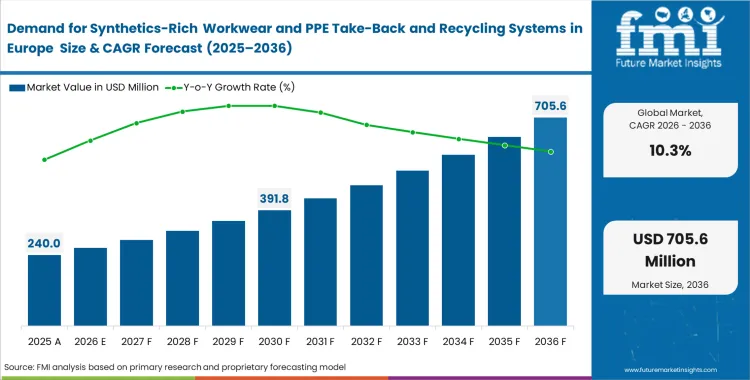
Regulatory pressure regarding PFAS and microplastic shedding is fundamentally altering how safety directors view the end-of-life phase for industrial workwear. Procurement teams are no longer evaluating workwear take-back systems Europe based on simple collection volume; they are prioritizing high-fidelity decontamination that removes hazardous residues. The ROI of workwear take-back systems is increasingly tied to liability mitigation, as what is a digital product passport for workwear becomes a standard query for compliance officers. This structural shift ensures that textile waste recycling machine infrastructure becomes a non-negotiable component of contracts rather than an optional add-on.
Large-scale operators trigger the primary inflection point when they integrate automated textile sorting hubs Europe directly into their existing wash cycles. This structural gate transforms synthetics-rich workwear recycling from a separate logistics cost into a streamlined operational output. Once industrial launderers solve the challenge of separating polycotton workwear recycling Europe at scale, the volume of feedstock available for recycled polyester apparel fiber will expand exponentially. This evolution explains how is workwear recycled in Europe today: through a blend of mechanical separation and chemical prep.
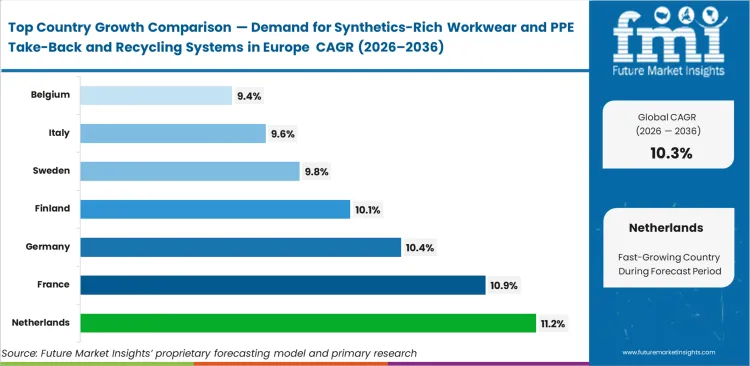
Netherlands leads at 11.2%, with advanced textile sorting automation Europe, while France tracks at 10.9% on the back of established France textile EPR workwear. Germany is forecast at 10.4% as Germany industrial workwear recycling is driven by automotive giants mandating closed-loop systems. Finland is projected at 10.1%, followed by Sweden at 9.8%, Italy at 9.6%, and Belgium at 9.4%. These figures clarify which European countries lead in workwear recycling systems.
Demand for Synthetics-Rich Workwear and PPE Take-Back and Recycling Systems in Europe Definition
This sector includes the physical systems and digital tools used to collect, clean, sort, and process synthetic-heavy workwear and PPE into reusable material. It covers garments that cannot move through normal municipal recycling channels because of flame-retardant treatments, chemical exposure, or other contamination risks. A key part of the system is traceability, which helps track used uniforms through recovery and recycling while meeting safety and compliance requirements.
Demand for Synthetics-Rich Workwear and PPE Take-Back and Recycling Systems in Europe Inclusions
The scope includes reverse logistics systems for industrial workwear in Europe, along with software platforms that track garment movement, use history, and end-of-life handling. It also covers sorting centers, pre-processing operations, mechanical shredding, and preparation steps for chemical recycling. These systems are designed for complex protective garments made from mixed and layered synthetic materials, especially where contamination control is required before recycling can begin.
Demand for Synthetics-Rich Workwear and PPE Take-Back and Recycling Systems in Europe Exclusions
This sector does not include general consumer clothing recycling or non-textile PPE such as helmets, goggles, or safety eyewear. It is also separate from standard municipal textile recycling because industrial workwear often needs specialized decontamination before it can be processed. Conventional clothing recycling streams that do not handle contaminated or industrial-grade synthetic garments are outside the scope of this market.
Demand for Synthetics-Rich Workwear and PPE Take-Back and Recycling Systems in Europe Research Methodology
- Primary Research: Interviews with operations managers at industrial laundry take-back programs, safety directors, and engineers at recycling hubs.
- Desk Research: Analysis of European REACH compliance, textile EPR Europe filing archives, and clothing recycling patent applications.
- Market-Sizing and Forecasting: Baseline anchored by the total annual volume of protective clothing put on the European market by tier-1 manufacturers.
- Data Validation and Update Cycle: Cross-referenced with independent waste shipment data and reporting recycled workwear volumes from sustainability disclosures.
Segmental Analysis
Synthetics-Rich Workwear and PPE Take-Back and Recycling Systems in Europe Analysis By Service Model
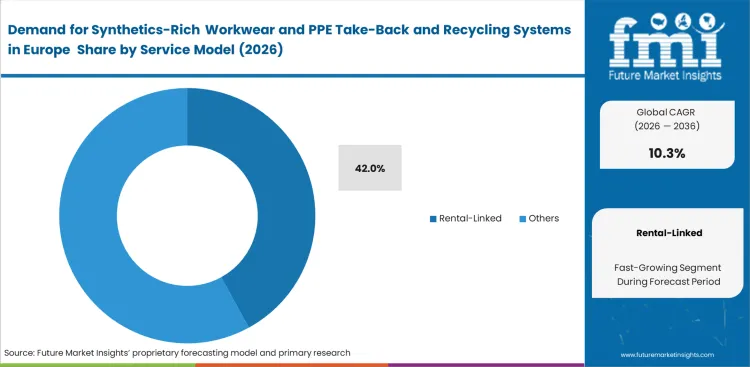
Rental-linked models dominate procurement because they align the incentives of the laundry provider with the sustainability goals of the buyer. Rental-linked services hold 42.0% share in this category, a figure that FMI's assessment indicates will remain stable as industrial launderers leverage their existing logistics. Safety directors at manufacturing plants prefer this model as it removes the burden of waste management from their internal teams, transferring the responsibility to the medical protective equipment provider. A uniform recycling partner Europe can offer the most efficient route for high-volume streams. The operational reality is that once a garment is entered into a rental circuit, its material composition is already logged, making sorting significantly more efficient than one-off programs. FMI observes that the share figure alone does not reveal how many smaller players are actually being excluded due to the high capital cost of building proprietary industrial commercial laundry microfibre capture system components. Buyers who stick to traditional disposal cycles face rapidly increasing landfill taxes.
- Contract-Bound Validation: Procurement directors utilize rental cycles to validate the durability and recyclability of fire retardant fabrics before committing to 2036 sustainability roadmaps. This mechanism ensures that only garments with a proven end-of-life pathway are introduced, reducing long-term environmental liability.
- Qualification-Led Renewal: Quality control managers at launderers use the end of a rental contract to trigger garment retirement, ensuring that 100% of the material is directed to a upcycled textile pouch or fiber reclaim stream. This sequence prevents garment leakage into unregulated second-hand markets where safety certifications might be void.
- Service-Integrated Expansion: Operations managers expand their recycling footprint by bundling PPE collection with existing uniform laundry services, achieving significant logistics economies of scale. This integration makes the recycling service nearly impossible for standalone waste vendors to compete with on a cost-per-unit basis.
Synthetics-Rich Workwear and PPE Take-Back and Recycling Systems in Europe Analysis By System Type
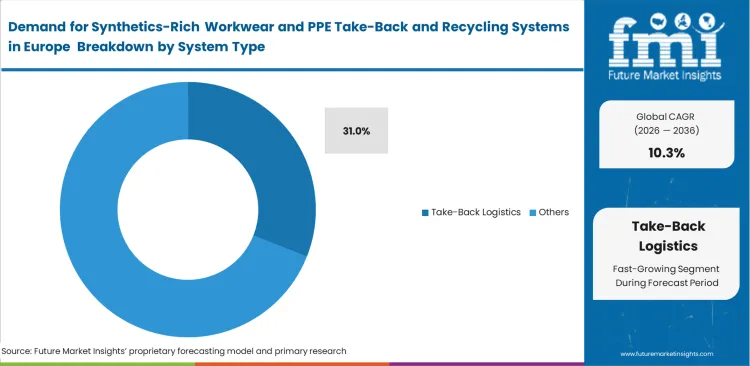
Take-back logistics represent the most critical infrastructure layer, as the recovery of used electrical safety personal protection equipment (PPE) requires a specialized chain of custody. Take-back logistics hold 31.0% share, but this number hides a growing tension between centralized sorting and regional collection points. FMI notes that logistics managers at large utilities are increasingly demanding on-site collection hubs that can pre-sort contaminated items. Chemical decontamination at the point of origin is becoming a standard requirement for flame resistant fabrics used in the energy sector to prevent cross-contamination during transit. A non-obvious observation is that the logistics cost often exceeds the material value of the recycled fiber, forcing providers to monetize the compliance data. R&D directors must acknowledge that without RFID-enabled sorting hubs, the manual labor costs of identifying material blends will remain a permanent barrier to profitability. This highlights the workwear recycling vs disposal debate, disposal is cheaper in the short term, but recycling is a structural necessity for 2026.
- Initial-Trigger Collection: Safety officers initiate the recycling cycle by mandating the return of damaged hand & arm protection PPE into secure on-site bins. This mechanism prevents employees from disposing of potentially hazardous synthetic materials in municipal waste streams, ensuring 100% recapture rates.
- Qualification-Stage Identification: Sorting hub managers utilize hyperspectral imaging to validate the material composition of unlabelled garments. This technical gate is essential for separating high-visibility polyester from standard polycotton, a requirement for high-purity halogen-free FR polyester fibers for workwear production.
- Renewal-Cycle Optimization: Logistics directors optimize collection routes by aligning take-back schedules with fresh garment delivery, minimizing the carbon footprint of the reverse supply chain. This lifecycle approach reduces the total cost of ownership for the end user while maximizing the volume of feedstock sent to sorting hubs.
Synthetics-Rich Workwear and PPE Take-Back and Recycling Systems in Europe Analysis By Material Focus
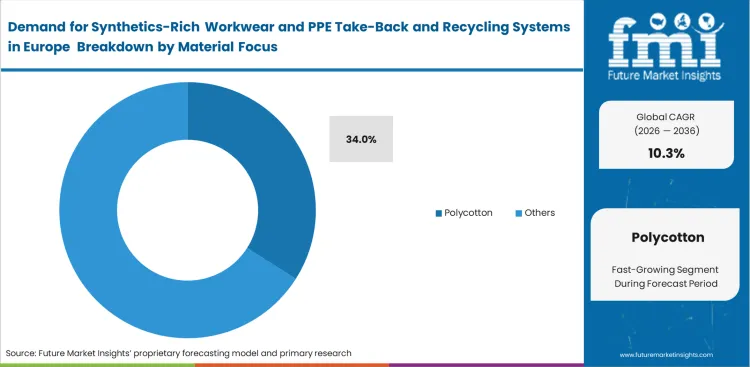
Polycotton blends remain the dominant material focus due to their widespread use in general industrial workwear, but their complexity makes them the most difficult to process. Polycotton holds 34.0% share, yet the market is rapidly shifting toward mono-material technical textiles to simplify chemical recycling. FMI's view is that the structural lock-in for polycotton is fading as chemical separation technologies reach commercial maturity. Fabric engineers at textile mills are now designing workwear specifically for disassembly, a move that procurement heads are beginning to reward. This shift supports mechanical vs chemical textile recycling for uniforms, as different materials require specific technology routes. The practitioner reality is that many "recyclable" labels on polycotton garments are technically true but economically unviable without massive subsidies. Manufacturers who fail to adopt fire resistant fabrics that are compatible with chemical recycling will lose access to tier-1 corporate accounts within the next three years.
- Procurement-Side Savings: Sourcing managers achieve lower unit costs by selecting mono-material polyester garments that bypass the expensive separation steps required for polycotton. This economic shift is driving a faster transition toward high-synthetic workwear in sectors that previously prioritized natural fiber feel.
- Operational-Cost Emergence: Operations managers face hidden costs when processing multilayer PPE, as each layer must be mechanically separated before chemical depolymerization. This complexity increases the processing time at sorting hubs, leading to higher service fees for companies with diverse PPE portfolios.
- Lifecycle-Comparison Advantage: Sustainability directors utilize lifecycle assessment data to prove that synthetic-rich workwear, when recycled, has a lower carbon footprint than single-use cotton alternatives. This data-driven approach is essential for securing budget approval for the higher upfront cost of circular PPE systems.
Demand for Synthetics-Rich Workwear and PPE Take-Back and Recycling Systems in Europe Drivers, Restraints, and Opportunities
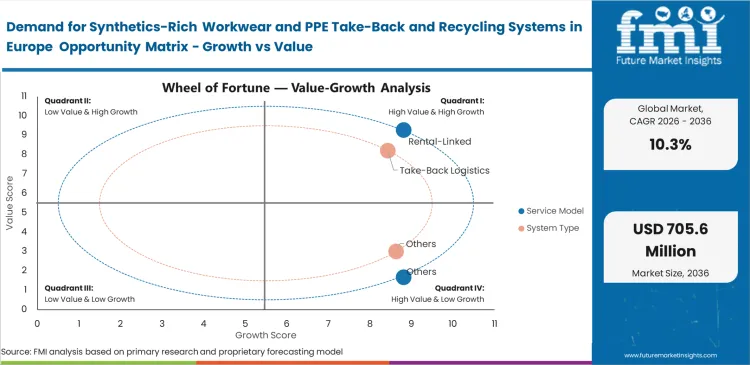
Impending EPR mandates force safety directors at large utilities to account for the total carbon footprint of their high-visibility gear. This commercial pressure makes buyers act now to secure recycling contracts before regional sorting capacity is fully booked by early adopters. The commercial consequence of delay is not just a regulatory fine; it is the risk of being locked out of the technical textiles supply chain as manufacturers prioritize circular-ready clients. This answers the query: what regulations drive textile take-back in Europe?
The primary operational friction is the lack of standardized decontamination protocols for garments used in heavy chemical or nuclear environments. This obstacle persists structurally because current recycling hubs are not equipped to handle the hazardous residues often found on industrial protective clothing. While mechanical shredding offers a partial solution, it degrades fiber length, leaving chemical depolymerization as the only viable route for high-performance safety wear. This reinforces the open-loop vs closed-loop workwear recycling decision that safety directors must navigate.
- Automated-Sorting Investment: Textile service firms that invest in AI-driven sorting can achieve 99% purity in textile waste recycling machine feedstock.
- RFID-Traceability Integration: Safety directors who implement RFID-based tracking gain a competitive edge in reporting accuracy for the EU Digital Product Passport.
- Depolymerization-Partnership Growth: Manufacturers who partner with chemical recyclers secure long-term access to recycled polyester apparel fiber for their next-generation safety lines.
Regional Analysis
.webp "Top Country Growth Comparison Demand For Synthetics Rich Workwear And Ppe Take Back And Recycling Systems In Europe Cagr (2026 2036)")
Based on regional analysis, Synthetics-Rich Workwear and PPE Take-Back and Recycling Systems in Europe is segmented into Western Europe, Northern Europe, Central Europe, Southern Europe, and Eastern Europe across 40 plus countries.
| Country | CAGR (2026 to 2036) |
|---|---|
| Netherlands | 11.2% |
| France | 10.9% |
| Germany | 10.4% |
| Finland | 10.1% |
| Sweden | 9.8% |
| Italy | 9.6% |
| Belgium | 9.4% |
Source: Future Market Insights (FMI) analysis, based on proprietary forecasting model and primary research
Western Europe Synthetics-Rich Workwear and PPE Take-Back and Recycling Systems in Europe Analysis
Policy mandates in Western Europe have moved from incentive to requirement, forcing industrial launderers to prove 100% recapture rates for workwear within their rental circuits. The adoption curve here is defined by the high concentration of automotive and chemical giants who have integrated circularity into their core procurement scorecards. FMI's analysis indicates that the region's focus is shifting toward the recovery of high-value aramids from fire resistant fabrics. This region provides the answer to: can PPE be recycled in Europe?
- Netherlands: Advanced robotic sorting clusters in the port regions allow for the efficient processing of industrial waste from across the continent. Logistics directors in this country capitalize on their central location to act as the primary clearinghouse for PPE waste, driving a 11.2% CAGR. This structural position provides a significant commercial opportunity for local recyclers to dominate the Northern European feedstock market.
- France: Implementation of the AGEC law has created the most mature EPR infrastructure in Europe, mandating that manufacturers manage the end-of-life of all clothing recycling products. Sustainability officers in France utilize this framework to secure funding for specialized medical protective equipment team recycling programs. The competitive positioning of French firms is bolstered by this early regulatory lead, supporting a 10.9% CAGR.
- Germany: Automotive manufacturing hubs are mandating that all tier-1 suppliers implement closed-loop systems for industrial protective clothing. Procurement teams in Germany are projected to drive a 10.4% CAGR as they transition toward halogen-free FR polyester fibers for workwear. This operational outcome ensures that high-purity polyester remains within the domestic manufacturing ecosystem.
- Belgium: Centralized industrial laundry microfibre capture system components are becoming a standard feature in the country's textile processing facilities. Analysts expect a 9.4% CAGR as Belgian launderers leverage their proximity to EU policy centers to set the standard for circular PPE. The structural trajectory points toward Belgium becoming the primary testing ground for digital product passport interoperability.
FMI's report includes Austria, Switzerland, and Luxembourg. The dense industrial corridor in these countries supports high-frequency collection routes that make decentralized take-back logistics economically viable.
Northern Europe Synthetics-Rich Workwear and PPE Take-Back and Recycling Systems in Europe Analysis
Infrastructure-led dynamics define the Northern European landscape, where specialized chemical recycling plants are being built adjacent to textile manufacturing zones. The adoption curve is accelerated by high public sector transparency requirements for personal protective equipment used in utilities and healthcare.
- Finland: Strategic investments in cellulose-based and synthetic-blended fiber recovery systems position the country as a leader in textile recycling innovation. R&D directors in Finland are likely to hit a 10.1% CAGR by focusing on the depolymerization of complex synthetic PPE. This practitioner reality means that Finland is often two years ahead of the rest of Europe in processing non-mechanical waste.
- Sweden: Municipalities and healthcare providers are mandating the use of recycled polyester apparel fiber in all new workwear tenders. Sourcing directors in Sweden are estimated to reach a 9.8% CAGR by prioritizing suppliers who offer a verified take-back service. The commercial opportunity here lies in the public sector's willingness to pay a premium for guaranteed circularity.
FMI's report includes Norway and Denmark. Strong inter-Nordic cooperation on waste management standards ensures that protective clothing can be moved across borders for specialized processing without regulatory friction.
Southern Europe Synthetics-Rich Workwear and PPE Take-Back and Recycling Systems in Europe Analysis
Economics-led transitions characterize Southern Europe, where the focus is on the reuse-first model to delay the high costs of chemical recycling infrastructure. The market is evolving through regional collection cooperatives that pool textile waste recycling machine resources for mid-size manufacturing clusters.
- Italy: High-end textile finishing expertise is being applied to the upcycled textile pouch market, transforming industrial waste into premium accessories. Design directors in Italy are set for a 9.6% CAGR as they find creative second-life applications for dope dyed recycled polyester PPE. This competitive positioning allows Italian firms to extract value from waste that other regions would simply shred.
FMI's report includes Spain, Portugal, and Greece. The growth in these countries is tied to the modernization of industrial workwear laundry facilities to include basic mechanical sorting capabilities.
Competitive Aligners for Market Players
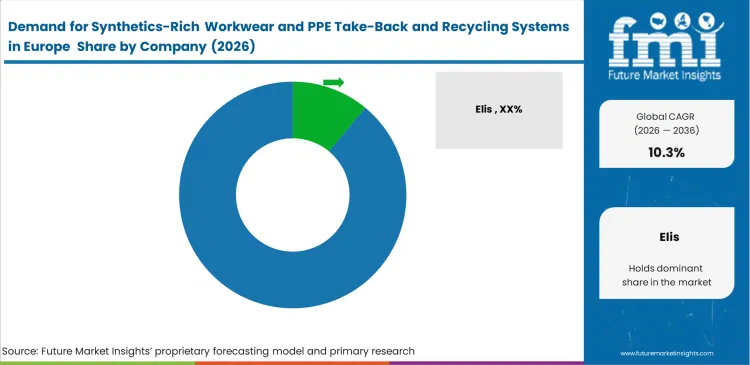
Competition in the European circular workwear space is structurally defined by the battle for logistics control rather than just recycling technology. Large textile service firms like Elis and Lindström hold a significant advantage because they already possess the "last mile" relationship with the industrial buyer through their laundry routes. These incumbents are currently insulating their share by building proprietary sorting hubs that can identify protective clothing material blends at the point of wash. Smaller challengers like TURNS are attempting to disrupt this by offering "platform-as-a-service" traceability that can sit on top of any third-party laundry network, appealing to buyers who want to avoid vendor lock-in. This mirrors the search for, give me key players in PPE take-back systems Europe.
Incumbents possess a critical structural asset in their massive libraries of safety certification data, which challengers cannot replicate without years of re-testing. When a buyer chooses a recycled PPE system, they are not just buying a garment; they are buying the legal assurance that the recycled fiber still meets industrial protective clothing standards for flame or arc protection. CWS Workwear and MEWA are leveraging this trust to bundle recycling services into high-margin safety-as-a-service contracts. The ability to guarantee that a recycled polyester thread will not compromise a garment's electrical safety personal protection equipment (PPE) rating is the primary barrier to entry for generalist textile recyclers.
Large industrial buyers are increasingly resisting vendor lock-in by demanding interoperable traceability data that can move between different service providers. This pressure is forcing a structural shift toward open-source digital product passports, which will eventually commoditize the basic take-back logistics. By 2036, the competitive battleground will move from "who collects the waste" to "who has the most efficient chemical depolymerization pathway" for specialized aramid and multilayer blends. Firms that fail to secure exclusive feedstock agreements with chemical recyclers today will find themselves unable to meet the high-purity requirements of future recycled polyester apparel fiber mandates.
Key Players in Synthetics-Rich Workwear and PPE Take-Back and Recycling Systems in Europe
- Elis
- Lindström
- CWS Workwear
- MEWA
- Fristads
- alsico
- TURNS
Scope of the Report
| Metric | Value |
|---|---|
| Quantitative Units | USD 242.7 million to USD 646.8 million, at a CAGR of 10.3% |
| Market Definition | Systems providing specialized logistics, decontamination, and processing pathways to transform synthetic-rich safety garments and PPE into high-value recycled fibers. |
| Segmentation | System type, Material focus, Service model, End user, Recycling route, and Region |
| Regions Covered | Western Europe, Northern Europe, Central Europe, Southern Europe, and Eastern Europe |
| Countries Covered | Netherlands, France, Germany, Finland, Sweden, Italy, Belgium, and others |
| Key Companies Profiled | Elis, Lindström, CWS Workwear, MEWA, Fristads, alsico, TURNS |
| Forecast Period | 2026 to 2036 |
| Approach | Data synthesis combining laundry volume tracking, safety garment replacement cycles, and chemical recycling capacity modeling. |
Source: Future Market Insights (FMI) analysis, based on proprietary forecasting model and primary research
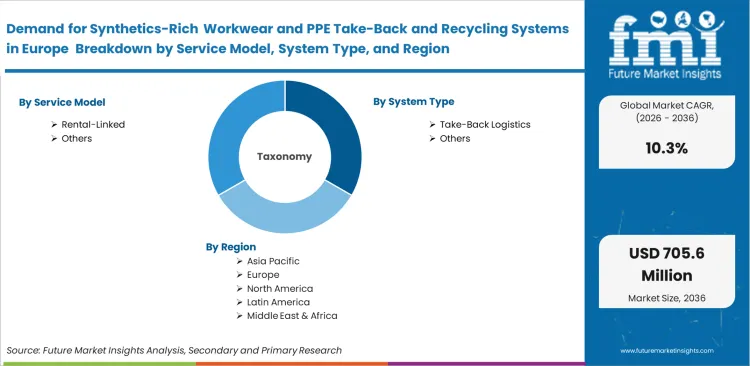
Key Segments:
System Type
- Take-back logistics
- Sorting hubs
- Traceability platforms
- Recycling prep
- Compliance services
Material Focus
- Polycotton
- Polyester
- Aramid blends
- High-vis blends
- Multilayer PPE
Service Model
- Rental-linked
- Brand take-back
- Producer schemes
- Recycler partnerships
- Managed programs
End User
- Manufacturing
- Utilities
- Construction
- Healthcare
- Logistics
Recycling Route
- Open-loop
- Mechanical
- Chemical
- Fiber reclaim
- Reuse-first
Regions:
- Western Europe
- Netherlands
- France
- Germany
- Belgium
- Northern Europe
- Finland
- Sweden
- Southern Europe
- Italy
Bibliography
- European Topic Centre on Circular Economy and Resource Use. (2024, May 21). Textile waste management in Europe’s circular economy (ETC CE Report 2024/5).
- European Parliamentary Research Service. (2024, June). Digital product passport for the textile sector. European Parliament.
- European Environment Agency. (2024, September 17). PFAS in textiles in Europe’s circular economy.
- Islam, G. M. N., Kasper, D., Parker, T., & Dolez, P. I. (2025). Recycling of inherently flame-resistant fabrics for protective clothing: A comprehensive review. Cleaner Waste Systems, 12, 100331.
- Solis, M., et al. (2024). Management of textile waste in Europe: An environmental and a socio-economic assessment of current and future scenarios. Resources, Conservation and Recycling.
This bibliography is provided for reader reference. The full FMI report contains the complete reference list with primary source documentation.
This Report Addresses
- Identification of the structural gap between current PPE collection volumes and actual high-fidelity sorting capacity.
- Detailed analysis of the rental-linked service model as the primary driver of circularity in industrial safety.
- Evaluation of chemical depolymerization as the only viable route for aramid and high-vis synthetic fiber recovery.
- Impact of the EU Digital Product Passport on traceability requirements for industrial protective clothing.
- Regional assessment of the Netherlands as the centralized sorting hub for Northern European PPE waste.
- Competitive positioning of tier-1 laundry firms leveraging safety certifications to prevent vendor lock-in.
- Strategic implications for procurement directors facing mandatory EPR compliance by 2036.
- Lifecycle comparison of recycled synthetic workwear versus traditional linear disposal models.
Frequently Asked Questions
What is the projected valuation of the Europe synthetics-rich workwear take-back market?
The valuation is set to reach USD 240 million in 2026 and is projected to surpass USD 640 million by 2036.
Which service model leads the European market?
Rental-linked models lead with a 42.0% share in 2026 as they integrate recycling directly into existing industrial laundry contracts.
Why is the Netherlands the fastest-growing country in this sector?
The Netherlands grows at 11.2% CAGR due to its advanced robotic sorting hubs and its role as a primary logistics nexus for Northwestern Europe.
What is the primary driver for recycling take-back systems?
Impending EPR legislation is the primary driver, forcing safety directors to account for the total lifecycle of PPE to avoid major legal liabilities.
How does chemical recycling differ from mechanical recycling in PPE?
Chemical recycling depolymerizes fibers to create virgin-quality feedstock, whereas mechanical recycling shreds fibers and degrades material quality.
What structural gate must be passed for self-reinforcing growth?
The integration of automated sorting directly into industrial laundry wash-cycles is the critical gate that turns recycling into an operational byproduct.
What operational friction slows adoption?
The lack of standardized decontamination protocols for hazardous residues remains the binding constraint for recycling hubs processing garments from high-risk environments.
Which material segment represents the biggest challenge?
Polycotton blends at 34.0% share represent the biggest challenge because separating cotton from polyester is technically complex and expensive.
How does the Digital Product Passport impact this market?
It mandates RFID-based traceability for every garment, requiring safety directors to prove end-of-life accountability across the entire supply chain.
What is the "practitioner paradox" in PPE recycling?
The paradox is that durability-enhancing features like flame retardancy make garments toxic or un-processable for general recyclers, necessitating specialized streams.
Why do incumbents hold a competitive advantage?
Incumbents like Elis and Lindström hold the safety certification data needed to validate that recycled garments still meet rigorous protection ratings.
What is the CAGR for Germany in this market?
Germany is forecast to grow at 10.4% as its massive automotive tier-1 base mandates circularity for all protective gear.
What happens to the buyer who ignores circularity mandates?
Buyers face rising landfill taxes, exclusion from green public procurement tenders, and potential carbon-border adjustment penalties.
How do sorting hubs improve the purity of recycled fibers?
They utilize hyperspectral imaging to identify material blends invisible to the naked eye, ensuring feedstock meets strict recycled fiber standards.
What is the significance of "reuse-first" in recycling routes?
It prioritizes garment repair and re-deployment to maximize functional life before shredding, offering the highest carbon savings for the user.
Are there specialized systems for flame-resistant aramids?
Specialized fiber reclaim systems focus on recovering expensive aramids to be spun back into new yarn for utility-sector safety garments.
How does FMI cross-validate its market forecasts?
FMI cross-references textile service disclosures with hazardous waste shipment data and PPE production volumes to ensure forecast accuracy.
Preview the report firsthand - request a free sample
Get SampleGet the brochure for pricing and purchase details.
Get PDFTable of Content
- Executive Summary
- Global Market Outlook
- Demand-side Trends
- Supply-side Trends
- Technology Roadmap Analysis
- Analysis and Recommendations
- Market Overview
- Market Coverage / Taxonomy
- Market Definition / Scope / Limitations
- Research Methodology
- Chapter Orientation
- Analytical Lens and Working Hypotheses
- Market Structure, Signals, and Trend Drivers
- Benchmarking and Cross-market Comparability
- Market Sizing, Forecasting, and Opportunity Mapping
- Research Design and Evidence Framework
- Desk Research Programme (Secondary Evidence)
- Company Annual and Sustainability Reports
- Peer-reviewed Journals and Academic Literature
- Corporate Websites, Product Literature, and Technical Notes
- Earnings Decks and Investor Briefings
- Statutory Filings and Regulatory Disclosures
- Technical White Papers and Standards Notes
- Trade Journals, Industry Magazines, and Analyst Briefs
- Conference Proceedings, Webinars, and Seminar Materials
- Government Statistics Portals and Public Data Releases
- Press Releases and Reputable Media Coverage
- Specialist Newsletters and Curated Briefings
- Sector Databases and Reference Repositories
- FMI Internal Proprietary Databases and Historical Market Datasets
- Subscription Datasets and Paid Sources
- Social Channels, Communities, and Digital Listening Inputs
- Additional Desk Sources
- Expert Input and Fieldwork (Primary Evidence)
- Primary Modes
- Qualitative Interviews and Expert Elicitation
- Quantitative Surveys and Structured Data Capture
- Blended Approach
- Why Primary Evidence is Used
- Field Techniques
- Interviews
- Surveys
- Focus Groups
- Observational and In-context Research
- Social and Community Interactions
- Stakeholder Universe Engaged
- C-suite Leaders
- Board Members
- Presidents and Vice Presidents
- R&D and Innovation Heads
- Technical Specialists
- Domain Subject-matter Experts
- Scientists
- Physicians and Other Healthcare Professionals
- Governance, Ethics, and Data Stewardship
- Research Ethics
- Data Integrity and Handling
- Primary Modes
- Tooling, Models, and Reference Databases
- Desk Research Programme (Secondary Evidence)
- Data Engineering and Model Build
- Data Acquisition and Ingestion
- Cleaning, Normalisation, and Verification
- Synthesis, Triangulation, and Analysis
- Quality Assurance and Audit Trail
- Market Background
- Market Dynamics
- Drivers
- Restraints
- Opportunity
- Trends
- Scenario Forecast
- Demand in Optimistic Scenario
- Demand in Likely Scenario
- Demand in Conservative Scenario
- Opportunity Map Analysis
- Product Life Cycle Analysis
- Supply Chain Analysis
- Investment Feasibility Matrix
- Value Chain Analysis
- PESTLE and Porter’s Analysis
- Regulatory Landscape
- Regional Parent Market Outlook
- Production and Consumption Statistics
- Import and Export Statistics
- Market Dynamics
- Global Market Analysis 2021 to 2025 and Forecast, 2026 to 2036
- Historical Market Size Value (USD Million) Analysis, 2021 to 2025
- Current and Future Market Size Value (USD Million) Projections, 2026 to 2036
- Y-o-Y Growth Trend Analysis
- Absolute $ Opportunity Analysis
- Global Market Pricing Analysis 2021 to 2025 and Forecast 2026 to 2036
- Global Market Analysis 2021 to 2025 and Forecast 2026 to 2036, By Service Model
- Introduction / Key Findings
- Historical Market Size Value (USD Million) Analysis By Service Model , 2021 to 2025
- Current and Future Market Size Value (USD Million) Analysis and Forecast By Service Model , 2026 to 2036
- Rental-Linked
- Rental-Linked
- Y-o-Y Growth Trend Analysis By Service Model , 2021 to 2025
- Absolute $ Opportunity Analysis By Service Model , 2026 to 2036
- Global Market Analysis 2021 to 2025 and Forecast 2026 to 2036, By System Type
- Introduction / Key Findings
- Historical Market Size Value (USD Million) Analysis By System Type, 2021 to 2025
- Current and Future Market Size Value (USD Million) Analysis and Forecast By System Type, 2026 to 2036
- Take-Back Logistics
- Take-Back Logistics
- Y-o-Y Growth Trend Analysis By System Type, 2021 to 2025
- Absolute $ Opportunity Analysis By System Type, 2026 to 2036
- Global Market Analysis 2021 to 2025 and Forecast 2026 to 2036, By Material Focus
- Introduction / Key Findings
- Historical Market Size Value (USD Million) Analysis By Material Focus, 2021 to 2025
- Current and Future Market Size Value (USD Million) Analysis and Forecast By Material Focus, 2026 to 2036
- Polycotton
- Polycotton
- Y-o-Y Growth Trend Analysis By Material Focus, 2021 to 2025
- Absolute $ Opportunity Analysis By Material Focus, 2026 to 2036
- Global Market Analysis 2021 to 2025 and Forecast 2026 to 2036, By Region
- Introduction
- Historical Market Size Value (USD Million) Analysis By Region, 2021 to 2025
- Current Market Size Value (USD Million) Analysis and Forecast By Region, 2026 to 2036
- North America
- Latin America
- Western Europe
- Eastern Europe
- East Asia
- South Asia and Pacific
- Middle East & Africa
- Market Attractiveness Analysis By Region
- North America Market Analysis 2021 to 2025 and Forecast 2026 to 2036, By Country
- Historical Market Size Value (USD Million) Trend Analysis By Market Taxonomy, 2021 to 2025
- Market Size Value (USD Million) Forecast By Market Taxonomy, 2026 to 2036
- By Country
- USA
- Canada
- Mexico
- By Service Model
- By System Type
- By Material Focus
- By Country
- Market Attractiveness Analysis
- By Country
- By Service Model
- By System Type
- By Material Focus
- Key Takeaways
- Latin America Market Analysis 2021 to 2025 and Forecast 2026 to 2036, By Country
- Historical Market Size Value (USD Million) Trend Analysis By Market Taxonomy, 2021 to 2025
- Market Size Value (USD Million) Forecast By Market Taxonomy, 2026 to 2036
- By Country
- Brazil
- Chile
- Rest of Latin America
- By Service Model
- By System Type
- By Material Focus
- By Country
- Market Attractiveness Analysis
- By Country
- By Service Model
- By System Type
- By Material Focus
- Key Takeaways
- Western Europe Market Analysis 2021 to 2025 and Forecast 2026 to 2036, By Country
- Historical Market Size Value (USD Million) Trend Analysis By Market Taxonomy, 2021 to 2025
- Market Size Value (USD Million) Forecast By Market Taxonomy, 2026 to 2036
- By Country
- Germany
- UK
- Italy
- Spain
- France
- Nordic
- BENELUX
- Rest of Western Europe
- By Service Model
- By System Type
- By Material Focus
- By Country
- Market Attractiveness Analysis
- By Country
- By Service Model
- By System Type
- By Material Focus
- Key Takeaways
- Eastern Europe Market Analysis 2021 to 2025 and Forecast 2026 to 2036, By Country
- Historical Market Size Value (USD Million) Trend Analysis By Market Taxonomy, 2021 to 2025
- Market Size Value (USD Million) Forecast By Market Taxonomy, 2026 to 2036
- By Country
- Russia
- Poland
- Hungary
- Balkan & Baltic
- Rest of Eastern Europe
- By Service Model
- By System Type
- By Material Focus
- By Country
- Market Attractiveness Analysis
- By Country
- By Service Model
- By System Type
- By Material Focus
- Key Takeaways
- East Asia Market Analysis 2021 to 2025 and Forecast 2026 to 2036, By Country
- Historical Market Size Value (USD Million) Trend Analysis By Market Taxonomy, 2021 to 2025
- Market Size Value (USD Million) Forecast By Market Taxonomy, 2026 to 2036
- By Country
- China
- Japan
- South Korea
- By Service Model
- By System Type
- By Material Focus
- By Country
- Market Attractiveness Analysis
- By Country
- By Service Model
- By System Type
- By Material Focus
- Key Takeaways
- South Asia and Pacific Market Analysis 2021 to 2025 and Forecast 2026 to 2036, By Country
- Historical Market Size Value (USD Million) Trend Analysis By Market Taxonomy, 2021 to 2025
- Market Size Value (USD Million) Forecast By Market Taxonomy, 2026 to 2036
- By Country
- India
- ASEAN
- Australia & New Zealand
- Rest of South Asia and Pacific
- By Service Model
- By System Type
- By Material Focus
- By Country
- Market Attractiveness Analysis
- By Country
- By Service Model
- By System Type
- By Material Focus
- Key Takeaways
- Middle East & Africa Market Analysis 2021 to 2025 and Forecast 2026 to 2036, By Country
- Historical Market Size Value (USD Million) Trend Analysis By Market Taxonomy, 2021 to 2025
- Market Size Value (USD Million) Forecast By Market Taxonomy, 2026 to 2036
- By Country
- Kingdom of Saudi Arabia
- Other GCC Countries
- Turkiye
- South Africa
- Other African Union
- Rest of Middle East & Africa
- By Service Model
- By System Type
- By Material Focus
- By Country
- Market Attractiveness Analysis
- By Country
- By Service Model
- By System Type
- By Material Focus
- Key Takeaways
- Key Countries Market Analysis
- USA
- Pricing Analysis
- Market Share Analysis, 2025
- By Service Model
- By System Type
- By Material Focus
- Canada
- Pricing Analysis
- Market Share Analysis, 2025
- By Service Model
- By System Type
- By Material Focus
- Mexico
- Pricing Analysis
- Market Share Analysis, 2025
- By Service Model
- By System Type
- By Material Focus
- Brazil
- Pricing Analysis
- Market Share Analysis, 2025
- By Service Model
- By System Type
- By Material Focus
- Chile
- Pricing Analysis
- Market Share Analysis, 2025
- By Service Model
- By System Type
- By Material Focus
- Germany
- Pricing Analysis
- Market Share Analysis, 2025
- By Service Model
- By System Type
- By Material Focus
- UK
- Pricing Analysis
- Market Share Analysis, 2025
- By Service Model
- By System Type
- By Material Focus
- Italy
- Pricing Analysis
- Market Share Analysis, 2025
- By Service Model
- By System Type
- By Material Focus
- Spain
- Pricing Analysis
- Market Share Analysis, 2025
- By Service Model
- By System Type
- By Material Focus
- France
- Pricing Analysis
- Market Share Analysis, 2025
- By Service Model
- By System Type
- By Material Focus
- India
- Pricing Analysis
- Market Share Analysis, 2025
- By Service Model
- By System Type
- By Material Focus
- ASEAN
- Pricing Analysis
- Market Share Analysis, 2025
- By Service Model
- By System Type
- By Material Focus
- Australia & New Zealand
- Pricing Analysis
- Market Share Analysis, 2025
- By Service Model
- By System Type
- By Material Focus
- China
- Pricing Analysis
- Market Share Analysis, 2025
- By Service Model
- By System Type
- By Material Focus
- Japan
- Pricing Analysis
- Market Share Analysis, 2025
- By Service Model
- By System Type
- By Material Focus
- South Korea
- Pricing Analysis
- Market Share Analysis, 2025
- By Service Model
- By System Type
- By Material Focus
- Russia
- Pricing Analysis
- Market Share Analysis, 2025
- By Service Model
- By System Type
- By Material Focus
- Poland
- Pricing Analysis
- Market Share Analysis, 2025
- By Service Model
- By System Type
- By Material Focus
- Hungary
- Pricing Analysis
- Market Share Analysis, 2025
- By Service Model
- By System Type
- By Material Focus
- Kingdom of Saudi Arabia
- Pricing Analysis
- Market Share Analysis, 2025
- By Service Model
- By System Type
- By Material Focus
- Turkiye
- Pricing Analysis
- Market Share Analysis, 2025
- By Service Model
- By System Type
- By Material Focus
- South Africa
- Pricing Analysis
- Market Share Analysis, 2025
- By Service Model
- By System Type
- By Material Focus
- USA
- Market Structure Analysis
- Competition Dashboard
- Competition Benchmarking
- Market Share Analysis of Top Players
- By Region
- By Service Model
- By System Type
- By Material Focus
- Competition Analysis
- Competition Deep Dive
- Elis
- Overview
- Product Portfolio
- Profitability by Market Segments (Product/Age /Sales Channel/Region)
- Sales Footprint
- Strategy Overview
- Marketing Strategy
- Product Strategy
- Channel Strategy
- Lindström
- CWS Workwear
- MEWA
- Fristads
- alsico
- Elis
- Competition Deep Dive
- Assumptions & Acronyms Used


