

- Industry Size (2026)
- USD 1510.0 Mn
- Forecast (2036)
- USD 3026.4 Mn
- CAGR (2026 to 2036)
- 7.2%
Solvent-Based Recycling Systems for Polyolefins Market Forecast and Outlook 2026 to 2036
The solvent-based recycling systems for polyolefins market is expected to be valued at USD 1,510.0 million in 2026, and reach USD 3,026.4 million by 2036, at a 7.2% CAGR. Expansion reflects rising investment in advanced recycling infrastructure aimed at recovering high-purity polyethylene and polypropylene from complex, contaminated waste streams that conventional mechanical processes cannot efficiently handle. Value behavior in this market is shaped by the structural need to reconcile recycled content targets with performance parity requirements. Solvent-based systems enable selective dissolution and purification of polyolefins, allowing removal of additives, inks, and degradation byproducts that compromise mechanical integrity.
Adoption remains concentrated where recovered polymer quality supports reintegration into demanding applications such as food-contact packaging, automotive components, and durable consumer goods. Capital allocation decisions are influenced by energy intensity, solvent recovery efficiency, and regulatory compliance costs tied to emissions and chemical handling. Scale advantages favor centralized facilities capable of processing heterogeneous waste streams with consistent output quality. Market progression reflects a preference for systems that stabilize molecular weight distribution and reduce variability risks, positioning solvent-based recycling as a targeted solution for high-value circular polyolefin supply rather than a universal replacement for mechanical recycling.
Quick Stats for Solvent-Based Recycling Systems for Polyolefins Market
- Solvent-Based Recycling Systems for Polyolefins Market Value (2026): USD 1,510.0 million
- Solvent-Based Recycling Systems for Polyolefins Market Forecast Value (2036): USD 3,026.4 million
- Solvent-Based Recycling Systems for Polyolefins Market Forecast CAGR 2026 to 2036: 7.2%
- Leading Polyolefin Type by Demand Share: Polyethylene
- Fastest-Growing Countries: India, China, Brazil, USA, Germany
- Top Players in Global Demand: Veolia, SUEZ, BASF, SABIC, LyondellBasell
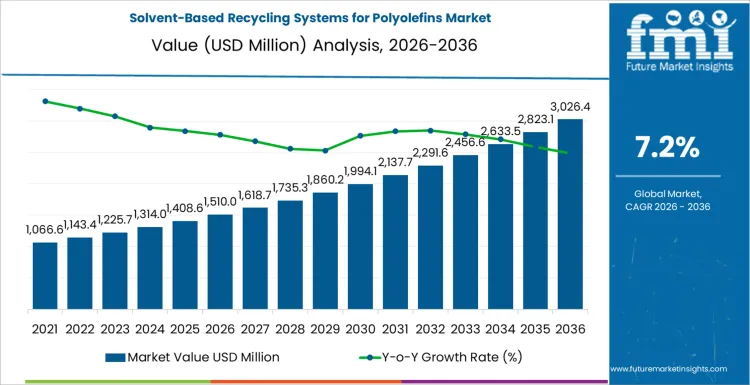
Key Takeaways, Market Size, and Forecast
| Metric | Value |
|---|---|
| Market Size (2026) | USD 1,510.0 Million |
| Market Size (2036) | USD 3,026.4 Million |
| CAGR (2026–2036) | 7.2% |
| Leading Material | Polyethylene (PE) |
| Polyethylene (PE) Share | 48.0% |
| Leading Recycling System Type | Solvent Extraction & Purification |
| Solvent Extraction & Purification Share | 49.0% |
Solvent-Based Recycling Systems for Polyolefins Market Key Takeaways
| Metric | Value |
|---|---|
| Market Value (2026) | USD 1,510.0 million |
| Market Forecast Value (2036) | USD 3,026.4 million |
| Forecast CAGR 2026 to 2036 | 7.2% |
Why is the Demand for Solvent-Based Recycling Systems for Polyolefins Growing?
Interest in solvent-based recycling systems for polyolefins has intensified as brand owners and resin producers seek routes to recover high value polymers from mixed and contaminated plastic waste streams. Traditional mechanical recycling often yields downgraded polyethylene and polypropylene with compromised mechanical properties because of residual additives and degradation products. Solvent-based processes dissolve target polymers and separate impurities, yielding reclaimed polyolefins with near-virgin performance. Packaging manufacturers operating in food, healthcare, and consumer goods sectors that require consistent mechanical strength and clarity increasingly evaluate solvent-based output as feedstock for high performance films, injection molded parts, and extrusion profiles.
Resin compounders benefit from solvent-based recycling’s ability to remove inks, adhesives, and fillers that mechanical methods cannot fully eliminate, supporting higher throughput of functional recycled resins. Procurement of solvent-based recycling systems is supported by corporate sustainability strategies and evolving regulations that incentivize advanced recycling technologies. Regions rolling out recycled content mandates in packaging and automotive interior parts create a business case for on-site or centralized solvent-based units that close loop materials back into supply chains. Engineering teams adjust operational parameters such as temperature and solvent choice to maximize yield and control polymer chain integrity. Materials scientists validate solvent-recovered polyolefin against performance benchmarks under tensile, impact, and thermal cycling tests. Stakeholders evaluate lifecycle benefits and cost impacts compared with mechanical recycling, driving capital planning for solvent-based investments.
How Is the Solvent-Based Recycling Systems for Polyolefins Industry Segmented by Polyolefin Type, Recycling System Type, and End Use Application?
Demand for solvent-based recycling systems is shaped by purity recovery targets, multilayer waste challenges, and recycled content compliance across polyolefin value chains. Technology selection reflects ability to remove additives, dyes, and contaminants while preserving polymer molecular weight. Investment decisions consider feedstock variability, solvent recovery efficiency, and integration with downstream compounding. Segmentation by polyolefin type, recycling system type, and end use application clarifies how technology choices align with material streams and performance requirements across packaging, automotive, construction, and industrial uses.
Which Polyolefin Type Represents the Largest Share in Solvent-Based Recycling Systems?

Polyethylene accounts for 48.0%, reflecting dominant presence in flexible packaging waste and strong suitability for selective dissolution processes. Solvent systems enable removal of inks, fillers, and multilayer residues while retaining polyethylene chain integrity. Polypropylene represents 42.0%, driven by growing interest in recovering high-purity grades from rigid packaging and automotive parts. Solvent-based approaches support isotactic polypropylene recovery with controlled melt flow properties. Other polyolefins account for 10.0%, including materials with higher separation complexity and regulatory constraints. Polyolefin-type segmentation reflects alignment between waste stream availability, dissolution behavior, and achievable purity outcomes.
Key Points
- Polyethylene dominates due to high waste volume and process compatibility.
- Polypropylene recovery benefits from purity-focused solvent separation.
- Other polyolefins present higher technical and regulatory complexity.
How Does Recycling System Type Influence Solvent-Based Polyolefin Recovery?
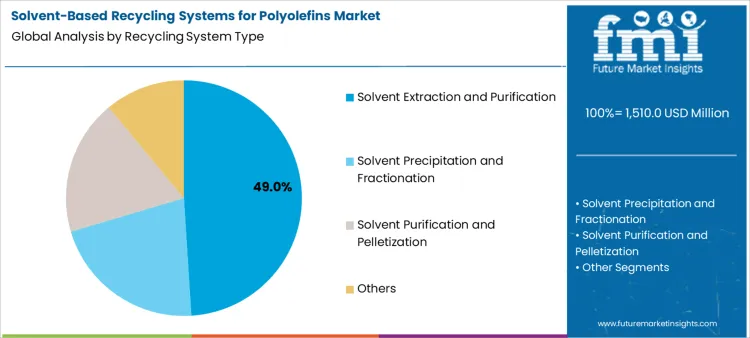
Solvent extraction and purification represent 49.0%, supported by capability to selectively dissolve target polymers and remove contaminants. These systems emphasize solvent recovery efficiency and polymer quality consistency. Solvent precipitation and fractionation account for 30.0%, enabling separation of polymer fractions based on molecular characteristics. This approach supports tailored property control for downstream applications. Solvent purification and pelletization hold 16.0%, focusing on integration of cleaning and regranulation steps for direct reuse. Other system types represent 5.0%, addressing pilot-scale or hybrid configurations. System-type segmentation reflects trade-offs between purity, yield, capital intensity, and operational complexity.
Key Points
- Extraction systems prioritize high-purity polymer recovery.
- Fractionation supports property-specific output control.
- Integrated pelletization streamlines downstream processing.
Which End Use Applications Drive Adoption of Solvent-Based Recycling Systems?
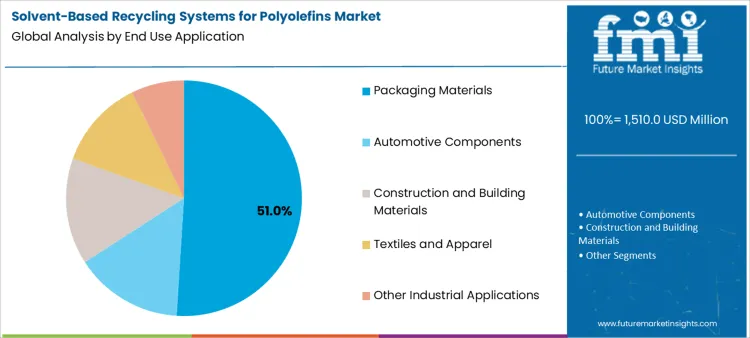
Packaging materials account for 51.0%, driven by regulatory recycled content targets and demand for near-virgin polymer quality. Automotive components represent 18.0%, using solvent-recycled polyolefins for interior and non-structural applications requiring consistent performance. Construction and building materials hold 14.0%, emphasizing durability and contamination control. Textiles and apparel account for 8.0%, focusing on fiber-grade polymer recovery. Other industrial applications represent 9.0%, covering specialized molded and extruded products. End use segmentation highlights concentration of adoption where purity requirements and volume economics justify solvent-based processing.
Key Points
- Packaging leads due to strict quality and compliance needs.
- Automotive adoption targets controlled performance components.
- Construction applications emphasize durability and consistency.
What are the Key Dynamics in the solvent-based recycling systems for polyolefins market?
Growth in the solvent-based recycling systems for polyolefins market reflects industrial efforts to recover high-value polyethylene (PE) and polypropylene (PP) from mixed waste streams with minimal degradation. Unlike mechanical recycling, solvent methods dissolve and purify polymer chains, enabling near-virgin material performance in applications such as automotive components, consumer goods, and rigid packaging. Demand is influenced by brand targets for recycled content in high-performance uses and by regulatory pressure on plastic waste diversion and circularity metrics.
How do material quality requirements and end-use performance expectations shape adoption?
Adoption in rigid packaging and industrial parts manufacturing rises where mechanical recycling fails to meet tensile strength, impact resistance, or optical clarity specifications. Automotive tier suppliers, for instance, pursue solvent-recycled PE and PP grades that demonstrate consistent melt flow and structural integrity needed for interior trim and under-hood applications. Consumer electronics OEMs increasingly specify higher-purity recycled polymers to avoid failure modes linked to contaminants present in mechanically recycled material. Brand owners in healthcare packaging require polyolefin streams that conform to tight barrier and sterility criteria; solvent washing and purification support these needs by removing additives and residues that would otherwise compromise critical properties. Food contact scenarios under stringent compliance frameworks also drive interest in solvent-recycling outputs capable of meeting migration limits while supporting recycled content goals.
How do energy intensity and regulatory compliance boundaries influence market scalability?
Scalability of solvent-based recycling systems for polyolefins is challenged by high energy consumption inherent to dissolution, separation, and solvent recovery processes. These systems require controlled thermal profiles and solvent reclamation infrastructure to ensure economic viability, which elevates capital intensity relative to conventional mechanical lines. At commercial scale, solvent losses and solvent handling safety protocols raise operating costs and necessitate skilled technical personnel for process control. Regulatory frameworks that govern emissions, worker safety, and solvent classification shape plant design and permit timelines, particularly in jurisdictions with stringent chemical management rules. Variability in post-consumer feedstock composition demands pre-sorting and pre-treatment to avoid yield depression, which adds logistical complexity. Cost pressures are pronounced where output pricing must compete with low-cost virgin resins, slowing adoption in cost-sensitive segments despite quality advantages.
How Is Demand for the Solvent-Based Recycling Systems for Polyolefins Market Evolving Globally?
Global demand for solvent-based recycling systems for polyolefins is rising as industries focus on enhancing recycling efficiencies and increasing the use of recycled materials in polyolefin-based products. Growth reflects rising demand for sustainable, high-quality recycled plastics in packaging, automotive, and consumer goods, driven by stringent recycling regulations and consumer preference for eco-friendly products. Solvent-based systems allow for high-purity recovery of polyolefins, making them suitable for high-value applications. India records 8.0% CAGR, China records 7.8% CAGR, Brazil records 7.4% CAGR, USA records 6.2% CAGR, and Germany records 6.0% CAGR. Adoption is driven by technological advancements, regulatory support, and increasing demand for recycled polyolefins.
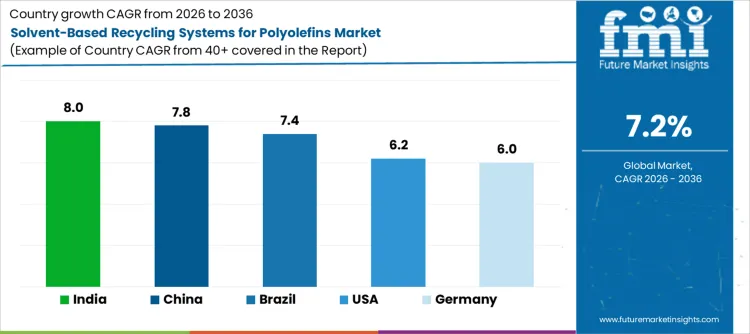
| Country | CAGR (%) |
|---|---|
| India | 8.0% |
| China | 7.8% |
| Brazil | 7.4% |
| USA | 6.2% |
| Germany | 6.0% |
What is driving growth of solvent-based recycling systems for polyolefins demand in India?
Demand for solvent-based recycling systems for polyolefins in India is expanding as industries seek to improve recycling efficiency and meet sustainability targets. Growth at 8.0% CAGR reflects rising adoption in packaging, automotive, and consumer goods sectors, which require high-purity recycled polyolefins. Government regulations on plastic waste management and the circular economy drive investments in advanced recycling technologies, including solvent-based systems. Domestic manufacturers are increasingly focusing on recovering high-quality polyolefins to reduce dependency on virgin materials. Demand is strongest in the packaging sector, where sustainable materials are increasingly prioritized for food and beverage containers.
- Government-driven recycling regulations
- Need for high-purity polyolefin recovery
- Demand for sustainable packaging solutions
- Focus on reducing reliance on virgin plastics
Why is China seeing expansion in solvent-based recycling systems for polyolefins adoption?
Solvent-based recycling systems for polyolefins demand in China is rising as the country strengthens its recycling infrastructure and focuses on improving the circular economy. Growth at 7.8% CAGR reflects China’s efforts to recover high-quality polyolefins from post-consumer waste, particularly in packaging, automotive, and consumer goods. Strong government support and regulations on plastic waste management are driving investments in advanced recycling systems. Domestic demand for sustainable materials, especially in packaging, fuels the need for high-purity recycled polyolefins. The growing trend of eco-friendly product packaging and manufacturing further supports this market’s growth.
- Strong government regulations on plastic recycling
- Increased adoption of recycled materials in packaging
- Focus on circular economy and sustainability
- Technological advancements in solvent-based systems
What factors are shaping solvent-based recycling systems for polyolefins sales in Brazil?
Sales of solvent-based recycling systems for polyolefins in Brazil are increasing as manufacturers respond to plastic waste reduction initiatives and consumer demand for sustainable packaging solutions. Growth at 7.4% CAGR reflects the push for high-quality recycling technologies that can handle mixed plastics and recover polyolefins from post-consumer waste. Brazil’s packaging sector, especially in food and beverage, is increasingly adopting recycled materials, encouraging investments in solvent-based systems to ensure the purity and quality of recycled polyolefins. Demand is driven by the need for compliance with international environmental standards and the growing demand for eco-friendly packaging solutions.
- Push for reducing plastic waste in packaging
- Increased regulatory pressure on recycling
- Demand for high-quality recycled polyolefins
- Adoption of eco-friendly packaging in consumer goods
How is the USA supporting growth of solvent-based recycling systems for polyolefins demand?
Solvent-based recycling systems for polyolefins market demand in the USA is advancing as companies in the packaging and automotive sectors strive to meet recycling targets and improve sustainability performance. Growth at 6.2% CAGR reflects increasing demand for high-purity recycled polyolefins to replace virgin materials, particularly in packaging and consumer products. The USA’s growing focus on reducing plastic waste and improving recycling rates is encouraging investments in advanced recycling technologies. Solvent-based systems are seen as key to achieving high recovery rates of polyolefins while maintaining material performance, making them a vital solution for the packaging industry.
- Regulatory and consumer-driven sustainability initiatives
- Growth of recycled content in packaging
- Demand for high-quality recycled materials
- Technological focus on improving recycling efficiency
What is driving expansion of solvent-based recycling systems for polyolefins demand in Germany?
Demand for solvent-based recycling systems for polyolefins in Germany is increasing as the country leads in recycling technologies and sustainability efforts. Growth at 6.0% CAGR reflects Germany’s commitment to the circular economy and its focus on using recycled materials in the packaging and automotive sectors. As regulations tighten on plastic waste and the demand for eco-friendly products grows, manufacturers are adopting solvent-based systems to ensure the quality of recycled polyolefins. Germany’s emphasis on high-purity recycling and compliance with EU waste management standards is driving innovation and market expansion for these advanced systems.
- Leadership in circular economy initiatives
- Regulatory compliance with EU recycling standards
- Focus on high-purity polyolefin recovery
- Increasing demand for eco-friendly packaging materials
What is the competitive landscape of demand for the solvent-based recycling systems for polyolefins market globally?
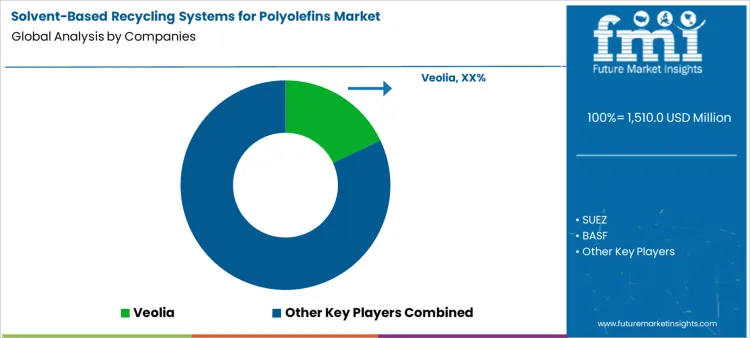
The solvent-based recycling systems for polyolefins market is driven by the need for high-efficiency recycling methods capable of handling mixed plastic waste streams, particularly post-consumer polyolefins. Key players in the market are focused on improving material purity, recovery rates, and reducing contamination in the recycled polyolefins. Operators evaluate system efficiency, solvent recovery, scalability, and compatibility with various polyolefin grades, including polyethylene and polypropylene. Buyer assessment includes regulatory approval, operational cost efficiency, environmental impact, and ability to meet circular economy goals. Procurement behavior favors suppliers with proven pilot-scale projects, strong technical service capabilities, and long-term sustainability commitments. Trend in the solvent-based recycling systems market reflects growing focus on achieving closed-loop recycling for polyolefins to meet rising demand for recycled content in packaging.
Veolia leads competitive positioning through its integrated recycling solutions, combining solvent-based systems with broad waste management infrastructure to achieve high-quality recycled polyolefins. SUEZ competes by focusing on advanced solvent extraction technologies and partnerships with municipalities and industrial customers to scale recycling capabilities. BASF participates with its expertise in chemical recycling technologies, providing solvent-based solutions designed for higher efficiency and broader polyolefin application. SABIC supports demand with its commitment to a circular economy, combining recycling systems with its polyolefin production facilities. LyondellBasell contributes through its extensive experience in polymer production and commitment to advancing chemical recycling technologies for sustainable polyolefin recovery. Competitive differentiation in this market is based on solvent recovery efficiency, scalability, environmental compliance, and integration with existing production systems.
Key Players in the Solvent-Based Recycling Systems for Polyolefins Market
- Veolia
- SUEZ
- BASF
- SABIC
- LyondellBasell
- Others
Scope of the Report
| Items | Values |
|---|---|
| Quantitative Units | USD million |
| Polyolefin Type | Polyethylene (PE); Polypropylene (PP); Other Polyolefins (PS, PVC) |
| Recycling System Type | Solvent Extraction and Purification; Solvent Precipitation and Fractionation; Solvent Purification and Pelletization; Others |
| End Use Application | Packaging Materials; Automotive Components; Construction and Building Materials; Textiles and Apparel; Other Industrial Applications |
| Regions Covered | Asia Pacific, Europe, North America, Latin America, Middle East & Africa |
| Countries Covered | India, China, Brazil, USA, Germany, and 40+ countries |
| Key Companies Profiled | Veolia; SUEZ; BASF; SABIC; LyondellBasell; Others |
| Additional Attributes | Dollar sales by polyolefin type, recycling system type, and end use application; effectiveness in separating and purifying polyolefins from mixed waste streams through solvent-based technologies; performance differences between solvent extraction, precipitation, and pelletization in achieving high-quality recycled materials; role in sustainable packaging and automotive recycling; procurement dynamics driven by regulatory compliance, circular economy adoption, and long-term supply chain partnerships. |
Solvent-Based Recycling Systems for Polyolefins Market by Segment
Polyolefin Type:
- Polyethylene (PE)
- Polypropylene (PP)
- Other Polyolefins (PS, PVC)
Recycling System Type:
- Solvent Extraction and Purification
- Solvent Precipitation and Fractionation
- Solvent Purification and Pelletization
- Others
End Use Application:
- Packaging Materials
- Automotive Components
- Construction and Building Materials
- Textiles and Apparel
- Other Industrial Applications
Region:
- Asia Pacific
- China
- Japan
- South Korea
- India
- Australia & New Zealand
- ASEAN
- Rest of Asia Pacific
- Europe
- Germany
- United Kingdom
- France
- Italy
- Spain
- Nordic
- BENELUX
- Rest of Europe
- North America
- United States
- Canada
- Mexico
- Latin America
- Brazil
- Chile
- Rest of Latin America
- Middle East & Africa
- Kingdom of Saudi Arabia
- Other GCC Countries
- Turkey
- South Africa
- Other African Union
- Rest of Middle East & Africa
Bibliography
- European Commission. (2023). A European strategy for plastics in a circular economy: Advanced recycling, solvent-based recovery, and material quality objectives. Publications Office of the European Union.
- International Organization for Standardization. (2023). Plastics recycling - Advanced recycling technologies - Process characterization and material quality considerations (ISO/TR 23076:2023). ISO.
- Ragaert, K., Delva, L., & Van Geem, K. M. (2023). Solvent-based recycling of polyolefins: Polymer purification, additive removal, and performance recovery. Waste Management, 158, 310-322.
- Schyns, Z. O. G., & Shaver, M. P. (2023). Mechanical and solvent-based plastic recycling: Challenges, opportunities, and circular economy implications. Macromolecular Rapid Communications, 44(2), 2200357.
- USA. Environmental Protection Agency. (2023). Advanced recycling technologies for plastics: Solvent-based systems, environmental controls, and lifecycle considerations. Office of Resource Conservation and Recovery.
- World Economic Forum. (2024). Advanced recycling of plastics: Solvent-based technologies and pathways to high-quality circular polymers. World Economic Forum.
Frequently Asked Questions
How big is the solvent-based recycling systems for polyolefins market in 2026?
The global solvent-based recycling systems for polyolefins market is estimated to be valued at USD 1,510.0 million in 2026.
What will be the size of solvent-based recycling systems for polyolefins market in 2036?
The market size for the solvent-based recycling systems for polyolefins market is projected to reach USD 3,026.4 million by 2036.
How much will be the solvent-based recycling systems for polyolefins market growth between 2026 and 2036?
The solvent-based recycling systems for polyolefins market is expected to grow at a 7.2% CAGR between 2026 and 2036.
What are the key product types in the solvent-based recycling systems for polyolefins market?
The key product types in solvent-based recycling systems for polyolefins market are polyethylene (pe), polypropylene (pp) and other polyolefins (ps, pvc).
Which recycling system type segment to contribute significant share in the solvent-based recycling systems for polyolefins market in 2026?
In terms of recycling system type, solvent extraction and purification segment to command 49.0% share in the solvent-based recycling systems for polyolefins market in 2026.
Preview the report firsthand - request a free sample
Get SampleGet the brochure for pricing and purchase details.
Get PDFTable of Content
- Executive Summary
- Global Market Outlook
- Demand-side Trends
- Supply-side Trends
- Technology Roadmap Analysis
- Analysis and Recommendations
- Market Overview
- Market Coverage / Taxonomy
- Market Definition / Scope / Limitations
- Market Background
- Market Dynamics
- Drivers
- Restraints
- Opportunity
- Trends
- Scenario Forecast
- Demand in Optimistic Scenario
- Demand in Likely Scenario
- Demand in Conservative Scenario
- Opportunity Map Analysis
- Product Life Cycle Analysis
- Supply Chain Analysis
- Investment Feasibility Matrix
- Value Chain Analysis
- PESTLE and Porter’s Analysis
- Regulatory Landscape
- Regional Parent Market Outlook
- Production and Consumption Statistics
- Import and Export Statistics
- Market Dynamics
- Global Market Analysis 2021 to 2025 and Forecast, 2026 to 2036
- Historical Market Size Value (USD Million) Analysis, 2021 to 2025
- Current and Future Market Size Value (USD Million) Projections, 2026 to 2036
- Y-o-Y Growth Trend Analysis
- Absolute $ Opportunity Analysis
- Global Market Pricing Analysis 2021 to 2025 and Forecast 2026 to 2036
- Global Market Analysis 2021 to 2025 and Forecast 2026 to 2036, By Polyolefin Type
- Introduction / Key Findings
- Historical Market Size Value (USD Million) Analysis By Polyolefin Type, 2021 to 2025
- Current and Future Market Size Value (USD Million) Analysis and Forecast By Polyolefin Type, 2026 to 2036
- Polyethylene (PE)
- Polypropylene (PP)
- Other Polyolefins (PS, PVC)
- Polyethylene (PE)
- Y-o-Y Growth Trend Analysis By Polyolefin Type, 2021 to 2025
- Absolute $ Opportunity Analysis By Polyolefin Type, 2026 to 2036
- Global Market Analysis 2021 to 2025 and Forecast 2026 to 2036, By Recycling System Type
- Introduction / Key Findings
- Historical Market Size Value (USD Million) Analysis By Recycling System Type, 2021 to 2025
- Current and Future Market Size Value (USD Million) Analysis and Forecast By Recycling System Type, 2026 to 2036
- Solvent Extraction and Purification
- Solvent Precipitation and Fractionation
- Solvent Purification and Pelletization
- Others
- Solvent Extraction and Purification
- Y-o-Y Growth Trend Analysis By Recycling System Type, 2021 to 2025
- Absolute $ Opportunity Analysis By Recycling System Type, 2026 to 2036
- Global Market Analysis 2021 to 2025 and Forecast 2026 to 2036, By End Use Application
- Introduction / Key Findings
- Historical Market Size Value (USD Million) Analysis By End Use Application, 2021 to 2025
- Current and Future Market Size Value (USD Million) Analysis and Forecast By End Use Application, 2026 to 2036
- Packaging Materials
- Automotive Components
- Construction and Building Materials
- Textiles and Apparel
- Other Industrial Applications
- Packaging Materials
- Y-o-Y Growth Trend Analysis By End Use Application, 2021 to 2025
- Absolute $ Opportunity Analysis By End Use Application, 2026 to 2036
- Global Market Analysis 2021 to 2025 and Forecast 2026 to 2036, By Region
- Introduction
- Historical Market Size Value (USD Million) Analysis By Region, 2021 to 2025
- Current Market Size Value (USD Million) Analysis and Forecast By Region, 2026 to 2036
- North America
- Latin America
- Western Europe
- Eastern Europe
- East Asia
- South Asia and Pacific
- Middle East & Africa
- Market Attractiveness Analysis By Region
- North America Market Analysis 2021 to 2025 and Forecast 2026 to 2036, By Country
- Historical Market Size Value (USD Million) Trend Analysis By Market Taxonomy, 2021 to 2025
- Market Size Value (USD Million) Forecast By Market Taxonomy, 2026 to 2036
- By Country
- USA
- Canada
- Mexico
- By Polyolefin Type
- By Recycling System Type
- By End Use Application
- By Country
- Market Attractiveness Analysis
- By Country
- By Polyolefin Type
- By Recycling System Type
- By End Use Application
- Key Takeaways
- Latin America Market Analysis 2021 to 2025 and Forecast 2026 to 2036, By Country
- Historical Market Size Value (USD Million) Trend Analysis By Market Taxonomy, 2021 to 2025
- Market Size Value (USD Million) Forecast By Market Taxonomy, 2026 to 2036
- By Country
- Brazil
- Chile
- Rest of Latin America
- By Polyolefin Type
- By Recycling System Type
- By End Use Application
- By Country
- Market Attractiveness Analysis
- By Country
- By Polyolefin Type
- By Recycling System Type
- By End Use Application
- Key Takeaways
- Western Europe Market Analysis 2021 to 2025 and Forecast 2026 to 2036, By Country
- Historical Market Size Value (USD Million) Trend Analysis By Market Taxonomy, 2021 to 2025
- Market Size Value (USD Million) Forecast By Market Taxonomy, 2026 to 2036
- By Country
- Germany
- UK
- Italy
- Spain
- France
- Nordic
- BENELUX
- Rest of Western Europe
- By Polyolefin Type
- By Recycling System Type
- By End Use Application
- By Country
- Market Attractiveness Analysis
- By Country
- By Polyolefin Type
- By Recycling System Type
- By End Use Application
- Key Takeaways
- Eastern Europe Market Analysis 2021 to 2025 and Forecast 2026 to 2036, By Country
- Historical Market Size Value (USD Million) Trend Analysis By Market Taxonomy, 2021 to 2025
- Market Size Value (USD Million) Forecast By Market Taxonomy, 2026 to 2036
- By Country
- Russia
- Poland
- Hungary
- Balkan & Baltic
- Rest of Eastern Europe
- By Polyolefin Type
- By Recycling System Type
- By End Use Application
- By Country
- Market Attractiveness Analysis
- By Country
- By Polyolefin Type
- By Recycling System Type
- By End Use Application
- Key Takeaways
- East Asia Market Analysis 2021 to 2025 and Forecast 2026 to 2036, By Country
- Historical Market Size Value (USD Million) Trend Analysis By Market Taxonomy, 2021 to 2025
- Market Size Value (USD Million) Forecast By Market Taxonomy, 2026 to 2036
- By Country
- China
- Japan
- South Korea
- By Polyolefin Type
- By Recycling System Type
- By End Use Application
- By Country
- Market Attractiveness Analysis
- By Country
- By Polyolefin Type
- By Recycling System Type
- By End Use Application
- Key Takeaways
- South Asia and Pacific Market Analysis 2021 to 2025 and Forecast 2026 to 2036, By Country
- Historical Market Size Value (USD Million) Trend Analysis By Market Taxonomy, 2021 to 2025
- Market Size Value (USD Million) Forecast By Market Taxonomy, 2026 to 2036
- By Country
- India
- ASEAN
- Australia & New Zealand
- Rest of South Asia and Pacific
- By Polyolefin Type
- By Recycling System Type
- By End Use Application
- By Country
- Market Attractiveness Analysis
- By Country
- By Polyolefin Type
- By Recycling System Type
- By End Use Application
- Key Takeaways
- Middle East & Africa Market Analysis 2021 to 2025 and Forecast 2026 to 2036, By Country
- Historical Market Size Value (USD Million) Trend Analysis By Market Taxonomy, 2021 to 2025
- Market Size Value (USD Million) Forecast By Market Taxonomy, 2026 to 2036
- By Country
- Kingdom of Saudi Arabia
- Other GCC Countries
- Turkiye
- South Africa
- Other African Union
- Rest of Middle East & Africa
- By Polyolefin Type
- By Recycling System Type
- By End Use Application
- By Country
- Market Attractiveness Analysis
- By Country
- By Polyolefin Type
- By Recycling System Type
- By End Use Application
- Key Takeaways
- Key Countries Market Analysis
- USA
- Pricing Analysis
- Market Share Analysis, 2025
- By Polyolefin Type
- By Recycling System Type
- By End Use Application
- Canada
- Pricing Analysis
- Market Share Analysis, 2025
- By Polyolefin Type
- By Recycling System Type
- By End Use Application
- Mexico
- Pricing Analysis
- Market Share Analysis, 2025
- By Polyolefin Type
- By Recycling System Type
- By End Use Application
- Brazil
- Pricing Analysis
- Market Share Analysis, 2025
- By Polyolefin Type
- By Recycling System Type
- By End Use Application
- Chile
- Pricing Analysis
- Market Share Analysis, 2025
- By Polyolefin Type
- By Recycling System Type
- By End Use Application
- Germany
- Pricing Analysis
- Market Share Analysis, 2025
- By Polyolefin Type
- By Recycling System Type
- By End Use Application
- UK
- Pricing Analysis
- Market Share Analysis, 2025
- By Polyolefin Type
- By Recycling System Type
- By End Use Application
- Italy
- Pricing Analysis
- Market Share Analysis, 2025
- By Polyolefin Type
- By Recycling System Type
- By End Use Application
- Spain
- Pricing Analysis
- Market Share Analysis, 2025
- By Polyolefin Type
- By Recycling System Type
- By End Use Application
- France
- Pricing Analysis
- Market Share Analysis, 2025
- By Polyolefin Type
- By Recycling System Type
- By End Use Application
- India
- Pricing Analysis
- Market Share Analysis, 2025
- By Polyolefin Type
- By Recycling System Type
- By End Use Application
- ASEAN
- Pricing Analysis
- Market Share Analysis, 2025
- By Polyolefin Type
- By Recycling System Type
- By End Use Application
- Australia & New Zealand
- Pricing Analysis
- Market Share Analysis, 2025
- By Polyolefin Type
- By Recycling System Type
- By End Use Application
- China
- Pricing Analysis
- Market Share Analysis, 2025
- By Polyolefin Type
- By Recycling System Type
- By End Use Application
- Japan
- Pricing Analysis
- Market Share Analysis, 2025
- By Polyolefin Type
- By Recycling System Type
- By End Use Application
- South Korea
- Pricing Analysis
- Market Share Analysis, 2025
- By Polyolefin Type
- By Recycling System Type
- By End Use Application
- Russia
- Pricing Analysis
- Market Share Analysis, 2025
- By Polyolefin Type
- By Recycling System Type
- By End Use Application
- Poland
- Pricing Analysis
- Market Share Analysis, 2025
- By Polyolefin Type
- By Recycling System Type
- By End Use Application
- Hungary
- Pricing Analysis
- Market Share Analysis, 2025
- By Polyolefin Type
- By Recycling System Type
- By End Use Application
- Kingdom of Saudi Arabia
- Pricing Analysis
- Market Share Analysis, 2025
- By Polyolefin Type
- By Recycling System Type
- By End Use Application
- Turkiye
- Pricing Analysis
- Market Share Analysis, 2025
- By Polyolefin Type
- By Recycling System Type
- By End Use Application
- South Africa
- Pricing Analysis
- Market Share Analysis, 2025
- By Polyolefin Type
- By Recycling System Type
- By End Use Application
- USA
- Market Structure Analysis
- Competition Dashboard
- Competition Benchmarking
- Market Share Analysis of Top Players
- By Regional
- By Polyolefin Type
- By Recycling System Type
- By End Use Application
- Competition Analysis
- Competition Deep Dive
- Veolia
- Overview
- Product Portfolio
- Profitability by Market Segments (Product/Age /Sales Channel/Region)
- Sales Footprint
- Strategy Overview
- Marketing Strategy
- Product Strategy
- Channel Strategy
- SUEZ
- BASF
- SABIC
- LyondellBasell
- Others
- Veolia
- Competition Deep Dive
- Assumptions & Acronyms Used
- Research Methodology


