

- Industry Size (2026)
- USD 1.4 Bn
- Forecast (2036)
- USD 5.8 Bn
- CAGR (2026 to 2036)
- 15.3%
PPWR-Compliant Recyclable PE/PP Stand-Up Pouch Recycling Systems Market Size, Market Forecast and Outlook By FMI
The PPWR-compliant recyclable PE/PP stand-up pouch recycling systems market crossed a valuation of USD 1.2 billion in 2025. Demand is poised to surpass USD 1.4 billion in 2026 at a CAGR of 15.3% during the forecast period. Steady industry expansion carries total revenue valuation to USD 5.8 billion through 2036 as European packaging regulations enforce a rapid transition toward verified mono-material recovery infrastructure.
Summary of PPWR-Compliant Recyclable PE/PP Stand-Up Pouch Recycling Systems Market
- The market is forecast to reach USD 5.8 billion by 2036.
- The market is expected to grow at a CAGR of 15.3% from 2026 to 2036.
- The market was estimated at USD 1.2 billion in 2025.
- The forecast period represents an incremental opportunity of USD 4.4 billion.
- This market focuses on machinery and digital systems used to sort, wash, process, and recycle single-material PE/PP stand-up pouches under evolving packaging regulations.
- Growth is strongly driven by regulatory mandates such as PPWR, requiring all packaging to be recyclable by 2030.
- Mechanical recycling systems lead the technology segment with a 43% share, as they remain the most practical and widely deployed solution.
- PE pouches dominate the material segment with a 52% share due to their widespread use in flexible packaging.
- Sorting lines hold a 29% share, reflecting their critical role in identifying and separating recyclable materials efficiently.
- Food brands account for 48% of demand, driven by pressure to adopt recyclable packaging without compromising shelf life.
- Retrofit lines lead with a 37% share, as operators prefer upgrading existing facilities over building new plants.
- India, China, and Germany are the fastest-growing markets, with India leading at a 16.4% CAGR.
- EREMA Group, TOMRA, STADLER, PELLENC ST, AMUT, and NGR are key participants in the competitive landscape.
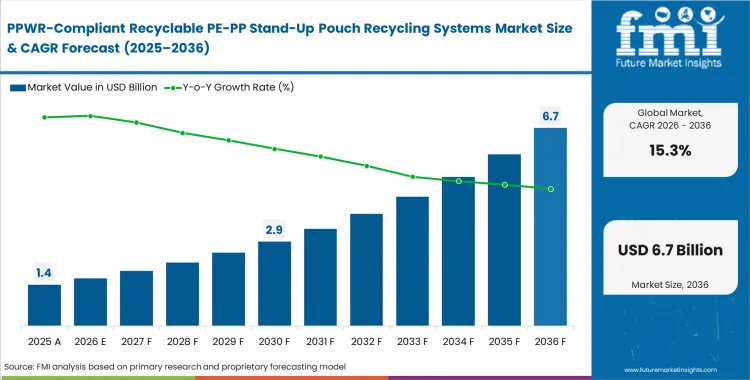
Waste plant owners are under pressure to upgrade sorting lines used for pouch recovery. PPWR compliance is increasing the need for recycling systems that can separate complex flexible packs from cleaner PE and PP streams. Facilities that fail to meet purity targets are likely to face limits in food-grade recycling applications. Many operators are expected to choose washing line upgrades over full plant reconstruction because this route can improve material quality with less disruption. Processing costs also depend on feed quality. Melt-stage equipment built for cleaner PE and PP pouch waste is likely to face performance issues when mixed municipal waste remains in the stream.
Better separation is expected to raise demand for melting systems designed for more consistent feedstock. Upgraded washing sections are also likely to improve the value of recovered resin supplied into packaging applications. Stable output quality is supporting investment in equipment that can process thin and flexible pouch waste more effectively. Friction washers are expected to see stronger demand where operators need better contaminant removal from lightweight material streams.
Policy timing is creating a clear split between markets moving faster on mechanical compliance and those adopting changes in phases. India is projected to expand at a CAGR of 16.4% during 2026-2036, supported by wider urban waste recovery networks. China is estimated to grow at 15.6% over the same period as sorting and recovery capacity continues to expand. Germany is likely to record 13.8% CAGR during 2026-2036, reflecting tighter circularity requirements. Spain and Italy are expected to advance at CAGRs of 13.4% and 13.1%, respectively, across the forecast period as flexible packaging recovery gains more weight. United Kingdom demand is projected to rise at a CAGR of 12.9% through 2036. United States demand is also expected to expand at 11.7% during 2026-2036, supported by improving pouch recovery economics and equipment upgrades.
Segmental Analysis
PPWR-Compliant Recyclable PE/PP Stand-Up Pouch Recycling Systems Market Analysis by Recycling Technology
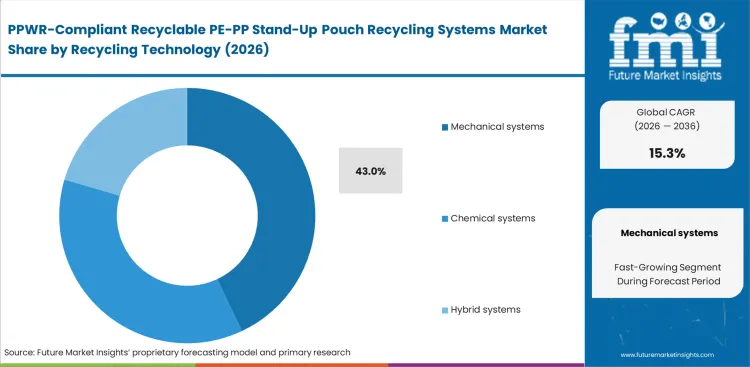
Facility owners are looking for practical routes to manage packaging waste recycling within current compliance timelines. Mechanical recycling lines are gaining preference because they can be integrated into existing plant setups without waiting for newer process routes to scale. This equipment category is projected to account for 43% share in 2026, reflecting its fit with near-term recycling targets and plant-level operating needs. Many buyers are expected to upgrade shredding, washing, friction cleaning, and melt filtration systems to improve film recovery and contamination control. This approach also helps keep daily operating costs more stable across established recycling lines. Delays in adopting workable mechanical systems are likely to raise compliance risk in markets facing tighter circular economy deadlines.
- Immediate Compliance Scaling: Advanced friction washers strip contaminants efficiently. Facility operators maintain high output volumes without entirely rebuilding the processing infrastructure.
- Capital Expenditure Control: Utilizing existing floor space reduces financial exposure. Processors avoid the massive investments required for untested solvent-based recovery facilities.
- Purity Threshold Challenges: Physical methods struggle with deeply embedded inks. Operators must carefully screen input bales to ensure final pellet quality meets brand specifications.
PPWR-Compliant Recyclable PE/PP Stand-Up Pouch Recycling Systems Market Analysis by Material Stream
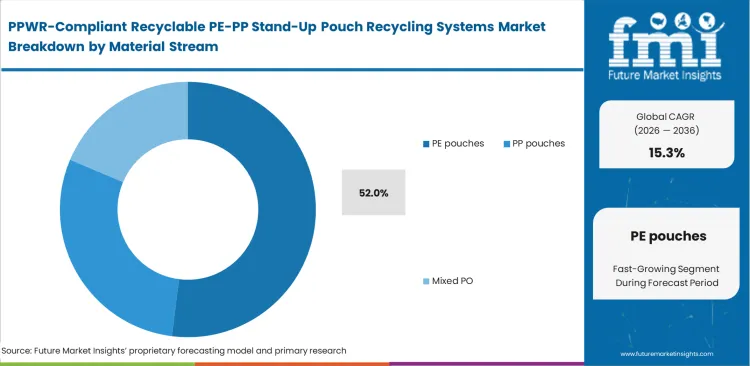
Polyethylene remains the primary material in flexible packaging because it offers reliable moisture resistance and efficient heat sealing. Sorting systems at waste plants are commonly configured to prioritize this stream because it enters recovery lines in higher volumes than other pouch materials. Optical sorting accuracy also improves when operators target clearer and more uniform plastic formats within this category. PE pouches are estimated to account for 52% share in 2026, reflecting their larger presence across post-use flexible packaging flows. Mixed plastic input can disrupt extrusion performance and reduce line stability during downstream processing. Early separation of the dominant material helps plants maintain steadier throughput and better operating control across recycling lines.
- Dominant Volume Capture: High-capacity optical sorters target the largest material fractions. Packaging engineers optimize air jets specifically for polyethylene film weights to boost recovery rates.
- Thermal Sensitivity Limits: Processing speeds drop significantly when handling mixed bales. Extrusion operators adjust melt filtration screens continuously to prevent degradation of temperature-sensitive components.
- Cross-Contamination Risks: Undetected laminates disrupt the entire extrusion batch. Processors must install advanced detection software to reject multi-material composites before thermal processing begins.
PPWR-Compliant Recyclable PE/PP Stand-Up Pouch Recycling Systems Market Analysis by System module
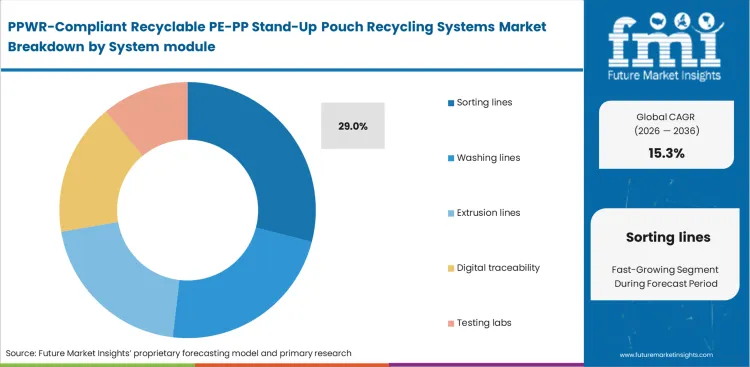
Sorting lines are estimated to represent 29% of the market in 2026, acting as the absolute foundation for every recycling plant's profitability. Plants simply cannot make good money if their incoming trash contains too much mixed garbage. Buying advanced near-infrared scanners designed specifically for autonomous sorting takes up the largest chunk of a facility's equipment budget. Washing and melting machines cannot fix mistakes made early on the belt. Installing specialized air jets keeps lightweight wrappers from blowing past the sensors unnoticed. Buyers often think running belts faster makes more money, but speeding up the process completely ruins the accuracy of finding usable flexible films.
- Incoming Material Screening: Sensor arrays identify polymer signatures instantly. Sorting technicians calibrate rejection thresholds to balance volume output against required material purity.
- Lightweight Material Handling: Conveyor systems designed for rigid plastics cause flexible films to become airborne. Plant engineers must install specialized containment hoods to maintain sorting accuracy.
- Yield Optimization Requirements: Frequent sensor recalibration prevents valuable polyolefins from entering the reject pile. Maintenance personnel must follow strict cleaning schedules to keep optical lenses functioning properly.
PPWR-Compliant Recyclable PE/PP Stand-Up Pouch Recycling Systems Market Analysis by End use
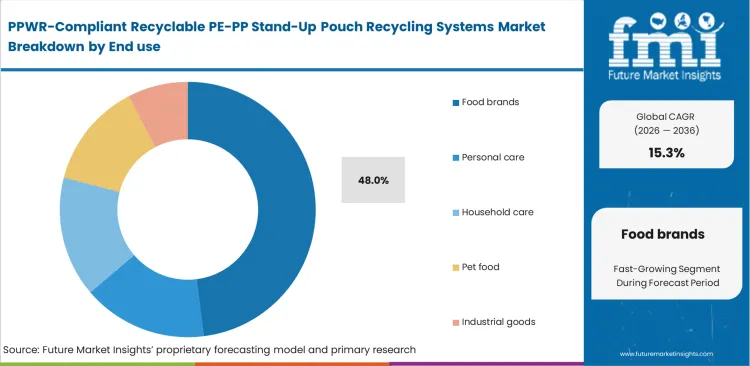
Grocery packaging manufacturers are under growing pressure to use packaging formats that can move through credible recycling streams. Food-contact recycled plastic also requires tighter washing and cleaning standards than many other packaging applications. Food brands are estimated to account for 48% share in 2026, reflecting the scale of grocery packaging volumes and the need for cleaner recycled output. Design-for-recycling programs are also increasing the need for supply chains that can deliver more consistent material quality. Poor contamination control creates compliance risk in food packaging applications and limits the use of recycled resin in sensitive formats. This is pushing more value toward regional washing infrastructure that can support higher purity standards. Hot-wash systems are gaining importance because they help remove odor, residue, and carryover that can affect the suitability of recycled pellets for new food packaging use.
- Food-Grade Purity Mandates: Hot-washing systems eliminate organic residues completely. Quality assurance personnel test extruded pellets rigorously to confirm compliance with food-contact regulations.
- Odor Removal Necessities: Specialized vacuum degassing modules strip volatile compounds during extrusion. Packaging buyers reject any secondary material that imparts off-flavors to the final consumer product.
- Supply Chain Integration: Direct partnerships between brands and recyclers guarantee material availability. Consumer companies secure long-term offtake agreements to shield themselves from volatile virgin polymer pricing.
PPWR-Compliant Recyclable PE/PP Stand-Up Pouch Recycling Systems Market Analysis by Plant Format
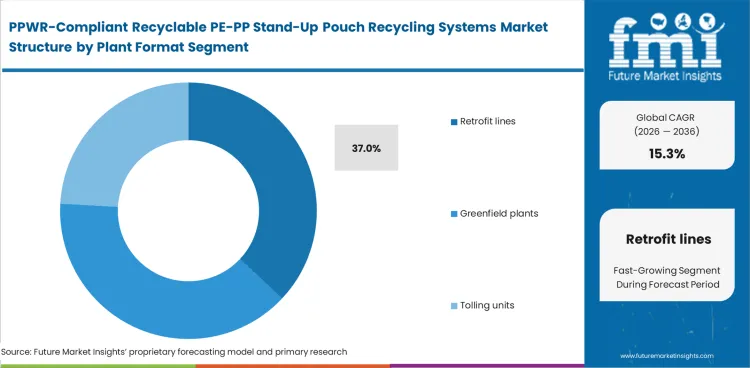
Upgrading an existing waste facility is often a faster route to compliance than building a new plant. New-site development usually involves longer approval cycles, higher capital needs, and more execution risk. Many facility owners prefer modular equipment that can be integrated into existing floor layouts with less disruption. Retrofit lines are estimated to account for 37% share in 2026, reflecting demand for quicker yield improvement without full asset replacement. Extending the use of installed extruders can also improve project economics when core equipment remains serviceable. Section-by-section upgrades help plants maintain operations during transition periods and reduce the risk of prolonged downtime.
- Modular Upgrade Execution: Technicians install compact near-infrared sorters above existing belts. Facility owners minimize downtime by staging installations during scheduled maintenance windows.
- Space Constraint Navigation: Machinery suppliers design compact washing units for tight layouts. Plant engineers optimize material flow pathways to accommodate new equipment without expanding the building footprint.
- Legacy Equipment Integration: Synchronizing modern digital controls with older mechanical extruders proves difficult. System integrators must design custom programmable logic controllers to ensure seamless operation.
PPWR-Compliant Recyclable PE/PP Stand-Up Pouch Recycling Systems Market Drivers, Restraints, and Opportunities
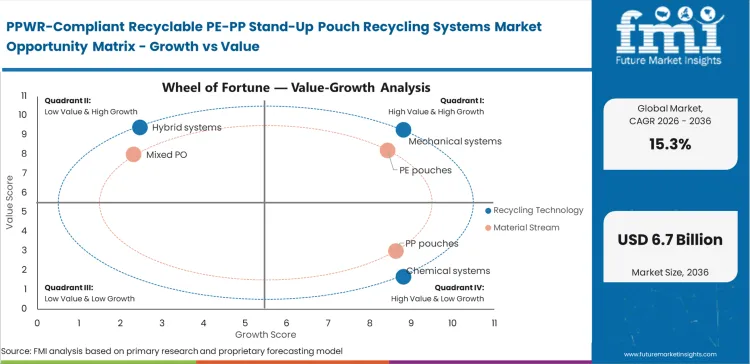
Strict packaging laws now force waste processors to completely remove mixed plastics from their lines. Governments penalize brands that use non-recyclable materials, sparking a massive shift toward mono-material pouches. Facility owners must upgrade their sorting machinery immediately to keep their profitable municipal waste contracts. Consumer goods companies need clean, food-safe recycled plastics to meet sustainability targets, but current supply falls completely short. Outdated belts guarantee poor recovery and lost profits. Modern optical scanners directly increase the amount of sellable plastic extracted from every single waste bale. Plant operators know modernizing is the only way to supply global brands with the high-quality material they demand.
Stubborn glues create major operational headaches for recycling plants. Strong adhesives that seal pouch layers refuse to break down in standard hot-water washes. Workers cannot separate these bonds without damaging the underlying plastic base. Contaminated flakes melt into weak, discolored pellets that buyers immediately reject. Specialized chemical washes fix the issue but add massive costs and delay environmental permits. Operators use finer screens to catch leftover glue, but clogged filters force them to stop the line constantly. Frequent stops slash the daily volume of plastic a facility can process. Plant owners constantly battle to balance material purity with fast processing speeds.
- Smart Detection Software: Machine learning helps optical scanners recognize flexible shapes instantly. Plant owners extract more usable plastic as the system adapts to confusing waste inputs.
- Odor Removal Upgrades: Vacuum degassing units pull embedded smells out of melted plastic. Facilities sell this clean material at premium prices to buyers needing high-quality flexible films PCR for sensitive uses.
- Automated Material Handling: Autonomous sorting arms eliminate physical labor bottlenecks. Supervisors keep material moving smoothly through the plant regardless of unexpected worker shortages or scheduling conflicts.
Regional Analysis
Regional demand relies on how quickly local waste networks transition from manual sorting to automated polyolefin recovery. Regulatory deadlines and municipal budgets dictate where equipment suppliers see the highest volume of machinery orders. Based on regional analysis, market is segmented into Asia-Pacific, Europe, and North America & Latin America across 40 plus countries.
.webp "Top Country Growth Comparison Ppwr Compliant Recyclable Pe Pp Stand Up Pouch Recycling Systems Market Cagr (2026 2036)")
| Country | CAGR (2026 to 2036) |
|---|---|
| India | 16.4% |
| China | 15.6% |
| Germany | 13.8% |
| Spain | 13.4% |
| Italy | 13.1% |
| United Kingdom | 12.9% |
| United States | 11.7% |
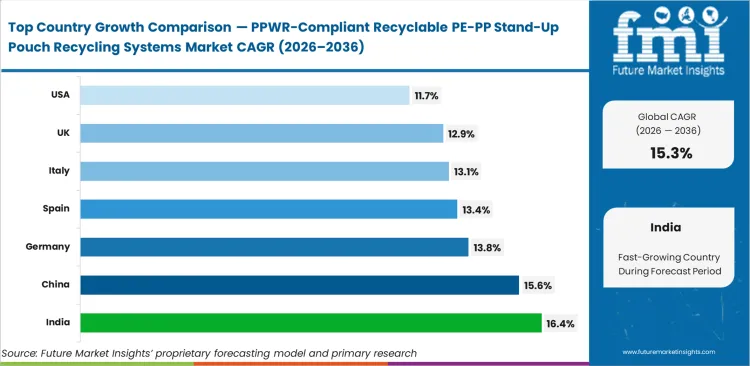
Source: Future Market Insights (FMI) analysis, based on proprietary forecasting model and primary research
Asia-Pacific PPWR-Compliant Recyclable PE/PP Stand-Up Pouch Recycling Systems Market Analysis
Cities across Asia are actively formalizing their waste collection. Heavy investments go into large sorting lines to handle mixed flexible plastics. Local rules push packaging makers toward single-material designs, creating a massive need for better washing systems. Finding consistent power and clean water for these friction washers remains a daily challenge for plant owners.
- India: Massive funds flowing into city waste networks force local operators to buy high-capacity sorting machines. Demand for recyclable pouch recycling systems in India is expected to rise at a CAGR of 16.4% through 2036, driven by this shift from informal picking to structured processing. Plant owners secure long-term contracts when they prove their equipment can handle dirty, mixed plastic bales.
- China: China is projected to witness 15.6% CAGR in the recovery machinery sector through 2036, because strict circular economy rules force rapid equipment upgrades. Facilities must improve their extrusion lines to meet these new domestic targets. Buyers prefer sorting systems built locally to guarantee they can get spare parts quickly when machines break down.
FMI reports, equipment sales in this region hinge completely on handling highly contaminated, mixed input. Success requires machines that offer raw durability over complex chemical processing.
Europe PPWR-Compliant Recyclable PE/PP Stand-Up Pouch Recycling Systems Market Analysis
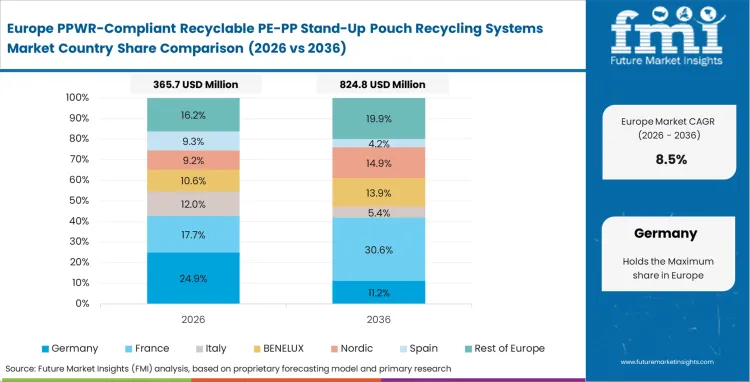
New laws in Europe actively punish companies using unverified recycled plastics. This legal pressure sparks a total overhaul of older recovery plants. Facility owners spend heavily on digital software to prove their recycled pellets meet regional standards. Upgrading optical scanners to separate food-grade from non-food-grade plastic is now a basic survival requirement. Closed-loop water systems are mandatory alongside new washing lines to pass strict wastewater checks.
- Germany: Strict enforcement of packaging laws forces regional waste groups to replace outdated sorting gear. The sector in Germany is anticipated to rise at a CAGR of 13.8% from 2026 to 2036 as these compliance deadlines approach. Upgraded plants make their money by selling certified food-safe polyolefins back to local consumer goods brands.
- Spain: Government cash handouts for circular economy projects speed up the purchase of advanced friction washers. Spain is poised to expand at a projected CAGR of 13.4% in the flexible plastic waste sorting market through 2036, fueled by this direct financial support. Plant owners use these state-funded upgrades to steal business away from competitors who still rely on manual labor.
- Italy: Italy faces heavy pressure from packaging consortiums, anticipated to gain momentum with demand rising at an expected CAGR of 13.1% over the forecast period. These groups demand better recovery rates for light recyclable plastic films. Facilities install robotic handling arms to cut down on wage costs and directly improve the final purity of the sorted bales.
- United Kingdom: Plastic packaging taxes create an immediate need for proven secondary polyolefins. Equipment suppliers must demonstrate their machines can actually wash away tough adhesives to win local contracts. Because of this urgent compliance push, adoption in the United Kingdom is expected to move ahead at a projected CAGR of 12.9% through 2036. Finding reliable technology to handle complex laminates dictates which facilities stay open.
FMI observes, European investments clearly prioritize verification and purity over sheer volume. Plants without advanced filtration and tracing software simply cannot find buyers for their recycled output.
North America & Latin America PPWR-Compliant Recyclable PE/PP Stand-Up Pouch Recycling Systems Market Analysis
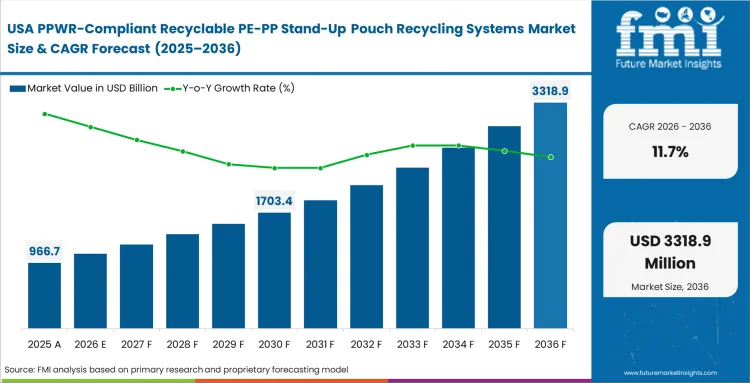
Big consumer brands push the upgrade cycle in this region rather than strict federal laws. Multinational food and beverage companies fund local recycling centers directly to ensure they get enough usable plastic back. Operators focus on expanding their floor space to handle the massive influx of mono-material stand-up pouches coming from household bins. Modifying older recovery facilities with better optical sorters offers the quickest way to increase usable yield. Adapting European machine designs to handle the unpredictable mix of North American curbside trash remains a massive technical hurdle.
- United States: Corporate promises to use more recycled content force massive spending on new detection screens. Sales of recovery machinery in the United States are expected to increase at an estimated CAGR of 11.7% during the forecast period as a direct result of these brand-led pledges. Facilities that install advanced near-infrared arrays easily win long-term supply deals with major cosmetic and grocery companies.
FMI analyses, success in the region depends entirely on building strong links between packaging designers and waste processors to create a functional circular plastic packaging ecosystem. Overcoming the poor quality of municipal curbside bales remains the main barrier to profitable extrusion.
Competitive Aligners for Market Players
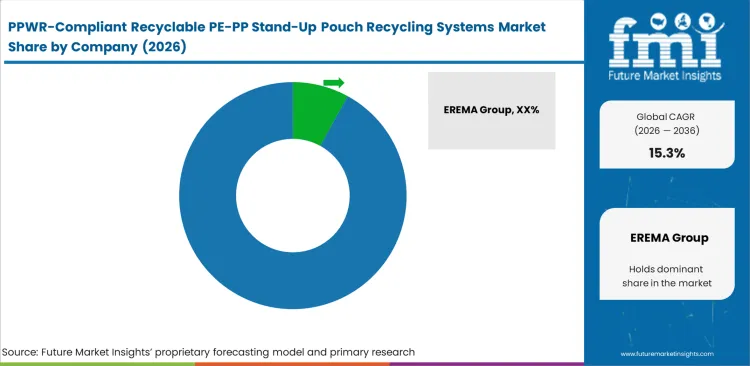
Material purity remains a key factor in equipment selection across this market. Buyers place greater weight on contamination control than on base processing speed when evaluating recovery systems. Competitive strength is increasingly tied to the ability to deliver integrated lines that combine sorting, washing, and extrusion within one operating setup. Flexible-format recycling also requires process control that can maintain pellet quality despite feedstock variability. Suppliers limited to standalone machine sales often face more pressure where buyers prefer complete line responsibility. Capital spending decisions remain closely linked to performance reliability, output consistency, and contamination control.
Installed operating experience also shapes supplier positioning in this market. Historical line performance helps machinery providers refine sorting accuracy, sensor response, and air-flow control for flexible packaging streams. This operating base improves calibration quality in systems handling lightweight and irregular pouch material. New entrants often face a harder path where service depth and local support remain important to plant operators. Replacement part availability also carries weight because wear components can affect uptime across heavy-use recovery lines. Downtime control remains central to supplier selection where plants need stable throughput and tighter material specifications.
Waste recovery facilities often combine equipment from multiple sources to avoid dependence on a single line architecture. System compatibility has become more important as operators look for washing, extrusion, and sorting units that can work within mixed installed bases. Overreliance on one supplier can increase operational exposure when delivery schedules or support access become constrained. Continuous equipment refinement remains necessary because post-consumer flexible packaging feedstock still presents variability in contamination, structure, and handling behavior. This keeps interoperability and process stability at the center of purchasing decisions.
Key Players in PPWR-Compliant Recyclable PE/PP Stand-Up Pouch Recycling Systems Market
- EREMA Group
- TOMRA
- STADLER
- PELLENC ST
- AMUT
- NGR
Scope of the Report
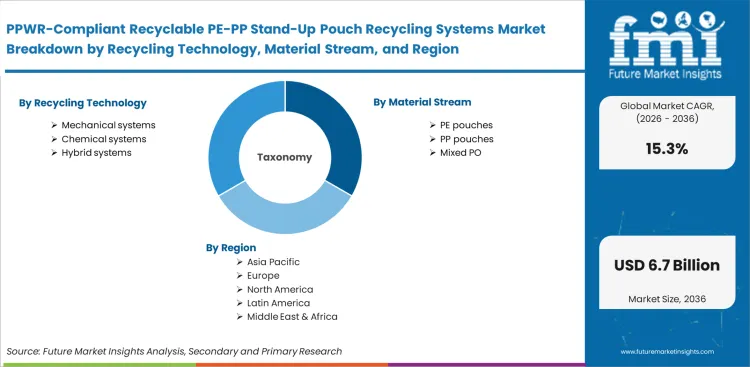
| Metric | Value |
|---|---|
| Quantitative Units | USD 1.4 billion to USD 5.8 billion, at a CAGR of 15.3% |
| Market Definition | Functional recovery infrastructure designed to process polyolefin-based flexible packaging into compliant secondary materials. Machinery must separate, wash, and extrude mono-material structures while adhering to strict regional packaging regulations. |
| Segmentation | Recycling technology, Material stream, System module, End use, Plant format, Region |
| Regions Covered | Asia-Pacific, Europe, North America & Latin America, Middle-East, Africa |
| Countries Covered | India, China, Germany, Spain, Italy, United Kingdom, United States |
| Key Companies Profiled | EREMA Group, TOMRA, STADLER, PELLENC ST, AMUT, NGR |
| Forecast Period | 2026 to 2036 |
| Approach | Installed capacity upgrades and capital expenditure for sorting lines anchor the baseline. |
Source: Future Market Insights (FMI) analysis, based on proprietary forecasting model and primary research
Segments
Recycling Technology
- Mechanical systems
- Chemical systems
- Hybrid systems
Material Stream
- PE pouches
- PP pouches
- Mixed PO
System Module
- Sorting lines
- Washing lines
- Extrusion lines
- Digital traceability
- Testing labs
End Use
- Food brands
- Personal care
- Household care
- Pet food
- Industrial goods
Plant Format
- Retrofit lines
- Greenfield plants
- Tolling units
Regions:
- Asia Pacific
- India
- China
- Japan
- South Korea
- Indonesia
- Australia
- New Zealand
- ASEAN
- Rest of Asia Pacific
- Europe
- Germany
- Italy
- France
- United Kingdom
- Spain
- Benelux
- Nordics
- Central & Eastern Europe
- Rest of Europe
- North America
- United States
- Canada
- Mexico
- Latin America
- Brazil
- Argentina
- Chile
- Rest of Latin America
- Middle East & Africa
- Kingdom of Saudi Arabia
- United Arab Emirates
- South Africa
- Turkey
- Rest of Middle East & Africa
Bibliography
- WRAP. (2024). The UK Plastics Pact | Roadmap 2025 - Creating a circular economy for flexible plastic packaging.
- Canada Plastics Pact. (2025). Pathways to mono-material flexible plastic packaging: Guidance document.
- Makarova, O. A., Ravi, B., Sobkowicz, M. J., Masato, D., & Olivetti, E. A. (2025). Addressing favorable and challenging flexible plastic packaging waste flows: A material flow analysis. Journal of Advanced Manufacturing and Processing, 7(3), e70014.
- Bonifazi, G., Capobianco, G., Cucuzza, P., & Serranti, S. (2025). Contaminant detection in flexible polypropylene packaging waste using hyperspectral imaging and machine learning. Waste Management, 195, 264-274.
- Rumetshofer, T., & Fischer, J. (2025). Enhancement in post-consumer mechanical recycling of plastics: Role of design for recycling, specifications, and efficient sorting of packaging material. Polymers, 17(9), 1177.
- Langwieser, J., Zeilerbauer, L., & Fischer, J. (2024). Identification of the recyclable content of polyethylene films in the Upper Austrian waste streams. International Journal of Sustainable Engineering, 17(1), 1-12.
This bibliography is provided for reader reference. The full FMI report contains the complete reference list with primary source documentation.
This Report Addresses
- Mechanical systems upgrade requirements for regional waste processors.
- Polyethylene detection calibration for advanced near-infrared sensor arrays.
- Capital expenditure limits driving the adoption of retrofit sorting lines.
- Food-grade purity mandates shaping extrusion and deodorization investments.
- Adhesive contamination impacts on continuous melt filtration operations.
- Artificial intelligence integration for complex flexible pouch identification.
- Vendor independence strategies for multi-module recycling plant layouts.
- European regulatory compliance timelines dictating immediate machinery purchase.
Frequently Asked Questions
What is the projected value of the market in 2036?
The sector is anticipated to reach USD 5.8 billion by 2036, reflecting massive capital investments in specialized sorting technology.
Which recycling technology holds the largest share?
Mechanical systems are projected to account for an estimated 43% share in 2026 due to immediate scalability and lower initial capital expenditure.
How are PE and PP stand-up pouches recycled?
They undergo advanced near-infrared sorting, aggressive friction hot-washing to remove adhesives, and specialized vacuum-degassed extrusion to produce high-purity secondary polyolefin pellets.
How do sorting lines influence the overall process?
Extracting specific materials accurately ensures downstream washing and extrusion modules operate without catastrophic contamination failures.
What drives food brands to invest in this sector?
Consumer goods companies face intense regulatory scrutiny to demonstrate verifiable circularity in their high-visibility packaging formats.
Why are retrofit lines gaining rapid adoption?
Upgrading existing facilities avoids the complex permitting delays and massive financial outlay required to construct entirely new greenfield operations.
When does PPWR apply to packaging recycling systems?
Enforcement timelines trigger immediate capital expenditure, as processors must upgrade their sorting and extrusion lines well before the 2030 recycled-content mandates take full effect.
Compare mechanical and chemical recycling for mono-material pouches.
Mechanical processing offers immediate scalability and lower capital expenditure, while chemical alternatives remain highly energy-intensive and are typically reserved for heavily contaminated multi-layer laminates.
How do adhesives impact mechanical recovery?
Aggressive glues resist standard hot-water washing and require specialized filtration screens that reduce overall plant throughput.
Explain the demand for PPWR-ready PE and PP pouch recycling systems.
Facility operators must rapidly procure compliant equipment to ensure they do not lose access to high-margin contracts for food-grade secondary plastics.
Why is deodorization critical for premium plastics?
Vacuum degassing removes volatile compounds, allowing the secondary material to be utilized in sensitive cosmetic and personal care applications.
How do European mandates force immediate action?
Regulations penalize unverified recycled content, compelling facility operators to install advanced traceability and quality testing modules.
What advantage do established machinery suppliers hold?
Companies like STADLER utilize decades of operational telemetry to fine-tune sorting algorithms for complex packaging geometries.
Why do facility operators avoid single-vendor setups?
Relying on one manufacturer for the entire line exposes the facility to severe supply chain risks if production delays occur.
How do lightweight films complicate sorting?
Conveyor systems designed for rigid plastics cause flexible films to become airborne, requiring specialized containment hoods for accuracy.
What forces brands to partner directly with recyclers?
Securing long-term off-take agreements guarantees material availability and shields companies from volatile virgin polymer pricing.
How do optical sorters handle tinted materials?
Tuning sensors for high-clarity polyolefins often increases the rejection rate of slightly colored variants if not carefully calibrated.
What happens if multi-material laminates enter the extruder?
Undetected barrier layers disrupt the entire batch, leading to catastrophic equipment blockages and costly operational downtime.
Why are testing labs considered a critical module?
Quality assurance personnel must rigorously test extruded pellets to confirm compliance with stringent food-contact regulations.
How do subsidies impact adoption in Spain?
Financial incentives accelerate the installation of advanced friction washing units, allowing operators to capture local processing contracts.
What dictates the adoption of robotic handling?
Deploying autonomous units removes manual labor bottlenecks and maintains consistent throughput regardless of workforce availability constraints.
Why do legacy equipment upgrades face delays?
Synchronizing modern digital controls with older mechanical extruders often introduces software compatibility issues during commissioning.
What is the primary operational friction for recyclers?
Finding the exact balance between material purity and processing speed remains a persistent challenge for plant engineers.
How do brand pledges influence the US market?
Corporate commitments to incorporate recycled content force massive capital deployment into advanced sorting technology despite limited federal mandates.
Preview the report firsthand - request a free sample
Get SampleGet the brochure for pricing and purchase details.
Get PDFTable of Content
- Executive Summary
- Global Market Outlook
- Demand-side Trends
- Supply-side Trends
- Technology Roadmap Analysis
- Analysis and Recommendations
- Market Overview
- Market Coverage / Taxonomy
- Market Definition / Scope / Limitations
- Research Methodology
- Chapter Orientation
- Analytical Lens and Working Hypotheses
- Market Structure, Signals, and Trend Drivers
- Benchmarking and Cross-market Comparability
- Market Sizing, Forecasting, and Opportunity Mapping
- Research Design and Evidence Framework
- Desk Research Programme (Secondary Evidence)
- Company Annual and Sustainability Reports
- Peer-reviewed Journals and Academic Literature
- Corporate Websites, Product Literature, and Technical Notes
- Earnings Decks and Investor Briefings
- Statutory Filings and Regulatory Disclosures
- Technical White Papers and Standards Notes
- Trade Journals, Industry Magazines, and Analyst Briefs
- Conference Proceedings, Webinars, and Seminar Materials
- Government Statistics Portals and Public Data Releases
- Press Releases and Reputable Media Coverage
- Specialist Newsletters and Curated Briefings
- Sector Databases and Reference Repositories
- FMI Internal Proprietary Databases and Historical Market Datasets
- Subscription Datasets and Paid Sources
- Social Channels, Communities, and Digital Listening Inputs
- Additional Desk Sources
- Expert Input and Fieldwork (Primary Evidence)
- Primary Modes
- Qualitative Interviews and Expert Elicitation
- Quantitative Surveys and Structured Data Capture
- Blended Approach
- Why Primary Evidence is Used
- Field Techniques
- Interviews
- Surveys
- Focus Groups
- Observational and In-context Research
- Social and Community Interactions
- Stakeholder Universe Engaged
- C-suite Leaders
- Board Members
- Presidents and Vice Presidents
- R&D and Innovation Heads
- Technical Specialists
- Domain Subject-matter Experts
- Scientists
- Physicians and Other Healthcare Professionals
- Governance, Ethics, and Data Stewardship
- Research Ethics
- Data Integrity and Handling
- Primary Modes
- Tooling, Models, and Reference Databases
- Desk Research Programme (Secondary Evidence)
- Data Engineering and Model Build
- Data Acquisition and Ingestion
- Cleaning, Normalisation, and Verification
- Synthesis, Triangulation, and Analysis
- Quality Assurance and Audit Trail
- Market Background
- Market Dynamics
- Drivers
- Restraints
- Opportunity
- Trends
- Scenario Forecast
- Demand in Optimistic Scenario
- Demand in Likely Scenario
- Demand in Conservative Scenario
- Opportunity Map Analysis
- Product Life Cycle Analysis
- Supply Chain Analysis
- Investment Feasibility Matrix
- Value Chain Analysis
- PESTLE and Porter’s Analysis
- Regulatory Landscape
- Regional Parent Market Outlook
- Production and Consumption Statistics
- Import and Export Statistics
- Market Dynamics
- Global Market Analysis 2021 to 2025 and Forecast, 2026 to 2036
- Historical Market Size Value (USD Million) Analysis, 2021 to 2025
- Current and Future Market Size Value (USD Million) Projections, 2026 to 2036
- Y-o-Y Growth Trend Analysis
- Absolute $ Opportunity Analysis
- Global Market Pricing Analysis 2021 to 2025 and Forecast 2026 to 2036
- Global Market Analysis 2021 to 2025 and Forecast 2026 to 2036, By Recycling Technology
- Introduction / Key Findings
- Historical Market Size Value (USD Million) Analysis By Recycling Technology , 2021 to 2025
- Current and Future Market Size Value (USD Million) Analysis and Forecast By Recycling Technology , 2026 to 2036
- Mechanical systems
- Chemical systems
- Hybrid systems
- Mechanical systems
- Y-o-Y Growth Trend Analysis By Recycling Technology , 2021 to 2025
- Absolute $ Opportunity Analysis By Recycling Technology , 2026 to 2036
- Global Market Analysis 2021 to 2025 and Forecast 2026 to 2036, By Material Stream
- Introduction / Key Findings
- Historical Market Size Value (USD Million) Analysis By Material Stream, 2021 to 2025
- Current and Future Market Size Value (USD Million) Analysis and Forecast By Material Stream, 2026 to 2036
- PE pouches
- PP pouches
- Mixed PO
- PE pouches
- Y-o-Y Growth Trend Analysis By Material Stream, 2021 to 2025
- Absolute $ Opportunity Analysis By Material Stream, 2026 to 2036
- Global Market Analysis 2021 to 2025 and Forecast 2026 to 2036, By System module
- Introduction / Key Findings
- Historical Market Size Value (USD Million) Analysis By System module, 2021 to 2025
- Current and Future Market Size Value (USD Million) Analysis and Forecast By System module, 2026 to 2036
- Sorting lines
- Washing lines
- Extrusion lines
- Digital traceability
- Testing labs
- Sorting lines
- Y-o-Y Growth Trend Analysis By System module, 2021 to 2025
- Absolute $ Opportunity Analysis By System module, 2026 to 2036
- Global Market Analysis 2021 to 2025 and Forecast 2026 to 2036, By End use
- Introduction / Key Findings
- Historical Market Size Value (USD Million) Analysis By End use, 2021 to 2025
- Current and Future Market Size Value (USD Million) Analysis and Forecast By End use, 2026 to 2036
- Food brands
- Personal care
- Household care
- Pet food
- Industrial goods
- Food brands
- Y-o-Y Growth Trend Analysis By End use, 2021 to 2025
- Absolute $ Opportunity Analysis By End use, 2026 to 2036
- Global Market Analysis 2021 to 2025 and Forecast 2026 to 2036, By Plant Format
- Introduction / Key Findings
- Historical Market Size Value (USD Million) Analysis By Plant Format, 2021 to 2025
- Current and Future Market Size Value (USD Million) Analysis and Forecast By Plant Format, 2026 to 2036
- Retrofit lines
- Greenfield plants
- Tolling units
- Retrofit lines
- Y-o-Y Growth Trend Analysis By Plant Format, 2021 to 2025
- Absolute $ Opportunity Analysis By Plant Format, 2026 to 2036
- Global Market Analysis 2021 to 2025 and Forecast 2026 to 2036, By Region
- Introduction
- Historical Market Size Value (USD Million) Analysis By Region, 2021 to 2025
- Current Market Size Value (USD Million) Analysis and Forecast By Region, 2026 to 2036
- North America
- Latin America
- Western Europe
- Eastern Europe
- East Asia
- South Asia and Pacific
- Middle East & Africa
- Market Attractiveness Analysis By Region
- North America Market Analysis 2021 to 2025 and Forecast 2026 to 2036, By Country
- Historical Market Size Value (USD Million) Trend Analysis By Market Taxonomy, 2021 to 2025
- Market Size Value (USD Million) Forecast By Market Taxonomy, 2026 to 2036
- By Country
- USA
- Canada
- Mexico
- By Recycling Technology
- By Material Stream
- By System module
- By End use
- By Plant Format
- By Country
- Market Attractiveness Analysis
- By Country
- By Recycling Technology
- By Material Stream
- By System module
- By End use
- By Plant Format
- Key Takeaways
- Latin America Market Analysis 2021 to 2025 and Forecast 2026 to 2036, By Country
- Historical Market Size Value (USD Million) Trend Analysis By Market Taxonomy, 2021 to 2025
- Market Size Value (USD Million) Forecast By Market Taxonomy, 2026 to 2036
- By Country
- Brazil
- Chile
- Rest of Latin America
- By Recycling Technology
- By Material Stream
- By System module
- By End use
- By Plant Format
- By Country
- Market Attractiveness Analysis
- By Country
- By Recycling Technology
- By Material Stream
- By System module
- By End use
- By Plant Format
- Key Takeaways
- Western Europe Market Analysis 2021 to 2025 and Forecast 2026 to 2036, By Country
- Historical Market Size Value (USD Million) Trend Analysis By Market Taxonomy, 2021 to 2025
- Market Size Value (USD Million) Forecast By Market Taxonomy, 2026 to 2036
- By Country
- Germany
- UK
- Italy
- Spain
- France
- Nordic
- BENELUX
- Rest of Western Europe
- By Recycling Technology
- By Material Stream
- By System module
- By End use
- By Plant Format
- By Country
- Market Attractiveness Analysis
- By Country
- By Recycling Technology
- By Material Stream
- By System module
- By End use
- By Plant Format
- Key Takeaways
- Eastern Europe Market Analysis 2021 to 2025 and Forecast 2026 to 2036, By Country
- Historical Market Size Value (USD Million) Trend Analysis By Market Taxonomy, 2021 to 2025
- Market Size Value (USD Million) Forecast By Market Taxonomy, 2026 to 2036
- By Country
- Russia
- Poland
- Hungary
- Balkan & Baltic
- Rest of Eastern Europe
- By Recycling Technology
- By Material Stream
- By System module
- By End use
- By Plant Format
- By Country
- Market Attractiveness Analysis
- By Country
- By Recycling Technology
- By Material Stream
- By System module
- By End use
- By Plant Format
- Key Takeaways
- East Asia Market Analysis 2021 to 2025 and Forecast 2026 to 2036, By Country
- Historical Market Size Value (USD Million) Trend Analysis By Market Taxonomy, 2021 to 2025
- Market Size Value (USD Million) Forecast By Market Taxonomy, 2026 to 2036
- By Country
- China
- Japan
- South Korea
- By Recycling Technology
- By Material Stream
- By System module
- By End use
- By Plant Format
- By Country
- Market Attractiveness Analysis
- By Country
- By Recycling Technology
- By Material Stream
- By System module
- By End use
- By Plant Format
- Key Takeaways
- South Asia and Pacific Market Analysis 2021 to 2025 and Forecast 2026 to 2036, By Country
- Historical Market Size Value (USD Million) Trend Analysis By Market Taxonomy, 2021 to 2025
- Market Size Value (USD Million) Forecast By Market Taxonomy, 2026 to 2036
- By Country
- India
- ASEAN
- Australia & New Zealand
- Rest of South Asia and Pacific
- By Recycling Technology
- By Material Stream
- By System module
- By End use
- By Plant Format
- By Country
- Market Attractiveness Analysis
- By Country
- By Recycling Technology
- By Material Stream
- By System module
- By End use
- By Plant Format
- Key Takeaways
- Middle East & Africa Market Analysis 2021 to 2025 and Forecast 2026 to 2036, By Country
- Historical Market Size Value (USD Million) Trend Analysis By Market Taxonomy, 2021 to 2025
- Market Size Value (USD Million) Forecast By Market Taxonomy, 2026 to 2036
- By Country
- Kingdom of Saudi Arabia
- Other GCC Countries
- Turkiye
- South Africa
- Other African Union
- Rest of Middle East & Africa
- By Recycling Technology
- By Material Stream
- By System module
- By End use
- By Plant Format
- By Country
- Market Attractiveness Analysis
- By Country
- By Recycling Technology
- By Material Stream
- By System module
- By End use
- By Plant Format
- Key Takeaways
- Key Countries Market Analysis
- USA
- Pricing Analysis
- Market Share Analysis, 2025
- By Recycling Technology
- By Material Stream
- By System module
- By End use
- By Plant Format
- Canada
- Pricing Analysis
- Market Share Analysis, 2025
- By Recycling Technology
- By Material Stream
- By System module
- By End use
- By Plant Format
- Mexico
- Pricing Analysis
- Market Share Analysis, 2025
- By Recycling Technology
- By Material Stream
- By System module
- By End use
- By Plant Format
- Brazil
- Pricing Analysis
- Market Share Analysis, 2025
- By Recycling Technology
- By Material Stream
- By System module
- By End use
- By Plant Format
- Chile
- Pricing Analysis
- Market Share Analysis, 2025
- By Recycling Technology
- By Material Stream
- By System module
- By End use
- By Plant Format
- Germany
- Pricing Analysis
- Market Share Analysis, 2025
- By Recycling Technology
- By Material Stream
- By System module
- By End use
- By Plant Format
- UK
- Pricing Analysis
- Market Share Analysis, 2025
- By Recycling Technology
- By Material Stream
- By System module
- By End use
- By Plant Format
- Italy
- Pricing Analysis
- Market Share Analysis, 2025
- By Recycling Technology
- By Material Stream
- By System module
- By End use
- By Plant Format
- Spain
- Pricing Analysis
- Market Share Analysis, 2025
- By Recycling Technology
- By Material Stream
- By System module
- By End use
- By Plant Format
- France
- Pricing Analysis
- Market Share Analysis, 2025
- By Recycling Technology
- By Material Stream
- By System module
- By End use
- By Plant Format
- India
- Pricing Analysis
- Market Share Analysis, 2025
- By Recycling Technology
- By Material Stream
- By System module
- By End use
- By Plant Format
- ASEAN
- Pricing Analysis
- Market Share Analysis, 2025
- By Recycling Technology
- By Material Stream
- By System module
- By End use
- By Plant Format
- Australia & New Zealand
- Pricing Analysis
- Market Share Analysis, 2025
- By Recycling Technology
- By Material Stream
- By System module
- By End use
- By Plant Format
- China
- Pricing Analysis
- Market Share Analysis, 2025
- By Recycling Technology
- By Material Stream
- By System module
- By End use
- By Plant Format
- Japan
- Pricing Analysis
- Market Share Analysis, 2025
- By Recycling Technology
- By Material Stream
- By System module
- By End use
- By Plant Format
- South Korea
- Pricing Analysis
- Market Share Analysis, 2025
- By Recycling Technology
- By Material Stream
- By System module
- By End use
- By Plant Format
- Russia
- Pricing Analysis
- Market Share Analysis, 2025
- By Recycling Technology
- By Material Stream
- By System module
- By End use
- By Plant Format
- Poland
- Pricing Analysis
- Market Share Analysis, 2025
- By Recycling Technology
- By Material Stream
- By System module
- By End use
- By Plant Format
- Hungary
- Pricing Analysis
- Market Share Analysis, 2025
- By Recycling Technology
- By Material Stream
- By System module
- By End use
- By Plant Format
- Kingdom of Saudi Arabia
- Pricing Analysis
- Market Share Analysis, 2025
- By Recycling Technology
- By Material Stream
- By System module
- By End use
- By Plant Format
- Turkiye
- Pricing Analysis
- Market Share Analysis, 2025
- By Recycling Technology
- By Material Stream
- By System module
- By End use
- By Plant Format
- South Africa
- Pricing Analysis
- Market Share Analysis, 2025
- By Recycling Technology
- By Material Stream
- By System module
- By End use
- By Plant Format
- USA
- Market Structure Analysis
- Competition Dashboard
- Competition Benchmarking
- Market Share Analysis of Top Players
- By Regional
- By Recycling Technology
- By Material Stream
- By System module
- By End use
- By Plant Format
- Competition Analysis
- Competition Deep Dive
- EREMA Group
- Overview
- Product Portfolio
- Profitability by Market Segments (Product/Age /Sales Channel/Region)
- Sales Footprint
- Strategy Overview
- Marketing Strategy
- Product Strategy
- Channel Strategy
- TOMRA
- STADLER
- PELLENC ST
- AMUT
- NGR
- EREMA Group
- Competition Deep Dive
- Assumptions & Acronyms Used


