

- Industry Size (2026)
- USD 1.1 Bn
- Forecast (2036)
- USD 2.6 Bn
- CAGR (2026 to 2036)
- 9.5%
Mono-Material Recyclable Stretch Yarn Systems Market Size, Market Forecast and Outlook By FMI
The mono-material recyclable stretch yarn systems market was valued at USD 1.0 billion in 2025. The market is projected to reach USD 1.1 billion in 2026 and USD 2.6 billion by 2036, which reflects a 9.5% CAGR for the overall market during 2026 to 2036. This implies an absolute dollar opportunity of USD 1.54 billion through 2036.
Summary of Mono-Material Recyclable Stretch Yarn Systems Market
- Market Snapshot
- The mono-material recyclable stretch yarn systems market was valued at USD 1.0 billion in 2025. The market is projected to reach USD 2.6 billion by 2036. That indicates an absolute dollar opportunity of USD 1.54 billion between 2026 and 2036.
- The market is expected to expand at a 9.5% CAGR from 2026 to 2036.
- Growth is coming mainly from material substitution in apparel, not from a broad increase in clothing volumes. Buyers are replacing elastane-containing constructions in selected product lines with yarn techniques that are easier to recover after use.
- In this sector, commercial acceptance depends heavily on stretch recovery, dye performance, and recyclability at the end of the product cycle.
- Market Demand and Growth Drivers
- Demand is rising because brands are moving away from stretch fabrics made with incompatible fiber combinations that are difficult to process after disposal.
- Policy is also tightening the market window for mixed-material textiles.
- Separate textile collection rules in Europe from 2025 are increasing pressure on apparel producers to use fabric formats that are easier to sort and process.
- Adoption across these countries will depend on how well mills can deliver stretch performance, color consistency, and processing reliability without relying on elastane.
- Market Product and Segment View
- When textile engineers build stretches without elastane, they rely heavily on polymer chemistry and physical geometry. They force stretch into the material through mechanical crimp, which commands a 42.0% share of the stretch mechanism segment, or through complex filament orientation in 2026.
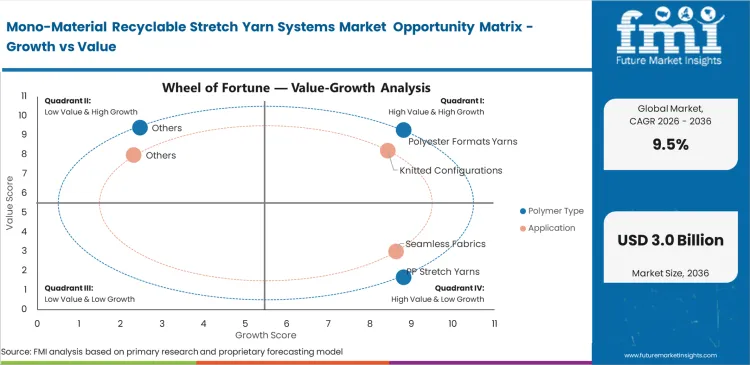
- Polyester entirely dominates the polymer breakdown at 38.0%, winning out purely due to its thermal stability and the sheer scale of the global mechanical recycling ecosystem.
- Mechanical recycling is expected to hold a 46.0% share of the recovery route segment in 2026, supported by the established PET bottle-to-fiber supply chain. At the fabric construction level, knitting mills capture 36.0% of the volume.
- A knit structure naturally amplifies the inherent give of a rigid yarn, masking the absence of true rubber-like elastomers. This technology finds its primary home in activewear, commanding a 31.0% share as athletic labels aggressively cleanse their supply chains of mixed synthetics across performance underwear, athleisure, and swimwear.
- The scope is limited to true mono-material architectures and compatible platforms. Standard spandex blends and unrecoverable trims are excluded from the data.
- Market Geography and Competitive Outlook
- The global map splits into two distinct functions. China, Brazil, and India operate as high-velocity execution engines where actual fabric production scales.
- The United States and Germany set many of the technical requirements for this market, supported by extended producer responsibility rules and stricter brand sourcing standards.
- The market remains relatively fragmented. This fragmentation exists because global sportswear sourcing is inherently decentralized to mitigate regional risk.
- Companies like Toray Industries, Teijin Frontier, Hyosung Advanced Materials, The LYCRA Company, Indorama Ventures, UNIFI, and Asahi Kasei are some of the key players in the sector.
- These players competing to tune recycled feedstocks, so they behave exactly like virgin polymers on the knitting floor without breaking the circularity promise at the end of the garment life.
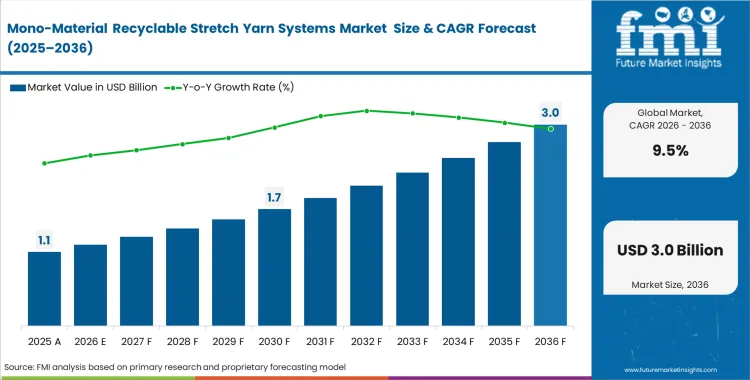
Activewear buyers are moving away from elastane and other mixed-material blends in new collections. For many retail programs, recyclable fabric construction now affects supplier approval and ranging decisions. That change is forcing mills to test recycled polyester apparel fiber systems that can still deliver the required fit and recovery. Many dye houses still struggle to hold shade consistency on these materials, which slows fabric approval and delays commercial rollout.
Factory qualifications are also taking longer than many buyers expected. Material teams may solve stretch recovery at the yarn and fabric stage, but collections can still be delayed when dye houses fail to meet seasonal color standards on recycled inputs. That gap matters commercially because missed color approvals can slow launches and disrupt supply commitments even after fabric development is complete.
China is expected to record a 10.7% CAGR during 2026 to 2036, supported by large textile mills adding conjugate spinning capacity close to PET recycling hubs. Brazil is projected to expand at a 10.3% CAGR for the country market over 2026 to 2036, helped by activewear producers building more integrated circular material strategies. India is likely to grow at a 9.9% CAGR for the country market during the forecast period, while the United States is estimated to rise at a 9.2% CAGR over the same period. Germany is projected to record a 9.1% CAGR for the country market from 2026 to 2036, while South Korea is expected to grow at 8.7% CAGR and Italy at 8.5% CAGR during the same period. Differences across these markets depend partly on how quickly local collection and sorting arrangements can identify and separate recyclable textile streams with enough accuracy to support downstream processing.
Mono-Material Recyclable Stretch Yarn Systems Market Key Takeaways
| Metric | Details |
|---|---|
| Industry Size (2026) | USD 1.1 billion |
| Industry Value (2036) | USD 2.6 billion |
| CAGR (2026 to 2036) | 9.5% |
Source: Future Market Insights (FMI) analysis, based on proprietary forecasting model and primary research
Segmental Analysis
Mono-Material Recyclable Stretch Yarn Systems Market Analysis by Polymer type
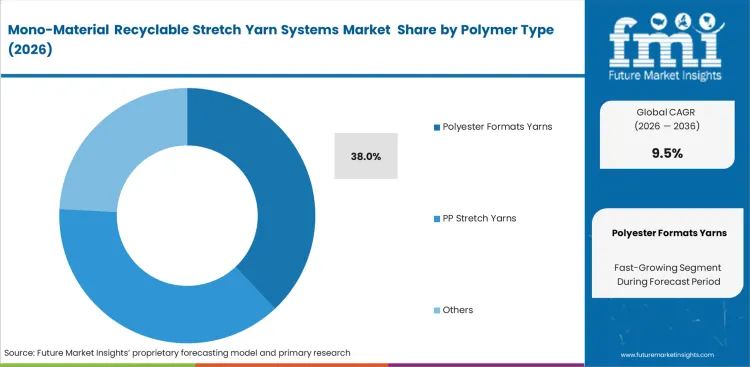
Conventional spandex blends are likely to face more difficulty in purity checks at advanced chemical recycling plants because cross-linked polyurethane can contaminate the recovery stream. Polyester formats are expected to account for 38.0% of the polymer type segment in 2026, supported by the existing PET recovery network. Sorting facilities are already better aligned with polyethylene terephthalate identification, which makes mono-polyester garments easier to process within current collection and separation systems. Dyeing still remains a practical issue in this market. Stretch filaments and base yarns do not always absorb color at the same rate. Brands delaying technical qualification risk massive inventory write-downs when upcoming textile recycling mandates render multi-material activewear legally unsellable in key European jurisdictions.
- Recovery threshold: Initial elasticity matches legacy spandex parameters flawlessly. Textile engineers specify polyester mono-stretch yarn for mid-compression applications, capturing immediate circularity premiums without altering cutting-room workflows.
- Thermal degradation: High-temperature disperse dyeing frequently relaxes bi-component coil geometries. Dye house managers must reduce processing temperatures, sacrificing deep shade penetration to preserve physical spring.
- Wash-cycle retention: Retractive force diminishes predictably after fifty consumer laundering cycles. Brand product developers must redesign garment profiles with negative ease compensating for gradual mechanical fatigue.
Mono-Material Recyclable Stretch Yarn Systems Market Analysis by Application
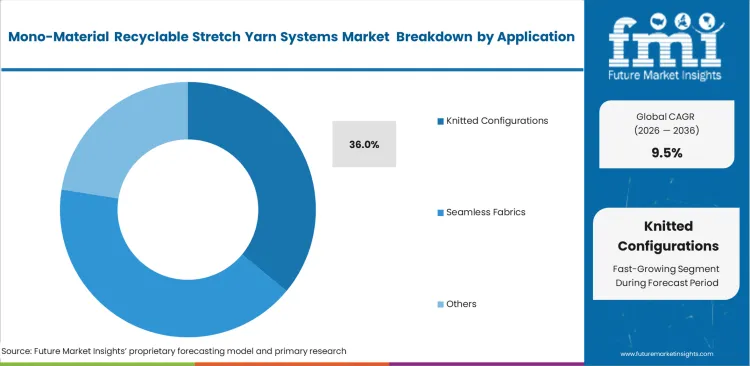
Knitted fabrics can work with slightly lower stretch recovery than true elastomer-based systems. Their looped construction helps absorb some of the performance gap seen in mono-polymer filaments. Knitted configurations are projected to secure 36.0% share in 2026, as product developers leverage loop flexibility achieving adequate compression without relying on high-denier elastane. Mill operations managers favor this route because circular knitting machines require minimal tension-gate recalibration to handle crimped polyester. Seam recovery remains a weak point in these garments. The main fabric may stretch and recover well, but standard sewing threads can still fail under repeated movement. That mismatch creates a practical problem at high-stress points such as gussets. Some products meet recyclable design targets but still perform poorly in use because the thread specification has not been adapted. Retail returns can rise when sourcing teams replace the fabric system without fixing seam performance at the same time.
- Seamless integration: Intimate apparel manufacturers are moving first in lower-impact base layers. Teams are removing elastane from simpler garments before extending mono-material formats into higher-compression categories such as sports bras.
- Performance lines: Tier-1 athletic brands are introducing conjugate yarns into products such as running tights. Buyers are securing volume from advanced spinners early to protect supply availability in key markets.
- Woven conversion: Heavy outdoor and technical apparel remains harder to convert. Tight woven constructions leave less room for built-in stretch, which slows the shift toward recyclable formats in outerwear.
Mono-Material Recyclable Stretch Yarn Systems Market Analysis by End use
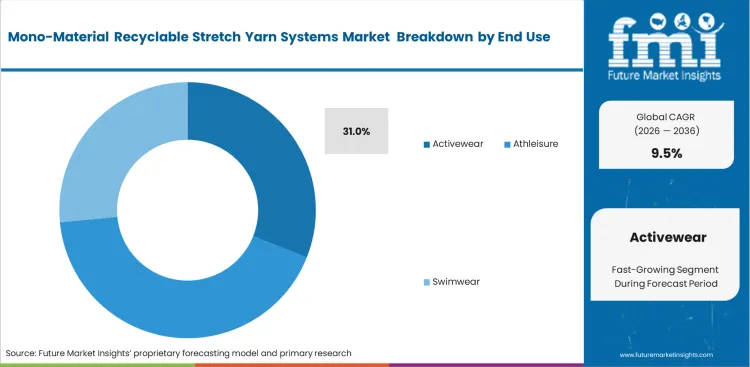
Category managers at global sports brands are under pressure to meet corporate ESG targets and maintain high-compression fits consumers expect. Activewear is estimated to account for 31.0% share in 2026, driven by intense public scrutiny over synthetic microfiber shedding and garment lifespan. Corporate uniform programs are an important demand source for mono-material spinners. They offer steady order volumes and longer planning visibility than many retail channels. What apparel marketers rarely disclose is active wear transitions actually cannibalize short-term margins due to higher yarn breakages during high-speed knitting. Procurement directors must subsidize mill downtime during initial qualification phases securing long-term capacity. Labels attempting to force legacy mills into rapid mono-polymer adoption without adjusting target cost parameters to face systemic quality rejections.
- Extrusion premium: Bi-component spinning requires specialized dual-feed spinnerets. Buyers often accept higher material costs when they expect lower waste-related charges later in the product cycle.
- Knitting downtime: Crimped filaments snag frequently on high-gauge circular machines producing workout clothes. Mill operators report increased needle breakage and slower production speeds, driving conversion costs.
- Lifecycle parity: Circular product design can lower end-of-life disposal costs. The cost difference often narrows over time as extended producer responsibility charges rise for elastane-based garments. In some product lines, the economy becomes more manageable by the third year.
Mono-Material Recyclable Stretch Yarn Systems Market Analysis by Stretch mechanism
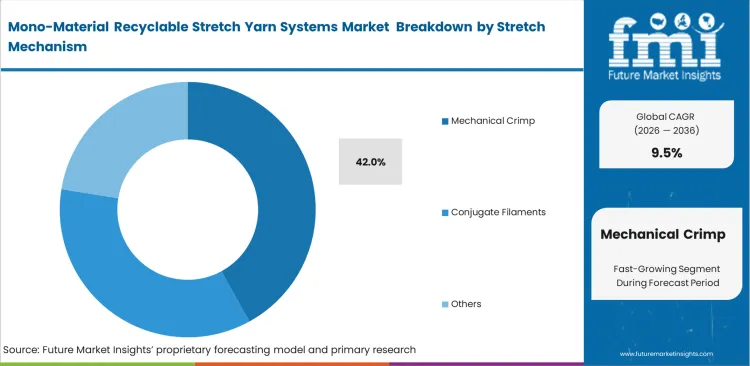
Replacing chemical cross-linking with physical geometry allows supply chains to maintain elasticity while achieving strict mono-material compliance. Mechanical crimp is expected to account for 42.0% share in 2026, primarily because texturizing facilities produce these yarns using modified false-twist machinery already installed globally. Operations managers prefer this mechanism over complex conjugate spinning due to vastly lower capital expenditure requirements. Standard physical crimping has a clear limitation. Stretch performance can drop sharply when fabric is exposed to high tension during finishing. Stenter operations are a common weak point because wet fabric stretched to width can flatten the crimp and reduce elasticity permanently. That problem may not appear until the fabric reaches later production stages. Mills that do not control finishing tension closely can end up with fabric that feels rigid and no longer meets the required stretch standard.
- Crimp flattening: High tension during wet processing permanently straightens yarn coils. Finishing facility managers invest in specialized conveyor dryers preventing catastrophic elasticity loss.
- Heat-setting limits: Thermal memory remains highly sensitive to exact temperature windows evaluating low creep high modulus yarns. Quality control inspectors detect inconsistent stretch behavior across different color batches due to varied time-in-bath requirements.
- Tensionless validation: Preserving functional spring requires comprehensive operational redesign. Textile engineers audit every roller and feed mechanism across supply chains, eliminating unintended drafting.
Mono-Material Recyclable Stretch Yarn Systems Market Analysis by Recycling route
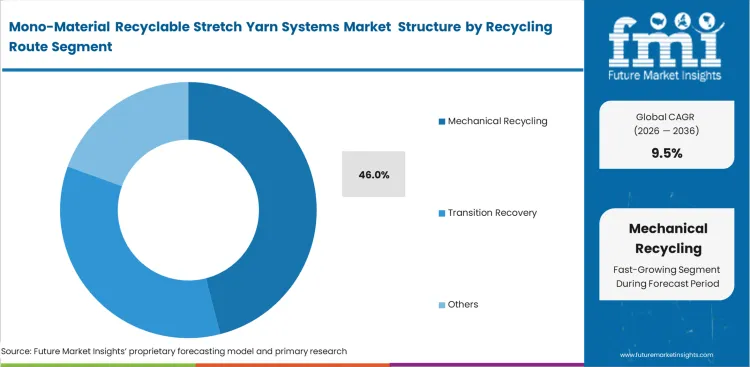
Chemical depolymerization offers infinite renewal cycles, yet municipal collection infrastructure strongly favors basic physical shredding. Mechanical recycling is expected to account for 46.0% share in 2026, supported by the large installed base of PET bottle recovery networks that are being adapted for textile inputs. Physical recycling can limit garment design choices. High twist stretch yarns may not process smoothly in standard shredding equipment. That can increase heat buildup during size reduction and affect material recovery efficiency.
- Shredder compatibility: Legacy tearing machines struggle with highly elastic fabric scraps. Facility engineers install specialized cutting cylinders handling stretch materials without generating excessive heat and fused clumps.
- Chemical scaling: Depolymerization reactors require massive, consistent feedstock volumes to achieve profitability. Procurement directors secure long-term waste aggregation contracts ensuring dedicated recycling partners survive startup phases.
- Viscosity constraints: Physical extrusion slowly destroys polymer chain lengths. Polymer scientists blend virgin resin with recovered stretch pellets, maintaining melt strength necessary for fine-denier spinning.
Mono-Material Recyclable Stretch Yarn Systems Market Drivers, Restraints, and Opportunities
Extended Producer Responsibility legislation compels sourcing directors to eliminate multi-material blends from impending athletic collections immediately. Delaying this architectural change exposes major apparel brands to, steep per-garment taxation penalties across European retail zones. Brand sustainability officers recognize traditional spandex renders entire garments virtually unrecyclable without toxic solvent separation, forcing rapid pivots toward elastane-free stretch platforms. Regulatory pressure converges with aggressive corporate climate pledges, pushing Tier-1 textile mills to accelerate capital investments in bi-component spinning technology. Sourcing teams must secure limited capacity allocations now guaranteeing compliant product lines by strict 2030 deadlines.
Dye house processing remains a key limit for mono-material stretch yarn systems. Deep shades are harder to achieve on mono-polymer fabrics without affecting the crimp that supports stretch. Heat and tension during finishing can reduce elastic recovery, especially in mills using standard stenter settings. Some producers are adjusting dyeing methods to lower that risk, but those changes often require equipment upgrades and tighter process control. This leaves many brands balancing color consistency against stretch performance in fashion-led product lines.
Opportunities in the Mono-Material Recyclable Stretch Yarn Systems Market
- Base layer integration: Intimate apparel manufacturers replace legacy spandex in low-impact garments. Product developers capture early circularity premiums while avoiding stringent retractive force requirements of high-performance outerwear.
- Workwear deployment: Corporate uniform suppliers transition bulk contracts to mono-material constructions. Procurement directors leverage massive, predictable volume justifying dedicated conjugate spinning lines and securing reliable take-back logistics.
- Digital print surfaces: Fabric technologists engineer specific mono-polymer fabrics for direct-to-garment applications. Supply chain managers adopt digital print optimized textile substrate platforms, reducing wet-processing tension and preserving dimensional crimp memory entirely.
Regional Analysis
Based on regional analysis, Mono-Material Recyclable Stretch Yarn Systems is segmented into North America, Latin America, Europe, East Asia, South Asia, and Oceania across 40 plus countries.
.webp "Top Country Growth Comparison Mono Material Recyclable Stretch Yarn Systems Market Cagr (2026 2036)")
| Country | CAGR (2026 to 2036) |
|---|---|
| China | 10.7% |
| Brazil | 10.3% |
| India | 9.9% |
| United States | 9.2% |
| Germany | 9.1% |
| South Korea | 8.7% |
| Italy | 8.5% |
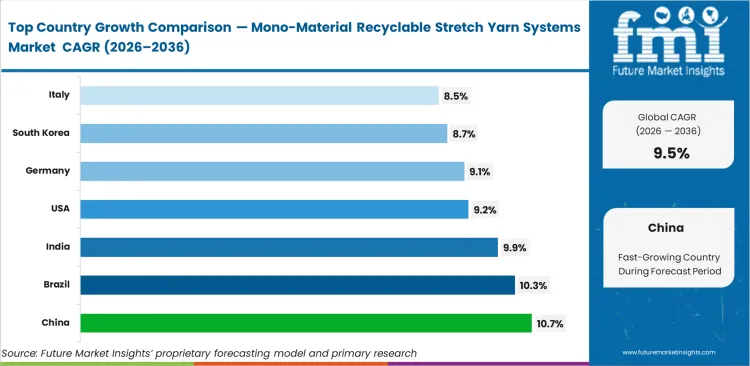
Source: Future Market Insights (FMI) analysis, based on proprietary forecasting model and primary research
Asia Pacific Mono-Material Recyclable Stretch Yarn Systems Market Analysis
Asia Pacific remains one of the key production base for mono-material recyclable stretch yarn systems because polymer recovery, spinning, and fabric manufacturing are concentrated across the same broader supply chain. That setup improves feedstock access, shortens material movement, and supports better cost control. The region also serves both ends of the market, from large-volume apparel programs to higher-specification technical applications. Buyer's sourcing recyclable stretch materials at scale continue to focus on Asia Pacific because it offers stronger manufacturing depth than most other regions.
- China: Large textile groups in China are adding bi-component spinning lines near chemical recycling units to improve feedstock access and reduce input movement across the chain. The market for mono-material recyclable stretch yarn systems in China is expected to grow at a 10.7% CAGR through 2036. This setup helps suppliers manage cost, scale output faster, and serve global activewear programs with shorter production cycles.
- South Korea: Demand for mono-material recyclable stretch yarn systems in South Korea is anticipated to rise at a CAGR of 8.7% through 2036. Producers are shifting part of their synthetic yarn capacity toward recyclable stretch formats for higher-specification apparel. Some suppliers are also aligning these developments with low-shedding synthetic textile fibers to support performance categories where fiber release is under closer review. This keeps the country more relevant in technical and premium categories than in large-volume basics.
- India: India is expected to grow at a CAGR of 9.9% through 2036 in the mono-material recyclable stretch yarn systems market. Mills are upgrading texturizing lines and tension-control systems to improve yarn consistency at a commercial scale. That supports export programs where buyers need recyclable stretch fabrics at high volumes and at workable cost.
FMI’s report also includes Japan, Taiwan, Bangladesh, and Sri Lanka in the wider Asia Pacific assessment. Regional growth is supported by strong textile manufacturing capacity and the practical ability to adapt existing assets for recyclable yarn production. Suppliers with reliable feedstock access and stable process control are better placed to win long-term apparel programs.
Latin America Mono-Material Recyclable Stretch Yarn Systems Market Analysis
Latin America is gaining traction in this market as local manufacturers look to reduce dependence on imported stretch inputs. Mills in the region are using existing texturizing assets to produce recyclable polyester-based stretch materials with lower capital requirements. That makes the shift more practical for suppliers serving activewear and value-focused apparel categories. Regional producers also benefit when buyers prefer shorter sourcing routes into North and South American end markets.
- Brazil: Brazil is projected to record a 10.3% CAGR in the mono-material recyclable stretch yarn systems market during 2026 to 2036, supported by stronger local conversion capacity.
- Domestic vertical mills in Brazil are expanding mechanical crimp capacity to reduce reliance on imported elastomer-based inputs. This improves planning for activewear suppliers that need faster response and tighter cost control.
FMI’s report also includes Mexico and Argentina in the Latin American analysis. Regional adoption still depends on reliable take-back and collection systems. Mills with better access to local waste streams are in a stronger position to reduce input costs.
North America Mono-Material Recyclable Stretch Yarn Systems Market Analysis
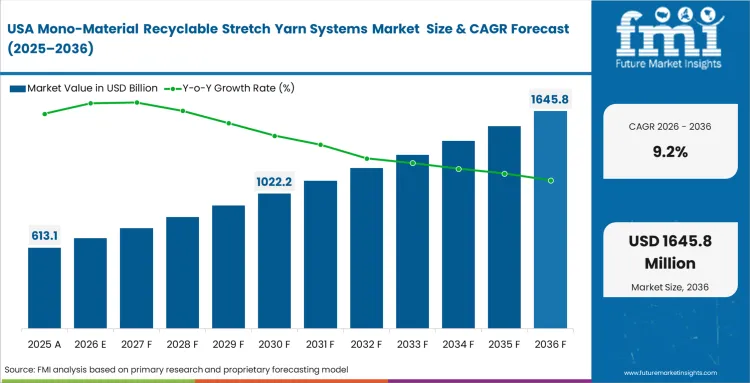
North America remains an important specification market for mono-material recyclable stretch yarn systems. Demand here is shaped more by brand requirements, traceability expectations, and material compliance than by low-cost volume production. Regional buyers are placing greater emphasis on closed-loop recovery models and verified recycled inputs. This supports demand for yarn systems that can meet both performance targets and documentation requirements.
- United States: Brand requirements are shaping demand for mono-material recyclable stretch yarn systems in the United States more than low-cost manufacturing factors. The country is anticipated to grow at a CAGR of 9.2% during 2026 to 2036. Buyers are asking suppliers to provide clearer material documentation and reduce the use of elastane-heavy fabric constructions. Local and near-regional sourcing is also gaining importance as brands look for tighter control over compliance, lead times, and recycled-content verification.
FMI’s report also covers Canada and Mexico in North America. Regional growth still depends on steady access to post-consumer feedstock. Suppliers with stronger waste collection ties are better placed to scale local recovery programs.
Europe Mono-Material Recyclable Stretch Yarn Systems Market Analysis
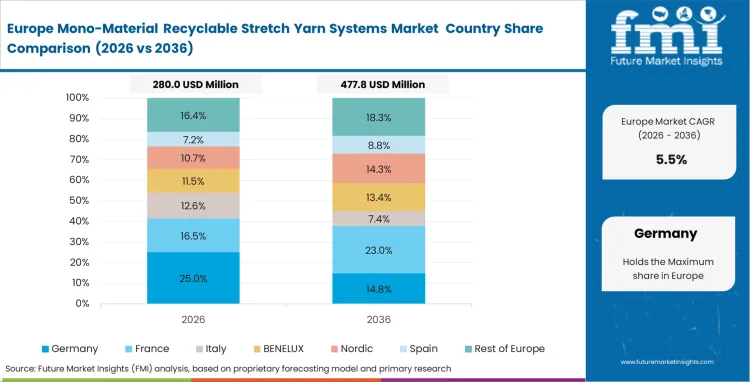
Europe is one of the strongest policy-driven markets for mono-material recyclable stretch yarn systems. Apparel brands and textile suppliers in the region face growing pressure to reduce product formats that are difficult to sort or recover. This is increasing demand for elastane-free, and mono-material stretch alternatives, especially in categories where compliance and traceability are becoming stricter. Capacity remains limited relative to policy ambition, which keeps qualification and sourcing discipline important across the region.
- Germany: Textile recovery rules and tighter material specifications are pushing earlier changes in product development across Germany, and the market is expected to grow at a 9.1% CAGR through 2036. Buyers are placing more emphasis on recyclable stretch formats that can move through sorting and recovery systems with fewer complications. Interest is also extending to nylon 6 and nylon 66 where suppliers are evaluating polymer options that fit performance needs more closely.
- Italy: Demand for mono-material recyclable stretch yarn systems in Italy is anticipated to increase at a CAGR of 8.5% through 2036. Premium activewear and performance apparel makers are testing bicomponent stretch formats that preserve fabric quality while improving recyclability. Dyeing and finishing remain a sensitive stage because mono-polymer materials allow less room for process error. Interest is also rising in low yellowing white technical yarns for applications where visual consistency and fabric appearance matter closely.
FMI’s report also includes France, the United Kingdom, and Spain in the European analysis. Regional demand is tied closely to traceability and material documentation. Suppliers that cannot show clear processing records may find it harder to stay in compliant textile recovery chains.
Competitive Aligners for Market Players
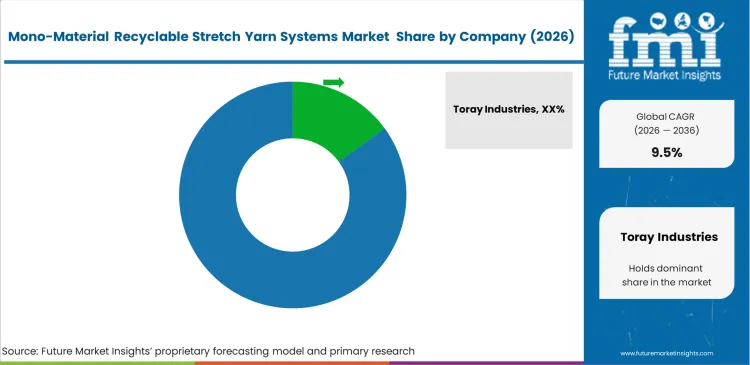
Spinning capability plays a major role in competition across the market. Toray Industries and Teijin Frontier stand out because they have stronger control over bi-component extrusion and conjugate yarn development. That matters because true conjugate stretch depends on how different polymer properties are combined within the same filament. Standard false-twist texturizing is not enough to replicate that result at the same performance level. Buyers in premium athletic apparel often favor suppliers with these higher-end spinning capabilities because fabric durability and stretch retention matter more than a lower starting yarn cost. Integrating low-lint technical yarns into these platforms further elevates supplier positioning.
Incumbents protect their market position by securing chemical recycling off-take agreements that give them more reliable access to closed-loop raw material supply. Companies are investing heavily in apparel take-back infrastructure, effectively controlling feedstock required to produce next-generation circular stretch textiles. New entrants often face feedstock constraints when trying to scale in this market. Many depend more heavily on mechanical recycling streams, where repeated processing can reduce polymer viscosity. Buyers are aware of that risk. Order volumes often shift toward integrated suppliers that can manage raw material recovery and yarn production more consistently. Incorporating elastic core spun yarn alternatives remains a fallback, but pure mono-materials secure premium contracts.
Large retail buyers try to avoid dependence on a single supplier. Many qualify multiple stretch platforms across different regions to keep sourcing options open. Volume is often split between Asian conjugate spinners and Western mechanical texturizers. This helps buyers manage pricing more effectively and reduce exposure to regional supply disruption. By 2036, apparel brands are expected to require standardized digital product passports for all stretch components, forcing obscure mid-tier mills evaluating adjacent sustainable footwear components to either adopt verifiable mono-polymer structures or face complete exclusion from global athletic supply chains.
Key Players in Mono-Material Recyclable Stretch Yarn Systems Market
- Toray Industries
- Teijin Frontier
- Hyosung Advanced Materials
- The LYCRA Company
- Indorama Ventures
- UNIFI
- Asahi Kasei
Scope of the Report
| Metric | Value |
|---|---|
| Quantitative Units | USD 1.1 billion to USD 2.6 billion, at a CAGR of 9.5% |
| Market Definition | Functional yarn architectures engineered to provide elasticity using a single polymer chemistry, eliminating incompatible elastomeric filaments to enable seamless mechanical or chemical recycling without solvent separation. |
| Segmentation | Polymer type, Application, End use, Stretch mechanism, Recycling route, Region |
| Regions Covered | North America, Latin America, Europe, East Asia, South Asia, Oceania, Middle East and Africa |
| Countries Covered | United States, Canada, Brazil, Mexico, Germany, United Kingdom, France, Italy, Spain, China, Japan, South Korea, India, ASEAN, ANZ, GCC |
| Key Companies Profiled | Toray Industries, Teijin Frontier, Hyosung Advanced Materials, The LYCRA Company, Indorama Ventures, UNIFI, Asahi Kasei |
| Forecast Period | 2026 to 2036 |
| Approach | Production volume of conjugate spinning equipment deployments correlated against brand-level circularity commitments. |
Source: Future Market Insights (FMI) analysis, based on proprietary forecasting model and primary research
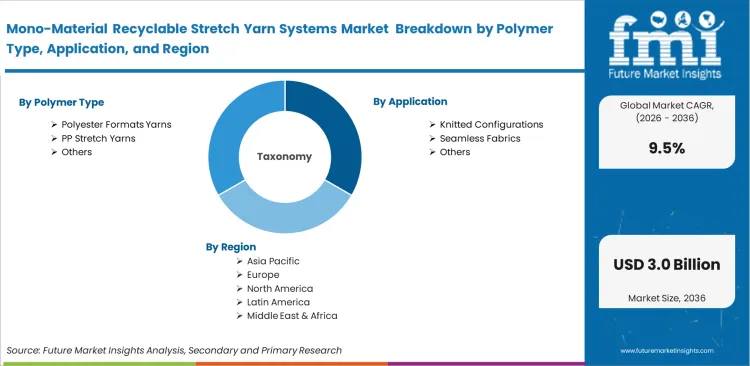
Mono-Material Recyclable Stretch Yarn Systems Market Analysis by Segments
Polymer type
- Polyester stretch yarns
- Polyamide stretch yarns
- PP stretch yarns
- Transition systems
Application
- Knitted fabrics
- Woven fabrics
- Seamless fabrics
- Other uses
End use
- Activewear
- Athleisure
- Swimwear
- Innerwear
- Uniforms
Stretch mechanism
- Mechanical crimp
- Conjugate filaments
- Textured filaments
- Geometry stretch
Recycling route
- Mechanical recycling
- Chemical recycling
- Closed-loop reuse
- Transition recovery
Region
- North America
- Latin America
- Europe
- East Asia
- South Asia
- Oceania
- Middle East and Africa
Bibliography
- Textile Exchange. (2024). Materials Market Report 2024.
- European Environment Agency. (2024, May 21). Management of used and waste textiles in Europe’s circular economy.
- Teijin Frontier Co., Ltd. (2025, June 23). Teijin Frontier develops a next-generation stretch fabric with an extremely fine, multiple crimp structure providing soft and airy comfort.
- Choudhury, K., et al. (2024, 20 July). Recycling of Blended Fabrics for a Circular Economy. Sustainability, 16(14), 6206.
- Asahi Kasei Corporation. (2025). Asahi Kasei Report 2025.
This bibliography is provided for reader reference. The full FMI report contains the complete reference list with primary source documentation.
This Report Addresses
- Tension-control strategies required to preserve bi-component crimp memory during high-temperature dye house processing.
- Capital expenditure models for upgrading legacy false-twist machines to handle advanced mechanical stretch filaments.
- Wholesale contract risks associated with upcoming European Union Extended Producer Responsibility activewear mandates.
- Discrepancies between initial laboratory elasticity testing and real-world stretch recovery degradation after fifty wash cycles.
- Feedstock aggregation challenges facing chemical depolymerization facilities processing post-consumer conjugate performance apparel.
- Optical sorting calibration requirements necessary to effectively separate mono-polyester blends from municipal waste streams.
- Intimate apparel supply chain pivots away from core-spun spandex toward geometry-based stretch architectures.
- Margin cannibalization metrics related to increased needle breakage during circular knitting of high-crimp materials.
Frequently Asked Questions
What is the anticipated value of Mono-Material Recyclable Stretch Yarn Systems in 2026?
Total revenue hits USD 1.1 billion in 2026, reflecting massive capital shifts toward bi-component extrusion equipment.
What valuation is projected for 2036?
Overall opportunity advances to USD 2.6 billion by 2036, driven by strict mandates eliminating cross-linked elastane entirely.
What is the forecasted CAGR?
Compound growth tracks at 9.5% from 2026 to 2036, forced by impending European multi-material clothing penalties.
Why do polyester stretch yarns lead the polymer segment?
Polyester formats dominate because municipal optical scanners easily identify them, keeping recycled polyester stretch yarn suppliers compliant.
How do knitted fabrics maintain share dominance?
Inherent loop structures accommodate slightly lower retractive forces, allowing compression without relying on high-denier elastane inputs.
Why does activewear adopt these yarns faster than any other end uses?
Performance labels face intense scrutiny over microfiber shedding, forcing immediate transition to elastane-free stretch platforms globally.
What technical advantage does mechanical crimp provide?
Physical crimping requires lower capital expenditure because legacy texturizing facilities simply modify existing global false-twist machines.
Why does mechanical recycling currently hold the largest share?
Physical shredding dominates due to massive global PET recovery networks actively adapted for textile recycling programs.
What drives adoption in China?
State-backed investments integrate bi-component spinning directly adjacent to depolymerization reactors, securing closed-loop material flows immediately.
How does India position itself competitively?
Government subsidies compel domestic manufacturers to scale mono-polymer capabilities, replacing aging core-spun machinery with advanced texturizing units.
What differentiates South Korea's growth trajectory?
Synthetic yarn producers pivot nylon extrusion infrastructure toward specialized recyclable stretch formats for premium outdoor technical apparel.
How does Brazil alter supply chain dynamics?
Local mill owners pivot away from imported spandex to bypass fluctuating currency rates, utilizing domestic mono-material solutions.
What friction prevents faster global adoption?
Textile engineers struggle matching deep shade colors without flattening mechanical crimps during high-temperature dye house processing.
How do incumbents maintain competitive advantage?
Leading suppliers lock down scarce chemical recycling off-take agreements, guaranteeing closed-loop raw material supply against challengers.
Why do large buyers split volume contracts?
Procurement teams actively resist sole-source dependency, distributing volume between Asian conjugate spinners and Western mechanical texturizers.
What risk do legacy dye houses face?
Operating stenter frames at traditional temperatures permanently destroys thermal memory, ruining entire mono-polymer production schedules completely.
How do sewing threads impact circularity?
Rigid sewing threads snap under dynamic load, forcing sourcing teams to specify elastomeric-equivalent inputs avoiding premature failures.
Why do heavy woven fabrics transition last?
Heavyweight apparel designers struggle engineering sufficient mechanical give into tight warp-weft interlacements without advanced bi-component filaments.
How does physical shredding limit garment design?
High-twist stretch yarns jam standard shredder blades, forcing facility engineers to install specialized cutting cylinders preventing melting.
What happens to oligomers during mechanical recycling?
Repeated thermal cycling degrades intrinsic viscosity, rendering polymers incapable of holding performance crimps without virgin resin blending.
Why are intimate apparel base layers ideal early adopters?
Low-impact garments require minimal retractive force, allowing production managers to validate extrusion consistency before scaling sportswear.
How do corporate uniforms impact total volume?
Workwear programs present massive predictable offtake agreements, justifying dedicated conjugate spinning lines and securing reliable take-back logistics.
Preview the report firsthand - request a free sample
Get SampleGet the brochure for pricing and purchase details.
Get PDFTable of Content
- Executive Summary
- Global Market Outlook
- Demand-side Trends
- Supply-side Trends
- Technology Roadmap Analysis
- Analysis and Recommendations
- Market Overview
- Market Coverage / Taxonomy
- Market Definition / Scope / Limitations
- Research Methodology
- Chapter Orientation
- Analytical Lens and Working Hypotheses
- Market Structure, Signals, and Trend Drivers
- Benchmarking and Cross-market Comparability
- Market Sizing, Forecasting, and Opportunity Mapping
- Research Design and Evidence Framework
- Desk Research Programme (Secondary Evidence)
- Company Annual and Sustainability Reports
- Peer-reviewed Journals and Academic Literature
- Corporate Websites, Product Literature, and Technical Notes
- Earnings Decks and Investor Briefings
- Statutory Filings and Regulatory Disclosures
- Technical White Papers and Standards Notes
- Trade Journals, Industry Magazines, and Analyst Briefs
- Conference Proceedings, Webinars, and Seminar Materials
- Government Statistics Portals and Public Data Releases
- Press Releases and Reputable Media Coverage
- Specialist Newsletters and Curated Briefings
- Sector Databases and Reference Repositories
- FMI Internal Proprietary Databases and Historical Market Datasets
- Subscription Datasets and Paid Sources
- Social Channels, Communities, and Digital Listening Inputs
- Additional Desk Sources
- Expert Input and Fieldwork (Primary Evidence)
- Primary Modes
- Qualitative Interviews and Expert Elicitation
- Quantitative Surveys and Structured Data Capture
- Blended Approach
- Why Primary Evidence is Used
- Field Techniques
- Interviews
- Surveys
- Focus Groups
- Observational and In-context Research
- Social and Community Interactions
- Stakeholder Universe Engaged
- C-suite Leaders
- Board Members
- Presidents and Vice Presidents
- R&D and Innovation Heads
- Technical Specialists
- Domain Subject-matter Experts
- Scientists
- Physicians and Other Healthcare Professionals
- Governance, Ethics, and Data Stewardship
- Research Ethics
- Data Integrity and Handling
- Primary Modes
- Tooling, Models, and Reference Databases
- Desk Research Programme (Secondary Evidence)
- Data Engineering and Model Build
- Data Acquisition and Ingestion
- Cleaning, Normalisation, and Verification
- Synthesis, Triangulation, and Analysis
- Quality Assurance and Audit Trail
- Market Background
- Market Dynamics
- Drivers
- Restraints
- Opportunity
- Trends
- Scenario Forecast
- Demand in Optimistic Scenario
- Demand in Likely Scenario
- Demand in Conservative Scenario
- Opportunity Map Analysis
- Product Life Cycle Analysis
- Supply Chain Analysis
- Investment Feasibility Matrix
- Value Chain Analysis
- PESTLE and Porter’s Analysis
- Regulatory Landscape
- Regional Parent Market Outlook
- Production and Consumption Statistics
- Import and Export Statistics
- Market Dynamics
- Global Market Analysis 2021 to 2025 and Forecast, 2026 to 2036
- Historical Market Size Value (USD Million) Analysis, 2021 to 2025
- Current and Future Market Size Value (USD Million) Projections, 2026 to 2036
- Y-o-Y Growth Trend Analysis
- Absolute $ Opportunity Analysis
- Global Market Pricing Analysis 2021 to 2025 and Forecast 2026 to 2036
- Global Market Analysis 2021 to 2025 and Forecast 2026 to 2036, By Polymer Type
- Introduction / Key Findings
- Historical Market Size Value (USD Million) Analysis By Polymer Type , 2021 to 2025
- Current and Future Market Size Value (USD Million) Analysis and Forecast By Polymer Type , 2026 to 2036
- Polyester Formats Yarns
- PP Stretch Yarns
- Others
- Polyester Formats Yarns
- Y-o-Y Growth Trend Analysis By Polymer Type , 2021 to 2025
- Absolute $ Opportunity Analysis By Polymer Type , 2026 to 2036
- Global Market Analysis 2021 to 2025 and Forecast 2026 to 2036, By Application
- Introduction / Key Findings
- Historical Market Size Value (USD Million) Analysis By Application, 2021 to 2025
- Current and Future Market Size Value (USD Million) Analysis and Forecast By Application, 2026 to 2036
- Knitted Configurations
- Seamless Fabrics
- Others
- Knitted Configurations
- Y-o-Y Growth Trend Analysis By Application, 2021 to 2025
- Absolute $ Opportunity Analysis By Application, 2026 to 2036
- Global Market Analysis 2021 to 2025 and Forecast 2026 to 2036, By End Use
- Introduction / Key Findings
- Historical Market Size Value (USD Million) Analysis By End Use, 2021 to 2025
- Current and Future Market Size Value (USD Million) Analysis and Forecast By End Use, 2026 to 2036
- Activewear
- Athleisure
- Swimwear
- Activewear
- Y-o-Y Growth Trend Analysis By End Use, 2021 to 2025
- Absolute $ Opportunity Analysis By End Use, 2026 to 2036
- Global Market Analysis 2021 to 2025 and Forecast 2026 to 2036, By Stretch Mechanism
- Introduction / Key Findings
- Historical Market Size Value (USD Million) Analysis By Stretch Mechanism, 2021 to 2025
- Current and Future Market Size Value (USD Million) Analysis and Forecast By Stretch Mechanism, 2026 to 2036
- Mechanical Crimp
- Conjugate Filaments
- Others
- Mechanical Crimp
- Y-o-Y Growth Trend Analysis By Stretch Mechanism, 2021 to 2025
- Absolute $ Opportunity Analysis By Stretch Mechanism, 2026 to 2036
- Global Market Analysis 2021 to 2025 and Forecast 2026 to 2036, By Recycling Route
- Introduction / Key Findings
- Historical Market Size Value (USD Million) Analysis By Recycling Route, 2021 to 2025
- Current and Future Market Size Value (USD Million) Analysis and Forecast By Recycling Route, 2026 to 2036
- Mechanical Recycling
- Transition Recovery
- Others
- Mechanical Recycling
- Y-o-Y Growth Trend Analysis By Recycling Route, 2021 to 2025
- Absolute $ Opportunity Analysis By Recycling Route, 2026 to 2036
- Global Market Analysis 2021 to 2025 and Forecast 2026 to 2036, By Region
- Introduction
- Historical Market Size Value (USD Million) Analysis By Region, 2021 to 2025
- Current Market Size Value (USD Million) Analysis and Forecast By Region, 2026 to 2036
- North America
- Latin America
- Western Europe
- Eastern Europe
- East Asia
- South Asia and Pacific
- Middle East & Africa
- Market Attractiveness Analysis By Region
- North America Market Analysis 2021 to 2025 and Forecast 2026 to 2036, By Country
- Historical Market Size Value (USD Million) Trend Analysis By Market Taxonomy, 2021 to 2025
- Market Size Value (USD Million) Forecast By Market Taxonomy, 2026 to 2036
- By Country
- USA
- Canada
- Mexico
- By Polymer Type
- By Application
- By End Use
- By Stretch Mechanism
- By Recycling Route
- By Country
- Market Attractiveness Analysis
- By Country
- By Polymer Type
- By Application
- By End Use
- By Stretch Mechanism
- By Recycling Route
- Key Takeaways
- Latin America Market Analysis 2021 to 2025 and Forecast 2026 to 2036, By Country
- Historical Market Size Value (USD Million) Trend Analysis By Market Taxonomy, 2021 to 2025
- Market Size Value (USD Million) Forecast By Market Taxonomy, 2026 to 2036
- By Country
- Brazil
- Chile
- Rest of Latin America
- By Polymer Type
- By Application
- By End Use
- By Stretch Mechanism
- By Recycling Route
- By Country
- Market Attractiveness Analysis
- By Country
- By Polymer Type
- By Application
- By End Use
- By Stretch Mechanism
- By Recycling Route
- Key Takeaways
- Western Europe Market Analysis 2021 to 2025 and Forecast 2026 to 2036, By Country
- Historical Market Size Value (USD Million) Trend Analysis By Market Taxonomy, 2021 to 2025
- Market Size Value (USD Million) Forecast By Market Taxonomy, 2026 to 2036
- By Country
- Germany
- UK
- Italy
- Spain
- France
- Nordic
- BENELUX
- Rest of Western Europe
- By Polymer Type
- By Application
- By End Use
- By Stretch Mechanism
- By Recycling Route
- By Country
- Market Attractiveness Analysis
- By Country
- By Polymer Type
- By Application
- By End Use
- By Stretch Mechanism
- By Recycling Route
- Key Takeaways
- Eastern Europe Market Analysis 2021 to 2025 and Forecast 2026 to 2036, By Country
- Historical Market Size Value (USD Million) Trend Analysis By Market Taxonomy, 2021 to 2025
- Market Size Value (USD Million) Forecast By Market Taxonomy, 2026 to 2036
- By Country
- Russia
- Poland
- Hungary
- Balkan & Baltic
- Rest of Eastern Europe
- By Polymer Type
- By Application
- By End Use
- By Stretch Mechanism
- By Recycling Route
- By Country
- Market Attractiveness Analysis
- By Country
- By Polymer Type
- By Application
- By End Use
- By Stretch Mechanism
- By Recycling Route
- Key Takeaways
- East Asia Market Analysis 2021 to 2025 and Forecast 2026 to 2036, By Country
- Historical Market Size Value (USD Million) Trend Analysis By Market Taxonomy, 2021 to 2025
- Market Size Value (USD Million) Forecast By Market Taxonomy, 2026 to 2036
- By Country
- China
- Japan
- South Korea
- By Polymer Type
- By Application
- By End Use
- By Stretch Mechanism
- By Recycling Route
- By Country
- Market Attractiveness Analysis
- By Country
- By Polymer Type
- By Application
- By End Use
- By Stretch Mechanism
- By Recycling Route
- Key Takeaways
- South Asia and Pacific Market Analysis 2021 to 2025 and Forecast 2026 to 2036, By Country
- Historical Market Size Value (USD Million) Trend Analysis By Market Taxonomy, 2021 to 2025
- Market Size Value (USD Million) Forecast By Market Taxonomy, 2026 to 2036
- By Country
- India
- ASEAN
- Australia & New Zealand
- Rest of South Asia and Pacific
- By Polymer Type
- By Application
- By End Use
- By Stretch Mechanism
- By Recycling Route
- By Country
- Market Attractiveness Analysis
- By Country
- By Polymer Type
- By Application
- By End Use
- By Stretch Mechanism
- By Recycling Route
- Key Takeaways
- Middle East & Africa Market Analysis 2021 to 2025 and Forecast 2026 to 2036, By Country
- Historical Market Size Value (USD Million) Trend Analysis By Market Taxonomy, 2021 to 2025
- Market Size Value (USD Million) Forecast By Market Taxonomy, 2026 to 2036
- By Country
- Kingdom of Saudi Arabia
- Other GCC Countries
- Turkiye
- South Africa
- Other African Union
- Rest of Middle East & Africa
- By Polymer Type
- By Application
- By End Use
- By Stretch Mechanism
- By Recycling Route
- By Country
- Market Attractiveness Analysis
- By Country
- By Polymer Type
- By Application
- By End Use
- By Stretch Mechanism
- By Recycling Route
- Key Takeaways
- Key Countries Market Analysis
- USA
- Pricing Analysis
- Market Share Analysis, 2025
- By Polymer Type
- By Application
- By End Use
- By Stretch Mechanism
- By Recycling Route
- Canada
- Pricing Analysis
- Market Share Analysis, 2025
- By Polymer Type
- By Application
- By End Use
- By Stretch Mechanism
- By Recycling Route
- Mexico
- Pricing Analysis
- Market Share Analysis, 2025
- By Polymer Type
- By Application
- By End Use
- By Stretch Mechanism
- By Recycling Route
- Brazil
- Pricing Analysis
- Market Share Analysis, 2025
- By Polymer Type
- By Application
- By End Use
- By Stretch Mechanism
- By Recycling Route
- Chile
- Pricing Analysis
- Market Share Analysis, 2025
- By Polymer Type
- By Application
- By End Use
- By Stretch Mechanism
- By Recycling Route
- Germany
- Pricing Analysis
- Market Share Analysis, 2025
- By Polymer Type
- By Application
- By End Use
- By Stretch Mechanism
- By Recycling Route
- UK
- Pricing Analysis
- Market Share Analysis, 2025
- By Polymer Type
- By Application
- By End Use
- By Stretch Mechanism
- By Recycling Route
- Italy
- Pricing Analysis
- Market Share Analysis, 2025
- By Polymer Type
- By Application
- By End Use
- By Stretch Mechanism
- By Recycling Route
- Spain
- Pricing Analysis
- Market Share Analysis, 2025
- By Polymer Type
- By Application
- By End Use
- By Stretch Mechanism
- By Recycling Route
- France
- Pricing Analysis
- Market Share Analysis, 2025
- By Polymer Type
- By Application
- By End Use
- By Stretch Mechanism
- By Recycling Route
- India
- Pricing Analysis
- Market Share Analysis, 2025
- By Polymer Type
- By Application
- By End Use
- By Stretch Mechanism
- By Recycling Route
- ASEAN
- Pricing Analysis
- Market Share Analysis, 2025
- By Polymer Type
- By Application
- By End Use
- By Stretch Mechanism
- By Recycling Route
- Australia & New Zealand
- Pricing Analysis
- Market Share Analysis, 2025
- By Polymer Type
- By Application
- By End Use
- By Stretch Mechanism
- By Recycling Route
- China
- Pricing Analysis
- Market Share Analysis, 2025
- By Polymer Type
- By Application
- By End Use
- By Stretch Mechanism
- By Recycling Route
- Japan
- Pricing Analysis
- Market Share Analysis, 2025
- By Polymer Type
- By Application
- By End Use
- By Stretch Mechanism
- By Recycling Route
- South Korea
- Pricing Analysis
- Market Share Analysis, 2025
- By Polymer Type
- By Application
- By End Use
- By Stretch Mechanism
- By Recycling Route
- Russia
- Pricing Analysis
- Market Share Analysis, 2025
- By Polymer Type
- By Application
- By End Use
- By Stretch Mechanism
- By Recycling Route
- Poland
- Pricing Analysis
- Market Share Analysis, 2025
- By Polymer Type
- By Application
- By End Use
- By Stretch Mechanism
- By Recycling Route
- Hungary
- Pricing Analysis
- Market Share Analysis, 2025
- By Polymer Type
- By Application
- By End Use
- By Stretch Mechanism
- By Recycling Route
- Kingdom of Saudi Arabia
- Pricing Analysis
- Market Share Analysis, 2025
- By Polymer Type
- By Application
- By End Use
- By Stretch Mechanism
- By Recycling Route
- Turkiye
- Pricing Analysis
- Market Share Analysis, 2025
- By Polymer Type
- By Application
- By End Use
- By Stretch Mechanism
- By Recycling Route
- South Africa
- Pricing Analysis
- Market Share Analysis, 2025
- By Polymer Type
- By Application
- By End Use
- By Stretch Mechanism
- By Recycling Route
- USA
- Market Structure Analysis
- Competition Dashboard
- Competition Benchmarking
- Market Share Analysis of Top Players
- By Regional
- By Polymer Type
- By Application
- By End Use
- By Stretch Mechanism
- By Recycling Route
- Competition Analysis
- Competition Deep Dive
- Toray Industries
- Overview
- Product Portfolio
- Profitability by Market Segments (Product/Age /Sales Channel/Region)
- Sales Footprint
- Strategy Overview
- Marketing Strategy
- Product Strategy
- Channel Strategy
- Teijin Frontier
- Hyosung Advanced Materials
- The LYCRA Company
- Indorama Ventures
- UNIFI
- Toray Industries
- Competition Deep Dive
- Assumptions & Acronyms Used


