

- Industry Size (2026)
- USD 838.5 Mn
- Forecast (2036)
- USD 1728.2 Mn
- CAGR (2026 to 2036)
- 7.5%
Low-Creep High-Modulus Yarns Market Forecast and Outlook 2026 to 2036
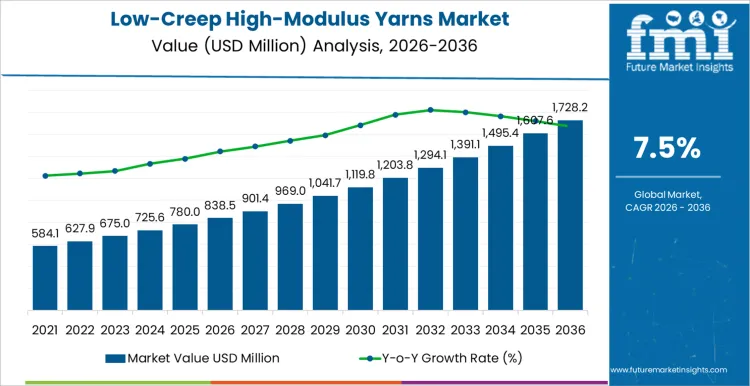
Engineering specifications for sustained load bearing applications define the demand structure of the low-creep high-modulus yarns market, which opens 2026 at USD 838.5 million and is projected to reach USD 1,728.2 million by 2036 at a 7.5% CAGR. Use is concentrated in applications where dimensional stability under continuous stress determines service life. Designers specify modulus range, creep limits, and fatigue tolerance during system architecture definition. Once a reinforcement layout enters certified design status, material substitution requires recalculation and renewed qualification. Volume expansion follows adoption in geotechnical systems, marine mooring, lifting equipment, and composite reinforcements governed by long approval cycles.
Commercial structure within the low-creep high-modulus yarns market is governed by certification regimes, engineering standards, and liability allocation across project owners and fabricators. Material acceptance depends on documented performance under sustained load, temperature exposure, and cyclic stress. Approved material lists remain stable across multi-year project schedules. Replacement decisions occur during redesign phases rather than during routine procurement. Revenue development tracks the number of infrastructure, marine, and industrial systems specifying high-modulus reinforcement. Competitive position depends on access to engineering design stages and inclusion within standardized project specifications. Supplier standing reflects continuity of approvals and consistency of third-party test records.
Low-Creep High-Modulus Yarns Market Quick Stats
- Low-Creep High-Modulus Yarns Market Value (2026): USD 838.5 million
- Low-Creep High-Modulus Yarns Market Forecast Value (2036): USD 1,728.2 million
- Low-Creep High-Modulus Yarns Market Forecast CAGR (2026 to 2036): 7.5%
- Leading Type in Low-Creep High-Modulus Yarns Market: High-Tenacity Polyester
- Key Growth Regions in Low-Creep High-Modulus Yarns Market: Brazil, USA, UK, Germany, Japan
- Top Players in Low-Creep High-Modulus Yarns Market: Toray Industries, Teijin Frontier, Honeywell (Spectra), Hyosung, Kolon Industries, Indorama Ventures (Performance Fibers), Kordsa, SGL Carbon, Mitsubishi Chemical Group
What is the Growth Forecast for the Low Creep High Modulus Yarns Market through 2036?
The low creep high modulus yarns market in 2026 stands near USD 838.5 million, anchored in load bearing uses where dimensional stability controls service life. Buyers specify these yarns for reinforcement in ropes, belts, composites, and technical fabrics where elongation limits remain narrow. Product choice centers on modulus level, creep curve shape, fatigue response, and consistency across lots. Qualification ties to end product certification cycles rather than to short purchasing windows. Value increases with wider use in wind, construction, lifting, and transport equipment that carries higher safety margins. The spending path rises through successive program adoptions and platform renewals. The approach to USD 1,728.2 million in 2036 follows a 7.5% growth profile supported by higher yarn content per structure and broader penetration in critical duty applications.
Production planning defines the commercial rhythm of the low creep high modulus yarns market. Orders follow project schedules, tender awards, and long manufacturing campaigns. Inventory policy favors secure supply over price timing. Cost structure depends on polymer grade selection, spinning control, drawing precision, and testing intensity. Annual values move through the low and mid one billions during the early 2030s as more designs replace conventional fibers with higher modulus alternatives. Purchasing teams focus on batch traceability, property retention after processing, and long term performance records. The rise to USD 1,728.2 million in 2036 comes from thicker reinforcement sections, wider use in structural composites, and longer service life expectations that justify higher material content per finished product.
Low-Creep High-Modulus Yarns Market Key Takeaways
| Metric | Value |
|---|---|
| Market Value (2026) | USD 838.5 million |
| Forecast Value (2036) | USD 1,728.2 million |
| Forecast CAGR (2026 to 2036) | 7.5% |
How Is the Low Creep High Modulus Yarns Market Supporting Dimensional Stability in Load Bearing Textile Structures?
The Low Creep High Modulus Yarns Market serves applications where dimensional stability under sustained load determines service life and safety margins. Early use concentrated in industrial ropes, reinforcement tapes, and technical fabrics where standard fibers showed time dependent elongation that reduced performance predictability. Material selection now focuses on creep resistance, tensile retention, and thermal response under continuous stress. Producers of lifting slings, conveyor belts, and geotextiles specify these yarns to control stretch and maintain geometry over long duty cycles. Weaving and knitting operations evaluate runnability, abrasion behavior, and filament cohesion because breakage or fuzzing affects output rates. Purchasing teams compare grades on modulus consistency, lot to lot uniformity, and documented long term performance data since small deviations translate into warranty exposure, requalification work, and conservative design factors.
The Low Creep High Modulus Yarns Market is evaluated through load path reliability and maintenance planning rather than through fiber price alone. Engineers calculate value using service interval extension, reduced retensioning needs, and stable mechanical response over time. A yarn that creeps outside its expected envelope forces redesign or overspecification across the entire structure. This shifts supplier selection toward producers that control polymer orientation, drawing conditions, and heat setting with tight discipline. Conversion plants track tension stability during processing because uneven elongation complicates fabric geometry control. Storage and handling rules also matter, since moisture and temperature history influence installed performance. Commercial terms increasingly define allowable creep bands and modulus drift. Demand concentrates in applications where geometry retention governs inspection cycles, safety approvals, and asset utilization planning.
How Do Load Retention Requirements and Qualification Cycles Shape Demand in the Low-Creep High-Modulus Yarns Market by Polymer Type and Application in 2026?
In the Low-Creep High-Modulus Yarns Market, material selection follows long service expectations, audit trails, and replacement risk more than short buying cycles. Programs begin with allowable movement, inspection timing, and liability exposure defined by owners and insurers. By polymer type, usage spans high-tenacity polyester, high-modulus polyethylene, aramid and para-aramid, and other high-modulus fibers, each showing different behavior under sustained load and temperature. By application, consumption covers industrial ropes and cables, composite reinforcement, geo and construction textiles, and other technical uses. Once a yarn grade clears testing and documentation, it becomes embedded in drawings, supplier lists, and maintenance plans. That lock-in explains stable portfolios and slow substitution across certified systems.
Why Do Polymer Choices Remain Stable Across Certified Systems?
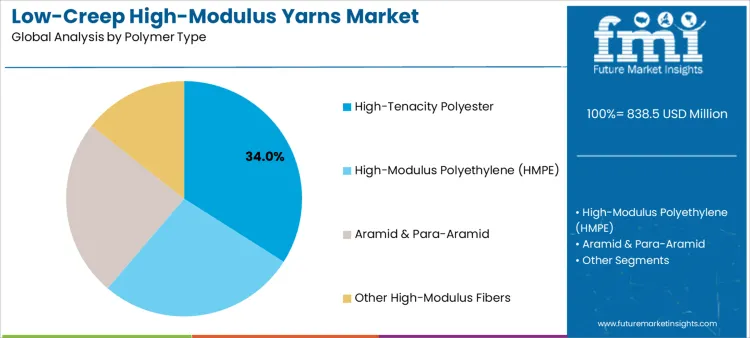
High-tenacity polyester holds about 34% share because it balances stiffness, creep resistance, and processing familiarity across spinning, twisting, and coating lines. In the Low-Creep High-Modulus Yarns Market, this balance reduces qualification cost and keeps takt time predictable on rope, webbing, and fabric equipment. High-modulus polyethylene brings superior strength to weight, yet its low surface energy and temperature sensitivity demand strict tension control and tailored finishes. Aramid and para-aramid deliver heat tolerance and dimensional stability under load, which suits safety-critical assemblies and composite preforms. Other high-modulus fibers serve narrow envelopes defined by chemical exposure or dielectric needs. Procurement teams judge polymers by repeatability under sustained load, not by brochure modulus. Production managers judge them by waste during changeovers and by uptime during long runs. Test labs judge them by creep curves measured over months. Once a polymer family clears these gates, it becomes embedded in drawings, audits, and vendor lists. Substitution triggers revalidation, retesting, and field trials. That sequence explains why portfolios remain stable and why incremental improvements arrive as grade updates inside the same family. The polymer mix reflects integration discipline, documentation burden, and the need to keep certified assemblies shipping without interruption across plants and audited programs globally.
How Do Installation Practice and Service Life Expectations Shape Application Demand?
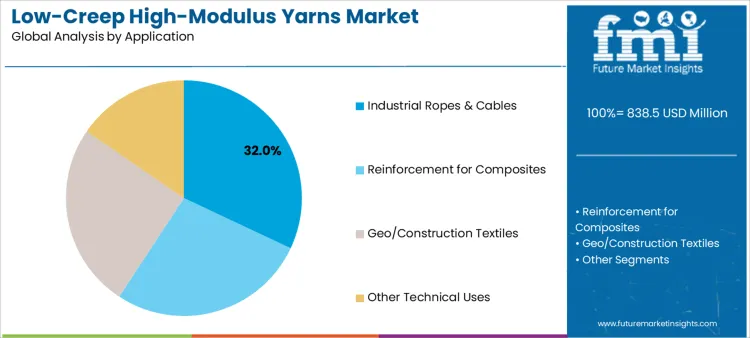
Industrial ropes and cables account for about 32% of demand because installations live under constant tension and small elongation changes alter safety margins. In the Low-Creep High-Modulus Yarns Market, owners specify inspection intervals and replacement rules around predictable deformation, not peak breaking load. Composite reinforcement consumes yarns where stiffness and load transfer set laminate response in beams, panels, and shells. Geo and construction textiles rely on long-term geometry control in slopes, walls, and foundations exposed to moisture and seasonal temperature swings. Other technical uses appear in lifting slings, protective fabrics, and specialty belts tied to equipment programs. Project engineers start with duty cycles, anchoring details, and allowable movement. Fabricators start with braiding, weaving, or winding windows that must stay stable for long runs. Inspectors start with records that prove creep remains inside limits across years of service. Once these three viewpoints align, the application becomes locked. Changing yarn type forces new calculations, new test panels, and new field trials. That sequence discourages experimentation inside mature platforms. Volume follows applications where contracts penalize length change more than mass or cost. Infrastructure projects and composite structures fit this pattern. Short-life products do not. That focus keeps demand anchored in critical uses.
Why Are Performance Demands Driving Growth in the Low-Creep High-Modulus Yarns Market?
Low-Creep High-Modulus Yarns Market demand is anchored in sectors where dimensional stability under sustained load determines product life and safety performance. Industrial textiles used in aerospace composites, technical ropes, body armor, and engineered belts require yarns that resist elongation under stress while retaining high tensile strength. Designers specify high-modulus fibers because reduced creep improves precision, load transfer, and fatigue resistance in structural components. Manufacturers and converters prioritize yarns with narrow filament variability and predictable behavior under temperature and humidity cycles. Procurement focuses on consistency across batches, reliable supplier qualification data, and performance parameters that align with rigorous certification standards central to end-use applications.
What Constraints Are Affecting Adoption and Scale in the Low-Creep High-Modulus Yarns Market?
Low-Creep High-Modulus Yarns Market growth is constrained by raw material costs, specialized processing requirements, and integration challenges within existing textile production systems. High-modulus polymers demand controlled spinning and heat-setting to realize target crystallinity and modulus levels. These processing steps increase capital intensity and energy input relative to commodity yarn production. Variability in feedstock quality can translate into creep performance scatter, forcing additional qualification time for finished goods manufacturers. In cost sensitive segments such as industrial webbing and mass transportation fabrics, buyers balance performance gains against unit price and processing adjustments. Supply continuity and batch uniformity remain priorities because inconsistent yarn properties can compromise downstream lamination and composite formation.
How Are Product Innovations and Supply Strategies Evolving in the Low-Creep High-Modulus Yarns Market?
Product development in the Low-Creep High-Modulus Yarns Market concentrates on engineered fiber architectures and tailored processing windows to optimize stiffness, creep resistance, and handleability. Manufacturers refine polymer chemistry and draw profiles to achieve targeted modulus without making yarns brittle or difficult to process. There is activity around hybrid yarns combining high-modulus elements with compliant carriers to balance performance and flexibility for weaving and knitting lines. Suppliers offer technical support for integration into composite preforms and high speed textile equipment. Commercial strategies emphasize long-term supply agreements and early stage collaboration to align yarn properties with part design requirements and to accelerate qualification cycles in aerospace, protective, and advanced industrial applications.
What is the Demand for Low Creep High Modulus Yarns by Country?
| Country | CAGR (%) |
|---|---|
| USA | 7.2% |
| Japan | 6.0% |
| Germany | 7.1% |
| UK | 7.2% |
| Brazil | 8.3% |
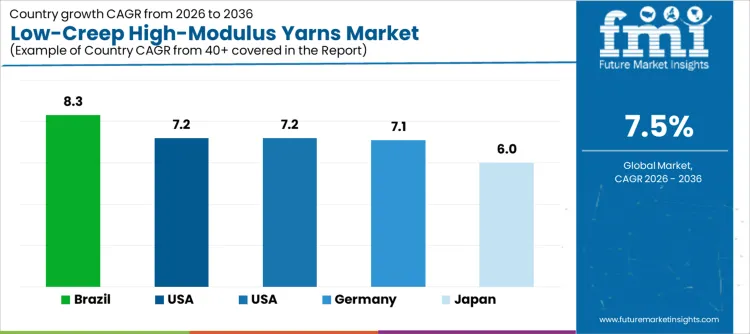
The demand for low creep high modulus yarns is expanding across lifting, reinforcement, and industrial textile applications where dimensional stability under load is critical. Brazil leads at 8.3% CAGR, supported by growth in infrastructure projects, mining, and industrial handling systems that rely on high performance ropes and reinforcement fabrics. The USA and the UK both grow at 7.2%, driven by steady replacement demand in industrial cords, composites, and safety critical applications. Germany records 7.1%, reflecting strong use in automotive reinforcement and engineered industrial textiles. Japan posts 6.0%, shaped by a mature but specification driven market focused on quality, reliability, and long service life in demanding technical applications.
How Do Specification Ownership and Long Program Cycles Shape Buying in the Low Creep High Modulus Yarns Market in the USA?
Specification control inside USA technical textiles programs is now pulling the low creep high modulus yarns market forward at a rate consistent with a 7.2% CAGR. The real gatekeepers sit in industrial fibers and aerospace composites teams that own performance standards. Engineers evaluate creep behavior, tensile retention, fatigue response, and compatibility with downstream coating and weaving steps. Automotive materials and construction reinforcement materials introduce additional validation layers tied to safety and lifetime performance. Once a yarn grade is written into a platform specification, it remains fixed across multiple product lines for many years. Volume increases only when those platforms win new programs. Qualification data supports entry decisions, not routine purchasing. Domestic suppliers benefit from test support and documentation depth. Imports remain in narrow niches. Commercial success depends on specification inclusion rather than transactional sales.
How Do Manufacturing Discipline and Product Stability Control Adoption in the Low Creep High Modulus Yarns Market in Japan?
Factory governance in Japan is absorbing the low creep high modulus yarns market at a pace aligned with a 6% CAGR. Producers treat yarn selection as a manufacturing stability variable inside technical textiles and industrial fibers operations. Any change affecting aerospace composites or automotive materials must pass internal production councils. Testing focuses on long duration creep resistance, tension uniformity, and processing behavior on production equipment. Once a grade is accepted, it stays embedded in the same constructions serving construction reinforcement materials and precision composites for extended periods. Documentation and traceability define supplier access. Local suppliers benefit from proximity and audit familiarity. Imports appear mainly under customer mandate. Volume expansion follows slow portfolio renewal rather than aggressive substitution. Commercial positioning depends on data depth, validation endurance, and the ability to supply identical material over long production runs without deviation.
How Do Platform Architectures Drive Scale in the Low Creep High Modulus Yarns Market in Germany?
Platform design governance explains why Germany is advancing in line with a 7.1% CAGR without frequent supplier change. Large groups develop shared yarn platforms that serve technical textiles and industrial fibers programs at the same time. One material decision can influence multiple constructions used in automotive materials, construction reinforcement materials, and aerospace composites. Central engineering teams evaluate candidates for creep resistance, dimensional stability, and processing tolerance, then decide whether a grade becomes part of the approved platform set. After inclusion, the same yarn appears across several product families and several plants. Regional suppliers benefit from audit familiarity and logistics reliability. Volume growth follows product family expansion rather than campaign selling. Change control remains formal. Commercial success depends on passing central approval and maintaining identical mechanical behavior across coordinated factories over extended production cycles.
How Do Compliance Frameworks and Network Purchasing Shape Demand in the Low Creep High Modulus Yarns Market in the UK?
Governance structures inside UK supply networks are supporting growth in the low creep high modulus yarns market at a rate consistent with a 7.2% CAGR. Procurement authority sits with central engineering bodies serving technical textiles and industrial fibers groups. Individual plants do not select yarn grades independently. Evaluation focuses on creep performance, traceability, and consistency across weaving and composite layup steps. Automotive materials and construction reinforcement materials programs add further checks linked to certification and lifetime performance. Once approved, the same yarn enters several product families supplied from different sites. Regional suppliers benefit from audit readiness and logistics responsiveness. Imports remain in specialized applications. Volume growth follows program expansion rather than spot demand. Commercial outcomes depend on framework inclusion and the ability to maintain stable properties across distributed production environments.
How Do Capacity Expansion and Recipe Replication Create Volume in the Low Creep High Modulus Yarns Market in Brazil?
Replication of proven constructions across new programs explains why Brazil is recording growth aligned with an 8.3% CAGR. Producers scale by copying validated yarn choices into new technical textiles and industrial fibers lines. Once a yarn performs reliably in one structure, it moves quickly into products serving automotive materials and construction reinforcement materials. Aerospace composites applications apply higher scrutiny yet follow the same replication logic after initial acceptance. Approval focuses on consistency and processing tolerance rather than incremental optimization. Domestic suppliers dominate because they can follow plant expansions and line additions. Imports remain concentrated in higher specification systems. Volume growth comes from repeating approved constructions across sites. Commercial advantage depends on being present when a design becomes a template rather than competing for each individual production line.
How Do Suppliers Compete in the Low-Creep High-Modulus Yarns Market?
Selection in the low-creep high-modulus yarns market is driven by tensile strength, creep resistance, fiber consistency, and thermal stability rather than catalog variety. Toray Industries, Teijin Frontier, Honeywell (Spectra), Hyosung, Kolon Industries, Indorama Ventures (Performance Fibers), Kordsa, SGL Carbon, and Mitsubishi Chemical Group compete during yarn development, process validation, and application testing stages. Once a yarn enters composite or reinforcement production, dimensional stability, modulus retention, and processability anchor supplier adoption. Toray Industries emphasizes carbon and aramid fiber technologies with controlled molecular orientation.
Teijin Frontier focuses on high-performance polyaramid and polyethylene fibers. Honeywell (Spectra) supplies ultra-high molecular weight polyethylene with low creep. Hyosung and Kolon Industries provide engineering polymer fibers for reinforced applications. Indorama Ventures targets specialty performance fibers for industrial composites. Kordsa offers reinforcement yarns integrated with tire and aerospace composites. SGL Carbon and Mitsubishi Chemical Group focus on carbon fiber and hybrid reinforcement solutions.
Technical performance, process reliability, and supply consistency define competitive positioning in the Low-Creep High-Modulus Yarns Market rather than price. Manufacturers evaluate fiber tensile strength, creep deformation, elongation at break, and thermal degradation during qualification. Composite production teams prioritize suppliers capable of reproducible lot quality and scalable supply. Toray Industries maintains adoption through extensive R&D and pilot line support. Teijin Frontier secures placements in applications requiring high-performance fiber orientation.
Honeywell (Spectra) captures programs needing ultra-high molecular weight fibers. Hyosung and Kolon Industries hold share in reinforced polymer and industrial applications. Indorama Ventures competes in specialty performance fibers. Kordsa serves tire and aerospace reinforcement programs. SGL Carbon and Mitsubishi Chemical Group provide carbon-based reinforcement for industrial and high-strength composites. Market positions vary by application, fiber type, processing method, and regional supply chain infrastructure.
Key Players in Low-Creep High-Modulus Yarns Market
- Toray Industries
- Teijin Frontier
- Honeywell (Spectra)
- Hyosung
- Kolon Industries
- Indorama Ventures (Performance Fibers)
- Kordsa
- SGL Carbon
- Mitsubishi Chemical Group
Scope of the Report
| Items | Values |
|---|---|
| Quantitative Units (2026) | USD million |
| Polymer Type | High-tenacity polyester, high-modulus polyethylene (HMPE), aramid and para-aramid, other high-modulus fibers |
| Application | Industrial ropes and cables, reinforcement for composites, geo and construction textiles, other technical uses |
| End Market | Marine and offshore, construction and infrastructure, energy and utilities, other industrial sectors |
| Yarn Form | Filament and roving, twisted and plied yarns, engineered and hybrid yarns |
| Regions Covered | Asia Pacific, Europe, North America, Latin America, Middle East & Africa |
| Countries Covered | United States, Canada, Mexico, Germany, United Kingdom, France, Italy, Spain, Nordics, BENELUX, China, Japan, South Korea, India, Australia & New Zealand, ASEAN, Brazil, Chile, Saudi Arabia, Turkey, South Africa, and other regional markets |
| Key Companies Profiled | Toray Industries, Teijin Frontier, Honeywell (Spectra), Hyosung, Kolon Industries, Indorama Ventures (Performance Fibers), Kordsa, SGL Carbon, Mitsubishi Chemical Group |
| Additional Attributes | Dollar sales by polymer type, application, yarn form, and end market, qualification driven demand patterns in certified technical textile and composite systems, long term creep performance and modulus retention requirements, integration into ropes, geotextiles, and composite reinforcement platforms, supplier positioning based on specification ownership and audit readiness, processing constraints tied to spinning, drawing, and heat setting control, and regional adoption patterns linked to infrastructure, marine, and industrial reinforcement programs |
Low-Creep High-Modulus Yarns Market Segmentation
Polymer Type:
- High-Tenacity Polyester
- High-Modulus Polyethylene (HMPE)
- Aramid & Para-Aramid
- Other High-Modulus Fibers
Application:
- Industrial Ropes & Cables
- Reinforcement for Composites
- Geo/Construction Textiles
- Other Technical Uses
End Market:
- Marine & Offshore
- Construction & Infrastructure
- Energy & Utilities
- Other Industrial Sectors
Yarn Form:
- Filament & Roving
- Twisted & Plied Yarns
- Engineered & Hybrid Yarns
Region:
- Asia Pacific
- China
- Japan
- South Korea
- India
- Australia & New Zealand
- ASEAN
- Rest of Asia Pacific
- Europe
- Germany
- United Kingdom
- France
- Italy
- Spain
- Nordic
- BENELUX
- Rest of Europe
- North America
- United States
- Canada
- Mexico
- Latin America
- Brazil
- Chile
- Rest of Latin America
- Middle East & Africa
- Kingdom of Saudi Arabia
- Other GCC Countries
- Turkey
- South Africa
- Other African Union
- Rest of Middle East & Africa
References
- Mahjoub, W., & Harzallah, O. (2025). Physical and mechanical characterization of flax fibers: from elementary fiber to yarn. Fibers, 13(7), 87
- Ding, J., Chen, G., Huang, W., Cheng, J., Li, T., Cheng, C., & Xu, J. (2024). Tensile strength statistics and fracture mechanism of ultrahigh molecular weight polyethylene fibers: On the Weibull distribution. ACS Omega.
- Yan, C., Yan, T., Dong, T., Xia, M., Xia, Y., & He, Y. (2025). Effect of resin parameters on the consistency and mechanical properties of ultra-high-molecular-weight polyethylene fiber. Polymers, 17(8), 1109.
- Yi, C., Xu, J., Tian, L., & Zhang, C. (2024). Temperature and strain rate related deformation behavior of UHMWPE fiber-reinforced composites. Polymers, 16, 1250.
Frequently Asked Questions
How big is the low-creep high-modulus yarns market in 2026?
The global low-creep high-modulus yarns market is estimated to be valued at USD 838.5 million in 2026.
What will be the size of low-creep high-modulus yarns market in 2036?
The market size for the low-creep high-modulus yarns market is projected to reach USD 1,728.2 million by 2036.
How much will be the low-creep high-modulus yarns market growth between 2026 and 2036?
The low-creep high-modulus yarns market is expected to grow at a 7.5% CAGR between 2026 and 2036.
What are the key product types in the low-creep high-modulus yarns market?
The key product types in low-creep high-modulus yarns market are high-tenacity polyester, high-modulus polyethylene (hmpe), aramid & para-aramid and other high-modulus fibers.
Which application segment to contribute significant share in the low-creep high-modulus yarns market in 2026?
In terms of application, industrial ropes & cables segment to command 32.0% share in the low-creep high-modulus yarns market in 2026.
Preview the report firsthand - request a free sample
Get SampleGet the brochure for pricing and purchase details.
Get PDFTable of Content
- Executive Summary
- Global Market Outlook
- Demand-side Trends
- Supply-side Trends
- Technology Roadmap Analysis
- Analysis and Recommendations
- Market Overview
- Market Coverage / Taxonomy
- Market Definition / Scope / Limitations
- Market Background
- Market Dynamics
- Drivers
- Restraints
- Opportunity
- Trends
- Scenario Forecast
- Demand in Optimistic Scenario
- Demand in Likely Scenario
- Demand in Conservative Scenario
- Opportunity Map Analysis
- Product Life Cycle Analysis
- Supply Chain Analysis
- Investment Feasibility Matrix
- Value Chain Analysis
- PESTLE and Porter’s Analysis
- Regulatory Landscape
- Regional Parent Market Outlook
- Production and Consumption Statistics
- Import and Export Statistics
- Market Dynamics
- Global Market Analysis 2021 to 2025 and Forecast, 2026 to 2036
- Historical Market Size Value (USD Million) Analysis, 2021 to 2025
- Current and Future Market Size Value (USD Million) Projections, 2026 to 2036
- Y-o-Y Growth Trend Analysis
- Absolute $ Opportunity Analysis
- Global Market Pricing Analysis 2021 to 2025 and Forecast 2026 to 2036
- Global Market Analysis 2021 to 2025 and Forecast 2026 to 2036, By Polymer Type
- Introduction / Key Findings
- Historical Market Size Value (USD Million) Analysis By Polymer Type , 2021 to 2025
- Current and Future Market Size Value (USD Million) Analysis and Forecast By Polymer Type , 2026 to 2036
- High-Tenacity Polyester
- High-Modulus Polyethylene (HMPE)
- Aramid & Para-Aramid
- Other High-Modulus Fibers
- High-Tenacity Polyester
- Y-o-Y Growth Trend Analysis By Polymer Type , 2021 to 2025
- Absolute $ Opportunity Analysis By Polymer Type , 2026 to 2036
- Global Market Analysis 2021 to 2025 and Forecast 2026 to 2036, By Application
- Introduction / Key Findings
- Historical Market Size Value (USD Million) Analysis By Application, 2021 to 2025
- Current and Future Market Size Value (USD Million) Analysis and Forecast By Application, 2026 to 2036
- Industrial Ropes & Cables
- Reinforcement for Composites
- Geo/Construction Textiles
- Other Technical Uses
- Industrial Ropes & Cables
- Y-o-Y Growth Trend Analysis By Application, 2021 to 2025
- Absolute $ Opportunity Analysis By Application, 2026 to 2036
- Global Market Analysis 2021 to 2025 and Forecast 2026 to 2036, By End Market
- Introduction / Key Findings
- Historical Market Size Value (USD Million) Analysis By End Market, 2021 to 2025
- Current and Future Market Size Value (USD Million) Analysis and Forecast By End Market, 2026 to 2036
- Marine & Offshore
- Construction & Infrastructure
- Energy & Utilities
- Other Industrial Sectors
- Marine & Offshore
- Y-o-Y Growth Trend Analysis By End Market, 2021 to 2025
- Absolute $ Opportunity Analysis By End Market, 2026 to 2036
- Global Market Analysis 2021 to 2025 and Forecast 2026 to 2036, By Yarn Form
- Introduction / Key Findings
- Historical Market Size Value (USD Million) Analysis By Yarn Form, 2021 to 2025
- Current and Future Market Size Value (USD Million) Analysis and Forecast By Yarn Form, 2026 to 2036
- Filament & Roving
- Twisted & Plied Yarns
- Engineered & Hybrid Yarns
- Filament & Roving
- Y-o-Y Growth Trend Analysis By Yarn Form, 2021 to 2025
- Absolute $ Opportunity Analysis By Yarn Form, 2026 to 2036
- Global Market Analysis 2021 to 2025 and Forecast 2026 to 2036, By Region
- Introduction
- Historical Market Size Value (USD Million) Analysis By Region, 2021 to 2025
- Current Market Size Value (USD Million) Analysis and Forecast By Region, 2026 to 2036
- North America
- Latin America
- Western Europe
- Eastern Europe
- East Asia
- South Asia and Pacific
- Middle East & Africa
- Market Attractiveness Analysis By Region
- North America Market Analysis 2021 to 2025 and Forecast 2026 to 2036, By Country
- Historical Market Size Value (USD Million) Trend Analysis By Market Taxonomy, 2021 to 2025
- Market Size Value (USD Million) Forecast By Market Taxonomy, 2026 to 2036
- By Country
- USA
- Canada
- Mexico
- By Polymer Type
- By Application
- By End Market
- By Yarn Form
- By Country
- Market Attractiveness Analysis
- By Country
- By Polymer Type
- By Application
- By End Market
- By Yarn Form
- Key Takeaways
- Latin America Market Analysis 2021 to 2025 and Forecast 2026 to 2036, By Country
- Historical Market Size Value (USD Million) Trend Analysis By Market Taxonomy, 2021 to 2025
- Market Size Value (USD Million) Forecast By Market Taxonomy, 2026 to 2036
- By Country
- Brazil
- Chile
- Rest of Latin America
- By Polymer Type
- By Application
- By End Market
- By Yarn Form
- By Country
- Market Attractiveness Analysis
- By Country
- By Polymer Type
- By Application
- By End Market
- By Yarn Form
- Key Takeaways
- Western Europe Market Analysis 2021 to 2025 and Forecast 2026 to 2036, By Country
- Historical Market Size Value (USD Million) Trend Analysis By Market Taxonomy, 2021 to 2025
- Market Size Value (USD Million) Forecast By Market Taxonomy, 2026 to 2036
- By Country
- Germany
- UK
- Italy
- Spain
- France
- Nordic
- BENELUX
- Rest of Western Europe
- By Polymer Type
- By Application
- By End Market
- By Yarn Form
- By Country
- Market Attractiveness Analysis
- By Country
- By Polymer Type
- By Application
- By End Market
- By Yarn Form
- Key Takeaways
- Eastern Europe Market Analysis 2021 to 2025 and Forecast 2026 to 2036, By Country
- Historical Market Size Value (USD Million) Trend Analysis By Market Taxonomy, 2021 to 2025
- Market Size Value (USD Million) Forecast By Market Taxonomy, 2026 to 2036
- By Country
- Russia
- Poland
- Hungary
- Balkan & Baltic
- Rest of Eastern Europe
- By Polymer Type
- By Application
- By End Market
- By Yarn Form
- By Country
- Market Attractiveness Analysis
- By Country
- By Polymer Type
- By Application
- By End Market
- By Yarn Form
- Key Takeaways
- East Asia Market Analysis 2021 to 2025 and Forecast 2026 to 2036, By Country
- Historical Market Size Value (USD Million) Trend Analysis By Market Taxonomy, 2021 to 2025
- Market Size Value (USD Million) Forecast By Market Taxonomy, 2026 to 2036
- By Country
- China
- Japan
- South Korea
- By Polymer Type
- By Application
- By End Market
- By Yarn Form
- By Country
- Market Attractiveness Analysis
- By Country
- By Polymer Type
- By Application
- By End Market
- By Yarn Form
- Key Takeaways
- South Asia and Pacific Market Analysis 2021 to 2025 and Forecast 2026 to 2036, By Country
- Historical Market Size Value (USD Million) Trend Analysis By Market Taxonomy, 2021 to 2025
- Market Size Value (USD Million) Forecast By Market Taxonomy, 2026 to 2036
- By Country
- India
- ASEAN
- Australia & New Zealand
- Rest of South Asia and Pacific
- By Polymer Type
- By Application
- By End Market
- By Yarn Form
- By Country
- Market Attractiveness Analysis
- By Country
- By Polymer Type
- By Application
- By End Market
- By Yarn Form
- Key Takeaways
- Middle East & Africa Market Analysis 2021 to 2025 and Forecast 2026 to 2036, By Country
- Historical Market Size Value (USD Million) Trend Analysis By Market Taxonomy, 2021 to 2025
- Market Size Value (USD Million) Forecast By Market Taxonomy, 2026 to 2036
- By Country
- Kingdom of Saudi Arabia
- Other GCC Countries
- Turkiye
- South Africa
- Other African Union
- Rest of Middle East & Africa
- By Polymer Type
- By Application
- By End Market
- By Yarn Form
- By Country
- Market Attractiveness Analysis
- By Country
- By Polymer Type
- By Application
- By End Market
- By Yarn Form
- Key Takeaways
- Key Countries Market Analysis
- USA
- Pricing Analysis
- Market Share Analysis, 2025
- By Polymer Type
- By Application
- By End Market
- By Yarn Form
- Canada
- Pricing Analysis
- Market Share Analysis, 2025
- By Polymer Type
- By Application
- By End Market
- By Yarn Form
- Mexico
- Pricing Analysis
- Market Share Analysis, 2025
- By Polymer Type
- By Application
- By End Market
- By Yarn Form
- Brazil
- Pricing Analysis
- Market Share Analysis, 2025
- By Polymer Type
- By Application
- By End Market
- By Yarn Form
- Chile
- Pricing Analysis
- Market Share Analysis, 2025
- By Polymer Type
- By Application
- By End Market
- By Yarn Form
- Germany
- Pricing Analysis
- Market Share Analysis, 2025
- By Polymer Type
- By Application
- By End Market
- By Yarn Form
- UK
- Pricing Analysis
- Market Share Analysis, 2025
- By Polymer Type
- By Application
- By End Market
- By Yarn Form
- Italy
- Pricing Analysis
- Market Share Analysis, 2025
- By Polymer Type
- By Application
- By End Market
- By Yarn Form
- Spain
- Pricing Analysis
- Market Share Analysis, 2025
- By Polymer Type
- By Application
- By End Market
- By Yarn Form
- France
- Pricing Analysis
- Market Share Analysis, 2025
- By Polymer Type
- By Application
- By End Market
- By Yarn Form
- India
- Pricing Analysis
- Market Share Analysis, 2025
- By Polymer Type
- By Application
- By End Market
- By Yarn Form
- ASEAN
- Pricing Analysis
- Market Share Analysis, 2025
- By Polymer Type
- By Application
- By End Market
- By Yarn Form
- Australia & New Zealand
- Pricing Analysis
- Market Share Analysis, 2025
- By Polymer Type
- By Application
- By End Market
- By Yarn Form
- China
- Pricing Analysis
- Market Share Analysis, 2025
- By Polymer Type
- By Application
- By End Market
- By Yarn Form
- Japan
- Pricing Analysis
- Market Share Analysis, 2025
- By Polymer Type
- By Application
- By End Market
- By Yarn Form
- South Korea
- Pricing Analysis
- Market Share Analysis, 2025
- By Polymer Type
- By Application
- By End Market
- By Yarn Form
- Russia
- Pricing Analysis
- Market Share Analysis, 2025
- By Polymer Type
- By Application
- By End Market
- By Yarn Form
- Poland
- Pricing Analysis
- Market Share Analysis, 2025
- By Polymer Type
- By Application
- By End Market
- By Yarn Form
- Hungary
- Pricing Analysis
- Market Share Analysis, 2025
- By Polymer Type
- By Application
- By End Market
- By Yarn Form
- Kingdom of Saudi Arabia
- Pricing Analysis
- Market Share Analysis, 2025
- By Polymer Type
- By Application
- By End Market
- By Yarn Form
- Turkiye
- Pricing Analysis
- Market Share Analysis, 2025
- By Polymer Type
- By Application
- By End Market
- By Yarn Form
- South Africa
- Pricing Analysis
- Market Share Analysis, 2025
- By Polymer Type
- By Application
- By End Market
- By Yarn Form
- USA
- Market Structure Analysis
- Competition Dashboard
- Competition Benchmarking
- Market Share Analysis of Top Players
- By Regional
- By Polymer Type
- By Application
- By End Market
- By Yarn Form
- Competition Analysis
- Competition Deep Dive
- Toray Industries
- Overview
- Product Portfolio
- Profitability by Market Segments (Product/Age /Sales Channel/Region)
- Sales Footprint
- Strategy Overview
- Marketing Strategy
- Product Strategy
- Channel Strategy
- Teijin Frontier
- Honeywell (Spectra)
- Hyosung
- Kolon Industries
- Indorama Ventures (Performance Fibers)
- Kordsa
- SGL Carbon
- Mitsubishi Chemical Group
- Toray Industries
- Competition Deep Dive
- Assumptions & Acronyms Used
- Research Methodology


