

- Industry Size (2026)
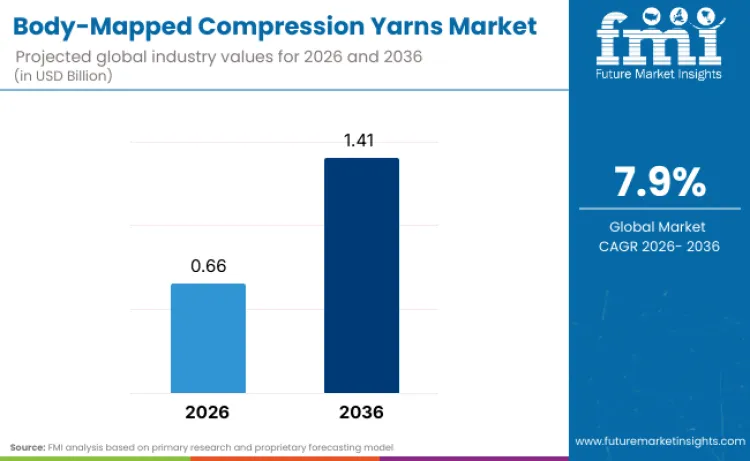
- USD 0.66 Bn
- Forecast (2036)
- USD 1.41 Bn
- CAGR (2026 to 2036)
- 7.9%
Body-Mapped Compression Yarns Market Forecast and Outlook 2026 to 2036
The global body-mapped compression yarns market is set to record a valuation of USD 0.66 billion in 2026, advancing toward USD 1.41 billion by 2036, representing a 7.9% CAGR. More compression garments are not creating the demand signal in a generic sense. It is being created by higher specificity in what brands and medical channels purchase: pressure gradients that remain stable after repeated wear, wash, and recovery cycles, delivered in seamless formats with minimal rework and reduced inventory risk.
Two evidence-backed capability shifts explain why body-mapped yarn value is expanding faster than conventional stretch yarn demand. Bio-integrated elastomer supply is moving from a sustainability feature to a procurement filter for global brands that are now planning for product passport disclosure and durability-based compliance in Europe.
EU’s Ecodesign for Sustainable Products Regulation entered into force on 18 July 2024, creating a pathway for binding product requirements and data disclosure mechanisms that elevate traceable, lower-footprint material inputs from nice to have to contractable. The category is being pulled forward by digital knit execution that makes complex zonal compression manufacturable at scale, which is why machinery-led players are increasingly influential in determining what “yarn demand” even means for body-mapping programs.
A board-level indicator sits in how upstream leaders frame their 2026 roadmap. Cho Hyun-joon, Chairman of Hyosung, tie perfectly to premium positioning, stating: “The bio business, which focuses on transitioning from fossil fuel-based raw materials to plant-based ones, will be a key pillar of Hyosung's centennial vision. Strengthening our global market strategy by focusing on our bio BDO and bio spandex integrated production system is key to elevating Hyosung's premium brand status.”
This matters for body-mapped compression yarns because stable, vertically integrated bio-BDO to spandex pathways reduce input volatility for high-power stretch programs where even minor modulus drift changes garment pressure outcomes.
Summary of the Body-Mapped Compression Yarns Market
What is the Growth Outlook for the Body-Mapped Compression Yarns Market as per FMI Projection?
Future Market Insights projects the body-mapped compression yarns market to grow at a 7.9% CAGR between 2026 and 2036, expanding from USD 0.66 billion in 2026 to USD 1.41 billion by 2036.
FMI Research Approach: Forecasts are built using bottom-up revenue modelling by compression profile, seamless knitting penetration assumptions, and validation of elastomer feedstock stability for high-power stretch programs.
How do Analysts at FMI Expect the Body-Mapped Compression Yarns Market to Evolve?
FMI analysts expect the market to evolve from commodity stretch sourcing toward software-defined compression architectures, where yarn choice is inseparable from stitch density, zonal mapping logic, and recovery curves.
FMI Research Approach: Analyst views are informed by evidence from seamless machine adoption, medical load-unload fibre development, and procurement shifts tied to durability and disclosure requirements under European regulation.
Which Country Is Emerging as a Key Growth Hub for Body-Mapped Compression Yarns?
China is emerging as the fastest-growing hub as dense proximity between spandex producers, covered yarn converters, and seamless knitting facilities enables rapid scale-up of zonal compression programs. Execution capability rather than cost advantage is driving adoption, particularly in sports recovery, shapewear, and medical-adjacent garments.
FMI Research Approach: Country-level outlook integrates manufacturing concentration analysis, seamless platform deployment, and export-oriented brand sourcing behavior.
How Large Will the Body-Mapped Compression Yarns Market Be by 2036?
By 2036, the global body-mapped compression yarns market is expected to reach USD 1.41 billion, with value concentrated in sports and performance wear, shapewear, and medical garments where pressure retention and wearer comfort directly influence product acceptance and liability risk.
FMI Research Approach: Market sizing reflects long-term revenue forecasts by compression profile and application mix, cross-validated against upstream elastomer capacity and seamless knitting adoption signals.
What Is the Definition of the Body-Mapped Compression Yarns Market?
The body-mapped compression yarns market comprises revenues from engineered yarn systems designed to deliver location-specific compression outcomes within knitted and seamless garments.
FMI Research Approach: Market definition follows FMI’s functional-outcome framework, capturing yarn revenues where compression performance is specified, measured, and contract-relevant.
What Are the Globally Distinct Trends Shaping the Body-Mapped Compression Yarns Market?
Globally, the market is shaped by digital seamless knitting precision, elastomer feedstock risk management, and durability-led compliance pressures. Body-mapped compression is increasingly used to reduce SKU complexity, inventory risk, and pressure-decay liability as brands move toward faster replenishment and regulated disclosure environments.
FMI Research Approach: Trend identification is grounded in analysis of machinery-led capability shifts, supplier integration strategies, and regulatory developments affecting durability, traceability, and circularity readiness.
Body-Mapped Compression Yarns Market Key Takeaways
| Metric | Details |
|---|---|
| Industry Size (2026) | USD 0.66 billion |
| Industry Value (2036) | USD 1.41 billion |
| CAGR (2026-2036) | 7.9% |
Source: Future Market Insights (FMI) analysis, based on proprietary forecasting model and primary research.
Why is the Body-Mapped Compression Yarns Market Growing?
Growth is driven by a structural shift from generic stretch sourcing toward compression systems that deliver repeatable pressure outcomes under real-world use. Brands are no longer buying elasticity in isolation. They are procuring yarns that behave predictably once integrated into seamless garments, where stitch density, zonal transitions, and recovery curves directly shape product performance.
One growth lever sits in how compression is being repositioned inside performance apparel ecosystems. In sports and recovery programs, compression is specified alongside motion control, moisture regulation, and thermal comfort, rather than treated as a standalone feature. This systems-level positioning mirrors the broader transition visible in performance-focused categories such as compression garments, where adoption increasingly favors engineered fit over aesthetic tightness, and in active wear where functional differentiation is replacing logo-led competition.
Manufacturing feasibility of body mapping at scale is an important facet. Digital seamless knitting platforms have made multi-zone compression commercially viable without prohibitive sampling cycles. As seamless production expands across performance and lifestyle categories visible in seamless apparel, yarn demand is shifting toward constructions that can maintain compression integrity at high gauge and speed. This manufacturing reality explains why yarns optimized for seamless architectures are gaining share over traditional covered elastics.
Increasing medical and wellness crossover demand further contributes to body mapped compression fiber industry’s expansion. Compression is moving beyond post-injury or clinical settings into everyday recovery, posture support, and circulation-focused apparel. This transition aligns with patterns observed in the compression garments and stockings market, where medical-grade performance expectations increasingly influence consumer-facing product specifications.
Inventory risk and compliance pressure are accelerating adoption of programmable compression formats. As brands reduce long production runs and shift toward faster replenishment cycles, body-mapped compression enables SKU rationalization by embedding multiple support functions into a single garment. This dynamic is increasingly relevant in shapewear programs aligned with fit philosophies associated with adaptive shapewear.
How is the Body-Mapped Compression Yarns Market Segmented?
The market is segmented by compression profile, application, yarn type, and region, reflecting how compression outcomes are specified and delivered across end uses.
Why do Graduated Compression Yarns Retain the Largest Share?
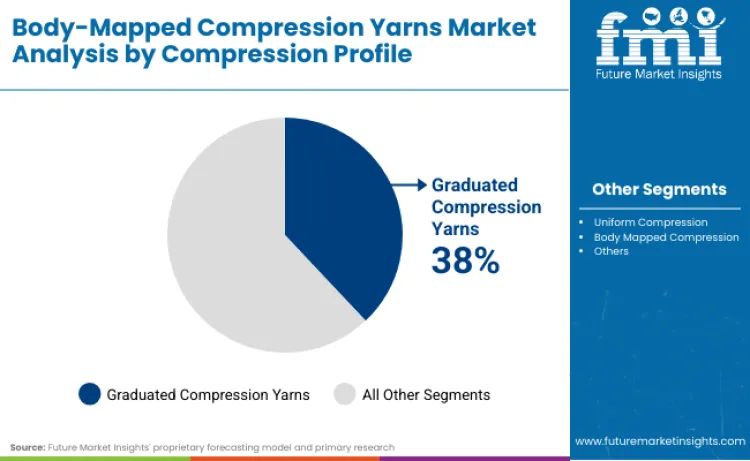
Graduated compression yarns account for 38% of demand because they offer a balance between performance credibility and manufacturing simplicity. They allow brands to communicate functional benefits without requiring fully bespoke body-mapping libraries for every SKU.
This makes them especially relevant in recovery and wellness programs that overlap with product classes addressed in the compression product market, where pressure gradients remain easier to standardize than fully customized zoning.
Where does Body-Mapped Compression Concentrate Its Value?
Body-mapped compression concentrates value in garments where multiple muscle groups or anatomical zones require different support intensities within a single structure. This is particularly relevant in performance apparel ecosystems associated with workout clothes, where garments are expected to support dynamic movement while maintaining comfort over extended wear.
Why does Sports and Performance Wear Lead Application Demand?
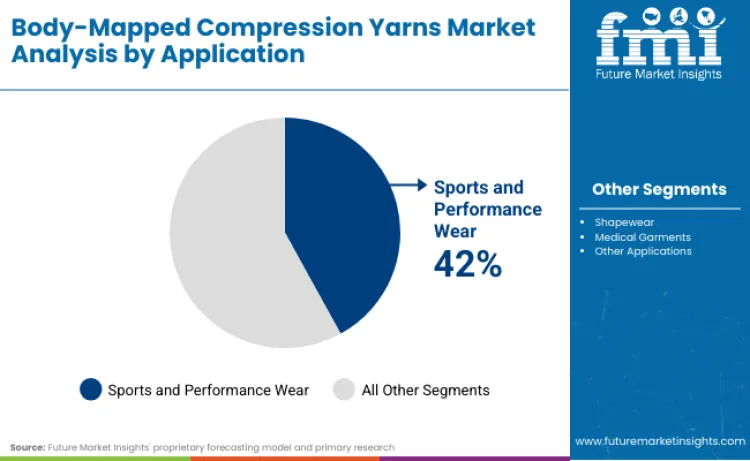
Sports and performance wear represents 42% of application demand because body-mapped compression aligns with how athletes and active consumers evaluate value. Compression is judged by comfort under motion, sweat management, and fatigue reduction rather than by static tightness. This performance-first logic mirrors dynamics prevalent in reflective sportswear fabrics, with functional engineering outweighing decorative attributes.
Why do Texture and Air Covered Yarns dominate Yarn Selection?
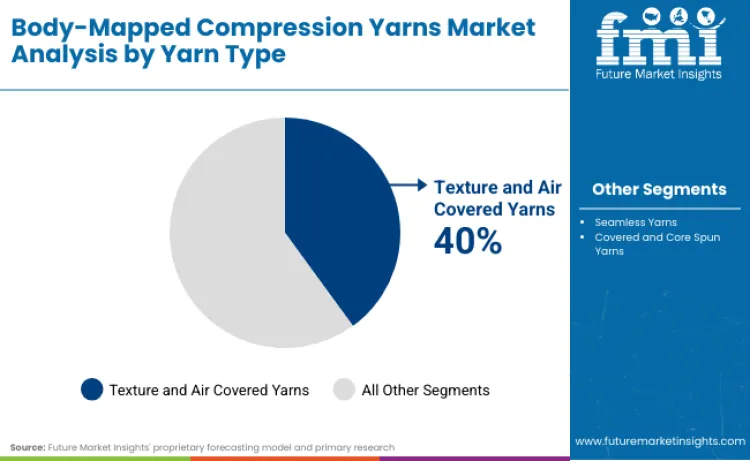
Texture and air covered yarns hold 40% share because they deliver compression with improved hand feel and breathability, which is critical for garments worn directly against skin. Their dominance reflects a broader material preference shift toward comfort-led engineering seen across high-performance fiber categories, including emerging alternatives highlighted in isosorbide-based high-performance apparel fibers.
What Forces are Reshaping Procurement and Risk in Body-Mapped Compression Yarns?
Procurement dynamics are changing as compression garments become linked to compliance, durability, and traceability expectations. In Europe-facing assortments, disclosure readiness and material longevity are becoming implicit selection criteria, pushing buyers to favor yarn systems that can support long service life without pressure degradation.
Inventory risk is another reshaping force. Policy pressure against overproduction and destruction of unsold apparel is encouraging shorter runs and on-demand manufacturing models. Body-mapped compression supports this transition by enabling multi-functional garments that reduce SKU proliferation, a logic increasingly visible across adjacent apparel ecosystems such as the seamless apparel market.
Trade and sourcing considerations further reinforce this shift. Nearshoring strategies designed to reduce lead times and tariff exposure are influencing yarn-forward sourcing decisions, particularly for North American brands serving high-velocity performance segments. These structural pressures reward suppliers that can integrate smoothly into compressed development cycles rather than those competing solely on unit cost.
What is the Country Profile for the Body Mapped Compression Yarns Market?
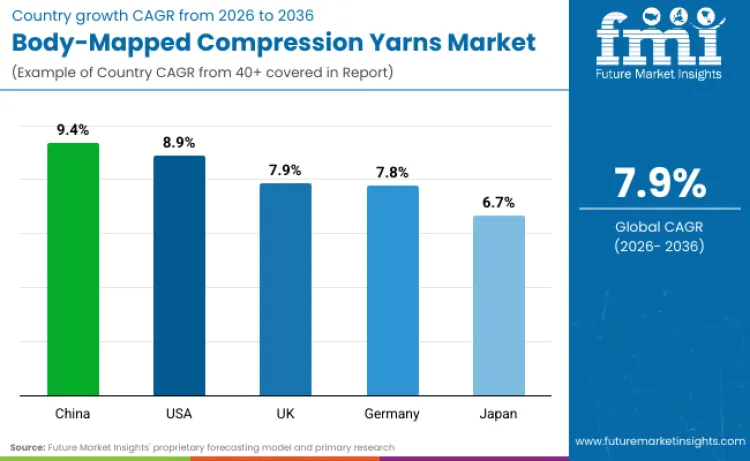
| Country | CAGR (2026-2036) |
|---|---|
| USA | 8.9% |
| China | 9.4% |
| Germany | 7.8% |
| UK | 7.9% |
| Japan | 6.7% |
Source: FMI analysis based on primary research and proprietary forecasting model
What anchors USA’s Demand for Body-Mapped Compression Yarns?
In the USA, the 8.9% CAGR reflects a shift in how compression is specified, purchased, and audited. Compression yarns are increasingly treated as functional medical inputs rather than performance embellishments. A visible inflection came with The LYCRA Company introducing LYCRA® T903C in 2024, engineered for controlled load-unload behaviour under repeated laundering. USA buyers adopted it quickly in recovery wear, post-surgical garments, and circulation products, where pressure decay creates clinical and liability exposure.
Parallel moves are occurring upstream. Hyosung has aligned its USA-facing spandex programs, including bio-based elastics, with nearshored yarn and garment supply chains serving American brands. These programs prioritise documented durability, traceable sourcing, and fast replenishment. Commodity stretch continues to clear price-driven channels, but growth is accruing to body-mapped yarn systems that behave predictably across wash, wear, and warranty cycles.
Why is China’s Growth Tied to Manufacturing Differentiation?
China’s 9.4% CAGR is tied to execution capacity, not cost scale. Zhejiang and Guangdong have become the production base for zonal compression programs that global brands no longer treat as experimental. One practical driver is the widespread deployment of Santoni seamless knitting platforms, which allow stitch-level compression control at commercial volumes.
Exporters using these platforms increasingly pair them with engineered covered yarns and recovery-stable elastics sourced domestically. This enables repeatable multi-zone compression without yield collapse. Producers relying on commodity elastics are seeing higher rejection rates as tolerance windows tighten. Growth is therefore concentrating among digitally enabled suppliers that can hold compression geometry stable across scale.
How does Germany’s Adoption Reflect Regulatory and Technical Discipline?
Validation pathways rather than apparel turnover drive Germany’s 7.8% CAGR. A clear signal is Asahi Kasei restructuring its ROICA™ elastane production and technical support footprint in Germany, positioning the country as a hub for certified, traceable stretch fibres used in medical and function-critical garments.
German buyers routinely require auditable pressure retention data, traceability documentation, and reproducible performance after laundering. Yarn systems qualified in German medical and orthopaedic programs often become reference specifications across Europe. Germany shapes standards first and volumes later.
What Factors stimulate Compression Yarn Demand in UK?
UK’s 7.9% CAGR reflects how body-mapped compression is being absorbed into seamless shapewear and lifestyle performance apparel. Brands focused on inclusive sizing and extended-wear comfort are replacing rigid shaping panels with zonal compression engineered directly into seamless garments.
This shift favours yarn systems that deliver moderate, anatomically aligned compression rather than high-power stretch. Suppliers able to manage smooth compression transitions without visual or tactile disruption are gaining share. In the UK, body-mapped compression succeeds when it improves wearability rather than signalling performance intensity.
Why does Japan Emphasize Precision Over Intensity?
Japan’s 6.7% CAGR is grounded in material refinement. Teijin Frontier has advanced multi-functional textiles that integrate compression with moisture management, UV protection, and surface aesthetics. These programs prioritise recovery uniformity, fabric appearance, and long-term comfort.
Japanese brands adopt body-mapped compression only when it disappears into the fabric structure. Aggressive compression is rejected if it compromises hand feel or visual finish. Japan therefore functions as a precision-validation market, rewarding yarn systems that enhance garment quality without asserting themselves.
How is Competitive Positioning Taking Shape in Body-Mapped Compression Yarns?
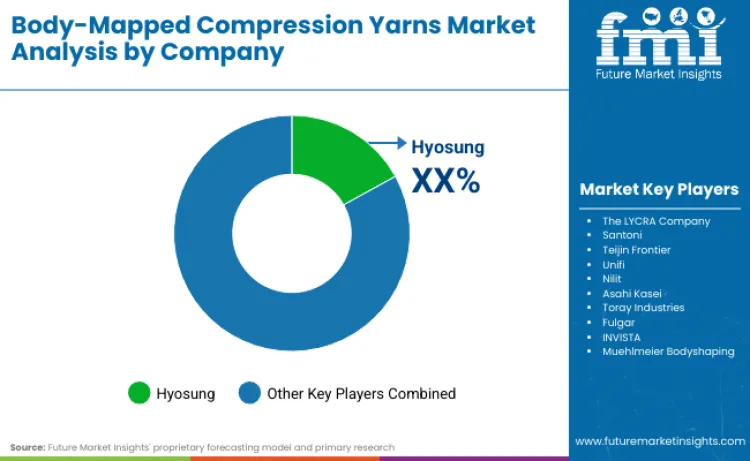
Competitive differentiation in body-mapped compression yarns is increasingly shaped by where suppliers absorb risk rather than how aggressively they market performance. Buyers are sorting platforms based on material exposure, manufacturing control, and the ease with which compression claims can survive audit, scale, and repeat ordering.
One segment of suppliers is being selected for raw material insulation rather than yarn novelty. These platforms are structured to protect global compression programs from feedstock volatility and sustainability disruptions that can destabilize modulus behaviour over time. Hyosung reflects this positioning through its bio-BDO and bio-spandex integration, which ties upstream chemistry directly to recovery consistency. In programs where pressure drift translates into warranty or regulatory risk, these suppliers are treated as stabilizing inputs rather than interchangeable elastomer sources.
Another set of suppliers is gaining relevance through manufacturing determinism, particularly in seamless and body-mapped construction. Here, competitive advantage sits less in fibre formulation and more in whether compression geometry can be executed repeatedly without yield erosion. Santoni platforms are central to this shift, as stitch-level control allows compression zoning to be resolved at the machine stage instead of through garment iteration. This changes sampling economics, limits rework, and supports shorter production runs as brands adjust to tighter inventory and waste constraints.
A third competitive approach centres on margin protection through functional integration. Teijin Frontier illustrates this path by embedding compression within structured textiles that also manage moisture, UV exposure, and fabric opacity. In performance-led apparel categories, buyers accept higher yarn costs when integrated functionality reduces reliance on secondary treatments or complex garment assemblies.
Key Developments
2024- Bio-spandex Stabilization for Long-cycle Compression Programs
Hyosung expanded the commercial rollout of bio-BDO-based spandex grades into performance compression programs where pressure retention over repeated laundering is contract-critical. Rather than positioning the material on sustainability claims alone, the development is being used by brand buyers to reduce long-term modulus drift risk tied to fossil feedstock volatility, particularly in medical-adjacent and recovery wear categories.
2023-2024- Stitch-resolved Compression Zoning in Seamless Production
Santoni advanced machine-level control for body-mapped compression by enabling tighter stitch-by-stitch variability within high-gauge seamless platforms. This has allowed brands to lock compression geometry at the machine specification stage, cutting garment iteration cycles and improving yield consistency for zoned compression apparel produced in shorter, demand-responsive runs.
Key Companies in the Body-Mapped Compression Yarns Market
- Hyosung
- The LYCRA Company
- Santoni
- Teijin Frontier
- Unifi
- Nilit
- Asahi Kasei
- Toray Industries
- Fulgar
- INVISTA
- Muehlmeier Bodyshaping
Market Definition
The body-mapped compression yarns market comprises engineered yarn systems specifically designed to generate predictable, location-specific compression behavior when integrated into knitted and seamless garment structures. Unlike conventional stretch yarns that provide uniform elasticity, these yarn systems are selected and configured to deliver controlled pressure profiles, including graduated compression, uniform compression, and zonal body-mapped compression that varies across anatomical regions within a single garment.
The defining characteristic of this market is not the fibre chemistry alone, but the functional outcome achieved at the garment level. Body-mapped compression yarns are evaluated on their ability to maintain pressure stability, elastic recovery, and wearer comfort across repeated motion, laundering, and long service cycles. As a result, yarn selection is inseparable from knit architecture, stitch density, and seamless manufacturing parameters that determine how compression is distributed and retained over time.
Commercial adoption spans sports and performance wear, where compression supports muscle stabilization and fatigue management; shapewear, where zonal control enables contouring without discomfort or pressure spikes; and medical garments, where sustained compression and controlled load-unload behavior are critical for therapeutic effectiveness and patient adherence. In each application, yarn systems are specified to align compression output with functional and comfort requirements rather than aesthetic tightness.
From a materials perspective, the market includes texture and air-covered yarns, seamless-optimized yarns, and covered or core-spun constructions that are compatible with engineered knit and seamless platforms. These yarns are selected for their ability to deliver consistent mechanical performance when subjected to high-gauge knitting, zonal transitions, and repeated deformation.
By definition, the market excludes generic apparel stretch yarns that are not specified for compression performance, pressure retention, or recovery stability. Elastic yarns used solely to provide fit or flexibility, without documented compression outcomes, fall outside the scope of body-mapped compression yarns.
Scope of Report
| Items | Values |
|---|---|
| Quantitative Units (2026) | USD 0.66 billion |
| Compression Profile | Graduated Compression Yarns, Uniform Compression, Body Mapped Compression, Others |
| Application Category | Sports & Performance Wear, Shapewear, Medical Garments, Other Applications |
| Yarn Type | Texture and Air Covered Yarns, Seamless Yarns, Covered and Core Spun Yarns |
| Technology Focus | Seamless knitting, zonal body mapping, pressure profile retention, recovery stability, comfort under load |
| Compliance and Sustainability Context | ESPR readiness, traceability, durability signalling, circular-ready yarn stacks (where applicable) |
| Regions Covered | North America, Europe, East Asia, South Asia, Latin America, Middle East & Africa |
| Countries Covered | USA, Germany, China, United Kingdom, Japan, and 20+ countries |
| Additional Attributes | Dollar sales by compression profile and application, regional demand trends, country-wise analysis, competitive landscape, manufacturing and compliance drivers, technology adoption signals in seamless platforms, and risk factors linked to tariffs and inventory policy direction. |
Body-Mapped Compression Yarns Market by Segments
By Compression Profile:
- Graduated Compression Yarns
- Uniform Compression
- Body Mapped Compression
- Others
By Application:
- Sports & Performance Wear
- Shapewear
- Medical Garments
- Other Applications
By Yarn Type:
- Texture and Air Covered Yarns
- Seamless Yarns
- Covered and Core Spun Yarns
By Region:
- North America
- Europe
- East Asia
- South Asia
- Latin America
- Middle East & Africa
Bibliography
- Hyosung Corporation. (2024, July 31). Chairman Cho Hyun-joon’s vision for Hyosung’s centennial: Growing bio BDO. PR Newswire.
- Santoni S.p.A. (2024). SM8-TOP2V seamless knitting platform: Technical overview. Santoni.
- Teijin Frontier Co., Ltd. (2025, December 24). Teijin Frontier unveils a next-generation, multi-functional comfort textile for sports and outdoor apparel.
- The LYCRA Company. (2024, April 11). Introducing LYCRA® T903C fiber for medical compression applications.
- Office of the United States Trade Representative. (2025, November). Fact sheet: Framework agreement for an agreement on reciprocal trade between the United States and El Salvador.
- Innovation in Textiles. (2025). Asahi Kasei and Nilit introduce biomass-balanced stretch fibre blends.
Frequently Asked Questions
What is driving adoption in body-mapped compression yarn programs?
Adoption is being driven by the shift toward repeatable pressure outcomes in seamless garments, supported by digital knit precision, engineered recovery behaviour, and supply-chain strategies designed to reduce compliance and volatility risk.
Which compression profile holds the largest share?
Graduated compression yarns capture the lar gest share at 38%, supported by clearer specification pathways and broad relevance across recovery and medical-adjacent programs.
Which application leads demand?
Sports & performance wear leads at 42%, reflecting high-volume demand for comfort-performance compression delivered through seamless and engineered knit architectures.
Which yarn type dominates the mix?
Texture and air covered yarns lead at 40% attributed to comfort, bulk, and recovery characteristics suitable for scalable compression programs.
What policy trend is most relevant for Europe-facing programs?
ESPR’s entry into force on 18 July 2024 is structurally relevant because it elevates traceability and durability signalling, influencing how brands standardize yarn stacks for Europe-linked assortments.
Which countries are profiled for growth benchmarking?
USA, China, Germany, UK, and Japan are profiled to benchmark how manufacturing capability, compliance planning, and channel mix shape adoption intensity.
Preview the report firsthand - request a free sample
Get SampleGet the brochure for pricing and purchase details.
Get PDFTable of Content
- Executive Summary
- Market Outlook and Value Trajectory
- Demand-side Evolution
- Supply-side and Feedstock Dynamics
- Technology and Seamless Execution Context
- Strategic Implications
- Market Overview
- Market Definition and Functional Scope
- Inclusions and Exclusions
- Market Size Snapshot, 2026 and 2036
- Key Drivers, Constraints, and Adoption Signals
- Market Analysis and Forecast 2021 to 2036
- Historical Market Size Value (USD Billion), 2021 to 2025
- Market Forecast Value (USD Billion), 2026 to 2036
- Year-on-Year Growth Trend Analysis
- Absolute Dollar Opportunity Analysis, 2026 to 2036
- Market Background and System Context
- Compression Architecture Versus Elasticity Supply
- Role of Seamless Knitting and Zonal Control
- Performance Benchmarks and Pressure Retention Criteria
- Durability, Compliance, and Traceability Context
- Why is the Body-Mapped Compression Yarns Market Growing?
- Shift Toward Repeatable Pressure Outcomes
- Integration into Performance and Recovery Ecosystems
- Manufacturing Feasibility at Scale
- Inventory Risk and SKU Rationalization
- Global Market Pricing Analysis 2021 to 2036
- Pricing Assumptions and Reference Structures
- Historical Pricing Trend Analysis
- Pricing Sensitivity and Forward Outlook
- Global Market Analysis 2021 to 2025 and Forecast 2026 to 2036, By Compression Profile
- Introduction and Key Findings
- Historical Market Size Value Analysis
- Market Forecast and Opportunity Analysis
- Graduated Compression Yarns
- Uniform Compression
- Body-Mapped Compression
- Others
- Y-o-Y Growth Trend Analysis
- Absolute Dollar Opportunity Analysis
- Global Market Analysis 2021 to 2025 and Forecast 2026 to 2036, By Application
- Introduction and Key Findings
- Historical Market Size Value Analysis
- Market Forecast and Opportunity Analysis
- Sports and Performance Wear
- Shapewear
- Medical Garments
- Other Applications
- Y-o-Y Growth Trend Analysis
- Absolute Dollar Opportunity Analysis
- Global Market Analysis 2021 to 2025 and Forecast 2026 to 2036, By Yarn Type
- Introduction and Key Findings
- Historical Market Size Value Analysis
- Market Forecast and Opportunity Analysis
- Texture and Air Covered Yarns
- Seamless Yarns
- Covered and Core Spun Yarns
- Y-o-Y Growth Trend Analysis
- Absolute Dollar Opportunity Analysis
- Global Market Analysis 2021 to 2025 and Forecast 2026 to 2036, By Region
- Introduction
- Historical Market Size Value Analysis
- Market Forecast by Region
- North America
- Europe
- East Asia
- South Asia
- Latin America
- Middle East and Africa
- Market Attractiveness Analysis
- North America Market Analysis 2021 to 2025 and Forecast 2026 to 2036
- Historical Trend Analysis
- Market Forecast
- Key Takeaways
- Europe Market Analysis 2021 to 2025 and Forecast 2026 to 2036
- Historical Trend Analysis
- Market Forecast
- Key Takeaways
- East Asia Market Analysis 2021 to 2025 and Forecast 2026 to 2036
- Historical Trend Analysis
- Market Forecast
- Key Takeaways
- South Asia Market Analysis 2021 to 2025 and Forecast 2026 to 2036
- Historical Trend Analysis
- Market Forecast
- Key Takeaways
- Latin America Market Analysis 2021 to 2025 and Forecast 2026 to 2036
- Historical Trend Analysis
- Market Forecast
- Key Takeaways
- Middle East and Africa Market Analysis 2021 to 2025 and Forecast 2026 to 2036
- Historical Trend Analysis
- Market Forecast
- Key Takeaways
- Competition Outlook
- Competitive Landscape and Positioning
- Raw Material and Feedstock Risk Strategies
- Manufacturing Determinism and Seamless Capability
- Recent Developments
- Company Profiles
- Hyosung
- The LYCRA Company
- Santoni
- Teijin Frontier
- Unifi
- Nilit
- Asahi Kasei
- Toray Industries
- Fulgar
- INVISTA
- Muehlmeier Bodyshaping
- Assumptions and Acronyms
- Assumptions
- Acronyms
- Research Methodology
- Chapter Orientation
- Analytical Framework
- Market Sizing and Forecasting Approach
- Validation and Data Sources
- Appendix
- Scope of Report
- Bibliography
- Frequently Asked Questions


