

- Industry Size (2026)
- USD 0.6 Bn
- Forecast (2036)
- USD 1.4 Bn
- CAGR (2026 to 2036)
- 9.0%
RF-Shielding Fiber Yarns Market Forecast and Outlook 2026 to 2036
FMI expects the global RF-shielding fiber yarns market to total USD 0.6 billion in 2026 and is projected to reach USD 1.4 billion by 2036, reflecting a 9.0% CAGR. Demand is moving from general EMI compliance toward frequency-specific containment at mmWave and emerging sub-THz bands.
FCC Technological Advisory Council work programs tied to 6G have focused engineering attention on shielding behavior near antennas and dense radio assemblies, changing how RF yarns are specified. Buyers increasingly request frequency-band attenuation curves, near-field behavior data, and grounding performance under dynamic strain.
Adoption is constrained by aperture stability and conductor surface integrity under stress. Test data near 100 GHz show that pore size distribution, yarn spacing consistency, and deformation under stretch influence leakage behavior. Development is shifting toward controlled-cover constructions, including double-wrapped conductive yarns and plated multifilament cores with elastic binders. Shielding textiles are increasingly treated as periodic RF structures during design and testing.
High-frequency conductor behavior introduces additional constraints. Skin effect confines current to the outer conductive layer, increasing sensitivity to plating defects and micro-fractures. Qualification protocols include bend-cycle and shielding-retention testing, corrosion exposure checks, and post-laundering attenuation measurements. Process control in metallization and coating systems has become a key differentiation factor.
Procurement requirements emphasize documentation, lot traceability, and integration guidance across defense, aerospace, medical electronics, and advanced wearables. Vendors that provide integration data and post-aging shielding results typically move through qualification faster than those offering datasheets alone.
"We enable key AI applications with high-density interconnect products and Laird thermal management solutions. We believe these leading positions will continue to drive industry outperformance for the future Electronics company [Qnity]."
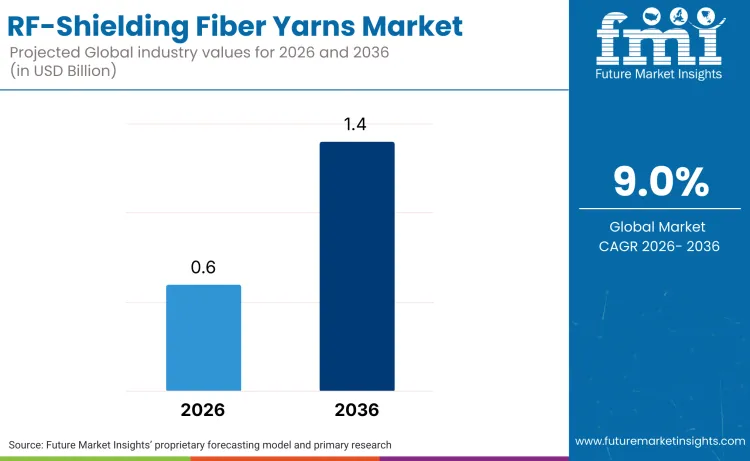
Summary of the RF-Shielding Fiber Yarns Market
What Is the Growth Outlook for the RF-Shielding Fiber Yarns Market as per FMI Projections?
Future Market Insights estimates that the RF-shielding fiber yarns market will grow at a 9.0% CAGR from 2026 to 2036, increasing from USD 0.6 billion in 2026 to USD 1.4 billion by 2036.
FMI Research Approach: Market forecasts are built using frequency-specific demand modelling, end-user qualification timelines, and procurement-linked adoption weighting across defence, healthcare, and electronics programs.
How do analysts at FMI expect the RF-Shielding Fiber Yarns Market to Evolve?
FMI expects the market to transition from general EMI compliance toward frequency-defined RF containment, particularly as electronics operate closer to antennas and dense radio assemblies. At higher bands, shielding effectiveness is shaped by textile geometry, metallisation continuity, and seam integrity, shifting development toward constructions that retain attenuation under flex, strain, and post-laundering conditions.
FMI Research Approach: Analyst assessments integrate FCC-linked 6G technical guidance, high-frequency attenuation data, and buyer requirements for post-aging and post-installation shielding verification.
Which Country Is Emerging as a Key Growth Hub for RF-Shielding Fiber Yarns?
China is the primary growth engine for RF-shielding fiber yarns as 6G activity progresses from exploratory research into structured standardisation and phased trials. Formalised coexistence thresholds and leakage limits are translated directly into material and enclosure specifications, favouring shielding yarn systems with stable performance across handling and environmental exposure.
FMI Research Approach: Country-level outlook is derived from standardisation milestones, manufacturing scale indicators, and frequency-driven procurement signals observed in network and defence programs.
How Large will the RF-Shielding Fiber Yarns Market Be by 2036?
By 2036, the RF-shielding fiber yarns market is expected to reach USD 1.4 billion, with value concentrated in applications where shielding functions as a defined reliability layer.
FMI Research Approach: Market sizing reflects application-specific acceptance criteria and attenuation-per-material economics, rather than uniform textile volume growth assumptions.
What defines the RF-Shielding Fiber Yarns Market?
The RF-shielding fiber yarns market comprises revenues from textile yarn systems engineered to attenuate electromagnetic and radio-frequency energy across defined frequency bands. These yarns are integrated into fabrics, wraps, garments, and enclosure textiles used in controlled electromagnetic environments.
FMI Research Approach: Market definition follows FMI’s yarn-level revenue framework, capturing manufacturer sales of RF-shielding yarns and yarn-integrated textile inputs.
Which Trends Distinguish Developments in the RF-Shielding Fiber Yarns Market?
RF-shielding fiber yarns demand is shaped by tightening frequency-band specifications, rising scrutiny of surface integrity and aperture stability, and procurement models that demand documented post-aging and post-installation performance.
FMI Research Approach: Trend identification is grounded in regulatory developments, defence and medical procurement practices, and supplier capability tracking across metallisation, coating, and process-control systems.
RF-Shielding Fiber Yarns Market Key Takeaways
| Metric | Value |
|---|---|
| Market Value (2026E) | USD 0.6 billion |
| Expected Value (2036F) | USD 1.4 billion |
| Forecast CAGR (2026-2036) | 9.0% |
Source: FMI’s proprietary forecasting model and primary research
Which Forces are expanding the RF-shielding Fiber Yarns Market?
RF shielding specifications are tightening as 6G research moves systems into higher operating bands and as radios, antennas, and high-speed electronics are packaged into smaller enclosures. At these frequencies, shielding performance depends on aperture control and conductor continuity rather than bulk conductivity alone.
Leakage paths that were acceptable at lower bands begin to produce measurable attenuation losses. Textile constructions with uncontrolled pore size or seam gaps do not meet high-frequency qualification requirements, which directs procurement toward shielding yarn architectures validated for containment at those bands.
Formal 6G technical workstreams coordinated through the Federal Communications Commission Technological Advisory Council define propagation limits, device density constraints, and infrastructure design considerations above legacy mobile frequencies. Equipment designers use this guidance to define operating envelopes for next-generation systems.
Materials and shielding suppliers develop products to meet these envelopes because shorter wavelengths and tighter component spacing increase enclosure leakage and near-field interference risks. In these contexts, textile-based shielding is specified as a defined control layer rather than an optional mitigation.
Medical electronics standards are also narrowing acceptable material choices for shielding textiles used near diagnostic and therapeutic equipment. IEC 60601-1-2 Edition 4.1 defines higher immunity thresholds for electrostatic discharge and radiated electromagnetic disturbances.
Hospital integrators and medical device OEMs specify multilayer conductive textile assemblies and plated yarns that retain surface conductivity after flexing, cleaning, and repeated handling. Qualification protocols include repeated bend testing and post-wash shielding verification, favoring suppliers that can provide test artefacts rather than catalogue claims.
Defence electronics programs provide an additional, documented adoption path. Recent upgrades to electronic warfare shelters, mobile command posts, and deployable communication tents integrate textile shielding into liners, seams, and cable transition zones. Procurement documents specify attenuation curves across defined frequency bands and mandate validated seam-continuity methods, driving demand for RF-shielding yarn systems engineered for stitch integrity, braid stability, and grounding compatibility during installation.
How is the RF-Shielding Fiber Yarns Market Segmented?
Mechanism, application, frequency, and end user segment the RF-shielding fiber yarns market. By mechanism, the market includes metal-plated fibers, carbon and conductive polymer yarns, metal-core yarns, and hybrid yarns, reflecting trade-offs between conductivity continuity, flex durability, mass stability, and manufacturability.
By application, demand spans cabin, room aing garments and PPE, cable wraps and components, and broadband shielding, reflecting where shielding is integrated as a structural layer rather than a discrete enclosure. By frequency, adoption divides into low frequency EMI, medium frequency EMI, and high-frequency RF, reflecting different interference profiles and validation regimes. By end user, purchasing concentrates across defence and security, healthcare and laboratories, and electronics and telecom.
Which Mechanism leads by Value Concentration in 2026?
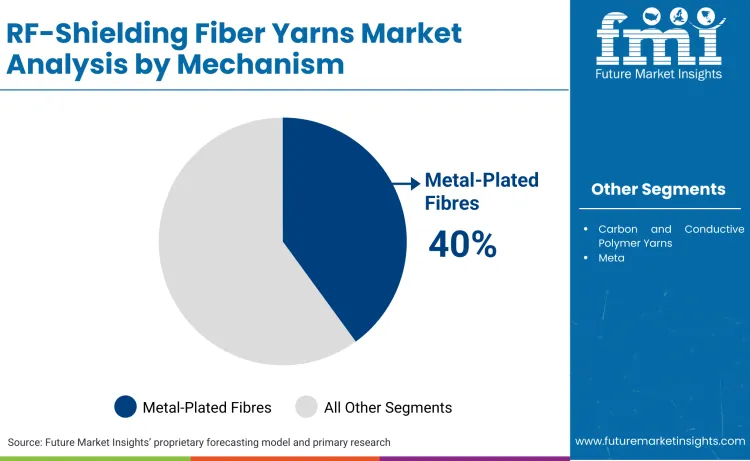
Metal-plated fibres lead with a 40.0% share in 2026 because they offer the most direct route to low-resistance surface continuity, which is the operating requirement implied by both high-frequency leakage risk and higher ESD immunity expectations. The blueprint also flags a surface-integrity failure mode at higher frequencies, where micro-cracking in plated fibres can degrade shielding effectiveness disproportionately, raising the premium on plating quality control and bend-stability validation.
Which Application concentrates Procurement Intensity?
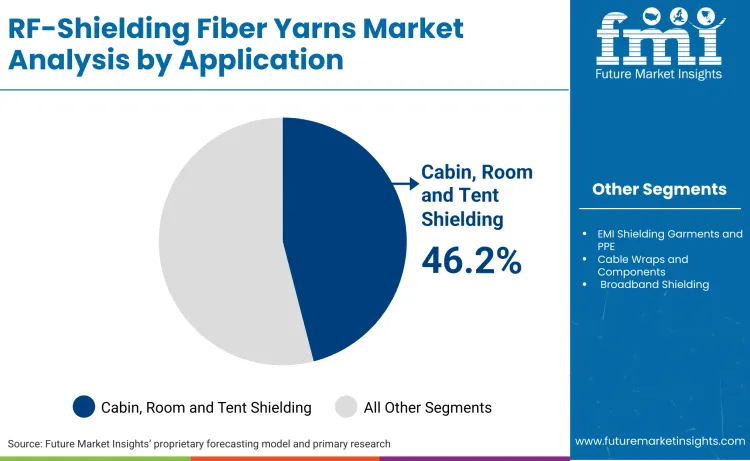
Cabin, room and tent shielding leads with a 46.2% share in 2026 because it sits at the intersection of field-deployable protection and fixed-site compliance, where buyers pay for predictable attenuation rather than aspirational conductivity. In FMI’s view, this segment also benefits from clearer acceptance testing at installatnd deployable tents can be validated in-situ for leakage, grounding integrity, and seam performance, keeping the buyer’s risk measurable.
How will Growth for RF-Shielding Fiber Yarns take Concrete Shape in Electronics, EV, and Smart Textiles?
Growth in RF-shielding fiber yarns is shifting from pilot smart-textile use cases into deployments that require electromagnetic compatibility evidence and repeatable qualification results. Adoption is linked to interference exposure in high-frequency, high-density electronics and to the limits of rigid foils and metal housings in constrained mechanical assemblies.
Electronics densification is a primary driver. Radios, antennas, power conversion, and high-speed interconnects are being integrated into smaller volumes across AI servers, EV control units, aerospace electronics, and wearables. Near-field coupling and unintended emission paths become harder to control using enclosure strategies alone. Design choices now place shielding closer to emission sources, using wraps, braids, tapes, and textile layers. At higher frequencies, seam geometry, stitch density, and small openings behave as leakage paths, turning textile construction parameters into RF performance variables.
Metal input cost volatility is shaping supplier behavior. Shielding effectiveness often tracks conductive mass per linear length in silver-, copper-, and nickel-based systems, while price volatility in these metals creates margin pressure for coaters and converters. Producers are reducing metal loading through stack design, deposition thickness control, and selective plating while maintaining attenuation targets. Procurement reviews now consider attenuation normalized by metal loading alongside absolute shielding values.
Multifunctional designs are appearing where EMI control and thermal pathways are evaluated together. EV power electronics, dense compute racks, and advanced harnessing programs assess interference control alongside heat management. Hybrid cores that combine shielding layers with thermally conductive elements are specified in assemblies where bend radius, compression, and connector pressure affect both thermal and EMI outcomes. Suppliers are selected when they provide repeatable results and degradation profiles under flex, compression, laundering, and connector-interface stress.
Coating and surface-treatment advances are expanding use cases that require low added thickness, air permeability, and drape, including garments, medical wearables, and soft enclosures. Packaging practice favors targeted shielding at modules and interconnects, increasing demand for narrow, form-adaptive shielding elements where yarn-based constructions fit mechanically.
Downstream component launches point to continued investment in validated EMI interfaces. Companies such as Tech-Etch have introduced EMI enclosure and gasket platforms aligned with high-performance and MIL-referenced requirements. Yarn-based shielding integrates into these assemblies as wraps, braids, or compressible textile layers, positioning RF-shielding fibers as material inputs into certified EMI stacks rather than standalone textile concepts.
How will RF-shielding fiber yarns demand evolve in Key Countries?
Growth trajectories diverge across countries during 2026 to 2036. China leads at a 10.4% CAGR due to the scale of network experimentation and industrial policy support for next-generation connectivity. USA follows at 9.9% CAGR, shaped by dense compute, aerospace-ground infrastructure, and compliance-driven procurement. UK and Germany sit in the high-single-digit range at 8.9% and 8.8%, reflecting medical, defence, and industrial EMC enforcement patterns. Japan tracks 7.7% CAGR, supported by space and all-photonics netwoin the blueprint.
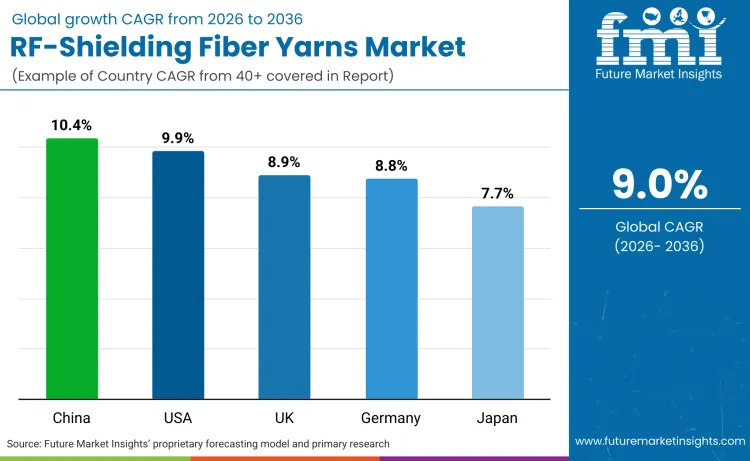
| Country | CAGR (2026-2036) |
|---|---|
| USA | 9.9% |
| China | 10.4% |
| Germany | 8.8% |
| UK | 8.9% |
| Japan | 7.7% |
Source: Future Market Insights analysis driven by proprietary forecasting models and primary research
Will Spectrum Actions and Compute Densification tighten USA’s Procurement Specifications?
USA growth at 9.9% CAGR is occurring in a procurement environment where spectrum reallocation and higher electronics density expose shielding weaknesses at interface points. The FCC upper C-band item released on 30 October 2025 set out approaches for repurposing portions of the 3.98 to 4.2 GHz range while maintaining coexistence with incumbent fixed satellite service operations, including earth station considerations.
Regulatory adjustments of this nature are triggering retrofit activity across ground infrastructure. In these programs, shielding performance is evaluated at cable entries, service panels, and enclosure seams rather than only at primary walls. Procurement requirements increasingly specify post-installation containment verification, seam bonding control, and demonstrated attenuation under field conditions.
Compute densification introduces an additional constraint on shielding performance. Higher interconnect density and power concentration inside AI and advanced compute racks increase near-field coupling and cross-talk exposure. DuPont completed the separation of its electronics business into Qnity on 1 November 2025, positioning the unit around semiconductor and interconnect solutions.
This separation reinforces the treatment of electromagnetic control as a defined subsystem reliability requirement rather than a peripheral design consideration. Suppliers are shortlisted when they can document attenuation stability under bending, compression, and repeated maintenance handling.
Will 6G Standardisation Activity accelerate China’s Specification Reset?
China’s 10.4% CAGR aligns with the transition of 6G activity from exploratory research into structured standardisation programs. An official government update dated 14 November 2025 confirmed the full launch of 6G standardisation research with broad industrial participation and international firm involvement in trials.
Once coexistence limits and interference thresholds are formalised, equipment vendors translate them directly into material and enclosure specifications. Public communications in January 2026 referenced completion of a first phase of 6G technology trials and progression into a second phase. Phase-based trials establish defined qualification checkpoints and standardised test protocols.
This environment favours shielding yarn systems that maintain conductivity and attenuation across humidity, flex, abrasion, and stitch stress. Multi-environment deployments expose textile joints, closures, and seams as primary leakage points, placing emphasis on performance retention beyond initial installation.
Will Medical EMC Enforcement sustain Germany’s Adoption Curve?
Germany’s 8.8% CAGR aligns with medical procurement practices that classify electromagnetic compatibility as a safety control. IEC 60601-1-2 defines electromagnetic disturbance requirements and test methods for medical electrical equipment and systems and is widely referenced in conformity assessment. OEMs and hospital integrators extend these expectations to surrounding environments, including shielding garments, drapes, and room textiles positioned near sensitive equipment.
Edition 4.1 discussions in conformity guidance highlight higher electrostatic discharge immunity expectations, including air discharge levels up to ±15 kV. This increases the relevance of multilayer metallised yarn constructions capable of maintaining surface continuity after repeated flexing and cleaning.
German buyers specify durability evidence covering wash cycles, bend fatigue, seam integrity, and attenuation retention. Lifecycle stability governs acceptance in medical environments where electromagnetic exposure is treated as a patient and device safety variable.
Will Defence Electronics Priorities sustain UK’s Preference for Qualification-Grade Textiles?
UK’s growth at 8.9% CAGR corresponds with defence procurement frameworks where electromagnetic control is structurally embedded. A May 2025 UK government announcement confirmed the creation of a Cyber and Electromagnetic Command and referenced investment exceeding £1 billion in a digital battlefield system under the Strategic Defence Review.
In this environment, qualification practice requires attenuation curves across defined frequency bands, seam and closure integrity validation, grounding compatibility, and lot traceability. Textile-based shielding is selected where it reduces weight and integration complexity while still allowing post-installation verification. End users prioritise suppliers with controlled manufacturing processes, test artefacts, and traceable qualification data over catalogue-only offerings.
Will Space and Photonics Infrastructure Sustain Demand for Advanced Fibres in Japan?
Japan’s 7.7% CAGR corresponds to demand patterns that prioritise fibre reliability and environmental stability. Seiren’s FY2025 first-quarter materials presentation recorded artificial satellite deliveries and highlighted strong sales of Belltron conductive fibre for dust-proof clothing supplied to overseas semiconductor manufacturers.
Space programs prioritise mass efficiency and performance stability under vibration and temperature cycling. Semiconductor manufacturing environments prioritise controlled conductivity and durability under repeated wear and cleaning. These use cases place emphasis on yarn architectures that retain electrical performance and surface continuity across handling, laundering, and long duty cycles.
Japanese buyers select higher-spec yarn constructions supported by documented performance retention data and integration guidance for seams and closures, reflecting procurement practices that emphasise lifecycle stability and environmental control.
How is Competition Intensifying in the RF-Shielding Fiber Yarns Landscape?
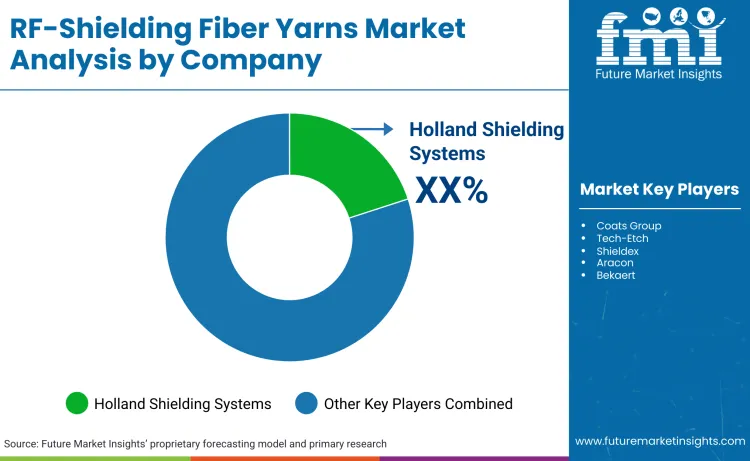
Competition is defined by qualification readiness, conductor integrity at higher frequencies, and the ability to sell shielding as a system layer rather than a commodity yarn. FMI sees two practical lanes. Lane one targets failure-intolerant programs in defence, medical, and aerospace. Advantage comes from repeatable attenuation performance, documented continuity at seams and interfaces, and durability evidence under bending and handling. Lane two targets scale-driven industrial programmes where buyers accept a narrower e for dependable volumes, consistent resistance, and integration guidance that protects downstream yields.
Key Developments:
- Corporate actions have clarified where investment is headed. DuPont’s completion of the Qnity separation on November 1, 2025 sharpened the market’s focus on electronics materials, interconnect solutions, and shielding-adjacent platforms linked to AI compute.
- Coats’ completion in October 2025 strengthened its footprint in footwear component ecosystems where smart integration and materials validation routines increasingly shape supplier selection, creating adjacency pull for conductive yarn and shielding partners that can meet documentation expectations.
- Supplier differentiation is also visible in validated product launches that sit at the enclosure interface. Tech-Etch’s December 2025 introduction of enclosure shielding gasket lines built for EMI and MIL-STD-referenced requirements reinforces that buyers continue to pay for verified contact performance, durability, and stable electrical behaviour under repeated compression cycles.
- FMI expects yarn and textile shielding suppliers to align more closely with this interface logic, supplying structures optimised for grounding, seam management, and stable contact resistance.
Key Players Profiled
- Holland Shielding Systems
- Coats Group
- Tech-Etch
- Shieldex
- Aracon
- Bekaert
- Miller Technical Textiles
- Schlegel Electronic Materials
- Statex
- Laird Performance Materials
Market Definition
The RF-shielding fiber yarns market represents revenue generated from specialised textile yarn systems engineered to attenuate electromagnetic interference and radio-frequency energy across defined frequency bands in end-use environments that require controlled electromagnetic performance. As operationally defined in this analysis, the market measures commercially sold yarns and yarn-integrated textile components designed to deliver shielding effectiveness through mechanisms such as metal plating, metal cores, conductive polymer matrices, carbon-based composites, and hybrid constructions.
The market includes yarns used in cabin, room and tent shielding textiles, EMI shielding garments and PPE, cable wraps and shielding components, and broadband shielding textiles supplied into defence and security, healthcare and laboratory environments, and electronics and telecom use cases. Market sizing reflects manufacturer-level revenues for RF-shielding yarn products and yarn-based shielding textile inputs, expressed in USD billion.
The market excludes rigid metal enclosures sold as finished assemblies, discrete shielding foils and tapes sold without textonics test services, and revenues from devices, antennas, or electronic hardware that incorporate shielding. Retail margins, logistics services, and certification service fees are excluded unless directly m sales.
Scope of Report
| Items | Values |
|---|---|
| Quantitative Units (2026) | USD 0.6 billion |
| Mechanism | Metal-plated Fibers, Carbon and Conductive Polymer Yarns, Metal-core Yarns, Hybrid Yarns |
| Application | Cabin, Room and Tent Shielding, EMI Shielding Garments and PPE, Cable Wraps and Components, Broadband Shielding |
| Frequency | Low Frequency EMI, Medium Frequency EMI, High-Frequency RF |
| End User | Defense and Security, Healthcare and Laboratories, Electronics and Telecom |
| Regions Covered | North America, Western Europe, Eastern Europe, East Asia, South Asia & Pacific |
| Countries Covered | United States, China, Germany, United Kingdom, Japan |
| Key Companies Profiled | Holland Shielding Systems, Coats Group, Tech-Etch, Shieldex, Aracon, Bekaert, Miller Technical Textiles, Schlegel Electronic Materials, Statex, Laird Performance Materials |
| Additional Attributes | Frequency-linked leakage and aperture sensitivity considerations, high-frequency conductor integrity risks, medical EMC compliance impacts, defence procurement qualification emphasis, raw material volatility exposure for plated yarn architectures, hybrid shielding and thermal management positioning, nano-coating integration pathways, and enclosure interface validation signals |
RF-Shielding Fiber Yarns Market by Key Segments
By Mechanism
- Metal-plated Fibers
- Carbon and Conductive Polymer Yarns
- Meta
By Application
- Cabin, Room and Tent Shielding
- EMI Shielding Garments and PPE
- Cable Wraps and Components
- Broadband Shielding
By Frequency
- Low Frequency EMI
- Medium Frequency EMI
- High-Frequency RF
By End User
- Defense and Security
- Healthcare and Laboratories
- Electronics and Telecom
By Region
- North America
- Latin America
- Western Europe
- Eastern Europe
- East Asia
- South Asia & Pacific
- Middle East & Africa
Bibliography
- Federal Communications Commission. (2025). FCC Technological Advisory Council meeting minutes August 5, 2025.
- International Electrotechnical Commission. (2020). IEC 60601-1-2 Amendment 1 publication record in IEC Webstore.
- Press Information Bureau, Government of India. (2025). National Technical Textiles Mission project approvals and research project funding. Ernst and Young Mms new import tariffs effective January 1, 2026.
- Tech-Etch. (2025). Tech-Etch launches new enclosure shielding gasket line designed for EMI and RFI protection.
Frequently Asked Questions
How big is the global RF-shielding fiber yarns market?
The global RF-shielding fiber yarns market is valued at USD 0.6 billion in 2026.
What is the growth outlook for the RF-shielding fiber yarns market over the next 10 years?
The global RF-shielding fiber yarns market is expected to advance at a 9.0% CAGR, reaching a valuation of USD 1.4 billion by 2036.
Which segments drive demand in this market?
Metal-plated fibers lead by mechanism with a 40.0% share. Cabin, room and tent shielding leads by application with a 46.2% share. Low frequency EMI leads by frequency with a 42.0% share. Defense and security leads by end user with a 35.0% share.
What are the main risks and constraints affecting this market?
Key headwinds include plated-material input volatility and performance drop-off at ultra-high frequencies that pushes the market toward higher-cost lossy composites and more demanding validation routines.
Preview the report firsthand - request a free sample
Get SampleGet the brochure for pricing and purchase details.
Get PDFTable of Content
- Executive Summary
- RF-Shielding Fiber Yarns Market Introduction
- Market Definition
- Market Scope
- Market Taxonomy
- Research Methodology
- Study Framework
- Assumptions and Limitations
- Data Sources
- Market Estimation and Forecasting Approach
- RF-Shielding Fiber Yarns Market Dynamics
- Drivers
- Restraints
- Opportunities
- Trends
- Global RF-Shielding Fiber Yarns Market Analysis 2021 to 2025 and Forecast 2026 to 2036
- Global RF-Shielding Fiber Yarns Market Analysis by Mechanism
- Global RF-Shielding Fiber Yarns Market Analysis by Application
- Global RF-Shielding Fiber Yarns Market Analysis by Frequency
- Global RF-Shielding Fiber Yarns Market Analysis by End User
- Global RF-Shielding Fiber Yarns Market Analysis by Region
- North America RF-Shielding Fiber Yarns Market Analysis
- United States
- Canada
- Latin America RF-Shielding Fiber Yarns Market Analysis
- Brazil
- Rest of Latin America
- Western Europe RF-Shielding Fiber Yarns Market Analysis
- Germany
- United Kingdom
- France
- Italy
- Spain
- BENELUX
- Nordics
- Eastern Europe RF-Shielding Fiber Yarns Market Analysis
- Poland
- Russia
- Rest of Eastern Europe
- East Asia RF-Shielding Fiber Yarns Market Analysis
- China
- Japan
- South Korea
- South Asia & Pacific RF-Shielding Fiber Yarns Market Analysis
- India
- ASEAN
- Australia & New Zealand
- Middle East & Africa RF-Shielding Fiber Yarns Market Analysis
- GCC
- South Africa
- Rest of Middle East & Africa
- Competitive Landscape Analysis
- Key Players Profiled
- Market Definition and Scope
- Market Segmentation Analysis
- Bibliography
- Frequently Asked Questions


