

- Industry Size (2026)
- USD 1.1 Bn
- Forecast (2036)
- USD 2.6 Bn
- CAGR (2026 to 2036)
- 9.0%
Carbon-Neutral Fiber Yarns Market Forecast and Outlook 2026 to 2036
The carbon-neutral fiber yarns market opens 2026 at USD 1.1 billion and is expected to reach USD 2.6 billion by 2036 at a 9% CAGR. Demand formation follows purchasing rules tied to verified footprint claims rather than changes in fabric performance. Brand owners define eligibility through audit boundaries, chain of custody coverage, and labeling permissions. Material choice occurs during collection planning aligned with merchandising calendars. Once a yarn family enters an approved list, substitution requires renewed certification and internal clearance. Volume growth follows expansion of certified assortments across apparel, home textiles, and workwear programs with multi season lifetimes globally applied.
Contract architecture governs participation inside the carbon-neutral fiber yarns market through ownership of claims, disclosure duties, and audit rights. Access depends on placement within approved material lists maintained by compliance teams. Qualification centers on documentation depth, traceability continuity, and repeatability of declared footprints across shipments. Price negotiations reference liability exposure and verification costs. Range planning cycles determine supplier rotation. Revenue accumulation follows the count of collections carrying certified claims. Competitive position reflects early inclusion in brand roadmaps and retention within preferred sourcing frameworks. Investment attention favors data systems, third party verification capacity, and chain of custody coverage across brand portfolios.
Carbon-Neutral Fiber Yarns Market Quick Stats
- Carbon-Neutral Fiber Yarns Market Value (2026): USD 1.1 billion
- Carbon-Neutral Fiber Yarns Market Forecast Value (2036): USD 2.6 billion
- Carbon-Neutral Fiber Yarns Market Forecast CAGR (2026-2036): 9.0%
- Leading Type in Carbon-Neutral Fiber Yarns Market: Polyester & blends
- Key Growth Regions in Carbon-Neutral Fiber Yarns Market: China, USA, Germany, South Korea, Japan
- Top Players in Carbon-Neutral Fiber Yarns Market: Lenzing, Birla Cellulose, Indorama Ventures, Toray Industries, Teijin, Unifi, Far Eastern New Century, Hyosung, Reliance Industries, Aquafil
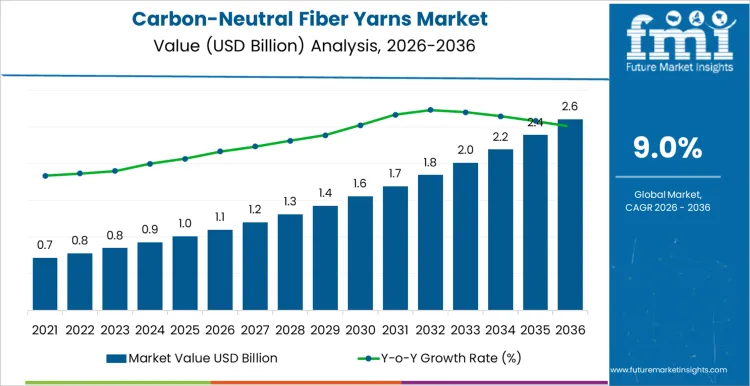
What is the Growth Forecast for the Carbon Neutral Fiber Yarns Market through 2036?
The carbon neutral fiber yarns market in 2026 stands near USD 1.1 billion, shaped by procurement rules that tie material choice to verified footprint accounting. Buyers treat these yarns as a compliance input rather than as a fashion feature. Product approval depends on chain of custody records, energy source disclosure, and audit alignment. Spinners and weavers integrate these yarns into programs that already run on fixed platforms, which limits sudden volume shifts. Value growth comes from wider adoption inside workwear, home textiles, and contract fabrics that carry formal reporting obligations. The expansion to USD 2.6 billion by 2036 follows a 9% growth profile supported by broader specification coverage and higher usage per finished product where reporting scope keeps widening.
Commercial behavior shapes the spending pattern of the carbon neutral fiber yarns market. Orders link to tender cycles, brand program renewals, and long production runs. Inventory policy favors continuity of certified supply over short term price moves. Cost structure reflects energy sourcing, certification overhead, and segregation inside spinning and finishing plants. Annual values pass through the mid and upper one billions during the early 2030s as more product families switch base materials. Purchasing teams focus on audit resilience, documentation quality, and delivery reliability. The rise to USD 2.6 billion by 2036 comes from broader integration across collections, thicker material specifications in some end uses, and longer contracts that lock certified volumes into standard supply chains.
Carbon-Neutral Fiber Yarns Market Key Takeaways
| Metric | Value |
|---|---|
| Market Value (2026) | USD 1.1 billion |
| Forecast Value (2036) | USD 2.6 billion |
| Forecast CAGR (2026-2036) | 9.0% |
How Is the Carbon Neutral Fiber Yarns Market Being Used to Formalize Material Qualification and Chain of Custody Control in Textile Production?
The carbon neutral fiber yarns market operates inside procurement systems that already manage recycled polyester fiber supply chains, bio based textile fibers, textile traceability software platforms, industrial yarn certification programs, sustainable dyeing and finishing chemicals, and textile life cycle assessment services. Spinners treat these yarns as controlled inputs because mass balance errors or undocumented blending invalidate shipment approvals. Qualification focuses on tensile stability, twist consistency, and break behavior since any reprocessing loss alters declared balances. Weaving and knitting plants monitor tension drift and lint formation because both affect yield accounting. Purchasing teams audit documentation flow with the same rigor used for compliance grade packaging materials. Storage, segregation, and labeling protocols become part of production routing because mixing streams breaks audit continuity and forces batch level write offs during inspection and customer acceptance.
The carbon neutral fiber yarns market is evaluated through audit survival, delivery clearance, and contract compliance rather than branding narratives. Programs aligned with circular textile manufacturing systems require every conversion step to preserve chain of custody records. Operators compare suppliers using nonconformance frequency, document correction cycles, and lot reconciliation time. A yarn that processes well but fails paperwork checks creates stoppages that exceed its material cost. Producers invest in energy attribution models, feedstock intake control, and campaign level traceability to keep declarations stable across sites. Converters track waste loops because regrind handling changes declared intensity values. Contracts define audit access, correction windows, and revocation triggers. Demand concentrates in supply programs where shipment release depends on third party verification, not on internal quality acceptance alone.
How Do Certification Pathways and Procurement Rules Shape Demand in the Carbon-Neutral Fiber Yarns Market by Fiber Type and Certification Route in 2026?
In the Carbon-Neutral Fiber Yarns Market, buying decisions start with audit scope, chain-of-custody coverage, and contract language that assigns liability for claims. Specifications reference product passports used in sustainable apparel supply chains and in technical textile manufacturing, where failure to document inputs leads to rejected lots. By fiber type, usage spans polyester and blends, cellulosic and regenerated fibers, polyamide and others, and multi-fiber blends, each presenting different traceability limits. By certification route, demand divides among verified offset-based neutral, in setting and value-chain neutral, mass-balance and accounting schemes, and other claims. Converters serving sportswear and performance fabrics require repeatable documentation packs, while programs tied to home textiles and furnishings emphasize batch identity across long runs. Procurement teams also check alignment with chemical recycling feedstock programs and with industrial yarn spinning operations that impose minimum lot sizes. Once a pathway is written into contracts and labels, substitution becomes difficult because re-audit cycles reset approvals.
Why Do Fiber Type Choices Track Documentation Burden as Much as Material Performance?
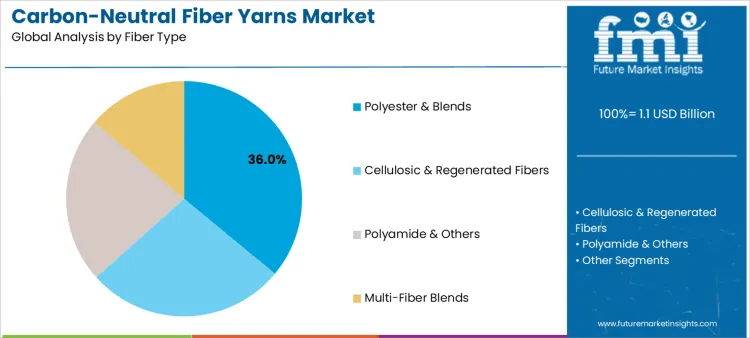
Polyester and blends hold about 36% share because their documentation systems already support multi-step custody and supplier declarations without disrupting throughput. In the Carbon-Neutral Fiber Yarns Market, mills feeding circular textile materials platforms need fibers that can pass identity checks at pellet, yarn, and fabric stages. Cellulosic and regenerated fibers bring strong narrative claims, yet their inputs cross more checkpoints, which raises the cost of verification and sample retention. Polyamide and other synthetics fit programs where durability claims dominate, though their upstream mapping requires tighter supplier coordination.
Multi-fiber blends serve designs that demand property balancing, though each added component multiplies paperwork. Quality managers write control plans that specify sampling, record retention, and lot linking. Production managers write schedules that protect changeover windows and keep winding speeds stable. Legal teams write claim language that survives retailer audits. A fiber family that satisfies all three groups becomes the default. Substitution forces a new document set, new witness tests, and new label approvals. That sequence favors families with mature chain-of-custody tooling and predictable supplier behavior. Volume follows the fibers that keep shipments moving through inspection gates without stopping looms or resetting certification clocks.
How Do Certification Routes Become Embedded in Contracts and Labels?
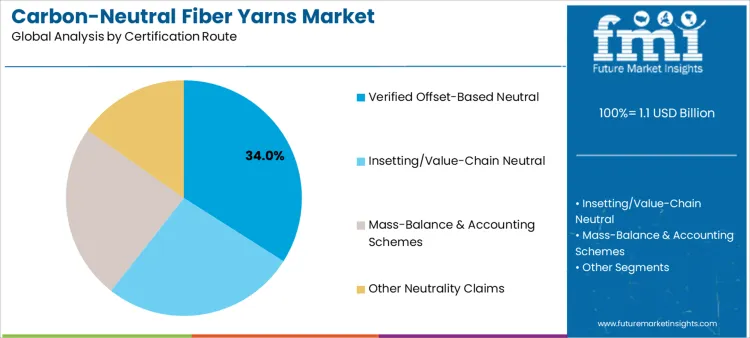
Verified offset-based neutral represents about 34% share because it fits procurement systems that separate physical flow from claim accounting. In the Carbon-Neutral Fiber Yarns Market, this route integrates with purchasing frameworks used by brand compliance programs and retailer audit protocols, where evidence packets are reviewed on schedule rather than per spool. In setting and value-chain neutral ties claims to upstream actions, which increases proof requirements and site audits. Mass-balance and accounting schemes support mixed-input plants that cannot segregate lines, though they require strict ledger control and reconciliation.
Other claims appear in pilot programs with limited volumes. Once a route is printed on labels and woven into specifications, changing it triggers artwork updates, customer approvals, and shelf resets. Logistics teams also plan storage and picking rules around claim classes. Sales teams align contracts to avoid mixed claims inside one shipment. The result is institutional lock-in. Programs expand inside the same route through capacity additions and supplier onboarding. Route changes remain rare because they reset audits and interrupt deliveries. Demand therefore grows along established certification paths rather than through frequent switching.
Why Are Sustainability Targets Driving the Carbon-Neutral Fiber Yarns Market?
Carbon-Neutral Fiber Yarns Market expansion is propelled by corporate decarbonization mandates, lifecycle impact reporting, and procurement policies that prioritize low carbon footprints. Apparel brands, automotive suppliers, and technical textile makers are redefining fiber specifications to align with net zero commitments and supplier scorecards. Carbon-neutral yarns allow converters to reduce Scope 3 emissions without compromising performance or processability. Manufacturers of spun and filament yarns leverage renewable energy, optimized spinning, and verified carbon offsets to validate claims. Buyers focus on traceable supply chains, third party carbon accounting, and consistency with sustainability frameworks. These requirements shift purchasing decisions toward vendors who can document carbon neutrality at the fiber level.
What Factors Are Limiting Adoption and Scale in the Carbon-Neutral Fiber Yarns Market?
Carbon-Neutral Fiber Yarns Market growth is constrained by production cost differentials, certification complexity, and limited infrastructure for low-carbon fiber manufacture. Achieving carbon neutrality requires investments in renewable energy, energy efficiency measures, and carbon management systems that elevate unit costs relative to conventional yarns. Verification through recognized standards introduces additional audit and reporting overhead for suppliers. Variability in renewable energy availability across geographies affects production continuity and pricing consistency. Buyers in price-sensitive segments evaluate cost-benefit tradeoffs and may defer transition until carbon-neutral yarns achieve cost parity with legacy options. Integration with recycling and circular systems remains early stage, which slows adoption in volume applications.
How Are Product Development and Supply Models Evolving in the Carbon-Neutral Fiber Yarns Market?
Product development in the Carbon-Neutral Fiber Yarns Market focuses on process redesign, energy optimization, and expanded offerings that align carbon performance with functional requirements. Suppliers are optimizing fiber spinning routes to reduce energy intensity while maintaining tensile strength, elongation control, and dye uptake. There is a shift toward bundled sustainability credentials, combining carbon neutrality with recycled or bio-based feedstocks. Supply models emphasize long-term agreements that secure renewable energy sourcing and stabilize carbon credit portfolios. Technical collaboration with converters accelerates integration into knit and woven lines with minimal process adjustment. Transparency in carbon accounting and standardized reporting tools become key differentiators for vendors competing in sustainability-driven procurement environments.
What is the Demand for Carbon Neutral Fiber Yarns by Country?
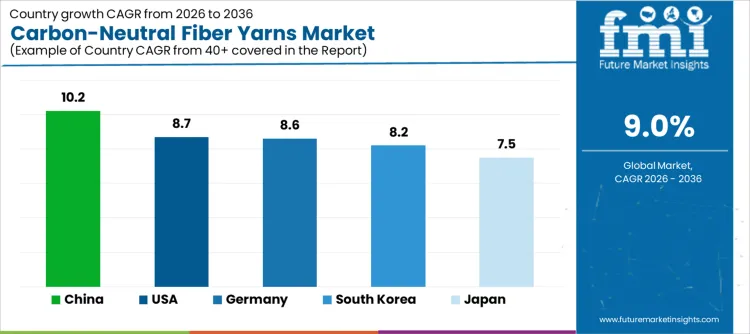
| Country | CAGR (%) |
|---|---|
| USA | 8.7% |
| Japan | 7.5% |
| South Korea | 8.2% |
| Germany | 8.6% |
| China | 10.2% |
The demand for carbon neutral fiber yarns is increasing across apparel, home textiles, and industrial fabric applications as producers adjust sourcing and manufacturing strategies to meet emission reduction targets. China leads at 10.2% CAGR, supported by scale driven textile manufacturing and growing commitments from export oriented mills to offer lower emission product lines. The USA grows at 8.7%, driven by brand programs that specify lower footprint materials in apparel and technical textiles. Germany records 8.6%, shaped by strong demand from performance apparel and automotive interior textiles. South Korea advances at 8.2%, reflecting steady uptake in functional textiles. Japan posts 7.5%, supported by a mature textile sector with emphasis on quality and traceability.
How Do Certification Pathways and Program Specifications Shape Buying in the Carbon Neutral Fiber Yarns Market in the USA?
The Carbon Neutral Fiber Yarns Market in the USA is advancing at an 8.7% CAGR. Entry decisions sit with program owners who manage life cycle assessment compliant textile programs, third party audited low emission fiber systems, traceable recycled polymer yarn platforms, mass balance verified fiber supply chains, automotive interior lightweight reinforcement programs, performance apparel material qualification pipelines, and industrial yarn durability certification frameworks. Engineering teams review tensile retention, fatigue behavior, dye uptake, and process stability before any commercial listing occurs. Once a yarn grade is written into a specification, substitution becomes rare because downstream approvals attach to the same data package. Volumes expand only when those certified programs win contracts. Suppliers gain access through documentation depth and audit readiness. Logistics planning follows program schedules rather than spot orders. Commercial success depends on specification inclusion and repeatable batch conformity.
How Do Manufacturing Governance and Documentation Discipline Control Adoption in the Carbon Neutral Fiber Yarns Market in Japan?
The Carbon Neutral Fiber Yarns Market in Japan is progressing at a 7.5% CAGR. Factory governance places emphasis on closed loop textile material control systems, plant level carbon accounting audit routines, long run process stability verification protocols, fiber origin traceability management schemes, precision weaving input qualification standards, automotive interior textile approval matrices, and industrial fabric durability validation programs. Selection authority remains with technical committees that own production stability metrics. Testing concentrates on creep resistance, tension uniformity, and batch repeatability on operating equipment. Once approved, a yarn remains embedded in the same constructions for extended cycles. Change requests trigger full revalidation. Supplier access depends on documentation quality and audit performance. Local sources benefit from proximity to inspection teams. Volume follows slow portfolio renewal rather than rapid replacement. Commercial positioning relies on consistency and disciplined process support.
How Do Platform Architectures and Multi Program Alignment Drive Scale in the Carbon Neutral Fiber Yarns Market in South Korea?
The Carbon Neutral Fiber Yarns Market in South Korea is moving at an 8.2% CAGR. Product strategy relies on shared platforms that connect next generation mobility interior textile programs, certified low emission composite reinforcement yarn systems, recycled content performance apparel fiber platforms, lightweight industrial fabric architecture frameworks, plant wide material qualification libraries, fiber process window optimization toolkits, and traceability enabled procurement control systems. Central development groups decide which yarn grades become platform standards. Evaluation focuses on creep behavior, dimensional stability, coating compatibility, and run speed tolerance. Once a grade enters the platform core, scale follows across several product families without separate plant approvals. Suppliers secure positions through joint testing and documentation alignment. Volume growth tracks platform rollout schedules. Commercial success depends on early inclusion in platform definitions and stable execution during coordinated launches.
How Do Central Technical Committees Govern Material Choice in the Carbon Neutral Fiber Yarns Market in Germany?
The Carbon Neutral Fiber Yarns Market in Germany is advancing at an 8.6% CAGR. Corporate governance relies on central approval bodies that manage group wide fiber material approval registers, audited carbon accounting textile supply frameworks, standardized yarn performance verification protocols, multi-site process consistency control systems, automotive interior compliance documentation structures, industrial textile lifetime validation programs, and traceability driven procurement governance models. Individual plants cannot introduce changes independently. Reviews concentrate on reproducibility, mechanical stability, and audit completeness. After approval, the same yarn appears across several factories and product lines. Volume expansion follows program growth rather than sales campaigns. Regional suppliers benefit from audit familiarity and logistics reliability. Commercial success depends on passing central reviews and maintaining identical behavior across coordinated production environments over long operating cycles.
How Do Capacity Replication and Program Proliferation Create Volume in the Carbon Neutral Fiber Yarns Market in China?
The Carbon Neutral Fiber Yarns Market in China is expanding at a 10.2% CAGR. Scale comes from rapid replication of approved constructions across new sites serving large volume sustainable apparel material rollouts, electric vehicle interior textile localization programs, certified recycled fiber integration projects, industrial fabric platform expansion plans, group level material standardization systems, plant replication execution playbooks, and supply chain carbon reporting compliance schemes. Approval focuses on consistency, throughput tolerance, and conformity to documented performance windows. Once a yarn works in one factory, it moves into parallel lines with limited redesign. Domestic suppliers dominate because they can follow capacity additions and line transfers. Imports remain concentrated in higher specification uses. Volume growth follows replication speed. Commercial advantage depends on being present when a construction becomes a template.
How Do Suppliers Compete in the Carbon-Neutral Fiber Yarns Market?
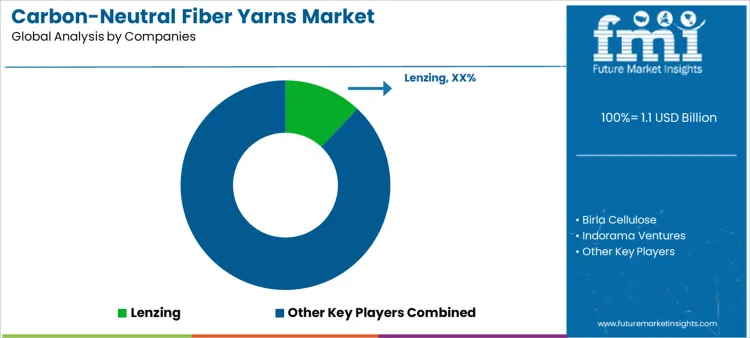
Adoption in the Carbon-Neutral Fiber Yarns Market is driven by sustainability credentials, fiber performance, and supply chain transparency rather than catalog size. Lenzing, Birla Cellulose, Indorama Ventures, Toray Industries, Teijin, Unifi, Far Eastern New Century, Hyosung, Reliance Industries, and Aquafil compete during supplier qualification, sustainability verification, and pilot production stages. Once a yarn enters textile or industrial applications, carbon footprint documentation, fiber uniformity, and processing behavior anchor supplier adoption. Lenzing emphasizes fully traceable, carbon-neutral viscose fibers. Birla Cellulose provides eco-certified fibers with process transparency. Indorama Ventures targets polyester and specialty fibers with verified emissions reductions. Toray and Teijin supply performance fibers aligned with industrial standards. Unifi focuses on recycled and low-carbon polyester. Far Eastern New Century emphasizes sustainable production processes. Hyosung and Reliance Industries offer high-strength and industrial-grade fibers. Aquafil delivers nylon solutions with verified carbon-neutral production pathways.
Technical reliability, carbon reporting, and process consistency determine competitive positioning in the Carbon-Neutral Fiber Yarns Market rather than pricing. R&D and production teams assess fiber uniformity, tensile strength, thermal stability, and dyeing performance during trials. Manufacturers favor suppliers capable of consistent lot quality and supply continuity. Lenzing benefits from established traceable sustainability programs. Birla Cellulose secures placements through eco-certifications and compliance documentation. Indorama Ventures gains adoption in industrial and textile applications with low-carbon solutions. Toray and Teijin maintain positions in high-performance fibers. Unifi competes in recycled and circular economy initiatives. Far Eastern New Century holds share where green production processes are prioritized. Hyosung and Reliance Industries provide fibers for industrial reinforcement. Aquafil captures adoption through fully carbon-neutral nylon offerings. Market positions vary by fiber type, application, regulatory compliance, and regional sourcing practices.
Key Players in Carbon-Neutral Fiber Yarns Market
- Lenzing
- Birla Cellulose
- Indorama Ventures
- Toray Industries
- Teijin
- Unifi
- Far Eastern New Century
- Hyosung
- Reliance Industries
- Aquafil
Scope of the Report
| Items | Values |
|---|---|
| Quantitative Units (2026) | USD billion |
| Fiber Type | Polyester and blends, cellulosic and regenerated fibers, polyamide and others, multi-fiber blends |
| Certification Route | Verified offset-based neutral, in setting and value-chain neutral, mass-balance and accounting schemes, other neutrality claims |
| Application | Apparel and fashion, sports and outdoor, home textiles, other textile uses |
| Customer Segment | Global fashion and sportswear brands, retailers and private labels, technical and workwear brands, other buyers |
| Regions Covered | Asia Pacific, Europe, North America, Latin America, Middle East & Africa |
| Countries Covered | United States, Canada, Mexico, Germany, United Kingdom, France, Italy, Spain, Nordics, BENELUX, China, Japan, South Korea, India, Australia & New Zealand, ASEAN, Brazil, Chile, Saudi Arabia, Turkey, South Africa, and other regional markets |
| Key Companies Profiled | Lenzing, Birla Cellulose, Indorama Ventures, Toray Industries, Teijin, Unifi, Far Eastern New Century, Hyosung, Reliance Industries, Aquafil |
| Additional Attributes | Dollar sales by fiber type, certification route, application, and customer segment, chain-of-custody and audit-driven procurement frameworks, carbon accounting and verification system requirements, integration into apparel, home textile, and workwear sourcing programs, supplier positioning based on documentation depth and traceability continuity, production segregation and batch-level accounting constraints, long-term supply contracts linked to certified collections, and regional adoption patterns shaped by decarbonization mandates and reporting obligations |
Carbon-Neutral Fiber Yarns Market Segmentation
Fiber Type:
- Polyester & Blends
- Cellulosic & Regenerated Fibers
- Polyamide & Others
- Multi-Fiber Blends
Certification Route:
- Verified Offset-Based Neutral
- In setting and Value-Chain Neutral
- Mass-Balance & Accounting Schemes
- Other Neutrality Claims
Application:
- Apparel & Fashion
- Sports & Outdoor
- Home Textiles
- Other Textile Uses
Customer Segment:
- Global Fashion & Sportswear Brands
- Retailers & Private Labels
- Technical & Workwear Brands
- Other Buyers
Region:
- Asia Pacific
- China
- Japan
- South Korea
- India
- Australia & New Zealand
- ASEAN
- Rest of Asia Pacific
- Europe
- Germany
- United Kingdom
- France
- Italy
- Spain
- Nordic
- BENELUX
- Rest of Europe
- North America
- United States
- Canada
- Mexico
- Latin America
- Brazil
- Chile
- Rest of Latin America
- Middle East & Africa
- Kingdom of Saudi Arabia
- Other GCC Countries
- Turkey
- South Africa
- Other African Union
- Rest of Middle East & Africa
Bibliography
- United Nations Environment Programme & One Planet Network. (2023). Sustainability and circularity in the textile value chain: A global roadmap. United Nations Environment Programme.
- International Organization for Standardization. (2023). ISO 14067: Greenhouse gases—Carbon footprint of products—Requirements and guidelines for quantification. International Organization for Standardization.
- International Organization for Standardization. (2024). ISO 22095: Chain of custody—General terminology and models. International Organization for Standardization.
Frequently Asked Questions
How big is the carbon-neutral fiber yarns market in 2026?
The global carbon-neutral fiber yarns market is estimated to be valued at USD 1.1 billion in 2026.
What will be the size of carbon-neutral fiber yarns market in 2036?
The market size for the carbon-neutral fiber yarns market is projected to reach USD 2.6 billion by 2036.
How much will be the carbon-neutral fiber yarns market growth between 2026 and 2036?
The carbon-neutral fiber yarns market is expected to grow at a 9.0% CAGR between 2026 and 2036.
What are the key product types in the carbon-neutral fiber yarns market?
The key product types in carbon-neutral fiber yarns market are polyester & blends, cellulosic & regenerated fibers, polyamide & others and multi-fiber blends.
Which certification route segment to contribute significant share in the carbon-neutral fiber yarns market in 2026?
In terms of certification route, verified offset-based neutral segment to command 34.0% share in the carbon-neutral fiber yarns market in 2026.
Preview the report firsthand - request a free sample
Get SampleGet the brochure for pricing and purchase details.
Get PDFTable of Content
- Executive Summary
- Global Market Outlook
- Demand-side Trends
- Supply-side Trends
- Technology Roadmap Analysis
- Analysis and Recommendations
- Market Overview
- Market Coverage / Taxonomy
- Market Definition / Scope / Limitations
- Market Background
- Market Dynamics
- Drivers
- Restraints
- Opportunity
- Trends
- Scenario Forecast
- Demand in Optimistic Scenario
- Demand in Likely Scenario
- Demand in Conservative Scenario
- Opportunity Map Analysis
- Product Life Cycle Analysis
- Supply Chain Analysis
- Investment Feasibility Matrix
- Value Chain Analysis
- PESTLE and Porter’s Analysis
- Regulatory Landscape
- Regional Parent Market Outlook
- Production and Consumption Statistics
- Import and Export Statistics
- Market Dynamics
- Global Market Analysis 2021 to 2025 and Forecast, 2026 to 2036
- Historical Market Size Value (USD Million) Analysis, 2021 to 2025
- Current and Future Market Size Value (USD Million) Projections, 2026 to 2036
- Y-o-Y Growth Trend Analysis
- Absolute $ Opportunity Analysis
- Global Market Pricing Analysis 2021 to 2025 and Forecast 2026 to 2036
- Global Market Analysis 2021 to 2025 and Forecast 2026 to 2036, By Fiber Type
- Introduction / Key Findings
- Historical Market Size Value (USD Million) Analysis By Fiber Type , 2021 to 2025
- Current and Future Market Size Value (USD Million) Analysis and Forecast By Fiber Type , 2026 to 2036
- Polyester & Blends
- Cellulosic & Regenerated Fibers
- Polyamide & Others
- Multi-Fiber Blends
- Polyester & Blends
- Y-o-Y Growth Trend Analysis By Fiber Type , 2021 to 2025
- Absolute $ Opportunity Analysis By Fiber Type , 2026 to 2036
- Global Market Analysis 2021 to 2025 and Forecast 2026 to 2036, By Certification Route
- Introduction / Key Findings
- Historical Market Size Value (USD Million) Analysis By Certification Route, 2021 to 2025
- Current and Future Market Size Value (USD Million) Analysis and Forecast By Certification Route, 2026 to 2036
- Verified Offset-Based Neutral
- Insetting/Value-Chain Neutral
- Mass-Balance & Accounting Schemes
- Other Neutrality Claims
- Verified Offset-Based Neutral
- Y-o-Y Growth Trend Analysis By Certification Route, 2021 to 2025
- Absolute $ Opportunity Analysis By Certification Route, 2026 to 2036
- Global Market Analysis 2021 to 2025 and Forecast 2026 to 2036, By Application
- Introduction / Key Findings
- Historical Market Size Value (USD Million) Analysis By Application, 2021 to 2025
- Current and Future Market Size Value (USD Million) Analysis and Forecast By Application, 2026 to 2036
- Apparel & Fashion
- Sports & Outdoor
- Home Textiles
- Other Textile Uses
- Apparel & Fashion
- Y-o-Y Growth Trend Analysis By Application, 2021 to 2025
- Absolute $ Opportunity Analysis By Application, 2026 to 2036
- Global Market Analysis 2021 to 2025 and Forecast 2026 to 2036, By Customer Segment
- Introduction / Key Findings
- Historical Market Size Value (USD Million) Analysis By Customer Segment, 2021 to 2025
- Current and Future Market Size Value (USD Million) Analysis and Forecast By Customer Segment, 2026 to 2036
- Global Fashion & Sportswear Brands
- Retailers & Private Labels
- Technical & Workwear Brands
- Other Buyers
- Global Fashion & Sportswear Brands
- Y-o-Y Growth Trend Analysis By Customer Segment, 2021 to 2025
- Absolute $ Opportunity Analysis By Customer Segment, 2026 to 2036
- Global Market Analysis 2021 to 2025 and Forecast 2026 to 2036, By Region
- Introduction
- Historical Market Size Value (USD Million) Analysis By Region, 2021 to 2025
- Current Market Size Value (USD Million) Analysis and Forecast By Region, 2026 to 2036
- North America
- Latin America
- Western Europe
- Eastern Europe
- East Asia
- South Asia and Pacific
- Middle East & Africa
- Market Attractiveness Analysis By Region
- North America Market Analysis 2021 to 2025 and Forecast 2026 to 2036, By Country
- Historical Market Size Value (USD Million) Trend Analysis By Market Taxonomy, 2021 to 2025
- Market Size Value (USD Million) Forecast By Market Taxonomy, 2026 to 2036
- By Country
- USA
- Canada
- Mexico
- By Fiber Type
- By Certification Route
- By Application
- By Customer Segment
- By Country
- Market Attractiveness Analysis
- By Country
- By Fiber Type
- By Certification Route
- By Application
- By Customer Segment
- Key Takeaways
- Latin America Market Analysis 2021 to 2025 and Forecast 2026 to 2036, By Country
- Historical Market Size Value (USD Million) Trend Analysis By Market Taxonomy, 2021 to 2025
- Market Size Value (USD Million) Forecast By Market Taxonomy, 2026 to 2036
- By Country
- Brazil
- Chile
- Rest of Latin America
- By Fiber Type
- By Certification Route
- By Application
- By Customer Segment
- By Country
- Market Attractiveness Analysis
- By Country
- By Fiber Type
- By Certification Route
- By Application
- By Customer Segment
- Key Takeaways
- Western Europe Market Analysis 2021 to 2025 and Forecast 2026 to 2036, By Country
- Historical Market Size Value (USD Million) Trend Analysis By Market Taxonomy, 2021 to 2025
- Market Size Value (USD Million) Forecast By Market Taxonomy, 2026 to 2036
- By Country
- Germany
- UK
- Italy
- Spain
- France
- Nordic
- BENELUX
- Rest of Western Europe
- By Fiber Type
- By Certification Route
- By Application
- By Customer Segment
- By Country
- Market Attractiveness Analysis
- By Country
- By Fiber Type
- By Certification Route
- By Application
- By Customer Segment
- Key Takeaways
- Eastern Europe Market Analysis 2021 to 2025 and Forecast 2026 to 2036, By Country
- Historical Market Size Value (USD Million) Trend Analysis By Market Taxonomy, 2021 to 2025
- Market Size Value (USD Million) Forecast By Market Taxonomy, 2026 to 2036
- By Country
- Russia
- Poland
- Hungary
- Balkan & Baltic
- Rest of Eastern Europe
- By Fiber Type
- By Certification Route
- By Application
- By Customer Segment
- By Country
- Market Attractiveness Analysis
- By Country
- By Fiber Type
- By Certification Route
- By Application
- By Customer Segment
- Key Takeaways
- East Asia Market Analysis 2021 to 2025 and Forecast 2026 to 2036, By Country
- Historical Market Size Value (USD Million) Trend Analysis By Market Taxonomy, 2021 to 2025
- Market Size Value (USD Million) Forecast By Market Taxonomy, 2026 to 2036
- By Country
- China
- Japan
- South Korea
- By Fiber Type
- By Certification Route
- By Application
- By Customer Segment
- By Country
- Market Attractiveness Analysis
- By Country
- By Fiber Type
- By Certification Route
- By Application
- By Customer Segment
- Key Takeaways
- South Asia and Pacific Market Analysis 2021 to 2025 and Forecast 2026 to 2036, By Country
- Historical Market Size Value (USD Million) Trend Analysis By Market Taxonomy, 2021 to 2025
- Market Size Value (USD Million) Forecast By Market Taxonomy, 2026 to 2036
- By Country
- India
- ASEAN
- Australia & New Zealand
- Rest of South Asia and Pacific
- By Fiber Type
- By Certification Route
- By Application
- By Customer Segment
- By Country
- Market Attractiveness Analysis
- By Country
- By Fiber Type
- By Certification Route
- By Application
- By Customer Segment
- Key Takeaways
- Middle East & Africa Market Analysis 2021 to 2025 and Forecast 2026 to 2036, By Country
- Historical Market Size Value (USD Million) Trend Analysis By Market Taxonomy, 2021 to 2025
- Market Size Value (USD Million) Forecast By Market Taxonomy, 2026 to 2036
- By Country
- Kingdom of Saudi Arabia
- Other GCC Countries
- Turkiye
- South Africa
- Other African Union
- Rest of Middle East & Africa
- By Fiber Type
- By Certification Route
- By Application
- By Customer Segment
- By Country
- Market Attractiveness Analysis
- By Country
- By Fiber Type
- By Certification Route
- By Application
- By Customer Segment
- Key Takeaways
- Key Countries Market Analysis
- USA
- Pricing Analysis
- Market Share Analysis, 2025
- By Fiber Type
- By Certification Route
- By Application
- By Customer Segment
- Canada
- Pricing Analysis
- Market Share Analysis, 2025
- By Fiber Type
- By Certification Route
- By Application
- By Customer Segment
- Mexico
- Pricing Analysis
- Market Share Analysis, 2025
- By Fiber Type
- By Certification Route
- By Application
- By Customer Segment
- Brazil
- Pricing Analysis
- Market Share Analysis, 2025
- By Fiber Type
- By Certification Route
- By Application
- By Customer Segment
- Chile
- Pricing Analysis
- Market Share Analysis, 2025
- By Fiber Type
- By Certification Route
- By Application
- By Customer Segment
- Germany
- Pricing Analysis
- Market Share Analysis, 2025
- By Fiber Type
- By Certification Route
- By Application
- By Customer Segment
- UK
- Pricing Analysis
- Market Share Analysis, 2025
- By Fiber Type
- By Certification Route
- By Application
- By Customer Segment
- Italy
- Pricing Analysis
- Market Share Analysis, 2025
- By Fiber Type
- By Certification Route
- By Application
- By Customer Segment
- Spain
- Pricing Analysis
- Market Share Analysis, 2025
- By Fiber Type
- By Certification Route
- By Application
- By Customer Segment
- France
- Pricing Analysis
- Market Share Analysis, 2025
- By Fiber Type
- By Certification Route
- By Application
- By Customer Segment
- India
- Pricing Analysis
- Market Share Analysis, 2025
- By Fiber Type
- By Certification Route
- By Application
- By Customer Segment
- ASEAN
- Pricing Analysis
- Market Share Analysis, 2025
- By Fiber Type
- By Certification Route
- By Application
- By Customer Segment
- Australia & New Zealand
- Pricing Analysis
- Market Share Analysis, 2025
- By Fiber Type
- By Certification Route
- By Application
- By Customer Segment
- China
- Pricing Analysis
- Market Share Analysis, 2025
- By Fiber Type
- By Certification Route
- By Application
- By Customer Segment
- Japan
- Pricing Analysis
- Market Share Analysis, 2025
- By Fiber Type
- By Certification Route
- By Application
- By Customer Segment
- South Korea
- Pricing Analysis
- Market Share Analysis, 2025
- By Fiber Type
- By Certification Route
- By Application
- By Customer Segment
- Russia
- Pricing Analysis
- Market Share Analysis, 2025
- By Fiber Type
- By Certification Route
- By Application
- By Customer Segment
- Poland
- Pricing Analysis
- Market Share Analysis, 2025
- By Fiber Type
- By Certification Route
- By Application
- By Customer Segment
- Hungary
- Pricing Analysis
- Market Share Analysis, 2025
- By Fiber Type
- By Certification Route
- By Application
- By Customer Segment
- Kingdom of Saudi Arabia
- Pricing Analysis
- Market Share Analysis, 2025
- By Fiber Type
- By Certification Route
- By Application
- By Customer Segment
- Turkiye
- Pricing Analysis
- Market Share Analysis, 2025
- By Fiber Type
- By Certification Route
- By Application
- By Customer Segment
- South Africa
- Pricing Analysis
- Market Share Analysis, 2025
- By Fiber Type
- By Certification Route
- By Application
- By Customer Segment
- USA
- Market Structure Analysis
- Competition Dashboard
- Competition Benchmarking
- Market Share Analysis of Top Players
- By Regional
- By Fiber Type
- By Certification Route
- By Application
- By Customer Segment
- Competition Analysis
- Competition Deep Dive
- Lenzing
- Overview
- Product Portfolio
- Profitability by Market Segments (Product/Age /Sales Channel/Region)
- Sales Footprint
- Strategy Overview
- Marketing Strategy
- Product Strategy
- Channel Strategy
- Birla Cellulose
- Indorama Ventures
- Toray Industries
- Teijin
- Unifi
- Far Eastern New Century
- Hyosung
- Reliance Industries
- Aquafil
- Lenzing
- Competition Deep Dive
- Assumptions & Acronyms Used
- Research Methodology


