

- Industry Size (2026)
- USD 4.8 Bn
- Forecast (2036)
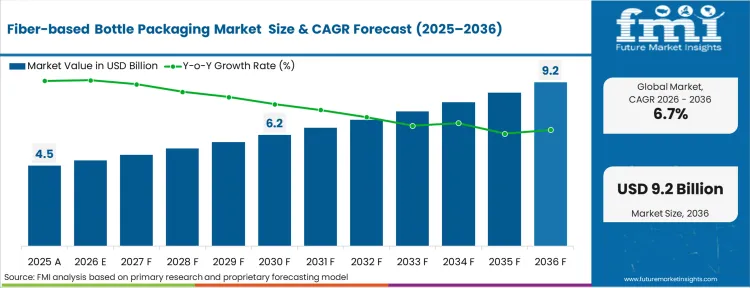
- USD 9.2 Bn
- CAGR (2026 to 2036)
- 6.72%
Fiber-based Bottle Packaging Market Size, Market Forecast and Outlook By FMI
The Fiber-based Bottle Packaging Market was valued at USD 4.5 billion in 2025. The industry is poised to reach USD 4.8 billion in 2026 at a CAGR of 6.72% during the forecast period. Revenue expansion propels the total opportunity to USD 9.2 billion through 2036 as institutional brand mandates for plastic-free portfolios accelerate adoption as a defensive move against tightening single-use plastic bans.
The transformation in this sector is driven by a fundamental shift in how procurement directors evaluate material circularity. Brands are moving beyond simple recyclability and are now being forced to decide between maintaining legacy plastic infrastructure or investing in fiber-native filling lines. Delaying this transition risks losing access to eco-conscious retail shelf space and facing higher extended producer responsibility penalties. FMI analysts observe that many early adopters are discovering that the paper bottles trajectory is limited less by the fiber itself and more by the availability of high-barrier, bio-based coatings that can withstand long-distance logistics.
Summary of Fiber-based Bottle Packaging Market
- Fiber-based Bottle Packaging Market Definition:
- The market represents a structural shift toward liquid containers manufactured from renewable cellulosic fibers, utilizing advanced moulding techniques to provide functional parity with rigid plastics while ensuring high repulpability.
- Demand Drivers in the Market:
- Regulatory pressure on single-use plastics forces packaging managers to qualify non-petrochemical alternatives for high-volume liquid lines.
- Consumer preference for tactile, premium sustainable materials compels brand owners to adopt fiber formats as a key differentiator in crowded retail environments.
- Corporate sustainability mandates require procurement heads to reduce scope 3 emissions by transitioning from energy-intensive glass to lightweight, carbon-sequestering fiber alternatives.
- Key Segments Analyzed in the FMI Report:
- Wood Pulp: Wood Pulp is expected to hold 42.3% share in 2026, as its superior fiber length provides the structural integrity required for pressurized carbonated beverage lines.
- Beverages: Beverages is projected to account for 38.6% share in 2026, driven by massive pilot investments from global spirits and soft-drink conglomerates seeking sustainable packaging solutions.
- 250ml to 500ml: This volume segment is estimated to lead with 45.2% share, aligning with the standard sizing for personal care and single-serve beverage retail.
- India: India records a 9.1% compound growth, benefiting from a robust domestic supply of agricultural residue fibers and aggressive state-level plastic bans.
- Analyst Opinion at FMI:
- Ismail Sutaria, Principal Consultant, Packaging, at FMI, opines, "The market holds a paradox where the most sustainable fiber bottles are often the hardest to scale commercially. While the industry fixates on the bottle body, the practitioner's reality is that the capping mechanism and label adhesive often remain the 'un-solvable' plastic components that delay a truly 100% bio-based launch. Success in this space will not be won by the company with the best fiber, but by the one that solves the high-speed sealing integrity without resorting to internal plastic liners."
- Strategic Implications / Executive Takeaways:
- Brand owners must initiate multi-year qualification cycles for barrier coatings to ensure shelf-life parity before committing to mass-market fiber bottle rollouts.
- Filling line operators should evaluate the capital expenditure required to adapt existing PET lines for fiber bottle handling to avoid significant throughput bottlenecks.
- Material suppliers face a critical need to secure long-term contracts for high-quality virgin pulp to mitigate price volatility as demand from the packaging sector surges.
- Methodology:
- Primary interviews focused on decision-makers within the global FMCG supply chain to capture on-the-ground adoption timelines.
- Market sizing utilizes a bottom-up approach based on machine-tool orders and specialized fiber-moulding capacity expansion.
- Forecasts account for the lag between regulatory announcement and actual procurement shift in major geographic hubs.
- Data validation includes cross-referencing with global pulp production indices and regional waste management infrastructure readiness.
A critical inflection point for the market rests on the standardization of high-speed capping mechanisms. Until fiber-based containers can achieve sealing parity with plastic ROPP or screw-cap systems without compromising the monomaterial claim, growth remains tethered to premium niche pilots. Once a truly plastic-free, high-pressure closure system reaches commercial scale, the industry will see a rapid transition from secondary packaging trials to primary liquid containment.
India is anticipated to record a CAGR of 9.1%, while China is predicted to advance at 8.4%. Brazil is set to register 5.8%, followed by the USA at 5.2% and Germany at 4.8%. The United Kingdom is likely to post 4.2% growth, with Japan estimated to track at 3.5% through 2036. This divergence is driven by localized manufacturing maturity and the differing urgency of domestic plastic-reduction legislation across these key hubs.
Fiber-based Bottle Packaging Market Key Takeaways
| Metric | Details |
|---|---|
| Industry Size (2026) | USD 4.8 Billion |
| Industry Value (2036) | USD 9.2 Billion |
| CAGR (2026-2036) | 6.72% |
Source: Future Market Insights (FMI) analysis, based on proprietary forecasting model and primary research
Fiber-based Bottle Packaging Market Definition
The fiber-based bottle packaging market comprises the design, manufacturing, and distribution of liquid containers primarily constructed from cellulosic fibers such as wood pulp, recycled paper, and agricultural residues. These bottles are distinguished by their three-dimensional moulded structure and the integration of internal barrier coatings designed to hold liquids while maintaining structural integrity. Functional differentiation lies in their ability to be recycled within existing paper streams while providing a tactile, sustainable alternative to rigid plastics and glass.
Fiber-based Bottle Packaging Market Inclusions
Inclusions encompass all moulded fiber containers, bagasse-based bottles, and multi-layered paper-based bottles equipped with bio-polymer or thin-film liners. The scope also covers specialized moulded fibre formats used for dry-moulding processes and high-density fiber packaging intended for premium beverage and personal care applications. Services related to the custom prototyping of fiber bottle geometries and the development of proprietary barrier coatings are also within the analytical boundary.
Fiber-based Bottle Packaging Market Exclusions
Explicitly excluded from this market are traditional liquid packaging cartons (Tetra Pak style), which rely on folding-boxboard technology rather than bottle-moulding processes. Flexible pouches, even those with high paper content, are excluded due to their lack of a rigid, bottle-like architecture. Additionally, industrial-scale fiber drums and secondary paperboard wraps that do not function as primary liquid containment vessels are omitted to maintain focus on the specific structural bottle category.
Fiber-based Bottle Packaging Market Research Methodology
- Primary Research: FMI conducted interviews with Procurement Directors at global beverage conglomerates, R&D Leads at moulded pulp manufacturing firms, and Sustainability Officers at tier-1 personal care brands.
- Desk Research: Data aggregation focused on international standards registries, global plastic-ban regulatory timelines, and patent filings related to cellulosic barrier coatings and high-speed dry-moulding equipment.
- Market-Sizing and Forecasting: The baseline anchors to observable installation rates of dry-moulding production lines and verified pilot-scale volume announcements from key brand owners.
- Data Validation and Update Cycle: Forecasts were cross-validated against independent paper-pulp pricing indices and historical adoption curves of adjacent sustainable packaging formats to triangulate demand patterns.
Segmental Analysis
Fiber-based Bottle Packaging Market Analysis by Material Type
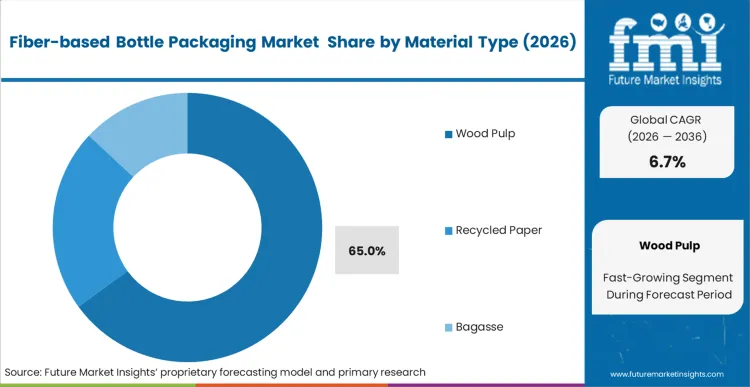
The displacement of legacy rigid plastics is most evident in how material selection now favors structural resilience over sheer cost. The transition away from fossil-fuel-derived polymers is not merely a choice of "green" alternatives but a calculated shift toward pulp and paper technologies that can survive the rigors of automated conveyor systems. FMI analysts suggest that while recycled content is a high priority, virgin fibers currently provide the necessary tensile strength that ensures bottles do not collapse under the vertical pressure of high-speed capping. Buyers are increasingly forced to balance the environmental narrative of recycled paper against the operational necessity of virgin wood pulp's performance.
- Initial procurement triggers: The decision to utilize wood pulp is often dictated by the need for surface smoothness that allows for high-quality direct-to-bottle printing and branding. Packaging managers prioritize this material to maintain premium aesthetic standards while meeting stringent sustainability goals.
- Qualification validation: During the testing phase, the consistency of fiber length in wood pulp validates the structural integrity of the bottle neck, preventing sealing failures. This ensures that the chosen format can withstand standard palletization and stacking heights during transit.
- Renewal mechanisms: Long-term adoption is secured when the fiber source can be traced back to certified sustainable forests, satisfying the audit requirements of global ESG frameworks. Brands expand their use of these materials as they achieve a reliable, high-yield production cycle that mimics PET throughput.
Fiber-based Bottle Packaging Market Analysis by Application
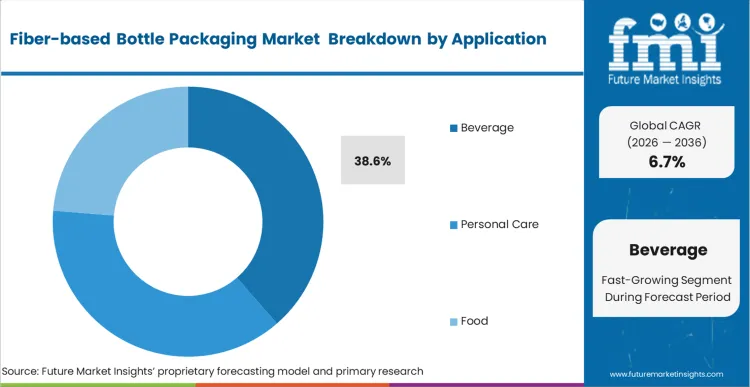
The logic of dominant share in application segments reveals that beverage packaging leaders are the primary architects of this market's growth. The 38.6% share held by beverages is not accidental; it is the result of massive capital injections by global spirits and soft-drink giants seeking to insulate themselves from future plastic taxes. According to FMI's estimates, these players are not just buying bottles but are investing in the entire manufacturing ecosystem to ensure supply security. This application segment serves as the testing ground for barrier technologies that will eventually migrate into personal care and food sectors.
- Upstream cost origins: Savings in the beverage procurement cycle are realized through the lightweighting of fiber bottles compared to glass, significantly reducing secondary freight costs. Logistics directors capture these savings to offset the initial unit-price premium of molded fiber formats.
- Operational hidden costs: In the filling phase, hidden costs often emerge from the need for specialized moisture-resistant labels that do not compromise the repulpability of the fiber substrate. Operators must account for these secondary material costs when calculating the total cost of ownership.
- Lifecycle comparisons: A total lifecycle analysis reveals that fiber bottles offer a superior carbon-sequestration profile compared to aluminum or plastic, even when accounting for the energy-intensive drying processes. This comparison drives executive-level shifts toward fiber in markets with high carbon-tax exposure.
Fiber-based Bottle Packaging Market Analysis by Volume Capacity
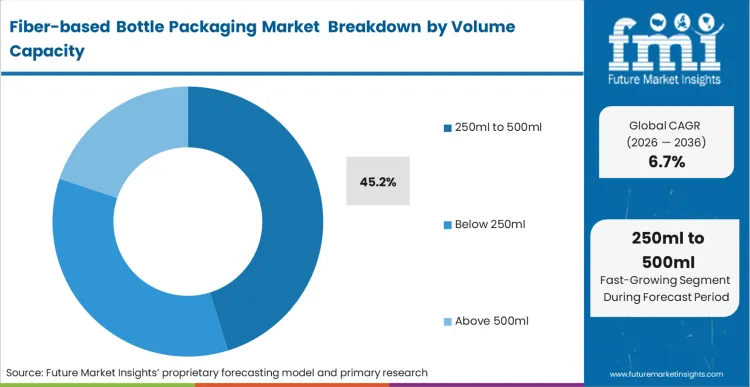
A specific decision facing brand managers today is whether to optimize for the most common retail footprints or to innovate in niche volume categories. The 45.2% share captured by the 250ml to 500ml segment reflects the industry's focus on the "sweet spot" of single-serve consumer goods packaging where consumer visibility is highest. FMI notes that choosing this volume capacity is a strategic move to maximize brand exposure in the high-traffic convenience retail channel. However, failure to address the unique structural stresses of larger volumes could limit the market's reach into the household and bulk-beverage categories.
- Primary failure prevention: Specifying a 250-500ml volume prevents the risk of structural "creep" or bulging that can occur in larger fiber containers under the weight of liquid contents. This choice ensures a stable shelf presence and maintains the tactile quality consumers expect.
- Edge condition risks: Residual risks remain when these bottles are subjected to extreme humidity or temperature fluctuations during maritime shipping, which can soften the fiber structure. Buyers must qualify barrier coatings specifically for these edge-case environments to avoid catastrophic product loss.
- Benefit capture requirements: To capture the full marketing benefit of fiber packaging, brands must educate consumers on the correct disposal of specialized caps and liners. The operational success of the fiber bottle is intrinsically linked to the consumer's ability to navigate the end-of-life process.
Fiber-based Bottle Packaging Market Drivers, Restraints, and Opportunities
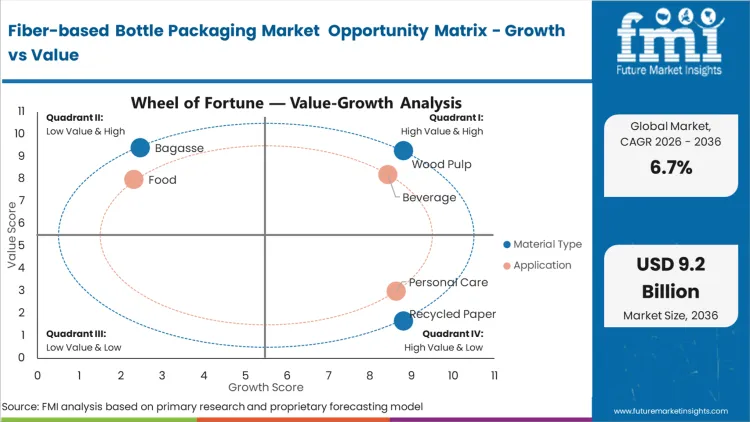
The primary structural forcing condition in this market is the misalignment between existing plastic-centric waste infrastructure and the rapid emergence of complex fiber-based formats. According to FMI's assessment, eco-friendly packaging mandates are forcing procurement directors at global brands to make immediate "convert or pay" decisions as regional plastic taxes escalate. This is not a shift driven by consumer sentiment alone; it is a defensive restructuring of the global supply chain to avoid the commercial stakes of being locked out of regulated markets.
The biggest structural friction is the operational qualification cycle for barrier coatings. Unlike plastic, which is inherently liquid-proof, fiber requires a complex internal treatment that must remain 100% repulpable to meet sustainability claims. This friction is structural because it involves the chemical engineering of coatings that can survive the shelf-life requirements of acidic or carbonated liquids without migrating into the product. The partial solution currently involves bio-polymers, but limited production capacity for these coatings remains a significant bottleneck that prevents mass-market displacement of PET.
Opportunities in the Fiber-based Bottle Packaging Market
- Barrier coating integration: The structural need for plastic-free, water-vapor-resistant barriers enables coating innovators to capture high-margin contracts with tier-1 moulded pulp manufacturers.
- Dry-moulding equipment: Machine tool builders who can provide high-throughput, energy-efficient dry-moulding lines have the opportunity to replace legacy wet-pulp systems in rapidly modernizing manufacturing hubs.
- Premium spirits branding: Distillers can utilize the unique biodegradable packaging textures and geometries of fiber bottles to command a price premium in the luxury retail segment, capturing the "eco-luxury" demographic.
Regional Analysis
Based on the regional analysis, the Fiber-based Bottle Packaging market is segmented into North America, Europe, Asia Pacific, Latin America, Middle East, and Africa across 40 plus countries.
.webp "Top Country Growth Comparison Fiber Based Bottle Packaging Market Cagr (2026 2036)")
| Country | CAGR (2026 to 2036) |
|---|---|
| India | 9.1% |
| China | 8.4% |
| Brazil | 5.8% |
| USA | 5.2% |
| Germany | 4.8% |
| United Kingdom | 4.2% |
| Japan | 3.5% |
Source: Future Market Insights (FMI) analysis, based on proprietary forecasting model and primary research
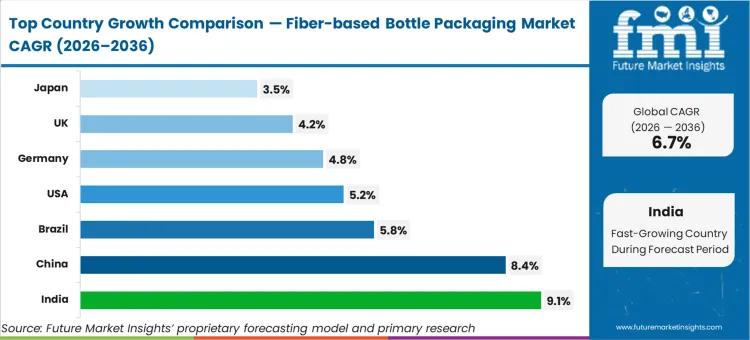
Asia Pacific Fiber-based Bottle Packaging Market Analysis
Economics-led dynamics define the Asia Pacific landscape, where the convergence of massive manufacturing capacity and low-cost agricultural residues creates a unique adoption environment. FMI analysts observe that the region is transitioning from being a primary exporter of molded pulp packaging to a significant domestic consumer, driven by the expansion of organized retail in India and China. The structural lens here is one of scale; as local manufacturers achieve high-volume efficiencies, the unit cost of fiber bottles is dropping faster than in western markets, making them a viable alternative even for mass-market consumer goods.
- India: The rapid expansion of India's manufacturing base for agricultural residue fibers provides a structural cost advantage that is unmatched globally. Procurement managers in India are increasingly shifting toward bagasse-based bottles to satisfy aggressive state-level plastic bans while maintaining price parity. The market is advancing at 9.1% compound between 2026 and 2036. This creates an immediate opportunity for brands to capture the growing eco-conscious middle-class consumer segment.
- China: China's trajectory is defined by the central government's systematic phasing out of non-degradable plastics in major urban centers. This policy shift forces domestic beverage brands to integrate fiber-based formats into their 2030 sustainability roadmaps or face exclusion from premium retail channels. China is expected to see its fiber bottle sector grow at a compound annual rate of 8.4%. This structural shift positions Chinese manufacturers as global leaders in the export of specialized fiber-moulding equipment.
- Japan: Japan's structural trajectory involves a high-tech approach to cellulosic chemistry, focusing on high-barrier nanofiber coatings. The domestic market for fiber bottles is projected to witness growth at a CAGR of 3.5%. This modest rate reflects a market that prioritizes ultra-high performance and perfection in barrier integrity before committing to mass-market rollouts, creating a highly sophisticated but slower-moving landscape.
Europe Fiber-based Bottle Packaging Market Analysis
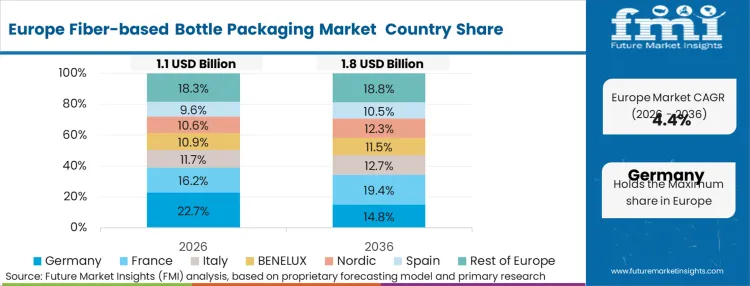
Policy-led structural conditions in Europe make the adoption of fiber bottles an economic necessity rather than a voluntary branding choice. FMI's view is that the European Green Deal and evolving Extended Producer Responsibility (EPR) frameworks are the primary drivers, penalizing mixed-material packaging and rewarding monomaterial fiber solutions.
- Germany: Germany's updated packaging legislation creates a direct cost differential between legacy plastic-lined containers and truly repulpable fiber bottles, making the transition a structural economic calculation. The German fiber bottle sector is set to achieve a CAGR of 4.8%. The reality for practitioners is that the cost of inaction is rising annually as carbon-weighted packaging taxes become more punitive for traditional formats.
- United Kingdom: The UK's infrastructure for paper recycling is among the most mature, providing a ready-made end-of-life pathway for fiber-based bottles. UK beverage brands are projected to register a CAGR of 4.2% as they leverage this infrastructure to claim true "closed-loop" status. This opens a commercial opportunity for brands to win preferred supplier status in retail procurement frameworks that prioritize verifiable circularity.
North America Fiber-based Bottle Packaging Market Analysis
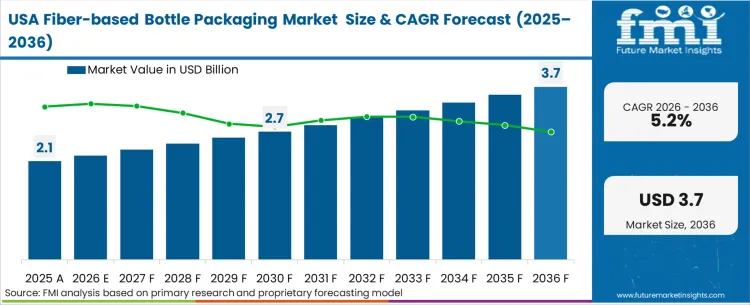
Infrastructure-led dynamics in North America center on the modernization of legacy pulp and paper mills to serve the emerging 3D-moulding packaging sector. As per FMI's projection, the region's focus is on securing domestic supply chains for high-quality wood pulp to reduce reliance on imported specialty papers.
- USA: The competitive positioning of U.S.-based brands is increasingly tied to their ability to provide plastic-free alternatives in the highly scrutinized personal care and premium beverage sectors. Demand for fiber bottle packaging in the USA is set for a CAGR of 5.2%. Companies that move first to qualify these formats are effectively "future-proofing" their portfolios against anticipated federal-level plastic restrictions.
Latin America Fiber-based Bottle Packaging Market Analysis
In Latin America, the market is primarily driven by the availability of abundant virgin fiber resources and the growing influence of multinational brands implementing global sustainability standards.
- Brazil: Brazil's structural advantage lies in its world-class eucalyptus pulp industry, which provides a consistent and high-quality feedstock for the fiber-moulding sector. Sales of fiber bottle products in Brazil are on track to record a CAGR of 5.8%. The operational outcome for Brazilian bottlers who transition to fiber is a significant reduction in the environmental footprint of their primary packaging, aligning with global export requirements.
FMI's report includes detailed analysis of Mexico, South Africa, and Southeast Asian markets. A structural pattern across these additional hubs shows a "leapfrog" effect where newer filling facilities are being designed for fiber handling from day one, bypassing the expensive retrofitting phase seen in North America.
Competitive Aligners for Market Players
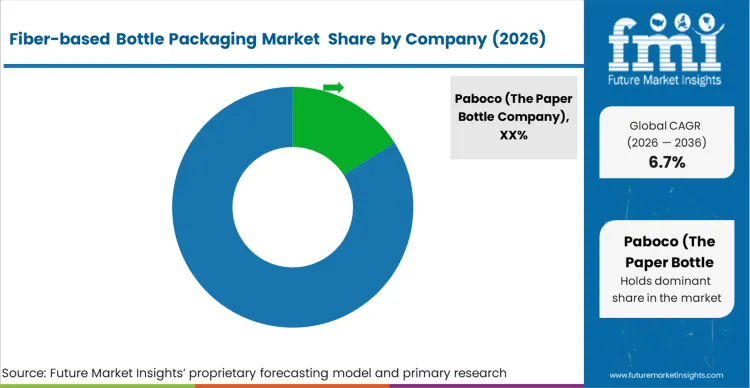
The structural reason for the concentration in the fiber bottle market stems from the extreme intellectual property (IP) barriers surrounding barrier coatings and high-speed dry-moulding processes. Buyers do not distinguish vendors based on pulp quality alone; they select based on the verifiable shelf-life performance of the internal coating and the manufacturer's ability to scale to millions of units. Leading players like Paboco and Pulpex have consolidated power by forming "pioneer communities" with global brand owners, effectively locking in future demand before the technology even reached mass-market maturity. Qualified vendors are those who can provide a complete rigid packaging ecosystem, including the cap and labeling solution, rather than just the bottle body.
Incumbents like Billerud and Stora Enso possess a structural advantage through their vertical integration into forest management and pulp production, which allows them to absorb price volatility that would crush smaller converters. To replicate this, a challenger must build not just a moulding plant, but a sophisticated cellulosic chemistry lab capable of iterating on bio-based barriers. The advantage persists because the "flight to fiber" is happening faster than the supply chain can qualify new material sources. A challenger must therefore demonstrate a "gate-to-gate" sustainability file that meets the rigorous auditing standards of Fortune 500 ESG departments, a capability that requires significant institutional maturity.
The competitive trajectory to 2036 is defined by the structural tension between buyer preferences for "pure" fiber and the technical necessity of functional additives. Large buyers are resisting vendor lock-in by demanding open-standard recycling profiles, forcing competitors to move away from proprietary, hard-to-recycle coatings toward standardized repulpable chemistries. As the market matures, FMI opines that the sector will transition from a highly concentrated R&D-led structure to a more fragmented conversion-led one as the core moulding technologies become commoditized. However, the high-pressure beverage segment will remain concentrated among a few tier-1 players who can manage the high-risk qualification cycles of carbonated liquids.
Key Players in Fiber-based Bottle Packaging Market
- Paboco (The Paper Bottle Company)
- Pulpex Limited
- Billerud AB
- Eco-Bottle AS
- Stora Enso Oyj
- Moulded Fibre Product Ltd.
- Cullen Eco-Friendly Packaging
- Fiber-X
- Absolut Company (Collaborator)
- Coca-Cola Company (Collaborator)
- Diageo (Collaborator)
- L’Oréal (Collaborator)
Scope of the Report
| Metric | Value |
|---|---|
| Quantitative Units | USD 4.8 Billion to USD 9.2 Billion, at a CAGR of 6.72% |
| Market Definition | A segment of the rigid packaging industry focusing on liquid containers moulded from renewable cellulosic fibers and treated with repulpable barrier coatings. |
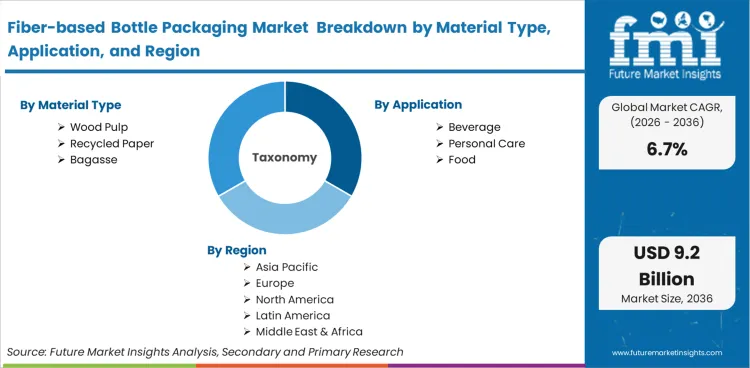
| Material Type Segmentation | Wood Pulp, Recycled Paper, Bagasse, Other Agricultural Fibers |
| Application Segmentation | Beverages, Personal Care, Food, Household Products |
| Volume Capacity Segmentation | Below 250ml, 250ml to 500ml, Above 500ml |
| Regions Covered | North America, Europe, Asia Pacific, Latin America, Middle East, Africa |
| Countries Covered | India, China, Brazil, USA, Germany, UK, Japan, and 40 plus countries |
| Key Companies Profiled | Paboco, Pulpex, Billerud, Eco-Bottle, Stora Enso, Moulded Fibre Product, Cullen Eco-Friendly Packaging |
| Forecast Period | 2026 to 2036 |
| Approach | Primary interviews with procurement directors and R&D leads, cross-referenced with machine-tool order data and global pulp indices to triangulate structural demand. |
Source: Future Market Insights (FMI) analysis, based on proprietary forecasting model and primary research
Fiber-based Bottle Packaging Market Analysis by Segments
Material Type:
- Wood Pulp
- Recycled Paper
- Bagasse
- Other Agricultural Fibers
Application:
- Beverages
- Personal Care
- Food
- Household Products
Volume Capacity:
- Below 250ml
- 250ml to 500ml
- Above 500ml
Region:
- North America
- USA
- Canada
- Europe
- Germany
- United Kingdom
- France
- Italy
- Spain
- Asia Pacific
- China
- India
- Japan
- Australia
- Latin America
- Brazil
- Mexico
- Middle East and Africa
Bibliography
- ISO. (2024, January). ISO 18604:2013 Packaging and the environment - Material recycling. ISO Standards Catalogue.
- Pulpex. (2024, May). Technology and Sustainability Report. Pulpex Official Site.
- Billerud. (2024, February). Annual and Sustainability Report 2023. Billerud Corporate IR.
- European Paper Packaging Alliance (EPPA). (2024, March). Life Cycle Assessment of Paper vs Plastic. EPPA Publications.
- Stora Enso. (2024, June). Fibre-based packaging solutions. Stora Enso Products.
- Confederation of European Paper Industries (CEPI). (2024, April). Key Statistics 2023. CEPI Statistics.
- U.S. Environmental Protection Agency (EPA). (2024, August). Advancing Sustainable Materials Management. EPA Gov Archive.
- ISTA. (2024, July). ISTA 3 Series Support. ISTA Packaging Testing.
- Paboco. (2024, April). The Next Generation Paper Bottle. Paboco News.
- Food and Drug Administration (FDA). (2024, September). Guidance for Industry: Preparation of Food Contact Substances. FDA Regulatory Guidance.
This bibliography is provided for reader reference. The full FMI report contains the complete reference list with primary source documentation.
This Report Addresses
- Market intelligence to support strategic decision making across wood pulp, recycled paper, and bagasse-based bottle formats.
- Market size estimation and 10-year revenue forecasts from 2026 to 2036, supported by bottom-up machine-tool installation tracking and primary R&D interviews.
- Growth opportunity mapping across beverage and personal care applications with emphasis on the standardization of plastic-free high-speed capping mechanisms.
- Segment and regional revenue forecasts covering single-serve and bulk volume capacities across evolving EPR regulatory environments.
- Competition strategy assessment including IP-based barrier coating advantages and vertical integration within the pulp and paper supply chain.
- Technology development tracking including bio-polymer barrier advancements, dry-moulding throughput efficiencies, and cellulosic nanofiber treatments.
- Market access analysis covering FDA/EFSA food-contact compliance pathways and national-level single-use plastic ban timelines.
- Market report delivery in PDF, Excel, PPT, and interactive dashboard formats for executive strategy, procurement planning, and sustainability benchmarking use.
Frequently Asked Questions
How large is the Fiber-based Bottle Packaging Market in 2026?
The market is valued at USD 4.8 billion in 2026. This figure signals that the industry is successfully transitioning from pilot-scale R&D experiments to commercial-scale production lines, backed by significant capital commitments from global beverage and personal care brands.
What will it be valued at by 2036?
The valuation is projected to reach USD 9.2 billion by the end of 2036. This growth suggests a decade-long structural shift where fiber bottles move from a "sustainable alternative" to a standard format for short-shelf-life retail liquids.
What CAGR is projected for the Fiber-based Bottle Packaging Market?
A CAGR of 6.72% is expected during the forecast period. This rate reflects the pace of filling-line modernization and the time required for manufacturers to qualify new high-barrier, plastic-free coatings that meet global food safety standards.
Which Material Type segment leads?
Wood Pulp leads the market with 42.3% share in 2026. The dominance is driven by the structural mechanism where virgin wood fibers provide the necessary tensile strength and smooth surface finish required for high-speed automated labeling and capping processes.
Which Application segment leads the market?
Beverages leads with 38.6% share. This leadership is sustained by the massive investment from global spirits and soft-drink conglomerates who are utilizing fiber bottles as a strategic defensive move against escalating plastic taxes and consumer brand scrutiny.
Which Volume Capacity segment leads?
The 250ml to 500ml segment holds 45.2% share. This leads because it perfectly aligns with the standard sizing for single-serve retail, which is the primary testing ground for brands to demonstrate sustainability without the structural risks associated with larger-volume liquid weights.
What drives the rapid growth of fiber bottle adoption?
Growth is driven by a non-obvious mechanism where brands use fiber packaging as a "bridge" to lower their Scope 3 emissions. This structural insight reveals that the move is often an accounting strategy for carbon-reduction targets as much as it is a consumer marketing gesture.
What is the primary restraint facing the Fiber-based Bottle Packaging Market?
The primary restraint is the technical gap in barrier parity for long-shelf-life products. The structural insight here is that until fiber bottles can provide oxygen and moisture protection identical to PET for 12+ months, their use will be limited to rapid-turnover retail items.
Which country grows fastest in the Fiber-based Bottle Packaging Market?
India is the fastest-growing market with a CAGR of 9.1%. Compared to China's 8.4%, India's growth is driven by a more fragmented but rapidly modernizing local manufacturing base that utilizes low-cost agricultural residues to leapfrog expensive virgin-pulp imports.
How do extended producer responsibility (EPR) laws affect this market?
EPR laws function as a structural tax on hard-to-recycle materials, creating a direct economic incentive for brands to shift toward fiber. The mechanism forces a permanent increase in the cost of plastic, making the higher unit price of fiber bottles a net-positive investment over a 5-year cycle.
Is the barrier coating in a fiber bottle truly plastic-free?
While many first-generation bottles use thin plastic liners, the industry is moving toward "aqueous" or bio-based coatings. The structural shift involves chemical engineering where the barrier becomes part of the fiber matrix, allowing it to be repulped in standard paper recycling streams without specialized equipment.
Can fiber bottles be used for carbonated beverages?
Currently, only a few tier-1 manufacturers have achieved the structural integrity required to hold internal pressure. The mechanism involves specialized "dry-moulding" that creates a higher-density fiber wall, preventing the bottle from "exploding" or leaking under CO2 pressure.
What is the difference between wet-moulding and dry-moulding for fiber bottles?
Wet-moulding is the legacy process that is slower and energy-intensive due to drying times. Dry-moulding is a structural innovation that uses heat and pressure to form the bottle with minimal water, resulting in higher throughput and a smoother finish that mimics the precision of plastic molding.
How does the recycling process work for fiber-based bottles?
Most fiber bottles are designed to be dropped directly into the blue bin (paper stream). The structural dynamic is that the internal coating is engineered to break down during the hydropulping process, allowing the high-quality fibers to be recovered and reused in secondary paper products.
Why is bagasse becoming a popular material for fiber bottles?
Bagasse is a byproduct of sugarcane processing, offering a structural advantage as a "zero-waste" feedstock. In regions like Brazil and India, it provides a low-cost, domestically sourced alternative to wood pulp, reducing the carbon footprint of the raw material sourcing.
Does the capping system affect the recyclability of the bottle?
Yes, the capping mechanism is the current "bottleneck" of the industry. If a fiber bottle requires a plastic ROPP cap, it complicates the monomaterial claim. Structural innovation is focused on paper-based screw caps that can maintain seal integrity under torque.
What is the shelf life of a product in a fiber bottle?
For most current applications, the shelf life is 6 to 9 months. This is shorter than the 12 to 24 months offered by glass or PET, which is why fiber bottles are currently focused on high-turnover categories like milk, water, and premium short-aged spirits.
How do fiber bottles handle temperature fluctuations during shipping?
Extreme humidity is a significant risk as it can soften the cellulosic structure. The structural response is the application of external hydrophobic coatings that prevent ambient moisture from compromising the bottle's vertical load-bearing capacity.
Who are the primary buyers of fiber-based bottle packaging?
The primary buyers are global FMCG brands in the beverage and personal care sectors. These organizations have the R&D budgets to co-develop custom geometries and the volume requirements to justify the initial setup costs of new fiber-moulding lines.
How does FMI validate its fiber bottle market forecasts?
FMI uses a bottom-up methodology that tracks the installation of specialized dry-moulding equipment and the long-term pulp-supply contracts signed by major packaging converters to triangulate actual production capacity.
What are the exclusions in the FMI fiber bottle report?
The report excludes traditional gable-top or aseptic cartons (like juice boxes) which are made from folding boxboard. It specifically focuses on 3D-moulded "bottle-shaped" containers that compete directly with the rigid plastic and glass bottle categories.
What will be the end-state of the market by 2036?
By 2036, fiber bottles are expected to be the standard format for "eco-premium" tiers in retail. The structural end-state is an industry where fiber handles the majority of short-term liquid retail, while glass and specialized polymers are reserved for ultra-long-shelf-life or hazardous materials.
Preview the report firsthand - request a free sample
Get SampleGet the brochure for pricing and purchase details.
Get PDFTable of Content
- Executive Summary
- Global Market Outlook
- Demand-side Trends
- Supply-side Trends
- Technology Roadmap Analysis
- Analysis and Recommendations
- Market Overview
- Market Coverage / Taxonomy
- Market Definition / Scope / Limitations
- Research Methodology
- Chapter Orientation
- Analytical Lens and Working Hypotheses
- Market Structure, Signals, and Trend Drivers
- Benchmarking and Cross-market Comparability
- Market Sizing, Forecasting, and Opportunity Mapping
- Research Design and Evidence Framework
- Desk Research Programme (Secondary Evidence)
- Company Annual and Sustainability Reports
- Peer-reviewed Journals and Academic Literature
- Corporate Websites, Product Literature, and Technical Notes
- Earnings Decks and Investor Briefings
- Statutory Filings and Regulatory Disclosures
- Technical White Papers and Standards Notes
- Trade Journals, Industry Magazines, and Analyst Briefs
- Conference Proceedings, Webinars, and Seminar Materials
- Sector Databases and Reference Repositories
- FMI Internal Proprietary Databases and Historical Market Datasets
- Subscription Datasets and Paid Sources
- Social Channels, Communities, and Digital Listening Inputs
- Additional Desk Sources
- Expert Input and Fieldwork (Primary Evidence)
- Primary Modes
- Qualitative Interviews and Expert Elicitation
- Quantitative Surveys and Structured Data Capture
- Blended Approach
- Why Primary Evidence is Used
- Field Techniques
- Interviews
- Surveys
- Focus Groups
- Observational and In-context Research
- Social and Community Interactions
- Stakeholder Universe Engaged
- C-suite Leaders
- Board Members
- Presidents and Vice Presidents
- R&D and Innovation Heads
- Technical Specialists
- Domain Subject-matter Experts
- Scientists
- Physicians and Other Healthcare Professionals
- Governance, Ethics, and Data Stewardship
- Research Ethics
- Data Integrity and Handling
- Primary Modes
- Tooling, Models, and Reference Databases
- Desk Research Programme (Secondary Evidence)
- Data Engineering and Model Build
- Data Acquisition and Ingestion
- Cleaning, Normalisation, and Verification
- Synthesis, Triangulation, and Analysis
- Quality Assurance and Audit Trail
- Market Background
- Market Dynamics
- Drivers
- Restraints
- Opportunity
- Trends
- Scenario Forecast
- Demand in Optimistic Scenario
- Demand in Likely Scenario
- Demand in Conservative Scenario
- Opportunity Map Analysis
- Product Life Cycle Analysis
- Supply Chain Analysis
- Investment Feasibility Matrix
- Value Chain Analysis
- PESTLE and Porter’s Analysis
- Regulatory Landscape
- Regional Parent Market Outlook
- Production and Consumption Statistics
- Import and Export Statistics
- Market Dynamics
- Global Market Analysis 2021 to 2025 and Forecast, 2026 to 2036
- Historical Market Size Value (USD Million) Analysis, 2021 to 2025
- Current and Future Market Size Value (USD Million) Projections, 2026 to 2036
- Y-o-Y Growth Trend Analysis
- Absolute $ Opportunity Analysis
- Global Market Pricing Analysis 2021 to 2025 and Forecast 2026 to 2036
- Global Market Analysis 2021 to 2025 and Forecast 2026 to 2036, By Material Type
- Introduction / Key Findings
- Historical Market Size Value (USD Million) Analysis By Material Type , 2021 to 2025
- Current and Future Market Size Value (USD Million) Analysis and Forecast By Material Type , 2026 to 2036
- Wood Pulp
- Recycled Paper
- Bagasse
- Wood Pulp
- Y-o-Y Growth Trend Analysis By Material Type , 2021 to 2025
- Absolute $ Opportunity Analysis By Material Type , 2026 to 2036
- Global Market Analysis 2021 to 2025 and Forecast 2026 to 2036, By Application
- Introduction / Key Findings
- Historical Market Size Value (USD Million) Analysis By Application, 2021 to 2025
- Current and Future Market Size Value (USD Million) Analysis and Forecast By Application, 2026 to 2036
- Beverage
- Personal Care
- Food
- Beverage
- Y-o-Y Growth Trend Analysis By Application, 2021 to 2025
- Absolute $ Opportunity Analysis By Application, 2026 to 2036
- Global Market Analysis 2021 to 2025 and Forecast 2026 to 2036, By Volume Capacity
- Introduction / Key Findings
- Historical Market Size Value (USD Million) Analysis By Volume Capacity, 2021 to 2025
- Current and Future Market Size Value (USD Million) Analysis and Forecast By Volume Capacity, 2026 to 2036
- 250ml to 500ml
- Below 250ml
- Above 500ml
- 250ml to 500ml
- Y-o-Y Growth Trend Analysis By Volume Capacity, 2021 to 2025
- Absolute $ Opportunity Analysis By Volume Capacity, 2026 to 2036
- Global Market Analysis 2021 to 2025 and Forecast 2026 to 2036, By Region
- Introduction
- Historical Market Size Value (USD Million) Analysis By Region, 2021 to 2025
- Current Market Size Value (USD Million) Analysis and Forecast By Region, 2026 to 2036
- North America
- Latin America
- Western Europe
- Eastern Europe
- East Asia
- South Asia and Pacific
- Middle East & Africa
- Market Attractiveness Analysis By Region
- North America Market Analysis 2021 to 2025 and Forecast 2026 to 2036, By Country
- Historical Market Size Value (USD Million) Trend Analysis By Market Taxonomy, 2021 to 2025
- Market Size Value (USD Million) Forecast By Market Taxonomy, 2026 to 2036
- By Country
- USA
- Canada
- Mexico
- By Material Type
- By Application
- By Volume Capacity
- By Country
- Market Attractiveness Analysis
- By Country
- By Material Type
- By Application
- By Volume Capacity
- Key Takeaways
- Latin America Market Analysis 2021 to 2025 and Forecast 2026 to 2036, By Country
- Historical Market Size Value (USD Million) Trend Analysis By Market Taxonomy, 2021 to 2025
- Market Size Value (USD Million) Forecast By Market Taxonomy, 2026 to 2036
- By Country
- Brazil
- Chile
- Rest of Latin America
- By Material Type
- By Application
- By Volume Capacity
- By Country
- Market Attractiveness Analysis
- By Country
- By Material Type
- By Application
- By Volume Capacity
- Key Takeaways
- Western Europe Market Analysis 2021 to 2025 and Forecast 2026 to 2036, By Country
- Historical Market Size Value (USD Million) Trend Analysis By Market Taxonomy, 2021 to 2025
- Market Size Value (USD Million) Forecast By Market Taxonomy, 2026 to 2036
- By Country
- Germany
- UK
- Italy
- Spain
- France
- Nordic
- BENELUX
- Rest of Western Europe
- By Material Type
- By Application
- By Volume Capacity
- By Country
- Market Attractiveness Analysis
- By Country
- By Material Type
- By Application
- By Volume Capacity
- Key Takeaways
- Eastern Europe Market Analysis 2021 to 2025 and Forecast 2026 to 2036, By Country
- Historical Market Size Value (USD Million) Trend Analysis By Market Taxonomy, 2021 to 2025
- Market Size Value (USD Million) Forecast By Market Taxonomy, 2026 to 2036
- By Country
- Russia
- Poland
- Hungary
- Balkan & Baltic
- Rest of Eastern Europe
- By Material Type
- By Application
- By Volume Capacity
- By Country
- Market Attractiveness Analysis
- By Country
- By Material Type
- By Application
- By Volume Capacity
- Key Takeaways
- East Asia Market Analysis 2021 to 2025 and Forecast 2026 to 2036, By Country
- Historical Market Size Value (USD Million) Trend Analysis By Market Taxonomy, 2021 to 2025
- Market Size Value (USD Million) Forecast By Market Taxonomy, 2026 to 2036
- By Country
- China
- Japan
- South Korea
- By Material Type
- By Application
- By Volume Capacity
- By Country
- Market Attractiveness Analysis
- By Country
- By Material Type
- By Application
- By Volume Capacity
- Key Takeaways
- South Asia and Pacific Market Analysis 2021 to 2025 and Forecast 2026 to 2036, By Country
- Historical Market Size Value (USD Million) Trend Analysis By Market Taxonomy, 2021 to 2025
- Market Size Value (USD Million) Forecast By Market Taxonomy, 2026 to 2036
- By Country
- India
- ASEAN
- Australia & New Zealand
- Rest of South Asia and Pacific
- By Material Type
- By Application
- By Volume Capacity
- By Country
- Market Attractiveness Analysis
- By Country
- By Material Type
- By Application
- By Volume Capacity
- Key Takeaways
- Middle East & Africa Market Analysis 2021 to 2025 and Forecast 2026 to 2036, By Country
- Historical Market Size Value (USD Million) Trend Analysis By Market Taxonomy, 2021 to 2025
- Market Size Value (USD Million) Forecast By Market Taxonomy, 2026 to 2036
- By Country
- Kingdom of Saudi Arabia
- Other GCC Countries
- Turkiye
- South Africa
- Other African Union
- Rest of Middle East & Africa
- By Material Type
- By Application
- By Volume Capacity
- By Country
- Market Attractiveness Analysis
- By Country
- By Material Type
- By Application
- By Volume Capacity
- Key Takeaways
- Key Countries Market Analysis
- USA
- Pricing Analysis
- Market Share Analysis, 2025
- By Material Type
- By Application
- By Volume Capacity
- Canada
- Pricing Analysis
- Market Share Analysis, 2025
- By Material Type
- By Application
- By Volume Capacity
- Mexico
- Pricing Analysis
- Market Share Analysis, 2025
- By Material Type
- By Application
- By Volume Capacity
- Brazil
- Pricing Analysis
- Market Share Analysis, 2025
- By Material Type
- By Application
- By Volume Capacity
- Chile
- Pricing Analysis
- Market Share Analysis, 2025
- By Material Type
- By Application
- By Volume Capacity
- Germany
- Pricing Analysis
- Market Share Analysis, 2025
- By Material Type
- By Application
- By Volume Capacity
- UK
- Pricing Analysis
- Market Share Analysis, 2025
- By Material Type
- By Application
- By Volume Capacity
- Italy
- Pricing Analysis
- Market Share Analysis, 2025
- By Material Type
- By Application
- By Volume Capacity
- Spain
- Pricing Analysis
- Market Share Analysis, 2025
- By Material Type
- By Application
- By Volume Capacity
- France
- Pricing Analysis
- Market Share Analysis, 2025
- By Material Type
- By Application
- By Volume Capacity
- India
- Pricing Analysis
- Market Share Analysis, 2025
- By Material Type
- By Application
- By Volume Capacity
- ASEAN
- Pricing Analysis
- Market Share Analysis, 2025
- By Material Type
- By Application
- By Volume Capacity
- Australia & New Zealand
- Pricing Analysis
- Market Share Analysis, 2025
- By Material Type
- By Application
- By Volume Capacity
- China
- Pricing Analysis
- Market Share Analysis, 2025
- By Material Type
- By Application
- By Volume Capacity
- Japan
- Pricing Analysis
- Market Share Analysis, 2025
- By Material Type
- By Application
- By Volume Capacity
- South Korea
- Pricing Analysis
- Market Share Analysis, 2025
- By Material Type
- By Application
- By Volume Capacity
- Russia
- Pricing Analysis
- Market Share Analysis, 2025
- By Material Type
- By Application
- By Volume Capacity
- Poland
- Pricing Analysis
- Market Share Analysis, 2025
- By Material Type
- By Application
- By Volume Capacity
- Hungary
- Pricing Analysis
- Market Share Analysis, 2025
- By Material Type
- By Application
- By Volume Capacity
- Kingdom of Saudi Arabia
- Pricing Analysis
- Market Share Analysis, 2025
- By Material Type
- By Application
- By Volume Capacity
- Turkiye
- Pricing Analysis
- Market Share Analysis, 2025
- By Material Type
- By Application
- By Volume Capacity
- South Africa
- Pricing Analysis
- Market Share Analysis, 2025
- By Material Type
- By Application
- By Volume Capacity
- USA
- Market Structure Analysis
- Competition Dashboard
- Competition Benchmarking
- Market Share Analysis of Top Players
- By Regional
- By Material Type
- By Application
- By Volume Capacity
- Competition Analysis
- Competition Deep Dive
- Paboco (The Paper Bottle Company)
- Overview
- Product Portfolio
- Profitability by Market Segments (Product/Age /Sales Channel/Region)
- Sales Footprint
- Strategy Overview
- Marketing Strategy
- Product Strategy
- Channel Strategy
- Pulpex Limited
- Billerud AB
- Eco-Bottle AS
- Stora Enso Oyj
- Moulded Fibre Product Ltd.
- Cullen Eco-Friendly Packaging
- Paboco (The Paper Bottle Company)
- Competition Deep Dive
- Assumptions & Acronyms Used


