

- Industry Size (2026)
- USD 320 Bn
- Forecast (2036)
- USD 521.2 Bn
- CAGR (2026 to 2036)
- 5.0%
Bottled Water Market Forecast and Outlook 2026 to 2036
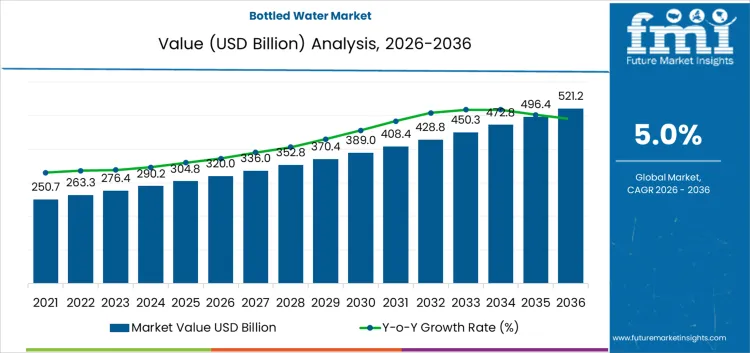
The bottled water market moves from USD 320 billion in 2026 to USD 521.2 billion by 2036, representing a CAGR of 5%. Regulatory oversight shapes where and how capacity is added, since source approvals, treatment standards, and labeling rules differ by jurisdiction. Compliance cost is not uniform and often determines whether local bottlers scale or exit. Certification complexity influences vendor positioning, with large groups better able to absorb audit cycles, documentation burdens, and recall risk. Product portfolios are organized around permitted claims and packaging rules rather than around marketing themes. In several countries, access to approved sources becomes a strategic constraint that guides merger and capacity placement decisions.
Over the period, growth paths diverge by region because enforcement intensity and distribution rules alter the economics of expansion. Markets with strict deposit schemes, transport regulations, or packaging recovery mandates favor operators with integrated logistics and compliance teams. Elsewhere, fragmented retail and informal trade still carry volume, though margin structures remain thin. Channel mix matters, since foodservice, travel retail, and home delivery each face different inspection regimes. Investment follows jurisdictions where regulatory processes are predictable and permitting timelines are short. The category expands through selective network buildouts and route density, not through uniform consumption increases across all consumer segments.
Quick Stats of the Bottled Water Market
- Bottled Water Market Value (2026): USD 320 billion
- Bottled Water Forecast Value (2036): USD 521.2 billion
- Bottled Water Forecast CAGR 2026 to 2036: 5.0%
- Leading Product in Bottled Water Market: Still Bottled Water (58 % share)
- Leading Packaging Format in Bottled Water Market: PET Bottles (64 % share)
- Key Growth Regions in Bottled Water Market: India, China, Brazil, USA, UK
- Top Players in Bottled Water Market: Nestlé Waters, Danone (Evian, Volvic, Badoit), The Coca Cola Company (Dasani), PepsiCo (Aquafina), Keurig Dr Pepper (Deer Park, Ozarka), Fiji Water
What is the Growth Forecast for Bottled Water Market through 2036?
Between 2026 and 2031, the bottled water market is projected to expand from USD 320 billion along a path consistent with a 5% CAGR, shaped more by consumption habits and distribution reach than by product innovation. In many regions, bottled water functions as a daily-use staple rather than an occasional purchase, which ties demand closely to urbanization, travel, and out-of-home consumption patterns. Growth during this phase comes from deeper penetration into secondary cities, expansion of on-the-go packaging formats, and wider cold-chain retail coverage. Volume increases are supported by convenience retail and food service channels, while pricing remains disciplined due to intense competition and private label presence. The business remains driven by logistics efficiency, shelf access, and brand visibility rather than by formulation differentiation.
From 2031 to 2036, the market is expected to reach USD 521.2 billion, with growth increasingly linked to population exposure and usage frequency rather than simple category expansion. Consumption becomes more embedded in daily routines across workplaces, transport hubs, and institutional settings, lifting per-capita intake even in mature markets. Multipack formats and bulk distribution gain weight in household consumption, while single-serve maintains relevance in travel and events. Competitive dynamics center on route-to-market strength, bottling scale, and cost control in packaging and transport. Market leadership depends less on product novelty and more on network density, sourcing reliability, and pricing discipline across regions and channels.
Bottled Water Market Key Takeaways
| Metric | Value |
|---|---|
| Market Value (2026) | USD 320 billion |
| Forecast Value (2036) | USD 521.1 billion |
| Forecast CAGR 2026 to 2036 | 5.0% |
How Is the Bottled Water Market Responding to Consumer Preferences and Health Trends?
The bottled water market is increasingly adopted to meet consumer demand for safe, convenient, and portable hydration options across residential, commercial, and on-the-go consumption. Historically, drinking water primarily relied on municipal supplies, which varied in quality and accessibility. Modern bottled water offerings include purified, mineral-enriched, flavored, and functional variants to cater to diverse consumer preferences and wellness trends. Beverage manufacturers, retailers, and distributors prioritize product safety, packaging convenience, and brand differentiation. Early adoption focused on urban populations with limited access to clean water, while current demand spans global markets, driven by health awareness, lifestyle convenience, and travel or outdoor consumption. Packaging type, water source quality, and product positioning influence market adoption and supplier selection.
Rising health consciousness, urbanization, and lifestyle-driven consumption patterns are shaping market growth. Compared with tap water, bottled water emphasizes perceived safety, convenience, and product variety, catering to consumer preferences for premium and functional options. Cost structures depend on water sourcing, purification, bottling, and distribution logistics, concentrating margins among suppliers capable of delivering consistent, high-quality products. Beverage companies adopt these offerings to meet consumer demand, enhance brand presence, and maintain regulatory compliance. By 2036, bottled water is expected to remain a widely consumed beverage, supporting convenience, hydration, and diversified product options across global consumer segments.
What Factors Are Shaping the Demand for Bottled Water by Product Positioning and Packaging Format in 2026?
The bottled water market in 2026 is segmented by product type and by packaging format. By product positioning, demand is divided into still, sparkling, flavored, and functional or fortified waters, each serving different consumption occasions and pricing tiers. By packaging, demand is organized around PET bottles, glass bottles, cans, and boxed or other formats that differ in cost, logistics efficiency, and shelf presentation. These segments reflect how producers and retailers manage volume throughput, brand differentiation, transport economics, and consumer convenience while operating within a category defined by high frequency purchase and tight margin structures.
Why Does Still Bottled Water Account for the Majority of Volume?
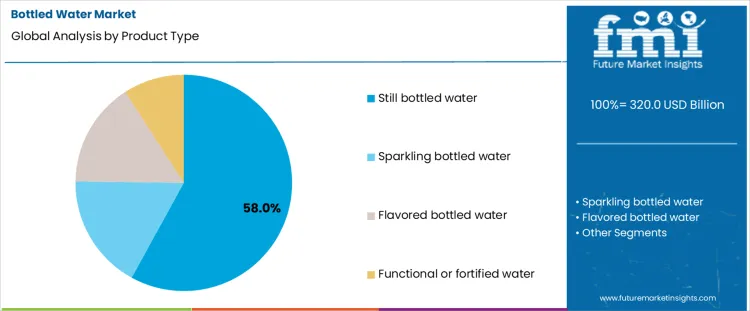
Still bottled water accounts for about 58% of demand in 2026, reflecting its role as a direct substitute for tap water and as a basic hydration product. Consumption is driven by daily use rather than by occasion or indulgence, which produces steady, repeat purchases. The product requires minimal flavoring or carbonation infrastructure, which supports large scale, low cost production. Distribution is optimized for high turnover in supermarkets, convenience stores, and foodservice. Price sensitivity in this segment encourages standardization and high volume packaging. This combination of habitual consumption, simple formulation, and efficient logistics keeps still water as the core volume driver within the bottled water category.
Sparkling, flavored, and functional waters follow more segmented demand patterns. Sparkling water serves consumers seeking texture and taste variation, yet it remains tied to discretionary consumption. Flavored and functional products depend on ingredient additions, regulatory labeling, and marketing positioning, which raises complexity and cost. Their purchase is more influenced by trends and personal preference than by basic hydration needs. Volumes grow through niche expansion and premiumization rather than through universal adoption. As a result, these categories add value and diversity to the shelf, but they do not displace still water as the dominant source of unit sales and distribution throughput.
Why Do PET Bottles Dominate Bottled Water Packaging?
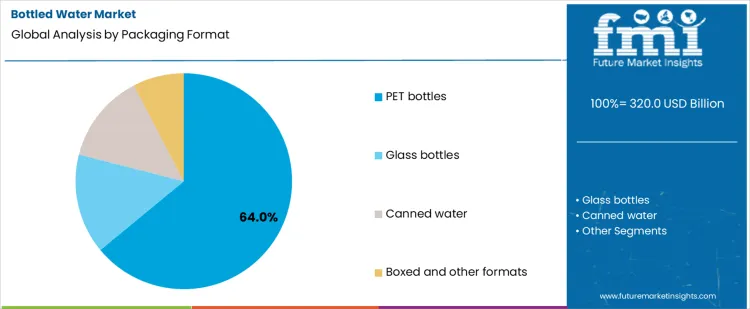
PET bottles represent about 64% of demand in 2026 because they offer the most efficient balance between cost, weight, and durability. Their light weight reduces transport expense, which is critical in a product where the contents are heavy and margins are tight. PET also supports high speed filling lines and flexible bottle shapes, which helps brands manage both large volumes and private label programs. Breakage risk is low compared with glass, which simplifies handling in retail and foodservice. These operational advantages make PET the default packaging choice for mass distribution and high turnover channels.
Glass, cans, and boxed formats serve more specific positioning strategies. Glass is associated with premium or on premise consumption, yet its weight and fragility raise logistics cost. Cans offer portability and faster cooling, though they require different filling infrastructure and are often used for smaller pack sizes. Boxed and alternative formats aim at differentiation or sustainability narratives, yet they face shelf space and consumer familiarity barriers. These options grow in selected niches, while PET remains the backbone of the category because it fits the economics of high volume, everyday consumption.
Why Are Trust in Municipal Supply and On the Go Consumption Patterns Driving the Bottled Water Market through 2036?
Demand is shaped by risk perception and convenience more than by basic hydration needs. In many regions, concerns about taste, aging pipes, or contamination events weaken confidence in tap water even where quality standards are met. At the same time, urban commuting, travel, and outdoor work increase reliance on portable, sealed beverages. Bottled water benefits from being positioned as a default, non-discretionary choice in these contexts. For retailers and foodservice operators, it is a low risk, high turnover item that fits every channel. Once habits form, consumption becomes routine, anchoring volume to daily mobility patterns rather than to income growth.
What Cost Pressure, Regulation, and Environmental Scrutiny Are Constraining Expansion?
Restraints come from public and policy response. Governments and institutions increasingly restrict single use plastics, impose extended producer responsibility fees, or promote refill systems. These measures raise costs and complicate packaging choices. Transportation is also a heavy cost component because water is bulky and low value per unit. Private label competition limits pricing power, and in some markets strong tap water campaigns reduce demand in offices and schools. Reputational risk affects procurement decisions for large organizations. Together, these pressures do not remove demand, but they slow volume growth, push shifts in pack formats, and keep margins under constant review.
How Are Packaging Strategies and Channel Mix Changes Reshaping This Category?
The structure of the category is evolving through format and route to market. Multi pack and home delivery formats gain importance as consumers try to reduce per unit cost and shopping trips. Larger returnable or refillable containers are being tested in offices and residential complexes. At the same time, single serve remains dominant in travel, events, and convenience channels. Brand portfolios are being segmented by source, treatment method, and packaging type to address different trust and usage situations. The category is becoming less about one universal bottle and more about managing multiple consumption occasions and distribution models.
What is the Demand for Bottled Water by Country?
| Country | CAGR (%) |
|---|---|
| USA | 4.5% |
| UK | 4.2% |
| China | 5.5% |
| India | 6.0% |
| Brazil | 5.0% |
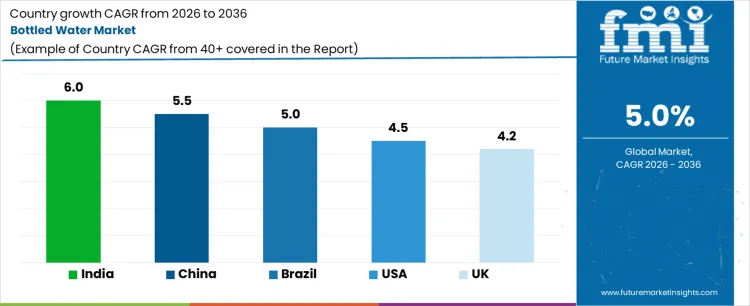
Demand for bottled water is rising as consumers increasingly prefer safe, convenient, and portable drinking water options amid urbanization, rising health awareness, and water quality concerns. India leads with a 6.0% CAGR, driven by rapid urban population growth, increased disposable income, and rising awareness of hygiene and safe drinking water. China follows at 5.5%, supported by expanding retail distribution, convenience-focused consumption, and rising middle-class demand. Brazil records 5.0% growth, shaped by urbanization and preference for packaged beverages. The USA grows at 4.5%, influenced by mature bottled water markets and steady consumption patterns. The UK shows 4.2% CAGR, reflecting moderate growth in bottled water consumption and retail penetration.
How is the United States experiencing growth in the bottled water market?
United States is experiencing growth at a CAGR of 4.5%, supported by rising consumer preference for convenience, health awareness, and premium water products. Bottled water products include mineral, spring, and flavored options, optimized for packaging sustainability and portability. Demand is concentrated in urban centers such as New York, Los Angeles, and Chicago, where on-the-go consumption and retail availability are high. Investments focus on packaging innovation, product quality, and compliance with FDA standards. Growth reflects shifting consumer behavior toward healthy beverages, increasing retail distribution, and focus on convenience-oriented consumption.
- Convenience and health awareness drive adoption.
- Products optimize portability and packaging quality.
- Urban retail hubs concentrate demand.
- Product quality and regulatory compliance guide investment.
How is the United Kingdom witnessing growth in the bottled water market?
United Kingdom is witnessing growth at a CAGR of 4.2%, fueled by consumer demand for premium and flavored bottled water options and a focus on health-conscious choices. Bottled water offerings are optimized for sustainable packaging, taste variety, and convenience. Demand is concentrated in London, Manchester, and Birmingham, where urban lifestyles and retail penetration are high. Investments prioritize product quality, eco-friendly packaging, and adherence to UK food safety regulations. Growth reflects rising health awareness, expansion of modern retail chains, and increasing adoption of ready-to-drink beverages.
- Health-conscious consumption drives adoption.
- Products enhance taste variety and sustainable packaging.
- Major cities concentrate demand.
- Product quality and regulatory compliance guide investment.
How is China experiencing growth in the bottled water market?
China is experiencing growth at a CAGR of 5.5%, supported by increasing urbanization, rising disposable incomes, and demand for safe drinking water. Bottled water products, including mineral and purified options, are optimized for taste, packaging innovation, and convenience. Demand is concentrated in metropolitan areas such as Beijing, Shanghai, and Guangzhou, where consumer awareness of water quality and modern retail presence is high. Investments focus on product safety, packaging durability, and compliance with national food safety regulations. Growth reflects urban population expansion, retail modernization, and rising preference for bottled beverages over tap water.
- Urbanization and disposable income drive adoption.
- Products optimize taste, packaging, and convenience.
- Metropolitan retail hubs concentrate demand.
- Safety and regulatory compliance guide investment.
How is India witnessing growth in the bottled water market?
India is witnessing growth at a CAGR of 6%, fueled by rising awareness of safe drinking water, urban population growth, and expanding modern retail networks. Bottled water products are optimized for purity, packaging convenience, and affordability, meeting diverse consumer needs. Demand is concentrated in urban centers such as Mumbai, Delhi, and Bengaluru, where water safety concerns and retail penetration are significant. Investments focus on product quality, packaging innovation, and adherence to FSSAI standards. Growth reflects increasing consumption of packaged water, health-conscious behavior, and development of cold-chain distribution for beverages.
- Safe drinking water concerns drive adoption.
- Products enhance purity, affordability, and packaging convenience.
- Urban centers concentrate demand.
- Product quality and regulatory compliance guide investment.
How is Brazil experiencing growth in the bottled water market?
Brazil is experiencing growth at a CAGR of 5%, supported by rising health awareness, urbanization, and demand for premium and mineral water products. Bottled water offerings are optimized for taste quality, packaging durability, and convenience for on-the-go consumption. Demand is concentrated in São Paulo, Rio de Janeiro, and Brasília, where modern retail channels and consumer awareness of water quality are high. Investments prioritize product safety, sustainable packaging, and compliance with Brazilian food safety standards. Growth reflects increasing urban consumption, expansion of retail distribution networks, and preference for convenient, safe drinking water.
- Health-conscious consumers drive adoption.
- Products optimize taste, packaging, and convenience.
- Urban retail hubs concentrate demand.
- Safety and regulatory compliance guide investment.
Who Are the Key Players Driving Competition in the Bottled Water Market and How Do They Differ?
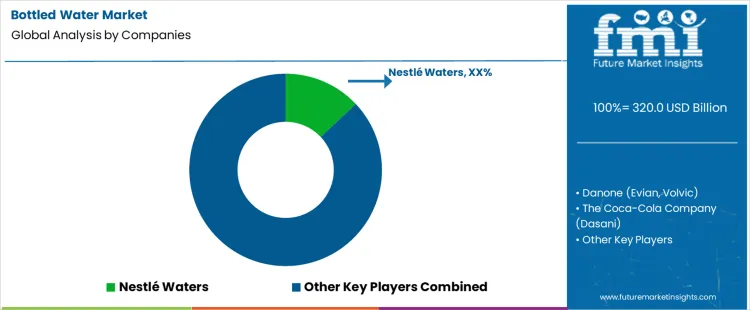
Competition in the bottled water market is shaped by brand portfolio breadth, geographic distribution, and positioning in still, sparkling, and premium segments. Nestlé Waters supplies a wide range of regional and international brands with varied mineral compositions, leveraging global distribution networks and retailer partnerships. Danone markets Evian and Volvic as mineral and spring waters with distinct source identities, supported by bottling infrastructure and marketing focused on natural purity. The Coca Cola Company markets Dasani as a treated municipal source water with broad retail reach, emphasizing convenience and affordability. PepsiCo’s Aquafina follows a similar strategy with extensive distribution across channels. Keurig Dr Pepper’s regional brands like Deer Park and Ozarka address local markets with familiar branding and shelf presence. Fiji Water positions itself in the premium segment with a focus on source origin and perceived quality.
Market participants differentiate through source type, packaging formats, and consumer perception. Nestlé Waters and Danone emphasize natural spring or mineral water sources to appeal to health and quality oriented consumers. Coca Cola and PepsiCo leverage vast logistics networks to ensure wide availability and competitive pricing in mainstream retail and foodservice. Keurig Dr Pepper’s regional brands maintain relevance through local heritage and tailored marketing in specific USA regions. Fiji Water competes on premium positioning with distinct packaging and narrative about remote aquifer sourcing. Other niche and private label bottled water providers focus on organic, alkaline, or enhanced functional water variants. Competitive differences arise from consumer preferences for taste and source, sustainability practices in packaging and water stewardship, and the ability to maintain supply continuity across global and regional markets.
Key Players in the Bottled Water Market
- Nestlé Waters
- Danone (Evian, Volvic)
- The Coca Cola Company (Dasani)
- PepsiCo (Aquafina)
- Keurig Dr Pepper (Deer Park, Ozarka)
- Danone (Badoit, etc.)
- Fiji Water
Scope of the Report
| Items | Values |
|---|---|
| Quantitative Units (2026) | USD billion |
| Product Type | Still Bottled Water, Sparkling Bottled Water, Flavored Bottled Water, Functional or Fortified Water |
| Packaging Format | PET Bottles, Glass Bottles, Canned Water, Boxed and Other Formats |
| Regions Covered | Asia Pacific, Europe, North America, Latin America, Middle East & Africa |
| Countries Covered | China, Japan, South Korea, India, Australia & New Zealand, ASEAN, Germany, United Kingdom, France, Italy, Spain, Nordic, BENELUX, United States, Canada, Mexico, Brazil, Chile, Saudi Arabia, Turkey, South Africa, and other regional markets |
| Key Companies Profiled | Nestlé Waters, Danone (Evian, Volvic, Badoit), The Coca Cola Company (Dasani), PepsiCo (Aquafina), Keurig Dr Pepper (Deer Park, Ozarka), Fiji Water |
| Additional Attributes | Dollar sales by product type and packaging format, still bottled water forming the largest volume segment due to daily-use substitution for tap water, PET bottles representing the dominant packaging format because of cost and logistics efficiency, market growth shaped by regulation, source approvals, and packaging rules rather than product innovation, expansion driven by route-to-market density and distribution reach, strong role of convenience retail, foodservice, and travel channels, increasing importance of multipacks and bulk formats for household consumption, and competitive positioning based on bottling scale, sourcing reliability, logistics efficiency, and compliance capability rather than formulation differentiation. |
Bottled Water Market Segmentation
Product Type:
- Still bottled water
- Sparkling bottled water
- Flavored bottled water
- Functional or fortified water
Packaging Format:
- PET bottles
- Glass bottles
- Canned water
- Boxed and other formats
Region:
- Asia Pacific
- China
- Japan
- South Korea
- India
- Australia & New Zealand
- ASEAN
- Rest of Asia Pacific
- Europe
- Germany
- United Kingdom
- France
- Italy
- Spain
- Nordic
- BENELUX
- Rest of Europe
- North America
- United States
- Canada
- Mexico
- Latin America
- Brazil
- Chile
- Rest of Latin America
- Middle East & Africa
- Kingdom of Saudi Arabia
- Other GCC Countries
- Turkey
- South Africa
- Other African Union
- Rest of Middle East & Africa
Bibliography
- European Commission. (2023). Drinking Water Directive (EU) 2020/2184: Quality of water intended for human consumption.
- USA Food and Drug Administration. (2024). Bottled water everywhere: Safety, labeling, and standards of identity.
- Organisation for Economic Co-operation and Development. (2024). Global plastics outlook: Policy scenarios to 2060 and packaging regulation.
- World Bank. (2023). Water supply, sanitation, hygiene, and urban services.
Frequently Asked Questions
How big is the bottled water market in 2026?
The global bottled water market is estimated to be valued at USD 320.0 billion in 2026.
What will be the size of bottled water market in 2036?
The market size for the bottled water market is projected to reach USD 521.2 billion by 2036.
How much will be the bottled water market growth between 2026 and 2036?
The bottled water market is expected to grow at a 5.0% CAGR between 2026 and 2036.
What are the key product types in the bottled water market?
The key product types in bottled water market are still bottled water, sparkling bottled water, flavored bottled water and functional or fortified water.
Which packaging format segment to contribute significant share in the bottled water market in 2026?
In terms of packaging format, pet bottles segment to command 64.0% share in the bottled water market in 2026.
Preview the report firsthand - request a free sample
Get SampleGet the brochure for pricing and purchase details.
Get PDFTable of Content
- Executive Summary
- Global Market Outlook
- Demand-side Trends
- Supply-side Trends
- Technology Roadmap Analysis
- Analysis and Recommendations
- Market Overview
- Market Coverage / Taxonomy
- Market Definition / Scope / Limitations
- Market Background
- Market Dynamics
- Drivers
- Restraints
- Opportunity
- Trends
- Scenario Forecast
- Demand in Optimistic Scenario
- Demand in Likely Scenario
- Demand in Conservative Scenario
- Opportunity Map Analysis
- Product Life Cycle Analysis
- Supply Chain Analysis
- Investment Feasibility Matrix
- Value Chain Analysis
- PESTLE and Porter’s Analysis
- Regulatory Landscape
- Regional Parent Market Outlook
- Production and Consumption Statistics
- Import and Export Statistics
- Market Dynamics
- Global Market Analysis 2021 to 2025 and Forecast, 2026 to 2036
- Historical Market Size Value (USD Million) Analysis, 2021 to 2025
- Current and Future Market Size Value (USD Million) Projections, 2026 to 2036
- Y-o-Y Growth Trend Analysis
- Absolute $ Opportunity Analysis
- Global Market Pricing Analysis 2021 to 2025 and Forecast 2026 to 2036
- Global Market Analysis 2021 to 2025 and Forecast 2026 to 2036, By Product Type
- Introduction / Key Findings
- Historical Market Size Value (USD Million) Analysis By Product Type, 2021 to 2025
- Current and Future Market Size Value (USD Million) Analysis and Forecast By Product Type, 2026 to 2036
- Still bottled water
- Sparkling bottled water
- Flavored bottled water
- Functional or fortified water
- Still bottled water
- Y-o-Y Growth Trend Analysis By Product Type, 2021 to 2025
- Absolute $ Opportunity Analysis By Product Type, 2026 to 2036
- Global Market Analysis 2021 to 2025 and Forecast 2026 to 2036, By Packaging Format
- Introduction / Key Findings
- Historical Market Size Value (USD Million) Analysis By Packaging Format, 2021 to 2025
- Current and Future Market Size Value (USD Million) Analysis and Forecast By Packaging Format, 2026 to 2036
- PET bottles
- Glass bottles
- Canned water
- Boxed and other formats
- PET bottles
- Y-o-Y Growth Trend Analysis By Packaging Format, 2021 to 2025
- Absolute $ Opportunity Analysis By Packaging Format, 2026 to 2036
- Global Market Analysis 2021 to 2025 and Forecast 2026 to 2036, By Region
- Introduction
- Historical Market Size Value (USD Million) Analysis By Region, 2021 to 2025
- Current Market Size Value (USD Million) Analysis and Forecast By Region, 2026 to 2036
- North America
- Latin America
- Western Europe
- Eastern Europe
- East Asia
- South Asia and Pacific
- Middle East & Africa
- Market Attractiveness Analysis By Region
- North America Market Analysis 2021 to 2025 and Forecast 2026 to 2036, By Country
- Historical Market Size Value (USD Million) Trend Analysis By Market Taxonomy, 2021 to 2025
- Market Size Value (USD Million) Forecast By Market Taxonomy, 2026 to 2036
- By Country
- USA
- Canada
- Mexico
- By Product Type
- By Packaging Format
- By Country
- Market Attractiveness Analysis
- By Country
- By Product Type
- By Packaging Format
- Key Takeaways
- Latin America Market Analysis 2021 to 2025 and Forecast 2026 to 2036, By Country
- Historical Market Size Value (USD Million) Trend Analysis By Market Taxonomy, 2021 to 2025
- Market Size Value (USD Million) Forecast By Market Taxonomy, 2026 to 2036
- By Country
- Brazil
- Chile
- Rest of Latin America
- By Product Type
- By Packaging Format
- By Country
- Market Attractiveness Analysis
- By Country
- By Product Type
- By Packaging Format
- Key Takeaways
- Western Europe Market Analysis 2021 to 2025 and Forecast 2026 to 2036, By Country
- Historical Market Size Value (USD Million) Trend Analysis By Market Taxonomy, 2021 to 2025
- Market Size Value (USD Million) Forecast By Market Taxonomy, 2026 to 2036
- By Country
- Germany
- UK
- Italy
- Spain
- France
- Nordic
- BENELUX
- Rest of Western Europe
- By Product Type
- By Packaging Format
- By Country
- Market Attractiveness Analysis
- By Country
- By Product Type
- By Packaging Format
- Key Takeaways
- Eastern Europe Market Analysis 2021 to 2025 and Forecast 2026 to 2036, By Country
- Historical Market Size Value (USD Million) Trend Analysis By Market Taxonomy, 2021 to 2025
- Market Size Value (USD Million) Forecast By Market Taxonomy, 2026 to 2036
- By Country
- Russia
- Poland
- Hungary
- Balkan & Baltic
- Rest of Eastern Europe
- By Product Type
- By Packaging Format
- By Country
- Market Attractiveness Analysis
- By Country
- By Product Type
- By Packaging Format
- Key Takeaways
- East Asia Market Analysis 2021 to 2025 and Forecast 2026 to 2036, By Country
- Historical Market Size Value (USD Million) Trend Analysis By Market Taxonomy, 2021 to 2025
- Market Size Value (USD Million) Forecast By Market Taxonomy, 2026 to 2036
- By Country
- China
- Japan
- South Korea
- By Product Type
- By Packaging Format
- By Country
- Market Attractiveness Analysis
- By Country
- By Product Type
- By Packaging Format
- Key Takeaways
- South Asia and Pacific Market Analysis 2021 to 2025 and Forecast 2026 to 2036, By Country
- Historical Market Size Value (USD Million) Trend Analysis By Market Taxonomy, 2021 to 2025
- Market Size Value (USD Million) Forecast By Market Taxonomy, 2026 to 2036
- By Country
- India
- ASEAN
- Australia & New Zealand
- Rest of South Asia and Pacific
- By Product Type
- By Packaging Format
- By Country
- Market Attractiveness Analysis
- By Country
- By Product Type
- By Packaging Format
- Key Takeaways
- Middle East & Africa Market Analysis 2021 to 2025 and Forecast 2026 to 2036, By Country
- Historical Market Size Value (USD Million) Trend Analysis By Market Taxonomy, 2021 to 2025
- Market Size Value (USD Million) Forecast By Market Taxonomy, 2026 to 2036
- By Country
- Kingdom of Saudi Arabia
- Other GCC Countries
- Turkiye
- South Africa
- Other African Union
- Rest of Middle East & Africa
- By Product Type
- By Packaging Format
- By Country
- Market Attractiveness Analysis
- By Country
- By Product Type
- By Packaging Format
- Key Takeaways
- Key Countries Market Analysis
- USA
- Pricing Analysis
- Market Share Analysis, 2025
- By Product Type
- By Packaging Format
- Canada
- Pricing Analysis
- Market Share Analysis, 2025
- By Product Type
- By Packaging Format
- Mexico
- Pricing Analysis
- Market Share Analysis, 2025
- By Product Type
- By Packaging Format
- Brazil
- Pricing Analysis
- Market Share Analysis, 2025
- By Product Type
- By Packaging Format
- Chile
- Pricing Analysis
- Market Share Analysis, 2025
- By Product Type
- By Packaging Format
- Germany
- Pricing Analysis
- Market Share Analysis, 2025
- By Product Type
- By Packaging Format
- UK
- Pricing Analysis
- Market Share Analysis, 2025
- By Product Type
- By Packaging Format
- Italy
- Pricing Analysis
- Market Share Analysis, 2025
- By Product Type
- By Packaging Format
- Spain
- Pricing Analysis
- Market Share Analysis, 2025
- By Product Type
- By Packaging Format
- France
- Pricing Analysis
- Market Share Analysis, 2025
- By Product Type
- By Packaging Format
- India
- Pricing Analysis
- Market Share Analysis, 2025
- By Product Type
- By Packaging Format
- ASEAN
- Pricing Analysis
- Market Share Analysis, 2025
- By Product Type
- By Packaging Format
- Australia & New Zealand
- Pricing Analysis
- Market Share Analysis, 2025
- By Product Type
- By Packaging Format
- China
- Pricing Analysis
- Market Share Analysis, 2025
- By Product Type
- By Packaging Format
- Japan
- Pricing Analysis
- Market Share Analysis, 2025
- By Product Type
- By Packaging Format
- South Korea
- Pricing Analysis
- Market Share Analysis, 2025
- By Product Type
- By Packaging Format
- Russia
- Pricing Analysis
- Market Share Analysis, 2025
- By Product Type
- By Packaging Format
- Poland
- Pricing Analysis
- Market Share Analysis, 2025
- By Product Type
- By Packaging Format
- Hungary
- Pricing Analysis
- Market Share Analysis, 2025
- By Product Type
- By Packaging Format
- Kingdom of Saudi Arabia
- Pricing Analysis
- Market Share Analysis, 2025
- By Product Type
- By Packaging Format
- Turkiye
- Pricing Analysis
- Market Share Analysis, 2025
- By Product Type
- By Packaging Format
- South Africa
- Pricing Analysis
- Market Share Analysis, 2025
- By Product Type
- By Packaging Format
- USA
- Market Structure Analysis
- Competition Dashboard
- Competition Benchmarking
- Market Share Analysis of Top Players
- By Regional
- By Product Type
- By Packaging Format
- Competition Analysis
- Competition Deep Dive
- Nestlé Waters
- Overview
- Product Portfolio
- Profitability by Market Segments (Product/Age /Sales Channel/Region)
- Sales Footprint
- Strategy Overview
- Marketing Strategy
- Product Strategy
- Channel Strategy
- Danone (Evian, Volvic)
- The Coca‑Cola Company (Dasani)
- PepsiCo (Aquafina)
- Keurig Dr Pepper (Deer Park, Ozarka)
- Danone (Badoit, etc.)
- Fiji Water
- Nestlé Waters
- Competition Deep Dive
- Assumptions & Acronyms Used
- Research Methodology


