

- Industry Size (2026)
- USD 1.75 Bn
- Forecast (2036)
- USD 4.17 Bn
- CAGR (2026 to 2036)
- 9.1%
Safety Bottle Tote Carriers Packaging Market Size, Market Forecast and Outlook By FMI
The safety bottle tote carriers packaging market was valued at USD 1.60 billion in 2025, projected to reach USD 1.75 billion in 2026, and is forecast to expand to USD 4.17 billion by 2036 at a 9.1% CAGR. Increasing volumes of hazardous chemical shipments across pharmaceutical and industrial sectors are compelling procurement managers to specify carrier-grade tote solutions that comply with transport safety regulations. Laboratory supply chain operators now prioritize HDPE-based carriers for their chemical resistance and stackability, replacing older metal and wooden crate systems across fulfillment channels.
Summary of Safety Bottle Tote Carriers Packaging Market
- Projected market value stands at USD 4.17 billion heading into 2036.
- The market is set to advance at a 9.1% CAGR during the 2026-2036 period.
- The market stood at USD 1.60 billion in 2025.
- Over the projection window, an additional USD 2.42 billion in value is expected to materialize.
- HDPE leads by material type with 40.2% share in 2026, and Chemicals Industry leads by end-user industry with 42.8% share in 2026.
- Small Carrier Safety Bottle Tote Carriers command 40.6% share in 2026.
- The market operates at the intersection of hazardous goods logistics compliance and laboratory supply chain standardization, where material durability and regulatory certification define competitive positioning.
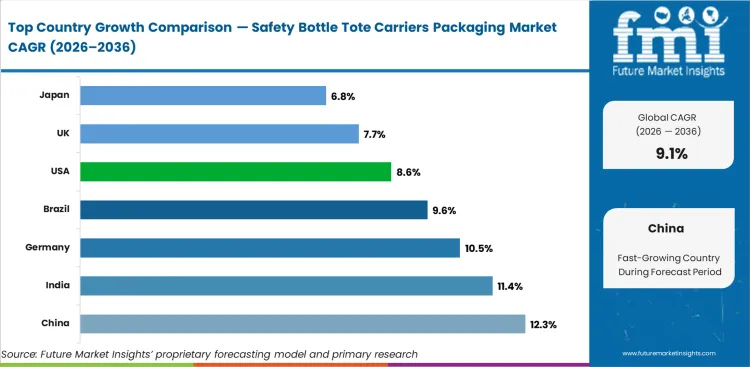
- Among key countries, China leads at 12.3% CAGR, followed by India at 11.4%, Germany at 10.5%, Brazil at 9.6%, the USA at 8.6%, the UK at 7.7%, and Japan at 6.8%.
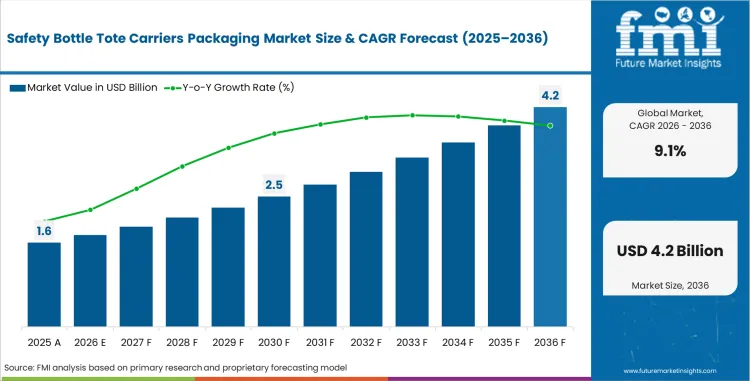
The absolute dollar opportunity of USD 2.42 billion between 2026 and 2036 signals a market transitioning from basic utility packaging to engineered containment systems designed for regulatory compliance and logistics efficiency. Chemical compatibility testing requirements and hazardous goods transport regulations are reshaping carrier specifications, pushing material science toward high-density polyethylene compounds with enhanced impact resistance. FMI analysts observe that cold chain pharmaceutical distribution networks are emerging as a secondary growth vector, as bottle tote carriers offer spill containment and temperature stability during last-mile delivery of liquid reagents.
Country-level growth rates reveal distinct adoption trajectories. China at 12.3%, India at 11.4%, Germany at 10.5%, Brazil at 9.6%, USA at 8.6%, UK at 7.7%, Japan at 6.8%. China and India lead as greenfield chemical manufacturing facilities specify carrier-grade packaging from initial plant commissioning. Germany's pace reflects strict EU hazardous goods transport directives compelling logistics operators to upgrade existing packaging infrastructure. Mature markets in the USA, UK, and Japan sustain demand through replacement cycles and laboratory supply chain standardization programs.
Safety Bottle Tote Carriers Packaging Market Key Takeaways
| Metric | Details |
|---|---|
| Industry Size (2026) | USD 1.75 billion |
| Industry Value (2036) | USD 4.17 billion |
| CAGR (2026-2036) | 9.1% |
Source: Future Market Insights, 2026
Safety Bottle Tote Carriers Packaging Market Definition
Safety bottle tote carriers are engineered packaging containers designed to transport and store hazardous liquid bottles safely during logistics handling, warehousing, and laboratory operations. Constructed from HDPE, LDPE, or rubber compounds, these carriers provide impact resistance, chemical compatibility, and spill containment for bottles containing acids, solvents, reagents, and other hazardous liquids. The market covers small, medium, and large carrier configurations serving chemicals, pharmaceutical, and food industry supply chains.
Safety Bottle Tote Carriers Packaging Market Inclusions
Market scope includes HDPE, LDPE, and rubber-based bottle tote carriers in small, medium, and large capacity configurations. Coverage includes global and regional market sizes, segment breakdowns by material type, capacity, and end-user industry, and forecast projections for 2026 to 2036.
Safety Bottle Tote Carriers Packaging Market Exclusions
The scope excludes generic storage bins without hazardous goods transport certification, metal drum containment systems, and non-certified plastic crates. Standalone bottle packaging without carrier frame structure and single-use packaging films are omitted from the valuation.
Safety Bottle Tote Carriers Packaging Market Research Methodology
- Primary Research: Analysts engaged with chemical logistics managers, laboratory supply chain directors, and packaging compliance officers to map carrier specification requirements and procurement decision frameworks across hazardous goods distribution networks.
- Desk Research: Data collection aggregated hazardous goods transport regulations, chemical compatibility testing standards, and laboratory supply chain procurement reports from regulatory agencies and industry associations.
- Market-Sizing and Forecasting: Baseline values derive from a bottom-up aggregation of carrier procurement volumes across chemical and pharmaceutical distribution channels, applying region-specific hazardous goods transport growth rates to project future demand.
- Data Validation and Update Cycle: Projections are tested against publicly reported capital expenditure data, regulatory compliance spending trends, and industry association procurement survey results to confirm forecast alignment with observable market activity.
Why is the Safety Bottle Tote Carriers Packaging Market Growing?
The Safety Bottle Tote Carriers Packaging market is experiencing strong growth, driven by increasing demand for secure and reliable packaging solutions across chemical, pharmaceutical, and industrial sectors. Rising awareness of product safety, handling efficiency, and regulatory compliance is fueling adoption of advanced packaging materials and designs. The market is being supported by innovations in packaging technologies that enhance durability, impact resistance, and ease of transport for liquid products.
Growing emphasis on sustainable and recyclable materials is further shaping the market, with manufacturers focusing on reducing environmental impact while maintaining product integrity. Industrial sectors are increasingly relying on packaging solutions that ensure safe storage, minimize spillage, and optimize supply chain efficiency.
The combination of regulatory requirements, operational safety considerations, and demand for standardized handling systems is driving investments in high-performance packaging solutions As chemical and industrial production continues to expand globally, the market for safety bottle tote carriers is expected to maintain robust growth, supported by technological advancements and evolving end-user requirements.
Segmental Analysis
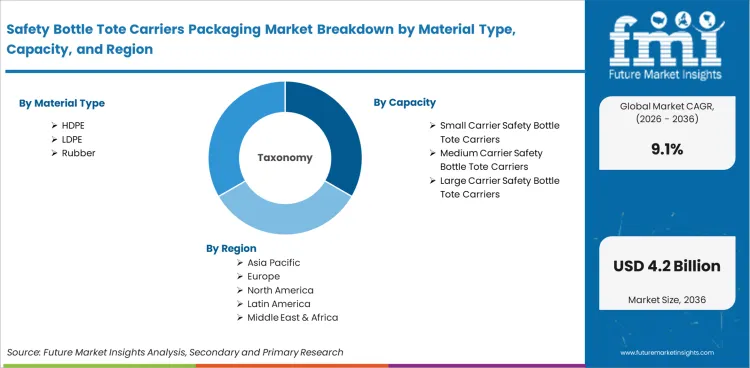
The safety bottle tote carriers packaging market is segmented by material type, capacity, end-user industry, and geographic regions. By material type, safety bottle tote carriers packaging market is divided into HDPE, LDPE, and Rubber. In terms of capacity, safety bottle tote carriers packaging market is classified into Medium Carrier Safety Bottle Tote Carriers (1001 Ml - 2,500 Ml), Small Carrier Safety Bottle Tote Carriers (500 Ml - 1000 Ml), and Large Carrier Safety Bottle Tote Carriers (2,501 Ml And 4,000 Ml). Based on end-user industry, safety bottle tote carriers packaging market is segmented into Chemicals Industry, Pharmaceutical Industry, and Food Industry. Regionally, the safety bottle tote carriers packaging industry is classified into North America, Latin America, Western Europe, Eastern Europe, Balkan & Baltic Countries, Russia & Belarus, Central Asia, East Asia, South Asia & Pacific, and the Middle East & Africa.
Insights into the HDPE Material Type Segment
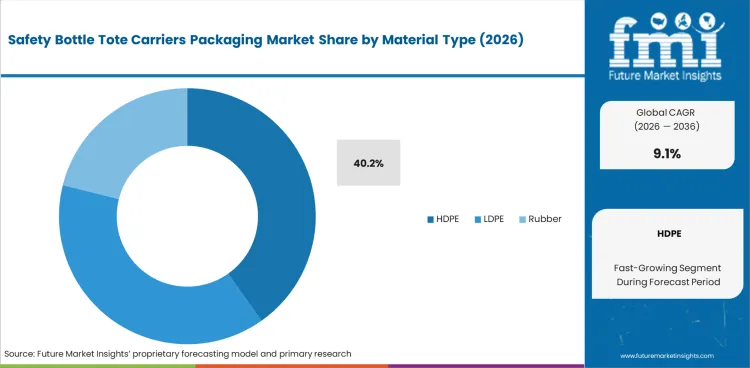
The HDPE material type segment is projected to hold 40.2% of the market revenue in 2026, establishing it as the leading material type. Growth in this segment is being driven by HDPE’s superior chemical resistance, strength, and durability, which ensure safe storage and transport of liquids in industrial and chemical applications. HDPE offers lightweight yet sturdy properties, reducing shipping costs while providing protection against leaks and contamination.
The ability to withstand high-impact handling and extreme temperatures further reinforces its adoption. Manufacturers are leveraging HDPE for standardized tote carrier designs, which improve operational efficiency and ease of stacking, handling, and storage.
Sustainability initiatives promoting recyclable and reusable materials have enhanced the appeal of HDPE packaging As demand grows for safe and efficient packaging solutions in chemical and industrial sectors, HDPE is expected to maintain its leading position, supported by its performance, cost-effectiveness, and widespread availability in global markets.
Insights into the Medium Carrier Safety Bottle Tote Carriers Capacity Segment
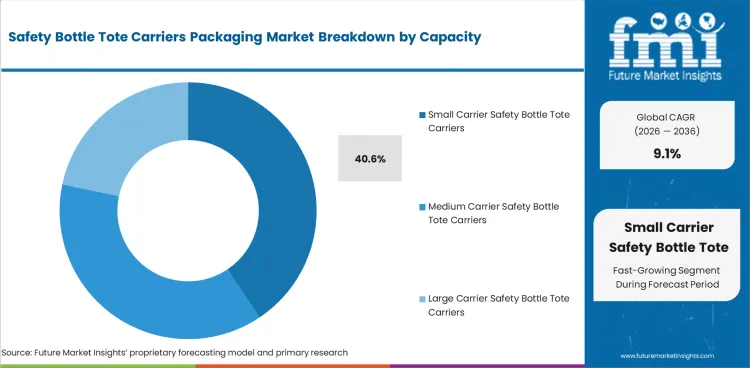
The medium carrier capacity segment, covering 1001 Ml - 2,500 Ml, is expected to account for 40.6% of the market revenue in 2026, making it the leading capacity category. This segment is favored due to its optimal balance between storage volume and handling convenience, allowing efficient transportation of moderate quantities of liquid products. Medium-sized carriers enable safer handling, reduce spillage risks, and provide standardized storage solutions that fit industrial and commercial supply chains.
The capacity range supports both manual and automated handling systems, improving operational efficiency and productivity. Rising demand for modular and flexible packaging solutions in chemical, pharmaceutical, and industrial sectors is further driving growth.
Manufacturers are increasingly designing carriers that can accommodate multiple bottle sizes while ensuring stability and safety during transport As regulatory compliance and workplace safety standards continue to influence packaging requirements, the medium carrier segment is expected to remain the preferred choice for end users, reinforcing its leading revenue share in the market.
Insights into the Chemicals Industry End-Use Segment
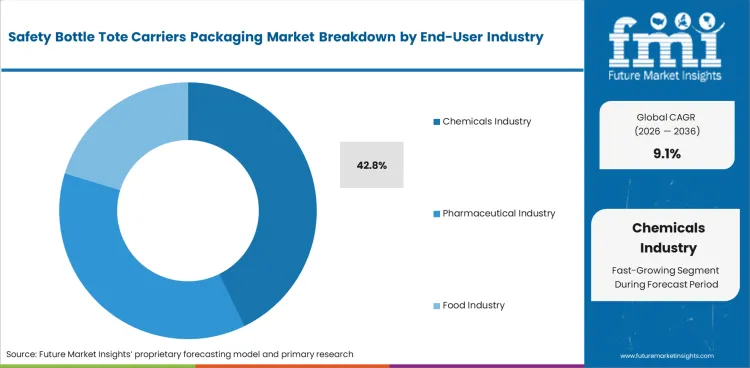
The chemicals industry segment is projected to hold 42.8% of the market revenue in 2026, establishing it as the leading end-use sector. Its growth is being driven by the need for safe, durable, and compliant packaging solutions to store and transport hazardous and non-hazardous chemicals. Safety bottle tote carriers in this industry ensure protection against leakage, contamination, and accidental spillage, while meeting regulatory standards for chemical handling and storage.
The adoption of standardized packaging solutions improves operational efficiency, facilitates bulk transport, and reduces the risk of workplace incidents. Rising chemical production in emerging and developed markets is further accelerating demand for reliable tote carrier systems.
Manufacturers are focusing on optimizing material selection, carrier design, and capacity configurations to address specific chemical storage and transport requirements As safety regulations and operational efficiency continue to shape packaging practices in the chemical sector, the market for safety bottle tote carriers is expected to maintain strong growth, with the chemicals industry remaining the primary revenue contributor.
Market Overview
Global safety bottle tote carriers packaging market: Introduction
Efficient and safe packaging solutions are of paramount importance for transportation of laboratory acids and chemicals. Safety bottle tote carriers have been designed keeping in mind the danger of transporting hazardous chemicals. One of the key contributors to growing preference for safety bottle tote carriers is their versatility. Safety bottle tote carriers have the ability to withstand a wide range of temperatures, i.e. from -45°C to 110°C, which increases the scope of applications for them.
In addition, safety bottle tote carriers can carry acids, alkalis, and other solvents. Thermoplastics elastomers are used to manufacture safety bottle tote carriers, which facilitate in maintenance of their tensile strength. The wide range of temperature handling capacity of safety bottle tote carriers enables them to carry both liquid and ice without compromising on product integrity.
In addition, safety bottle tote carriers have found a wide range of applications in the chemical industry, pharmaceutical, and the food industries. The need to transport hazardous chemicals from one place to another is expected to grow over the forecast period. Due to their ease of handling and efficiency, safety bottle tote carriers are widely used in the chemicals industry, and are expected to have high preference over the forecast period, thus resulting in a largely positive outlook over the forecast period.
Analysis of Safety Bottle Tote Carriers Packaging Market By Key Countries
.webp "Top Country Growth Comparison Safety Bottle Tote Carriers Packaging Market Cagr (2026 2036)")
| Country | CAGR |
|---|---|
| China | 12.3% |
| India | 11.4% |
| Germany | 10.5% |
| Brazil | 9.6% |
| USA | 8.6% |
| UK | 7.7% |
| Japan | 6.8% |
Country-wise Analysis
The Safety Bottle Tote Carriers Packaging Market is expected to register a CAGR of 9.1% during the forecast period, exhibiting varied country level momentum. China leads with the highest CAGR of 12.3%, followed by India at 11.4%. Developed markets such as Germany, France, and the UK continue to expand steadily, while the USA is likely to grow at consistent rates. Japan posts the lowest CAGR at 6.8%, yet still underscores a broadly positive trajectory for the global Safety Bottle Tote Carriers Packaging Market. In 2026, Germany held a dominant revenue in the Western Europe market and is expected to grow with a CAGR of 10.5%. The USA Safety Bottle Tote Carriers Packaging Market is estimated to be valued at USD 578.5 million in 2026 and is anticipated to reach a valuation of USD 578.5 million by 2036. Sales are projected to rise at a CAGR of 0.0% over the forecast period between 2026 and 2036. While Japan and South Korea markets are estimated to be valued at USD 86.7 million and USD 41.4 million respectively in 2026.
Key Players in the Safety Bottle Tote Carriers Packaging Market
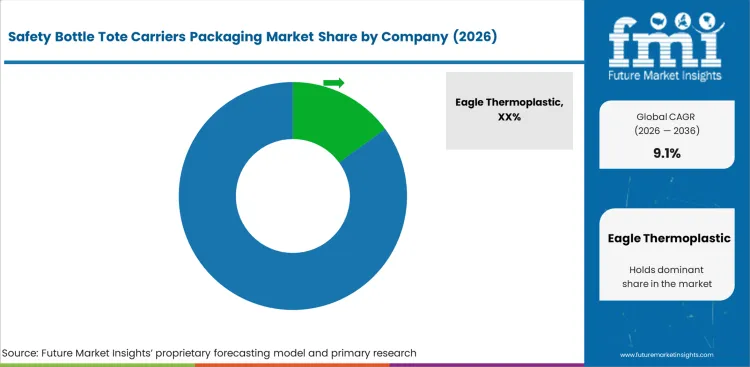
- Eagle Thermoplastic
- Spectrum Chemical Manufacturing
- Qorpak
- Spectrum Chemical
- Thermo Fisher Scientific
- Merck
- United States Plastic
- ULINE
- Smurfit Kappa
- Kou Hing Hong Scientific Supplies
- Daigger
- Heathrow Scientific
Scope of the Report
| Metric | Value |
|---|---|
| Quantitative Units | USD 1.75 billion to USD 4.17 billion, at a CAGR of 9.1% |
| Market Definition | Engineered containment carriers for safe transport and storage of hazardous liquid bottles across chemicals, pharmaceutical, and food industry supply chains. |
| Segmentation | Material Type: HDPE, LDPE, Rubber; Capacity: Small Carrier Safety Bottle Tote Carriers, Medium Carrier Safety Bottle Tote Carriers, Large Carrier Safety Bottle Tote Carriers; End-User Industry: Chemicals Industry, Pharmaceutical Industry, Food Industry |
| Regions Covered | North America, Latin America, Europe, East Asia, South Asia, Oceania, Middle East and Africa |
| Countries Covered | India, China, USA, Canada, UK, Germany, Japan, and 40 plus countries |
| Key Companies Profiled | Eagle Thermoplastic, Spectrum Chemical Manufacturing, Qorpak, Thermo Fisher Scientific, Merck, United States Plastic, ULINE, Smurfit Kappa, Kou Hing Hong Scientific Supplies, Daigger, Heathrow Scientific |
| Forecast Period | 2026 to 2036 |
| Approach | Forecasting models apply a bottom-up methodology starting with installed base metrics and procurement volume analysis, cross-validated against industry expenditure data and regulatory adoption timelines. |
Safety Bottle Tote Carriers Packaging Market by Segments
Material Type:
- HDPE
- LDPE
- Rubber
Capacity:
- Medium Carrier Safety Bottle Tote Carriers (1001 Ml – 2,500 Ml)
- Small Carrier Safety Bottle Tote Carriers (500 Ml - 1000 Ml)
- Large Carrier Safety Bottle Tote Carriers (2,501 Ml And 4,000 Ml)
End-User Industry:
- Chemicals Industry
- Pharmaceutical Industry
- Food Industry
Region:
- North America
- USA
- Canada
- Mexico
- Latin America
- Brazil
- Chile
- Rest of Latin America
- Western Europe
- Germany
- UK
- Italy
- Spain
- France
- Nordic
- BENELUX
- Rest of Western Europe
- Eastern Europe
- Russia
- Poland
- Hungary
- Balkan & Baltic
- Rest of Eastern Europe
- East Asia
- China
- Japan
- South Korea
- South Asia and Pacific
- India
- ASEAN
- Australia & New Zealand
- Rest of South Asia and Pacific
- Middle East & Africa
- Kingdom of Saudi Arabia
- Other GCC Countries
- Turkiye
- South Africa
- Other African Union
- Rest of Middle East & Africa
Bibliography
- United Nations Economic Commission for Europe. (2024). Recommendations on the transport of dangerous goods: Model regulations (Rev. 24). UNECE.
- Occupational Safety and Health Administration. (2024). Hazard communication standard 29 CFR 1910.1200. USA Department of Labor.
- European Chemicals Agency. (2024). Guidance on the classification, labelling, and packaging of substances and mixtures. ECHA.
- Thermo Fisher Scientific. (2024). Annual report 2024: Laboratory products division. Thermo Fisher Scientific.
- International Organization for Standardization. (2024). ISO 3394: Dimensions of rigid rectangular packages. ISO.
- Smurfit Kappa Group. (2024). Sustainability report 2024: Packaging solutions innovation. Smurfit Kappa.
This bibliography is provided for reader reference. The full Future Market Insights report contains the complete reference list with primary research documentation.
Frequently Asked Questions
How large is the demand for Safety Bottle Tote Carriers Packaging in the global market in 2026?
Demand for Safety Bottle Tote Carriers Packaging in the global market is estimated to be valued at USD 1.75 billion in 2026.
What will be the market size of Safety Bottle Tote Carriers Packaging in the global market by 2036?
Market size for Safety Bottle Tote Carriers Packaging is projected to reach USD 4.17 billion by 2036.
What is the expected demand growth for Safety Bottle Tote Carriers Packaging between 2026 and 2036?
Demand for Safety Bottle Tote Carriers Packaging is expected to grow at a CAGR of 9.1% between 2026 and 2036.
Which Material Type is poised to lead global sales by 2026?
HDPE accounts for 40.2% share in 2026 based on structural demand patterns and procurement preference data analyzed in the FMI report.
What is the China growth outlook in this report?
China is projected to grow at a CAGR of 12.3% during 2026 to 2036.
What is Safety Bottle Tote Carriers Packaging and what is it mainly used for?
Safety bottle tote carriers are engineered containment packaging designed to transport hazardous liquid bottles safely. They are primarily used in chemical logistics, pharmaceutical distribution, and laboratory supply chains.
What is included in the scope of this Safety Bottle Tote Carriers Packaging report?
Market scope includes HDPE, LDPE, and rubber-based bottle tote carriers in small, medium, and large capacity configurations. Coverage includes global and regional market sizes, segment breakdowns by material type, capacity, and end-user industry, and forecast projections for 2026 to 2036..
How does FMI build and validate the Safety Bottle Tote Carriers Packaging forecast?
Forecasting models apply a bottom-up methodology starting with installed base metrics and procurement volume analysis, cross-validated against industry expenditure data and regulatory adoption timelines.
Preview the report firsthand - request a free sample
Get SampleGet the brochure for pricing and purchase details.
Get PDFTable of Content
- Executive Summary
- Global Market Outlook
- Demand-side Trends
- Supply-side Trends
- Technology Roadmap Analysis
- Analysis and Recommendations
- Market Overview
- Market Definition / Scope / Limitations
- Research Methodology
- Chapter Orientation
- Analytical Lens and Working Hypotheses
- Market Structure, Signals, and Trend Drivers
- Benchmarking and Cross-market Comparability
- Market Sizing, Forecasting, and Opportunity Mapping
- Research Design and Evidence Framework
- Desk Research Programme (Secondary Evidence)
- Company Annual and Sustainability Reports
- Peer-reviewed Journals and Academic Literature
- Corporate Websites, Product Literature, and Technical Notes
- Earnings Decks and Investor Briefings
- Statutory Filings and Regulatory Disclosures
- Technical White Papers and Standards Notes
- Trade Journals, Industry Magazines, and Analyst Briefs
- Conference Proceedings, Webinars, and Seminar Materials
- Government Statistics Portals and Public Data Releases
- Press Releases and Reputable Media Coverage
- Specialist Newsletters and Curated Briefings
- Primary Modes
- Qualitative Interviews and Expert Elicitation
- Quantitative Surveys and Structured Data Capture
- Blended Approach
- Why Primary Evidence is Used
- Field Techniques
- Interviews
- Surveys
- Focus Groups
- Observational and In-context Research
- Social and Community Interactions
- Stakeholder Universe Engaged
- C-suite Leaders
- Board Members
- Presidents and Vice Presidents
- R&D and Innovation Heads
- Technical Specialists
- Domain Subject-matter Experts
- Scientists
- Physicians and Other Healthcare Professionals
- Governance, Ethics, and Data Stewardship
- Research Ethics
- Data Integrity and Handling
- Tooling, Models, and Reference Databases
- Desk Research Programme (Secondary Evidence)
- Data Engineering and Model Build
- Data Acquisition and Ingestion
- Cleaning, Normalisation, and Verification
- Synthesis, Triangulation, and Analysis
- Quality Assurance and Audit Trail
- Market Background
- Market Dynamics
- Drivers
- Restraints
- Opportunity
- Trends
- Scenario Forecast
- Demand in Optimistic Scenario
- Demand in Likely Scenario
- Demand in Conservative Scenario
- Opportunity Map Analysis
- Product Life Cycle Analysis
- Supply Chain Analysis
- Investment Feasibility Matrix
- Value Chain Analysis
- PESTLE and Porter’s Analysis
- Regulatory Landscape
- Regional Parent Market Outlook
- Production and Consumption Statistics
- Import and Export Statistics
- Market Dynamics
- Global Market Analysis 2021 to 2025 and Forecast, 2026 to 2036
- Historical Market Size Value (USD Million) Analysis, 2021 to 2025
- Current and Future Market Size Value (USD Million) Projections, 2026 to 2036
- Y-o-Y Growth Trend Analysis
- Absolute $ Opportunity Analysis
- Global Market Pricing Analysis 2021 to 2025 and Forecast 2026 to 2036
- Global Market Analysis 2021 to 2025 and Forecast 2026 to 2036, By Material Type
- Introduction / Key Findings
- Historical Market Size Value (USD Million) Analysis By Material Type , 2021 to 2025
- Current and Future Market Size Value (USD Million) Analysis and Forecast By Material Type , 2026 to 2036
- HDPE
- LDPE
- Rubber
- HDPE
- Y-o-Y Growth Trend Analysis By Material Type , 2021 to 2025
- Absolute $ Opportunity Analysis By Material Type , 2026 to 2036
- Global Market Analysis 2021 to 2025 and Forecast 2026 to 2036, By Capacity
- Introduction / Key Findings
- Historical Market Size Value (USD Million) Analysis By Capacity, 2021 to 2025
- Current and Future Market Size Value (USD Million) Analysis and Forecast By Capacity, 2026 to 2036
- Small Carrier Safety Bottle Tote Carriers
- Medium Carrier Safety Bottle Tote Carriers
- Large Carrier Safety Bottle Tote Carriers
- Small Carrier Safety Bottle Tote Carriers
- Y-o-Y Growth Trend Analysis By Capacity, 2021 to 2025
- Absolute $ Opportunity Analysis By Capacity, 2026 to 2036
- Global Market Analysis 2021 to 2025 and Forecast 2026 to 2036, By End-User Industry
- Introduction / Key Findings
- Historical Market Size Value (USD Million) Analysis By End-User Industry, 2021 to 2025
- Current and Future Market Size Value (USD Million) Analysis and Forecast By End-User Industry, 2026 to 2036
- Chemicals Industry
- Pharmaceutical Industry
- Food Industry
- Chemicals Industry
- Y-o-Y Growth Trend Analysis By End-User Industry, 2021 to 2025
- Absolute $ Opportunity Analysis By End-User Industry, 2026 to 2036
- Global Market Analysis 2021 to 2025 and Forecast 2026 to 2036, By Region
- Introduction
- Historical Market Size Value (USD Million) Analysis By Region, 2021 to 2025
- Current Market Size Value (USD Million) Analysis and Forecast By Region, 2026 to 2036
- North America
- Latin America
- Western Europe
- Eastern Europe
- East Asia
- South Asia and Pacific
- Middle East & Africa
- Market Attractiveness Analysis By Region
- North America Market Analysis 2021 to 2025 and Forecast 2026 to 2036, By Country
- Historical Market Size Value (USD Million) Trend Analysis By Market Taxonomy, 2021 to 2025
- Market Size Value (USD Million) Forecast By Market Taxonomy, 2026 to 2036
- By Country
- USA
- Canada
- Mexico
- By Material Type
- By Capacity
- By End-User Industry
- By Country
- Market Attractiveness Analysis
- By Country
- By Material Type
- By Capacity
- By End-User Industry
- Key Takeaways
- Latin America Market Analysis 2021 to 2025 and Forecast 2026 to 2036, By Country
- Historical Market Size Value (USD Million) Trend Analysis By Market Taxonomy, 2021 to 2025
- Market Size Value (USD Million) Forecast By Market Taxonomy, 2026 to 2036
- By Country
- Brazil
- Chile
- Rest of Latin America
- By Material Type
- By Capacity
- By End-User Industry
- By Country
- Market Attractiveness Analysis
- By Country
- By Material Type
- By Capacity
- By End-User Industry
- Key Takeaways
- Western Europe Market Analysis 2021 to 2025 and Forecast 2026 to 2036, By Country
- Historical Market Size Value (USD Million) Trend Analysis By Market Taxonomy, 2021 to 2025
- Market Size Value (USD Million) Forecast By Market Taxonomy, 2026 to 2036
- By Country
- Germany
- UK
- Italy
- Spain
- France
- Nordic
- BENELUX
- Rest of Western Europe
- By Material Type
- By Capacity
- By End-User Industry
- By Country
- Market Attractiveness Analysis
- By Country
- By Material Type
- By Capacity
- By End-User Industry
- Key Takeaways
- Eastern Europe Market Analysis 2021 to 2025 and Forecast 2026 to 2036, By Country
- Historical Market Size Value (USD Million) Trend Analysis By Market Taxonomy, 2021 to 2025
- Market Size Value (USD Million) Forecast By Market Taxonomy, 2026 to 2036
- By Country
- Russia
- Poland
- Hungary
- Balkan & Baltic
- Rest of Eastern Europe
- By Material Type
- By Capacity
- By End-User Industry
- By Country
- Market Attractiveness Analysis
- By Country
- By Material Type
- By Capacity
- By End-User Industry
- Key Takeaways
- East Asia Market Analysis 2021 to 2025 and Forecast 2026 to 2036, By Country
- Historical Market Size Value (USD Million) Trend Analysis By Market Taxonomy, 2021 to 2025
- Market Size Value (USD Million) Forecast By Market Taxonomy, 2026 to 2036
- By Country
- China
- Japan
- South Korea
- By Material Type
- By Capacity
- By End-User Industry
- By Country
- Market Attractiveness Analysis
- By Country
- By Material Type
- By Capacity
- By End-User Industry
- Key Takeaways
- South Asia and Pacific Market Analysis 2021 to 2025 and Forecast 2026 to 2036, By Country
- Historical Market Size Value (USD Million) Trend Analysis By Market Taxonomy, 2021 to 2025
- Market Size Value (USD Million) Forecast By Market Taxonomy, 2026 to 2036
- By Country
- India
- ASEAN
- Australia & New Zealand
- Rest of South Asia and Pacific
- By Material Type
- By Capacity
- By End-User Industry
- By Country
- Market Attractiveness Analysis
- By Country
- By Material Type
- By Capacity
- By End-User Industry
- Key Takeaways
- Middle East & Africa Market Analysis 2021 to 2025 and Forecast 2026 to 2036, By Country
- Historical Market Size Value (USD Million) Trend Analysis By Market Taxonomy, 2021 to 2025
- Market Size Value (USD Million) Forecast By Market Taxonomy, 2026 to 2036
- By Country
- Kingdom of Saudi Arabia
- Other GCC Countries
- Turkiye
- South Africa
- Other African Union
- Rest of Middle East & Africa
- By Material Type
- By Capacity
- By End-User Industry
- By Country
- Market Attractiveness Analysis
- By Country
- By Material Type
- By Capacity
- By End-User Industry
- Key Takeaways
- Key Countries Market Analysis
- USA
- Pricing Analysis
- Market Share Analysis, 2025
- By Material Type
- By Capacity
- By End-User Industry
- Canada
- Pricing Analysis
- Market Share Analysis, 2025
- By Material Type
- By Capacity
- By End-User Industry
- Mexico
- Pricing Analysis
- Market Share Analysis, 2025
- By Material Type
- By Capacity
- By End-User Industry
- Brazil
- Pricing Analysis
- Market Share Analysis, 2025
- By Material Type
- By Capacity
- By End-User Industry
- Chile
- Pricing Analysis
- Market Share Analysis, 2025
- By Material Type
- By Capacity
- By End-User Industry
- Germany
- Pricing Analysis
- Market Share Analysis, 2025
- By Material Type
- By Capacity
- By End-User Industry
- UK
- Pricing Analysis
- Market Share Analysis, 2025
- By Material Type
- By Capacity
- By End-User Industry
- Italy
- Pricing Analysis
- Market Share Analysis, 2025
- By Material Type
- By Capacity
- By End-User Industry
- Spain
- Pricing Analysis
- Market Share Analysis, 2025
- By Material Type
- By Capacity
- By End-User Industry
- France
- Pricing Analysis
- Market Share Analysis, 2025
- By Material Type
- By Capacity
- By End-User Industry
- India
- Pricing Analysis
- Market Share Analysis, 2025
- By Material Type
- By Capacity
- By End-User Industry
- ASEAN
- Pricing Analysis
- Market Share Analysis, 2025
- By Material Type
- By Capacity
- By End-User Industry
- Australia & New Zealand
- Pricing Analysis
- Market Share Analysis, 2025
- By Material Type
- By Capacity
- By End-User Industry
- China
- Pricing Analysis
- Market Share Analysis, 2025
- By Material Type
- By Capacity
- By End-User Industry
- Japan
- Pricing Analysis
- Market Share Analysis, 2025
- By Material Type
- By Capacity
- By End-User Industry
- South Korea
- Pricing Analysis
- Market Share Analysis, 2025
- By Material Type
- By Capacity
- By End-User Industry
- Russia
- Pricing Analysis
- Market Share Analysis, 2025
- By Material Type
- By Capacity
- By End-User Industry
- Poland
- Pricing Analysis
- Market Share Analysis, 2025
- By Material Type
- By Capacity
- By End-User Industry
- Hungary
- Pricing Analysis
- Market Share Analysis, 2025
- By Material Type
- By Capacity
- By End-User Industry
- Kingdom of Saudi Arabia
- Pricing Analysis
- Market Share Analysis, 2025
- By Material Type
- By Capacity
- By End-User Industry
- Turkiye
- Pricing Analysis
- Market Share Analysis, 2025
- By Material Type
- By Capacity
- By End-User Industry
- South Africa
- Pricing Analysis
- Market Share Analysis, 2025
- By Material Type
- By Capacity
- By End-User Industry
- USA
- Market Structure Analysis
- Competition Dashboard
- Competition Benchmarking
- Market Share Analysis of Top Players
- By Regional
- By Material Type
- By Capacity
- By End-User Industry
- Competition Analysis
- Competition Deep Dive
- Eagle Thermoplastic
- Overview
- Product Portfolio
- Profitability by Market Segments (Product/Age /Sales Channel/Region)
- Sales Footprint
- Strategy Overview
- Marketing Strategy
- Product Strategy
- Channel Strategy
- Spectrum Chemical Manufacturing
- Qorpak
- Spectrum Chemical
- Thermo Fisher Scientific
- Merck
- Value (USD Million)ed States Plastic
- ULINE
- Smurfit Kappa
- Kou Hing Hong Scientific Supplies
- Daigger
- Heathrow Scientific
- Eagle Thermoplastic
- Competition Deep Dive
- Assumptions & Acronyms Used


