

- Industry Size (2026)
- USD 661.9 Mn
- Forecast (2036)
- USD 1496.5 Mn
- CAGR (2026 to 2036)
- 8.5%
Superabsorbent Fiber Yarns Market Forecast and Outlook 2026 to 2036
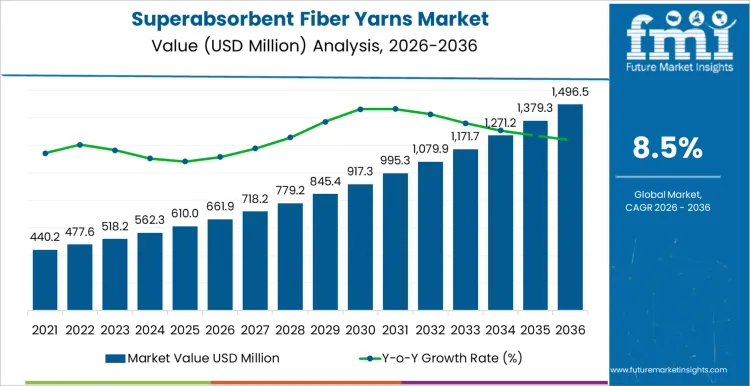
USD 661.9 million represents the opening size of the superabsorbent fiber yarns market in 2026, with the value projected to reach USD 1,496.5 million by 2036 at an 8.50% CAGR. Demand arises in hygiene products, medical textiles, and moisture management fabrics where absorption rate, retention under load, and fluid distribution determine functional performance. Material specification is defined during fabric architecture development through selection of polymer systems, filament geometry, and integration methods. Once a fabric platform enters approved production status, subsequent yarn substitution requires renewed performance and safety validation. Volume growth follows expansion in adult care products, wound care materials, and technical textiles designed for controlled fluid management.
Access to the superabsorbent fiber yarns market is governed by specification ownership, approved construction lists, and extended qualification timelines. Market participation depends on documented absorption kinetics, gel stability, and compatibility with adjacent fibers and binders. Approved material sets remain unchanged across long product lifecycles because regulatory and performance claims attach to specific constructions. Supplier replacement occurs during formal product redesign programs rather than routine sourcing cycles. Revenue development reflects the number of product families integrating absorbent yarn structures. Competitive position depends on early involvement in fabric design stages and sustained inclusion within standardized material systems across hygiene, medical, and technical textile applications.
Superabsorbent Fiber Yarns Market Quick Stats
- Superabsorbent Fiber Yarns Market Value (2026): USD 661.9 million
- Superabsorbent Fiber Yarns Market Forecast Value (2036): USD 1,496.5 million
- Superabsorbent Fiber Yarns Market Forecast CAGR (2026 to 2036): 8.5%
- Leading Type in Superabsorbent Fiber Yarns Market: SAP-loaded cellulosic fibers
- Key Growth Regions in Superabsorbent Fiber Yarns Market: China, USA, Germany, South Korea, Japan
- Top Players in Superabsorbent Fiber Yarns Market: BASF, Evonik, Nippon Shokubai, Sumitomo Seika Chemicals, Fitesa, Kelheim Fibres, Fibertex Personal Care, Sandtex, Nitto Denko, Suedwolle Group
What is the Growth Forecast for the Superabsorbent Fiber Yarns Market through 2036?
The superabsorbent fiber yarns market in 2026 stands near USD 661.9 million, centered on products where liquid handling defines performance and liability. Buyers use these yarns in hygiene, medical textiles, wound care, and technical wipes where uptake speed and retention under load matter more than basic strength. Specification work focuses on swelling behavior, gel stability, fiber integrity after wetting, and compatibility with knitting or weaving equipment. Adoption depends on how the yarn runs in existing processes and how it behaves during storage and transport. The climb toward USD 1,496.5 million in 2036 follows an 8.50% growth profile supported by higher absorbent content per product and wider use in multi-layer constructions.
Product design practice sets the spending pattern of the superabsorbent fiber yarns market. Orders follow platform lifetimes, regulatory approval cycles, and long production campaigns. Inventory policy favors continuity of qualified grades and predictable moisture sensitivity behavior. Cost structure reflects polymer input, spinning yield, crosslink control, and quality screening intensity. Development teams value consistency in absorption curves and tensile retention after wetting over marginal price changes. Annual values move through the low and mid one billions during the early 2030s as more designs replace blends with dedicated absorbent yarn structures. The rise to USD 1,496.5 million in 2036 comes from thicker absorbent zones, broader adoption across care products, and longer contracts that place these yarns into fixed material specifications across multiple product families.
Superabsorbent Fiber Yarns Market Key Takeaways
| Metric | Value |
|---|---|
| Market Value (2026) | USD 661.9 million |
| Forecast Value (2036) | USD 1,496.5 million |
| Forecast CAGR (2026 to 2036) | 8.5% |
How Is the Superabsorbent Fiber Yarns Market Being Used to Control Fluid Uptake, Retention, and Process Reliability in Absorbent Products?
The superabsorbent fiber yarns market is specified where liquid handling performance must remain stable across storage, use, and disposal conditions. In production chains linked to hygiene absorbent products, buyers focus on uptake speed and gel blocking behavior because slow response shows up as leakage during first contact. Converters supplying medical wound care textiles evaluate fiber integrity after swelling and compression cycles. Programs serving incontinence care materials test retention under load because squeeze out changes product acceptance. Developers working within technical nonwoven fabrics review distribution uniformity across webs. Teams aligned with diaper core structures track bonding compatibility and dust generation. Qualification centers on consistency, not peak capacity, because uneven behavior forces conservative design and increases material usage.
The superabsorbent fiber yarns market is managed through performance verification and line stability rather than laboratory absorption figures. Operations connected to feminine hygiene products measure value through defect rates, complaint frequency, and scrap tied to wet strength loss. Plants running high speed forming lines watch cutting behavior and static control because swollen residue affects cleanup time. Storage conditions receive attention since humidity exposure changes starting performance before conversion. Procurement groups link supplier choice to documentation quality and lot to lot drift because requalification interrupts production schedules. Contracts define limits for retention under pressure, fiber breakage, and fines generation. Demand concentrates in applications where leakage risk, skin contact, and disposal handling govern approval, which places material selection inside routine quality control rather than formulation experimentation.
How do fluid management targets and qualification files shape demand in the Superabsorbent Fiber Yarns Market by polymer and application in 2026?
In the Superabsorbent Fiber Yarns Market, specifications start from uptake rate, retention under load, and lint control rather than from yarn price. Programs serving hygiene absorbent product manufacturing, medical dressing fabrication, and industrial cable protection require fibers that keep performance stable across forming, cutting, and bonding steps. By polymer, usage spans sap-loaded cellulosic fibers, sap-loaded synthetic fibers, pure superabsorbent fibers, and other systems, each with different swelling behavior and tensile retention. By application, consumption covers hygiene and incontinence, medical and wound care, cables and industrial uses, and other applications. Once a yarn passes trials and enters control plans, substitution triggers re-testing and customer approvals. That lock-in explains stable portfolios and incremental scaling inside approved constructions.
Why do sap-loaded cellulosic constructions remain central to high-volume programs?
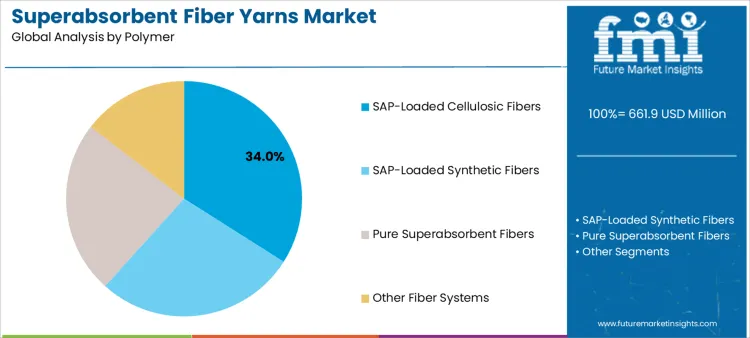
SAP-loaded cellulosic fibers hold about 34% share because they combine fast wicking with controlled swelling and familiar converting behavior. In hygiene absorbent product manufacturing and nonwoven web forming, this balance keeps basis weight and cut quality predictable at speed. SAP-loaded synthetic fibers serve designs that need higher wet strength or abrasion resistance during handling and transport. Pure superabsorbent fibers target extreme capacity roles where structure can be sacrificed for uptake. Other systems remain tied to narrow equipment windows. Engineers screen polymers by acquisition speed, gel blocking tendency, and tensile after saturation. Process teams screen them by winding stability, dust, and bond response. Quality teams screen them by lot consistency and aging under storage. A polymer family that clears these gates becomes standard across multiple SKUs.
Once selected, the construction is embedded in spinning packs, twist levels, and downstream cutting tools. Changing polymer type forces new settings, new sampling plans, and new packaging labels. Documentation updates follow to keep claims aligned. Planning then protects the approved recipe with dedicated schedules. Inventory rules prevent mixing to avoid field complaints. The commercial outcome favors repeating the same construction across widths and counts. Capacity grows by adding positions rather than altering chemistry. That discipline explains the persistent role of sap-loaded cellulosic options in platforms where run stability and claim control outweigh maximum theoretical capacity.
How do use conditions and care pathways lock in application demand?
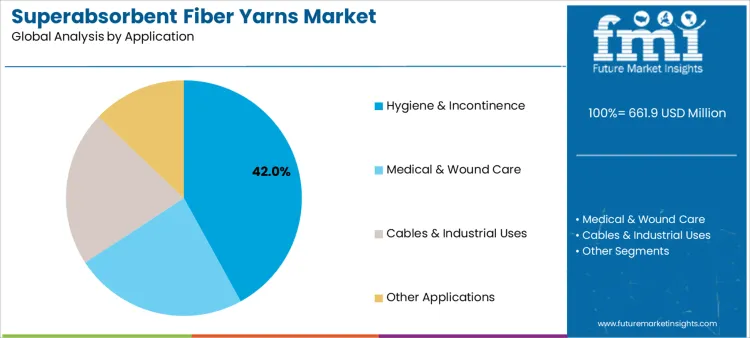
Hygiene and incontinence represent about 42% of demand because acceptance depends on rapid intake, low rewet, and stable shape during use. In hygiene absorbent product manufacturing, approval files link yarn behavior to core integrity and surface dryness. Medical and wound care consume fibers where controlled swelling and fiber integrity matter during dressing changes in medical dressing fabrication. Cables and industrial uses rely on swelling to block ingress inside jackets and glands in industrial cable protection. Other applications remain tied to site-specific equipment. Converters approve routes through forming speed, bonding profile, and downstream scrap. Compliance teams define sampling and traceability. Service teams define replacement intervals and storage rules. Once a route clears these checks, it becomes fixed to a narrow operating window.
Switching the application route resets trials and customer files. Tooling and kitting layouts also change. Training and inspection sheets must be updated. Supervisors then protect the approved route with dedicated schedules. Orders expand by adding shifts and lanes rather than changing fiber types. Demand follows applications where documentation and care pathways govern performance expectations more than short purchasing cycles.
Why Are Liquid Management Requirements Driving the Superabsorbent Fiber Yarns Market?
Superabsorbent Fiber Yarns Market demand is expanding because product developers need yarns that can absorb and lock away liquids while maintaining structural integrity in end use. In hygiene products, medical dressings, and industrial wipes, superabsorbent yarns enhance moisture control, reduce leakage risk, and improve wearer or application confidence. Textile and nonwoven producers specify yarns with high uptake capacity and rapid absorption rates to maintain process efficiency on spinning and bonding equipment. Buyers evaluate swelling behavior under load, retention after fluid uptake, and compatibility with printing, lamination, and conversion systems. Material consistency across production lots supports predictable line speeds and product uniformity.
What Factors Are Restricting Adoption and Scale in the Superabsorbent Fiber Yarns Market?
Superabsorbent Fiber Yarns Market growth is limited by manufacturing complexity, cost differentiation, and integration into existing textile and nonwoven lines. Producing fiber yarns with high absorbent capacity requires precise control over polymer crosslinking, filament morphology, and post-spinning treatments, which can increase production costs relative to standard yarns. Differences in absorption rate and swelling volume necessitate adjustments in web formation, bonding, and cutting operations to avoid machine disruptions. Price sensitivity in segments such as wipes and commodity hygiene products forces buyers to balance performance gains against unit economics. Ensuring yarn stability under storage and handling also affects qualification timelines and inventory planning.
How Are Product Offerings and Commercial Practices Shaping the Superabsorbent Fiber Yarns Market?
Superabsorbent Fiber Yarns Market offerings are being organized around defined absorption capacity categories, retention performance metrics, and conversion compatibility ratings to help converters choose appropriate grades quickly. Suppliers provide detailed data on fluid uptake kinetics, gel blocking behavior, and mechanical strength after swelling to support material selection and minimize trial runs. Portfolio segmentation by application type such as high capacity for medical uses and rapid uptake for hygiene goods simplifies buying decisions. Commercial arrangements increasingly include volume guarantees and consistent delivery schedules to match production planning cycles. Technical support focuses on winding stability, web integration strategies, and defect reduction to help customers maintain throughput and product quality.
What is the Demand for Superabsorbent Fiber Yarns by Country?
| Country | CAGR (%) |
|---|---|
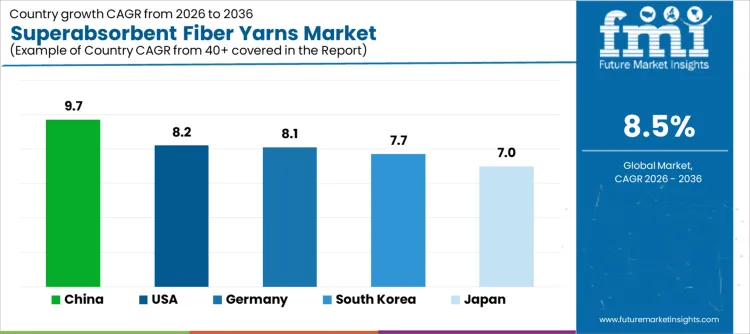
| USA | 8.2% |
| Japan | 7.0% |
| South Korea | 7.7% |
| Germany | 8.1% |
| China | 9.7% |
The demand for superabsorbent fiber yarns is rising across hygiene, medical textiles, and specialty industrial applications where moisture management and fluid retention define product performance. China leads at 9.7% CAGR, supported by large scale production of hygiene products, medical disposables, and functional nonwovens for domestic use and export markets. The USA grows at 8.2%, driven by steady demand in adult incontinence products, wound care textiles, and technical fabrics. Germany records 8.1%, shaped by high quality medical and hygiene textile manufacturing. South Korea advances at 7.7%, reflecting stable demand from healthcare and specialty textile producers. Japan posts 7.0%, within a mature but specification driven market focused on consistent quality and performance.
How Do Medical and Hygiene Qualification Protocols Shape Buying in the Superabsorbent Fiber Yarns Market in the USA?
In the United States, the Superabsorbent Fiber Yarns Market is advancing at a pace consistent with an 8.2% CAGR. Procurement is governed by qualification protocols that define liquid uptake capacity, retention under load, and structural integrity during use. Evaluation programs measure absorption rate, rewet performance, tensile stability, and behavior during repeated handling. Once a yarn grade passes these trials, the same approval file anchors downstream contracts and material substitution becomes infrequent. Volume increases only when approved hygiene, medical, or industrial maintenance programs expand coverage or introduce new product formats. Technical committees retain authority over any specification change. Supplier access depends on documentation completeness and audit performance. Inventory policies follow production planning rather than spot purchasing. Commercial success depends on specification inclusion and consistent batch performance across multiple manufacturing locations.
How Do Factory Governance Systems Determine Adoption in the Superabsorbent Fiber Yarns Market in Japan?
Within Japanese operations, material governance is directing the Superabsorbent Fiber Yarns Market along a trajectory aligned with a 7% CAGR. Yarn selection is treated as a manufacturing control variable rather than a procurement decision. Any proposed change enters a formal review cycle that includes extended absorption stability checks and cleanliness assessments. Engineers examine swelling behavior, fiber cohesion, dust generation, and tolerance to processing stress. Once approved, the same yarn remains embedded in identical constructions for extended production cycles. Change requests trigger complete revalidation procedures. Supplier access depends on documentation completeness and inspection outcomes. Local sources benefit from proximity to audit teams and quality oversight groups. Volume growth follows gradual portfolio extension rather than replacement initiatives. Commercial positioning relies on procedural discipline, documentation rigor, and sustained performance verification.
How Do Standardized Product Platforms Drive Scale in the Superabsorbent Fiber Yarns Market in South Korea?
Platform based product strategy explains why the Superabsorbent Fiber Yarns Market in South Korea is advancing in line with a 7.7% CAGR. Development organizations define standard yarn sets that apply across several product families. A single material decision can influence numerous lines without separate approvals. Evaluation centers on absorption speed, retention efficiency, structural stability, and compatibility with existing processing routes. When a yarn enters the platform baseline, scale follows through synchronized product introductions. Plant level changes remain limited because the platform file governs material use. Suppliers secure positions through joint testing and alignment with documentation requirements. Volume growth mirrors platform rollout schedules. Inventory planning aligns with coordinated production programs. Commercial success depends on early inclusion in platform definitions and stable execution during multi line manufacturing deployments.
How Do Central Approval Registers Control Material Choice in the Superabsorbent Fiber Yarns Market in Germany?
In Germany, centralized technical governance is steering the Superabsorbent Fiber Yarns Market in accordance with an 8.1% CAGR. Material access is controlled through central approval registers that apply across multiple production sites. Individual plants do not possess authority to introduce new yarns independently. Reviews focus on reproducibility, absorption performance, and audit completeness across operations. After approval, the same yarn grade is released for use in several factories under identical specification rules. Volume expansion follows program growth rather than local purchasing initiatives. Supplier positioning depends on audit performance and documentation discipline. Change control remains formal and closely supervised. Inventory policies reflect coordinated production planning. Commercial success depends on passing central reviews and maintaining identical performance across distributed manufacturing environments over extended operating periods.
How Do Network Replication Programs Create Scale in the Superabsorbent Fiber Yarns Market in China?
Replication across manufacturing networks explains why the Superabsorbent Fiber Yarns Market in China is advancing in line with a 9.7% CAGR. Once a yarn performs within defined absorption and processing limits in one plant, it is transferred into parallel lines with limited redesign. Approval focuses on consistency and tolerance to high volume production rather than incremental optimization. Expansion teams rely on standardized qualification files and rollout checklists. Domestic suppliers dominate because they can follow capacity additions and regional program expansion. Imports remain concentrated in higher specification applications. Volume growth results from repeating approved constructions across sites. Commercial advantage depends on being present when a product architecture becomes a reference template rather than competing for each individual facility.
How Do Suppliers Compete in the Superabsorbent Fiber Yarns Market?
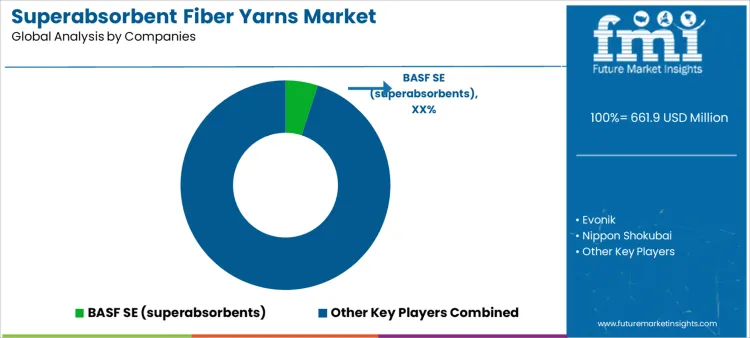
Absorbency performance, swelling control, and fiber integration define adoption in the Superabsorbent Fiber Yarns Market. BASF, Evonik, Nippon Shokubai, Sumitomo Seika Chemicals, Fitesa, Kelheim Fibres, Fibertex Personal Care, Sandtex, Nitto Denko, and Suedwolle Group compete through product trials, pilot spinning, and nonwoven line validation. Once incorporated into hygiene products, fiber retention, dimensional stability, and compatibility with absorbent cores anchor supplier selection. BASF emphasizes high-capacity polymers engineered for personal care.
Evonik delivers industrial-grade fibers with consistent swelling behavior. Nippon Shokubai focuses on specialty polyacrylate fibers for thin-core applications. Sumitomo Seika Chemicals targets functional fibers requiring predictable expansion. Fitesa and Fibertex Personal Care integrate superabsorbent fibers into spunbond and meltblown nonwovens. Kelheim Fibres provides fibers with optimized absorption kinetics. Sandtex focuses on cost-efficient hygiene solutions. Nitto Denko and Suedwolle Group supply functional yarns for industrial and specialty hygiene applications.
Consistency, processing reliability, and technical support drive supplier competitiveness in the Superabsorbent Fiber Yarns Market. R&D teams evaluate fiber swelling rate, retention under load, extrusion stability, and thermal tolerance during qualification. Manufacturers prioritize suppliers that deliver reproducible lots and scalable production. BASF secures adoption through integrated superabsorbent polymer and fiber systems. Evonik maintains positions in high-volume absorbent cores requiring uniform performance.
Nippon Shokubai competes in applications demanding thin-profile fibers. Sumitomo Seika Chemicals supports specialty functional fiber programs. Fitesa and Fibertex Personal Care gain placements through direct integration with nonwoven lines. Kelheim Fibres attracts users needing controlled expansion kinetics. Sandtex targets large-scale disposable hygiene applications. Nitto Denko and Suedwolle Group maintain positions in technical and industrial hygiene yarn programs. Market positions vary by fiber chemistry, production method, end-use application, and regulatory requirements.
Key Players in Superabsorbent Fiber Yarns Market
- BASF (superabsorbents)
- Evonik
- Nippon Shokubai
- Sumitomo Seika Chemicals
- Fitesa (superabsorbent nonwovens)
- Kelheim Fibres (superabsorbent fibers)
- Fibertex Personal Care
- Sandtex
- Nitto Denko
- Suedwolle Group (functional yarns)
Scope of the Report
| Items | Values |
|---|---|
| Quantitative Units (2026) | USD million |
| Polymer | SAP-loaded cellulosic fibers, SAP-loaded synthetic fibers, pure superabsorbent fibers, other fiber systems |
| Application | Hygiene and incontinence, medical and wound care, cables and industrial uses, other applications |
| Yarn Form | Staple and spun yarns, core-shell and composite yarns, other engineered yarns |
| End Customer | Hygiene product makers, medical and healthcare, cable and industrial users, other buyers |
| Regions Covered | Asia Pacific, Europe, North America, Latin America, Middle East & Africa |
| Countries Covered | United States, Canada, Mexico, Germany, United Kingdom, France, Italy, Spain, Nordics, BENELUX, China, Japan, South Korea, India, Australia & New Zealand, ASEAN, Brazil, Chile, Saudi Arabia, Turkey, South Africa, and other regional markets |
| Key Companies Profiled | BASF, Evonik, Nippon Shokubai, Sumitomo Seika Chemicals, Fitesa, Kelheim Fibres, Fibertex Personal Care, Sandtex, Nitto Denko, Suedwolle Group |
| Additional Attributes | Dollar sales by polymer, application, yarn form, and end customer, absorption capacity and retention under load performance metrics, swelling and gel stability control requirements, integration into hygiene, medical, and industrial textile structures, processing and converting constraints linked to dust generation and wet strength loss, lot-to-lot consistency and documentation requirements, long qualification and approval cycles tied to medical and hygiene regulations, and regional demand patterns driven by growth in adult care, wound care, and technical fluid management textiles |
Superabsorbent Fiber Yarns Market Segmentation
Polymer:
- SAP-Loaded Cellulosic Fibers
- SAP-Loaded Synthetic Fibers
- Pure Superabsorbent Fibers
- Other Fiber Systems
Application:
- Hygiene & Incontinence
- Medical & Wound Care
- Cables & Industrial Uses
- Other Applications
Yarn Form:
- Staple/Spun Yarns
- Core-Shell/Composite Yarns
- Other Engineered Yarns
End Customer:
- Hygiene Product Makers
- Medical & Healthcare
- Cable & Industrial Users
- Other Buyers
Region:
- Asia Pacific
- China
- Japan
- South Korea
- India
- Australia & New Zealand
- ASEAN
- Rest of Asia Pacific
- Europe
- Germany
- United Kingdom
- France
- Italy
- Spain
- Nordic
- BENELUX
- Rest of Europe
- North America
- United States
- Canada
- Mexico
- Latin America
- Brazil
- Chile
- Rest of Latin America
- Middle East & Africa
- Kingdom of Saudi Arabia
- Other GCC Countries
- Turkey
- South Africa
- Other African Union
- Rest of Middle East & Africa
Bibliography
- United Nations Environment Programme. (2024). Global waste management outlook 2024. United Nations Environment Programme.
- World Health Organization. (2024). Global report on infection prevention and control 2024. World Health Organization.
- Organisation for Economic Co-operation and Development. (2025). Decarbonising health systems across OECD countries. OECD Publishing.
- Organisation for Economic Co-operation and Development. (2025). OECD regulatory policy outlook 2025. OECD Publishing.
Frequently Asked Questions
How big is the superabsorbent fiber yarns market in 2026?
The global superabsorbent fiber yarns market is estimated to be valued at USD 661.9 million in 2026.
What will be the size of superabsorbent fiber yarns market in 2036?
The market size for the superabsorbent fiber yarns market is projected to reach USD 1,496.5 million by 2036.
How much will be the superabsorbent fiber yarns market growth between 2026 and 2036?
The superabsorbent fiber yarns market is expected to grow at a 8.5% CAGR between 2026 and 2036.
What are the key product types in the superabsorbent fiber yarns market?
The key product types in superabsorbent fiber yarns market are sap-loaded cellulosic fibers, sap-loaded synthetic fibers, pure superabsorbent fibers and other fiber systems.
Which application segment to contribute significant share in the superabsorbent fiber yarns market in 2026?
In terms of application, hygiene & incontinence segment to command 42.0% share in the superabsorbent fiber yarns market in 2026.
Preview the report firsthand - request a free sample
Get SampleGet the brochure for pricing and purchase details.
Get PDFTable of Content
- Executive Summary
- Global Market Outlook
- Demand-side Trends
- Supply-side Trends
- Technology Roadmap Analysis
- Analysis and Recommendations
- Market Overview
- Market Coverage / Taxonomy
- Market Definition / Scope / Limitations
- Market Background
- Market Dynamics
- Drivers
- Restraints
- Opportunity
- Trends
- Scenario Forecast
- Demand in Optimistic Scenario
- Demand in Likely Scenario
- Demand in Conservative Scenario
- Opportunity Map Analysis
- Product Life Cycle Analysis
- Supply Chain Analysis
- Investment Feasibility Matrix
- Value Chain Analysis
- PESTLE and Porter’s Analysis
- Regulatory Landscape
- Regional Parent Market Outlook
- Production and Consumption Statistics
- Import and Export Statistics
- Market Dynamics
- Global Market Analysis 2021 to 2025 and Forecast, 2026 to 2036
- Historical Market Size Value (USD Million) Analysis, 2021 to 2025
- Current and Future Market Size Value (USD Million) Projections, 2026 to 2036
- Y-o-Y Growth Trend Analysis
- Absolute $ Opportunity Analysis
- Global Market Pricing Analysis 2021 to 2025 and Forecast 2026 to 2036
- Global Market Analysis 2021 to 2025 and Forecast 2026 to 2036, By Polymer
- Introduction / Key Findings
- Historical Market Size Value (USD Million) Analysis By Polymer , 2021 to 2025
- Current and Future Market Size Value (USD Million) Analysis and Forecast By Polymer , 2026 to 2036
- SAP-Loaded Cellulosic Fibers
- SAP-Loaded Synthetic Fibers
- Pure Superabsorbent Fibers
- Other Fiber Systems
- SAP-Loaded Cellulosic Fibers
- Y-o-Y Growth Trend Analysis By Polymer , 2021 to 2025
- Absolute $ Opportunity Analysis By Polymer , 2026 to 2036
- Global Market Analysis 2021 to 2025 and Forecast 2026 to 2036, By Application
- Introduction / Key Findings
- Historical Market Size Value (USD Million) Analysis By Application, 2021 to 2025
- Current and Future Market Size Value (USD Million) Analysis and Forecast By Application, 2026 to 2036
- Hygiene & Incontinence
- Medical & Wound Care
- Cables & Industrial Uses
- Other Applications
- Hygiene & Incontinence
- Y-o-Y Growth Trend Analysis By Application, 2021 to 2025
- Absolute $ Opportunity Analysis By Application, 2026 to 2036
- Global Market Analysis 2021 to 2025 and Forecast 2026 to 2036, By Yarn Form
- Introduction / Key Findings
- Historical Market Size Value (USD Million) Analysis By Yarn Form, 2021 to 2025
- Current and Future Market Size Value (USD Million) Analysis and Forecast By Yarn Form, 2026 to 2036
- Staple/Spun Yarns
- Core-Shell/Composite Yarns
- Other Engineered Yarns
- Staple/Spun Yarns
- Y-o-Y Growth Trend Analysis By Yarn Form, 2021 to 2025
- Absolute $ Opportunity Analysis By Yarn Form, 2026 to 2036
- Global Market Analysis 2021 to 2025 and Forecast 2026 to 2036, By End Customer
- Introduction / Key Findings
- Historical Market Size Value (USD Million) Analysis By End Customer, 2021 to 2025
- Current and Future Market Size Value (USD Million) Analysis and Forecast By End Customer, 2026 to 2036
- Hygiene Product Makers
- Medical & Healthcare
- Cable & Industrial Users
- Other Buyers
- Hygiene Product Makers
- Y-o-Y Growth Trend Analysis By End Customer, 2021 to 2025
- Absolute $ Opportunity Analysis By End Customer, 2026 to 2036
- Global Market Analysis 2021 to 2025 and Forecast 2026 to 2036, By Region
- Introduction
- Historical Market Size Value (USD Million) Analysis By Region, 2021 to 2025
- Current Market Size Value (USD Million) Analysis and Forecast By Region, 2026 to 2036
- North America
- Latin America
- Western Europe
- Eastern Europe
- East Asia
- South Asia and Pacific
- Middle East & Africa
- Market Attractiveness Analysis By Region
- North America Market Analysis 2021 to 2025 and Forecast 2026 to 2036, By Country
- Historical Market Size Value (USD Million) Trend Analysis By Market Taxonomy, 2021 to 2025
- Market Size Value (USD Million) Forecast By Market Taxonomy, 2026 to 2036
- By Country
- USA
- Canada
- Mexico
- By Polymer
- By Application
- By Yarn Form
- By End Customer
- By Country
- Market Attractiveness Analysis
- By Country
- By Polymer
- By Application
- By Yarn Form
- By End Customer
- Key Takeaways
- Latin America Market Analysis 2021 to 2025 and Forecast 2026 to 2036, By Country
- Historical Market Size Value (USD Million) Trend Analysis By Market Taxonomy, 2021 to 2025
- Market Size Value (USD Million) Forecast By Market Taxonomy, 2026 to 2036
- By Country
- Brazil
- Chile
- Rest of Latin America
- By Polymer
- By Application
- By Yarn Form
- By End Customer
- By Country
- Market Attractiveness Analysis
- By Country
- By Polymer
- By Application
- By Yarn Form
- By End Customer
- Key Takeaways
- Western Europe Market Analysis 2021 to 2025 and Forecast 2026 to 2036, By Country
- Historical Market Size Value (USD Million) Trend Analysis By Market Taxonomy, 2021 to 2025
- Market Size Value (USD Million) Forecast By Market Taxonomy, 2026 to 2036
- By Country
- Germany
- UK
- Italy
- Spain
- France
- Nordic
- BENELUX
- Rest of Western Europe
- By Polymer
- By Application
- By Yarn Form
- By End Customer
- By Country
- Market Attractiveness Analysis
- By Country
- By Polymer
- By Application
- By Yarn Form
- By End Customer
- Key Takeaways
- Eastern Europe Market Analysis 2021 to 2025 and Forecast 2026 to 2036, By Country
- Historical Market Size Value (USD Million) Trend Analysis By Market Taxonomy, 2021 to 2025
- Market Size Value (USD Million) Forecast By Market Taxonomy, 2026 to 2036
- By Country
- Russia
- Poland
- Hungary
- Balkan & Baltic
- Rest of Eastern Europe
- By Polymer
- By Application
- By Yarn Form
- By End Customer
- By Country
- Market Attractiveness Analysis
- By Country
- By Polymer
- By Application
- By Yarn Form
- By End Customer
- Key Takeaways
- East Asia Market Analysis 2021 to 2025 and Forecast 2026 to 2036, By Country
- Historical Market Size Value (USD Million) Trend Analysis By Market Taxonomy, 2021 to 2025
- Market Size Value (USD Million) Forecast By Market Taxonomy, 2026 to 2036
- By Country
- China
- Japan
- South Korea
- By Polymer
- By Application
- By Yarn Form
- By End Customer
- By Country
- Market Attractiveness Analysis
- By Country
- By Polymer
- By Application
- By Yarn Form
- By End Customer
- Key Takeaways
- South Asia and Pacific Market Analysis 2021 to 2025 and Forecast 2026 to 2036, By Country
- Historical Market Size Value (USD Million) Trend Analysis By Market Taxonomy, 2021 to 2025
- Market Size Value (USD Million) Forecast By Market Taxonomy, 2026 to 2036
- By Country
- India
- ASEAN
- Australia & New Zealand
- Rest of South Asia and Pacific
- By Polymer
- By Application
- By Yarn Form
- By End Customer
- By Country
- Market Attractiveness Analysis
- By Country
- By Polymer
- By Application
- By Yarn Form
- By End Customer
- Key Takeaways
- Middle East & Africa Market Analysis 2021 to 2025 and Forecast 2026 to 2036, By Country
- Historical Market Size Value (USD Million) Trend Analysis By Market Taxonomy, 2021 to 2025
- Market Size Value (USD Million) Forecast By Market Taxonomy, 2026 to 2036
- By Country
- Kingdom of Saudi Arabia
- Other GCC Countries
- Turkiye
- South Africa
- Other African Union
- Rest of Middle East & Africa
- By Polymer
- By Application
- By Yarn Form
- By End Customer
- By Country
- Market Attractiveness Analysis
- By Country
- By Polymer
- By Application
- By Yarn Form
- By End Customer
- Key Takeaways
- Key Countries Market Analysis
- USA
- Pricing Analysis
- Market Share Analysis, 2025
- By Polymer
- By Application
- By Yarn Form
- By End Customer
- Canada
- Pricing Analysis
- Market Share Analysis, 2025
- By Polymer
- By Application
- By Yarn Form
- By End Customer
- Mexico
- Pricing Analysis
- Market Share Analysis, 2025
- By Polymer
- By Application
- By Yarn Form
- By End Customer
- Brazil
- Pricing Analysis
- Market Share Analysis, 2025
- By Polymer
- By Application
- By Yarn Form
- By End Customer
- Chile
- Pricing Analysis
- Market Share Analysis, 2025
- By Polymer
- By Application
- By Yarn Form
- By End Customer
- Germany
- Pricing Analysis
- Market Share Analysis, 2025
- By Polymer
- By Application
- By Yarn Form
- By End Customer
- UK
- Pricing Analysis
- Market Share Analysis, 2025
- By Polymer
- By Application
- By Yarn Form
- By End Customer
- Italy
- Pricing Analysis
- Market Share Analysis, 2025
- By Polymer
- By Application
- By Yarn Form
- By End Customer
- Spain
- Pricing Analysis
- Market Share Analysis, 2025
- By Polymer
- By Application
- By Yarn Form
- By End Customer
- France
- Pricing Analysis
- Market Share Analysis, 2025
- By Polymer
- By Application
- By Yarn Form
- By End Customer
- India
- Pricing Analysis
- Market Share Analysis, 2025
- By Polymer
- By Application
- By Yarn Form
- By End Customer
- ASEAN
- Pricing Analysis
- Market Share Analysis, 2025
- By Polymer
- By Application
- By Yarn Form
- By End Customer
- Australia & New Zealand
- Pricing Analysis
- Market Share Analysis, 2025
- By Polymer
- By Application
- By Yarn Form
- By End Customer
- China
- Pricing Analysis
- Market Share Analysis, 2025
- By Polymer
- By Application
- By Yarn Form
- By End Customer
- Japan
- Pricing Analysis
- Market Share Analysis, 2025
- By Polymer
- By Application
- By Yarn Form
- By End Customer
- South Korea
- Pricing Analysis
- Market Share Analysis, 2025
- By Polymer
- By Application
- By Yarn Form
- By End Customer
- Russia
- Pricing Analysis
- Market Share Analysis, 2025
- By Polymer
- By Application
- By Yarn Form
- By End Customer
- Poland
- Pricing Analysis
- Market Share Analysis, 2025
- By Polymer
- By Application
- By Yarn Form
- By End Customer
- Hungary
- Pricing Analysis
- Market Share Analysis, 2025
- By Polymer
- By Application
- By Yarn Form
- By End Customer
- Kingdom of Saudi Arabia
- Pricing Analysis
- Market Share Analysis, 2025
- By Polymer
- By Application
- By Yarn Form
- By End Customer
- Turkiye
- Pricing Analysis
- Market Share Analysis, 2025
- By Polymer
- By Application
- By Yarn Form
- By End Customer
- South Africa
- Pricing Analysis
- Market Share Analysis, 2025
- By Polymer
- By Application
- By Yarn Form
- By End Customer
- USA
- Market Structure Analysis
- Competition Dashboard
- Competition Benchmarking
- Market Share Analysis of Top Players
- By Regional
- By Polymer
- By Application
- By Yarn Form
- By End Customer
- Competition Analysis
- Competition Deep Dive
- BASF SE (superabsorbents)
- Overview
- Product Portfolio
- Profitability by Market Segments (Product/Age /Sales Channel/Region)
- Sales Footprint
- Strategy Overview
- Marketing Strategy
- Product Strategy
- Channel Strategy
- Evonik
- Nippon Shokubai
- Sumitomo Seika Chemicals
- Fitesa (superabsorbent nonwovens)
- Kelheim Fibres (superabsorbent fibers)
- Fibertex Personal Care
- Sandtex
- Nitto Denko
- Suedwolle Group (functional yarns)
- BASF SE (superabsorbents)
- Competition Deep Dive
- Assumptions & Acronyms Used
- Research Methodology


