

- Industry Size (2026)
- USD 3.31 Bn
- Forecast (2036)
- USD 6.13 Bn
- CAGR (2026 to 2036)
- 38.0%
Fiber Cushioning Market Size, Market Forecast and Outlook By FMI
The fiber cushioning market reached USD 3.11 billion in 2025 and is projected to rise to USD 3.31 billion in 2026. Over 2026 to 2036, demand is expected to advance at a CAGR of 6.4%, taking total market value to USD 6.13 billion by 2036. Industry outlook is being shaped by extended producer responsibility mandates that are pushing high-volume shippers to replace expanded polystyrene with paper-based cushioning formats that can slot into existing packaging lines with less regulatory exposure.
Summary of Fiber Cushioning Market
- Fiber Cushioning Market Snapshot
- The fiber cushioning market is valued at USD 3.11 billion in 2025 and is projected to reach USD 6.13 billion by 2036.
- The market is expected to expand at a 6.4% CAGR from 2026 to 2036, creating an incremental opportunity of USD 2.82 billion over the period.
- Industry expansion is being driven by extended producer responsibility mandates that are pushing high-volume shippers to replace expanded polystyrene with paper-based cushioning formats.
- The category remains closely linked to transit protection requirements in electronics, parcel, appliance, and industrial shipping, where recyclability, automation compatibility, and material recovery are increasingly influencing purchasing decisions.
- Fiber Cushioning Market Demand and Growth Drivers
- Demand is rising as regulators and brand owners push packaging systems away from plastic-heavy protective formats toward recyclable paper and formed-fiber solutions.
- Paper cushioning is gaining wider acceptance in e-commerce and industrial shipping because it can absorb shock while moving more easily through paper recovery streams than mixed-material packs.
- Rising parcel volumes are also supporting demand as shippers look to reduce transit damage without depending on bulky foam-based formats.
- Growth is moderated by machine-conversion costs, performance validation requirements for fragile goods, and slower retrofit cycles in mature fulfillment networks.
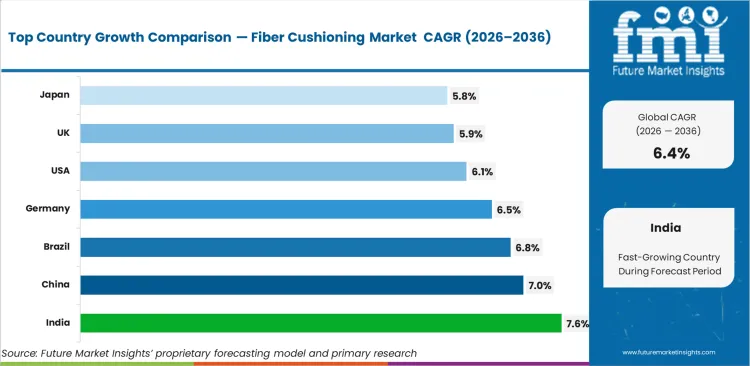
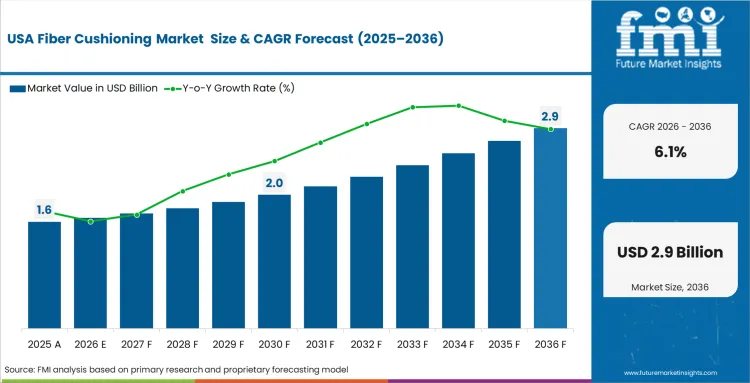
- Among key countries, India leads at 7.6% CAGR, followed by China at 7.0%, Brazil at 6.8%, Germany at 6.5%, United States at 6.1%, United Kingdom at 5.9%, and Japan at 5.8%.
- Fiber Cushioning Market Product and Segment View
- The market includes inserts, pads, wraps, edge protectors, liners, and other fiber-based protective components made mainly from recycled paper, virgin pulp, kraft paper, bagasse, and bamboo fiber.
- These products are used across electronics, appliances, e-commerce parcels, foodservice packs, and industrial goods shipping where vibration, impact, and movement control remain important.
- Custom-fit inserts are expected to remain central to fiber cushioning demand, with the segment projected to account for 34.0% share in 2026 as shippers work to reduce in-box movement and limit damage claims on fragile or branded goods.
- Across material types, recycled paper is estimated to account for 61.0% share in 2026 because it offers a practical mix of convertibility, cost efficiency, and circularity for mainstream cushioning lines.
- Electronics is anticipated to capture 27.0% share in 2026 as drop sensitivity and scratch prevention keep protection requirements high.
- Molded fiber is forecast to command 46.0% share in 2026 because it combines cushioning and load-bearing support in a single part.
- Direct sales are likely to hold 58.0% share in 2026 since large-volume shippers usually source through packaging engineers and integrated supply programs rather than open distribution.
- The market scope includes formed-fiber inserts, paper cushion pads, paper wraps, protective liners, and edge components, while excluding film air pillows, foam-in-place chemistries, and non-fiber protective plastics.
- Fiber Cushioning Market Geography and Competitive Outlook
- India, China, and Brazil are lucrative markets, while the United States remains the most stable demand base because of its large installed packaging automation footprint. Germany, the United Kingdom, and Japan continue to represent regulated or mature packaging environments with steadier adoption patterns.
- Competition depends on paper-conversion equipment, custom pack design capability, sustainability credentials, and the ability to supply high-volume customers across multiple fulfillment and shipping locations.
- International Paper, Ranpak, Pregis, Storopack, Smurfit Westrock, Sonoco, and Stora Enso are among the key participants. Sector is moderately fragmented, with global protective packaging groups competing alongside regional converters and molded-fiber specialists.
Fiber Cushioning Market Key Takeaways
| Metric | Details |
|---|---|
| Industry Size (2026) | USD 3.31 billion |
| Industry Value (2036) | USD 6.13 billion |
| CAGR (2026 to 2036) | 6.4% |
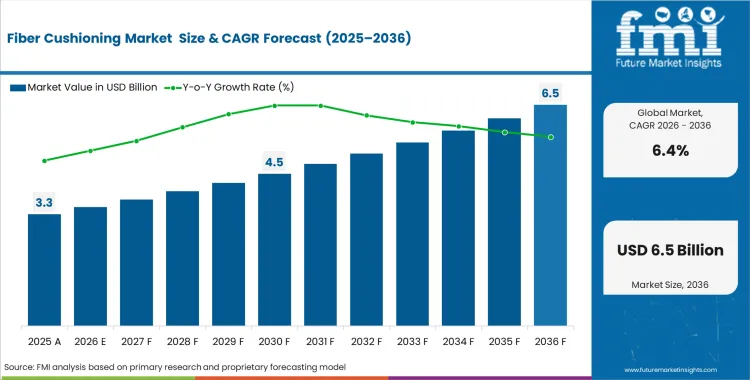
Source: Future Market Insights (FMI) analysis, based on proprietary forecasting model and primary research
Procurement teams in consumer electronics are weighing transit protection against disposal cost as packaging rules tighten across retail and distribution channels. Foam wraps still offer dependable in-transit performance, yet compliance exposure and penalty risk are becoming harder to ignore where landfill charges and plastic reduction mandates carry direct commercial consequences. Paper-based protective packaging can ease end-of-life cost pressure, although the switch usually requires changes in pack design, line configuration, and cube utilization. Material choice, for that reason, is tied to the broader cost of packaging redesign rather than to substitution alone. Delayed transition can leave brands exposed to higher disposal-related charges, weaker retailer acceptance, and slower progress against internal plastic reduction commitments.
Moisture control continues to limit wider use of fiber cushioning in long-distance shipping. Compression strength and dimensional stability can weaken on trans-Pacific routes where humidity variation is harder to manage over extended transit cycles. Broader adoption of paper pad cushioning systems in global shipping programs will depend on better performance under those conditions, since current use remains more practical in short-haul void fill applications. Converters and equipment suppliers able to deliver high-speed consistency at larger volumes stand to benefit once that barrier is addressed, while dependence on smaller regional players built around custom-format supply is likely to ease.
India is projected to expand at a 7.6% CAGR through 2036, supported by the localization of smartphone assembly and the parallel build-out of environmentally compliant packaging supply chains. China is expected to grow at 7.0%, with export-oriented manufacturers increasing the use of molded fiber packaging to meet European retailer requirements. Brazil follows at 6.8% as domestic production adapts to changing packaging preferences and local conversion capacity improves. Germany is likely to record 6.5% growth, reflecting the effect of stricter waste-management rules on material selection. The United States is forecast to grow at 6.1% as automated fulfillment networks increase demand for standardized dunnage packaging formats. The United Kingdom is expected to post 5.9% growth, while Japan is projected to expand at 5.8% annually. Regional investment priorities remain uneven, with some markets focused on high-speed void-fill systems and others placing more value on precise protective geometry for heavier industrial shipments.
Segmental Analysis
Fiber Cushioning Market Analysis by Material type
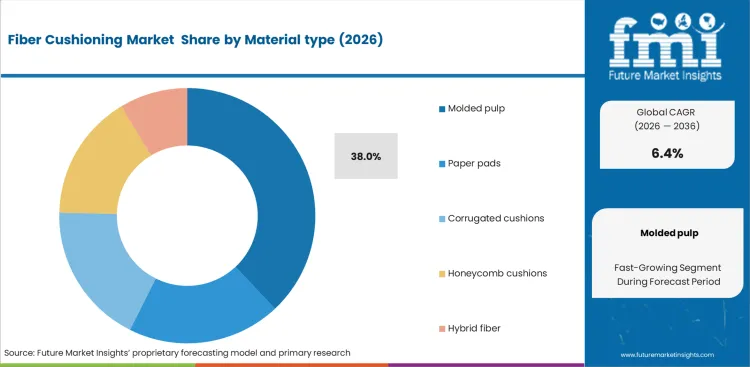
Dimensional precision remains a key reason molded pulp is expected to account for 38.0% share in 2026. Suppliers achieve that accuracy by pressing wet slurry through heated metal tooling, which allows tighter tolerances than generic paper-based protective formats. Appliance manufacturers often prefer these engineered shapes for heavy and fragile motor assemblies, where fit consistency matters for protection as well as pack-line stability. Molded fiber pulp packaging also withstands crushing loads better than loose void fill, which strengthens its use in applications requiring more controlled support. Compatibility with automated assembly environments adds to that advantage, since robotic systems can place components without slowing established handling speeds, particularly in molded pulp versus EPS foam comparisons.
- Tooling lock-in: Heated metal molds dictate exact product contours. Packaging engineers lose design iteration agility once standard geometries finalize.
- Robotic handling parity: Rigid shapes allow automated vacuum lifters to perform precise insertions. Assembly directors maintain throughput speeds established during legacy foam eras.
- Capital amortization: Custom mold creation requires significant upfront expenditure. Procurement officers must guarantee multi-year production volumes to justify initial converter investments.
Fiber Cushioning Market Analysis by Form factor
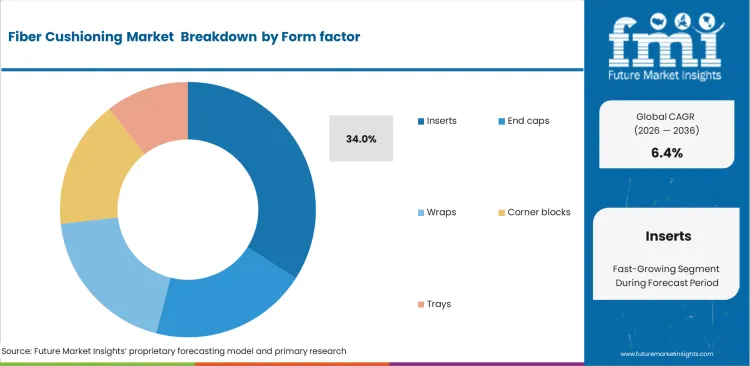
Protection of several components depends on engineered geometry rather than loose padding. Inserts are expected to account for 34.0% share in 2026, reflecting their role in securing sensitive products that cannot tolerate movement during transit. Packaging directors at industrial equipment OEMs often specify custom fiber inserts for servo motors and similar assemblies because shaped cavities hold the product in position and keep it away from carton walls. Dedicated crush zones add another layer of protection, which generic wrapping formats cannot provide with the same consistency. Packing operations also become easier to control when warehouse teams can place items into pre-fitted slots instead of estimating void-fill requirements for each shipment.
Storage efficiency remains a trade-off in these programs. Empty inserts, even when nested, can consume substantial floor space before reaching the packing line. Volumetric share figures do not fully reflect that warehouse burden, especially in facilities already working with tight staging capacity. Inbound congestion and dock pressure become more visible when insert-heavy formats are compared with flatter corrugated cushioning alternatives.
- Suspension geometry: Custom contours hold delicate mechanisms away from outer impacts. Packaging engineers guarantee survival rates for expensive fragile shipments.
- Throughput standardization: Pre-formed slots eliminate packer discretion regarding material usage. Fulfillment managers achieve predictable pack times and uniform box weights.
- Storage consumption: Empty shapes ship air and require immense warehouse footprints. Logistics directors face sudden staging area constraints when transitioning from flat-packed alternatives.
Fiber Cushioning Market Analysis by End use
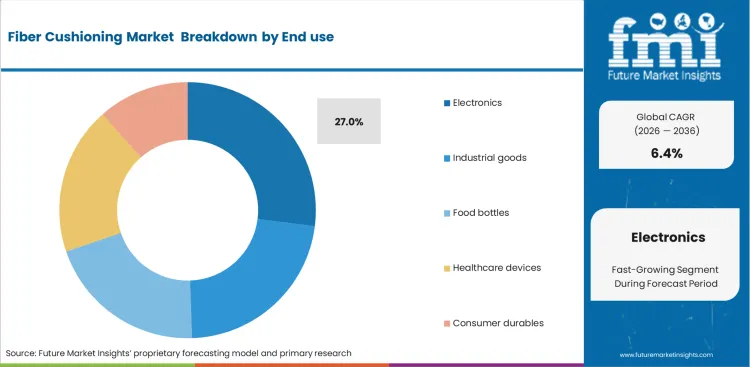
Retail waste compliance and unboxing quality both shape packaging decisions in consumer electronics. Electronics are estimated to account for 27.0% share in 2026, supported by procurement shifts toward protective formats that fit plastic-reduction targets. FMI analysts note that smartphone manufacturers are specifying dunnage trays to align with European Union directives restricting single-use plastics. Fiber cushioning also fits brand requirements where visible packaging choices influence consumer perception at the point of unboxing and disposal. Risk enters once pack performance is tested over longer transit cycles. Unsealed paper edges can shed fine fibers, creating contamination concerns for sensitive parts such as camera lenses.
- Compliance avoidance: Pure cellulosic materials bypass European retail plastic penalties. Supply chain directors ensure seamless border crossings and dock acceptances.
- Dust contamination: Micro-abrasions and particulate shedding threaten optical components. Quality control managers must qualify high-density sealed edges to prevent lens damage.
- Unboxing perception: Premium tactile feel signals environmental commitment. Brand managers use visual and material presentation to support premium hardware pricing.
Fiber Cushioning Market Analysis by Sales channel
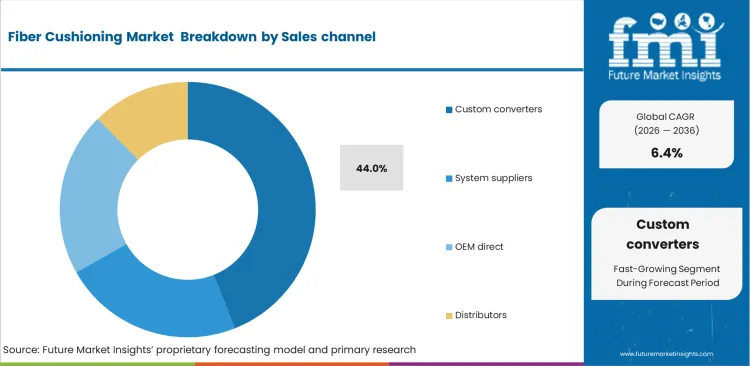
Complex product geometries rarely fit standard procurement models because pack performance depends on design precision as much as material choice. Paper-based honeycomb transit packaging has to be die-cut to exact payload dimensions, since even minor mismatch can weaken product stability in transit and reduce protective consistency. Packaging engineers at tier-one automotive suppliers therefore rely on converter partners that can build custom multi-layer pads for demanding cross-border movements and adjust prototypes quickly during validation. Faster local iteration also helps OEMs test drop performance before final carton dimensions are locked in with paper cushioning system suppliers. Custom converters are expected to account for 44.0% share in 2026, reflecting the value buyers place on localized engineering support rather than volume supply alone.
Freight economics place a clear limit on wider centralization. Empty fabricated paper formats consume space quickly and lose margin when shipped over longer distances. Sourcing teams that try to consolidate supply into distant hubs often end up returning to localized converter networks once transport cost and pack-volume inefficiencies become harder to justify.
- Prototyping velocity: Localized engineering teams refine packaging designs quickly. Packaging engineers compress new product launch timelines significantly.
- Freight radius limitation: Shipping empty formats ruins unit economics beyond local zones. Procurement directors must manage dozens of regional converter contracts rather than one global master agreement.
- Payload calibration: Precise drop-testing ensures custom dies match specific center-of-gravity requirements. Quality assurance officers minimize field return rates through validated transit survival.
Fiber Cushioning Market Analysis by Function
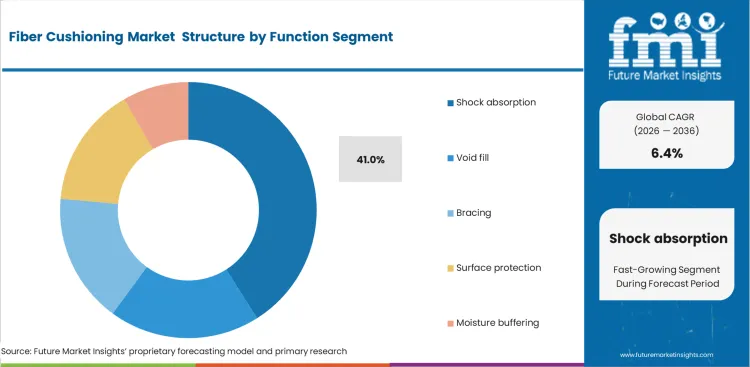
Replacing expanded polystyrene continues to hinge on one technical requirement: controlling kinetic energy before impact reaches the product. Appliance manufacturers and other heavy-goods shippers evaluate recyclable transit cushioning against that performance threshold first, since protection fails quickly when heavy masses are allowed to transfer force directly into the packed item. Pulp liner geometries are therefore engineered to slow impact during sudden drops by spreading compression across the pack structure. Shock absorption is expected to account for 41.0% share in 2026, reflecting its position as the primary benchmark in protective cushioning design. Foam-equivalent performance usually depends on multi-wall constructions that compress in stages and reduce force before it reaches the product. Well-designed recyclable cushioning can lower transit damage claims, but only when protective geometry is matched carefully to load behavior.
- Sequential crushing: Engineered walls collapse at specific force thresholds. Packaging engineers tune material density to match specific component fragility scores.
- Humidity degradation: Ambient moisture reduces load-bearing strength over time. Shipping managers face unexpected transit failures when crossing humid equatorial shipping lanes.
- Chargeback mitigation: Proven drop survival ensures retailers accept high-value shipments without penalty. Logistics directors protect operating margins from expensive return freight costs.
Fiber Cushioning Market Drivers, Restraints, and Opportunities
Extended producer responsibility legislation transfers end-of-life disposal costs directly back to brand owners. Ecological directors at global electronics firms face mounting taxation tied directly to plastic usage in shipping boxes under current fiber cushioning trends. Foam blocks trigger immense surcharges across European networks, making immediate transition to paper-based sustainable packaging financially mandatory regardless of initial unit cost discrepancies. Delaying adoption directly erodes net margins as retailers actively deduct disposal fees from wholesale invoices.
Moisture sensitivity remains a practical barrier to wider adoption. Fiber-based formats can lose compressive strength when exposed to high humidity over long ocean transit cycles. That makes direct substitution for foam difficult in routes where moisture exposure is hard to control. Shippers often need extra barrier protection or packaging redesign to maintain performance. Coated solutions are available, but they can weaken the recyclability proposition that makes fiber cushioning attractive in the first place.
Opportunities in Fiber Cushioning Market
- Hydrophobic coating integration: Chemical engineers develop water-resistant barriers that meet recycling standards. Packaging directors unlock maritime shipping routes for fiber cushioning for e-commerce parcels without compromising circularity claims.
- On-demand hybrid systems: Equipment manufacturers invent localized molded pulp packaging machines combining rigid shapes with lightweight corrugated cutting. Fulfillment managers eliminate massive empty-tray storage requirements.
- Automated quality inspection: Vision systems verify dimensional tolerances of molded shapes post-pressing. Quality control officers reduce line-stoppage incidents caused by warped geometries in sustainable dunnage packaging.
Regional Analysis
.webp "Top Country Growth Comparison Fiber Cushioning Market Cagr (2026 2036)")
Based on regional analysis, Fiber Cushioning is segmented into North America, Europe, Asia Pacific, Latin America, and other key regions across 40 plus countries.
| Country | CAGR (2026 to 2036) |
|---|---|
| India | 7.6% |
| China | 7.0% |
| Brazil | 6.8% |
| Germany | 6.5% |
| United States | 6.1% |
| United Kingdom | 5.9% |
| Japan | 5.8% |
Source: Future Market Insights (FMI) analysis, based on proprietary forecasting model and primary research
Europe Fiber Cushioning Market Analysis
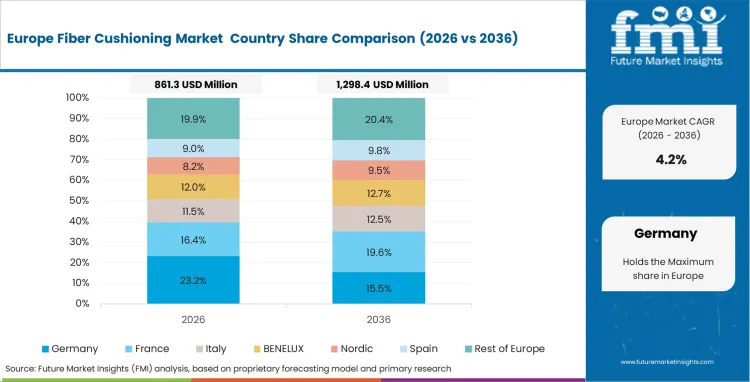
Europe is being shaped by compliance, disposal cost, and packaging redesign rather than by sustainability messaging alone. Packaging decisions now have to reflect tighter controls on plastic use and rising producer responsibility costs across multiple markets. That is increasing demand for molded fiber and paper-based protective formats that can meet recovery requirements with less material complexity. Weight reduction is also becoming more important because EPR exposure is closely tied to total packaging volume and composition. Europe remains one of the most commercially advanced regions for fiber cushioning because regulation and packaging economics are moving in the same direction.
- Germany: Sales of fiber cushioning in Germany are expected to increase at a CAGR of 6.5% during the forecast period. Manufacturers and retailers are redesigning appliance and industrial transit packs to reduce dependence on foam-based protective formats. Pure cellulosic bracing is gaining attention where buyers need easier recovery pathways and lower end-of-life packaging costs. The market also favors suppliers that can deliver stronger fiber formats with better moisture resistance for export applications. Vendors that cannot meet those performance requirements are likely to lose ground in major white-goods and industrial shipping programs.
- United Kingdom: The fiber cushioning market in the United Kingdom is poised to expand at a CAGR of 5.9% through 2036. Retailers and parcel shippers are increasing adoption of fiber-recoverable protective packaging as plastic-related costs and consumer scrutiny continue to rise. Small-parcel delivery formats are an important part of this shift because e-commerce brands need simpler material mixes that fit existing recycling expectations. Procurement teams are also trying to reduce exposure to future packaging policy changes by moving earlier into paper-based formats. Brands that continue to rely heavily on polymer-based void fill may face both higher cost pressure and weaker consumer acceptance.
FMI’s report includes detailed analysis of Germany, France, Italy, Spain, the United Kingdom, and other European countries. Compliance pressure, EPR-linked packaging costs, and foam replacement programs are influencing regional purchasing decisions.
Asia Pacific Fiber Cushioning Market Analysis
Asia Pacific demand is being driven by export manufacturing, electronics production, and the need to meet overseas packaging requirements. Many producers in the region do not choose cushioning formats only on domestic cost logic; they also need solutions that support acceptance in North American and European end markets. That is increasing demand for molded pulp trays, pressed fiber inserts, and other paper-based protective formats that align with customer sustainability expectations. Supply chains are also becoming more localized, with conversion capacity moving closer to major manufacturing clusters to reduce freight inefficiencies and improve turnaround times. The region is expanding on both volume and responsiveness.
- India: The fiber cushioning market in India is expected to rise at a CAGR of 7.6% during the study period. Electronics assembly localization is creating stronger demand for domestic protective packaging supply rather than imported cushioning formats. Buyers are increasingly looking for nearby conversion capacity that can support shorter lead times and reduce exposure to international freight disruption. That matters in fast-cycle device categories where packaging has to move in step with product launch schedules. Suppliers with regional manufacturing presence are in a better position to secure long-term electronics and export packaging business.
- China: China is projected to witness 7.0% CAGR in the fiber cushioning market through 2036. Consumer electronics and export-oriented manufacturing continue to support demand for compliant transit protection that can move smoothly into Western retail channels. Tooling speed is especially important here because packaging formats often need to adjust quickly around frequent product refresh cycles. The country also benefits from a dense manufacturing base for molded pulp inserts near major eastern industrial centers. Producers that fail to improve shape precision and density for higher-value goods may lose share in premium export programs.
- Japan: Automotive, electronics, and precision-component applications require tighter dimensional control and more consistent vibration protection than standard transit formats can provide. Demand for fiber cushioning in Japan is likely to advance at a CAGR of 5.8% by 2036. Premium fiber inserts are gaining space where buyers want cleaner presentation, smoother finish quality, and better fit for sensitive parts. Unboxing quality also matters more in Japan than in many volume-led packaging markets, which supports demand for higher-specification formats. Suppliers that cannot meet strict tolerance and protection requirements are unlikely to win premium OEM and precision goods programs.
FMI’s report includes detailed analysis of China, India, Japan, South Korea, ASEAN, Australia, and New Zealand. Export manufacturing, electronics packaging requirements, and localized molded fiber capacity are driving regional market expansion.
Latin America Fiber Cushioning Market Analysis
Latin America is adopting fiber cushioning through export logistics, breakage control, and plastic-reduction requirements in overseas trade channels. Glass, beverage, and agricultural exporters are a major source of demand because they need protective formats that can perform in long transit routes while aligning with buyer sustainability standards. Adoption is growing, but regional conversion speed is still constrained by tooling availability and limited local machinery depth in some markets. That keeps implementation uneven across countries even where end-market demand is improving. Capacity development remains a practical commercial issue across the region.
- Brazil: Beverage and agricultural exporters in Brazil are increasing their use of molded pulp protective formats, especially where breakage risk and sustainability requirements both shape packaging decisions. Local converters play an important role because regional freight complexity makes nearby customization and supply continuity more valuable. The market also depends on reliable recycled fiber availability, particularly for exporters serving buyers with tighter procurement standards. Brazil is likely to post a 6.8% CAGR in fiber cushioning industry by 2036, supported by rising demand from export-facing packaging programs. Companies that cannot secure stable raw material supply may struggle to scale with these customers.
FMI’s report includes detailed analysis of Brazil, Mexico, Argentina, and other Latin American countries. Export logistics, recycled fiber availability, and local conversion capacity remain central to regional adoption trends.
Competitive Aligners for Market Players
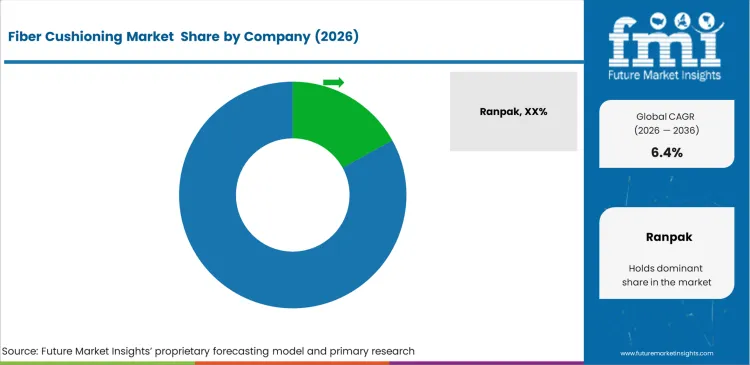
Regional production density determines competitive survival far more than material science innovation among fiber cushioning key players. Companies recognize that shipping empty cellulosic shapes destroys profit margins over long distances. Consequently, these incumbents prioritize geographic footprint expansion, acquiring regional flexible protective packaging converters specifically to place manufacturing capacity within 100 miles of major OEM assembly lines.
Established fiber cushioning suppliers possess vast proprietary libraries detailing specific pulp molding tooling designs and drop-test survival data. Leading organizations leverage decades of kinetic absorption engineering to guarantee transit safety for heavy industrial components according to recent protective packaging market share analysis. Challengers attempting to enter this space struggle to replicate this empirical validation; a new converter might easily press a paper tray, but proving it protects a heavy compressor during a five-foot drop requires years of accumulated physics data.
Large electronics manufacturers actively resist tooling lock-in by demanding standardized external tray dimensions across multiple molded pulp insert manufacturers. When adopting fiber based bottle packaging formats, sourcing directors refuse to pay amortization costs for proprietary molds, forcing system suppliers to share design IP. Competition evaluated through molded fiber pulp packaging market share analysis focuses entirely on achieving high-speed automated robotic insertion parity with legacy plastic foams.
Key Players in Fiber Cushioning Market
- Ranpak
- Huhtamaki
- Brødrene Hartmann Sonoco
- Nefab
- PAPACKS
- CKF
- Sonoco
Scope of the Report
| Metric | Value |
|---|---|
| Quantitative Units | USD 3.31 billion to USD 6.13 billion, at a CAGR of 6.4% |
| Market Definition | Cellulosic shock-absorbing formats replace petrochemical foams in transit applications. Formats utilize specific geometries to disperse impact energy across biodegradable components. |
| Segmentation | Material type, Form factor, End use, Sales channel, Function, and Region |
| Regions Covered | North America, Latin America, Europe, East Asia, South Asia, Oceania, Middle East and Africa |
| Countries Covered | United States, Canada, Brazil, Mexico, Germany, United Kingdom, France, Spain, Italy, China, Japan, South Korea, India, Australia, New Zealand, GCC Countries, South Africa |
| Key Companies Profiled | Ranpak, Huhtamaki, Brødrene Hartmann, Nefab, PAPACKS, CKF, Sonoco |
| Forecast Period | 2026 to 2036 |
| Approach | Global corrugated paperboard production volumes cross-referenced against e-commerce package shipping indices. |
Source: Future Market Insights (FMI) analysis, based on proprietary forecasting model and primary research
Fiber Cushioning Market Analysis by Segments
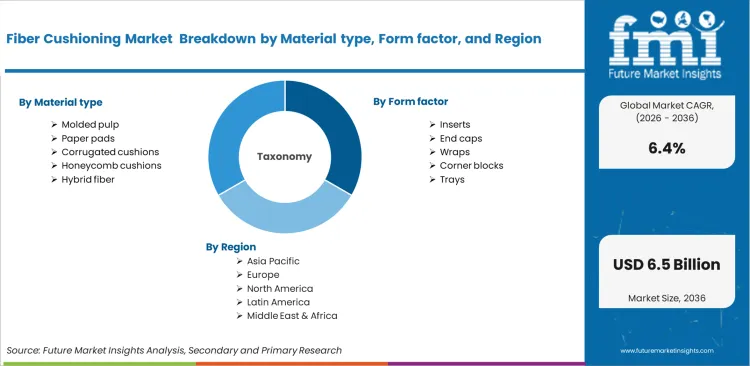
Material type
- Molded pulp
- Paper pads
- Corrugated cushions
- Honeycomb cushions
- Hybrid fiber
Form factor
- Inserts
- End caps
- Wraps
- Corner blocks
- Trays
End use
- Electronics
- Industrial goods
- Food bottles
- Healthcare devices
- Consumer durables
Sales channel
- Custom converters
- System suppliers
- OEM direct
- Distributors
Function
- Shock absorption
- Void fill
- Bracing
- Surface protection
- Moisture buffering
Region
- North America
- Latin America
- Europe
- East Asia
- South Asia
- Oceania
- Middle East and Africa
Bibliography
- Humbert, C., Jadeau, F., & Guichard, C. (2024, 10th December). Moulded-Pulp Packaging: A Straightforward Method for Designing, Manufacturing and Testing Complex Shapes for Crash Protection Pads.
- Singh, A. K., et al. (2024, 15th December). Integrating silica aerogel into recycled paper pulp for the development of high-performance, sustainable molded pulp products. Industrial Crops and Products.
- Kóczán, Z., et al. (2024, 9th January). Overview of Natural Fiber-Based Packaging Materials. Taylor & Francis.
- American Forest & Paper Association. (2024). Paper & Cardboard Recycling.
- U.S. International Trade Commission. (2024, December). Thermoformed Molded Fiber Products from China and Vietnam.
This bibliography is provided for reader reference. The full FMI report contains the complete reference list with primary source documentation.
Frequently Asked Questions
What is fiber cushioning packaging and what drives formational conversion?
Extended producer responsibility legislation transfers disposal costs onto shippers. Sourcing directors abandon foam to avoid escalating retailer penalties.
Why does molded pulp lead material preferences?
Wet-pressing techniques achieve rigid dimensional tolerances matching complex product contours. Assembly robots rely on this rigidity for seamless line integration.
What limits long-distance sourcing strategies?
Shipping empty formed shapes ruins unit economics quickly. Procurement officers must maintain localized converter relationships near final assembly hubs.
How do custom inserts function operationally?
Engineered geometries suspend fragile payloads away from carton walls. This creates dedicated crush zones that sequential dissipate kinetic impact forces.
Why do electronics brands adopt these systems fastest?
Massive export volumes face strict European retail compliance borders. Brand managers utilize pure paper interiors to ensure friction-free dock acceptances.
What differentiates North American capacity expansion?
Automated fulfillment centers demand high-speed dispensing systems. Operations managers reject manual static packing in favor of continuous roll extrusion.
How do Asian manufacturers respond to Western regulations?
Contract manufacturers establish adjacent pressing clusters. Localized supply guarantees compliant export packaging without relying on volatile global shipping.
What hidden costs disrupt initial pilot programs?
Thicker cellulosic walls increase overall carton dimensions. Logistics managers suddenly face soaring ocean freight charges due to reduced pallet density.
How does moisture affect compositional integrity?
Cellulosic walls absorb ambient humidity over time. Transit managers must implement desiccants or barrier bags to prevent premature crush failures.
Why is tooling flexibility a critical competitive metric?
Custom metal molds require massive upfront capital and long lead times. Agile electronics manufacturers demand shared intellectual property to prevent vendor lock-in.
What role do custom converters play locally?
Specialized engineering teams design bespoke drop-test solutions. Tier-one suppliers depend on rapid prototyping velocity to compress new product launches.
How does dust contamination alter specification choices?
Microscopic shedding damages sensitive optics during vibration. Quality engineers strictly mandate sealed edges for all camera and display screen shipments.
What limits trans-Pacific paper pad usage?
Prolonged ocean exposure degrades generic void fill rapidly. Shippers restrict these formats to short-haul domestic transit pending hydrophobic coating breakthroughs.
Why do system suppliers pivot toward leasing models?
Fulfillment centers require massive capital to automate packing lines. Equipment manufacturers secure revenue through proprietary consumable roll contracts rather than hardware sales.
How do European directives reshape engineering priorities?
Strict weight-based taxation forces extreme lightweighting efforts. Designers push configurational limits to satisfy compliance without increasing absolute mass.
What differentiates German deployment from alternative regions?
Aggressive national laws penalize virtually all non-recyclable padding. Logistics directors convert heavy appliance bracing to escape crippling disposal levies.
How does molded fiber cushioning compare with EPS foam regarding lifecycle economics?
Procurement models incorporate end-of-life taxation avoidance. Higher initial unit costs become justifiable when eliminating downstream retail chargebacks entirely.
What determines successful kinetic energy absorption?
Multi-wall structures collapse sequentially under stress. Packaging engineers tune material density to match exact product fragility scores precisely.
Why do operations directors resist nested tray storage?
Empty three-dimensional shapes consume massive warehouse footprints. Facilities transitioning from flat-packed solutions frequently encounter severe staging bottlenecks.
Is fiber cushioning recyclable across all municipalities?
While inherently repulpable, the addition of heavy hydrophobic coatings or adhesives often disrupts standard recycling streams, causing compliance failures.
What limits rapid capacity scaling in emerging regions?
Advanced heated tooling requires specialized local engineering expertise. Manufacturers relying on imported machinery experience capped conversion velocities.
How do incumbent suppliers defend market share?
Established producers possess vast empirical drop-test libraries. Challengers struggle to replicate decades of validated kinetic physics data across varied payloads.
What structural trajectory defines future development?
Hybrid systems combine continuous extrusion with localized die-cutting. Fulfillment centers anticipate machines that eliminate pre-formed empty tray storage completely.
Preview the report firsthand - request a free sample
Get SampleGet the brochure for pricing and purchase details.
Get PDFTable of Content
- Executive Summary
- Global Market Outlook
- Demand-side Trends
- Supply-side Trends
- Technology Roadmap Analysis
- Analysis and Recommendations
- Market Overview
- Market Coverage / Taxonomy
- Market Definition / Scope / Limitations
- Research Methodology
- Chapter Orientation
- Analytical Lens and Working Hypotheses
- Market Structure, Signals, and Trend Drivers
- Benchmarking and Cross-market Comparability
- Market Sizing, Forecasting, and Opportunity Mapping
- Research Design and Evidence Framework
- Desk Research Programme (Secondary Evidence)
- Company Annual and Sustainability Reports
- Peer-reviewed Journals and Academic Literature
- Corporate Websites, Product Literature, and Technical Notes
- Earnings Decks and Investor Briefings
- Statutory Filings and Regulatory Disclosures
- Technical White Papers and Standards Notes
- Trade Journals, Industry Magazines, and Analyst Briefs
- Conference Proceedings, Webinars, and Seminar Materials
- Government Statistics Portals and Public Data Releases
- Press Releases and Reputable Media Coverage
- Specialist Newsletters and Curated Briefings
- Sector Databases and Reference Repositories
- FMI Internal Proprietary Databases and Historical Market Datasets
- Subscription Datasets and Paid Sources
- Social Channels, Communities, and Digital Listening Inputs
- Additional Desk Sources
- Expert Input and Fieldwork (Primary Evidence)
- Primary Modes
- Qualitative Interviews and Expert Elicitation
- Quantitative Surveys and Structured Data Capture
- Blended Approach
- Why Primary Evidence is Used
- Field Techniques
- Interviews
- Surveys
- Focus Groups
- Observational and In-context Research
- Social and Community Interactions
- Stakeholder Universe Engaged
- C-suite Leaders
- Board Members
- Presidents and Vice Presidents
- R&D and Innovation Heads
- Technical Specialists
- Domain Subject-matter Experts
- Scientists
- Physicians and Other Healthcare Professionals
- Governance, Ethics, and Data Stewardship
- Research Ethics
- Data Integrity and Handling
- Primary Modes
- Tooling, Models, and Reference Databases
- Desk Research Programme (Secondary Evidence)
- Data Engineering and Model Build
- Data Acquisition and Ingestion
- Cleaning, Normalisation, and Verification
- Synthesis, Triangulation, and Analysis
- Quality Assurance and Audit Trail
- Market Background
- Market Dynamics
- Drivers
- Restraints
- Opportunity
- Trends
- Scenario Forecast
- Demand in Optimistic Scenario
- Demand in Likely Scenario
- Demand in Conservative Scenario
- Opportunity Map Analysis
- Product Life Cycle Analysis
- Supply Chain Analysis
- Investment Feasibility Matrix
- Value Chain Analysis
- PESTLE and Porter’s Analysis
- Regulatory Landscape
- Regional Parent Market Outlook
- Production and Consumption Statistics
- Import and Export Statistics
- Market Dynamics
- Global Market Analysis 2021 to 2025 and Forecast, 2026 to 2036
- Historical Market Size Value (USD Million) Analysis, 2021 to 2025
- Current and Future Market Size Value (USD Million) Projections, 2026 to 2036
- Y-o-Y Growth Trend Analysis
- Absolute $ Opportunity Analysis
- Global Market Pricing Analysis 2021 to 2025 and Forecast 2026 to 2036
- Global Market Analysis 2021 to 2025 and Forecast 2026 to 2036, By Material type
- Introduction / Key Findings
- Historical Market Size Value (USD Million) Analysis By Material type , 2021 to 2025
- Current and Future Market Size Value (USD Million) Analysis and Forecast By Material type , 2026 to 2036
- Molded pulp
- Paper pads
- Corrugated cushions
- Honeycomb cushions
- Hybrid fiber
- Molded pulp
- Y-o-Y Growth Trend Analysis By Material type , 2021 to 2025
- Absolute $ Opportunity Analysis By Material type , 2026 to 2036
- Global Market Analysis 2021 to 2025 and Forecast 2026 to 2036, By Form factor
- Introduction / Key Findings
- Historical Market Size Value (USD Million) Analysis By Form factor, 2021 to 2025
- Current and Future Market Size Value (USD Million) Analysis and Forecast By Form factor, 2026 to 2036
- Inserts
- End caps
- Wraps
- Corner blocks
- Trays
- Inserts
- Y-o-Y Growth Trend Analysis By Form factor, 2021 to 2025
- Absolute $ Opportunity Analysis By Form factor, 2026 to 2036
- Global Market Analysis 2021 to 2025 and Forecast 2026 to 2036, By End use
- Introduction / Key Findings
- Historical Market Size Value (USD Million) Analysis By End use, 2021 to 2025
- Current and Future Market Size Value (USD Million) Analysis and Forecast By End use, 2026 to 2036
- Electronics
- Industrial goods
- Food bottles
- Healthcare devices
- Consumer durables
- Electronics
- Y-o-Y Growth Trend Analysis By End use, 2021 to 2025
- Absolute $ Opportunity Analysis By End use, 2026 to 2036
- Global Market Analysis 2021 to 2025 and Forecast 2026 to 2036, By Sales channel
- Introduction / Key Findings
- Historical Market Size Value (USD Million) Analysis By Sales channel, 2021 to 2025
- Current and Future Market Size Value (USD Million) Analysis and Forecast By Sales channel, 2026 to 2036
- Custom converters
- System suppliers
- OEM direct
- Distributors
- Custom converters
- Y-o-Y Growth Trend Analysis By Sales channel, 2021 to 2025
- Absolute $ Opportunity Analysis By Sales channel, 2026 to 2036
- Global Market Analysis 2021 to 2025 and Forecast 2026 to 2036, By Function
- Introduction / Key Findings
- Historical Market Size Value (USD Million) Analysis By Function, 2021 to 2025
- Current and Future Market Size Value (USD Million) Analysis and Forecast By Function, 2026 to 2036
- Shock absorption
- Void fill
- Bracing
- Surface protection
- Moisture buffering
- Shock absorption
- Y-o-Y Growth Trend Analysis By Function, 2021 to 2025
- Absolute $ Opportunity Analysis By Function, 2026 to 2036
- Global Market Analysis 2021 to 2025 and Forecast 2026 to 2036, By Region
- Introduction
- Historical Market Size Value (USD Million) Analysis By Region, 2021 to 2025
- Current Market Size Value (USD Million) Analysis and Forecast By Region, 2026 to 2036
- North America
- Latin America
- Western Europe
- Eastern Europe
- East Asia
- South Asia and Pacific
- Middle East & Africa
- Market Attractiveness Analysis By Region
- North America Market Analysis 2021 to 2025 and Forecast 2026 to 2036, By Country
- Historical Market Size Value (USD Million) Trend Analysis By Market Taxonomy, 2021 to 2025
- Market Size Value (USD Million) Forecast By Market Taxonomy, 2026 to 2036
- By Country
- USA
- Canada
- Mexico
- By Material type
- By Form factor
- By End use
- By Sales channel
- By Function
- By Country
- Market Attractiveness Analysis
- By Country
- By Material type
- By Form factor
- By End use
- By Sales channel
- By Function
- Key Takeaways
- Latin America Market Analysis 2021 to 2025 and Forecast 2026 to 2036, By Country
- Historical Market Size Value (USD Million) Trend Analysis By Market Taxonomy, 2021 to 2025
- Market Size Value (USD Million) Forecast By Market Taxonomy, 2026 to 2036
- By Country
- Brazil
- Chile
- Rest of Latin America
- By Material type
- By Form factor
- By End use
- By Sales channel
- By Function
- By Country
- Market Attractiveness Analysis
- By Country
- By Material type
- By Form factor
- By End use
- By Sales channel
- By Function
- Key Takeaways
- Western Europe Market Analysis 2021 to 2025 and Forecast 2026 to 2036, By Country
- Historical Market Size Value (USD Million) Trend Analysis By Market Taxonomy, 2021 to 2025
- Market Size Value (USD Million) Forecast By Market Taxonomy, 2026 to 2036
- By Country
- Germany
- UK
- Italy
- Spain
- France
- Nordic
- BENELUX
- Rest of Western Europe
- By Material type
- By Form factor
- By End use
- By Sales channel
- By Function
- By Country
- Market Attractiveness Analysis
- By Country
- By Material type
- By Form factor
- By End use
- By Sales channel
- By Function
- Key Takeaways
- Eastern Europe Market Analysis 2021 to 2025 and Forecast 2026 to 2036, By Country
- Historical Market Size Value (USD Million) Trend Analysis By Market Taxonomy, 2021 to 2025
- Market Size Value (USD Million) Forecast By Market Taxonomy, 2026 to 2036
- By Country
- Russia
- Poland
- Hungary
- Balkan & Baltic
- Rest of Eastern Europe
- By Material type
- By Form factor
- By End use
- By Sales channel
- By Function
- By Country
- Market Attractiveness Analysis
- By Country
- By Material type
- By Form factor
- By End use
- By Sales channel
- By Function
- Key Takeaways
- East Asia Market Analysis 2021 to 2025 and Forecast 2026 to 2036, By Country
- Historical Market Size Value (USD Million) Trend Analysis By Market Taxonomy, 2021 to 2025
- Market Size Value (USD Million) Forecast By Market Taxonomy, 2026 to 2036
- By Country
- China
- Japan
- South Korea
- By Material type
- By Form factor
- By End use
- By Sales channel
- By Function
- By Country
- Market Attractiveness Analysis
- By Country
- By Material type
- By Form factor
- By End use
- By Sales channel
- By Function
- Key Takeaways
- South Asia and Pacific Market Analysis 2021 to 2025 and Forecast 2026 to 2036, By Country
- Historical Market Size Value (USD Million) Trend Analysis By Market Taxonomy, 2021 to 2025
- Market Size Value (USD Million) Forecast By Market Taxonomy, 2026 to 2036
- By Country
- India
- ASEAN
- Australia & New Zealand
- Rest of South Asia and Pacific
- By Material type
- By Form factor
- By End use
- By Sales channel
- By Function
- By Country
- Market Attractiveness Analysis
- By Country
- By Material type
- By Form factor
- By End use
- By Sales channel
- By Function
- Key Takeaways
- Middle East & Africa Market Analysis 2021 to 2025 and Forecast 2026 to 2036, By Country
- Historical Market Size Value (USD Million) Trend Analysis By Market Taxonomy, 2021 to 2025
- Market Size Value (USD Million) Forecast By Market Taxonomy, 2026 to 2036
- By Country
- Kingdom of Saudi Arabia
- Other GCC Countries
- Turkiye
- South Africa
- Other African Union
- Rest of Middle East & Africa
- By Material type
- By Form factor
- By End use
- By Sales channel
- By Function
- By Country
- Market Attractiveness Analysis
- By Country
- By Material type
- By Form factor
- By End use
- By Sales channel
- By Function
- Key Takeaways
- Key Countries Market Analysis
- USA
- Pricing Analysis
- Market Share Analysis, 2025
- By Material type
- By Form factor
- By End use
- By Sales channel
- By Function
- Canada
- Pricing Analysis
- Market Share Analysis, 2025
- By Material type
- By Form factor
- By End use
- By Sales channel
- By Function
- Mexico
- Pricing Analysis
- Market Share Analysis, 2025
- By Material type
- By Form factor
- By End use
- By Sales channel
- By Function
- Brazil
- Pricing Analysis
- Market Share Analysis, 2025
- By Material type
- By Form factor
- By End use
- By Sales channel
- By Function
- Chile
- Pricing Analysis
- Market Share Analysis, 2025
- By Material type
- By Form factor
- By End use
- By Sales channel
- By Function
- Germany
- Pricing Analysis
- Market Share Analysis, 2025
- By Material type
- By Form factor
- By End use
- By Sales channel
- By Function
- UK
- Pricing Analysis
- Market Share Analysis, 2025
- By Material type
- By Form factor
- By End use
- By Sales channel
- By Function
- Italy
- Pricing Analysis
- Market Share Analysis, 2025
- By Material type
- By Form factor
- By End use
- By Sales channel
- By Function
- Spain
- Pricing Analysis
- Market Share Analysis, 2025
- By Material type
- By Form factor
- By End use
- By Sales channel
- By Function
- France
- Pricing Analysis
- Market Share Analysis, 2025
- By Material type
- By Form factor
- By End use
- By Sales channel
- By Function
- India
- Pricing Analysis
- Market Share Analysis, 2025
- By Material type
- By Form factor
- By End use
- By Sales channel
- By Function
- ASEAN
- Pricing Analysis
- Market Share Analysis, 2025
- By Material type
- By Form factor
- By End use
- By Sales channel
- By Function
- Australia & New Zealand
- Pricing Analysis
- Market Share Analysis, 2025
- By Material type
- By Form factor
- By End use
- By Sales channel
- By Function
- China
- Pricing Analysis
- Market Share Analysis, 2025
- By Material type
- By Form factor
- By End use
- By Sales channel
- By Function
- Japan
- Pricing Analysis
- Market Share Analysis, 2025
- By Material type
- By Form factor
- By End use
- By Sales channel
- By Function
- South Korea
- Pricing Analysis
- Market Share Analysis, 2025
- By Material type
- By Form factor
- By End use
- By Sales channel
- By Function
- Russia
- Pricing Analysis
- Market Share Analysis, 2025
- By Material type
- By Form factor
- By End use
- By Sales channel
- By Function
- Poland
- Pricing Analysis
- Market Share Analysis, 2025
- By Material type
- By Form factor
- By End use
- By Sales channel
- By Function
- Hungary
- Pricing Analysis
- Market Share Analysis, 2025
- By Material type
- By Form factor
- By End use
- By Sales channel
- By Function
- Kingdom of Saudi Arabia
- Pricing Analysis
- Market Share Analysis, 2025
- By Material type
- By Form factor
- By End use
- By Sales channel
- By Function
- Turkiye
- Pricing Analysis
- Market Share Analysis, 2025
- By Material type
- By Form factor
- By End use
- By Sales channel
- By Function
- South Africa
- Pricing Analysis
- Market Share Analysis, 2025
- By Material type
- By Form factor
- By End use
- By Sales channel
- By Function
- USA
- Market Structure Analysis
- Competition Dashboard
- Competition Benchmarking
- Market Share Analysis of Top Players
- By Regional
- By Material type
- By Form factor
- By End use
- By Sales channel
- By Function
- Competition Analysis
- Competition Deep Dive
- Ranpak
- Overview
- Product Portfolio
- Profitability by Market Segments (Product/Age /Sales Channel/Region)
- Sales Footprint
- Strategy Overview
- Marketing Strategy
- Product Strategy
- Channel Strategy
- Huhtamaki
- Brødrene Hartmann
- Nefab
- PAPACKS
- CKF
- Sonoco
- Ranpak
- Competition Deep Dive
- Assumptions & Acronyms Used


