

- Industry Size (2026)
- USD 1.2 Bn
- Forecast (2036)
- USD 2.6 Bn
- CAGR (2026 to 2036)
- 8.0%
Paper-Based Honeycomb Transit Packaging Market Size, Market Forecast and Outlook By FMI
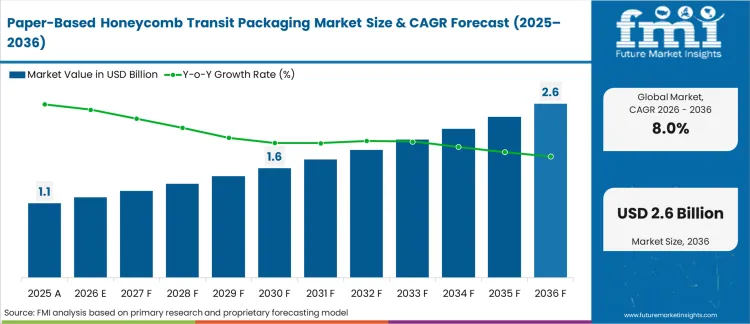
The paper-based honeycomb transit packaging market was valued at USD 1.1 billion in 2025. The industry is expected to cross USD 1.2 billion in 2026 at a CAGR of 8.0% during the forecast period. Demand outlook carries the total opportunity to USD 2.6 billion through 2036 as aggressive extended producer responsibility taxation on EPS and wooden pallet phytosanitary compliance costs force high-volume exporters to transition to lightweight, single-stream recyclable hex-core structures. The transition from rigid plastics forces global consumer electronics brands to secure alternative void fill and structural protection that does not alienate retail consumers or violate zero-waste mandates.
High-volume exporters delaying the integration of paper core architectures lose critical shelf access in heavily regulated European channels and face exorbitant air freight surcharges due to the heavy tare weight of legacy wooden crates. Practitioners operating within this space know that the true limitation of engineered paper core is not compressive load failure, but localized puncture resistance during rough forklift handling. To circumvent this, designers must deploy high-burst-strength Kraft facings, establishing a protective transit solution capable of surviving complex cross-docking environments.
True self-sustaining adoption activates when structural honeycomb pallets achieve verifiable dynamic impact parity with heat-treated ISPM-15 wooden pallets under standard forklift tine impacts. High-volume industrial exporters must mandate this specific testing threshold in their procurement specifications before the upcoming global supply chain contract renewal cycle. Once this certification barrier is crossed, automated multi-node fulfillment networks systematically reject non-recyclable alternatives.
Summary of Paper-Based Honeycomb Transit Packaging Market
- Paper-Based Honeycomb Transit Packaging Market Definition
- Paper-based honeycomb transit packaging encompasses engineered structural formats utilizing a hexagonal inner cellular paper core between Kraft facings, specifically designed to provide high vertical compression resistance, impact absorption, and multi-axis rigidity for industrial and commercial goods transportation.
- Demand Drivers in the Market
- The European Union Packaging and Packaging Waste Regulation forces global consumer electronics brands to abandon expanded polystyrene and adopt single-stream repulpable protective alternatives.
- Exorbitant air freight dimensional weight surcharges compel automotive part exporters to replace heavy ISPM-15 wooden crates with highly rigid, lightweight hex-core structures.
- Strict extended producer responsibility taxation directives drive e-commerce fulfillment networks to eliminate mixed-material void fills that incur heavy downstream disposal penalties.
- Key Segments Analyzed in the FMI Report
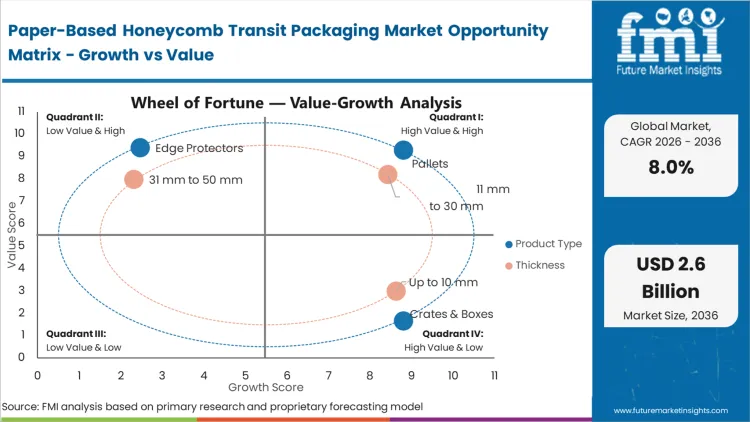
- Pallets: 34.5% share in 2026, leading because high-volume exporters face escalating phytosanitary compliance costs for wood, driving the rapid adoption of exempt paper-based alternatives.
- 11 mm to 30 mm: 41.2% share in 2026, dominating as this specific thickness provides the exact shock absorption threshold required for heavy white goods and consumer appliances without sacrificing volumetric efficiency.
- Automotive: 28.6% share in 2026, capturing the largest segment as tier-1 suppliers redesign outbound shipping matrices to minimize tare weight against tightening air-freight limits.
- China: 10.5% compound growth, driven by aggressive state-level green packaging mandates explicitly targeting the elimination of single-use plastics in high-volume export hubs.
- Analyst Opinion at FMI
- Ismail Sutaria, Principal Consultant of Packaging, opines, "In my analysis, I have observed that the true bottleneck in sustainable transit packaging is not static load capacity, but dynamic puncture resistance during multi-node handling. Facility operators attempting to replace wooden crates with basic honeycomb panels face unacceptable product damage rates without heavy-duty Kraft facing. Procurement teams who continue sourcing standard flute corrugated instead of engineered hex-core will find themselves unable to meet the severe dimensional-weight cost constraints of next-generation autonomous freight networks."
- Strategic Implications / Executive Takeaways
- Automotive parts exporters must validate the dynamic impact resistance of hex-core pallets against localized forklift punctures before the upcoming global supply contract renewal cycle.
- Integrated paper manufacturers should decentralize their core-expansion capabilities to build facilities within a 200-mile radius of major electronics assembly hubs.
- E-commerce fulfillment operators must integrate automated honeycomb wrap dispensing systems or face crippling labor and material costs associated with manual void fill processes.
- Methodology
- Primary Research: FMI conducted detailed technical interviews with transit packaging designers, supply chain sustainability officers, and facility managers across 40 countries to map the displacement timeline of legacy EPS.
- Desk Research: Analysts aggregated ISTA performance testing registries, global extended producer responsibility tax schedules, and corporate zero-waste-to-landfill public commitments.
- Market-Sizing and Forecasting: The model applies a bottom-up methodology starting with global installed base metrics for core-expansion machinery and projecting the regional conversion rate to hex-core architectures.
- Data Validation and Update Cycle: Segment forecasts undergo constant cross-validation against quarterly unbleached Kraft paper shipment volumes dedicated specifically to structural applications.
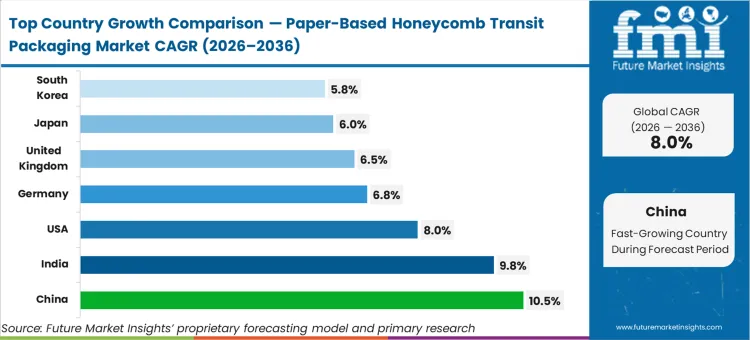
China advances at a 10.5% CAGR, driven by state-level green packaging initiatives explicitly penalizing secondary plastic waste in cross-border hubs. India follows at a 9.8% expansion as domestic automotive exporters optimize dimensional weights for international freight. The United States tracks an 8.0% trajectory supported by e-commerce fulfillment centers automating their void fill processes. Germany records a 6.8% rate anchored by stringent extended producer responsibility auditing. The United Kingdom expands at 6.5% as retail supply chains enforce strict single-stream recyclability. Japan posts a 6.0% growth, anchored by precision electronics manufacturing requiring static-free structural cushioning. South Korea reaches a 5.8% annual expansion as high-value appliance exporters redesign outbound packaging arrays. This distinct regional spread exists because nations enforcing punitive landfill taxes accelerate the abandonment of legacy expanded polystyrene significantly faster than regions relying on voluntary sustainability pledges.
Paper-Based Honeycomb Transit Packaging Market Definition
Paper-based honeycomb transit packaging represents engineered structural materials utilizing a continuous hexagonal inner cellular core sandwiched between high-strength Kraft or testliner facings. It is designed specifically to absorb kinetic energy, distribute heavy static loads, and provide multi-axis structural rigidity during the storage and transportation of commercial goods. This architecture distinguishes itself from traditional corrugated board through its superior vertical compression resistance and significantly enhanced strength-to-weight ratio.
Paper-Based Honeycomb Transit Packaging Market Inclusions
The scope encompasses continuous-core paper pallets, structural layer pads, edge and corner protectors, die-cut protective enclosures, and integrated rigid crates constructed entirely from honeycomb paperboard. Associated structural reinforcement accessories made of Kraft paper, specialized moisture-resistant barrier coatings applied to the hex-core, and automated corrugated packaging dispensing equipment specifically calibrated for honeycomb roll stock are incorporated within the valuation parameters.
Paper-Based Honeycomb Transit Packaging Market Exclusions
Standard fluted corrugated boxes, molded pulp inserts, and traditional solid wood or plastic pallets are explicitly excluded from the analysis. Expanded polystyrene (EPS), polyethylene foam wraps, and hybrid packaging materials containing un-separable plastic polymer laminations that prevent standard paper repulping processes from falling outside the defined boundaries. Standard consumer-facing retail folding cartons without structural transit reinforcement capabilities are omitted.
Paper-Based Honeycomb Transit Packaging Market Research Methodology
- Primary Research: FMI analysts engaged with industrial packaging engineers, outbound logistics directors, and raw material procurement leads across major automotive and electronics OEMs to map the exact cost crossover points triggering the shift from EPS.
- Desk Research: The data aggregation phase analyzed the EU Packaging and Packaging Waste Regulation implementation timelines, ISPM-15 phytosanitary trade compliance logs, and material testing data from the International Safe Transit Association.
- Market-Sizing and Forecasting: The baseline derives from a bottom-up aggregation of continuous-core paperboard production volumes, applying specific conversion ratios to project the localized manufacturing capacity required to meet shifting export demands.
- Data Validation and Update Cycle: Projections are rigorously cross-validated against publicly reported capital expenditure on automated core-expansion machinery by leading integrated paper and forest product conglomerates.
Segmental Analysis
Paper-Based Honeycomb Transit Packaging Market Analysis by Product Type
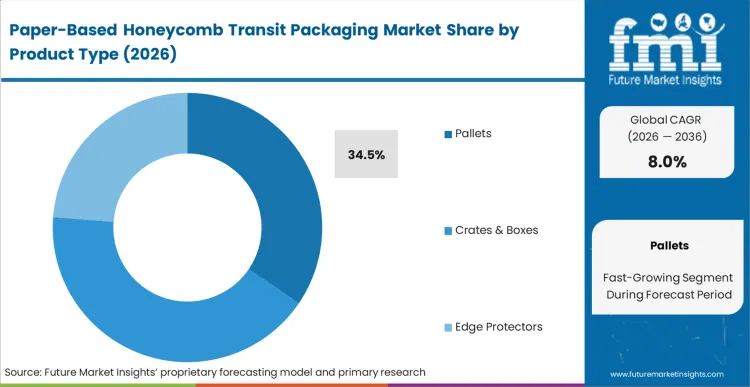
The displacement of heavy, heat-treated ISPM-15 wooden platforms specifically accelerates as phytosanitary compliance costs and air freight surcharges cripple international logistics margins. Pallets command a dominant 34.5% share in 2026, reflecting the massive cost advantage exporters gain when stripping 60% of the tare weight from their outbound shipments. Facility managers deploying these high-compression hex-core platforms completely bypass international wood pest treatment regulations. According to FMI's estimates, this exemption drastically streamlines cross-border customs clearance times. However, this architectural pivot relies entirely on deploying pallets with sufficient dynamic impact resistance to survive rough handling. High-volume automotive parts exporters who fail to qualify these structural replacements against standard forklift tine impacts risk catastrophic payload collapses during complex cross-docking operations.
- Phytosanitary Exemption: Utilizing engineered repulpable materials entirely bypasses international ISPM-15 wood treatment mandates. Logistics directors capturing this advantage eliminate costly heat-treatment bottlenecks in their outbound supply chains.
- Dimensional Weight Optimization: Stripping excessive tare weight from the shipping platform directly slashes air freight surcharges. Financial controllers enforcing these strict weight diets dramatically improve international margin profiles.
- Automated Line Integration: Consistent sizing and lack of protruding nails allow paper platforms to feed flawlessly into automated palletizing robots. Facility managers standardizing on these units eliminate the machine jams common with degraded wooden equipment.
Paper-Based Honeycomb Transit Packaging Market Analysis by Thickness
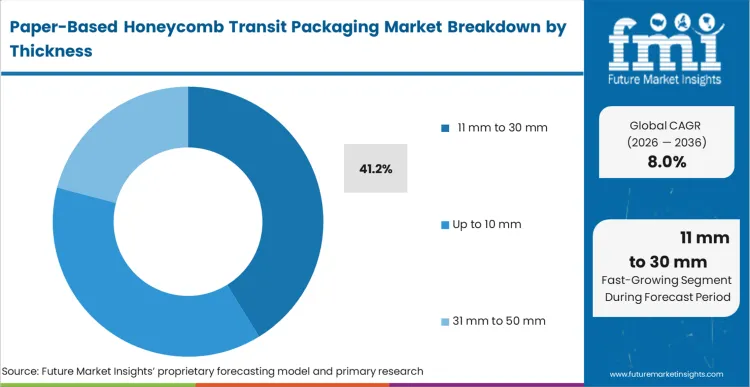
The 11 mm to 30 mm thickness bracket holds 41.2% share in 2026 due to its unique capability to absorb shock events without compromising the volumetric efficiency of the shipping container. Packaging engineers specifying this specific gauge achieve the optimal balance between crush resistance and localized puncture defense. Thinner profiles fail to protect heavy industrial goods, while thicker panels consume too much valuable interior space. In FMI's view, locking in this precise geometric ratio enables brands to safely transit heavy white goods and large consumer electronics. Failing to specify the correct inner cellular expansion ratio within this thickness band forces consumer appliance manufacturers to endure unacceptable transit damage rates and escalating reverse logistics costs.
- Volumetric Efficiency: Maintaining a tight profile prevents the structural cushioning from consuming the profitable payload space within a standard shipping container. Outbound logistics planners optimizing this metric maximize the revenue generated per cubic meter of freight.
- Vibration Dampening: The specific cellular depth acts as a kinetic energy absorber during extended rail or over-the-road transit. Quality assurance teams relying on this physical property drastically reduce the incidence of micro-fractures in sensitive consumer electronics.
- Die-cut Adaptability: Panels in this thickness range can be precisely routed and die-cut to cradle asymmetrical products without losing structural integrity. Packaging designers utilizing this flexibility eliminate the need for costly, multi-part mixed-material inserts.
Paper-Based Honeycomb Transit Packaging Market Analysis by End Use
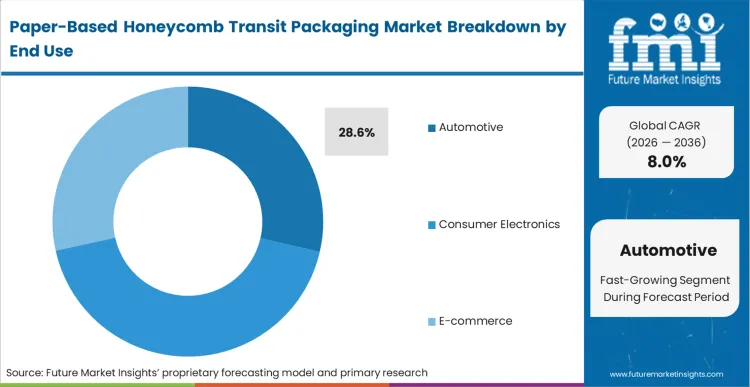
The requirement to eradicate single-use plastics from complex global supply chains forces the Automotive sector to adopt highly rigid, single-stream recyclable architectures. The automotive segment is poised to capture a leading 28.6% share in 2026 as tier-1 component suppliers systematically redesign their inter-continental shipping matrices. Replacing heavy steel stillages and wooden crates with engineered paper core immediately reduces total freight tonnage while maintaining the high static load capacities necessary for engine parts and heavy castings. As per FMI's projection, standardizing on a single recyclable material streamlines the industrial packaging waste stream at the final assembly plant. Procurement specification leads who continue sourcing legacy EPS dunnage will face punitive disposal tariffs and risk losing priority vendor status with major automotive OEMs aggressively pursuing zero-waste-to-landfill mandates.
- Tare Weight Eradication: Shifting to hex-core dunnage strips heavy wood and steel from the inbound logistics loop. Supply chain directors executing this transition slash total transportation fuel costs across global supplier networks.
- Single-Stream Disposal: Utilizing unlaminated Kraft paper architectures ensures the entire transit array can be baled and sold directly to regional repulpers. Assembly plant facility operators leveraging this closed loop transform a waste disposal expense into a new revenue stream.
- Custom Cavity Routing: Precision routing allows heavy metallic components to be suspended securely within the cellular matrix. Industrial engineering teams deploying this technique eliminate metal-on-metal abrasion damage during turbulent oceanic transit.
Paper-Based Honeycomb Transit Packaging Market Drivers, Restraints, and Opportunities
The European Union Packaging and Packaging Waste Regulation (PPWR) forces high-volume commercial exporters to entirely eradicate expanded polystyrene and un-recyclable mixed plastics from their inbound supply chains. This legislative trigger compels consumer electronics and appliance brands to transition rapidly toward engineered repulpable transit materials to avoid punitive extended producer responsibility taxes. As the regulatory deadline approaches, global brands mandate the adoption of hex-core paper solutions to maintain compliance and preserve critical European retail shelf access. Companies that fail to redesign their protective arrays around these approved single-stream materials face crippling border tariffs and immediate exclusion from major retail distribution networks.
The inherent vulnerability of standard paper honeycomb to moisture degradation creates massive operational friction in uncontrolled cold chain or maritime shipping environments. When exposed to high humidity, the structural Kraft facings lose burst strength, causing the internal hex-core to collapse under sustained static loads. To mitigate this failure, material scientists apply specialized hydrophobic barrier coatings and wax emulsions, but these complex additives inherently jeopardize the single-stream repulpability that made the material attractive in the first place, creating a structural limit to widespread adoption in maritime freight.
Opportunities in the Paper-Based Honeycomb Transit Packaging Market
- Hydrophobic Repulpable Barrier Coatings: Next-generation chemical formulations allow material scientists to apply intense moisture resistance to the Kraft facing without triggering rejection at the paper mill. Manufacturers licensing this specific coating technology secure exclusive procurement contracts for trans-oceanic automotive part shipments.
- Decentralized Core-Expansion Nodes: Shipping unexpanded continuous paper core allows integrated packaging firms to establish highly automated, localized expansion and cutting facilities immediately adjacent to client assembly plants. Facility planners executing this network strategy drastically reduce inbound freight costs and eliminate the economic penalty of shipping expanded air.
- Automated Void-Fill Dispensing: Advanced packaging line robotics can now dynamically slice and expand flexible honeycomb paper wrap directly into the shipping carton based on 3D volumetric scanning. Fulfillment center operators deploying these robotic integrators eliminate manual labor bottlenecks and maximize outbound shipping throughput.
Regional Analysis
Based on the regional analysis, the Paper-Based Honeycomb Transit Packaging market is segmented into North America, Latin America, Europe, East Asia, South Asia, Oceania and Middle East & Africa across 40 plus countries.
.webp "Top Country Growth Comparison Paper Based Honeycomb Transit Packaging Market Cagr (2026 2036)")
| Country | CAGR (2026 to 2036) |
|---|---|
| China | 10.5% |
| India | 9.8% |
| United States | 8.0% |
| Germany | 6.8% |
| United Kingdom | 6.5% |
| Japan | 6.0% |
| South Korea | 5.8% |
Source: Future Market Insights (FMI) analysis, based on proprietary forecasting model and primary research
Asia-Pacific Paper-Based Honeycomb Transit Packaging Market Analysis
Aggressive state-level environmental mandates and massive outbound manufacturing volumes across the Asian industrial corridor are accelerating the transition from legacy expanded polystyrene and wooden crates to scalable paper-based transit materials. To avoid foreign waste tariffs and maintain uninterrupted export velocities, supply chain directors are rapidly scaling continuous-core expansion to secure a reliable sustainable packaging baseline for the consumer electronics sector. Simultaneously, compounding air-freight costs, volatile domestic timber supplies, and stringent phytosanitary hurdles make legacy wood economically unviable. Based on FMI's assessment, regional exporters are deploying heavy-duty, repulpable hex-core platforms to explicitly bypass ISPM-15 heat treatment requirements, accelerate cross-border customs clearance, and remain cost-competitive while satisfying the strict sustainability demands of their tier-1 multinational clients.
- China: Advancing at a 10.5% CAGR through 2036, the market in China is undergoing a massive architectural shift in export hubs as the State Post Bureau explicitly penalizes secondary plastic waste in cross-border e-commerce shipments. Widespread auditing at international freight terminals confirms this rapid eradication of single-use plastics. Supply chain sustainability officers who ignore these state-level dictates face severe operational bottlenecks and outright export embargoes on non-compliant outbound freight. This aggressive top-down regulatory pressure forces massive fulfillment networks to abandon EPS void fill in favor of expandable hex-core wrap.
- Japan: Procurement specification leads failing to provide static-free paper dunnage lose access to lucrative domestic electronics contracts. Because commercial disposal costs are exorbitant, domestic appliance brands must design outbound transit arrays that retail partners can easily break down and recycle. Expanding at 6.0% between 2026 and 2036, this precise trajectory reflects the high technical standards required. Constrained urban waste management infrastructure in Japan forces precision electronics manufacturers to adopt highly compressible, repulpable cushioning materials. The national push toward deep circularity anchors this transition across the domestic logistics network.
- South Korea: Capital project planners who delay this material transition endure crippling air-cargo surcharges that decimate international profitability. The optimization of these high-margin export routes necessitates continuous investment in high-compression paper cores. South Korea's high-value home appliance export sector operates under strict dimensional weight constraints for premium global air freight. This structural condition requires industrial engineers to deploy ultra-lightweight structural honeycomb layer pads instead of heavy wooden bracing. Tracking a 5.8% CAGR through to 2036, the focus remains on maximum load-bearing efficiency.
- India: Sustaining a 9.8% CAGR to 2036, the market relies heavily on bypassing physical logistics bottlenecks. Facility owners operating heavy industrial lines who rely on untreated wood face immediate shipment rejections at critical European borders. Exporters in this region must bypass lengthy ISPM-15 wooden pallet heat-treatment queues to maintain strict just-in-time delivery schedules for European assembly plants. The national integration of these repulpable transit platforms dramatically accelerates outbound customs velocity. The rapid expansion of India's automotive component export sector requires lightweight structural pallets to mitigate exorbitant international air freight costs.
FMI's report includes detailed analysis of Taiwan, the broader ASEAN manufacturing sector, and the broader South Asian logistics network. Developing port infrastructures across the region increasingly prioritize single-stream repulpable waste management, forcing inbound shippers to adapt their packaging matrices. The rapid localization of high-speed paper core machinery across these secondary hubs aims to eliminate the massive logistical inefficiency of importing pre-expanded transit materials across long oceanic distances.
Europe Paper-Based Honeycomb Transit Packaging Market Analysis
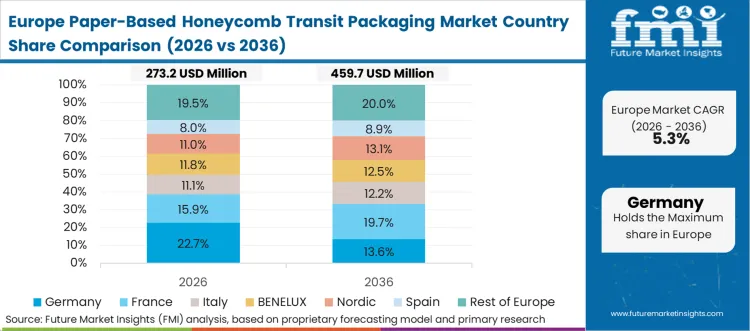
Upgrading the core protective architecture ensures full compliance with impending zero-waste mandates and shields massive commercial importers from escalating downstream disposal tariffs. FMI analysts opine that this aggressive legislative environment forces brands to specify fully repulpable hex-core structures from the initial product design phase. Regional logistics directors redesigning legacy supply chains must navigate a complex web of national waste legislation that heavily penalizes the introduction of mixed-material or non-repulpable EPS into the regional disposal network. Punitive extended producer responsibility (EPR) taxes and stringent circular economy directives form the primary policy mechanisms completely overhauling the European transit packaging ecosystem.
- Germany: Network operators who attempt to bypass these material taxes face catastrophic fines and immediate embargoes on non-compliant freight. Regular audits by the Central Agency Packaging Register ensure absolute compliance across all major inbound freight hubs. Projected at 6.8% CAGR over the forecast period, the market responds to these direct financial levers. This legislative mechanism forces massive automotive and industrial goods importers to demand pure paper-based hex-core dunnage from their global supplier base. Germany's updated VerpackG legislation imposes severe financial penalties on commercial logistics networks utilizing non-recyclable expanded polystyrene cushioning.
- United Kingdom: Technology vendors lacking seamless integration capabilities for these automated core-expansion systems forfeit major national fulfillment contracts. The shift is verified through rigorous quarterly HMRC tax reporting structures. Retail supply chain directors must deploy automated honeycomb wrap systems to eliminate un-taxed plastic void fill from daily outbound fulfillment operations. The post-Brexit plastic packaging tax in the United Kingdom requires massive e-commerce and retail distribution networks to utilize extreme levels of recycled content. The market scales as robotic dispensers replace manual packing stations, anchored to a 6.5% CAGR through the decade.
FMI's report includes thorough investigation of Italy, France, and the Nordics. A prevailing structural condition across these nations is the strict enforcement of commercial waste auditing, compelling logistics providers to adopt closed-loop paper recovery systems.
North America Paper-Based Honeycomb Transit Packaging Market Analysis
This strategic transition requires significant capital allocation toward specialized automated packaging line infrastructure capable of handling high-tension Kraft paper rolls. Nationwide e-commerce dimensional weight pricing dynamics and hyper-consolidated retail procurement standards govern the exact specifications required for protective transit materials. In FMI's view, the integration of highly automated core-dispensing equipment allows massive third-party logistics providers to achieve throughput parity with legacy plastic air-pillow systems. Logistics engineers leading critical fulfillment overhauls face strict directives to maximize payload density while simultaneously eliminating the visual and environmental friction associated with unboxing legacy EPS.
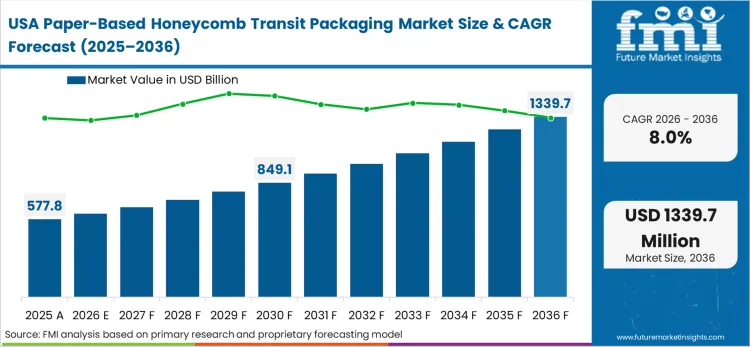
- United States: Advancing at 8.0% compound between 2026 and 2036, the market reflects massive capital investments in fulfillment automation. Corporate zero-waste public pledges further accelerate the systematic removal of EPS from all outbound distribution centers. System integrators unable to provide high-speed, jam-free paper dispensing robotics risk total exclusion from the next wave of mega-warehouse construction. Tier-1 e-commerce fulfillment networks in the United States face crushing dimensional weight pricing models enforced by major national parcel carriers. Fulfillment network architects must deploy flexible honeycomb wrap systems to tightly contour products, eliminating the wasteful volumetric expansion inherent in legacy bubble wrap.
FMI's report includes specific analysis of the Canadian and Mexican industrial markets. The integration of cross-border automotive supply chains requires standardized, repulpable dunnage to coordinate just-in-time delivery sequences without accumulating unmanageable plastic waste at the final assembly node.
Competitive Aligners for Market Players
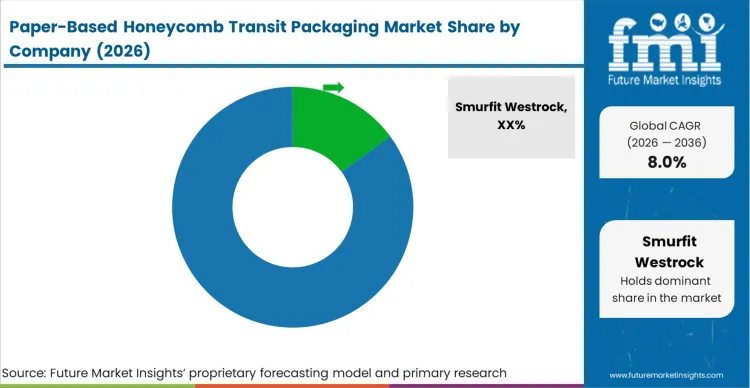
The global paper-based honeycomb transit packaging sector operates as a moderately consolidated landscape heavily dependent on localized manufacturing infrastructure. This specific structure exists because the fundamental economics of the product prohibit shipping highly expanded, air-filled honeycomb panels over long distances. Dominant companies such as Smurfit Westrock, International Paper, and Sonoco Products Company maintain their leadership by operating highly decentralized networks of continuous-core production nodes positioned strategically near major industrial and agricultural hubs. When massive automotive or electronics OEMs evaluate potential transit packaging partners, the primary competitive variable is the vendor's physical proximity to the final assembly line and their ability to guarantee uninterrupted, just-in-time material delivery.
Vendors embedding automated, on-site core-expansion machinery directly inside the client's fulfillment centers gain a significant structural advantage. Honicel Worldwide B.V. and Axxor excel by supplying highly compressed, unexpanded continuous core rolls that are only expanded into their final rigid geometric shape at the precise moment of use. This model drastically reduces inbound freight costs for the buyer; a challenger attempting to disrupt this market must build sophisticated, high-speed automated expansion equipment capable of matching this on-site efficiency. Equipment manufacturers that cannot provide reliable, high-throughput expansion hardware fail to secure long-term consumable paper supply contracts with high-volume industrial clients.
Large industrial buyers actively prevent vendor lock-in by standardizing their procurement specifications around generic cell sizes and universally compatible Kraft facings. While dominant packaging conglomerates attempt to lock buyers into proprietary continuous-core formats, massive fulfillment networks intentionally split their multi-million-dollar contracts among multiple regional converters to maintain price tension. This dynamic severely limits the pricing power of any single manufacturer, even during periods of tight raw material availability. Moving toward 2036, the market is becoming slightly more concentrated as tier-1 integrated paper mills acquire independent regional core-converters to capture the full margin profile from raw timber to finished transit pallet.
Key Players in Paper-Based Honeycomb Transit Packaging Market
- Smurfit Westrock
- International Paper
- Sonoco Products Company
- Packaging Corporation of America (PCA)
- Axxor
- Honicel Worldwide B.V.
- Lsquare Eco-Products Pvt. Ltd.
- MAC Pack
Scope of the Report
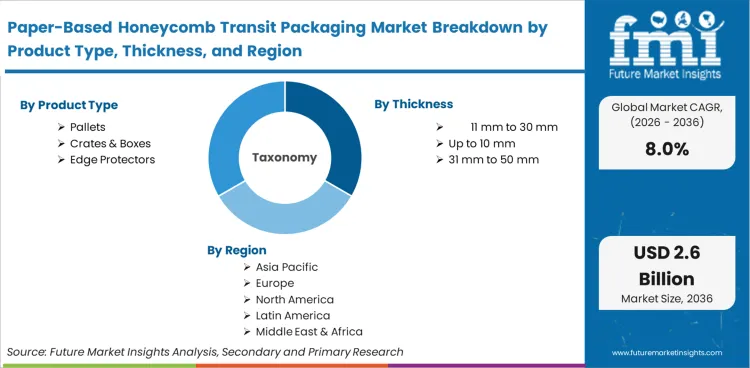
| Metric | Value |
|---|---|
| Quantitative Units | USD 1.2 billion to USD 2.6 billion, at a CAGR of 8.0% |
| Market Definition | Paper-based honeycomb transit packaging encompasses engineered structural formats utilizing a hexagonal inner cellular paper core between Kraft facings, specifically designed to provide high vertical compression resistance, impact absorption, and multi-axis rigidity for industrial and commercial goods transportation. |
| Product Type Segmentation | Pallets, Crates & Boxes, Edge Protectors, Void Fillers, Layer Pads |
| Thickness Segmentation | Up to 10 mm, 11 mm to 30 mm, 31 mm to 50 mm, Above 50 mm |
| End Use Segmentation | Automotive, Consumer Electronics, E-commerce, Food & Beverage, Industrial Goods |
| Regions Covered | North America, Latin America, Europe, East Asia, South Asia, Oceania, Middle East & Africa |
| Countries Covered | China, India, United States, Germany, United Kingdom, Japan, South Korea, and 40 plus countries |
| Key Companies Profiled | Smurfit Westrock, International Paper, Sonoco Products Company, Packaging Corporation of America (PCA), Axxor, Honicel Worldwide B.V., Lsquare Eco-Products Pvt. Ltd., MAC Pack |
| Forecast Period | 2026 to 2036 |
| Approach | The baseline derives from a bottom-up aggregation of continuous-core paperboard production volumes, applying specific conversion ratios to project the localized manufacturing capacity. Projections are rigorously cross-validated against publicly reported capital expenditure on automated core-expansion machinery. |
Source: Future Market Insights (FMI) analysis, based on proprietary forecasting model and primary research
Key Segments
Product Type:
- Pallets
- Crates & Boxes
- Edge Protectors
- Void Fillers
- Layer Pads
Thickness:
- Up to 10 mm
- 11 mm to 30 mm
- 31 mm to 50 mm
- Above 50 mm
End Use:
- Automotive
- Consumer Electronics
- E-commerce
- Food & Beverage
- Industrial Goods
Regions:
- North America
- United States
- Canada
- Latin America
- Brazil
- Mexico
- Europe
- Germany
- United Kingdom
- France
- Italy
- Spain
- Asia-Pacific
- China
- Japan
- South Korea
- India
- Rest of Asia-Pacific
- Australia
- Middle East & Africa
- South Africa
- GCC Countries
Bibliography
- International Safe Transit Association. (2024, February 12). ISTA 3E: General Simulation Performance Test for Similar Packaged-Products in Unitized Loads. ISTA Testing Standards.
- State Post Bureau of the People's Republic of China. (2024, January 08). Implementation directives for the 9917 green packaging initiative in cross-border e-commerce. PRC Government Portals.
- Packaging Corporation of America (PCA). (2024, August 30). Hexacomb structural design testing methodologies for automotive component distribution. PCA Technical Resources.
- International Plant Protection Convention. (2024, July 05). ISPM 15: Regulation of wood packaging material in international trade and exempt alternatives. IPPC Publications.
- Flexible Packaging Association. (2024, September 18). Assessing the shift from EPS to engineered paper core in e-commerce fulfillment operations. FPA Research Reports.
This bibliography is provided for reader reference. The full FMI report contains the complete reference list with primary source documentation.
This Report Addresses
- Market intelligence to support strategic decision making across heavy-duty paper pallets, continuous-core wrap systems, and edge protection technologies unique to this market
- Market size estimation and 10-year revenue forecasts from 2026 to 2036, supported by rigorous tracking of ISPM-15 phytosanitary trade compliance logs and global EPS substitution metrics
- Growth opportunity mapping across specific thickness brackets and product types with emphasis on the specific non-obvious structural dynamic of verifiable dynamic impact parity with heat-treated wooden pallets
- Segment and regional revenue forecasts covering engineered honeycomb layer pads and rigid crates across automotive export networks and consumer electronics procurement channels
- Competition strategy assessment including highly decentralized continuous-core production networks, integration of automated on-site core-expansion machinery, and the standardization of generic cell sizes to prevent vendor lock-in
- Technology development tracking including automated 3D volumetric scanning for void-fill dispensing, hydrophobic repulpable barrier coatings, and high-burst-strength Kraft facings discussed in this article
- Market access analysis covering European PPWR EPR compliance pathways, Chinese State Post Bureau 9917 initiative regulations, and international ISPM-15 exemption channels
- Market report delivery in PDF, Excel, PPT, and interactive dashboard formats for executive strategy, global outbound logistics planning, and operational benchmarking use
Frequently Asked Questions
How large is the Paper-Based Honeycomb Transit Packaging market in 2026?
The industry is expected to be valued at USD 1.2 billion in 2026, driven by immediate compliance requirements surrounding the EU Packaging and Packaging Waste Regulation.
What will it be valued at by 2036?
Revenue expansion carries the total valuation to USD 2.6 billion through 2036 as high-volume exporters transition to lightweight, single-stream recyclable hex-core structures to mitigate punitive EPR taxes.
What CAGR is projected?
The market is poised to advance at a CAGR of 8.0%, supported structurally by the compounding costs of wooden pallet heat-treatments and rising air-freight dimensional weight surcharges.
Which Product Type segment leads?
Pallets hold a leading 34.5% share in 2026 because facility managers deploying these high-compression platforms completely bypass international wood pest treatment regulations.
Which Thickness segment leads?
The 11 mm to 30 mm bracket commands 41.2% share by perfectly balancing essential shock absorption with the volumetric efficiency required to maximize payload space within shipping containers.
Which End Use segment leads?
Automotive captures 28.6% of the market as tier-1 component suppliers systematically eradicate heavy steel stillages and wooden crates to optimize inter-continental shipping matrices.
What drives rapid growth?
Aggressive extended producer responsibility taxation directives and prohibitive air-freight weight limits force massive industrial and electronics exporters to abandon legacy EPS and dense wooden crates.
What is the primary restraint?
The inherent vulnerability of standard Kraft facings to moisture degradation in uncontrolled maritime environments causes structural core collapse, creating friction for trans-oceanic adoption.
Which country grows fastest?
China expands at a rapid 10.5% rate as the State Post Bureau's 9917 green packaging initiative forces export hubs to aggressively eliminate single-use secondary plastics.
How does ISPM-15 regulation impact this sector?
Engineered paper cores are explicitly exempt from ISPM-15 phytosanitary heat-treatment mandates, allowing exporters to eliminate a massive cost and delay bottleneck at international borders.
Why is puncture resistance critical for these products?
While static load limits are sufficient, localized dynamic punctures from forklift tines can destroy pallet integrity, requiring the integration of high-burst-strength Kraft facings to survive cross-docking.
What dictates competitive positioning among top manufacturers?
Establishing highly automated continuous-core expansion nodes within 200 miles of major automotive assembly plants allows dominant players to avoid the severe economic penalty of shipping expanded air.
Why does Germany exhibit strong adoption?
The updated VerpackG legislation imposes severe financial penalties on logistics networks utilizing non-recyclable expanded polystyrene cushioning, forcing an immediate pivot to pure paper dunnage.
What drives the United States market trajectory?
Tier-1 e-commerce fulfillment networks deploy flexible honeycomb wrap systems to tightly contour products and defeat crushing dimensional weight pricing models enforced by national parcel carriers.
How do Indian automotive exporters utilize these materials?
Local manufacturers deploy heavy-duty hex-core platforms specifically to bypass ISPM-15 heat treatment requirements and accelerate cross-border customs clearance for European-bound automotive components.
What specific role does the 11-30mm thickness play?
This exact gauge acts as an optimal kinetic energy absorber during rail or over-the-road transit, drastically reducing micro-fracture incidents in sensitive consumer electronics shipments.
Why are standard fluted corrugated boxes excluded from this analysis?
Standard fluting lacks the vertical compression resistance and multi-axis structural rigidity provided by continuous hexagonal inner cellular cores, placing them outside the heavy-duty transit definition.
How are e-commerce networks integrating this technology?
Fulfillment operators are installing advanced robotics that dynamically slice and expand flexible honeycomb paper wrap directly into shipping cartons based on 3D volumetric scanning.
What allows paper pallets to survive maritime freight?
Next-generation chemical formulations apply intense hydrophobic barrier coatings to the Kraft facing, blocking humidity degradation without triggering rejection at the downstream paper repulping mill.
How is the market validated by FMI?
Projections undergo constant cross-validation against quarterly unbleached Kraft paper shipment volumes dedicated specifically to structural applications and capital expenditure on automated core-expansion machinery.
Why is the UK shifting toward automated wrap dispensers?
The post-Brexit plastic packaging tax forces massive retail distribution networks to utilize extreme levels of recycled content, prompting the complete replacement of manual plastic air-pillow stations.
What prevents vendor lock-in with major packaging conglomerates?
Massive fulfillment networks intentionally standardizing procurement specifications around generic cell sizes and splitting multi-million-dollar contracts among multiple regional converters to maintain price tension.
Preview the report firsthand - request a free sample
Get SampleGet the brochure for pricing and purchase details.
Get PDFTable of Content
- Executive Summary
- Global Market Outlook
- Demand-side Trends
- Supply-side Trends
- Technology Roadmap Analysis
- Analysis and Recommendations
- Market Overview
- Market Coverage / Taxonomy
- Market Definition / Scope / Limitations
- Research Methodology
- Chapter Orientation
- Analytical Lens and Working Hypotheses
- Market Structure, Signals, and Trend Drivers
- Benchmarking and Cross-market Comparability
- Market Sizing, Forecasting, and Opportunity Mapping
- Research Design and Evidence Framework
- Desk Research Programme (Secondary Evidence)
- Company Annual and Sustainability Reports
- Peer-reviewed Journals and Academic Literature
- Corporate Websites, Product Literature, and Technical Notes
- Earnings Decks and Investor Briefings
- Statutory Filings and Regulatory Disclosures
- Technical White Papers and Standards Notes
- Trade Journals, Industry Magazines, and Analyst Briefs
- Conference Proceedings, Webinars, and Seminar Materials
- Government Statistics Portals and Public Data Releases
- Press Releases and Reputable Media Coverage
- Specialist Newsletters and Curated Briefings
- Sector Databases and Reference Repositories
- FMI Internal Proprietary Databases and Historical Market Datasets
- Subscription Datasets and Paid Sources
- Social Channels, Communities, and Digital Listening Inputs
- Additional Desk Sources
- Expert Input and Fieldwork (Primary Evidence)
- Primary Modes
- Qualitative Interviews and Expert Elicitation
- Quantitative Surveys and Structured Data Capture
- Blended Approach
- Why Primary Evidence is Used
- Field Techniques
- Interviews
- Surveys
- Focus Groups
- Observational and In-context Research
- Social and Community Interactions
- Stakeholder Universe Engaged
- C-suite Leaders
- Board Members
- Presidents and Vice Presidents
- R&D and Innovation Heads
- Technical Specialists
- Domain Subject-matter Experts
- Scientists
- Physicians and Other Healthcare Professionals
- Governance, Ethics, and Data Stewardship
- Research Ethics
- Data Integrity and Handling
- Primary Modes
- Tooling, Models, and Reference Databases
- Desk Research Programme (Secondary Evidence)
- Data Engineering and Model Build
- Data Acquisition and Ingestion
- Cleaning, Normalisation, and Verification
- Synthesis, Triangulation, and Analysis
- Quality Assurance and Audit Trail
- Market Background
- Market Dynamics
- Drivers
- Restraints
- Opportunity
- Trends
- Scenario Forecast
- Demand in Optimistic Scenario
- Demand in Likely Scenario
- Demand in Conservative Scenario
- Opportunity Map Analysis
- Product Life Cycle Analysis
- Supply Chain Analysis
- Investment Feasibility Matrix
- Value Chain Analysis
- PESTLE and Porter’s Analysis
- Regulatory Landscape
- Regional Parent Market Outlook
- Production and Consumption Statistics
- Import and Export Statistics
- Market Dynamics
- Global Market Analysis 2021 to 2025 and Forecast, 2026 to 2036
- Historical Market Size Value (USD Million) Analysis, 2021 to 2025
- Current and Future Market Size Value (USD Million) Projections, 2026 to 2036
- Y-o-Y Growth Trend Analysis
- Absolute $ Opportunity Analysis
- Global Market Pricing Analysis 2021 to 2025 and Forecast 2026 to 2036
- Global Market Analysis 2021 to 2025 and Forecast 2026 to 2036, By Product Type
- Introduction / Key Findings
- Historical Market Size Value (USD Million) Analysis By Product Type , 2021 to 2025
- Current and Future Market Size Value (USD Million) Analysis and Forecast By Product Type , 2026 to 2036
- Pallets
- Crates & Boxes
- Edge Protectors
- Pallets
- Y-o-Y Growth Trend Analysis By Product Type , 2021 to 2025
- Absolute $ Opportunity Analysis By Product Type , 2026 to 2036
- Global Market Analysis 2021 to 2025 and Forecast 2026 to 2036, By Thickness
- Introduction / Key Findings
- Historical Market Size Value (USD Million) Analysis By Thickness, 2021 to 2025
- Current and Future Market Size Value (USD Million) Analysis and Forecast By Thickness, 2026 to 2036
- 11 mm to 30 mm
- Up to 10 mm
- 31 mm to 50 mm
- 11 mm to 30 mm
- Y-o-Y Growth Trend Analysis By Thickness, 2021 to 2025
- Absolute $ Opportunity Analysis By Thickness, 2026 to 2036
- Global Market Analysis 2021 to 2025 and Forecast 2026 to 2036, By End Use
- Introduction / Key Findings
- Historical Market Size Value (USD Million) Analysis By End Use, 2021 to 2025
- Current and Future Market Size Value (USD Million) Analysis and Forecast By End Use, 2026 to 2036
- Automotive
- Consumer Electronics
- E-commerce
- Automotive
- Y-o-Y Growth Trend Analysis By End Use, 2021 to 2025
- Absolute $ Opportunity Analysis By End Use, 2026 to 2036
- Global Market Analysis 2021 to 2025 and Forecast 2026 to 2036, By Region
- Introduction
- Historical Market Size Value (USD Million) Analysis By Region, 2021 to 2025
- Current Market Size Value (USD Million) Analysis and Forecast By Region, 2026 to 2036
- North America
- Latin America
- Western Europe
- Eastern Europe
- East Asia
- South Asia and Pacific
- Middle East & Africa
- Market Attractiveness Analysis By Region
- North America Market Analysis 2021 to 2025 and Forecast 2026 to 2036, By Country
- Historical Market Size Value (USD Million) Trend Analysis By Market Taxonomy, 2021 to 2025
- Market Size Value (USD Million) Forecast By Market Taxonomy, 2026 to 2036
- By Country
- USA
- Canada
- Mexico
- By Product Type
- By Thickness
- By End Use
- By Country
- Market Attractiveness Analysis
- By Country
- By Product Type
- By Thickness
- By End Use
- Key Takeaways
- Latin America Market Analysis 2021 to 2025 and Forecast 2026 to 2036, By Country
- Historical Market Size Value (USD Million) Trend Analysis By Market Taxonomy, 2021 to 2025
- Market Size Value (USD Million) Forecast By Market Taxonomy, 2026 to 2036
- By Country
- Brazil
- Chile
- Rest of Latin America
- By Product Type
- By Thickness
- By End Use
- By Country
- Market Attractiveness Analysis
- By Country
- By Product Type
- By Thickness
- By End Use
- Key Takeaways
- Western Europe Market Analysis 2021 to 2025 and Forecast 2026 to 2036, By Country
- Historical Market Size Value (USD Million) Trend Analysis By Market Taxonomy, 2021 to 2025
- Market Size Value (USD Million) Forecast By Market Taxonomy, 2026 to 2036
- By Country
- Germany
- UK
- Italy
- Spain
- France
- Nordic
- BENELUX
- Rest of Western Europe
- By Product Type
- By Thickness
- By End Use
- By Country
- Market Attractiveness Analysis
- By Country
- By Product Type
- By Thickness
- By End Use
- Key Takeaways
- Eastern Europe Market Analysis 2021 to 2025 and Forecast 2026 to 2036, By Country
- Historical Market Size Value (USD Million) Trend Analysis By Market Taxonomy, 2021 to 2025
- Market Size Value (USD Million) Forecast By Market Taxonomy, 2026 to 2036
- By Country
- Russia
- Poland
- Hungary
- Balkan & Baltic
- Rest of Eastern Europe
- By Product Type
- By Thickness
- By End Use
- By Country
- Market Attractiveness Analysis
- By Country
- By Product Type
- By Thickness
- By End Use
- Key Takeaways
- East Asia Market Analysis 2021 to 2025 and Forecast 2026 to 2036, By Country
- Historical Market Size Value (USD Million) Trend Analysis By Market Taxonomy, 2021 to 2025
- Market Size Value (USD Million) Forecast By Market Taxonomy, 2026 to 2036
- By Country
- China
- Japan
- South Korea
- By Product Type
- By Thickness
- By End Use
- By Country
- Market Attractiveness Analysis
- By Country
- By Product Type
- By Thickness
- By End Use
- Key Takeaways
- South Asia and Pacific Market Analysis 2021 to 2025 and Forecast 2026 to 2036, By Country
- Historical Market Size Value (USD Million) Trend Analysis By Market Taxonomy, 2021 to 2025
- Market Size Value (USD Million) Forecast By Market Taxonomy, 2026 to 2036
- By Country
- India
- ASEAN
- Australia & New Zealand
- Rest of South Asia and Pacific
- By Product Type
- By Thickness
- By End Use
- By Country
- Market Attractiveness Analysis
- By Country
- By Product Type
- By Thickness
- By End Use
- Key Takeaways
- Middle East & Africa Market Analysis 2021 to 2025 and Forecast 2026 to 2036, By Country
- Historical Market Size Value (USD Million) Trend Analysis By Market Taxonomy, 2021 to 2025
- Market Size Value (USD Million) Forecast By Market Taxonomy, 2026 to 2036
- By Country
- Kingdom of Saudi Arabia
- Other GCC Countries
- Turkiye
- South Africa
- Other African Union
- Rest of Middle East & Africa
- By Product Type
- By Thickness
- By End Use
- By Country
- Market Attractiveness Analysis
- By Country
- By Product Type
- By Thickness
- By End Use
- Key Takeaways
- Key Countries Market Analysis
- USA
- Pricing Analysis
- Market Share Analysis, 2025
- By Product Type
- By Thickness
- By End Use
- Canada
- Pricing Analysis
- Market Share Analysis, 2025
- By Product Type
- By Thickness
- By End Use
- Mexico
- Pricing Analysis
- Market Share Analysis, 2025
- By Product Type
- By Thickness
- By End Use
- Brazil
- Pricing Analysis
- Market Share Analysis, 2025
- By Product Type
- By Thickness
- By End Use
- Chile
- Pricing Analysis
- Market Share Analysis, 2025
- By Product Type
- By Thickness
- By End Use
- Germany
- Pricing Analysis
- Market Share Analysis, 2025
- By Product Type
- By Thickness
- By End Use
- UK
- Pricing Analysis
- Market Share Analysis, 2025
- By Product Type
- By Thickness
- By End Use
- Italy
- Pricing Analysis
- Market Share Analysis, 2025
- By Product Type
- By Thickness
- By End Use
- Spain
- Pricing Analysis
- Market Share Analysis, 2025
- By Product Type
- By Thickness
- By End Use
- France
- Pricing Analysis
- Market Share Analysis, 2025
- By Product Type
- By Thickness
- By End Use
- India
- Pricing Analysis
- Market Share Analysis, 2025
- By Product Type
- By Thickness
- By End Use
- ASEAN
- Pricing Analysis
- Market Share Analysis, 2025
- By Product Type
- By Thickness
- By End Use
- Australia & New Zealand
- Pricing Analysis
- Market Share Analysis, 2025
- By Product Type
- By Thickness
- By End Use
- China
- Pricing Analysis
- Market Share Analysis, 2025
- By Product Type
- By Thickness
- By End Use
- Japan
- Pricing Analysis
- Market Share Analysis, 2025
- By Product Type
- By Thickness
- By End Use
- South Korea
- Pricing Analysis
- Market Share Analysis, 2025
- By Product Type
- By Thickness
- By End Use
- Russia
- Pricing Analysis
- Market Share Analysis, 2025
- By Product Type
- By Thickness
- By End Use
- Poland
- Pricing Analysis
- Market Share Analysis, 2025
- By Product Type
- By Thickness
- By End Use
- Hungary
- Pricing Analysis
- Market Share Analysis, 2025
- By Product Type
- By Thickness
- By End Use
- Kingdom of Saudi Arabia
- Pricing Analysis
- Market Share Analysis, 2025
- By Product Type
- By Thickness
- By End Use
- Turkiye
- Pricing Analysis
- Market Share Analysis, 2025
- By Product Type
- By Thickness
- By End Use
- South Africa
- Pricing Analysis
- Market Share Analysis, 2025
- By Product Type
- By Thickness
- By End Use
- USA
- Market Structure Analysis
- Competition Dashboard
- Competition Benchmarking
- Market Share Analysis of Top Players
- By Regional
- By Product Type
- By Thickness
- By End Use
- Competition Analysis
- Competition Deep Dive
- Smurfit Westrock
- Overview
- Product Portfolio
- Profitability by Market Segments (Product/Age /Sales Channel/Region)
- Sales Footprint
- Strategy Overview
- Marketing Strategy
- Product Strategy
- Channel Strategy
- International Paper
- Sonoco Products Company
- Packaging Corporation of America (PCA)
- Axxor
- Honicel Worldwide B.V.
- Smurfit Westrock
- Competition Deep Dive
- Assumptions & Acronyms Used


