

- Industry Size (2026)
- USD 0.7 Bn
- Forecast (2036)
- USD 1.7 Bn
- CAGR
- 58.0(2026 to 2036)
Honeycomb Mailers Market Size, Market Forecast and Outlook By FMI
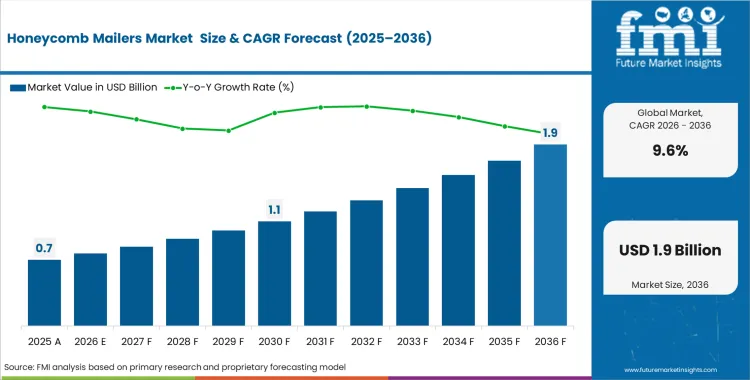
The honeycomb mailers market generated a valuation of USD 0.6 billion in 2025 and is projected to reach USD 0.7 billion in 2026. Valuation is expected to rise to USD 1.7 billion by 2036, reflecting a CAGR of 9.6% from 2026 to 2036. Industry expansion is supported by continued investment in paper-based protective packaging as large fulfillment networks replace multi-material mailers that are harder to sort and recover through municipal recycling systems.
Summary of honeycomb mailers market
- Market Snapshot
- The honeycomb mailers market is valued at USD 0.7 billion in 2025 and is projected to reach USD 1.7 billion by 2036.
- The market is expected to expand at an 9.6% CAGR from 2026 to 2036, creating an incremental opportunity of USD 1.0 billion over the period.
- Honeycomb mailers are paper-based padded shipping formats that use expanded die-cut kraft forms to provide cushioning without poly bubble interiors.
- The category remains part of the broader padded mailers segment, where paper-based formats are gaining share as e-commerce continues to account for the largest volume of demand.
- Honeycomb Mailers Demand and Growth Drivers
- Demand is rising as large shippers and marketplaces replace padded plastic mailing formats with recyclable paper alternatives.
- Recyclability rules in Europe are supporting adoption, particularly as packaging buyers move toward formats that are easier to sort and recover at scale.
- Paper-based cushioning is gaining wider use because it reduces mixed-material complexity while still protecting small consumer goods in parcel transit.
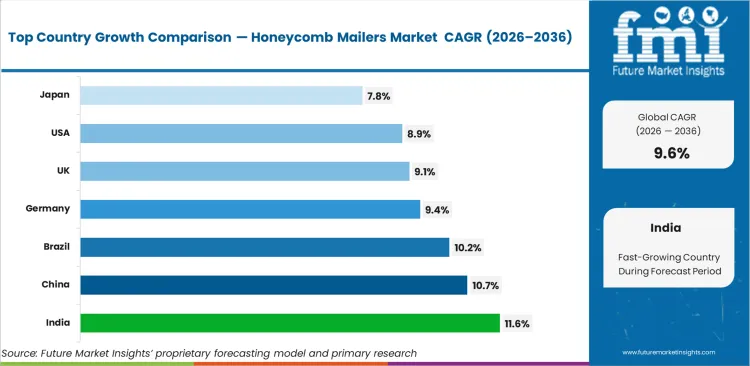
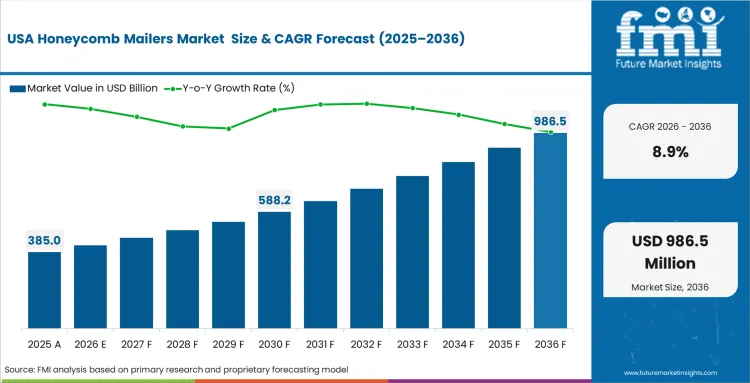
- India is expected to record the stable expansion at 11.6% CAGR in honeycomb mailer demand from 2026 to 2036 among the major countries. China follows with an expected 10.7% CAGR, Brazil at 10.2%, Germany at 9.4%, the United Kingdom at 9.1%, the United States at 8.9%, and Japan at 7.8% through 2036. Line-speed validation continues to affect adoption, as high-volume shippers still need paper padded formats to run through scanners, induction points, and sorting equipment without increasing jam or misread rates.
- Honeycomb Mailers Product and Segment View
- The market includes padded paper mailers, paper sleeves, and honeycomb wrap formats made mainly from virgin or recycled kraft paper for e-commerce parcel protection and lightweight shipment cushioning.
- These formats are used across e-commerce, electronics accessories, books, beauty shipments, and selected apparel categories where replacing a box with a lighter mailer makes commercial sense.
- Padded mailers are expected to account for 58% of the product type segment because they offer the closest functional substitute for legacy bubble-lined mailing formats.
- Curbside recyclability claims and rising demand for higher recycled-content packaging are expected to keep recycled kraft at 46% of the material segment in 2026.
- Self-seal formats are likely to represent 62% of the closure segment because packing speed remains a priority in dense fulfillment environments.
- In the broader mailer packaging category, parcel shipment volumes remain concentrated in online retail, and that keeps e-commerce at 52% of end-use demand.
- Direct sales are estimated to secure 49% of the sales channel segment in 2026, reflecting the consultative nature of packaging conversion, testing, and line-integration decisions.
- The market scope includes honeycomb padded mailers, honeycomb wrap mailers, and adjacent paper-cushion mailer formats, while excluding rigid mailer boxes, plain envelopes, and non-cushioned poly mailers.
- Honeycomb Mailers Geography and Competitive Outlook
- India, China, and Brazil are the fastest-growing national markets, while the United States and Germany remain the more established commercial demand bases.
- Competition is centered on recyclable product launches, paper mailer line extensions, and continued conversion away from poly-lined padded formats.
- Ranpak, Pregis, Sealed Air, Mondi, Smurfit Westrock, PAC Worldwide, and ProAmpac are among the most visible active participants in this niche.
- The market remains fragmented, with competition shaped by channel reach, printability, and fulfillment-line compatibility across a broad supplier base.
| Metric | Details |
|---|---|
| Industry Size (2026) | USD 0.7 billion |
| Industry Value (2036) | USD 1.7 billion |
| CAGR (2026 to 2036) | 9.60% |
Source: Future Market Insights (FMI) analysis, based on proprietary forecasting model and primary research
Large e-commerce fulfillment operators are facing increasing pressure to remove polyethylene bubble layers from outbound packaging. Delays in securing curbside-recyclable padded paper mailers that can run on existing automated induction lines raise exposure to plastic taxes and compliance costs across major urban shipping hubs. The shift away from traditional padded mailers also requires closer control over weight, protection, and packing efficiency. The higher cost of fiber-based alternatives is partly offset by better space use in transit and fewer handling issues across the shipping process, which supports wider commercial adoption.
Adoption is being shaped by operating performance inside automated facilities. Distribution centers move faster once textured honeycomb formats show they can pass through scanners, pinch rollers, and sortation systems without increasing jam rates or misread incidents. Suppliers that can deliver the same or better line reliability as legacy plastic mailers are in a stronger position to secure large-volume contracts.
India is expected to record an 11.6% CAGR in honeycomb mailer demand from 2026 to 2036 as third-party logistics providers standardize mailer formats across expanding domestic delivery networks. China is projected to grow at a 10.7% CAGR over the same period, supported by tighter green packaging rules across export-oriented manufacturing and shipping hubs. Brazil is forecast to see 10.2% CAGR growth in market demand as local converted-paper capacity improves supply availability. Germany is projected to expand at a 9.4% CAGR through 2036, supported by stricter Extended Producer Responsibility enforcement. The United Kingdom is expected to grow at 9.1%, the United States at 8.9%, and Japan at 7.8% during the same period. Differences across these markets depend largely on whether postal and packaging systems impose real cost pressure on non-recyclable formats or simply encourage paper-based alternatives without strict enforcement.
Segmental Analysis
Honeycomb Mailers Market Analysis by Product type
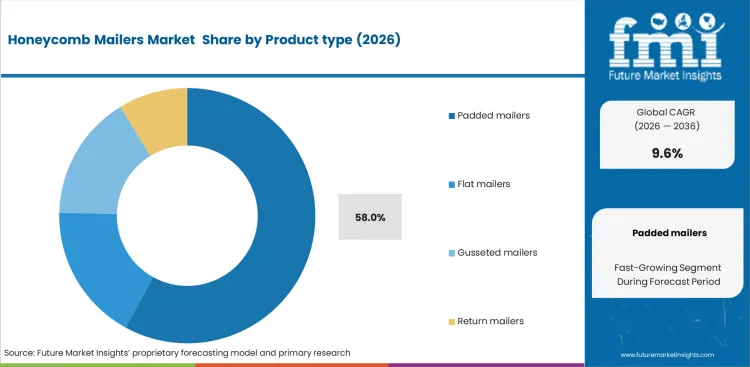
Facility managers calculate internal volume displacement constantly when substituting polymer buffers with paper equivalents. Honeycomb padded mailers hold 58.0% share because integrated cores expand to identical geometric thickness as legacy variants, satisfying existing drop-test criteria without requiring custom carton resizing. Packaging engineers at massive fulfillment centers refuse formats demanding secondary manual fluffing. These professionals demand self-expanding compositions capable of dropping straight into automated bagging sequences. What generalist reports miss is that die-cut expansion actually impact distribution over time. Whereas popped plastic bubbles lose protective value instantly, crushed paper cells interlock to form dense secondary barriers. Sourcing directors evaluating honeycomb mailers vs bubble mailers face unacceptable transit damage metrics if they specify inferior flat cushioned mailer formats for fragile payloads.
- Impact threshold limits: Static drop performance determines initial qualification. Packaging engineers approve padded geometries specifically because hexagonal expansion absorbs shock waves comparable to legacy plastics.
- Edge crush realities: Real-world logistics introduce lateral forces beyond laboratory testing. Operations directors must verify paper edges do not collapse under stack pressure during multi-zone transit.
- Vibration fatigue failure: Continuous transport oscillation degrades physical memory. Quality assurance leads monitor return rates closely to ensure initial rigidity survives transcontinental rail journeys.
Honeycomb Mailers Market Analysis by Material
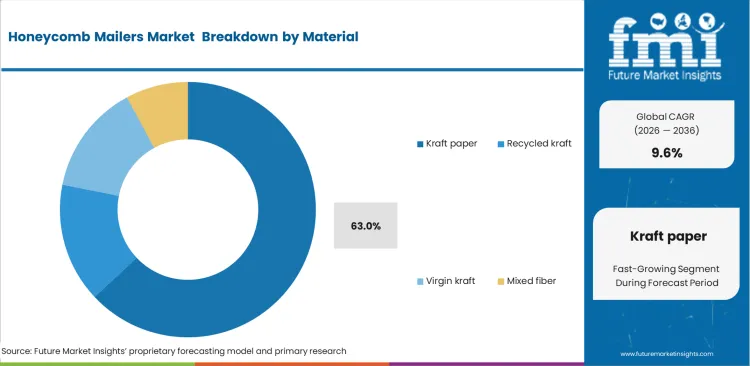
Procurement directors face mounting pressure to balance physical integrity with aggressive corporate environmental targets. Kraft paper dominates with 63.0% share, providing essential tensile strength required to survive high-speed automated sorting arms. The managers cannot compromise on burst strength when substituting plastic film for recyclable padded mailers. Switching to heavily processed recycled variants often introduces unacceptable tear rates during automated barcode scanning and conveyor routing. Sourcing teams know virgin fiber content heavily dictates humidity resistance. Pure recycled substrates absorb atmospheric moisture rapidly, degrading crush resistance before parcels even reach delivery vehicles. Buyers delaying transition to engineered high-yield kraft envelopes risk crippling automated packing lines with excessive material failures.
- Procurement baseline metrics: Raw fiber strength dictates initial unit pricing. Category managers calculate total spend by balancing slight kraft premiums against eliminated secondary plastic wrap costs.
- Hidden downtime penalties: Weak fiber blends tear unexpectedly during automated loading. Facility supervisors face compounding hourly losses when inferior material jams induction rollers.
- Lifecycle damage equations: True expense emerges at returns docks. Logistics directors assess total cost of ownership by comparing upfront material savings against damaged product write-offs.
Honeycomb Mailers Market Analysis by Closure type
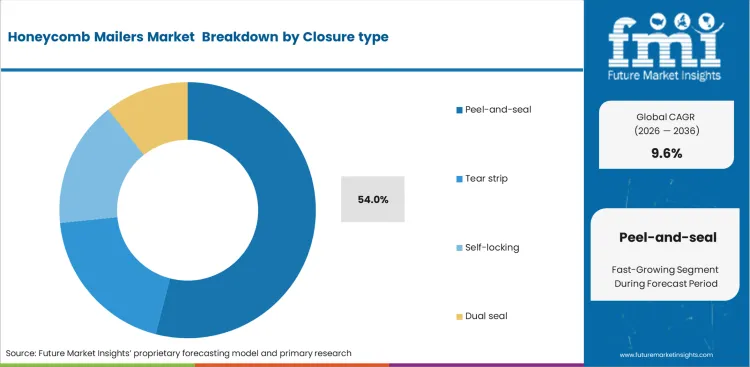
Legacy mechanical sealers fail immediately when introduced to expanded paper thicknesses. Peel-and-seal configurations is poised to capture 54.0% share in 2026 as they bypass machinery retrofits entirely, allowing manual and semi-automated stations to maintain legacy processing speeds. According to the estimates, fulfillment supervisors rely on integrated adhesive approaches to eliminate separate taping operations that ruin mono-material recyclability narratives. Aggressive acrylic adhesives must penetrate textured paper surfaces deeply to prevent unauthorized transit opening. Overlooking adhesive cure times in varied facility climates creates hidden vulnerabilities. Cold-weather distribution centers frequently report catastrophic flap failures when specifying generic pressure-sensitive strips for wholesale honeycomb mailers. Operators ignoring temperature-specific adhesive requirements suffer severe pilferage rates during winter fulfillment peaks when handling smooth mailers.
- Adhesive bonding failure: Smooth plastic accepts glue easily. Quality inspectors reject paper-based formats when specific adhesive formulations fail to bite into fibrous textures.
- Temperature degradation risks: Ambient facility conditions dictate seal permanence. Fulfillment leads observe sudden spikes in open-transit claims if storage drops below critical curing temperatures.
- Contamination protocol gaps: Dust destroys pressure-sensitive viability. Station managers must enforce strict clean-handling procedures to ensure release liners protect glue integrity until final sealing.
Honeycomb Mailers Market Analysis by End use
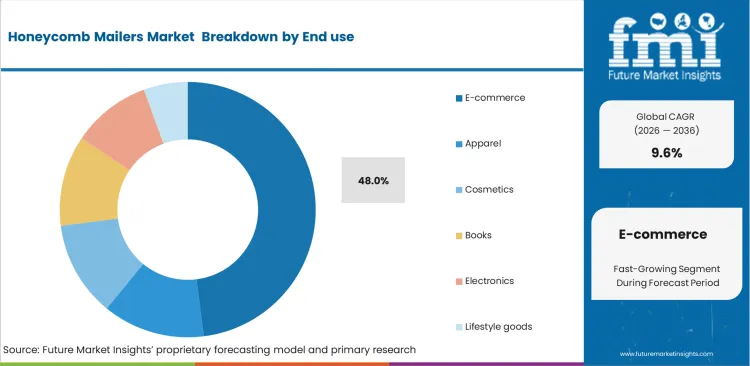
E-commerce is predicted to hold 48.0% share in 2026, functioning as primary proving grounds for paper resilience across multi-node carrier networks. It has been noted logistics directors at major digital retailers utilize volume to force standardizations upon smaller upstream converters. Replacing established flexible protective packaging requires massive scale to justify custom converting machinery investments. Apparel shippers adopted formats first, but true physical testing occurs only when heavy cosmetics and hard-edged electronics migrate into protective packaging for ecommerce. Brands failing to align outbound operations with new material handling realities risk isolation from preferred third-party fulfillment networks.
- Early cosmetic adoption: Beauty brands prioritize unboxing aesthetics over pure cost. Marketing directors specify textured paper formats early to align brand perception with zero-plastic consumer expectations.
- Electronics transition hurdles: Sharp corners puncture weak substrates easily. Packaging engineers for tech accessories only adopt honeycomb designs after converters demonstrate multi-layered edge reinforcement capabilities.
- Apparel volume conversion: Clothing requires minimal physical cushioning. Logistics managers shift soft goods into expanding paper last, driven entirely by municipal recycling mandates rather than product protection needs.
Honeycomb Mailers Market Analysis by Sales channel
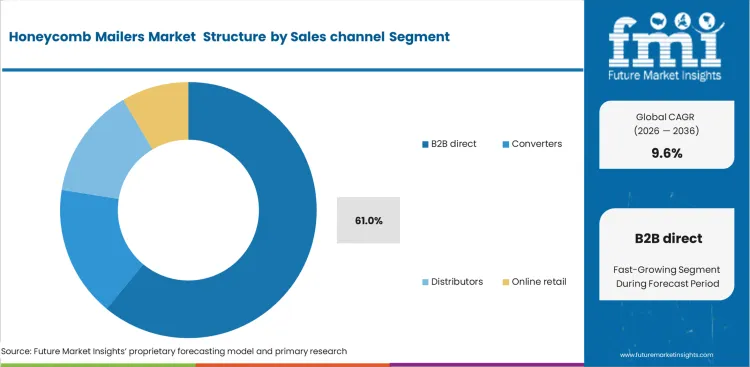
Custom engineering defines success when transitioning massive distribution networks away from legacy plastics. B2B direct channels is set to command 61.0% share because high-volume fulfillment centers require specific dimensional tailoring that off-the-shelf catalog options cannot provide. The procurement directors at massive logistics hubs dictate specific expansion ratios and adhesive strengths directly to honeycomb mailer suppliers. Eliminating distributor margins allows major shippers to offset inherent unit cost premiums associated with complex custom honeycomb mailers. Relying exclusively on indirect sourcing obscures crucial chain-of-custody data regarding recycled fiber origins, a metric increasingly demanded by corporate CSR audits. Smaller merchants attempting to source comparable bespoke corrugated mailers through fragmented distribution networks face prohibitive minimum order quantities.
- Initial qualification parameters: Corporate buyers establish stringent baseline specifications. Sourcing directors issue complex requests for proposals demanding exact dimensional tolerances and guaranteed monthly capacity allocations.
- Audit phase validations: Secondary verification prevents catastrophic line failures. Automation engineers conduct intensive pilot runs to confirm custom-engineered paper behaviors match promised performance.
- Long-term contract renewals: Continuous volume depends entirely on defect rates. Category managers expand direct vendor agreements only after observing zero degradation across seasonal humidity shifts.
Honeycomb Mailers Market Drivers, Restraints, and Opportunities
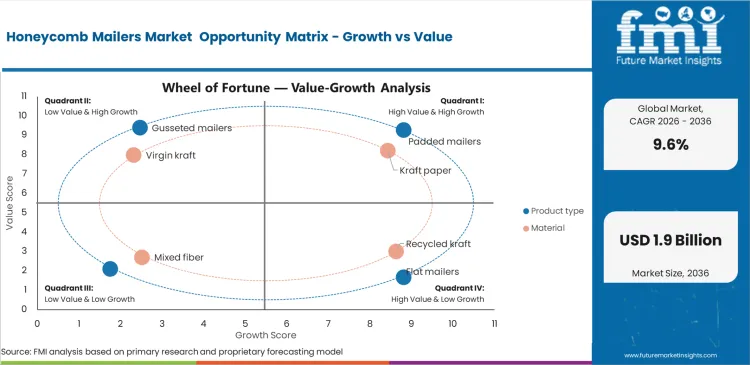
Extended Producer Responsibility frameworks compel procurement directors at global e-commerce nodes to redesign entire outbound logistics strategies. Ignoring localized plastic packaging taxes creates unsustainable cost burdens as municipalities aggressively penalize mixed-material shipments. Replacing traditional bubble liners with honeycomb packing paper allows facility managers to secure curbside recyclable ecommerce packaging that bypasses consumer separation requirements while maintaining automated throughput speeds. Immediate action shields shippers from compounding regulatory fees.
Converting machinery throughput caps create friction slowing adoption significantly. High-speed slitting and die-cutting equipment require precise web tension control, limiting output rates compared to established polymer extrusion lines. Operations directors face frustrating lead times as converters struggle to scale production rapidly. Upgraded servo-driven cutting technologies offer partial resolution, but true capacity parity demands massive capital investment across converting sectors.
Opportunities in the Honeycomb Mailers Market
- Cold-chain insulation engineering: Specialized paper based honeycomb transit packaging geometries capture trapped air efficiently. Food fulfillment directors secure significant cost advantages by replacing polystyrene coolers with expandable paper formats.
- Cross-border tax avoidance: Navigating varied international plastic bans requires standardized solutions. Logistics managers establish unified global compliance by deploying mono-material paper across export channels.
- Reverse logistics optimization: Flattened inbound profiles maximize container density. Supply chain executives reduce raw material transport costs drastically by shipping unexpanded envelopes to regional fulfillment hubs.
Regional Analysis
.webp "Top Country Growth Comparison Honeycomb Mailers Market Cagr (2026 2036)")
Based on regional analysis, Honeycomb Mailers Market is segmented into North America, Europe, Asia Pacific, and Latin America across 40 plus countries.
| Country | CAGR (2026 to 2036) |
|---|---|
| India | 11.6% |
| China | 10.7% |
| Brazil | 10.2% |
| Germany | 9.4% |
| United Kingdom | 9.1% |
| United States | 8.9% |
| Japan | 7.8% |
Source: Future Market Insights (FMI) analysis, based on proprietary forecasting model and primary research
North America honeycomb mailers market analysis
North American logistics operators evaluate packaging formats on line performance first. Throughput, jam risk, and handling consistency matter more than sustainability claims at the point of adoption. Facility directors test paper-based mailers closely to confirm that textured surfaces can move through optical sensors, induction belts, and high-speed handling systems without disruption. Adoption moves faster when honeycomb formats can match existing processing speeds across large fulfillment networks.
Procurement teams avoid formats that add extra steps before packing. Mailers that require manual inflation, secondary preparation, or complicated folding reduce packing speed and raise labor dependence. Line supervisors also need paper shapes that can pass through pinch rollers without tearing or losing protective form too early in the process. The shift away from plastic cushioning depends on physical testing at operating speed, especially to ensure sorting arms do not pierce outer kraft layers during rapid routing. Tier-1 fulfillment nodes scale these formats only when protection, machinability, and packing speed work together in the same system.
- United States: Honeycomb mailers demand in the United States is projected to rise at an 8.9% CAGR through 2036. Large procurement teams use their purchasing scale to lock in dedicated converting capacity as retailers reduce dependence on plastic cushioning. Facility directors run resilience trials that replicate heavy stacking, fast belt movement, and repeated handling stress inside domestic sorting centers. Buyers also expect local suppliers to prove that expanding paper cells can hold shape during peak-volume operations. The appeal is practical: removing secondary plastic void fill simplifies packing and reduces material complexity across large warehouse networks.
FMI’s report includes the United States, Canada, and Mexico. E-commerce fulfillment scale, automation compatibility, and recyclable protective packaging adoption continue to influence purchasing decisions across the region.
Europe Honeycomb Mailers Market Analysis
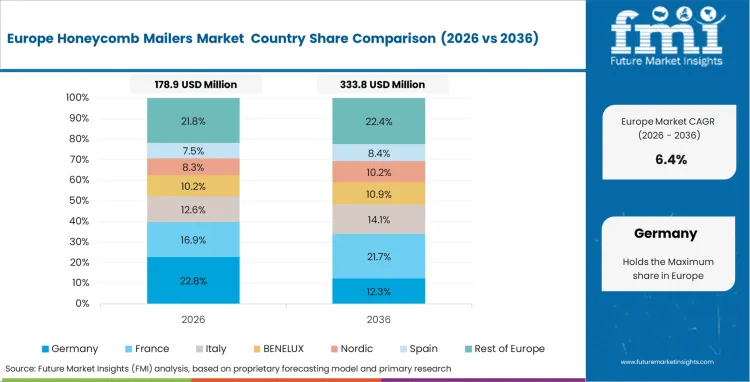
European buyers operate under regulatory conditions that leave little room for mixed-material packaging. Extended Producer Responsibility rules and related compliance costs have pushed recyclability from a brand preference into a procurement requirement. Packaging formats that cannot move cleanly through municipal recovery streams face faster rejection in vendor reviews. As a result, brand owners are moving toward mono-material protective mailers that support both compliance and fulfillment efficiency.
- Germany: Strict municipal sorting laws require absolute mono-material compliance across outbound logistics, forcing immediate vendor requalification. Germany is set to witness a CAGR push of 9.4% by 2036 by adopting non cushioned mailer alternatives rapidly to bypass crippling logistical taxes applied to legacy mixed-material protective formats. Facility managers are adopting paper-based mailers more quickly because taxes and compliance costs on older formats are becoming harder to absorb. Procurement teams are also favoring stronger kraft grades after finding that lower-grade recycled blends can create scanning and handling issues in automated systems. Dedicated regional converting capacity has become an important safeguard against supply disruption.
- United Kingdom: Plastic levies are raising distribution costs in the United Kingdom and pushing direct-to-consumer operators to reassess packaging economics. Honeycomb mailers demand in the United Kingdom is expected to grow at a 9.1% CAGR through 2036. Operations teams are weighing higher unit costs for paper mailers against the savings from removing secondary separation steps and reducing material complexity. Packaging engineers are also testing seal strength under low-temperature transit conditions, since early paper-format failures often appeared at the adhesive joint rather than in the paper formations itself. Suppliers that address these operating issues are better placed to secure large-scale programs.
FMI’s report includes Germany, the United Kingdom, France, and Italy. Extended Producer Responsibility rules, plastic levy exposure, and mono-material compliance standards remain central to packaging conversion strategies across Europe.
Asia Pacific Honeycomb Mailers Market Analysis
Asia Pacific demand is being shaped by the growth of third-party logistics networks and longer, more demanding shipping routes. Protective packaging must hold up across multiple handling points, changing climates, and varied transport modes. That is pushing merchants away from lighter formats that struggle under compression, humidity, and long-haul movement. Logistics teams are setting tougher requirements for crush resistance, burst strength, and dimensional stability before approving new paper mailer formats.
- India: Honeycomb mailers sales in India are forecast to grow at an 11.6% CAGR through 2036. Procurement strategies increasingly favor local production because imported plastic-based formats face tariff and cost disadvantages. Expanding domestic delivery networks also need nearby converting capacity to support consistent supply across fragmented shipping corridors, a trend that also aligns with developments tracked in kraft envelopes share analysis. Buyers pay close attention to edge-crush performance because parcels often face lateral pressure across multi-stage regional transport routes. Stronger domestic supply chains give logistics providers more control over quality, lead times, and price exposure.
- China: Export-oriented fulfillment networks are shifting away from traditional kraft bubble mailers to meet European import expectations around mono-material recyclability. Manufacturing and logistics operators are adapting large packing lines to run paper-based formats without slowing induction speed or disrupting throughput. Quality teams are focusing on vibration fatigue and composed memory to confirm that protective performance holds across long international shipping routes. Honeycomb mailers demand in China is expected to advance at a 10.7% CAGR through 2036. This shift helps exporters preserve compliance and maintain access to high-value international retail channels.
- Japan: Honeycomb mailers demand in Japan is set to rise at a 7.8% CAGR through 2036. Dense urban logistics systems place a premium on dimensional efficiency, which favors protective formats that stay compact until final packing. Facility managers value paper cores that expand only when needed because storage density and floor space remain tightly managed. Operations teams also require reliable drop-test performance for electronics and other fragile consumer products moving through domestic channels. Well-sized fiber mailers help shippers reduce bulk without giving up protection or compliance credibility.
FMI’s report includes China, India, Japan, South Korea, and Australia. Cross-border shipping requirements, humidity resistance, and local converting capacity continue to shape honeycomb mailer adoption across the region.
Latin America Honeycomb Mailers Market Analysis
In FMI's view, establishing domestic production lines acts as primary catalyst for widespread adoption across fragmented distribution networks. Supply chain executives depend heavily on regional pulp resources to offset high import tariffs on finished converting machinery and imported packaging substrates. Localized manufacturing capacity dictates pace for material transition, determining exactly when regional merchants can abandon heavily taxed plastic formats. Facility supervisors coordinate directly with domestic paper mills to engineer custom grammage specifications that balance tear resistance against total parcel weight. Procurement teams prioritize vendors capable of delivering consistent adhesive performance despite intense seasonal temperature swings common in unconditioned regional warehouses. Mastering these localized supply chain dynamics allows major e-commerce platforms to scale operations predictably. Securing reliable local suppliers ultimately neutralizes severe currency exchange vulnerabilities.
- Brazil: Abundant domestic fiber resources support rapid local converter expansion, bypassing complex international supply chain bottlenecks entirely. Supply chain executives leverage regional pulp availability to offset high import tariffs on finished converting machinery. Transitioning to paper bubble wrap alternatives is one of the primary factor promoting the estimated 10.2% compound growth rate through 2036 by improving competitive positioning against merchants reliant on imported plastic formats. Logistics directors monitor cold-chain insulation properties closely, discovering expandable geometries trap air efficiently enough for short-haul temperature-sensitive deliveries. Establishing robust domestic production lines ultimately secures long-term cost advantages for regional e-commerce operators facing unpredictable currency fluctuations.
FMI’s report includes Brazil and Mexico. Domestic fiber availability, converter expansion, and import cost pressure remain important factors influencing regional demand for honeycomb mailers.
Competitive Aligners for Market Players
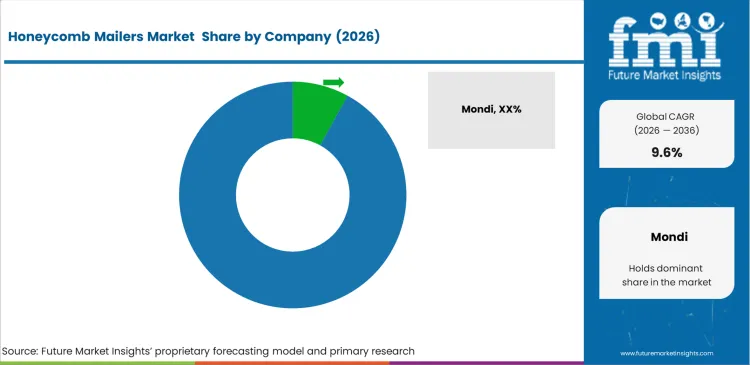
Contract security defines competitive hierarchies far more than minor physical innovations. Procurement directors at major e-commerce nodes qualify massive protective packaging volumes based entirely on vendor ability to guarantee uninterrupted seasonal supply. Established converting giants possess deep capital reserves necessary to deploy high-speed, servo-driven die-cutting modules across multiple geographic zones. This installed base of specialized machinery acts as insurmountable barriers for regional e commerce packaging suppliers attempting to secure national retail contracts. Honeycomb mailers key players lacking multi-site redundancy consistently fail qualification audits conducted by risk-averse corporate sourcing teams.
Major logistics networks are reducing supplier concentration risk by standardizing honeycomb expansion specifications across approved formats. Facility managers spread volumes across multiple qualified converters to preserve pricing discipline and avoid overdependence on a single source. Procurement teams also avoid proprietary closure or locking features so suppliers can be changed more easily when regional capacity tightens during peak fulfillment periods.
Key Players in Honeycomb Mailers Market
- Mondi
- Pregis
- Ranpak
- Sealed Air
- PAC Worldwide
- Smurfit Westrock
- DS Smith
Scope of the Report
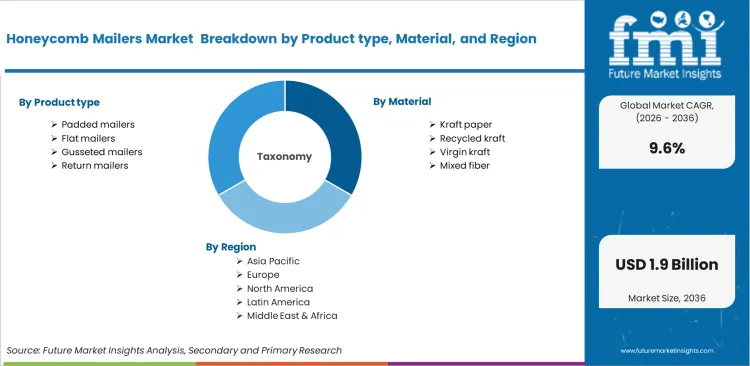
| Metric | Value |
|---|---|
| Quantitative Units | USD 0.7 billion to USD 1.7 billion, at a CAGR of 9.60% |
| Market Definition | This category covers protective shipping envelopes constructed entirely from paper-based materials, utilizing expandable geometric structures to provide internal cushioning. Physical integrity relies on core expansion rather than trapped air. |
| Segmentation | Product type, Material, Closure type, End use, Sales channel, and Region |
| Regions Covered | North America, Latin America, Europe, Asia Pacific, Middle East and Africa |
| Countries Covered | United States, Germany, United Kingdom, China, India, Japan, Brazil |
| Key Companies Profiled | Mondi, Pregis, Ranpak, Sealed Air, PAC Worldwide, Smurfit Westrock, DS Smith |
| Forecast Period | 2026 to 2036 |
| Approach | Baseline volume anchored on outgoing parcel transit data cross-referenced with mono-material packaging procurement contracts |
Source: Future Market Insights (FMI) analysis, based on proprietary forecasting model and primary research
Honeycomb Mailers Market Analysis by Segments
Product type
- Padded mailers
- Flat mailers
- Gusseted mailers
- Return mailers
Material
- Kraft paper
- Recycled kraft
- Virgin kraft
- Mixed fiber
Closure type
- Peel-and-seal
- Tear strip
- Self-locking
- Dual seal
End use
- E-commerce
- Apparel
- Cosmetics
- Books
- Electronics
- Lifestyle goods
Sales channel
- B2B direct
- Converters
- Distributors
- Online retail
Region
- North America
- Latin America
- Europe
- Asia Pacific
- Middle East and Africa
Bibliography
- PAC Worldwide. (2024, October 10). PAC Worldwide Continues to Push the Sustainability Envelope by Expanding Its Suite of All-Paper Mailers and System Solutions.
- Ranpak Holdings Corp. (2024, April 22). Ranpak Champions Earth Day 2024 with Two Eco-Friendly Packaging Innovations.
- USA Census Bureau. (2026, March 10). Quarterly Retail E-Commerce Sales Report.
- Universal Postal Union. (2024, December 17). The State of the Postal Sector 2024.
- Amazon. (2024). 2024 Sustainability Report.
This bibliography is provided for reader reference. The full FMI report contains the complete reference list with primary source documentation.
This Report Addresses
- Facility manager requirements for recalibrating induction sensors to read textured paper surfaces accurately.
- Sourcing team transitions from spot buying to secured volume contracts amid tightening converting capacity.
- Brand director strategies for gaining consumer goodwill by eliminating plastic bubble separation friction.
- Packaging engineer challenges in validating compression recovery during multi-stop logistics transit.
- Procurement director risks associated with relying on static crush ratings for expandable geometries.
- Logistics manager mandates to align outbound operations with zero-plastic consumer expectations.
- Corporate buyer techniques for establishing stringent baseline specifications and monthly capacity allocations.
- Supply chain executive methods for reducing raw material transport costs via unexpanded envelope shipping.
Frequently Asked Questions
What drives the honeycomb mailers forecast 2036?
Mass migration toward mono-material paper designs helps high-volume fulfillment centers bypass strict municipal curbside separation requirements.
Are honeycomb mailers recyclable in standard streams?
Yes, these envelopes maintain complete single-stream compatibility, allowing consumers to drop them directly into municipal paper bins.
How do paper honeycomb mailers vs corrugated mailers compare?
Corrugated formats offer rigid edge protection, while honeycomb constructions wrap dynamically to reduce dimensional weight penalties.
Explain the honeycomb mailers outlook through 2036?
Category expansion tracks at a 9.6% CAGR as Extended Producer Responsibility frameworks compel massive outbound logistics redesigns.
Which product type commands primary share?
Padded mailers secure a 58.0% position because their integrated cores satisfy existing drop-test criteria perfectly.
Why does kraft paper dominate material selection?
Kraft variants hold 46% share because their high burst strength prevents tearing during automated barcode scanning.
What physical gate dictates adoption speed?
True transition velocity accelerates only when optical scanners configure successfully for textured die-cut surfaces without jamming.
How do cold-weather climates impact closure viability?
Ambient conditions dictate seal permanence; distribution center temperatures dropping below curing thresholds cause catastrophic adhesive failures.
What specific operational friction slows broader conversion?
Precise web tension requirements on high-speed slitting equipment limit output rates compared to traditional polymer extrusion.
How do major logistics networks counter vendor consolidation?
Facility managers actively distribute volume across multiple qualified converters to maintain pricing leverage and swap suppliers easily.
Why do cosmetic brands drive early adoption?
Beauty marketing directors specify textured paper formats proactively to align premium brand perception with zero-plastic expectations.
What drives B2B direct channel dominance?
Direct sourcing captures 49.0% volume because procurement directors dictate exact expansion ratios to bypass distributor margins.
How do edge crush realities affect sourcing choices?
Operations directors verify paper edges resist lateral collapse under severe stack pressure to survive multi-zone transit.
What forces United Kingdom packaging redesigns?
Rising plastic levies force sourcing teams to align outbound shipping operations with strict municipal zero-waste mandates.
Why do electronics present specific transition hurdles?
Sharp corners puncture weak substrates, forcing packaging engineers to demand reliable multi-layered edge reinforcement from converters.
Why do apparel shippers adopt formats differently?
Clothing requires minimal cushioning, so logistics managers adopt expanding paper strictly to satisfy municipal recycling mandates.
What defines German regulatory compliance pressure?
Strict municipal sorting laws mandate mono-material compliance, pushing facility managers to bypass taxes on mixed-material formats.
How do vibration fatigue metrics inform quality assurance?
Quality assurance leads monitor return rates obsessively to ensure honeycomb rigidity survives transcontinental rail journeys without flattening.
What advantage does reverse logistics optimization offer?
Supply chain executives reduce raw material transport costs by shipping unexpanded die-cut envelopes directly to regional hubs.
Preview the report firsthand - request a free sample
Get SampleGet the brochure for pricing and purchase details.
Get PDFTable of Content
- Executive Summary
- Global Market Outlook
- Demand-side Trends
- Supply-side Trends
- Technology Roadmap Analysis
- Analysis and Recommendations
- Market Overview
- Market Coverage / Taxonomy
- Market Definition / Scope / Limitations
- Research Methodology
- Chapter Orientation
- Analytical Lens and Working Hypotheses
- Market Structure, Signals, and Trend Drivers
- Benchmarking and Cross-market Comparability
- Market Sizing, Forecasting, and Opportunity Mapping
- Research Design and Evidence Framework
- Desk Research Programme (Secondary Evidence)
- Company Annual and Sustainability Reports
- Peer-reviewed Journals and Academic Literature
- Corporate Websites, Product Literature, and Technical Notes
- Earnings Decks and Investor Briefings
- Statutory Filings and Regulatory Disclosures
- Technical White Papers and Standards Notes
- Trade Journals, Industry Magazines, and Analyst Briefs
- Conference Proceedings, Webinars, and Seminar Materials
- Government Statistics Portals and Public Data Releases
- Press Releases and Reputable Media Coverage
- Specialist Newsletters and Curated Briefings
- Sector Databases and Reference Repositories
- FMI Internal Proprietary Databases and Historical Market Datasets
- Subscription Datasets and Paid Sources
- Social Channels, Communities, and Digital Listening Inputs
- Additional Desk Sources
- Expert Input and Fieldwork (Primary Evidence)
- Primary Modes
- Qualitative Interviews and Expert Elicitation
- Quantitative Surveys and Structured Data Capture
- Blended Approach
- Why Primary Evidence is Used
- Field Techniques
- Interviews
- Surveys
- Focus Groups
- Observational and In-context Research
- Social and Community Interactions
- Stakeholder Universe Engaged
- C-suite Leaders
- Board Members
- Presidents and Vice Presidents
- R&D and Innovation Heads
- Technical Specialists
- Domain Subject-matter Experts
- Scientists
- Physicians and Other Healthcare Professionals
- Governance, Ethics, and Data Stewardship
- Research Ethics
- Data Integrity and Handling
- Primary Modes
- Tooling, Models, and Reference Databases
- Desk Research Programme (Secondary Evidence)
- Data Engineering and Model Build
- Data Acquisition and Ingestion
- Cleaning, Normalisation, and Verification
- Synthesis, Triangulation, and Analysis
- Quality Assurance and Audit Trail
- Market Background
- Market Dynamics
- Drivers
- Restraints
- Opportunity
- Trends
- Scenario Forecast
- Demand in Optimistic Scenario
- Demand in Likely Scenario
- Demand in Conservative Scenario
- Opportunity Map Analysis
- Product Life Cycle Analysis
- Supply Chain Analysis
- Investment Feasibility Matrix
- Value Chain Analysis
- PESTLE and Porter’s Analysis
- Regulatory Landscape
- Regional Parent Market Outlook
- Production and Consumption Statistics
- Import and Export Statistics
- Market Dynamics
- Global Market Analysis 2021 to 2025 and Forecast, 2026 to 2036
- Historical Market Size Value (USD Million) Analysis, 2021 to 2025
- Current and Future Market Size Value (USD Million) Projections, 2026 to 2036
- Y-o-Y Growth Trend Analysis
- Absolute $ Opportunity Analysis
- Global Market Pricing Analysis 2021 to 2025 and Forecast 2026 to 2036
- Global Market Analysis 2021 to 2025 and Forecast 2026 to 2036, By Product type
- Introduction / Key Findings
- Historical Market Size Value (USD Million) Analysis By Product type , 2021 to 2025
- Current and Future Market Size Value (USD Million) Analysis and Forecast By Product type , 2026 to 2036
- Padded mailers
- Flat mailers
- Gusseted mailers
- Return mailers
- Padded mailers
- Y-o-Y Growth Trend Analysis By Product type , 2021 to 2025
- Absolute $ Opportunity Analysis By Product type , 2026 to 2036
- Global Market Analysis 2021 to 2025 and Forecast 2026 to 2036, By Material
- Introduction / Key Findings
- Historical Market Size Value (USD Million) Analysis By Material, 2021 to 2025
- Current and Future Market Size Value (USD Million) Analysis and Forecast By Material, 2026 to 2036
- Kraft paper
- Recycled kraft
- Virgin kraft
- Mixed fiber
- Kraft paper
- Y-o-Y Growth Trend Analysis By Material, 2021 to 2025
- Absolute $ Opportunity Analysis By Material, 2026 to 2036
- Global Market Analysis 2021 to 2025 and Forecast 2026 to 2036, By Closure type
- Introduction / Key Findings
- Historical Market Size Value (USD Million) Analysis By Closure type, 2021 to 2025
- Current and Future Market Size Value (USD Million) Analysis and Forecast By Closure type, 2026 to 2036
- Peel-and-seal
- Tear strip
- Self-locking
- Dual seal
- Peel-and-seal
- Y-o-Y Growth Trend Analysis By Closure type, 2021 to 2025
- Absolute $ Opportunity Analysis By Closure type, 2026 to 2036
- Global Market Analysis 2021 to 2025 and Forecast 2026 to 2036, By End use
- Introduction / Key Findings
- Historical Market Size Value (USD Million) Analysis By End use, 2021 to 2025
- Current and Future Market Size Value (USD Million) Analysis and Forecast By End use, 2026 to 2036
- E-commerce
- Apparel
- Cosmetics
- Books
- Electronics
- Lifestyle goods
- E-commerce
- Y-o-Y Growth Trend Analysis By End use, 2021 to 2025
- Absolute $ Opportunity Analysis By End use, 2026 to 2036
- Global Market Analysis 2021 to 2025 and Forecast 2026 to 2036, By Sales channel
- Introduction / Key Findings
- Historical Market Size Value (USD Million) Analysis By Sales channel, 2021 to 2025
- Current and Future Market Size Value (USD Million) Analysis and Forecast By Sales channel, 2026 to 2036
- B2B direct
- Converters
- Distributors
- Online retail
- B2B direct
- Y-o-Y Growth Trend Analysis By Sales channel, 2021 to 2025
- Absolute $ Opportunity Analysis By Sales channel, 2026 to 2036
- Global Market Analysis 2021 to 2025 and Forecast 2026 to 2036, By Region
- Introduction
- Historical Market Size Value (USD Million) Analysis By Region, 2021 to 2025
- Current Market Size Value (USD Million) Analysis and Forecast By Region, 2026 to 2036
- North America
- Latin America
- Western Europe
- Eastern Europe
- East Asia
- South Asia and Pacific
- Middle East & Africa
- Market Attractiveness Analysis By Region
- North America Market Analysis 2021 to 2025 and Forecast 2026 to 2036, By Country
- Historical Market Size Value (USD Million) Trend Analysis By Market Taxonomy, 2021 to 2025
- Market Size Value (USD Million) Forecast By Market Taxonomy, 2026 to 2036
- By Country
- USA
- Canada
- Mexico
- By Product type
- By Material
- By Closure type
- By End use
- By Sales channel
- By Country
- Market Attractiveness Analysis
- By Country
- By Product type
- By Material
- By Closure type
- By End use
- By Sales channel
- Key Takeaways
- Latin America Market Analysis 2021 to 2025 and Forecast 2026 to 2036, By Country
- Historical Market Size Value (USD Million) Trend Analysis By Market Taxonomy, 2021 to 2025
- Market Size Value (USD Million) Forecast By Market Taxonomy, 2026 to 2036
- By Country
- Brazil
- Chile
- Rest of Latin America
- By Product type
- By Material
- By Closure type
- By End use
- By Sales channel
- By Country
- Market Attractiveness Analysis
- By Country
- By Product type
- By Material
- By Closure type
- By End use
- By Sales channel
- Key Takeaways
- Western Europe Market Analysis 2021 to 2025 and Forecast 2026 to 2036, By Country
- Historical Market Size Value (USD Million) Trend Analysis By Market Taxonomy, 2021 to 2025
- Market Size Value (USD Million) Forecast By Market Taxonomy, 2026 to 2036
- By Country
- Germany
- UK
- Italy
- Spain
- France
- Nordic
- BENELUX
- Rest of Western Europe
- By Product type
- By Material
- By Closure type
- By End use
- By Sales channel
- By Country
- Market Attractiveness Analysis
- By Country
- By Product type
- By Material
- By Closure type
- By End use
- By Sales channel
- Key Takeaways
- Eastern Europe Market Analysis 2021 to 2025 and Forecast 2026 to 2036, By Country
- Historical Market Size Value (USD Million) Trend Analysis By Market Taxonomy, 2021 to 2025
- Market Size Value (USD Million) Forecast By Market Taxonomy, 2026 to 2036
- By Country
- Russia
- Poland
- Hungary
- Balkan & Baltic
- Rest of Eastern Europe
- By Product type
- By Material
- By Closure type
- By End use
- By Sales channel
- By Country
- Market Attractiveness Analysis
- By Country
- By Product type
- By Material
- By Closure type
- By End use
- By Sales channel
- Key Takeaways
- East Asia Market Analysis 2021 to 2025 and Forecast 2026 to 2036, By Country
- Historical Market Size Value (USD Million) Trend Analysis By Market Taxonomy, 2021 to 2025
- Market Size Value (USD Million) Forecast By Market Taxonomy, 2026 to 2036
- By Country
- China
- Japan
- South Korea
- By Product type
- By Material
- By Closure type
- By End use
- By Sales channel
- By Country
- Market Attractiveness Analysis
- By Country
- By Product type
- By Material
- By Closure type
- By End use
- By Sales channel
- Key Takeaways
- South Asia and Pacific Market Analysis 2021 to 2025 and Forecast 2026 to 2036, By Country
- Historical Market Size Value (USD Million) Trend Analysis By Market Taxonomy, 2021 to 2025
- Market Size Value (USD Million) Forecast By Market Taxonomy, 2026 to 2036
- By Country
- India
- ASEAN
- Australia & New Zealand
- Rest of South Asia and Pacific
- By Product type
- By Material
- By Closure type
- By End use
- By Sales channel
- By Country
- Market Attractiveness Analysis
- By Country
- By Product type
- By Material
- By Closure type
- By End use
- By Sales channel
- Key Takeaways
- Middle East & Africa Market Analysis 2021 to 2025 and Forecast 2026 to 2036, By Country
- Historical Market Size Value (USD Million) Trend Analysis By Market Taxonomy, 2021 to 2025
- Market Size Value (USD Million) Forecast By Market Taxonomy, 2026 to 2036
- By Country
- Kingdom of Saudi Arabia
- Other GCC Countries
- Turkiye
- South Africa
- Other African Union
- Rest of Middle East & Africa
- By Product type
- By Material
- By Closure type
- By End use
- By Sales channel
- By Country
- Market Attractiveness Analysis
- By Country
- By Product type
- By Material
- By Closure type
- By End use
- By Sales channel
- Key Takeaways
- Key Countries Market Analysis
- USA
- Pricing Analysis
- Market Share Analysis, 2025
- By Product type
- By Material
- By Closure type
- By End use
- By Sales channel
- Canada
- Pricing Analysis
- Market Share Analysis, 2025
- By Product type
- By Material
- By Closure type
- By End use
- By Sales channel
- Mexico
- Pricing Analysis
- Market Share Analysis, 2025
- By Product type
- By Material
- By Closure type
- By End use
- By Sales channel
- Brazil
- Pricing Analysis
- Market Share Analysis, 2025
- By Product type
- By Material
- By Closure type
- By End use
- By Sales channel
- Chile
- Pricing Analysis
- Market Share Analysis, 2025
- By Product type
- By Material
- By Closure type
- By End use
- By Sales channel
- Germany
- Pricing Analysis
- Market Share Analysis, 2025
- By Product type
- By Material
- By Closure type
- By End use
- By Sales channel
- UK
- Pricing Analysis
- Market Share Analysis, 2025
- By Product type
- By Material
- By Closure type
- By End use
- By Sales channel
- Italy
- Pricing Analysis
- Market Share Analysis, 2025
- By Product type
- By Material
- By Closure type
- By End use
- By Sales channel
- Spain
- Pricing Analysis
- Market Share Analysis, 2025
- By Product type
- By Material
- By Closure type
- By End use
- By Sales channel
- France
- Pricing Analysis
- Market Share Analysis, 2025
- By Product type
- By Material
- By Closure type
- By End use
- By Sales channel
- India
- Pricing Analysis
- Market Share Analysis, 2025
- By Product type
- By Material
- By Closure type
- By End use
- By Sales channel
- ASEAN
- Pricing Analysis
- Market Share Analysis, 2025
- By Product type
- By Material
- By Closure type
- By End use
- By Sales channel
- Australia & New Zealand
- Pricing Analysis
- Market Share Analysis, 2025
- By Product type
- By Material
- By Closure type
- By End use
- By Sales channel
- China
- Pricing Analysis
- Market Share Analysis, 2025
- By Product type
- By Material
- By Closure type
- By End use
- By Sales channel
- Japan
- Pricing Analysis
- Market Share Analysis, 2025
- By Product type
- By Material
- By Closure type
- By End use
- By Sales channel
- South Korea
- Pricing Analysis
- Market Share Analysis, 2025
- By Product type
- By Material
- By Closure type
- By End use
- By Sales channel
- Russia
- Pricing Analysis
- Market Share Analysis, 2025
- By Product type
- By Material
- By Closure type
- By End use
- By Sales channel
- Poland
- Pricing Analysis
- Market Share Analysis, 2025
- By Product type
- By Material
- By Closure type
- By End use
- By Sales channel
- Hungary
- Pricing Analysis
- Market Share Analysis, 2025
- By Product type
- By Material
- By Closure type
- By End use
- By Sales channel
- Kingdom of Saudi Arabia
- Pricing Analysis
- Market Share Analysis, 2025
- By Product type
- By Material
- By Closure type
- By End use
- By Sales channel
- Turkiye
- Pricing Analysis
- Market Share Analysis, 2025
- By Product type
- By Material
- By Closure type
- By End use
- By Sales channel
- South Africa
- Pricing Analysis
- Market Share Analysis, 2025
- By Product type
- By Material
- By Closure type
- By End use
- By Sales channel
- USA
- Market Structure Analysis
- Competition Dashboard
- Competition Benchmarking
- Market Share Analysis of Top Players
- By Regional
- By Product type
- By Material
- By Closure type
- By End use
- By Sales channel
- Competition Analysis
- Competition Deep Dive
- Mondi
- Overview
- Product Portfolio
- Profitability by Market Segments (Product/Age /Sales Channel/Region)
- Sales Footprint
- Strategy Overview
- Marketing Strategy
- Product Strategy
- Channel Strategy
- Pregis
- Ranpak
- Sealed Air
- PAC Worldwide
- Smurfit Westrock
- DS Smith
- Mondi
- Competition Deep Dive
- Assumptions & Acronyms Used


