

- Market Size (2026)
- USD 1.1 Bn
- Forecast (2036)
- USD 1.7 Bn
- CAGR (2026 to 2036)
- 5.1%
Fiber Optic Test Equipment Market Size, Market Forecast and Outlook By FMI
The fiber optic test equipment market was valued at USD 1.0 billion in 2025. The market is set to reach USD 1.1 billion by 2026-end and grow at a CAGR of 5.1% between 2026-2036 to reach USD 1.7 billion by 2036. Optical Time Domain Reflectometers will dominate with a 42.0% share, while Handheld Equipment will lead with a 56.0% share.
Summary of the Fiber Optic Test Equipment Market
- Demand and Growth Drivers
- Changing procurement requirements and modernization of facilities in key end-use segments in mature and emerging markets are impacting demand for fiber optic test equipment.
- The growth is being driven by higher adoption of OTDRs as specifications tighten and buyers are looking for performance, compliance and long term cost efficiency.
- Regional expansion in the USA and South Korea is driven by infrastructure investment, increased commercial activity and government initiatives to formalize procurement standards.
- Product and Segment View
- Optical Time Domain Reflectometers is expected to account for 42.0% of the product segment in 2026, supported by steady demand from institutional and commercial buyers.
- Handheld Equipment holds 56.0% share of the portability type segment, reflecting established procurement patterns and specification requirements across mature markets.
- Optical Light Sources and emerging product variants are gaining traction in applications requiring differentiated performance characteristics.
- Geography and Competitive Outlook
- The USA leads growth at a CAGR of 5.3% driven by large scale production capacity and increased domestic demand in multiple end-use sectors.
- North America and Europe will continue to dominate in terms of value through procurement of higher specifications and established distribution infrastructure.
- VIAVI Solutions Inc. with approximately 25.0% market share and other established players remain competitive by using integrated supply chains and extensive product portfolios.
- Analyst Opinion
- 'The fiber optic test equipment market is transitioning from a volume-driven growth phase toward a more specification-led expansion where product quality, compliance readiness, and supply chain reliability are becoming the primary competitive differentiators. Companies that can maintain cost discipline while meeting evolving regulatory and performance requirements across key regions are positioned to capture a disproportionate share of the projected USD 0.68 billion incremental opportunity through 2036.'
- Adoption is increasing due to tighter procurement standards and growing preference for products that meet evolving safety, efficiency, and sustainability requirements.
- The market is moving toward consolidation in mature regions, with scale and compliance capabilities becoming prerequisites for participation in large-volume procurement.
- Regional growth variations, particularly the gap between USA at 5.3% and mature markets at lower single-digit CAGRs, indicate that supply chain localization will be a key strategic priority through 2036.
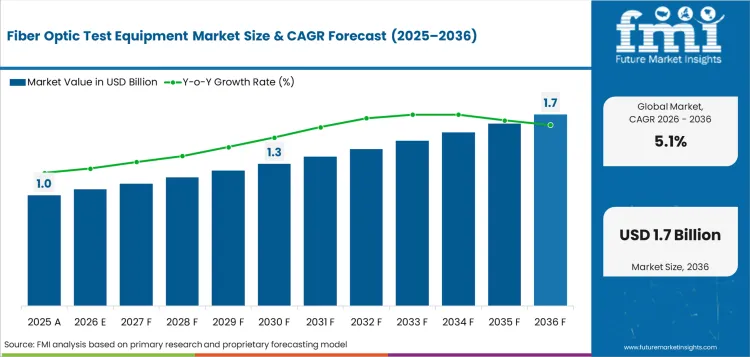
Key Takeaways, Market Size, and Forecast
| Metric | Value |
|---|---|
| Market Size (2025) | USD 1.00 Billion |
| Market Size (2036) | USD 1.73 Billion |
| CAGR (2026–2036) | 5.1% |
| Market Size (2026) | USD 0.68 Billion |
| Leading Optical Time Domain Reflectometers (2026) | The Optical Time Domain Reflectometers Segment |
| The Optical Time Domain Reflectometers Segment Share (2026) | 42.0% |
| Fastest-Growing Country | USA |
| USA CAGR | 5.3% |
| 2nd Fastest-Growing Country | South Korea |
| South Korea CAGR | 5.2% |
Fiber Optic Test Equipment Market Definition
The fiber optic test equipment market includes the manufacturing, distribution, and commercial trade of fiber optic test equipment products used in telecommunication service providers, network equipment manufacturers, data centers, and related applications. Product categories include optical time domain reflectometers, optical light sources, optical power and loss meters and others, available in configurations for various operational needs.
Fiber Optic Test Equipment Market Inclusions
Market scope encompasses all commercially traded fiber optic test equipment products categorized by product, portability type, end use, equipment type. The revenue range covers the forecast period from 2026 to 2036 across North America, Latin America, Europe, East Asia, South Asia and Pacific, and Middle East and Africa.
Fiber Optic Test Equipment Market Exclusions
The scope does not include products outside the defined fiber optic test equipment category, raw materials or intermediate inputs not sold as finished commercial products, or applications that fall outside the specified end-use segmentation. Custom or prototype products manufactured for non-commercial purposes are also excluded.
Fiber Optic Test Equipment Market Research Methodology
- Primary Research: FMI analysts conducted interviews with manufacturers, distributors, and end-use procurement teams across key markets to validate demand patterns and pricing dynamics.
- Desk Research: Combined data from industry associations, government statistical databases, manufacturer disclosures, and trade publications.
- Market Sizing and Forecasting: Bottom-up aggregation across product categories, end-use applications, and regional markets, validated against top-down industry benchmarks.
- Data Validation: Cross-checked quarterly against production statistics, trade data, and manufacturer-reported volumes to ensure consistency.
Why is the Fiber Optic Test Equipment Market Growing?
- Tightening quality and safety standards across key end-use sectors are creating structured demand for higher-specification fiber optic test equipment products, supporting sustained growth at 5.1% CAGR through 2036.
- USA at 5.3% leads growth, reflecting large-scale infrastructure development and expanding commercial activity that generates volume demand across multiple product categories.
- The projected market expansion from USD Billion 1.05 billion in 2026 to USD Billion 1.73 billion in 2036 reflects both replacement demand in mature markets and new installation demand in developing economies.
Platform Integration Requirements Drive Vendor Selection
System integration and platform compatibility requirements are becoming major buying criteria for fiber optic test equipment. Procurement benefits are achieved with products that offer direct compatibility with existing infrastructure and data management systems. Standards for Interoperability are changing, and suppliers that get out ahead of the curve on new protocols will have the chance to influence the specification stage and ultimately earn a spot in the long-term contract.
Infrastructure Investment Cycles Shape Replacement Demand
Fiber optic test equipment demand patterns are directly affected by infrastructure investment cycles. Telecommunications, energy and construction capital expenditure creates demand for installation, and aftermarket revenue is supported by maintenance and upgrade cycles. Government infrastructure programs in USA and South Korea are speeding deployment timeframes, resulting in demand windows that are concentrated in time which benefits suppliers with available inventory and local distribution.
Component Standardization Reduces Differentiation Margins
Margin sustainability in fiber optic test equipment market depends on product differentation and value added services. Low cost players pressure mass market products while niche products benefit from higher margins with the need for technical specifications. The premium over commodity margins is growing, rewarding companies with application-specific development.
Energy Efficiency Mandates Reshape Product Specifications
The demand for fiber optic test equipment is driven by varying compliance requirements from jurisdiction to jurisdiction. In North America, product certification timelines and test requirements influence procurement cycles. In Europe, harmonized standards allow for more predictable routes to approval. East Asia (USA leading at 5.3% CAGR) is raising quality and safety standards, favoring incumbents with compliance infrastructure. Without regional certification, companies experience delays in market entry and limited access to distribution.
Regional Deployment Patterns Reflect Infrastructure Maturity
Factors driving regional production patterns in the fiber optic test equipment market include labor costs, proximity to end markets, and regulatory climates. USA is leading the growth with CAGR of 5.3% due to combination of expanding domestic demand and manufacturing base advantages. Higher specification production and well established distribution infrastructure maintain value leadership in Europe and North America.
Market Segmentation Analysis
- Optical Time Domain Reflectometers, which made up 42.0% of the product segment in 2026, reflects established procurement patterns and specification-driven demand.
- The Handheld Equipment segment is leading the portable type segment with a 56.0% share. Steady demand from institutional and commercial end uses is driving this dominance.
- The market is segmented by product, by type of portability, by end use, by equipment type, offering granular visibility into demand drivers across product categories and applications.
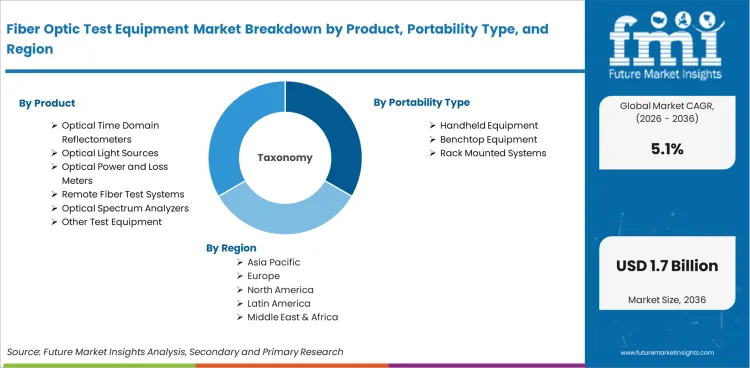
The fiber optic test equipment market is divided into product, portability type, end use and equipment type. Product Categories include Optical Time Domain Reflectometers, Optical Light Sources, Optical Power and Loss Meters etc. The Portability Type can be Handheld Equipment Benchtop Equipment Rack Mounted Systems.
Insights into the Optical Time Domain Reflectometers Segment
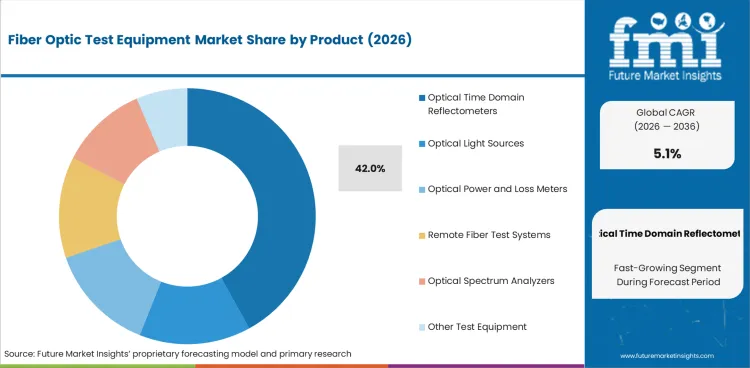
The largest demand for products is Optical Time Domain Reflectometers at 42.0% in 2026. Telecommunication service providers and network equipment manufacturers have concentrated procurement, with specification requirements and performance standards that favor established product categories. Demand is supported by replacement cycles and facility modernization in mature markets, while new installations in the USA and South Korea add incremental volume.
The sub-segments in this category are Long Haul Fiber Testing, Advanced Fault Detection Systems, Stabilized Light Sources, catering to different end-use requirements. In this segment procurement decisions are driven by compliance standards, total cost of ownership and supplier reliability.
Insights into the Optical Light Sources Segment
Optical Light Sources is an increasing share of demand, with expanding applications in network equipment manufacturers and data centers. This segment growth reflects buyer preferences for differentiated performance characteristics and changing specification requirements.
Fiber Optic Test Equipment Market Drivers, Restraints, and Opportunities
- Structured demand for higher specification products, driven by higher quality standards and compliance requirements in key markets, supports continued market growth.
- Higher cost of inputs and complexity of production compared to conventional alternatives limits adoption in price-sensitive market segments, focusing growth in premium and specification-driven applications.
- We see incremental demand opportunities from infrastructure modernization programs and facility upgrades in the USA, South Korea and other high growth markets.
The fiber optic test equipment market is still growing, driven by stricter quality standards, infrastructure modernization and specification driven procurement. Increasing production cost and competitive intensity are challenges faced by the market. However, the projected incremental opportunity of USD Billion 0.68 billion during the forecast period 2026-2036 reflects the continued commercial interest across the key regions and end-use categories.
Specification-Driven Procurement Upgrades
Demand is being driven by changing procurement standards requiring higher product specifications. There is continuous demand for replacements in mature markets, where telecommunication service providers and institutional end-use buyers are upgrading to products that meet more stringent performance, safety and efficiency requirements.
Cost and Scalability Constraints
Higher production costs than conventional alternatives restrict adoption in price-sensitive segments. The cost differential drives growth into premium, specification-oriented applications where performance needs align with the premium, while commodity segments remain more competitive.
Infrastructure Modernization and Expansion
Driven by government and private sector investments in facility modernization and new infrastructure in USA, South Korea and other developing markets. These programs will extend the addressable market for fiber optic test equipment products and support volume growth through 2036.
Regional Compliance and Standards Harmonization
Regulatory frameworks are being evolved across North America, Europe and East Asia to establish higher baseline requirements for product quality and safety. Compliance-driven procurement is particularly prevalent in the EU and the United States, where updated standards are redefining product specifications and supplier qualification criteria.
Analysis of Fiber Optic Test Equipment Market By Key Countries
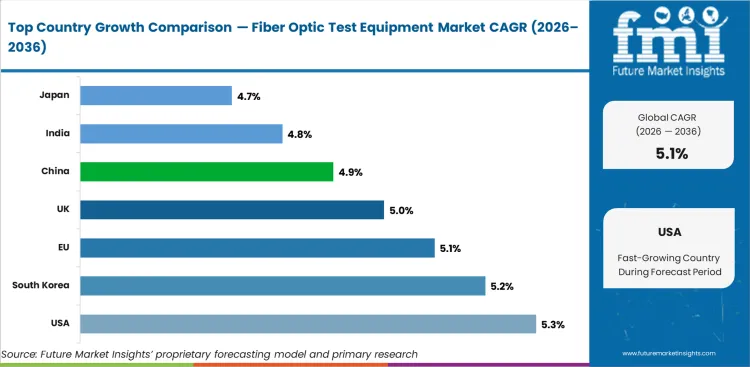
.webp "Top Country Growth Comparison Fiber Optic Test Equipment Market Cagr (2026 2036)")
| Country | CAGR |
|---|---|
| USA | 5.3% |
| South Korea | 5.2% |
| EU | 5.1% |
| UK | 5.0% |
| China | 4.9% |
- USA leads the way in demand growth with a 5.3% CAGR through 2036 driven by infrastructure investment and rising commercial activity.
- South Korea at 5.2% CAGR through 2036 is indicative of steady demand growth supported by infrastructure investment and burgeoning commercial activity.
- Infrastructure investment and growing commercial activity are supporting EU at 5.1% CAGR through 2036 to sustain demand growth.
The global fiber optic test equipment market is projected to grow at 5.1% CAGR from 2026 to 2036. The analysis covers more than 30 countries, with the following key markets highlighted.
Demand Outlook for Fiber Optic Test Equipment Market in USA
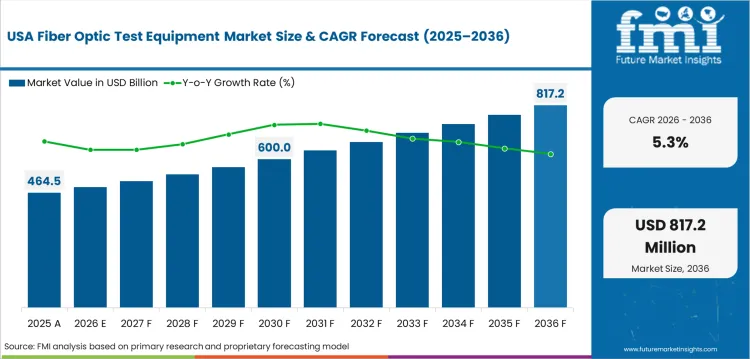
The United States is projected to grow at 5.3% CAGR through 2036. Demand is supported by a mature distribution infrastructure, regulatory compliance requirements, and ongoing facility upgrades across key end-use sectors. Procurement decisions increasingly factor in total cost of ownership and sustainability considerations.
- Mature distribution infrastructure and regulatory compliance support stable demand for optical time domain reflectometers.
- Facility modernization and replacement cycles sustain aftermarket procurement.
- Sustainability-driven procurement policies are shifting specifications toward higher-performance products.
Future Outlook for Fiber Optic Test Equipment Market in South Korea
South Korea is projected to expand at 5.2% CAGR through 2036. The country's semiconductor and electronics ecosystem, high per-capita R&D spending, and export-oriented chaebol production base create sustained demand for precision-grade inputs and components.
- Chaebol-driven electronics and semiconductor sectors sustain demand for precision-grade optical time domain reflectometers.
- High per-capita R&D spending accelerates adoption of advanced product specifications.
- Export-oriented production base creates sustained demand for premium components.
Opportunity Analysis of Fiber Optic Test Equipment Market in EU
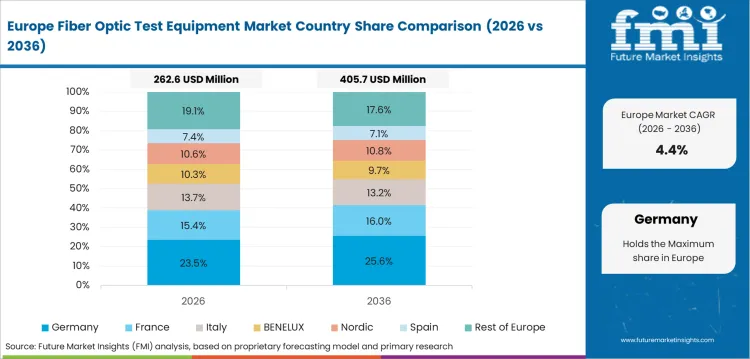
The European Union is projected to grow at 5.1% CAGR through 2036. Harmonized regulatory standards, sustainability mandates, and established procurement frameworks support steady demand growth across member states. Infrastructure modernization and energy efficiency requirements are key demand drivers.
- Harmonized regulatory standards create predictable procurement requirements for optical time domain reflectometers.
- Sustainability mandates accelerate transition to higher-efficiency solutions.
- Infrastructure modernization programs sustain demand across member states.
In-depth Analysis of Fiber Optic Test Equipment Market in UK
The United Kingdom is projected to grow at 5.0% CAGR through 2036. Demand is shaped by NHS and public-sector modernization programs, post-Brexit regulatory realignment, and sustained private-sector investment in healthcare and commercial infrastructure.
- NHS and public-sector modernization programs support procurement of optical time domain reflectometers.
- Post-Brexit regulatory realignment is reshaping import sourcing and compliance requirements.
- Private-sector investment in healthcare and commercial facilities sustains demand growth.
Sales Analysis of Fiber Optic Test Equipment Market in China
China is projected to expand at 4.9% CAGR through 2036, supported by large-scale manufacturing capacity, government modernization programs, and rising domestic consumption. Infrastructure investment and urbanization continue to support demand expansion across both industrial and consumer segments.
- Large-scale domestic production base supports cost-competitive procurement of optical time domain reflectometers.
- Government modernization programs are accelerating quality upgrades in telecommunication service providers.
- Export-oriented manufacturing capacity positions the country as a global supply hub.
Competitive Landscape and Strategic Positioning
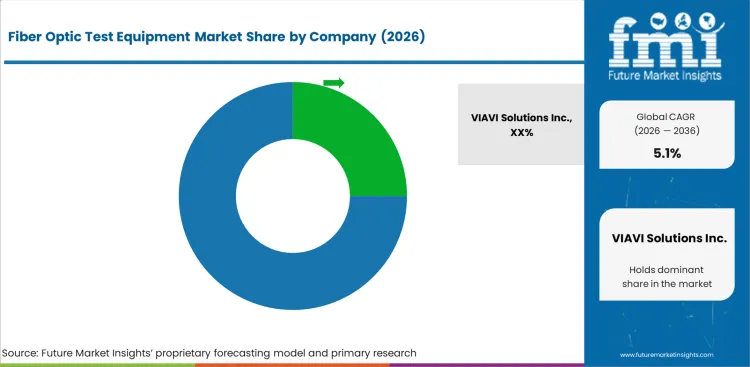
- Market Share: ~25.0%) VIAVI Solutions Inc. is a key player in the market owing to its integrated manufacturing capabilities and established distribution networks.
- EXFO Inc., Anritsu Corporation, Yokogawa Electric Corporation have wide product portfolios across several product categories and end-use applications.
- New entrants are focusing on specialized applications and regional niches where differentiated products and local market know-how create competitive advantages.
VIAVI Solutions Inc. is the industry’s largest scale, integrated manufacturing and global distribution reach. EXFO Inc., Anritsu Corporation and Yokogawa Electric Corporation compete on the basis of product breadth and regional coverage across different end-use applications.
Competitive barriers are product qualification requirements, established supply chain relationships, manufacturing scale economics and regional certification infrastructure. Strategic priorities are cost optimization, geographic expansion and broadening product portfolio.
Key Companies in the Fiber Optic Test Equipment Market
Key global companies leading the fiber optic test equipment market include:
- VIAVI Solutions Inc., EXFO Inc., Anritsu Corporation, Yokogawa Electric Corporation, Fluke Corporation have strong market position through integrated manufacturing infrastructure, established distribution networks, and wide product portfolios covering multiple end-use applications.
- Keysight Technologies, AFL, and VeEX Inc. have attained regional leadership by concentrating on product lines and forging strong relationships with key end-use customers in their primary markets.
- Emerging competitive tier is Kingfisher International, Optical Design Manufacturing. Positions in this tier are based on specialized product capabilities and targeted market approaches.
Competitive Benchmarking: Fiber Optic Test Equipment Market
| Company | Product Breadth | Product Coverage | Distribution Reach | Geographic Footprint |
|---|---|---|---|---|
| VIAVI Solutions Inc. | High | High | Strong | Global |
| EXFO Inc. | High | High | Strong | Global |
| Anritsu Corporation | High | High | Strong | Multi-regional |
| Yokogawa Electric Corporation | Medium | High | Moderate | Multi-regional |
| Fluke Corporation | Medium | Medium | Moderate | Multi-regional |
| Keysight Technologies | Medium | Medium | Moderate | Regional |
| AFL | Low to Medium | Medium | Low | Regional |
| VeEX Inc. | Low to Medium | Low to Medium | Low | Regional |
| Kingfisher International | Low to Medium | Low to Medium | Low | Regional |
| Optical Design Manufacturing | Low to Medium | Low to Medium | Low | Regional |
Source: Future Market Insights competitive analysis, 2026.
Key Developments in Fiber Optic Test Equipment Market
- In 2025, VIAVI Solutions Inc. expanded its fiber optic and network test portfolio with new AI-driven and high-speed network validation solutions for telecommunications service providers in North America and Europe.
- In 2025, EXFO Inc. expanded its manufacturing and operational capabilities to support rising global demand for fiber network testing, 5G, and data center deployment solutions across Asia-Pacific markets.
Key Players in the Fiber Optic Test Equipment Market
Major Global Players
- VIAVI Solutions Inc.
- EXFO Inc.
- Anritsu Corporation
- Yokogawa Electric Corporation
- Fluke Corporation
- Keysight Technologies
- AFL
Emerging Players/Startups
- VeEX Inc.
- Kingfisher International
- Optical Design Manufacturing
Report Scope and Coverage
| Parameter | Details |
|---|---|
| Quantitative Units | USD Billion 1.05 billion to USD Billion 1.73 billion, at a CAGR of 5.1% |
| Market Definition | The fiber optic test equipment market encompasses the production, distribution, and commercial trade of fiber optic test equipment products across product, portability type, end use, and related categories. |
| Regions Covered | North America, Latin America, Europe, East Asia, South Asia and Pacific, Middle East and Africa |
| Countries Covered | USA, South Korea, EU, UK, China, 30 plus countries |
| Key Companies Profiled | VIAVI Solutions Inc., EXFO Inc., Anritsu Corporation, Yokogawa Electric Corporation, Fluke Corporation, Keysight Technologies, AFL, VeEX Inc., Kingfisher International, Optical Design Manufacturing |
| Forecast Period | 2026 to 2036 |
| Approach | Hybrid bottom-up and top-down methodology starting with verified transaction data, projecting adoption velocity across segments and regions. |
Market Segmentation Analysis
Fiber Optic Test Equipment Market Segmented by Product:
- Optical Time Domain Reflectometers
- Long Haul Fiber Testing
- Single Mode Fiber OTDR
- Multi Mode Fiber OTDR
- Advanced Fault Detection Systems
- High Resolution OTDR
- High Dynamic Range OTDR
- Long Haul Fiber Testing
- Optical Light Sources
- Stabilized Light Sources
- Laser Based Sources
- LED Light Sources
- Broadband Light Sources
- Wavelength Tunable Sources
- Stabilized Light Sources
- Optical Power and Loss Meters
- Fiber Power Measurement
- High Precision Power Meters
- Insertion Loss Testers
- Handheld Power Meters
- Field Measurement Devices
- Fiber Power Measurement
- Remote Fiber Test Systems
- Automated Network Monitoring
- Centralized Fiber Monitoring
- Distributed Test Systems
- Automated Network Monitoring
- Optical Spectrum Analyzers
- Wavelength Analysis Systems
- High Resolution Spectrum Analyzers
- Channel Power Analyzers
- Wavelength Analysis Systems
- Other Test Equipment
- Fusion Splicers Testing Tools
- Fiber Inspection Scopes
- Connector Cleaning Systems
- Fusion Splicers Testing Tools
Fiber Optic Test Equipment Market Segmented by Portability Type:
- Handheld Equipment
- Portable Field Devices
- Rugged Outdoor Testers
- Battery Operated Units
- Portable Field Devices
- Benchtop Equipment
- Lab Based Systems
- High Precision Testing Units
- Research Grade Instruments
- Lab Based Systems
- Rack Mounted Systems
- Network Infrastructure Testing
- Data Center Testing Systems
- Network Infrastructure Testing
Fiber Optic Test Equipment Market Segmented by End Use:
- Telecommunication Service Providers
- Fiber Network Operators
- Broadband Service Providers
- 5G Infrastructure Testing
- Fiber Network Operators
- Network Equipment Manufacturers
- Telecom Hardware Testing
- Fiber Cable Manufacturers
- Switching Equipment Testing
- Telecom Hardware Testing
- Data Centers
- Enterprise Network Testing
- Cloud Infrastructure Testing
- Server Connectivity Testing
- Enterprise Network Testing
- Cable Operators
- Cable TV Networks
- Internet Service Providers
- Cable TV Networks
- Educational and Research Institutes
- Academic Testing Labs
- Fiber Optic Research Centers
- Academic Testing Labs
- Others
- Industrial Communication Systems
- Military Communication Networks
- Industrial Communication Systems
Fiber Optic Test Equipment Market Segmented by Equipment Type:
- Fiber Fault Testing Equipment
- Reflectometry Based Systems
- OTDR Systems
- Event Detection Tools
- Reflectometry Based Systems
- Optical Measurement Equipment
- Light Analysis Systems
- Power Measurement Devices
- Loss Measurement Tools
- Light Analysis Systems
- Network Monitoring Equipment
- Real Time Monitoring Systems
- Remote Diagnostics Tools
- Real Time Monitoring Systems
- Calibration Equipment
- Testing Calibration Devices
- Reference Light Sources
- Testing Calibration Devices
Fiber Optic Test Equipment Market by Region:
- North America
- USA
- Canada
- Mexico
- Latin America
- Brazil
- Chile
- Rest of Latin America
- Western Europe
- Germany
- UK
- Italy
- Spain
- France
- Nordic
- BENELUX
- Rest of Western Europe
- Eastern Europe
- Russia
- Poland
- Hungary
- Balkan & Baltic
- Rest of Eastern Europe
- East Asia
- China
- Japan
- South Korea
- South Asia and Pacific
- India
- ASEAN
- Australia & New Zealand
- Rest of South Asia and Pacific
- Middle East & Africa
- Kingdom of Saudi Arabia
- Other GCC Countries
- Turkiye
- South Africa
- Other African Union
- Rest of Middle East & Africa
Research Sources and Bibliography
- 1. International Telecommunication Union. (2025). ITU Global ICT Development Index. ITU.
- 2. International Energy Agency. (2025). IEA Energy Technology Perspectives. IEA.
- 3. International Electrotechnical Commission. (2025). IEC Standards for Electronic Components. IEC.
- 4. United Nations Industrial Development Organization. (2025). UNIDO Technology and Innovation Report. UNIDO.
- 5. World Bank. (2025). Global Economic Prospects: Industry and Trade Data. World Bank Group.
This bibliography is provided for reader reference. The full Future Market Insights report contains the complete reference list with publication dates, URLs, and supporting data for all cited works.
This Report Addresses
- Estimating the size of the market and revenue projections from 2026 to 2036.
- Segmentation analysis by product, portability type, end use, equipment type.
- Regional and country-level insights across more than 30 markets.
- Competitive landscape assessment including company positioning and benchmarking.
- Analysis of demand drivers, restraints, and growth opportunities.
- Investment opportunity identification across key segments and regions.
- Data delivery in PDF and Excel formats.
Frequently Asked Questions
What is the global market demand for Fiber Optic Test Equipment Market in 2026?
In 2026, the global fiber optic test equipment market is expected to be worth USD Billion 1.05 billion.
How big will the Fiber Optic Test Equipment Market be in 2036?
By 2036, the fiber optic test equipment market is expected to be worth USD Billion 1.73 billion.
How much is demand for Fiber Optic Test Equipment Market expected to grow between 2026 and 2036?
Between 2026 and 2036, demand for fiber optic test equipment is expected to grow at a CAGR of 5.1%.
Which Product segment is expected to lead in 2026?
Optical Time Domain Reflectometers is expected to account for 42.0% of the product segment in 2026, reflecting sustained procurement across established end-use categories.
What is causing demand to rise in USA?
USA is projected to grow at 5.3% CAGR through 2036, supported by large-scale infrastructure development, expanding domestic demand, and increasing procurement quality standards.
What is causing demand to rise in South Korea?
South Korea is projected to grow at 5.2% CAGR through 2036, supported by expanding commercial activity, infrastructure modernization, and growing adoption of higher-specification products.
What does this report mean by 'Fiber Optic Test Equipment Market definition'?
The fiber optic test equipment market encompasses the production, distribution, and commercial trade of fiber optic test equipment products used across telecommunication service providers, network equipment manufacturers, data centers, and related applications.
How does FMI make the Fiber Optic Test Equipment Market forecast?
Forecasting models use a hybrid bottom-up and top-down approach, starting with verified transaction data and checking it against industry production statistics and manufacturer disclosures.
Preview the report firsthand - request a free sample
Get SampleGet the brochure for pricing and purchase details.
Get PDFTable of Content
- Global Market Outlook
- Demand-side Trends
- Supply-side Trends
- Technology Roadmap Analysis
- Analysis and Recommendations
- Market Overview
- Market Coverage / Taxonomy
- Market Definition / Scope / Limitations
- Analytical Lens and Working Hypotheses
- Market Structure, Signals, and Trend Drivers
- Benchmarking and Cross-market Comparability
- Market Sizing, Forecasting, and Opportunity Mapping
- Research Design and Evidence Framework
- Desk Research Programme (Secondary Evidence)
- Company Annual and Sustainability Reports
- Peer-reviewed Journals and Academic Literature
- Corporate Websites, Product Literature, and Technical Notes
- Earnings Decks and Investor Briefings
- Statutory Filings and Regulatory Disclosures
- Technical White Papers and Standards Notes
- Trade Journals, Industry Magazines, and Analyst Briefs
- Conference Proceedings, Webinars, and Seminar Materials
- Government Statistics Portals and Public Data Releases
- Press Releases and Reputable Media Coverage
- Specialist Newsletters and Curated Briefings
- Sector Databases and Reference Repositories
- FMI Internal Proprietary Databases and Historical Market Datasets
- Blended Approach
- Why Primary Evidence is Used
- Field Techniques
- Interviews
- Surveys
- Focus Groups
- Observational and In-context Research
- Social and Community Interactions
- Stakeholder Universe Engaged
- C-suite Leaders
- Board Members
- Presidents and Vice Presidents
- R&D and Innovation Heads
- Technical Specialists
- Domain Subject-matter Experts
- Scientists
- Physicians and Other Healthcare Professionals
- Governance, Ethics, and Data Stewardship
- Research Ethics
- Data Integrity and Handling
- Desk Research Programme (Secondary Evidence)
- Tooling, Models, and Reference Databases
- Data Engineering and Model Build
- Data Acquisition and Ingestion
- Cleaning, Normalisation, and Verification
- Synthesis, Triangulation, and Analysis
- Quality Assurance and Audit Trail
- Market Background
- Market Dynamics
- Drivers
- Restraints
- Opportunity
- Trends
- Scenario Forecast
- Demand in Optimistic Scenario
- Demand in Likely Scenario
- Demand in Conservative Scenario
- Opportunity Map Analysis
- Product Life Cycle Analysis
- Supply Chain Analysis
- Investment Feasibility Matrix
- Value Chain Analysis
- PESTLE and Porter’s Analysis
- Regulatory Landscape
- Regional Parent Market Outlook
- High Resolution OTDR
- High Dynamic Range OTDR
- Market Dynamics
- Optical Light Sources
- Stabilized Light Sources
- Laser Based Sources
- LED Light Sources
- Broadband Light Sources
- Wavelength Tunable Sources
- Optical Power and Loss Meters
- Fiber Power Measurement
- High Precision Power Meters
- Insertion Loss Testers
- Handheld Power Meters
- Field Measurement Devices
- Remote Fiber Test Systems
- Automated Network Monitoring
- Centralized Fiber Monitoring
- Distributed Test Systems
- Optical Spectrum Analyzers
- Wavelength Analysis Systems
- High Resolution Spectrum Analyzers
- Channel Power Analyzers
- Other Test Equipment
- Fusion Splicers Testing Tools
- Fiber Inspection Scopes
- Connector Cleaning Systems
- Y-o-Y Growth Trend Analysis By Product, 2021 to 2025
- Absolute $ Opportunity Analysis By Product, 2026 to 2036
- Global Market Analysis 2021 to 2025 and Forecast 2026 to 2036, By Portability Type
- Introduction / Key Findings
- Historical Market Size Value (USD Million) Analysis By Portability Type, 2021 to 2025
- Current and Future Market Size Value (USD Million) Analysis and Forecast By Portability Type, 2026 to 2036
- Handheld Equipment
- Portable Field Devices
- Rugged Outdoor Testers
- Battery Operated Value (USD Million)s
- Benchtop Equipment
- Lab Based Systems
- High Precision Testing Value (USD Million)s
- Research Grade Instruments
- Rack Mounted Systems
- Network Infrastructure Testing
- Data Center Testing Systems
- Handheld Equipment
- Y-o-Y Growth Trend Analysis By Portability Type, 2021 to 2025
- Absolute $ Opportunity Analysis By Portability Type, 2026 to 2036
- Global Market Analysis 2021 to 2025 and Forecast 2026 to 2036, By End Use
- Introduction / Key Findings
- Historical Market Size Value (USD Million) Analysis By End Use, 2021 to 2025
- Current and Future Market Size Value (USD Million) Analysis and Forecast By End Use, 2026 to 2036
- Telecommunication Service Providers
- Fiber Network Operators
- Broadband Service Providers
- 5G Infrastructure Testing
- Network Equipment Manufacturers
- Telecom Hardware Testing
- Fiber Cable Manufacturers
- Switching Equipment Testing
- Data Centers
- Enterprise Network Testing
- Cloud Infrastructure Testing
- Server Connectivity Testing
- Cable Operators
- Cable TV Networks
- Internet Service Providers
- Educational and Research Institutes
- Academic Testing Labs
- Fiber Optic Research Centers
- Others
- Industrial Communication Systems
- Military Communication Networks
- Telecommunication Service Providers
- Y-o-Y Growth Trend Analysis By End Use, 2021 to 2025
- Absolute $ Opportunity Analysis By End Use, 2026 to 2036
- Global Market Analysis 2021 to 2025 and Forecast 2026 to 2036, By Equipment Type
- Introduction / Key Findings
- Historical Market Size Value (USD Million) Analysis By Equipment Type, 2021 to 2025
- Current and Future Market Size Value (USD Million) Analysis and Forecast By Equipment Type, 2026 to 2036
- Fiber Fault Testing Equipment
- Reflectometry Based Systems
- OTDR Systems
- Event Detection Tools
- Optical Measurement Equipment
- Light Analysis Systems
- Power Measurement Devices
- Loss Measurement Tools
- Network Monitoring Equipment
- Real Time Monitoring Systems
- Remote Diagnostics Tools
- Calibration Equipment
- Testing Calibration Devices
- Reference Light Sources
- Fiber Fault Testing Equipment
- Y-o-Y Growth Trend Analysis By Equipment Type, 2021 to 2025
- Absolute $ Opportunity Analysis By Equipment Type, 2026 to 2036
- Global Market Analysis 2021 to 2025 and Forecast 2026 to 2036, By Region
- Introduction
- Historical Market Size Value (USD Million) Analysis By Region, 2021 to 2025
- Current Market Size Value (USD Million) Analysis and Forecast By Region, 2026 to 2036
- North America
- Latin America
- Western Europe
- Eastern Europe
- East Asia
- South Asia and Pacific
- Middle East & Africa
- Market Attractiveness Analysis By Region
- North America Market Analysis 2021 to 2025 and Forecast 2026 to 2036, By Country
- Historical Market Size Value (USD Million) Trend Analysis By Market Taxonomy, 2021 to 2025
- Market Size Value (USD Million) Forecast By Market Taxonomy, 2026 to 2036
- By Country
- USA
- Canada
- Mexico
- By Product
- By Portability Type
- By End Use
- By Equipment Type
- By Country
- Market Attractiveness Analysis
- By Country
- By Product
- By Portability Type
- By End Use
- By Equipment Type
- Key Takeaways
- Latin America Market Analysis 2021 to 2025 and Forecast 2026 to 2036, By Country
- Historical Market Size Value (USD Million) Trend Analysis By Market Taxonomy, 2021 to 2025
- Market Size Value (USD Million) Forecast By Market Taxonomy, 2026 to 2036
- By Country
- Brazil
- Chile
- Rest of Latin America
- By Product
- By Portability Type
- By End Use
- By Equipment Type
- By Country
- Market Attractiveness Analysis
- By Country
- By Product
- By Portability Type
- By End Use
- By Equipment Type
- Key Takeaways
- Western Europe Market Analysis 2021 to 2025 and Forecast 2026 to 2036, By Country
- Historical Market Size Value (USD Million) Trend Analysis By Market Taxonomy, 2021 to 2025
- Market Size Value (USD Million) Forecast By Market Taxonomy, 2026 to 2036
- By Country
- Germany
- UK
- Italy
- Spain
- France
- Nordic
- BENELUX
- Rest of Western Europe
- By Product
- By Portability Type
- By End Use
- By Equipment Type
- By Country
- Market Attractiveness Analysis
- By Country
- By Product
- By Portability Type
- By End Use
- By Equipment Type
- Key Takeaways
- Eastern Europe Market Analysis 2021 to 2025 and Forecast 2026 to 2036, By Country
- Historical Market Size Value (USD Million) Trend Analysis By Market Taxonomy, 2021 to 2025
- Market Size Value (USD Million) Forecast By Market Taxonomy, 2026 to 2036
- By Country
- Russia
- Poland
- Hungary
- Balkan & Baltic
- Rest of Eastern Europe
- By Product
- By Portability Type
- By End Use
- By Equipment Type
- By Country
- Market Attractiveness Analysis
- By Country
- By Product
- By Portability Type
- By End Use
- By Equipment Type
- Key Takeaways
- East Asia Market Analysis 2021 to 2025 and Forecast 2026 to 2036, By Country
- Historical Market Size Value (USD Million) Trend Analysis By Market Taxonomy, 2021 to 2025
- Market Size Value (USD Million) Forecast By Market Taxonomy, 2026 to 2036
- By Country
- China
- Japan
- South Korea
- By Product
- By Portability Type
- By End Use
- By Equipment Type
- By Country
- Market Attractiveness Analysis
- By Country
- By Product
- By Portability Type
- By End Use
- By Equipment Type
- Key Takeaways
- South Asia and Pacific Market Analysis 2021 to 2025 and Forecast 2026 to 2036, By Country
- Historical Market Size Value (USD Million) Trend Analysis By Market Taxonomy, 2021 to 2025
- Market Size Value (USD Million) Forecast By Market Taxonomy, 2026 to 2036
- By Country
- India
- ASEAN
- Australia & New Zealand
- Rest of South Asia and Pacific
- By Product
- By Portability Type
- By End Use
- By Equipment Type
- By Country
- Market Attractiveness Analysis
- By Country
- By Product
- By Portability Type
- By End Use
- By Equipment Type
- Key Takeaways
- Middle East & Africa Market Analysis 2021 to 2025 and Forecast 2026 to 2036, By Country
- Historical Market Size Value (USD Million) Trend Analysis By Market Taxonomy, 2021 to 2025
- Market Size Value (USD Million) Forecast By Market Taxonomy, 2026 to 2036
- By Country
- Kingdom of Saudi Arabia
- Other GCC Countries
- Turkiye
- South Africa
- Other African Union
- Rest of Middle East & Africa
- By Product
- By Portability Type
- By End Use
- By Equipment Type
- By Country
- Market Attractiveness Analysis
- By Country
- By Product
- By Portability Type
- By End Use
- By Equipment Type
- Key Takeaways
- Key Countries Market Analysis
- USA
- Pricing Analysis
- Market Share Analysis, 2025
- By Product
- By Portability Type
- By End Use
- By Equipment Type
- Canada
- Pricing Analysis
- Market Share Analysis, 2025
- By Product
- By Portability Type
- By End Use
- By Equipment Type
- Mexico
- Pricing Analysis
- Market Share Analysis, 2025
- By Product
- By Portability Type
- By End Use
- By Equipment Type
- Brazil
- Pricing Analysis
- Market Share Analysis, 2025
- By Product
- By Portability Type
- By End Use
- By Equipment Type
- Chile
- Pricing Analysis
- Market Share Analysis, 2025
- By Product
- By Portability Type
- By End Use
- By Equipment Type
- Germany
- Pricing Analysis
- Market Share Analysis, 2025
- By Product
- By Portability Type
- By End Use
- By Equipment Type
- UK
- Pricing Analysis
- Market Share Analysis, 2025
- By Product
- By Portability Type
- By End Use
- By Equipment Type
- Italy
- Pricing Analysis
- Market Share Analysis, 2025
- By Product
- By Portability Type
- By End Use
- By Equipment Type
- Spain
- Pricing Analysis
- Market Share Analysis, 2025
- By Product
- By Portability Type
- By End Use
- By Equipment Type
- France
- Pricing Analysis
- Market Share Analysis, 2025
- By Product
- By Portability Type
- By End Use
- By Equipment Type
- India
- Pricing Analysis
- Market Share Analysis, 2025
- By Product
- By Portability Type
- By End Use
- By Equipment Type
- ASEAN
- Pricing Analysis
- Market Share Analysis, 2025
- By Product
- By Portability Type
- By End Use
- By Equipment Type
- Australia & New Zealand
- Pricing Analysis
- Market Share Analysis, 2025
- By Product
- By Portability Type
- By End Use
- By Equipment Type
- China
- Pricing Analysis
- Market Share Analysis, 2025
- By Product
- By Portability Type
- By End Use
- By Equipment Type
- Japan
- Pricing Analysis
- Market Share Analysis, 2025
- By Product
- By Portability Type
- By End Use
- By Equipment Type
- South Korea
- Pricing Analysis
- Market Share Analysis, 2025
- By Product
- By Portability Type
- By End Use
- By Equipment Type
- Russia
- Pricing Analysis
- Market Share Analysis, 2025
- By Product
- By Portability Type
- By End Use
- By Equipment Type
- Poland
- Pricing Analysis
- Market Share Analysis, 2025
- By Product
- By Portability Type
- By End Use
- By Equipment Type
- Hungary
- Pricing Analysis
- Market Share Analysis, 2025
- By Product
- By Portability Type
- By End Use
- By Equipment Type
- Kingdom of Saudi Arabia
- Pricing Analysis
- Market Share Analysis, 2025
- By Product
- By Portability Type
- By End Use
- By Equipment Type
- Turkiye
- Pricing Analysis
- Market Share Analysis, 2025
- By Product
- By Portability Type
- By End Use
- By Equipment Type
- South Africa
- Pricing Analysis
- Market Share Analysis, 2025
- By Product
- By Portability Type
- By End Use
- By Equipment Type
- USA
- Market Structure Analysis
- Competition Dashboard
- Competition Benchmarking
- Market Share Analysis of Top Players
- By Regional
- By Product
- By Portability Type
- By End Use
- By Equipment Type
- Competition Analysis
- Competition Deep Dive
- VIAVI Solutions Inc.
- Overview
- Product Portfolio
- Profitability by Market Segments (Product/Age /Sales Channel/Region)
- Sales Footprint
- Strategy Overview
- Marketing Strategy
- Product Strategy
- Channel Strategy
- EXFO Inc.
- Anritsu Corporation
- Yokogawa Electric Corporation
- Fluke Corporation
- Keysight Technologies
- AFL
- VeEX Inc.
- Kingfisher International
- Optical Design Manufacturing
- VIAVI Solutions Inc.
- Competition Deep Dive
- Assumptions & Acronyms Used


