

- Market Size (2026)
- USD 501.3 Mn
- Forecast (2036)
- USD 1613.5 Mn
- CAGR (2026 to 2036)
- 12.4%
How big is Fiber-Integrated Fat Mimetics for Dairy Alternatives Market in 2026?
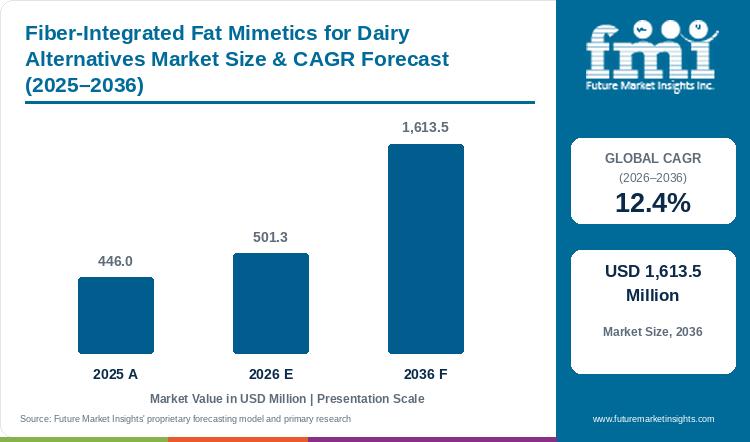
Sales in the fiber-integrated fat mimetics for dairy alternatives market are projected to grow at 12.4% CAGR, with the market size rising from USD 446.0 million in 2025 to USD 501.3 million in 2026 and reaching USD 1,613.5 million by 2036.
Eliminating dairy fat from commercial formulations removes the natural emulsion stability and lubricity that consumers expect in chilled beverages and yogurts. Processors attempting to mask watery mouthfeel by simply pouring vegetable oils into protein bases confront severe phase separation, greasy off-flavors, and elevated saturated fat profiles that defeat consumer wellness positioning. Fiber-integrated fat mimetics resolve this friction by structuring soluble and insoluble dietary fibers into micro-particulated networks that entrap water and mimic the globular sensation of milkfat droplets under oral shear. In March 2025, the U.S. Food and Drug Administration issued updated guidance verifying that physiological fiber structures must demonstrate proven blood glucose or satiety benefits to support nutrient declarations, compelling food formulators to adopt certified functional fiber ingredients [1]. Consequently, the market is valued at USD 446.0 million in 2025 and expands to USD 501.3 million in 2026, before reaching USD 1,613.5 million by 2036 at a 12.4% CAGR, generating USD 1,112.2 million in added revenue. Growth concentrates in dairy analogs where repeat household purchases depend entirely on preventing curdling and serum separation in hot coffee applications.
Formulation requirements in this sector closely intersect with emerging trends in plant-based milk and industrial emulsion systems across consumer packaged goods.
Key Market Trends & Insights
- By application: Dairy led with 50.0% share in 2026, because commercial plant-based cheese and yogurt lines require fat replacers that sustain smooth spoonability without syneresis.
- By form: Powdered formats held 45.0% share in 2026, as industrial blenders utilize dry premixes to prevent microbiological spoilage and streamline warehouse inventory handling.
- By channel: Direct-to-B2B represented 60.0% in 2026, driven by specialized pilot trials and bespoke homogenization adjustments negotiated directly between ingredient suppliers and dairy brands.
Regional Highlights
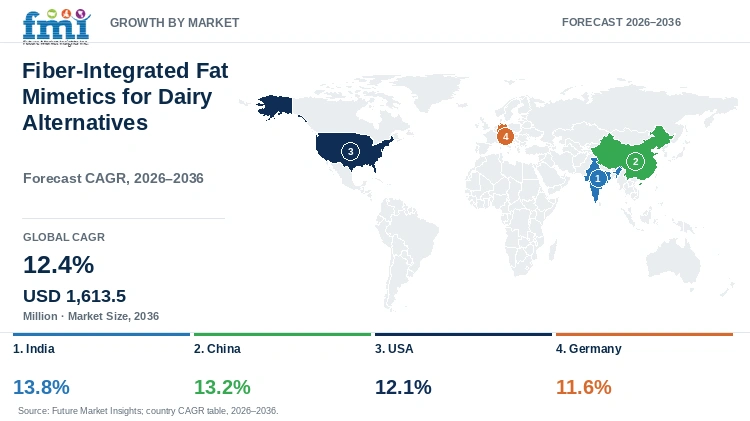
- Fastest-growing evaluated country: India, at 13.8% CAGR from 2026 to 2036.
- By country: China at 13.2%, USA at 12.1%, and Germany at 11.6% follow, reflecting consumer demand for clean-label nutrition across metropolitan retail centers.
Market Size & Forecast
Table 1: Market Size and Forecast for the Fiber-Integrated Fat Mimetics for Dairy Alternatives Market (USD million and CAGR percentage), 2025 to 2036
| Metric | Value |
|---|---|
| 2025 Market Size | USD 446.0 million |
| Estimated Market Size in 2026 | USD 501.3 million |
| Projected Market Size by 2036 | USD 1,613.5 million |
| CAGR, 2026 to 2036 | 12.4% |
| Added Revenue, 2026 to 2036 | USD 1,112.2 million |
Regional adoption develops differently across countries because dairy processing infrastructure, local starch supplies, and statutory clean-label thresholds diverge substantially. North American brands focus heavily on calorie and saturated fat reduction in liquid creamers, whereas European manufacturers prioritize non-GMO citrus and oat fiber streams to satisfy strict front-of-pack health labeling rules. In July 2025, the European Food Safety Authority finalized a scientific opinion on modified plant fibers in dairy analogs, confirming that micro-particulated pectin-cellulose complexes preserve structural integrity under ultra-high-temperature pasteurization [2]. Procurement officers therefore favor ingredient systems that combine texture replication with clean-label documentation, bypassing synthetic emulsifiers while sustaining viscosity across extended refrigerated shelf life.
This structural shift reflects broader momentum across dairy alternatives as food processors upgrade sensory standards.
Plant-Based Dairy Output and Fat Mimetic Requirement Sizing
Table 2: Plant-Based Dairy Output and Fat Mimetic Requirement Sizing for the Fiber-Integrated Fat Mimetics Market (USD million and operational metric tonnes), mixed historical and forecast years from 2025 to 2036
| Metric | 2025 | 2026 | 2036 |
|---|---|---|---|
| Market size (USD million) | 446.0 | 501.3 | 1,613.5 |
| Global plant-based dairy output (million tonnes) | 18.2 to 21.5 | 19.8 to 23.4 | 38.5 to 45.0 |
| Fat mimetic inclusion volume (thousand tonnes) | 45.5 to 53.8 | 51.2 to 60.5 | 115.5 to 135.0 |
| Average ingredient realization per kg (USD) | 8.5 to 9.8 | 8.3 to 9.8 | 11.9 to 14.0 |
Per Capita & Formulation Procurement Sizing
Commercializing plant-based beverages and fermented desserts requires precise hydrocolloid balancing to prevent phase breakdown. As per FMI analysis, industrial food manufacturers are integrating fiber-bound texturizers to satisfy consumer demand for reduced sugar and saturated fat while maintaining velvety mouthfeel. Institutional foodservice suppliers represent expanding volume buyers for bulk powder ingredients.
Table 3: Per Capita and Plant-Based Dairy Processing Indicators for the Fiber-Integrated Fat Mimetics Market (USD and kilograms), mixed historical and forecast years from 2025 to 2036
| Metric | 2025 | 2026 | 2036 |
|---|---|---|---|
| World population (billion) | 8.2 | 8.3 | 9.0 |
| Global spend per capita (USD) | 0.054 | 0.060 | 0.179 |
| Global spend per 1,000 people (USD) | 54.39 | 60.40 | 179.28 |
| Plant-based dairy per capita consumption (kg) | 2.2 to 2.6 | 2.4 to 2.8 | 4.3 to 5.0 |
Table 4: Application Revenue and Processing Indicators for the Fiber-Integrated Fat Mimetics Market (USD million and percentages), 2026
| Metric | Value | Basis |
|---|---|---|
| Market size, 2026 | USD 501.3 million | Report baseline value |
| Dairy application revenue, 2026 | USD 250.7 million | 50.0% share |
| Powder format revenue, 2026 | USD 225.6 million | 45.0% share |
| Direct-to-B2B channel revenue, 2026 | USD 300.8 million | 60.0% share |
Analyst Perspective
“Plant-based dairy processors face severe mouthfeel rejection when simply extracting oils without rebuilding colloidal body. Suppliers that engineer soluble fiber networks with thermal stability during homogenization will capture long-term commercial formulation contracts across beverage and dessert brands.”
- Nandini Roy Choudhury, Principal Consultant, Future Market Insights.
How is the fiber-integrated fat mimetics for dairy alternatives market segmented?
The fiber-integrated fat mimetics for dairy alternatives market is segmented by application, form, channel, and region. In 2026, dairy accounts for 50.0% of application revenue, powder represents 45.0% of form demand, and direct-to-B2B holds 60.0% of distribution sales.
The market is segmented across three commercial product axes alongside regional evaluation from 2026 to 2036. Application encompasses dairy analogs, functional beverages, bakery items, and savory meat alternatives. Form evaluates powdered formats, liquid emulsions, encapsulated particles, and dense pastes. Channel covers direct-to-B2B corporate supply, wholesale distributors, online B2B ordering portals, and contract manufacturing partnerships.
Why does Dairy lead the Application category?
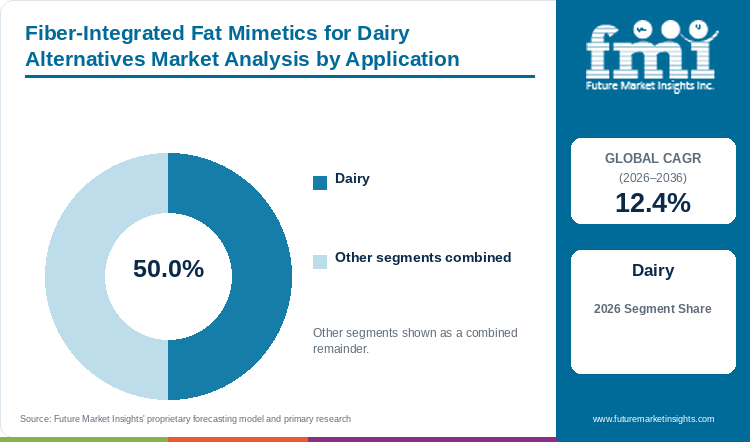
Dairy applications are projected to account for 50.0% of application revenue in 2026, supported by high consumer demand for creamy plant-based milks and yogurts.
Table 5: Application Share for the Fiber-Integrated Fat Mimetics for Dairy Alternatives Market (percentage share), 2026
| Application | Share (2026) |
|---|---|
| Dairy | 50.0% |
| Other Segments Combined | 50.0%* |
| Total | 100.0% |
*Calculated as the balance remaining after deducting the leading segment's reported share from 100.0%.
Table 6: Application Leadership and Market Growth for the Fiber-Integrated Fat Mimetics for Dairy Alternatives Market (segment and CAGR percentage), 2026 to 2036
| Metric | Value |
|---|---|
| Global CAGR (2026 to 2036) | 12.4% |
| Leading Segment | Dairy |
Plant-based milk and yogurt producers concentrate purchasing on fiber-based fat replacers because removing dairy milkfat destabilizes casein-micelle analogies, triggering immediate flavor fade and serum leakage. Formulating with micro-particulated oat, citrus, or chicory root fibers rebuilds the colloidal network required to suspend insoluble proteins while providing velvety oral coating. That structural advantage protects finished beverages against feathering in acidic coffee environments.
- Dairy applications are projected to capture 50.0% of application revenue in 2026, supported by the critical operational need to prevent phase separation in commercial plant milks.
- In February 2026, Ingredion introduced its Fibertex CF citrus fiber range designed to replicate dairy fat mouthfeel in fermented plant-based dessert bases [3].
Technical progress in fat replication accelerates commercial integration of functional food ingredients across major consumer brands.
What makes Powdered Formats central to the Form category?
Powdered formats are estimated to hold 45.0% of form demand in 2026, reflecting extended shelf life and straightforward dry blending in manufacturing.
Industrial food plants heavily favor spray-dried powders because ambient storage minimizes cold-chain logistics costs and eliminates bacterial proliferation risks associated with liquid emulsions. Powdered fiber mimetics hydrate uniformly during high-shear batch mixing, allowing operators to disperse the functional system into water-oil phases before pasteurization. Liquids account for 35.0% share, but require refrigerated transport that limits cross-border distribution.
- Powdered formats are anticipated to hold 45.0% of form demand in 2026, reflecting stable reconstitution behavior and ambient storage across manufacturing plants.
- In May 2025, Tate & Lyle expanded spray-drying operations for its PROMITOR soluble fiber systems to support high-volume dry blending in dairy-alternative facilities [4].
Formulation demand is closely aligned with manufacturer procurement of clean label ingredients across modern retail portfolios.
What supports Direct-to-B2B leadership within the Channel category?
Direct-to-B2B is projected to capture 60.0% of channel revenue in 2026, driven by specialized technical collaboration required during dairy-alternative reformulation.
Rebuilding texture in oat, almond, and soy bases involves unique rheological challenges, requiring food scientists to collaborate directly with ingredient technical service teams. Direct commercial contracts ensure processors receive customized shear-tolerance profiles, batch viscosity certificates, and pilot plant validation before committing to multi-year supply volumes. Distributors supply standardized bags to regional bakeries, but high-volume plant-based brands purchase directly to secure consistent pricing.
- Direct-to-B2B is projected to account for 60.0% of channel sales in 2026, driven by direct application support and contract manufacturing volume requirements.
- In October 2025, Cargill signed long-term ingredient partnership agreements with leading plant-based beverage co-packers across North America [5].
Procurement dynamics mirror broader commercial strategies in dietary fiber supply chains across developed regions.
What are the drivers, restraints, and opportunities in the fiber-integrated fat mimetics for dairy alternatives market?
Surging consumer demand for saturated-fat reduction supports market expansion, whereas thermal viscosity breakdown under commercial pasteurization restrains adoption, and tailored fiber networks for spoonable yogurts create lucrative value-add opportunities.
- Driver: Intensifying regulatory and retail pressure to eliminate saturated palm and coconut oils drives plant-based brands toward functional dietary fiber texturizers.
- Restraint: Shear-induced thinning and thermal degradation during ultra-high-temperature pasteurization can cause batch instability and brand rejection.
- Opportunity: Multi-component fiber-hydrocolloid complexes tailored for cultured plant yogurts and cream cheeses command premium contract margins across commercial dairies.
Growth Analysis and Future Potential: Saturated Fat Reduction and Clean-Label Fortification
Plant-based beverage processors face persistent consumer criticism regarding high levels of saturated coconut oil and added gums used to simulate dairy richness. Food formulators are under pressure from mass retailers to improve front-of-package nutritional scores without sacrificing consumer acceptance. In May 2025, the World Health Organization published nutritional benchmarks recommending that saturated fats contribute less than 10% of total daily energy intake [6]. In response, manufacturers utilize micro-particulated soluble fiber systems that yield natural opacity and creamy mouthfeel while allowing legitimate dietary fiber claims on product labels. Commercial adoption accelerates as brands replace synthetic texturizers with upcycled citrus, apple, and grain fiber streams that satisfy rigorous clean-label consumer expectations.
This transition aligns with rapid innovation in food texturizers engineered for dairy-free processing lines.
Risk Assessment of the Fiber-Integrated Fat Mimetics Market: Viscosity Drift and Thermal Breakdown Under Shear
Thermal degradation during ultra-high-temperature sterilization represents the primary engineering bottleneck restricting widespread ingredient adoption. When fiber-oil emulsions pass through industrial plate heat exchangers above 135 degrees Celsius, delicate polysaccharide chains can hydrolyze or unfold, triggering irreversible viscosity collapse and oil droplet coalescence. In November 2025, research in Food Hydrocolloids documented that unshielded cellulose-pectin complexes experienced up to 40% loss of apparent viscosity under commercial homogenization pressures exceeding 200 bar [7]. Food processors face substantial economic losses when off-spec batches separate during warehouse storage, resulting in stringent sensory screening trials before external fat mimetic systems receive factory-level formula approval.
Commercial Opportunity Analysis: Synergistic Fiber-Hydrocolloid Texturizers for Spoonable Yogurts and Cheeses
Formulation science rewards ingredient suppliers that develop co-processed fiber-protein composites capable of replicating the dense gel structure of set yogurts and melting cheeses. Cultured dairy alternatives frequently suffer from watery syneresis, forcing processors to overload formulations with modified starches that leave a gummy aftertaste. In January 2026, Kerry Group unveiled its Sherex functional texturizing system combining acacia fiber with pea protein to improve gel elasticity and spoonability in plant-based yogurts [8]. Suppliers delivering multi-functional systems that combine moisture binding, fat mimicry, and natural mouthcoating capture privileged sole-source vendor agreements across industrial dairy brands.
Expanding commercial applications support sustained growth across plant-based yogurt and dairy-free cultured categories.
Fiber-Integrated Fat Mimetics for Dairy Alternatives Market by Country (2026 to 2036)
According to FMI research, India represents the fastest-growing market for fiber-integrated fat mimetics at a 13.8% CAGR from 2026 to 2036, followed closely by China at 13.2% CAGR, while Germany registers 11.6% CAGR. Across all evaluated territories, commercial velocity reflects domestic dairy-free consumption density, dietary fiber guidelines, and local food processing infrastructure.
Table 7: Country CAGR and Primary Growth Levers for the Fiber-Integrated Fat Mimetics Market (CAGR percentage and operational drivers), 2026 to 2036
| Country | CAGR (2026 to 2036) | Primary Growth Lever |
|---|---|---|
| India | 13.8% | Surging urban lactose intolerance and demand for fortified plant milks |
| China | 13.2% | Scale manufacturing of oat and soy beverages with western-style creaminess |
| USA | 12.1% | Clean-label creamer reformulation and strict saturated fat reduction goals |
| Germany | 11.6% | Strict clean-label scrutiny and organic plant-based yogurt adoption |
India Fiber-Integrated Fat Mimetics Market Outlook (2026 to 2036)
India is projected to expand at a leading 13.8% CAGR through 2036, supported by rapid urban adoption of lactose-free and plant-based dairy substitutes across tier-1 cities. In June 2025, the Food Safety and Standards Authority of India established comprehensive nutritional standards for plant-based dairy analogs, specifying permissible dietary fiber fortification levels in commercially packaged beverages [9]. However, domestic beverage processors operate under tight unit economics, where high import tariffs on specialty European hydrocolloids constrain widespread adoption. Domestic ingredient converters overcome this margin friction by extracting functional soluble fibers from indigenous agricultural by-products such as fenugreek and citrus peels, enabling affordable local manufacturing of creamy chai-compatible oat and almond milks.
Key takeaway: In India, statutory standards for dairy analogs and local extraction of plant fibers establish strong growth momentum for affordable, creamy beverage formulations.
China Fiber-Integrated Fat Mimetics Market Outlook (2026 to 2036)
China is forecast to advance at a 13.2% CAGR between 2026 and 2036, driven by massive industrial co-packing capacity dedicated to ready-to-drink oat and soy lattes. In September 2025, China's National Health Commission released an updated nutritional guidance report urging reduced saturated fat intake and elevated dietary fiber consumption across commercial beverages [10]. While consumer demand for velvety mouthfeel in coffee-paired plant milks is exceptionally high, processors struggle with rapid precipitation and sedimentation during prolonged room-temperature shelf storage. Chinese ingredient suppliers mitigate this stability hurdle by deploying wet-milled microcrystalline cellulose blended with soluble polydextrose, ensuring uniform beverage opacity throughout national retail distribution networks.
Key takeaway: In China, high-volume ready-to-drink coffee applications and government fiber initiatives compel industrial beverage processors to adopt micro-particulated fiber texturizers.
USA Fiber-Integrated Fat Mimetics Market Outlook (2026 to 2036)
The United States market is anticipated to record a 12.1% CAGR through 2036, anchored by aggressive brand reformulation away from palm kernel oils in refrigerated plant creamers and desserts. In August 2025, the U.S. Department of Agriculture documented that consumer purchases of low-saturated-fat dairy alternatives increased significantly across conventional supermarket channels [11]. Nevertheless, North American food developers encounter technical resistance when formulating spoonable oat yogurts, where fiber-based systems can impart gritty sensory defects if particle sizes exceed 20 microns. Leading ingredient producers resolve this barrier by supplying micronized citrus fiber powders that integrate seamlessly with pea protein isolates, securing premium placement on major supermarket shelves.
Key takeaway: In the USA, consumer scrutiny of saturated fat and demand for indulgent plant creamers drive widespread adoption of ultra-fine fiber mimetic powders.
Germany Fiber-Integrated Fat Mimetics Market Outlook (2026 to 2036)
Germany is estimated to progress at an 11.6% CAGR over the assessment period, reflecting a mature, quality-driven plant-based food culture governed by strict clean-label expectations. In April 2025, the Federal Ministry of Food and Agriculture published consumer survey data showing that 68% of German shoppers actively scrutinize ingredient lists for chemical additives and synthetic stabilizers in vegan products [12]. While demand for organic plant-based cheeses and yogurts is robust, manufacturers face severe formulation limits because European organic regulations prohibit chemical modified starches and synthetic emulsifiers. German food scientists overcome this regulatory constraint by utilizing enzymatically treated native oat and apple fibers, satisfying organic purity mandates while preserving desired creaminess.
Key takeaway: In Germany, stringent organic labeling standards and clean-label consumer discipline establish high barriers to entry that favor natural, minimally processed fiber ingredients.
Full report country CAGRs cover: North America; Latin America; Western Europe; Eastern Europe; East Asia; South Asia and Pacific; Middle East and Africa.
Regional manufacturing investments mirror technological upgrades in food emulsifiers and stabilization systems across global facilities.
Who are the notable companies in the fiber-integrated fat mimetics for dairy alternatives market?
Ingredion Incorporated, Tate & Lyle PLC, Cargill Incorporated, Kerry Group, DSM-Firmenich, and International Flavors & Fragrances are notable companies operating in this market.
Future Market Insights data suggests that commercial competition divides between global agricultural processing conglomerates and specialized functional food ingredient innovators. Global processing majors leverage vast grain and citrus processing footprints to supply cost-effective soluble fibers and texturizers at high volumes. In contrast, specialized flavor and hydrocolloid houses differentiate by co-developing proprietary fat-mimetic systems tailored to specific plant protein matrices. Procurement directors evaluate vendors based on batch-to-batch viscosity consistency, neutral sensory profiles, and direct formulation support in pilot facilities.
- Global Agricultural & Starch Processors: Ingredion Incorporated, Tate & Lyle PLC, and Cargill Incorporated provide bulk soluble fibers and texturizing systems at industrial scale.
- Specialized Food Nutrition & Flavor Platforms: Kerry Group, DSM-Firmenich, and International Flavors & Fragrances combine flavor masking with fiber-based mouthfeel technologies.
Competitive Benchmarking: Fiber-Integrated Fat Mimetics Market
Table 8: Competitive Benchmarking for the Fiber-Integrated Fat Mimetics for Dairy Alternatives Market (qualitative capability ratings), 2026
| Company | Fat Mimicry Breadth | Fiber Fortification Depth | Dairy Application Access | Geographic Reach |
|---|---|---|---|---|
| Ingredion Incorporated | High | High | High | High |
| Tate & Lyle PLC | High | High | High | High |
| Cargill Incorporated | High | Medium | High | High |
| Kerry Group | High | High | Medium | High |
| DSM-Firmenich | Medium | High | Medium | High |
| International Flavors & Fragrances | Medium | Medium | High | High |
Scoring basis: High indicates broad documented commercial capability across multiple dairy-alternative product formats. Medium indicates specialized or regional focus. Low is reserved for documented capability constraints relative to peer companies.
Key Developments in the Fiber-Integrated Fat Mimetics Market
- In February 2026, Ingredion Incorporated launched its Fibertex CF line of functional citrus fibers engineered to replicate fat mouthfeel in plant-based milks and desserts [3].
- In January 2026, Kerry Group unveiled its Sherex texturizing system combining acacia fiber with plant proteins to optimize creaminess in vegan yogurts [8].
- In October 2025, Cargill Incorporated expanded its commercial partnership with North American dairy-alternative co-packers to deliver custom fat-mimetic systems [5].
- In May 2025, Tate & Lyle PLC increased production capacity for its PROMITOR soluble fiber systems at its European manufacturing facility [4].
Key Players in the Fiber-Integrated Fat Mimetics for Dairy Alternatives Market
Global Agricultural & Texture Solution Leaders
- Ingredion Incorporated
- Tate & Lyle PLC
- Cargill Incorporated
Specialty Nutrition & Ingredient Innovators
- Kerry Group
- DSM-Firmenich
- International Flavors & Fragrances
Fiber-Integrated Fat Mimetics for Dairy Alternatives Market - Report Scope
Table 9: Report Scope for the Fiber-Integrated Fat Mimetics for Dairy Alternatives Market (coverage fields and definitions), 2026 to 2036
| Coverage field | Report scope |
|---|---|
| Market breakdown | Application; Form; Channel; Region |
| Quantitative Units | USD Million |
| Market Definition | Includes supplier revenues from fiber-integrated fat mimetics, soluble fiber texturizers, and co-processed fiber-fat replacers used in plant-based dairy formulations. Excludes revenues from commodity fats, pure vegetable oils, and downstream finished retail foods. |
| Regions Covered | North America; Latin America; Western Europe; Eastern Europe; East Asia; South Asia and Pacific; Middle East and Africa |
| Countries Covered | India, China, USA, Germany, and additional countries covered in the full report |
| Key Companies Covered | Ingredion Incorporated, Tate & Lyle PLC, Cargill Incorporated, Kerry Group, DSM-Firmenich, International Flavors & Fragrances |
| Forecast Period | 2026 to 2036 |
| Approach | Primary and secondary research with rigorous market triangulation. |
Fiber-Integrated Fat Mimetics for Dairy Alternatives Market - Research Methodology
Table 10: Research Methodology for the Fiber-Integrated Fat Mimetics for Dairy Alternatives Market (research methods and approach), 2026 edition
| Method | Approach |
|---|---|
| Primary Research | Primary interviews were conducted with ingredient manufacturers, dairy-alternative processors, food scientists, procurement managers, and industry experts across the value chain to validate market trends, formulation challenges, demand dynamics, and purchasing decisions. |
| Secondary Research | Secondary research included company annual reports, investor presentations, regulatory publications, food science technical journals, trade association databases, patent filings, and publicly available market data. |
| Market Sizing and Forecasting | Market sizing and forecasting for the 2026 to 2036 forecast period were developed using top-down and bottom-up approaches to assess volume demand, price points, and institutional adoption trends. |
| Data Triangulation and Validation | Data is validated against macro-economic indicators, plant-based dairy production volume, regulatory fiber standards, and historical trend analysis to ensure high accuracy without double counting adjacent categories. |
Fiber-Integrated Fat Mimetics for Dairy Alternatives Market by Segments
Fiber-Integrated Fat Mimetics for Dairy Alternatives Market segmented by Application:
- Dairy
- Beverages
- Bakery
- Meat
Fiber-Integrated Fat Mimetics for Dairy Alternatives Market segmented by Form:
- Powder
- Liquid
- Encapsulated
- Paste
Fiber-Integrated Fat Mimetics for Dairy Alternatives Market segmented by Channel:
- Direct-to-B2B
- Distributors
- Online B2B
- Contract Mfg
Fiber-Integrated Fat Mimetics for Dairy Alternatives Market by Region
- North America: United States, Canada, Mexico
- Latin America: Brazil, Chile, Rest of Latin America
- Western Europe: Germany, United Kingdom, France, Italy, Spain, Nordic, BENELUX, Rest of Western Europe
- Eastern Europe: Poland, Russia, Hungary, Balkan & Baltic, Rest of Eastern Europe
- East Asia: China, Japan, South Korea
- South Asia and Pacific: India, ASEAN, Australia & New Zealand, Rest of South Asia and Pacific
- Middle East & Africa: Kingdom of Saudi Arabia, Other GCC Countries, Turkiye, South Africa, Other African Union, Rest of Middle East & Africa
Broader market trends connect with rapid consumer adoption of plant-based beverages across commercial foodservice chains.
Research Sources and Bibliography
- [1] U.S. Food and Drug Administration. (2025, March 14). Dietary fiber declarations and physiological health effects on packaged nutrition labels. Center for Food Safety and Applied Nutrition Guidance.
- [2] European Food Safety Authority. (2025, July 18). Scientific opinion on the rheological stability and safety of micro-particulated plant fiber complexes in dairy analogs. EFSA Journal, 23(7), e08912.
- [3] Ingredion Incorporated. (2026, February 19). Launch of Fibertex CF functional citrus fibers for clean-label dairy alternative texturizing. Ingredion Product Releases.
- [4] Tate & Lyle PLC. (2025, May 22). Capacity expansion for PROMITOR soluble dietary fibers across European manufacturing network. Tate & Lyle Newsroom.
- [5] Cargill Incorporated. (2025, October 29). Strategic formulation partnership established with North American plant-based dairy co-packers. Cargill Press Releases.
- [6] World Health Organization. (2025, May 08). Saturated fat intake guidelines and cardiovascular risk reduction in processed foods. WHO Global Nutrition Reports.
- [7] Food Hydrocolloids Research Group. (2025, November 11). Thermal shear degradation and viscosity drift in cellulose-pectin fat mimetics during continuous UHT processing. Food Hydrocolloids, 158, 109842.
- [8] Kerry Group. (2026, January 16). Commercial rollout of Sherex texturizing systems for cultured plant-based yogurts. Kerry Formulation News.
- [9] Food Safety and Standards Authority of India. (2025, June 26). Standards and labeling guidelines for non-dairy plant-based beverage analogs. Ministry of Health and Family Welfare, Government of India.
- [10] National Health Commission of the People's Republic of China. (2025, September 12). Guidelines on dietary fiber enhancement and saturated fat control in manufactured foods. National Health Reports.
- [11] U.S. Department of Agriculture. (2025, August 15). Plant-based dairy retail sales trends and dietary fiber composition report. Economic Research Service.
- [12] Federal Ministry of Food and Agriculture (BMEL). (2025, April 17). Consumer purchasing behavior and clean-label scrutiny in vegan food categories. German Federal Reports.
This bibliography is provided for reader reference and is not exhaustive. The full report contains the complete reference list and detailed citations.
This Report Answers
- How large is the fiber-integrated fat mimetics for dairy alternatives market in 2026 and what is forecast for 2036?
- Which mouthfeel and nutritional pressures compel food formulators to adopt fiber-integrated fat mimetics?
- Why does dairy lead application demand across plant-based alternatives?
- Why do powdered formats dominate the form segment globally?
- How do commercial growth conditions differ across India, China, the USA, and Germany?
- Which leading ingredient companies provide certified texture and fat-mimicry solutions?
- What operational friction limits manufacturer adoption during thermal processing?
- What qualification criteria matter most to dairy-alternative procurement teams?
Frequently Asked Questions
How big is the fiber-integrated fat mimetics for dairy alternatives market in 2026, and what is forecast for 2036?
The global fiber-integrated fat mimetics for dairy alternatives market is estimated to reach USD 501.3 million in 2026. The market is projected to expand further and reach USD 1,613.5 million by 2036, supported by consumer demand for plant-based nutrition.
What is the CAGR forecast for the market between 2026 and 2036?
As per FMI, the market is projected to expand at a 12.4% CAGR over the assessment period. Growth is propelled by widespread brand reformulation to reduce saturated fats in non-dairy beverages.
Which application segment leads global demand for fiber-integrated fat mimetics?
Dairy applications represent the largest segment, holding 50.0% of demand in 2026. Adoption is centered on plant-based milk, yogurt, and cheese analogs where fat mouthfeel is essential to consumer repeat purchase.
Which form factor dominates commercial ingredient shipments?
Powdered formats command the leading position with 45.0% share in 2026. Powders provide superior ambient shelf stability and blend easily into dry premixes during food manufacturing.
Which country exhibits the highest projected growth rate during the forecast period?
FMI data suggests that India is projected to advance at the fastest rate of 13.8% CAGR through 2036. Rapid expansion is driven by expanding urban demand for lactose-free, fortified plant milks.
Who are the key players active in the fiber-integrated fat mimetics market?
Leading companies include Ingredion Incorporated, Tate & Lyle PLC, Cargill Incorporated, Kerry Group, DSM-Firmenich, and International Flavors & Fragrances. These vendors focus on shear-tolerant fiber texturizers, clean-label positioning, and direct formulation support.
Preview the report firsthand - request a free sample
Get SampleGet the brochure for pricing and purchase details.
Get PDFTable of Content
- Key Takeaways
- Market Size and CAGR
- Top Growth Driver
- Fastest Growing Segment
- Leading Region
- Key Companies
- Emerging Opportunities
- Executive Summary
- Global Market Outlook
- Demand-side Trends
- Supply-side Trends
- Technology Roadmap Analysis
- Analysis and Recommendations
- Analyst Perspective (What is happening? Why now? What should investors know?)
- Key Questions Answered
- How large is the market?
- What is the CAGR?
- What are key trends?
- Which region dominates?
- Who are the leaders?
- Market Overview
- Market Coverage / Taxonomy
- Market Definition / Scope / Limitations
- Research Methodology
- Chapter Orientation
- Analytical Lens and Working Hypotheses
- Market Structure, Signals, and Trend Drivers
- Benchmarking and Cross-market Comparability
- Market Sizing, Forecasting, and Opportunity Mapping
- Research Design and Evidence Framework
- Desk Research Programme (Secondary Evidence)
- Expert Input and Fieldwork (Primary Evidence)
- Tooling, Models, and Reference Databases
- Data Engineering and Model Build
- Quality Assurance and Audit Trail
- Market Background
- Market Dynamics (Drivers, Restraints, Opportunity, Trends)
- Scenario Forecast (Optimistic, Likely, Conservative)
- Impact Analysis
- AI Impact
- Sustainability Impact
- Regulatory Impact
- Technology Impact
- Consumer / Buyer Analysis
- Purchase Drivers
- Adoption Barriers
- Buyer Journey
- Opportunity Map Analysis
- Product Life Cycle Analysis
- Supply Chain Analysis
- Investment Feasibility Matrix
- Value Chain Analysis
- PESTLE and Porter's Analysis
- Regulatory Landscape
- Regional Parent Market Outlook
- Production and Consumption Statistics
- Import and Export Statistics
- Global Market Analysis and Forecast, 2021 to 2036
- Historical Market Size Value (USD Million) Analysis, 2021 to 2025
- Current and Future Market Size Value (USD Million) Projections, 2026 to 2036
- Y-o-Y Growth Trend Analysis
- Absolute $ Opportunity Analysis
- Global Market Pricing Analysis, 2021 to 2036
- Global Market Analysis and Forecast, By Application, 2021 to 2036
- Introduction / Key Findings
- Historical Market Size Value (USD Million) Analysis By Application, 2021 to 2025
- Current and Future Market Size Value (USD Million) Analysis and Forecast By Application, 2026 to 2036
- Dairy
- Beverages
- Bakery
- Meat
- Y-o-Y Growth Trend Analysis By Application, 2021 to 2025
- Absolute $ Opportunity Analysis By Application, 2026 to 2036
- Global Market Analysis and Forecast, By Form, 2021 to 2036
- Introduction / Key Findings
- Historical Market Size Value (USD Million) Analysis By Form, 2021 to 2025
- Current and Future Market Size Value (USD Million) Analysis and Forecast By Form, 2026 to 2036
- Powder
- Liquid
- Encapsulated
- Paste
- Y-o-Y Growth Trend Analysis By Form, 2021 to 2025
- Absolute $ Opportunity Analysis By Form, 2026 to 2036
- Global Market Analysis and Forecast, By Channel, 2021 to 2036
- Introduction / Key Findings
- Historical Market Size Value (USD Million) Analysis By Channel, 2021 to 2025
- Current and Future Market Size Value (USD Million) Analysis and Forecast By Channel, 2026 to 2036
- Direct-to-B2B
- Distributors
- Online B2B
- Contract Mfg
- Y-o-Y Growth Trend Analysis By Channel, 2021 to 2025
- Absolute $ Opportunity Analysis By Channel, 2026 to 2036
- Global Market Analysis and Forecast, By Region, 2021 to 2036
- Introduction
- Historical Market Size Value (USD Million) Analysis By Region, 2021 to 2025
- Current Market Size Value (USD Million) Analysis and Forecast By Region, 2026 to 2036
- North America
- Latin America
- Western Europe
- Eastern Europe
- East Asia
- South Asia and Pacific
- Middle East & Africa
- Market Attractiveness Analysis By Region
- North America Market Analysis and Forecast, By Country, 2021 to 2036
- Historical Market Size Value (USD Million) Trend Analysis By Market Taxonomy, 2021 to 2025
- Market Size Value (USD Million) Forecast By Market Taxonomy, 2026 to 2036
- By Country
- United States
- Canada
- Mexico
- By Application
- By Form
- By Channel
- By Country
- Market Attractiveness Analysis
- By Country
- By Application
- By Form
- By Channel
- Key Takeaways
- Latin America Market Analysis and Forecast, By Country
- Historical Market Size Value (USD Million) Trend Analysis By Market Taxonomy, 2021 to 2025
- Market Size Value (USD Million) Forecast By Market Taxonomy, 2026 to 2036
- By Country
- Brazil
- Chile
- Rest of Latin America
- By Application
- By Form
- By Channel
- By Country
- Market Attractiveness Analysis
- By Country
- By Application
- By Form
- By Channel
- Key Takeaways
- Western Europe Market Analysis and Forecast, By Country
- Historical Market Size Value (USD Million) Trend Analysis By Market Taxonomy, 2021 to 2025
- Market Size Value (USD Million) Forecast By Market Taxonomy, 2026 to 2036
- By Country
- Germany
- United Kingdom
- France
- Italy
- Spain
- Nordic
- BENELUX
- Rest of Western Europe
- By Application
- By Form
- By Channel
- By Country
- Market Attractiveness Analysis
- By Country
- By Application
- By Form
- By Channel
- Key Takeaways
- Eastern Europe Market Analysis and Forecast, By Country
- Historical Market Size Value (USD Million) Trend Analysis By Market Taxonomy, 2021 to 2025
- Market Size Value (USD Million) Forecast By Market Taxonomy, 2026 to 2036
- By Country
- Poland
- Russia
- Hungary
- Balkan & Baltic
- Rest of Eastern Europe
- By Application
- By Form
- By Channel
- By Country
- Market Attractiveness Analysis
- By Country
- By Application
- By Form
- By Channel
- Key Takeaways
- East Asia Market Analysis and Forecast, By Country
- Historical Market Size Value (USD Million) Trend Analysis By Market Taxonomy, 2021 to 2025
- Market Size Value (USD Million) Forecast By Market Taxonomy, 2026 to 2036
- By Country
- China
- Japan
- South Korea
- By Application
- By Form
- By Channel
- By Country
- Market Attractiveness Analysis
- By Country
- By Application
- By Form
- By Channel
- Key Takeaways
- South Asia and Pacific Market Analysis and Forecast, By Country
- Historical Market Size Value (USD Million) Trend Analysis By Market Taxonomy, 2021 to 2025
- Market Size Value (USD Million) Forecast By Market Taxonomy, 2026 to 2036
- By Country
- India
- ASEAN
- Australia & New Zealand
- Rest of South Asia and Pacific
- By Application
- By Form
- By Channel
- By Country
- Market Attractiveness Analysis
- By Country
- By Application
- By Form
- By Channel
- Key Takeaways
- Middle East & Africa Market Analysis and Forecast, By Country
- Historical Market Size Value (USD Million) Trend Analysis By Market Taxonomy, 2021 to 2025
- Market Size Value (USD Million) Forecast By Market Taxonomy, 2026 to 2036
- By Country
- Kingdom of Saudi Arabia
- Other GCC Countries
- Turkiye
- South Africa
- Other African Union
- Rest of Middle East & Africa
- Broader market trends connect with rapid consumer adoption of plant-based beverages across commercial foodservice chains.
- By Application
- By Form
- By Channel
- By Country
- Market Attractiveness Analysis
- By Country
- By Application
- By Form
- By Channel
- Key Takeaways
- Key Countries Market Analysis
- United States
- Pricing Analysis
- Market Share Analysis, 2025
- By Application
- By Form
- By Channel
- Canada
- Pricing Analysis
- Market Share Analysis, 2025
- By Application
- By Form
- By Channel
- Mexico
- Pricing Analysis
- Market Share Analysis, 2025
- By Application
- By Form
- By Channel
- Brazil
- Pricing Analysis
- Market Share Analysis, 2025
- By Application
- By Form
- By Channel
- Chile
- Pricing Analysis
- Market Share Analysis, 2025
- By Application
- By Form
- By Channel
- Germany
- Pricing Analysis
- Market Share Analysis, 2025
- By Application
- By Form
- By Channel
- United Kingdom
- Pricing Analysis
- Market Share Analysis, 2025
- By Application
- By Form
- By Channel
- Italy
- Pricing Analysis
- Market Share Analysis, 2025
- By Application
- By Form
- By Channel
- Spain
- Pricing Analysis
- Market Share Analysis, 2025
- By Application
- By Form
- By Channel
- France
- Pricing Analysis
- Market Share Analysis, 2025
- By Application
- By Form
- By Channel
- India
- Pricing Analysis
- Market Share Analysis, 2025
- By Application
- By Form
- By Channel
- ASEAN
- Pricing Analysis
- Market Share Analysis, 2025
- By Application
- By Form
- By Channel
- Australia & New Zealand
- Pricing Analysis
- Market Share Analysis, 2025
- By Application
- By Form
- By Channel
- China
- Pricing Analysis
- Market Share Analysis, 2025
- By Application
- By Form
- By Channel
- Japan
- Pricing Analysis
- Market Share Analysis, 2025
- By Application
- By Form
- By Channel
- South Korea
- Pricing Analysis
- Market Share Analysis, 2025
- By Application
- By Form
- By Channel
- Russia
- Pricing Analysis
- Market Share Analysis, 2025
- By Application
- By Form
- By Channel
- Poland
- Pricing Analysis
- Market Share Analysis, 2025
- By Application
- By Form
- By Channel
- Hungary
- Pricing Analysis
- Market Share Analysis, 2025
- By Application
- By Form
- By Channel
- Kingdom of Saudi Arabia
- Pricing Analysis
- Market Share Analysis, 2025
- By Application
- By Form
- By Channel
- South Africa
- Pricing Analysis
- Market Share Analysis, 2025
- By Application
- By Form
- By Channel
- United States
- Market Structure Analysis
- Competition Dashboard
- Competition Benchmarking
- Market Share Analysis of Top Players
- By Regional
- By Application
- By Form
- By Channel
- Emerging Startups
- Innovation Benchmarking
- Competition Analysis
- Competition Deep Dive
- Ingredion Incorporated
- Overview
- Product Portfolio
- Profitability by Market Segments
- Sales Footprint
- Strategy Overview
- Marketing Strategy
- Product Strategy
- Channel Strategy
- Tate & Lyle PLC
- Cargill Incorporated
- Kerry Group
- DSM-Firmenich
- International Flavors & Fragrances
- Ingredion Incorporated
- Case Studies
- Success Stories
- Recent Developments
- Competition Deep Dive
- Assumptions & Acronyms Used


