

- Industry Size (2026)
- USD 2.7 Bn
- Forecast (2036)
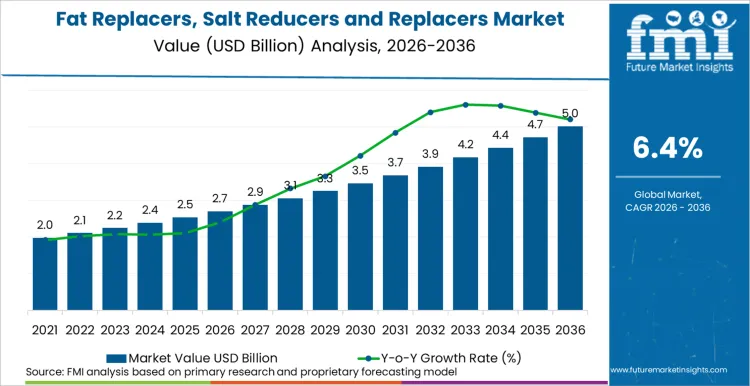
- USD 5.0 Bn
- CAGR (2026 to 2036)
- 6.4%
Fat Replacers, Salt Reducers and Replacers Market Size, Market Forecast and Outlook By FMI
In 2025, the fat replacers, salt reducers and replacers market was valued at USD 2.50 billion. Based on Future Market Insights’ analysis, demand is estimated to grow to USD 2.70 billion in 2026 and USD 5.0 billion by 2036. FMI projects a CAGR of 6.4% during the forecast period.
Regulatory mandates and the associated compliance gate serve as the primary catalyst for market expansion. In India, for instance, the FSSAI approved a proposal in July 2024 to display total sugar, salt, and saturated fat in bold on packaged food labels, creating a powerful transparency trigger for consumers [12]. According to FMI's estimates, such front-of-pack labeling requirements force manufacturers to invest in salt content reduction ingredients to avoid negative brand perception and potential tax penalties. This policy-led pressure transforms reformulation from a marketing choice into a survival-based procurement specification.
Strategic investments in sensory science are now bridging the gap between nutritional targets and consumer taste expectations. As Nick Hampton, Chief Executive of Tate & Lyle, noted regarding the industry's technological evolution, 'With this multi-million pound investment we are transforming the new product development process for our mouthfeel solutions, empowering our scientists to accelerate experiment design, analysis, and delivery of innovative solutions for customers.' [21] This commitment to automated R&D enables the rapid deployment of fat replacers that mimic the lubricity of lipids, ensuring that reduced-calorie products retain the necessary mouthfeel to secure repeat purchases in the competitive snacks and dairy sectors.
Summary of Fat Replacers, Salt Reducers and Replacers Market
- Fat Replacers, Salt Reducers and Replacers Market Definition
- The industry focuses on advanced ingredient technologies that mimic the functional and sensory roles of fat and salt in food systems.
- Demand Drivers in the Market
- Rising chronic disease burdens associated with sodium intake and obesity accelerate mandatory reformulation cycles.
- Front-of-pack labeling regulations increase consumer awareness and force brands to optimize nutritional scores.
- Advancements in AI-driven taste design and automated lab testing reduce the time-to-market for healthy ingredients.
- Key Segments Analyzed in the FMI Report
- Product Type: Fat reducers command a 51.2% share in 2026.
- Application: High-volume snacking and dairy categories lead ingredient integration.
- Geography: Rapidly urbanizing APAC markets drive the highest growth trajectories.
- Analyst Opinion at FMI
- Nandini Roy Choudhury, Principal Consultant for Chemicals and Materials Industry at Future Market Insights, opines, 'The industry is moving beyond simple substitution toward holistic sensory rebuilding, where umami flavors and texture-mapped mimetics solve the traditional trade-off between nutrition and palatability. However, high ingredient costs for potassium-based salts and complex lipid-mimetics remain a significant barrier for mass-market adoption in price-sensitive regions.'
- Strategic Implications/Executive Takeaways
- Prioritize modular reformulation systems that combine taste modulation with functional bulking to simplify manufacturing.
- Invest in regionalized flavor profiles to ensure low-sodium versions of local snacks maintain traditional acceptance.
- Leverage AI and automated sensory labs to hedge against the technical complexity of fat-mimetic integration.
- Methodology
- Validated through first-hand corporate production and capacity data.
- Zero reliance on speculative third-party market research reports.
- Based on verifiable industrial benchmarks and verified sources.
Demand for sodium and fat mitigation solutions is accelerating across major economies, with China leading the growth curve at an 8.6% CAGR through 2036. India follows closely at 8.0%, while Germany records a 7.4% CAGR, the UK expands at 6.1%, and the United States grows at 5.4%. Even mature markets like Brazil are projected to advance at 4.8% CAGR, as national health agencies tighten guidelines to combat the 1.89 million annual deaths globally associated with excessive sodium consumption [1].
Fat Replacers, Salt Reducers and Replacers Market Definition
The industry covers the production and application of functional ingredients designed to substitute or reduce the content of traditional fats and sodium chloride in processed foods. These flavor modulators and mimetics use chemical or physical properties to replicate the mouthfeel, texture, and taste profile of original ingredients. As per FMI's projection, the scope includes lipid-based, protein-based, and carbohydrate-based replacers alongside potassium-based and yeast-derived salt reducers.
Fat Replacers, Salt Reducers and Replacers Market Inclusions
This report features a comprehensive analysis of ingredients such as sodium reduction ingredients, fiber-integrated fat mimetics, and potassium chloride-based mineral salts. It covers various forms including powder, liquid, and gel formats utilized across dairy, bakery, meat, and savory snack categories. Inclusion also extends to taste modulators and umami-enhancing agents that compensate for the loss of flavor intensity when sodium levels are lowered.
Fat Replacers, Salt Reducers and Replacers Market Exclusions
The scope excludes traditional non-nutritive sweeteners and sugar substitutes unless they are part of a multi-functional reformulation blend for fat and salt reduction. It omits basic commodity oils and salts used in standard food production without functional modification for health-led substitution. Furthermore, the report excludes finished retail consumer goods such as diet snacks or low-fat yogurts, focusing strictly on the industrial ingredient intermediates and flavoring systems used by manufacturers.
Fat Replacers, Salt Reducers and Replacers Market Research Methodology
- Primary Research: Detailed interviews were conducted with ingredient suppliers, R&D directors at major F&B firms, and sensory scientists to validate fat replacers and fat mimetics adoption rates.
- Desk Research: Production data from global health bodies, WHO milestone reports, and national regulatory updates provided the baseline for sodium and obesity burden benchmarking.
- Market-Sizing and Forecasting: A hybrid top-down and bottom-up model reconstructed demand from processed food volumes and ingredient inclusion rates, cross-verified against plant-level capacities.
- Data Validation and Update Cycle: Final outputs underwent rigorous anomaly screening and variance checks across trade datasets to ensure forecast accuracy for reduced salt packaged foods.
Segmental Analysis
Fat Replacers, Salt Reducers and Replacers Market Analysis by Product Type
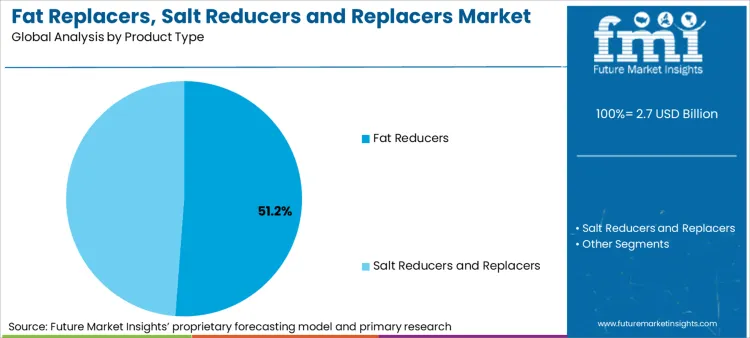
Fat reducers command 51.2% of the market in 2026 as manufacturers struggle to lower caloric density in dairy and bakery sectors while maintaining texture. FMI analysts opine that the dominance of lipid-mimetics stems from the widespread obesity crisis, which reached a 40.3% prevalence in the United States by late 2023 [4]. This pressure forces the adoption of fiber-integrated fat mimetics for dairy alternatives to satisfy health-conscious consumers. Suppliers are increasingly pivoting toward automated solutions to solve mouthfeel challenges associated with fat reduction.
- Technology shift: Tate & Lyle opened the automated Singapore lab ALFIE in October 2024 to accelerate the development of mouthfeel solutions for fat-reduced formulations [10]. This investment allows for rapid iteration of ingredient blends that maintain consumer palatability.
- Buyer priority: Kerry Group launched the Smart Taste platform in September 2025 to integrate advanced scientific processes into natural flavor modulators and reformulation levers [22]. Manufacturers prioritize these integrated systems to ensure that reduced-fat products do not lose their premium sensory appeal.
- Supply-side move: Ajinomoto expanded its portfolio in April 2025 to include 56 low-sodium products across 25 brands, demonstrating the scale required to meet global nutrition targets [16]. This move secures long-term supply contracts with global F&B leaders seeking consistent reformulation components.
Fat Replacers, Salt Reducers and Replacers Market Analysis by Form
Powder formats represent the primary delivery mechanism for mineral-based salts and carbohydrate replacers due to their shelf-stability and ease of blending. FMI analysts opine that the versatility of powders enables their seamless integration into large-scale dry-mix production for bakery and snack categories. According to FMI's estimates, the development of ultra-fine powder particles allows for better dispersion and salt perception enhancing flavor modulators to work more effectively. This form factor reduces logistics costs and simplifies the procurement process for global food processors.
- Procurement trigger: Cargill promoted its Potassium Pro Ultra Fine in late 2024, enabling up to 50% sodium reduction while providing necessary potassium enrichment for packaged goods [5]. This ingredient allows buyers to meet nutritional goals while maintaining the functional properties of traditional salt.
- Innovation signal: IFF showcased groundbreaking food flavour enhancers and reformulation solutions at Gulfood Manufacturing in October 2024 to address changing regional taste preferences [7]. These innovations highlight the shift toward more sophisticated powder-based delivery systems.
- Regulatory signal: Germany implemented strict maximum iodine levels of 25 mg per kg of salt in December 2025, forcing powder salt suppliers to recalibrate their iodization processes [20]. This regulatory mandate ensures that salt reducers remain compliant with local safety standards during export.
Fat Replacers, Salt Reducers and Replacers Market Drivers, Restraints, and Opportunities
The rising global burden of non-communicable diseases (NCDs) serves as the primary demand driver for reformulated food systems. Excessive sodium intake is currently associated with 1.89 million deaths annually, prompting the World Health Organization to issue aggressive reduction targets [1]. This clinical urgency translates into industrial action, as manufacturers seek low sodium sea salt and mimetics to lower the health risks of their product portfolios. According to FMI's estimates, the WHO recognized four countries, Austria, Norway, Oman, and Singapore, in May 2025 for their life-saving trans-fat elimination policies, further validating the global shift toward healthier ingredient profiles [15]. These regulatory milestones create a predictable environment for long-term R&D investment in salt content reduction ingredients.
High ingredient costs and the technical complexity of achieving "sensory parity" act as significant market restraints. While potassium, sodium, and calcium salts of fatty acids offer functional benefits, they can introduce bitter off-notes that require expensive flavour modulators to mask. FMI analysts opine that the price sensitivity of mass-market snacks, especially in emerging economies, limits the speed of transition from standard sodium chloride. Furthermore, the German Nutrition Society's recommendation to cap table salt at 6 g per day by September 2025 highlights the increasing pressure on manufacturers to reformulate without passing excessive costs to consumers [19]. This economic friction necessitates the development of more cost-effective yeast extracts and monosodium glutamate (MSG) blends to achieve umami without high sodium levels.
- Modular Taste Design: Suppliers can capture high-margin opportunities by developing modular systems that combine low sodium olive brine flavor systems with bulking agents. These systems allow for one-step reformulation across multiple product lines, significantly reducing R&D overhead for mid-sized F&B players [8].
- AI-Driven Reformulation: Symrise expanded its Symvision AI functionality in November 2025 to accelerate taste design and the development of savoury flavour blends. This technology offers manufacturers a significant time-to-market advantage by predicting consumer acceptance of complex fat and salt substitutions [15].
- Clean-Label Mimetics: The ongoing removal of partially hydrogenated oils (PHOs), reiterated as non-GRAS by the FDA in October 2024, creates a massive opening for natural fat replacers [13]. Companies that offer plant-based mimetics with clean-label credentials will likely dominate the premium bakery and dairy segments through 2036.
Regional Analysis
Based on the regional analysis, the fat replacers, salt reducers and replacers market is segmented into North America, Latin America, Europe, East Asia, South Asia, Oceania and Middle East & Africa across 40+ countries. The full report also offers market attractiveness analysis based on regional trends.
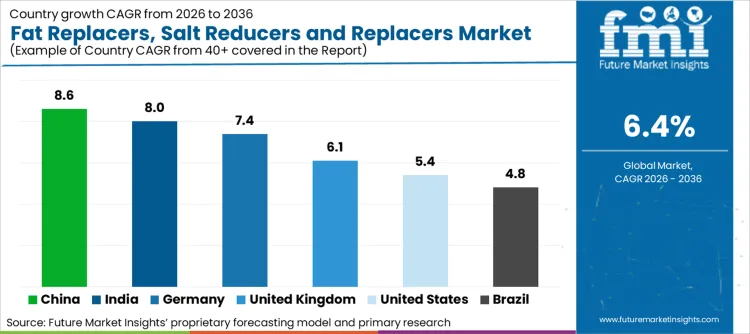
| Country | CAGR (2026 to 2036) |
|---|---|
| China | 8.6% |
| India | 8.0% |
| Germany | 7.4% |
| United Kingdom | 6.1% |
| United States | 5.4% |
| Brazil | 4.8% |
Source: Future Market Insights (FMI) analysis
Asia Pacific Fat Replacers, Salt Reducers and Replacers Analysis
Asia Pacific is the fastest-growing region, driven by rapid urbanization and the implementation of national nutrition plans designed to curb rising NCD rates. China’s national guideline aims to cap daily salt intake at 5 g by March 2025, which directly accelerates the procurement of sodium reduction ingredients across the snack and instant noodle sectors [11]. FMI analysts opine that the region’s massive volume requirements attract significant corporate investment in automated labs and regional taste customization. For example, Tate & Lyle's Singapore ALFIE lab, launched in October 2024, specifically targets the unique mouthfeel requirements of Asian dairy and beverages [10]. This localized R&D approach is essential for overcoming the sensory barriers of reduced salt packaged foods in diverse culinary landscapes.
- China: Demand for Fat Replacers, Salt Reducers and Replacers in China is set to grow at 8.6% CAGR through 2036, supported by national "Healthy China" targets before procurement cycles translate into higher deployment volumes [11]. Suppliers are focusing on umami flavors to maintain taste intensity in low-sodium sauces and soups.
- India: India is likely to see Fat Replacers, Salt Reducers and Replacers revenues increase at 8.0% CAGR during 2026 to 2036, given the FSSAI's July 2024 mandate for bold labeling of salt and fat on packaged goods [12]. This trajectory is supported by the rising demand for affordable snacks that meet new health-labeling criteria.
FMI’s report includes a detailed growth analysis for other prospective markets such as Japan and Indonesia. These countries are expected to see increased adoption of flavored salt and modulators as regional manufacturers upgrade their facilities to meet export-grade health standards [16].
North America Fat Replacers, Salt Reducers and Replacers Analysis
North America remains a highly sophisticated market where regulatory pressure from the FDA is paired with a heavy chronic disease burden. The FDA stated in November 2024 that voluntary sodium reduction could prevent hundreds of thousands of premature deaths, reinforcing the long-term R&D commitment to salt content reduction ingredients [17]. FMI analysts opine that the region is a leader in "systemic reformulation," where companies like Ajinomoto Health & Nutrition NA launch integrated platforms like Salt Answer to tackle complex formulation challenges in a single step [3]. This focus on efficiency and sensory parity ensures that fat replacers can be scaled across massive fast-food and retail product lines without consumer rejection.
- United States: The United States Fat Replacers, Salt Reducers and Replacers sector is poised to expand at 5.4% CAGR during 2026 to 2036 because sodium intake currently exceeds 3,300 mg per day [2]. Growth is anchored in the mandatory pivot toward ULEF (Ultra-Low-Emitting Formaldehyde) and healthy resin technologies that convert into measurable budget allocation [17].
FMI’s report includes assessments for Canada and Mexico, where the adoption of front-of-pack warning labels is driving a shift toward taste modulators. Buyers in these countries are increasingly looking for "plug-and-play" ingredient systems that allow for rapid label optimization [3].
Europe Fat Replacers, Salt Reducers and Replacers Analysis
Europe functions as the global regulatory hub for health-led ingredient standards, with a strong emphasis on clean-label solutions and sodium mitigation. In the EU, excessive salt intake was accountable for approximately 120,000 deaths and over 2 million DALYs in 2023, creating an urgent mandate for industrial reformulation [10]. FMI analysts opine that European consumers have a high sensitivity to additives, leading manufacturers to favor natural flavor modulators and yeast-derived enhancers. The German Nutrition Society’s max 6 g salt recommendation, noted in September 2025, serves as a benchmark for the region’s bread and processed meat industries [19]. This regulatory baseline forces the integration of high-consistency fiber-integrated fat mimetics to maintain market share.
- Germany: Growth in Fat Replacers, Salt Reducers and Replacers across Germany is estimated at 7.4% CAGR through 2036, driven by strict table salt guidelines and maximum iodine updates that increase the value of compliance [20]. Manufacturers are adopting umami flavors to offset the salt loss in traditional savory categories.
- United Kingdom: The UK is projected to post 6.1% CAGR for Fat Replacers, Salt Reducers and Replacers between 2026 and 2036 as industry-wide salt reduction targets aim to drop daily intake by 1.2 g [18]. This CAGR is underpinned by research finding that meeting these targets could prevent tens of thousands of heart-related illnesses.
FMI’s report includes analysis for France and Italy, where the focus on "Nutri-Score" optimization is pushing brands toward fat replacers and fat mimetics. The regional trend points toward a preference for ingredients that support "A" or "B" ratings on front-of-pack labels [14].
Competitive Aligners for Market Players
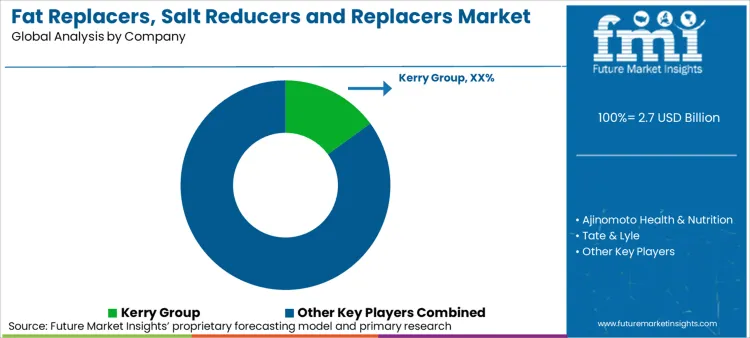
The competitive structure of the market is shifting from standalone ingredient supply toward integrated "sensory rebuilding" partnerships. Roughly one third of the global capacity is controlled by large-scale players like Kerry and IFF who provide modular reformulation platforms such as Tastesense Salt and Flavorfit [1, 8]. These integrated solutions allow manufacturers to solve multiple technical hurdles, such as mouthfeel, off-note masking, and bulking, through a single vendor relationship. According to FMI's estimates, this consolidation of technical expertise limits the pricing leverage of smaller, niche suppliers who cannot offer holistic taste modulators and application support.
Regulatory compliance has become a critical competitive variable that narrows the field to suppliers with robust testing infrastructure. The ability to provide consistent E1 and CARB compliant grades at scale requires significant process control discipline, creating natural attrition among underinvested plants [110]. In June 2025, Ajinomoto Health & Nutrition North America launched new product platforms to tackle food formulation challenges, demonstrating how market leaders use comprehensive R&D to bind customers to their technology stacks [3]. This "specification dependency" makes it difficult for buyers to switch suppliers once a successful reformulation has been locked into high-volume product lines.
Cost survivability at mid-cycle pricing remains the final competitive hurdle, as many fat and salt alternatives carry a price premium over commodity ingredients. Producers with captive feedstock and vertically integrated supply chains, such as Tate & Lyle following its CP Kelco combination in July 2025, can absorb price volatility more effectively [13]. This structural resilience allows these players to sustain supply continuity during disruptions that would otherwise force unintegrated suppliers to lose volume. As per FMI's projection, the most successful aligners will be those who can prove cost-neutrality through savoury flavour blends that reduce raw material usage while maintaining premium sensory profiles.
Recent Developments
The report includes full coverage of key trends from competitive benchmarking. Some of the recent developments covered in the reports:
- In September 2025, Kerry Group launched Smart Taste, a platform that integrates advanced scientific processes to replicate salt and fat profiles across 25 global brands [2].
Key Players in Fat Replacers, Salt Reducers and Replacers
- Kerry Group
- Ajinomoto Health & Nutrition
- Tate & Lyle
- Cargill
- IFF (International Flavors & Fragrances)
- dsm-firmenich
- Symrise
- BASF SE
- ADM (Archer Daniels Midland)
- Corbion
- Givaudan
- Ingredion
Scope of the Report
| Metric | Value |
|---|---|
| Quantitative Units | USD 2.7 billion (2026) to USD 5.0 billion (2036), at a CAGR of 6.4% |
| Market Definition | Advanced ingredient technologies including flavor modulators, mineral salts, and lipid-mimetics designed to reduce sodium and caloric density while maintaining sensory parity in food systems. |
| Product Type Segmentation | Fat Replacers, Salt Reducers and Replacers |
| Form Segmentation | Powder, Liquid, Gel |
| Application Coverage | Bakery and Confectionery, Dairy and Frozen Desserts, Snacks and Savory, Meat and Poultry, Others |
| Regions Covered | North America, Latin America, Europe, East Asia, South Asia, Oceania, Middle East and Africa |
| Countries Covered | United States, China, India, Germany, United Kingdom, Brazil, and 40 plus countries |
| Key Companies Profiled | Kerry Group, Ajinomoto, Tate & Lyle, Cargill, IFF, dsm-firmenich, Symrise, BASF, ADM |
| Forecast Period | 2026 to 2036 |
| Approach | Hybrid top-down and bottom-up modeling validated through trade data, capacity checks, and primary industry interviews. |
Fat Replacers, Salt Reducers and Replacers Market Analysis by Segments
Product Type
- Fat Replacers
- Salt Reducers and Replacers
Form
- Powder
- Liquid
- Gel
Application
- Bakery and Confectionery
- Dairy and Frozen Desserts
- Snacks and Savory
- Meat and Poultry
- Others
Region
- Asia Pacific
- India
- China
- Japan
- South Korea
- Indonesia
- Australia & New Zealand
- ASEAN
- Rest of Asia Pacific
- Europe
- Germany
- Italy
- France
- United Kingdom
- Spain
- Benelux
- Nordics
- Central & Eastern Europe
- Rest of Europe
- North America
- United States
- Canada
- Mexico
- Latin America
- Brazil
- Argentina
- Chile
- Rest of Latin America
- Middle East & Africa
- Kingdom of Saudi Arabia
- United Arab Emirates
- South Africa
- Turkey
- Rest of Middle East & Africa
Bibliography
- [1] WHO (2025). Sodium Reduction Fact Sheet.
- [2] CDC (2025). Sodium Intake and Heart Health in the U.S.
- [3] Ajinomoto (2025). Product Platform Launch for North America.
- [4] CDC (2024). Adult Obesity Prevalence and Trends.
- [5] Cargill (2024). Potassium Pro Ultra Fine Application Guidance.
- [7] IFF (2024). Groundbreaking Innovations at Gulfood Manufacturing.
- [8] IFF (2024). Flavorfit Taste Modulation and Salt Reduction Solutions.
- [10] Tate & Lyle (2024). Automated Lab Launch in Singapore.
- [11] National Health Commission of China (2025). National Nutrition Guidelines and Salt Targets.
- [12] Press Information Bureau India (2024). FSSAI Labeling Mandate for HFSS Foods.
- [13] FDA (2024). Final Determination Regarding PHOs and Trans Fat.
- [14] WHO (2024). Global Trans-fat Elimination Progress Report.
- [15] Symrise (2025). Symvision AI Expansion for Taste Design.
- [16] Ajinomoto Group (2025). Sustainability and Health Report.
- [17] FDA (2024). Sodium Reduction Goals and Public Health Impact.
- [18] University of Oxford (2026). Salt Reduction Research in the UK.
- [19] BfR Germany (2025). Salt and Iodine Nutrition Guidelines.
- [20] BfR Germany (2025). Maximum Iodine Levels Update.
- [21] Tate & Lyle (2024). Executive Statement on NPD Transformation.
- [22] Kerry Group (2025). Smart Taste Platform Launch and Science.
This bibliography is provided for reader reference and is not exhaustive. The full report contains the complete reference list and detailed citations.
This Report Addresses
- Market intelligence to enable structured strategic decision making across global nutrition and reformulation cycles.
- Market size estimation and 10-year revenue forecasts from 2026 to 2036, supported by validated production and regulatory benchmarks.
- Growth opportunity mapping across fat replacers and salt reducers with emphasis on ULEF and clean-label transitions.
- Segment and regional revenue forecasts covering bakery, dairy, savory snacks, and meat applications.
- Competition strategy assessment including integrated partnership models, cost survivability, and compliance capability benchmarking.
- Product reformulation tracking including potassium enrichment, umami enhancement, and texture-mimetic engineering.
- Regulatory impact analysis covering front-of-pack labeling, sodium caps, and trans-fat elimination mandates.
Frequently Asked Questions
How large is the demand for Fat Replacers, Salt Reducers and Replacers in the global market in 2026?
Demand is estimated to be valued at USD 2.7 billion in 2026.
What will be the market size of Fat Replacers, Salt Reducers and Replacers in the global market by 2036?
The market size is projected to reach USD 5.0 billion by 2036.
What is the expected demand growth for Fat Replacers, Salt Reducers and Replacers in the global market between 2026 and 2036?
The market is expected to grow at a CAGR of 6.4% between 2026 and 2036.
Which Product Type is poised to lead global sales by 2026?
Fat replacers are expected to lead the market, capturing approximately 51.2% of the global share in 2026 due to the obesity crisis.
How significant is the role of Snacks and Savory in driving Fat Replacers, Salt Reducers and Replacers adoption in 2026?
This segment represents a primary volume driver as manufacturers prioritize sodium reduction to meet front-of-pack labeling mandates.
What is driving demand in China?
National health targets aiming to cap daily salt intake at 5 g and a shift toward urban packaged foods are driving growth.
What compliance standards or regulations are referenced for India?
The FSSAI’s July 2024 mandate for bold labeling of sugar, salt, and saturated fat on packaged goods is the key benchmark.
What is the China growth outlook in this report?
China is projected to expand at an 8.6% CAGR during the forecast period.
Why is Europe described as a priority region in this report?
High NCD burdens and strict Nutri-Score optimization trends force a rapid evolution toward clean-label reformulation.
What type of demand dominates in Europe?
Demand is dominated by replacement-driven cycles for high-consistency, clean-label flavor modulators and potassium-based salts.
What is Germany growth outlook in this report?
Germany is projected to grow at a CAGR of 7.4% during 2026 to 2036.
Does the report cover the United Kingdom in its regional analysis?
Yes, the United Kingdom is included under the Europe regional section.
What are the sources referred to for analyzing the United Kingdom?
Official statistics from the UK government and academic research from the University of Oxford are primary reference sources.
What is the main demand theme linked to the United Kingdom in its region coverage?
Growth is tied to industry-wide salt initiatives aiming to drop intake from 6.1 g to 4.9 g per day.
Does the report cover Brazil in its regional analysis?
Yes, Brazil is included under the Latin America regional section.
What is the main Brazil related demand theme in its region coverage?
Which product formats or configurations are strategically important for Asia Pacific supply chains?
Which product formats or configurations are strategically important for Asia Pacific supply chains?
Powder formats are prioritized due to lower storage risk and reduced logistics constraints across regional export channels.
What is Fat Replacers, Salt Reducers and Replacers and what is it mainly used for?
They are functional ingredients used as industrial substitutes in plywood, dairy, and snack manufacturing to lower health risks.
What does Fat Replacers, Salt Reducers and Replacers mean in this report?
The market refers to global production, trade, and industrial consumption of functional reformulation ingredients in liquid, powder, and gel forms.
What is included in the scope of this Fat Replacers, Salt Reducers and Replacers report?
Scope covers ingredients by form, application such as savory snacks and bakery, and regional health-led demand trends.
What is excluded from the scope of this report?
Finished retail foods, non-industrial research, and standard commodity oils or salts are excluded unless part of a functional blend.
What does market forecast mean on this page?
Market forecast represents a model-based projection built on defined assumptions for strategic planning purposes through 2036.
How does FMI build and validate the Fat Replacers, Salt Reducers and Replacers forecast?
The forecast is developed using hybrid top-down and bottom-up modeling validated through trade data, capacity checks, and industry review.
What does zero reliance on speculative third party market research mean here?
Primary interviews and verifiable public datasets are used instead of unverified syndicated market estimates to ensure data integrity.
Preview the report firsthand - request a free sample
Get SampleGet the brochure for pricing and purchase details.
Get PDFTable of Content
- Executive Summary
- Global Market Outlook
- Demand-side Trends
- Supply-side Trends
- Technology Roadmap Analysis
- Analysis and Recommendations
- Market Overview
- Market Coverage / Taxonomy
- Market Definition / Scope / Limitations
- Research Methodology
- Chapter Orientation
- Analytical Lens and Working Hypotheses
- Market Structure, Signals, and Trend Drivers
- Benchmarking and Cross-market Comparability
- Market Sizing, Forecasting, and Opportunity Mapping
- Research Design and Evidence Framework
- Desk Research Programme (Secondary Evidence)
- Company Annual and Sustainability Reports
- Peer-reviewed Journals and Academic Literature
- Corporate Websites, Product Literature, and Technical Notes
- Earnings Decks and Investor Briefings
- Statutory Filings and Regulatory Disclosures
- Technical White Papers and Standards Notes
- Trade Journals, Industry Magazines, and Analyst Briefs
- Conference Proceedings, Webinars, and Seminar Materials
- Government Statistics Portals and Public Data Releases
- Press Releases and Reputable Media Coverage
- Specialist Newsletters and Curated Briefings
- Sector Databases and Reference Repositories
- FMI Internal Proprietary Databases and Historical Market Datasets
- Subscription Datasets and Paid Sources
- Social Channels, Communities, and Digital Listening Inputs
- Additional Desk Sources
- Expert Input and Fieldwork (Primary Evidence)
- Primary Modes
- Qualitative Interviews and Expert Elicitation
- Quantitative Surveys and Structured Data Capture
- Blended Approach
- Why Primary Evidence is Used
- Field Techniques
- Interviews
- Surveys
- Focus Groups
- Observational and In-context Research
- Social and Community Interactions
- Stakeholder Universe Engaged
- C-suite Leaders
- Board Members
- Presidents and Vice Presidents
- R&D and Innovation Heads
- Technical Specialists
- Domain Subject-matter Experts
- Scientists
- Physicians and Other Healthcare Professionals
- Governance, Ethics, and Data Stewardship
- Research Ethics
- Data Integrity and Handling
- Primary Modes
- Tooling, Models, and Reference Databases
- Desk Research Programme (Secondary Evidence)
- Data Engineering and Model Build
- Data Acquisition and Ingestion
- Cleaning, Normalisation, and Verification
- Synthesis, Triangulation, and Analysis
- Quality Assurance and Audit Trail
- Market Background
- Market Dynamics
- Drivers
- Restraints
- Opportunity
- Trends
- Scenario Forecast
- Demand in Optimistic Scenario
- Demand in Likely Scenario
- Demand in Conservative Scenario
- Opportunity Map Analysis
- Product Life Cycle Analysis
- Supply Chain Analysis
- Investment Feasibility Matrix
- Value Chain Analysis
- PESTLE and Porter’s Analysis
- Regulatory Landscape
- Regional Parent Market Outlook
- Production and Consumption Statistics
- Import and Export Statistics
- Market Dynamics
- Global Market Analysis 2021 to 2025 and Forecast, 2026 to 2036
- Historical Market Size Value (USD Million) Analysis, 2021 to 2025
- Current and Future Market Size Value (USD Million) Projections, 2026 to 2036
- Y-o-Y Growth Trend Analysis
- Absolute $ Opportunity Analysis
- Global Market Pricing Analysis 2021 to 2025 and Forecast 2026 to 2036
- Global Market Analysis 2021 to 2025 and Forecast 2026 to 2036, By Product Type
- Introduction / Key Findings
- Historical Market Size Value (USD Million) Analysis By Product Type , 2021 to 2025
- Current and Future Market Size Value (USD Million) Analysis and Forecast By Product Type , 2026 to 2036
- Fat Reducers
- Salt Reducers and Replacers
- Fat Reducers
- Y-o-Y Growth Trend Analysis By Product Type , 2021 to 2025
- Absolute $ Opportunity Analysis By Product Type , 2026 to 2036
- Global Market Analysis 2021 to 2025 and Forecast 2026 to 2036, By Region
- Introduction
- Historical Market Size Value (USD Million) Analysis By Region, 2021 to 2025
- Current Market Size Value (USD Million) Analysis and Forecast By Region, 2026 to 2036
- North America
- Latin America
- Western Europe
- Eastern Europe
- East Asia
- South Asia and Pacific
- Middle East & Africa
- Market Attractiveness Analysis By Region
- North America Market Analysis 2021 to 2025 and Forecast 2026 to 2036, By Country
- Historical Market Size Value (USD Million) Trend Analysis By Market Taxonomy, 2021 to 2025
- Market Size Value (USD Million) Forecast By Market Taxonomy, 2026 to 2036
- By Country
- USA
- Canada
- Mexico
- By Product Type
- By Country
- Market Attractiveness Analysis
- By Country
- By Product Type
- Key Takeaways
- Latin America Market Analysis 2021 to 2025 and Forecast 2026 to 2036, By Country
- Historical Market Size Value (USD Million) Trend Analysis By Market Taxonomy, 2021 to 2025
- Market Size Value (USD Million) Forecast By Market Taxonomy, 2026 to 2036
- By Country
- Brazil
- Chile
- Rest of Latin America
- By Product Type
- By Country
- Market Attractiveness Analysis
- By Country
- By Product Type
- Key Takeaways
- Western Europe Market Analysis 2021 to 2025 and Forecast 2026 to 2036, By Country
- Historical Market Size Value (USD Million) Trend Analysis By Market Taxonomy, 2021 to 2025
- Market Size Value (USD Million) Forecast By Market Taxonomy, 2026 to 2036
- By Country
- Germany
- UK
- Italy
- Spain
- France
- Nordic
- BENELUX
- Rest of Western Europe
- By Product Type
- By Country
- Market Attractiveness Analysis
- By Country
- By Product Type
- Key Takeaways
- Eastern Europe Market Analysis 2021 to 2025 and Forecast 2026 to 2036, By Country
- Historical Market Size Value (USD Million) Trend Analysis By Market Taxonomy, 2021 to 2025
- Market Size Value (USD Million) Forecast By Market Taxonomy, 2026 to 2036
- By Country
- Russia
- Poland
- Hungary
- Balkan & Baltic
- Rest of Eastern Europe
- By Product Type
- By Country
- Market Attractiveness Analysis
- By Country
- By Product Type
- Key Takeaways
- East Asia Market Analysis 2021 to 2025 and Forecast 2026 to 2036, By Country
- Historical Market Size Value (USD Million) Trend Analysis By Market Taxonomy, 2021 to 2025
- Market Size Value (USD Million) Forecast By Market Taxonomy, 2026 to 2036
- By Country
- China
- Japan
- South Korea
- By Product Type
- By Country
- Market Attractiveness Analysis
- By Country
- By Product Type
- Key Takeaways
- South Asia and Pacific Market Analysis 2021 to 2025 and Forecast 2026 to 2036, By Country
- Historical Market Size Value (USD Million) Trend Analysis By Market Taxonomy, 2021 to 2025
- Market Size Value (USD Million) Forecast By Market Taxonomy, 2026 to 2036
- By Country
- India
- ASEAN
- Australia & New Zealand
- Rest of South Asia and Pacific
- By Product Type
- By Country
- Market Attractiveness Analysis
- By Country
- By Product Type
- Key Takeaways
- Middle East & Africa Market Analysis 2021 to 2025 and Forecast 2026 to 2036, By Country
- Historical Market Size Value (USD Million) Trend Analysis By Market Taxonomy, 2021 to 2025
- Market Size Value (USD Million) Forecast By Market Taxonomy, 2026 to 2036
- By Country
- Kingdom of Saudi Arabia
- Other GCC Countries
- Turkiye
- South Africa
- Other African Union
- Rest of Middle East & Africa
- By Product Type
- By Country
- Market Attractiveness Analysis
- By Country
- By Product Type
- Key Takeaways
- Key Countries Market Analysis
- USA
- Pricing Analysis
- Market Share Analysis, 2025
- By Product Type
- Canada
- Pricing Analysis
- Market Share Analysis, 2025
- By Product Type
- Mexico
- Pricing Analysis
- Market Share Analysis, 2025
- By Product Type
- Brazil
- Pricing Analysis
- Market Share Analysis, 2025
- By Product Type
- Chile
- Pricing Analysis
- Market Share Analysis, 2025
- By Product Type
- Germany
- Pricing Analysis
- Market Share Analysis, 2025
- By Product Type
- UK
- Pricing Analysis
- Market Share Analysis, 2025
- By Product Type
- Italy
- Pricing Analysis
- Market Share Analysis, 2025
- By Product Type
- Spain
- Pricing Analysis
- Market Share Analysis, 2025
- By Product Type
- France
- Pricing Analysis
- Market Share Analysis, 2025
- By Product Type
- India
- Pricing Analysis
- Market Share Analysis, 2025
- By Product Type
- ASEAN
- Pricing Analysis
- Market Share Analysis, 2025
- By Product Type
- Australia & New Zealand
- Pricing Analysis
- Market Share Analysis, 2025
- By Product Type
- China
- Pricing Analysis
- Market Share Analysis, 2025
- By Product Type
- Japan
- Pricing Analysis
- Market Share Analysis, 2025
- By Product Type
- South Korea
- Pricing Analysis
- Market Share Analysis, 2025
- By Product Type
- Russia
- Pricing Analysis
- Market Share Analysis, 2025
- By Product Type
- Poland
- Pricing Analysis
- Market Share Analysis, 2025
- By Product Type
- Hungary
- Pricing Analysis
- Market Share Analysis, 2025
- By Product Type
- Kingdom of Saudi Arabia
- Pricing Analysis
- Market Share Analysis, 2025
- By Product Type
- Turkiye
- Pricing Analysis
- Market Share Analysis, 2025
- By Product Type
- South Africa
- Pricing Analysis
- Market Share Analysis, 2025
- By Product Type
- USA
- Market Structure Analysis
- Competition Dashboard
- Competition Benchmarking
- Market Share Analysis of Top Players
- By Regional
- By Product Type
- Competition Analysis
- Competition Deep Dive
- Kerry Group
- Overview
- Product Portfolio
- Profitability by Market Segments (Product/Age /Sales Channel/Region)
- Sales Footprint
- Strategy Overview
- Marketing Strategy
- Product Strategy
- Channel Strategy
- Ajinomoto Health & Nutrition
- Tate & Lyle
- Cargill
- IFF (International Flavors & Fragrances)
- dsm-firmenich
- Kerry Group
- Competition Deep Dive
- Assumptions & Acronyms Used


