

- Industry Size (2026)
- USD 2890.0 Mn
- Forecast (2036)
- USD 6068.1 Mn
- CAGR (2026 to 2036)
- 7.7%
Fat Replacers and Fat Mimetics Market Forecast and Outlook 2026 to 2036
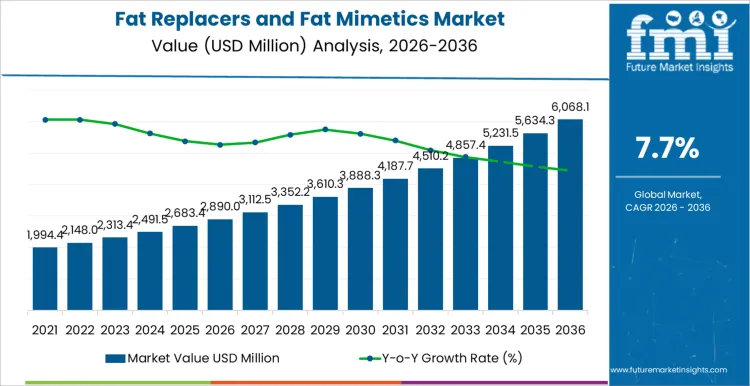
The fat replacers and fat mimetics market is likely to be valued at USD 2,890.0 million in 2026, and is set to reach USD 6,068.1 million by 2036, at a CAGR of 7.7% over the forecast period. Demand momentum is tied to reformulation programs across bakery, dairy, spreads, sauces, and ready meals where fat reduction alters texture, lubrication, and flavor delivery. Fat replacers and mimetics compensate for the loss of creaminess, moisture retention, and mouth coating traditionally delivered by fats, allowing manufacturers to meet calorie and saturated fat reduction objectives without eroding eating quality. Carbohydrate- and protein-based systems dominate use in high-volume applications because they deliver bulk and structure under baking, freezing, and shear-intensive processing conditions. Reduced-fat baked goods, frozen desserts, and dairy alternatives rely on these systems to preserve softness, melt behavior, and indulgent sensory cues that influence repeat purchase decisions.
Meal replacements, nutrition bars, and medical nutrition products increasingly specify fat mimetics to support smooth texture and controlled energy density within tightly defined macronutrient targets. Ingredient suppliers focus on multifunctional systems that deliver creaminess, moisture control, and flavor release at low inclusion rates to manage formulation cost and label complexity. Technical validation through rheology testing and sensory benchmarking guides selection across different matrices, particularly where freeze-thaw stability or extended shelf life is required. Regulatory variability across regions influences formulation strategies for global brands, encouraging modular fat replacement platforms adaptable to local compliance needs. As reformulation depth increases across mainstream and health-positioned portfolios, fat replacers and fat mimetics remain central to texture recovery rather than optional calorie-reduction tools.
Quick Stats for Fat Replacers and Fat Mimetics Market
- Fat Replacers and Fat Mimetics Market Value (2026): USD 2,890.0 million
- Fat Replacers and Fat Mimetics Market Forecast Value (2036): USD 6,068.1 million
- Fat Replacers and Fat Mimetics Market Forecast CAGR 2026 to 2036: 7.7%
- Leading Ingredient Type by Demand Share: Carbohydrate-based fat replacers
- Fastest-Growing Countries: India, China, Brazil, USA, UK
- Top Players in Global Demand: Ingredion, Cargill, Tate & Lyle, ADM, DSM-Firmenich
Fat Replacers and Fat Mimetics Market Key Takeaways
| Metric | Value |
|---|---|
| Market Value (2026) | USD 2,890.0 million |
| Market Forecast Value (2036) | USD 6,068.1 million |
| Forecast CAGR 2026 to 2036 | 7.7% |
Why is the Demand for Fat Replacers and Fat Mimetics Market Growing?
Demand for fat replacers and fat mimetics is rising as food developers reformulate products to meet consumer interest in lower calorie and better-for-you options while retaining desirable sensory qualities. Traditional fat contributes to creaminess, mouth coating, and texture in products such as dressings, ice cream, baked goods, and spreads. When fat content is reduced to align with dietary recommendations that emphasize calorie control and lower saturated fat intake, fat replacers and mimetics help maintain structure and palatability. Manufacturers in dairy, bakery, and snack sectors integrate carbohydrate, protein, or lipid based fat mimetics to simulate the lubricity and richness of full fat ingredients. This need is heightened in beverage and confectionery categories where low fat versions can suffer from thinness or off texture without effective replacement systems.
Procurement of fat replacers and fat mimetics is supported by regulatory frameworks and labeling standards that draw attention to nutrient composition and encourage reformulation toward nutrient profiles perceived as healthier. Ingredient specialists optimize solutions that perform across thermal processing, shelf life demands, and varying pH conditions typical of mass produced foods. Sensory testing and texture analysis guide selection of specific mimetics to achieve targeted viscosity, creaminess, and bite characteristics. Product developers in meal replacements and nutrition bars use these technologies to support smooth texture while meeting macro nutrient goals.
How Is the Fat Replacers and Fat Mimetics Industry Segmented by Ingredient Type, Functional Role, and Application?
Demand for fat replacers and fat mimetics is driven by calorie reduction targets, reformulation of traditional foods, and nutritional labeling pressures. Food manufacturers focus on maintaining sensory quality while lowering fat content across bakery, dairy, and processed food categories. Adoption patterns vary based on processing conditions, cost constraints, and consumer acceptance of ingredient sources. Functional performance, stability during processing, and regulatory suitability influence selection decisions. Segmentation explains how ingredient composition, functional contribution, and application environment shape usage across reduced-fat product development.
Which Ingredient Type Holds the Largest Share in Fat Replacers and Fat Mimetics?
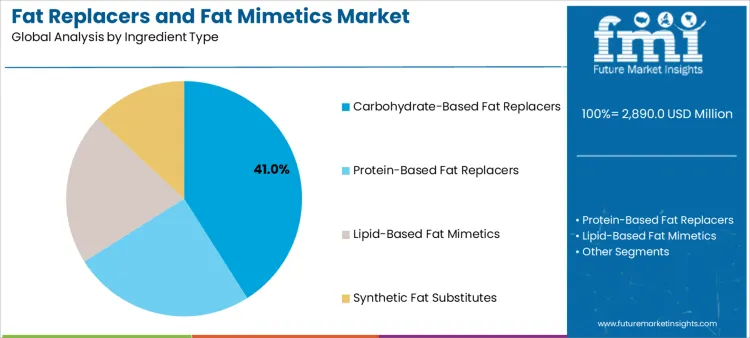
Carbohydrate-based fat replacers hold 41.0%, reflecting widespread use in delivering bulk, viscosity, and creaminess in reduced-fat formulations. These ingredients are commonly applied in bakery and dairy systems due to thermal stability and cost efficiency. Protein-based fat replacers account for 29.0%, supporting structure and mouth-coating properties, particularly in dairy and nutritional products. Lipid-based fat mimetics at 24.0% replicate lubricity and flavor release associated with fats. Synthetic fat substitutes represent 6.0%, applied selectively due to regulatory and labeling considerations. Ingredient segmentation highlights preference for carbohydrate systems supported by functional versatility and processing tolerance.
Key Points
- Carbohydrate systems dominate due to bulk and texture contribution.
- Protein-based replacers enhance structure and creaminess.
- Lipid mimetics replicate fat-like sensory behavior.
How Does Functional Role Influence Demand for Fat Replacers and Fat Mimetics?
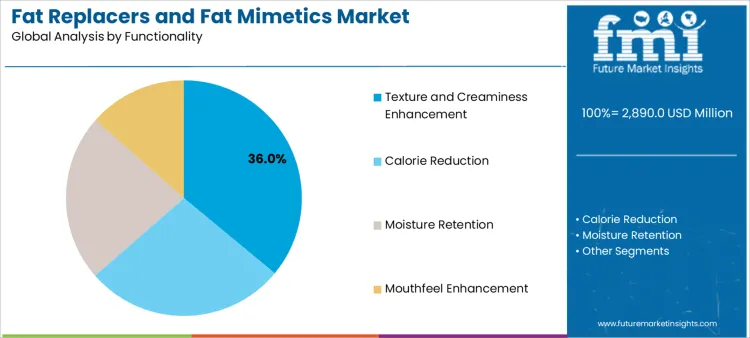
Texture and creaminess enhancement represents 36.0%, driven by need to compensate for sensory losses in reduced-fat products. Calorie reduction accounts for 28.0%, reflecting formulation strategies targeting lower energy density without compromising palatability. Moisture retention at 21.0% supports shelf life and softness, particularly in baked goods and processed foods. Mouthfeel enhancement at 15.0% focuses on lubricity and oral perception. Functional segmentation shows stronger utilization where multiple sensory attributes must be restored simultaneously to meet consumer expectations.
Key Points
- Texture restoration drives primary functional demand.
- Calorie reduction remains a core formulation objective.
- Moisture and mouthfeel support product stability and acceptance.
Which Applications Drive Utilization of Fat Replacers and Fat Mimetics?
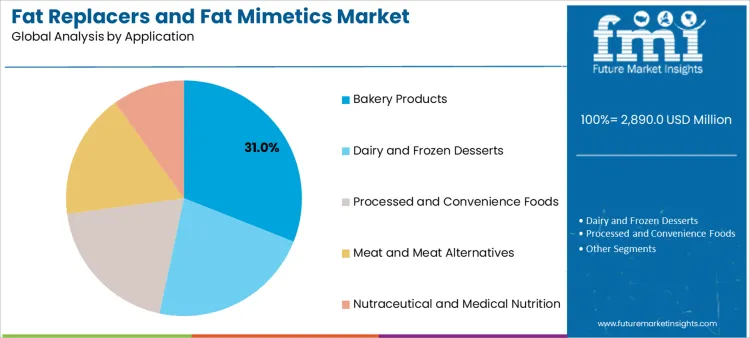
Bakery products account for 31.0%, reflecting high reliance on fat for texture, volume, and mouthfeel. Dairy and frozen desserts at 28.0% apply replacers to manage creaminess and melt behavior. Processed and convenience foods represent 22.0%, focusing on stability and sensory consistency. Meat and meat alternatives at 12.0% use replacers to improve juiciness and texture. Nutraceutical and medical nutrition at 7.0% emphasize controlled calorie intake and digestibility. Application segmentation highlights stronger adoption where fat reduction directly impacts sensory quality.
Key Points
- Bakery applications lead due to high fat dependency.
- Dairy formulations require precise creaminess control.
- Processed foods focus on stability and consistency.
What are the Key Dynamics in the Fat Replacers and Fat Mimetics Market?
Demand in the fat replacers and fat mimetics market is driven by food manufacturers seeking to reduce caloric density and saturated fat content while maintaining sensory properties traditionally delivered by fats. Key applications include dairy products, bakery items, confectionery, dressings, and meat alternatives where textural richness, lubrication, and mouth coating significantly impact consumer acceptance. Value is determined by the effectiveness of a replacer or mimetic to replicate performance attributes of fat without compromising process stability or label positioning. Procurement decisions revolve around functional performance under specific processing regimes, cost per functional yield, and compatibility with targeted nutrition profiles.
How do nutritional reformulation goals and sensory texture requirements shape adoption?
Demand for fat replacers and fat mimetics increases where nutritional targets require meaningful reductions in fat content without sacrificing eating quality. In dairy products such as yogurts and cheeses, formulators select carbohydrate-based or protein-based replacers that replicate creaminess and body lost during fat reduction, maintaining palatability and consumer satisfaction. Baked products reformulated to lower fat levels depend on mimetics that deliver crumb softness and moisture retention normally provided by fats, supporting shelf life and mouthfeel. Dressings and sauces, where fat contributes to viscosity and flavor release, use structured replacers to balance shear response during dispensing with sensory richness on consumption. Emerging plant-based meat and dairy alternatives require systems that mimic adipose behavior, helping approximate juiciness and succulence found in animal-derived fats. Functional stability under heat, shear, and storage is a critical selection criterion influencing adoption in these categories.
How do regulatory landscapes and functional limits influence scalability?
Scalability in the fat replacers and fat mimetics market is influenced by varied regulatory environments and the functional limits of specific ingredient systems within complex food matrices. Regions differ in how fat replacer classes are regulated, including permitted use levels, labeling requirements, and nutritional claims, which affects global formulation strategies for multinational food brands. Technical constraints arise when certain mimetics do not perform effectively under extreme pH, high temperatures, or during freeze-thaw cycles, necessitating iterative development to achieve target quality. Cost pressures emerge when multi-component systems are required to balance texture, flavor release, and process tolerance, particularly in high-volume segments like bakery and dairy. Sensory evaluation intensity increases development time, as trained panels are needed to validate that textural and flavor benchmarks are met. These factors shape decisions about where and how extensively fat replacers are employed, influencing market penetration across product categories with differing quality expectations.
How Is Demand for the Fat Replacers and Fat Mimetics Market Evolving Globally?
Global demand for fat replacers and fat mimetics is increasing as food manufacturers reformulate products to lower fat content while preserving taste, texture, and mouthfeel. Growth reflects regulatory pressure on saturated fat intake, rising obesity concerns, and portfolio shifts toward healthier processed foods. Demand expansion remains closely linked to bakery, dairy, spreads, sauces, and ready meal reformulation activity. India records 9.1% CAGR, China records 8.8% CAGR, Brazil records 8.4% CAGR, USA records 7.2% CAGR, and UK records 7.0% CAGR. Adoption intensity is driven by reformulation complexity rather than incremental growth in food consumption volumes.
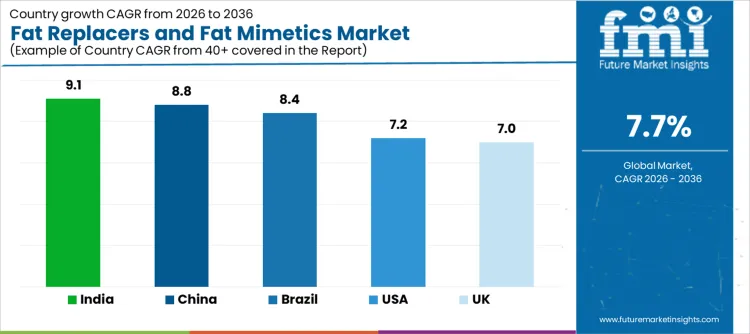
| Country | CAGR (%) |
|---|---|
| India | 9.1% |
| China | 8.8% |
| Brazil | 8.4% |
| USA | 7.2% |
| UK | 7.0% |
What is driving growth of fat replacers and fat mimetics demand in India?
Demand for fat replacers and fat mimetics in India is expanding as packaged food and dairy manufacturers reduce fat levels across mass-market products. Growth at 9.1% CAGR reflects reformulation of biscuits, snacks, spreads, and dairy desserts targeting calorie-conscious urban consumers. Texture and mouthfeel loss from fat reduction increases reliance on carbohydrate-based and protein-based mimetics. Cost sensitivity favors ingredients delivering creaminess and structure at low inclusion rates. Domestic food processors prioritize heat-stable replacers compatible with high-throughput manufacturing. Demand remains concentrated within bakery, dairy, and value-added snack categories positioned around health-forward claims.
- Reformulation of bakery and snack products
- Rising demand for low-fat dairy alternatives
- Cost-efficient texture restoration needs
- Urban health-oriented product positioning
Why is China seeing expansion in fat replacers and fat mimetics adoption?
Fat replacers and fat mimetics demand in China is rising as large food processors adjust formulations to align with dietary fat intake guidance. Growth at 8.8% CAGR reflects strong activity across baked goods, dairy beverages, and ready meals. Reduced-fat formulations create challenges in texture, lubrication, and flavor release, increasing reliance on functional mimetics. High-volume manufacturing environments require consistent performance across large batches. Domestic ingredient suppliers scale starch, fiber, and fermentation-derived solutions for industrial use. Demand remains strongest among centralized processors supplying national retail chains.
- Dietary fat reduction policy alignment
- High-volume industrial food processing
- Texture correction in reduced-fat products
- Expansion of ready meal categories
What factors are shaping fat replacers and fat mimetics sales in Brazil?
Sales of fat replacers and fat mimetics in Brazil are increasing as food manufacturers respond to nutrition labeling rules and consumer awareness of fat intake. Growth at 8.4% CAGR reflects reformulation across bakery, spreads, and dairy-based products. Reduced-fat formulations require mimetics to maintain creaminess and indulgent mouthfeel. Tropical climate storage conditions increase demand for stabilizing fat replacement systems. Local producers emphasize taste preservation to protect mass-market acceptance. Demand remains concentrated within packaged foods serving price-sensitive consumers.
- Nutrition labeling compliance pressure
- Reformulation of bakery and dairy products
- Need for creaminess preservation
- Focus on mass-market taste acceptance
How is the USA supporting growth of fat replacers and fat mimetics demand?
Fat replacers and fat mimetics market demand in the USA is advancing as manufacturers pursue low-fat and reduced-calorie positioning across established brands. Growth at 7.2% CAGR reflects portfolio-wide reformulation in snacks, sauces, dairy alternatives, and frozen meals. Regulatory focus on nutritional transparency influences ingredient strategies. Protein-based and fiber-based mimetics are specified to maintain mouthfeel and satiety. Large manufacturers prioritize clean label compatibility and functional consistency. Demand is driven by reformulation risk management rather than expansion of processed food output.
- Portfolio-wide low-fat reformulation
- Demand for clean label fat alternatives
- Growth of dairy alternative products
- Focus on mouthfeel and satiety retention
What is driving expansion of fat replacers and fat mimetics demand in the UK?
Demand for fat replacers and fat mimetics in the UK is rising as public health frameworks and retailer standards encourage reduced-fat formulations. Growth at 7.0% CAGR reflects reformulation across bakery, ready meals, and dairy alternatives. Texture loss from fat reduction creates reliance on mimetics that restore creaminess and structure. Retailer nutritional benchmarks accelerate adoption across private label ranges. Ingredient selection emphasizes regulatory approval and label simplicity. Demand remains linked to compliance-driven reformulation cycles rather than changes in food consumption patterns.
- Public health driven fat reduction targets
- Retailer nutritional standard enforcement
- Expansion of reduced-fat ready meals
- Clean label ingredient preference
What is the competitive landscape of demand for the fat replacers and fat mimetics market globally?
Demand for fat replacers and fat mimetics is driven by calorie reduction targets, nutritional labeling pressure, and texture preservation needs in processed foods. Product developers assess fat-like mouthfeel delivery, lubrication behavior, thermal stability, and performance across dairy, bakery, sauces, and plant-based formulations. Buyer assessment includes clean label alignment, sensory neutrality, process tolerance, and effectiveness at low inclusion levels. Procurement behavior reflects long reformulation cycles, extensive pilot trials, and preference for suppliers offering application support and sensory validation. Trend in the fat replacers and fat mimetics market reflects expanding use in reduced-fat and plant-forward products seeking taste and texture parity.
Ingredion leads competitive positioning through carbohydrate- and fiber-based fat mimetic systems integrated within broader texture platforms. Cargill competes by offering fat replacement solutions combined with stabilizers and emulsifiers supporting formulation robustness. Tate and Lyle supports demand with fiber-derived fat replacers aligned with calorie reduction and clean label strategies. ADM maintains relevance through formulation expertise and scalable ingredient systems across global food manufacturers. DSM-Firmenich participates with fat mimetic technologies supported by sensory science and co-development capabilities. Competitive differentiation centers on texture authenticity, formulation flexibility, regulatory coverage, and depth of technical collaboration.
Key Players in the Fat Replacers and Fat Mimetics Market
- Ingredion
- Cargill
- Tate & Lyle
- ADM
- DSM-Firmenich
- Others
Scope of the Report
| Items | Values |
|---|---|
| Quantitative Units | USD million |
| Ingredient Type | Carbohydrate-Based Fat Replacers; Protein-Based Fat Replacers; Lipid-Based Fat Mimetics; Synthetic Fat Substitutes |
| Functionality | Texture and Creaminess Enhancement; Calorie Reduction; Moisture Retention; Mouthfeel Enhancement |
| Application | Bakery Products; Dairy and Frozen Desserts; Processed and Convenience Foods; Meat and Meat Alternatives; Nutraceutical and Medical Nutrition |
| Regions Covered | Asia Pacific, Europe, North America, Latin America, Middle East & Africa |
| Countries Covered | India, China, Brazil, USA, UK, and 40+ countries |
| Key Companies Profiled | Ingredion; Cargill; Tate & Lyle; ADM; DSM-Firmenich; Others |
| Additional Attributes | Dollar sales by ingredient type, functionality, and application; performance of carbohydrate, protein, and lipid-based systems in replicating fat-like texture and creaminess; calorie reduction efficiency without compromising sensory attributes; stability across baking, freezing, and thermal processing conditions; formulation compatibility with clean-label and nutritional claims; procurement dynamics driven by large-scale reformulation initiatives and long-term supply partnerships with food manufacturers. |
Fat Replacers and Fat Mimetics Market by Segment
Ingredient Type:
- Carbohydrate-Based Fat Replacers
- Protein-Based Fat Replacers
- Lipid-Based Fat Mimetics
- Synthetic Fat Substitutes
Functionality:
- Texture and Creaminess Enhancement
- Calorie Reduction
- Moisture Retention
- Mouthfeel Enhancement
Application:
- Bakery Products
- Dairy and Frozen Desserts
- Processed and Convenience Foods
- Meat and Meat Alternatives
- Nutraceutical and Medical Nutrition
Region:
- Asia Pacific
- China
- Japan
- South Korea
- India
- Australia & New Zealand
- ASEAN
- Rest of Asia Pacific
- Europe
- Germany
- United Kingdom
- France
- Italy
- Spain
- Nordic
- BENELUX
- Rest of Europe
- North America
- United States
- Canada
- Mexico
- Latin America
- Brazil
- Chile
- Rest of Latin America
- Middle East & Africa
- Kingdom of Saudi Arabia
- Other GCC Countries
- Turkey
- South Africa
- Other African Union
- Rest of Middle East & Africa
Bibliography
- European Food Safety Authority. (2023). Safety assessment and functional considerations of fat replacers and fat mimetics used in food products. EFSA Journal.
- Food and Agriculture Organization of the United Nations. (2023). Dietary fat reduction and reformulation strategies: Role of fat replacers and mimetics in food systems. FAO.
- World Health Organization. (2023). Healthy diet guidelines: Implications of fat reduction and use of fat substitutes in processed foods. World Health Organization.
- Codex Alimentarius Commission. (2023). General Standard for Food Additives (GSFA): Provisions relevant to fat replacers, fat mimetics, and texturizing agents. FAO/WHO.
- USA Food and Drug Administration. (2024). Regulatory status and classification of fat replacers and fat mimetics in conventional and medical foods. USA Department of Health and Human Services.
- European Commission. (2024). Guidance on the application of EU food law to fat substitutes and reduced-fat food formulations. European Union.
- International Organization for Standardization. (2023). ISO 11036: Sensory analysis - Methodology for texture and mouthfeel profile evaluation. ISO.
Frequently Asked Questions
How big is the fat replacers and fat mimetics market in 2026?
The global fat replacers and fat mimetics market is estimated to be valued at USD 2,890.0 million in 2026.
What will be the size of fat replacers and fat mimetics market in 2036?
The market size for the fat replacers and fat mimetics market is projected to reach USD 6,068.1 million by 2036.
How much will be the fat replacers and fat mimetics market growth between 2026 and 2036?
The fat replacers and fat mimetics market is expected to grow at a 7.7% CAGR between 2026 and 2036.
What are the key product types in the fat replacers and fat mimetics market?
The key product types in fat replacers and fat mimetics market are carbohydrate-based fat replacers, protein-based fat replacers, lipid-based fat mimetics and synthetic fat substitutes.
Which functionality segment to contribute significant share in the fat replacers and fat mimetics market in 2026?
In terms of functionality, texture and creaminess enhancement segment to command 36.0% share in the fat replacers and fat mimetics market in 2026.
Preview the report firsthand - request a free sample
Get SampleGet the brochure for pricing and purchase details.
Get PDFTable of Content
- Executive Summary
- Global Market Outlook
- Demand-side Trends
- Supply-side Trends
- Technology Roadmap Analysis
- Analysis and Recommendations
- Market Overview
- Market Coverage / Taxonomy
- Market Definition / Scope / Limitations
- Market Background
- Market Dynamics
- Drivers
- Restraints
- Opportunity
- Trends
- Scenario Forecast
- Demand in Optimistic Scenario
- Demand in Likely Scenario
- Demand in Conservative Scenario
- Opportunity Map Analysis
- Product Life Cycle Analysis
- Supply Chain Analysis
- Investment Feasibility Matrix
- Value Chain Analysis
- PESTLE and Porter’s Analysis
- Regulatory Landscape
- Regional Parent Market Outlook
- Production and Consumption Statistics
- Import and Export Statistics
- Market Dynamics
- Global Market Analysis 2021 to 2025 and Forecast, 2026 to 2036
- Historical Market Size Value (USD Million) Analysis, 2021 to 2025
- Current and Future Market Size Value (USD Million) Projections, 2026 to 2036
- Y-o-Y Growth Trend Analysis
- Absolute $ Opportunity Analysis
- Global Market Pricing Analysis 2021 to 2025 and Forecast 2026 to 2036
- Global Market Analysis 2021 to 2025 and Forecast 2026 to 2036, By Ingredient Type
- Introduction / Key Findings
- Historical Market Size Value (USD Million) Analysis By Ingredient Type , 2021 to 2025
- Current and Future Market Size Value (USD Million) Analysis and Forecast By Ingredient Type , 2026 to 2036
- Carbohydrate-Based Fat Replacers
- Protein-Based Fat Replacers
- Lipid-Based Fat Mimetics
- Synthetic Fat Substitutes
- Carbohydrate-Based Fat Replacers
- Y-o-Y Growth Trend Analysis By Ingredient Type , 2021 to 2025
- Absolute $ Opportunity Analysis By Ingredient Type , 2026 to 2036
- Global Market Analysis 2021 to 2025 and Forecast 2026 to 2036, By Functionality
- Introduction / Key Findings
- Historical Market Size Value (USD Million) Analysis By Functionality, 2021 to 2025
- Current and Future Market Size Value (USD Million) Analysis and Forecast By Functionality, 2026 to 2036
- Texture and Creaminess Enhancement
- Calorie Reduction
- Moisture Retention
- Mouthfeel Enhancement
- Texture and Creaminess Enhancement
- Y-o-Y Growth Trend Analysis By Functionality, 2021 to 2025
- Absolute $ Opportunity Analysis By Functionality, 2026 to 2036
- Global Market Analysis 2021 to 2025 and Forecast 2026 to 2036, By Application
- Introduction / Key Findings
- Historical Market Size Value (USD Million) Analysis By Application, 2021 to 2025
- Current and Future Market Size Value (USD Million) Analysis and Forecast By Application, 2026 to 2036
- Bakery Products
- Dairy and Frozen Desserts
- Processed and Convenience Foods
- Meat and Meat Alternatives
- Nutraceutical and Medical Nutrition
- Bakery Products
- Y-o-Y Growth Trend Analysis By Application, 2021 to 2025
- Absolute $ Opportunity Analysis By Application, 2026 to 2036
- Global Market Analysis 2021 to 2025 and Forecast 2026 to 2036, By Region
- Introduction
- Historical Market Size Value (USD Million) Analysis By Region, 2021 to 2025
- Current Market Size Value (USD Million) Analysis and Forecast By Region, 2026 to 2036
- North America
- Latin America
- Western Europe
- Eastern Europe
- East Asia
- South Asia and Pacific
- Middle East & Africa
- Market Attractiveness Analysis By Region
- North America Market Analysis 2021 to 2025 and Forecast 2026 to 2036, By Country
- Historical Market Size Value (USD Million) Trend Analysis By Market Taxonomy, 2021 to 2025
- Market Size Value (USD Million) Forecast By Market Taxonomy, 2026 to 2036
- By Country
- USA
- Canada
- Mexico
- By Ingredient Type
- By Functionality
- By Application
- By Country
- Market Attractiveness Analysis
- By Country
- By Ingredient Type
- By Functionality
- By Application
- Key Takeaways
- Latin America Market Analysis 2021 to 2025 and Forecast 2026 to 2036, By Country
- Historical Market Size Value (USD Million) Trend Analysis By Market Taxonomy, 2021 to 2025
- Market Size Value (USD Million) Forecast By Market Taxonomy, 2026 to 2036
- By Country
- Brazil
- Chile
- Rest of Latin America
- By Ingredient Type
- By Functionality
- By Application
- By Country
- Market Attractiveness Analysis
- By Country
- By Ingredient Type
- By Functionality
- By Application
- Key Takeaways
- Western Europe Market Analysis 2021 to 2025 and Forecast 2026 to 2036, By Country
- Historical Market Size Value (USD Million) Trend Analysis By Market Taxonomy, 2021 to 2025
- Market Size Value (USD Million) Forecast By Market Taxonomy, 2026 to 2036
- By Country
- Germany
- UK
- Italy
- Spain
- France
- Nordic
- BENELUX
- Rest of Western Europe
- By Ingredient Type
- By Functionality
- By Application
- By Country
- Market Attractiveness Analysis
- By Country
- By Ingredient Type
- By Functionality
- By Application
- Key Takeaways
- Eastern Europe Market Analysis 2021 to 2025 and Forecast 2026 to 2036, By Country
- Historical Market Size Value (USD Million) Trend Analysis By Market Taxonomy, 2021 to 2025
- Market Size Value (USD Million) Forecast By Market Taxonomy, 2026 to 2036
- By Country
- Russia
- Poland
- Hungary
- Balkan & Baltic
- Rest of Eastern Europe
- By Ingredient Type
- By Functionality
- By Application
- By Country
- Market Attractiveness Analysis
- By Country
- By Ingredient Type
- By Functionality
- By Application
- Key Takeaways
- East Asia Market Analysis 2021 to 2025 and Forecast 2026 to 2036, By Country
- Historical Market Size Value (USD Million) Trend Analysis By Market Taxonomy, 2021 to 2025
- Market Size Value (USD Million) Forecast By Market Taxonomy, 2026 to 2036
- By Country
- China
- Japan
- South Korea
- By Ingredient Type
- By Functionality
- By Application
- By Country
- Market Attractiveness Analysis
- By Country
- By Ingredient Type
- By Functionality
- By Application
- Key Takeaways
- South Asia and Pacific Market Analysis 2021 to 2025 and Forecast 2026 to 2036, By Country
- Historical Market Size Value (USD Million) Trend Analysis By Market Taxonomy, 2021 to 2025
- Market Size Value (USD Million) Forecast By Market Taxonomy, 2026 to 2036
- By Country
- India
- ASEAN
- Australia & New Zealand
- Rest of South Asia and Pacific
- By Ingredient Type
- By Functionality
- By Application
- By Country
- Market Attractiveness Analysis
- By Country
- By Ingredient Type
- By Functionality
- By Application
- Key Takeaways
- Middle East & Africa Market Analysis 2021 to 2025 and Forecast 2026 to 2036, By Country
- Historical Market Size Value (USD Million) Trend Analysis By Market Taxonomy, 2021 to 2025
- Market Size Value (USD Million) Forecast By Market Taxonomy, 2026 to 2036
- By Country
- Kingdom of Saudi Arabia
- Other GCC Countries
- Turkiye
- South Africa
- Other African Union
- Rest of Middle East & Africa
- By Ingredient Type
- By Functionality
- By Application
- By Country
- Market Attractiveness Analysis
- By Country
- By Ingredient Type
- By Functionality
- By Application
- Key Takeaways
- Key Countries Market Analysis
- USA
- Pricing Analysis
- Market Share Analysis, 2025
- By Ingredient Type
- By Functionality
- By Application
- Canada
- Pricing Analysis
- Market Share Analysis, 2025
- By Ingredient Type
- By Functionality
- By Application
- Mexico
- Pricing Analysis
- Market Share Analysis, 2025
- By Ingredient Type
- By Functionality
- By Application
- Brazil
- Pricing Analysis
- Market Share Analysis, 2025
- By Ingredient Type
- By Functionality
- By Application
- Chile
- Pricing Analysis
- Market Share Analysis, 2025
- By Ingredient Type
- By Functionality
- By Application
- Germany
- Pricing Analysis
- Market Share Analysis, 2025
- By Ingredient Type
- By Functionality
- By Application
- UK
- Pricing Analysis
- Market Share Analysis, 2025
- By Ingredient Type
- By Functionality
- By Application
- Italy
- Pricing Analysis
- Market Share Analysis, 2025
- By Ingredient Type
- By Functionality
- By Application
- Spain
- Pricing Analysis
- Market Share Analysis, 2025
- By Ingredient Type
- By Functionality
- By Application
- France
- Pricing Analysis
- Market Share Analysis, 2025
- By Ingredient Type
- By Functionality
- By Application
- India
- Pricing Analysis
- Market Share Analysis, 2025
- By Ingredient Type
- By Functionality
- By Application
- ASEAN
- Pricing Analysis
- Market Share Analysis, 2025
- By Ingredient Type
- By Functionality
- By Application
- Australia & New Zealand
- Pricing Analysis
- Market Share Analysis, 2025
- By Ingredient Type
- By Functionality
- By Application
- China
- Pricing Analysis
- Market Share Analysis, 2025
- By Ingredient Type
- By Functionality
- By Application
- Japan
- Pricing Analysis
- Market Share Analysis, 2025
- By Ingredient Type
- By Functionality
- By Application
- South Korea
- Pricing Analysis
- Market Share Analysis, 2025
- By Ingredient Type
- By Functionality
- By Application
- Russia
- Pricing Analysis
- Market Share Analysis, 2025
- By Ingredient Type
- By Functionality
- By Application
- Poland
- Pricing Analysis
- Market Share Analysis, 2025
- By Ingredient Type
- By Functionality
- By Application
- Hungary
- Pricing Analysis
- Market Share Analysis, 2025
- By Ingredient Type
- By Functionality
- By Application
- Kingdom of Saudi Arabia
- Pricing Analysis
- Market Share Analysis, 2025
- By Ingredient Type
- By Functionality
- By Application
- Turkiye
- Pricing Analysis
- Market Share Analysis, 2025
- By Ingredient Type
- By Functionality
- By Application
- South Africa
- Pricing Analysis
- Market Share Analysis, 2025
- By Ingredient Type
- By Functionality
- By Application
- USA
- Market Structure Analysis
- Competition Dashboard
- Competition Benchmarking
- Market Share Analysis of Top Players
- By Regional
- By Ingredient Type
- By Functionality
- By Application
- Competition Analysis
- Competition Deep Dive
- Ingredion
- Overview
- Product Portfolio
- Profitability by Market Segments (Product/Age /Sales Channel/Region)
- Sales Footprint
- Strategy Overview
- Marketing Strategy
- Product Strategy
- Channel Strategy
- Cargill
- Tate & Lyle
- ADM
- DSM-Firmenich
- Others
- Ingredion
- Competition Deep Dive
- Assumptions & Acronyms Used
- Research Methodology


