

- Industry Size (2026)
- USD 2145.0 Mn
- Forecast (2036)
- USD 4219.5 Mn
- CAGR (2026 to 2036)
- 7.0%
Stabilizers for Protein Beverages Market Forecast and Outlook 2026 to 2036
The stabilizers for protein beverages market is projected to reach USD 2,145.0 million in 2026 and is set to expand to USD 4,219.5 million by 2036, at a CAGR of 7.0%. Expansion reflects the technical difficulty of maintaining physical stability in high-protein liquid formats where sedimentation, aggregation, and phase separation directly affect consumer acceptance. Rising use of whey, pea, soy, and blended proteins in ready-to-drink shakes, sports beverages, and medical nutrition increases dependence on stabilizers that control viscosity and particle suspension without creating slimy or chalky mouthfeel. Shelf-stable distribution, exposure to temperature variation, and extended storage cycles further elevate the role of stabilizers in protecting visual appearance and drinkability.
Beverage developers prioritize stabilizers that remain effective under UHT processing, high shear mixing, mineral fortification, and pH variability while supporting clean label objectives. Cost discipline favors multifunctional systems capable of delivering suspension stability, mouthfeel control, and processing tolerance at low inclusion rates. Plant protein variability and sugar reduction strategies add complexity, increasing reliance on stabilizers to preserve consistency across batches and geographies. Regulatory interpretation of hydrocolloids and emulsifiers shapes ingredient selection, especially for brands operating across multiple regions. Demand remains strongest where stabilizers safeguard shelf life performance and sensory reliability in competitive, protein-dense beverage portfolios.
Quick Stats for Stabilizers for Protein Beverages Market
- Stabilizers for Protein Beverages Market Value (2026): USD 2,145.0 million
- Stabilizers for Protein Beverages Market Forecast Value (2036): USD 4,219.5 million
- Stabilizers for Protein Beverages Market Forecast CAGR 2026 to 2036: 7.0%
- Leading Stabilizer Type by Demand Share: Hydrocolloids
- Fastest-Growing Countries: India, China, Brazil, USA, UK
- Top Players in Global Demand: CP Kelco, Cargill, Ingredion, Tate & Lyle, DSM-Firmenich
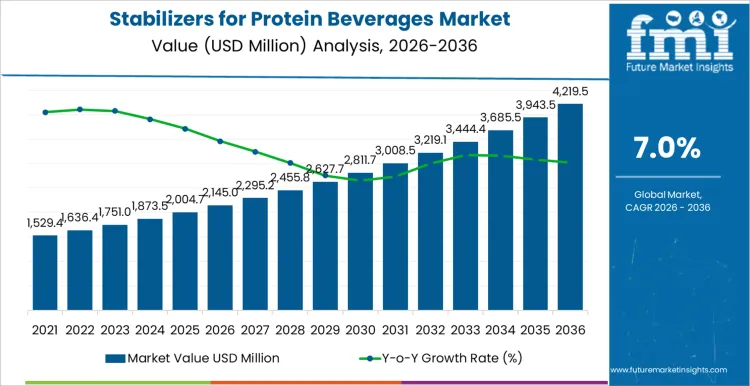
Stabilizers for Protein Beverages Market Key Takeaways
| Metric | Value |
|---|---|
| Market Value (2026) | USD 2,145.0 million |
| Market Forecast Value (2036) | USD 4,219.5 million |
| Forecast CAGR 2026 to 2036 | 7.0% |
Why is the Demand for Stabilizers for Protein Beverages Market Growing?
Protein beverages present formulation challenges tied to solubility, sedimentation, and viscosity that differ dramatically from low protein drinks. Stabilizers for protein beverages interact with protein molecules and water to maintain homogeneous dispersion and prevent phase separation during storage and distribution. Beverage developers targeting high protein waters, shakes, and RTD (ready-to-drink) formats require stabilizers that support clarity, controlled mouthfeel, and a smooth pour without visible flocculation. Plant protein bases such as pea, soy, and rice introduce varying surface charges and hydrophobic interactions that increase the risk of precipitation.
Stabilizers tailored for these systems adjust hydration dynamics and promote network formation that holds protein particles in suspension under differences in temperature and pH common in supply chains and point of sale environments. Growth in active lifestyle and clinical nutrition segments reinforces demand as manufacturers aim to deliver consistent sensory quality in products designed for muscle recovery, weight management, and supplementation routines. Ingredient specialists optimize molecular weight distributions and charge densities of stabilizers to align with specific protein sources and processing conditions such as high shear mixing and heat treatment. Sensory scientists conduct textural profiling to ensure proteins deliver acceptable viscosity without sliminess or chalky mouthfeel. Retail expansion of high protein drink options intensifies competition among producers to maintain shelf stable quality.
How Is the Stabilizers for Protein Beverages Industry Segmented by Stabilizer Type, Beverage Type, and End User?
Stabilizers for protein beverages are selected to manage sedimentation, viscosity control, protein dispersion, and shelf-life stability under thermal and mechanical stress. Demand is shaped by higher protein loading, clean-label constraints, and expansion of ready-to-drink formats across dairy and plant-based categories. Ingredient choice reflects interactions between proteins, fats, and processing conditions such as UHT treatment or high-shear mixing. Segmentation by stabilizer type, beverage format, and end user explains how formulation strategies vary across commercial beverage production models.
Which Stabilizer Type Holds the Largest Share in Protein Beverage Formulations?
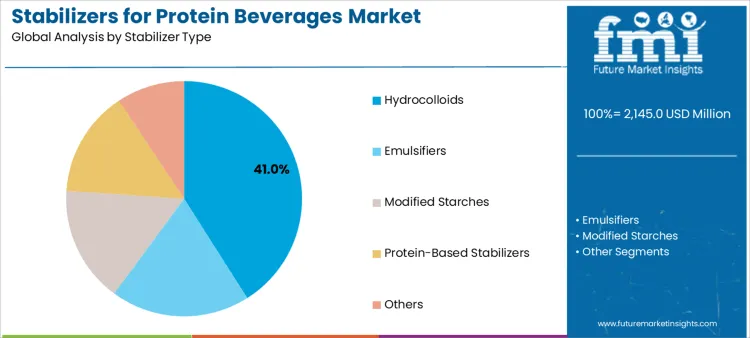
Hydrocolloids hold 41.0%, reflecting their effectiveness in suspension control, viscosity adjustment, and protein stabilization across multiple beverage systems. Emulsifiers account for 24.0%, supporting fat-protein interactions and preventing phase separation in emulsified protein drinks. Modified starches represent 18.0%, used where body enhancement and process tolerance are required at controlled cost. Protein-based stabilizers hold 11.0%, applied in formulations prioritizing label familiarity and protein synergy. Other stabilizer systems account for 6.0%, serving niche functional requirements.
Key Points
- Hydrocolloids dominate due to broad stabilizing functionality.
- Emulsifiers address phase separation challenges.
- Starches balance texture control and processing stability.
How Does Beverage Type Influence Stabilizer Selection?
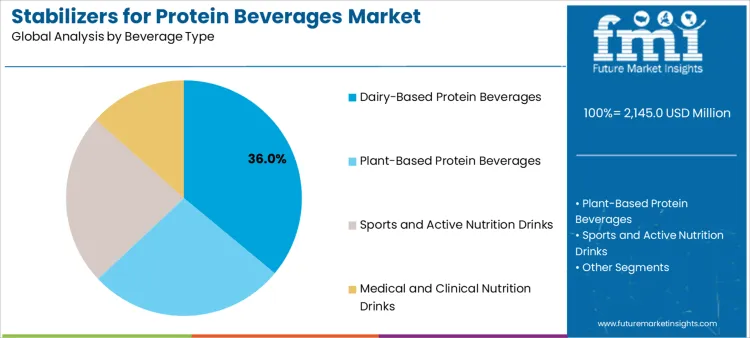
Dairy-based protein beverages represent 36.0%, requiring stabilizers that manage heat stability and casein or whey interactions. Plant-based protein beverages account for 34.0%, driven by sedimentation control and masking of protein-induced viscosity changes. Sports and active nutrition drinks hold 20.0%, emphasizing clarity, mouthfeel, and rapid consumption stability. Medical and clinical nutrition drinks represent 10.0%, where consistency, tolerance, and precise rheology are critical. Beverage type segmentation reflects distinct formulation constraints tied to protein source and consumption context.
Key Points
- Dairy beverages prioritize thermal and protein stability.
- Plant-based drinks require suspension management.
- Clinical beverages demand controlled viscosity profiles.
Which End Users Drive Commercial Demand for Protein Beverage Stabilizers?
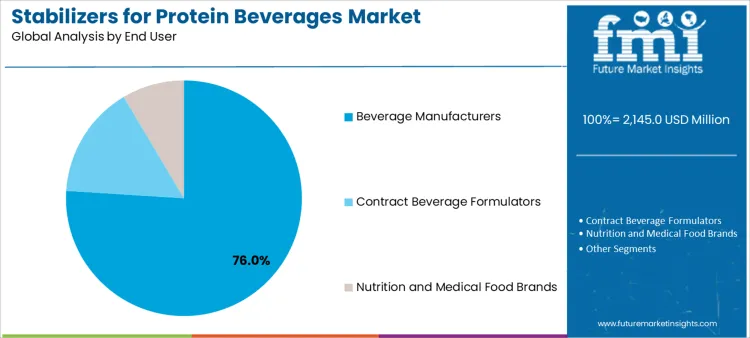
Beverage manufacturers account for 76.0%, reflecting in-house formulation, large-scale processing, and continuous product line extensions. Contract beverage formulators represent 14.0%, supporting emerging brands and private-label protein beverages. Nutrition and medical food brands hold 10.0%, focusing on specialized formulations with strict performance specifications. End user segmentation highlights concentration of stabilizer demand within high-volume beverage production environments.
Key Points
- Large beverage manufacturers dominate stabilizer usage.
- Contract formulators support flexible production models.
- Medical nutrition relies on precise stabilizer performance.
What are the Key Dynamics in the Stabilizers for Protein Beverages Market?
Demand in the stabilizers for protein beverages market is defined by the need to maintain colloidal stability and desirable mouthfeel in high-protein liquid products where phase separation, sedimentation, and grittiness reduce consumer acceptance. Activity is concentrated in ready-to-drink nutrition shakes, plant-based protein drinks, recovery beverages, and medical nutrition formulations. Value depends on a stabilizer’s ability to control viscosity, prevent protein aggregation, and sustain texture through processing and shelf life. Ingredient choice reflects how stabilizers interact with specific proteins and other formulation components under typical temperature and pH conditions inherent to beverage systems.
How do formulation challenges in high-protein liquid systems influence adoption?
In high-protein beverages, proteins tend to denature, aggregate, or precipitate during thermal processing or cold storage, which creates visual separation and unpleasant texture. Beverage developers use hydrocolloids and emulsifiers that build a stable network around protein particles, helping maintain uniform dispersion and a smooth mouthfeel.
Plant proteins such as pea and soy present unique stability challenges because of soluble and insoluble fractions that behave differently under shear and heat. Dairy protein isolates can form gels at moderate temperatures, requiring stabilizers that modulate network strength without excessive thickening. Brands targeting active lifestyle segments require systems that deliver clean mouthfeel without sliminess, balancing pH sensitivity and ionic strength typical of fortified beverage matrices to ensure performance across distribution channels.
How do processing conditions and regulatory definitions affect market scalability?
Market scaling in the stabilizers for protein beverages segment is influenced by how stabilizers perform under a range of processing conditions and by regulatory treatment of specific ingredient categories. Some stabilizers lose functional capacity when exposed to high shear or extended heat, necessitating careful selection to suit pasteurization or UHT parameters. Interaction with minerals, sweeteners, and flavor components can alter viscosity and stability, requiring iterative optimization for each beverage format.
Regulatory frameworks that classify certain hydrocolloids differently across regions affect labeling and permissible use levels, shaping global formulation strategies. Cost pressure emerges where multi-component systems are needed to achieve both stability and preferred sensory attributes, affecting adoption in mainstream and value-oriented beverage lines. Sensory profiling to validate texture and appearance adds development complexity, especially for products positioned on both functionality and drinkability.
How Is Demand for the Stabilizers for Protein Beverages Market Evolving Globally?
Global demand for stabilizers for protein beverages is increasing as high protein drink consumption expands across nutrition and lifestyle categories. Growth reflects rising use of plant and dairy proteins creating stability challenges during processing and storage. Manufacturers specify stabilizers to manage sedimentation, viscosity, and appearance across distribution cycles. Demand aligns with sugar reduction strategies and clean label positioning. India records 8.3% CAGR, China records 8.0% CAGR, Brazil records 7.6% CAGR, USA records 6.2% CAGR, and UK records 5.9% CAGR. Adoption intensity is driven by formulation performance requirements rather than volume expansion.
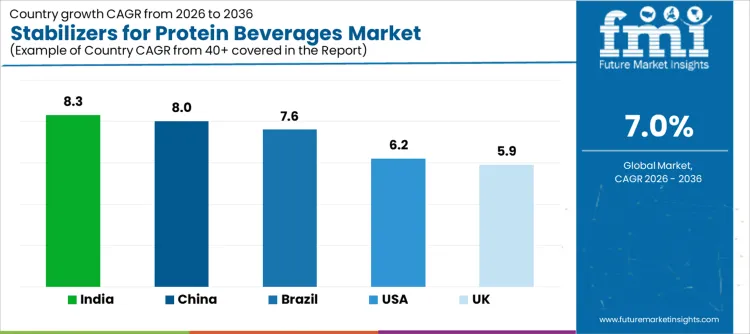
| Country | CAGR (%) |
|---|---|
| India | 8.3% |
| China | 8.0% |
| Brazil | 7.6% |
| USA | 6.2% |
| UK | 5.9% |
What is driving growth of stabilizers for protein beverages demand in India?
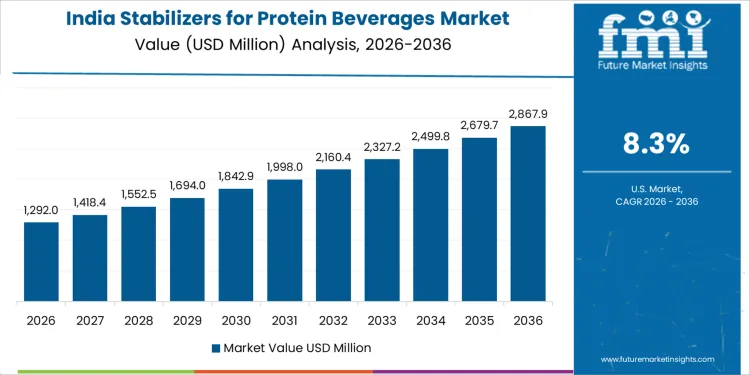
Demand for stabilizers for protein beverages in India is expanding as ready to drink nutrition and sports beverage manufacturing scales nationwide. Growth at 8.3% CAGR reflects rising use of whey, soy, and plant protein systems that require suspension stability across shelf life. High ambient temperatures and extended distribution channels increase reliance on hydrocolloids and emulsifying systems. Cost sensitivity encourages multifunctional stabilizers delivering viscosity control and protein dispersion at low inclusion levels.
Formulators prioritize heat stability and compatibility with aseptic processing. Demand remains concentrated within fortified dairy beverages, sports drinks, and affordable nutrition products targeting urban consumers. Regulatory alignment around protein labeling supports consistent stabilizer specification.
- Expansion of ready to drink protein beverages
- Need for suspension stability in warm climates
- Cost-efficient multifunctional stabilizers
- Growth of urban nutrition consumption
Why is China seeing expansion in stabilizers for protein beverages adoption?
Protein beverage stabilizers demand in China is rising as functional drinks and meal replacement production expands across industrial processors. Growth at 8.0% CAGR reflects high inclusion levels of soy, pea, and dairy proteins requiring uniform suspension during storage. Large batch manufacturing prioritizes stabilizers delivering consistent viscosity and sedimentation control. Centralized production models favor ingredients performing reliably under ultra-high temperature treatment.
Export focused brands emphasize appearance stability across long logistics cycles. Domestic suppliers scale pectin and cellulose based systems for beverage use. Demand concentrates in ready to drink protein shakes and nutritional beverages supplied through modern retail channels. Compliance requirements reinforce adoption.
- Growth of industrial protein beverage production
- High reliance on UHT processing stability
- Expansion of domestic stabilizer supply
- Export driven appearance consistency needs
What factors are shaping stabilizers for protein beverages sales in Brazil?
Sales of stabilizers for protein beverages in Brazil are increasing as manufacturers reformulate dairy based drinks and sports beverages. Growth at 7.6% CAGR reflects rising protein fortification within shelf stable beverages. Tropical climate conditions intensify separation risks, increasing reliance on stabilizers delivering viscosity and mouthfeel balance. Sugar reduction initiatives heighten formulation complexity within flavored protein drinks.
Local producers prioritize cost controlled systems maintaining visual appeal and texture consistency. Demand remains strongest in mass market dairy beverages, protein shakes, and fortified drinks positioned for mainstream consumption. Labeling compliance and ambient storage stability requirements influence ingredient selection decisions across categories nationally markets.
- Tropical climate driven stability challenges
- Expansion of protein-fortified dairy drinks
- Sugar reduction related formulation complexity
- Mass-market beverage reformulation focus
How is the USA supporting growth of stabilizers for protein beverages demand?
Stabilizers for protein beverages demand in the USA is advancing as brands expand high protein positioning across mainstream drinks. Growth at 6.2% CAGR reflects adoption within protein shakes, meal replacements, and medical nutrition. Plant protein usage introduces sedimentation and chalkiness challenges requiring precise stabilization systems. Clean label expectations shape ingredient selection and processing compatibility. Large manufacturers specify stabilizers delivering uniform appearance across national distribution.
Demand is driven by portfolio reformulation and shelf life performance targets rather than new category launches. Regulatory clarity on protein content claims supports consistent formulation strategies nationwide across beverage and nutrition product portfolios widely adopted segments.
- Expansion of high protein beverage portfolios
- Plant protein stabilization requirements
- Clean label formulation priorities
- Nationwide distribution appearance consistency
What is driving expansion of stabilizers for protein beverages demand in the UK?
Demand for stabilizers for protein beverages in the UK is rising as manufacturers reformulate high protein drinks aligned with nutrition targets. Growth at 5.9% CAGR reflects expansion of dairy alternative protein beverages and sports drinks. Sugar reduction and clean label priorities increase reliance on stabilizers supporting suspension without sensory impact. Retail acceptance standards emphasize appearance stability across shelf life. Ingredient choice prioritizes regulatory approval and processing reliability.
Demand remains linked to compliance driven reformulation rather than consumption growth. Beverage brands focus on maintaining homogeneous texture across chilled and ambient storage formats nationally within modern retail channels consistently supplied nationwide operations.
- Growth of dairy alternative protein beverages
- Retail driven appearance stability standards
- Clean label stabilization solutions
- Compliance focused reformulation activity
What is the competitive landscape of demand for the stabilizers for protein beverages market globally?
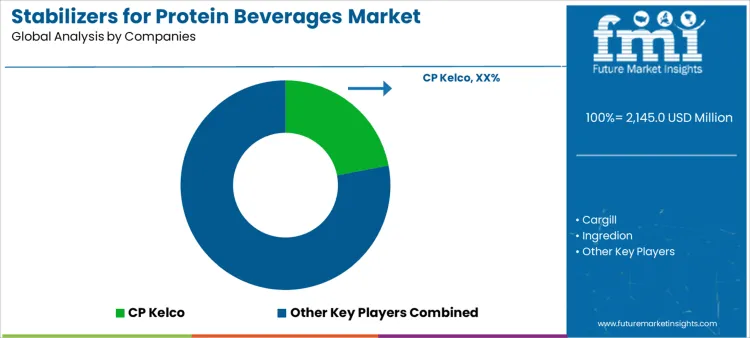
Protein beverage formulation challenges are driving demand for stabilizers that manage sedimentation, viscosity, and phase separation. Beverage developers evaluate suspension efficiency, protein compatibility across whey and plant sources, heat stability during UHT processing, and shelf life consistency. Buyer assessment includes sensory neutrality, mouthfeel contribution, performance at low pH, and tolerance to mineral fortification. Procurement behavior reflects extended pilot testing, reliance on application labs, and preference for suppliers supporting scale-up validation. Trend in the stabilizers for protein beverages market reflects rapid growth in ready to drink nutrition products requiring long term physical stability.
CP Kelco leads competitive positioning through hydrocolloid stabilizers engineered specifically for protein suspension and texture control in beverages. Cargill competes by combining stabilizers with broader texture systems supporting scalable beverage manufacturing. Ingredion supports demand through starch and texturizer solutions aligned with clean label and protein fortified drink formulations. Tate and Lyle maintains relevance by supplying stabilizers designed to balance viscosity and stability without masking protein taste. DSM Firmenich participates with functional systems supported by sensory science and beverage formulation expertise. Competitive differentiation centers on suspension reliability, processing tolerance, sensory impact control, and formulation support depth.
Key Players in the Stabilizers for Protein Beverages Market
- CP Kelco
- Cargill
- Ingredion
- Tate & Lyle
- DSM-Firmenich
- Others
Scope of the Report
| Items | Values |
|---|---|
| Quantitative Units | USD million |
| Stabilizer Type | Hydrocolloids; Emulsifiers; Modified Starches; Protein-Based Stabilizers; Others |
| Beverage Type | Dairy-Based Protein Beverages; Plant-Based Protein Beverages; Sports and Active Nutrition Drinks; Medical and Clinical Nutrition Drinks |
| End User | Beverage Manufacturers; Contract Beverage Formulators; Nutrition and Medical Food Brands |
| Regions Covered | Asia Pacific, Europe, North America, Latin America, Middle East & Africa |
| Countries Covered | India, China, Brazil, USA, UK, and 40+ countries |
| Key Companies Profiled | CP Kelco; Cargill; Ingredion; Tate & Lyle; DSM-Firmenich; Others |
| Additional Attributes | Dollar sales by stabilizer type, beverage type, and end user; dispersion efficiency and long-term suspension stability for high-protein matrices; control of sedimentation, creaming, and phase separation under heat treatment and shelf storage; impact on mouthfeel, viscosity, and clean-label positioning; compatibility with UHT, aseptic filling, and high-shear processing; procurement dynamics shaped by beverage reformulation cycles and co-development with contract formulators. |
Stabilizers for Protein Beverages Market by Segment
Stabilizer Type:
- Hydrocolloids
- Emulsifiers
- Modified Starches
- Protein-Based Stabilizers
- Others
Beverage Type:
- Dairy-Based Protein Beverages
- Plant-Based Protein Beverages
- Sports and Active Nutrition Drinks
- Medical and Clinical Nutrition Drinks
End User:
- Beverage Manufacturers
- Contract Beverage Formulators
- Nutrition and Medical Food Brands
Region:
- Asia Pacific
- China
- Japan
- South Korea
- India
- Australia & New Zealand
- ASEAN
- Rest of Asia Pacific
- Europe
- Germany
- United Kingdom
- France
- Italy
- Spain
- Nordic
- BENELUX
- Rest of Europe
- North America
- United States
- Canada
- Mexico
- Latin America
- Brazil
- Chile
- Rest of Latin America
- Middle East & Africa
- Kingdom of Saudi Arabia
- Other GCC Countries
- Turkey
- South Africa
- Other African Union
- Rest of Middle East & Africa
Bibliography
- Food and Agriculture Organization of the United Nations. (2023). Proteins in liquid food systems: Stability, processing effects, and formulation challenges. FAO.
- International Organization for Standardization. (2023). ISO 13320: Particle size analysis - Laser diffraction methods (applications to beverage dispersion stability). ISO.
- International Organization for Standardization. (2024). ISO 11036: Sensory analysis - Methodology - Texture profile analysis (confirmed current edition). ISO.
- McClements, D. J. (2023). Beverage emulsions and suspensions: Stability mechanisms and formulation strategies. Food Hydrocolloids, 136, 108266.
- Loveday, S. M., & Singh, H. (2024). Interactions of proteins with hydrocolloids in liquid food systems. Current Opinion in Food Science, 56, 101094.
- Zhang, Y., Chen, X., & Liu, F. (2023). Stabilization of plant-protein beverages: Challenges and ingredient solutions. Trends in Food Science & Technology, 134, 210-221.
Frequently Asked Questions
How big is the stabilizers for protein beverages market in 2026?
The global stabilizers for protein beverages market is estimated to be valued at USD 2,145.0 million in 2026.
What will be the size of stabilizers for protein beverages market in 2036?
The market size for the stabilizers for protein beverages market is projected to reach USD 4,219.5 million by 2036.
How much will be the stabilizers for protein beverages market growth between 2026 and 2036?
The stabilizers for protein beverages market is expected to grow at a 7.0% CAGR between 2026 and 2036.
What are the key product types in the stabilizers for protein beverages market?
The key product types in stabilizers for protein beverages market are hydrocolloids, emulsifiers, modified starches, protein-based stabilizers and others.
Which beverage type segment to contribute significant share in the stabilizers for protein beverages market in 2026?
In terms of beverage type, dairy-based protein beverages segment to command 36.0% share in the stabilizers for protein beverages market in 2026.
Preview the report firsthand - request a free sample
Get SampleGet the brochure for pricing and purchase details.
Get PDFTable of Content
- Executive Summary
- Global Market Outlook
- Demand-side Trends
- Supply-side Trends
- Technology Roadmap Analysis
- Analysis and Recommendations
- Market Overview
- Market Coverage / Taxonomy
- Market Definition / Scope / Limitations
- Market Background
- Market Dynamics
- Drivers
- Restraints
- Opportunity
- Trends
- Scenario Forecast
- Demand in Optimistic Scenario
- Demand in Likely Scenario
- Demand in Conservative Scenario
- Opportunity Map Analysis
- Product Life Cycle Analysis
- Supply Chain Analysis
- Investment Feasibility Matrix
- Value Chain Analysis
- PESTLE and Porter’s Analysis
- Regulatory Landscape
- Regional Parent Market Outlook
- Production and Consumption Statistics
- Import and Export Statistics
- Market Dynamics
- Global Market Analysis 2021 to 2025 and Forecast, 2026 to 2036
- Historical Market Size Value (USD Million) Analysis, 2021 to 2025
- Current and Future Market Size Value (USD Million) Projections, 2026 to 2036
- Y-o-Y Growth Trend Analysis
- Absolute $ Opportunity Analysis
- Global Market Pricing Analysis 2021 to 2025 and Forecast 2026 to 2036
- Global Market Analysis 2021 to 2025 and Forecast 2026 to 2036, By Stabilizer Type
- Introduction / Key Findings
- Historical Market Size Value (USD Million) Analysis By Stabilizer Type , 2021 to 2025
- Current and Future Market Size Value (USD Million) Analysis and Forecast By Stabilizer Type , 2026 to 2036
- Hydrocolloids
- Emulsifiers
- Modified Starches
- Protein-Based Stabilizers
- Others
- Hydrocolloids
- Y-o-Y Growth Trend Analysis By Stabilizer Type , 2021 to 2025
- Absolute $ Opportunity Analysis By Stabilizer Type , 2026 to 2036
- Global Market Analysis 2021 to 2025 and Forecast 2026 to 2036, By Beverage Type
- Introduction / Key Findings
- Historical Market Size Value (USD Million) Analysis By Beverage Type, 2021 to 2025
- Current and Future Market Size Value (USD Million) Analysis and Forecast By Beverage Type, 2026 to 2036
- Dairy-Based Protein Beverages
- Plant-Based Protein Beverages
- Sports and Active Nutrition Drinks
- Medical and Clinical Nutrition Drinks
- Dairy-Based Protein Beverages
- Y-o-Y Growth Trend Analysis By Beverage Type, 2021 to 2025
- Absolute $ Opportunity Analysis By Beverage Type, 2026 to 2036
- Global Market Analysis 2021 to 2025 and Forecast 2026 to 2036, By End User
- Introduction / Key Findings
- Historical Market Size Value (USD Million) Analysis By End User, 2021 to 2025
- Current and Future Market Size Value (USD Million) Analysis and Forecast By End User, 2026 to 2036
- Beverage Manufacturers
- Contract Beverage Formulators
- Nutrition and Medical Food Brands
- Beverage Manufacturers
- Y-o-Y Growth Trend Analysis By End User, 2021 to 2025
- Absolute $ Opportunity Analysis By End User, 2026 to 2036
- Global Market Analysis 2021 to 2025 and Forecast 2026 to 2036, By Region
- Introduction
- Historical Market Size Value (USD Million) Analysis By Region, 2021 to 2025
- Current Market Size Value (USD Million) Analysis and Forecast By Region, 2026 to 2036
- North America
- Latin America
- Western Europe
- Eastern Europe
- East Asia
- South Asia and Pacific
- Middle East & Africa
- Market Attractiveness Analysis By Region
- North America Market Analysis 2021 to 2025 and Forecast 2026 to 2036, By Country
- Historical Market Size Value (USD Million) Trend Analysis By Market Taxonomy, 2021 to 2025
- Market Size Value (USD Million) Forecast By Market Taxonomy, 2026 to 2036
- By Country
- USA
- Canada
- Mexico
- By Stabilizer Type
- By Beverage Type
- By End User
- By Country
- Market Attractiveness Analysis
- By Country
- By Stabilizer Type
- By Beverage Type
- By End User
- Key Takeaways
- Latin America Market Analysis 2021 to 2025 and Forecast 2026 to 2036, By Country
- Historical Market Size Value (USD Million) Trend Analysis By Market Taxonomy, 2021 to 2025
- Market Size Value (USD Million) Forecast By Market Taxonomy, 2026 to 2036
- By Country
- Brazil
- Chile
- Rest of Latin America
- By Stabilizer Type
- By Beverage Type
- By End User
- By Country
- Market Attractiveness Analysis
- By Country
- By Stabilizer Type
- By Beverage Type
- By End User
- Key Takeaways
- Western Europe Market Analysis 2021 to 2025 and Forecast 2026 to 2036, By Country
- Historical Market Size Value (USD Million) Trend Analysis By Market Taxonomy, 2021 to 2025
- Market Size Value (USD Million) Forecast By Market Taxonomy, 2026 to 2036
- By Country
- Germany
- UK
- Italy
- Spain
- France
- Nordic
- BENELUX
- Rest of Western Europe
- By Stabilizer Type
- By Beverage Type
- By End User
- By Country
- Market Attractiveness Analysis
- By Country
- By Stabilizer Type
- By Beverage Type
- By End User
- Key Takeaways
- Eastern Europe Market Analysis 2021 to 2025 and Forecast 2026 to 2036, By Country
- Historical Market Size Value (USD Million) Trend Analysis By Market Taxonomy, 2021 to 2025
- Market Size Value (USD Million) Forecast By Market Taxonomy, 2026 to 2036
- By Country
- Russia
- Poland
- Hungary
- Balkan & Baltic
- Rest of Eastern Europe
- By Stabilizer Type
- By Beverage Type
- By End User
- By Country
- Market Attractiveness Analysis
- By Country
- By Stabilizer Type
- By Beverage Type
- By End User
- Key Takeaways
- East Asia Market Analysis 2021 to 2025 and Forecast 2026 to 2036, By Country
- Historical Market Size Value (USD Million) Trend Analysis By Market Taxonomy, 2021 to 2025
- Market Size Value (USD Million) Forecast By Market Taxonomy, 2026 to 2036
- By Country
- China
- Japan
- South Korea
- By Stabilizer Type
- By Beverage Type
- By End User
- By Country
- Market Attractiveness Analysis
- By Country
- By Stabilizer Type
- By Beverage Type
- By End User
- Key Takeaways
- South Asia and Pacific Market Analysis 2021 to 2025 and Forecast 2026 to 2036, By Country
- Historical Market Size Value (USD Million) Trend Analysis By Market Taxonomy, 2021 to 2025
- Market Size Value (USD Million) Forecast By Market Taxonomy, 2026 to 2036
- By Country
- India
- ASEAN
- Australia & New Zealand
- Rest of South Asia and Pacific
- By Stabilizer Type
- By Beverage Type
- By End User
- By Country
- Market Attractiveness Analysis
- By Country
- By Stabilizer Type
- By Beverage Type
- By End User
- Key Takeaways
- Middle East & Africa Market Analysis 2021 to 2025 and Forecast 2026 to 2036, By Country
- Historical Market Size Value (USD Million) Trend Analysis By Market Taxonomy, 2021 to 2025
- Market Size Value (USD Million) Forecast By Market Taxonomy, 2026 to 2036
- By Country
- Kingdom of Saudi Arabia
- Other GCC Countries
- Turkiye
- South Africa
- Other African Union
- Rest of Middle East & Africa
- By Stabilizer Type
- By Beverage Type
- By End User
- By Country
- Market Attractiveness Analysis
- By Country
- By Stabilizer Type
- By Beverage Type
- By End User
- Key Takeaways
- Key Countries Market Analysis
- USA
- Pricing Analysis
- Market Share Analysis, 2025
- By Stabilizer Type
- By Beverage Type
- By End User
- Canada
- Pricing Analysis
- Market Share Analysis, 2025
- By Stabilizer Type
- By Beverage Type
- By End User
- Mexico
- Pricing Analysis
- Market Share Analysis, 2025
- By Stabilizer Type
- By Beverage Type
- By End User
- Brazil
- Pricing Analysis
- Market Share Analysis, 2025
- By Stabilizer Type
- By Beverage Type
- By End User
- Chile
- Pricing Analysis
- Market Share Analysis, 2025
- By Stabilizer Type
- By Beverage Type
- By End User
- Germany
- Pricing Analysis
- Market Share Analysis, 2025
- By Stabilizer Type
- By Beverage Type
- By End User
- UK
- Pricing Analysis
- Market Share Analysis, 2025
- By Stabilizer Type
- By Beverage Type
- By End User
- Italy
- Pricing Analysis
- Market Share Analysis, 2025
- By Stabilizer Type
- By Beverage Type
- By End User
- Spain
- Pricing Analysis
- Market Share Analysis, 2025
- By Stabilizer Type
- By Beverage Type
- By End User
- France
- Pricing Analysis
- Market Share Analysis, 2025
- By Stabilizer Type
- By Beverage Type
- By End User
- India
- Pricing Analysis
- Market Share Analysis, 2025
- By Stabilizer Type
- By Beverage Type
- By End User
- ASEAN
- Pricing Analysis
- Market Share Analysis, 2025
- By Stabilizer Type
- By Beverage Type
- By End User
- Australia & New Zealand
- Pricing Analysis
- Market Share Analysis, 2025
- By Stabilizer Type
- By Beverage Type
- By End User
- China
- Pricing Analysis
- Market Share Analysis, 2025
- By Stabilizer Type
- By Beverage Type
- By End User
- Japan
- Pricing Analysis
- Market Share Analysis, 2025
- By Stabilizer Type
- By Beverage Type
- By End User
- South Korea
- Pricing Analysis
- Market Share Analysis, 2025
- By Stabilizer Type
- By Beverage Type
- By End User
- Russia
- Pricing Analysis
- Market Share Analysis, 2025
- By Stabilizer Type
- By Beverage Type
- By End User
- Poland
- Pricing Analysis
- Market Share Analysis, 2025
- By Stabilizer Type
- By Beverage Type
- By End User
- Hungary
- Pricing Analysis
- Market Share Analysis, 2025
- By Stabilizer Type
- By Beverage Type
- By End User
- Kingdom of Saudi Arabia
- Pricing Analysis
- Market Share Analysis, 2025
- By Stabilizer Type
- By Beverage Type
- By End User
- Turkiye
- Pricing Analysis
- Market Share Analysis, 2025
- By Stabilizer Type
- By Beverage Type
- By End User
- South Africa
- Pricing Analysis
- Market Share Analysis, 2025
- By Stabilizer Type
- By Beverage Type
- By End User
- USA
- Market Structure Analysis
- Competition Dashboard
- Competition Benchmarking
- Market Share Analysis of Top Players
- By Regional
- By Stabilizer Type
- By Beverage Type
- By End User
- Competition Analysis
- Competition Deep Dive
- CP Kelco
- Overview
- Product Portfolio
- Profitability by Market Segments (Product/Age /Sales Channel/Region)
- Sales Footprint
- Strategy Overview
- Marketing Strategy
- Product Strategy
- Channel Strategy
- Cargill
- Ingredion
- Tate & Lyle
- DSM-Firmenich
- Others
- CP Kelco
- Competition Deep Dive
- Assumptions & Acronyms Used
- Research Methodology


